




Abstract
The paper aims to review public administration education in the higher education institutions in Bangladesh, and their role in ensuring modern public services. Most universities in the country offer public administration degrees; however, minimal contributions to nationbuilding have been observed. The study asks: what are the pitfalls behind this? How to address the limitations? This is a qualitative study with gleaned data, using inductive content analysis to investigate the phenomenon with three case universities indicating the link between curriculum and learning delivery at the universities in Bangladesh. The research finds that poor development-oriented public administration education has little correlation to national development. The education system is traditional, where typical cultural features are nonchalance and indifference towards domestic demands. The discipline cannot create a distinctive identity and position in academia, which has consequences for the advancement of the administrative system in a developing country like Bangladesh. A research-informed curriculum with innovative pedagogical approach might be an alternative. The paper enlightens both academics and practitioners, as literature on public administration education in Bangladesh has been scarce. It calls for higher education institutions to reassess public administration education, teaching methods and research for national development.
Keywords
Introduction
Public administration is ‘a social reality of people and organization’ as well as ‘a specific academic field of study, i.e. the science or study of public administration’ (Rutgers, 2010: 3). It ‘deals with values, depending on beliefs’, which shape world views, and government visions with differing in praxis towards changes (Rommel and Christiaens, 2006: 616). The targeted students of public administration education are both current and future civil servants (Huque, 1992; Ventriss, 1991), who would serve the nation and promote national development. Unlike many other field of studies (e.g. poltical science, sociology), public administration as a separate academic discipline came in late, with developing countries following the developed nations without realising the pros and cons (Huque, 1992). As a result, it suffers from a lack of context-driven teaching approaches. There are two substantive reasons, as argued by Khan (2001), for the underdevelopment of public administration as a distinct academic discipline: one is that public administration was considered the sole domain of public bureaucracy, whose staff can learn by doing their job or through on-the-job training. Another reason is that it was treated as a sub-discipline of political science, and political scientists were not cooperative enough for the development of public administration as a distinct academic discipline.
More recently, however, the importance of public administration as a separate discipline has been well recognised, although belatedly, by academics and practitioners in developed countries in the early stages and later by developing regions of the world. As we reach the end of the second decade of the 21st century, the issue of public administration as an independent discipline, unfortunately, remains at the realisation stage through creating a public administration department separate from its mother or sister departments. The question now is to what extent public administration can establish its position in academia as a distinct discipline and whether it stands alone with specific standards in curriculum, teaching, and research endeavours.
This paper is a qualitative study based on gleaned data from both primary and secondary sources. The methodology used for the study reported in this paper includes a detailed discussion of public administration education and critical observation of the phenomenon. Thus, the study begins with a descriptive discussion and moves to an in-depth analysis to generalise likely outcomes (Azizuddin, 2016; Finnegan, 1998; Nooteboom, 2003; Zifcak, 1992). As public administration is taught at the tertiary level, we have explored university websites and other online sources for required information. Our personal experiences as insiders of the studied universities are also reflected in the paper (Polanyi, 1964). We have critically examined the course curriculum and pedagogy of two public universities in Bangladesh as an embedded case and presented a graduate programme in a private university as a model for its distinct features (Denzin and Lincoln, 2005; Yin, 2014).
Many universities around the world offer public administration at both undergraduate and postgraduate level of studies. Similarly, in Bangladesh, most of the public universities have launched a Department of Public Administration separate from the Department of Political Science; universities tend to follow one another in replicating courses and curricula with little or no modification (Huque, 1992). However, to what extent is the socio-economic, cultural and religious context of this region taken into consideration in developing the course and curriculum of public administration? What approaches to learning are chosen? Is it based on the British administrative system that was introduced to serve the then colonial rules and agenda? This study has tried to identify the pitfalls and fill the gap related to the contextualisation of teaching contents and pedagogical approaches of public administration. The research also assesses to what extent public administration education reflects the society of Bangladesh and promotes overall national development. This paper, therefore, addresses two key research questions. First, what is the current status of public administration education as an independent discipline? Second, to what extent is the public administration education able to realise the contextual reality in educating both current and future civil servants in Bangladesh? Having reviewed the existing curriculum and pedagogics of public administration education programmes in three higher education institutions (HEIs) in Bangladesh, this paper makes recommendations for future curriculum development in this discipline. It recommends that both academics and practitioners reassess the higher education offering of public administration degrees and take initiatives for necessary improvement in curriculum and teaching methods that can contribute to national development.
Public administration as academic discipline
The history of public administration dates back to ancient civilisation, when administrative systems and practices were prevalent in different cultures around the world. Wilson (1887: 198) said that ‘Administration is the most obvious part of government; it is “a government in action”; it is the executive, the operative, the most visible side of government, and is of course as old as government itself’. The Bible talks about administrative hierarchy and management structure while the Greeks and the Romans exercised the division of works method to run their administration in the conquered areas (Noor, 2000). Moreover, the Persian and Ottoman Empires, India, China, America and Europe contributed to flourishing public administration in the modern age (Vigoda, 2003). Although the history of public administration, as a system of organisational activities and management, is as old as human civilisation, it is quite a recent topic as an academic field of study. A remarkable contribution to the recognition of public administration as an academic discipline was made by the American scholar Woodrow Wilson, who considered the science of administration as the latest fruit in the study of politics (Wilson, 1887). He criticised all political scientists who had not contributed to the scholarly writings on administrative science until the late 19th century. In the academic realm, the discussion on public administration took formal shape in 1952 with the American establishment of the Institute of Public Administration (IPA) in the University of the Philippines. At first, American scholars did not make a significant contribution to the advancement of the science of administration; rather, French and German professors developed it for their highly centralised system of governance. Wilson emphasised the Americanisation of the administrative system before applying it in a democratic polity (Wilson, 1887).
Table 1 shows some major development events of public administration as an academic discipline. The events are divided into different time periods based on the major paradigms of public administration. As the objective of this paper is to emphasise the development of public administration in education, learning and teaching, we therefore focus on the academic discourse, which includes the establishment of professional associations and the publication of the most notable academic books and journal articles.
Historical development of public administration as an academic discipline.
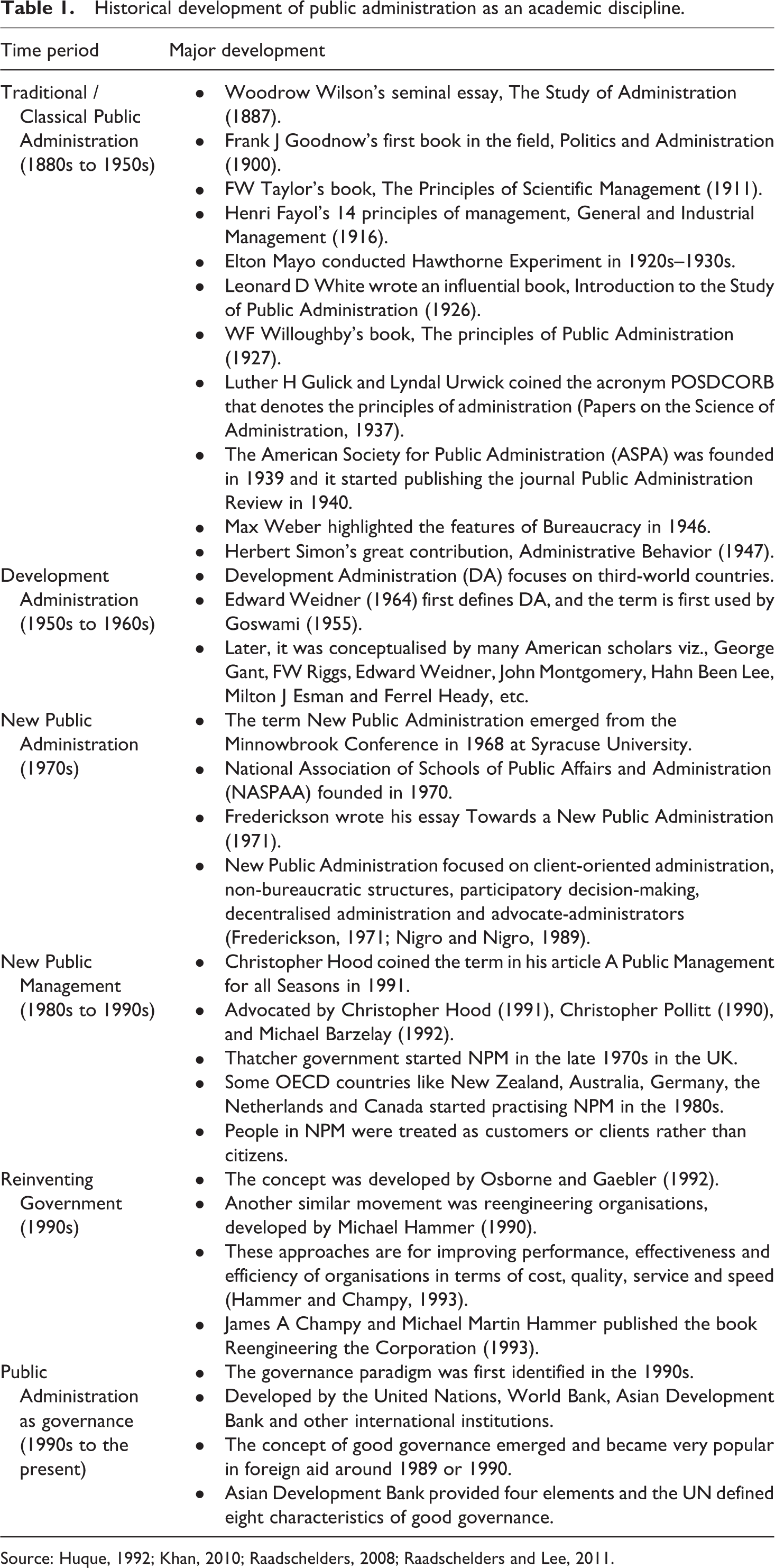
The term administration was considered the sole property of political science until the 1890s, when some influential scholarly works (e.g. Goodnow, 1900; Wilson, 1887) emphasised the importance of a separate and unique discipline in the field of public administration. As a result, the demand was created to establish an independent academic discipline that would include a distinct theory, special kind of knowledge, practical skills and methods (Vigoda, 2003). As we see from Table 1, public administration has been influenced by scholars and experts from the private sector since the very early stages of inception, and has introduced different conceptualisations, principles and strategies from general management or private management. The domination of the private sector reached its peak during the 1980s and 1990s when the idea of new public management (NPM) was introduced, which intensified the self-identity problem of public administration (Vigoda, 2003). However, attempts have been taken since the 1990s to reinstate the original concept in the name of reinventing government whereby public administration is considered as governance. This paradigm indeed is dominated by donor agencies and international institutes like the United Nations, World Bank, Asian Development Bank, etc. In line with this historical development of public administration as an academic discipline, the curriculum of HEIs all over the world has been modified over time. Such competing paradigms have a significant influence on the selection of curriculum for public administration education. However, the curriculum should be based on a contextual basis with global relevance instead of being bogged down in the ‘paradigm war’ promoted mostly by Western scholars (Wu and He, 2009).
Public administration education: Literature review
Public administration is closely linked to general management as they have shared features that study complex organisations and bureaucracies (Vigoda, 2003). This is one of the reasons why public organisations borrow private sector concepts and practices with or without modifications (Ahmad and Hossain, 2015; Hossain, 2018). Similarly, public administration education depends on the theories and conceptual knowledge that is developed from the experiments conducted in the private management environment by scholars who have worked in private factories or industries. Several well-known theories, experiments and research findings, such as motivation theories, Hawthorne studies, Harvard Business School studies, etc., are conducted in the context of factory or private management (Liebman, 1963). Moreover, many scholars who have made a significant contribution to the scholarly literature and theories related to management are from private sectors. F.W. Taylor, Henry Fayol, and Lindel Urwick are among the most influential management theorists who are considered the founders of modern public administration and management.
However, private sectors are quite different from public organisations in terms of management styles and objectives of profit maximisation, although some scholars argue that all management, in both public and private sector organisations, faces similar problems and challenges that require the same strategies to overcome them (Peters, 1996). Public organisations and governance deal with more complicated situations where the nature of problems and challenges concerning, for example, honesty, integrity, transparency, accountability and corruption are entirely different (Hossain, 2018). As the environment in the public sector is quite different, the university curriculum would not be useful for public administration education if it follows the private sector studies (Liebman, 1963).
The curriculum of public administration has shifted from social science to management, resulting in a very close alignment with business management (Greenwood and Eggins, 1995). Such changes have led to some inevitable and adverse consequences in public administration education. In order to solve the complex problems in public administration, several remedies and strategies were suggested, with different terminologies and conceptions. When some side effects of NPM became visible, post-NPM models emerged with several counteractive prescriptions that included whole-of-government, joined-up government, quality of government, networks, partnerships, etc. (Christensen and Lægreid, 2012). Such a diverse conceptualisation and theorisation of public governance creates even more confusion in the study of public administration. This is the result of emphasising public administration as governance since the 1990s, with scholars being influenced by the ideas and policy prescriptions from international agencies.
Moreover, governance is a political theory that describes state–society relations (Peters and Pierre, 1998). Thus, as soon as the study of public administration turns towards a governance orientation, it loses once again its uniqueness and independence from its mother discipline, political science. However, some fundamental work in the field of institutionalism and organisation theories has also been done that enriches the public administration discipline on its own. Rutgers (2010), Vigoda (2003), March and Olsen (1984, 1989, 1998) and Olsen (1998, 2010) are the cases in point.
As evident from a different theoretical perspective, public administration deals with several human constructs (e.g. people as citizens, clients, customers, etc.). It becomes necessary with a multi-disciplinary approach to explain complex situations better to manage public sectors more effectively. Therefore, public administration education requires a multi-disciplinary approach consisting of three main disciplines: political, social and managerial (Azizuddin, 2018; Vigoda, 2003). However, it should be noted that the aspiration for independent public administration education is not contradictory with the interdependence in social science among different disciplines. The demand was indeed for an independent position as a unique field of study while interdependency among different disciplines in social science offers the advantage of mutual contributions. Nevertheless, the identity crisis of public administration as a separate department has not been overcome, and it is still in a transitional phase. As Vigoda (2003) observes, many universities have independent public administration units, but in an equal number of universities it is placed under larger units like Political Science, Business and Management, Public Affairs schools, etc. At present, around two decades after Vigoda’s observation, the situation of public administration seems to have improved in regard to the number of independent units in universities, while little remarkable advancement has been noticed in developing theories and practical knowledge of its own.
Scholars are divided into two groups: those who believe that public administration education should emphasise more scientific rigour and research methods; and those who favour a better understanding of government, public services and the interdisciplinary nature of public administration (Raadschelders, 2008). This scholarly debate about science versus profession started in the 1960s and is well known as the Simon-Waldo contradiction in the study of public administration. Public administration scholarship has been influenced by many traditions and cultures (Lynch, 1989; Mäkinen, 2013) at national, regional and global levels. University-level curricula focus on teaching theory, while research concerns both theoretical and applied challenges. In order to construct a comprehensive intellectual framework, the curricula for public administration education must integrate knowledge from both theory and research. Considering the heterodoxy and interdisciplinary nature, Raadschelders (2008) organises the scholarship into four main intellectual traditions: practical wisdom, practical experience, scientific knowledge and relativist perspectives. He terms these four perspectives the ‘Wissenschaft’ approach, which demands that scholars and practitioners work together. The contributions from practitioners are equally important to enrich public administration education (Godwin and Meek, 2016). Unfortunately, the number of practitioner authors in the field of public administration is sharply declining, according to Raadschelders and Lee (2011), who observed the topical coverage in the journal Public Administration Review during 2000–2009.
Another area of debate, known as the Hutchins and Mosher contradiction, is to what extent a university curriculum can prepare or educate students to be future civil servants (Liebman, 1963). Robert Hutchins argued that college or curriculum cannot prepare men for public life. Public life is concerned with immediate concrete situations that are impossible to learn through education. It is only possible through experiencing or dealing with those situations. On the other hand, William Mosher argues that having an academic background in administration can make substantial contributions to administrative functions through bringing innovation in doing things. Even public administration education can equip an administrator in the same way as physicians and engineers are equipped for practice in their professional life (Liebman, 1963; Waldo, 1953). Reviewing several relevant articles, Fenwick (2018) summarises that higher education in public administration is yet to meet the needs of practitioners, although academics consider themselves capable of providing what practitioners want.
The main focus of public administration education is to examine the executive branch of a state in order to understand its functions, strategies and challenges. Students of public administration should be able to suggest the best way of performing administrative works that can produce better services for citizens. The scope of public administration is wide (Lorch, 1978) and may include a better understanding of government, to educate and prepare good citizens or administrators (Huque, 1992). It is commonly believed that on-the-job training is the best way to educate civil servants about public administration (Dean, 1962; Leathes, 1923). Many civil servants come from a variety of academic disciplines and may get very little or no orientation about public administration. As a result, all countries have specific arrangements to train public employees, such as on-the-job training. Similarly, the phenomenon gets enormous scholarly attention; for instance, Fenwick (2018) lists some articles focusing on civil service training in different countries and regions.
The knowledge gained from experience and training is with the aim to master some skills required in the practical field of work. On the other hand, university education aims at discussing relations between history and administrative practices. It focuses on the social, political and cultural environment to enrich and contextualise the knowledge on public administration (Liebman, 1963). Public administration education is worthy of particular study because civil service management is in many ways more difficult than management in industry or commerce. Multiple arrangements can be made to offer such education, for example, education before joining the civil service, on-the job-training, and learning through doing. Another effective way can be to send young administrative officials to HEIs or university to learn public administration from an academic perspective (Dean, 1962). In the field of public policymaking, it is vital to have an academic–practitioner link where both can learn from each other (Cairney, 2015). Referring to the MPA and DPA programmes in the USA, Godwin and Meek (2016) use the term scholarly practitioner to highlight the integration of research, theory and practice.
Public administration is integrated into a complex network of national and international political institutions, several agencies, interest groups and clients. For effective functioning in such complexity, Christensen and Lægreid (2004) emphasise a research tradition for public administration. Norway has conducted several empirical works to study the functioning, change and reforms of public administration. Similarly, many other developed countries rely on research to identify the problems in public administration and accordingly set their strategies. While administration in developed countries initiates necessary reforms (e.g. NPM) depending on extensive research findings, most of the developing world tries to follow the reform initiatives without evaluating the consequences for their own countries (Schick, 1998). The research tradition provides dual benefits. The research findings drive the administrative reforms, and at the same time academics, who are involved in the research, can use those resources and experiences as the study materials for classroom teaching, and as the source of curriculum modifications.
One of the central aims of education is imparting critical thinking where one can learn how to ask for reasons, how to articulate them and how to assess them rationally (Bøyum, 2006). Such critical thinking is based on the notion that ‘nothing is taken for granted’ that challenges existing traditional system or authority. The components of critical thinking must be present in the academic curriculum that promotes analytical ability among students. Evaluating curriculum in Canadian public administration schools, Borins (1990) found that undergraduate-level courses are more general while graduate courses incorporate analytical components. He also observed substantial diversity in the curriculum among the different schools since no accreditation body would enforce curricular homogeneity. He emphasises situational contexts and also suggests some measures for the improvement of the curriculum in the study of public management. Public administration education can be useful and innovative through using more cases and simulations, emphasising managerial skills, adopting advanced technology, using action learning projects and inviting senior bureaucrats or politicians as instructors.
Corruption is a widespread phenomenon, especially in developing countries like Bangladesh. Public officials tend to misuse their authority for personal benefits. This fact demands ethics in education with an inherent expectation that it will affect the ethical behaviour of students. Fenwick (2018) argues that ethics in public administration and the work of public servants are essential dimensions of scholarly works that remind us of values and morality in public service. Technical know-how can be developed over time by doing things in practice, but the right way of doing a job requires ethical education, awareness and motivation. Every organisation is concerned with growing technical expertise among its employees, ignoring the normative dimension of knowledge. Thus, an efficient employee becomes an expert in corruption as well (Hossain, 2018). However, the question is whether education can bring many changes to the cognisance of learners that they will apply the acquired knowledge in their professional life. As Brudney and Martinez (2010) argue, ethics is a very personal and private concept that depends on one’s conscience, and therefore it is difficult to claim that ethical education in public administration would affect the behaviour of students who complete it. A more difficult question is how to impart ethical education. Is it through superior teaching methods, approaches, modifying curriculum, or following any other measures? Menzel (1997) argues that teaching ethics and values in public administration is valuable in schools of public affairs and administration. However, instruction methods must improve to have the desired impact on students.
The literature discussed above mentions the various aspects, problems and challenges of public administration education, its curriculum and pedagogical issues. Although much of the literature on education and teaching of public administration concerns the middle of the 20th century, it is relevant and insightful for the current situation as several problems are still present today. For a successful review process on public administration education in Bangladesh, some indicators can be derived from the literature. The indicators include blending of theory and practice, the interdisciplinary nature of public administration, exchange of academics and practitioners, accreditation and homogeneity of curriculum, research-based knowledge generation and dissemination, environment and contextualisation, the ethical dimension of knowledge for administrators, and the use of real-life cases and modern technology in teaching.
Public administration education in Bangladesh
Public administration in Bangladesh is a legacy of the past. It has travelled down from ancient Bengal through British India to United Pakistan (Zafarullah, 1998). During the 1950s to 1960s, public administration all over the world was suffering from a crisis of identity, and it was considered as a subfield or wing of political science (Khan, 2010). Similarly, in the then East Pakistan (present Bangladesh), there was no separate academic department for public administration during British rule, and it was included under the mother discipline, political science. Later, in the Pakistan era, a minor development was made in West Pakistan (current Pakistan) through establishing a Department of Administrative Science at Punjab University in the early 1960s.
In contrast, in East Pakistan, a few related courses were offered in different public universities under the Department of Political Science. In 1968, Dhaka University (DU) took the first initiative, introducing a one-year master’s degree programme in Public Administration, but the degree was offered by the Department of Political Science (Khan, 2001). Just after the independence of Bangladesh, the full-fledged Department of Public Administration was established in 1972 at the DU, and was followed by many other public universities (Khan, 2010).
Currently, there are 45 public, 103 private and three international universities in Bangladesh (University Grants Commission, 2019). Around one-third of the public universities have a Department of Public Administration. Private universities usually do not have a full-fledged degree programme in public administration, but a few private universities offer different related courses of public administration. However, Stamford University, Bangladesh has recently started both undergraduate (BPA) and graduate programmes (MPA) in public administration, North South University offers an MA in Public Policy and Governance (MPPG) and BRAC University has an MA in Governance and Development (MAGD). The current paper has taken two public universities and one private as the areas of study where the main focus is the evaluation of the curriculum and pedagogy of the public administration departments. Among the public universities, we select the oldest, University of Dhaka (DU website 2019), and another comparatively newer, (Shahjalal University of Science and Technology (SUST website 2019), whereas the first private university, North South University (NSU), is taken as an exemplary case for its success in educating civil servants. A brief description of the three universities and the Department of Public Administration is given in Annex 1.
Curriculum and pedagogy: The case of public universities
One of the major objectives of this study is to assess the existing curriculum of the departments of public administration in public universities in Bangladesh with particular reference to DU and SUST. As the public universities are autonomous in conducting their academic programmes, they have full freedom in designing and modifying courses and curriculum (Khan, 2001). Reviewing and updating the curriculum entirely depends on the capacity and willingness of concerned faculty members. However, teachers of the departments are found to be persistently reluctant in updating the curriculum to make it relevant to the present time and needs. Public administration scholars (e.g. Huque, 1992; Khan, 2010, 2001) are critical of the outdated curriculum and traditional methods of teaching in public administration departments in the universities of Bangladesh.
Assessment of curriculum
Public administration curricula of the public universities, at the initial stage, were more oriented to political science with some focuses on organisational management and local government. Later, the core areas of public administration, along with some multidisciplinary courses, were incorporated (Khan, 2010). The current study extensively reviews the curriculum of public administration in both public universities (DU and SUST). We find that, except for a few changes in course titles, both universities are offering the same courses and curriculum, where the core courses of public administration are integrated with some related subject areas such as political science, sociology, economics, management, etc. The curriculum is found to be interdisciplinary, and it also includes both theoretical discussion and practical applications. The courses at the undergraduate level of study focus on basic and introductory issues of the subject area. The graduate-level courses do not provide enough emphasis on more profound knowledge with analytical components. It seems to be the case that the courses at the graduate level are an extension of the courses offered at the undergraduate level. Similar contents are covered in the master’s level of studies as in the bachelor’s level, with only some more detailed discussions of the topics (Miller, 2019). The noticeable difference is that undergraduate courses are interdisciplinary, whereas graduate courses focus mostly on core issues of public administration.
Research in public administration is also very sparse and fails to create an indigenous knowledge base for the discipline. Moreover, research areas are also limited to some extraneous topics, while no significant research is conducted on core issues of public administration (Khan, 2010). The universities in Bangladesh, therefore, demonstrate little originality in developing courses and curriculum on public administration. Most syllabi are a ‘copy-paste’ from the older institutions without caring to update or modify according to the needs of the times. The context of the country is not used to illustrate theories or concepts encountered in the lectures (Huque, 1992). Sometimes, a few initiatives have been taken to update the curriculum but there is little success in many cases. Consequently, the syllabi have become outdated, and the students are losing interest in the subject due to its lack of job opportunities.
The syllabus of public administration in both universities indicates some limitations. First, the course contents are not updated regularly; instead, the number of courses is only increased over time. For example, in DU 20 courses were offered earlier at the four-year bachelor (BSS) level (Khan, 2001) and four courses at the one-year master’s (MSS) level. In contrast, currently, it offers 30 courses at BSS and seven courses at MSS level (see Annexes 2 and 4). The duration of degrees remains the same, but the number of courses has rapidly increased. This may hamper the ability to gain a deeper understanding of any particular subject for students, and, at the same time, teachers would struggle to impart the knowledge with detailed discussion and relevant examples. Moreover, in the short period in a semester, both the students and teachers would engage themselves in exams and results rather than exploring the new knowledge and insights.
Second, the curricula are not well organised in a standard format with objectives, contents and learning outcomes. Only a brief description of the contents and reading list is included. Therefore, teachers are not getting specific guidelines from the curriculum regarding the teaching contents with clear objectives. As a result, the same course may be taught by different faculty members in different ways and students would not have the right kind of understanding of any course. Accreditation system of the curriculum is absent in Bangladesh, and therefore there is no homogeneity of courses and curriculum in different universities in the country. Graduates of different universities from the same departments are getting entirely dissimilar knowledge and exposure. Therefore, they are also treated differently in the job market, although having the same degree and results from different universities.
Third, courses related to administrative ethics and moral values are absent. Only one course on administrative law and ethics is available at DU, whereas no course on this issue is found in SUST. One of the primary purposes of higher education is to acquire mental muscles (Dean, 1962), whereby students should be oriented with moral values to develop ethical standards so that they can make the right decisions in their personal and professional life. At present, the major problem of public administration is the corrupt behaviour of government officials which may be reduced through imparting ethical knowledge among the graduates who are the future civil servants of the country.
Fourth, there is a lack of comprehensive research works by the universities to develop an evidence-based education system for the classroom. Many developed countries such as Norway have conducted several studies on functioning, change and reforms of public administration (Christensen and Lægreid, 2004) and developed teaching and reading materials. Case studies developed through research works are one of the most effective methods of teaching for better understanding of any particular problems in a specific situational context. The problems of public administration in Bangladesh may not necessarily be similar to those in any Western developed countries. Therefore, the existing theories which were originated in different contexts may not be equally applicable to Bangladesh. Contextualisation of knowledge is necessary for not only a better understanding of any concepts but its practical application as well. Al-Buraey (2013: 297) argues that ‘No model can be sound and effective unless it is grounded in the culture and ideology of the people which it is constructed to serve’. A traditional education system usually teaches the beliefs and values of some authority that reflects the traditions of a society. Students are not encouraged to question the authorities and existing practices that may call for reforms. In a traditional society, questioning and criticisms are considered disobedience and treachery (Bøyum, 2006). Therefore, cases of administrative problems in our country should be developed through conducting research and later those should be discussed in classroom lectures for graduating students of public administration.
Finally, the curriculum puts more focus on theoretical discussion, having a large number of theory-based courses at both undergraduate and graduate level. Practical examples and orientation are absent where teachers are busy making students understand the concepts and aspects of theories, and students are trying to memorise those for exams. As a result, students cannot make a connection between theory and practice and fail to understand the applicability of those theories in our country context. Public administration practitioners, i.e. senior civil servants, can make significant contributions in this regard. However, unfortunately, in Bangladesh, civil servants are not found active in writing articles or any other literature based on their practical experience.
Assessment of teaching methods
Teaching methods in the departments of public administration mostly include the traditional way of delivering lectures, assignments, term papers and presentations. Teachers are now using PowerPoint slides in delivering lectures. Earlier, there was a system of tutorial classes which was abolished after the introduction of the semester system. There is also viva voce and a comprehensive examination system. The questions pattern for final exams is also traditional, where students can assume what could be the possible questions in the exam. The traditional exam, questions and marking system where exams hold 70% marks is not suitable for encouraging students to internalise the subject matter of a course. Students usually memorise some answers to prospective questions for exams and forget everything after attending the exams. Creative and analytical questions can solve these problems and enhance the understanding capacities of students.
It is also found that teachers at public universities are well qualified in terms of academic results. However, many of them are not very serious about further study and research works for personal development. They are not willing to work hard in maintaining and improving the quality of education and conducting research. There could be justifiable reasons for that including low pay scale, lack of facilities and motivation. Being frustrated, qualified teachers have left the department for better job opportunities outside the country. Many teachers, mostly seniors, are engaged themselves in full-time consultancy and also remain busy with taking classes at private universities for higher pay. Juniors spend a significant amount of time (4–5 years) abroad for their higher studies. As a result, students are deprived of guidelines and academic support from their teachers as and when necessary. However, some faculty members are dedicated and committed to the department. They always try to be innovative and adopt a dynamic way of presenting lectures and make creative questions for students’ assessment.
Another aspect of teaching is that one specific faculty member delivers all the lectures. Exchange of knowledge and experience between academics and practitioners is required to solve critical organisational, managerial and policy problems in the area of public administration and research. However, such initiatives are a rare case in public universities of Bangladesh in general. There is no formal requirement to invite practitioners as guest lecturers. Some of the faculty members, however, from their initiative do invite senior civil servants and civil society leaders to share their knowledge and experience with students. Field visits, research activities and other exposure-related activities are usually not organised for students at the Department of Public Administration in both DU and SUST. Only a research monograph at DU and a term paper at SUST are incorporated into the curriculum at the undergraduate level for small-scale research works by the students. Internship in any government office would be an effective method for giving exposure and practical experience for students about public administration in the country.
MPPG at NSU: An example of success story for learning
The scenario in private universities is quite different and, in some cases, better than the public universities. Top private universities are in a competition that emphasises the curriculum and teaching staff to be innovative with a high standard. Faculty members at NSU are well qualified with higher degrees, MAs and PhDs, from abroad, especially from North American or European universities. NSU also follows the American academic and grading systems. The Master in Public Policy and Governance (MPPG) programme of NSU is our area of interest to highlight here. The distinct features of the MPPG programme in terms of curriculum, pedagogy and other academic features are presented here as good examples for public universities in the field of public administration, public policy and governance. Some of the strengths and particular aspects of MPPG are worthy of discussing here.
Regional and international nature
The MPPG is both a regional as well as an international programme in terms of its curriculum, students and faculty members. It has collaboration with a leading European university, the University of Bergen in Norway, and with two other South Asian universities, University of Peradeniya, Sri Lanka and Tribhuvan University, Nepal. Each year very few students (currently 12) are admitted from Bangladesh, Nepal and Sri Lanka. Most of the students are from the civil service while half of them are officials of NGOs and embassies, researchers, or academics. Recently, since 2017, a new window has opened for the MPPG programme under the NORPART project of the Norwegian government whereby all students of MPPG get an opportunity to study one semester in Norway. At the same time, two Norwegian students can join MPPG for one semester to be completed at NSU, Bangladesh. The students’ mobility enhances the internationalisation of the MPPG programme, with students from South Asia learning about the social and administrative policies and governance challenges of Norway, Scandinavia and the West, and Norwegian students learning about the social, political and economic policies, issues and challenges of governance in the South Asia. Apart from the student exchange, academics and scholars from Norway, Sri Lanka and Nepal also regularly visit MPPG as guest faculty members, share their knowledge and conduct joint research.
Centre of excellence in South Asia
The MPPG programme is a part of the South Asian Institute of Policy and Governance (SIPG) at NSU that strives to be a centre of excellence with a vision to become a leading academic institution and a think tank on policy and governance studies in South Asia. Faculty members of all four partner countries are engaged in conducting joint research and publications. The institute has conducted nationwide and cross-country surveys in Bangladesh, Nepal and Sri Lanka, for example the Citizens Trust Survey 2009 and 2015 and the Citizens Charter Survey 2010, while the third phase of Citizens Trust Survey 2019–2020 is going on now. Some other remarkable survey initiatives where SIPG is in a joint venture with other countries are the State of Democracy in South Asia (SDSA II) 2014 and SDSA III 2019 with Lokniti-CSDS, India; Citizen Attitudes Toward Climate Finance for Reducing Vulnerability in Bangladesh 2019 with American University in Washington; and Sustainable Maritime Resource Management in Bangladesh: Exploring the Areas of Cooperation between China and Bangladesh 2019 with China. The data and findings are considered a source of new knowledge with an empirical focus that are used as course materials, and MPPG students also get access to the database for their research works. SIPG organises international conferences, seminars and workshops where several national and international scholars and practitioners take part. Thus, the SIPG is emerging as a centre of excellence in policy and governance for the South Asia region.
Standard curriculum
The course curriculum of MPPG has been developed following the model of the MPhil in Public Administration (MPA) programme at the University of Bergen, Norway. The MPPG curriculum is also updated regularly following international universities. The course and curriculum are developed in a standard format with course objectives, contents and learning outcomes along with reading lists for each course. Each course has a compendium of at least 600 pages to be used as reading materials. The programme aims to cater to knowledge in the broader field of policy, governance and public administration. It also initiates research, publications, policy briefs, training and research programmes to generate knowledge to strengthen and broaden the intellectual capacity of Bangladesh and regional countries at the policy stage (NSU website 2019). The courses of MPPG are mixed of both theoretical discussions as well as practical and research components. Emphasis is given on core areas of public administration, public policy and governance with empirical research in the field.
Research focus
MPPG is a 36-credits master’s programme where 12 credits (one-third) are reserved for research works or thesis. MPPG comprises four semesters, and the research activities start from the third semester while the final semester is dedicated to the thesis. Students have to conduct field works (survey or interviews) for their thesis writing. They need to present their theses in different stages from proposal to final thesis in the presence of faculty members from all partner countries. Such a rigorous process helps them build confidence, enhance research and analytical skills, and develop quality for presentation in public. Students are also encouraged to choose their research topics considering their professional background so that they can relate and implement the findings of their research in the office they work. Some bright examples are also found, where MPPG alumni applied their learning from MPPG in their workplaces.
Special kind of pedagogy
MPPG does not follow the traditional way of teaching through lectures in the classroom only. It has a distinct pedagogical system that includes class lectures, presentations by students, term paper, home assignments, field visits and seminar workshops. Creative questions in the exam, more emphasis on home exams and presentations are among the essential features of MPPG. There are two remarkable practices in MPPG. First, it invites practitioners from higher-level bureaucrats (e.g. government secretaries), civil society leaders, ambassadors, higher officials of bi-lateral and multi-lateral agencies and academics from public universities as guest speakers. Second, it organises different academic events, for example, workshops, seminars, policy dialogues, policy colloquiums. Both government and non-government senior officials, civil society members and academics take part in debates and discussion on various policy and governance issues. MPPG students are the active participants of these lectures and events where they get the opportunity to exchange their views and learn from the real-life experiences of such practitioners.
Discussion and conclusion
The paper has examined qualitatively the plight of public administration as an academic discipline with an attempt to address two of our research questions. The first research question is: ‘what is the current status of public administration education as an independent discipline?’ We observe that many universities in Bangladesh now have a separate Department of Public Administration under the faculty of social science. It has a distinct identity in academia, but in the job market it is yet to create its position with a specialty in organisational knowledge and services. Graduates in public administration do not get any preference in the civil service or government administrative system. Our second research question is about the contextualisation of knowledge for current and future civil servants of Bangladesh. The assessment of curriculum and pedagogy reveals that public administration education fails to realise the contextual reality of the country due to the lack of an evidence-based curriculum and absence of knowledge exchange between scholars and practitioners.
The findings of this study have implications for students, academics, policymakers and professionals of public administration and governments to reconsider the development of public administration education with an updated curriculum and effective pedagogy in all public universities that can contribute to the development of a modern public administration in the country (Bhuiyan, 2012). The curriculum and pedagogy of both DU and SUST are suffering from many problems and limitations. The condition in other public universities in the country is not exceptional. Overall, the paper demonstrates that public universities in Bangladesh neglect public administration education and, therefore, it remains underdeveloped and unable to contribute to the development of the administrative system in the country.
There are some positive aspects of the public administration education in public universities that can be considered as potential strengths and opportunities. Public universities have a better image, with well-qualified teachers, more meritorious students and a pool of bureaucrats who are the alumni of the public administration department. Such advantageous positions can contribute to the development of public administration education in all public universities of the country. The MPPG program of NSU is a case in point for the development of curriculum and teaching methods in public administration education.
Public universities are unable to produce competent graduates of the expected standard who can contribute to the administrative process as well as assist the government in policy issues through providing advice and consultation (Huque, 1992). The government of Bangladesh, therefore, is yet to receive any substantial benefits from the study of public administration imparted by the universities. The country needs the services of well-qualified graduates in the field of public administration to overcome the existing problems in the administrative system. However, the curriculum, the methods of teaching of public administration programmes in universities and the relationship among academics and practitioners in the field fall short of the expectations and demands of the country.
One of the main goals for higher education is exploring new knowledge to unlock potential by creating a pool of highly trained and skilled individuals to contribute to national development (Monem and Muhammad, 2010). A comprehensive review of the public administration education system in the public universities of Bangladesh is now very much needed to restructure the courses, pedagogy and methods of assessment to produce graduates with the necessary skills and qualifications who can contribute to the development of the country. Academics and practitioners should work together, sharing knowledge and experience. Doors should open for cross-learning, where the government invites academics for some advisory and consultation works, and at the same time the university invites senior bureaucrats to the classroom lectures. It will give substantial benefits for both government and university. The government can get scholarly inputs from academics, and university teachers can share their experiences with students in the classroom. Students will benefit from lively sessions for deeper insights into public administration and its issues in the eyes of expert people.
Contributions from senior and experienced civil servants are indeed a rare phenomenon in the field of public administration education. In Bangladesh, civil servants as a whole are reluctant to engage in scholarly writing, maybe because of complexity in obtaining approval from the higher authority for publication and dissemination. Both in the academic and professional arena of public administration, critical thinking is restricted due to the lack of academic freedom and intervention from the political government. Therefore, bureaucrats, academics and students have generally confined themselves to highlighting the positive dimension of administrations and governance in Bangladesh. Hence, self-censorship adversely affects the development of public administration from both an academic and professional perspective. Public administration education is struggling globally to create its own identity as a distinct discipline with adequate resources. At the same time, the scenario in Bangladesh is even worse due to several limitations and challenges. Future studies can include a larger sample size by following a systematic sampling process to produce results for further improvements in public administration education in developing countries.
Supplemental material
supplementary - Reflections on public administration education with a case of Bangladesh
supplementary for Reflections on public administration education with a case of Bangladesh by Muhammad Azizuddin and Akram Hossain in Teaching Public Administration
Footnotes
Author contribution
Both authors contributed equally.
Acknowledgement
The first author would like to acknowledge the initial guidance for this paper from his doctoral supervisor and mentor late Professor Juha Vartola of the University of Tampere, Finland.
Declaration of conflicting interests
The author(s) declared no potential conflicts of interest with respect to the research, authorship, and/or publication of this article.
Funding
The author(s) received no financial support for the research, authorship, and/or publication of this article.

Supplemental material
Supplemental material for this article is available online.
References
Supplementary Material
Please find the following supplemental material available below.
For Open Access articles published under a Creative Commons License, all supplemental material carries the same license as the article it is associated with.
For non-Open Access articles published, all supplemental material carries a non-exclusive license, and permission requests for re-use of supplemental material or any part of supplemental material shall be sent directly to the copyright owner as specified in the copyright notice associated with the article.
