




Abstract
Programmes teaching public policy and administration (PPA) increasingly include dedicated modules or courses on interest groups (aka public affairs, aka government affairs aka lobbying). Despite its journalistic familiarity, the topic of lobbying includes concepts that may appear particularly abstract to students. Given the shift towards problem-based learning (PBL) approaches in PPA programmes, courses could benefit from such activities on this specific topic. Complementing other pedagogical methods, we developed a PBL activity that allows students to practically apply their newly gained knowledge on the subject through a simulation game. We found that the game was popular amongst students and helpful as a learning tool. Students left the activity feeling they can better contextualize theory and concepts. Aiming to broaden the use of such pedagogical tools in teaching government affairs, this paper provides an outline behind the games' context, its main steps, some reflections on its effectiveness, and a case example with relevant links in the annex to implement and/or adapt to different settings.
Introduction
Programmes teaching public policy and administration whether at the bachelor’s or master’s level increasingly tend to include dedicated modules examining interest groups’ role in PPA. Depending on the department(s) responsible for the programme, other similar terms might be used instead of “interest group” such as lobbying, government affairs, organized interests, or public affairs. Regardless of the specific term, the courses’ common thread is their focus on the link between organizations representing policy stakeholders and PPA.
There are two key reasons educational programmes have come to include lobbying in their teaching agenda. To begin with, such organizations have had a growing role to play in policymaking since the early 1970s (for example see Vogel, 1978a). Over time interest group density, diversity, and mobilization has exploded (Baumgartner et al., 2009; Coen 1997; Coen et al., 2021a; Grant 2003). Interest groups aim to gain access and engage with the public administration and policymakers to influence policy. Conversely, the administration and policymakers demand resources from interest groups to improve the quality of policy, raise procedural representativeness, and ensure effective implementation. Partially as a result of this, the last two decades there has been an explosion in the academic literature examining government affairs across academic fields, including work in PPA (e.g Bozhikin et al., 2019; Bunea and Baumgartner 2014; Dahlgren 2021; Lawton et al., 2013; Walker 2009). Scholars study interest groups, their evolving strategies, and their role in policymaking.
Despite interest groups inclusion across PPA programmes and numerous dedicated courses aiming to teach students about lobbying, they face two overarching challenges. On the one hand, these courses address a topic with concepts that may appear particularly abstract. Whereas lobbying is often well-known to students through news articles in popular media that addressing tantalizingly simplistic cause-and-effect cases. The theories modelling interest group activity for example resource-exchange, discussions on information demands across the policy cycle, interest intermediation and its impact; may be harder to grasp. On the other hand, given PPA’s shift towards problem based learning (PBL) as a tool that can improve student learning (Goodman 2008; Lucas and Goodman 2015; Munoz-del-Campo 2023). Learning programmes addressing interest groups could benefit from integrating PBL activities in their curricula.
To complement teaching methods on organised interests we developed a simulation game that aims to implement students newly gained knowledge on interest groups and public policy. We found that the game was popular amongst students and helpful as a learning tool. Students left the simulation game feeling they can better contextualize theory and concepts. Aiming to broaden the use of such teaching tools in courses addressing interest groups, this paper provides an outline behind the games’ context, its key premise, its main steps, and some reflections on its effectiveness. Whereas this particular simulation game is focused on the EU context we argue that it can be adapted to fit different political contexts across western polities as well as the global south (Barber et al., 2007; Hosman and Jacobs 2018). We begin with a brief discussion regarding the link between interest groups and public policy and administration before providing the game’s outline. In the final section we offer some constructive reflections on the activity’s benefits and limitations, and offer an annex with relevant links to documents and lobbying registries that can be used to implement the activity in a different context. In the paper we use the terms interest group, organized interest, lobbying, government-affairs interchangeably.
Interest groups, pedagogy, and PBL
Lobbying is a term that has been growing since the mid-1970s in the US where business set up its first permanent offices with specialized staff to represent and engage with government. These offices became known for engaging in “government affairs” or “public affairs” (Vogel 1978a; 1978b). Since then, government affairs have become a norm as the interest group population grew dramatically over time across the globe and in particular the last two decades. In part, this has been a result of new-institutionalism and new public management approaches that welcome interest groups into policymaking as a means to improve institutional legitimacy and policymaking effectiveness (Dryzek 2001; Dunleavy and Hood 1994; March and Olsen 1983).
Policymakers are resource constrained actors faced with increasingly complex mandates. Interest groups operating within their own specialized areas can better inform the public administration and policymakers. This is likely to improve regulatory effectiveness, but also improve the procedures’ inclusiveness, their democratic legitimacy, and their implementation (Carpenter and Krause 2015; Schmidt 2013; Coen and Katsaitis 2022, 2024; Dunlop and Radaelli, 2024; Katsaitis, 2014). As such, interest groups have come to play a core role in contemporary policymaking. Students of PPA might join an interest group as a future career choice and/or might engage with one as an individual working for the public administration, an elected official, or other similar organisation.
As such, “interest groups” or associated terms/ themes (e.g. “lobbying”, “government affairs”, “public affairs”) have become a normal part of the PPA curriculum; as well as curricula in programmes in adjacent departments in the social sciences and business & management studies. Nevertheless, understanding the literature’s why, when, and how can be difficult for students: especially in a real world setting. There are a few reasons behind this.
Lobbying as a concept can be intuitively understood because it contains a clear and practical objective. Nevertheless, it is quite a complex research object impacted by different variables across different settings. Beyond the nuances of the subject itself, the theoretical tools and concepts employed in the literature can appear particularly abstract even to students with a social science background. Lobbying activity takes place in the wider PPA context, which means students have to appreciate the interaction between various moving targets such as the policymaking process, interest groups, public opinion, and resource demands (to name a few).
Furthermore, the theoretical work and concepts aimed at explaining these interactions might be challenging. They significantly compress highly complex real-world events to produce reliable models. In addition, the literature on interest groups has exploded the last 20 years along with the field. This allows us to better understand the phenomenon yet simultaneously creates an enormous body of work within which students may feel lost. Even students that perform well in terms of understanding theoretical constructs and research, may have difficulty translating course material within a practical context.
Course and programme directors in PPA have attempted to address this issue, which is not unique to the interest group literature, through case studies and by inviting practitioners to give lectures. Drawing from practices in other fields, case studies allow students to appreciate their readings through a practical example that demonstrates how theory can be applied to understand reality. Practitioners aim to provide an insider perspective that allows students to connect their learning with real-world experiences. Beneficial as these approaches may be, they are primarily passive pedagogical tools; they do not implement what is often referred to as “problem based learning” (PBL).
PBL provides some complementary benefits to traditional passive learning techniques by asking students to solve exercises linked directly to real-world cases. In turn this requires that students think critically, while drawing and combining knowledge different parts of their programme’s curriculum (or course). Often PBL pedagogy requires students to work in collaboration with others, engage in discussion/debate, and produce solutions within the context of an applicable scenario. The scenario may be directly drawn from a real case or one that closely resembles it (Michaelsen and Sweet 2008; Parmelee and Michaelsen, 2010; Sweet and Michaelsen 2023).
PBL requires students to employ and train different cognitive capabilities. Research demonstrates that such activities “encourage students prior knowledge…facilitate the comprehension of new information related to the problem and enhance its long-term memorability” (in Schmidt et al., 2011). In addition, because PBL works around scenarios that working groups respond to; students have to develop independent thinking and focus on aspects that interest them in particular. This not only encourages students to think and further their learning on their own; it also strengthens their ability to revisit the subject and expand their knowledge base in the future (Gijbels et al., 2005; Hmelo 1998; Schmidt et al., 2019).
We have refrained from using Artificial Intelligence in developing this course for two core reasons. Significantly, as we discuss in greater detail below, the activity is meant to allow students to combine their learning experiences in setting that is as close as possible to a real policymaking case. As such, focusing on an existing real case not only permits the students to engage with a scenario that could have been part of their portfolio as a policymaker or lobbying. It also provides actual information around the topic for them to interact with and trains them in processing such data (Bijsmans and Versluis 2020). On a smaller note, while there is some encouraging evidence around the use of AI in PBL activity in STEM courses, the jury is still out in the PPA and PoliSci context. Moreover, the use of AI on course development may have adverse effects on students’ perception of the activity’s quality (see for interesting discussion, Bell et al., 2013; Catalano, 2015; Hamid et al., 2023; Koschmann et al., 2012). Furthermore, potential “hallucinations” from the AI software could adversely impact the intended real-life feel of the activtity.
Therefore, to improve students subject learning, as a complement to other teaching approaches that are part of a specific course on interest groups (in the EU policymaking context), we developed a PBL activity. Below we outline the context within which this activity takes place and how we implemented it in the classroom.
Activity context
This activity is developed as class for a course on lobbying in the European Union [“Interest Representation in the European Union”] at the master’s level. The thirty (30) hour elective course corresponds to 5 ECTS points, it is taught over a span of 8 weeks. Note that the course corresponds to ten (10) classes each lasting approximately three (3) hours. Each, class consists of a 90-min lecture and Q&A session. It is followed by a 90-min interactive seminar where students engage in group or individual exercises that are meant to provide them with a hands-on practical application of the lecture. This is meant to encourage/activate collaborative and constructive deep-learning practices through active learning activities (see Berg, 1999). These activities encourage students to develop knowledge specifically through the use of new conceptual and methodological tools that are applied in tasks/exercises in groups or individually (see Stewart 2012, 2021) 1 .
Correspondingly, the teacher’s role during seminars becomes one of a facilitator and mentor (Harden et al., 2000). That is to say, the lecture provides central concepts, methodological tools, and empirics in the field where the teacher has a clearer mentoring role. While the seminar aims to help students overcome threshold concepts through exercises (Savin-Baden 2016). In this case the teacher guides students through the process while ensuring the participants get the most out of the exercise’s objectives.
The course covers a wide literature on interest group activity in the EU, drawing from political science, public policy and administration, and business and management studies. It is designed to allow students to understand and examine central theories, conceptualizations, methodologies, and themes in lobbying in the EU. We underscore that the students attending this specific masters’ programme are motivated individuals interested in understanding how the EU functions from a theoretical and practical perspective. They are most likely seeking employment (or are employed) in Brussels in an EU government-affairs related area, some are also likely to have some experience in the field. For example, students are interested in working in government affairs, civil society organizations, or the European Commission.; and given the university’s track record they are likely to obtain such a position.
This teaching/educational approach corresponds to the course’s main teaching objectives, which blend conceptual, practical on-hand, and interpretative understanding of a wide body of work. Students by the end of the course should be able to: (i) Appreciate determinants of interest group representation. This means that students should understand and critically review central theoretical models on interest intermediation and mobilization. (ii) Familiarize themselves with interest group strategies, such as choices when lobbying across policy areas. (iii) Have a grasp of traditional and contemporary work on lobbying in the EU; this includes the use of databases and methodological tools.
During the course students go through a significant amount of literature which includes complex theories and conceptual models, training in how to use key databases in the field, and weekly exercises/presentations on each class’s theme. To achieve its objectives the course aims to activate a “deep learning” approach, by employing tasks and exercises that require students to use information to solve problems in an independent, critical, and associational fashion (Biggs, 1999).
Despite this, trying to bring together the classes different themes under a common frame can be challenging for students. Put differently, because each class conducts an intense dive within a subtheme. Adjusting the students’ focus to a macro-level that allows them to process and critically connect issues, methodologies, and themes organically can be difficult. Considering the students motivation and the course objectives to deliver theoretical and practical tools on interest group mobilization in Brussels. A popular and standardized approach that conducts a form of “review” or “conclusion” class cannot suffice.
A different approach that draws from situated learning that better contextualizes the course’s knowledge application can help address this issue (Brown et al. 1989). Specifically, an interactive exercise that is based on real-life events can encourage students to draw from the course-material and their own individual and collective experiences, as they apply them. In turn, this improves learning outcomes as it requires students to connect different knowledge-components and produce a solution relevant to the given context. Moreover, a situated approach emphasizes the role of learning through socialization, which remains a valuable element of government affairs and policymaking.
Simulating Lobbying
Taking these prerequisites into consideration, the course conducts a dedicated simulation of lobbying a legislative proposal. We aim to conduct this exercise towards the end of the course. At that point the students have engaged with a variety of concepts, theories, empirical tools, and practical perspectives on lobbying in the European Union. The simulation replicates the policymaking activity that takes place during an EU legislative proposal, focusing on the role of interest groups. Due to time limitations the simulation cannot replicate all policymaking stages and/or the lobbying that takes place across the policy cycle.
As such, the simulation focuses on a policymaking stage where lobbying becomes relatively more intense and complex (Coen and Katsaitis 2022a, 2022b; Coen et al., 2021b); requiring students to draw from a wider array of theories and tools. Because of time limits, the simulation will focus on the policymaking stage when the legislation has arrived at the European Parliament (EP). That is to say, it focuses on the committee stage of the EU’s policy process.
The students’ objective is to influence the legislative proposal in an accurate manner. To achieve this, students need to draw from material and tasks during previous classes. Students will operate individually or in pairs (depending on class numbers). They are given the roles of actors involved in EU policymaking, primarily that of different interest groups and EP policymakers. The interest groups represent active organisations mobilised in the issue-area of a specific legislative proposal i.e. students represent key: (i) business actors; (ii) civil society organizations/non-governmental organizations; (iii) trade/professional associations; (iv); think tanks, consultancies, other. A team will also represent the rapporteur and a member of their staff (the member of the European Parliament managing the legislative proposal).
Different interest groups produce mock policy reports, meet with other interest groups, and meet with the MEPs to influence policy. To situate students in a real-life feeling a few actions take place. First, to more accurately replicate resource limitations, interest groups and member of the EP have a finite number of interactions. Each interaction (or meeting) with MEPs is also time limited. Resources are divided depending on real-life interest groups’ resources e.g. business can have more meeting options than civil society. Conversely, the MEP (and their assistant) managing the legislation is not obliged to meet with every interest group, while their political orientation influences their political and policy preferences. Again, to achieve this, they need to draw from course, and extracurricular, material to appreciate their specific interest group’s policy position on the legislation, form potential alliances, and design a lobbying strategy.
During the exercise “randomized” events are employed to increase the process’ realism, for example a crisis might erupt (e.g. financial crash), a member of the EP or the interest groups may be “investigated”, mock news article are “published”. These events impact interest groups’ meetings or their ability to meet with specific members, and can have an effect on their strategies. The “winner” of the simulation is the group that most accurately reflects an interest group strategy that is likely to influence the MEPs (rather than just influence). Despite the increasingly political toolkit of EU lobbying (for example Coen and Katsaitis, 2022b), technical expertise remains the basis of successful interest group mobilization in Brussels. As such, in this specific activity we emphasize students ability to go over technical information and contextualize and frame it in a manner that is relevant to the MEP. While also considering their organization’s position and the wider context, which is also provided.
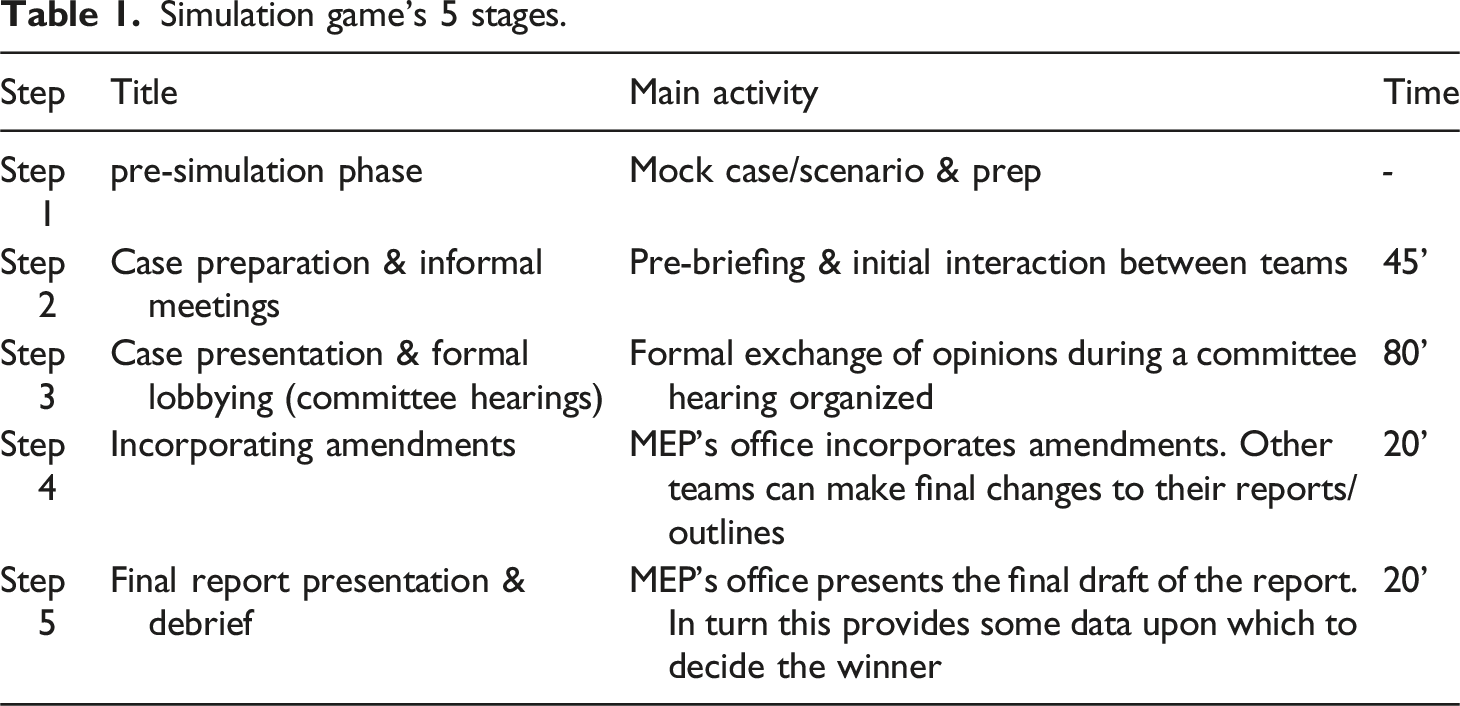
The simulation takes place across five steps (provided below), and last approximately 150’, for this simulation discussed below, 7 interest group teams and an MEP team are considered.
Simulation outline
The simulation takes place across five steps. The total simulation takes place over 150′, for this simulation discussed below, 7 interest group teams and an MEP team are considered. Depending on the number of total participants, the case’s complexity, and the time available; it is possible to extend the activity longer.
Step 1: There is a pre-simulation phase
One week before the date of the simulation students are provided with a detailed 3 page document which outlines the mock case/scenario. This document discusses the specific legislation to be used in the exercise, the scenario designed (e.g. key institutional positions), and each student’s specific role. Roles are allocated randomly. Students must study the legislative proposal, its main themes, points, and context. This includes relevant policy reports, studies conducted by their interest groups, news articles, etc. In addition, students must study the specific interest group they represent and assume the role of the actual lobbyist representing their interest group. This requires them to observe the individual’s education, experience, work, statements etc. Students must consider and design 1 page formal statements of their interest group’s position on the legislation (same applies for the MEP’s team). Overall, this is meant to help situate the students in the lobbying feeling.
Step 2: Case preparation & informal meetings [total time, 45’]
The day of the simulation the class meets at the classroom for a quick pre-briefing exercise. To improve the situational experience each interest group and MEP is provided with a dedicated office. Common meetings/discussions take place at a dedicated room at the university, used for formal events. A dedicate mock webpage is used as a “forum” space where documents for common discussion are uploaded.
Following the pre-briefing participants go to their dedicated offices and the simulation begins. The live simulation begins by giving teams 45’ to regroup in an interactive manner. During this stage teams are shaping their position and preparing for step 3, while at the same time collecting information/attempting to informally influence the MEP. Each team’s designated representative can meet to discuss with other reps. in an attempt to influence each other, and most critically attempt to meet with the MEP’s office. i.e. Interest groups can request meetings with the MEP’s office by contacting the assistants; and vice versa the MEP’s office can make use of this time to meet with interest group representatives.
This step allows for the “informal” exchange of information and potential influence. It comes with some strict rules. (i) Only team representatives can meet, not entire teams; (ii) Meetings shall take place at the side-line i.e. in private rooms. (iii) Meetings cannot last longer than 8’. Wealthy interest groups can get 2 meetings with the MEP’s office. Poorer interest groups can get 1 meeting with the MEP’s office. Wealthy interest groups have a total time of 35’ for meetings; poorer interest groups have a total time of 25’ for meetings [during this step]. At the end of Step 2 break for a 5’ recess, reflecting the EP’s winter recess.
Step 3: Case presentation & formal lobbying (committee hearings) [total time, 80’]
This step reflects a formal exchange of opinions during a committee hearing organized by the MEP (and assistants), a common event in the EP. To improve on the situational-feeling the hearing the formal-room used resembles (or is shaped to resemble) that of a committee. During this time, each team representative presents its case and outlines proposed amendments: (i) the MEP (and assistants) provide an outline i.e. the purpose of the report, the hearing, and info the MEP’s office seeks (duration max 10’). (ii). Following each team gets time to make its case and propose its vision/opinion vis-à-vis the report (duration: 7 teams X max 5’). PowerPoint presentations are allowed/welcome. Presentations are produced during Step 3; (iii) at the end of the presentations, the MEP and his/her assistants are encouraged to ask each team questions to which they respond. Each team gets max. 3’ time to respond to questions. (duration 7X3’). (iv) Hearing concludes, all participants can go to “spring recess” break.
Step 4: Incorporating amendments. [duration 20’]
During the break, the MEP’s office incorporates amendments it finds interesting/ reasonable for its final legislative report (duration (20’). (ii) At the same time, other teams can make final changes to their reports/ outlines (duration 20’). (iii) During this time interest groups and MEPs can ask for meetings with representatives for clarifications. Each meeting cannot last longer than 3’. Each group gets 1 meeting with the MEP’s office.
Step 5: Final report presentation & debrief. [duration 20’]
Simulation game’s 5 stages.
Bridging approaches
Overall, the simulation draws from three points. First, it is important that students focus on the knowledge provided by the course rather than focusing on exam outcomes. In doing so, this exercise draws from problem-based approaches that activate students to explore the course (Biggs, 1999). At the same time, it encourages a holistic approach where students can search for answers across the spectrum of classes, literature, methods, and empirical evidence available to them (Fornauf and Erickson 2020). Moreover, the simulation does so through a team-based approach that emphasizes knowledge application and exchange (Parmelee and Michaelsen 2010).
Second, the simulation increases the course’s utility by going much further than standard mnemonic exercises/tests (see e.g. Dulnosky and Rawson, 2015). It encourages students to approach the course material in a relational and targeted manner. To participate in the simulation the student needs to understand context and how the EU works, the EU policymaking process, appreciate the role of different institutions, and key actors. Third, in the wider context of polisci teaching where material tends to disaggregate policy dimensions from political variables (Mead 2013). This course activity attempts to actively bridge that gap. Moreover, it encourages less motivated students to actively participate through the gamification of learning (Brown 2020).
Drawing from the course’s anonymous evaluations we note positive responses. Students found that the simulation game allows them to better bridge different types of information and knowledge, as well as to visualize its implementation. This has made it easier for students to connect the course’s different component and appreciate its theoretical and methodological aspects. We have not received, so far, a negative comment vis-à-vis the simulation thus far. Below are some indicative responses. Student A: “Regarding the Simulation Game, it was a unique experience to understand how lobbying is conducted at EU level and since it was only one day it was not exhausting. Overall, it was a really nice experience.” Student B: “….I really liked the simulation game…” Student C: “….Lobbying simulation was fun…” Student D: “I enjoyed the sim game a lot - I think it was the perfect amount of time and depth and maybe one of the highlights of my year in terms of coursework.”
Concerns – limitations
There are some issues with the simulation’s implementation. First, because the exercise aims to simulate an activity/process that is complex, it requires a clear discussion and directions regarding how it takes place, the aims and objectives for the participants. We provide an example of a simulation in the Annex. As such, step 1 is particularly important. Moreover, it has to focus on the aspects most relevant for interest groups in order for the students to effectively draw from the course’s material. On a small note, during step 3 of the simulation which resembles a committee hearing, it would be unlikely that all interest groups are actually invited however, to maintain participants in the exercise they must be involved. Hence all teams are invited to the hearing.
Furthermore, the fact that the students attending the course are most likely experienced in the field and highly motivated suggests that an oversimplified activity will have reduce its contextual value and their interest. Rather the simulation needs to address both the need for relational-active learning and satisfy a modest-difficulty standard to maintain students’ incentives and expectations.
In turn, this requires that the teacher spends a sufficient amount of time conducting preparatory work for the simulation (see e.g. Connell 2020; Loewenberg and Forzani 2009). We focus primarily on three aspects. First, in preparing the simulation we will select a directive whose legislative proposal is complete. This will make it likelier sufficient and interesting material is available. For example this year (2024), the simulation focuses on the Digital Services Act.
Second, we carefully select which interest groups students are likely to represent, and set-up most likely scenarios that students are likely to follow in terms of strategy. This allow us to rate which forms of strategy would make the simulation more interesting. It also allows us to set up guidelines that minimise the likelihood of the exercise taking an unappealing direction. In addition, drawing from “flipped classroom” concepts, students are encouraged to observe selected short-videos and texts of the interest groups represented in the simulation as a way of setting up behavioural expectations (Milman 2012; Johnson, 2013). Students are provided with relevant information 1 week before the simulations takes place.
Third, following the exercise, participants will be handed questionnaires allowing them to anonymously rate the simulation (see step 5). They will also be given the opportunity to provide more extensive comments. This allows for the inclusion of students in the course’s design, improving its self-reflection and its reflexivity (Fornauf and Erickson 2020). It also permits the course to create it’s own metrics assessing it’s performance over time (Viberg et al. 2018).
Fourth, whereas this specific simulation is geared towards the EU setting it is possible to adjust to a global south setting. There are two main premises that need to be followed. First, the policymaking process may differ in another political context however, if it is not an autocracy, then most likely a similar policymaking process that involved parliamentary discussion/debate will be included. Second, the interest groups and policymaker(s) to be selected should be chosen from a list of real options. To that end we provide in the annex a list of lobbying registers. Moreover, in courses focusing on interest groups in, for example, South Africa, Brazil, Senegal, or Turkey; it is possible to draw from local research and government webpages to transpose our activity in a reliable, realistic, and educationally effective manner.
Considering that the simulation is followed by a home-essay and a final exam, the course applies a diverse educational-testing format that borrows from different tools in the toolbox. This is likely to aid students’ reach the course objectives by providing different pathways to gaining knowledge. Thus, the more targeted and relational approach of the simulation complements the exam which requires critical questions to be answered. At the same time, this approach allows students to explore and participate in the course through different settings, which helps broaden its inclusiveness. That is to say, for students who prefer a more classical approach to learning that option is still available. Bearing in mind the course’s wider structure, we would be interested in adjusting further the practical-seminar exercises to be closer interlinked with the simulation-exercise. Fundamentally, this is about improving the course’s design by taking into consideration knowledge-application concerns (see e.g. Higbee and Goff, 2009).
Conclusions
Programmes on public policy and administration across levels have increasingly adopted courses and/or module addressing interest groups and their role in policymaking. This a positive addition given the critical role that interest groups play in contemporary policymaking, and the notable research that has developed around them. Whereas the curriculum can be exciting and rich, it can also be difficult for students to comprehend the subject due to its complexity and limited exposure to it from an empirical perspective. Nevertheless, students of PPA programmes are likely to work for an interest group or engage with one as a member of the public administration.
Drawing from pedagogical discussions on problem based learning we developed a simulation game for students participating at a master’s level course. We share the simulation’s structure and outline so that other teachers can employ in their courses on lobbying or draw inspiration from it. While the specific activity is design around the EU’s policymaking process and institutions, it can be easily modified and adapted to different settings including that of the global south. To that end, we provide an annex with an example of such a simulation and the relevant links, as well as a list of lobbying registers. Moreover, the time frame per stage (and in total) can also be expanded to last longer, giving students additional time to engage with PBL actions. Significantly, we find that this activity has been positively received by the students.
Supplemental Material
Supplemental Material - Simulating lobbying: A problem based learning approach to teaching interest groups
Supplemental Material for Simulating lobbying: A problem based learning approach to teaching interest groups by David Coen and Alexander Katsaitis in Teaching Public Administration.
Footnotes
Declaration of conflicting interests
The author(s) declared no potential conflicts of interest with respect to the research, authorship, and/or publication of this article.
Funding
The author(s) received no financial support for the research, authorship, and/or publication of this article.

Supplemental Material
Supplemental material for this article is available online.
Note
References
Supplementary Material
Please find the following supplemental material available below.
For Open Access articles published under a Creative Commons License, all supplemental material carries the same license as the article it is associated with.
For non-Open Access articles published, all supplemental material carries a non-exclusive license, and permission requests for re-use of supplemental material or any part of supplemental material shall be sent directly to the copyright owner as specified in the copyright notice associated with the article.
