




Abstract
The gap between public managers and academics has long been a topic of discussion in the field of public affairs. This article presents a successful strategy to bridge this gap: the creation and use of local case studies in executive education for Portuguese public managers. We found that the creation process, which included interviews with practitioners, allowed them to reflect on their work from the framework of academic theories. As for the use of cases in the classroom, the local aspect of the case studies - set in Portuguese institutions, and shaped by the local values, mores, and norms - fostered the appropriation of the subject matter and enhanced the sharing of experiences and ideas, combining academic theory with tacit knowledge from the field. We discuss examples of the observed benefits, as well as the challenges and possibilities of replicating the strategy in other contexts.
Public administration was formed through the combination of two fields once seen as dichotomous: politics and administration. At its birth, the field was dominated by an applied perspective (Bushouse et al., 2011). Researchers would study the real-world challenges facing public institutions and their research work was performed jointly with the public managers. Since then, however, the distance between academics and practitioners in the field has grown, with the literature identifying as main causes for the expanding divide conflicting incentives (Bolton and Stolcis, 2003; Martin, 2010), the risk of political capture (Orr et al., 2012) or the use of different jargon in the two communities (Ancira et al., 2021).
Battaglio Jr. and Scicchitano (2013), among others, addressed various strategies to solve this problem, including the use of case studies and the expansion of executive programs for middle-to high-ranking public managers (Bushouse et al., 2011). The use of cases in public administration or public policy courses has a long tradition in the US and elsewhere (Massie, 1995). Their reported benefits include the development of skills that are indispensable to public managers, such as critical thinking and problem-solving (Aragão and Sango, 1995; Graham, 2010) as well as the transmission of knowledge and best practices from older to younger employees (Groff and Jones, 2003). This paper examines how the creation and use of case studies in public affairs executive education may help to bridge the academic–practitioner divide.
Our discussion is based on a project recently developed by IPPS, Institute for Social and Public Policies (IPPS), linked to the University Institute of Lisbon (Iscte), which provides executive programs to Portuguese public managers. Executive training programs for middle and senior public managers became mandatory in Portugal in 2004. Since then, some Universities played a central role as providers, facing the challenge of the aforementioned divide between academia and realm of practice. The goals of IPPS’s “Case Studies About Portuguese Public Administration” project were: (a) to create case studies contextualized in the country’s public administration, coauthored by research assistants, practitioners, and academics; and (b) to encourage the use of case studies in the executive programs.
This paper describes this experience and its results, as well as its challenges. The first section reviews the literature on the divide between academics and practitioners in the field and some of the strategies proposed to address it. We then focus on the literature on the case-study method (in particular in public administration), its potential benefits and its various styles. The next section describes the aforementioned project and its outputs, focusing on the links built between universities and public administrations through the case studies. The final sections cover the challenges facing this type of project and how they can be successfully overcome in other contexts.
The gap between university and public affairs
In its beginnings, public administration as a field of study was seen as a highly applied social science, with strong connections to practice. Academics would work almost as consultants to public-sector organizations, developing tested solutions to real problems facing public sector management (Posner, 2009). As a result, theoretical insights were derived from practice, and many managers became scholars. Classic authors of the field, such as Luther Gulick and Charles Merriam, were “pracademics”: they combined their teaching and research with their role as public administrators. Strong interactions and common interests between these two communities marked the early stages of this field.
Since then, however, many authors have highlighted the growing gap between practitioners and academics in the field (Bolton and Stolcis, 2003; Caplan, 1979; Posner, 2009). According to Bushouse et al. (2011): “[Public administration], ironically, once criticized for lacking theories of its own, may have moved too far in the opposite direction” (p. 101). This is reflected in authorship figures: practitioners are involved in just 23% of articles published in the Public Administration Review (Palus et al., 2008), and 3% for the Journal of Public Administration Research and Theory (Bushouse et al., 2011).
While academics are usually rewarded for publishing scientific papers with theory-driven research, practitioners benefit from maximizing their organizations’ performance and solving day-to-day problems. As stated by Bolton and Stolcis (2003): “This does not mean that academic researchers have been doing it wrong - it just means that academic researchers have merely done what is needed to be approved by their universities as tenured faculty members. That which is rewarded tends to be repeated” (p. 627).
Practitioner-oriented journals, consultants’ reports, and experience in public management are usually less valuable when trying to climb the career ladder in universities (Buckley, 1998). 1 These conflicting goals, priorities, and incentives are the most frequently mentioned reasons for the widening divide in the field (Bolton and Stolcis, 2003; Martin, 2010; Orr et al., 2012) - but they do not tell the whole story.
Scholars are usually very concerned about their academic freedom, and the risk of having their studies politicized increases when research is coproduced with government agents (Orr et al., 2012). Moreover, the miscommunication caused by the use of different jargon and technical terms further distances the two communities (Ancira et al., 2021).
Possible strategies for bridging the divide emerged as the reasons for the problem became clear. Boston and Stolcis (2003), for example, suggested that scholarly journals should be more accepting of practitioner experience-driven studies, and that universities should increase opportunities for faculty members to immerse themselves in organizations.
The “pracademics” are also seen as important players in bridging the divide. As teachers, they can enliven their lectures with situations they have experienced in practice and, as researchers, they can bring innovative insights about theory and concepts from their actions as public managers (Mosier and Opp, 2020). As practitioners, their academic background allows them to address day-to-day challenges from a broader point of view (Posner, 2009).
Posner (2009) points to the potential benefits arising from executive programs, directed either to middle or top public managers: while practitioners gain theoretical knowledge and advance their careers with proper academic training, faculty members “gain valuable insights from the experience.”
Bushouse et al. (2011) advocate for classroom content that is more “closely linked to the ‘real world’,” as well as the use of problem-solving pedagogical approaches, such as case studies: short accounts of events, situations, and initiatives taking place in the context of public administration that are used to kick off discussions that link theory to practice.
The benefits of case studies in public affairs
The case study method was born in the fields of law, business, and medicine, where it has a long tradition dating back to the late 19th and early 20th century (Merseth, 1991). In public affairs, case-method pedagogy has been used since the late 1940s in North American public administration courses, in “response to the behavioral ‘revolution’ underway in the social sciences” (Massie, 1995: p. 105). At that time, teachers of this subject saw case studies as a way to facilitate the learning of praxis (the integration of theory and practice) and also to reconnect public administration with political science, providing an alternative to purely administrative learning. Since then, however, the method has undergone waves of use and disuse in the field, being particularly “reborn” in the 1960s when former public administrators who became professors used it to link their classes to their practical experience (Massie, 1995).
According to Chetkovich and Kirp (2001), the case method has consistently been at the center of public policy teaching strategy since courses first appeared in the 1970s. The teaching of public policies requires the learning, at the same time, of contents from various policy areas (health, education, urban policy…) and management skills (leadership, decision-making, personnel administration…), making the matching with case studies inevitable. The ambiguity, complexity, and interdisciplinarity of the cases were very useful for teaching a subject that “would provide graduates with a kitbag of tools drawn from all the social sciences” (Chetkovich and Kirp, 2001).
According to these authors, the narratives of case studies in the field of public affairs generally follow one of two models: the ‘action-forcing’ model, in which events are recounted leading up to a climax, at which point readers are prompted to put themselves in the protagonist’s shoes and make a decision; or the ‘retrospective’ model, in which the entire situation, including the most critical decision-making moments, is described, and the role of the reader is to analyze and critique. The use of cases in public administration or public policy courses promotes the development of a set of skills that are indispensable to all public officials: critical thinking, problem-solving, argumentation, holistic analysis, decision-making, and using theory in practical situations (Aragão and Sango, 1995; Foster et al., 2010).
According to Graham (2010), “the richness of public organizational life is not in its databases, but rather in people, their stories, and how they have dealt with problems, with greater or lesser success.” The author suggests that one of the main advantages of case studies in teaching public affairs is that they are tools that can capture this combination of real-world elements of public organizations, full of complexities, dramas, and ambiguities, while also connecting them with academic theories and pedagogical techniques. One of the main characteristics of case studies is the lack of a unique correct answer. Students, future policy analysts or public officials, must analyze all the complex factors involved in the situation and link them to the theory covered by the course, as well as weighing the pros and cons of each potential decision, just like in real life, in order to get to possible solutions (Ferreira and Da Silva, 2014; Jacobson and Lambright, 2017).
However, the benefits of the method are not limited to the learning of public affairs students. Some authors also indicate a benefit linked to the knowledge management of public organizations (Ferreira and Da Silva, 2014; Graham, 2010). Around the world, only a small portion of retired public managers become teachers to share their knowledge in the classroom. Case studies can be a way of documenting and passing on the know-how, lessons learned, experience, and tacit knowledge of these professionals, to form the new generation of public leaders who are now entering the world of public administration and public policy.
Even in contexts where the retirement of professionals is not a problem, the public sector faces rapid and constant changes (with new elected political leaders and shifts in policies, for example) as well as scarcity of resources, which results in a lack of time and space to learn from what worked and what didn’t, allowing experience to create shortcuts and avoid falling into an ‘eternal cycle of new beginnings' and the repetition of mistakes (Graham, 2010; Groff and Jones, 2003). In this context, case studies can be used to promote the sharing of best practices and lessons learned within (or between) public organizations, occupying a central position in the sector’s knowledge management.
Even with all these teaching and organizational benefits, there are still some challenges on the way to realizing the full potential of the case method in the field of public affairs. Bushouse et al. (2011), for example, point out that the scant academic incentives for case writing results in a lack of up-to-date cases. Mudida and Rubaii (2017), indicate that most cases are set in the North American context, which has its own rules and dynamics, dimpinishing those cases’ teaching value to students in other global regions.
Moreover, the method is not free from criticism. Chetkovich and Kirp (2001) analyzed Harvard’s top 10 public policy cases and identified a number of frequent biases. The lead characters, for example, were usually high-ranking managers who were portrayed as heroes - they individually “save the day” in the face of a conspiracy of “traditionalists,” who are represented as afraid of change and an obstacle to the advancement of organizations. This heroic behavior implies a top-down approach, where top officials “know best.” But this is not an accurate representation of the reality that graduates and undergraduates are going to face in their day-to-day workplace routine.
In addition, almost all the protagonists in the reviewed cases were white men - a problem that is not unique to Harvard. Using the main public affairs case studies database in the U.S., Kenney (2004) estimated that less than one percent focused on women protagonists or showed any concern for gender issues. Beyond this lack of diversity, the dilemmas in the cases usually revolved around good technical analysis coming under pressure from political interests, which oversimplifies the relationship between management and politics in the public sector (Chetkovich and Kirp, 2001).
Notwithstanding those criticisms, the case method is an established pedagogical tool, with two clear benefits that have been observed by several studies: the teaching benefit and the organizational learning benefit. In public affairs, cases allow students to get a glimpse of real problems that public agents face and take action to solve them.
In this paper, we emphasize another potential benefit arising from case studies that usually goes unnoticed: their role in bridging the divide between academics and practitioners, especially in public administration. We use a recent project developed by a Portuguese university institution to illustrate the point.
Public administration and public affairs education in Portugal
The origins of Portugal’s modern public administration can be traced back to the Proclamation of the Republic in 1910. The First Republic governments (1910-1926) reformed the State’s structure, expanding its responsibilities and services to respond to the needs of the population and prevent the return of the monarchical regime, in a time that became known as the “Period of Social Administration” (Marcos, 2016).
This trend of increasing State capacity continued, albeit in an authoritarian and centralized manner, during the dictatorship of the Estado Novo, which prevailed in the country between 1933 and 1974, with its corporatist principles leaving a lasting mark on the country’s public affairs (Azevedo, 2018). The Carnation Revolution of 1974 established the democratic period that lasts to this day. Administrative decentralization and the empowerment of municipalities have become constitutional principles, together with popular participation and the removal of red tape.
Since then, Portuguese public administration has been marked by a series of administrative reforms, based on the vision of managerialism and New Public Management. All government programs, regardless of party ideology, have put forward proposals for reforming the central public administration since the 1970s (Madureira et al., 2013). The philosophy and models of Portuguese public management have been continually adapted since then, with the increase in public-private partnerships, performance management systems and new rules that converged the public and private labor regimes (Madureira, 2015).
This historical context reveals some fundamental and unique characteristics of the Portuguese Public Administration. Initially, it can be positioned as an administration strongly influenced by the Napoleonic model (similarly to France, Spain, Italy, and Greece), in which formality, the rigor of laws, standardization, and uniformity of procedures are unshakable principles (Peters, 2008).
Although Portugal followed the reformist and de-bureaucratizing trend common to much of the Western world, its implementation was distinct from other countries because it began in a context of transition to democracy after the Carnation Revolution. Thus, in the 1980s and 1990s, while other OECD countries were implementing measures to dismantle the welfare state, Portugal was beginning to build and consolidate its own, expanding the scope of public policies, while seeking to reform its public administration based on principles of de-bureaucratization (Araújo, 2002). Therefore, the current Portuguese public administration is characterized by different elements of distinct administrative models that coexist and overlap within the State, in a great mixture of new and old practices.
Within this package of changes and new practices, the education and training of public leaders became one of the most pressing issues. Far from having its own École Nationale d’Administration - the French educational establishment that disseminated the vision of specialized training for civil servants from the 1940s onwards -, Portugal has always lagged behind on this issue (Ferraz, 2008). The first undergraduate courses in public administration appeared in the late 1970s, as well as executive education courses for State cadres, as part of the recently inaugurated Instituto Nacional de Administração (National Administration Institute). These executive courses, however, were discontinued between 1988 and 2003.
In 2004, a legislation was passed making it mandatory for middle and senior public managers to undertake an executive education program. Madureira (2010) argues that this obligation, adopted by legislators, “reveals that in the organizational culture of the Portuguese public administration, there has never been a tradition of training senior management” and that it “gives response to one of the main objectives of the administrative reform in Portugal”.
The IPPS-Iscte project, described in the next section, had the mission of creating and fostering the use of case studies as a way of improving the Portuguese mandatory executive programs for middle and senior public managers.
The IPPS-Iscte experience
The Institute for Social and Public Policies (IPPS), linked to the University Institute of Lisbon (Iscte), provides two executive programs for public servants: the Public Management Training Program, aimed at mid-level managers; and the Advanced Course in Public Management, created for senior managers. These courses are mandatory for Portuguese public managers, who must complete the appropriate course within two years of being appointed to a public sector position.
In 2019, an analysis of alumni satisfaction surveys concluded that most managers thought the courses were too theoretical and not practical or dynamic enough. IPPS’s board of directors led a review of the courses’ pedagogy and suggested using more case studies to boost classroom participation. However, in line with other countries that do not have a long tradition of using the case method, there were few up-to-date case studies set in the context of the Portuguese public administration. Using American cases could limit the benefits of the method, since they “risk leading students to draw inappropriate comparisons or make unrealistic recommendations” (Careaga et al., 2017). Since the history, ideological influences, role and scope of American public administration are very different from its Portuguese counterpart, there was a fear that a “not invented here” syndrome (the idea that you cannot learn from something created elsewhere) would hinder the use of cases, by both lecturers and students.
To overcome this obstacle, IPPS launched a project with two main goals: to create several case studies on the Portuguese public administration; and to encourage their use in the training and advanced executive programs for public managers.
IPPS hired a project manager and five MSc students with full-time scholarships to carry out the project over a 10-month period. The main task of this team was to foster the use of case studies, by writing the case studies and facilitate training on using them to the lecturers. They analyzed the executive programs’ curricula, talked to lecturers to understand their pedagogical objectives and the theories and concepts they aimed to convey, and looked for real events, initiatives and examples from Portuguese public administration that illustrated these themes. The search was based on 138 applications for IPPS’s Public Innovation Award (open to innovative projects by government departments), the discussions on IPPS’s Alumni Forum (where ex-students share comments about their daily challenges), and finally the lecturers’ recommendations, based on their direct experience of working with the public administration.
Once the researchers found a real-life story that might inspire a good case study, the next step was to interview the managers and public servants involved. Then the writing process began, incorporating iterative feedback from the lecturers - the main “customers” for each case, since they would be the ones using it in their classes - and, in some instances, also from the public managers interviewed.
The project covered 24 public administration topics, ranging from data protection and information systems to leadership, ethics, procurement, employee evaluation, and many more. The full topic list can be seen in Annex 1. Each case study corresponds to a topic, so 24 case studies were produced. The length of the cases ranges between 10 and 25 pages, and, in general, the main character is a mid-level public manager. The local approach to the case studies included mirroring the diversity of the Portuguese public administration: half the protagonists are women, and several are people of color, immigrants, or LGBT + people.
The narrative and structure of the cases followed the proposal of Hatcher, McDonald III, & Brainard (2018), who argue that a good case study in public affairs “places the student into the situation of the protagonist and imposes on them a need for an administrative decision”. The cases do not aim to describe techniques and theories (which would be the role of the professor in the classroom), but rather present situations in which these analytical techniques and tools can be applied to solve complex situations in the practice of public professionals.
The cases created in the project can be categorized according to the four types of case studies for public affairs proposed by Hatcher, McDonald III, & Brainard (2018). In “individually based” cases, the story is focused on a single protagonist, so that the subject matter is reflected in the actions and dilemmas of this manager/politician. In “organizationally based” cases, the focus is not on just one person, but on the organization as a whole (although there may be a central character, the story reflects how various people react to a given situation). In “published report cases,” all information is collected from public sources such as newspapers, academic articles, and reports, so that the emotions and reactions of people are not fictionalized. Finally, in “general experience case studies,” authors rely on their own experiences and tacit knowledge to write them. Out of the 24 cases written in the project, 19 are organizationally based cases and 5 are individually based cases. Annex 1 presents the full categorization of the cases published in the project.
The case on leadership, entitled “Work is work, cognac is cognac” embodies most of the storytelling characteristics featured in the project’s cases. The first chapter introduces readers to the main character, Rafaela, a mid-level public manager from a financial department, and the problem that was giving her “sleepless nights in the last few months”: the growing lack of motivation of Carlos, a subordinate. The second act presents additional information on the central issue, such as the budgetary and regulatory constraints, Rafaela’s main character traits as manager, and the department’s overwork. The case reaches its climax when Carlos asks to be transferred to another division and Rafaela convinces him to stay a few more months in order to finish an important report. The penultimate narrative arc portrays the aftermath and an additional critical event: the introduction of remote work at the characters’ workplace changes the game and, as a result, Carlos abandons his plans to leave. The case ends with a final concern and Rafaela full of doubts: with the imminent return to office working, how can she keep the team motivated? Although fictionalized, this case draws from three interviews with mid-level public managers from Portuguese public institutes.
Each case is complemented by an additional document for teachers, the Teaching Notes. These Notes summarize the case, identify the pedagogical objectives, the relevant academic concepts and theories, and present a set of questions lecturers can use to spark debate in the classroom, as well as the potential answers to these questions. The Teaching Notes also cover dynamics and facilitation suggestions and possible ways to organize a two-hour class around the case.
Since the case study method was new to most of the lecturers who taught courses on the executive programs, the project team also engaged in a set of strategies to encourage and create the conditions for the use of the cases. The section on challenges and change management below describes these strategies. Figure 1 summarizes the project’s overall process of producing locally made case studies about Portuguese public administration. The overall project’s process.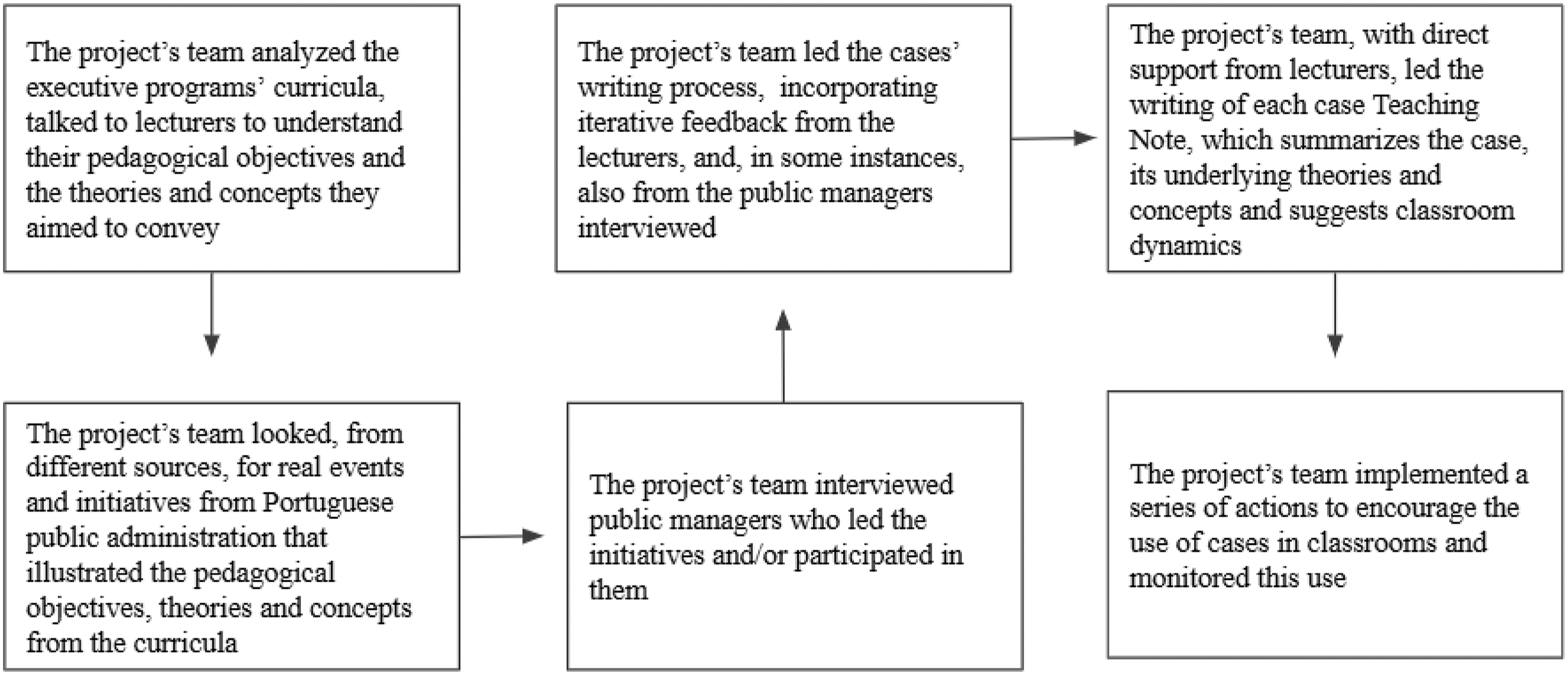
The unexpected fostering of links between university and practitioners
As mentioned above, the project began as a way to improve teaching in executive programs on public administration and, more specifically, to increase the participation of managers (students) in the classroom. However, over the course of the project, another benefit was observed as a direct result of it: the narrowing of the divide between managers and academics. The relation between the project and this outcome was mediated by two processes: the creation of case studies; and their use in the classroom.
Creation as a mediator
The cases were created by a research team of five MSc students under senior supervision. After finding real examples from the Portuguese public administration that illustrated the theory covered in class, the team conducted semi-structured interviews with the public managers who participated in these cases, individually or in small groups. Some topics, like public policy evaluation, leadership, and knowledge management, were based on several examples from real-life situations. In total, 52 middle-to high-ranking public managers were interviewed (Annex 2 contains more detailed information about these interviews).
The interviews captured a range of views on motivations, challenges, and consequences, to get a full picture of the circumstances. Since a key aspect of case studies is their focus on problems - each case study features a difficult situation that managers must overcome - the interviews’ focus were the challenges of each situation. As interviewees shared these challenges, they naturally reflected on them, and were nudged towards using the framework of academic theories and concepts to do so. Thereby, the interview highlighted the link between the situations and the pedagogical objectives of each discipline.
One of the interviewees for the ethics case said that even though she was “satisfied overall” with the way she dealt with an ethics problem in a social work department, she “should have sought allies to deal with it along with her.” Sharing the challenges of managing a cross-sectoral cultural project, another interviewee reflected on how top-down political decisions messed up the initial project schedule and how the management of expectations had been the trigger for these problems.
In one of the interviews for the Employee Evaluation case, the manager reflected on the strengths and weaknesses of the Portuguese Assessment System based on his own experiences, like when one of his employees refused to carry out a demand because it “was not among his objectives contractualized for the year”, which, for the manager interviewed, “just shows how the system needs to be aligned with a competences’ mapping”.
When asked about the challenges of implementing an Information System that monitors the responses provided by civil servants to citizens’ questions, a senior manager reflected on the change management strategies that worked better in that case: “starting small and being transparent, that’s what lowered their resistance”.
Change management was also one of the main themes addressed by the manager interviewed for the Data Protection case, who sees in her practice a deprioritization of the subject by public servants, who are always concerned with issues seen as more essential: “data protection always lags behind”. In her experience, the support of the top leadership of the public organizations was the key to guarantee the implementation of data protection rules.
As for the Administrative Reform study case, interviewed managers indicated in detail the main problems that occurred in practice when the Portuguese government merged two Public Institutes: “two completely different organizational cultures merged that day (…) we had people who perform the same function earning twice as much, unionized and non-unionized together…”.
In some cases, interviewees participated in the writing process itself, giving feedback and adapting the storyline. However, managers were not primarily responsible for writing, which solved the problem of lack of time - one of the main reasons why practitioners rarely engage in academic writing. This heightened the sense of collaboration between the fields. In some cases, the level of practitioners’ participation was such that they were credited in the published case as “scientific coordinators.”
Classroom dynamics as a mediator
After the cases were completed, or neared completion, they began to be used in IPPS’s executive program classrooms, as well as in ISCTE’s Master programs in Public Administration. Since each case comes with a teaching note, teachers could follow the dynamics and questions proposed in it and adapt them or develop new ones. Either way, teaching with case studies was centered on discussion and debate, with teachers playing the facilitator’s role. They were given free rein in how they used the cases, with most of them opting to use them as an auxiliary method, merging the case with theoretical-expository parts. In a four-hour class, for example, half of the teaching was done with cases and half with traditional theoretical presentation.
The main benefit of these debates in executive programs, in terms of reducing the gap between practitioners and academics, is that they allowed managers from different areas to share their practical experience around a subject and align this tacit knowledge with the explicit knowledge coming from academic theory - as represented by the figure of the professor. For example, when the employee evaluation case was used in the classroom, and the teacher asked how managers would deal with one of the case’s problems, they laid out some successful strategies that they had previously used in their own organizations. For another problem where no manager knew a possible solution, the teacher used traditional exposition to explain the legislation and theory behind it. One teacher, when interviewed about the classroom dynamics using cases, explained: The classes I taught a year ago had a much larger theoretical component than they do now. They now have a more practical perspective. Although […] in the practical discussion I end up explaining some theoretical things, because they ask me to. […] In fact, while I’m explaining the theory, I’m already thinking about some examples from the case.
This link between practitioners’ experience and academic theory was also driven by the cases’ local aspect. They portray the Portuguese public administration, with its own regulatory framework, constraints, and cycles, as well as some more subjective aspects, such as its particular organizational culture, leadership styles, and even jargon and terminology. Overall, this sense of specificity encouraged identification with the characters and their problems, which was essential for enhancing practitioners’ participation in the classroom dynamics. As one teacher who used the case in the classroom reported: Above all, [students] identify themselves a lot in the case. They realize that they have something tailor-made in their hands, […] it’s not business, it’s not a case with a context different from the Portuguese. Before, I focused on bringing examples from Brazil, which were the closest examples I had. These are still good examples, but it’s completely different when they identify with the situations, when the “speech” used is closer to their own “speech.”
This teacher also reported that the absence of “scientific verbiage” increased students’ reading beforehand and their participation and engagement in the classroom. As she explained: Before, if they hadn’t read any of the material I had made available a few days earlier—and they usually hadn’t—they expected to absorb all the knowledge there and then [during the class]. They now arrive […] more prepared to get into the topic […]. [The case study] is shorter, it’s a story that has to do with them […] it’s almost as if they were reading a novel.
Summary of main findings and discussion
Findings from the IPPS-Iscte project.
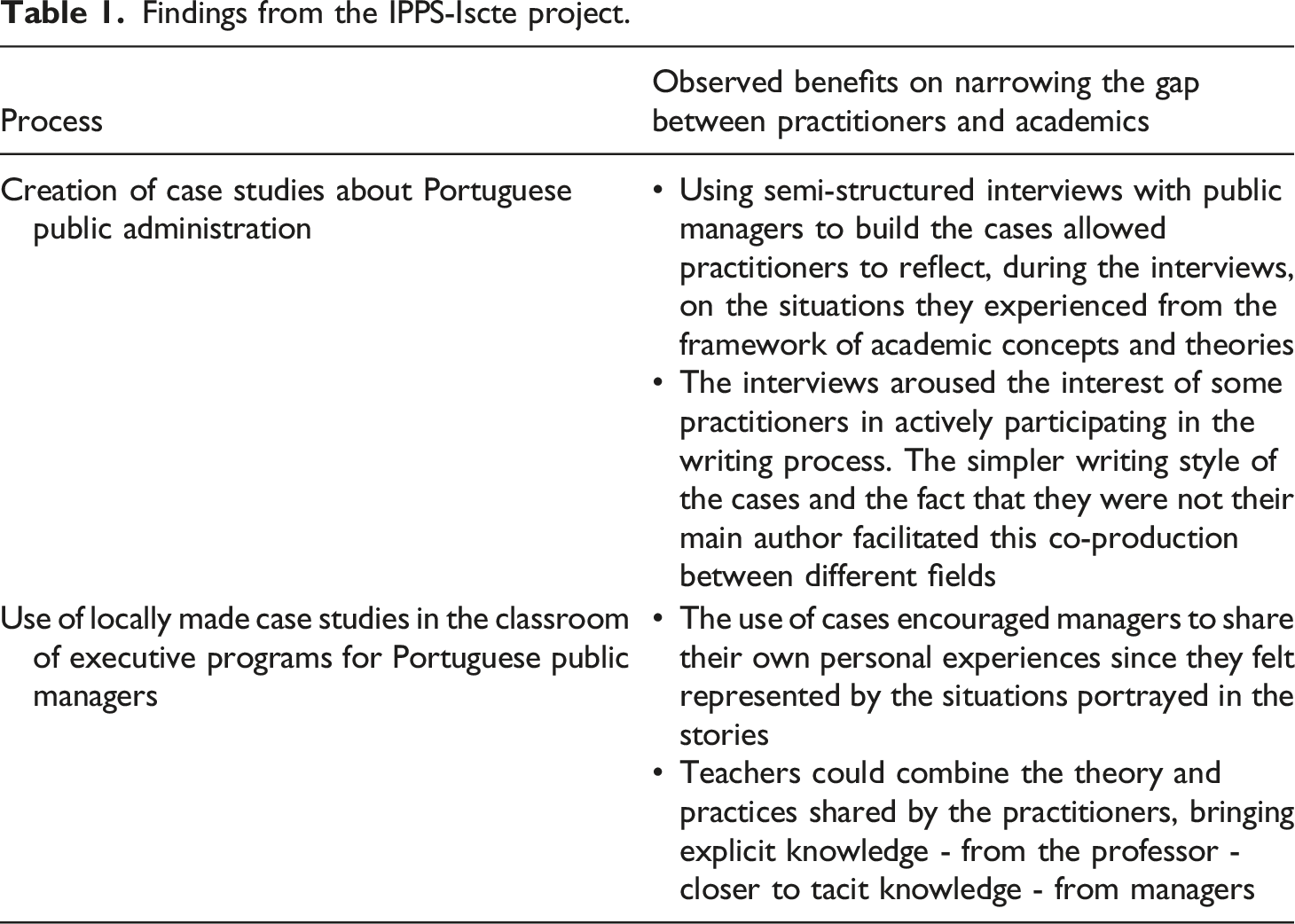
IPPS’s project seems to confirm several benefits of case pedagogy reported in previous literature. In particular, the use of cases in the classroom has changed the role of teachers, who became more facilitators of discussions among peers then “transmitters of knowledge”, as suggested by Popil (2011). By focusing the discussion on real-world situations, students had to think critically and to confront their arguments about the resolution of challenging situations, as argued by Graham (2010) and Aragão and Sango (1995). The fact that the cases refer to the national public administration (instead of focusing on foreign and/or business experiences) has reportedly increased the engagement of students in their discussion, overcoming the problems discussed in Mudida and Rubaii (2017). Finally, the cases provided the more academic-oriented teachers with additional opportunities to relate theory with practical examples, thus helping to mitigate the theoretical drift of public administration scholars, discussed by Bushouse et al. (2011), among others.
In addition, our findings include some interesting results that are less emphasized in the existing literature on the benefits of case studies, in particular those that accrue from the creation process. First, the participation of public managers in the creation of the cases – through interviews and, in some instances, in the writing process – has contributed to the use of a common language between the academics (who designed, wrote and/or used the cases) and the students (who are mostly public managers themselves), therefore reducing the miscommunication problems between the two communities that are mentioned by Ancira et al. (2021). Second, by the participation in the creation of cases seems to nudge public managers towards using the framework of academic theories and concepts to reflect on the challenges they face in their public administration functions, thus helping to bridge the worlds of academics and practitioners.
Challenges and change management
IPPS’s experience of creating and using case studies in public administration executive programs in Portugal may be fruitfully replicated in other contexts. However, attention should be paid to some challenges that arose in the implementation of the project.
As stated above, the case method is relatively new in several national contexts. Because of this, most public administration teachers were trained in the traditional expository method and simply do not know about the benefits of cases (Graham, 2010). Therefore, it is normal to encounter resistance to change among teachers, since they not only know little about the method, but often also need to acquire new skills to use it correctly.
The IPPS project used a number of strategies in order to overcome resistance to change among teachers. First of all, it focused on building one-on-one relationships with each of them, presenting the project, as well as the importance and potential of using cases. From these conversations, the project team could sense who would become “early adopters” (those who were enthusiastic and showed their full intention to use the cases and collaborate with the project), those who would become the “late majority” (less enthusiastic, but still willing to collaborate in some sense), and finally the “laggards” (who expressed their skepticism with the method and did not want to participate in it at all). With these profiles, the team was able to adjust its approach to each group.
As part of the effort to train and mobilize teachers, the project team organized two open sessions: one at the beginning of the project with an international expert on the case method; and another towards the middle of the project, to present the main intermediary results, “leaving the door open” in case other teachers wanted to join. In addition, IPPS offered a free online six-session course on how to teach using cases, delivered by another international (Portuguese-speaking) case expert, which aimed to develop teachers’ “discussion facilitation” skills. These connections with international scholars increased the legitimacy of the project and helped to reduce disbelief and engage the “late majority.” The most skeptical, however, have not been touched by these activities. Hopefully, once the cases feature in the majority of classes, they will see the positive results and get involved.
Another important issue is confidentiality. In some cases, the organizations under study faced risky issues involving organizational politics, high-ranking officials, or other public departments. Because of this, a number of them did not want their real names to be revealed in the final cases, and this matter must be handled with care. When faced with those situations, the team chose to fictionalize the name of the organization, its public role, and the people involved in it. The same approach was required for cases portraying successful initiatives or outstanding behaviors of some characters, to avoid accusations of favoritism by the IPPS.
Conclusion
The IPPS experience suggests that the creation and use of case studies in public management executive programs fosters the links between academics and practitioners in the field.
In both processes, creation and usage, the local aspect was a central part of the project and essential to reach a stage where these links could be forged more effectively. Local Portuguese events and initiatives were selected for the cases, resulting in a process of ideation, interviewing, and writing carried out in partnership - between local public managers, academic professors, and postgraduate students - who engaged in an in-depth discussion of the various initiatives and their relationships to academic theories in order to create them. As for the classroom dynamics, using local cases made for a greater sense of self-identification and ownership with the cases, which resulted in more direct and in-depth discussions.
This fostering of links between university and public administration was first shown when some public managers played a consultant-like role in the creation of the cases, with some even becoming co-authors. The cases’ modest size and lack of rigid structure allowed these busy managers to participate in their creation. These links also appeared during classroom dynamics, when public managers from different backgrounds read and discussed them, which prompted them to share their own personal experiences, their own analytical lenses and, together with the teacher, reach understandings between practice and theory, tacit and explicit knowledge.
This experience, therefore, emphasizes another benefit of using case studies in public administration, specifically when they are created locally for executive programs: in addition to the previously observed teaching and organizational learning benefits, these types of case studies may help foster the links between academics and practitioners.
Reproducing this experience in other contexts is highly encouraged. However, attention should be paid to some potential challenges, such as teachers’ resistance to changing traditional teaching methods and organizations fearful of being overexposed or wanting to use cases as publicity. Some strategies to overcome them could be to focus on one-on-one relationships with professors, organize open sessions, and enhance the legitimacy of the process by involving international experts from an early stage.
Footnotes
Declaration of conflicting interests
The author(s) declared no potential conflicts of interest with respect to the research, authorship, and/or publication of this article.
Funding
The author(s) received no financial support for the research, authorship, and/or publication of this article.

Note
Appendix
Case studies written in the project.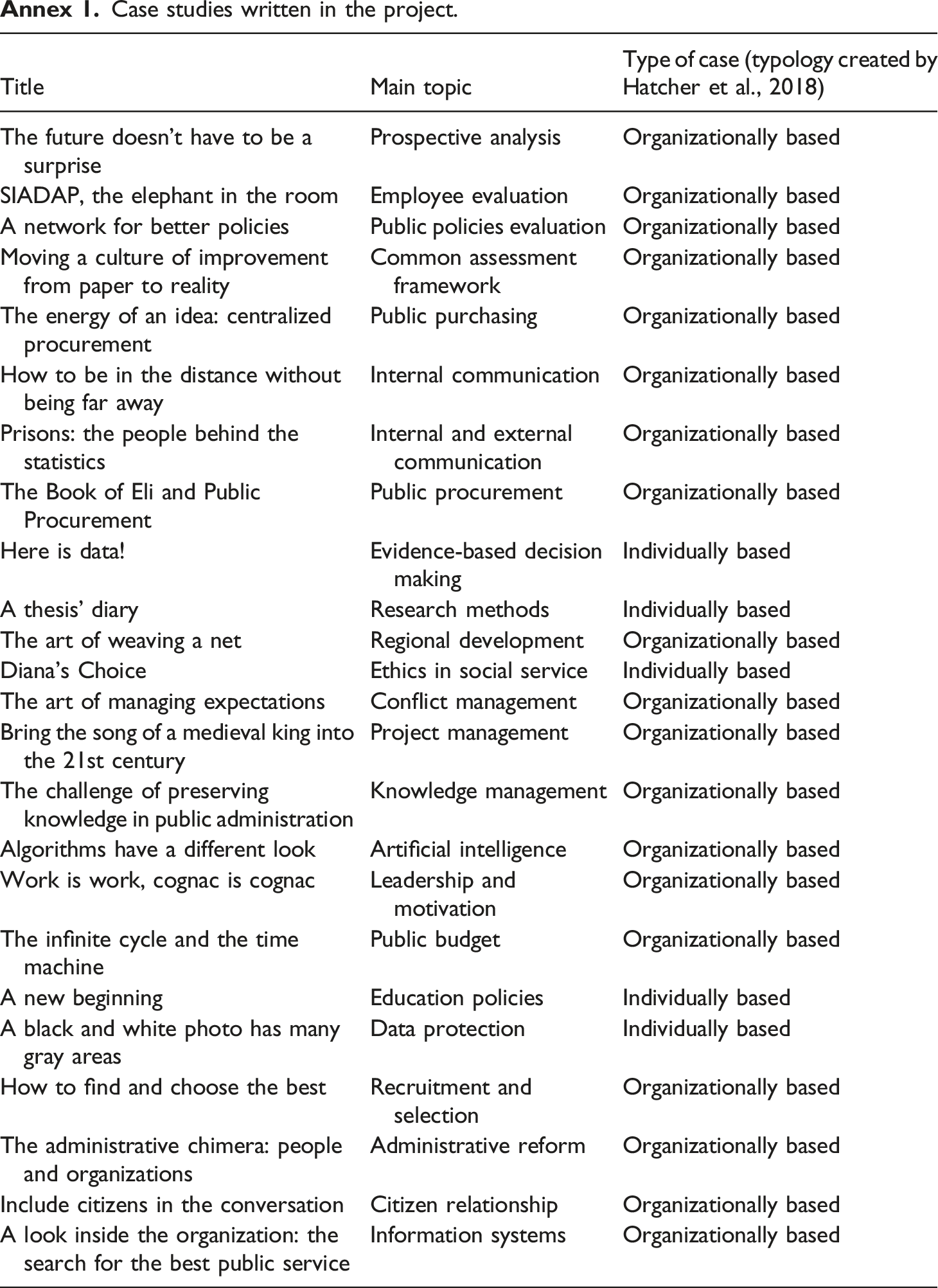
Title
Main topic
Type of case (typology created by Hatcher et al., 2018)
The future doesn’t have to be a surprise
Prospective analysis
Organizationally based
SIADAP, the elephant in the room
Employee evaluation
Organizationally based
A network for better policies
Public policies evaluation
Organizationally based
Moving a culture of improvement from paper to reality
Common assessment framework
Organizationally based
The energy of an idea: centralized procurement
Public purchasing
Organizationally based
How to be in the distance without being far away
Internal communication
Organizationally based
Prisons: the people behind the statistics
Internal and external communication
Organizationally based
The Book of Eli and Public Procurement
Public procurement
Organizationally based
Here is data!
Evidence-based decision making
Individually based
A thesis’ diary
Research methods
Individually based
The art of weaving a net
Regional development
Organizationally based
Diana’s Choice
Ethics in social service
Individually based
The art of managing expectations
Conflict management
Organizationally based
Bring the song of a medieval king into the 21st century
Project management
Organizationally based
The challenge of preserving knowledge in public administration
Knowledge management
Organizationally based
Algorithms have a different look
Artificial intelligence
Organizationally based
Work is work, cognac is cognac
Leadership and motivation
Organizationally based
The infinite cycle and the time machine
Public budget
Organizationally based
A new beginning
Education policies
Individually based
A black and white photo has many gray areas
Data protection
Individually based
How to find and choose the best
Recruitment and selection
Organizationally based
The administrative chimera: people and organizations
Administrative reform
Organizationally based
Include citizens in the conversation
Citizen relationship
Organizationally based
A look inside the organization: the search for the best public service
Information systems
Organizationally based
Interviews carried out in the IPPS-Iscte project.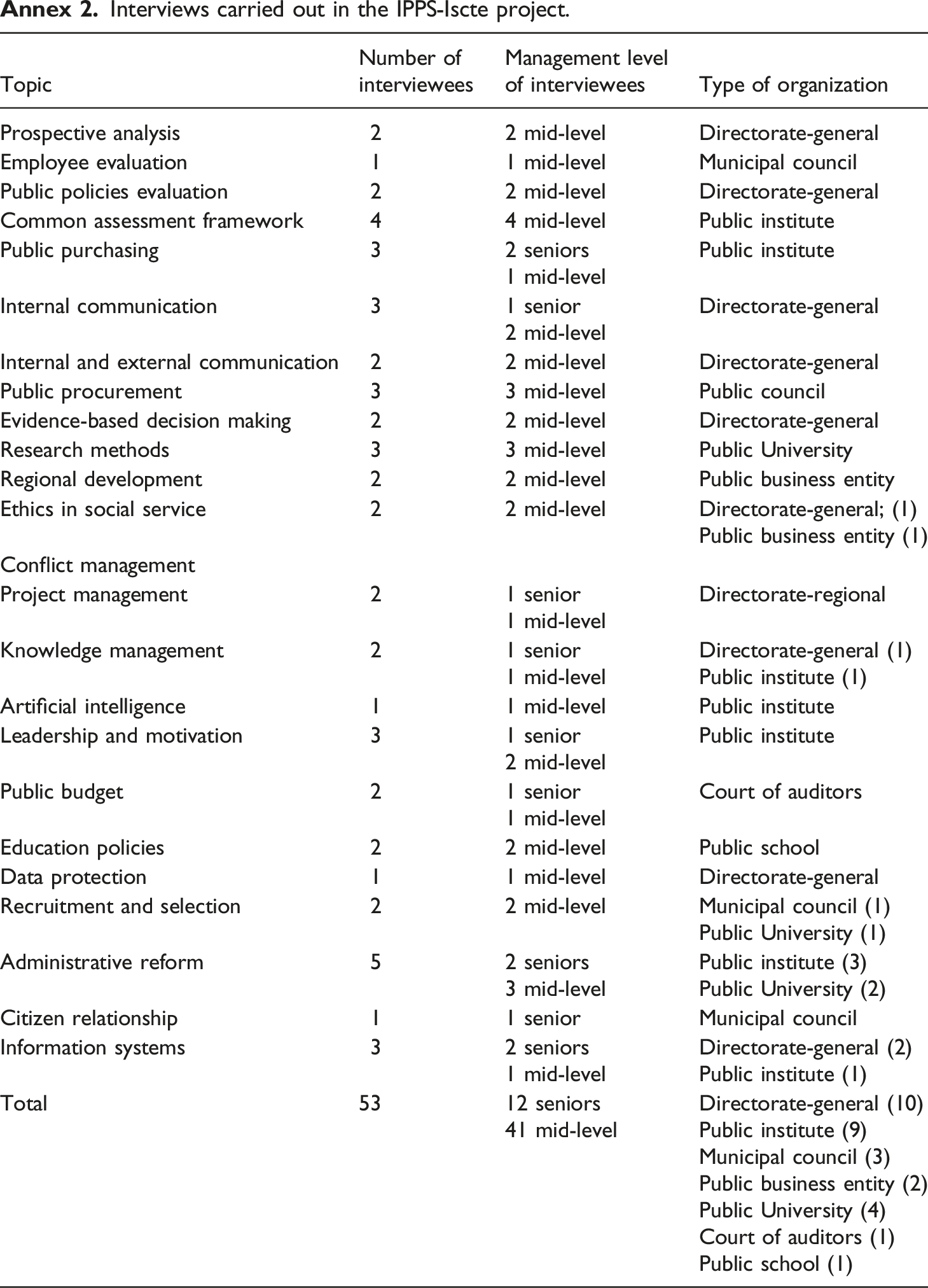
Topic
Number of interviewees
Management level of interviewees
Type of organization
Prospective analysis
2
2 mid-level
Directorate-general
Employee evaluation
1
1 mid-level
Municipal council
Public policies evaluation
2
2 mid-level
Directorate-general
Common assessment framework
4
4 mid-level
Public institute
Public purchasing
3
2 seniors
Public institute
1 mid-level
Internal communication
3
1 senior
Directorate-general
2 mid-level
Internal and external communication
2
2 mid-level
Directorate-general
Public procurement
3
3 mid-level
Public council
Evidence-based decision making
2
2 mid-level
Directorate-general
Research methods
3
3 mid-level
Public University
Regional development
2
2 mid-level
Public business entity
Ethics in social service
2
2 mid-level
Directorate-general; (1)
Public business entity (1)
Conflict management
Project management
2
1 senior
Directorate-regional
1 mid-level
Knowledge management
2
1 senior
Directorate-general (1)
1 mid-level
Public institute (1)
Artificial intelligence
1
1 mid-level
Public institute
Leadership and motivation
3
1 senior
Public institute
2 mid-level
Public budget
2
1 senior
Court of auditors
1 mid-level
Education policies
2
2 mid-level
Public school
Data protection
1
1 mid-level
Directorate-general
Recruitment and selection
2
2 mid-level
Municipal council (1)
Public University (1)
Administrative reform
5
2 seniors
Public institute (3)
3 mid-level
Public University (2)
Citizen relationship
1
1 senior
Municipal council
Information systems
3
2 seniors
Directorate-general (2)
1 mid-level
Public institute (1)
Total
53
12 seniors
Directorate-general (10)
41 mid-level
Public institute (9)
Municipal council (3)
Public business entity (2)
Public University (4)
Court of auditors (1)
Public school (1)