



Abstract
Traditionally, civil servants and public officials are highly educated and have strong administrative expertise. Public financial managers have been regarded as ‘guardians of the public purse’, who have solid budgeting, accounting and auditing skills. However, the development of ‘mega-trends’ such as digitalization and e-government affect the future of the public sector by challenging the traditional competencies of public managers. This paper examines an attempt to redefine the capabilities of future public financial managers as part of the curriculum development process at Tampere University, Finland. The study reflects the tensions and institutional pressures between what is traditionally taught and what will be needed in the public sector in the future. Although in our teaching we emphasise the constant changes happening in public administration, we may be failing to provide our students with the broader skills they will need for dealing with the dynamics of change in a complex working environment.
Keywords
Introduction
The call to educate with new management capabilities
Public managers face increasing complexity when dealing with social problems in today’s volatile environment. Globally, continuous political, economic and technological change drives the need to revise teaching of management and leadership skills in the education of future public managers to tackle the challenges more effectively (e.g. Wessels, 2020) when the graduates meet the future requirements of working life (cf. Dickinson and Sullivan, 2014; Henson, 2019; Kinghorn et al., 2007; Osborne and Brown, 2005; Pollitt, 2012; Stout, 2018).
Traditionally, civil servants and public managers are highly educated with strong administrative and technical expertise. Public financial managers have been regarded as ‘guardians of the public purse’, who require solid budgeting, accounting and auditing skills (e.g. Thom, 2019). While the need for expertise on financial management to secure effective planning and use of public administration resources has not disappeared, the development of ‘mega-trends’ such as digitalization and e-government challenge the traditional competencies expected of public financial managers. Responsiveness to a changing work environment, the capability towards innovation, networking and collaboration (van der Wal, 2017), the willingness to utilize the latest technology and the recognition of cultural differences have been acknowledged as essential current managerial skills (Hardy and Tolhurst, 2014; Tienhaara et al., 2016). Nevertheless, there is a gap in knowledge on how these changes have been considered in the education and curricula of public financial managers.
Higher education institutions play an important role in determining the new competencies required of future public managers. To meet these varied requirements, higher education institutions need to provide curricula that include greater boundary-crossing. Following the argument by Chalmers and Partridge (2012), the academic skills of future public managers should include and go beyond any discipline-specific or technical knowledge. In this study, we will approach the education of public financial management and capabilities of future public financial managers from the perspective of curriculum development by focussing on the challenges that emerged during curriculum redesign of the public financial management degree program in a Finnish university. Accordingly, we ask what kind of tensions arise in the curriculum development process, and how these tensions affect the efforts redefining the capabilities of public financial managers?
The need for curriculum redesign stems from the apparent changes in working life. Western countries have witnessed a shift from economies dominated by industrial manufacturing towards knowledge-intensive and service-oriented economies (Lönnqvist, 2011). This paradigm shift applies also to the public sector. The New Public Management ideology has been adopted in response to the changing environment of public sector management and as a move towards ‘digital-era governance’ (cf. Dunleavy et al., 2006; Hood, 1995; Osborne, 2006; Pollitt et al., 2007). Efforts of reducing bureaucracy and regulation make room for novel expertise and work autonomy, changing the very nature of the work and practices of public managers. Professional management skills, decentralized decision-making processes, customer-orientation and the networking of actors become essential capabilities in public management (e.g. Sanderson 2001; Van Helden et al., 2008). Thus, to respond these requirements, new skills and competencies need to be taken into account in higher education and curricula redesign for future public financial managers.
Prior research on graduate attributes and academic skills has scrutinized interpersonal and intercultural skills and specific competencies in public administration context (Barrie, 2004; Beenen et al., 2018; Capobianco et al., 2018; Chalmers and Partridge, 2012; Reichard and Krogt, 2014; Ritter et al., 2018). Instead of relying on transferring ‘how-to-do’ skills or ‘management tricks’, teaching should encourage students to adopt analytical skills and cultural competency (Capobianco et al., 2018). Interpersonal skills such as coaching and developing others, team building and conflict resolution have been identified as critical for future public managers (Beenen et al., 2018; Ritter et al., 2018). Public administration-specific competencies must include the ability to communicate with diverse internal and external stakeholder groups (Reichard and Krogt, 2014). While we recognize the importance of these discussions, in this study, our focus is rather on curriculum development process. Therefore, instead of speaking of graduate attributes ((Barrie, 2004; Chalmers and Partridge, 2012), we use the concept of capabilities when referring to the knowledge, skills and competencies required by future public managers. According to Wessels (2020), capabilities is a broader concept with a scope that includes future working life requirements in a context of continuous social change.
The development of a curriculum cannot be detached from socio-political changes and trends. The focus of the current agenda on skills and the outcomes of higher education reflects external demands on universities to ‘produce’ a qualified workforce for the labour market. There is a vast literature on curriculum development in the field of higher education studies. Traditional perspectives in the curriculum research theory focus either on subject content, developmental processes, pedagogical practices, assessment, or lately, on students’ learning outcomes and skills (Kandiko and Blackmore, 2012). Consequently, curriculum can be approached as a syllabus (controlling content), as a product (producing competencies), as a process (negotiating potentials) or as a praxis of empowerment (Annala et al., 2016).
In this study, we understand curriculum development as an iterative process that is implemented in a broader social context and involves interaction between actors in higher education, government and the labour market. Instead of approaching the curriculum as a goal-oriented administrative product, we focus on a process in which different values and conceptions of learning and knowledge are represented. In this way, the curriculum illustrates interpretations of the role of higher education and its relationship with a changing society (Annala and Mäkinen, 2017), acting both as an internal and external driver of change. Accordingly, it is steered by the institutional developmental aims of the university but also by societal demands for a highly-skilled workforce for the labour market.
It has been argued that ‘curriculum change is a product of these interrelated changes and can only be understood by reference to them’ (Kandiko and Blackmore, 2012). The curriculum development process involves continuous discussion about means and ends as well as the actions that will be needed. Therefore, if we acknowledge that there are multiple interpretations of the purpose of the curriculum, the development process can be explored as a negotiation of meaning (Annala and Mäkinen, 2017; Wenger, 1998) by focussing on the intentions and dynamics that shape the design and implementation of a curriculum.
Our study takes a critical approach to the practices of teaching and the process of curriculum design by reflecting the experiences on a particular master degree program within the public management discipline. Our case offers important learning for understanding the curriculum development process as a negotiation of its meaning. By bringing out the concepts of curriculum development used in the higher education research literature, this study reflects the tensions and institutional pressures between what is traditionally taught and what is needed in the public sector teaching and management in the future. Our case study and the curriculum development process of Public Financial Management study programme are described in chapters 2 and 3. As the results of the process the identified capabilities of students is presented in chapter 4, followed by a discussion about the challenges that surfaced in the curriculum development process in chapter 5.
Research setting
We use the Public Financial Management (PFM) study programme at Tampere University, Finland as an illustrative case study to demonstrate how the necessary capabilities, including both skills and competencies, were redefined and incorporated into the curriculum and the syllabi for the bachelor’s and master’s studies in the administrative sciences. Our study is related to a pedagogic development task (2018–2019) carried out in the Faculty of Management and Business. We use the action research approach (cf. Steier et al., 2015) to study a curriculum development process in which two of the authors were personally involved. As the development task was part of the pedagogic training, different participative methods were encouraged to explore and experiment. The data were collected from the workshops and focus group discussions with PFM students and staff (see the Case study: Curriculum development process in a public financial management study programme section for details of data and methods). In addition, we utilised the course statistics and the questionnaire given to staff members. The results of these analyses were presented and discussed in monthly meetings on the study programme. Between the meetings, we worked on the process by designing and preparing an actual curriculum for PFM. However, ideas and insights from graduated students were brought in the process by students.
Our case study starts at the institutional level of target setting and continues by describing the process of curriculum development in the Faculty and at the study programme level (see the Case study: Curriculum development process in a public financial management study programme section).
Target setting at the institutional level
The curriculum development originated at a time when a remarkable merger took place in Tampere University. Two local universities joined their operations and merged into one higher education unit. The higher education community then formulated a collective vision relating to the competencies and skills needed both in present and future working life. That vision was intended to challenge the existing practices of sharing knowledge, learning and research to produce skilful, inquisitive and industrious students with competitive skill sets. The vision was then developed further into joint learning outcomes that were considered the critical competencies a graduating student needs to acquire.
University level key competencies, set as aims for curriculum development: • effective learning and critical thinking skills • ethical thinking skills • interpersonal skills for the work community • IT and digital skills • development and innovation skills • interaction and communication skills • skills for understanding the economy and society, leadership skills • skills for international relations and global responsibility
According to the institutional guidelines, all Faculties and degree programmes were responsible for integrating these key competencies into their learning outcomes. Each degree programme was to accommodate the outcomes in a manner appropriate to the degree in question.
Target setting at the faculty level
The Faculty of Management and Business comprises five degree programmes: 1) Politics, 2) Administrative Sciences, 3) Business Studies, 4) Industrial Engineering and Management and 5) Information and Knowledge Management. The degree programme for Administrative Sciences includes altogether five study programmes (PFM being one of those) of which students will choose one as their specialization. All of the study programmes include syllabus for bachelor’s and master’s degrees. The general guidelines and objectives for curriculum development were stated by the faculty Dean. Joint learning outcomes framed the basis for the development work to be done in the Faculty. One of the main aims was to elucidate the key substance of the individual study programmes and to reduce the use of external teaching services. An analysis of the key substance was expected to illustrate the knowledge and expertise of the current staff. Moreover, as the Faculty had invested in new international bachelor and master programmes to attract international students, the study programmes were also urged to increase the courses taught in English. Finally, to facilitate cooperation between Faculties, study programmes were also encouraged to seek opportunities for collaborative teaching within the degree programme/faculty/university.
The aims for curriculum development at the Faculty level: • to elucidate the key substance of the study programmes • to increase teaching in English • to advance e-learning • to facilitate cooperation in organising courses
Case study: Curriculum development process in a public financial management study programme
The actors
The staff members of the PFM study programme consisted of three professors, a research director, a university lecturer, a post-doctoral researcher and two university instructors. Our development task was to design a new syllabus according to the key substance and current teaching resources of the study programme. The university lecturer and the post-doctoral researcher (two of the authors of the paper) were appointed to lead the development process.
As the highest decision-making body, the Faculty Council supervised the curriculum development. To guide and support the task, working committees were organized under each degree programme. The members of these committees consisted mainly of university lecturers and instructors. The head professors of each degree programme belonged to the faculty steering committee, whose task was mainly to supervise the work of the working committees.
The start
The development task was framed around joint learning outcomes at the university level and faculty-specific aims. At the study programme level, the first step was to identify the specific needs of the new curriculum. The concrete targets acknowledged included the demand for a clearer profile for the programme, a stronger research-teaching nexus and the reinforcement of students’ theoretical knowledge and methodological skills. There was also a desire to pilot novel and flexible ways of organizing PFM courses to ensure the efficient use of teaching resources and to avoid an overload of teaching that required the hiring of substitutes. The previous syllabus included courses that had been bought from external part-time teachers due to changes in the staff and the different expertise of the current (teaching) staff.
At the Faculty level, the PFM was identified as an example of a study programme within the degree programme that had offered too many courses, with the result that the teaching commitments were no longer in balance with its current resources. The lack of resources and the large number of courses both taught and bought within the study programme were also acknowledged. Therefore, one of the core aims in the curriculum development was to look for possibilities for collaborative teaching within the new university community.
PFM study programme’s aims for the new curriculum: • to elucidate the key substance of the study programme • a stronger research-teaching nexus • to decrease the number of compulsory courses by increasing the optional courses • to strengthen the theoretical and methodological competencies of the students • to develop flexible ways of taking courses (a pilot) • to investigate possibilities for collaboration in teaching accounting and bookkeeping courses
The actions and data collection methods
Our actual development process started with an analysis of the previous curriculum. We conducted a portfolio review (cf. Blackmore and Kandiko, 2012) to get a bigger picture of the cost-effectiveness of the existing syllabus. We collected and analysed the statistics of the PFM study programme, for instance, the number of students who signed up, who took and passed courses, the graduate students and the courses offered in previous semesters. In addition to this descriptive statistical analysis, we created a benchmark and a comparative analysis of the allocation of resources between the programmes of Administrative Sciences in the Faculty by comparing the number of teaching resources, the number of courses and of students. Moreover, the possibilities for collaborative teaching (e.g. bookkeeping courses) with other units were explored.
To describe the scientific and professional knowledge and skills of the current staff members of the PFM, we conducted a core curriculum analysis (cf. Levander and Mikkola, 2009) to set a starting point for the development work. We made a content analysis of the previous curriculum, the courses taught, and any overlaps in the content of the courses. We formulated a short questionnaire for our teaching staff to collect their experiences, the pros and cons they saw in the previous syllabus, and their expectations for the current curriculum development. Based on the data collected, we then organized workshops and focus group discussions with students and staff. In one of the workshops, we conducted the world café method (cf. Steier et al., 2015) to engage the staff members of PFM in brainstorming, reflection and constructive dialogue concerning the future direction of the PFM study programme.
The end
As a result of the development process, we designed a new thematic selection of courses. With the aim of utilising the teaching resources in a (more) sustainable way, the total number of courses in the future syllabus would decrease and the optional courses would increase by narrowing the role of compulsory courses. Moreover, as a result of the key substance analysis, the compulsory bookkeeping courses were excluded from the key substance of the study programme. Accordingly, students would have greater leeway and more flexible ways of taking the courses.
The PFM study programme held monthly meetings to discuss and decide on the teaching issues. The agenda of the meetings concerned the formulation of learning outcomes for the new courses. Even though the new course selection had already been decided on in previous meetings, the new syllabus was open for criticism, and shared decisions made previously could be contested. The most critical matters were the number of optional and compulsory courses. At this point, the curriculum development work came to a full stop. From the initial shared intention to renew the curriculum, it shrank to a situation where each member/teacher was considering the optional development of a single course. At this point, the professoriate of the PFM study programme then stepped in and decided on the content for the new curriculum, which meant the development process came to an end.
Results: Toolbox
The process had been going smoothly, with a shared understanding of the key substance, until it reached the phase where the learning outcomes of the individual new courses were to be determined. As the persons responsible for the curriculum development project, we felt enthusiastic about the possibility of redesigning a curriculum that would better reflect the current needs of students and the staff resources. However, while the ongoing societal change and the needs of future working life were commonly acknowledged, it would appear that the need to develop the curriculum was not.
Against the initial aim and the development task to which we were appointed by the faculty Dean, the results of the process were such that the number of courses increased, and the use of part-time teachers and the number of compulsory courses and buy-in courses remained the same, or even increased in some cases. For instance, the joint analysis of key substance resulting in an agreement to decrease the number of compulsory bookkeeping courses, were in the end contested and abandoned. The unexpected outcome was that even more courses on bookkeeping were included in the syllabi. Moreover, since the number of compulsory courses increased, there were hardly any optional courses for the students to choose from. Although, the new learning outcomes and skills needed were accepted at the study programme level, they were not incorporated into the actual contents of the courses.
In the PFM study programme, there are long traditions of certain teachers teaching specific substance courses and being strongly possessive of these roles. Previous joint attempts to develop the curriculum have been met with little or no success. The current strategy for curriculum development was to start at the abstract level of identifying the key substance and the essential skills needed for the study programme and then to proceed, step by step, to more concrete matters, including the content of courses.
For instance, in the joint discussions the skills identified for public financial managers were: • The ability to communicate about public finance verbally and in writing (argumentation and reporting skills) • The ability to recognise the differences between research and practice, theory and politics (the competency to identify theoretical and normative discussions) • The ability to understand and analyse public finance from different theoretical perspectives (analytical skills) • The ability to utilise auditing as a part of public financial management (auditing skills) • The ability to understand the characteristics of public administration (competency in solving complex management problems) • The ability to manage public finances (accounting and management skills)
The general learning attributes listed related to research and methodological skills, for instance, the ability to utilise different sources of information (research, reports, financial analyses, etc.) and the methodologies, concepts and theories of public administration. Moreover, interaction and teamwork skills, such as being a responsible member of a group, were highlighted. In higher education, critical thinking, debating and problem-solving are considered essential skills for students.
As a result of the qualitative content analysis of these discussions, we developed ‘a toolbox for the public financial manager’ to illustrate our interpretation of the capabilities as well as the key substance of the study programme (see Figure 1). Inside the triangle, the learning outcomes of the courses are described and outside the triangle (in italics) are listed some of the key substances of the courses and the necessary expertise of staff members. The toolbox is based on the concept of Bloom’s taxonomy (e.g. Krathwohl, 2002), where the cognitive learning objectives describe the different skills students need at different levels (verbs are associated with the levels: remembering, understanding, applying, analysing, evaluating, creating). A taxonomy is a way of hierarchically classifying objectives and learning outcomes from low-level to high-level thinking. The identified capabilities needed by PFM students.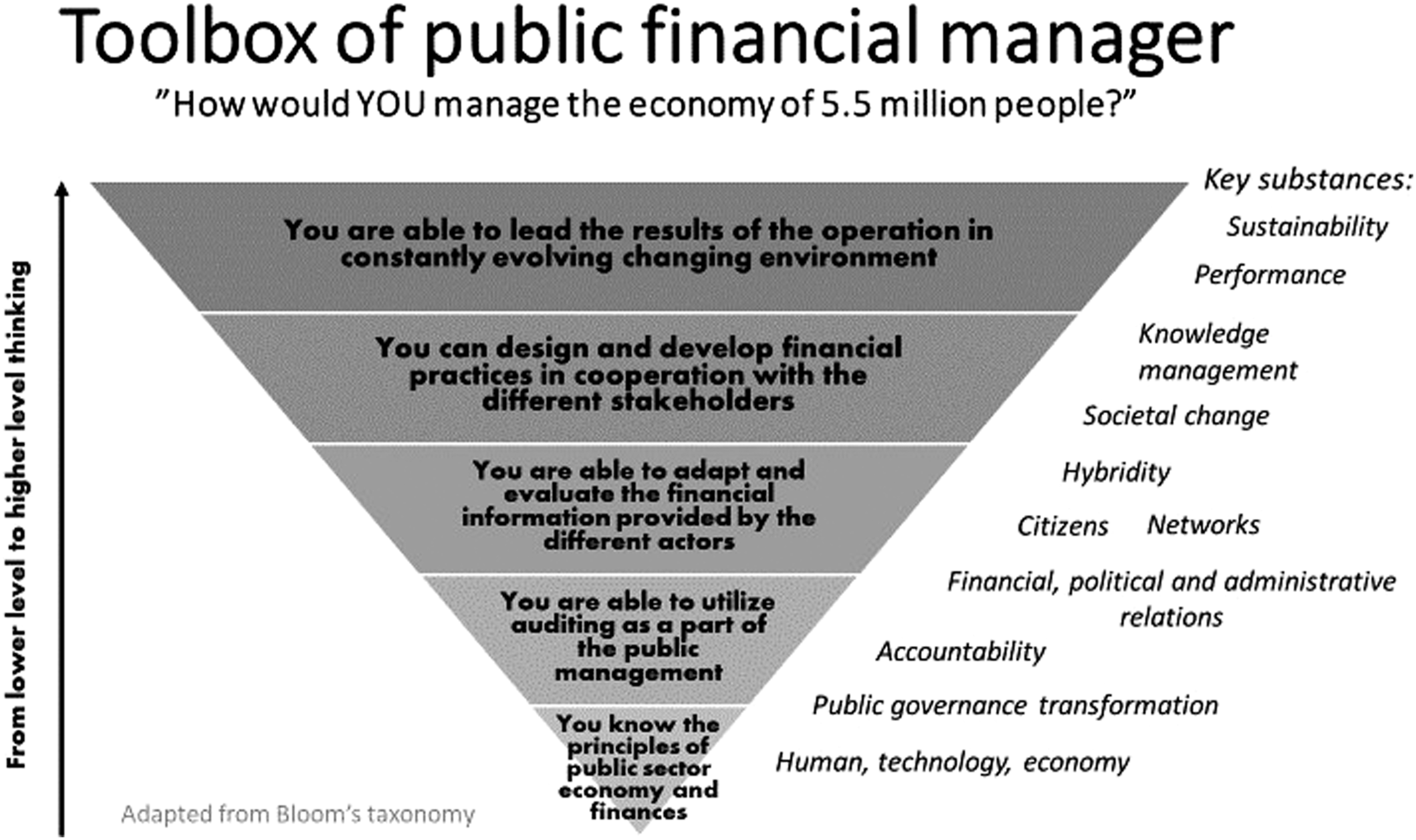
The toolbox was presented to the working committee and was received with positive feedback and encouragement from the rest of the PFM staff. Accordingly, the toolbox was utilised in formulating the capabilities for the bachelor and master studies in public financial management, with consensus among the members and staff of the PFM. Based on the toolbox, the content for the new courses was suggested and originally agreed upon in the PFM study programme meetings but in the end this suggestion confronted insurmountable resistance. Instead of communal approach, the development of course content and methods of teaching and learning remained voluntary responsibility of each teacher.
Discussion
We examined a curriculum development process as an attempt to redefine the capabilities of future public financial managers. Our results reflect the institutional pressures between what is traditionally taught and what will be needed in public sector management in the future. Curriculum development is about strategic planning and target setting, but it may also operate as an instrument of communication between different stakeholders. Still, the strategic change and structural renewal of curricula in higher educations are often enacted through top-down initiatives (Blackmore and Kandiko, 2012). There is a tradition to understand curriculum as producing competencies and curriculum development as a tool for guiding pedagogical activities, but it reflects social, political and cultural change too (Lindén et al., 2016). Therefore, it can serve as an instrument that meets both internal purposes and external expectations: maintaining traditions, advancing the discipline, influencing society, satisfying external intentions, highlighting market-oriented competencies and promoting students’ identity and career-building (Mäkinen and Annala, 2010).
Our case study demonstrates that there was a lack of a shared understanding of the curriculum itself. Instead of seeing the curriculum as an iterative development process, it was understood merely as a product. As Annala and Mäkinen (2017) point out, relevant actions would have required more negotiation, as the purpose and the development of ideas concerning the curriculum were not always shared. Similarly, during our design process, an understanding of the curriculum as a concept was not discussed, and therefore, the aim and the need for curriculum development were not truly appreciated. While the participative methods during the curriculum development process received favourably, more time and effort would have been needed for construction of shared aims and actions of the development process. Prior research has also recognized the beneficial role of practitioners in the curriculum process (Azizuddin and Hossain, 2020), however, in this case practitioners were not involved in the process. Arriving at consensus on the learning outcomes and skills at a general level was straightforward, but their subsequent incorporation into courses, which would probably have meant further workload in designing new courses and discarding certain old ones, proved unachievable. There were also objections to the new ways of teaching. For example, while the importance of graduates’ teamwork skills was advocated at a general level, this was not supported by being included in the teaching methods to be used in the courses.
Pressures for renewal at the university and faculty level were recognized, but they were not seen as influential drivers for changing current teaching practices. In the past, the curriculum design work was implemented with minimum effort by concentrating mainly on updating written descriptions of the courses. Moreover, instead of rotating the teaching of particular courses, there has been a history of strong course ownership, which enables static teaching practices and leaves little room for change. Despite institutional pressures stemming from an evolving public administration, university fusion and faculty level aims for curriculum design, the traditional teaching practices used in the PFM study programme carried superior weight.
Our case study highlights the significance of university hierarchies and the power relations embedded in the curriculum design process. The working committee, consisting of university lecturers and instructors, who held lower positions in the hierarchy, had no clear mandate to decide on the development actions to be implemented. Instead, the major decisions were made in the steering committee by the professors and in the faculty council. At the study programme level, despite support from the faculty Dean and the working committee, consensus reached regarding the development actions needed did not prevail over the professoriate of the PFM study programme. It became evident that the autonomy of the professors was a stronger driver in resisting change than efforts made at the institutional or faculty level for development and renewal.
In our paper, we have identified some of the new and apparent management skills required in both current and future working life and the role of curriculum development in providing them to students. The study brought out the tensions and institutional pressures relating to the development and implementation of the curriculum, namely, the contradictions between teaching traditions and the demands of future working life. This can also be interpreted with reference to the debate between generalized and specialized skills (cf. Dickinson and Sullivan, 2014). While it can be stated that both generalists and specialists will be needed in the public service workforce of the future, the set of ‘softer’ skills (e.g. emotional intelligence, communication, collaboration, people management) are becoming increasingly important in the evolving context of public administration and will likely become even more crucial in the future (Dickinson and Sullivan, 2014).
When designing the curriculum, the notion that solutions for complex and interdisciplinary societal problems can be found at the interface of the different management traditions of public administration, politics and business should be taken as a preliminary premise. To encourage the development of interdisciplinary skills in students, the management of both public and private sectors as well as knowledge of political processes and international relations should all be emphasized (e.g. Stout, 2018). However, in addition to the need for general skills and interdisciplinary knowledge, there is also a need for specialized knowledge and contextual skills.
As digital technologies transform and facilitate ways of working, some tasks are disappearing. Therefore, an understanding of the dynamics related to policymaking and how public organizations work and can be developed are considered important public administration-specific competencies (Reichard and Krogt, 2014).Future public managers must be educated to find, analyse and evaluate both theoretical and practical information about complex organizational phenomena if they are to critically assess the key challenges in a process of organizational change. However, our study showed that despite an emphasis in the substance of our teaching on constant change in public administration, we may be failing to provide our students with the general skills needed for dealing with the dynamics of change in complex working environments. For instance, instead of teaching interpersonal skills, the main emphasis in public financial management studies is still on technical knowledge. Interestingly, it is possible that behind the different ideas about the skills and competencies needed by future public financial managers may be contradictory interpretations of whether ‘public administration’ is a discipline or a practice (e.g. Rutgers, 1998; Zalmanovitch, 2014). This historical debate on the fundamental nature of ‘public administration’ may also explain the different perceptions of the vital skills and competencies needed by public administration students. For instance, seeing ‘public administration’ as a practice results in the teaching of technical knowledge being valued. Perhaps when public administration is perceived as a discipline, as a field of science, more emphasis is placed on teaching general skills in higher education.
Corresponding to a study by Annala and Mäkinen (2017), our case study illustrates the role played by the hierarchies, positions and power relations among academic members involved in a curriculum design process. It becomes apparent that different interpretations of the purpose of the curriculum and individual interests make curriculum development a highly complex social process. This relates in part to the autonomy of teachers in higher education: the right to determine one’s individual teaching practice simultaneously enables one to neglect the joint development goals of teaching. Thus, despite the fact that the curriculum aims were negotiated at the university, faculty, degree programme and study programme levels, the outcome of the curriculum design process reverted to the professoriate, although this group were not engaged in the actual development task. Nevertheless, encouraged by Karjalainen (2003), it can be a relief to acknowledge that a discussion about what is considered the key substance in a particular field of science is always relevant, even when no consensus is arrived at, since such core discussions also play a necessary role in the development of the science itself.
