




Abstract
Many graduate public affairs programs offer both residential and online options for students. One of the challenges for multi-format programs is creating a sense of belonging among online students who may never set foot on campus. In 2017, the MPA program at the University of North Carolina at Chapel Hill developed an “immersion” course designed for residential and online students in a weekend intensive format on campus to help create a greater sense of connectedness and satisfaction among (principally) online students, while benefiting students in both formats. This paper examines immersion courses as one strategy to address gaps in belonging and satisfaction between online and on-campus students. The case study of UNC-Chapel Hill developing the immersion course and the first three iterations of it are described, offering practical insight for other campus-based public affairs programs that also have online degrees who may want to try something similar.
Keywords
Introduction
Over the last two decades, numerous residential (campus-based) graduate public affairs programs expanded into online education. Many public affairs graduate programs have long been innovative in expanding access by offering part-time programs, with night classes, sometimes with satellite locations where student populations reside. The advancement of online education offers another avenue for expanding access, and programs with parallel residential and online options are now commonplace.
As graduate public affairs education evolves with new teaching technologies, it is important to assess new and emerging approaches to ensure that change is concurrent with improvement. Today, we see some public affairs graduate programs offering a somewhat binary choice between full-time residential or part-time online paths. Others provide some mix of hybrid online or in-person courses. And yet others add another option for working professionals in the form of executive-style programs with short-term (often weekend) face-to-face instruction and preparation work at a distance.
In cases where programs have more-or-less parallel tracks (residential or online), the question of fostering a sense of belonging across formats is central. It can be difficult for online students to experience the same sense of belonging (feeling valued, connected, and fitting in) as their residential counterparts. For situations like this, where a reasonable goal is to have all students (regardless of format) feel part of “one” program, extra effort is needed to create conditions whereby online students can have the kinds of experiences that engender a sense of belonging with the program.
Our central research question is: How can graduate public affairs programs with both residential (on-campus) and online formats/tracks increase online students’ sense of belonging? And, by extension, how can such multi-track programs enhance student satisfaction among online students that lack the kind of interaction residential students enjoy? With residential students experiencing both formal and informal experiences with faculty, other students, and the home institution at a level that distance (online) students cannot, are there strategies public affairs programs might employ to close the gap?
We posit that one innovative pedagogical strategy is offering “immersion” courses and associated activities. Immersion courses provide online students the chance to enjoy face-to-face institutional immersion through on-campus experience of formal and informal faculty and student interaction within a for-credit course experience. We present a case study of immersion course offerings at University of North Carolina at Chapel Hill as one promising strategy for enhancing online MPA student belonging and satisfaction. We describe the design, delivery, and evaluation of the first three iterations of the immersion model at UNC-Chapel Hill MPA program. We explore the extent to which the immersion course promotes student belonging and satisfaction and offer guidance for other programs that face similar challenges that might be partially addressed by the immersion model.
This paper is organized as follows. First, we review relevant literature about online education in public affairs programs, sense of belonging, two concepts key to the immersion course strategy: teacher presence and hybrid course design, and student satisfaction with their graduate education. Next, we describe the adoption of an immersion course model at UNC-Chapel Hill MPA program, meant to provide an institutional immersion experience that would contribute positively to online student belonging and satisfaction. We then review evaluation data from the first three iterations of the immersion course model (2017–2018) at UNC-Chapel Hill MPA. We conclude with advice for other graduate public affairs programs with multiple formats, including fully online.
Literature review
Growth of public administration online education and the challenge for online student belonging
Online public affairs graduate education has grown significantly over the last 25 years. In the mid-1990s, the Network of Schools of Public Policy, Affairs, and Administration (NASPAA) reported eight MPA/MPP programs offering any online courses (not full degrees, but online courses at all). By 2003, the number was up to 15 (Network of Schools of Public Policy, Affairs, and Administration, 2016). In 2012, Ginn and Hammond found that of 96 NASPAA-affiliated programs, 40% offered online or hybrid courses while 24% had fully online programs (Ginn and Hammond, 2012).
As of 2020, 60 programs providing data to NASPAA (22% of total) are reported offering “primarily online” or “completely online” instruction (as reported in Blair et al., 2021). Perhaps the most significant evidence of the rise of online education in public affairs is that many of the highest rated (according to U.S. News and World Report) graduate programs in public affairs offer fully online degrees (in addition to residential programs). Blair, Slagle, and Williams’ (2021) analysis of fully online master’s programs finds that 19% of the U.S. News Top 50 programs offer fully online degrees. It is remarkable to consider that the number of primarily or fully online (NASPAA-affiliated) degree programs has grown from 23 to 60 over the course of a decade, and that the growth is relatively evenly distributed across institutional ranking groups (Blair et al., 2021: p. 8).
Student sense of belonging
The idea of student sense of belonging has long been viewed as an important component of student success at various levels of education and types of learning environments (Goodenow, 1993; Tovar, 2013; Vaccaro et al., 2015). Most treatments of student sense of belonging draw on a definition put forth by Goodenow (1993), where belonging comprises of feelings of “being accepted, valued, included, and encouraged by others (teachers and peers) in the academic classroom and of feeling oneself to be an important part of the life and activity of the class. More than simply liking or warmth, it also involves support and respect for personal autonomy and for the student as an individual” (Goodenow, 1993: p. 25).
Scholarship on sense of belonging in higher education is consistent in connecting it with educational outcomes (Strayhorn, 2019). While most of the literature on sense of belonging in higher education has focused on the undergraduate, full-time residential experience, more recent scholarship has explored the concept in the context of graduate and online education. Strayhorn finds that extant literature on socialization of graduate students contributes to “feelings of membership, community, relatedness, or a
Strayhorn’s research finds that socialization (which includes activities such as faculty advising, social gatherings with faculty and peers, research training, and professional association) matters a great deal to graduate students and that it “begets sense of belonging.” Moreover, graduate student sense of belonging begets success (Strayhorn, 2019: pp. 124–139). “Graduate students thrive and excel where they feel like they belong” (Strayhorn, 2019: p. 138).
Research by Drezner and Pizmony-Levy (2021) also suggests that sense of belonging has important implications for graduate student alumni engagement. The authors demonstrate that alumni with a stronger sense of belonging is positively associated with key forms of alumni engagement such as financial giving and volunteering. 1 The authors conclude that graduate programs could view “investments in student services, curricular, and co-curricular life as having a potential impact on future alumni donation” (Drezner and Pizmony-Levy, 2021, p. 773).
As online education has become more common, studies into sense of belonging among online students have emerged. Online education experiences significantly lower retention rates than traditional learning environments (Muljana and Luo, 2019). Among the key factors cited as contributing to these lower retention rates is “low sense of belonging” (Muljana and Luo, 2019: p. 27). A relatively early study by Thomas et al. (2014) argued that “strategies that aim to foster a sense of belonging and inclusion in the online context appear promising in improving retention in online learning” (p. 70). Related research noted struggles with “sense of community” and “social connectedness” in online graduate studies as compared with on-campus experiences (see Exter et al., 2009 and Irani et al., 2014, respectively).
Research by Susi Peacock and colleagues connects developing and nurturing a sense of belonging amongst online learners to improvements in student experiences, performance, and retention (Peacock et al., 2020). They find that online learners who are remote from a physical campus and separated physically from other students “seem to be especially in need of a sense of belonging” (Peacock et al., 2020: p. 30).
Hybrid or blended courses
An important set of strategic choices in curricular elements for online student belonging concerns the mix of in-person and online learning opportunities. As noted above, PA programs vary by having students in either all online or all on-campus formats, with variations in-between. Osguthorpe and Graham (2003), identify three kinds of blending of online and face-to-face learning environments: learning activities, students, and instructors. They note, “The most common way to create a blended learning system is to design part of the course for the classroom and for the internet. For traditional courses, this often results in less face-to-face class time, replaced by some type of online activity” (Osguthorpe and Graham, 2003: p. 229).
The immersion course strategy (detailed below) comports with Alammary, Sheard, and Carbone’s definition of a blended learning course, one that: 1. Thoughtfully integrates different instructional methods such as lecture, discussion group, and self-paced activity; and 2. Contains both face-to-face and computer-mediated portions. (Alammary et al., 2014: p. 443)
A study of two pilot hybrid courses identified four features of the hybrid courses: 1. Numerous, short writing assignments 2. Learning from classmates 3. Convenience—not having face-to-face class every week 4. Participating in an asynchronous manner (Shea et al., 2015: p. 547)
A recent collection of articles on technology-enhanced public administration instruction did not cover the immersion model (Sandfort, 2016). However, the immersion approach fits the call for more documentation and assessment of varieties of technology-infused public administration education.
Online education and teacher presence
Building on the dimensions of hybrid course design is teaching presence online. The immersion course innovation (described below) has student assignments online prior to the on-campus teaching of online and residential students in the same course. Research on teacher presence in online learning formats focuses on two primary concepts: transactional presence and the interaction of teacher presence, with three dimensions of student presence.
Naylor et al. (2016) place their study in the context of student retention rates for online programs. “There is solid evidence that attrition rates are higher in online courses than in traditional courses,” (Naylor et al., 2016: p. 45) which means that high quality transactional presence is likely to be important for online students’ assessment of their learning.
Turning to public affairs pedagogy, Shea et al. (2015) explored the concept of teacher presence. Drawing from earlier work, teacher presence creates structure and processes that supports both social and cognitive presence of students. Teacher presence can increase strengths and minimize weaknesses of a hybrid format. Social presence can facilitate communities of inquiry among students, which contributes to cognitive presence. Teaching presence is reflected in the course design and organization, facilitation, and instruction.
Thomas, Herbert, and Teras’ research found that “more than opportunities for interaction, teacher presence contributed greatly to the sense of belonging in the online context” (Thomas et al., 2014: p. 78). Peacock and Cowan’s research also identifies an overlap between the social presence of the instructor (or online tutor) and learners’ sense of belonging (Peacock and Cowan, 2019).
Student satisfaction within graduate public affairs programs
A final line of research explores factors that influence students’ assessment of their graduate education. As noted below, the immersion course innovation was prompted, in part, by online students’ feedback about having the right incentives for some form of on-campus experience while not disrupting their online education.
Bright and Graham (2016) report there has been limited research on predictors of graduate student satisfaction in public administration education. They researched the socialization experiences of students in graduate public administration programs through a survey of approximately 500 students from programs across the United States (Bright and Graham 2016: p. 18). Their review of previous research finds, … many of the performance outcomes judged important for degree programs are related to student satisfaction. Students who are satisfied with their experiences in their degree programs have been found to be significantly more likely to complete their degrees, perform highly in their coursework, and recommend their program to others. (Bright and Graham, 2016: p. 19, p. 19)
Bright and Graham identify many factors that could affect student satisfaction: demographics, general degree and curriculum characteristics, program climate professional and alumni interactions, and public sector experience (2016, pp. 21–22).
Bright and Graham define program climate as “The level of interaction and support that students receive from their peers and professors is among the most important predictors of satisfaction in college.” (2016, p. 22). They found “the only variables that were meaningfully related to student satisfaction were program climate and years of government experience. These two predictors alone significantly explained over 20% of the variability in student satisfaction.” (Bright and Graham, 2016: p. 28).
Of the two variables, the most important predictor of satisfaction was program climate. As students’ perceptions of the quantity of support received from peers and faculty increased, they were significantly more likely to indicate that they were highly satisfied in their degree program. Bright and Graham’s finding strongly supports existing research that students are affected by more than the curricular activities and that they thrive in environments that support their social needs
In offering guidance concerning the program climate factor, Bright and Graham argue: … the significance of program climate in public administration programs cannot be understated. Based on this study, there are three strategies MPA programs can use to enhance program climate: offering opportunities to interact with professionals of interest, fostering greater interactions with alumni, and encouraging involvement in service-learning projects. (Bright and Graham, 2016: p. 29, p. 29)
The authors note their study cannot claim a causal relationship, since more satisfied students may perceive more support, rather than vice versa (Bright and Graham, 2016: pp. 30–31).
More recent research examines the role of online graduate education in public affairs specifically (e.g., Blair et al., 2021; Ni et al., 2021). Anna Ni et al. (2021) explored online MPA students’ perceptions of quality in online education through a systematic literature review and survey of 160 MPA students. They identified key contributors to satisfaction with online courses of overall teaching modality, teacher engagement, instructional support, interactive online modality, and cognitive presence as primary, with social presence and trust in the online teaching system as less-important factors.
Student satisfaction and sense of belonging are inextricably linked, of course. A study of the determinants of student satisfaction in higher education found “feeling a sense of belonging” as one of the strongest predictors of student satisfaction (Elliott, 2002: p. 276).
Literature synthesis
In sum, extant research suggests a strong link between sense of belonging and salient outcomes for online learners such as retention, attainment, and satisfaction. Sense of belonging is also linked to critical outcomes for graduate students, including retention, attainment, satisfaction, and alumni engagement. Belonging can be enhanced through well-designed curricular, co-curricular and informal social components. Curricular design must attend to teacher presence (online and otherwise) and factors influencing students’ satisfaction with their education. When we consider these observations together it is reasonable to conclude that a focus on sense of belonging among students of online graduate public affairs programs is very relevant.
Case study: UNC-Chapel Hill program development of “immersion” course
University of North Carolina at Chapel Hill MPA program (hereafter UNC-MPA) initiated an online degree program in 2013. The online format was viewed as a way to expand opportunities to more students in a program that had been a residential, cohort-based, graduate degree program only, for more than four decades. The online format consists of the same required courses, credit hours, and admissions standards as the traditional, on-campus, full-time student program. Online students have no obligation to come to campus as all degree requirements can be met remotely. All courses in the online program (known as MPA@UNC) combine asynchronous content that must be completed on a regular week-to-week schedule over the course of a 13-week term, with weekly live class sessions conducted via Zoom.
MPA faculty design and update the asynchronous content for their courses, so that the online courses are essentially the same as taught in the residential program. Online course sections are taught predominantly by adjunct faculty, though MPA faculty also regularly teach online sections of their courses. The asynchronous content consists of recorded lectures and other assignments in advance of the live weekly 90-minute class session.
The MPA@UNC program has been a success in terms of enrolling qualified students and providing them with the same competency-based curriculum as the residential program. The feedback from students is positive and the graduation rate and quality of graduates is strong. Yet one drawback with the fully online program is that a student can go through the program without ever setting foot on campus. Thus, online students may not feel the same sense of belonging, in the same way as residential students who live, work and study in Chapel Hill for 2 years.
Online students appreciate having the flexibility of live online instruction during evening hours (for North America) to maintain employment and for other purposes. Nonetheless, many students expressed a desire for closer connection to the MPA “home” at Chapel Hill. Strategies to better connect online students include the ability to participate in on-campus MPA student organizations, enhanced communication (such as a monthly digest of program news sent by email) Alumni Board involvement 2 and exceptional student services staff support. But among faculty and staff, there was still a sense that those efforts fell short of integrating and creating a sense of belonging among online students in comparable ways to residential students.
The immersion course developed as an additional strategy to enhance online student satisfaction and address the sense of belonging among the students. The immersion course is a short-term on-campus elective course designed to attract both residential and online students. The immersion course model features an atypical combination: 1. An intensive weekend format, beginning Thursday evening with a welcome dinner with introductions and course overview; Friday and Saturday 9:00 a.m. to 5:00 p.m. instruction with lunch and other breaks; utilizing Friday early evening for a social event to bring in faculty, staff, alumni, and students (in addition to those taking part in the course). 2. Advance online assignments prior to in-the-classroom instruction and assessment. 3. Changing topics and instructors for each iteration of the course. 4. Students enrolled from two formats: full-time on-campus and part-time online. 5. A 1.5-credit hour design. 6. Program guidance for each course to include, if possible, other full-time faculty instructors to enhance online-students’ connections to faculty and the program as a whole.
Thus, the course was designed as an immersive experience, beyond just classroom time with on-campus faculty, but also informal experiences for online students with faculty, staff, and residential students and opportunities to feel a part of the UNC-Chapel Hill community.
For the two courses in the Shea et al. (2015) study, instructors had alternating engagement with students through online activities and through face-to-face instruction. For the UNC-Chapel Hill-MPA immersion courses, there was minimal alternation. 3
The UNC-Chapel Hill-MPA context is important because instructors for the Immersion courses had gained experience in developing and delivering both asynchronous and synchronous parts of the UNC-Chapel Hill-MPA online curriculum. To the extent that discussion is a teaching method when synchronous online video mimics the physical classroom, then “face-to-face” as a descriptor of where people are, how they interact, and the instructional trade-offs involved, is problematic.
The MPA@UNC immersion courses’ designs align with the most of Shea et al. (2015) and Shea et al. (2016) findings regarding hybrid courses. Specifically, they were designed to be convenient (synchronous content confined to one intensive weekend); stimulate peer learning; and include relevant asynchronous content to complement the in-person experience. The immersion courses varied on how much online student-student interaction and learning was embedded in assignments.
Implementation of immersion course model
The first three immersion courses were offered Spring 2017, Fall 2017, and Fall 2018 semesters.
4
The MPA program director's criteria for course and faculty selection were (and continue to be): 1. Topics that are timely and relevant to the field 2. Feedback from students on topics for future immersions 3. Faculty expertise and availability (Rivenbark, 2019).
The first two courses involved one faculty course designer/lead instructor. The third course involved two faculty as course designers and primary instructors. Hereafter, the courses are referenced as Immersion 1 (Spring 2017), Immersion 2 (Fall 2017), and Immersion 3 (Fall 2018). Course topics and learning objectives varied but were essentially opportunities to dive deeper into contemporary issues in the field that were introduced in the core curriculum. The first three immersion course titles were: “Changing the DNA of your Community,” “Navigating Diverse Perspectives in Public Sector Leadership,” and “Collaborative Governance and Collective Impact.” 5
Student participation
Online student attendance by term and region.
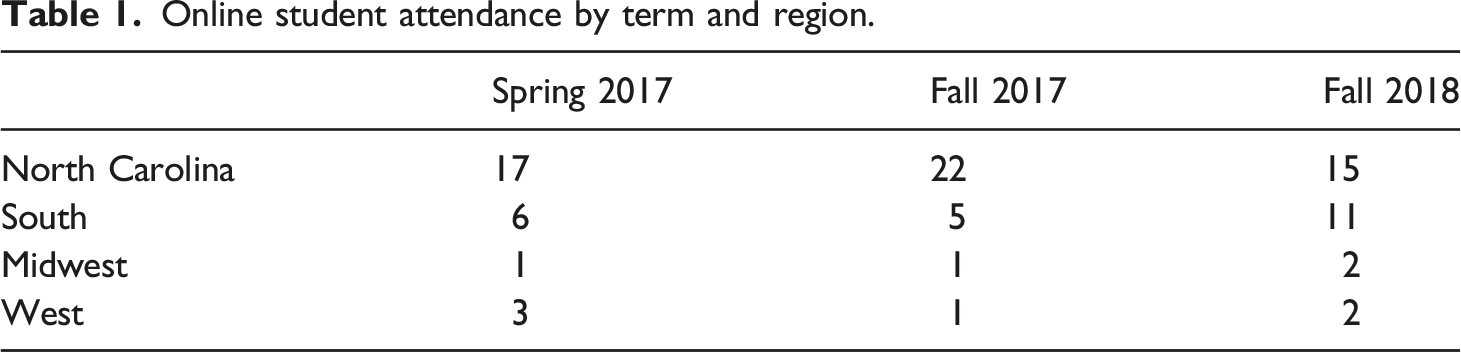
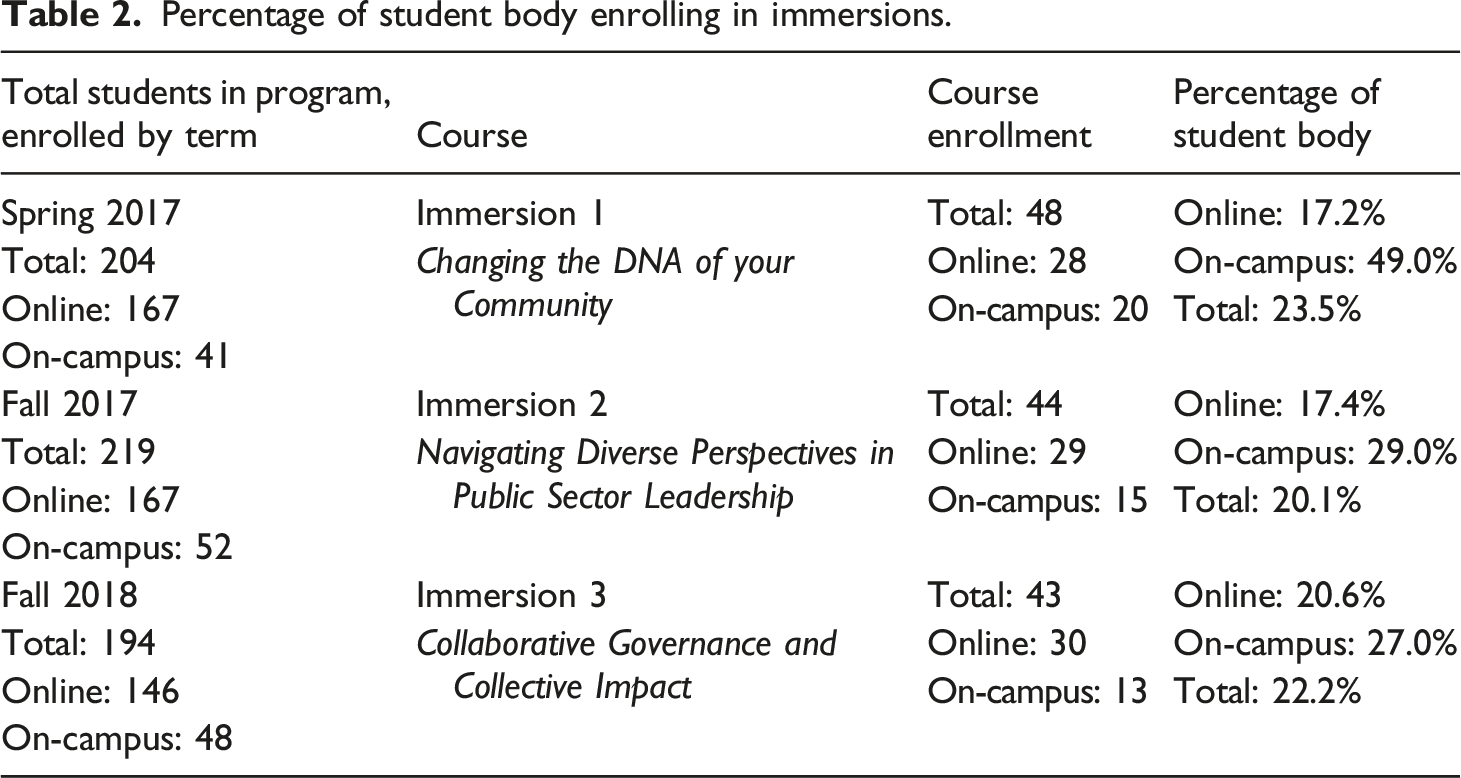
On-campus student enrollment decreased across the three courses: Immersion 1–20 students (49% of all on-campus students for that term) Immersion 2–15 students (29% of all on-campus students for that term) Immersion 3–13 students (27% of all on-campus students for that term)
Immersion enrollments were significantly larger than any other section or course in the MPA program. On-campus required courses are usually taught in a single section of 23–27 students. Online required courses have more than one section, with no more than 15 students per section. Elective courses are typically 7–12 students for on-campus and 10–15 students online.
Percentage of student body enrolling in immersions.
Primary instructors and other MPA faculty
Two, separate, faculty members were the course designer and lead instructor for Immersion 1 and Immersion 2. For Immersion 3, two MPA faculty shared the design and lead instruction. All four instructors were experienced in designing online instruction and had taught at least one online course.
Immersion 1 and Immersion 3 utilized other MPA faculty in teaching the face-to-face segments. Immersion 1 had three faculty instructors and Immersion 3 had one additional MPA colleague teach a segment. Immersion 2 and Immersion 3 also utilized practitioner panels (including alumni) for case study analysis or theory-to-practice sessions in their respective courses.
Immersion 1 and Immersion 3 developed advance videos for two distinct purposes. The first purpose was for marketing the course. The videos summarized the course topics and relevance to public administration practice and encouraged students to enroll. Immersion 3 co-leads created a second set of videos to guide students on asynchronous assignments and required readings.
Primary instructors provided brief advice to their successors for course structure and classroom activities. Some of the early lessons from a faculty perspective were: Not to let students assign their own groups. Not to assign group work prior to face-to-face class time (i.e., asynchronous portion). Be sure to provide a lot of in-class time for student reflection on course content.
MPA administrators—ongoing evaluation and adjustment
Following the Immersion 1 course, MPA staff created a guidance document for coordinated planning. The document addresses setting the course title and short description, the planning timeline for faculty and outside vendor development of online activities, materials, and assessments), marketing and course registration, and previous faculty advice (as noted above). 6
Aimed at online students, the Thursday afternoon prior to the first face-to-face session had a wide range of optional programming, with drop-in advising hours, a town-hall lunch with the MPA Director (available in-person and online for students not participating in the immersion), a campus tour, and student identification assistance. Other logistics included Thursday-Saturday meals at no charge to students. Immersion 2 and 3 had a major Friday evening reception (heavy hors d’oeuvres and drinks) with the MPA Alumni Council, other alumni, and MPA faculty interacting with students.
UNC-Chapel Hill-MPA program historically hosted a co-curricular annual event called the MPA Alumni Conference. On-campus students had often attended for both the substantive sessions and for networking with alumni. Informally, students reported the benefits of interacting with alumni professionally and socially. In 2014, online students were invited to the MPA Alumni conference. A few attended, but many noted that their limited time—usually balancing work, family, and studies—required a greater incentive to justify coming to campus. The last MPA Alumni conference was held in 2015. UNC-Chapel Hill-MPA program faculty and staff view the immersion course as a way to facilitate those kinds of connections comparable to the Alumni conference with the added benefit and incentive of students receiving course credit.
Utilizing the 1.5-credit hour elective option already in the curriculum, the UNC-Chapel Hill-MPA program director and staff undertook the immersion course design across 2016. A for-credit course open to students from both formats, with on-campus in-person instruction Thursday evening to Saturday 5:00 p.m. was considered attractive to online students. At the same time, the immersion course would be an elective, so online students were not obligated to attend. And with the online students on campus for a few days, opportunities for more networking with faculty, staff, and alumni could be built into the weekend as well.
As for curricular priorities, having short-term electives with different topics has been a positive outcome of adopting the immersion model. Choosing instructors has not been difficult, due to their areas of expertise and faculty interest in supporting ways for students from both formats to interact (Rivenbark, 2019).
Implementation, from choosing instructors to marketing and enrollment to the associated co-curricular events has been generally satisfactory (Rivenbark, 2019). Thursday afternoon optional events and appointments have had relatively low attendance, but this has not been a concern. First, these events are designed almost exclusively for online students. Second, online students have other options for most of the events via phone, email, and live online interactions with advisors and other MPA staff. Finally, the events have not required large investments of money or staff time.
The largest financial outlay was for meals. The two Friday evening receptions have drawn on MPA alumni and development support. The breakfasts and lunches have been received positively by students and reinforce the goal of making online students’ campus experience easy to navigate and supportive of socializing.
The one area for improvement is on-campus student involvement. Beyond course enrollment, MPA administrators seek relevant, low overhead ways for on-campus students to interact with the online students in the immersion course or associated events. Optional activities to date have not yielded the desired level of interaction. This is seen as a minor concern compared to other program goals.
Student experience: Course evaluations and repeat enrollment
Comparison of overall immersion evaluations versus other electives.
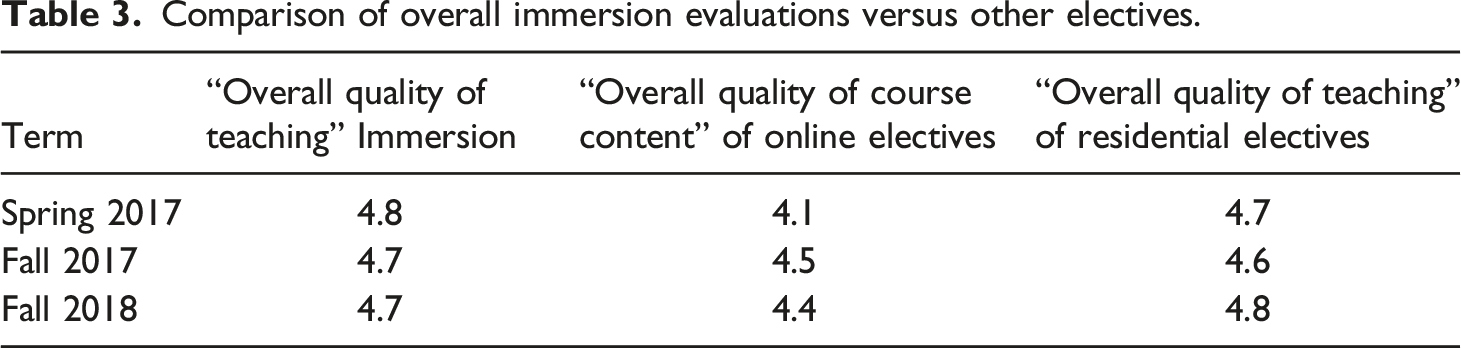
One key metric for student evaluation of the immersion courses is the question “How likely are you to recommend future immersions?” The responses were overwhelmingly positive: 92, 96, and 95% of students (respectively) responded somewhat or extremely likely.
An exact comparison of the immersion course versus all other electives is impossible. Unfortunately, different evaluation instruments are used for online versus residential formats. The closest “apples to apples” comparison can be made within semester, comparing responses to the immersion question about “overall quality of teaching” versus the average of the same question for all residential electives and average of the “overall quality of course content” for all other electives offered in the online format, for the same semester.
The qualitative data yielded from the student evaluations of the three immersion classes was more useful and offers insight into what students valued the most (including aspects of belonging) from the experience and offers guidance for future iterations. The evaluations asked the following open-ended questions: “The strongest point(s) of this course was (were)”: “The weakest point(s) of this course was (were)”: “What changes, if any, do you feel might strengthen this course?” “What did you like most about the Immersion?” “What did you like least about the Immersion?”
Eight themes from student feedback with number of comments for each theme versus total number of comments overall.
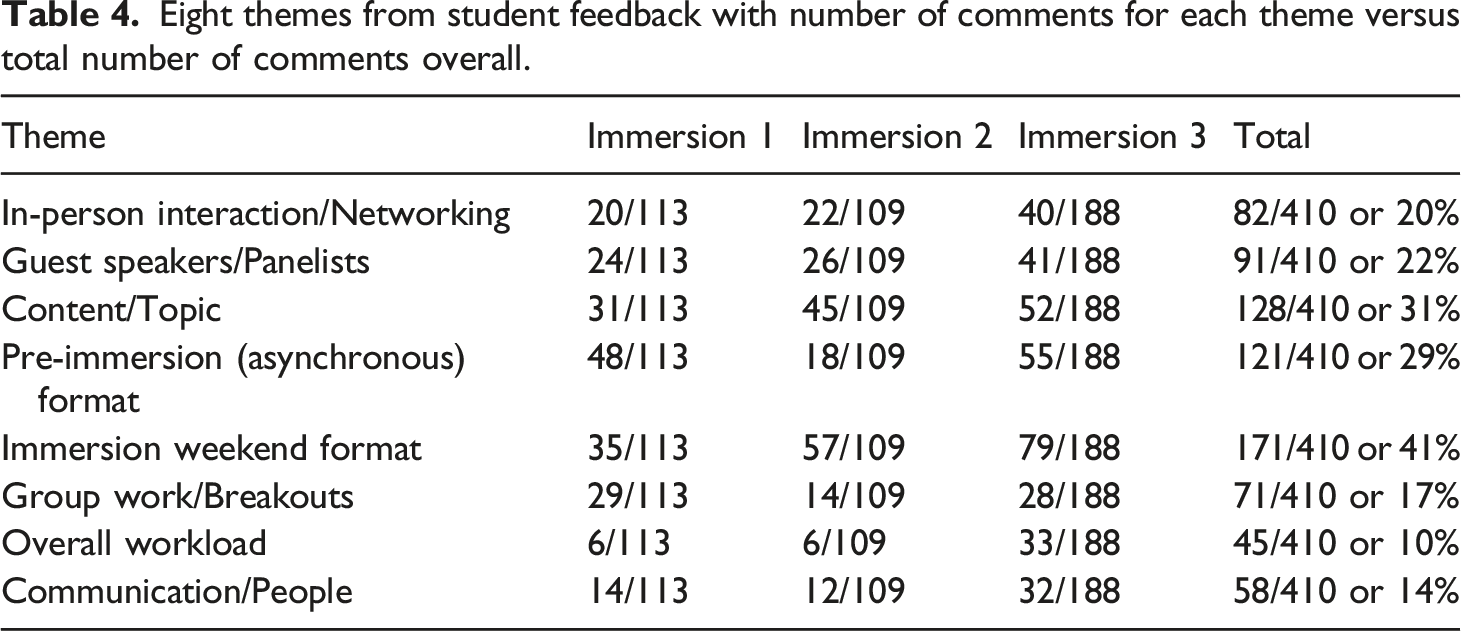
We explored subthemes within the eight thematic categories and looked for lessons that cut across all three courses; lessons that spoke to the immersion format itself rather than the peculiarities of individual instructors, reading choices, etc. Several themes related directly to student sense of belonging. The most common topic students discussed was the immersion weekend intensive, hybrid learning format (including the frequent opportunities for informal interaction and other aspects of being immersed in the campus experience). Other belonging-related themes included appreciation of networking, interaction with guest speakers (including faculty and alumni).
Many students across all three courses noted that, at times, the content during the two in-class days may have been too much. Students spoke of not trying to cram so much in and allow more time for student engagement of guest speakers and with each other (e.g., in breakout groups to discuss cases).
Another predominant point students made regarding the weekend intensive was how much they appreciated the in-person networking and interaction (one of the eight themes, per Table 4). The clear appreciation of in-person interaction with faculty, staff, and peers ties directly to the belonging.
Feedback on the pre-immersion, asynchronous coursework was mostly in the form of constructive criticism along four lines. 1. Numerous students wanted clearer instructions and direction for the asynchronous advance work. This frustration was noted by both residential students who were not used to asynchronous work as well as online students used to independent work, but whose other online courses were likely much more carefully structured (not to mention refined over time). 2. Residential students unfamiliar with the online learning platform used for the immersion course found there was a learning curve to navigating it. 3. There were many complaints about having too much assigned reading for a 1.5-credit course. 4. Some students wanted to see more connection between the readings and the content of the intensive weekend.
As mentioned, the feedback from online students supported the idea that they valued being on campus, interacting with faculty, fellow students, staff, and alumni in person. The feedback around the networking component was universally positive.
Students also offered ample praise for having guest speakers and speaker panels. This connected to the networking theme as students appreciated being able to interact with guest speakers, including other faculty. There were numerous comments about how bringing in practitioners offered a great theory-to-practice dynamic for the courses.
The qualitative feedback from students reflected the overall positive ratings of the immersion format. The vast majority of comments were positive, with particular emphasis on the value of the on-campus, in-person interaction and opportunity to connect theory-to-practice with practitioner presenters and real-life case study work. Weaker areas included the clarity and amount of reading and assignments prior to in-person instruction and getting the pacing of the intensive weekend of class time right. The feedback affirmed the main reasons for offering the immersion courses while at the same time pointed to aspects that course designers/instructors should pay particular attention.
Students enrolling in more than one immersion course.
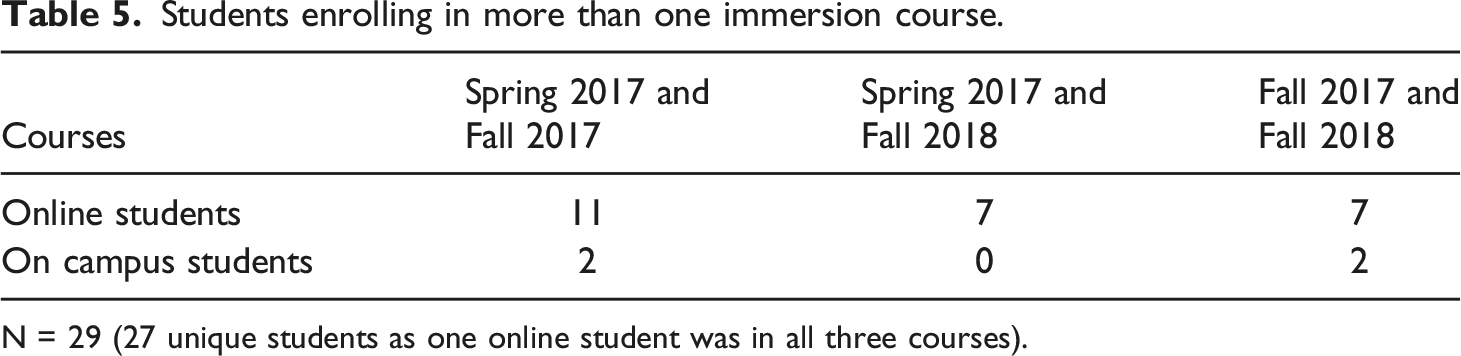
N = 29 (27 unique students as one online student was in all three courses).
There may be many reasons for students to take more than one immersion course. Factors for their choice could include topic and content; interest in the course instructors’ expertise; good timing in relation to other educational opportunities; family and work obligations; word-of-mouth support from students, and other variables. 8
Conclusion and advice for other MPA programs with online and residential formats
Online instruction for public administration is growing rapidly. This poses challenges and opportunities for public affairs program administrators in addressing how connected and satisfied online students feel compared to residential students.
The UNC-Chapel Hill-MPA program initiated an immersion course in Spring 2017 to meet several goals of students and program leaders. Large numbers of online and on-campus students could register and interact through the course and related activities. Different subjects and instructors allowed for learning on timely topics responding to student interests and developments in the public administration field. The course is a 1.5-credit elective course, so online students are not required to come to campus. The courses are built off a set of electives offered through the online program, and in response to a significant portion of online students who wanted an on-campus experience through a for-credit course.
The case study finds that student participation is strong, although with a smaller group of on-campus students after the first iteration of the course. Student evaluations are positive. Many correlates of student belonging showed up in the qualitative course feedback. Immersion courses appear to be a helpful strategy to enhance sense of belonging and satisfaction amongst online students.
The main guidance we offer to other programs with online and on-campus formats considering an immersion course for similar reasons at UNC-Chapel Hill-MPA, include: Preparing on-campus students for effective use of an online platform for work preceding face-to-face instruction. Including ancillary events and opportunities for online students to connect with faculty, students, and alumni. If they are coming to campus, make every effort to help them feel that they belong. This includes both formal and informal experiences. Avoid requiring student group work prior to face-to-face instruction. Utilize the intensive weekend format as an opportunity to go beyond traditional classroom activities. While lectures, case studies, and group work all have their place, having the time to bring in practitioner panels and otherwise expose students to a variety of voices (program alumni, other practitioners, in addition to faculty) is a great value-add to both online and residential students.
As the MPA program at the UNC-Chapel Hill continues strategically to build a sense of belonging and connectedness with residential and online students, the immersion class will be a key tool in its toolbelt. While the immersion class cannot be the only way online students are integrated into the graduate program, it is a powerful opportunity to accomplish many goals at once. Feedback from students and faculty at UNC-Chapel Hill participating in the first three immersion courses indicates it is a model that may be worth replicating in other public affairs programs that offer residential and online formats.
Footnotes
Declaration of conflicting interests
The author(s) declared no potential conflicts of interest with respect to the research, authorship, and/or publication of this article.
Funding
The author(s) received no financial support for the research, authorship, and/or publication of this article.
