




Abstract
The following contribution hypothesizes that it is crucial for future professionals in public administrations and organizations to be familiar with the concepts, tools, and techniques of policy, public, and social entrepreneurship to address societal, environmental, health, and wicked problems in an innovative and sustainable way. Attention is drawn to the importance of entrepreneurship as an essential asset and feature of public administration and public policy education at higher educational institutions in Germany and the United States. The paper aims at filling a research gap because knowledge about the interrelationships between entrepreneurship and public administration and public policy education is still underdeveloped. Emphasis is put on the discussion why entrepreneurship should be incorporated in curricula and how study programs have been designed or reformed, while placing emphasis on entrepreneurship in meeting current and complex challenges in the public sector. Findings from a systematic online assessment are presented which show whether and how policy, public and social entrepreneurship are taught as an integral element of current governance and public policy study programs and what difference it makes teaching and learning wise. The findings reflect a high demand for entrepreneurship education by public administration and public policy students, on the one hand, and a low incorporation in curricula, on the other hand. Two case studies from Germany and the United States are presented which serve as good practice examples on how to transfer public, policy, and social entrepreneurship into curricula.
Keywords
Introduction
Reflecting on the last decade of extraordinary global changes, we face pressing new challenges in politics, policy-making, and public administration that subsequently affect the design and content of academic study programs, as well as the methods of teaching in the fields of public administration (PA) and public policy (PP). Due to a host of new political realities—threats to liberal democracies, the renaissance of populist parties and actors, global migration, digitalization, the COVID-19 pandemic, climate change, and further pressing issues—the demand for interdisciplinary, transformative, practically-oriented teaching has increased tremendously. In this context, Rosenbaum (2014: 92) noted that society, but also political leaders, expect that governments and public officials professionally and effectively deal with and administer new challenges at the same rapid speed in which they emerge. This expectation can only be met if PA and PP education and training are improved accordingly. Whereas the demand for qualitatively-enhanced PA and PP education has generally been confirmed by scholars (Haupt et al., 2017; Knassmüller, 2016; Wessels, 2010), there is a lack of research, knowledge, and progressive ideas on how PA and PP curricula should be reformed to enable public professionals to cope with and manage new challenges in fast-changing environments. Special emphasis needs to be put on capabilities that go beyond the traditional skills set of public professionals, such as creative, innovative, independent, and critical thinking; and trying and testing new solutions. Furthermore, the capability to perform in a responsive, reflexive, and resilient way, especially when facing wicked problems, and the skill to reach consensus in impasses-situations, characterize professional PA servants today.
Whereas the need for reforming PA and PP education 1 is evident, and the competences, skills, and capabilities of leaders in the public sector organizations are analyzed and well-defined, the question of how to reform PA and PP education lacks scientific research and investigation. The following contribution is an attempt to fill that academic void.
This contribution discusses entrepreneurship as an important asset and feature of PA and PP education. Future public and policy entrepreneurs must be equipped with problem-solving, opportunity-seizing, and analytical skills, as well as the above-described capabilities (Shane and Venkataram, 2000; Wessels, 2020).
In this context, greater attention will also be paid to the role and importance of entrepreneurial leadership. Osborne and Gaebler (1992) paved the way for a vivid discussion, emphasizing the potentials of an entrepreneurial, reinventing government. As an effect of this debate, the number of leadership programs at universities increased significantly from 2000 onwards, first in the United Kingdom and the United States (U.S.) and later in other countries, either as single study programs, predominantly in business and management programs, but also integrated in PA and PP programs (Graeme et al., 2008).
Therefore, the article puts emphasis on the role of public and policy entrepreneurs who are motivated by diverse interests, such as improving services to their own communities and increasing the level and quality of public goods (e.g. health, safety etc.) available to citizens. They also show high capabilities to manage conflict through negotiation and mediation and align various interests (Mintrom and Norman, 2009; Ostrom, 2005). We further emphasize the role of social entrepreneurship (a) due to pressing societal and environmental problems and (b) to enhance the concept of entrepreneurial leadership in the public sector.
We hypothesize that it is crucial for future professionals in public organizations to be familiar with the concepts, tools, and techniques of policy, public, and social entrepreneurship to think out of the box, seize opportunities, and make a sustainable difference in society. Attention is drawn to the importance of entrepreneurship as an essential asset and feature of innovative entrepreneurship education, with the goal of promoting public and policy entrepreneurship to develop and implement new solutions for local-global problems (Hynes, 1996; Lackeus, 2015; Volkmann and Audretsch, 2017). The paper aims at filling a research gap because knowledge about the inter-relationships between entrepreneurship and PA and PP education is still under-developed, though essential to better understanding the key challenges of societies and designing innovative policies for sustainable and inclusive development (Demircioglu and Chowdhury, 2020).
This contribution will reconsider the concept of entrepreneurial leadership and the role of entrepreneurship education in context of PA and PP study programs at universities. Further, the concepts public, policy, and social entrepreneurship will be distinguished. Although the activities of public and policy entrepreneurs have received attention in a substantial number of studies (Berni and Hafsi, 2007; De Leon and Denhardt, 2000; Hisrich and Al-Dabbagh, 2013; Klein et al., 2010; Mack et al., 2008; Mintrom and Norman, 2009; Mintrom and Vergari, 1996; Roberts and King, 1996), both concepts have apparently not been incorporated into PA and PP education (Grimm, 2019a). This is more notable concerning social entrepreneurial tools and techniques and their role and importance for PA and PP education. To facilitate more integration of these concepts, this paper offers a brief theoretical discussion of the typological classification of the variety of entrepreneurship with the goal of answering the question: Why should these concepts be taken into consideration in a university PA and PP study programs? Therefore, the paper will first explain why the importance of incorporating entrepreneurship in the core curricula of PA and PP programs has increased. Second, it will investigate what should be changed and reformed in the context of PA and PP education and curriculum to prepare entrepreneurial bureaucrats for meeting current and future wicked problems, while emphasizing the role of entrepreneurship. This discussion is linked to the analysis of how entrepreneurship can be incorporated in public sector management and administration.
In this context, two case studies from Germany and the U.S. are presented for an in-depth investigation on how educational PP study programs and curricula have been designed and/or reformed, while placing emphasis on entrepreneurship in meeting current and complex challenges in the public sector.
Our paper is structured as follows: In the next Section, a theoretical framework is developed which pinpoints to the differences of public and private sector organizations being challenged by fast and wicked changes and challenges resulting in the growing importance of teaching leadership and entrepreneurship in PA and PP programs. The transfer from old to new paradigms of administration and bureaucracy is reviewed to explain the emergence of the concept of entrepreneurial and transformational public and policy leadership. In the following, the concept of entrepreneurship is explained with a conceptual differentiation between public, policy, and social entrepreneurship, as all concepts play a crucial role for PA and PP programs. The increased incorporation of entrepreneurship education and training at universities is documented and serves additional evidence for this assumption and allows to drawing conclusions about the core elements of PA and PP entrepreneurship education. After presenting the methodology and data assessed in this research, the findings are presented which reflect a high demand for entrepreneurship education by PP and PA students, on the one hand, and a low incorporation in curricula, on the other hand. Two case studies from Germany and the U.S. are presented which serve as good practice examples followed by conclusions and outlook.
Theoretical framework and conceptualization
The purpose of this section is to reflect on changing paradigms of public administration and the current, complex, and wicked challenges that demand entrepreneurial leadership from public servants and policy makers. Wessels (2020: 152/153) analyzed the manifold meanings of the concept “challenge” in the context of public service education and performance, and distinguished between the attributes, task, “difficultness” referring to wickedness, “supercomplexity” (Quinn, 2016: 12), or non-specification, and capabilities to better grasp the concept. He presented insights and empirically findings, including a) which capabilities and skills of future public professionals need to be improved and b) what consequences this may have for rethinking and reforming PA and PP curricula. He pinpoints to the task of governments to not only act proactively, but also in an enabling and facilitating way (Wessels, 2020: 153) in responding to so-called “wicked” problems emerging since beginning of the millennium. They are described as unique, global, complex, and lacking an immediate, consistent, and clearly and well-defined response and strategy that is applied across states, nations, and continents (Rittel and Webber, 1973: 160–163). These current multi-national, multi-sector, and transboundary challenges affect policy makers and public servants not only at the global or national level, but also at a local level; PA and PP curricula have to respond accordingly, resulting in “(…) a gradual paradigm shift (…) from objective-based, competency-based curriculum mapping approaches (…) to capability approaches” (Wessels, 2020: 160).
In this context, it is necessary to reconsider the ongoing and vivid debate about transferring entrepreneurship into public administration and bureaucracies, and the assumption that models of entrepreneurial leadership can be directly adapted from private to public sectors. The transfer and adaptation of concepts and models of entrepreneurship to the public sectors requires contextual sensitivity with regard to the organization, staff members, and various stakeholders involved in public policy making, as well as a clear understanding of the mandate (creating public value) and administrative challenges in bringing about change and efficient outcomes through public entrepreneurial activity. Public sector organizations are facing manifold, competing, and potentially incompatible interests and need to manage and cope with diverse objectives. Their mandate is to compromise between multiple stakeholders to engage and solve social, political, environmental, and economic issues in a rather transparent manner with tight decision-making autonomy and flexibility, whereas private organizations operate within the framework of a limited number of relatively stable goals, such as growth, profitability, or market share. Business leaders are driven by the profit motive and competition and are accountable to their shareholders. Public sector organizations are funded by taxation and are accountable to tax payers, in other words, to a great number of diverse, equally powerful stakeholders. Within such an environment, characterized by a variety of actors, interests, problems, and expectations, the tolerance for making mistakes is low, affecting the willingness to take risk and the entrepreneurial behavior, activity, and leadership of public sector employees and servants (Hisrich and Al-Dabbagh, 2013: 8–15; Kearny et al., 2008: 275–279; Moore, 1995). Reflecting on the pressing wicked, cross-sectional, and multilevel problems that public administrators face today in a fast-changing environment, the careful transfer of entrepreneurship into PA and PP education, as well as bureaucracies, is badly needed. Demircioglu and Chowdhury (2020) confirm that, despite such urgent demand, there is lack of research and knowledge on how public sector entrepreneurship can be increased, while taking into account the peculiar structures and features of bureaucracies and the low incentives for public servants.
Paradigms of public administration and entrepreneurial leadership
The role of entrepreneurship for policy making and entrepreneurial leadership in public administrations seems somewhat non-evident at first glance but becomes clear when considering the shift from traditional public administration to new public management (NPM) reforms that evolved into new forms of governance and entrepreneurial bureaucracies (Hisrich and Al-Dabbagh, 2013; Ohemeng, 2017). The role of entrepreneurship within a public sector context evolved slowly though constantly over time.
The traditional Max Weber-style bureaucracy emphasized stability and predictability, functional specialization, and rational, efficient methods of public organization characterized by hierarchical authority, discretion, impersonality, precision, strict subordination, knowledge of the files, and impersonality. This bureaucratic style and administrative ethos brought about major disadvantages when turning from a managerial to a post-industrial and then entrepreneurial economy in the second half of the 20th century (Audretsch and Thurik, 2000; Weiss, 1983). Public organizations became preoccupied with dictating how things should be done—regulating the process and controlling the input—so that they ignored the outcomes. Bureaucracies developed a distinct ethos and evolved into slow, impersonal, and inefficient organizations. The divergence between the operational realities in traditional bureaucracy, on the one hand, and the requirements of a post-industrial economy and society, on the other, fueled the spread of New Public Management (NPM) reforms from the 1970s onwards, resulting in a new discourse on the role, management, efficiency, and effectivity of public sector organization. In its most extreme form, this asserted the superiority of private-sector managerial techniques over those of traditional public administration techniques; the application of such techniques to public services with the goals to create market mechanisms within public administrations that follow and measure a priori defined objectives (Hood, 1991). Public servants received the freedom to manage and experienced early forms of entrepreneurial leadership, while providing politicians with greater authority to set strategic directions and to allocate resources. The shift from the bureaucratic model to managerialism was not only welcomed, but also hotly debated and criticized. Moore (1995) underlined that the transfer of private sector managerialism to the public sector is, to a certain extent, contradictory to the mission of public sector organizations, which is to create public value (Hogget, 2006). In the following, a new approach emerged related to the “public value” agenda, with a focus on public value creation and innovation, accelerating the rise of governance, and foregrounding transformational, entrepreneurial leadership.
New forms of governance affect the work and activities of public sector organizations facing advanced procedures and processes of co-operation, networking, and schemes of regulation; negotiation of actors at multi-levels of government and administration; new participatory elements within and beyond bureaucracies; an increase focus on social and political cohesion; as well as civic participation and engagement. The hierarchical nature of the public leadership model was outmoded and superseded rapidly due to a world characterized by networked interdependency, in which “no single authority is formally and exclusively ‘in charge’ (…). Order is fundamentally negotiated, and the acceptance of leadership in networks does not rely on power to decide and impose, but instead on the ability to seduce parties to commit to the network process and to orchestra helpful dialogue and cooperation between them (t’Hart, 2011: 326/327).
With their path-breaking volume on reinventing government, Osborne and Gaebler (1992) offered a variety of ideas on how to make bureaucracies more entrepreneurial without following the ideas of the NPM and going beyond the concept of governance. They regard entrepreneurship as an attitude and mindset promoting innovative, solution-oriented action to make bureaucracies more efficient and effective. Policy entrepreneurs are crucial to paving new paths for designing and implementing public policy and are key actors in the policy process. Future policy makers need competences to draw lessons, understand context, align bottom up and top down approaches, communicate professionally, build up trust, be inclusive, and engage with an entrepreneurial attitude, rather than to apply a one-size-fits-all approach (Rose, 1993).
The notion of an entrepreneurial leader and bureaucrat was introduced in the 1980s alongside the emergence of the concept of transformational leadership that emphasizes change orientation, visionary organizational activity, and charismatic and influential leadership behavior that impacts processes and followers (Bass, 1996). This development followed and built on the situational transactional leadership approach that focused on management and the top-down, efficient delegation of tasks (Bass, 1985). The entrepreneurial leader in public administrations was first defined by Eugene Lewis (1980), and further explained by Doig and Hargrove (1981). Van Wart offers a comprehensive overview of the growing literature, following the before mentioned pioneers (Van Wart, 2003: 219–220). He refers to prominent publications that emphasize public leaders’ role in creating, managing, and materializing change from the mid-1980s onwards (Kotter, 1990; Van Wart, 2003: 221). The shift to a new knowledge-based economy with a strong focus on customers, as well as from an exogenous to an endogenous growth model (Romer, 1994), has undermined old conventions, requiring more encompassing leadership styles in the private and administrative sectors. Due to the turbulent, diverse, and fast-changing environments challenging the private sector, government and bureaucracies adapted their policies in order to enable actors in the economy, enforcing competition and cooperation (instead of one or the other).
Whereas the variety of leadership aspects has been discussed and developed continuously by researchers and educators in the fields of business and psychology, since 1990, a shift has been seen in leadership research in the political science, policy, public administration, and public management fields, with the goal of better aligning powerful stewardship with entrepreneurial attitude, responsiveness, and activity in bureaucracies.
Today, different types and levels of leadership confronted with high contextual complexity require various and exceptional skills and traits. The demand for entrepreneurial leadership has consequently increased; the consequences for curriculum advancement applying encompassing models of transformational leadership in education and training in PA and PP programs are still rather missing, or vaguely conceptualized or defined.
Entrepreneurship as a core element of a public administration and public policy curriculum
The concept of entrepreneurship in the public sector is not new; the number of publications appearing in Web of Science journals with the key words “public entrepreneurship” and “public sector entrepreneurship” increased significantly from 1980 until 2019 (Bernier and Hafsi, 2007; DeLeon and Denhardt, 2000; Hayter et al., 2018; Kingdon, 1984; Klein et al., 2010; Leyden, 2016). On the contrary, the academic interest in entrepreneurship education is rather new and has increased significantly in recent years (Volkmann and Audretsch, 2017), and the reasons for the emerging role of entrepreneurship in PA and PP programs are manifold. First, entrepreneurship is important at the individual level with regard to certain skills and attitudes, including creativity, innovativeness, and a specific mindset characterized by a positive understanding of risk, action, and failure (Drucker, 1985; Schumpeter, 2008 [1934]; Shane and Vankataraman, 2000). The emphasis on personal leadership traits was already a major theme being discussed and advanced in the 1940s by scientific methodologies highlighting individual skills, attributes, and characteristics, as well as scientific management research drawing on competencies to fulfill roles and assignments (Van Wart, 2003: 218). Traits also determine entrepreneurial behavior next to the ability to develop creative ideas and to convince followers and stakeholders to support and implement them. Nowadays, the traits of an entrepreneurial leader and bureaucrat are defined more specifically and associated with personalities who perceive opportunities and exploit them (Shane and Venkataraman, 2000: 217). This perspective is shared by Drucker (1985), who further associates entrepreneurship with the creation and the implementation of new forms of management. Schumpeter (1942) stressed that innovation and creativity are correlated with entrepreneurship and a precondition for professionally managing public, as well as non-profit, organizations. He also underlined that entrepreneurship is a mindset that produces certain kinds of behavior. These include grasping seizing opportunities, transferring and implementing new ideas, and the ability to change: “(…) the entrepreneur always searches for change, responds to it, and exploits it as an opportunity” (ibid.: 28).
Entrepreneurship serves as a driving force to improve the quality and delivery of public goods and services in order to bring about social change and development. The complexity, demand, and extent of political action taken by decision makers and the challenges for public servants to transfer policy into action have recently increased drastically due to digitalization or the coping with a new pandemic. This further explains the demand for new contents of teaching in PA and PP, considering entrepreneurship as a value added.
Valerio et al. (2014) provide a comprehensive overview of entrepreneurship education and training (EET). Although entrepreneurship education became a major component of many business and management programs, there is an ongoing debate whether entrepreneurship can be learned and which content and aspects should be taught (Lackéus, 2015; Pittaway and Cope, 2007). Traditionally, EET training served to support entrepreneurs in developing a business idea or new product and exploiting it in an entrepreneurial and profitable way. The predominant method of teaching utilized tools such as writing business plans. Other entrepreneurial skills and competences are regarded as the “art” of entrepreneurship and are rather difficult to be learned, including reactive and innovative thinking, but also soft skills, such as negotiation, resilience, risk propensity, leadership, persistence, and ways of facing critical stages of development (Fayolle and Gailly, 2015; Rauch and Frese, 2007; World Bank, 2010). The World Bank defines EET as an “(…) academic education or formal training interventions that share the broad objective of providing individuals with the entrepreneurial mindsets and skills to support participation and performance in a range of entrepreneurial activities” (Valerio et al., 2014: 21). Fayolle’s definition of EET is similar and also useful for further analysis in context of public or policy entrepreneurship: “(…) any (short or long term) pedagogical program or process of education for entrepreneurial attitudes and skills which involves developing certain personal qualities” (Fayolle et al., 2006: 702).
Lackeus (2015) developed and applied three categories of EET that are useful for a better understanding of how to teach public and policy entrepreneurship: education for, about, and through entrepreneurship. Whereas the first category highlights a very practical understanding and learning, the second category includes theoretical aspects and awareness education, and the third category goes beyond both other aspects by reflecting on entrepreneurial values and skills, problem-solving, conflict management, communication, etc. and is, therefore, also important for the education of future policy entrepreneurs. By turning to practical and real-life experiences, including role plays, participation in business idea competitions, and interaction with real world practitioners, the processes and challenges of entrepreneurial activity, as well as a capability for overcoming obstacles and reaching high goals, can be taught and enhances the development of an entrepreneurial mindset (Ramirez-Gonzalez, 2017: 18).
Public entrepreneurship
Public entrepreneurs try to foster a culture of innovation and entrepreneurship in public organizations to bring about beneficial reforms serving public interests (Bernier and Hafsi, 2007). Kearny et al. (2009: 28) summarize in their definition that public sector entrepreneurship is “the process that exists within the public sector organization that results in innovative activities such as the development of new and existing services, technologies, administrative techniques, new improved strategies, risk taking and proactivity.” King and Roberts (1991) also emphasize that public entrepreneurs act inside administrations and government institutions with the effect that they need to collaborate with public bureaucrats and internal stakeholders, on the one hand, and with politicians, on the other hand, to translate their innovative ideas. Polsby (1984: 171) underlines that these forms of collaboration may result in a “symbiotic relationship” with political leaders and politicians which is a prerequisite for public entrepreneurs to move their new policies in the policy process. Roberts and King (1991: 148) even speak about “coupler(s) in a very complex policy process.”
Indeed, public entrepreneurs and leaders act in various, complex environments and arenas—political, policy, bureaucratic, civic—and face varied tasks, duties, and performance challenges. The mission of public entrepreneurs is to ensure the successful integration of innovation into the work of public agencies and organizations and to create innovative products and processes while managing scarce public resources with or without possible private resources, whereas the implementation of innovation is the culmination of entrepreneurial activity grounded in idea development and followed by the design and development phase (Klein et al., 2010; Mack et al., 2008; Schumpeter, 1942).
Bernier and Hafsi (2007) argue that public entrepreneurs may also act in teams and pursue systematic actions, slowly reinventing their public agency or organization. They define a public entrepreneur as a person contributing to building a public organization or to fostering its ability to deliver services and create value, e.g. through new laws, regulations and policies (Bernier and Hafsi, 2007). Public entrepreneurs encounter possibilities for innovation, but also institutional barriers, since they are restricted by their political system and context (Klein et al., 2010). t’Hart (2001: 325) adds for consideration that the success of good public leadership is difficult to measure, referring to the diverse, contextual, and institutional governance environment, but also the motivation of leaders to consolidate their positions either by (re)appointment or (re)election; the extent to which followers and allies contribute entrepreneurial leadership sustainably (follower perspective); or the degree of “legitimacy, performance and continuity of public organization.” He proposes a tringle for measurement that aligns smart, accepted, but also accountable leadership behavior.
Public entrepreneurs need manifold skills to achieve their mission, facing the difficult task of bringing about change through innovation. Bellone and Goerl (1992) describe autonomy, a personal vision of the future, secrecy, and risk-taking as the four important characteristics of public entrepreneurs. Effective leaders “accept, manage and negotiate difference (…)” (t’Hart, 2001: 326), encourage dialogue and communication within diverse environments, compromise between potentially contradictory and heterogeneous interests in complementary and efficient ways, and align a critical mass of followers behind innovative ideas transferred into a policy process and/or into administrations (Ostrom, 2005).
Policy entrepreneurship
Entrepreneurs contribute not only to economic progress, but also to overall societal change through entrepreneurial activity. The policy entrepreneur is a type of actor who not only develops ideas for solutions to political and social challenges, but also designs measures and instruments for implementing and promoting change (Grimm, 2010; Ostrom, 2005). Such processes are driven by a type of actor who develops not only innovative and creative ideas for the solution of socio-political challenges, but also provides tools and instruments to transfer and implement them in order to promote political and policy change. We draw on the definition by Roberts and King (1991: 147ff) who refer to policy entrepreneurs as actors who influence the policy process from outside the formal bureaucratic and government institutions different from public entrepreneurs which makes them more independent from the political establishment but also less integrated in the formal policy process. Based on a longitudinal, multi-method, large-N survey they refer to educators, authors, writers, researchers etc. who develop innovative policy idea and advocate for radical change and emphasize their power and strong will “to shape the direction of history” (ibid.: 159).
Policy entrepreneurs are frequently, in the Schumpeterian sense, visionaries who think the unthinkable and set in motion rather unimaginable ideas and political processes by mobilizing the public and civic society, forming new coalitions with diverse stakeholders, and accepting, if necessary, considerable costs in the form of time or money to reach their mission (Grimm, 2019a; Mintrom and Norman, 2009; Schumpeter, 1942). “Policy entrepreneurs represent actors that are capable of bringing about the implementation of their political ideas, even if material distribution conflicts have gained the upper hand in the political process and lead to the organization of powerful oppositional interests” (Roberts and King, 1996: 5).
The policy entrepreneur overcomes political stagnation and inertia caused by short-term, instrumentally rational, and even egoistic thinking of political actors who seek to maximize their own benefit in the political process. Consequently, the policy entrepreneur does not act according to routine (maximizing short-term interests), which would lead to political stagnation. He/she acts as a promoter of political change processes, enters new paths, recognizes new political possibilities (windows of opportunities), and is not afraid of any resistance in the implementation of innovative ideas. In their research about activities of policy entrepreneurs involved in political change processes, Roberts and King (1996: 117) highlight the role of creative/intellectual skills and activities (among them, developing and disseminating new policy ideas); strategic activities (e.g. formulating visions and developing political strategies and action plans); mobilization activities (e.g. building up lobby groups and media support and obtaining support from politicians); and evaluation of activities. The mobilization of media, support groups and elites and the generation of funding to realize their ideas are essential.
Social entrepreneurship
Social entrepreneurship has demonstrated an increased importance in policy debates in countries all over the world, as well as in the number of public policies for promoting an ecosystem conducive to social business development and promotion (Agapitova et al., 2017; OECD, 2013; Terjesen et al., 2011).
Social entrepreneurial activities can play an important role in addressing pressing societal issues in general, which the state has failed to address, while also fostering inclusive growth, delivering good quality value and welfare, and increasing social inclusion, mostly at the very local level, either in cities or remote areas (OECD, 2013). Social entrepreneurship has further been acknowledged as playing a key role at the supranational level, for example, in achieving the United Nations’ Sustainable Development Goals (SDGs). Considering the 17 SDGs and the interrelationship and interaction between societal, corporate, and governmental elements, social entrepreneurship and public policy should be given high priority by policy-makers.
The reasons for the renaissance of social entrepreneurship are diverse, among them, a permanent and lasting disappointment with governmental and philanthropic efforts that had only moderate or no success to decrease socio-economic and environmental drawbacks. “Social entrepreneurs are one species in the genus entrepreneur. They are entrepreneurs with a social mission,” stressed J. Gregory Dees in his treatise that is still groundbreaking for research in this field (2001: 2). The clear, explicit formulation of a social mission as the purpose of action is central for social entrepreneurs as much as the generation of income to achieving social goals. The social entrepreneur differs fundamentally from the traditional, altruistically acting philanthropist because the generating of income for the financial security of a socially motivated project is recognized as an important means to an end (Emerson and Twersky, 1996).
Due to the complexity of socio-economic problems, however, it is assumed that there is no ideal solution for the achievement of the mission, but rather a creative and innovative process of experimenting, learning, and adjusting. There is further a high probability that social entrepreneurs may fail, which is explained by the fact that social entrepreneurs are characterized by an above-average risk-taking attitude (Dees, 2001: 5). The social entrepreneur fulfills his mission if he/she 1) innovates solutions to public problems and/or dissolves existing, inefficient structures through social innovation and replaces them with more efficient and effective ones; 2) implements new tools, processes, services, and/or products for social problem-solving over the long term; and 3) generates sustainable change through social engagement (Wiley and Berry, 2015: 384).
This mission-driven approach of trial and error in creating public value and change significantly influences the teaching of skills development and training and further requires new forms that go beyond traditional forms of teaching in PA and PP programs. In this context, Wiley and Berry (2015) observe a shift from government to governance in public affairs curriculum over the last 20 years, also caused by the rapid emergence of a variety of new hybrid organizational structures in the public, social, and non-profit sectors. As a consequence, the interest in social entrepreneurship education has grown distinct from non-profit management teaching because “students need more experience and skills in understanding how to combine the best of public/nonprofit and business practices for agency missions geared toward social benefits” (ibid.: 382). The authors refer to an explosion of social innovation offerings in universities as well as the extension of cross-disciplinary programs emphasizing the encouragement of risk-taking, innovative attitudes, and entrepreneurial skills. “The days of public affairs programs teaching governmental bureaucracy and single-agency programs are over, as cross-sectional programs and collaboration have increased and become the norm for policy implementation and service delivery” (ibid.: 382). Parallel to the shift of paradigms of public administrations as described in the previous section, PA and PP programs went through a period of transformation from a purely government/bureaucracy/public administration management perspective to a transformative, entrepreneurial approach of post-modern public leadership and activity.
What differentiates policy, public, and social entrepreneurship?
The literature still lacks a consensus on what differentiates public from policy entrepreneurship. “Rarely are these terms defined, much less distinguished from each other” (Roberts and King, 1991: 151). This observation still holds true although the literature on public, public sector and policy entrepreneurship has increased substantially, since 2010. 2
We first distinguish between public and policy entrepreneurship by specifically drawing on Roberts and King (1991, 1996), t’Hart (2011) and Carter et al. (2019). Whereas public entrepreneurs act within the bureaucratic and political environment, policy entrepreneurs act from outside this context. As a consequence, policy entrepreneurs are more independent from politicians, parties, and internal administrative processes and pressures. Beyond idea generation, the policy entrepreneurs must engage in manifold activities including problem identification, advocating, lobbying, attracting, media attention, generating own funding for the good cause and collaborating with diverse stakeholder (Roberts and King, 1991: 158/159). Their ideas are radical and are targeted to change existent social, public and other deficits. And they rare rarely personally involved in bureaucratic policy processes. Policy leaders have, therefore, more flexibility and freedom to lobby for radical change and innovation.
Public entrepreneurs are directly involved in the full policy process and, as a consequence, there is a strong interdependence between them and the bureaucratic and the political environment. The advantage is that they are more or less directly involved in policy and decision-making processes. They receive crucial support for realizing innovative ideas if the relationship between them and politicians as well as public leaders is serving all of their interests. Maintaining support within a complex administrative context characterized by interdependencies is a very challenging task for public entrepreneurs. Furthermore, efficient public leadership and entrepreneurship must be linked to good governance, transparency, and accountability.
Social entrepreneurship is different from public or policy entrepreneurship in that social entrepreneurs aim at solving social or environmental problems through innovative approaches and projects that are funded by sustainable financial and human resources and incorporate multi-stakeholder outreach and advocacy. They are either serving in or out of public bureaucracies. Their projects should have the potential to scale-up and bring about considerable social and policy change, as well as public value in the long run. “Social entrepreneurship is not the same as policy entrepreneurship in that policy entrepreneurs work for policy change but rarely toward creating the organizational and financing structures to deliver that change” (Wiley and Berry, 2015: 384).
Method and data
We selected the U.S. due to a long tradition in PA and PP education in contrast to Germany where the first public policy program was launched, in 2002, and only few PA programs were offered by German universities by then. With the comparison we aim at assessing the number of PA and PP programs that incorporated entrepreneurship education hypothesizing a striking difference between both countries. We selected two prominent programs and PP schools for in-depth case analysis to further explain how public, policy, and social entrepreneurship has been incorporated in PA and PP programs successfully and what difference it made. The Willy Brandt School of Public Policy at the University of Erfurt (a rather small, public university with focus on humanities and social sciences) was chosen for in-depth analysis because it was the first PP program initiated by one of the youngest German universities, in 2002, with a focus on entrepreneurship teaching and research. The Kennedy School of Government at Harvard University (a big, private financed university covering the full spectrum of study programs) serves as a role model for innovative, entrepreneurial PP teaching and education since decades. The comparison aims at pinpointing to differences, similarities but also good practice experience enhancing future curriculum development. In other words, we applied a small-N most different systems design comparing two cases that are very different on most but not the variable of interest (Lijphart, 1971).
For our primary data, we ran a systematic online search conducting a quantitative (number) and qualitative (content, curricula) analysis of the courses of public, policy, and social entrepreneurship offered in PA and PP academic study programs in Germany and the U.S. The systematic assessment draws on information provided by the platform www.hochschulkompass.de for German universities and www.studyportals.com for US universities (last access on November 11, 2020). The platform www.hochschulkompass.de was chosen because it serves as the major information portal of the German Rectors’ Conference (Hochschulrektorenkonferenz), the voluntary association of state universities in Germany, especially dealing with teaching, studying, training, and research affairs of higher educational institutions (HEIs) in German academia and society. 268 HEIs publish their study programs and doctoral study opportunities here, representing around 94% of all enrolled students in Germany. Founded in 1998, it is the oldest online study information service in Germany. The study programs were systematically evaluated to assess whether public, policy, and social entrepreneurship education are integral part of existent PA and PP study programs, and to examine what difference they make for teaching and learning. Due to the modest number of outcomes, we examined all curricula in detail. We did not differentiate between public and private HEIs in Germany and the U.S.
The portal www.studyportals.com was further used for comparative analysis to assess the quantity of PA and PP Bachelor and Master programs at HEIs in the U.S. The www.studyportals.com platform is built upon extensive cooperation with academic partners, national institutes, and student associations, hence providing verified up-to-date rankings for more than 3,750 participating universities worldwide, among them, the 257 best universities and colleges in the US (November 2020).
The initial online research revealed that HEIs in the U.S. offer significantly more PA and PP programs than German universities. According to the assessed websites, U.S. universities offer 218 Bachelor and 533 PA and 254 Bachelor and 334 PP programs. In comparison, we depicted 20 Bachelor and 22 Master in PA and only one Bachelor and 11 Master in PP programs, in Germany. We included all German Bachelor and Master PA and PP German programs (54 in total) for analysis in our study. For the U.S., we counted 751 PA programs and 588 PP programs in total (November 2020).
Because the total numbers of PA and PP programs were much higher than the German ones, we faced validity problems if we had taken all U.S. programs into account and evaluated for comparison. Therefore, we further assessed a total of four U.S. study websites that offer a ranking of the best PA and PP programs in the U.S. (different from www.studyportals.com which ranks the universities and not single study programs) and selected a simple random sample of 57 HEIs offering the best ranked PA and PP study programs. In order to increase the validity of the sample, we additionally examined for the HEIs in the sample that also have an NASPAA accreditation. We evaluated the best PA and PP study programs while assessing 1) best-master.com (a website provided by Eduniversal); 2) ideas.repec.org (based on the Research Papers in Economics (RePEc) project); 3) nogre.com (showcasing the 30 Best NASPAA-accredited MPA Programs for 2019–2020; the Network of Schools of Public Policy, Affairs, and Administration (NASPAA) aims to ensure high quality education and training for public service candidates, striving to represent highest ethical standards accrediting suitable universities); 4) collegefactual.com.
Seven study programs occurred twice and thus overlapped, these were removed from the total number of study programs examined, the result is a sample of the best ranked 50 PA and PP programs for the U.S.
Findings
Entrepreneurship as core element of PA and PP programs in Germany
The content analysis for the 54 German PA and PP programs shows that public, policy or social entrepreneurship education is rarely offered: Entrepreneurship is taught in three of all German PP study programs only. Only one of them, the Willy Brandt School of Public Policy (Brandt School) focuses teaching and training on public, policy, and social entrepreneurship. The School emphasizes social entrepreneurship education in theory and praxis as a core specialization of the MPP program. Next to the Brandt School, the University of Mainz offers an elective seminar in digital entrepreneurship in a PP program; the University of Augsburg offers an elective module (start-up challenge) as integral part of the PP program.
Only three PA study programs (at two universities) offer entrepreneurship education, one of them incorporated by the Hertie School of Governance offering an elective module with focus on social innovation and entrepreneurship. The Zeppelin University teaches an elective course on general entrepreneurship as integral element of a mandatory module of the Master study program. All undergraduate students are obliged to participate in a workshop in entrepreneurship with special emphasis on social entrepreneurship at Zeppelin University.
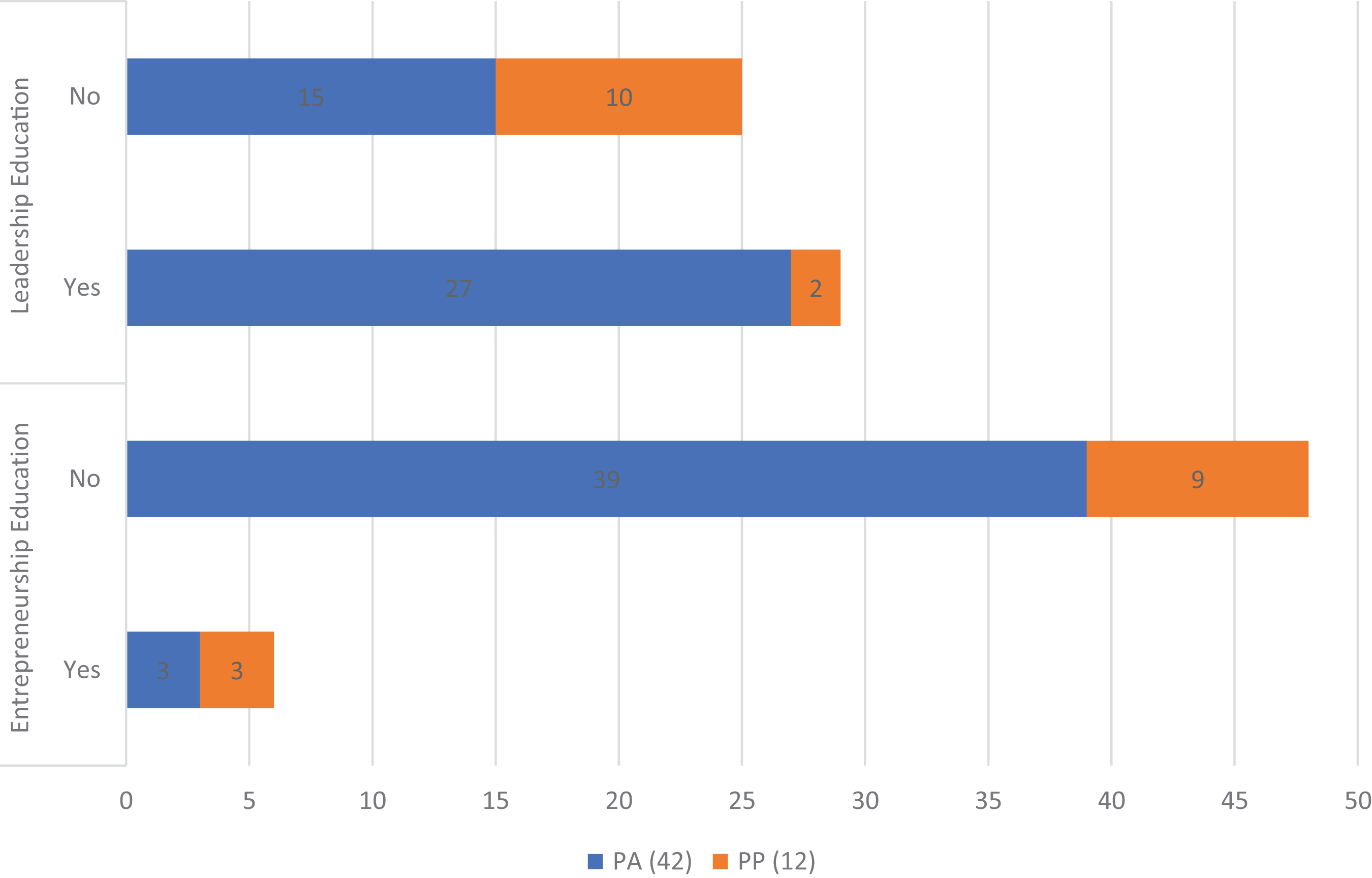
Entrepreneurship and leadership education as part of PA and PP programs in Germany (in total).
Only 11% of all German PP and PA programs offer entrepreneurship education. Figure 2 reveals that entrepreneurship education is rather provided in PP programs (25%) than in PA programs (7%). Only 5% of all evaluated PA and PP programs offer leadership classes whereas leadership education is far more often taught in PA programs (64%) than in PP programs (17%).
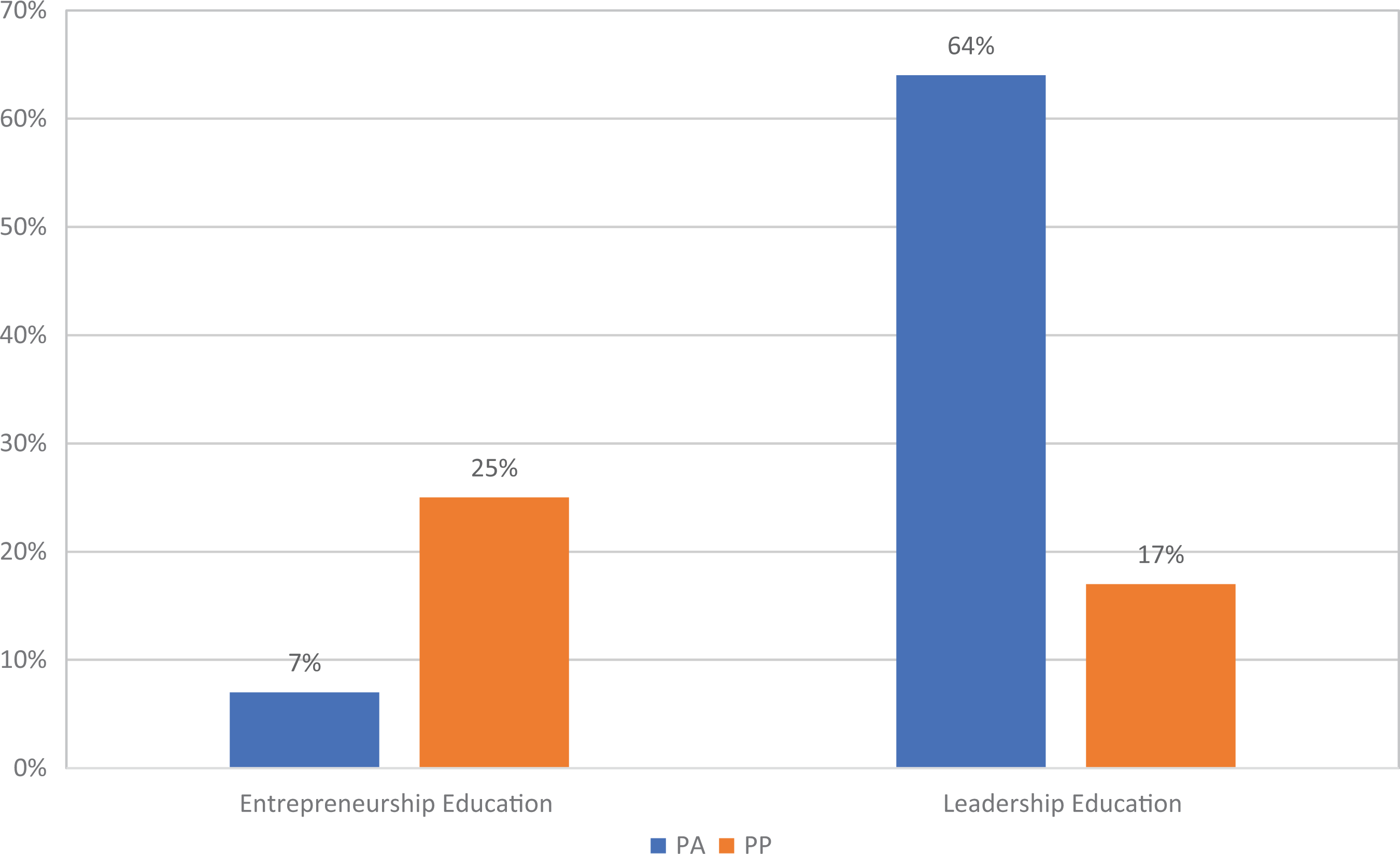
Entrepreneurship and leadership education as part of PA and PP programs in Germany (in percent).
Social entrepreneurship in PA and PP education and training in Germany
Particular attention was drawn on the role of social entrepreneurship education for PP and PA education in a German context. The website of the association Förderkreis Gründungsforschung e.V. (www.fgf-ev.de) was systematically assessed, which offers a comprehensive overview of all 146 entrepreneurship professorships currently established in Germany to profile whether a) their teaching and/or research is linked to any PA and PP study programs and b) we observe an increasing demand of social entrepreneurship teaching and learning at HEIs (last access August 12, 2020). Founded in 1987, Förderkreis Gründungsforschung e.V. (FGF) was the first association in Germany promoting entrepreneurship education at HEIs. Today, the non-profit association is the leading scientific association for entrepreneurship research, education, and policy in Germany, Austria, Switzerland, and Liechtenstein.
From all assessed PA and PP programs, we detected one university offering entrepreneurship courses, specifically going beyond entrepreneurship as part of leadership and non-profit management education. The Brandt School serves, therefore, as a case for illustrating how (social) entrepreneurship and entrepreneurial leadership education has been integrated into a PP curriculum.
By drawing on FGF online information, we profiled social professorships, education, and teaching currently in place. The following graph presents an overview of the variety of social entrepreneurship education and teaching in Germany. We identified 2 professorships, 1 core social entrepreneurship study program, 11 social entrepreneurship modules, and 3 modules in “Sustainable Entrepreneurship & Foundation,” “Social Innovation” and “Innovation Processes,” emphasizing social entrepreneurship in teaching.
Despite the varied program manifestations, social entrepreneurship education and teaching in PA and PP programs is still rather an exception taught at HEIs.
Hereinafter, we illustrate the manifestation of social entrepreneurship education and teaching in Germany. The assessment shows a broad and interdisciplinary spread. Most frequently represented are the study and teaching areas of sustainability, innovation, and management in a wider sense. Another landmark result is that social entrepreneurship already has a pioneering presence in technology, finance, and digital study programs.
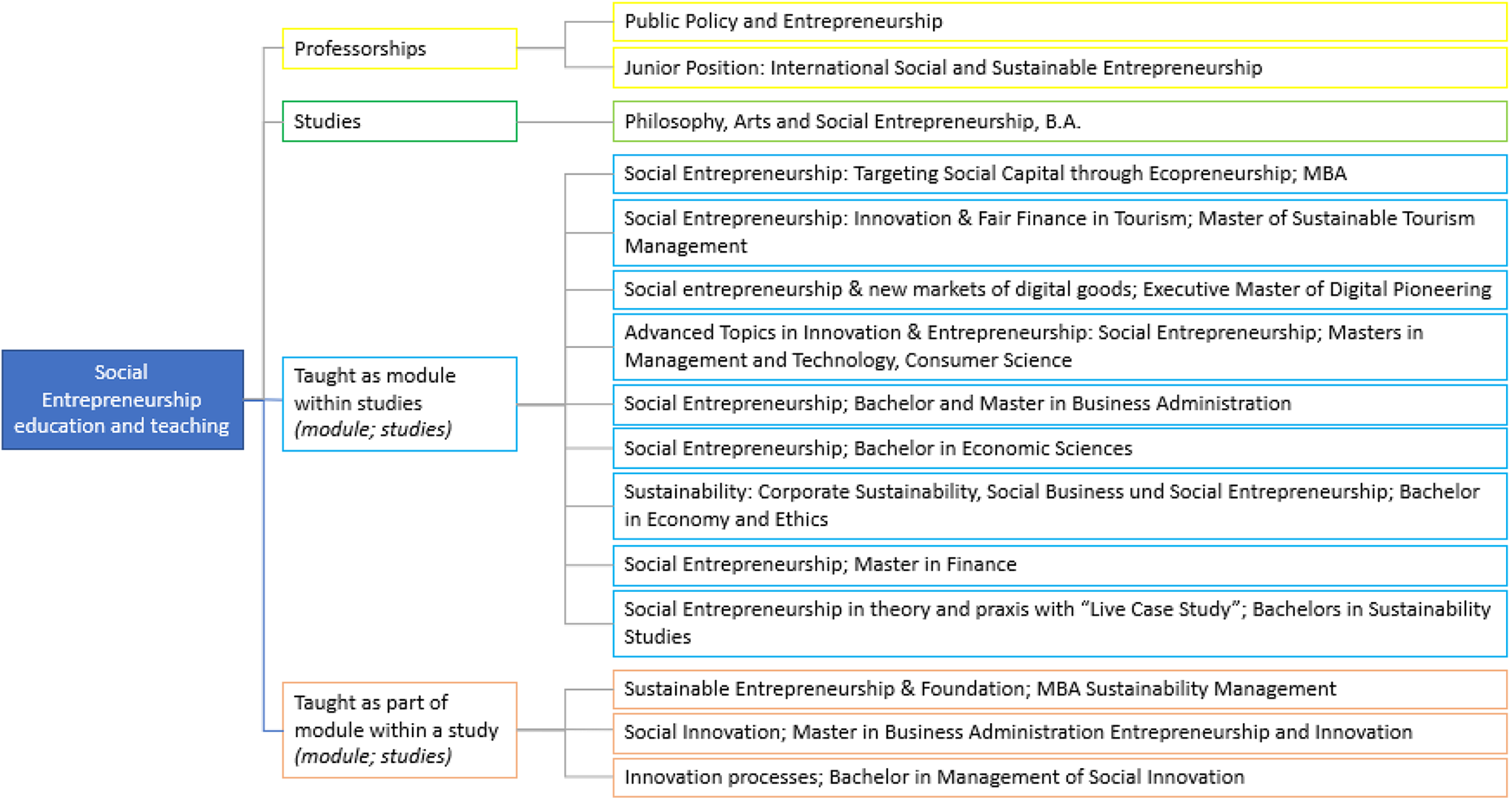
Variety of social entrepreneurship education and training in Germany.
Case Germany: The Willy Brandt School of Public Policy at the University of Erfurt
The Brandt School was founded in 2002. The School serves as Germany’s first public institution offering a 2-year international MPP at the University of Erfurt. The MPP is taught in English and places students in a unique international and intercultural environment. The majority of students enrolled with the Brandt School come from fragile, emerging, and developing countries. The aim of the program was and is to provide students with mostly international backgrounds with practice-oriented, academically-grounded, and interdisciplinary postgraduate education qualifying them for managerial and administrative leadership roles in the public and non-profit sector. The program imparts theoretical and practical knowledge and skills, particularly focusing on analytical and methodological expertise to prepare students as professional to lead and manage organizations competently, and to represent the interests of the public and wider society based on ethical values (Grimm, 2019a; University of Erfurt, 2020).
In addition to addressing good governance issues, the school’s strategic and analytical expertise in entrepreneurship has flourished steadily. No longer merely defined by its significance for the private sector and economic development, the study of entrepreneurship has also been acknowledged for acquiring practical and methodological competencies necessary for the promotion of transformative, progressive processes within public administrations (Audretsch, 2007; Karlsson et al., 2016). New forms of governance and emerging wicked challenges at a local-global scale demand high social, entrepreneurial, and public leadership skills to professionally and successfully act in polycentric systems (Ostrom, 2005; Wiley and Berry, 2015). As such, the focus on entrepreneurship in a public policy program—both in terms of teaching and research—has been a logical consequence for meeting high standards in education. Therefore, the rules and regulations for the MPP degree at the Brandt School have been adjusted accordingly, in June 2020, also taking into account that challenges differ significantly across the Global North and the Global South and demand an entrepreneurial approach to meeting sophisticated teaching standards which cannot follow a one-size-fits-all curriculum development (Wessels, 2020: 145). “The courage to act” (Quilligan, 2002: 62) is one of the main themes of the School, based on the Brandt Report, which was developed by the Independent Commission on International Development Issues, and was chaired by the former German chancellor and Nobel Peace Prize laureate Willy Brandt, in 1980. The School follows his vision to “create” the future, which is, by definition, linked to entrepreneurial behavior and associated with developing, implementing, and assessing innovation in public sector organizations, rather than transferring policies without prior efforts in lesson learning and geographic, cultural, or political contextualization (Grimm, 2019b; Lasswell, 1951, 1956; Rose, 1993).
Due to the aforementioned reasons, entrepreneurship education was adapted in various ways to fit into a public policy program that aims to educate future professionals in the public and non-profit sector. During the first year, students take mandatory courses in comparative public policy, economics, public administration, and finance, as well as quantitative methods. From the first semester onwards, students select two specializations and can choose between non-profit-management and social entrepreneurship, international and global public policy, development and socio-economic policies, and conflict studies and management. During the second years, students complement their studies with mandatory courses focusing on leadership, ethics, and advanced methods, and go through an intense practical training, which is similar to a capstone course from the Anglo-American context (University of Erfurt, 2020). In the course of recent curriculum advancement, the mandatory leadership class has been enhanced with entrepreneurial leadership theories and approaches linked to the growing importance of public, policy, and social entrepreneurship in public sector organizations, as to overcome the divide between educating about entrepreneurship to educating for entrepreneurship (Etzkowitz, 2004; Van Wart, 2003). The courage to act is related to the aptitude for transferring theoretical knowledge into practice and for creating public value. Therefore, the Brandt School has been offering courses on social entrepreneurship and social business development, since 2014. The approach has been a mix of theory and practice. The applied-oriented element includes developing a social business idea, working with a social business model canvas, collaborating with practitioners and successful entrepreneurs, receiving support and advice from local start-up public and non-profit consultancies, and participating in competitions. These are all elements of a public policy program today that aim to enhance transformational entrepreneurial skills. The success of this teaching is reflected several teams that won start-up and business idea competitions and turned them into social business ideas. Highly innovative business ideas are awarded with financial support schemes. By aligning a public policy education with social entrepreneurship and transformational leadership skills training, the Brandt School developed an advanced profile and successfully applied for federal grants with the Federal Ministry of Economics and Technology for implementing a social and international start-up campus at the University of Erfurt. 3 Previous successful start-up teams from the Willy Brandt School, such as MINTy Girls (the social business offers STEM teaching and programming modules at primary school for girls before entering high school), Sharing Living (the project aims to promote intergenerational interaction through shared living), or Amigo (a platform that links migrants to local bureaucracies in their own language), provided essential motivation for the idea and the development of a social and international start-up campus at the University of Erfurt. 4
This case study is enriched with empirical data drawn from a survey finalized in 2018 that was conducted among alumni that graduated from the school between 2002 and 2018. A questionnaire was sent out to 445 alumni, which aimed at evaluating whether social entrepreneurship education incorporated into an MPP. The survey focused on questions in the context of PP education, among them; whether graduates confirm (or not) a high demand for entrepreneurship education; what courses they registered for when enrolled in the program to develop and/or improve entrepreneurial skills; whether such participation has increased entrepreneurial (leadership) skills; and what achievements have been made after graduation that are related to entrepreneurship education in a public policy program. The response rate reached 39,3% (175 responses in total) and allows for drawing representative insights and findings about the impact of entrepreneurship education on employability and leadership abilities.
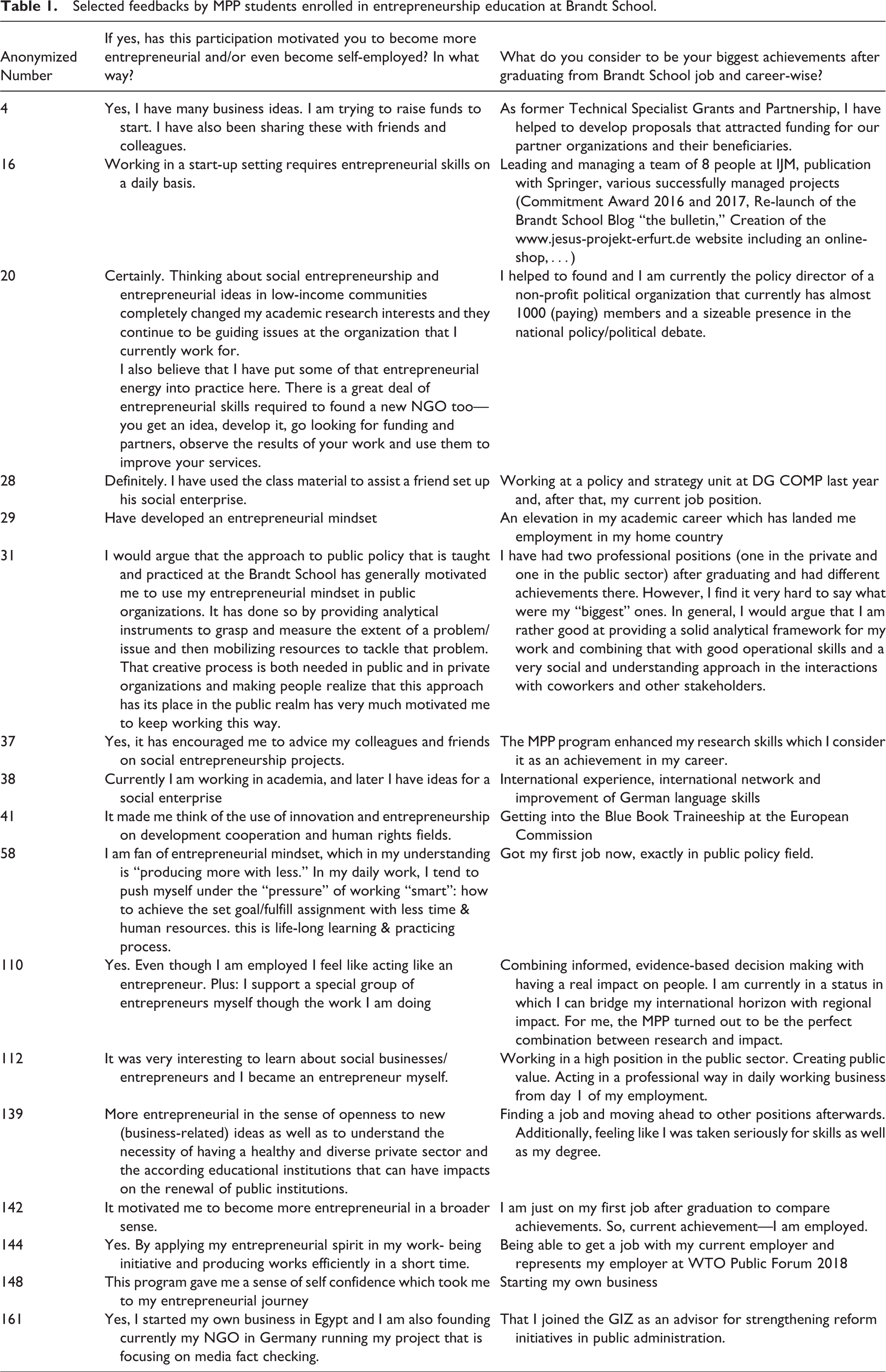
81% of the respondents confirmed and emphasized that entrepreneurship should be part of a PP study program. 14% gave a negative answer to this question, 5% answered “don’t know.” 62% confirmed that entrepreneurial skills are needed at their current workplace, 31% gave a negative response to this question, 7% answered “don’t know.” The findings underline a high demand for incorporating entrepreneurship education in PA and PP programs which is further reflected by the open answers which are presented in Table 1.
Selected feedbacks by MPP students enrolled in entrepreneurship education at Brandt School.
Entrepreneurship as core element of PA and PP programs in the U.S.
In contrast, slightly more of the assessed PA and PP programs in the U.S. offer entrepreneurship education, eight elective courses in total though no focus on public or policy entrepreneurship. We came across six PA study programs offering social entrepreneurship education as integral part of the programs: Syracuse University (stated as faculty focus but no regular course offerings per semester); George Mason University (elective course); the University of Oregon, Department of Planning, Public Policy & Management (elective course in “Social Enterprise”); the Andrew Young School of Policy Studies, Georgia State University (elective course “Social Innovation and Enterprise”); the School of International and Public Affairs (SIPA), Columbia University (elective course Entrepreneurship including Social Enterprise). Two PP programs offer training on social entrepreneurship, namely the Kennedy School of Government, Harvard University, which offers several elective courses, such as “Social Entrepreneurship and Social Enterprises”; and Duke University’s Sanford School of Public Policy offering an elective course “Social Entrepreneurship.”
The Harvard Kennedy School (HKS) focuses on social entrepreneurship in the MPA and MPP programs and puts clear emphasis on social entrepreneurship education and praxis for creation of social value added while emphasizing the importance of social entrepreneurship in facing today’s and future wicked problems, reinforced by their Harvard Social Business institute. The HKS is, therefore, selected for in-depth case study.
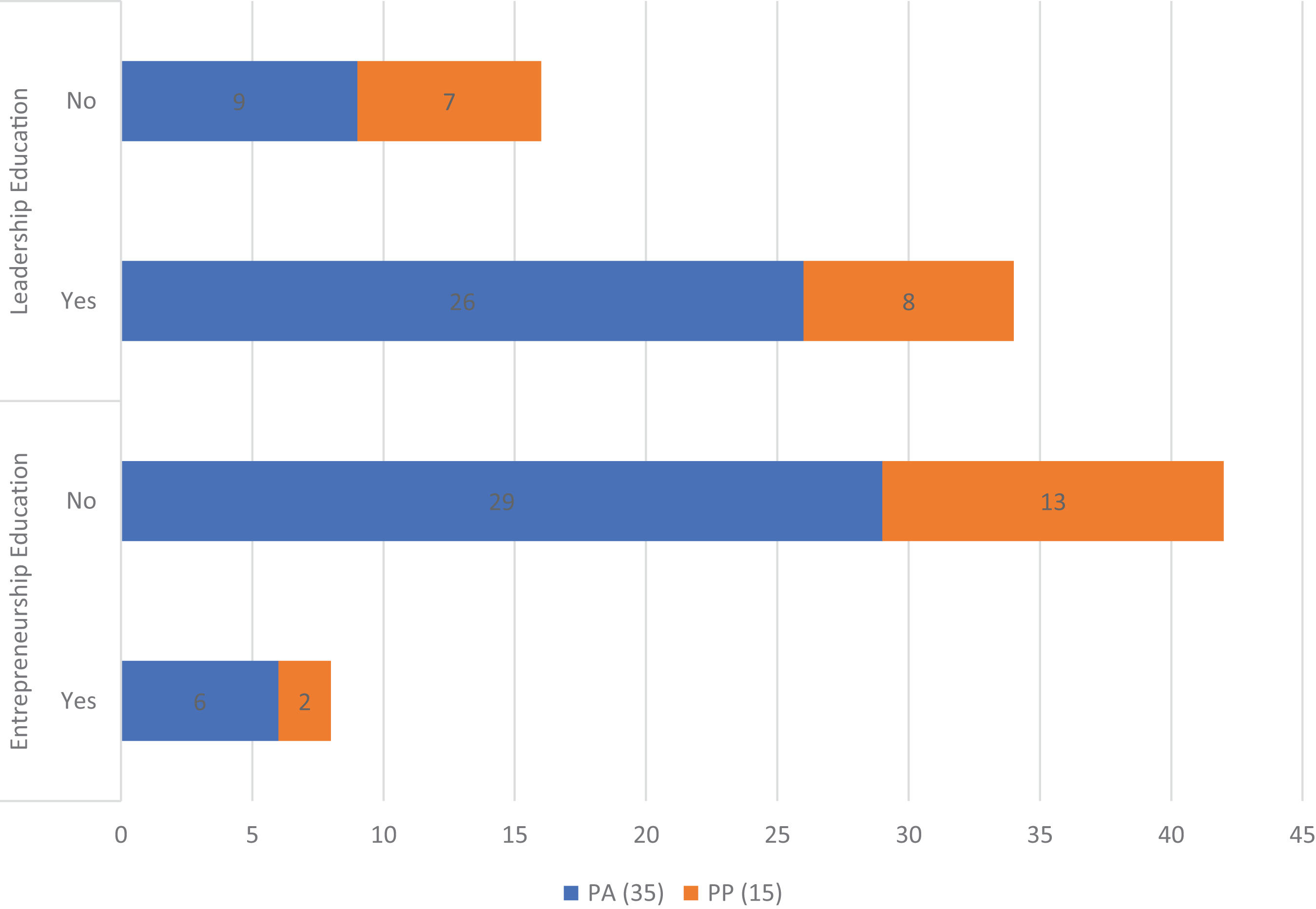
Entrepreneurship and leadership education as part of PA and PP programs in the U.S. (in total).
Only 16% of all PA and PP programs evaluated in the U.S. offer entrepreneurship courses. This is in strong contrast to the total sample amount of leadership courses offered in both programs, amounting to 68%. Slightly more entrepreneurship education is offered in PA programs (17%) than in PP programs (13%). We investigated eight courses which include education on social entrepreneurship /social enterprise specifically. The institution putting most emphasis on social entrepreneurship education is HKS offering the MPP and MPA program. Clearly more leadership education is offered in PA programs (74%) than in PP programs (53%).
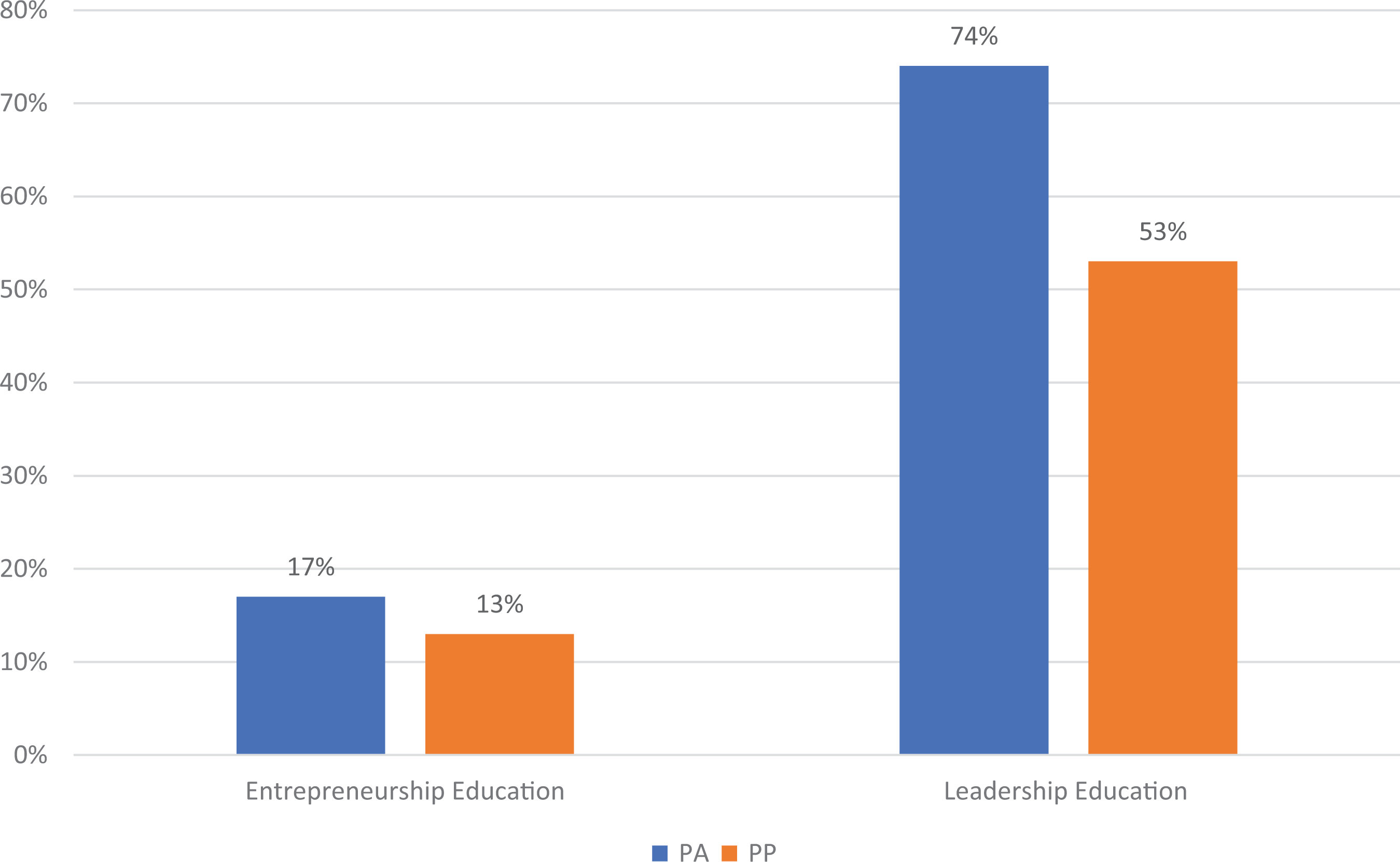
Entrepreneurship and leadership education as part of PA and PP programs in the U.S. (in percent).
Case U.S.: Harvard Kennedy School, the public policy school of Harvard University
Established in 1936, the HKS, also known as John F. Kennedy School of Government, represents the public policy school of Harvard University in Cambridge, Massachusetts. Setting strong focus on application-orientation, the school offers a 2 years MPP program, including three practical units in between and after both theoretical years. Based on social science concepts and entrepreneurship education, real world problems are addressed in both theory and practice, in order to enable students to create concrete and innovative solutions to social issues. During the first year, students take mandatory courses in politics, quantitative analysis, economics, ethics, negotiation, leadership, as well as policy design and delivery. In their second year, they choose one policy area of concentration from the following: Business and Government Policy; Democracy, Politics, and Institutions; International and Global Affairs; Political and Economic Development; and Social and Urban Policy.
As an integral part of the compulsory leadership module of the first year, social entrepreneurship education is practiced in various courses: “Social Entrepreneurship/Social Enterprises: How to Go from Start-Up to End Up,” “Entrepreneurship and Innovation in the Private and Social Sectors,” the consecutive Business Plan Workshop, and “Entrepreneurial Finance.” Following the strong relationship between leadership and social entrepreneurship, the courses are aimed at creating visionaries. Therefore, course contents concentrate on the mediation of necessary basic entrepreneurial skills, so to enable students to lead a sustainable social enterprise. Students develop skills to analyze societal problems from a problem-centric perspective, designing the type of organization that best suits the envisaged solution, including organizational planning on human capital, strategic direction of the venture, and relevant partnerships. To ensure the sustainability and independence of the organization, knowledge about financing, financial management, and funding is imparted. Moreover, students learn methods for measuring social impact, representing a key tool for every practitioner, since social impact measurement proves the empirical relevance and social significance of SE interventions. In addition, students can develop their own business plan for their social venture.
Building upon gained knowledge in compulsory courses, students carry out the Spring Exercise, a 2 weeks practical module. Depending on their core courses, students are divided into five-person groups. MPP professors design and assign one real world policy issue per group, and the students’ task is to elaborate applicable policy recommendations to a senior decision maker. Former topics addressed emphasize the importance that is given to the students’ skill development in creating concrete and innovative policy solutions. Former elaborated policy recommendations included were: “Better Schools for Boston”; “Sex Trafficking: Global Challenge, Local Solutions”; and “Preparing for the Next Pandemic.” Prepared by the Spring Exercise, students execute an internship between the first and second year. National and international institutions dedicated to the solution of social and societal problems are often chosen, as students may be inclined to these groups and are equipped with entrepreneurial tools to approach such challenges. Since creating applicable public policies are at the core of the MPP program, students act as consultants to conduct their applied Master thesis, exploring a specific policy or management problem of an organization in the public or non-profit sector. Other examples included “The ‘Stuck Kids’ Problem: Assessment of the Children’s Mental Health System in Massachusetts,” under the authority of the Massachusetts Executive Office of Health and Human Services, and “Italy and Startups: Harnessing a Country of Innovators,” on behalf of the Italian Prime Minister’s Office and Ministry of Economic Development of the Italian Republic.
Today’s broad offers in social entrepreneurship education started over 25 years ago. Research and teaching pioneering in research and social entrepreneurship education is deeply rooted within Harvard’s institutions and offered programs. Fostering entrepreneurial thinking and skills, Professors James E. Austin and V. Kasturi Rangan built up Harvard Social Enterprise Initiative (SEI) in 1993, embedded in the mission of Harvard Business School, aiming to create cross-sectoral social impact. By promoting innovative sustainable business practices, it serves as educational institution for the creation, as well as acceleration, of social added value and social change. SEI offers courses to all studies at Harvard Business School, especially the MBA and Executive Education program. The initiative additionally promotes professionals in the social sector by offering tailored career development programs.
At Harvard Business School, all students enrolled in an MBA program undergo the same compulsory courses in the first year, hence ensuring a comprehensive cross-sectoral sensitization through the purposeful inclusion of social entrepreneurship cases. Within the second year, elective curriculum, students can choose by a variety of SE educational offers, including the execution of own field-based independent SE projects. The number of courses in SE education has been increased for the semester 2020/2021. Innovative formats for school and university education are essential to keep the education system functioning, regardless of borders and continents. The same holds for the manner in which business is conducted. A significant increase in social entrepreneurial action seems inevitable to sustaining populations’ livelihoods and environments’ well-being. The electives offered in the SEI include and furthermore combine both movements, therefore pioneering the shift in content of curricula and hypothesizing social entrepreneurship to be a meaningful tool for rethinking educational systems.
Conclusions and outlook
The article assessed the quantity and content of public, policy and social entrepreneurship and leadership education in PA and PP programs in two countries—Germany and U.S.—hypothesizing that these components play a crucial role for teaching PA and PP and for preparing public managers and policy makers for future complex challenges in a multi-contextual governance environment. The study contributes to a vibrant discussion about responses in PA and PP education and training at HEIs in context of fast emerging wicked problems which were outlined in the introductory part (Haupt et al., 2017; Quinn, 2013; Rosenbaum, 2014; Wessels, 2020). Due to those challenges it is assumed that PA and PP curricula have to further enhance traditional approaches of teaching and incorporate entrepreneurial, innovative, transformational leadership skills and capability training. Whereas comprehensive research and analysis has been presented outlining the traits of such capabilities and skills as summarized and emphasized in this article (Wessels, 2020: 155–157), the question how PA and PP curricula need to be advanced and reformed to prepare for public sector activity facing “supercomplexity” (Quinn, 2013) has not been pursued. This article aims at filling this void by emphasizing the demand for a paradigm shift from purely knowledge, management and competence driven PA and PP teaching and learning to entrepreneurial approaches enhancing above-mentioned skills and capabilities. Therefore, the introductory Sections reviewed the change of paradigms of public administration during the last century while reflecting on new wicked administrative and policy challenges demanding innovative solutions and practices. This leads to the question what should be reformed in the context of PA and PP education emphasizing the role of public, policy and social entrepreneurship capacities and the importance of transformational and entrepreneurial leadership skills. The research puts specific emphasis on generating insights and recommendations on how public, policy and social entrepreneurship can be incorporated in PA and PP curricula.
The results from a comparative analysis of universities in Germany and the U.S. presented in the previous sections show that entrepreneurship education is still rare in PA and PP education at universities. Less than 10 universities in each country selected randomly in a sample provide entrepreneurship education in their PA and PP study programs. In the U.S. sample, eight entrepreneurship classes have been identified which include education on social entrepreneurship specifically. In the German sample, three out of the six entrepreneurship courses offered as part of PA and PP programs focus on social entrepreneurship education specifically. Entrepreneurship education in PA programs are more frequently established in the U.S. (17%) than in Germany (7%). It turned out to be the opposite for respective education in PP programs. 25% of PP programs in Germany teach entrepreneurship whereas in the US 13% of PP programs provide students with entrepreneurship education. U.S. universities offer more leadership classes (68%) than German universities (54%) as core element of both, PA and PP programs though there are no specializations on entrepreneurial leadership. Rather, the analysis revealed a growing number of entrepreneurship professorships, study programs and single electives in Germany. The variety of entrepreneurship education in Germany points to an increasing demand for topics with focus on entrepreneurship, social innovation and sustainability. Future PP and PA curricula will have to incorporate such topics to align with immediate requirements of public administrations, the job market but also in society in general and to emphasize an education that trains critical, innovative, societal and creative thinking and acting.
Based on the case studies and survey we suggest the following recommendations for the development of future PA and PP curricula by incorporating entrepreneurship: By developing business ideas, canvas, and plans, students receive a real world experience and need to employ translational capacities, transformational leadership skills, and practical skills to not only start but also sustain a (social) business. We observed a special focus on the development of social enterprises and social innovations at HSK that meanwhile focuses on specialized, theme-oriented topics such as health, migration, environment and others. The generation of new (social) business ideas contributes to exploring and developing new and innovative solutions for wicked issues and to coping with interrelated social, public, environmental and many other problems that challenge public servants and leaders. Teaching is enhanced by practitioners and successful entrepreneurs but also insights from start-ups that failed in practice. Such teaching approach further enhances creative, innovative, risk-taking, value- and change-oriented thinking.
The findings may enhance a reconsideration of current curricula of PA and PP study programs and may help institutions and study programs to advance curriculum development by introducing entrepreneurial skills. This would respond to Wessels critique to push forward a “paradigm shift to capability curriculum approaches (…) and ongoing rethinking of the facilitation of learning” facing complex tasks and wicked challenges (Wessels, 2020: 161).
The herewith presented findings reflect a rather low emphasis on entrepreneurship education as part of PA and PP programs and a low incorporation in curricula, on the one hand, but also a high demand for entrepreneurship education by students, on the other hand. The survey among MPP graduates from the Brandt School confirmed a high demand by students for entrepreneurship education that is increasing substantially the employability and enhancing the leadership skills.
In this context, two case studies from the U.S. and Germany were presented for an in-depth investigation on how educational MPA and MPP study programs and curricula have been designed and/or reformed, while placing emphasis on entrepreneurship. Both programs emphasize the importance that entrepreneurial public and policy professionals with multifaceted learning experiences, are well prepared to promote innovative development at various levels in bureaucracies and societies.
Limitations
There are two limitations to this study. First, the literature still lacks consensus about the differences between public and policy entrepreneurship. Our differentiation aims at comparing both terms while overcoming the current blurring of concepts. Future, currently ongoing research aims at systematically analyzing how both terms have been defined in publications since 1980. We ran a bibliometric analysis and synthesis of the literature that specifically focuses on public, public sector, policy and political entrepreneurship to define these terms precisely which is essential for further research in this field.
Second, we are able to present findings from a survey among alumni students of the Brandt School that responded openly to our request also because they are currently developing an alumni database and our idea to doing a survey among former students was very welcomed. We faced limitations at the HKS pursuing a survey among alumni due to issues of data privacy. Due to corona related travel restrictions we perceived no further possibilities to personally negotiate alternative forms of collaboration.
Footnotes
Declaration of conflicting interests
The author(s) declared no potential conflicts of interest with respect to the research, authorship, and/or publication of this article.
Funding
The author(s) received no financial support for the research, authorship, and/or publication of this article.
