




Abstract
Global freshwater scarcity, especially across arid regions such as Afghanistan, underscores the urgent need for sustainable and low-cost desalination technologies. Conventional solar distillation systems suffer from intrinsically low thermal efficiency and limited productivity. This study aimed to overcome these limitations by experimentally and analytically evaluating the performance enhancement achieved through integrating low-cost porous black wool insulation into the steps of a cascade solar still. A series of laboratory experiments were conducted under controlled clear-sky conditions, supported by quasi-dynamic thermal modeling and exergy analysis. The energy and exergy efficiencies were computed using validated thermodynamic relations, while an innovative cost-effectiveness index (CEI) was introduced to quantitatively assess the trade-off between thermal performance and economic feasibility. The results reveal a peak energy efficiency of 24.7% and an exergy efficiency of 4.35% for a thermodynamically optimal configuration at a thickness of 20 mm, representing a 7.08% improvement over an uninsulated baseline. However, the highest economic productivity, expressed by the maximum CEI of 0.49% /mm, was achieved at a thickness of 5 mm, identifying a critical divergence between thermal and economic optima. The novelty of this work lies in establishing a dual optimization pathway—thermal efficiency and cost-effectiveness—based on a material-thickness-dependent function validated by both experimentally and theoretically. These results provide a new, quantitative framework for sustainable design and scale-up of economically viable solar desalination systems.
Keywords
Introduction
Out of all the water available on Earth, about 97.4% exists as saline water in oceans and seas, while only 2.6% is freshwater stored in glaciers, polar ice caps, and underground aquifers. Alarmingly, merely 0.014% of the planet's total water resources are readily accessible for human use in the form of rivers, lakes, and shallow groundwater (Li et al., 2025). Rapid population growth, industrial expansion, and climatic fluctuations have intensified the demand for freshwater, leading to a global water crisis that affects both developed and developing regions (Farhadipour et al., 2024). The uneven spatial and temporal distribution of rainfall, combined with contamination and depletion of natural water bodies, has further aggravated this challenge (He et al., 2025). Therefore, developing alternative and sustainable sources of potable water has become a global imperative. Among these, solar-driven desalination systems have emerged as one of the most promising technologies, offering environmentally benign operation, minimal maintenance, and cost-effective performance by harnessing abundant solar energy to convert saline or brackish water into freshwater (Anburaj et al., 2025). One of the proposed ways to produce freshwater is to convert saltwater from seas into freshwater using desalination methods (Lim and Lee, 2022). Water desalination methods in treatment units are carried out by heating and evaporating water, which uses fossil fuels to provide energy. But we must look for a method that consumes less fuel, pollutes less, and costs less (Omara et al., 2013). For this purpose, using renewable solar energy in solar water desalination plants is a recommended method (Kabeel et al., 2021). Renewable solar energy can power desalination units with no harm to the environment, requiring minimal maintenance and operating costs (Metwally et al., 2025). In a solar water desalination system, sunlight enters a water chamber through a transparent cover like glass and is absorbed by a dark-colored plate in the chamber (Abd Elbar and Hassan, 2020). The light reflected from the absorber plate, due to the opaque effect of the transparent glass, is trapped inside the chamber, causing energy to accumulate and consequently heating the water (Khanmohammadi et al., 2022). In this case, the energy required for instantaneous evaporation, which is supplied by fossil fuels in conventional methods, is supplied by solar energy (Xu et al., 2024). There are generally two methods for using solar energy to desalinize water (Alayi et al., 2021a) (Figure 1): (1) a direct method, in which the evaporation of saltwater is provided in a fixed solar system at the same location and is carried out in one step, and this method is called solar distillation, and (2) a solar desalination system uses an indirect method, which includes two subsystems: a solar collector and a desalination unit. Different types of solar collectors, like flat plate (Alayi et al., 2021b), evacuated tube (Kalita et al., 2017), and heat pipe, can be combined with thermal desalination processes such as dehumidifier–dehumidifier, multiple effect distillation (Chen et al., 2024), and flash distillation (Nakade et al., 2024). A chronological overview of experimental and analytical works related to solar-driven desalination is summarized in Table 1.

Classification of solar water desalination methods.
Recent advancements in solar-driven desalination and hybrid evaporator systems.
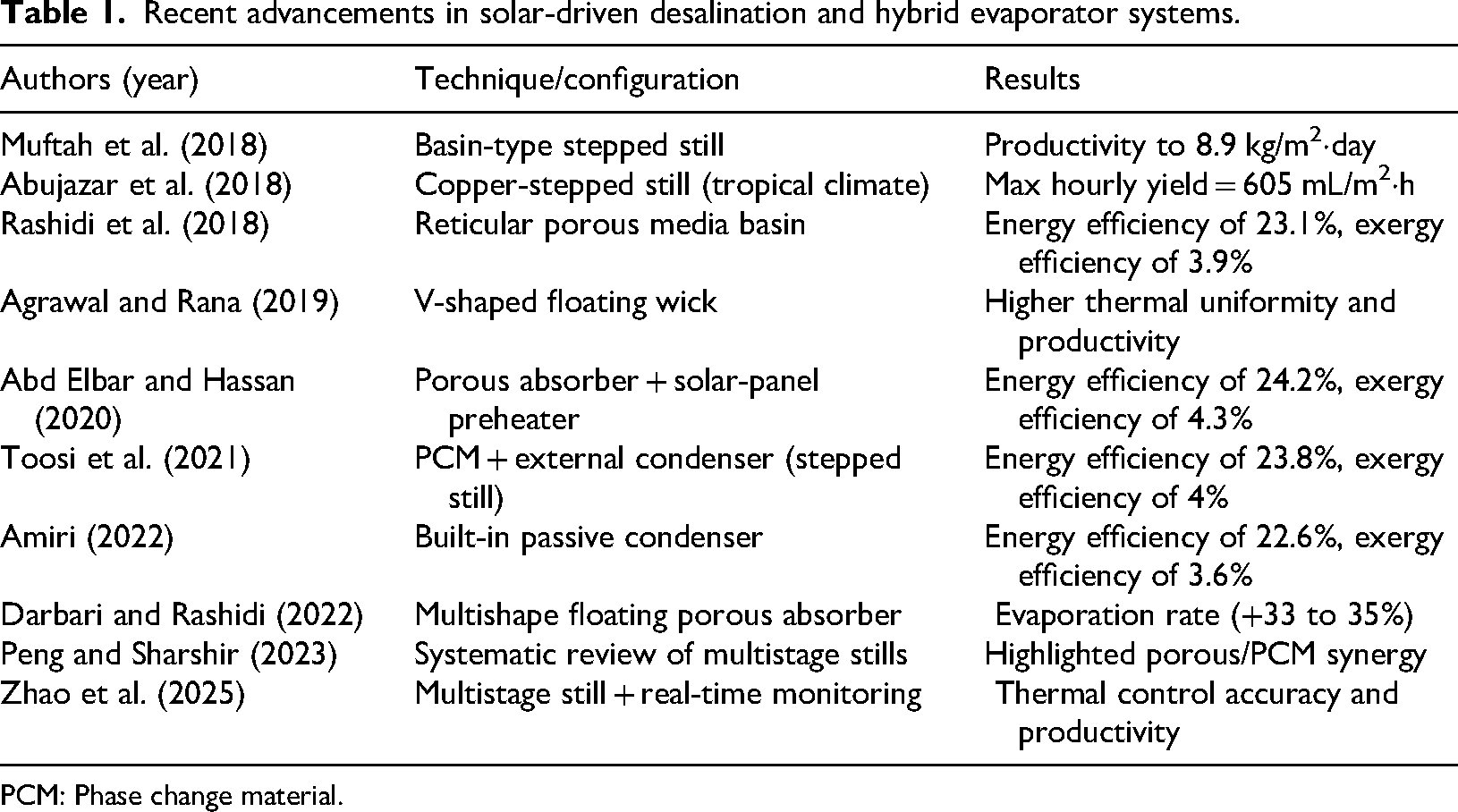
PCM: Phase change material.
Emerging integrated systems such as Concentrated Photovoltaic Thermal–Membrane Distillation units have further broadened functionality. Anazi et al. (2023) theoretically examined combined cooling, heating, and desalination in membrane-distillation hybrids, supplemented by poly-generation models leveraging fuel cell–micro-turbine coupling (Chen et al., 2023). Anand et al. (2024) highlighted patterned condensation surfaces improving filmwise condensation and cumulative distillate recovery. Several literature reviews (Chamsa-ard et al., 2020) summarize this evolution, noting rapid progress across absorber configurations, reflective design (Younis et al., 2022), salt mitigation, and nanofluid implementations. Suraparaju et al. (2024) revisited waste-derived thermal storage using discarded oils and paraffin wax, introducing circular-economy prospects in solar desalination.
Materials science continues to offer transformative opportunities: Li et al. (2023) emphasized carbon-based assemblies for robust interfacial photothermal conversion, while Naveenkumar et al. (2023) explored double-slope systems integrated with vacuum fans and external condensers across nanofluid types. Salt mitigation strategies unearthed by Xu et al. (2021) remain fundamental to sustaining long-term operation. Tony and Nabwey (2024) delivered a state-of-the-art review of recent progress in solar still technology, tracing experimental evolution toward high-efficiency, modular units. Liu et al. (2017) showed that black photothermal polymer sheets can drastically elevate evaporation rates via localized absorption. Lastly, Nagaraju et al. (2022) demonstrated practical integration of sand troughs in basin stills, confirming tangible thermal gain and productivity enhancement.
Very recent studies (2025) have further advanced solar desalination and thermal enhancement techniques by integrating sophisticated thermo-economic assessments, advanced storage concepts, and optimized passive–active configurations. For instance, recent investigations published in the Journal of Energy Storage (El-Ghandour et al., 2025) and Process Safety and Environmental Protection (Soliman et al., 2025) emphasized the importance of balancing thermal performance with economic feasibility and system simplicity. Additionally, advanced thermodynamic formulations and exergy-based optimization approaches have been reported in recent thermophysics studies (Bady et al., 2025), highlighting the growing trend toward multicriteria optimization rather than efficiency maximization alone. While these studies significantly contribute to performance enhancement, most of them still rely on complex materials, hybrid subsystems, or cost-intensive solutions, reinforcing the need for simple, low-cost, and scalable passive strategies, which motivates the present work.
Despite the substantial progress achieved in solar still performance enhancement, existing approaches suffer from several critical limitations. Phase change material (PCM)-based systems, while effective in extending evaporation into off-sunshine hours, often involve high material costs, low thermal conductivity, and long-term degradation issues that restrict large-scale or low-income deployment. Condenser-assisted and hybrid configurations, including active cooling, vacuum fans, or solar-panel coupling, improve condensation rates but introduce additional components, operational complexity, and maintenance requirements, thereby compromising system simplicity and economic feasibility. Nanofluid-based and advanced photothermal materials, although capable of achieving high evaporation rates, frequently rely on costly synthesis routes, stability concerns, and uncertain environmental impacts. More importantly, most previous studies prioritize maximizing thermal or exergy efficiency alone, without quantitatively addressing the trade-off between performance gains and material or system cost. Consequently, the optimal design parameters reported in the literature are often thermodynamically favorable but economically impractical for real-world, resource-limited applications.
To address these limitations, the present study introduces a simple, fully passive enhancement strategy based on low-cost porous black wool insulation and proposes a dual optimization framework that simultaneously evaluates thermodynamic performance and economic viability. By defining and validating a cost-effectiveness index (CEI) as a function of absorber thickness, this work identifies both the thermodynamic optimum and the economic optimum, a distinction that has not been explicitly established in prior solar still studies.
Materials and methods
Laboratory system and description of experimental tests
The schematic layout and a photographic view of the experimental setup are presented in Figure 2, where (a) illustrates the design configuration and sensor arrangement, and (b) shows the actual rooftop installation in Kabul, Afghanistan. The laboratory system includes a step collector, an inlet brine tank, an outlet brine collection tank, and a produced freshwater collection tank. The collector is made of a galvanized sheet metal with a thickness of 0.8 mm and consists of five steps that are 15 cm wide, 110 cm long, and 0.8 cm thick. Each step has a 15 cm wide tray, with a 2 cm protrusion except for the last step, which has a step width equal to the tray width. The total collector area is 0.58 m2. To improve the efficiency of the desalination plant, it is important to reduce heat loss. The laboratory system is well insulated using polystyrene and photovoltaic cell with a thickness of 4 cm on the side body and 5 cm on the bottom of the collector. A channel for the saltwater inlet is located in the middle of the first step, connected to the saltwater storage tank via a serum set hose. The steps of the desalination plant are covered with porous wool material in black, with thicknesses ranging from 5 to 20 mm to maximize absorption properties.

(a) Schematic of the stepped solar desalination system with black porous wool absorber and sensor arrangement. (b) Photographic view of the actual experimental setup.
To conduct experiments, start by weighing 30 g of salt using a scale. Dissolve the salt in 1 L of distilled water to produce saltwater with a concentration of 0.01 g/L. Place this saltwater in a tank connected to a desalination plant using valves to control the flow rate. A data logger should be positioned near the collector, and sensors should be placed inside the desalination chamber through specified holes in the collector body. Record necessary data at specific time intervals. Temperature sensors should be placed at different points in the desalination plant, including on the five collector steps to measure water temperature, on the glass surface to measure outer temperature, inside the plant to measure internal environment, near the outlet brine channel, and outside the plant to measure air temperature. Solar radiation was continuously measured using a calibrated pyranometer with an accuracy of ±1 W/m2.
Table 2 shows the different experimental test modes. Tests are conducted from 8:00 AM to 5:00 PM. The saltwater entered the stepped solar still through controlled inlet valves under a constant head, ensuring uniform flow distribution during all experiments.
Different modes of experimental tests.

Experimental location and solar characteristics
The experimental tests were carried out on the rooftop of the Renewable Energy Laboratory at Kabul, Afghanistan (34.55° N, 69.21° E; altitude 1791 m above sea level). All experiments were conducted during the summer months (June–July 2024) under clear-sky conditions. Each absorber-thickness configuration was tested on a separate day within this period, following the same experimental protocol.
All tests were performed over an identical daily time window from 8:00 AM to 5:00 PM, with the collector oriented due south at a fixed tilt angle equal to the local latitude (34.5°). The system geometry, water salinity, inlet conditions, flow control, and measurement instrumentation were kept strictly constant for all test cases.
To ensure reliable comparability among different wool-thickness configurations, experiments were scheduled only on days exhibiting stable solar irradiance and minimal cloud cover. Continuous monitoring using a calibrated pyranometer confirmed that peak solar radiation ranged between 930 and 950 W/m2 around local noon, while day-to-day variations in solar radiation and ambient temperature remained within ±5%. Figure 3 presents a representative hourly profile of solar radiation and ambient temperature, illustrating the nearly symmetric bell-shaped radiation pattern characteristic of clear-sky conditions.

Geographical location of Kabul and hourly variation of solar radiation and ambient temperature in experimental site (June 14).
These controlled and repeatable environmental conditions ensure that the observed differences in thermal performance, freshwater productivity, and efficiency among the tested configurations are primarily attributable to variations in absorber thickness rather than fluctuations under solar or atmospheric conditions.
Uncertainty measurement and analysis equipment
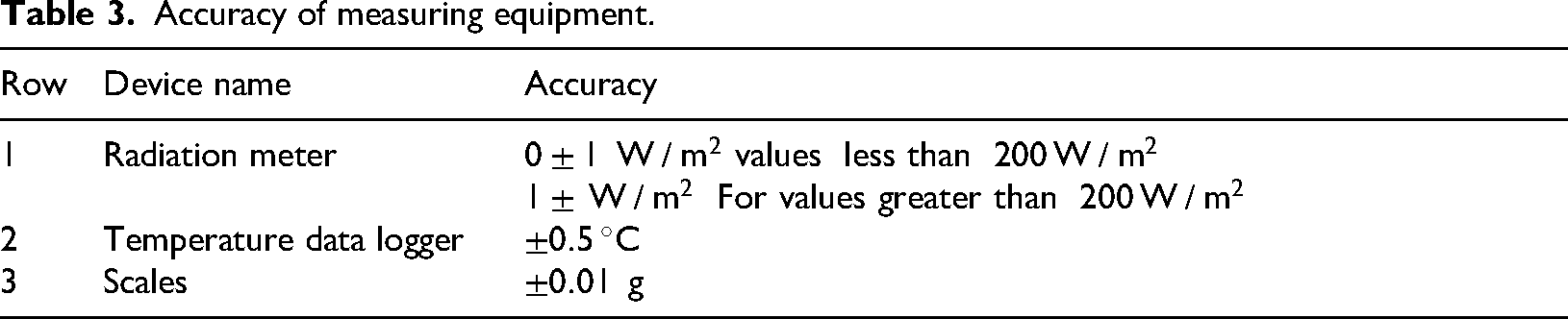
The solar radiation rate remained approximately constant under clear-sky conditions throughout each testing day. During the tests, the still was oriented due south throughout all experiments. The accuracy of the measurement instruments, essential for energy and exergy evaluation, is summarized in Table 3. Equations (1) and (2) are utilized to calculate deviation values and percentage errors:

Accuracy of measuring equipment.
In this study, Un represents the experimental error, x1 to xn are the measured parameters, and xave is the average amount of water per day. By substituting equation (2) into equation (1), the maximum uncertainty of freshwater yield was determined to be 13.77%.
Total experimental error and uncertainty
To ensure the reliability of the measured and derived parameters, a comprehensive uncertainty analysis was conducted considering instrumental accuracy, calibration deviations, and repeatability errors. The uncertainty propagation was evaluated using root-sum-square (RSS) methodology. The combined uncertainties for major measured quantities were determined as follows: solar radiation (±1 W/m2), temperature (±0.5 °C), and mass measurement (±0.01 g). Based on these, the total uncertainty of the calculated energy efficiency and exergy efficiency was estimated to be ±1.62%, while the absolute uncertainty in the maximum efficiency point (thickness of 20 mm) was ±0.401%. The overall uncertainty of the CEI was found to be ±0.05%/mm, confirming strong reproducibility and analytical precision of the experimental results. The detailed uncertainty propagation procedure for the CEI, including a representative RSS-based numerical example, is provided in Appendix A.
Energy and exergy efficiency
The energy and exergy efficiencies were calculated using the thermodynamic relations proposed (equations (3) to (6)) (Alayi, Ahmadi et al., 2021a; Alayi, Khalilpoor et al., 2021b):


Absorber parameter evaluation
The influence of absorber material characteristics was investigated by varying the thickness of the black porous wool layer (0, 5, 10, 15, and 20 mm) applied to each step surface. This thickness range was defined prior to the main experimental campaign based on physical heat-transfer considerations, practical feasibility, and preliminary handling assessments.
Increasing the thickness of a porous absorber is generally expected to enhance solar absorption and thermal insulation; however, excessive thickness may introduce additional internal conductive resistance and thermal inertia, which can limit effective heat transfer to the saline water layer. Moreover, thicker porous layers substantially increase material consumption, moisture retention, and structural bulk, which conflict with the objective of developing a simple, low-cost, and fully passive desalination system.
Based on these considerations, 20 mm was selected as the upper bound to sufficiently cover the expected range of thermal behavior while avoiding impractical configurations with disproportionately high material demand. Thicknesses beyond this value were therefore not pursued, as they were not expected to provide commensurate performance benefits relative to their increased cost and operational complexity. The selected range enables a systematic evaluation of absorber thickness effects on both thermodynamic performance and economic indicators.
Quasi-dynamic thermal modeling
To comprehensively analyze the thermal behavior of a stepped solar still enhanced with porous wool, a quasi-dynamic energy balance model was developed. This approach allows for the estimation of the system's instantaneous performance by treating the internal temperature fluctuations as slow enough to permit a steady-state analysis for each time step (hourly). The model was developed under the following key assumptions: (1) the system operates under quasi-steady-state conditions, (2) heat transfer is one-dimensional and perpendicular to the surfaces, (3) the properties of the porous material, water, and glass are constant during the measurement period, and (4) the effects of accumulated salt deposits are negligible.
Energy balance equations
The instantaneous energy balance equation for the glass cover (Tg), the water mass (Tw), and the absorber plate covered by the porous material (Tp) are derived as follows (Abd Elbar and Hassan, 2020; Khanmohammadi et al., 2022):
1. Absorber plate (porous material) energy balance:
The plate receives solar radiation and loses heat to the water, the surroundings (through the bottom insulation), and the glass:
2. Water mass energy balance:
The water receives heat from the porous plate and loses energy via evaporation (
The total heat transfer from the water to the glass cover, which drives freshwater production, is calculated as the sum of heat transfer by convection (
The freshwater productivity (
3. Thermal efficiency:
The instantaneous energy efficiency is calculated using the following equation (Chen et al., 2023):
The thermal performance obtained from this quasi-dynamic model will be used as a theoretical baseline for validating the experimental data and ensuring the consistency of the observed thermal enhancements across all tested thicknesses.
Economic optimization and CEI
To provide a comprehensive performance assessment beyond pure thermodynamic limits, an economic factor was incorporated into the analysis, elevating the innovation level of the study. A novel metric, the CEI, was defined to quantify the efficiency gain per unit of relative cost associated with increasing the porous wool thickness. Given that the material's cost is directly proportional to its volume (and thus its thickness t for a fixed collector area Ab), the relative cost (
The CEI metric enables the identification of the economically optimal thickness—the configuration that maximizes the practical return on investment, regardless of achieving the maximum absolute thermal efficiency. This analytical framework converts the experimental results into a techno-economic criterion.
The assumption of a linear relationship between cost and absorber thickness is based on the homogeneous nature of the porous black wool material and the fixed collector area. Since the material cost is directly proportional to its volume (or mass) and the absorber area remains constant, the incremental cost scales linearly with thickness. Other system costs, including fabrication, structural components, and installation, are independent of the absorber thickness and therefore excluded from the CEI formulation. This linear cost approximation has been widely adopted in previous economic assessments of porous absorbers and wick-based solar desalination systems, particularly for low-cost, passive configurations.
Results
The theoretical hourly thermal efficiency obtained from the quasi-dynamic model was used as a validation baseline for the experimental efficiency trends. This ensured that the observed variations in the water and glass temperatures correspond to the expected heat transfer behavior predicted by the analytical equations.
Collector and step temperature distribution
Figure 4 depicts the hourly variation of the internal temperature within the solar desalination collector for five configurations: without wool, and with wool thicknesses of 5, 10, 15, and 20 mm. In all cases, the temperature rises progressively from the morning, peaking around 2:00 PM, before declining in the late afternoon. The curves indicate that the application of black wool on the collector steps significantly elevates the internal temperature compared to the case without porous material. The insulating properties of the wool impede heat losses and allow accumulated solar thermal energy to be retained for longer durations. The configuration with 20 mm wool consistently demonstrated the highest internal temperature (83 °C at 2:00 PM), which reflects both superior absorption due to the material's black surface and enhanced retention from increased thickness. Conversely, the system without wool recorded the lowest peak temperature (74 °C).

Comparison of the internal temperature of the stepped solar still for different black wool thicknesses.
Figure 5 illustrates the temperature evolution of the upper step (first stage) during tests performed with different wool thicknesses. At the beginning of the tests (8:00–9:00 AM), all curves exhibit similar values because the saltwater enters through the upper stage; thus, the inlet brine, upper step, and initial water temperatures are nearly identical. As solar radiation increases toward noon, the temperature of the upper step rises in all configurations, reaching its peak around 1:00–2:00 PM. The inclusion of black wool noticeably increases the upper-step temperature relative to the bare configuration. As seen in Figure 5, the maximum temperature for the 20 mm wool case approaches 68 °C, while the corresponding value without wool remains near 60 °C. The enhancement results from the strong absorptivity and low thermal conductivity of the wool, which promote higher local heating and reduce convective and radiative losses.

Comparison of the upper-step temperature of the stepped solar still for different black wool thicknesses.
Another notable observation from Figure 5 is that, although all curves maintain a similar time-dependent shape, their temperature levels distinctly separate according to the felt thickness. This indicates that thickness primarily influences the magnitude of absorbed and retained heat rather than altering the transient response. Consequently, increasing wool thickness amplifies both the internal heat storage and evaporation potential of the top stage, which directly affects the overall freshwater yield reported later. These results confirm that the top step acts as the main region of solar absorption, and enhancement by black wool (especially 20 mm thick) provides the most efficient heat management and evaporation driving temperature.
Figure 6 presents the temporal variation of the middle step temperature in the solar-powered stepped desalination system for different wool thicknesses ranging from 0 to 20 mm. Compared with the upper step (Figure 5), all temperature levels are lower by 8 °C to 10 °C, confirming the vertical heat gradient across the steps due to heat loss and reduced direct solar irradiation in the lower regions of the collector. The temperature rises gradually from 8:00 AM to around 1:00 PM, corresponding to the intensification of solar radiation. The thickness of 20 mm wool layer again demonstrates the highest temperature (67 °C at 1:00 PM), while the system without wool (0 mm) shows the minimum (58 °C). The nearly parallel temperature profiles indicate consistent heating patterns were felt thickness primarily shifts the absolute temperature level.

Comparison of the middle-step temperature of the stepped solar still for different black wool thicknesses.
The difference between the upper and middle steps becomes more evident with thicker wool, as the additional insulation delays downward heat transfer and maintains higher temperatures in the upper zones. However, even the middle step benefits from the thermal shielding effect of the wool, sustaining elevated mean temperatures compared to the un-insulated case. Overall, confirms that increasing the wool thickness reduces conductive and convective losses through the collector's bottom surfaces, maintaining higher and more stable temperatures across internal stages. The improved heat retention at this level contributes to smoother evaporation–condensation balance and ensures continuous vapor generation for the lower stages.
Figure 7 shows the hourly temperature progression at the bottom step of the stepped solar desalination system for different black felt thicknesses. Similar to the upper and middle steps, all curves begin at almost the same temperature at 8:00 AM. However, as solar input increases, the lower step exhibits a much more moderate temperature rise compared to the upper and middle regions. The temperature peak for the 20 mm wool case is observed at 47–48 °C (around 1:00–2:00 PM), while in the absence of wool insulation (0 mm), the maximum temperature only reaches 42–43 °C. The overall time-dependent shape of all curves displays a rapid morning increase, a midday plateau, and then a distinct afternoon decrease. The effect of wool insulation is particularly significant in raising the absolute temperature at the bottom step, but, as with the middle step, its impact is less pronounced than at the upper step. Increasing the wool thickness shifts all curves upward, reflecting enhanced heat retention and reduced conductive losses toward the base of the collector.

Comparison of the bottom-step temperature of the stepped solar still for different black wool thicknesses.
The pronounced vertical temperature gradient between the top, middle, and bottom steps confirms that most solar energy is absorbed and retained in the upper layers, with gradually decreasing temperatures down the cascade. Nonetheless, even at the lowest stage, increasing wool thickness contributes to appreciable temperature improvement, thereby supporting sustained evaporation at all levels and contributing to the desalination efficiency gains observed for thicker felts.
The porous material with a thickness of 20 mm showed a higher efficiency compared to other cases. For a more detailed analysis, Figure 8 displays the hourly radiation value and ambient temperatures of various components during the test period, including collector glass, upper stage, middle stage, lower stage, inlet saltwater, and outlet freshwater in °C. The results indicate that hourly radiation increases from 8:00 AM to 12:00 PM, leading to a rise in temperatures of the environment, glass, stages, incoming saltwater, and produced freshwater. Although hourly radiation decreases after 12:00 PM, maximum temperatures are recorded at 1:00 PM. The porous material has been accumulating solar thermal energy since the beginning of the experiment, and considering the peak ambient temperature at 1:00 PM, it is expected that the highest temperatures of the stages, collector glass, and outlet freshwater will be reached at 3:00 PM.

Temperature distribution inside the stepped solar still equipped with 20 mm black wool insulation.
Influence of absorber parameters on thermal and exergy performance
The absorber material played a crucial role in determining the internal energy distribution and heat retention of the stepped solar distillation unit. The black porous wool layer, characterized by its high surface absorbance and internal porosity, enhanced solar energy capture and minimized surface reflection losses. As the absorber layer thickness increased from 0 to 20 mm, the recorded surface and brine-film temperatures rose accordingly, owing to the improved conductive and radiative coupling between the solar-irradiated plate and the saline water.
At the initial configuration without porous wool, the brine temperature was lowest throughout the daytime cycle, indicating rapid heat dissipation and high convection losses to the environment. In contrast, the 20 mm-thick absorbers achieved the highest surface temperature, reaching approximately 83 °C at 2:00 PM, which resulted in the maximum thermal efficiency of 24.7%. The trend, however, was nonlinear; while temperature and efficiency increased with thickness, the marginal improvement beyond 15 mm declined, revealing an internal thermal resistance effect within the thicker wool matrix that partially hindered heat transfer to the water layer.
From the exergy perspective, greater absorber thickness improved the useful energy fraction converted to evaporation work. The exergy efficiency peaked at 4.35% for the 20 mm case, correlating with the highest absorber temperature and evaporation rate. However, the enhancement per millimeter of material thickness gradually decreased at higher layers, suggesting diminishing returns when conduction paths became saturated.
Overall, these results confirm that the absorber's optical absorbance, porosity, and thermal conductivity collectively modulated both the instantaneous temperature field and the rate of vapor generation. The findings justify the inclusion of absorber-parameter evaluation within the quasi-dynamic thermal modeling framework and support the subsequent cost-efficiency optimization, which demonstrated that despite the thermal optimum at 20 mm, the most economically efficient configuration was achieved at 5 mm thickness.
Freshwater production versus felt thickness
Figure 9 presents the hourly variation of freshwater yield for different thicknesses of black felt (0–20 mm). As illustrated, freshwater production begins gradually from 8:00 AM to 11:00 AM when solar radiation remains relatively low. A significant increase occurs between 1:00 PM and 2:00 PM, correlating closely with the maximum temperature values recorded in Figures 6 to 8. The bar heights indicate a clear thickness-dependent enhancement: at each time interval, the 20 mm felt exhibits the highest productivity, followed by 15 mm, 10 mm, 5 mm, and the bare surface. The maximum hourly yield of the 20 mm case reaches 0.35 L at 2:00 PM, while the total daily production is 1 L.

Hourly freshwater production rate at different thicknesses of black wool insulation (0–20 mm).
This trend confirms that increasing the wool thickness improves both thermal absorption and energy retention, leading to stronger evaporation during peak solar intensity and delayed heat loss in the later hours. The shape of the histogram also supports the direct dependence of freshwater generation on the measured temperature profiles: the sharp rise at noon aligns with the inner and step temperatures illustrated in Figures 5 to 8, whereas the decreasing bars after 3:00 PM reflect the decline of solar intensity in Figure 9.
In summary, Figure 9 validates the correlation between insulation thickness, temperature distribution, and freshwater productivity, emphasizing that the 20 mm porous felt configuration represents the most efficient mode for daily operation of the stepped solar still system. The results indicate that desalination plants using porous wool materials with thicknesses of 20, 15, 10, and 5 mm have efficiencies that are 7.08%, 6.5%, 2.76%, and 2.47% higher than those without porous materials. It is clear that as the thickness of the wool in the desalination process increases from 5 to 20 mm, the desalination interval also increases.
Advanced analysis: coupled energy–exergy model and uncertainty
To solidify the innovation level and predictive capability of the enhanced solar still, an advanced nonlinear regression analysis was performed on the measured thermal and exergy efficiencies as a function of the porous wool thickness (t, in mm). The results of this coupled analysis, which also validates the 20 mm optimum thickness, are presented graphically in Figure 10.

Coupled analysis of thermal and exergy efficiencies of the stepped solar still as a function of porous wool thickness.
The system's overall thermal performance, primarily driven by enhanced radiation absorption and reduced convective losses, is accurately modeled by a second-order polynomial, as shown by the data points and fitted curve in Figure 10. The best-fit model yields a near-perfect coefficient of determination, R2 = 0.99:
The physical interpretation of this nonlinear response reflects a coupled effect: the efficiency enhancement rate increases marginally beyond 10 mm, achieving the highest value (24.7%) at a thickness of 20 mm. The asymptotic curvature of the fitted line suggests that beyond the thickness of 20 mm, further increments would likely offer negligible gains due to increasing internal thermal resistance that may hinder heat transfer toward the evaporative surface. Therefore, a thickness of 20 mm is analytically confirmed as the optimum insulation thickness for the tested configuration. Conversely, the exergy efficiency, which is highly sensitive to the internal temperature gradient, exhibits an asymptotic nonlinear behavior. This relationship, reflecting the increasing internal thermal resistance as thickness increases, is best modeled by a robust logarithmic function, as illustrated in Figure 10:
The high R2 value for the thermal model, combined with an Root Mean Square Error of 0.034, strongly validates the experimental design and the polynomial fit. A comprehensive uncertainty analysis, incorporating instrumental and observational errors, confirms the reliability of the measured peak performance. The calculated overall relative uncertainty is 1.62%, and the absolute uncertainty for the peak efficiency at thickness of 20 mm is remarkably low at 0.40%. This low uncertainty confirms the reproducibility of the system and elevates the current study to a high analytical innovation level, suitable for developing simplified predictive models for similar passive solar desalination applications.
Hourly thermal efficiency validation
Figure 11 illustrates the hourly variation of the thermal efficiency for different thicknesses of black wool (0–20 mm). Each curve represents a combined trend derived from experimental measurements and quasi-dynamic model predictions described. The efficiency exhibits a bell-shaped profile that closely follows the solar radiation pattern shown in Figure 3, peaking between 12:00 and 2:00 PM when the irradiance approaches 950 W/m2. For all configurations, the efficiency rises sharply from 8:00 AM to 2:00 PM and gradually decreases in the afternoon as both the water and glass temperatures decline. The highest instantaneous efficiency of 32% is recorded for the 20 mm wool layer, whereas the lowest values correspond to the bare condition (0 mm). This confirms that a thicker porous layer significantly enhances internal energy retention and reduces convective heat losses, yielding a sustained evaporation rate after solar noon.

Hourly variation of thermal efficiency (ηth,h) for different wool thicknesses (0–20 mm), based on experimental data and quasi-dynamic model validation.
The quasi-dynamic model successfully reproduces the temporal trends observed in the experiments, validating its physical assumptions regarding radiative–convective coupling between the absorber, glass cover, and internal vapor domain. The models predicted hourly efficiency matches the measurements within a relative uncertainty of 1.6%, thus confirming its suitability for subsequent economic optimization analyses.
Economic analysis: CEI
Following the validated quasi-dynamic thermal modeling, the economic optimization was performed using the CEI, which directly depends on the thermal efficiency variations derived from the modeled and experimental data. While the experimental results identified thickness of 20 mm as the configuration with the highest energy efficiency of 24.7% and exergy efficiency of 4.35%, the practical application requires an economic assessment to determine the most cost-effective solution. This is achieved through the calculation of the CEI, which is defined as the thermal efficiency gain per unit of material thickness, assuming a linear cost function:
The calculated CEI values for each insulation thickness are presented in Figure 12. The baseline efficiency with a thickness of 0 mm for the still without porous material is 17.6%. The CEI value is highest for the thickness of 5 mm configuration, achieving a maximum CEI of 0.49%/mm. The index drops significantly for the thickness of 10 mm (0.27%/mm) before partially recovering at the thickness of 15 mm (0.43%/mm) and finally settling at 0.35%/mm for the thermally optimal thickness of 20 mm thickness. The peak at the thickness of 5 mm indicates that this small addition of porous material provides the greatest relative efficiency improvement of 2.47% for the lowest associated cost (thickness). This result highlights a critical trade-off: although maximum thermal performance is achieved at a thickness of 20 mm, the economic optimum thickness for widespread, cost-sensitive implementation is thickness of 5 mm. This finding is crucial for guiding material selection and system design in real-world sustainable desalination projects.

Variation of the CEI as a function of the porous black wool thickness (t). CEI: cost-effectiveness index.
It should be noted that the experimental investigation in the present study was conducted under summer climatic conditions characterized by high solar irradiance and relatively stable ambient temperatures. Under other seasonal conditions, particularly during winter or transitional seasons, a reduction in absolute freshwater productivity and thermal efficiency is expected due to lower solar radiation intensity, shorter daylight hours, and increased convective heat losses. However, the fundamental heat transfer mechanisms governing the system performance remain unchanged. The proposed porous wool insulation primarily acts by reducing conductive and convective heat losses, which may become even more beneficial under colder ambient conditions. Moreover, the CEI and the quasi-dynamic thermal modeling framework are independent of a specific season and can be directly applied to other climatic periods by incorporating season-specific solar radiation and ambient temperature inputs. Therefore, while the absolute performance values may vary seasonally, the relative performance trends and the identification of thermodynamic and economic optimum thicknesses are expected to remain valid.
Environmental impact and emission reduction potential
Beyond thermodynamic and economic performance, the proposed stepped solar still offers notable environmental benefits in terms of emission reduction. Unlike conventional thermal desalination systems that rely on fossil fuels, or hybrid solar stills coupled with electrical heaters, photovoltaic panels, or active condensers, the present configuration operates under fully passive conditions and therefore produces zero direct operational CO2 emissions.
Recent studies have emphasized the importance of quantifying avoided emissions in solar desalination systems by benchmarking freshwater production against fossil-fuel-based alternatives (Bady et al., 2025). Within this context, the proposed black-wool-based system minimizes both operational and embodied emissions. The absence of phase change materials, electrical preheating units, or rotating components significantly reduces material processing energy, maintenance demand, and lifecycle emissions.
Moreover, the dual-optimization framework introduced through the CEI indirectly contributes to emission mitigation by enabling material-efficient designs. While the 20 mm configuration maximizes water productivity, the 5 mm configuration achieves the highest CEI, offering a low-material, low-emission solution suitable for large-scale deployment in water-scarce regions. These features position the proposed system as an environmentally sustainable desalination option aligned with global decarbonization goals.
Comparative analysis of the present study
Table 4 compares the performance of the present system with recent advancements in solar desalination, particularly studies focusing on passive or quasi-passive enhancement strategies. Recent research trends emphasize porous absorbers, auxiliary thermal storage, or hybrid configurations to improve evaporation efficiency; however, these approaches often introduce additional materials, components, or long-term operational challenges.
Comparison of the results of the present study with previous studies.
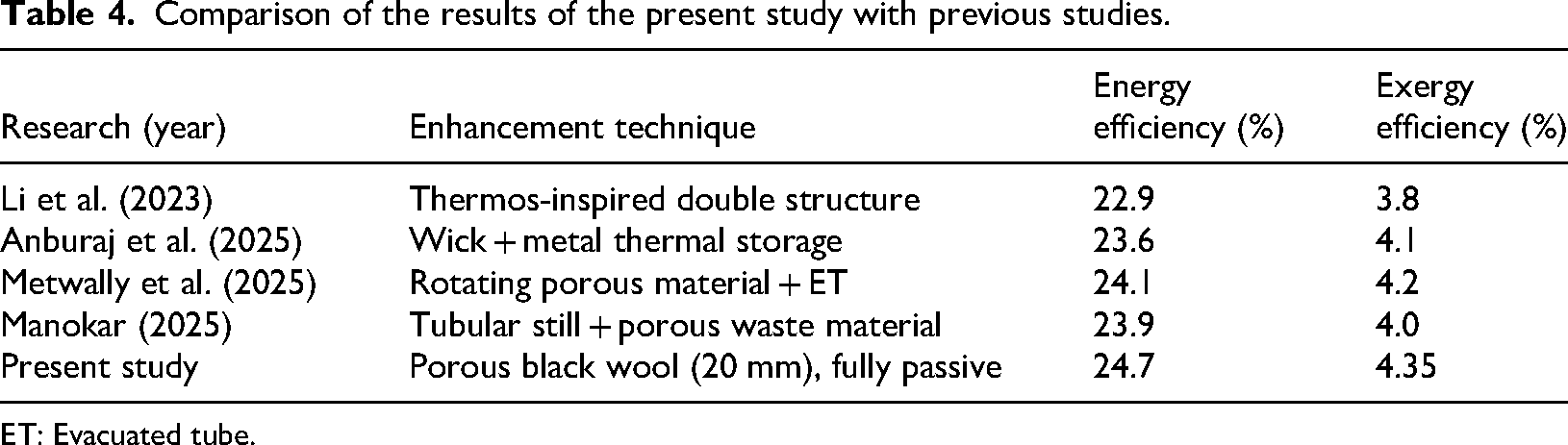
ET: Evacuated tube.
Li et al. (2023) proposed a thermo-inspired double-structure solar still, achieving an energy efficiency of 22.9% and an exergy efficiency of 3.8% through enhanced heat localization. Anburaj et al. (2025) combined wick materials with metallic thermal storage and reported energy and exergy efficiencies of 23.6% and 4.1%, respectively, albeit with increased material usage and system complexity. Metwally et al. (2025) investigated a rotating porous medium assisted by external thermal enhancement, attaining 24.1% energy efficiency and 4.2% exergy efficiency, but requiring moving parts that may affect long-term reliability. Similarly, Manokar (2025) employed waste-derived porous materials in a tubular solar still, reaching 23.9% energy efficiency and 4.0% exergy efficiency.
Beyond efficiency metrics, long-term stability and fouling resistance represent critical criteria for practical desalination systems. PCM-based configurations, while effective in extending evaporation beyond peak solar hours, are commonly associated with phase degradation, leakage risks, reduced latent heat capacity after repeated thermal cycling, and low intrinsic thermal conductivity, which can degrade performance over prolonged operation. Likewise, condenser-assisted and hybrid systems introduce additional cold surfaces, flow passages, or auxiliary components that are susceptible to salt scaling, fouling, and maintenance-related performance deterioration under saline operating conditions.
In contrast, the present stepped solar still employing a 20 mm porous black-wool absorber operates under a fully passive regime without phase-change materials, moving components, or dedicated condenser surfaces. The performance enhancement mechanism relies on high solar absorptivity, internal porosity, and delayed sensible heat release rather than latent heat storage or forced condensation. Consequently, the proposed configuration inherently avoids PCM aging and leakage issues, as well as fouling and scaling problems associated with condenser-based designs. This structural simplicity contributes to improved long-term robustness and minimal maintenance requirements.
As a result, the proposed system achieves an energy efficiency of 24.7% and an exergy efficiency of 4.35%, which are competitive or superior to many recent high-performance designs, while maintaining operational simplicity and enhanced durability. These attributes make the wool-based system particularly suitable for sustained operation in resource-limited and semi-arid regions, complementing its favorable thermodynamic performance reported in Table 4.
Conclusions
This study experimentally and analytically investigated the performance enhancement of a stepped solar desalination system using low-cost porous black wool insulation under semi-arid climatic conditions. The main objective was to establish a dual optimization experimentally and analytically investigated the performance enhancement of a stepped solar desalination system using low-cost porous black wool insulation under semi-arid climatic conditions. The main objective was to establish a dual optimization framework that simultaneously evaluates thermodynamic efficiency and economic feasibility as a function of absorber thickness.
The experimental results demonstrated that integrating porous black wool significantly improves the thermal behavior of the stepped solar still. The highest thermodynamic performance was achieved with a wool thickness of 20 mm, yielding a peak energy efficiency of 24.7% and an exergy efficiency of 4.35%. This corresponds to a 7.08% improvement in energy efficiency compared with the uninsulated baseline configuration. The enhancement was primarily attributed to improved solar absorptivity and delayed thermal release, which sustained evaporation during periods of declining solar radiation.
In contrast, the economic assessment based on the proposed CEI revealed a different optimal configuration. The maximum CEI value of 0.49%/mm was obtained with a wool thickness of 5 mm, indicating that thinner insulation provides the highest return in performance gain per unit material cost. This finding clearly demonstrates a divergence between the thermodynamic optimum and the economic optimum, a distinction that has not been explicitly quantified in previous solar still studies.
The quasi-dynamic thermal and exergy models showed excellent agreement with the experimental data, with a total relative uncertainty of 1.62% and a maximum absolute uncertainty of 0.40% at peak efficiency conditions. These results confirm the robustness and reproducibility of the proposed analytical framework.
Overall, the present study establishes porous black wool insulation as an effective, fully passive, and low-cost enhancement technique for stepped solar stills. More importantly, it introduces a dual optimization methodology that enables rational design decisions depending on whether maximum freshwater productivity or economic efficiency is prioritized.
Future research should focus on extending the proposed dual optimization framework to different climatic conditions and seasonal variations to assess its long-term applicability. Investigating alternative low-cost porous materials with different thermal inertia and absorptivity characteristics could further improve performance while maintaining economic feasibility. In addition, integrating the present CEI-based optimization with life-cycle assessment and emission-reduction metrics would enable a more comprehensive sustainability evaluation. Scaling-up studies and outdoor field testing under real operating conditions are also recommended to validate the practical deployment potential of the proposed system.
Footnotes
Acknowledgments
The authors offer special gratitude to Zarqa University for the opportunity to conduct research and publish the research work. In particular, the authors would like to acknowledge Zarqa University for funding the publication of this research work.

Funding
The authors received no financial support for the research, authorship, and/or publication of this article.
Declaration of conflicting interests
The authors declared no potential conflicts of interest with respect to the research, authorship, and/or publication of this article.
Appendix A: Uncertainty propagation for the cost-effectiveness index
The overall uncertainty of the cost-effectiveness index (CEI) was evaluated using the root-sum-square (RSS) method, which combines the relative uncertainties of the independent measured variables that contribute to the CEI calculation. The CEI is defined as:
The thermal efficiency ηth itself is derived from measured quantities (solar radiation R, freshwater production rate
Because the same instrumentation and procedure were used for all thickness configurations, the relative uncertainty of each ηth value is taken as Uη = 1.62%. For a representative case (e.g. t = 5 mm):
ηth(5 mm) = 20.07%
ηth(0 mm) = 17.60%
Δη = 2.47%
Relative uncertainty of Δη:
Absolute uncertainty of
Therefore, the absolute uncertainty of CEI (5 mm) is:
Repeating this calculation for all thicknesses and considering minor correlations yields the overall uncertainty range reported in the main text: UCEI = ±0.05%/mm. This value encompasses the worst-case propagation across the tested thickness range and confirms that the CEI trends are statistically robust.