




Abstract
Generation IV nuclear reactor designs, like molten salt reactors (MSRs), provide passive safety and improved economics by dissolving fuel with liquid salt and moving it through the heat exchangers and core. Notwithstanding the technology's enormous potential, there is a dearth of comprehensive studies that use bibliometric and systematic review techniques to examine the development and patterns of the MSR technology. This paper adopts the bibliometric review approach using the VOSviewer and Bibliometrix package in R software to analyze the global research landscape of MSR technology between 2000 and 2024. The findings show that international collaboration is increasing in the field of advanced reactor designs and fuel cycle technologies, notably involving MSRs, thorium fuel cycles, and advanced simulation models. The research clusters indicate a multidisciplinary nature involving nuclear chemistry, reactor physics, materials science, and computational modelling. This notwithstanding, challenges such as salt purity, corrosion-resistant materials, and long-term safety are still barriers. Future research should therefore optimise fuel cycles and make advances in core designs for mini reactors while transmutating waste to reduce the radioactive inventory. Also, simulation tools should be developed further, especially in areas such as isotope transmutation and neutron transport, to increase the scalability, efficiency, and sustainability of MSR.
Keywords
Introduction
Molten salt reactors (MSRs) are liquid-fueled reactors that can eliminate fission products by helium bubbling, online refuelling, and reprocessing. They can effectively use thorium since it is possible to extract 233Pa from the core to lessen the absorption of neutrons. Because there is less transuranic synthesis from 232Th than from 238U, the 232Th-233U fuel cycle, which is frequently linked to MSRs, has lower equilibrium radiotoxicity. This lowers the amount of long-lived, high-level radioactive waste in the inventory. Additionally, during the primary operation cycle, MSRs provide low excess reactivity. Following their selection as one of the GEN-IV reactor designs in 2002, MSRs have attracted attention from all across the world. Since the Oak Ridge National Laboratory's (ORNL) successful MSR experiment (MSRE) in the 1960s, several MSR concepts have been put forth (Biradar et al., 2024; Serp et al., 2014; Wu et al., 2022b, 2022a).
MSRs and other advanced reactor technologies are being investigated for potential future utilisation due to their potential advantages over conventional light water reactors. The main heat transfer fluid in MSRs is either fluoride or chloride salt. Improved economics, passive safety, high exergy, elimination of fission products in real time, thermodynamic efficiency, and lower production of high-level waste are all benefits of these reactors. Catastrophic mishaps involving over-pressurisation are rare since MSRs have low volatility in primary circuit fluids and can maintain low pressure even in accident situations. In the event of an accident or a natural disaster, the intention is to provide ‘walk away’ safety so that operators can avoid intervening and make sure the unit does not present a risk to the public (Andrews et al., 2021; Forsberg, 2020; Kaky et al., 2024).
Different research has been carried out recently on the neutronics and fuel cycle of MSR systems. However, only a few studies have been performed to review the recent developments in this technology. The existing literature on MSR employed the traditional review approach to analyze different aspects of the MSR system. For instance, Roper et al. (2022) reviewed the applications of molten salt in advanced energy systems. Zhang et al. (2018) reviewed China's comprehensive development of MSRs, including thermal-hydraulics modelling, neutronics modelling, material investigation, and safety analysis. Also, Faure and Kooyman (2022) reviewed the possibility of using iodide and bromide salts as nuclear salts in MSR technologies. Comparable radiotoxicity and stable critical neutronic configurations were found when their thermodynamic properties were compared to those of fluoride and chloride compounds. Andrews et al. (2021) discussed high-fidelity modelling, the components of a MSR's off-gas stream, the resources that are accessible, design concerns, and the necessity of improved sensor technology and thermophysical property research. In another study by Mochizuki (2025), neutrons and thermal-hydraulics coupling analysis were used to summarise the safety and operational features of molten-salt fast reactors. Furthermore, using insights from pyro-processing studies, Riley et al. (2019) reviewed methods for handling and processing MSR-type wastes, such as reconditioning, recycling, partitioning, and immobilisation. Finally, Romatoski and Hu (2017a) reviewed numerical research and experimental data on the thermophysical characteristics of liquid fluoride salts, taking into account uncertainties between 2% and 20%, in order to establish benchmarks for modelling and validation.
The existing reviews on MSR employed the traditional review approach in providing an overview of work done so far in relation to the subject under discussion. There is currently no study that employed both the bibliometric and the systematic review methods to provide a comprehensive review on the topic. The main objective of this study is to fill the research gap that currently exists in the literature. Compared to traditional reviews, bibliometric and systematic review approaches provide a more objective, thorough, and data-driven analysis. Bibliometric reviews examine patterns in publications, citations, and authorships to give a clear picture of research trends and impact, while systematic reviews employ stringent selection and synthesis criteria to reduce bias and improve reproducibility, producing more trustworthy and transparent results (Agyekum et al., 2025a; Agyekum and Odoi-Yorke, 2024a; Haghani, 2023; Ma and Ismail, 2025; Odoi-Yorke et al., 2024; Passas, 2024). This research therefore attempts to address the following questions: How many studies were conducted on MSR neutronics and fuel cycle research between 2000 and 2024; what are the current research trends; which countries or publications are leading in this field; what is the focus of this field of study; and what is the future of MSR neutronics and fuel research. Knowing these patterns can assist direct future studies and policy efforts, pinpoint critical areas for development, and promote cooperation. Determining the study themes will facilitate adoption by tackling technological and social barriers. The study also seeks to determine possible areas of future investigation.
The study is structured as follows: The ‘Materials and methods’ section covers the materials and methods utilised in the study; the ‘Results and discussion’ section shows the results and discussion; and the ‘Conclusion and future research recommendations’ section, the last part, presents the conclusion and recommendations for future research.
Materials and methods
Scopus, a database with a greater number of works on technological topics, was chosen for this study, while Google Scholar and ResearchGate were excluded due to the unreliability of bibliometric results from those databases (Borri et al., 2021). Bibliometrics is a multidisciplinary approach that employs linguistics, statistics, and mathematics and uses journal literature as a reliable data source for bibliometric analysis. The bibliometric method is used to create knowledge graphs, a technique used to identify relationships between entities (Cabeza et al., 2020; Odoi-Yorke et al., 2025). The Scopus database was searched using the following terms: TITLE-ABS-KEY (‘molten salt reactor*’ OR ‘MSR’) AND (‘neutronics’ OR ‘reactor physics’ OR ‘neutron transport’ OR ‘neutron flux’ OR ‘neutron behavior’) AND (‘fuel cycle’ OR ‘fuel reprocessing’ OR ‘fuel management’ OR ‘nuclear fuel cycle’ OR ‘fuel sustainability’ OR ‘fuel utilization’) in conjunction with the Preferred Reporting Items for Systematic Reviews and Meta-Analyses (PRISMA) methodology. The period of the search was 2000–2024, yielding 104 papers in total. The following subjects were then included on the list: Material science, engineering, energy, physics and astronomy, and environmental science, which led to a reduction in the total number of documents to 102. The documents were further reduced to 94 when the document type was set to include conference papers and articles. By including only English-language papers in the screening process, the number of relevant documents was further reduced to 87, which were then retrieved for the analysis from the Scopus database. The bibliometric visualisations in this paper were done utilising the Bibliometrix package in the R software and the VOSviewer tool.
Results and discussion
A detailed analysis of the various findings is presented in this section. This includes a general overview of the analyzed data, a comprehensive analysis of the author keywords and their relationship with the topic under study, the conceptual structure of the subject matter, that is, evolution of author keywords, and factorial analysis. Countries and corresponding author countries are also discussed. Furthermore, an overview of the top 25 most cited articles and their key findings was also reviewed and presented.
The bibliometric analysis for the studies covering MSR neutronics and fuel cycle from 2000 to 2024 has shown important trends in research for this area of science. There are 87 documents published in 40 different journals, which indicate a moderate volume of scholarly activity as shown in Figure 1. The annual growth rate of 7.59% demonstrates a slow and steady interest in the topic. The lack of publications in the first two years of the study period, that is, 2000 and 2001, and having gaps in 2009, 2010, and 2011 (Figure 2) might suggest that the research in MSR neutronics and fuel cycles was just evolving or considered new. Research interest may take time to build a significant academic presence because of the technology's complexities and early phases of development, which could explain the delayed and uneven publishing pattern.
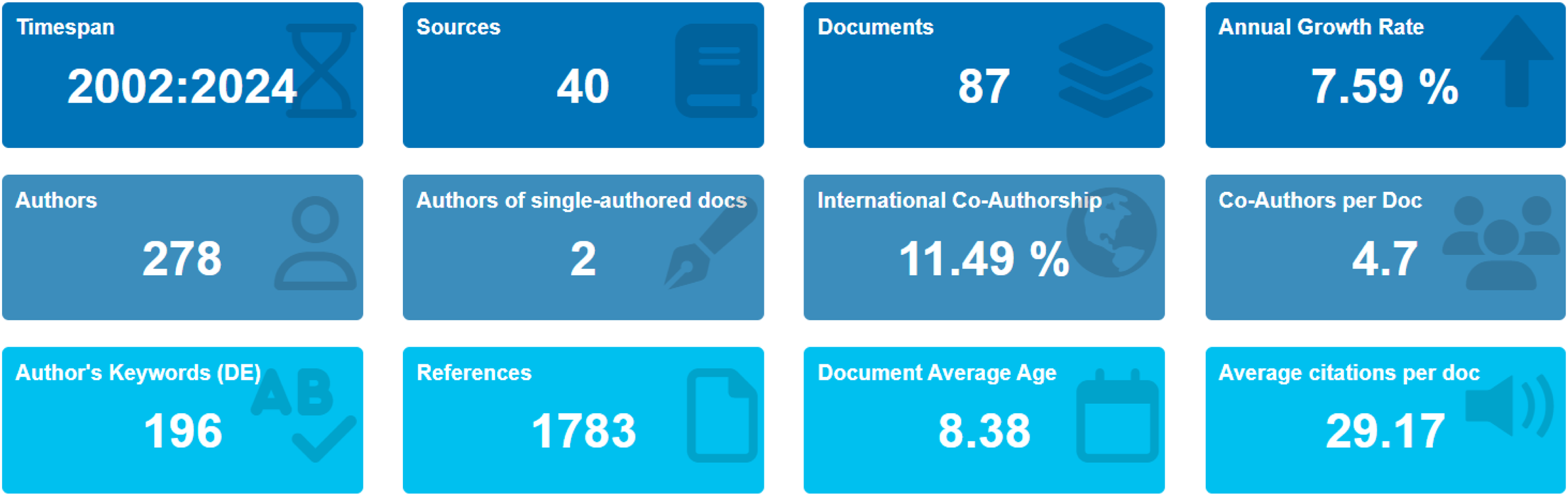
Summary of data.
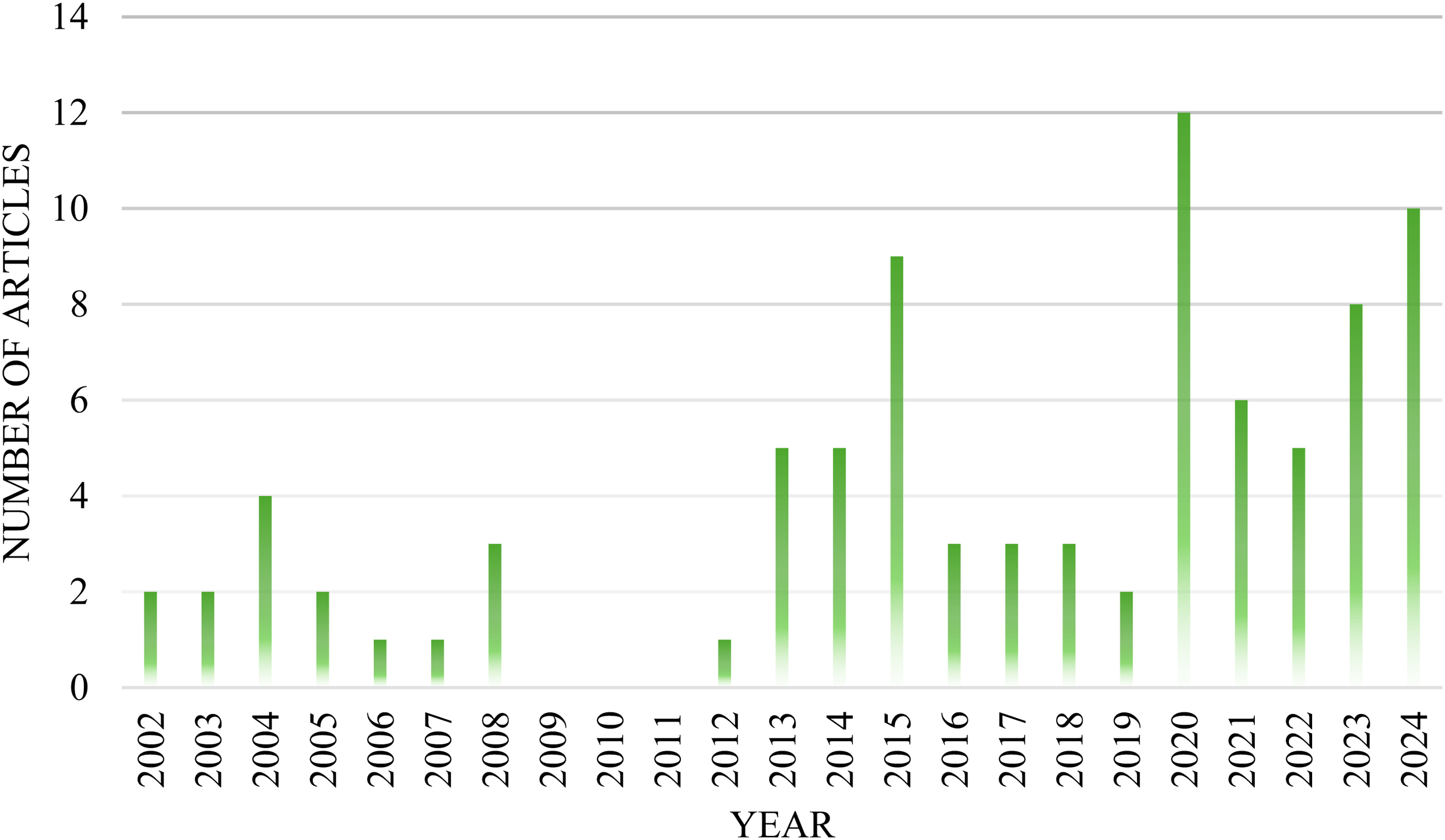
Number of articles per year.
Furthermore, while the global co-authorship rate is moderate at 11.49%, it does indicate some element of international co-publication. The mean number of co-authors for each document, approximately 4.7, and an average citation number per document of 29.17, implies that although not highly cited, the research does find its way into the citations of the wider scientific community. Also, the average age of the documents is estimated to be about 8.38 years, indicating that research in this area is still relatively recent, with the field still in the process of maturing and establishing its theoretical and practical foundations. It then draws the bibliometric review into a picture of an expanding and increasingly collaborative field with early signs of international interest that should increase in a few years as technology matures.
Word cloud and cluster analysis of author keywords
Bibliometric studies employ word clouds, which are graphic representations of word frequency, to pinpoint the centre of written text. They determine a term's magnitude by displaying its frequency. Smaller-letter words suggest possible lines of inquiry. Additionally, word clouds convert words into tags that enable size and colour comparisons of the texts’ relative values (Alkhammash, 2023).
The word cloud derived from the bibliometric review, as shown in Figure 3, highlights several key themes and trends in the field of MSR neutronics and fuel cycle studies from 2000 to 2024. The high-frequently used themes, such as MSR, nuclear, reactor physics, and fuel cycle, suggest a significant focus on understanding the fundamental principles and challenges of MSR systems. For these topics, interest in understanding neutronic behaviour, safety, and efficiency of MSR as an alternative to conventional nuclear reactors is growing. Terms like Monte Carlo N-Particle (MCNP) and neutron flux indicate that detailed simulation tools and neutron transport modelling are of crucial importance in MSRs’ design and optimisation. Furthermore, the popularity of terms like thorium, depletion, burnup, and online reprocessing signifies a strong emphasis on advanced fuel cycles, especially thorium-based cycles, and continued interest in recycling and management of nuclear fuel to improve sustainability and minimise waste. This transition toward innovative fuel cycles and reactor designs delivers a broader aim to remedy the environmental and operational problems of nuclear energy.
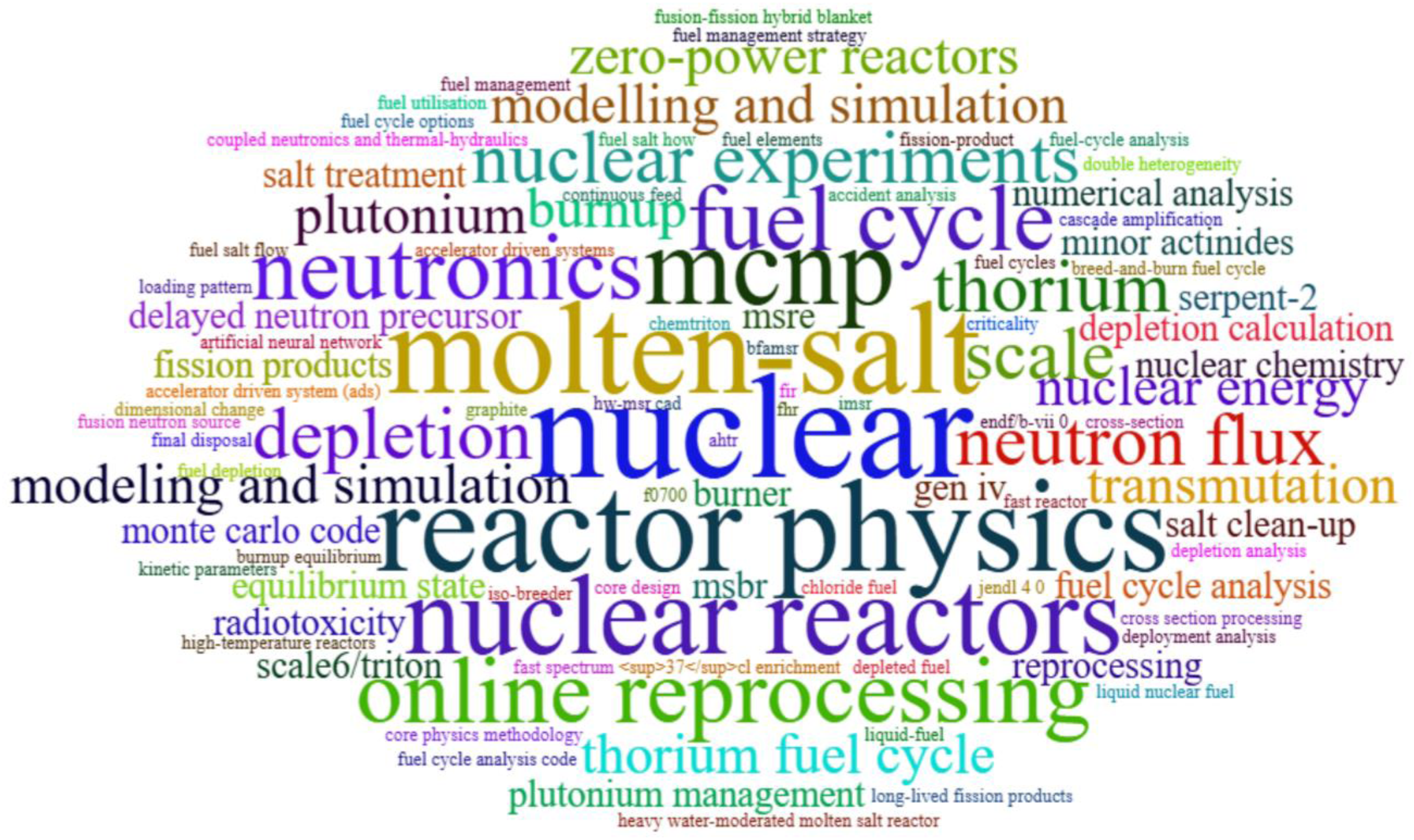
Author keywords word cloud.
On the other hand, the themes of lesser frequency, which are represented in smaller font sizes, yield insightful ideas with respect to more niche aspects in MSR research. Here, terms such as nuclear chemistry, reprocessing, and numerical analysis reflect a profound understanding of molten salts’ chemical and material characteristics, which are critical in reactor performance and longevity. The mention of simulation tools such as Serpent-2 and terms such as cascade amplification and core design indicate advanced modelling efforts to predict the behaviour of nuclear systems under varying conditions. Additionally, themes like artificial neural networks (ANNs) and breed-and-burn fuel cycles point toward the integration of the latest computational methods and innovative reactor concepts, such as optimising fuel cycles for better resource utilisation. The mention of MSRE and Advanced High-Temperature Reactor (AHTR) also signifies the historical context of the development of MSRs and the exploration of specialised reactor types. In summary, these results, as demonstrated in the word cloud, imply that while core themes of reactor physics and fuel cycle efficiency occupy the most considerable chunk of interest in this area, there are emerging interests in niche advanced concepts that could greatly shape nuclear energy's future, especially with the fast-advancing computational and experimental techniques.
The co-occurrence of the various themes forming various clusters is presented in Figure 4. Conducting co-occurrence studies in bibliometrics takes the analysis further by focusing on the relationship between concepts, authors, journals, or keywords within a body of literature. Co-occurrences of specific terms, phrases, and authors in academic text, and their frequencies are then analysed to identify emerging trends, major research themes, and the intellectual structure of a field. In turn, this research methodology supports mapping scientific knowledge development, discovering collaborative networks, and identifying areas with potential research gaps. As such, they afford researchers and policymakers knowledge of the increasing level of academic discourse, enabling more incisive and effective research policies (Agyekum et al., 2025b; Klarin, 2024). In this study, the fractional counting approach was considered, and the minimum number of occurrences of author keywords used in the analysis is 2. Six clusters in total were obtained with a total link strength of 75. The link strength helps find closely connected elements in the dataset by measuring the frequency or intensity of a connection between items in the network (van van Eck and Waltman, 2019). A detailed analysis of the various clusters is as follows:
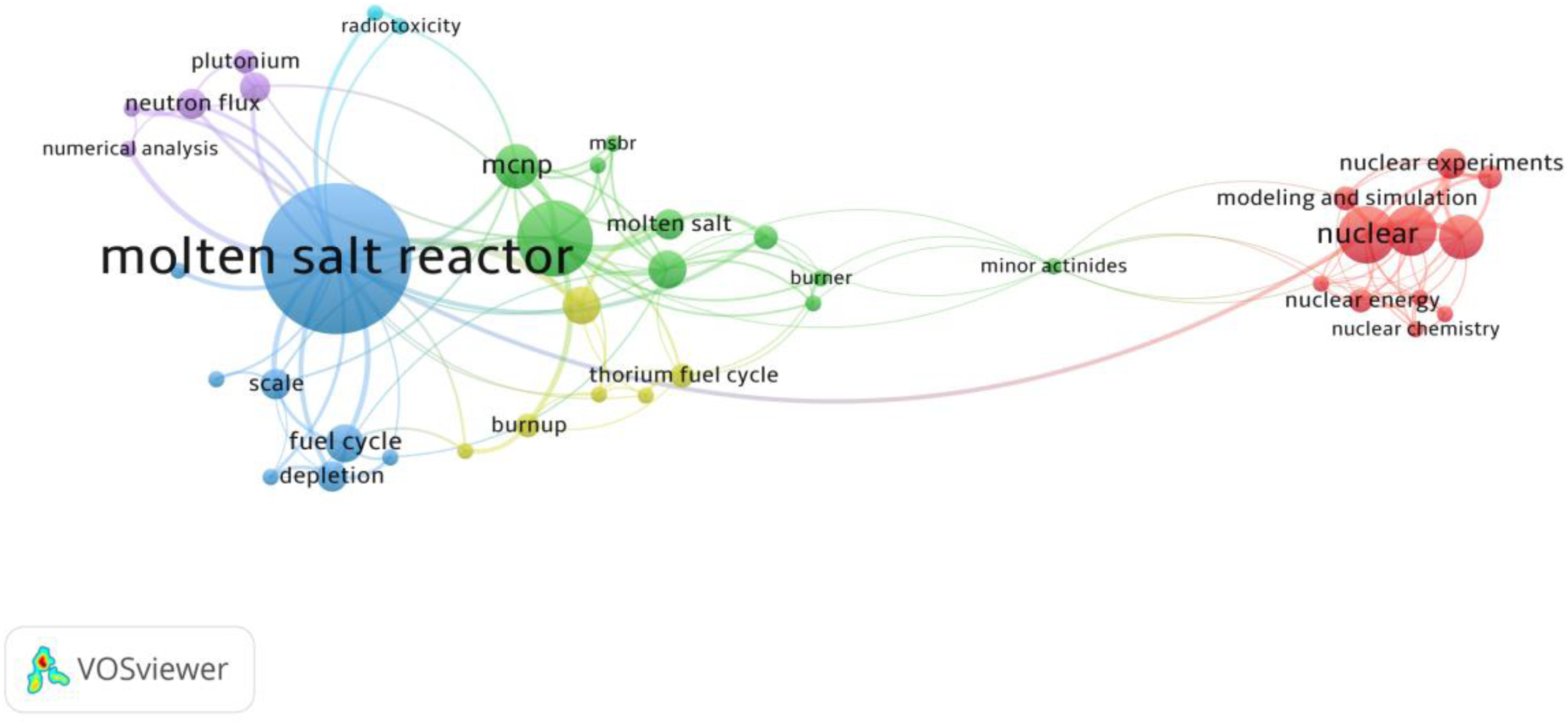
Network visualisation for the author keywords.
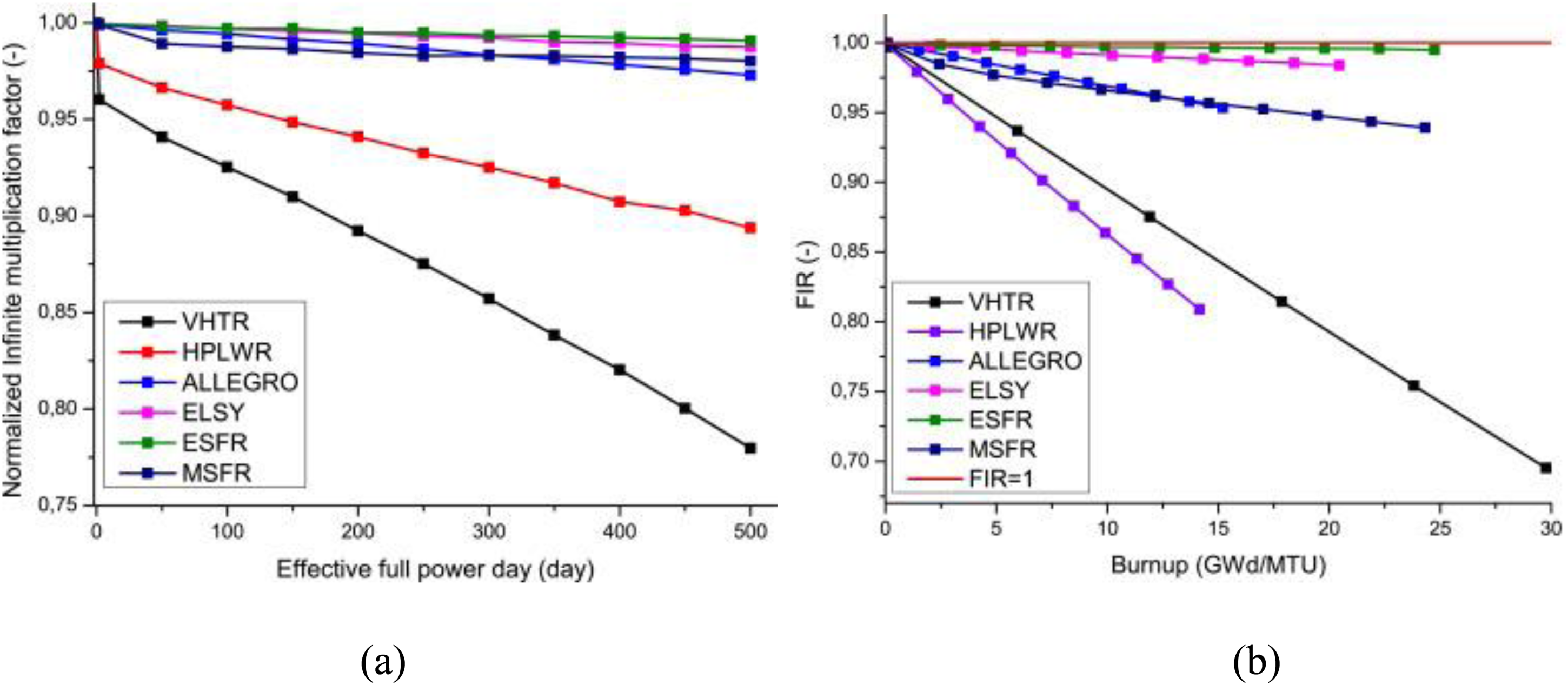
The comparison of the estimated (a) infinite multiplication factors (b) fissile inventory ratios of the Gen IV reactors. Reproduced with permission from (György and Czifrus, 2015). Copyright Elsevier.
In another study, the transmutation of 241Am in thermal- and fast-spectrum MSRs was compared by Ashraf and Tikhomirov (2020a) using an Am-cylinder in the centre of single-fluid double-zone thorium-based MSR (SD-TMSR) and a small molten salt fast reactor (SMSFR). The total neutron fluxes were calculated, and the flux per unit lethargy at the Beginning-of-life was examined. Due to increased capture cross-sections in thermal energy zones, the study discovered that 241Am disappearance rates were higher in SD-TMSR than SMSFR; yet SMSFR showed higher FP accumulation (Figure 6). In the fast neutron spectrum, transmutation produced short-lived FPs (by fission) instead of heavier actinides, and all Pu isotopes took a long burnup time to disappear. For SD-TMSR and SMSFR, the first released energy ratio from the Am-cylinder was found to be around 230 and 240, respectively.
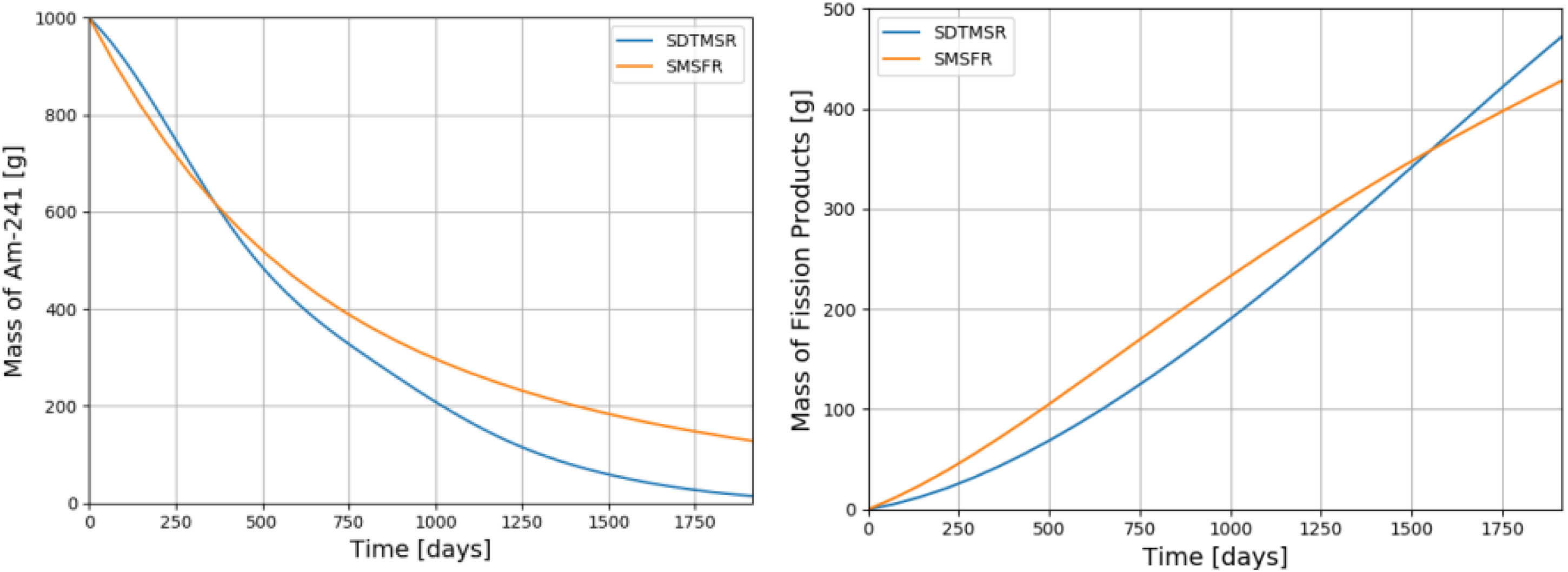
(a) Impact of time on 241Am mass (b) build-up of FPs in the Am-cylinder for SD-TMSR and SMSFR (Ashraf and Tikhomirov, 2020b). Published under open access. SMSFR: small molten salt fast reactor; SD-TMSR: single-fluid double-zone thorium-based molten salt reactor.
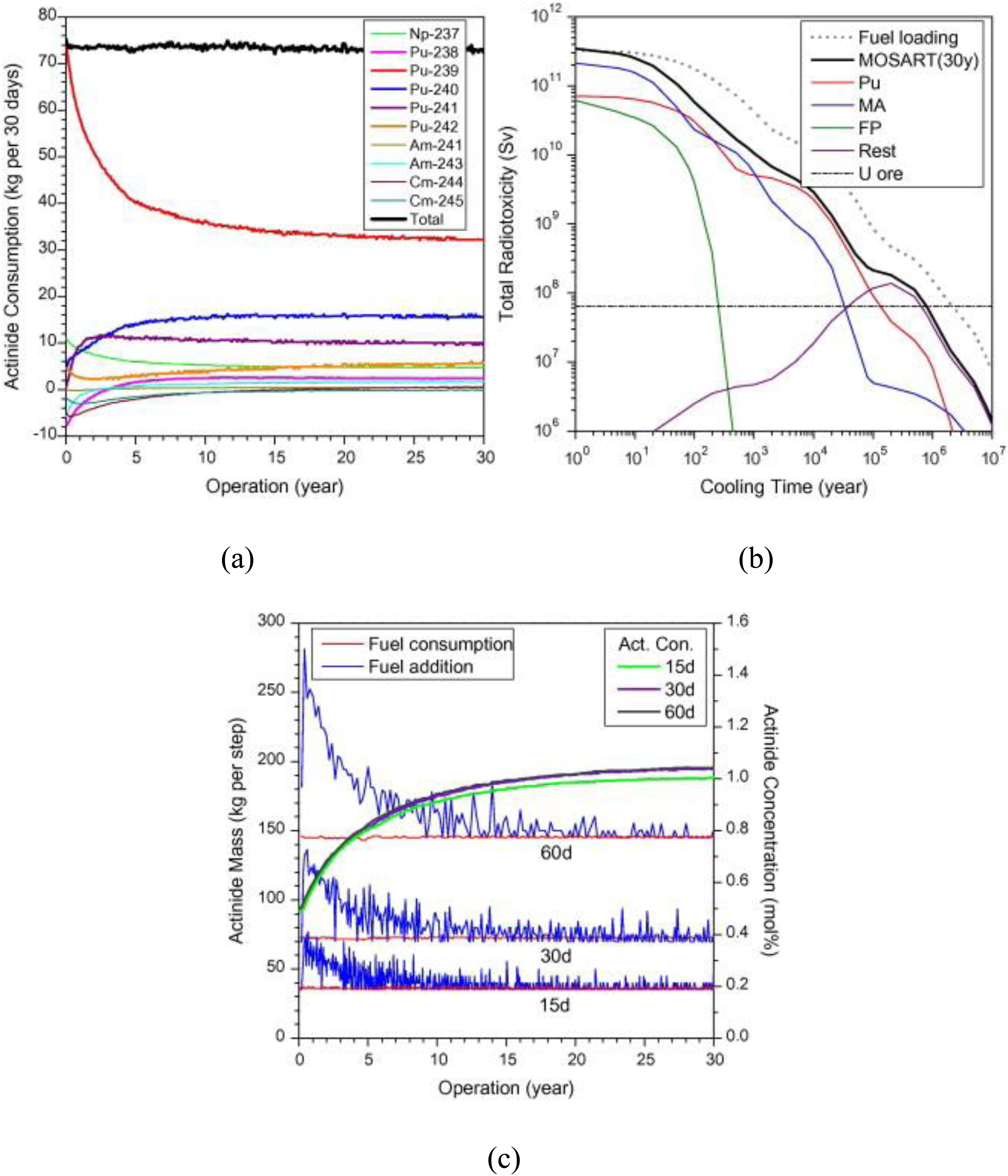
(a) Rates of actinide consumption over the course of molten salt actinide recycler and transmuter (MOSART)'s 30-year operation, (b) radiotoxicity of the residual fuel salt in the MOSART core over time following a 30-year operation (c) step-length effects on modelling the addition and consumption of fuel, as well as the resulting actinide concentration in the fuel salt, during MOSART's 30-year operation. Reproduced with permission from (Sheu et al., 2013). Copyright Elsevier.
Similarly, a novel technique for creating Mo-99 in molten-salt fluoride fuel that may generate a significant quantity of Mo-99 in 1 MW of fission was studied by Sheu et al. (2014). Potential for large-scale production in a small MSR was discovered after three proposed small MSRs were examined and optimised for Mo-99 production. A simulation of the MSRE's operation over a 50-year period showed changes in system keff values and Mo-99 activities in the fuel salt, and an automatic computation and control programme was created based on stepwise TRITON calculations. According to the study, in the long run, the HeteType core design provided the lowest radiotoxicity and best fuel use with the least amount of initial fuel loading. For the tiny MSR operation, only non-soluble FPs needed to be removed. The HeteType model was further optimised with respect to reflector thickness and fuel channel diameter.
Brief overview of the key findings of the top 25 most cited documents
A bibliometric analysis is essential because it also identifies the most cited papers, which are important hypotheses, groundbreaking discoveries, or fundamental research that have greatly influenced the area. In such publications, key trends, hot topics, and the conceptual basis of this field are sometimes identified. The analysis of these materials allows scholars to establish the prominent researchers, methods, concepts, and frameworks that inform their understanding of how a topic develops. In this section, a brief overview of the top 25 most cited documents, as shown in Table 1 is presented.
Top 25 most cited documents.
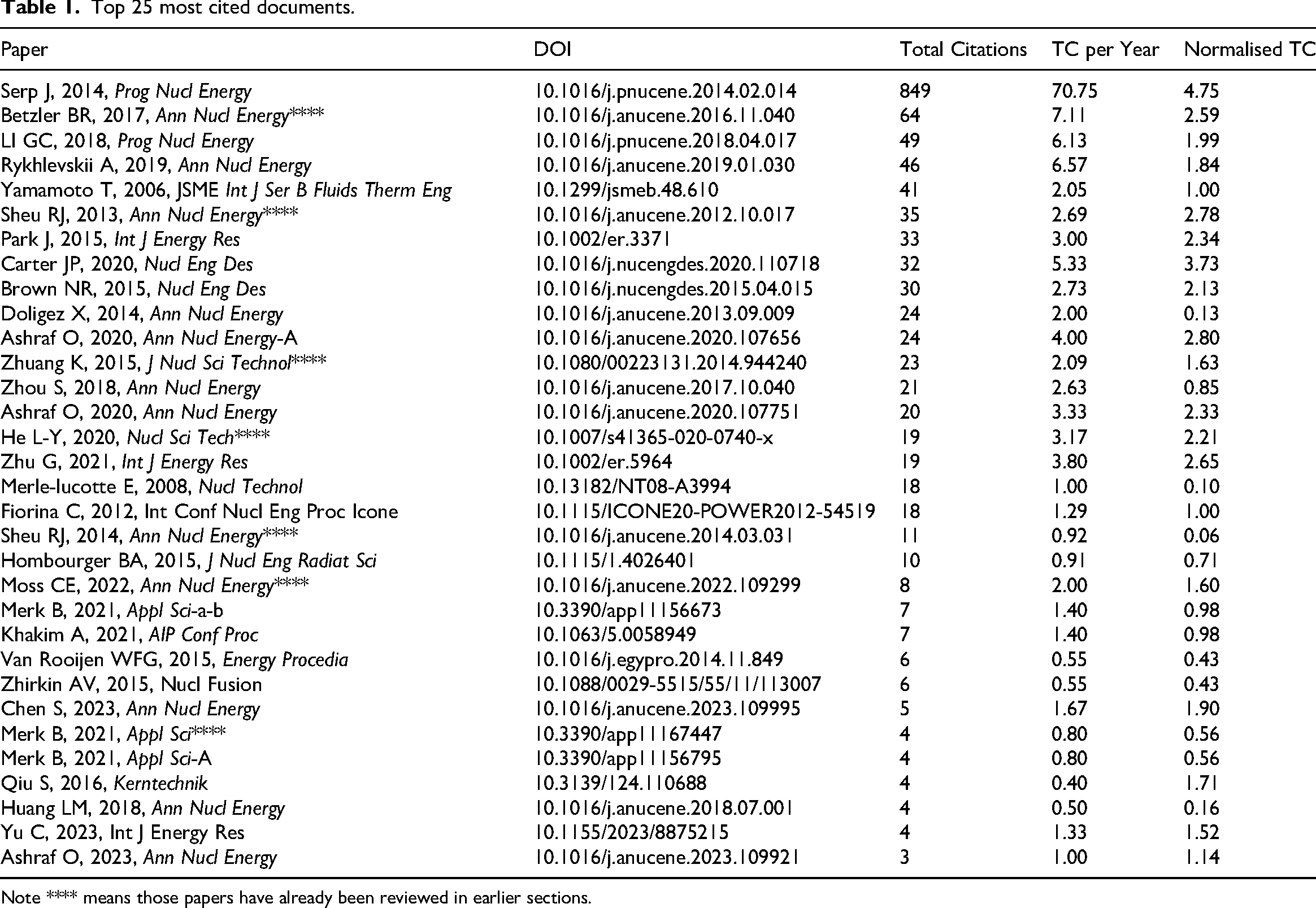
Note **** means those papers have already been reviewed in earlier sections.
Serp et al. (2014) gave a summary of global research and development initiatives on Generation-IV reactor types, including those from China, India, the United States, Japan, France, and the European Union. Three primary lines of inquiry were investigated: Solid fuel reactors, MSR with thermal neutron spectrum, liquid fuel, and the fluoride-salt-cooled high-temperature reactors (FHR). According to the study, China is working on solid fuel reactors, while the United States is concentrating on the FHR. Russia, France, and the EU are collaborating to create a quick-spectrum MSR that can either transmute or breed actinides from spent nuclear fuel. Future research, according to the study, should concentrate on fuel and fuel cycle chemistry, materials behaviour, liquid salt technology, safety design, and numerical simulation. An investigation by Li et al. (2018) suggested a SD-TMSR core architecture. In order to optimise the assembly, the ratios of molten salt to graphite were changed while taking into account BR, double time, 233U inventory, and TCR. The ratios were at their best when DT and TCR were 0.357 and 1.162, respectively. Th-U fuel breeding benefited from online reprocessing, according to burn-up calculations using a self-developed MSR reprocessing sequence (MSR-RS). From Figure 8, 200 l/d was the rate at which iso-breeding could be accomplished, and 5 m3/d greatly enhanced Th-U breeding success. The time required to double 233U was only 16 years. TCR stayed negative, indicating that inherent safety was maintained during operation.
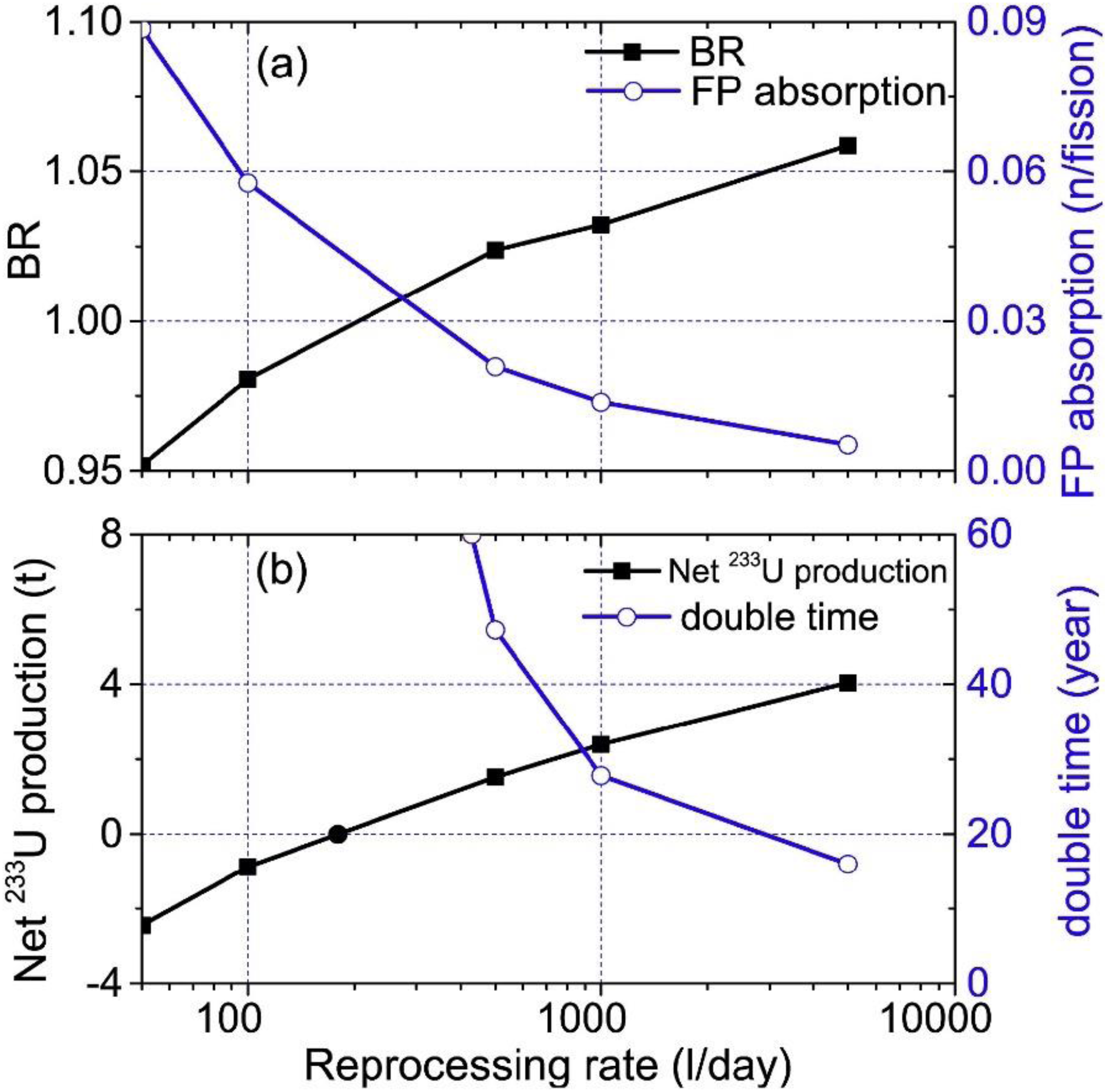
Effects of reprocessing rate on 60-year Th-U breeding performance. Reproduced with permission from (Li et al., 2018). Copyright Elsevier.
Also, the benefits of continuous fission product removal for thermal MSR design were illustrated by Rykhlevskii et al. (2019), who also compared the expected operational and safety parameters of the MSBR at startup and equilibrium state, and showed how SaltProc may determine the equilibrium fuel salt composition. The MSBR's full-core high-fidelity benchmark model was applied to SERPENT2, which captured breeding in the outer core zone. The concentrations of 233U, 232Th, 233Pa, and 232Pa settled after about 2500 days of operation, and the effective multiplication factor dropped from 1.075 to 1.02 at equilibrium after about 6 years of operation, according to the study. Additionally, the study discovered that neutron energy spectrum hardening during fuel salt depletion had an undesired effect on MSBR stability and controllability, and that it should be considered while conducting additional studies on transient accident scenarios. The estimated effective multiplication factor for the full-core MSBR model after removing different fission product groups throughout a ten-year operating period is presented in Figure 9.
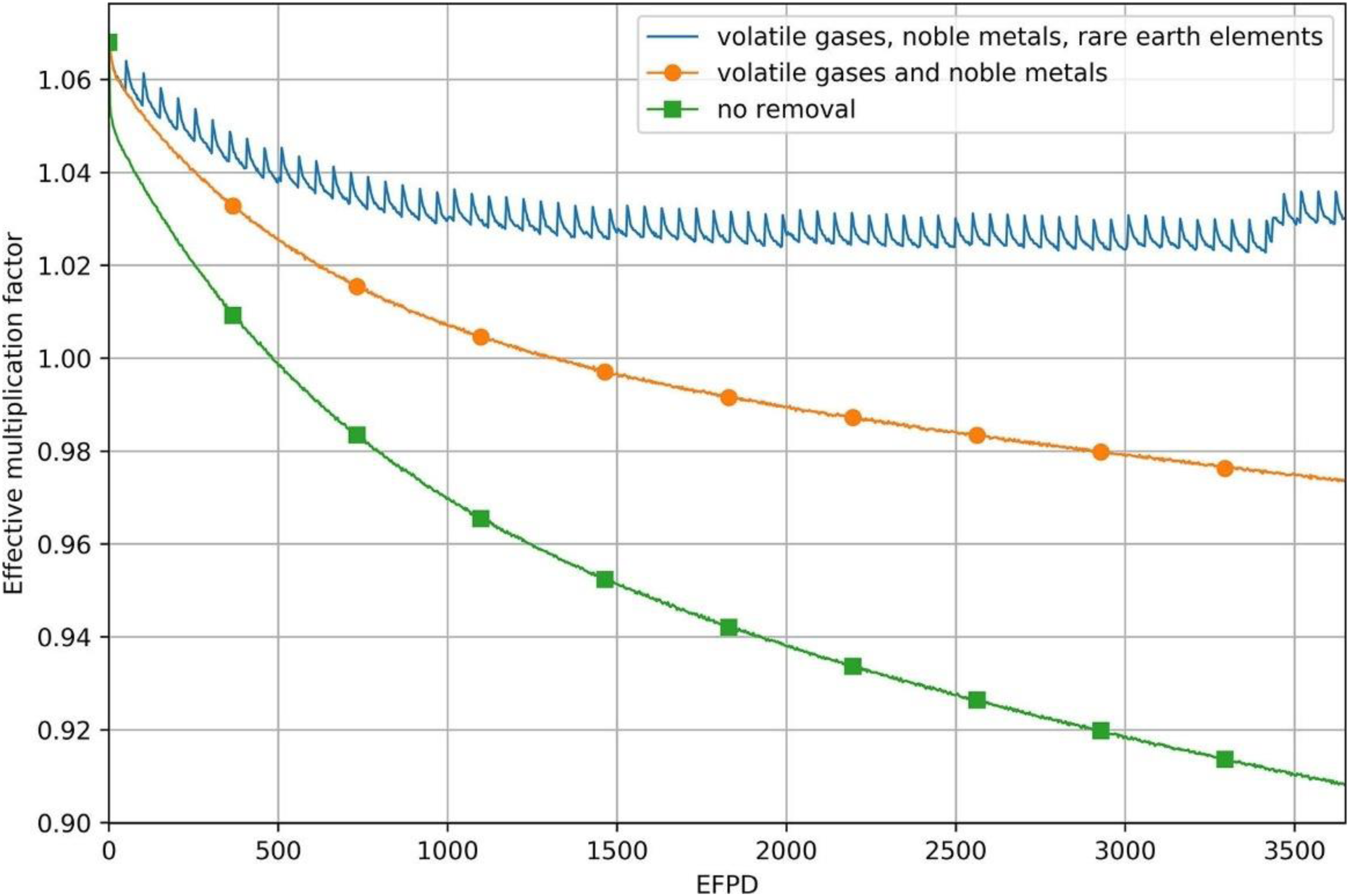
Estimated effective multiplication factor for the full-core molten salt breeder reactor (MSBR) model after removing different fission product groups throughout a ten-year operating period. Reproduced with permission from (Rykhlevskii et al., 2019). Copyright Elsevier.
Yamamoto et al. (2005) also used a model that contained energy conservation equations for fuel salt and graphite moderator, transport equations for delayed neutron precursors, and neutron diffusion equations for fast and thermal neutron fluxes to assess a small MSR system. According to the results, neutron flux peaks migrated towards the bottom, and fuel salt flow considerably carried delayed neutron precursors. The small MSR system's neutron multiplication factor decreased as a result of weak negative reactivity effects from the external-loop system's extended residence period, and the fuel input temperature increased.
Furthermore, in a different study Park et al. (2015) used the MCNP6 Python computer code system to model online refuelling and reprocessing, and the MSBR core's depletion calculation. Graphite elements were approximated to restore complex geometry information, and the core analysis was conducted using the searched equilibrium material composition. The graphite element model reconstruction for Zones 1 and 2A is shown in Figure 10. Fission products were removed every three days, and the fuel salt was supplemented with ferrous or fissile elements. Important MSR features like online reprocessing and refuelling were implemented by the computer code system. According to the study, as the depletion process progressed, the neutron energy spectra of Zones 1 and 2 became increasingly distinct. The findings of the core rod worth test showed that graphite control rods could only subcriticalise the core when it was neutral. Also, according to the power distribution of the MSBR core, approximately 95% of the fission power was generated in Zone 1.
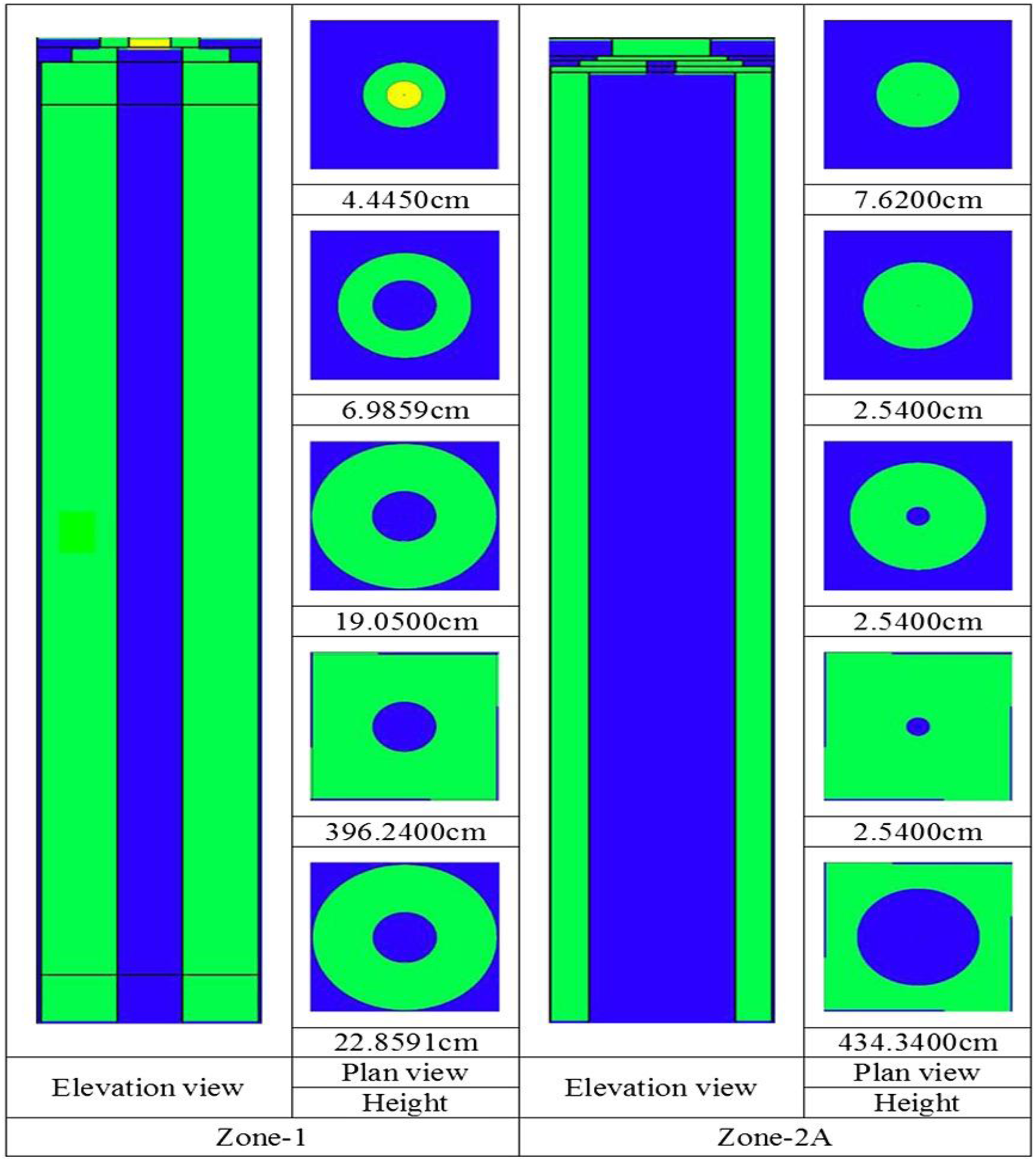
Zones 1 and 2A elements. Reproduced with permission from (Park et al., 2015). Copyright John Wiley & Sons, Ltd.
Carter and Borrelli (2020) investigated the MCNP transport code's performance using an integral MSR. It contrasted basic neutronic and thermal performance properties with those of well-known MSRs, such as the FUJI-MSR and ORNL MSRE. To do calculations, the study made use of the High-Performance Computing facility at the Idaho National Laboratory, which included the 34,992 core Falcon 2 SGI ICE-X distributed memory system. The researchers suggested investigating fuel burnup on alternate molten salt fuels, such as FLiBe, and integrating a model into Serpent. According to the study, a multi-physics approach is necessary for a thorough understanding of the molten salt nuclear system in order to comprehend fluid flow-thermal-neutronic stability, salt transport and deposition, and delayed neutron precursor. Strong simulation analysis can be produced by combining the Multi-physics Object Oriented Simulation Environment (MOOSE) application. In an object-oriented setting, Serpent can create cross-section databases to connect MOOSE multi-physics simulation programmes. Additional uses include two-phase flow modelling, RELAP 7 for thermal fluids, and BISON for fuel and structure performance simulation. The study indicated that a robust transient analysis and design optimisation would be made possible by combining PRONGHORN with GRIFFIN, enabling predictive modelling of material behaviours at the engineering materials and microscale. According to the study, despite being certified for safety software applications, MOOSE-based computing frameworks still require validation before they can be used on MSRs. An experimental investigation, according to the findings, is necessary to understand the chemical and thermophysical properties of molten salts under irradiation flux conditions.
Additionally, Brown et al. (2015) examined reactor models of a nuclear fuel cycle in which uranium and thorium were continuously recycled. In the fuel cycle, the objective was to ascertain if intermediate spectrum systems whose fission events have neutron energy ranging from 1 to 105 eV, perform as fast spectrum systems. The study covered options such as sodium-cooled reactors with hydride fuel, continually refuelled MSRs, and tight lattice heavy or light water-cooled reactors. In terms of the computed metrics, the study discovered that intermediate spectrum systems performed similarly to the reference fuel cycle, which used a sodium-cooled fast reactor design with metallic fuel. In that fuel cycle, however, intermediate spectrum systems’ burnup and breeding performance were constrained by their lower intermediate energy compared to fast energy levels. When deployed in the fuel cycle at equilibrium, the results showed that the total fuel cycle performance for critical reactors with fast and moderate spectra was comparable. In another study, Doligez et al. (2014) provided a tool for examining the MSFR in conjunction with its reprocessing system, enabling a thorough comprehension of the impact of the reprocessing unit on the neutronics of the reactor. In the reprocessing unit, the tool also took into account nuclear decays because some isotopes had short-lived nuclei. Complete coupled research was conducted by modelling the chemical kinetics. According to the study, reprocessing regulates salt chemistry and redox potential rather than reactor operation constraints. Low fission product reaction rates and non-critical extractions were made possible by the core's rapid neutron spectrum. Because alkali and earth alkaline elements did not require extraction, they were able to build up in fuel salt without having a major effect on the breeding ratio. The tool evaluated back-end cycle features such as criticality and nuclear decay heat production, calculating quantities in each component of the reprocessing system at any point during operation.
Moreover, Ashraf et al. (2020) used reactor-grade Pu, TRU, and 233U as initial fissile materials to study the SD-TMSR model's transition to the thorium fuel cycle. The findings showed that a shorter transition period (∼4.5 years) was possible with a continuous flow of reactor-grade Pu as opposed to 26 years with Th/233U starter fuel. With TRU as the starting fissile material, it was possible to run the SD-TMSR for about 40 years without requiring an external 233U input. It was discovered that the fuel salt's Pu mole concentration was below the solubility limit. In contrast to the 233U fuelling scenario, the neutron energy spectrum change during reactor operation was different for the Pu and TRU cases. For reactor-grade Pu starter loading, the largest shift in the neutron energy spectrum was observed. Comparisons were made between the initial and equilibrium states of the SD-TMSR's operational and safety parameters for the three promising startup fuels. The overall TCR was found to be consistently negative and comparatively high. Also, Zhou et al. (2018) created a new fuel cycle analysis code FAMOS for MSR applications. Fuel depletion, reprocessing, and feeding simulations were performed using an in-house multi-channel thermal-hydraulics solver and nuclide depletion solver, and the DIF3D code was extended to model delayed neutron precursors. The effective delayed neutron fraction could be computed by FAMOS, taking into consideration reactivity feedback coefficients, neutron generation time, and fuel salt motion. The EVOL project's proposed MSFR was used to test the code, and the results demonstrated that it could accurately simulate the MSRs’ fuel cycle process. Additionally, FAMOS was used for the MSBR's fuel cycle analysis. Three distinct calculation models were used to assess the impacts of temperature distribution and delayed neutron precursor drift on neutronics properties and fuel cycle performances. In MSRs, the effects of delayed neutron precursors and temperature distribution on actinides and fission products were insignificant. By providing 232Th, it was also able to produce a 233U conversion ratio greater than 1.0 without removing protactinium, enabling MSBR operation.
A major drawback of nuclear power is the long-lived MAs, which, when directly disposed off in deep geological formations, generate heat and effective doses. Transmutation of these MAs is therefore suggested as a substitute. The transmutation performance of MAs in the crucial Singlefluid Double-zone Thorium-based MSRSD-TMSR and SMSFR was thus examined and contrasted by (Ashraf and Tikhomirov, 2020a). The transmutation ratio (TR), neutron spectrum shift, temporal evolution of MAs and major nuclide inventories, as well as change of Keff and core reactivity with various MAs loadings, were also investigated. According to the study, SMSFR used around 86.5% of the produced Pu isotopes in the fuel salt, whereas SD-TMSR consumed roughly 50%. Both reactors successfully transmuted 237Np, 241Am, 243Am, and 243Cm as shown in Table 2 when online reprocessing and refuelling were used during burnup, keeping the core critical and the total fuel mass nearly constant. SMSFR had a higher TR than SD-TMSR.
The long-lived MAs’ TR following 20 and 40 years of burnup for the SD-TMSR and SMSFR (Ashraf and Tikhomirov, 2020a).
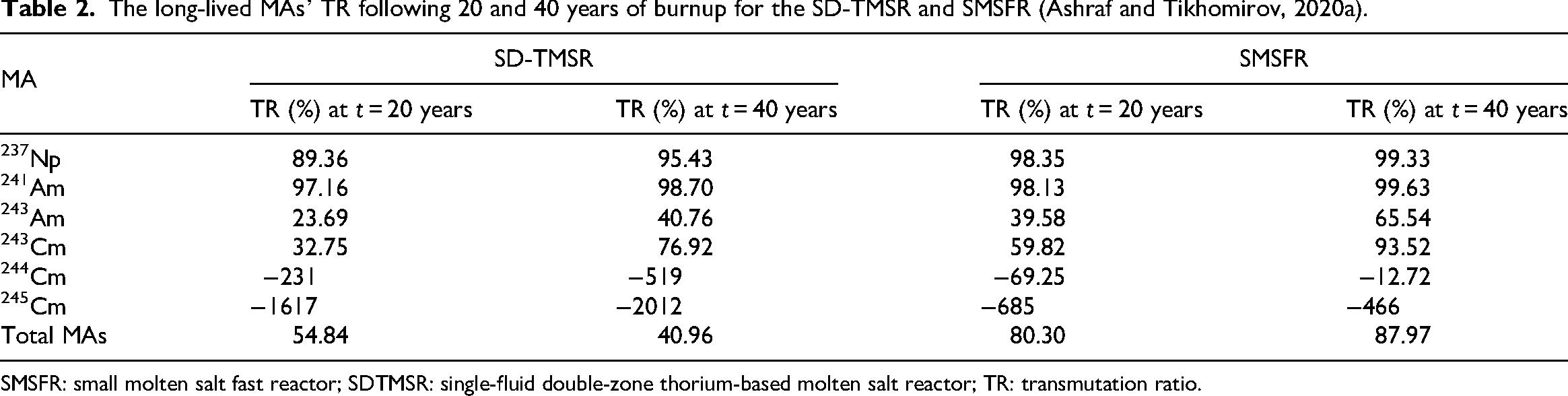
SMSFR: small molten salt fast reactor; SDTMSR: single-fluid double-zone thorium-based molten salt reactor; TR: transmutation ratio.
Moreover, Zhu et al. (2021) demonstrated a multiphysical burnup code that showed that the neutronic properties of SM-SMR, including fuel burnup and TRC, are not significantly affected by dimensional variations in graphite. Local temperature, mass flow, and power density distributions, however, varied by 10%–30%. More accurate direction for useful engineering technologies, such as fuel management plans and core monitoring, was given by the proposed approach. The findings indicated that graphite's typical shrink ratio at the end of its life is around −1.0% ΔL/L. The researchers proposed that the thermal-hydraulic model be made simpler and that the flow field between gaps in a CFD code be examined. Another study by Merle-Lucotte et al. (2008) examined the effects of several processing methods on the reactor's neutronic behaviour and provided a reference design for a thorium MSR. The goal of the project was to create a processing scheme that was realistic, dependable, and efficient while taking chemistry and neutronic effects into account. The method involved an in-line bubbling mechanism inside the reactor and a slower external processing unit. It also investigated how processing speeds affected the reactor's behaviour, particularly the breeding ratio. The study also took into account the salt's characteristics, selecting a 78 mol% LiF–22 mol% [heavy nuclei (HN)] F4 salt for the fuel while also taking into account lower HN proportions to reduce the 233U inventory. The study indicated that the simplicity of salt processing enhanced the practicality of the TMSR system. The HN percentage significantly altered the neutron spectrum, affecting the reactor's behaviour.
Fiorina et al. (2012) analysed the main neutronic features of the MSFR using state-of-the-art neutronic codes, including ERANOS and SERPENT codes. A 6-group diffusion model using COMSOL Multiphysics was set up, providing insight into the approximation introduced by a diffusion approach. ERANOS-based EQL3D was used to create the MSFR equilibrium core, which was used to analyse the neutron spectra and flux distributions. The findings revealed an intermediate spectrum with a complicated structure in the 10 keV–1 MeV energy range. High neutron flux in the resonance zone below 10 keV was caused by the softer spectrum, which improved Doppler coefficients. This feedback coefficient for salt expansion increased MSFR safety. Generation time and βeff were comparable to FRs, even though the spectrum was softer. If the reactor is initially loaded with TRUs as fissile material, Doppler coefficients and generation time drastically deteriorate; this parameter could be improved by partially replacing TRUs with enriched uranium. The fuel's liquid nature implied a homogeneous core, and the flux near the core boundaries was six times lower than at the reactor centreline. SERPENT and ERANOS results showed good agreement, with a maximum discrepancy of 3% in the overall feedback coefficient. Another study by Hombourger et al. (2015) examined the impact of heterogeneity in the fuel-graphite lattice of an MSR core using channel radius and salt share variables. They calculated the equilibrium composition in a closed thorium-uranium fuel cycle, and used neutronics considerations to study the difference in absolute and relative fuel utilisation performance. The results demonstrated that the optimal utilisation of 233U at equilibrium occurred at a graphite thickness between channels of about 30 cm, or the slowing-down length of neutrons in graphite. This optimum was a local minimum of the reactor with equilibrium fuel composition, and some intermediate-spectrum configurations could produce significant excess reactivity at equilibrium, but this optimum was sensitive to engineering uncertainties and should be taken into account for actual reactor design. The study stated that the combination of a graphite moderator and a liquid fuel that can endure harsh conditions may lead to alternative reactor design optimisation paths. The use of a different, more powerful moderator, like hydrogen-containing compounds like metal hydrides, is of interest for lowering the slowing-down length and core size, and more research in this area should be taken into consideration.
Merk et al. (2021b) also argued for the importance of a zero-power reactor in developing innovative reactor concepts like MSRs. The research focused on salt compositions and experimental setup dimensions to narrow down choices for a zero-power experiment. The study used various tools from the SCALE package to study two different salt systems: Eutectic and heavy metal-rich. The results showed that the heavy metal-rich system required a smaller volume, while the eutectic system had a slightly harder neutron spectrum. Three configurations were chosen for follow-up 3D analysis: Eutectic with 35% uranium-235 enrichment and heavy metal-rich with 20% and 35% enrichment. They concluded that validation experiments were required for future modelling and simulation of MSR systems, but their analysis was only applied for a narrow operational temperature window around 980 K, and a more thorough study is required to better understand a potential first core based on a solid salt mixture. The heavy metal-rich composition was selected as the reference system for future zero-power reactor investigations. Additionally, Khakim et al. (2021) demonstrated key MSR neutronic safety features, including fuel, moderator, and reflector temperature reactivity feedback. Nuclear data ENDF/B-VII and MCNP6 calculations were used to analyse neutron energy spectrum behaviour during voiding and void reactivity feedback. Neutron flux and power density distribution were also considered, along with modelling the entire core geometry. To review the safety parameters, Monte Carlo code calculations were employed. The findings demonstrated that the core produces negative reactivity feedback when the fuel and moderator temperatures rise, but positive feedback when the reflector temperature rises. The temperature reactivity coefficients were significantly negative, indicating that there should be a secure buffer between the boiling point and operational temperature to avoid void formation from fuel boiling.
Additionally, a research of the Th-MA-fueled Molten Salt Fast Reactor conducted by Van Van Rooijen et al. (2015) found that trivalent actinoids in fuel salt raise melting points, which is significant because reactor components have temperature constraints. With an uncertainty of roughly 2%, the reactivity difference between JENDL-4.0, JEFF-3.1.2, and ENDF/B-VII.1 was found to be significant in their findings. However, the study found that this was an understatement because important isotopes such as F-19 and Li-7 in JENDL-4.0 lacked covariance data. The isotope distribution varied considerably, with U-233 fission predominating in JEFF-3.1.2 and ENDF/B-VII.1, whereas Th-232 capture was essential for the Doppler- and fuel density effect in JENDL-4.0. The study concluded that additional research was required to address the uncertainties surrounding the multiplication factor and the depletion behaviour of individual fuel isotopes. Also, Zhirkin et al. (2015) examined the potential of hybrid fusion neutron source blankets for the production of heat, power, spent nuclear fuel reprocessing, and nuclear fuel. The blankets featured molten lead, molten salt blankets, uranium and thorium oxides, heavy water solutions of salts, and solid-state blankets of uranium and thorium. Radiation toxic waste accumulation was kept to a minimum while the maximum nuclear fuel output was attained by optimising the blankets, moderators, and fertile materials’ geometrical parameters and structure. Burnup, radiotoxicity, and the development of fuel remote reprocessing and refabrication technologies were among the difficulties encountered while removing the created 233U or 239Pu from a solid blanket. Due to their low sensitivity to electromagnetic fields, great radiation and thermal stability, low accident probability, and fire safety, fluoride molten-salt blankets were found to be the best choice for producing nuclear fuel.
Chen et al. (2023) introduced two machine learning techniques for examining equilibrium burnup in MSRs. A database including neutronic data about the equilibrium and non-equilibrium of a fuel assembly with varying geometric characteristics was created. A number of machine learning classification models were developed to filter for equilibrium burnup states after the equilibrium characteristics of three different fuel cycle types were assessed. Using ML regression techniques, a technique for quickly predicting equilibrium neutronic parameters was also created. According to the findings, 2854 of the 4860 MSR fuel assembly cases produced for the three different fuel cycle types reached the equilibrium state. Over 0.96 and 0.97 performance metrics were attained by the LGBM, XGB, and RF models, respectively. From the perspectives of MAE, MSE, and MAPE, the LGBM, MLP, and SVM models fared better than other ML models with smaller variances. In conclusion, the LGBM model was suggested for forecasting MSR neutronic characteristics and identifying the burnup stage. A study was also conducted by Merk et al. (2021c) to explore the influence of different reflector materials on achievable keff and power distribution for a particular reference configuration. Classical reactor materials and unusual alternatives were explored, with SS304, lead, copper, graphite, beryllium oxide, and iron-based material with high Si concentration identified as promising. It was discovered that moderating reflectors made of graphite and beryllium oxide had a significant impact on the power distribution. The most appealing options were found to be copper and stainless steel, with lead serving as a contingency and graphite being a desirable option for upcoming thermal systems. According to the study, although 30 cm showed to be the ideal reflector size, narrower reflectors could work well for copper and thicker ones for lead. The anticipated impact of moderating reflectors BeO and graphite was validated by the examination of the reflector material's influence on the neutron flux spectrum. The power increase at the core boundary was also explained by the study, which showed that a sizable portion of the neutrons held in moderating reflectors caused well thermalised neutrons to stream back into the core. Potential fuel volume reductions of up to 60% as compared to the reference scenario utilising a NaCl reflector were discovered using 3D Monte Carlo research. Although it was the least expensive option, the stainless-steel reflector had the biggest impact on power distribution.
To calculate and analyse MOSART, Qiu et al. (2016) introduced the basic models of the neutronics/thermal hydraulics connection and the numerical approach for liquid-fuel MSRs. Neutron fluxes showed to be marginally impacted by liquid-fuel flow, whereas delayed neutron precursors, particularly those with lower decay constants, were strongly impacted. For MOSART, the liquid-fuel flow caused a 127 pcm reactivity loss. Both the liquid-fuel and graphite reflectors had negative temperature reactivity coefficients, demonstrating the intrinsic safety features of liquid-fuel MSRs. MSR safety was further enhanced by the influence of three operational factors in the external loop: Dwell duration, inlet temperature, and inlet velocity. The ULOF results demonstrated that substantial negative reactivity feedback makes the MOSART conceptual design intrinsically stable. Also, Huang and Petrovic (2018) described a process for creating a neutronics model for an optimisation research on the fuel design of FHR. ORNL's AHTR with hexagonal fuel elements and fuel ‘planks’ served as the model for the reactor design. The objective was to develop an accurate, practical, and sufficiently fast methodology for a fuel plank design optimum search in order to decrease the fuel cycle cost (FCC) of FHR. Double heterogeneity was automatically modelled to enable precise multi-group simulation use. The methodology used SCALE6.2 to calculate MCDancoff factors. The performance of multi-batch refuelling was analysed using a straightforward non-linear reactivity model with assembly-to-whole-core reactivity correction. The results indicated that cycle length is maximised at 40% packing fraction with a carbon-to-heavy metal ratio (CHM) of about 250, minimising outage costs. The discharge burnup and fuel utilisation were maximised at about 20% packing fraction with a CHM of about 600, minimising fuel cost but not necessarily FCC cost; the minimum FCC was the best trade-off between the two, within the stability domain.
Finally, Yu et al. (2023b) examined the temperature reactivity coefficients, molten salt volume, heavy metal mole fraction, and fuel utilisation of three fuel salts at various heavy metal mole fractions and molten salt volume fractions. The findings demonstrated that as the energy of the average lethargy causing fission (EALF) increases, the burnup tends to increase, decrease, and then increase again. While natural uranium burnup was very low in the epithermal spectrum, it was favourable for fuel utilisation in the thermal spectrum region. When EALF rose, the burnup was greater in the fast spectrum region than in the thermal spectrum zone. The temperature reactivity coefficient was negative across the whole energy spectrum and tended to rise, fall, and then rise again with EALF. The study found that small modular reactors required longer-term fuel management planning and had greater initial fuel investment costs, but they burned up less than chlorine salt fast reactors. Ashraf and Tikhomirov (2023) used SERPENT-2 to simulate the reactor's entire core depletion. Fuel channel pitch and radius of the SD-HWMSR were optimised, with an inner zone volumetric ratio of 0.480 and an outer zone volumetric ratio of 1.887. This ratio led to negative temperature and void reactivity coefficients, a high BR, and a low initial 233U loading. In the inner and outer zones of the reactor, there were 486 and 522 fuel channels, respectively. Over time, excess reactivity was managed by decreasing the refill rate while 233U from the Pa-decay tank and 232Th from an external stockpile were continually replenished. After 25 years of operation, the neutron spectrum was constant, but it became harder due to fissile Pu and other thermal neutron absorbers in the fuel salt. Over the course of 60 years, the net output of 233U rose to around 1.98.
A summary of the top-most cited documents, as presented in the earlier paragraphs in this section, shows that Serp et al. (2014) provided a programme-level strategic integration of Generation-IV directions (national priorities, reactor types, and high-level R&D goals), and established the technological drivers of MSR/MSBR/MSFR studies in depth. The other studies also explored basic physics, fuel-cycle parameters, and coupled neutronic-thermal-chemical processes that Serp et al. (2014) identified as priorities: Reprocessing online, fuel chemistry, materials behaviour, and multiphysics safety evaluation. Technically, the various analyses converged on several uniform conclusions: (a) Fission-product removal and reprocessing rate in online mode is a first-order design knob, for example, the SD-TMSR burnup/repro runs demonstrated iso-breeding at ∼200 L/d and significantly improved Th-U breeding at 5 m3/d, lowering 233U doubling time to ∼16 y; (b) spectrum hardening during depletion substantially alters stability and control (MSBR work: keff reduction from 1.075→1.02, and hardening deteriorated controllability); (c) temperature reactivity coefficients are generally negative for fuel and moderator (good intrinsic safety), but reflector and void effects could be positive and must be quantitatively accounted for; and (d) delayed neutron precursor transport and external-loop residence times introduced measurable reactivity penalties (e.g., MOSART ∼127 pcm loss) and modified flux distributions, therefore flow-neutronics coupling was found to be necessary. These high-fidelity depletion and equilibrium calculations (SERPENT2, MCNP6, SaltProc, FAMOS) also revealed practical engineering limits: Heterogeneity of graphite, control-rod worth reduction at equilibrium, and chemistry/solubility limits for Pu/TRU loading.
By contrast, the technological research as presented supra differs in modelling fidelity, scope of physics, and design emphasis, with complementary results. MCNP6- and SERPENT-based depletion and full-core benchmarks (MSBR, MSFR) delivered a comprehensive neutronic equilibrium and spectral resolution and quantified keff trajectories. Code developments, that is, FAMOS, SaltProc, and MSR-RS explicitly model online reprocessing and delayed-neutron back-coupling so that quantities like TR, BR, and development of fuel inventory can be calculated. Furthermore, the studies showed that ML techniques (LGBM/XGB/RF) offered rapid predictors of equilibrium values but required robust training sets validated by high-fidelity codes.
The main technical distinctions according to the findings of the top-most cited documents reviewed supra include spectrum choice (fast vs intermediate): Fast-spectrum systems can achieve fast-spectrum fuel cycle efficiency but are restricted in breeding and burnup by lower neutron energies; SMSFR achieved much greater Pu usage (≈86.5%) and TR than SD-TMSR (≈50%). Nuclear data and covariance uncertainties (ENDF/B, JEFF, JENDL) remained non-negligible for keff and depletion paths, and experimental validation (zero-power salt experiments, and salt property tests under irradiation) was repeatedly identified as necessary going into the future. Together, the literature went beyond the study conducted by Serp et al. (2014) to indicate that effective MSR deployment requires (i) cross-validated multi-physics toolkits including online reprocessing chemistry, (ii) nuclear data and materials/salt chemistry uncertainty resolution, and (iii) targeted experiments to anchor simulations and define control, safety margin, and material limits.
A brief overview of the FHR technology
FHRs represent a distinct category from liquid-fuel MSRs: FHRs pair solid fuel (typically TRISO-coated particles in prismatic or pebble fuel assemblies) with a liquid fluoride salt coolant, but MSRs have liquid fuel (actinides in the carrier salt) that is both inventory holder and transport medium for the fissile/fertile material as well as fission products. This distinction has first-order consequences for neutronics, safety, and fuel-cycle management: In FHRs, fuel geometry is fixed, so neutronic feedback from fuel motion and precursor advection are irrelevant, but the temperature-dependent density and spectral moderation of the coolant still alter the neutron spectrum and reactivity coefficients; in MSRs, continuous circulation of fuel, online reprocessing, and transport of delayed-neutron precursors transform transient behaviour and depletion paths. Literature and technology roadmaps present this dichotomy; the AHTR/SmAHTR designs and ORNL/Department of Energy work define FHR structure and material/thermal boundaries separately from MSR activity (Holcomb et al., 2013; Ramey and Petrovic, 2018).
Technically, FHRs have design and operating attributes meriting unique treatment: Hot outlet temperatures (>600–800 °C) for efficient thermal conversion and process heat, low-pressure operation enabled by molten salt coolant, strong passive safety margins due to TRISO fuel endurance, and favourable thermal energy storage/integration potential with sensible- or latent-heat systems, attributes documented for the AHTR family and recent commercial projects such as Kairos Power's KP-FHR (Forsberg, 2002; Scarlat et al., 2014; ‘Technology’, n.d.). These features pose different neutronic and systems-analysis issues than MSRs: FHR modelling contends with refined solid-fuel heterogeneity (TRISO microstructure on fuel-compact/assembly scales), high-temperature coolant spectral and thermal hydraulics, and fuel-performance/pebble/plate mechanics, while MSR activity addresses continuous reprocessing, chemistry and solubility limits, and precursor transport. Nuclear Energy Agency/Organisation for Economic Co-operation and Development (OECD) benchmarking exercises and comparative Serpent/SCALE/MCNP simulations for FHR applications illustrate both the feasibility of utilising standard neutronic codes and the unique modelling issues (temperature/material dependent cross sections for fluoride salts, high-temperature thermal hydraulic coupling, and demonstration of TRISO behaviour at FHR conditions) that must be overcome to allow credible design and licensability (Romatoski and Hu, 2017b).
Conceptual analysis – thematic map, evolution, and factorial analysis
Conceptual analysis finds important application in a bibliometric context, since it allows for the systematic exploration and understanding of the evolution of a research field. In so doing, evolution analysis helps researchers to follow the historical development of key topics in a field, thus unveiling how concepts have changed with time and how they are interrelated with each other. The thematic map is an input to visualise research themes, mapping out the interconnections of the various topics, thereby leading to a perspective on growing areas of concern. The density on the thematic map reveals how well-developed or unified a subject is, while the centrality demonstrates how important a theme is within the area. Again, through factorial analysis, one can articulate the consequential forces and patterns constitutive of the structure of the research field, thereby highlighting clusters of related research and accounts of greatly influential stakeholders. Together, these forms of analysis provide a complete backdrop from which to analyse contents, uncover trends, and hence give coherence and direction to emerging avenues of inquiry (Agyekum and Odoi-Yorke, 2024b; Khizar et al., 2024). In this study, the thematic map for the subject is presented in Figure 11. A detailed discussion of the thematic map for the various quadrants is as follows:
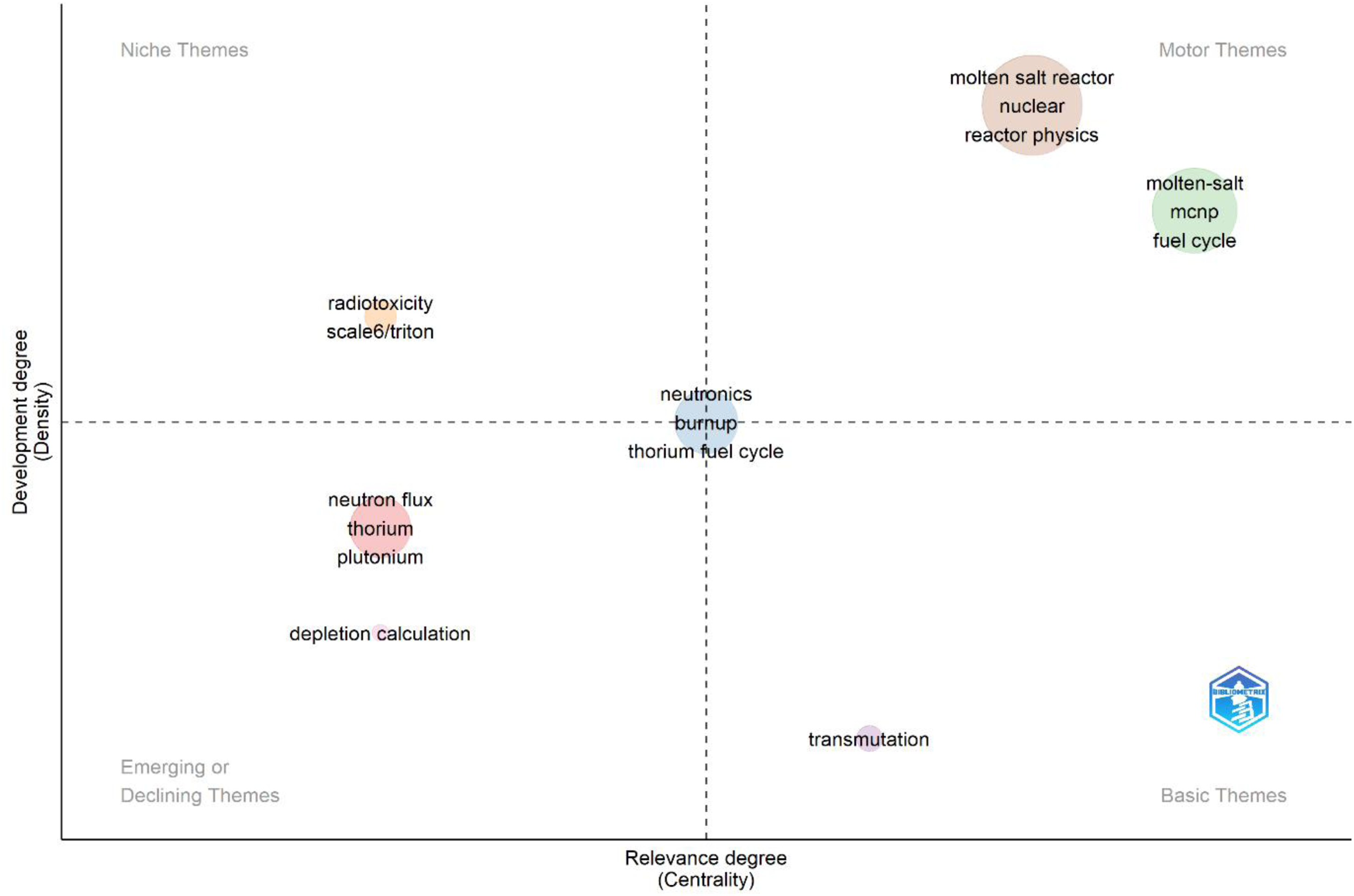
Thematic map for author keywords.
Motor themes quadrant – A bibliometric analysis of MSR neutronics and fuel cycle has revealed the linkage of two interdependent scientific clusters: One concerning molten salt, MCNP, and fuel cycle. This cluster delineates the construction of computational modelling and simulation of MSR fuel behaviour (neutron transfer) and cycle efficiency. It mainly focuses on operational optimisation of MSRs regarding safety, performance, and sustainability evaluation. The second cluster assesses MSR, nuclear, and reactor physics, which focuses on reactor design, operation, and fundamental nuclear physics. Future research should bridge the two clusters with simulation-based insights obtained from the first cluster, integrated with reactor physics and system-level considerations from the second cluster. This should include further coupled modelling with neutronics, thermos-hydraulics, and fuel cycle optimisations. This would advance the scalability, efficiency, and sustainability of MSR systems. Exploring new fuel materials and their energy behaviour under neutron irradiation, along with reactor safety and waste management, are also rich research areas for the future.
Niche themes quadrant – This quadrant depicts the significance of investigating environmental and safety aspects of MSRs. The radiotoxicity dimension points to a need for further investigations into health and environmental consequences of MSR fuel cycles, especially associated with the management of radioactive wastes and decay heat. The SCALE6/TRITON codes play an important role in modelling reactor physics and fuel behaviour, implying that some work should be devoted to implementing and improving these tools with respect to MSR design. The second cluster, equally represented across all four quadrants, contains topics such as neutronics, burnup, and thorium, which play a fundamental role in MSRs. Neutronics and burnup provide understanding of neutron behaviour, fuel consumption, and overall reactor efficiency. Thorium, as an alternative fuel, also has potential due to its reduced radiotoxicity and enhanced fuel utilisation compared to uranium. Research going forward should thus look at thorium-based fuel cycle development and optimisation, as well as burnup model enhancements to provide better resource utilisation and waste minimisation. When activities relating to radiotoxicity are integrated with MSR fuel cycle modelling and the relevant improvements to simulation tools SCALE6/TRITON are carried out, this could provide an avenue for better predictions of long-term reactor performance and environmental impact assessment.
Emerging/declining themes quadrant – This quadrant depicts interesting clustering in the context of MSR neutronics and fuel cycle. The first cluster, focusing on neutron flux, thorium and plutonium, indicates an ongoing interest in both understanding neutron behaviour within the reactor and at the same time looking for alternative fuels such as thorium and plutonium. Neutron flux is one of the basic necessities in designing reactors. It is a measure of their power of fission reaction and fuel utilisation. Several studies indicate that using thorium instead of uranium in conventional reactors has advantages, including safety and reduced waste output. Also, the presence of plutonium in this quadrant suggests research focused on recycling and transmutation techniques to cut down on nuclear waste. The second cluster, which also has themes such as depletion calculation, indicates research that is focused on models to track nuclear fuel consumption through time and its importance in optimising the fuel cycle and waste management, alongside the understanding of the long-term behaviour of the reactor. Future work should, therefore, emphasise the improvement of depletion models, thorium or plutonium use for radioactive waste reduction and strengthening fuel management strategies.
Basic themes quadrant – this quadrant has a single cluster with a single theme, that is, transmutation. Transmutation is one significant field of research in the domain of MSR neutronics and fuel cycle engineering. MSRs convert long-lived nuclear isotopes into shorter-lived isotopes, knocking the long-term radiotoxicity down and stretching the need for storage for these isotopes. This quadrant could be seen as a reflection of the increasing attention paid by researchers towards developing transmutation strategies, thereby reducing the threats posed by high levels of radioactive waste in future generations. Future research can, thus, cover transmutation advancement, efficiency enhancement in transmutation processes, fuel composition and reactor condition optimisation. Studies can also look at the design of advanced MSR systems associated with transmutation, new materials and reactor configurations for the process. Finally, researchers can also assess the long-term sustainability of transmutation-based fuel cycles. Such studies would contribute to making nuclear energy green, hence contributing to reducing waste storage and improving the lifecycle of nuclear fuel.
Evolution and factorial analysis of keywords
Figures 12 and 13 present the thematic evolution of research themes on the topic. The findings from the thematic evolution of keywords for the different periods studied: 2002–2008, 2012–2020, and 2021–2024 indicate a great forward shift in the scientific attention and complexity of study involving MSRs and their fuel cycle. Between 2002 and 2008, molten salt and MSRs were the most popular topics. The time frame most likely represented the initial investigation of MSRs as a substitute design for nuclear reactors, with an emphasis on comprehending molten salt as a fuel and coolant medium. Between 2012 and 2020, the topics had extended to neutronics, SCALE code, fuel cycle, and depletion, which, in a way, marked the transition to more specific and highly technical portions of MSR research. The need to simulate and optimise neutron behaviour for optimal reactor performance made neutronics the main focus of attention. The presence of SCALE, a software package, could be for the reasons mentioned in the preceding sections of this study. Fuel cycle and depletion, which also occurred within the period, are at the heart of the growing interest in MSR sustainability, specifically in avoiding waste, managing resources efficiently, and controlling nuclear fuel over time. From 2021 to 2024, the thematic introduction of nuclear chemistry, modelling and simulation, nuclear experiment, and MAs signals a maturity in the field of research. Nuclear chemistry within that period suggests that there is an emerging interest in the chemical behaviour of materials in the reactor environment, encompassing the interaction between molten salt and nuclear fuel. Furthermore, the modelling and simulation angle signifies advancements in computational studies that might treat the optimisation of reactor design and fuel cycles with increasing sophistication, possibly integrating multiple physical and chemical processes. The addition of MAs, which are elements generally hard to accommodate in standard reactors, suggests the researchers are devising ways to accommodate these substances in nuclear waste, possibly via an enhanced scheme of transmutation or fuel cycle management. This shift or evolution in themes underscores the growing complexity and interdisciplinary nature of MSR research, extending from simple reactor design to advanced modelling of fuel cycles, safety, and sustainability.
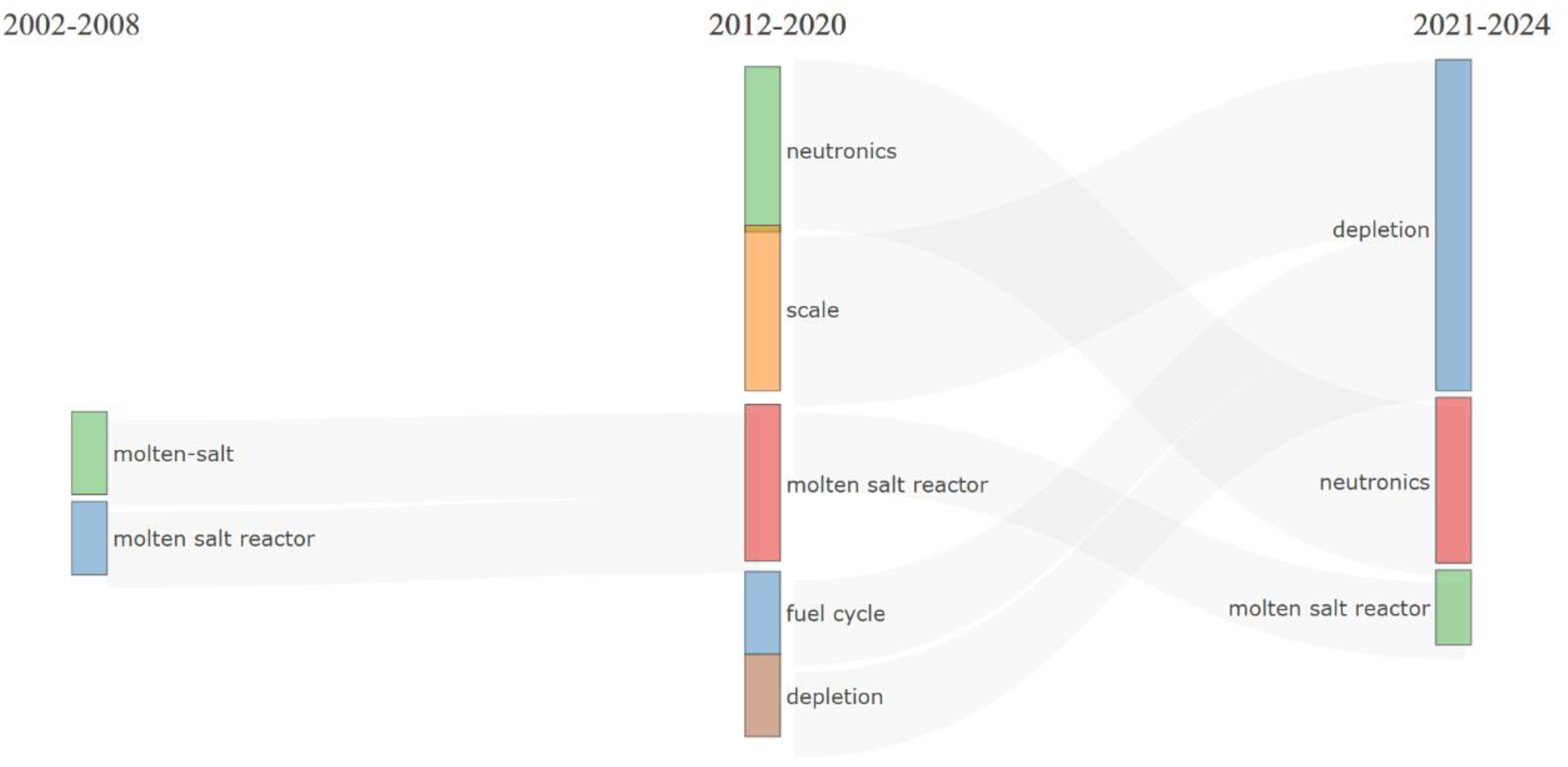
Thematic evolution of author keywords over time.
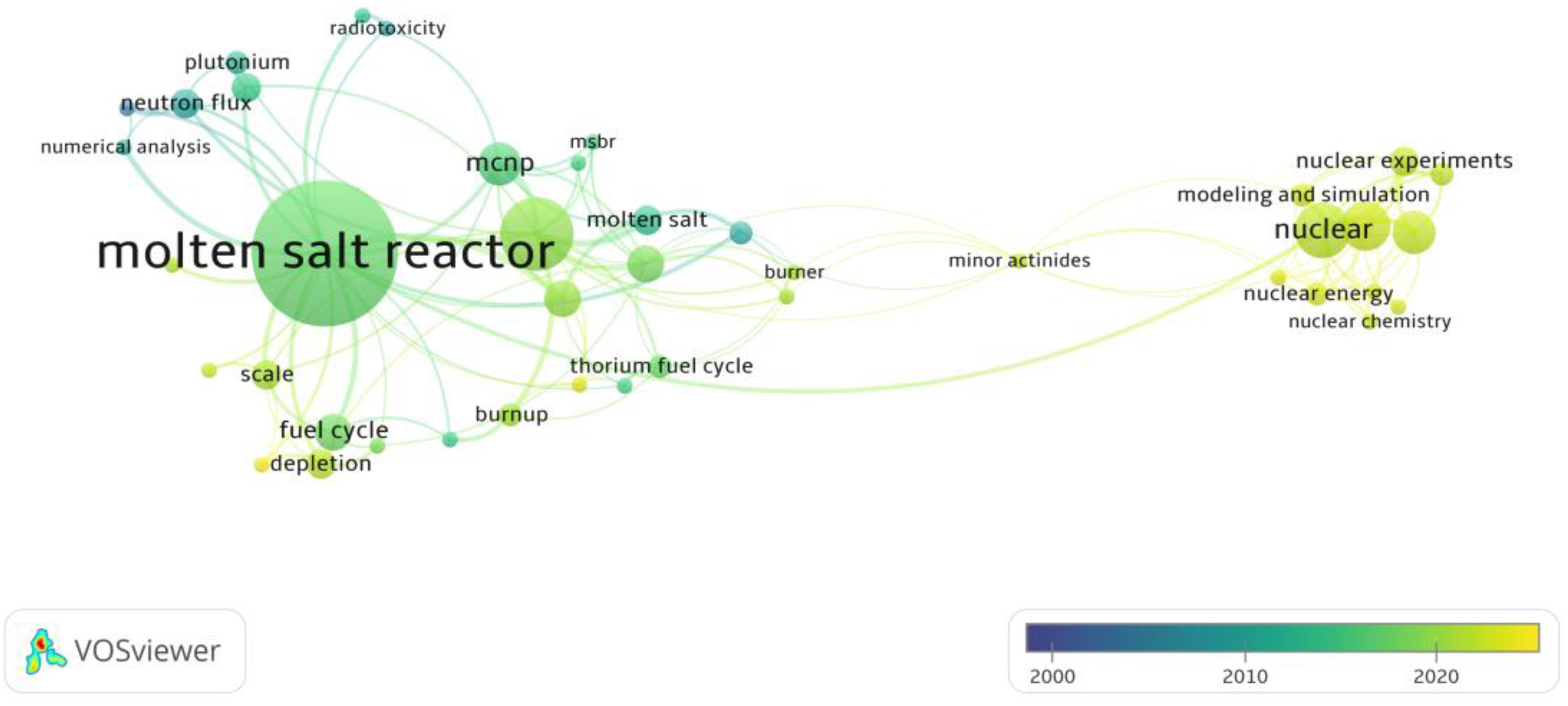
Author keywords’ overlay visualisation.
By performing a factorial analysis of keywords, as shown in Figure 14
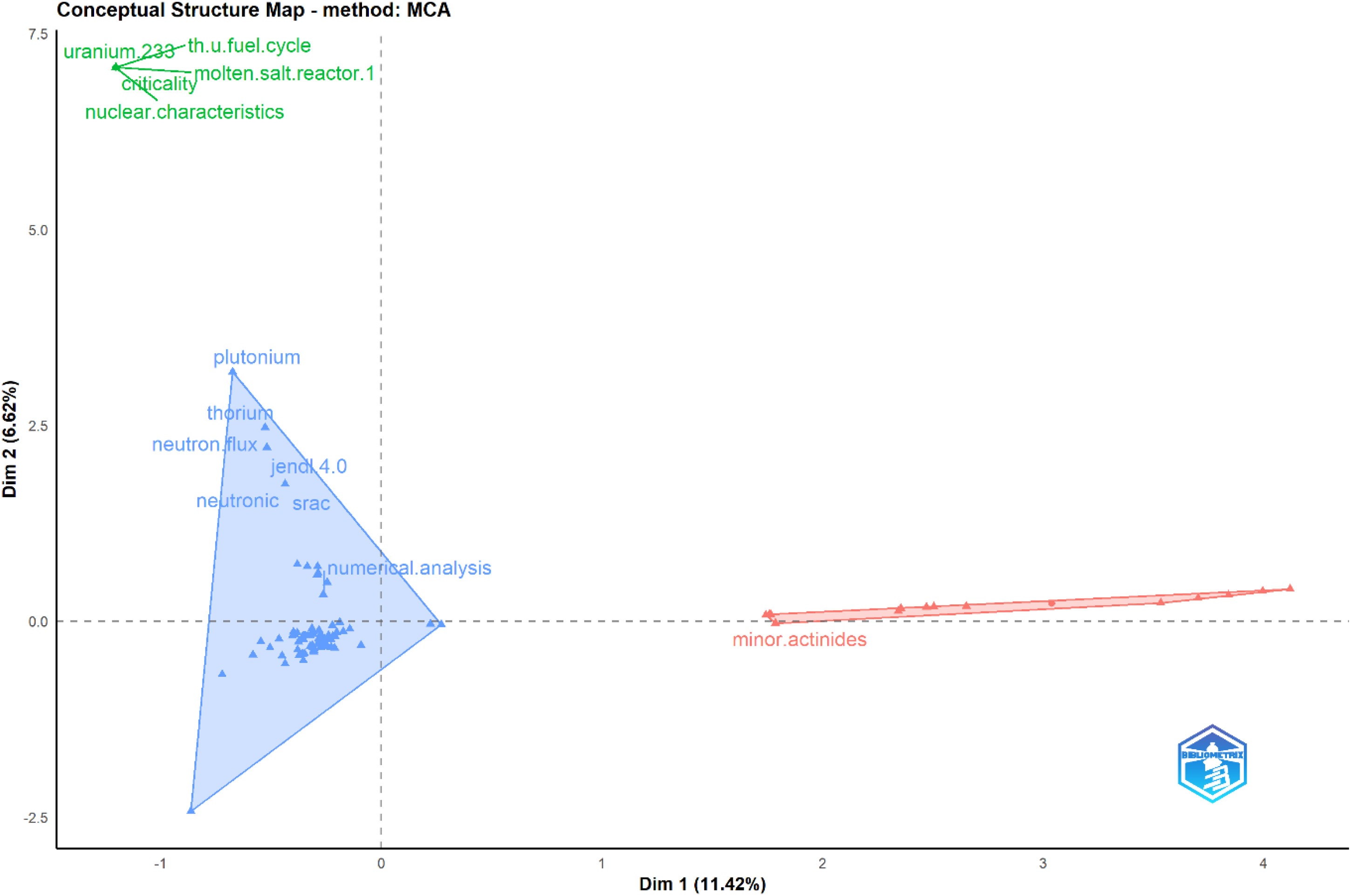
Factorial analysis of author keywords.
In the most recent research focus, the factorial map suggests a concerted movement toward optimisation of fuel cycles, enhanced designs of reactors, and ensuring a long-term sustainability of MSRs as thorium and uranium-233. Future research directions should therefore address criticality safety and neutron behaviour in thorium fuel cycles, advanced fuel compositions, and transmutation of MAs. Such development may lead to more efficient, sustainable reactors with minimised nuclear waste. Furthermore, refinement of numerical analysis tools with the latest nuclear data, such as JENDL 4.0, remains crucial for advances in reactor design and predictions on long-term fuel behaviour. All these should culminate in a research direction that heads towards the making of an efficient and sustainable nuclear energy system that can address energy demand needs as well as challenges associated with waste management for now and the future.
Limitations of MSR designs and some identified tools used in various studies
Limitations of MSR designs
Current MSR designs are underpinned by underlying chemistry-materials, and fuel-cycle integration constraints that restrict reliability and lifetime. Fuel depletion alters the salt redox chemistry and potential (i.e., depletion-driven thermochemistry), leading to higher structural alloy corrosion rates and modifying solubility/precipitation behaviour, directly limiting component life and making prolonged operation difficult unless active redox control and well-developed corrosion-resistant material are embraced (Walker et al., 2023). Reprocessing on-line continuously, which is one of the principal advantages of MSRs is also introducing technical and operational sophistication: Realistic simulation and design of on-line decontamination of salt, removal of fission products rates, and chemical separation units require tightly coupled neutronic–chemical process modelling and experimental validation; codes such as SaltProc exhibit progress but simultaneously demonstrate breeding ratio and inventory metrics sensitivity to reprocessing throughput and assumptions (Rykhlevskii et al., 2019). Collectively, they pose challenging engineering trade-offs among achieving desired breeding/performance and maintaining acceptable corrosion rates, control of salt chemistry, and component life.
From the neutronics, safety, and regulatory perspective, there are a number of limitations in the reliability of modelling, experimental validation, and control of waste/proliferation. Mobility of precursors in circulating fuel alters dynamic response and effective reactivity feedback in a way not represented by traditional static or LWR-based transient codes without complete precursor-transport models. This leads to non-negligible reactivity burdens and altered transient margins, which must be estimated for licensing (Diniz et al., 2022). Moreover, current licensing and safety analyses invariably demand coupled multi-physics experiments (irradiation tests, salt-chemistry campaigns, zero-power salt loops) because of gaps in data (irradiation of materials in hot salts, salt thermophysical and chemical kinetics) that preclude high-confidence source-term and accident-progression predictions (Holcomb et al., 2020). Finally, nuclear data and cross-sections, and covariance uncertainty for salt-relevant isotopes (actinide/fission-product chains) remain a significant source of predictive uncertainty in depletion, reactivity, and radiotoxicity calculations, informing fuel-cycle conclusions and waste management plans. Therefore, coordinated data improvement and uncertainty quantification are vital to avoid design risk (Bostelmann et al., 2020).
Limitations of some identified tools used for simulation
MCNP, SERPENT-2, and TRITON are powerful instruments, but when applied to MSRs, their typical modes of operation reveal important technical constraints. Firstly, both MCNP and TRITON have a tendency to presume static geometry and fixed material regions; this applies to solid-fuel or batch-fuel reactors but does not adequately cover MSRs where fuel salt moves, fission product extraction (online reprocessing) and delayed neutron precursor drift continuously occur. As an example, the 2016 MCNP5 + ORIGEN2 burnup code for the MSR (MOCBurn) study conducted by (Sun and Cheng, 2016) illustrated that the standard MCNP5 + ORIGEN2 framework must be modified to accept fuel mixing and flow after burnup calculations to simulate MSR behaviour realistically. Without them, MCNP will overestimate reactivity, power distribution, and breeding/burnup performance since MCNP cannot naturally simulate advection of fissile/fertile/fission product isotopes.
SERPENT-2, while more flexible to deplete with online reprocessing scripts, has its own limitations to resolve full multi-physics coupling and back couplings dependent on flow, such as a study conducted by Clarno et al. (2023) on the benchmark evaluation of SCALE, Serpent, and MCNP for MSRE. It concluded that SERPENT requires external assumptions of mixing, temperature feedback, and salt-density change to be able to reproduce experimental or benchmark results. Moreover, both MCNP (and MCNP-based codes like MOCBurn) and SERPENT-2 commonly make the assumption of spatial homogeneity of properties within zones, and do not precisely model gradients of delayed neutron precursors or isotopic concentration in flowing fuel salt. Thermal-hydraulic phenomena (salt temperature, density, flow velocity) with neutron spectrum impacts, temperature reactivity coefficients, and precursor drift are often not taken into account or are only taken into account with simplified coupling (MCNP + thermal-hydraulic code MAC) rather than with a built-in solver (Guo et al., 2013). TRITON, as a component of SCALE, is very good at depletion, sensitivity, and cross-section correction but struggles to model online continuous reprocessing, non-uniform flow, or travelling precursor populations without scripting or approximations external to the code. Though conditions in publications sometimes mimic these, there is little peer-reviewed documentation showing TRITON extensively implementing continuous precursor drift, reprocessing mass flow, or high-fidelity spatial thermal feedback.
Authorship, journals, country-level production, and collaborations
This segment uncovers the significant contributors, their countries, and the top platforms or sources for knowledge dissemination. It further reveals the global distribution and influence of research. It also discusses trends of international collaboration and the flow of knowledge across borders. Such a detailed analysis helps identify influential works and gaps, aids in the formation of policy, and funding and strategic decisions made within academia. The top 10 influential sources of data on the subject matter are presented in Figure 15. The Annals of Nuclear Energy recorded the highest number of articles on the topic, recording a total of 16 documents. Progress in Nuclear Energy followed with 6 documents. Bradford's Law divides sources according to the number of articles produced in a field and places them in zones according to the frequency of cumulative publications. According to Bradford's Law, there will be n times as many journals in the second zone as there are in the first, and n2 times as many in the third. This makes it possible to estimate how many journals overall include articles about a given subject (Parsay et al., 2025). The distribution of the various sources that published the most documents according to the Bradford law is presented in Figure 16
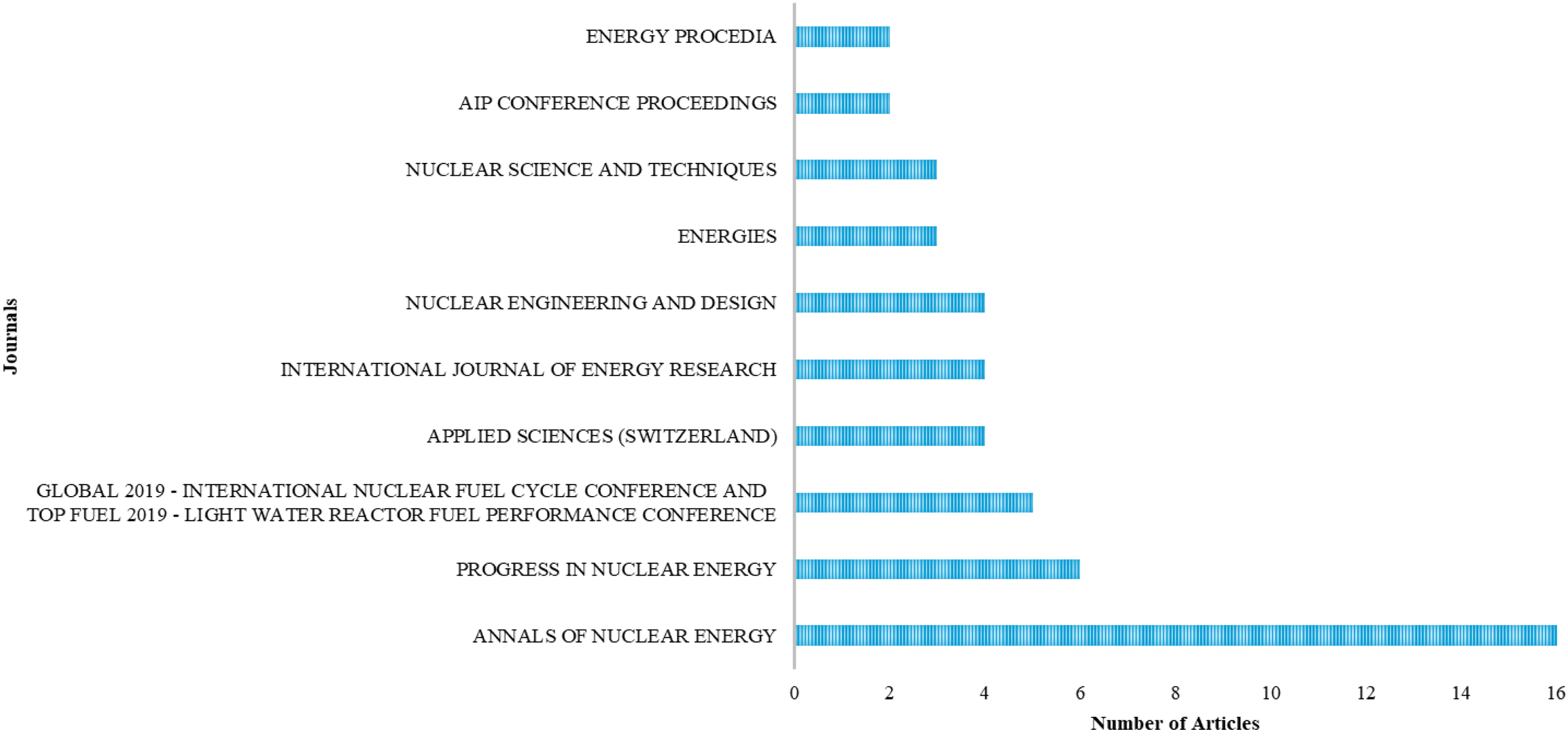
Most relevant sources (top 10).
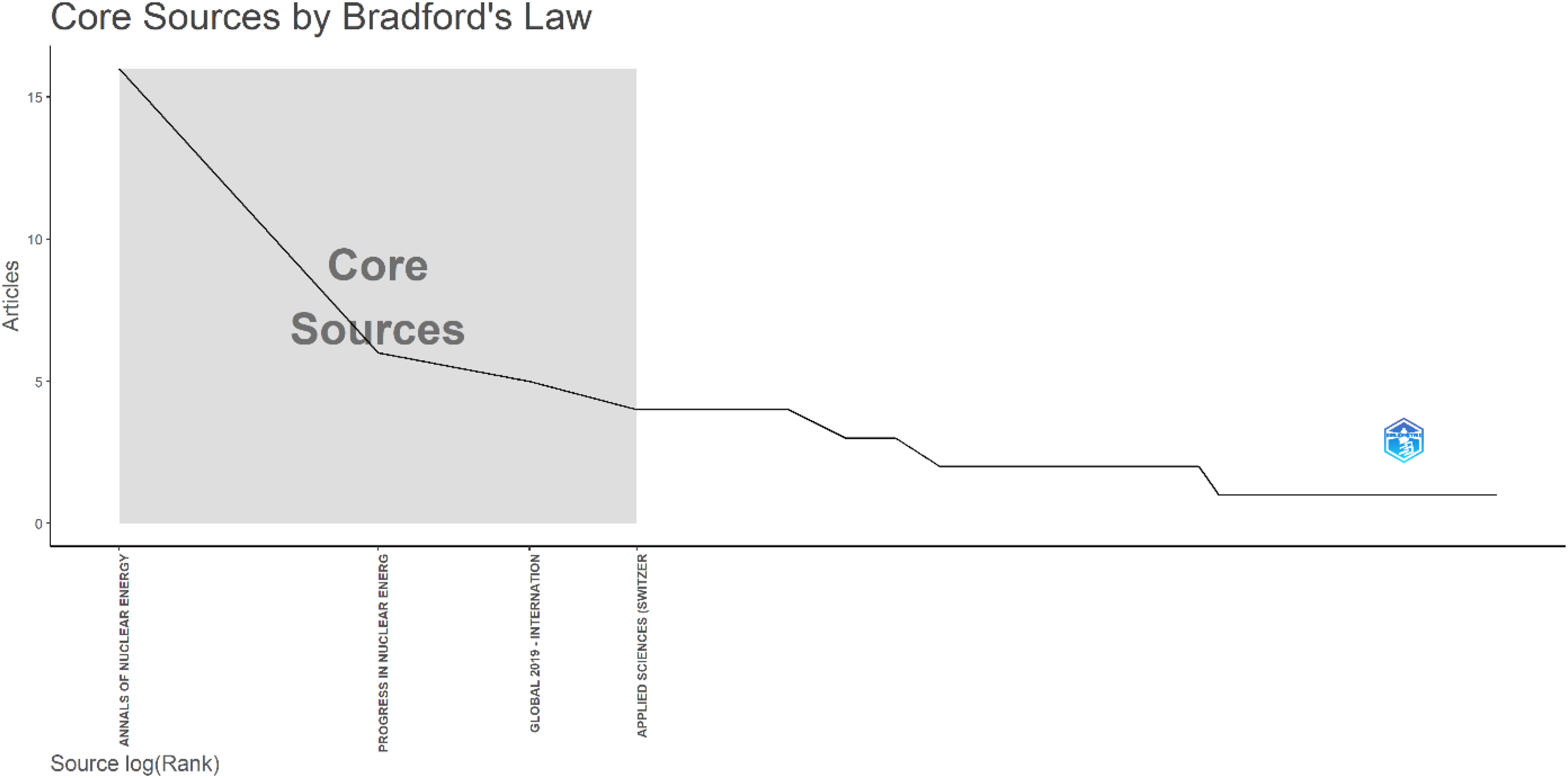
Distribution analysis of main sources using Bradford's law.
The analysis of the corresponding author countries, as presented in Figure 17, shows a highly fragmented global collaboration landscape, where some countries have a strong individual contribution (e.g., China, USA, UK) through Single Country Publications (SCP), while others have little or no participation in Multiple Country Publications (MCP). China is seen as a dominant player in this field with 12 SCPs and a few MCPs, suggesting a heavy investment within national boundaries but probably a lack of engagement in international collaborative research. China's SCP monopoly could be due to centralised national programmes, self-reliance initiatives, and restricted multinational cooperation. China, under the Chinese Academy of Sciences and Shanghai Institute of Applied Physics (SINAP) in the TMSR programme, leads indigenous innovation, independent fuel-cycle research, and fast-spectrum MSR development (EnergyCentral, 2022; Flanders, n.d.). Export controls, data-sharing restrictions, and a focus on unique thorium-based technology restrict multinational cooperation and result in mostly independent research and support for China's national energy and technological goals. The absence of MCPs from countries like Japan, the Czech Republic, and France suggests a possibility of silos in this research landscape, preventing an exchange of experiences and innovations. This fragmentation may in the future hinder the development path of appropriate MSR technology since broader multidisciplinary collaborations are required to deal with complex issues like fuel cycle sustainability and reactor design optimisation. There may well be a need for such increased international cooperation in this regard to expand different funding avenues and innovations as the field advances. Given the recent surge of international interest in nuclear power and the plight of cleaner energy technologies, the current lack of international collaboration might not be sustainable. In that context, the potential of MSRs might not be attained in a timely fashion unless collaborative efforts receive a huge boost.
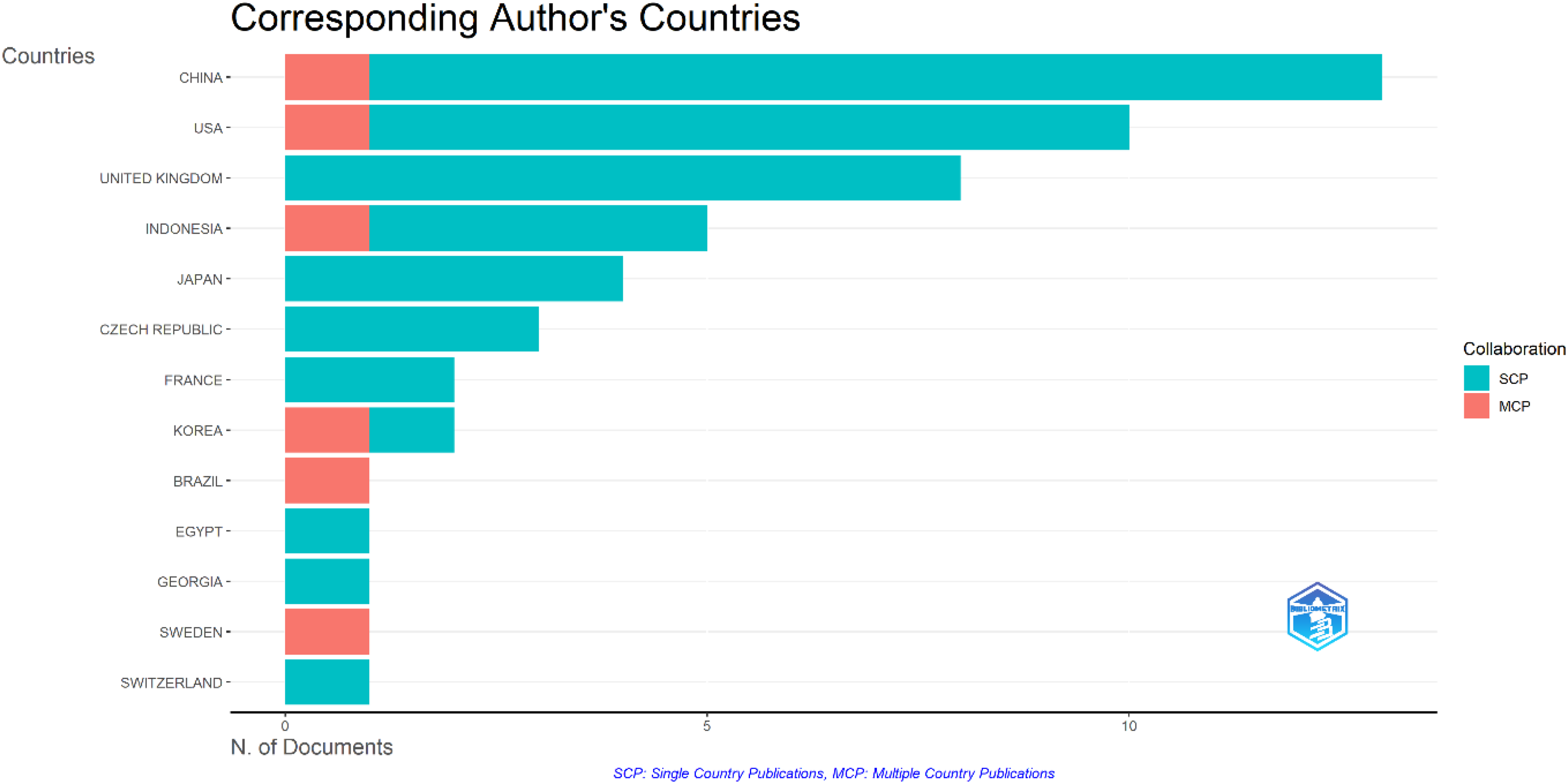
Corresponding author country.
In terms of the number of documents produced by each country, as shown in Figure 18, the United States produced a total of 104 documents, followed by China (73), the UK (55), France (36), Indonesia (19), Japan (18), South Korea (11), Czech Republic (10). The rest of the participating countries recorded single digits in terms of the number of documents produced over the study period. In terms of article collaborations, the USA had the highest collaborations among countries, collaborating with countries like China, the Czech Republic, Egypt, France, Germany, Italy, Japan, Korea, the Netherlands, and the UK. This is followed by China, which also collaborated with countries like the Czech Republic, France, Germany, Italy, Japan, Korea, and the Netherlands. The results indicate that the United States and China are the two major leaders in research towards MSR neutronics and the fuel cycle; however, other international collaborations with countries with a diverse set of research output are also actively being pursued. This gives credence to the positive correlation already posited between international collaboration and the advancement of MSR technology, where developed countries will have to put forth their expertise and resources to encourage local participation from less developed economies. In less advanced countries with minimal work in the area domains such as Indonesia, South Korea, and the Czech Republic, these collaborations create great synergy opportunities for knowledge transfer, capability building, and implementing joint research efforts. Future works should strengthen these linkages, especially in the less developed economies, through support in funding, training, and research infrastructure. Such collaborations will also help close research gaps and will consolidate a more inclusive, global approach to MSR development, which will be key in breaking down technological and economic barriers for widespread uptake.
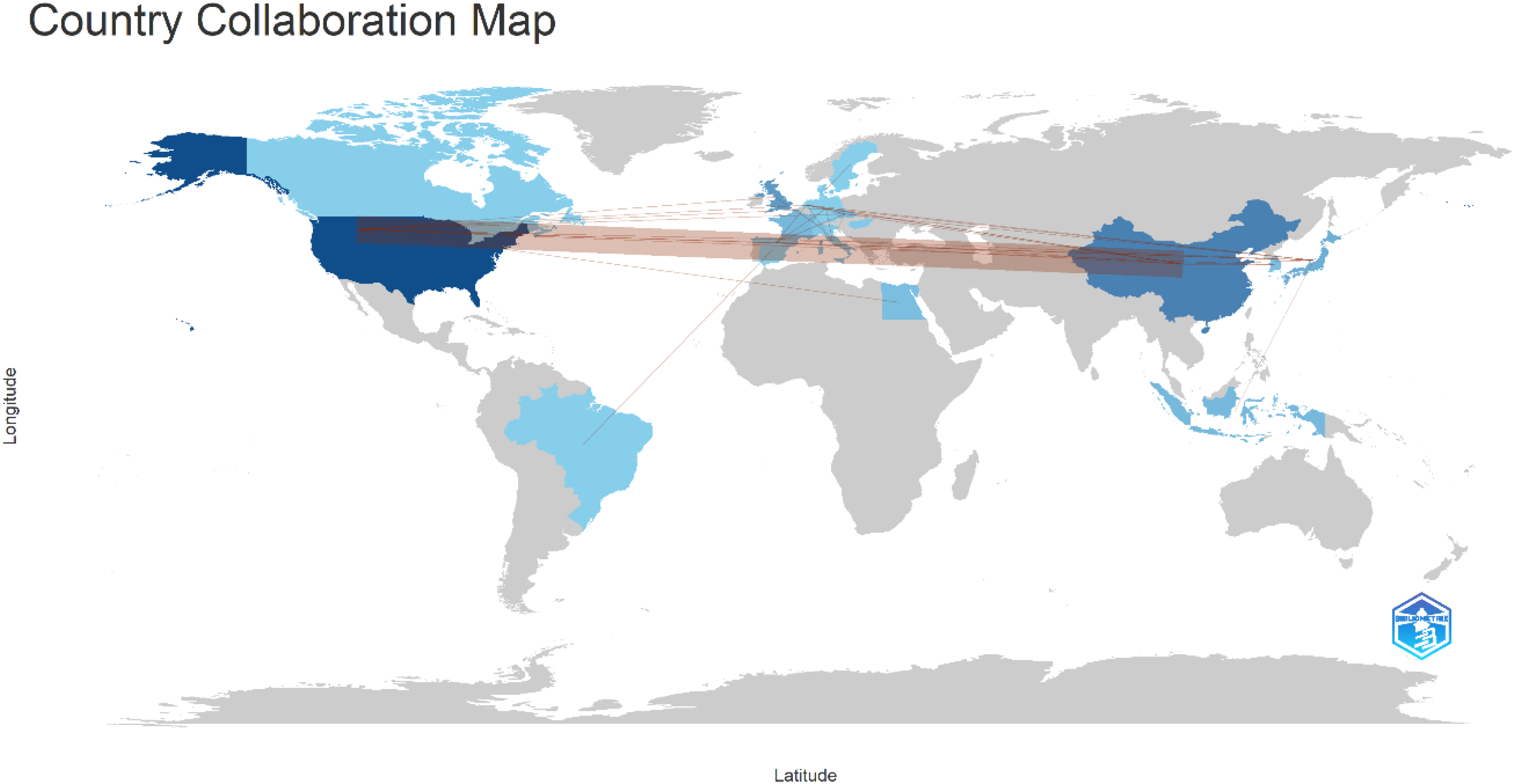
Country-level production and collaboration map.
Conclusion and future research recommendations
A flexible energy technology for power generation and storage is molten salt. It is perfect for cutting-edge energy technologies like MSR and hybrid energy systems since it maintains its single-phase liquid state even at high temperatures and atmospheric pressures. Molten salt has a substantially larger heat capacity per cubic metre than the gas phase and can be used as a fuel salt or as a coolant for solid fuel. However, there is currently a dearth of studies that employ the bibliometric and systematic review methods to provide a detailed bird's eye view of the evolution, trends, and future research directions on the MSR technology. This study, thus, employed the bibliometric review approach to provide a comprehensive review of the technology within 2000–2024 using the VOSviewer and the Bibliometrix package in R software. The following are the key observations and potential future research directions that can be pursued going forward.
The research shows a steady increase in international collaborations regarding advanced reactor designs and fuel cycle technologies. According to the findings, research interest has grown despite some early gaps in publication activity, especially in fields like MSR, thorium fuel cycles, and cutting-edge computer models. Hundreds of investigators have made use of sophisticated simulation tools such as MCNP, Serpent-2, and TRITON. All these mean a good research attempt for improving safety, efficiency, and waste management in reactors. Research clusters suggest a multi-disciplinary approach, combining nuclear chemistry, reactor physics, materials science, and computational modelling, to tackle significant challenges in MSR technology. Though a lot has been achieved, many still lack in salt purification, corrosion-resistant materials, and long-term safety, which are points for further research in the practical application of MSRs in the global energy landscape.
The study also reveals a very fast-moving and multidimensional space, with a considerable promise for future developments. The identified clusters point to integrations between computational modelling and reactor physics in relation to optimising fuel cycles to increase scalability, efficiency, and sustainability of MSRs. Properties such as isotope transmutation, neutron transport, thermal hydraulics, and thermochemical interactions should all be included in modelling platforms. This research has also emphasised major future developments like the thorium-based fuel cycle, depletion modelling optimisation, and the advancement of transmutation techniques for reducing long-lived radioactive waste. The study emphasises improved characterisation of simulation tools and the consideration of environmental and safety aspects regarding radiotoxicity and waste management. While the global landscape of research tends to be quite fragmented, particularly in terms of international collaboration, it is again the USA and China that made most of the global contribution. Future research should bring about more collaboration among countries, especially those least involved, to speed up their development and address the technological and economic challenges associated with broad adoption.
Finally, optimising core dimensions and fuel compositions for breeding and reactor performance over time should be considered the most significant area of future study for fast-spectrum MSR. While the larger core size increases the amount of fertile material for breeding and the amount of time spent above subcritical, it can also provide challenges in engineering and building the cost of the reactor. Research should look at the approaches to allowing smaller cores to breed functionally for live-fuel applications, with heavy-duty reprocessing taking out any bred fissile material to keep the reactor critical for its assumed useful life. Another investigation should include the behaviour of the higher actinides and delayed neutrons as an empirical burnup indicator. Optimising these parameters could lead to more efficient, cost-effective, and safer fast-spectrum MSR designs.
Footnotes

Funding
The authors received no financial support for the research, authorship, and/or publication of this article.
Declaration of conflicting interests
The authors declared no potential conflicts of interest with respect to the research, authorship, and/or publication of this article.
Data availability
Data will be made available on request