




Abstract
As a key factor of production, digitalization has been integrated into the goals of green and low-carbon development, driving improvements in low-carbon economic development efficiency. Using panel data from nine prefecture-level cities in Zhejiang province, this study constructs an econometric model to empirically analyze the impact of digitalization levels on low-carbon economic development efficiency and its underlying mechanisms. The findings reveal the following four aspects. First, digitalization significantly enhances low-carbon economic development efficiency, with all four sub-dimensions of digitalization demonstrating positive effects. Among these, digital infrastructure exerts the strongest influence. Second, both overall digitalization and its four sub-dimensions indirectly improve low-carbon economic efficiency by reducing energy consumption intensity and promoting industrial structure upgrading, confirming their significant mediating roles. Third, the synergy between digitalization (and three of its sub-dimensions, excluding digital penetration rate) and energy consumption intensity further boosts low-carbon economic efficiency. Fourth, the synergy between digitalization (including all four sub-dimensions) and industrial structure upgrading consistently enhances low-carbon economic performance. Based on these findings, the study proposes tailored policy recommendations to leverage digitalization for advancing low-carbon economic development efficiency in Zhejiang province.
Keywords
Introduction
Digitalization serves as a key means for energy conservation and emission reduction, optimizing operations, improving overall efficiency, reducing energy consumption and carbon emissions, and generating economic benefits. Digital technology and digitalization have become indispensable components of high-quality economic development. Adjusting industrial structure to influence carbon emission intensity not only helps build a low-carbon economic foundation but also promotes low-carbon development (Lange et al., 2020). The “2023 High-Quality Development Report on the Digital Economy” reveals that from 2018 to 2022, China's digital economy expanded from approximately 30 trillion yuan to 50.2 trillion yuan, maintaining its position as the world's second largest. Its GDP share increased to 41.5%, demonstrating robust growth momentum and emerging as a new economic growth driver. Huawei's “Green Development 2030” report emphasizes that digitalization and decarbonization serve as dual engines for green development—development must be pursued through digitalization while sustainability is ensured through decarbonization. Amid the digital transformation wave, digitalization has become a crucial foundation for globally advocated green and low-carbon development, a core driver of worldwide green and low-carbon transitions, and an inevitable choice for nations addressing climate and environmental changes.
In September 2020, China explicitly set its 2030 carbon peak and 2060 carbon neutrality goals. In 2022, Zhejiang province—China's first pilot zone for synergistic innovation in pollution reduction and carbon mitigation—generated 6.26% of national GDP while occupying just 1% of land, 4% of population, and producing 4% of national CO₂ emissions. By 2023, Zhejiang's digital economy reached 4.33 trillion yuan in added value, constituting 52.5% of its GDP. The province's exploration of low-carbon digital economic development offers a new model for achieving national “dual carbon” goals. Consequently, Zhejiang must more precisely identify how digital technology enhances low-carbon economic development efficiency.
Domestic and foreign scholars have examined the promoting effect of technological innovation on carbon emission reduction and low-carbon economic efficiency from macro-level perspectives such as BRICS countries (Azevedo et al., 2018; Zahidr et al., 2020) and Chinese provinces (Xie, 2022). Sun et al. (2024) constructed a four-stage sequential game model incorporating digitalization and carbon emission reduction decision-making, investigating the impact of digitalization on corporate emission reduction and the research and development of carbon reduction technologies, while also analyzing the optimal level of digitalization (Sun et al., 2024). The study explores the external effects of digitalization on green innovation, renewable energy, and the relationship between financial development and environmental sustainability. Using the System Generalized Method of Moments (SYS-GMM) for 36 OECD countries from 2000 to 2018, the analysis found that digitalization, green innovation, renewable energy, and financial development significantly enhance environmental sustainability (Karlilar et al., 2023). A comprehensive indicator system was developed to assess the level of digital development, and the super-SBM model was applied to quantify low-carbon economic efficiency (Zhou et al., 2024).
With the rapid development of digital technologies such as big data, cloud computing, and artificial intelligence, integrating digitalization as a production factor into the goals of low-carbon development can enhance the efficiency of the low-carbon economy and contribute to the achievement of the dual carbon goals. However, a review of existing research reveals that studies on digitalization and low-carbon economic efficiency remain largely one-dimensional, with limited in-depth exploration of the impact of digitalization on the efficiency of low-carbon economic development.
Therefore, how does digitalization impact the efficiency of low-carbon economic development? What are the differences in the effects of different dimensions of digitalization on the efficiency of low-carbon economic development? What is the mechanism through which digitalization influences the efficiency of the low-carbon economy? Accurately answering these questions holds significant theoretical and practical importance for analyzing the impact of digitalization on the efficiency of low-carbon economic development in Zhejiang province and for precisely implementing digitalization to advance low-carbon development.
This study makes some theoretical and practical contributions. The theoretical contributions are that this study employs an improved DEA model to measure the low-carbon economic development efficiency (LCE) of cities in Zhejiang province. The Kernel density estimation and natural breaks method are used to analyze the temporal evolution and dynamic trends of digital development across these cities. Furthermore, a baseline regression model and a mediation effect model are constructed to examine whether and how digitalization enhances LCE in Zhejiang, as well as the underlying mechanisms. By integrating the DEA model with quantitative regression analysis, this study overcomes the limitations of single-model approaches. The baseline regression clarifies the net effect of digitalization on low-carbon economic efficiency, while the mediation model reveals the transmission pathway of digitalization → energy consumption intensity/industrial structure upgrading → LCE improvement, achieving a dual verification of both effect magnitude and mechanism chain.
The practical contributions are that the quantitative findings of this study provide concrete data support for Zhejiang province to formulate differentiated policies, such as prioritizing digital infrastructure investment in less-developed regions while focusing on green technology R&D subsidies in core areas. The identified relationship between digitalization levels and LCE offers guidance for governments to set phased targets for computing power investment, 5G coverage, and other digital initiatives, thereby avoiding resource misallocation. The research advances the digital-green synergy theory in Zhejiang and provides actionable insights for regional low-carbon policies and corporate practices.
While the study has a limitation: this study primarily explores the mechanisms and pathways through which digitalization influences LCE in Zhejiang province, which may differ from the actual conditions in other provinces. Thus, the findings should not be directly generalized to other regions without further validation.
Theoretical analysis and research hypothesis
The concept of low-carbon economy first appeared in official documents in 2003 with the publication of the UK government's Energy White Paper titled “Our Energy Future: Creating a Low Carbon Economy.” In August 2010, China's National Development and Reform Commission initiated pilot projects for low-carbon industry construction in five provinces and eight cities, marking the beginning of China's low-carbon economy development. In July 2024, the “Decision of the Central Committee of the Communist Party of China on Further Comprehensively Deepening Reforms and Advancing Chinese Modernization” emphasized accelerating the comprehensive green transformation of economic and social development, improving the ecological environment governance system, and promoting ecological priority and green low-carbon development. Based on existing theoretical research findings, the theoretical framework model of this study is constructed as illustrated in Figure 1.
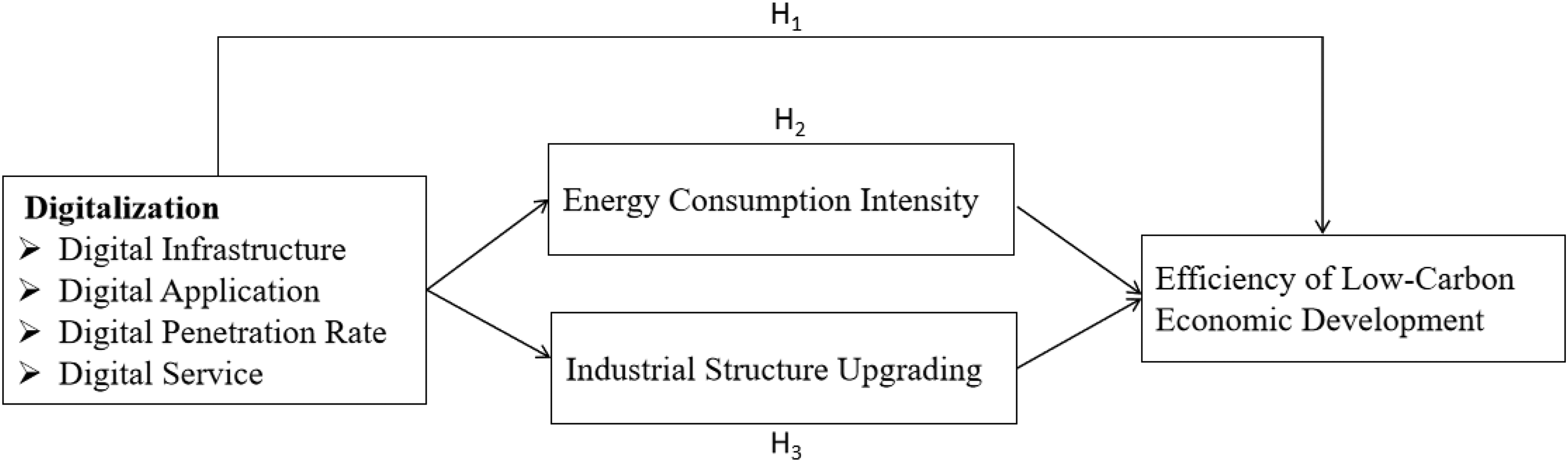
Conceptual model.
Digitalization and the low-carbon economic development efficiency
Digitalization is a complex process involving the application of digital technologies across various fields, triggering continuous transformations in all aspects of economic and social life (Momeni et al., 2024). The enhancement of digital capabilities relies on the innovative combination and application of digital technologies. As the process of leveraging data elements and digital technologies to reshape resource allocation methods, digitalization impacts infrastructure, technological innovation, and industrial development (Chiaroni et al., 2023).
The internet has emerged as a new digital tool that enables the exploration of low-carbon and green digital technologies, thereby achieving sustainable digital development. Digitalization applications positively contribute to low-carbon economy development through multiple pathways: improving resource utilization efficiency, facilitating industrial transformation and upgrading, optimizing energy consumption structures, and driving green technology innovation.
The China Academy of Information and Communications Technology (CAICT) states that by 2030, digitalization could help reduce carbon emissions in China's high-energy-consuming industries by 12% to 22%. Digital transformation alleviates information asymmetry in the market, reduces ineffective economic activities and resource waste during development, and injects new momentum into achieving the “dual carbon” goals (Li et al., 2023), already delivering significant low-carbon benefits for enterprises.
Digitalization facilitates green and low-carbon development by promoting efficiency improvements, industrial upgrading, and technological innovation (Stermieri et al., 2024). The interplay between the embedding process of digital technologies and low-carbon growth objectives reflects the synergistic development of digitalization and greening (Lyu et al., 2024). By continuously advancing digital technology, optimizing production factors, enhancing productivity and energy efficiency, and reducing carbon emission intensity, digitalization has significantly propelled the low-carbon transformation of traditional industries. Therefore, this paper proposes the following research hypothesis.
H1: Digitalization can promote the improvement of low-carbon economic development efficiency.
Yang et al. (2021) conceptualized digitalization as encompassing three key aspects: the application of various digital technologies, their integration into enterprise management processes, and their capacity to generate measurable outcomes. Building on this framework, Li et al. (2024) operationalized that digitalization measurement through three dimensions: digital infrastructure, digital services, and digital applications. Zhao et al.(2020) alternatively proposed a five-dimensional measurement system incorporating internet penetration rate, digital employment, digital output, mobile phone penetration rate, and digital financial development. Urban digitalization development contains three critical dimensions, that is, digital technology adoption, digital business activity, and digital innovation capability (Zhou et al., 2024). Considering data availability constraints, this study focuses on four primary measurement dimensions: digital infrastructure, digital applications, digital penetration rate, and digital services.
Digital infrastructure, fundamentally rooted in advanced information and communication technologies (e.g., 5G, artificial intelligence), undergoes continuous evolution through organic integration within information networks, ultimately forming comprehensive digital platforms and integrated systems. Three key observations emerge: first, enterprises’ low-carbon transformation capabilities critically depend on digital infrastructure enhancement, particularly through production process digitalization enabled by AI, blockchain, cloud computing, and big data technologies (Chiaroni et al., 2023).
Second, empirical analyses of industrial digitalization investments confirm positive contributions to low-carbon economic development, necessitating enterprise adoption of digital tools like computers, intelligent robots, and automated production lines (Zhang et al., 2023). Finally, digital infrastructure provides indispensable support throughout the low-carbon technology lifecycle—from R&D to large-scale implementation—serving as a foundational enabler for low-carbon advancement (Yu and Hu, 2024). These findings collectively support the following research hypothesis:
H1a: Digital infrastructure enhances the low-carbon economic development efficiency.
Information and communication technology (ICT) plays a more significant role in promoting carbon efficiency and helps realize a win-win situation for both the economy and the environment (Li et al., 2024). Using data from 2008 to 2022, studies have found that digital transformation significantly enhances low-carbon transitions (Wang, 2025). Digital tools provide fresh opportunities to reduce carbon footprints, and realizing the positive interaction between digitization and green development is essential for achieving high-quality growth (Lin et al., 2024).
Digital technology represents the most advanced productivity of the new era. Developing the digital economy and effectively utilizing digital technologies are crucial for accelerating the green transformation of production and lifestyles (Lv and Chen, 2024). For example, through digital transformation, automobile manufacturing enterprises can adjust production line pace and process parameters in real time based on order demands. Under the premise of ensuring product quality, this reduces energy consumption per unit product by 10% to 20%, significantly cutting carbon emissions during production. Therefore, this paper proposes the following research hypothesis:
H1b: Digital application enhances the low-carbon economic development efficiency.
Su and Zheng (2025) examined the digital economy's role in carbon emission reduction across Yellow River Basin cities, incorporating digital penetration rate as a key indicator in their comprehensive digital economy development index. As a fundamental application platform, internet penetration effectively facilitates low-carbon industry implementation, with efficiency and green operation representing critical focus areas for digital transformation (Hu et al., 2025).
Through IoT, big data, and AI technologies, the internet enables real-time monitoring and analysis of energy consumption and carbon emission data, allowing enterprises to optimize resource allocation and minimize waste. By overcoming geographical constraints, it fosters international collaboration in low-carbon technology, financing, and knowledge exchange, thereby accelerating the low-carbon economy's globalization. Digital penetration rate measures the adoption level of digital technologies (including mobile devices, computers, IoT systems, cloud computing, and AI) within specific regions or populations. Since internet penetration rate partially reflects digital penetration, this study proposes the following research hypothesis:
H1c: Digital penetration rate enhances the low-carbon economic development efficiency.
Zhao et al.(2020) identified the number of internet industry employees as a key indicator for measuring digitalization levels. The deep integration of emerging technologies with green low-carbon industries needs to be promoted, while accelerating low-carbon process innovation and digital transformation in the industrial sector (Yang et al., 2023).
Internet professionals drive low-carbon technology innovation and dissemination through developing and applying advanced technologies (e.g., AI, big data, and IoT), helping enterprises optimize resources and reduce carbon footprints by analyzing energy consumption and emission data. These professionals play multifaceted roles in low-carbon economic development by: advancing technological innovation, facilitating skill transfer, implementing green office practices, promoting low-carbon consumption, providing policy support, fostering green innovation, enhancing public awareness, and strengthening global collaboration (Dai et al., 2025). This study uses internet industry employment data to reflect digital service conditions, leading to the following research hypothesis:
H1d: Digital service enhances the low-carbon economic development efficiency.
Mechanism of energy consumption intensity and industrial structure upgrading
Mechanism of energy consumption intensity
Su and Zheng (2025) investigated the mechanism through which the digital economy affects carbon emissions in Yellow River Basin cities by introducing energy consumption intensity as a mediating variable. Their empirical analysis revealed that the digital economy's development level can significantly suppress energy consumption intensity, while energy consumption intensity itself positively influences carbon emissions. This suggests that reducing energy consumption intensity effectively mitigates carbon emissions.
The digital economy provides multiple advantages, including energy conservation, emission reduction, environmental sustainability, and unlimited sharing capabilities. It enhances energy utilization efficiency, lowers energy consumption intensity, and simultaneously promotes both economic growth and green development in China (Dian et al., 2024). By curbing energy consumption intensity, the digital economy consequently reduces carbon emission intensity (Zhang et al., 2022).
Digitalization accelerates the research, development and application of green technologies—including energy-saving equipment and renewable energy systems—thereby promoting widespread adoption of low-carbon solutions. The substitution of digital resources for natural resources reduces energy consumption, with the digital economy's direct pathway of modifying energy consumption intensity playing the dominant role (Zhong et al., 2022). Advanced digital technologies (particularly IoT, big data and AI) enable real-time energy monitoring and optimization, minimizing energy waste while decreasing energy intensity per GDP unit.
Through multiple pathways, digitalization indirectly enhances low-carbon economic efficiency by: (a) reducing energy consumption intensity, (b) improving production efficiency, (c) optimizing resource allocation, (d) stimulating green innovation, (e) transforming consumption patterns, (f) supporting policy/market mechanisms, (g) raising environmental awareness, and (h) facilitating global cooperation(Huang et al., 2024). The digitalization-energy intensity synergy not only optimizes energy utilization but also drives low-carbon technology innovation and deployment, significantly accelerating the global transition toward sustainable economies. Based on this analytical framework, the study proposes the following hypotheses:
H2: Digitalization indirectly enhances the low-carbon economic development efficiency through energy consumption intensity, and the synergy between digitalization and energy consumption intensity can promote the improvement of low-carbon economic development efficiency.
Mechanism of industrial structure upgrading
Industrial structure upgrading manifests through an increasing proportion of tertiary industry, representing a transition from inefficient, energy-intensive industrial structures to low-energy, high-efficiency configurations (Tao et al., 2024). As an emerging economic paradigm, the digital economy empowers traditional industries through digital technologies to achieve industrial upgrading (Chen and Zhou, 2024) and enhance low-carbon economic efficiency. The socioeconomic impacts of digital economy have increasingly become a research focus, with scholars examining its effects on industrial upgrading from macro and micro perspectives (Zhu et al., 2022).
New digital infrastructure significantly promotes circulation industry structural upgrading and industrial resilience. Furthermore, it enhances resilience through facilitating such upgrading, though this mechanism exhibits threshold effects (Zhu, 2023). The technological spillover effects from industrial upgrading drive low-carbon transformation throughout industrial chains, enabling cross-sector resource mobility and improving overall production efficiency (Zhang and Liu, 2024).
Digitalization indirectly boosts low-carbon economic efficiency by: (a) advancing industrial upgrading, (b) optimizing resource allocation, (c) stimulating technological innovation, and (d) accelerating green transformation. The digitalization-industrial upgrading synergy not only directs economic development toward higher value-added and lower energy consumption, but also accelerates green technology adoption, providing crucial momentum for global low-carbon development. This establishes digitalization as a key enabler for achieving low-carbon economic goals. Building on this analysis and preceding theoretical framework of digitalization dimensions, we propose the following hypothesis:
H3: Digitalization indirectly enhances the low-carbon economic development efficiency through industrial structure upgrading, and the synergy between digitalization and industrial structure upgrading can promote the improvement of low-carbon economic development efficiency.
Research design
Variable definition
Dependent variable
The dependent variable in this study is low-carbon economic development efficiency. We employ an improved DEA model to measure the low-carbon economic development efficiency across various cities in Zhejiang province. Our measurement framework utilizes regional GDP as the output indicator, while incorporating four input indicators: (a) energy input, (b) labor input, (c) capital input, and (d) carbon emissions.
Carbon emissions are treated as a special input indicator because lower values are more desirable for low-carbon economic development. Although carbon emissions represent an undesirable output in reality, the DEA model conventionally processes such undesirable indicators as inputs when evaluating efficiency (Luo and Lin, 2023). Therefore, consistent with standard DEA methodology, we include carbon emissions as an input indicator in our low-carbon economic development efficiency analysis.
Explanatory variables
The explanatory variables mainly include the following four aspects.
Digital infrastructure
Definition: Reflects the physical and technological foundations of digital transformation, including 5G networks, data centers, and cloud computing facilities (Brynjolfsson and McAfee, 2014).
Measurement: It is measured primarily by investment in information transmission, software, and information technology services.
Theoretical basis: Infrastructure enables digital adoption.
Digital application
Definition: Measures the intensity of digital technology usage in economic activities (Goldfarb and Tucker, 2019).
Measurement: It is measured primarily by per capita telecommunications business volume.
Theoretical basis: Application reflects the actual utilization of digital tools (Bresnahan and Trajtenberg, 1995).
Digital penetration rate
Definition: Indicates the breadth of digital access across society.
Measurement: It is measured primarily by mobile phone penetration rate, represented by the number of mobile phone users per hundred people.
Theoretical basis: Penetration is a prerequisite for inclusive digital growth (ITU, 2021).
Digital services
Definition: Represents the human capital supporting digitalization (Autor et al., 2020).
Measurement: It is measured primarily by the year-end number of employees in information transmission, software, and information technology services (Zhao et al., 2020).
Theoretical basis: Skilled labor drives digital innovation (Acemoglu and Restrepo, 2019).
Here we clarify the logical relationships among the four dimensions in our digitalization assessment framework. While digital services, digital infrastructure, and digital applications may appear conceptually overlapping, they are distinctly measured from complementary perspectives without actual redundancy.
Digital infrastructure focuses on capital inputs (investment amounts) while digital services measure human resource inputs (employment numbers) in information transmission and IT sectors, representing logically separate dimensions of capital versus labor.
Digital applications quantify usage levels (e.g., telecommute service volumes) whereas digital services assess supply-side capacity (workforce size), maintaining a clear demand-supply dichotomy. Together with digital penetration rates, these four dimensions—infrastructure (investment), applications (usage), penetration (coverage), and services (talent)—form a comprehensive yet non-overlapping analytical framework that captures digital development from mutually reinforcing angles of input factors, market dynamics, and diffusion breadth.
Mediating variables
Based on existing research and data availability, this study selects two primary mediating variables: energy consumption intensity and industrial structure upgrading.
Energy Consumption Intensity: Measured by regional electricity consumption per unit of GDP. Industrial Structure Upgrading: Quantified using the GDP share of primary, secondary, and tertiary industries (Liu and Chen, 2023).
Control variables
Drawing on prior research, this study employs four control variables: marketization level, population density, urbanization level, and environmental regulation intensity.
Marketization Level: Measured using the total marketization index from the China Provincial Marketization Index Report (Wang et al., 2021), this variable enhances low-carbon economic development efficiency through multiple pathways: optimizing resource allocation, promoting technological innovation, diversifying policy tools, transforming corporate behavior, influencing consumer choices, and facilitating international cooperation. Population Density: Calculated as the ratio of total population to regional area. Urbanization Level: Represented by the proportion of urban population to total regional population at year-end (Chen et al., 2024). Environmental Regulation Intensity: Computed as the weighted average of relative pollution emission levels across cities (Chen et al., 2024).
Model construction
To test the hypotheses mentioned above, this paper utilizes a panel data model at the prefecture-level city level in Zhejiang province to examine the impact of digitalization levels on low-carbon economic efficiency. The following econometric model is employed for analysis.

Among them, LCE
i
,t represents the low-carbon economic efficiency of prefecture-level city i in year t, which is the dependent variable. Dig
i
,t represents the level of digitalization, which is the core explanatory variable. Con
i
,t represents a series of control variables. α0 is the intercept term of the model. β1 and β2 are the estimated coefficients of the variables.
This paper employs the stepwise testing method to explore the potential mechanisms through which the level of digitalization may affect low-carbon economic efficiency.


Among them, β3 represents the effect of the level of digitalization on the mediating variable. β5 represents the direct effect of the level of digitalization on low-carbon economic efficiency. β6 × β3 indicates the mediating effect through which the level of digitalization promotes the improvement of low-carbon economic development efficiency via the mediating variable.
Data description
Due to unavailable energy consumption data in Shaoxing and Lishui's Statistical Yearbooks, this study calculates low-carbon economic efficiency for the remaining 9 prefecture-level cities in Zhejiang province using the DEA model. We compiled data from 2015 to 2022 for these 9 cities, resulting in a balanced panel data set comprising 72 city-year observations for analysis.
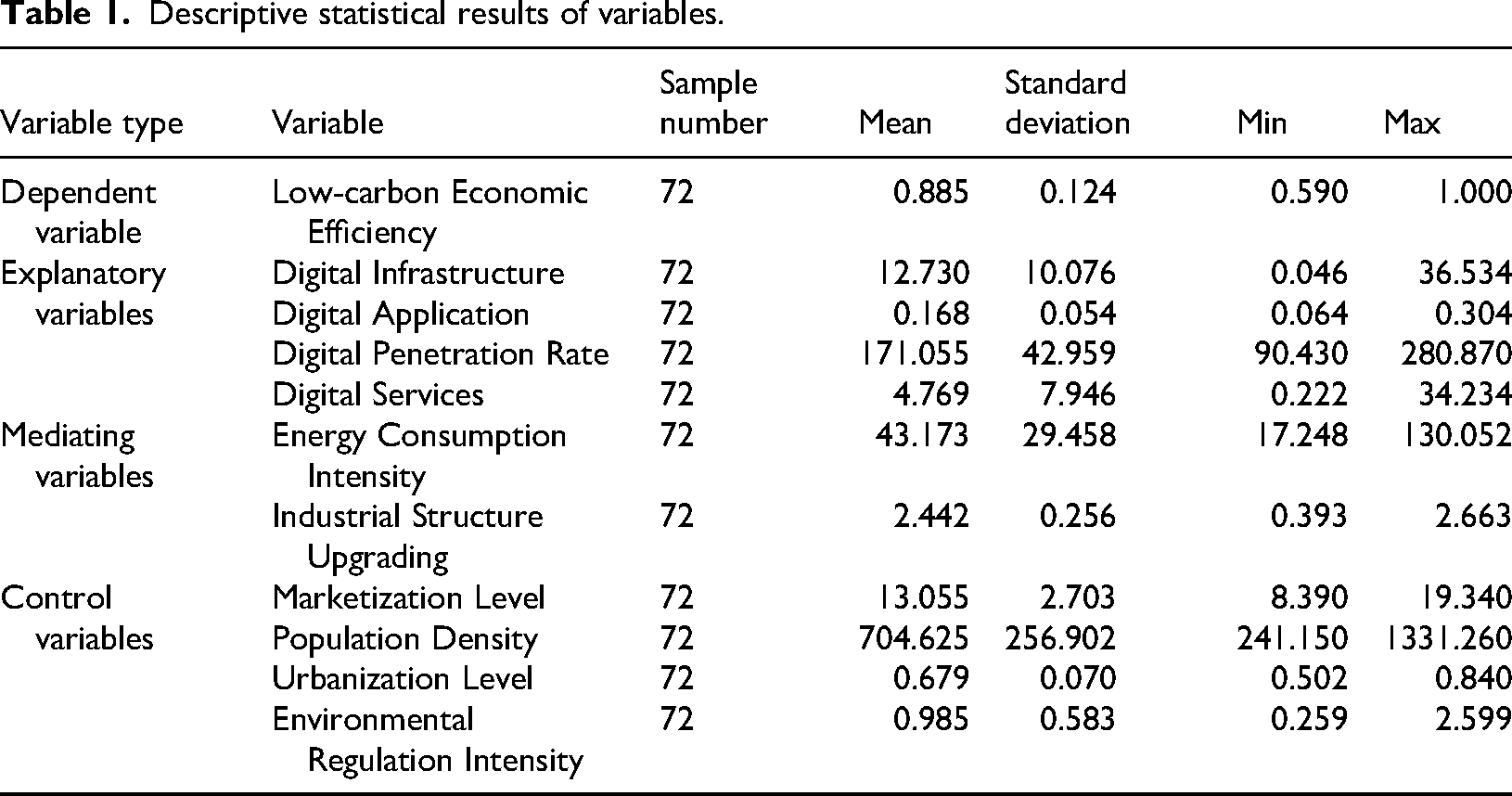
The data set draws upon multiple sources: Zhejiang Provincial Statistical Yearbook, China Energy Statistical Yearbook, China Statistical Yearbook, China City Statistical Yearbook, statistical yearbooks from various Zhejiang prefecture-level cities, and municipal statistical annual reports. To mitigate extreme value effects, all variables are subject to 1% and 99% tailing. Table 1 presents the descriptive statistics of all variables.
Descriptive statistical results of variables.
Empirical analysis
Benchmark regression analysis
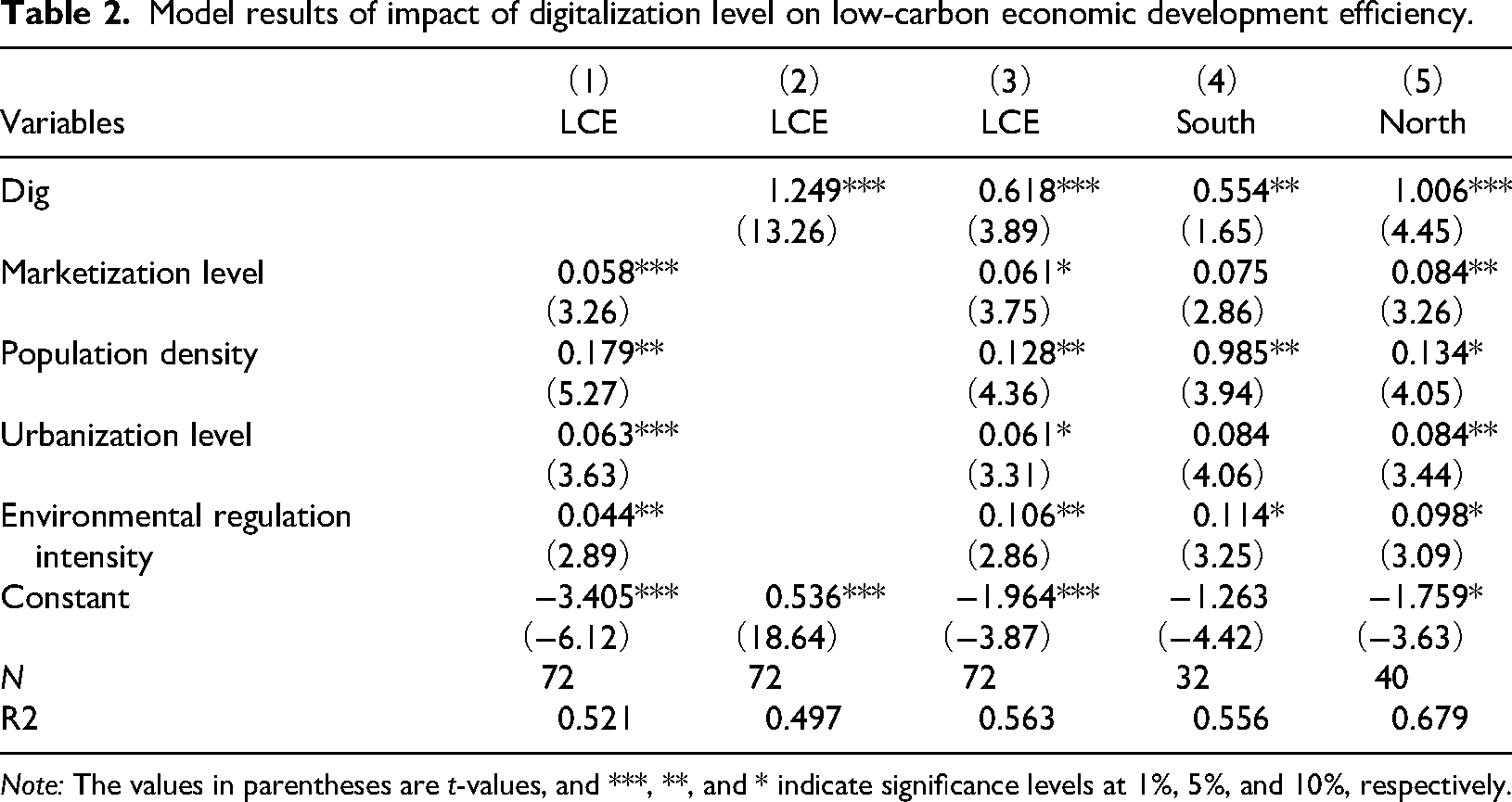
Through sequential application of the F-test, LM test, and Hausman test, we progressively screened regression model specifications. The test results consistently rejected all null hypotheses, ultimately selecting the individual fixed-effects model for panel regression analysis. Using Equation (1) as our baseline specification, we examined the impact of digitalization level on low-carbon economic efficiency, with detailed results presented in Table 2.
Model results of impact of digitalization level on low-carbon economic development efficiency.
Note: The values in parentheses are t-values, and ***, **, and * indicate significance levels at 1%, 5%, and 10%, respectively.
As presented in Table 2, column (1) displays regression results for control variables only. The findings demonstrate that marketization level, population density, urbanization level, and environmental regulation intensity all show statistically significant positive correlations with low-carbon economic development efficiency, indicating these four control variables effectively contribute to efficiency improvements. Columns (2) and (3) reveal that digitalization level significantly enhances low-carbon economic development efficiency regardless of control variable inclusion, thereby confirming research hypothesis H1.
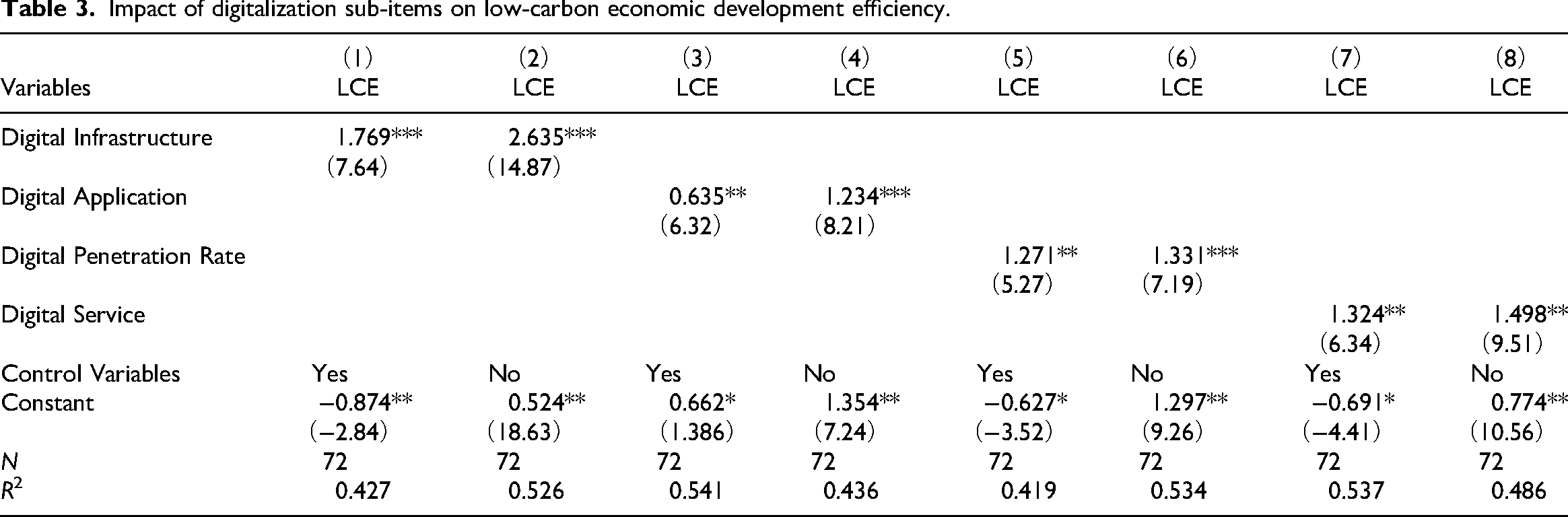
Building on Equation (1), we examined the effects of four digitalization sub-dimensions on low-carbon economic development efficiency, with results presented in Table 3. Columns (2), (4), (6), and (8) analyze each sub-dimension's isolated impact, while columns (1), (3), (5), and (7) incorporate control variables. All models demonstrate statistically significant positive coefficients, confirming that digital infrastructure consistently enhances low-carbon economic efficiency regardless of control variable inclusion, thus validating research hypotheses H1a, H1b, H1c, and H1d.
Impact of digitalization sub-items on low-carbon economic development efficiency.
Building upon subsample regression analysis, we further examine the regional heterogeneity of digitalization's impact on low-carbon economic development efficiency between northern and southern Zhejiang. Columns (4) to (5) reveal that while digitalization significantly enhances low-carbon economic efficiency in both regions, the effect demonstrates a “Northern Zhejiang > Southern Zhejiang” intensity gradient.
Based on the analysis of digital infrastructure, digital applications, digital penetration rates, and digital services in southern and northern Zhejiang from 2015 to 2022, the digital infrastructure and application levels in northern Zhejiang were significantly higher than the provincial average, while those in southern Zhejiang lagged behind, falling below the average. Similarly, in terms of digital services, northern Zhejiang outperformed the provincial mean, whereas southern Zhejiang's figures were notably lower. Regarding digital penetration rates, the values for both regions were relatively close, with southern Zhejiang slightly surpassing northern Zhejiang.
Table 3 reveals that digital infrastructure demonstrates the largest influence coefficient, followed by digital services and digital penetration rate, while digital applications show the smallest impact. Digital infrastructure exerts the strongest effect on low-carbon economic development efficiency because it establishes the technological foundation and data support system essential for digital services, penetration, and applications, serving as a fundamental pillar for green economic transformation.
Specifically, digital infrastructure (including 5G networks, IoT systems, and cloud computing platforms) provides the critical technical support and data circulation framework required for low-carbon economic development. The widespread deployment of 5G base stations and gigabit broadband networks enables efficient data transmission for low-carbon applications such as smart grids and intelligent transportation systems. Through digital infrastructure, sectors like energy, transportation, and construction achieve real-time data collection and intelligent scheduling, significantly enhancing resource utilization efficiency while reducing carbon emissions. For example, smart transportation systems optimize routing and reduce both congestion and energy consumption through continuous real-time monitoring.
Moreover, digital infrastructure construction exhibits distinct scale economies, which persistently drive innovation and implementation of low-carbon technologies while generating sustained momentum for green economic transformation.
Robustness test
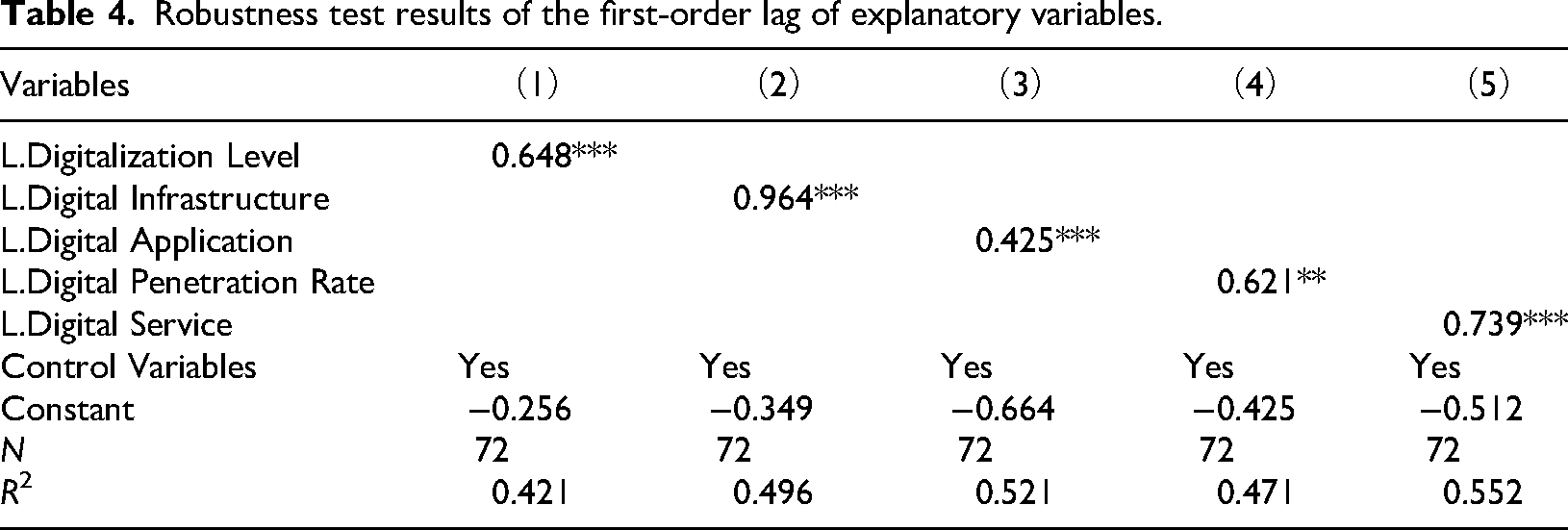
We conducted robustness checks by lagging all explanatory variables by one period and re-running the regressions. As shown in Table 4 (columns 1–5), both the one-period lagged digitalization level and its four sub-components maintain statistically significant positive effects on low-carbon economic development efficiency. The influence coefficients of these sub-components consistently follow the pattern: digital infrastructure > digital service > digital penetration rate > digital application, further confirming the robustness of our findings.
Robustness test results of the first-order lag of explanatory variables.
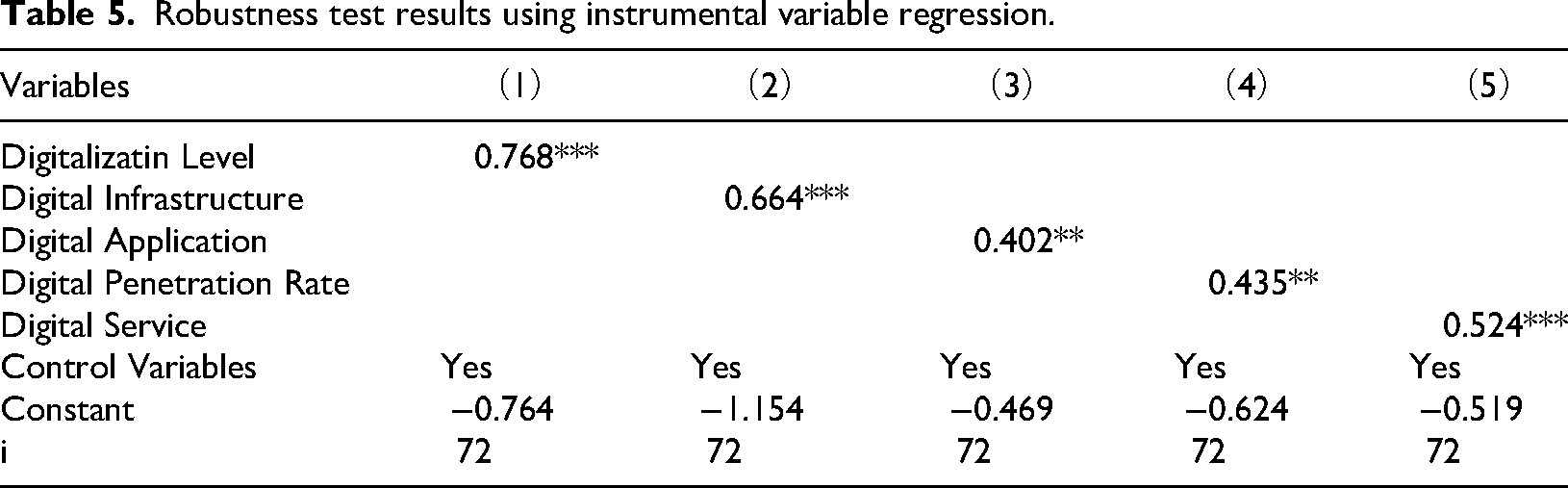
Employing the first-order lagged explanatory variables as instrumental variables, we conducted instrumental variable estimation. The results presented in Table 5 (columns 1–5) remain consistent with the benchmark regression findings, providing additional evidence for the robustness of our research conclusions.
Robustness test results using instrumental variable regression.
To further verify the robustness of our findings, we conduct additional tests by: (a) Replacing the core explanatory variable digitalization level (Dig) with the Digital Inclusive Finance Index (DigI), (b) Substituting the explained variable low-carbon economic efficiency (LCE) with low-carbon economic development level (LCEL). The regression results are presented in Table 6. Column (1): The coefficient of DigI is 1.204 (significant at 1% level). Column (2): Dig remains positively significant (1.365, 1% level) for LCEL, results remain consistent with baseline regressions, confirming the robustness.
Robustness tests with variable replacement and Winsorization.
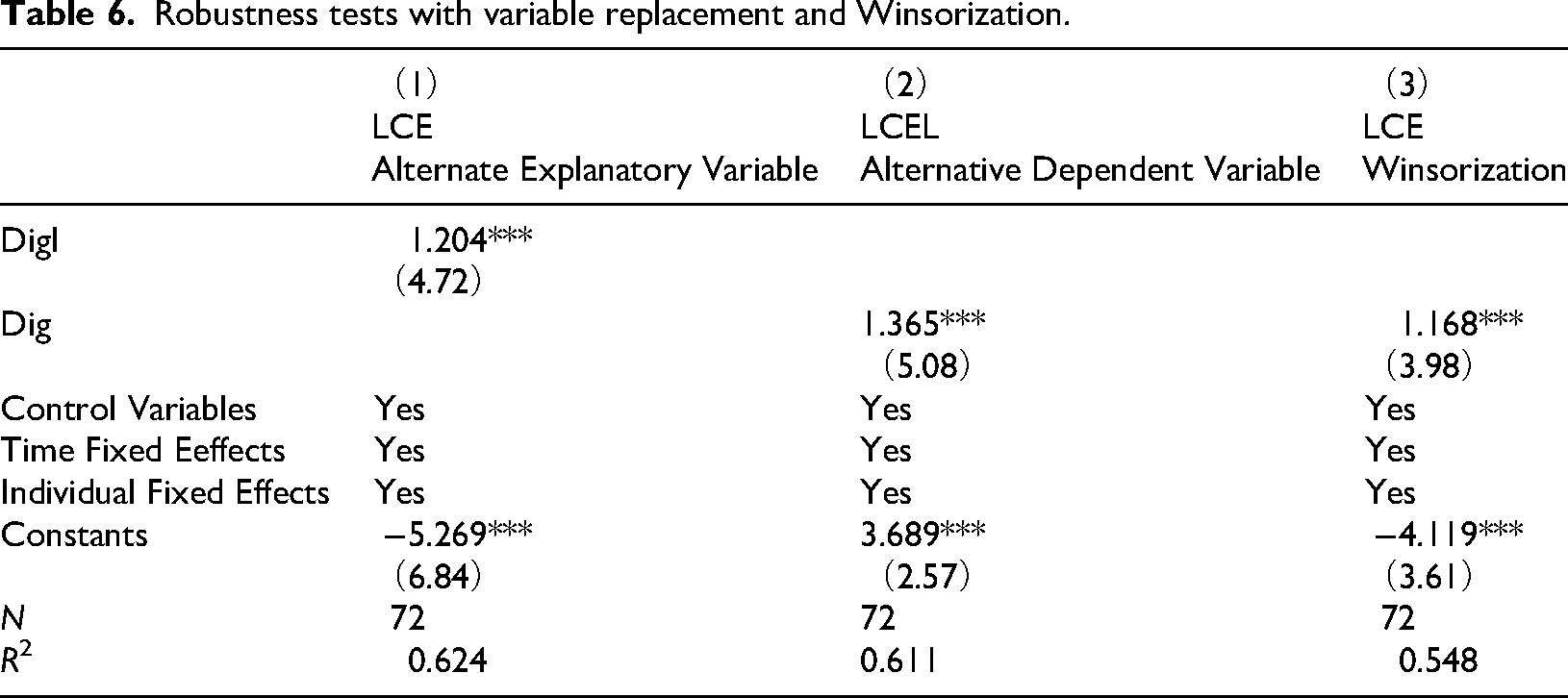
To address potential bias caused by outliers in the sample data, we applied 1% winsorization to all variables and re-run the regression tests to eliminate the influence of extreme values. The results are presented in Column (3) of Table 6. The regression coefficient for the digitalization level remains significantly positive at the 1% level, consistent with the baseline regression results, thus confirming the robustness of our previous conclusions.
Mechanism of energy consumption intensity
Building on Equations (2) and (3), we examined both: (a) the mediating role of energy consumption intensity in the relationship between digitalization level and low-carbon economic development efficiency, and (b) the impact of their interaction effect on efficiency. The empirical results are presented in Table 7.
Effect of energy consumption intensity between digitalization level and low-carbon economic development efficiency.
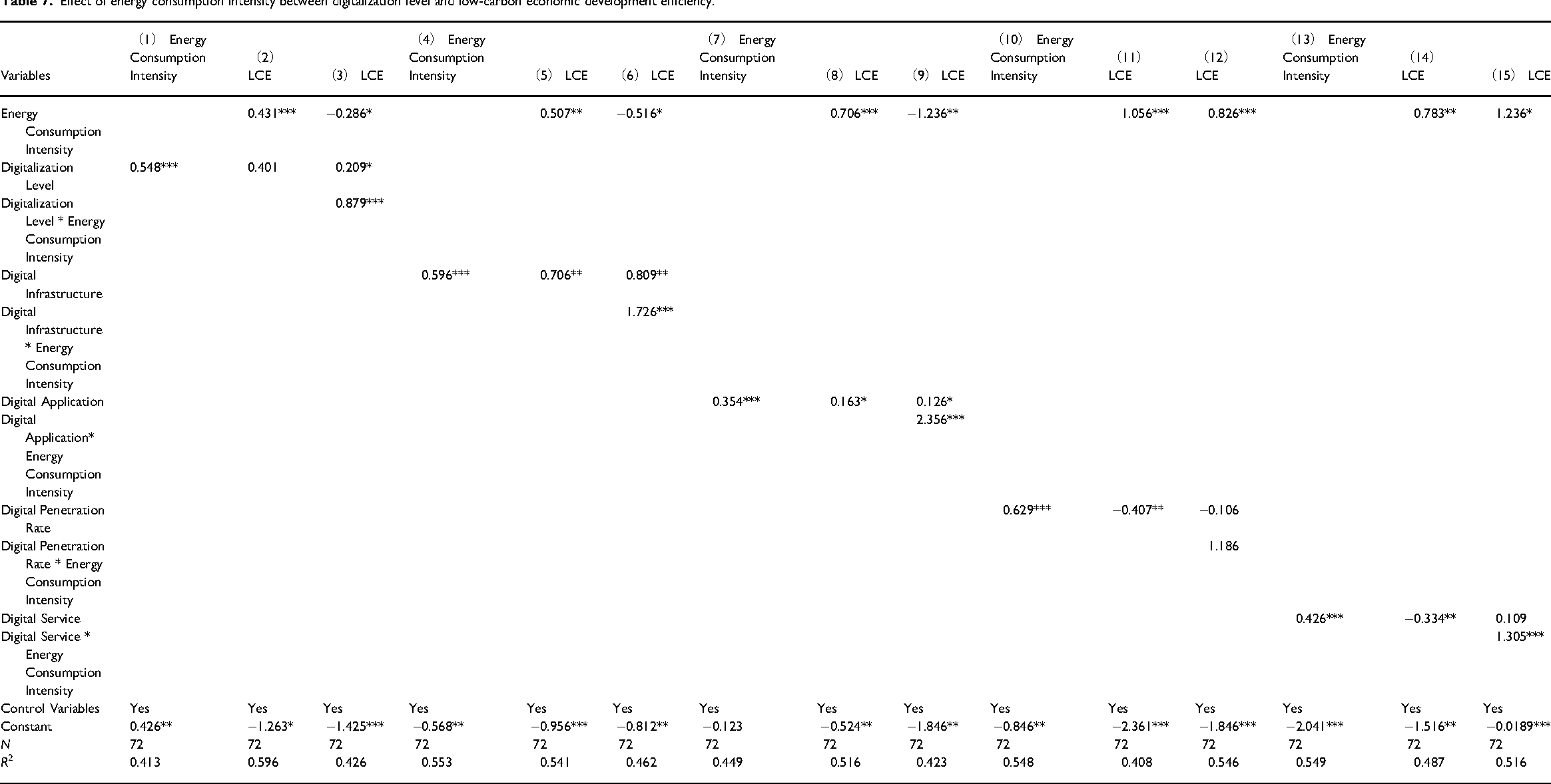
Table 7 demonstrates the mediating effect of energy consumption intensity between digitalization level and low-carbon economic efficiency. Column (1) reveals a significant positive coefficient of 0.548*** between digitalization level and energy consumption intensity. Column (2) shows a 0.431*** coefficient for energy consumption intensity's positive impact on efficiency, while the reduced coefficient for digitalization level indicates partial mediation. Column (3) presents a significant interaction coefficient of 0.879***, confirming synergistic effects between digitalization and energy intensity in enhancing low-carbon economic development efficiency.
Table 7 further illustrates the mediating effect of energy consumption intensity between digital infrastructure and low-carbon economic efficiency. Column (4) displays a significant positive coefficient of 0.596*** for the relationship between digital infrastructure and energy consumption intensity. Column (5) reports a coefficient of 0.507**, demonstrating energy consumption intensity's significant positive impact on efficiency, while the reduced coefficient for digital infrastructure suggests partial mediation. Column (6) reveals a strong interaction coefficient of 1.726***, indicating significant synergy between digital infrastructure and energy consumption intensity in enhancing low-carbon economic development efficiency.
Table 7 presents the mediating effect of energy consumption intensity between digital applications and low-carbon economic development efficiency. Column (7) indicates a significant positive coefficient of 0.354*** for the relationship between digital applications and energy consumption intensity. Column (8) demonstrates a coefficient of 0.706***, confirming energy consumption intensity's significant positive impact on efficiency development, while the reduced coefficient for digital applications suggests partial mediation. Column (9) reveals a strong interaction coefficient of 2.356***, establishing significant synergy between digital applications and energy consumption intensity in driving efficiency improvements.
Table 7 examines the relationship between digital penetration rate and low-carbon economic efficiency through energy consumption intensity. Column (10) displays a significant positive coefficient of 0.629*** between digital penetration rate and energy consumption intensity. Column (11) reports a 1.056*** coefficient, showing energy consumption intensity's significant positive effect on efficiency, while the reduced coefficient for digital penetration rate suggests partial mediation. Notably, column (12) reveals a non-significant interaction coefficient (1.186), indicating no synergistic effect between these factors in driving efficiency improvements.The non-significant relationship may be attributed to the following potential explanations:
Measurement limitations
The current penetration rate metric primarily captures infrastructure availability rather than actual usage intensity. Lack of granularity in distinguishing between different application scenarios (industrial vs. residential). Potential time-lag effects in technology adoption (typically 3–5-year implementation cycles).
Regional economic characteristics
Existing energy infrastructure may not be fully compatible with digital management systems. Maturity of digital ecosystem (78.3% penetration rate) suggests diminishing marginal returns.
Policy environment factors
The dual-control energy policy framework may constrain potential synergies. Immature carbon market mechanisms (currently limited to power sector). Misalignment between digital investment cycles and energy efficiency targets
Theoretical considerations
Possible non-linear relationship thresholds not captured in linear models. Unmeasured moderating variables (e.g., enterprise digital maturity). Context-specific factors in Zhejiang's development stage.
The effect of energy consumption intensity between digital service and low-carbon economic development efficiency is shown in Table 7. Column (13) shows a result of 0.426***, indicating a significant positive correlation between digital service and energy consumption intensity. Column (14) yields a result of 0.783**, indicating that energy consumption intensity significantly promotes the improvement of low-carbon economic efficiency, while the influence coefficient of digital service decreases, suggesting that energy consumption intensity plays a mediating role between digital service and low-carbon economic efficiency. Column (15) shows that the interaction coefficient between digital service and energy consumption intensity is 1.305***, indicating a significant positive correlation, which demonstrates their synergy in jointly driving the improvement of low-carbon economic development efficiency.
Our analysis reveals that among the four digitalization components, only the digital penetration rate fails to demonstrate significant synergy with energy consumption intensity, while the other three factors (digital infrastructure, applications, and services) all show statistically significant interactive effects that enhance low-carbon economic efficiency. These findings provide robust validation for research hypothesis H2.
Mechanism of industrial structure upgrading
Building on Equations (2) and (3), we examined both (a) the mediating effect of industrial structure upgrading in the digitalization-low-carbon efficiency relationship, and (b) their interaction effect on efficiency. The empirical results are presented in Table 8.
Effect of industrial structure upgrading between digitalization level and low-carbon economic development efficiency.
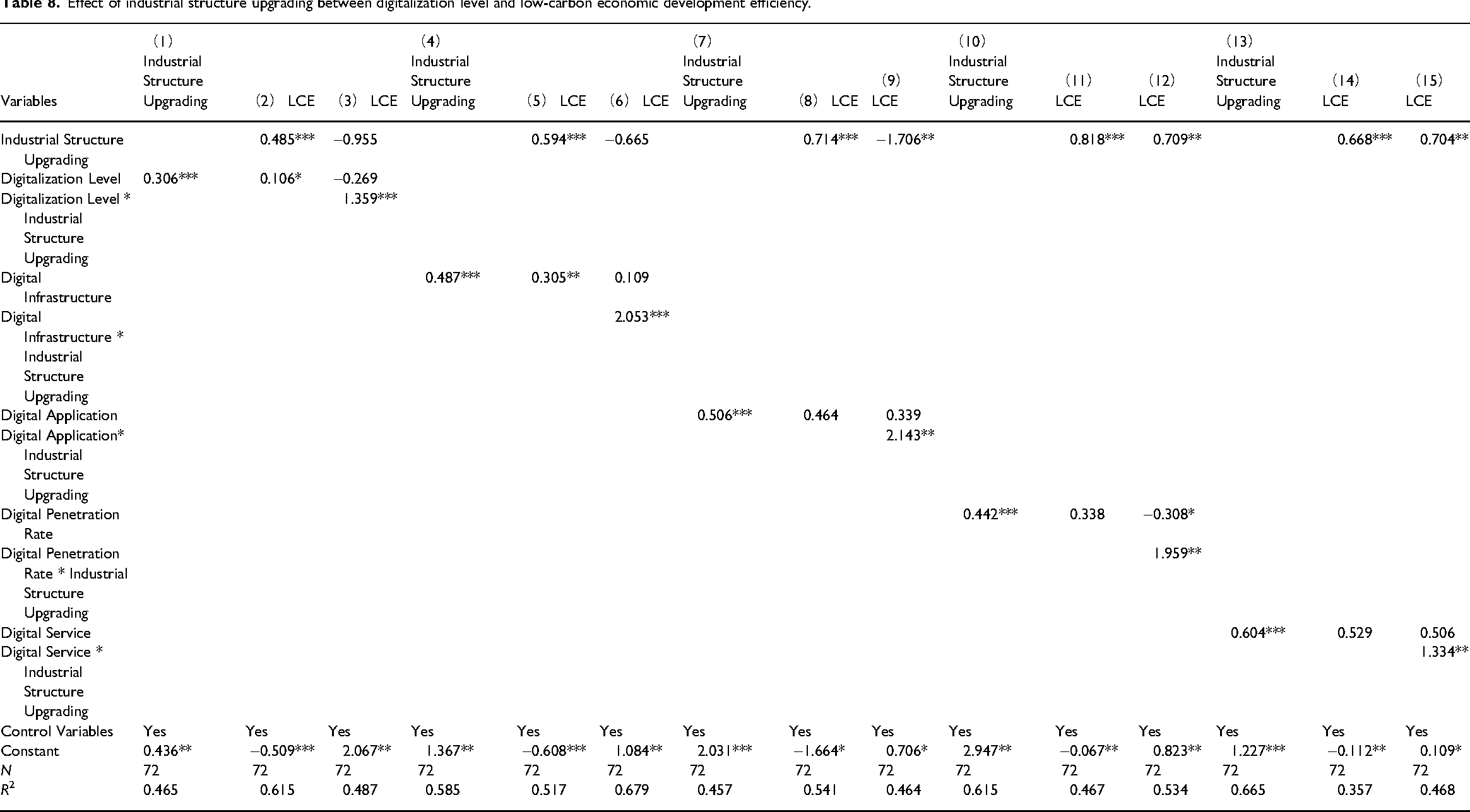
Table 8 presents the mediating effect of industrial structure upgrading between digitalization level and low-carbon economic efficiency. Column (1) reveals a significant positive coefficient of 0.306*** between digitalization level and industrial upgrading. Column (2) demonstrates a 0.485*** coefficient for industrial upgrading's positive impact on efficiency, while the reduced digitalization coefficient suggests partial mediation. Column (3) shows a significant interaction coefficient of 1.359***, confirming strong synergy between digitalization and industrial upgrading in enhancing low-carbon efficiency.
The effect of industrial structure upgrading between digital infrastructure and low-carbon economic efficiency is shown in Table 8. Column (4) shows a result of 0.487***, indicating a significant positive correlation between digital infrastructure and industrial structure upgrading. Column (5) yields a result of 0.594***, indicating that industrial structure upgrading significantly promotes the improvement of low-carbon economic efficiency, while the influence coefficient of digital infrastructure decreases, suggesting that industrial structure upgrading plays a mediating role between digital infrastructure and low-carbon economic efficiency. Column (6) shows that the interaction coefficient between digital infrastructure and industrial structure upgrading is 2.053***, indicating a significant positive correlation, which demonstrates their synergy in jointly driving the improvement of low-carbon economic efficiency.
The effect of industrial structure upgrading between digital application and low-carbon economic efficiency is shown in Table 8. Column (7) shows a result of 0.506***, indicating a significant positive correlation between digital application and industrial structure upgrading. Column (8) yields a result of 0.714***, indicating that industrial structure upgrading significantly promotes the improvement of low-carbon economic efficiency, while the influence coefficient of digital application decreases, suggesting that industrial structure upgrading plays a mediating role between digital application and low-carbon economic efficiency. Column (9) shows that the interaction coefficient between digital application and industrial structure upgrading is 2.143**, indicating a significant positive correlation, which demonstrates their synergy in jointly driving the improvement of low-carbon economic efficiency.
The effect of industrial structure upgrading between digital penetration rate and low-carbon economic efficiency is shown in Table 8. Column (10) shows a result of 0.442***, indicating a significant positive correlation between digital penetration rate and industrial structure upgrading. Column (11) yields a result of 0.818***, indicating that industrial structure upgrading significantly promotes the improvement of low-carbon economic efficiency, while the influence coefficient of digital penetration rate decreases, suggesting that industrial structure upgrading plays a mediating role between digital penetration rate and low-carbon economic efficiency. Column (12) shows that the interaction coefficient between digital penetration rate and industrial structure upgrading is 1.959**, indicating a significant positive correlation, which demonstrates their synergy in jointly driving the improvement of low-carbon economic efficiency.
The effect of industrial structure upgrading between digital service and low-carbon economic efficiency is shown in Table 8. Column (13) shows a result of 0.604***, indicating a significant positive correlation between digital service and industrial structure upgrading. Column (14) yields a result of 0.668***, indicating that industrial structure upgrading significantly promotes the improvement of low-carbon economic efficiency, while the influence coefficient of digital service decreases, suggesting that industrial structure upgrading plays a mediating role between digital service and low-carbon economic efficiency. Column (15) shows that the interaction coefficient between digital services and industrial structure upgrading is 1.334**, indicating a significant positive correlation, which demonstrates their synergy in jointly driving the improvement of low-carbon economic efficiency.
Based on the above analysis, it is found that the level of digitalization and its four components indirectly promote the improvement of low-carbon economic efficiency by facilitating industrial structure upgrading. Additionally, their interactions with industrial structure upgrading significantly enhance low-carbon economic efficiency, validating research hypothesis H3.
Conclusions and implications
Research conclusions
This study employs panel data from nine prefecture-level cities in Zhejiang province (2015–2022) to examine digitalization's impact on low-carbon economic development through benchmark regression and mediation models. Our key findings are as follows: first, digitalization significantly enhances low-carbon economic efficiency in Zhejiang, a conclusion robust to multiple tests including random effects modeling, sample exclusion, and control variable substitution. Second, all four digitalization components positively influence low-carbon efficiency, with effect sizes ordered as: digital infrastructure > digital services > digital penetration rate > digital applications.
The analysis further reveals that digitalization and its components significantly improve both energy consumption intensity and industrial structure upgrading, thereby indirectly boosting low-carbon efficiency. Energy intensity and industrial upgrading serve as important mediators in this relationship. Notably, all digitalization elements except penetration rate demonstrate significant synergistic effects with energy intensity on efficiency improvement. Similarly, digitalization and all its components show significant synergy with industrial upgrading in enhancing low-carbon economic performance.
Policy implications
Implement differentiated digital infrastructure development strategies to provide fundamental support for enhancing low-carbon economic development efficiency
Our analysis reveals that among the four digital technology factors, digital infrastructure exhibits the largest impact coefficient, indicating Zhejiang province should prioritize strengthening digital infrastructure construction to advance the “Digital Zhejiang” initiative and consolidate the foundation for low-carbon economic development. For cities with established digital infrastructure, the focus should be on pioneering cutting-edge technologies like 6G trials and quantum communication pilots, while less-developed cities should prioritize closing basic network coverage gaps through “low-cost, easy-to-maintain” solutions.
Industry-specific adaptations are essential: manufacturing-intensive cities need to enhance industrial internet identification and resolution systems, whereas commercial hubs should concentrate on building smart logistics infrastructure. Through government-guided funds and project financing, the province should accelerate the expansion and upgrading of 5G networks, industrial internet systems, and big data centers, optimizing data transmission efficiency and service capabilities to create a high-speed, stable, and secure network environment for digital applications in the low-carbon economy.
Concurrently, digital transformation of traditional infrastructure must be promoted, including developing intelligent transportation/logistics systems and smart energy grids to improve energy efficiency and resource allocation. A province-wide carbon emission monitoring network utilizing IoT and big data technologies should be established to enable real-time carbon data tracking, providing critical data support for government emission reduction policies and corporate carbon management initiatives.
Leverage digital technological innovation to reduce energy consumption intensity, thereby providing technical safeguards for enhancing low-carbon economic development efficiency
In July 2022, Zhejiang province issued the Zhejiang province Industrial Energy Conservation and Carbon Reduction Technology Transformation Action Plan (2022–2024), fully advancing energy conservation and carbon reduction digital technology transformation in the industrial sector and building a green manufacturing system and service system. This is a concrete measure to achieve China's dual-carbon goals. To reduce energy consumption intensity, Zhejiang province should carry out joint research on key core technologies, focusing on a new generation of clean, efficient, green, low-carbon, and recyclable production processes and equipment, and introduce, absorb, and develop advanced low-carbon digital technologies. It should accelerate the promotion and application of energy-saving and carbon-reduction technology equipment, publish promotion catalogs, and organize industry-specific on-site promotion meetings.
For example, it should promote clean production in industrial enterprises, implement mandatory clean production audits in industries with “double excess, double high energy consumption,” and continue to carry out voluntary clean production audits. It should advance the recycling of resources, promote green design of industrial products, and accelerate the promotion and application of advanced technology and equipment for comprehensive resource utilization. Additionally, it should promote the high-value utilization of renewable resources and drive the large-scale and refined development of the renewable resource utilization industry.
Establish A tiered industrial low-carbon transition system to provide endogenous momentum for enhancing low-carbon economic development efficiency
Implement a ‘three-color list’ gradient transition system: green (encouraged industries like next-generation IT), yellow (transformation-needed industries like high-end equipment manufacturing), and red (restricted/phase-out industries like traditional coal power). For green-list industries, Zhejiang should accelerate the cultivation of emerging industrial clusters—implementing national initiatives to foster new growth drivers by developing next-generation IT, new energy, advanced materials, and AI sectors, with focused development of smart IoT and high-end software clusters to create complementary, structurally optimized emerging industrial zones.
Yellow-list industries require transformation through clean energy supply, intelligent manufacturing processes, and low-carbon product services, particularly for smart grid equipment, new energy vehicles, and high-end machine tools. Red-list industries demand progressive phase-out plans, especially for high-energy-consuming sectors like traditional coal power and chemical industries, while advancing the national demonstration zone for traditional manufacturing upgrade through high-end, intelligent, green, and integrated development.
A classified guidance mechanism for key enterprises and full-chain management for major projects should be established to promote technological upgrades and obsolete equipment replacement. This industrial restructuring further requires widespread digital technology application across manufacturing, agriculture, and services to foster new models like shared manufacturing, virtual industrial parks, online education, and internet healthcare.
Footnotes

Funding
The authors disclosed receipt of the following financial support for the research, authorship, and/or publication of this article: This work was supported by the Quzhou Science and Technology Project, PR China, Soft Science Project of Science department of Zhejiang Province, PR China, Philosophy and Social Science Foundation of Heilongjiang Province, PR China (grant numbers 2024K162, 2025C35033, 21JYB152).
Declaration of conflicting interests
The authors declared no potential conflicts of interest with respect to the research, authorship, and/or publication of this article.