




Abstract
Heating and cooling account for a significant share of energy consumption, particularly in the European Union, where they account for almost half of total energy consumption. The energy demand for heating and cooling is mainly driven by space, process, and water heating, with a growing demand for space cooling. Fossil fuel technologies currently dominate in buildings, with renewable energy sources contributing only 24.8% of consumption in 2022 (Energy 2024). In order to reduce greenhouse gas emissions and increase the share of renewable energy, the development and implementation of renewable technologies for heating and cooling in buildings is crucial. An interesting and promising approach to the use of renewable energy sources is their use in hybrid systems. These can often combine the advantages of different technologies while mitigating their disadvantages. Hybrid heating systems increase energy efficiency, reduce environmental impact, and improve system reliability by integrating multiple renewable energy sources. Combining technologies such as solar, biomass, and heat pumps has great potential to optimize energy use, stabilize thermal output, and reduce primary energy consumption. This article reviews previous work on the integration of different renewable hybrid systems for residential buildings. Both stand-alone and grid-connected systems, incorporating various renewable energy sources and storage technologies are reviewed. This work also discusses the control requirements and how advanced and intelligent approaches can help improve performance and energy consumption. Furthermore, it discusses the challenges of hybrid system implementation, such as high initial costs and integration complexities. The novelty of this work lies in its comprehensive assessment of hybrid system configurations, their control requirements, and the role of smart technologies in optimizing their operation. The findings provide valuable insights for researchers, policymakers, and industry stakeholders, guiding future developments in sustainable heating solutions and energy transition strategies.
Keywords
Introduction
In view of the rapid progression of global warming, there is an urgent need to take more measures to limit its consequences. An energy sector that still has great potential for the reduction of greenhouse gas emissions and an increase in the share of renewable energy use is the heating and cooling sector (IPCC, 2022). Renewable sources that can be used for heating are mainly direct solar energy, biomass, geothermal energy, renewably generated electricity, and the energy of the environment. Solar energy can be transferred to heating fluids by using collectors. Biomass can be used in solid or gaseous form, for example, when burnt as pellets in a biomass boiler (BB) or as biogas in a micro-combined heat and power (mCHP) plant. Geothermal energy can be accessed with boreholes or through ground collectors, though the temperature level is often low and needs to be raised to a useful level with further effort. The same is true for the temperature level or the environment. This rise in the temperature level can be achieved with the use of heat pumps, that are powered with renewable electricity and come in different types. Another way to use electricity for heating is with electric heating rods or electric storage heating. Their efficiency is way lower than that of heat pumps, but might be a viable option in specific use cases, for example, to convert excess electricity generated from a photovoltaic (PV) plant into heat in a storage tank (Kaltschmitt et al., 2016).
Heat pumps are expected to play a key role in the future of building heating, especially in Europe. They are highly efficient (under favourable conditions) and further technological developments are expected. There are several renewable sources that can be used (ambient air, soil, and water) and, therefore, the potential is large (Rosenow et al., 2022). Furthermore, investment and operating costs are comparable to or lower than those of other renewable options, although often still higher than for fossil options (IEA, 2021). With the expected increase in the price of fossil fuels such as gas and oil, the economic gap between renewable energy and fossil fuels will narrow. Not to mention the need to phase out fossil fuels if climate change is to be mitigated, for which policymakers must provide incentives and increase the economic feasibility of renewable solutions. Heat pumps are not the only solution, however, and are not without their drawbacks. To be climate-neutral and achieve the maximum reduction in greenhouse gases, the electricity used to power them must come from renewable sources. At present, most countries still have a high proportion of fossil fuels in their energy mix (ENTSO-E, 2024). Furthermore, the main renewable energy sources used are solar and wind, which are intermittent in nature. This means that they do not provide constant power, but depend on solar radiation or wind. As a result, solar power is most available during the day and none at night. Heating, on the other hand, is most needed in the morning and evening hours (VDI-Gesellschaft Energie und Umwelt, 2021). In addition, the overall demand for electricity will increase as electrification takes place in different sectors. This creates fierce competition for sustainable electricity and can lead to shortages where demand exceeds generation, forcing grid operators to actively manage demand and, as a last resort, turn off consumers to maintain grid stability. To address the intermittency challenges of renewable energy sources, strategies such as energy storage systems, demand response programs, and intelligent energy management systems are employed. These approaches enhance grid reliability by balancing supply and demand, ensuring a stable and efficient energy infrastructure (Ahmad and Zhang, 2020). In Germany, for example, a new law already allows temporary curtailment of heat pumps (Gesetz über die Elektrizitäts- und Gasversorgung (Energiewirtschaftsgesetz—EnWG), 2005). In addition to these obstacles on the electricity supply side of heat pumps, it has to be considered that the high advertised efficiencies of heat pumps, especially air-to-water heat pumps, can often only be achieved under good conditions, meaning not at low ambient temperatures (above 0 °C) and not at high supply temperatures (in the range of 30 °C–50 °C), as the coefficient of performance (COP) decreases with increasing temperature difference between the source and the sink. This can result in low efficiency during the peak heating periods when outdoor temperatures are low and heating demand is high. This is less of an issue with ground source heat pumps, but they have higher investment costs and may be subject to environmental restrictions on drilling the necessary boreholes. In addition, the temperature decline in the ground has to be considered and could be a further limitation to their use (Gaur et al., 2021). Considering the possible disadvantages of heat pumps, the idea of combining two or more (renewable) heating devices using different types of (renewable) energy sources becomes interesting. These so-called hybrid heating systems may be able to exploit the advantages of each technology while at least partially mitigating the disadvantages. A system that has been in use for several decades is the combination of solar thermal collectors with a gas boiler. When solar energy is available, it is used primarily for domestic hot water (DHW) and heating, or stored in a buffer tank. The gas boiler serves as a reliable heat source that can cover the remaining heating load or act as a base load when solar energy is not available. (Frei and Vogelsanger, 1998) A renewable solution to this combination would be a BB, often an automatically fed pellet or wood chip boiler, coupled with solar thermal collectors. In recent decades, research has also been carried out into solar-assisted heat pumps, which are available in various designs (see ‘Historical research on hybrid systems for residential applications’ section). The main idea is to use solar energy to raise the temperature level of the fluid entering the heat pump and increase its COP, thus reducing electricity demand and operating costs. Another hybrid system involving a heat pump is the combination with a BB. The boiler is usually at its best when operating at full load, which is required when heating demand is high. As mentioned above, this is when the heat pump works less efficiently. On the other hand, the boiler works less efficiently, or produces more energy than is currently needed and, therefore, needs to be stored, when heating demand is low or only needed for DHW. In addition, the potential of biomass is limited, and competition for the resource is increasing, as it can be used as a material and as a raw material for chemical or other industries. This makes combination an interesting option for domestic heating, taking into account the different constraints that may apply to the use of each technology.
The aim of this work is to optimize hybrid heating systems by evaluating key technological options and identifying the most effective combinations for improving efficiency and sustainability. The article provides a comprehensive overview of major technologies, including heat pumps, solar thermal, and biomass, highlighting their advantages and limitations. It emphasizes the potential of combining renewable energy technologies, particularly heat pumps, with other solutions to address the limitations of individual systems, such as intermittency, low efficiency under specific conditions, and resource competition.
The novelty of this work lies in its exploration of how hybrid systems can enhance energy efficiency, reduce greenhouse gas emissions, and utilize various renewable sources like solar energy, biomass, and geothermal energy. It also examines the ongoing research collaborations, particularly within the European Union (EU), to understand developments and funding opportunities in the field. The article provides a unique bibliometric analysis of global research trends, identifying gaps and future research opportunities. Additionally, by integrating technical, economic, and policy perspectives, the work contributes to advancing innovative hybrid heating solutions that align with climate change mitigation goals and the growing need for sustainable energy transitions.
This article provides an overview of the work on hybrid heating systems in the residential sector, with a focus on renewable solutions and those incorporating heat pumps. The ‘Introduction’ section includes a general introduction to hybrid heating systems, followed by the ‘Methodology’ section. A brief introduction to the historical discussion on the subject is presented in the ‘Overview of hybrid heating technologies’ section, as well as a comparison of regional differences regarding energy consumption patterns. The main part of this study, the literature review on different types of hybrid heating systems, is carried out in the ‘Renewable Hybrid heating systems’ section. The first part is dedicated to the combination of heat pumps and the use of solar energy, followed by various types of hybrid systems that include the use of biomass. The section is completed with a review of innovations regarding the use of thermal energy storage (TES), as they can play an important role in renewable energy systems (due to their intermittent nature). The ‘Smart control and energy management’ section deals with intelligent control and energy management of heating systems, as it has gained increasing interest over the last decade and shows great potential for improving system efficiency on the one hand, and is becoming indispensable for some systems, that is, if forecasts and electricity price predictions should be considered in operational strategies. The ‘Policies, energy landscapes, and research contributions of European countries in hybrid heating systems’ section takes a look at regional differences regarding policies, energy mixes, and building standards of the cited studies and presents a visual overview and bibliometric information on recent research activities across different countries, created with VOSviewer. The article concludes with a discussion and conclusions, including an outlook on the need for action in terms of research, market implementation, and policy.
Methodology
This study follows a structured approach to analyse the integration of hybrid heating systems in residential buildings, combining a narrative literature review with bibliometric analysis. The methodological framework consists of three main components:
Narrative literature review: A qualitative synthesis of existing research on hybrid heating technologies, innovations in TESs, and smart control systems for heating systems Data analysis and synthesis: Comparative analysis of system configurations, key findings, and research gaps. Bibliometric analysis: A quantitative analysis of research trends using bibliometric tools.
Narrative literature review and analysis
The study aims to provide a comprehensive overview of hybrid heating systems with a focus on reviewing different renewable energy sources, integration and thermal storage systems, and intelligent control systems to assess their performance, efficiency, and feasibility for residential applications, with a focus on the integration of heat pumps with other renewable energy sources. The literature review is carried out using the Scopus, Web of Science, ScienceDirect, IEEE Xplore, Springer, and Google Scholar databases.
The search process follows a structured approach using Boolean operators (AND, OR) and the following keywords and their common abbreviations, used in various combinations:
Hybrid heating system, hybrid renewable heating system, HRES, HYRES, integrated renewable heating system, renewable energy system, RES, heat pump hybrid heating system, biomass hybrid heating system, solar hybrid heating system, smart control of hybrid heating, smart control heating system, model predictive control heating system. Extensions such as ‘residential heating’, ‘domestic heating’, ‘with thermal storage’, or ‘review’ are used. Examples of combinations are hybrid heat pump biomass heating systems or hybrid solar biomass heating systems.
In addition, backward and forward citation tracking is used to identify relevant references. For the selection of studies peer-reviewed journal articles, conference proceedings, and existing literature reviews, published in the last 5 (to 10) years, are preferably selected (inclusion) while studies focusing on industrial applications, outdated technologies, or heating systems without a renewable component are excluded. An attempt is made to include both experimental and theoretical studies.
The relevant studies are categorized according to the technology type (e.g. heat pump-based, biomass-based, and solar-assisted systems). Performance data such as efficiency, greenhouse gas emission reduction, and cost-effectiveness are of particular interest in the analysis and are compared across the studies found. The studies are further analysed with regard to the integration of thermal storage and resulting effects. A separate section is devoted to the study of intelligent control systems. For each section, a comparative analysis is conducted to highlight key findings, limitations, and research gaps. The literature found is also examined to determine how regional differences affect energy management regulations or the composition of the energy mix.
Bibliometric analysis
The bibliometric analysis is carried out using VOSviewer on the Web of Science database for the period 2000 to 2024 in order to analyse research trends and visualize research contributions. The methodology includes:
Data collection: The search is performed using predefined keywords that are listed in the ‘Smart control and energy management’ section. A co-authorship analysis is carried out to identify research collaborations. A network analysis is used to outline research connections and emerging trends.
This approach allows for a quantitative assessment of research activity, complementing the qualitative insights from the narrative literature review.
Overview of hybrid heating technologies
Historical research on hybrid systems for residential applications
The general idea of combining two or more devices that use different energy sources to provide useful energy is not new. Concepts to connect a solar thermal collector with a heat pump date back at least as far as 1978 (Kern JR. and Russell, 1978) and show that the hybrid system can be economically favourable compared to a fossil-fuelled boiler. A heating system using a wind turbine and a solar collector is analysed by Darkazalli and McGowan (1978). Depending on the size of the collector area and the blade diameter, the hybrid system was able to provide up to 90% of the heating demand. From an economic point, the system could not compare with an electric heating system though. A similar study has been performed by Evans et al. (1977) who came to the conclusion, that the combined wind–solar system would be more feasible than the sole solar system if its costs surpassed 120 US dollars/m2 of solar thermal collector (in 1977). Bell and McGowan (1984) also analysed the use of wind turbines for heating and electricity generation. For their study, they combined the wind turbine with a super-insulated passive solar house and performed a computer simulation in 1984. They concluded that the system can achieve a significant reduction of the auxiliary heating and electricity demands that increase with greater sizes of the wind turbine or the improved insulation of the building. The most cost-effective use can be achieved at sites with an average wind speed of at least 5.4 m/s. Though, with increasing wind speeds, the infiltration losses of the building rise and result in heating losses greater than the surplus energy provided, resulting in an increased auxiliary heating requirement. Nonetheless, the authors remark on the need for mass-produced wind turbines in order for the system to be economically competitive with conventional energy prices.
Regional differences in energy consumption for heating, cooling, and DHW
Due to the challenge of distinguishing between heating, cooling, and DHW energy consumption, Figure 1 combines all categories for residential and commercial buildings. DHW constitutes a minor portion of the total heating and cooling energy use in residential buildings, with the highest percentages observed in Eastern Europe and the former Soviet Union (EEU) as well as Latin America and the Caribbean (LAM), where it approaches 35%–40%. In other regions, DHW accounts for between 20% and 30% of the total. Commercial water heating typically consumes less energy, both in absolute and relative terms, compared to residential use, with the exception of the former Soviet Union (FSU), Africa, and the Pacific regions. In Sub-Saharan Africa, energy use for DHW in both residential and commercial sectors remains relatively low. However, a slight increase is projected from 2010 to 2050, reflecting gradual improvements in access while also highlighting disparities in infrastructure, technology, and economic conditions (Ürge-Vorsatz et al., 2015).
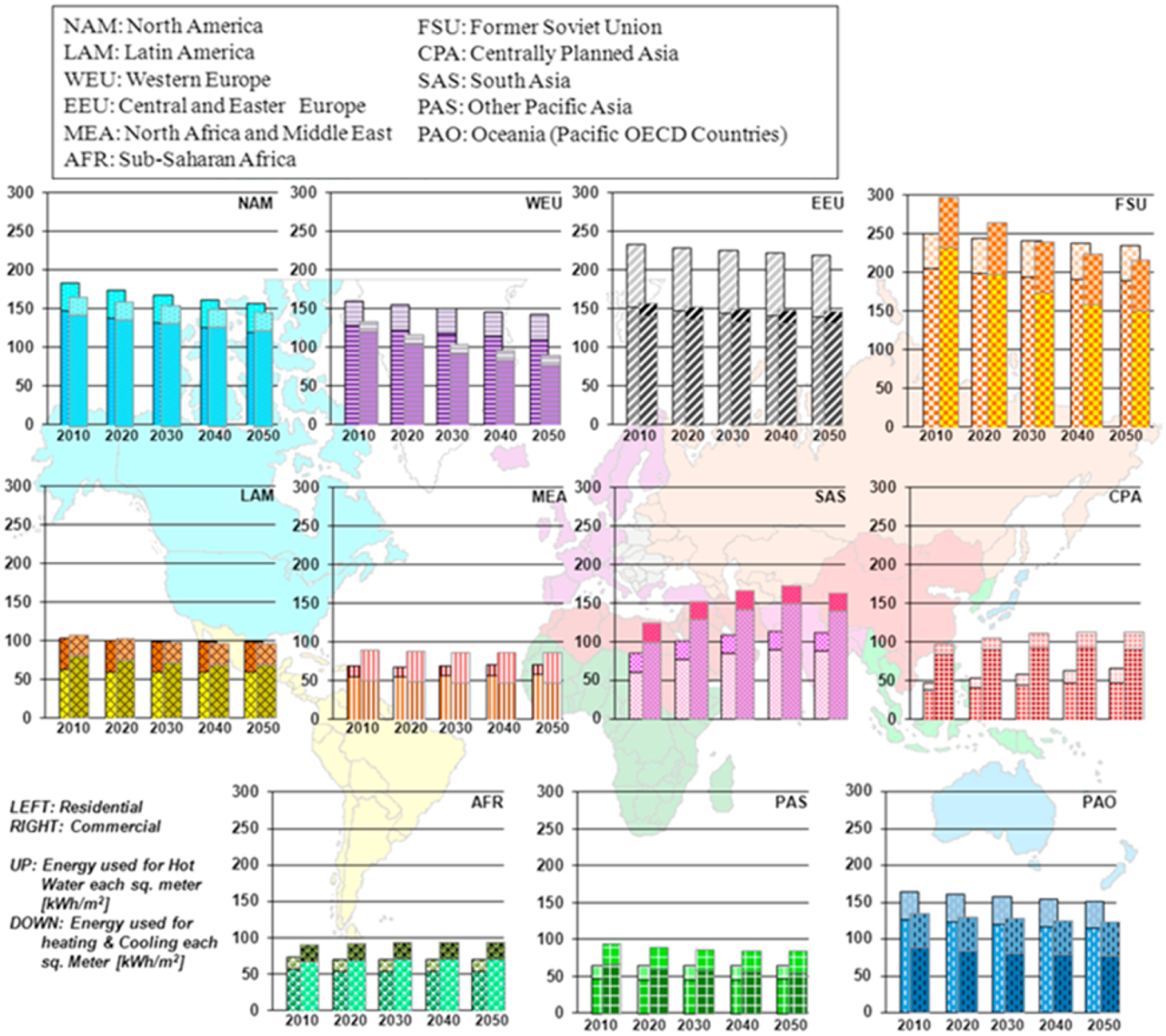
Specific energy consumption for heating, cooling, and hot water in residential and commercial buildings by major world regions, measured in kWh/m2 (2010–2050) (Ürge-Vorsatz et al., 2015) (published under the CC BY license).
In New South Wales, Australia, adoption rates of household energy technologies differ significantly between metropolitan and rural areas due to socioeconomic, lifestyle, and living conditions (Gui and Gou, 2022).
Similarly, a study in Portugal revealed differences in DHW energy consumption and carbon emissions between two locations in a touristic region, highlighting the importance of context-specific modelling, it does mention that water heating accounted for 14.8% of the energy consumed in households in the EU in 2019 and 2020, with substantial variation between different countries. For example, it ranged from 7.8% in Luxembourg to 26.5% in Malta. Additionally, the article highlights that the share of domestic energy consumption related to DHW production varies across different regions globally. The share of DHW production-related energy consumption ranges from 19% in the USA, 25% in Australia, 22% in Canada, 37% in South Africa, 27% in China, 29% in Mexico, 25% in the UK, 20% in Hong Kong, to 20% in Brazil (Sousa and Meireles, 2022).
These percentages indicate that regional differences in energy consumption for heating, cooling, and DHW can vary significantly based on factors such as climatic conditions, energy sources used, building characteristics, and cultural habits.
Research in South Africa found considerable differences in hot water demand, energy consumption, and efficiency between peri-rural and urban regions, with urban areas using 20% more water and showing higher efficiency (Marcel Roux and M.J. (Thinus) Booysen, 2017). In the United States, heating is associated with similar or greater CO2 emissions than cooling across all regions, with the most significant differences observed in the Midwest and Northeast (Jacobsen, 2014). These studies emphasize the importance of considering regional variations in energy consumption patterns for effective policy-making and sustainability initiatives.
Renewable hybrid heating systems
Various renewable hybrid heating system combinations can be used to supply the residential sector with heat and DHW, as shown in Figure 2. This article will review some of these systems, primarily focusing on heat pumps, which have garnered significant attention in research.
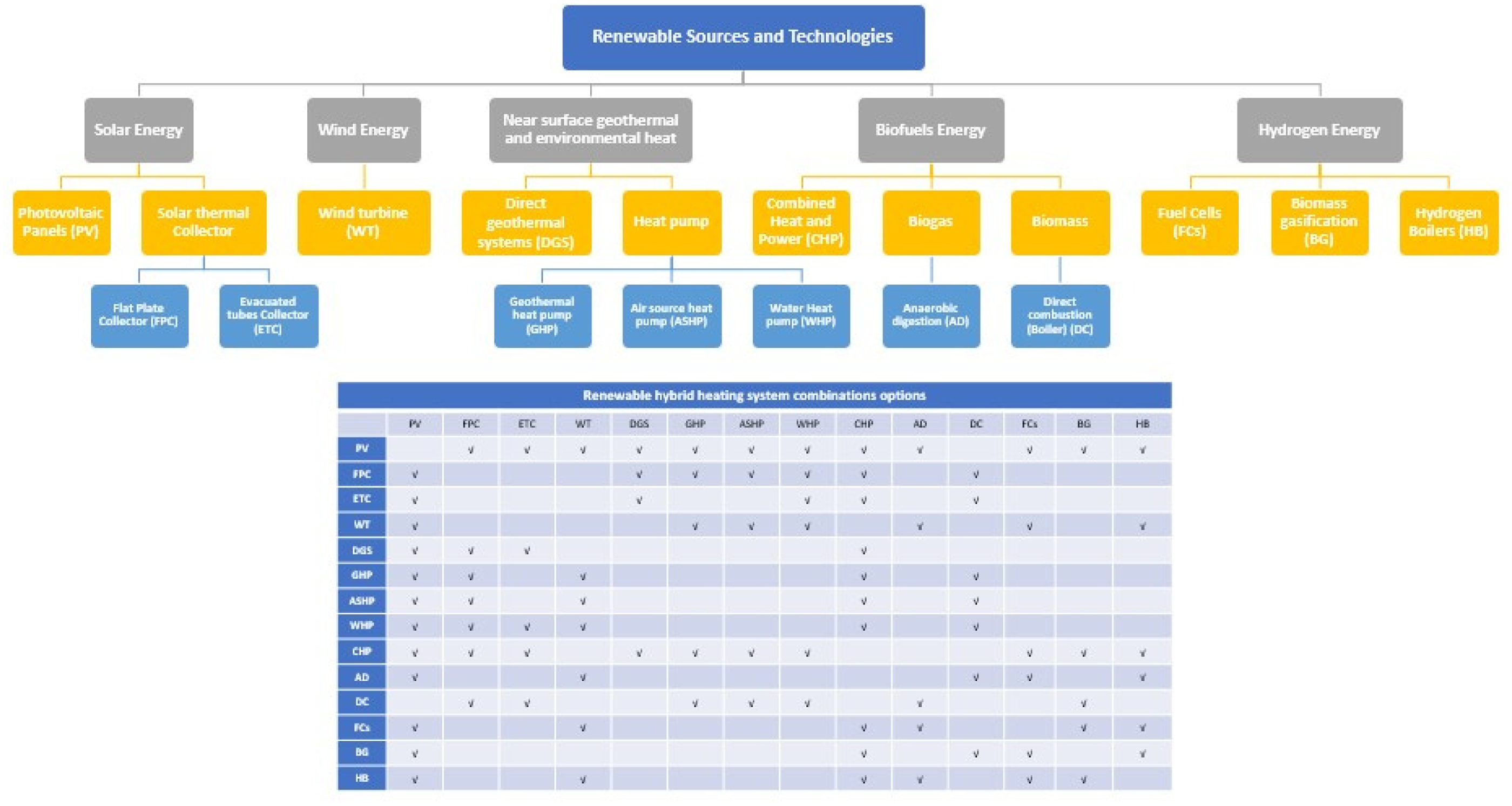
Renewable sources and technologies and the hybrid heating system combinations options.
The focus on hybrid heating systems stems from the limitations of using a single heating system during winter. With the transition to alternative power sources such as wind and PV systems, there could be critical supply situations (J. Petrovic et al., 2022). A hybrid system that combines a heat pump with other renewable energy sources could be a game changer in addressing these limitations.
Heat pumps supported by solar energy
There is much literature on the integration of solar energy into other renewable and nonrenewable energy sources (Canale et al., 2021; Khamraev, 2023; Sarbu et al., 2022). In particular, the integration into heat pump systems has received increasing attention in the past. Table 1 gives an overview of recent literature reviews and their focus, and the findings of those literature reviews will be discussed in this section. As these review papers already cover the relevant research articles on this topic, this review focuses on their results. The main reason given by the authors for coupling a heat pump with the use of solar energy is an increase in the performance of the heat pump, which is reflected in higher COP values due to a reduced temperature rise required when the fluid entering the heat pump is preheated. Other reasons given, as a consequence of the performance increase, are reduced greenhouse gas emissions and reduced primary energy demand. Another reason given by Nouri et al. (2019) includes the ability to recharge the energy extracted from the ground in ground source heat pumps by injecting solar energy into the boreholes. Vaishak and Bhale (2019) also see an advantage when using photovoltaic-thermal (PVT) instead of PV modules to cool the panels and increase electricity production, as the heat removed can then be used in the heat pump. Kazem et al. (2024) further stated that the reduced dependence on other energy sources that comes with increased autonomy is an incentive for coupling. They also state that both solar collectors and heat pumps have a wide range of applications in terms of climatic regions and are therefore suitable for different uses. This is also mentioned by Miglioli et al. (2023), although they see the best use case in regions where both heating and cooling are required.
Overview of recent literature reviews on hybrid solar-assisted heat pump systems.
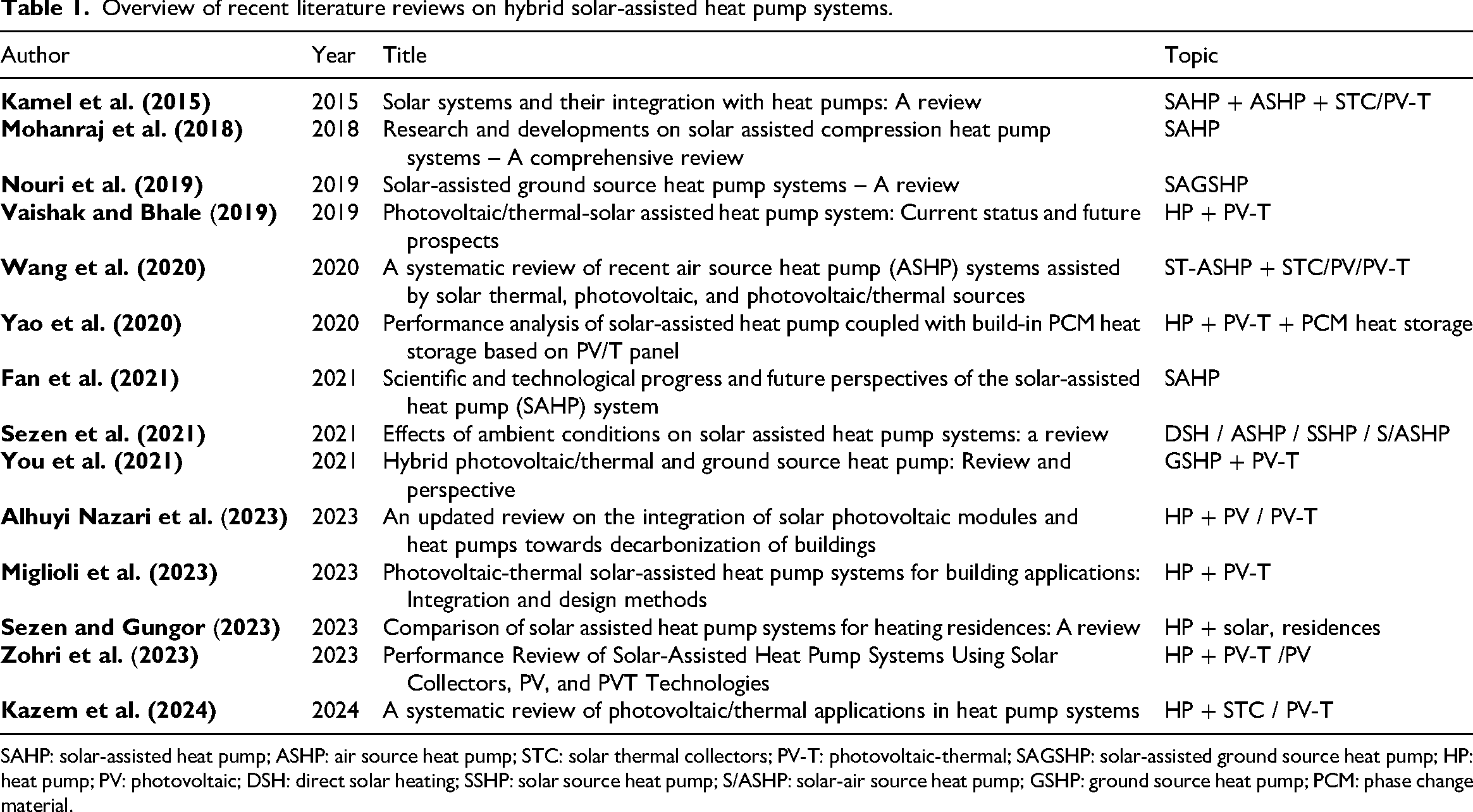
SAHP: solar-assisted heat pump; ASHP: air source heat pump; STC: solar thermal collectors; PV-T: photovoltaic-thermal; SAGSHP: solar-assisted ground source heat pump; HP: heat pump; PV: photovoltaic; DSH: direct solar heating; SSHP: solar source heat pump; S/ASHP: solar-air source heat pump; GSHP: ground source heat pump; PCM: phase change material.
The main classification of solar-assisted heat pump systems made in the literature is into direct expansion (DX-SAHP) and indirect expansion (IDX-SAHP) solar-assisted heat pump systems. In the conventional DX-SAHP system, also referred to as a dual-source DX-SAHP, the collector (which could be either a solar thermal or a PVT collector) functions as the evaporator of the heat pump. That means, the working fluid of the heat pump flows through the collector and is evaporated. The heat source is either solar energy or the ambient air, if there is no solar irradiation. Hence the name dual-source. In recent years, two alternative setups have been examined, a series and a parallel setup. In the series setup, the collector is insulated, which hinders the evaporation by the ambient air. Therefore, an evaporator is added to the system, which enables the evaporation of the working fluid by air. This evaporator can be placed either in front or behind the collector, both having advantages and disadvantages (Sezen and Gungor, 2023). The parallel setup also has an insulated collector and an additional evaporator, though they are operated in parallel. This means both types of evaporation can be used either separately or simultaneously, by adjusting the mass flow of the working fluid (Sezen and Gungor, 2023). It is considered best practice to add an auxiliary energy supply, as the solar irradiation could be insufficient for the working fluid to evaporate completely. This would cause an inefficient operation of the heat pump (Kamel et al., 2015).
The IDX-SAHP system has two separate fluid circuits and can be operated as a serial, a parallel, or a dual system. With a serial setup, one fluid flows through the collector and absorbs the solar heat, while the second fluid (the heat pump working fluid) is evaporated by that heat. This can either be done directly in the heat pump evaporator or by connecting thermal storage in between. If thermal storage is used, a bypass can be integrated, so that the heat pump stays off if the solar radiation is sufficient to cover the thermal demand. Otherwise, only the heat pump is connected to the heating circuit via a heat exchanger (Sezen and Gungor, 2023). In the parallel setup, both the collector and the heat pump are connected to the heating circuit and can operate independently. In the dual setup, the heat pump working fluid can be evaporated by either the solar thermal collector or the ambient air (Sezen and Gungor, 2023).
The research on hybrid heating systems that combine heat pumps with solar collectors of various types show overall positive results and a growing interest in its application (Kazem et al., 2024). Though the majority of the stated review papers point out, that the results vary considerably among the performed studies. This is due to varying system configurations (Kazem et al., 2024), used components (Alhuyi Nazari et al., 2023; Kazem et al., 2024; Zohri et al., 2023), climate and ambient conditions (Alhuyi Nazari et al., 2023; Kazem et al., 2024; Miglioli et al., 2023; Sezen and Gungor, 2023), System complexity (Sezen and Gungor, 2023), system boundaries (Wang et al., 2020), control strategies (Alhuyi Nazari et al., 2023), heating loads (Alhuyi Nazari et al., 2023; Miglioli et al., 2023; Sezen and Gungor, 2023) and examination intervals (Sezen and Gungor, 2023). This leads to difficult comparability, as, for example, COP values and their ranges vary strongly (Kazem et al., 2024; Sezen and Gungor, 2023).
According to Sezen and Gungor (2023), a properly selected SAHP system can significantly improve performance compared to an ASHP while achieving low payback periods. The integration of PVT collectors can further improve the performance and decrease the payback period, as well as the greenhouse gas emissions (Alhuyi Nazari et al., 2023), when grid electricity is substituted through self-generated PV electricity. This is backed by Kazem et al. (2024) who state, that PVT-integrated HP systems demonstrate economic viability, when taking into account their initial investment costs, the achieved energy savings, which affect the operating costs, and possible incentives and subsidies (Kazem et al., 2024). Compared to the electricity generation of standalone PV systems, the PVT-SAHP systems achieve a higher electricity output, due to the cooling of the collectors as the thermal energy is dissipated and used (Miglioli et al., 2023). The DX-SAHP can achieve better cooling for PVT collectors, although, the problem of rising temperatures in IDX-SAHP systems can be overcome as well, by using low-cost external cooling devices (Sezen and Gungor, 2023). Miglioli et al. (2023), Yao et al. (2020), Yao and Shekhar (2021), and Vaishak and Bhale (2019) have identified the PVT-assisted DX-SAHP, where the PVT modules function as the evaporator of the HP, as the best performing system, with the highest heat recovery, as well. Nevertheless, Miglioli et al. (2023) stated that the reliability and flexibility are higher when the two circuits are separated in the IDX-SAHP system, especially when further heat sources are used. For the DX system to work efficiently, the evaporation of the refrigerant should take place under constant conditions. This is often not the case due to the fluctuating nature of solar radiation which results in a loss of performance. Nonetheless, the DX system allows to leave out the anti-freeze mixture, leading to increased heat transfer properties. The IDX system achieves a more consistent operation, as vaporization takes place under more stable conditions in a water-to-gas heat exchanger, instead of the direct expansion in the solar collector. If all thermal needs of buildings are to be considered, namely heating, DHW, and cooling, the dual-source IDX system is stated as the best choice (Miglioli et al., 2023). The PVT-assisted HP system can further achieve higher energy and exergy efficiency than a heat pipe-based system according to Vaishak and Bhale (2019).
The work of Zohri et al. (2023) presents a comparative analysis of different SAHP systems and technologies, that is, heat pumps using PV for cooling, PVT systems using flat-plate collectors, and PVT-assisted heat pump (PVTA-HP) technology, as well as conventional heat pump systems and PV module-assisted heat pump technology. The study concludes that the combination of multiple heat sources with heat pump technology is a successful strategy for meeting the cooling and heating needs of different residential and commercial buildings. Furthermore, this integration results in better energy performance than a water/air heat pump without integration.
A lot of studies generate their data by modelling SAHP systems or through laboratory experiments. Though to truly understand the effects of the environmental conditions on the system and vice versa, experimental data is needed (Kazem et al., 2024; Wang et al., 2020).
Influencing factors on system performance
According to Sezen and Gungor (2023), Yao et al. (2020), and Sezen et al. (2021), solar irradiation and ambient temperature are the two most influential environmental impacts on SAHP performance. They further concluded from the reviewed literature, that critical ambient conditions for each SAHP system setup exist, limiting their use for residential applications. In general, the SSHP starts to work more efficiently than the ASHP at a solar radiation of 350 W/m2 (Sezen et al., 2021). For the operation of the parallel IDX-SAHP, the temperature of the heat transfer fluid must be increased to the flow temperature of the heating cycle. For that, the solar radiation needs to be at least 800 W/m2. In general, for systems operated in cold climates, it can be observed that heat losses to the environment occur in the DX system when the solar irradiation exceeds 500 W/m2. This is because the temperature of the collector rises above the ambient temperature. However, the actual level of solar irradiation at which heat losses begin depends on the specific system configuration and the ambient conditions. Therefore, the series and dual-source IDX-SAHP systems are the preferable systems for solar irradiations above 500 W/m2 from a performance point of view. Below that and with mild ambient temperatures, the DX-SAHP shows the best performance, as it uses both solar energy and energy from the ambient air. The authors point out though, that for the range of 500–800 W/m2, it is necessary to analyse each specific case to determine if the IDX systems, with their insulated STC, can absorb more energy than the DX-SAHP, which absorbs solar radiation and ambient air with an uninsulated (and thus potentially heat-losing) STC. Though the IDX system can reach a higher performance under the stated conditions, the system is more complex than the DX system and thus leads to higher investment costs. Therefore and because of its satisfactory operation under any ambient conditions, the authors point out the DX-SAHP as the preferable system for residential applications. The same conclusion and for the same reasons is drawn by Kazem et al. (2024).
Yao et al. (2020) examined a DX-SAHP with built-in phase change material (PCM) heat storage and PVT panels for residential heating in high latitudes. The system is efficient, with a COP reaching 5.79, significantly higher than conventional air conditioning systems. A 20 m2 PVT panel can heat a 100 m2 room and supply electricity to the grid when solar radiation is 600 W/m2. The study shows the effect of the solar radiation intensity on the performance of the DX-SAHP that the variation of the solar radiation intensity from 200 to 1000 W/m2 directly impacts the systems heating COP, thermal and electrical efficiency, with the COP-values increasing from 3.0 to 10.8 as the solar intensity rises. It examines the effect of the collector area ranging from 1 to 3 m2, which shows that when the area increases, the COP tends to increase as well. Despite a higher initial cost, the system becomes cost-effective over time due to reduced operating costs and the potential to sell excess electricity. The system's efficiency and environmental benefits make it a competitive alternative to traditional heating systems.
Sezen et al. (2021) further see the serial IDX-SAHP as unfitting, if a continuous heating supply, including night times, is required, because of the reasons stated above. Due to its ability to switch between SSHP and ASHP modes, the dual-source IDX-SAHP has the widest range of ambient conditions where it can operate efficiently. Under frosting conditions, which occur with coinciding ambient temperatures below 5 °C and relative humidity above 70%, the DX-SAHP is the preferred system, as it is protected against frosting down to a solar irradiation of 100 W/m2. Even without solar irradiation the ice layer stays thin and doesn't affect the performance or can even have a positive effect on performance due to latent heat dissipation. Miglioli et al. (2023) see the dual-source IDX system as the best option when cooling must be considered in addition to heating and DHW supply.
The system's performance is further highly dependent on correct configuration, proper sizing, and an effective control strategy. The components must be correctly connected and well-coordinated (Kazem et al., 2024). The control strategy can have a great influence on an optimized self-consumption of the generated energy, both heat and electricity. For example, by integrating a TES and/or electrical energy storage (EES), the self-consumption can be better aligned with peak building loads (Kazem et al., 2024). A good and tailored control strategy can further increase cost savings (Alhuyi Nazari et al., 2023). With regard to the control strategy, real-time and predictive strategies in particular are very interesting (Miglioli et al., 2023). However, advanced control strategies cause increased system complexity, generally resulting in higher investment costs (Miglioli et al., 2023).
Due to varying thermodynamic properties, the used refrigerant can influence the system performance and needs to be selected correctly (Kazem et al., 2024; Miglioli et al., 2023). It should be accounted for, that while one refrigerant might work well for a monovalent heat pump it might not be the best choice for use in a DX-SAHP system or a system, that uses both air and solar heat for the evaporation (M Azzolin et al., 2024). The same considerations need to be made for systems that are used for both heating and cooling (Kazem et al., 2024).
Miglioli et al. (2023) found that the integrated system leads to a reduction in the quantity of defrost cycles for solar-assisted ASHP systems compared to their standalone use. For GSHP systems, the hybridization enables a reduction of the borehole length. They further see the DX system is not suitable for cooling, as no speed reversal of the compressor is possible. This is due to the limitation of heat transfer from the solar modules to the environment during the daytimes. Moreover, several of their reviewed studies see good feasibility in including further energy sources, thus also other heating devices, into the SAHP systems. This applies in particular to the IDX system, with the possibility that a further source is used either independently or simultaneously. More research on multi-energy systems is proposed.
An interesting point found in the literature reviewed by Mohanraj et al. (2018), is that an excessive increase in the collector area can have a negative effect on the COP due to an excess pressure drop in the system.
As the performance of the solar collectors relies strongly on solar irradiation the hybrid system performs best in climate regions that have high irradiation. Therefore, the applicability of the PVT-SAHP is especially good in regions with hot and temperate climates. If applied in colder regions and limit solar irradiation a more comprehensive analysis should be made. The combination of the PVT with a GSHP has its best use in colder regions, where it can be used to either enhance the system performance or with a focus on borehole regeneration (Kazem et al., 2024; Miglioli et al., 2023).
Performance examples and economic viability of solar-assisted heat pump systems
The studies investigated by Kazem et al. (2024) show COP values ranging from 2.5 to 4.5 for ASHPs, whereas GSHPs are more efficient, with COPs ranging from 3.5 to 5.0. Miglioli et al. (2023) summarized that experimental research shows average COP values of 2.7–7 for DX-PVT-SAHP systems, but these measurements are often taken over just one day under favourable environmental conditions. In contrast, IDX systems generally show lower COP values, ranging from 2.3 to 4.5, though these values are measured over longer periods. This suggests that while DX systems have high-performance potential, their performance is inconsistent over longer durations due to unstable operating conditions, as elaborated above. The reviewed literature by Vaishak and Bhale (2019) shows the COP values between 2 and 6.
Among the reviewed literature by Wang et al. (2020), the ST-ASHP is the most studied system. The achieved COP values are typically low with an average of 2.9, while the PV-ASHP achieves 3.75 and the PVT-ASHP 3.03 due to the inefficiency of solar thermal collectors used in ST-ASHP compared to direct electricity generation from PV panels used in PV-ASHP system. The ST-ASHP has the lowest investment cost, resulting in the shortest payback period of 3.5–10 years. Compared to the standalone use of an HP, the solar-assisted systems can improve the COP by 30%–60%. Furthermore, the ST-ASHP is the most dependent on ambient conditions, while the other two's performance mainly relies on solar radiation. For all three types frosting can be reduced by the integration of solar energy, making the heat pump suitable for a larger range of environmental conditions and colder climates.
Sezen and Gungor (2023) see a wide range for the payback time among studies, depending on the used setup, the location, and additional units like PCM storage. For example, Plytaria et al. (2019) assessed a Serial IDX-SAHP in Athens and reached a payback period of 10.2 years with a setup that used a flat plate collector and a PCM storage, reaching cost balance sooner than when using only the FPC without a PCM. On the contrary, using a PVT collector without a PCM storage amortized itself within 21.7 years, while the same setup with a PCM storage needed 30.9 years. Bellos and Tzivanidis, (2017) compared a system with a serial IDX-SAHP in Madrid and London (where heat storage was added) and reached payback periods of 6.6, respectively, 30 years. Nouri et al. (2019) found from the reviewed studies, that the use of SAGSHP in cold climates with low solar irradiance entails a long payback period of 25 years, due to high capital costs but low utility rates of the solar system. They see the system as most feasible under cool climate conditions with high irradiance and a relevant, not too low, heating load.
Innovative system improvements
Standalone PVT systems use typically either air or water to dissipate heat from the PV modules. A development is the use of heat pipes that work with a working fluid, similar to the PVT-SAHP system. The heat pipe system achieves better performance than the air or water-based systems and achieves a more uniform cooling compared to the PVT-SAHP system. However, a major disadvantage of the heat pipe system is its unreliable performance in maintaining sufficient temperatures for DHW, especially during periods of low or no solar irradiation. This has been shown in a comparative study by Fu et al. (2012), who found that the exergy and energy efficiency can be improved with both the PVT-SAHP setup and the heat pipe system compared to a standalone PVT system, but the PVT-SAHP achieves significantly better exergy (8.3%–9.1% vs. 7.4%–7.8%) and energy (61.1%–82.1% vs. 36.5%–38.4%) efficiency compared to the heat pipe system.
Promising results can be seen for research on the replacement of micro-fluid tubes through nano-fluid tubes, which is made possible by advances in the manufacturing processes. The nano-fluid tubes ensure an increased refrigerant flow rate and reduced fluid resistance, resulting in better heat transfer and a better performance of the system (Kazem et al., 2024). The research is mainly done on monovalent PVT systems though and further research is needed for use in both monovalent and hybrid applications (Badiei et al., 2020; Mohanraj et al., 2018).
The overall performance of PVT systems can be further increased when using enhanced PV modules, such as double glass PV collectors (Alhuyi Nazari et al., 2023) or direct-laminated PV cells on the thermal absorber (Miglioli et al., 2023). However, while improving energy efficiency, the enhancement can result in higher costs, which is why the economic viability must be examined if they are to be used (Alhuyi Nazari et al., 2023). Fan et al. (2021) introduced an improved system, with three major innovations: (1) a double-stage evaporator for the heat pump, that uses both the ambient and the building exhaust air as heat sources. This leads to reduced heat loss via the exhaust heat and further offers a new defrosting approach, where the exhaust heat is used to defrost the heat pump. (2) A multiple-throughout-flow micro-channel solar thermal panel array is used, in which the mass flow is directed horizontally through all panels via multiple outlets instead of flowing through the whole panel one by one. (3) A fast-responsive heat storage and exchanger unit (HSEU) is used, which is divided into two chambers, of which the lower one functions as a heat exchanging unit and the second as a heat storage unit. (1) has the effect of an increased COP value of 3.72–4.16 compared to a vapour injection HP (VIHP) without heat recovery (3.34–3.88) and an ASHP (3.02–3.61). (2) Leads to an increase in solar efficiency by 10.4% from 67% to 74% and a reduction of the solar panel temperature in the rear (from 33.4 °C to 32.2 °C) (Fan et al., 2021).
Some of the studies address the challenge of grid intermittency associated with renewable electricity through several key components. Demand-side management is a significant aspect, with the potential for optimizing energy consumption based on factors like electricity prices and weather conditions (Thorsteinsson et al., 2023). Energy storage solutions, such as batteries or thermal storage, play a crucial role in capturing excess energy produced during periods of high renewable generation, which can then be used when renewable supply is low. This ensures a continuous energy supply for the heat pump system (Alhuyi Nazari et al., 2023; Behzadi and Sadrizadeh, 2023). Some of the studies address the challenge of grid intermittency associated with renewable electricity through several key components. Demand-side management is a significant aspect, with the potential for optimizing energy consumption based on factors like electricity prices and weather conditions (Thorsteinsson et al., 2023). Energy storage solutions, such as batteries or thermal storage, play a crucial role in capturing excess energy produced during periods of high renewable generation, which can then be used when renewable supply is low. This ensures a continuous energy supply for the heat pump system (Alhuyi Nazari et al., 2023; Behzadi and Sadrizadeh, 2023).
Moreover, an intelligent energy management system facilitates demand-side management by dynamically adjusting the heat pump's operation based on real-time grid conditions. This optimization of energy use reduces grid strain during peak times, and the coordination of multiple systems enhances demand response. Additionally, the systems are designed for seamless grid connectivity, allowing for backup energy to be drawn from the grid when storage is depleted or grid instability occurs. This two-way energy exchange helps maintain both grid stability and system flexibility. These integrated strategies effectively manage grid intermittency, enabling efficient use of renewable energy while ensuring the reliability and sustainability of heat pump systems (Drgoňa et al., 2020).
Integration of solar energy with ground-source heat pumps
Similar to the solar-assisted ASHP systems, the PVT-assisted GSHP system can be classified into different setups. The PVT collector can be used to either directly supply heat, assist the GSHP by raising the supply temperature, or by using multiple energy sources. Further, the collector can be used to regenerate the energy balance in the borehole. The decrease in temperature in the earth is a possible problem with GSHP applications (You et al., 2021). You et al. (2021) state, that the efficiency of the PV modules can be increased by 5% with every 10 °C reduction in PV temperature. The most studied system configuration is the hybrid PVT-GSHP with an energy storage or ground recharge. Its greatest benefit is the increased performance of the GSHP, caused by a reduction of the thermal imbalance in the ground by recharging the heat. Results further show that the borehole length could be reduced by up to 18% without influencing the SCOP. The average SCOP increase is up to 55% with the hybrid system compared to a conventional GSHP system. The system configuration that uses the PVT to increase the inlet temperature of the GSHP evaporator was studied in several works but is less widely adopted than the previous one. The system achieves a temperature reduction of the PVT modules by 20 °C, resulting in an increased electricity generation of 9.5%, and an increase of the heating COP from 4.6 to 6.2. Besides, the electricity consumption was reduced by 26% and the life cycle costs were reduced by 4% (You et al., 2021). If the PVT modules are used to directly supply heat for DHW and space heating, they can be used either for preheating or for full heating. The use for preheating results in higher PV efficiency, while the use for full heating results in a higher thermal yield (You et al., 2021). The authors conclude for residential applications, that the hybrid PVT-GSHP system with energy storage/ground recharge is the best choice in heating-dominant regions, mainly because attempts are made to keep the borehole length small due to financial reasons and it is aimed to keep a good thermal balance in the ground. For more temperate regions where the need for cooling is dominant, other system configurations are preferable (You et al., 2021).
According to Mohanraj et al. (2018), a cost reduction is possible with the hybridization compared to a standalone GSHP system, as the borehole length can be reduced.
Challenges with solar-assisted heat pump systems
The following points summarize the main challenges faced by solar-assisted heat pump systems, although some of the points also apply to standalone solar systems:
Shading needs to be accounted for, as it impairs the electricity production of PVT modules (Kazem et al., 2024). Dust and dirt accumulation on the PV panels can have a negative influence on their performance and therefore need to be maintained and cleaned regularly. More research is needed to evaluate the effect and the correct intervals, while those may vary for different climate conditions as well (Kazem et al., 2024). As of today, the majority of buildings do not have PV or PVT installed, which hinders the installation of PVT-integrated SAHP systems (Alhuyi Nazari et al., 2023). An STC or PVT system must be sensibly dimensioned. The solar fraction of heating as well as the self-consumed electricity does not increase linear with an increased collector area. While a larger collector area might reduce greenhouse gas emissions, it will most likely increase the payback period for the system and make it, therefore, less economically viable (Alhuyi Nazari et al., 2023). But in the end, this is a question of preference for the user. As a general rule according to Miglioli et al. (2023), the PVT area should be dimensioned in such a way, that it can provide the total thermal load in the month of the highest solar radiation, as an overproduction of hot water thereby preventing (Miglioli et al., 2023). The heat pump power must be based on the peak thermal load, without considering the solar contribution (Miglioli et al., 2023). According to Alhuyi Nazari et al. (2023), there is a lack of knowledge and awareness among (potential) users regarding the benefits of PVT-assisted SAHP systems. The instability of solar energy, addressing these fluctuations, and designing systems that can deal with these conditions also acknowledge the need to establish a dynamic model for predicting and analysing solar-assisted heat pump systems under transient working conditions. Addressing dynamic system behaviour and optimizing performance under varying environmental and operational dynamics are significant challenges (Yao et al., 2020).
Bioenergy
The energetic use of biomass is traditionally the most widely used renewable energy source for heating and still accounts for a significant share of global energy consumption today (Ritchie et al., 2024). Biomass comes in various forms and can be of plant, animal, or microbial origin. For energetic use, biomass can be used as solid, gaseous, or liquid bioenergy, for which conversion processes are sometimes necessary. The most used form for heating applications is solid biomass like wood logs or pellets, in some cases biogas is used for heating gas boilers. It´s produced by fermentation of versatile biogenic raw materials. Typically, the bioenergy is burned and the heat is transferred to a heat transfer medium, often water, or emitted directly to the surrounding air (Kaltschmitt et al., 2016).
Authors in the reviewed literature give many reasons why biomass should be integrated into hybrid systems, in addition to the general reasons why renewable sources should replace fossil sources, such as the reduction of greenhouse gas emissions and the limited availability of fossil fuels. The main reason given by several authors is the reliability of biomass compared to the intermittent nature of solar energy in particular (Behzadi et al., 2023; Chen et al., 2023; Ma et al., 2018; Zhang et al., 2020). While this would primarily be an argument for the stand-alone use of biomass heating, the authors note that the integration of other devices such as solar collectors (Chen et al., 2023) or heat pumps (Hou et al., 2023) increases the overall system efficiency (Ma et al., 2022). In addition, the use of two or more devices increases the reliability of the system and reduces the dependency on a single source, while eliminating the dependency on fossil sources altogether (Chen et al., 2023; Ma et al., 2022). Yuan et al. (2024) point out that while solar energy has very low operating costs, its intermittent nature makes it unsuitable as a single, reliable heating source, and therefore suitable for reducing overall costs in a hybrid system with biomass. The hybrid use of biomass further reduces the environmental impact, as both carbon emissions and other pollutants such as particulate matter can be reduced if the biomass is only burned for limited periods (Ahmad and Zhang, 2020; Behzadi et al., 2023; Giama et al., 2023; Ma et al., 2022). Another important reason for using biomass is its regional availability (Chen et al., 2023; Zhang et al., 2020). Furthermore, Ma et al. (2018) stated that hybrid systems help to reduce the curtailment of renewable energy by storing or using excess energy. A point made by Liu et al. (2023) specific to the use of biogas is that the use of solar energy helps to maintain a constant temperature for fermentation and can help to compensate for reduced heat availability from biogas due to lower biogas production in winter.
Devices that are commonly used for residential heating are boilers, used for central heating, and single-room furnaces. The typical fuels used are pellets, logwood, and woodchips. Further, gas boilers or mCHP systems which use biogas or biomethane, are used but less widely adopted than the before-named devices that burn solid biomass (López-Ochoa and Paredes-Sánchez, 2022).
Biomass and heat pump
There is limited literature on hybrid systems making use of a BB and a heat pump. One study has been done by Hou et al. (2023) analysing a centralized heating system for a rural community in eastern China. The analysed system consists of a 310 kW geothermal HP, a 251 kW ASHP, a 500 kW BB, and a storage tank, with a yearly heating load of ∼ 2 GWh. The performance and costs of the system are analysed with a TRNSYS simulation and compared to the standalone use of the three devices. Regarding the control strategy, the GHP is the prioritized device, due to its high efficiency and stable energy supply. Whether the GHP is turned on is determined by comparing a setpoint temperature to the momentary temperature in the storage tank. Based on the ambient temperature and the resulting efficiency of the ASHP, as well as the momentary demand for heat, either the ASHP or the BB is switched on to assist the GHP. The simulation is run for a year resulting in heat supply ratios of 47% for the GHP, 35% for the BB, and 18% for the ASHP. Compared to standalone uses of the GHP, the ASHP and the BB, the hybrid systems achieves the lowest operating cost, being reduced by 9.6%, 14.2% and 11.7%, respectively. The hybrid system further achieves the lowest power consumption and requires only 34.3% of the biomass needed for the standalone use of the BB.
Drofenik et al. (2023) investigated the coupling of a micro-CHP unit, generating 16 kWth and 6.5 kWel, with a heat pump, that has an electrical power consumption of 6.5 kWel and a thermal output of 28.5 kWth. The mCHP unit is powered with biogas that is derived from local food waste. The system is designed for integration into existing heating networks for smaller communities with up to 40,000 households in Slovenia with the aim to substitute fossil sources and primarily provide DHW. For the simulation, a community with 3300 households is considered and the system is modelled with Aspen Plus and compared to the standalone use of the mCHP unit. The hybrid system can provide more than twice the amount of heat compared to the reference with the heat pump achieving a high COP of 4.4 and the system contributing to 5% of DHW needs. The payback period is 7.2 years with a heat price of 80 €/MWh, while the payback period can be reduced to 3 years for a system scaled up to a 40.000 households community.
In the OptDienE research project in Germany, Wurdinger et al. (2022) investigated whether a single-room furnace in combination with either a heat pump, a solar thermal collector, or both can be operated in a grid-supporting way and thus contribute to stabilizing the grid in times of congestion. The authors analysed different combinations of the above devices and for different levels of house insulation, always including a single-room furnace fired with either wood logs or pellets. The results were obtained with simulations (TRNSYS and other calculations) for residential buildings and the whole electricity grid in Germany. The authors found that the theoretical potential to support the grid, especially during the evening hours (6–9 pm), is high, up to 25 GWel, which can be substituted if individual room furnaces are used instead of heat pumps. While the potential for individual homes is low, the large number of SRFs, around 10 million, adds to the large theoretical potential. However, the realistic potential is lower and is estimated to be between 3 and 5 GWel. According to the authors, automatically fed furnaces, for example, with pellets, are best suited for grid-supported operation, as they have a greater potential for automation than manually fed furnaces. In order for these systems to become more relevant, the authors see a need for regulatory measures that enable the potential and implementation of interface standards that allow real-time communication between devices. In addition, the public and politicians need to be educated about the benefits and incentives that need to be implemented to make hybrid systems attractive.
Biomass and solar energy
Ma et al. (2022) investigated a hybrid system in a cold region in northwest China whose main heating source is a set of vacuum tube collectors connected to a storage tank. As auxiliary units, the system uses a BB and an electrical heating unit. The authors tested two different control strategies in order to evaluate the solar fraction, usage time of the storage tank as a heat source, operation costs, and CO2 emissions. The results show, that a control strategy that focuses on using the heat in the storage tank directly (if sufficient) instead of heating the storage to a target temperature and using the auxiliary heating instead, results in a higher solar fraction (+10%), reduced operating costs and lower CO2 emissions. Further the hybrid system, if compared with coal-fired heating, direct electric heating, and an air source heat pump, shows the lowest operation cost and CO2 emissions. The payback time is 9.7 years higher than for conventional electricity- (4.2 years) or coal-based systems (3 years) but lower than the monovalent use of an ASHP (11.7 years). Investment costs have a major impact on the payback period and are highest for the hybrid system (4560 US$), closely followed by the ASHP (4520 US$) and the coal-fired boiler having the lowest (761 US$). On the other hand, energy costs are the lowest for the hybrid system (77 US$), while the coal-fired boiler, for example, is the most expensive (593 US$), exceeding the electric boiler (440 US$) and the ASHP (158 US$).
Büchner (2021) conducted a simulative and experimental study to investigate control optimizations for a combined solar thermal and pellet boiler heating system for a single-family home in Germany, in order to achieve better system efficiency while reducing operating costs. Overall, he showed that the investigated system is well suited to play a role in the decarbonization of heating by applying improved control settings and strategies. The results show that significant savings could be achieved with a variety of measures, each of which required different levels of effort to implement. Büchner tested various changes in system settings, as well as a dynamic optimization approach that included the use of weather forecasting. The measures taken to improve the settings already accounted for the majority of savings, adding up to ∼ 5.6%, while being classified as medium effort. The dynamic measures added a further 2.6% but required a high level of effort to implement. Of the measures taken to improve the settings, reducing the target boiler water temperature to 55 °C, reducing the maximum boiler utilization to 50%, reducing the base point of the radiator circuit heating curve to 34 °C and reducing the boiler water temperature cut-off temperature to 42.5 °C showed the best results. The improved system settings also improved the efficiency and consequently reduced primary energy consumption. However, the author points out that further practical research is needed to validate the results, as some of the measurements were within error tolerances. Further, predictive weather forecasting was based on historical data and most probably achieved better accuracy than true prediction would have.
Zhang et al. (2020) did an analytic and experimental study of a hybrid solar-biomass space heating system for a rural house in China using a micro-channel solar thermal panels array, a BB, and a control algorithm. The system achieved a solar fraction of 63% and a biomass fraction of 37%. The primary energy and exergy efficiency of the system are 68% and 17%. The results are compared to the use of an ASHP, which achieves a higher primary energy efficiency of 70% as well as a higher exergy efficiency of 23%. However, if the supply chain of the electricity is considered, the exergy efficiency drops to 7%. There is no statement regarding costs by the authors.
Giama et al. (2023) performed an environmental analysis for a biomass heating system in Greece. The standalone use of a 60 kW pellet boiler is compared with (1) a hybrid system that uses a 30 kW pellet boiler and 2.4 m2 of solar thermal collectors and (2) a conventional 56 kW oil boiler system. To assess the impact of the systems on the environment and on human health, an LCA is performed and different categories are rated with so-called ‘eco-points’, where a high number indicates a strong negative impact. For the comparison of the energy consumption, two insulation scenarios are further compared, where the first scenario has a minimum requirement and the second enhanced thermal insulation. The pellet boiler has the highest energy consumption under both scenarios, and the oil boiler has the lowest for the first scenario, though all values are in close range. In the second scenario, the hybrid system can significantly reduce energy consumption with a solar fraction of 72%. Regarding the emission of greenhouse gases, both biomass-based systems achieve a significant reduction, with the hybrid system being as low as 20% of the emissions of the oil-based system. Considering other factors, like the emittance of fine particulate matter or land use (16 categories in total, awarded with ‘eco-points’), the standalone pellet boiler performs worse than the oil boiler under both scenarios, as there is especially a large increase of fine particle (PM2.5) mass concentration by 30% (absolute values are not provided in the study). The hybrid system achieves the lowest points for both scenarios, which is due to the significant substitution of biomass being burned. For the second scenario, the hybrid system achieves 2.6 kPt, compared to 5.9 kPt for the oil- and 6.4 kPt for the pellet boiler. The authors conclude, that besides the often looked at greenhouse gas emissions it is important to consider other environmental impacts. The hybridization with solar collectors achieves significant improvement. The authors further state, that the operation phase accounts for 80%–90% of the total environmental impact and is thus of great importance. For further research, the authors suggest the combination of an LCA with the analysis of cost-effectiveness, as costs play a key role in the acceptance and likeliness for usage.
Behzadi et al. (2023) examined a hybrid heating system for a multi-family building in Stockholm, Sweden, with 100 residential units. The hybrid system includes a PVT collector, an advanced BB (using external combustion), a heat pump, an absorption chiller, and an electric heater. The system is intelligently controlled to primarily utilize energy from the PVT collector, and secondarily, during periods of electricity surplus, to operate the electric devices (heat pump and electric heater). Any additional surplus electricity is fed into the grid for compensation. When solar energy is insufficient, the choice of device is based on electricity and biomass prices, though it remains unclear if the COP of the heat pump is considered for calculating the costs or if biomass and electricity are compared directly (the latter seems likely). The heat pump's capacity is reduced to save on investment costs, and a battery storage system is also omitted for the same reason. By using the proposed hybrid system, the carbon emissions can be reduced to 12 kgCO2/MWh, resulting in an annual reduction of 70 tCO2/a compared to the use of the conventional Swedish system (18 kgCO2/MWh). Of the total energy demand, heating accounts for 55% (327 MWh), of which the majority is supplied by the BB (217 MWh). The supply of DHW accounts for 196 MWh, of which 83% is provided through the PVT, and 69 MWh is needed for cooling, of which 64% can be supplied by the PVT.
In the following article, two of the authors aim for an optimization of the described system by combining rule-based control with machine learning and performing multi-objective optimization. They train a neural network, which is then fed to an algorithm called grey wolf optimizer, which finds the optimal system configuration based on the TOPSIS method. The results show great optimization potential for the system. The overall efficiency is improved by 3.8%, while the emission index and the LCOE can be reduced to 4.4 kgCO2/MWh, respectively, 29.9 $/MWh. The results further show, that the influence of the tank volume and heat exchanger effectiveness is low. An increased collector results in a reduced emission index but entails an efficiency decrement of 7% and an increase of the LCOE by 36.5 $/MWh. According to the authors, these results show the importance of multi-objective over single-objective optimization, as the change of a parameter might have different effects on the system and the aim should be to find the overall optimum (Behzadi and Sadrizadeh, 2023).
Chen et al. (2023) deal with a heating system for a rural village in northern China. They analyse the combination of a biogas boiler (467 kW) and a solar thermal collector (6000 m2) with the standalone uses of both devices. All systems are further equipped with a safety backup device and an electric boiler. To produce the biogas, poultry, and livestock waste is fermented. The hybrid system achieves an energy efficiency of 29.7%, the exergy efficiency is 4.5% and the renewable fraction exceeds 95%. The values for the standalone uses are not provided. Regarding the payback time, the biogas heating system has the shortest with 4.8 years, while that of the hybrid system is 7.7 years and the solar system has the longest with 14.8 years. The authors summarize, that the hybrid system offers a promising solution to achieve climate-friendly heating in rural Chinese regions. They state, that it achieves better values regarding the economic viability, reduced exergy losses, and the economic viability compared to the standalone uses. It needs to be considered though, that this is not backed by actual data in the study.
Hou et al. (2022) also look into heating in rural northern China, though they investigate a one-storied single-family home, with an area of 21 m2. The heating system consists of a BB with a 12 kW capacity coupled with a vacuum tube solar collector with an area of 5 m2 and is compared to a traditional coal-fired heating system. The control works rule-based and is dependent on the temperature within a 150-L storage tank. If the temperature exceeds 50 °C the system operates solely on solar energy, otherwise the boiler is engaged. The ambient temperatures in winter range from–15 °C to 10 °C and the system is tested on 51 days during the heating season in January to March. During that period about 7 GJ of heat were delivered, of which both devices provided about half (49% solar fraction). The demanded indoor temperature could be met, though it remained low at an average of 16.49 °C, which is due to the living circumstances in the regarded region (people often move between indoors and outdoors without changing clothes, which could cause discomfort if the indoor temperatures were to be too high). Overall the system works effectively and satisfactorily in the considered region, which is considered solar-rich with 3000–3200 sunshine hours per year and where biomass is readily available from regional agricultural applications. Compared to the reference system, 1750 kg of coal could be saved, resulting in a reduction of life cycle carbon emissions by 78.7%. The payback period is stated at 4.4 years and cost savings are numbered at 2400 CNY/a, whereby government subsidies are considered. As the exergy efficiency of the used components was relatively low, the authors see a research need for improvement. According to other research, the exergy efficiency could be increased by implementing concentrators, though the improvement comes along with higher investment costs. They further ask for a more detailed exergoenvironmental analysis.
A similar study has been performed by Yuan et al. (2024). Located in northern China as well, the used BB differs from the one used by Hou et al. (2022). The used BB is a modified stove that can simultaneously be used for cooking and heating. 20 stainless steel pipes are installed in the boiler to collect the heat and distribute it to the installed radiators, as well as a thermal storage floor and the traditional Chinese Kang (a type of bed) in the house. With the hybrid system, higher average indoor temperatures in the range from 16.8 °C to 25.8 °C could be reached, while a guaranteed temperature of 14 °C was ensured. This was only the case for 88% of the time with the coal-fired reference system with temperatures in the range from 13.0 °C to 21.9 °C. Further, the primary energy efficiency was improved and a solar fraction of 60% was achieved with an overall share of 95% renewables. The experiment was done for 41 days from the end of November to the beginning of January during the heating period.
Another study investigating a hybrid heating system in northern China was performed by Liu et al. (2023). Their interest is in the optimization potential of the sizing of the heating system for a three-story office building. The system consists of a biogas boiler (600 kW), for which the biogas is fermented from agricultural wastes, and a solar collector (677 m2), combined with a PCM storage tank to store excess energy, with a capacity of 1900 kWh. As a backup for the solar system an electric boiler is used as an auxiliary heating device. The values are determined with a so-called ‘sparrow search algorithm’, focusing on an economic performance optimization to minimize the operation costs by finding the optimal sizing of the components. With the selected design a payback period of 4.2 years is achieved. The system is compared to the city's central heating network, which is mainly operated with fossil sources. The economic viability of the system is measured with a daily return rate, which compares the daily revenue (mainly savings compared to the use of the conventional system) to its daily operating costs. The average return rate exceeds 30%. The majority of the operating costs fall back on biogas purification, which accounts for 94%. Solar energy was predominantly used during low-demand periods, while biogas and stored energy supplemented the supply during high demand.
Other uses of biomass in hybrid systems
An option to use biomass and solar energy in an mCHP is the combination with a transcritical ORC. Such a system, used to supply a residential building with 90 apartments in Messina, Southern Italy, has been investigated in a simulation-based analysis by Algieri and Morrone (2022). The BB (300 kWth) is operated with residual lignocellulosic biomass, to use the solar energy, parabolic trough collectors (PTCs) are used (2500 m2). The ORC works with an organic working fluid (isobutane in this case), that is compressed beyond its critical point and then evaporated with the energy provided by the BB and the PTC. The vapour is first expanded in a turbine, to generate electricity and then condensed back into a liquid. The heat released is transferred to the heating cycle. The system is further equipped with a thermal storage tank and to back up the system, a natural gas boiler functions as auxiliary heating. Surplus energy is used to supply an aquatic centre with energy.
The performance of the system is evaluated with a thermo-economic analysis and compared to the standalone use of solar and biomass energy. An electric-driven strategy with a nominal electric power of 56.3 kWel and a thermal power of 215.1 kWth has proven to be the optimal configuration for the system with regard to an optimal trade-off between energy self-consumption, surplus energy, and payback time. Compared to the standalone use cases, the hybrid system achieves slightly better electric efficiency and higher primary energy savings. The thermal efficiency is better than that of the BB and almost equal to that of the PTC. The solar-only system has the highest exergy efficiency (29%), with the hybrid system (25%) being better than the biomass-only system (22%). In terms of costs for a unit of electricity and thermal energy, the hybrid system achieves 98 €/MWh, respectively, 47 €/MWh. This is slightly more than for the biomass-only system (89 €/MWhel; 42 €/MWhth) and almost half of that for the solar-only system. The payback period for the hybrid system is 7.5 years not stated for the other two. Compared to the use of natural gas, greenhouse gas emissions can be reduced by 58%. Though slightly more expensive, the authors see the hybrid system as a good choice for the analysed case. The hybrid system uses 100 tons of biomass per year less, thus causing less emissions, while achieving a similar cost basis. Compared to the solar-only system, there is a 60% gain in self-consumed energy and 9% of wasted energy can be avoided. For future research the authors see the need to work on optimizations on the thermal storage and the sizing of used components, the implementation of advanced dynamic control systems with load-following capabilities, and comprehensive environmental assessments. Further, there is a need for real-world implementations and case studies, a broader analysis of different climatic regions, and strategies for market integration.
Kallio and Siroux (2022) performed the exergy and exergo-economic analysis of an HRES that consists of a biomass-fueled Stirling engine micro-CHP unit and PVT collectors, both connected to a TES. With this setting the system provides heat that is used for space heating and DHW, as well as electricity, that is primarily used to satisfy the building demand and excess electricity being fed into the grid. The analysis is done for three different climates in Europe: Barcelona, Strasbourg, and Tampere. The system results are compared with different settings for a reference system, that is either solely the electrical grid or the latter combined with a gas boiler. The results show a significant increase in cost-free electricity production, combined with a reduced use of biomass for each of the locations due to the hybridization. The authors conducted an exergy analysis, which considers the useful work potential of the energy. For electricity, the exergy equals the energy but for the heat, the exergy is only a fraction of the total energy. This needs to be considered when the primary energy savings are compared with the reference system, as electricity and heat are attributed the same value of exergy for the PES. Thus, the authors also compare the relative avoided irreversibility (RAI), which is an exergy-based indicator that describes how efficient the energy conversion is, with a higher value indicating a more efficient process. The results of the study show, that the RAI is overall positive and reaches values of 90% and more in summer for all locations. However, in November the RAI turned negative for Tampere, which indicates that the system has a negative impact compared to the reference system. The authors highlight this fact and comment, that the sole use of the PES indicator is not sufficient for a thorough analysis.
Chen et al. (2022a) investigated the possibility of integrating a heat pump into biomass heating networks in order to use the waste heat of the BB. Therefore, a simulation-based multi-objective optimization framework is chosen and performed on an existing biomass heating network in Germany. The results show an improved system efficiency and reduced costs. The authors further analyse the possibility of exchanging the existing BB (2 MWth) with a biomass gasifier combined heat and power (GCHP) unit. By that, the carbon emissions can be further reduced, while the costs are not competitive with the base configuration. The annual COP of the HP in a minimal cost scenario is 6.2, while it decreases to 3.3 in a minimal emission scenario, which is due to an increased temperature difference between the evaporation and condensation compared to the other scenarios. In a follow-up study by Chen et al. (2022b), the authors investigate two different positions in the system where the HP can be integrated, namely a flue gas condenser and the network return flow. Therefore, three existing heating networks are included in the model, of which two already make use of a heat pump at different positions. The results show an increased efficiency of 17% for both systems. The two concepts are then applied to the third system and the efficiency can be increased by 13% for both concepts. Though the increased complexity of the system comes along with higher investment costs, the LCOH can be reduced with the concept that integrates on the flue-gas side, compared to a base case. This is due to reduced operating costs. The network-side integration results in slightly increased LCOH. Further, the exhaust gas temperature has been identified as a significant influence factor and the appropriate setpoint temperature should be found when the system is applied in practice in order to maximize the overall efficiency and minimize the LCOH.
Innovations in TES
TESs gained a lot of research attention due to their ability to enhance the efficiency and stability of heating systems. There are different types of TESs, such as sensible heat storage (SHS), latent heat storage (LHS) integrated into cooling and heating systems, as well as district heating systems. Studies in this review such as Fan et al. (2021), Liu et al. (2023), Yao et al. (2020), and Zou et al. (2023) used the LHS systems which store and release energy through phase-change material (PCM). Other studies by Behzadi et al. (2023), Behzadi and Sadrizadeh (2023), Giama et al. (2023), Ma et al. (2022), Miglioli et al. (2023), Yuan et al. (2024) and Zhang et al. (2020) used the SHS. Table 2 shows the studies using the different types of TES which are reviewed in this article.
Overview of review studies investigating heating systems that make use of thermal energy storage.
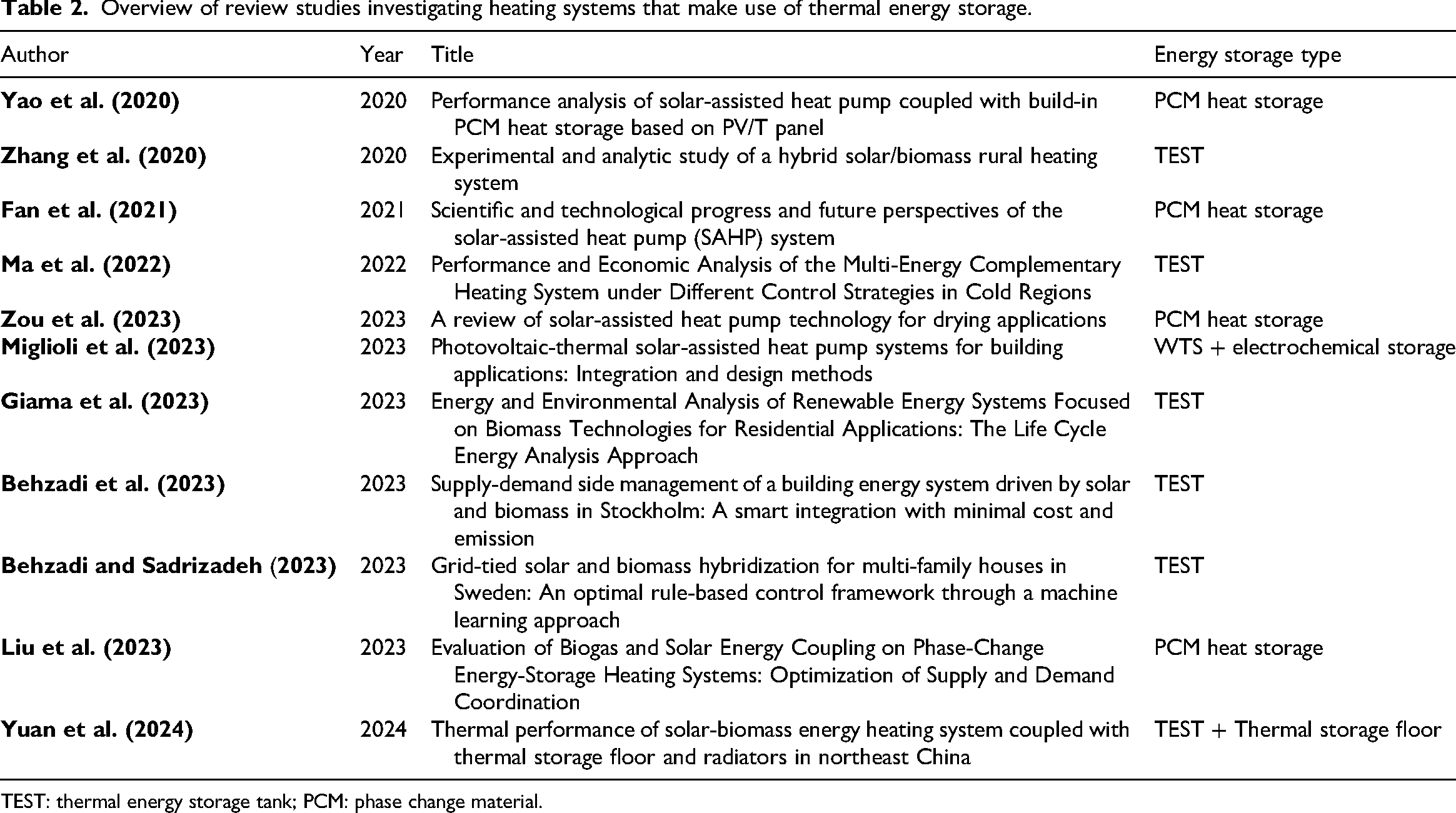
TEST: thermal energy storage tank; PCM: phase change material.
TES integrated with PCM
The importance of efficient PCM energy storage and efficient heat storage heat exchangers in solar-assisted heat pump (SAHP) systems for drying was discussed by Zou et al. (2023). In this study, hydrated salt as phase-change heat storage material is used. It is mentioned that while hydrated salt materials are inexpensive, they are prone to leakage and are often corrosive, necessitating anti-corrosion measures.
While the study by Yao et al. (2020) combined the PCM with building materials to create a built-in PCM heat storage used for underfloor heating. This type of energy storage allows for the storage of excess heat generated by the solar PVT heat pump system and facilitates the release of this stored heat to maintain a stable and continuous residential heating supply, especially during periods of low solar irradiation such as rainy days or winter. This approach aims to provide a more compact and space-saving solution compared to conventional PCM storage tank systems, making it suitable for use in urban areas where land resources are scarce.
Enhancements in PCM performance
The HSEU used in the research by Fan et al. (2021) is a crucial component of the SAHP system as shown in Figure 3. It consists of a dual-chamber design that allows for quick response to the heating demand of buildings. The HSEU enables the efficient storage and exchange of thermal energy, contributing to the enhanced performance of the SAHP system, especially in addressing challenges such as poor energy performance in cold weather and mismatches between heat demand and supply.
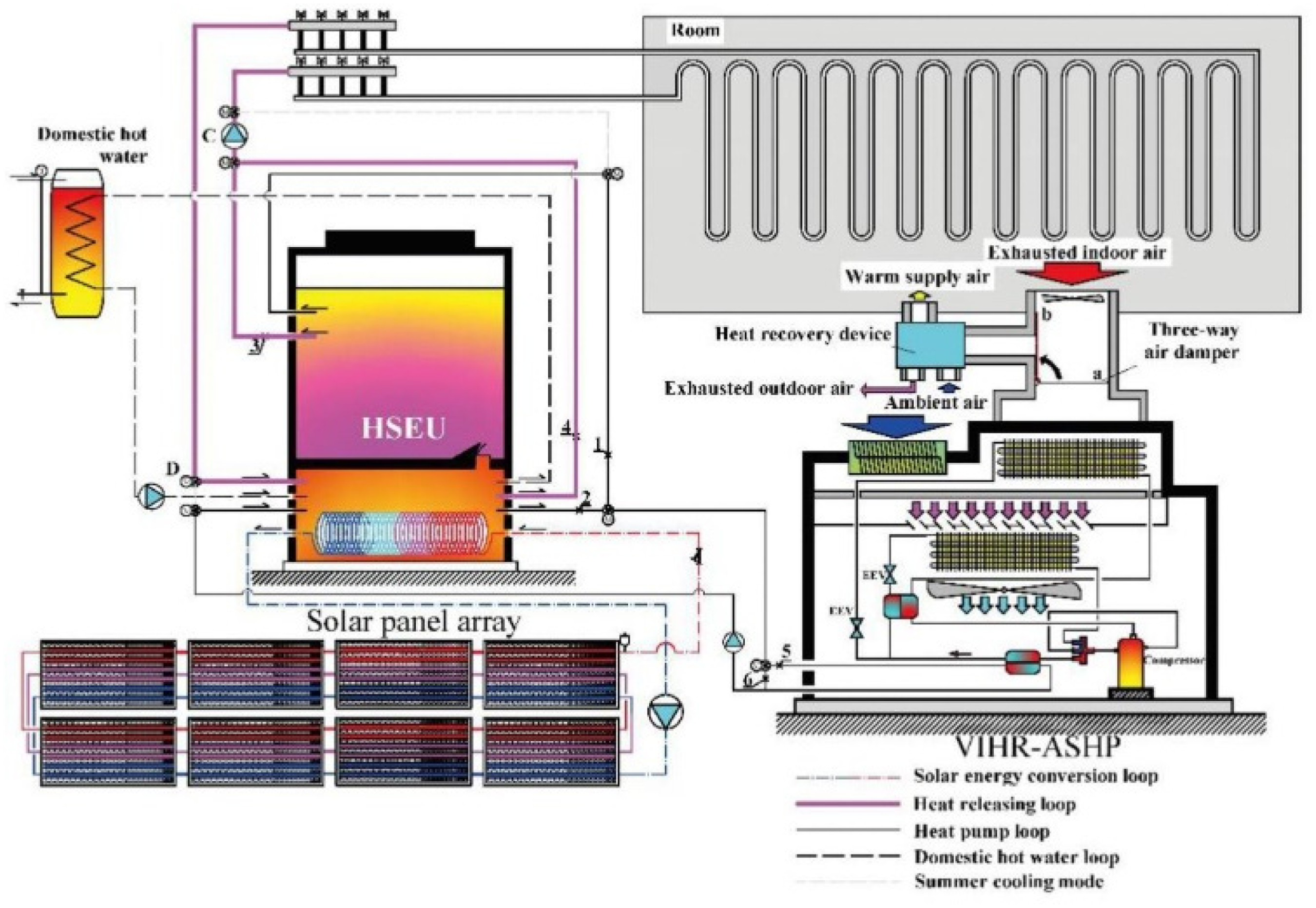
Schematic of the novel solar-assisted heat pump (SAHP) system by Fan et al. (2021) (published under the CC BY license).
Furthermore, the article discusses various approaches to enhance the performance of PCM within the HSEU. These approaches include incorporating metal fins to increase the heat transfer rate of the PCM, developing and implementing better-performing PCMs such as shape-stabilized PCMs with graphite, microencapsulated PCM slurries, and direct contact LHS systems, mixing porous aluminium gradients with the PCM, integrating compressed expanding natural graphite (CENG) with PCM, creating rectangular cavities filled with paraffin, and adding fins into the PCM block. Therefore, among the various PCM approaches discussed, the use of shape-stabilized PCMs with graphite may yield some of the most efficient outputs in terms of heat storage and exchange in the SAHP system.
Additionally, the implementation of porous blocks is noted as a means to increase the heat transfer capacity of the solar collectors due to improved thermal mixing. These details demonstrate the focus on utilizing advanced heat storage and exchange techniques, including the integration of innovative PCMs and optimized heat transfer designs, to ensure efficient and responsive TES in the SAHP system.
Liu et al. (2023) discussed the use of a phase-change energy-storage heating system coupled with biogas and solar energy. It mentions that paraffin is utilized as the PCM in the heat storage tank, and heat transfer is enhanced by heat pipes. Additionally, it states that the phase-change accumulator is sized at 1900 kWh and the energy efficiency of the electric boiler and heat-storage device is stated to be 92% and 90%, respectively. While the paper does not explicitly delve into the drawbacks, it focuses on the economic and energy benefits of the proposed multi-energy complementary system for heating. The heat sources used in the heat storage system are solar energy, biomass energy in the form of biogas, and electric energy as shown in Figure 4. Solar energy is captured by a solar collector, while BBs and an electric boiler are employed to convert biomass energy and electric energy, respectively, into heat energy. These heat sources are utilized to provide thermal energy for heating purposes and to heat the phase-change accumulator.
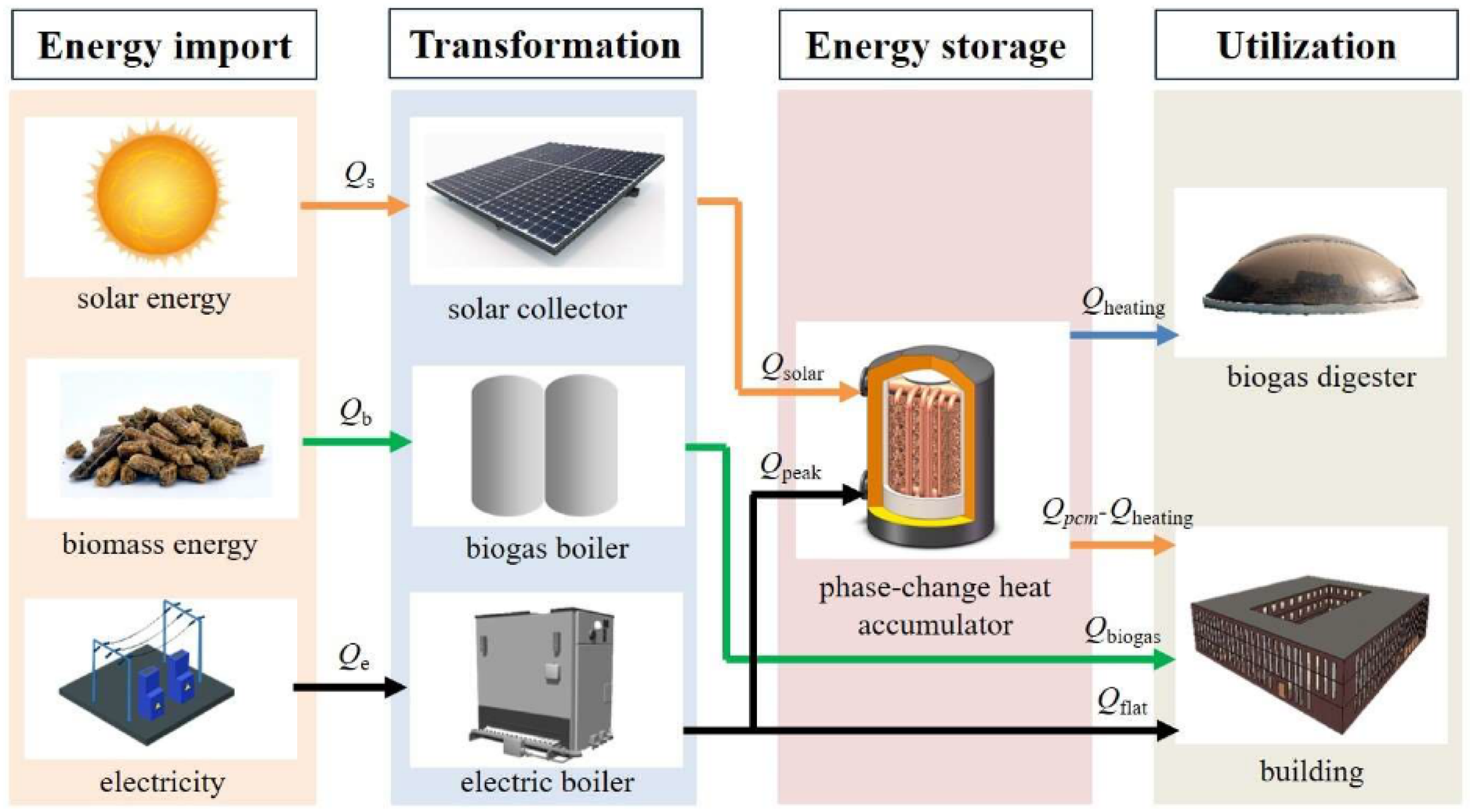
System energy flow diagram used by Liu et al. (2023) (published under the CC BY license).
TES tank (TEST)
Design and Performance of TESTs
The design and performance of TESTs are critical in enhancing the efficiency and reliability of energy systems. Behzadi and Sadrizadeh (2023) proposed that proper design and sizing are essential to achieve a balance between energy efficiency, cost, and environmental sustainability. Their study reveals that increasing tank volume from 10 to 20 m3 improves system efficiency by reducing the surface area-to-volume ratio, thereby minimizing heat losses. However, in contrast to the efficiency gains, this increase also leads to higher total costs, levelized energy expenses, and an elevated emission index, emphasizing the trade-offs involved in tank sizing.
The material and insulation of storage tanks are also critical design elements. Yuan et al. (2024) analysed a thermal storage tank within a solar-biomass energy heating system (SBEHS-TSFR) made from 304 stainless steel, featuring adequate insulation to minimize heat losses. A heat exchanger installed in the tank ensures water quality and supports energy storage. Their energy analysis demonstrated a reasonable absolute error range of 3.5%–10.3% between the input and output energy of the system, highlighting the effectiveness of the tank design.
Stratification within thermal storage tanks has been widely studied for its impact on heat management and performance. Behzadi et al. (2023) examined a stratified TEST by incorporating nodal simulations to forecast temperature variations and optimize charging and discharging cycles. The stratified tank autonomously met heating demands during peak solar energy availability and employed auxiliary heating coils, powered by PV panels or the local grid, during periods of low solar energy input. The study demonstrated that maintaining temperature stratification significantly enhances system reliability and reduces energy losses.
In hybrid energy systems, heat loss mechanisms must be carefully addressed. Zhang et al. (2020) investigated the thermal performance of a storage tank in a hybrid solar/biomass heating system. The study applied conduction, convection, and evaporation theories to calculate heat losses and introduced step-control strategies to balance ambient temperature variations with heat demand. The findings emphasized the significance of advanced control mechanisms for efficient heat supply and storage.
Moreover, Ma et al. (2022) proposed the use of hot water storage tanks (HSTs) in multi-energy heating systems (MECH). These tanks act as both storage and distribution units, working alongside BBs and electric heaters as shown in Figure 5. However, in contrast to short-term storage solutions, these tanks face challenges in maintaining heat retention over extended periods, particularly when energy inputs are minimal, necessitating supplementary heating solutions.
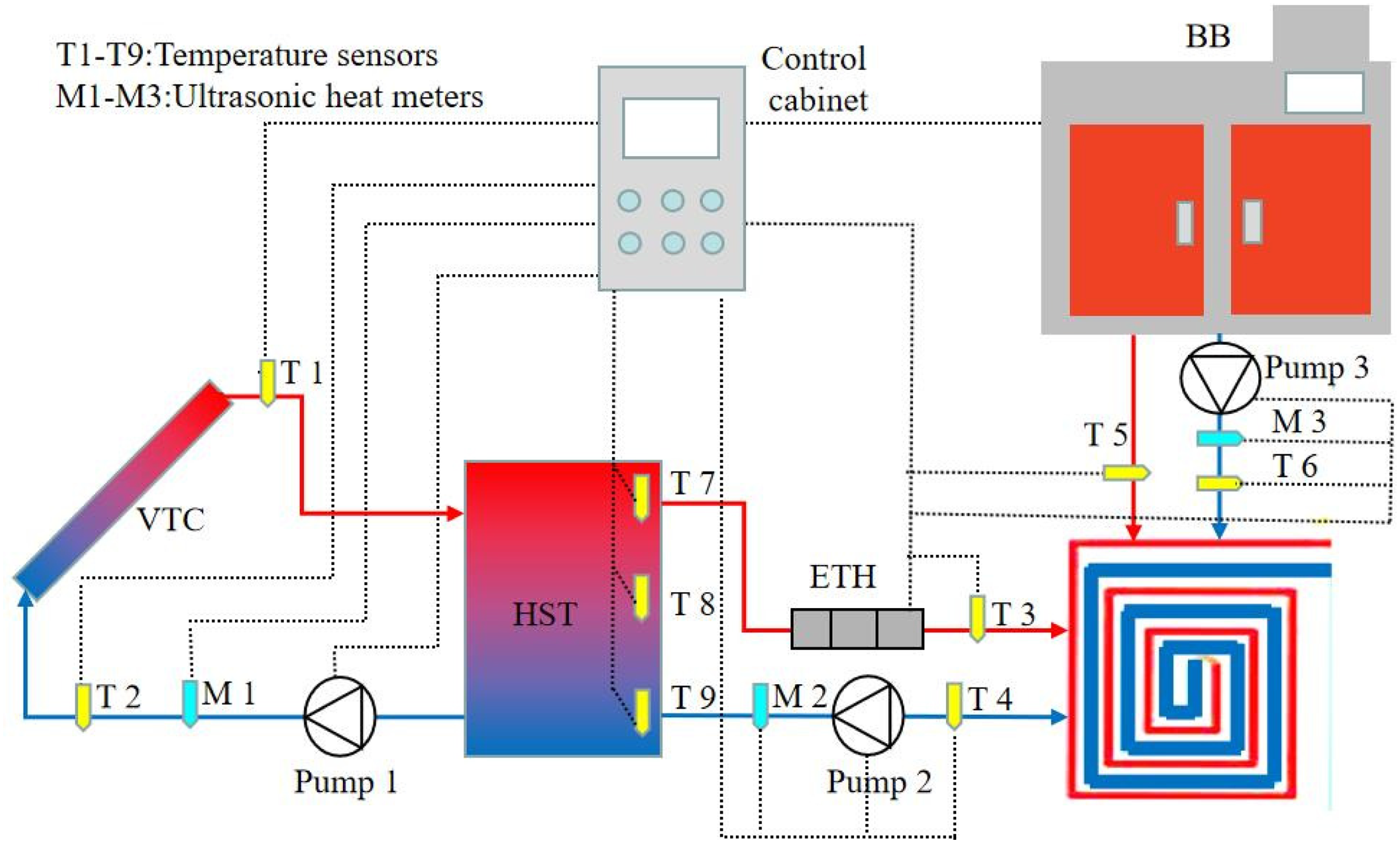
Diagram of MECH system. HST: heat storage tank; VTC: vacuum tube collector; ETH: electric tube heater; BB: biomass boiler; T1–T9: temperature sensors; M1–M3: ultrasonic heat meters (Ma et al., 2022) (published under the CC BY license).
Applications and Environmental Impacts of TESTs
TESTs are integral to the operation of hybrid energy systems, offering diverse applications and notable environmental benefits. Giama et al. (2023) investigated storage tanks in biomass-solar systems and highlighted their capacity to reduce environmental impacts by 43% when appropriately integrated. A 5000-L storage tank, configured with single and double heat exchangers, effectively met heating demands. However, the study identified key challenges in integrating thermal storage with renewable energy systems, particularly in determining the optimal size to maximize efficiency and minimize environmental costs.
Innovative applications of storage tanks in PVT solar-assisted heat pump (PVT-SAHP) systems were analysed by Miglioli et al. (2023). The study emphasized the use of water thermal storage (WTS) units on both the source and user sides of the system to stabilize solar heat supply, increase solar energy self-consumption, and limit the start-stop cycles of heat pumps. Although the study noted the potential of PCMs for enhanced storage performance, it emphasized the need for further research to optimize their use.
The environmental and energy implications of storage tank design are profound. Behzadi and Sadrizadeh (2023) and Giama et al. (2023) highlighted the trade-offs between tank size, efficiency, and environmental impact. While larger tanks enable higher energy storage capacity and efficiency, they also increase investment costs and carbon emissions. Properly designed storage tanks can significantly enhance energy efficiency, minimize operational costs, and reduce greenhouse gas emissions.
Advanced control and energy distribution strategies further demonstrate the potential of storage tanks in hybrid systems. Zhang et al. (2020) explored the use of heat conversion factors and sensors in storage tanks to estimate annual energy performance accurately. Their findings underscore the importance of precise monitoring and control to mitigate heat losses and optimize system performance.
Challenges with TES
One limitation of using PCM is its predisposition to leakage and corrosive nature which affect the long-term performance of such systems (Zou et al., 2023).
Ensuring the stored energy is released efficiently when needed is a significant challenge. Heat losses during storage and transfer can reduce the overall efficiency of the system (Fan et al., 2021; Zhang et al., 2020).
Integrating advanced PCM materials and approaches within the SAHP system can be technically complex and costly and it is considered a challenge that needs to be addressed (Fan et al., 2021).
A need for proper design and sizing of TESTs to achieve high efficiency and reliability while minimizing energy costs and carbon dioxide emissions (Behzadi et al., 2023; Liu et al., 2023).
Smart control and energy management
To achieve high system performance, ideally resulting in a reduction of costs, emittance of greenhouse-gas emissions, and required fuel consumption, the control of the hybrid system plays a crucial role. At the same time, the predicted widespread use of heat pumps will most likely have a negative effect on grid stability because the simultaneous operation of many heat pumps will result in high electrical power demand at the same time. Thus, the integration of smart control systems gained increasing interest over the past years and is establishing itself as best practice. Intelligent controls make it possible to operate heat pumps both more efficiently and in a grid-friendly manner
There are different levels regarding the degree of intelligence of the control, resulting in different degrees of performance improvement and also the complexity of the control implementation and hence the underlying costs. A simple intelligent control could be a learning thermostat that understands and adapts to the user's preferences by applying basic machine learning. A more advanced system could be a weather-responsive system that considers weather forecasts and adjusts the heating requirements accordingly (Drgoňa et al., 2020). A further step would be the detection of building occupations with a medium to high level of intelligence. This is followed by systems that use advanced algorithms to optimize energy usage and operation costs by considering variable energy prices and aiming to shift energy production away from peak usage times, being already a high-level intelligence system (Afram and Janabi-Sharifi, 2014). Another high-level system is the integrated home automation system, which includes the beforehand named concepts but further interacts with other smart home devices and systems and might include basic artificial intelligence (AI) features (Drgoňa et al., 2020). One concept that moves in this area of intelligence is model predictive control (MPC), whereby the exact scope varies, that is, whether several devices are connected to each other or the heating system is considered independently, or whether AI is used or not, for example, (Ala’raj et al., 2022). The most advanced control system would be a fully autonomous system run by an AI that includes predictive maintenance with machine learning and continuous system optimization (Lytras and Chui, 2020).
As mentioned above, MPC is a powerful concept that can encompass a broader range of optimization goals. A comprehensive review of different types of MPC and how to implement such strategies has been done by Drgoňa et al. (2020). In the research on intelligent control for heating systems, MPC has gained great interest in the last decade with an increasing number of studies as shown in Figure 6, displaying data from the Web of Science database. The basic concepts of MPC are explained below, while the reader is referred to the literature for a comprehensive picture (Drgoňa et al., 2020).
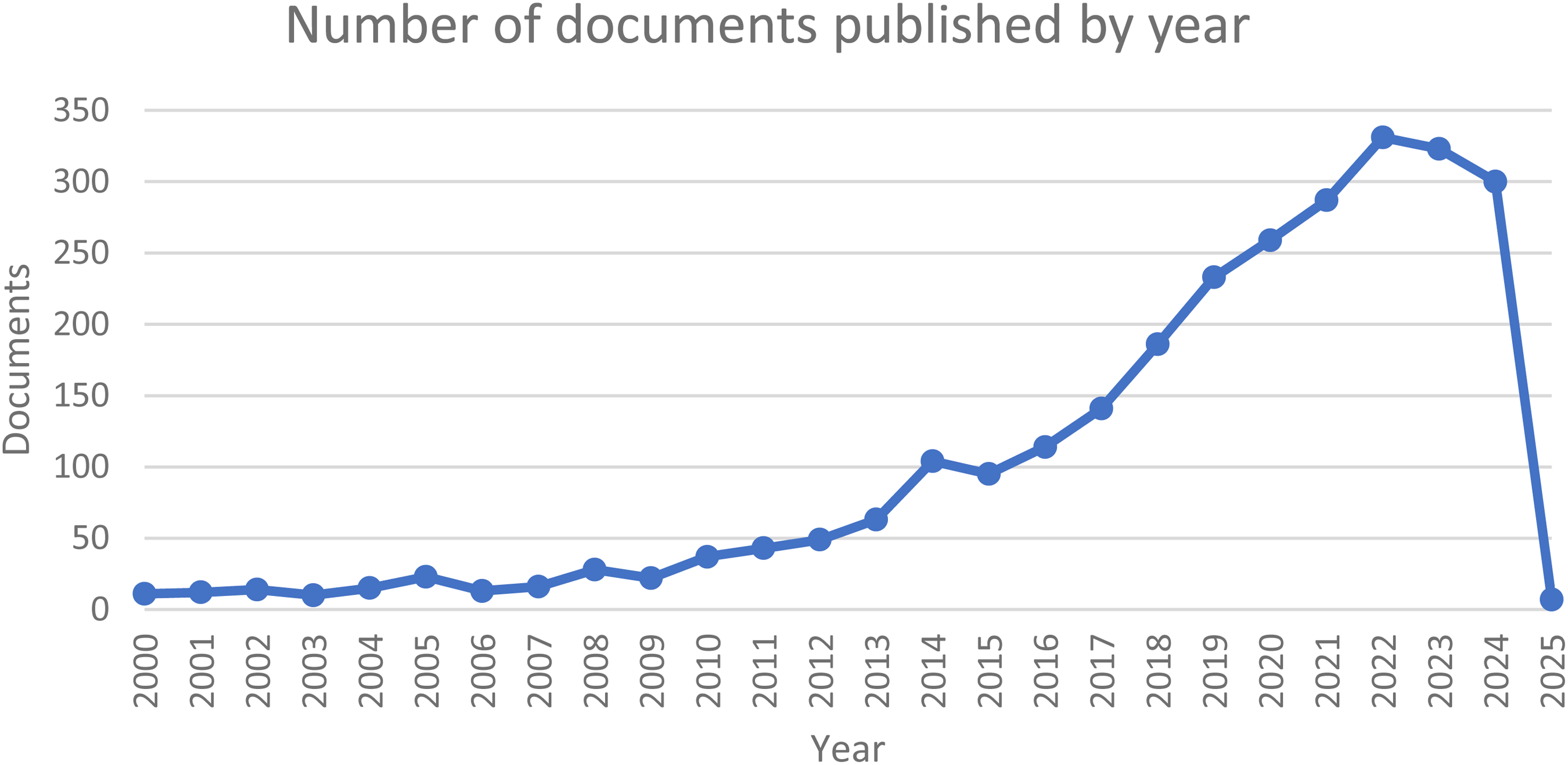
Number of documents published by year with the search criteria ‘TITLE-ABS-KEY (heating AND systems AND model AND predictive AND control) AND PUBYEAR > 2000 AND PUBYEAR < 2025’ at Web of Science.
MPC aims to optimize the current state and overall performance of the system, by recalculating the optimal control inputs for each time step. Together with the current condition measurements and weather forecasts, the mathematical model predicts the future behaviour of the building and adjusts the operation to optimize the performance with respect to the set target. Thereby MPC is able to consider constraints for the state, input, and output, which improves the applicability of the control to real systems (Drgoňa et al., 2020).
Mathematically seen, the MPC aims to solve and minimize a cost function, also known as an objective function. This function is designed to achieve a specific goal, which could be, for example, to actually minimize costs, but also reduce energy usage or maintain a certain comfort level. To achieve this, the following key points are implemented in MPC (Drgoňa et al., 2020):
Objective function: With the objective function, the performance of the control strategy is represented, regarding the set goal. It can also weigh up between different goals and find a balanced solution. This is multi-criteria optimization. System prediction: To predict the system's future behaviour, MPC relies on a system model, incorporating the system dynamics, physical processes, environmental influences, and external disturbances. Further, the current state needs to be measured. Based on the current state, future behaviour is predicted. Optimization: To optimize the system, the best control actions to minimize the cost function are calculated with a solver function. Control application: From the solver function the first timestep is applied to the systems control. Subsequently, the future prediction is updated with the new current state data (feedback loop) and the solver function calculates a new optimization (reiteration). The feedback loop allows real-time adaptation to changes in the system and ensures a higher robustness. Constraints: MPC has the ability to consider different constraints for the inputs, states, and outputs. That way it is ensured, that the control function stays within the physical and operational limits of the system and its components.
A graphical representation of the above-described MPC for a standard closed-loop system is shown in Figure 7 and a mathematical formulation based on a practical case study can be found further along in equation (1).
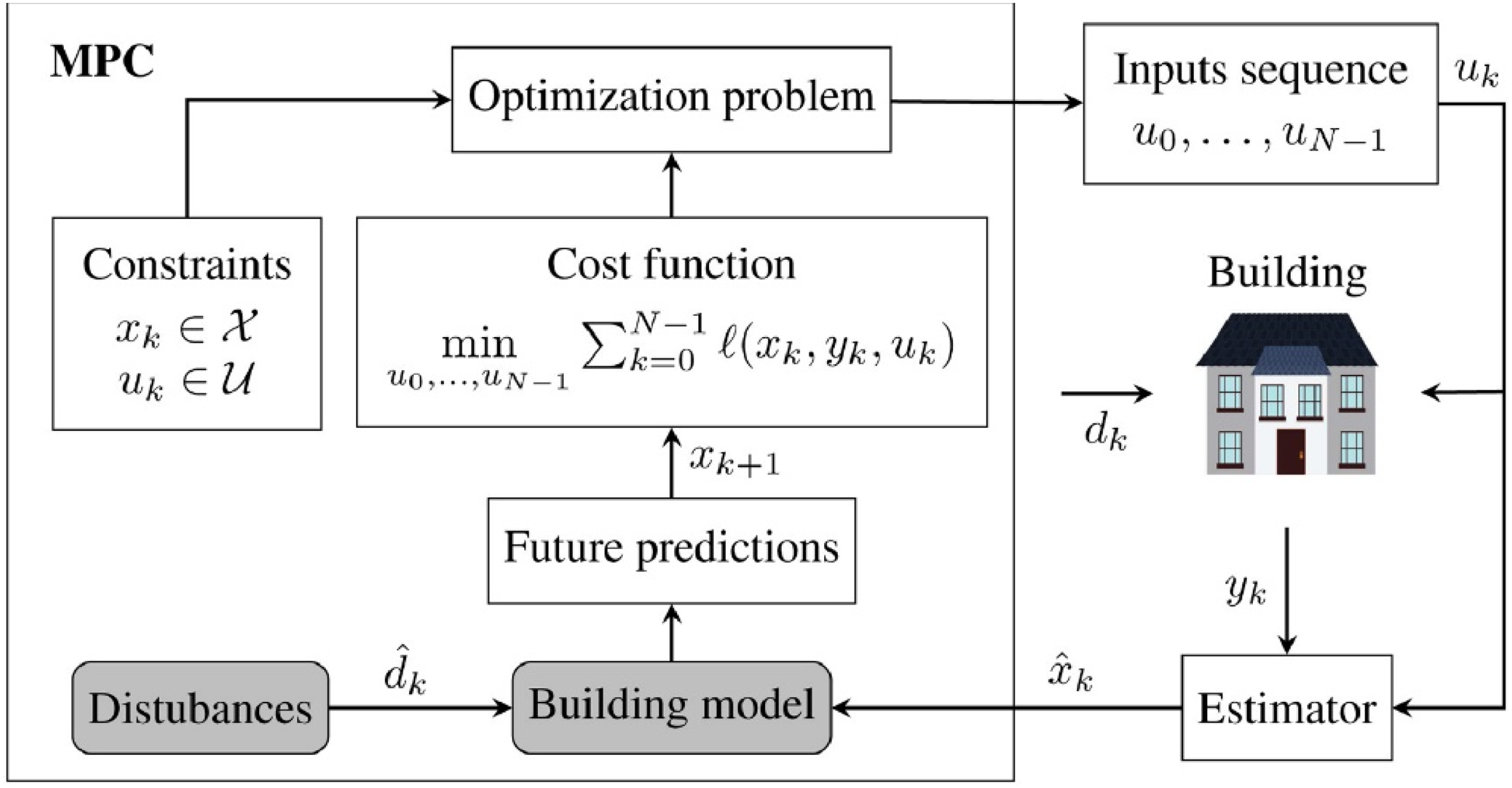
A graphical representation of model predictive control (MPC) for a standard closed-loop system (Drgoňa et al., 2020) (published under the CC BY license).
The concrete implementation of MPC for a specific system offers a great variety of different approaches and concepts for each of the MPC components. This makes it difficult to name universally valid solutions and to compare the results from different studies. A general approach for the implementation of MPC in buildings is shown in Figure 8. A further challenge is the limited application of MPC in field tests with the majority of studies using simulations for their research. If field tests are performed, the control is generally limited to one configuration of MPC without the comparison of different algorithms. Further, the evaluation periods are often limited to short periods, lacking an evaluation of long-term performance over the span of a whole heating cycle or year. Lastly, the main focus of the assessments is often on topics like energy consumption or costs, while other aspects closer connected to MPC like computation time, robustness to changing conditions, or implementation effort are neglected. A general and broad assessment framework would therefore be desirable. Further obstacles regarding the practical implementation of MPC are not standardized communications protocols, lack of standardized interfaces within building automation systems (BASs), and closed commercial BAS software solutions instead of open source applications (Drgoňa et al., 2020).
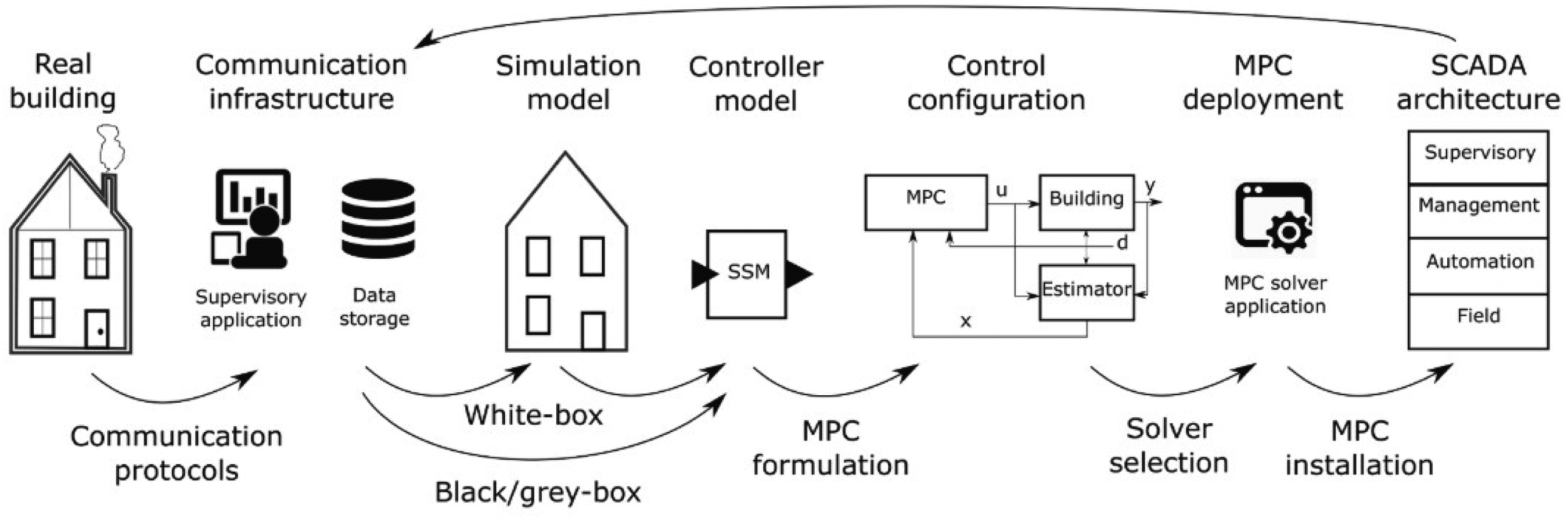
A general approach for the implementation of model predictive control (MPC) in buildings (Drgoňa et al., 2020) (published under the CC BY license).
One important aspect that needs to be considered when implementing MPC is the required computational power which can be significantly high, depending on the specific type of MPC. A linear MPC requires less computational power than a nonlinear but comes with a lower flexibility and possibly a lower performance. Therefore, the linear MPC is often used in building applications. It is also possible to use hybrid MPC, which is e.g., needed to display different heat pump modes. MPC can further be differentiated into implicit, explicit, and approximate MPC. The implicit MPC performs the optimization online, generally achieving the best results, while also requiring the highest computational power. This method is best applied in large buildings with complex HVAC systems or where the needed computing performance requirements are secondary. For smaller buildings and single-zone control problems that require a fast response do not have complex systems, however, an explicit MPC is usually the best choice. Thereby the MPC works offline and uses pre-computed controls but usually has limited memory. If memory is available but the computational resources are limited, an approximate explicit MPC is a possible choice. This includes machine learning to approximate the explicit MPC law. However, to achieve good performance, qualitative training data is needed (Drgoňa et al., 2020).
Within MPC, a wide variety of sub-control schemes exists. A more detailed explanation would exceed the scope of this review and the reader is referred to the existing literature reviews on MPC. Further, there are other smart control solutions like fuzzy logic control or the use of artificial neural networks (ANNs). The following Table 3 contains an overview of the literature on the subject that resulted from the literature research and has helped the authors to comprehend MPC but should be seen without claiming to be complete.
Overview of reviews targeting smart control systems for HVAC systems.
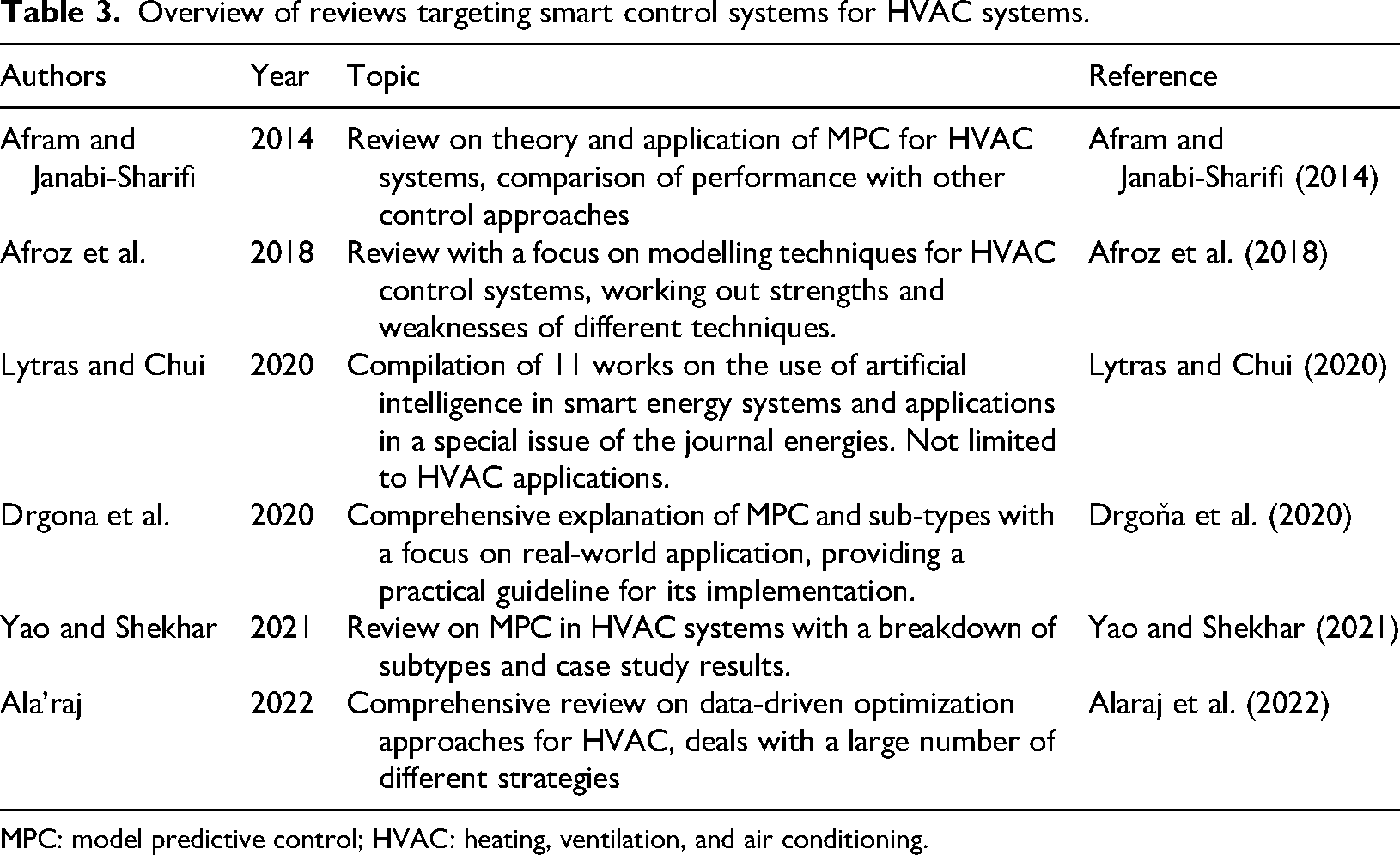
MPC: model predictive control; HVAC: heating, ventilation, and air conditioning.
In the following, the results of several studies investigating the implementation of MPC or other types of smart control into HVAC systems are discussed. As there is a lack of recent studies targeting the smart control of hybrid heating systems, most of the references deal with monovalent systems.
Hedegaard et al. (2017) analysed a price-responsive control strategy for residential buildings using electrical baseboard heaters, by implementing an economic-MPC (e-MPC). The control is able to decide based on the day-ahead and/or intraday market price if electricity is used to generate heat or not while having to stay within a given range. Three different control strategies and three different levels of building insulation are analysed. The control strategy can either act based on the day ahead market prices, a 1-h intraday timeframe, or a 3-h intraday timeframe. Thereby the intraday strategies also include the day ahead control. The insulation is varied from 60 to 28 kWh/m2 and 18.5 kWh/m2. The aim of these control strategies is to show that, on the one hand, cost-saving is possible for the user and system-supporting operation on the other. For that, the building's thermal mass is used as a form of energy storage, enabling a (limited) time shift of energy distribution. Regarding cost savings, an improvement was achieved with all strategies and for all insulation levels compared to the reference based on a simple PI (proportional and integral) control. The results are the best for the 3-h intraday timeframe with ∼19% for the best insulation case. At the same time, the additional energy consumption was the highest. This emphasizes, that the shift away from peak demand times (where price is high) reduces the overall costs, even though more energy is needed in order to stay within the comfort range. The improvement from the 1-h to the 3-h intraday timeframe is marginal so the benefit is limited due to the higher computational and planning effort. The increased energy consumption as a result of the e-MPC also supports the result regarding the grid-supporting operation, where the authors found, that a downward regulation (increasing consumption) worked better than an upward regulation (reducing consumption). For the downward regulation, the system made far more often the correct decision, meaning actual grid support was achieved. For the upward regulation, the decision was more often incorrect than correct. Overall the authors draw a positive conclusion and see good potential for a broader application of e-MPC in both older, less well-insulated, and new or retrofitted buildings. For future works, they see the need to develop control strategies that allow temporary comfort violations to enhance the system's scope for action and increase the building's potential to support the grid with upward regulation.
Thorsteinsson et al. (2023) conducted a four-month experimental study to analyse the use of a hierarchical MPC approach, based on the electricity price, for demand-side management. The investigated system consists of an air-to-water HP, a PV system, and floor heating in a near-zero emission residential building in Denmark.
This article presents a mathematical model aimed at optimizing demand-side management for a single-family house using a mixed-integer MPC (MIMPC) approach. At the core of this model, as shown in equation (1), is an optimization framework designed to enhance energy efficiency and reduce costs. The control algorithm integrates multiple inputs, including electricity price signals, weather forecasts, a building thermal model, and a heat pump efficiency model, to generate a space-heating schedule that facilitates load shifting. By dynamically adjusting heating patterns based on external factors, the system aims to optimize energy consumption while maintaining thermal comfort.
The overall cost function consists of three components. The first component is a linear function,
For the experiment, four different comfort levels are defined and it is evaluated, if the thermal comfort can be upheld and a cost saving can be achieved. For the lowest comfort level (1), the room temperature was too low and the results were not further considered. For comfort level (2), the room temperature was described as comfortable by the residents while a cost saving was achieved (see Figure 9). However, it is not clear, whether those savings can be accounted to the MPC or are the result of a lower room temperature compared to the reference. During the period where comfort level (3) was tested, a cost saving of 2.3% was achieved, likely being a consequence of the MPC. At the same time, electricity consumption as well as the provided heat rose, which is an effect that is also described in other literature, according to the authors. Comfort level (4) achieved the most constant room temperature, and a cost reduction of 17% was achieved during the testing period. However, this can be a consequence of a series of sunny days, resulting in a higher PV share and more efficient control by the MPC. Overall, there was a significant change in the daily heating patterns conducted by the MPC due to the varying price signals. That and the results stated above show, that there is a considerable potential for the MPC to adjust the heating patterns and improve performance.
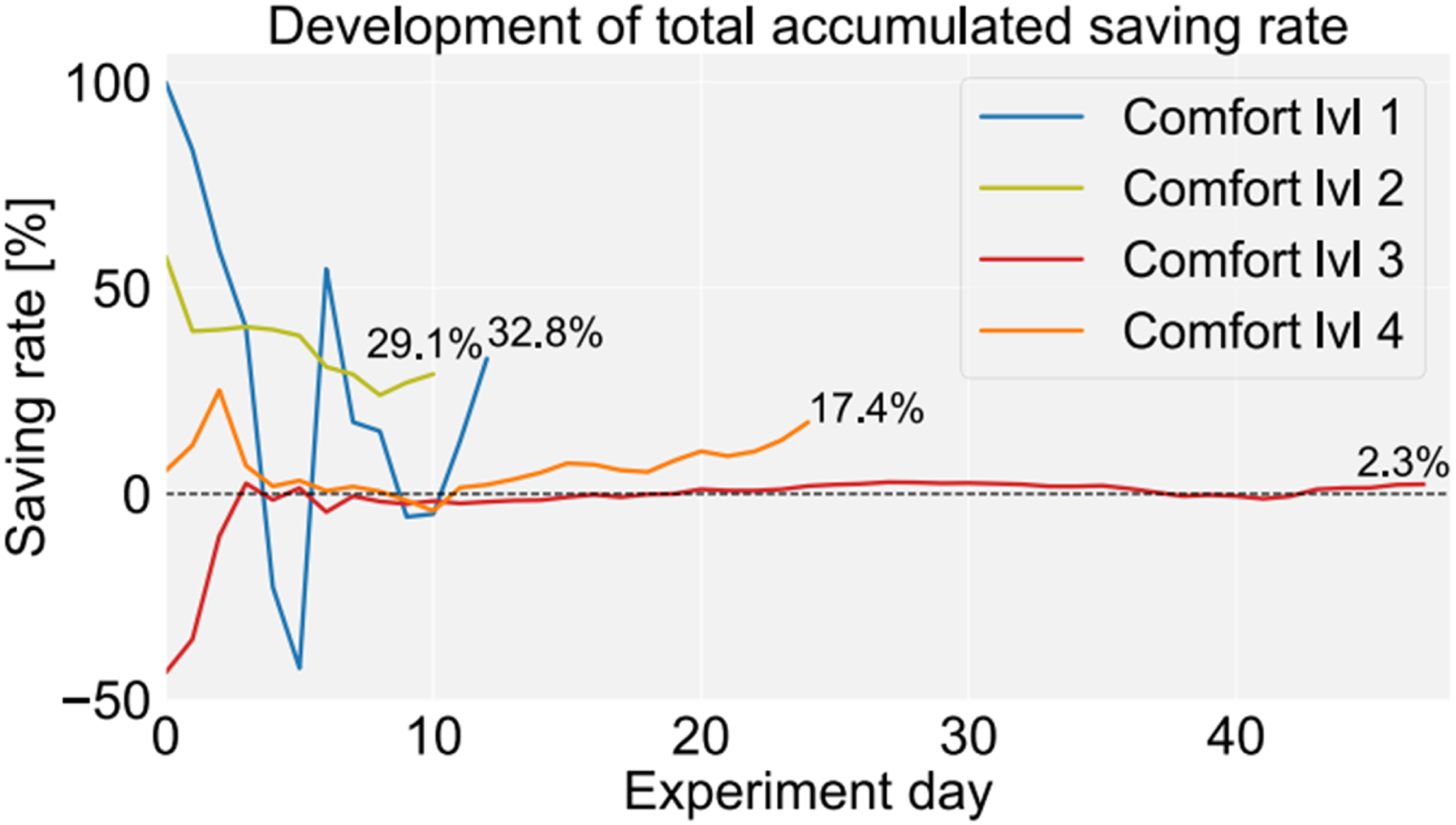
Development of total accumulated saving rate (Thorsteinsson et al., 2023) (published under the CC BY license).
However, the authors state, that, for example, the heat pump efficiency decreased, as the states the HP was operated in by the MPC diverted from the manufactures’ optimal operation schemes. This was partly due to the fact that the compressor speed had to be controlled by manipulating the ambient temperature, as it could not be controlled otherwise. This is probably a high limiting factor in higher cost savings. In addition, model and forecast errors, as well as a lack of controller robustness are further limitations. Problems occurred especially with the forecast of sunny days. With regard to the cost saving, the rate did not converge for three of the four comfort levels over their test period (see Figure 10). That shows that long-term experiments are needed to truly evaluate the cost savings, as the results from few-day experiments risk to overestimate cost savings. The highest cost-saving potential occurred by load shifting away from the evening peak and an increased consumption at night.
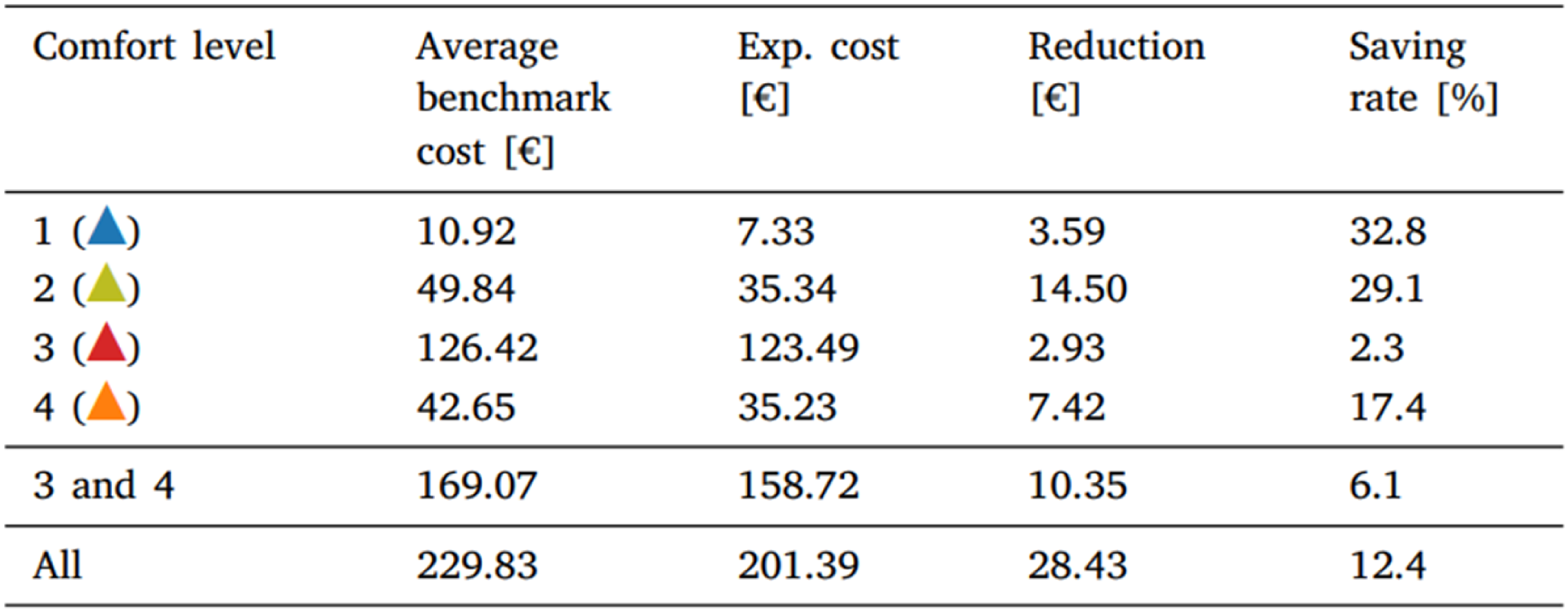
Accumulated economical savings estimate for space heating over the test periods (Thorsteinsson et al., 2023) (published under the CC BY license).
Overall, the authors see good potential for the application of MPC. Meanwhile, they see a need for a more comprehensive cost analysis that also determines how high the additional costs for MPC could be for it to be economically viable. Further, the HP operation based on the ambient temperature showed inefficiencies, and a reference-based operation is proposed, with an appeal to manufacturers for adaptations of their controls. Lastly, there is a need for improved data collection (e.g. longer periods for the reference data), updated, improved models, and more accurate weather forecasting.
Alimohammadisagvand et al. (2018) compared four different rule-based demand response control strategies in a Finnish residential home. The building is either heated with a GSHP or an electric heater, complemented by two storage tanks for separate provision of space heating and DHW. The authors analyse the effect of the control strategies on the energy consumption and the operating costs, while the limits for thermal comfort must not be violated. The four control algorithms are described as follows:
Momentary control algorithm (MCA): The heating system is turned on or off based on the current minimum indoor temperature, the maximum temperatures in the storage tanks, and the hourly electricity price. Blocking control algorithm (BCA): Identifies periods with high electricity prices by monitoring current and future hourly electricity prices and blocks the operation in those periods and adjusts the heating accordingly, so that thermal comfort limits are not violated. Sliding control algorithm (SCA): Works similar to the above, but the control signal is continuously updated, whereas it is calculated only at the beginning of a defined period for the blocking control algorithm. Moving average control algorithm (MACA): The decision whether heating is turned on or off is based on a moving average of the future hourly electricity prices.
The results, expressed as a change compared to the reference system are presented in Table 4. The reference system is the building with the stated heating systems but without the use of any demand control algorithm.
Energy and cost savings resulting from the use of different control algorithms (Alimohammadisagvand et al., 2018).
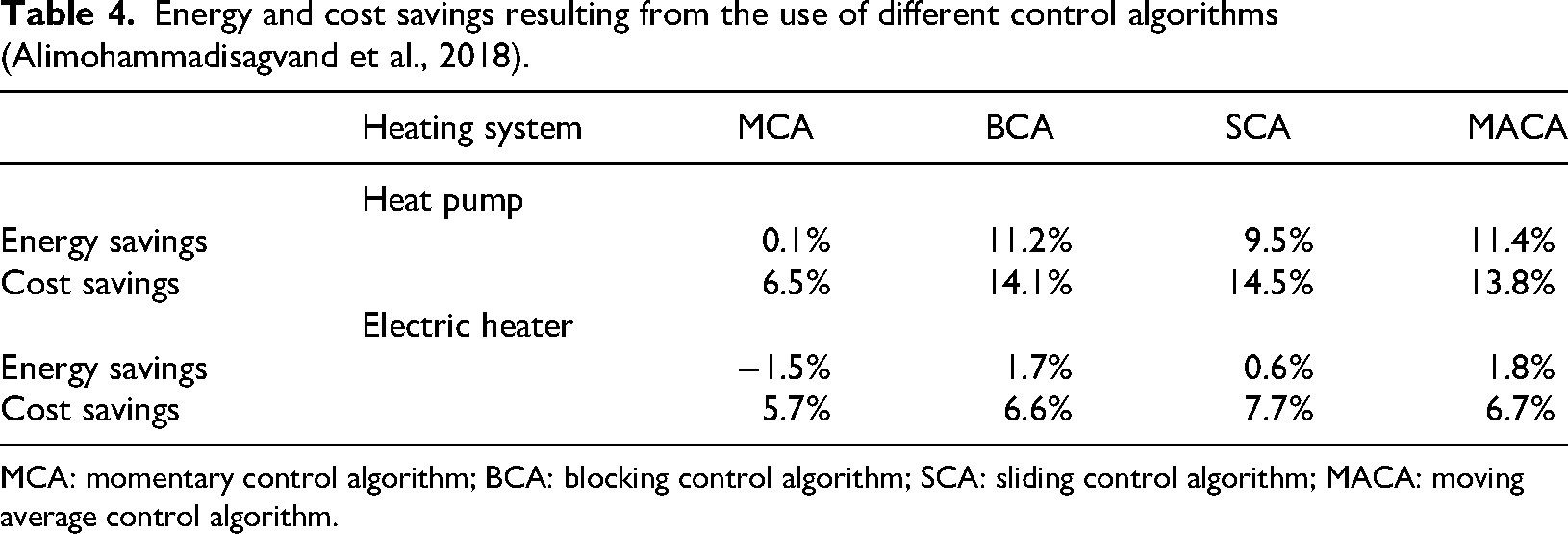
MCA: momentary control algorithm; BCA: blocking control algorithm; SCA: sliding control algorithm; MACA: moving average control algorithm.
Further, the electricity consumption for space heating and DHW supply is four times as high as the electric heating compared to the GSHP. The authors draw the conclusion, that the use of demand control algorithms is a promising solution to reduce electricity consumption and costs, whereby the GSHP is the option with the higher savings potential and overall electricity consumption. To draw a more complete picture, a more comprehensive cost analysis would have been desirable.
A more general study, not focused on the use of MPC but smart home technology (SHT) in general, has been performed by Larsen et al. (2023). The authors investigate the application of SHT in households connected to district heating networks in Denmark, aiming to understand how residents make use of SHT and how it affects their behaviour and comfort level. As a result, there are four main topics addressed by the authors. First, the user's knowledge about how the system works plays a crucial role in its effectiveness. Thereby the practical knowledge with regard to technical experience is of great importance, as users with greater experience find it easier to adapt to the new type of control. Secondly, the implementation of SHP led to the feeling of loss of control, when the operation took place without the user's input. In consequence, this led to discomfort and distrust, though the thermal conditions stayed the same. The third finding emphasizes, that SHT needs to be designed in a manner that allows flexibility, as the users often adapt the control to certain needs instead of having the same daily routines. Many users set up a schedule in the beginning but soon adapted it and some found themselves performing frequent ad hoc adjustments. The ability to perform these adjustments was greatly valued by the users. The last point states, that the users developed strategies to stay in control when they had the feeling of not being in control and the system not meeting their needs or preferences. The users came up with both technical adjustments and changes in their interaction with the SHT. For example, one user had the preference to open the door to air out a room for a long time, though not advised by the manufacturer. To stop the system from adjusting the heating due to temperature changes measured by the sensors, she removed those from the room or manually turned down the heating devices. Another user hid the control interface in a cupboard as he disliked its design and found it disruptive. This emphasizes the need to design SHT in a way that allows users the adjust to their specific needs and preferences.
The results of this study need to be seen with a limited significance, as the sample size of 16 households is small. Nonetheless, it shows the importance of user acceptance and their ability to have control. To achieve a broad application of SHT, the authors believe that a flexible design of control strategies, increased familiarity with the technology, including the ability to learn how the system works while using it, and clarification of policymakers what the user's role within SHT will be are decisive factors.
Esrafilian-Najafabadi and Haghighat (2021) took a look at an occupancy-based HVAC control system and carried out a literature review. The authors distinguished three types of how the system was controlled and the occupancy monitored: with a user-defined schedule, a reactive control, and a predictive control. As the name says, the user-defined schedule is based on the occupants’ actions, like manually turning off radiators when they leave the buildings. But this also includes programmable thermostats, where the user inputs his schedule. The main disadvantages of this strategy are the need for manual intervention from the user and the frequent deviation of actual behaviour from the specified routines. Studies show, that the users’ interference can even result in worse energy efficiency compared to an always-on control. For reactive control, building occupancy is automatically detected by using instruments like passive infrared sensors, cameras, or monitoring Wi-Fi connections. The HVAC control then adjusts its operation accordingly in a reactive manner. While the reactive control overcomes the drawbacks of the user-defined control, this strategy can cause thermal discomfort as the HVAC might act too slowly, which is due to the system's lag time. The predictive control is based on models, often integrated with learning abilities, that predict a building occupancy and perform proactive control instead of reacting to a change in occupancy. The main drawbacks of this type of control are the need for accurate prediction models and qualitative data to achieve good performance, as well as the increased complexity and cost. Further concerns are often made regarding data privacy and possible security threats. On the basis of the literature examined, the authors state that applying predictive control resulted in higher energy consumption than with reactive control, due to a preconditioning of buildings before they were occupied. On the other hand, as stated before, the reactive control was not always able to meet the thermal comfort requirements. In general, the main interest of studies is on energy efficiency and thermal comfort, with a lack of studies targeting economics, greenhouse gas emissions, and peak shifting. Further topics for future work are deep learning, enabling to understanding of more hidden occupant patterns, identifying what parameters have the highest influence on performance, and testing out control strategies in field studies.
Crawley et al. (2023) analysed the real-life application of three different demand-side control strategies in three different UK households using different types of heat pumps. The aim of side demand control is a grid-supporting operation, with the ability to control the heat pumps during high demand periods. The first control strategy had the ability to reduce the air temperature setpoint (to 15 °C), the second was able to block the compressor and the third reduced the temperature setpoint of the space heating flow. The compressor blocking achieved the highest reduction in electrical power consumption (90%), followed by the reduction of the air temperature setpoint (87%) and the flow temperature setpoint reduction (56%). Thereby the temperature drop was the highest for the first strategy (–1.07 °C) and the lowest for the third (–0.34 °C), while the second had a drop of (–0.62 °C). The authors draw the conclusion, that the reduction of the air temperature setpoint is not a suitable option. The blocking of the compressor is an effective solution if total load shedding is needed, though it can negatively influence the compressor's service life. The heat pump best runs constantly and therefore shut offs should be reduced to a minimum. There might further be a negative effect on the grid when multiple heat pumps restart after the load shedding. Consequently, if partial load shedding is a viable option to support the grid, the third strategy with a reduction of the fluid flow temperature setpoint is preferable. This slows down the temperature drop, while also reducing the compensation need of the heat pumps following the high peak period. Overall the authors successfully demonstrate how a support of the electrical grid can be achieved by adjusting the heat pump operation strategy.
Another experimental study has been performed by Baumann et al. (2023), who investigate the use of MPC for the control of a hot water heat pump (HWHP), solely supplying DHW. They analyse two different scenarios, one called perfect prediction (PP), where the future demand for DHW is perfectly known, and the second called data-driven probabilistic (DDP), where historic data and probabilistic models are used to predict future demand. Both scenarios are compared to a conventional control strategy, where a hysteresis is used to control the switching on and off of the heat pump (HYS). The application of MPC has produced good results, with considerable cost and energy use reductions, while thermal comfort was always guaranteed. The electrical energy consumption was reduced by 20% with the PP control and a COP increase of 24% was achieved, compared to the HYS control. With the DDP control, the results were 11%, respectively, 13%. Those improvements resulted in heating unit cost reductions of 33%, respectively, 24%. While the total operation time was significantly reduced by up to 33% for the PP control, the number of start-ups doubled from 15 to 30 over the course of the investigated week in winter. If this has an effect on the longevity of the HP could be investigated in further research. Other issues raised by the authors were especially problems with the interaction with the heat pump controller as there were fixed settings by the manufacturer. For future research, the authors suggest improving the accuracy of demand predictions, as these directly influence the effectiveness of the MPC. In addition, the integration of real-time data is interesting.
AI-enhanced MPC
With regard to the use of AI in MPC for heating systems, the use of ANNs has been the subject of numerous research studies, often showing great potential for improving the energy efficiency of systems compared to conventional controls such as PI controls, but not always being the most powerful type of MPC. A neural network is a mathematical model based on the structure and function of the human brain. It consists of interconnected nodes, or ‘neurons’, organized in layers. These nodes process and transmit data through weighted connections, allowing the network to learn patterns and make predictions based on input data.
In a study by Zheng et al. (2024), the authors compare a reduced-order resistance-capacitance MPC (RC-MPC), modelled as a physical grey-box model, and an ANN-MPC, a data-driven black-box model trained with a neural network. Both are also compared with conventional PI control. The RC-MPC is based on differential equations to describe the building physics and is optimized with a linear model. The ANN-MPC is trained with historical building energy data and learns the building physics using a neural network with two hidden layers. Optimization is performed with a projected stochastic gradient descent. The analysis is then performed for two different scenarios, a winter peak period and a typical spring heating period. The results show that both MPC approaches achieve high accuracy, with the ANN-MPC performing slightly better. Both controllers achieve comparable performance in terms of energy savings and thermal comfort. The RC-MPC achieves energy savings of 18%–30% (peak vs. typical heating period) while reducing the overall thermal discomfort by 95% and 30%, respectively, compared to the PI controller. The ANN-MPC achieved energy savings of 17% and 34%, respectively, while reducing thermal discomfort by 88% and 45%, again compared to the PI controller. Overall, the ANN-MPC was able to maintain a higher indoor temperature compared to the RC-MPC while achieving lower operating costs in spring and similar costs during peak loads, indicating that the ANN-MPC was able to make better use of dynamic electricity prices. However, the ANN-MPC requires the most computation and takes the longest to solve the optimization. In addition, the ANN-MPC proved to be sensitive to the objective weights, making it more important to fine-tune it to meet the requirements. In addition, the performance of the ANN-MPC is highly dependent on the training data used. The RC-MPC, on the other hand, requires careful implementation of the correct physical connections. Overall, both economic MPC strategies perform significantly better than the PI controller, although it is important to consider the increased effort required to implement the MPC strategies correctly and the need for high-performance hardware to perform the optimizations.
Two other studies investigating the use of neural networks are conducted by Rani et al. (2024) and Batra et al. (2024). Although only Batra et al. (2024) declare the origin of the dataset used for training, a dataset of 768 buildings from the UCI machine learning repository, both studies seem to use the same dataset as both show a graph of the same heat map of the building features, such as wall or roof area, where the heat map shows the features that have the strongest correlations with heating and cooling loads, helping to understand which factors most influence energy demand. Both studies also use almost the same graphs to show the distribution of the different features. In terms of analysis, Rani et al. (2024) developed a deep neural network (DNN) in order to predict building energy demand and optimize energy efficiency. Batra et al. (2024) developed a hybrid model that combines long short-term memory (LSTM) networks with gradient-boosting machines (GBMs). A DNN is a type of neural network with multiple hidden layers, which increases its complexity and computational cost. An LSTM network is a specialized type of recurrent neural network (RNN) designed to mitigate the vanishing gradient problem that occurs in standard RNNs. This makes LSTM networks particularly effective at processing time-dependent data, and they are used to predict weather forecasts and occupancy patterns. The GBM is an algorithm that trains multiple decision trees and corrects errors of previous trees in an iterative process. It is used to detect non-linear relationships between building parameters and energy demand. This study also incorporates dynamic features generated by the LSTM network into its optimization. Two common measures to evaluate the performance of neural networks are the root mean squared error (RMSE) and the mean absolute error (MAE). The RMSE is sensitive to large errors, with a lower value indicating higher accuracy. The MAE calculates the average error between the predicted and the real value while weighing all errors equally. Within both studies, the proposed control models perform best compared to conventional controllers and other AI-based approaches like decision trees and random forests (Batra et al., 2024) or stochastic gradient descent and AdaGrad (Rani et al., 2024). Comparing the two proposed models of the studies, the DNN achieves significantly lower RMSE and MAE values, indicating its better performance. However, it should be noted that the results come from two different studies and it is not possible to say with certainty how far the underlying data can be compared.
The authors of both studies also note the need for powerful hardware. Rani et al. (2024) further note that deep learning algorithms sometimes tend to store data rather than learn the underlying pattern, which can lead to poor performance when used with unknown data and can be problematic when using the same model for regions with different climate, energy infrastructure or building typologies. Batra et al. (2024) see the advantage of their approach in exploiting the synergy between the two types of AI but note that using two advanced models also results in a greater need for data processing and fine-tuning, which is often more time-consuming. One suggestion to further improve performance is to use real-time IoT sensors, which provide more data, and to develop frameworks that efficiently integrate and manage real-time data.
To conclude this section, it can be stated that smart control systems have gained great interest over the past decades. As shown above, various different approaches have been investigated and there are multiple good options for application. However, the majority of studies to date have been simulation-based and though some experimental studies have proven practical suitability, there is still a lack of such studies. Furthermore, a variety of challenges remain and the reviewed literature shows several methodological weaknesses and inconsistencies in smart control and energy management, particularly in terms of modelling accuracy, treatment of uncertainties, and practical implementation. These methodological shortcomings undermine the effectiveness and comparability of different smart control strategies.
A major point of contention and weakness remains with modelling techniques. Afroz et al. (2018) highlighted that most models suffer from inaccuracies due to assumptions, unmeasured disturbances, or uncertainties in system characteristics, making the development of a truly accurate and effective HVAC system model very challenging. The choice of modelling approach – whether physics-based, data-driven, or grey-box – introduces unique limitations.
Physics-based models are based on fundamental principles but often require simplifying assumptions that may not reflect real-world conditions. Data-driven models use historical data but may miss crucial physical relationships, limiting their generalizability. Grey-box models attempt to balance the two but can be complex and computationally demanding.
Yao and Shekhar (2021) further highlighted the increasing use of black-box models, despite the advantages of hybrid and physics-based models that require less expertise and data. In addition to these modelling issues, the lack of studies focusing on model validation and error analysis exacerbates these challenges.
Uncertainties in ambient temperature, solar radiation, and internal heat gains significantly impact the performance of predictive controllers. Drgoňa et al. (2020) emphasized that the lack of systematic methodologies for identifying dominant disturbances across different building types, climate zones, and occupancy patterns complicates performance evaluations. While robust MPC (RMPC) and stochastic MPC (SMPC) can help deal with uncertainties, this often comes at the cost of reduced energy savings.
Moreover, the use of MPC does not always guarantee better performance than conventional control strategies. As stated by Taheri et al. (2022), energy consumption may actually increase when using MPC compared to a reactive control strategy. This comes as a consequence of the preconditioning of room temperatures to achieve thermal comfort, referred to in this study as overall comfort time, which was aimed to be maximized. The authors go on to state that the effectiveness of MPC is highly dependent on the accuracy of the underlying prediction model. Inaccuracies between the predicted and the actual load can therefore lead to reduced performance compared to reactive control strategies.
Afram and Janabi-Sharifi (2014) identified the following as the main limitations of different control strategies:
Classical controllers require manual tuning and perform poorly outside their preset parameters. Hard controllers rely on mathematical analysis and stable equilibrium points, which limits their adaptability. Soft controllers require large data sets and can be computationally intensive, limiting real-world applications.
Adding to that, Lytras and Chui (2020) noted that many studies suffer from limited data granularity and a narrow scope in terms of the number of devices considered. As a result, this limited focus reduces the generalizability of the findings and hinders their applicability to real-world scenarios.
Drgoňa et al. (2020) proposed several methods to address these weaknesses:
Adaptive and learning-based MPC can improve performance by dynamically adjusting control strategies. Oscillations due to unbalanced weighting terms can be mitigated by fine-tuning control constraints. Weather forecasts can be integrated into prediction models using data-driven linear dynamics. Distributed MPC can reduce computational and communication requirements compared to centralized MPC. The choice of modelling approach should balance accuracy, smoothness, reliability, and computational efficiency.
Going forward, in order to overcome these challenges, methodological weaknesses need to be addressed in a more systematic approach to model validation, uncertainty management, and data granularity. Additional challenges include the sometimes-high computing effort, associated costs and complexity, the need for high-quality training data, and the acceptance among the users. Researchers should focus on experimental studies, whereby in addition to the aspects of energy consumption and comfort – which have frequently been examined to date – comprehensive cost and greenhouse gas analyses should also be carried out. Research should further focus on developing standardized evaluation frameworks and improving the adaptability of smart control strategies for energy management. Beyond methodological improvements, broader systemic challenges must also be addressed. In this regard, more effort needs to be made by policymakers to communicate the importance and benefits of smart control from both an energy and cost-saving perspective for the users, as well as the need for grid-supporting operations. With regard to manufacturers, it would be desirable if controls were more accessible to enable a more flexible integration with tertiary devices.
Policies, energy landscapes, and research contributions of European countries in hybrid heating systems
National policies, energy mixes, and building standards across Europe
In order to enhance comprehension of the variations in DHW and space heating consumption across different regions, it is imperative to undertake a thorough examination of the interplay between policies, energy mixes, and building standards. It is acknowledged that different regions implement diverse regulatory frameworks, incentives, and technological preferences that shape energy consumption patterns. Table 5 provides a comparative overview of key factors influencing DHW and heating consumption across various countries and regions.
Energy policies, building standards, and consumption patterns in selected European regions.
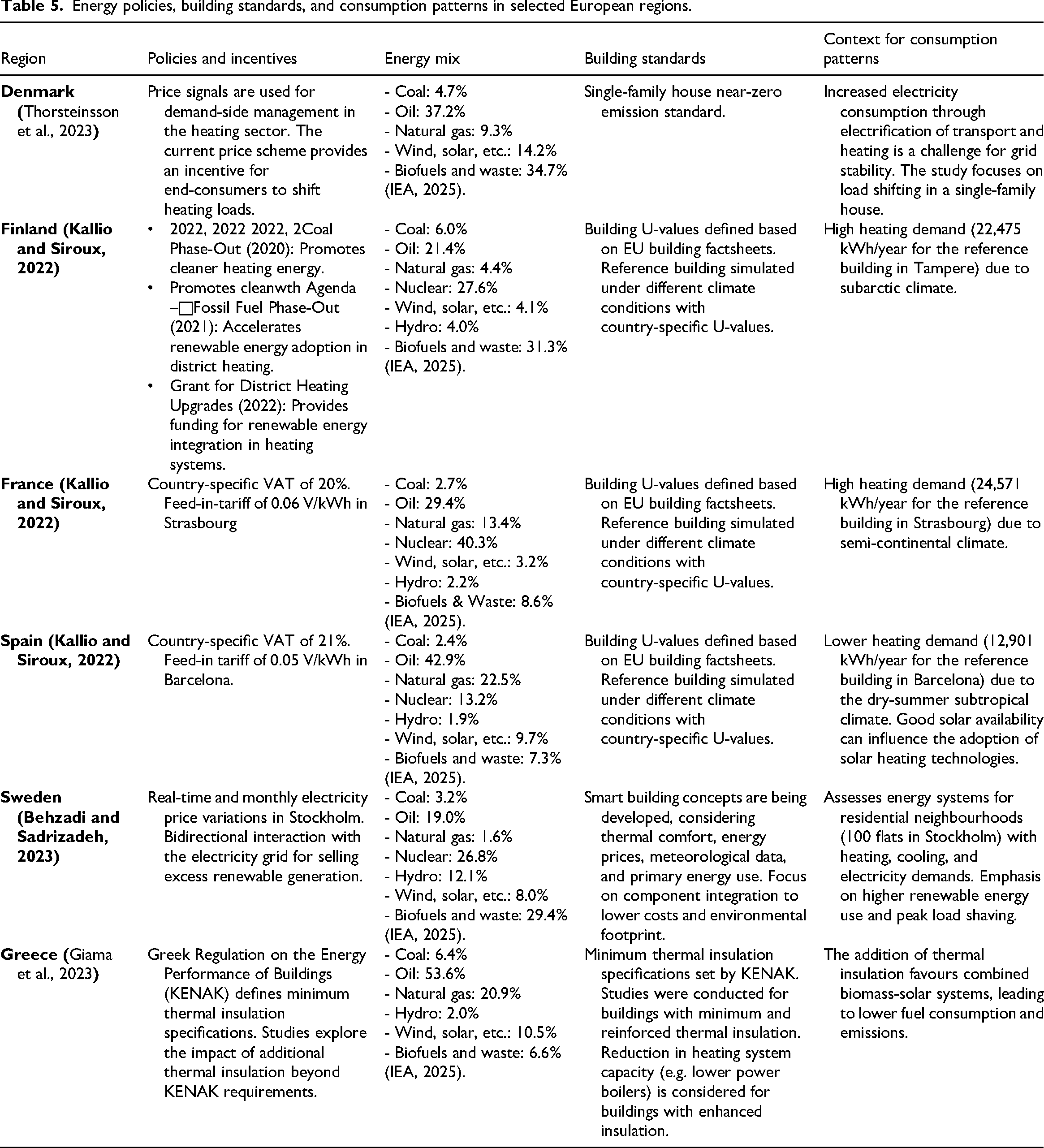
This comparison highlights how regional policies, energy infrastructure, and building standards have a significant impact on the demand for hot water and heating. For instance, the implementation of insulation requirements in Denmark and Greece reduces heating loads, while the high integration of renewable energy in Sweden and Spain influences the energy sourcing for DHW. The analysis further demonstrates the importance of government incentives and energy pricing structures in driving the uptake of efficient and sustainable heating technologies. A comprehensive understanding of these regional variations is essential for contextualizing differences in DHW consumption and for developing targeted energy policies.
The differences in DHW solutions across the EU are significantly influenced by the local character of the heating and cooling sector, as highlighted in the European Parliament Resolution on an EU Strategy on heating and cooling. This local dimension requires that policies and infrastructure planning take into account regional specificities, leading to diverse DHW solutions across Member States (Strategy on Heating and Cooling, 2016).
One key aspect contributing to these variations is the deployment of different DHW technologies. The study by Pezzutto et al. (2019) provides granular data on the number of operative units for various space heating (SH) and DHW equipment across the EU28. Their findings indicate that non-condensing boilers are the most prevalent, with ∼80 million installed units, followed by stoves and electric radiators. This widespread use of boilers, which often provide both SH and DHW, suggests a significant reliance on centralized combustion-based heating systems across the EU. In contrast, the deployment of dedicated solar thermal systems (STSs) for DHW, including flat-plate and evacuated tube collectors, is considerably lower, indicating that while incentivized in some regions like Malta, their overall penetration remains limited compared to conventional systems.
Furthermore, fuel utilization patterns vary significantly for DHW technologies, as detailed in the analysis by Pezzutto et al. (2019). Their data reveals that condensing boilers predominantly use natural gas (66.23%) and oil (33.77%), highlighting a substantial reliance on fossil fuels for DHW provision in many areas. Similarly, non-condensing boilers also show significant consumption of natural gas (54.30%) and oil (38.30%). This granular fuel data supports the idea of gas-reliant DHW solutions in countries with established gas infrastructure, such as Luxembourg. Conversely, stoves are reported to use 100% renewables (biomass), representing a distinct DHW approach in regions where biomass is readily available.
District heating (DH) systems also play a crucial role in DHW provision, accounting for a significant portion of the EU's energy use for heating and cooling. The study indicates that DH systems utilize a mixed fuel portfolio, including natural gas (38.35%), coal (28.76%), and renewables (26.02%). This diverse fuel mix demonstrates that DHW provided through district heating can vary substantially depending on the local energy sources and infrastructure, aligning with the EU strategy's emphasis on integrating renewable energy sources and recovered heat into district energy networks (Pezzutto et al., 2019).
The rate at which Member States adopt more energy-efficient DHW solutions also contributes to the observed variations. The ‘energy efficiency first’ principle, highlighted in the EU strategy, is not uniformly implemented. The continued prevalence of older, less efficient boilers, as noted by Pezzutto et al. (2019), indicates differing paces of modernization across the EU, influenced by factors like building stock age, financial incentives for renovations, and consumer awareness.
Alofaysan et al. (2024) analysed and compared the effects of several factors, such as digitalization, green technology innovation (green patents), renewable energy, population growth, gross domestic product (GDP), and environmental taxes, on energy efficiency across 22 EU countries. The authors found a positive correlation between digitalization, green patents, and the use of renewable energy with energy efficiency, while environmental taxes appeared to have no significant impact. In contrast, population growth and GDP showed a negative correlation with energy efficiency. The authors do not provide a regionally disaggregated analysis, which could provide interesting insights into the strength of the correlations, as there are strong regional differences, for example, significantly higher renewable shares in Northern European countries than in Eastern European countries (IEA, 2025). The authors suggest a deeper analysis of policies and other factors such as industrial or cultural structures. However, they recommend investing in digital infrastructure, such as smart grids and IoT technologies, and revising environmental taxes, as they do not seem to have the desired effects.
Finally, national policy and regulatory frameworks, including the setting of renewable energy targets and the implementation of specific incentives, significantly shape DHW approaches. Countries like Malta, with incentives favouring solar thermal technologies, may exhibit a different DHW energy mix compared to nations where policies or existing infrastructure favour fossil fuels. The diverse energy mixes and climatic conditions across the Member States necessitate tailored national strategies for sustainable heating and cooling, leading to the varied DHW solutions observed throughout the EU. The drive towards achieving the EU's renewable energy targets and the ambition of 100% renewables in heating and cooling by 2050 will continue to influence and potentially harmonize DHW technologies in the long term, but the current landscape reflects a complex interplay of historical development, geographical factors, and diverse national priorities (Strategy on Heating and Cooling, 2016).
Research contribution of European countries (VOSviewer analysis)
To gain a deeper understanding of the research landscape in the EU concerning hybrid heating systems, a bibliometric analysis was conducted. This method provides valuable insights into publication trends, prominent countries, institutions, researchers, and collaborations in this important field. To conduct this study, data were collected from the Web of Science collection, a comprehensive database for scholarly publications. An advanced search function was employed to identify relevant articles using the search query: (hybrid AND heating) AND ((renewable AND energy) OR (biomass) OR (solar) OR (heat AND pump) OR (thermal AND storage) OR (PCM)). This ensured that the retrieved articles included these terms within their title, abstract, and keywords. Only articles and reviews published in English were considered for analysis to maintain consistency and accessibility within the global research community. The analysis covered the period from 2000 to 2024. The recorded data were using VOSviewer software (version 1.6.20), which is specifically designed for bibliometric mapping and visualization.
The analysis revealed a significant contribution from the EU to the field of hybrid heating systems. Notably, 1740 out of 5733 articles identified globally originated from institutions within the EU. This translates to a percentage contribution of 30.35%. Furthermore, the co-authorship analysis identified strong collaborative relationships among EU countries.
Figure 11 visually depicts these collaborations, with larger nodes representing more productive countries worldwide and Figure 12 for the EU countries (in terms of publication output) and the thickness and length of connecting lines indicating the strength of cooperation. The analysis identified Italy as the leading contributor within the EU, with 314 published documents and a total link strength of 86. This is followed by Germany with 265 documents and a total link strength of 72. France ranks third with 175 documents and a total link strength of 66 and Spain also emerged as a significant contributor with 162 documents and a total link strength of 48, respectively. These findings highlight the EU's expertise and commitment to addressing hybrid heating systems.
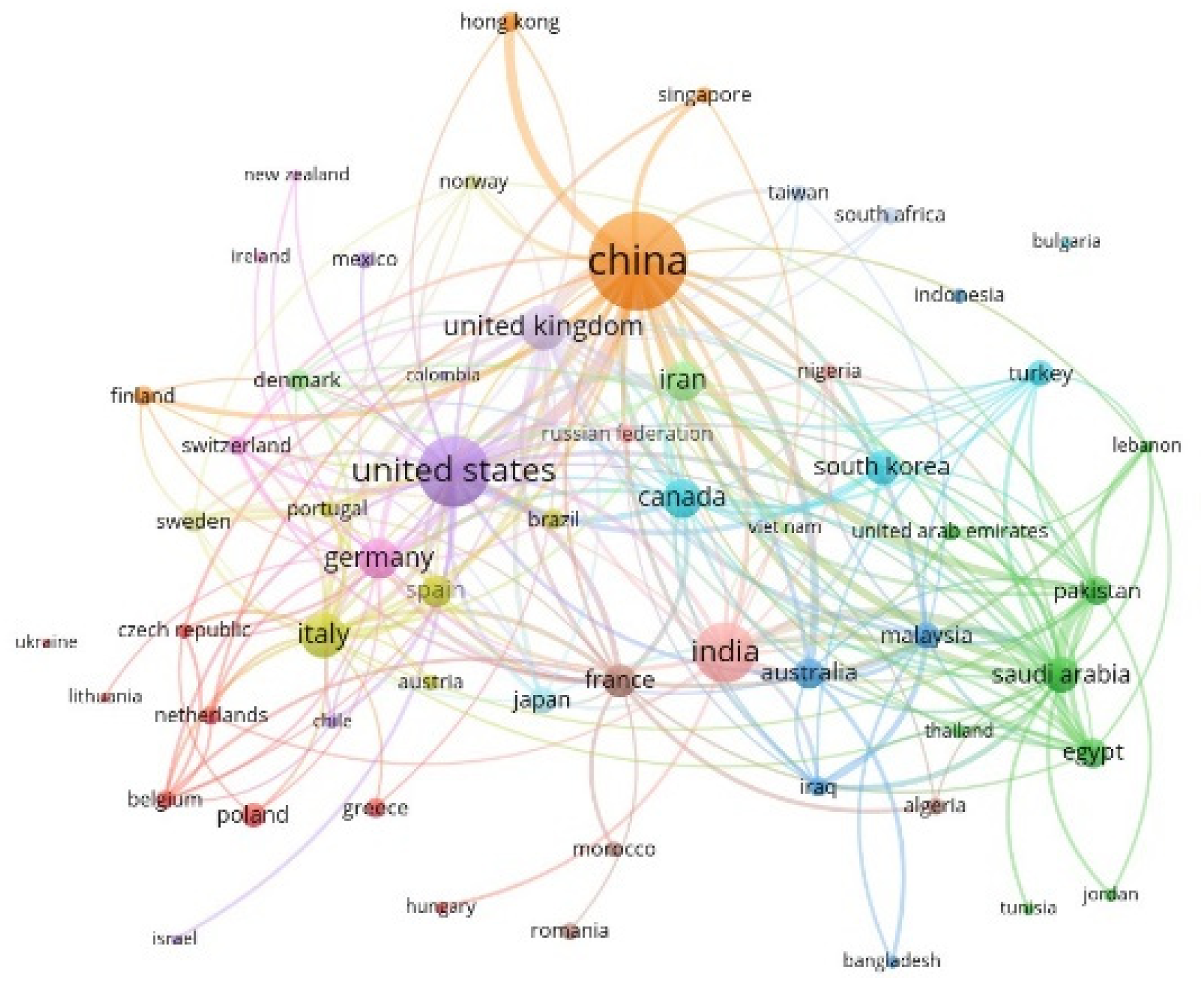
The collaboration map of country co-authorship regarding the hybrid heating systems (image created with VOSviewer).
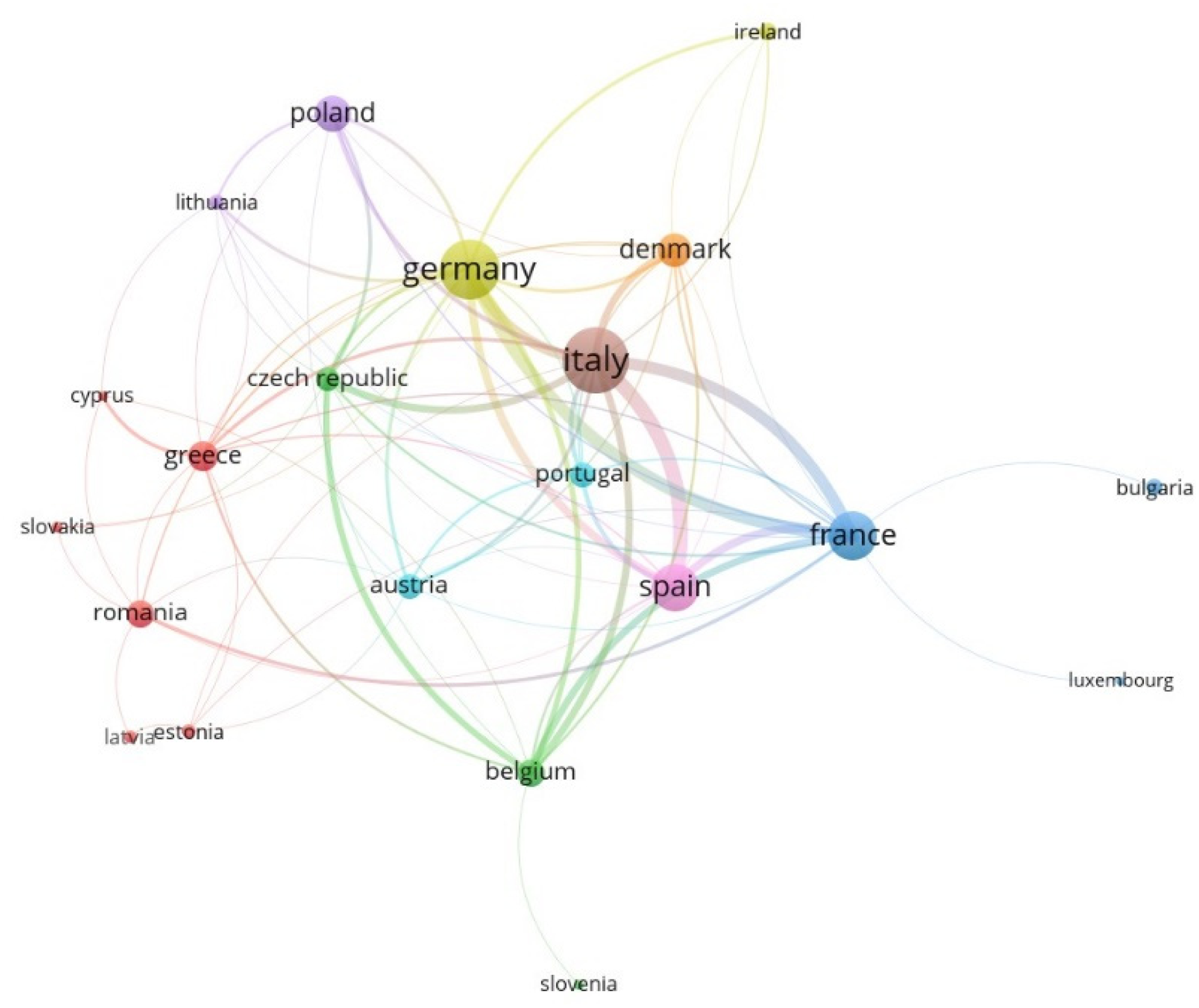
The collaboration map of European Union (EU) country co-authorship regarding the hybrid heating systems (image created with VOSviewer).
Network analysis is an effective bibliometric technique for tracking the evolution of research topics and identifying emerging trends. By examining the occurrences of keywords, we can gain insights into the current focus and predict future directions in the field of hybrid heating systems.
Figure 13 depicts these temporal trends using a network visualization. Based on the network analysis, several promising trends in hybrid heating systems in the EU can be anticipated such as hybrid system technology used: keywords such as ‘Heating’ (1146 occurrences, total link strength = 3761), ‘Solar heating’ (1247 occurrences, total link strength = 4543), ‘Heat pump system’ (539 occurrences, total link strength = 1816), ‘Biomass’ (300 occurrences, total link strength = 720), ‘Thermal energy storage’ (197 occurrences, total link strength = 956), and indicate ongoing research aimed at enhancing the hybrid heating system by utilizing the heat pump, solar energy and heat storage technologies. This could lead to more viable and efficient hybrid heating systems.
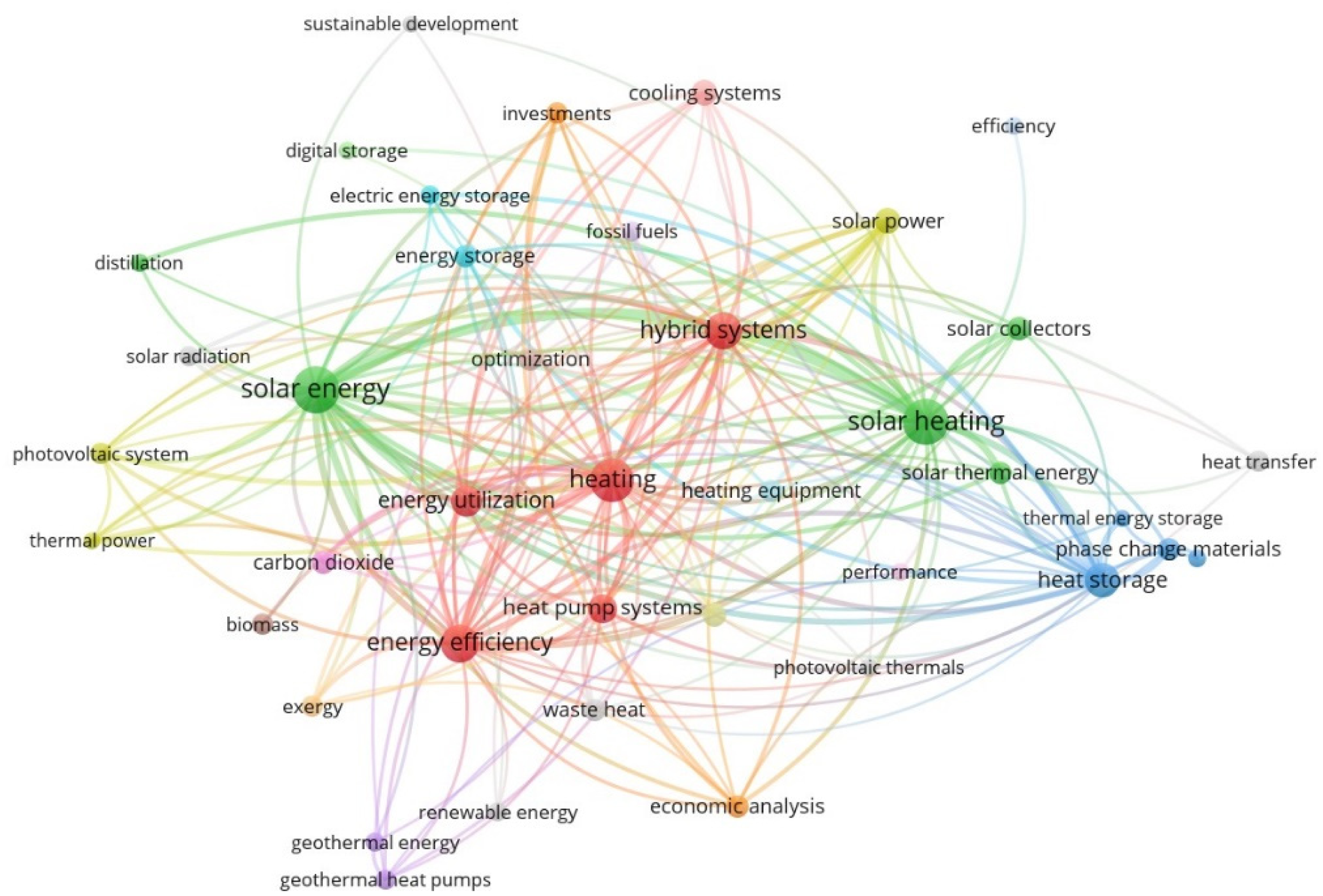
Overlay visualization of keyword trends (image created with VOSviewer).
Discussion
In this article, a variety of hybrid heating systems were reviewed, with a particular focus on systems for the residential heating sector. Among the systems evaluated, heat pumps show great potential for residential heating solutions due to their high efficiency, adaptability to different climatic conditions, and ability to integrate with other renewable energy sources. The integration of heat pumps with solar energy systems appears to be an exceptionally effective approach for improving system performance and energy efficiency (Kazem et al., 2024; Yao et al., 2020) and has been one major focus of this review.
A primary rationale for integrating heat pumps with solar energy is the enhancement of the COP. Preheating the fluid entering the heat pump using solar energy reduces the temperature differentials the heat pump must address. This reduction in temperature lift leads to an increase in COP, as the heat pump consumes less electricity to achieve the same heating output. This boost in performance not only improves system efficiency but also contributes to broader environmental and economic benefits, including a reduction in greenhouse gas emissions and a decrease in primary energy demand (Alhuyi Nazari et al., 2023). The research on hybrid heating systems that combine heat pumps with solar collectors – whether flat plate, evacuated tube, or other types – demonstrates consistently positive results, particularly in regions with high levels of solar irradiation (Miglioli et al., 2023).
One of the primary challenges in integrating solar energy into hybrid heating systems is the fluctuation of solar energy. Solar availability experiences daily and seasonal fluctuations that can substantially impact system performance (Wang et al., 2020). Consequently, it is imperative to develop systems capable of successfully managing these variations. Researchers have underscored the necessity for dynamic models capable of predicting and analysing the performance of solar-assisted heat pump systems under transient operating situations (Yao et al., 2020). These models are essential for understanding how system behaviour changes in response to variations in solar irradiance, ambient temperature, and other environmental factors. Dynamic models also enable the optimization of system performance in real time, ensuring that hybrid heating systems can operate efficiently under a wide range of conditions.
In addition to solar energy, biomass is an interesting renewable source for utilization in hybrid systems. Biomass is a widely used renewable energy source, and heating devices such as pellet boilers are highly developed and efficient. It is often regionally available and a variety of different types of biomass can be used for energetic use. At the same time, the competition between the energetic and material use of biomass and the natural sink function of forests is increasing. The sustainable potential of biomass is limited and the type of use must be considered from different perspectives, such as climate protection, security of supply, and circular economy. In this context, the use of biomass in hybrid systems becomes very interesting, as it allows the use of biomass to cover peak loads, while the base load can be covered by a heat pump or (on a more limited scale) solar thermal collectors. In this way, the energetic use of biomass becomes much more targeted compared to a complete coverage of the heating demand by biomass combustion. While the hybrid use of biomass, especially in combination with heat pumps, seems very promising from a theoretical approach, there is little experimental evidence to support these concepts. Claims that hybrid biomass heating systems can improve efficiency (and therefore reduce primary energy use), reduce greenhouse gas emissions, increase lifetime, or operate in a grid-friendly manner and therefore contribute to grid stabilization need to be validated and should be topics for future research. In addition, the main concern often stated, the high investment cost due to the need for two expensive devices, needs to be addressed and cost-competitive solutions need to be developed, even though different research results show that the overall costs can be lower compared to other renewable systems, due to lower operating costs. One approach to reduce investment costs could be to simplify the devices as they only need to cover part of the heating needs. For example, a BB could be designed to run only at full load to cover peak demand which would reduce the need for complex and expensive control technology. The heat pump, on the other hand, could be designed with a reduced capacity as the BB can cover peak loads, resulting in lower costs. The reduced need for biomass throughout the year also requires less storage capacity, which could make hybrid systems an option for existing buildings with limited space.
Multiple companies selling BBs or heat pumps have introduced hybrid systems in recent years. However, the control algorithms appear to be quite basic, with potential for optimization. The reviewed literature shows that it makes sense to adjust the settings of the heating system to the respective application. In addition, it can be seen from the available findings that a significant increase in efficiency can already be achieved through measures with moderate effort. Furthermore, intelligent control strategies offer promising opportunities for increasing the efficiency of heating systems. However, it must be weighed up in each individual case whether the effort and costs are proportionate to the benefits. Nonetheless, intelligent, digitally networked control systems will become increasingly important in the future, especially for larger systems such as apartment blocks and district heating or those systems that interact with other heating or energy systems.
The inclusion of TES systems is another key factor in improving the stability and reliability of hybrid heating systems. Energy storage is particularly important for managing the intermittent nature of solar energy, allowing excess heat generated during periods of high solar availability to be stored and used during times of low solar irradiance. LHS systems, in particular, have attracted attention due to their relatively low cost and high energy storage capacity. The integration of PCMs in these storage systems has been shown to significantly enhance their efficiency. PCMs absorb and release large amounts of heat as they change phase, enabling more efficient TES and contributing to the overall stability of the heating system.
Despite the promising results associated with the use of PCMs in LHS systems, there is still a shortage of research on the long-term performance and material optimization of PCMs. Further studies are needed to explore the potential of new and innovative PCMs, as well as their applicability in different types of hybrid heating systems. Moreover, additional research is required to evaluate the cost-effectiveness of PCM-based storage solutions and their integration with other components in hybrid systems.
Hybrid systems are crucial for off-grid or rural areas facing energy access and affordability challenges by providing more reliable and sustainable energy solutions (Zhang et al., 2020). Combining sources like solar and biomass ensures a more stable energy supply, overcoming the intermittency of single renewables. Hybrid systems lead to reduced operational costs by utilizing free solar energy and locally available biomass, enhancing energy autonomy and decreasing dependence on expensive fuels. While initial investment may be higher, the long-term benefits of lower fuel consumption and greater energy independence make them cost-effective (Zhang et al., 2020). Utilizing local biomass also supports rural economies and offers an environmentally friendly alternative to polluting traditional fuels (Yuan et al., 2024). Therefore, hybrid renewable energy systems are vital for improving energy access and affordability in remote areas, fostering more resilient energy infrastructures.
Hybrid heating systems should also be addressed by policy makers. Targeted funding programs could be an option to overcome high investment costs and therefore help the market distribution of hybrid systems, making use of their advantages. A recent study of heating subsidies in the EU and the UK found that only 3.4% of subsidies go to ‘other/hybrid heating’, while it is not specified how large the share of hybrid systems is within this category (Williams et al., 2023). Furthermore, this category includes hybrid systems using fossil fuels. While in general it is not excluded that a subsidy targeted at monovalent use of a device can be used in a hybrid system, specifically targeted subsidies for hybrid systems should be evaluated as they may be more efficient in promoting such systems.
To sum up, hybrid heating systems, particularly those that integrate heat pumps with renewable energy sources like solar or biomass, represent a promising solution for the residential sector. These systems offer significant environmental and economic benefits, including reduced greenhouse gas emissions, lower energy demand, and increased system efficiency. However, there are still challenges to be addressed, including system optimization, the integration of dynamic models, and the development of advanced materials for thermal storage. Future research should focus on experimental studies with the aim of refining system designs, improving the performance of individual components, cost-efficient control strategies, and exploring new materials and technologies to further enhance the efficiency and reliability of hybrid heating systems.
Conclusion
Hybrid heating systems have received increasing attention in the past years and their potential benefits have been demonstrated in various studies. However, although there have been literature reviews on some types of hybrid heating systems like the combination of heat pumps and solar thermal collectors, a comprehensive review of different types of hybrid heating systems has been missing. This review article aims to fill this gap while focusing on hybrid heating systems in the residential sector with different combinations, such as the integration of heat pumps, solar systems, and biomass combustion. This review discusses the advantages and challenges of such hybrid systems, with common challenges in such systems often being cost-effectiveness and environmental impact. The state-of-the-art innovations in TES solutions were discussed by different researchers and show the importance of integrating TES systems with hybrid heating systems. LTSs, like phase change material storages, show good potential to increase energy efficiency, but still come at high costs.
The main findings on heating systems highlight their potential to improve energy efficiency, reduce environmental impact, and increase system reliability. These systems effectively integrate multiple energy sources to maximize the use of renewable energy. For example, combining solar and biogas heating systems improves thermal stability and increases the share of renewable energy, with biogas compensating for the intermittency of solar energy. Similarly, integrating PVT collectors with heat pumps improves the use of both electrical and thermal energy, increasing overall system performance.
Hybrid systems also make a significant contribution to energy efficiency and reduced energy consumption. Solar-assisted heat pumps, for example, achieve higher coefficients of performance and reduce electricity consumption, making them a viable alternative to conventional heating methods.
Another key advantage of a hybrid system is improved system reliability and stability. By combining different energy sources and incorporating storage solutions, these systems ensure a more consistent energy supply. TES plays a crucial role in hybrid renewable energy systems, enabling the storage of thermal energy produced by micro-CHP (combined heat and power) and PVT collectors. This stored energy can be utilized for space heating and DHW, helping to meet peak and off-peak demand by optimizing the timing of solar heat collection and heating load distribution.
Studies show that efficiency improvements can often be achieved by improving system operating settings, which often involve low or medium-effort measurements. Intelligent control systems, which have gained much interest in recent decades, often show great potential for further improvements but also come with greater effort, cost, or other requirements to implement. Several different approaches have been investigated and there are several good options for application. However, the majority of studies to date have been simulation-based, and although some experimental studies have demonstrated practical suitability, there is still a lack of such studies. Other challenges include the sometimes-high computational requirements, the resulting cost and complexity, the need for high-quality training data, and user acceptance. More effort is needed by policy-makers to communicate the potential of intelligent control, both in terms of energy and cost savings for users and the need for grid-supporting operations. Researchers should focus on experimental studies, including comprehensive cost and greenhouse gas analyses, in addition to the energy consumption and comfort aspects that have often been studied to date. For manufacturers, it would be desirable to make controls more accessible to allow more flexible control by tertiary devices.
Research on hybrid heating systems has several limitations, including a narrow scope, with many studies focusing on specific technologies, such as solar-assisted heat pumps or PVT collectors, without comprehensive comparisons. Methodological inconsistencies, such as varying performance evaluation methods and a lack of standardized simulation tools, make cross-study comparisons difficult. Data and modelling limitations result from oversimplified assumptions that may not reflect real-world conditions, leading to inaccuracies. Economic and environmental considerations are often secondary, with many studies prioritizing energy performance over cost-effectiveness or environmental impact. Technological constraints, such as poor performance in low temperatures and difficulties in integrating thermal storage, further limit adoption. Additionally, operational and control challenges, including the need for advanced optimization strategies and intelligent control systems, remain significant barriers to widespread adoption. Addressing these issues is essential to improve the efficiency, reliability, and market viability of hybrid heating systems.
A bibliometric analysis of research on hybrid heating systems in the EU showed that out of 5733 global publications worldwide, 1740 (30.4%) originated from EU institutions, highlighting strong contributions, particularly from Italy, Germany, France, and Spain. The network analysis identified promising research trends focusing on hybrid system technologies such as solar heating, heat pump systems, biomass, and TES, which are key to advancing more efficient hybrid heating solutions.
The main challenge highlighted in this review article is the difficulty in comparing hybrid heating systems. Each study and experimental setup operate under different operating conditions, climatic regions, and a wide range of technologies, making it difficult to define the most efficient hybrid heating system. The variations in experimental setups, performance evaluation methods, and geographical locations add to the complexity of drawing definitive conclusions about the optimal system. This lack of standardization makes it difficult to directly compare the effectiveness of different configurations and technologies.
Footnotes
Data availability
The data that support the findings of this study are available within the article.
Declaration of conflicting interests
The author(s) declared no potential conflicts of interest with respect to the research, authorship, and/or publication of this article.
Funding
The author(s) received no financial support for the research, authorship, and/or publication of this article.
