




Abstract
Shallow-water carbonates from the Yingshan Formation are important target of hydrocarbon exploration in Tarim Basin. Detailed descriptions of outcrop, core, and thin sections, isotopic composition analysis, and trace element analysis were conducted. Seven lithofacies which consists of two facies belt groups were identified and used to interpret deposition environments of Yingshan Formation: (1) peritidal carbonate, with relatively lower δ13C values from −4.2% to −1.9%, mainly represented by intertidal to supratidal facies and restricted subtidal facies and (2) open-marine subtidal carbonate, with higher δ13C values (−1.5% to −0.3%), mainly consists of shoal facies and interbank sea facies. On the basis of the lithology sets, four types of meter-scale cycle model (types A–D) were grouped into peritidal sequences and subtidal sequences. On the basis of vertical lithofacies, cycle stacking patterns, and accommodation variations in Fischer plots, two third-order depositional sequences (SQ1–SQ2) were recognized. The sequence boundary between SQ1 and SQ2 is not only a surface of a positive shift of δ13C values, but also the transitional zone of cycle stacking patterns. The sequences can be further divided into four fourth-order sequence sets: Sq1–Sq4. The lower sequences (Sq1–Sq2) are dominated by peritidal facies and characterized by a progressive decreasing in accommodation space probably indicates a longer-term fall in sea level. The upper sequences (Sq3–Sq4) are mainly dominated by subtidal facies and characterized by the accommodation space with a progressive increasement, likely indicates a rising sea level with a longer term. The facies-controlled reservoirs are mainly present in the Sq3, related to the sequence boundary between SQ1 and SQ2.
Keywords
Introduction
Meter-scale cycle commonly occur in shallow-marine carbonate successions, and is a fundamental stratigraphic unit (Anderson and Goodwin, 1990; Catuneanu et al., 2011; Catuneanu and Zecchin, 2020). Larger-scale depositional sequences consist of various high-frequency meter-scale cycles combinations (D'Argenio et al., 1997, 1999; Strasser et al., 1999; Zhang et al., 2015). The mechanism is high-frequence sea-level changes which are genetically related with the Milankovitch cycles (Goldhammer et al. 1987; Mei and Tucker, 2013). High-frequency sequence stratigraphy investigation was chosen for shallow carbonate platform deposits on account of their high sensitivity to sea-level changes (Védrine and Strasser, 2009).
The Yingshan Formation is deposited on a shallow-water carbonate platform during the Middle-Lower Ordovician in the western Tarim Basin (Lin et al., 2012; Zhao et al., 2009). Oil and gas fields, such as Tahe, Shunbei, and Fuman, were discovered in Yingshan Formation in the Tarim Basin (Qi, 2016; Wang et al., 2023). Recently, a major breakthrough has been obtained in the high-energy intraplatform shoal in Fudong 1 Well in the Ordovician Yingshan Formation (Wang, 2023; Wang et al., 2023). Although the third-order depositional sequences have been recognized for the Yingshan Formation in the Tarim Basin (Fan et al., 2007; Zhao et al., 2010), the meter-scale cycles are still rarely studied. This led to many uncertainties in identifying larger-scale depositional sequences of the platform and predicting favorable reservoirs. Microfacies, carbon, and oxygen isotopic analyses were performed on outcrops and core samples to interpret the sequence stratigraphic framework. The objectives of this article were to: (1) describe the sedimentary facies of the Yingshan Formation; (2) identify the sequence boundaries, the meter-scale cycles, and depositional sequences on the basis of the outcrop and core; and (3) evaluate the facies and geochemical characteristics in the high-frequency meter-scale cycles within a comprehensive sequence stratigraphic framework.
Geologic setting
The Tarim plate was located near the equator in the Early-Middle Ordovician (Torsvik and Cocks, 2013; Wang et al., 2013), near the northwestern margin of Gondwana. Deep water basin deposition occurred in the eastern Tarim Basin, while carbonate platform was deposited in the western Tarim Basin (Wu et al., 2012; Zhang et al., 2006). The Tarim Basin, with an area of 56 × 104 km2, is located in the southern part of northwest China's Xinjiang Uygur region (Figure 1).
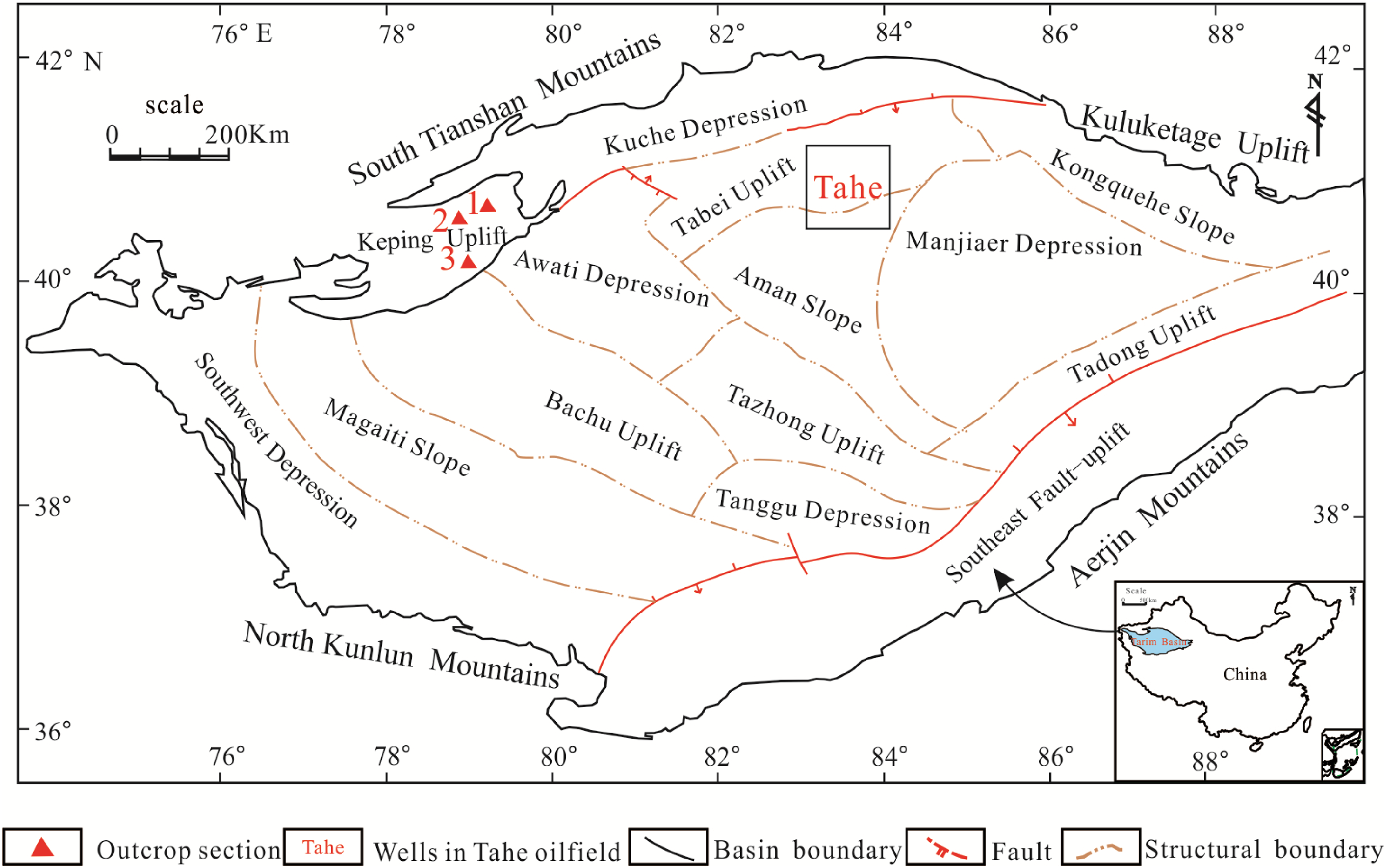
Location of the outcrop sections and wells in Tarim Basin (modified from Jin et al., 2009 and Lan et al., 2014). (1) Xiaoerbulake section (XEBLK); (2) Keping Shuinichang section (KPSNC); (3) Dabantage (DBTG).
The Yingshan Formation was established at the north slope of Yingshan in Keping. Typical thickness of the Yingshan Formation is 855 to 925 m in the Tahe Oilfield. The Yingshan Formation was subdivided into lower and upper units on the basis of lithology and paleontology (Liu et al., 2002). In the lower unit, the interbedding of light gray calcarenite, and dolomite are mainly present. In the upper unit, the rocks consist of skeletal packstone and lime mudstone, with rare dolomite (Figure 2).
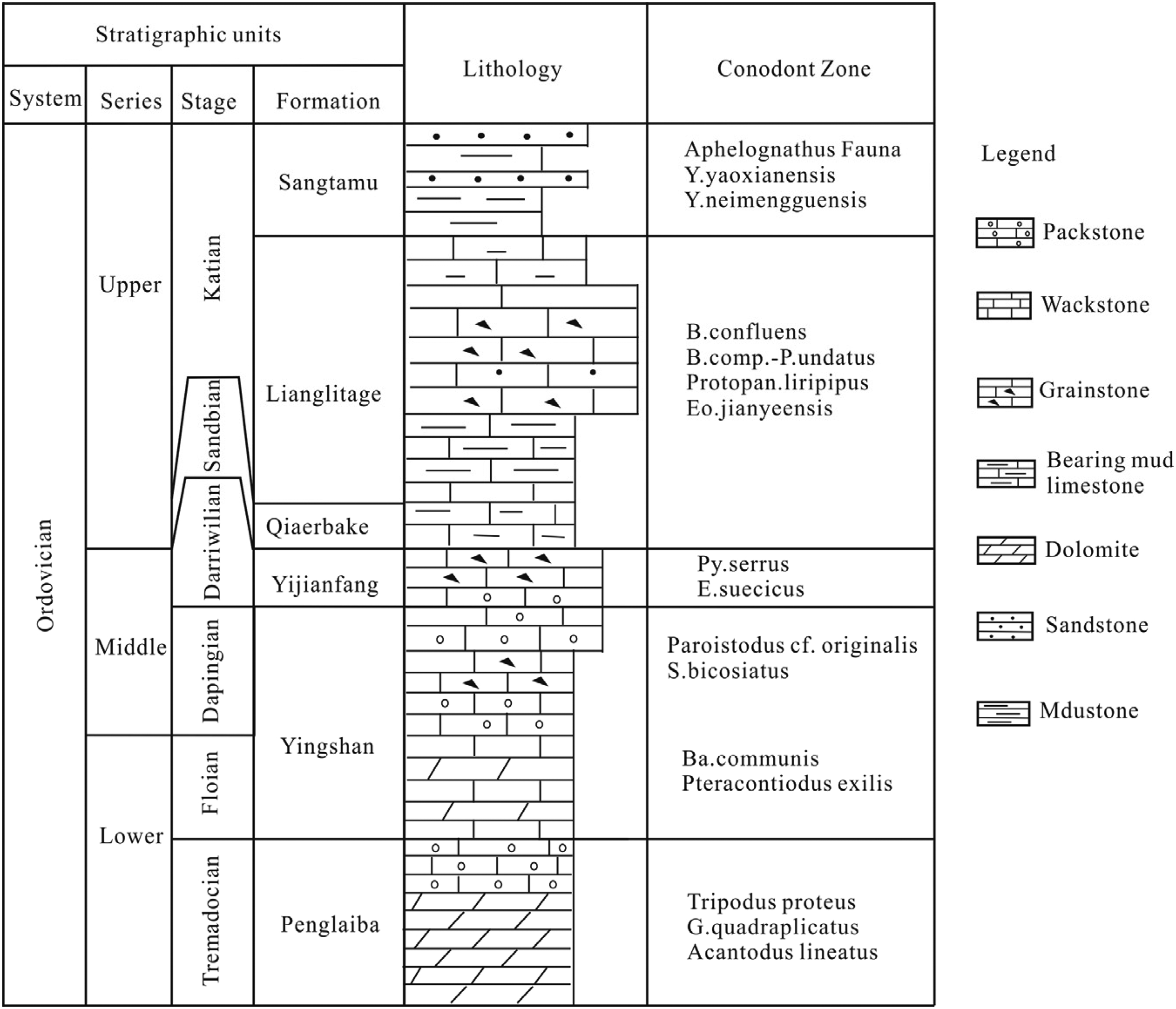
Stratigraphic column for the Ordovician in Tarim Basin (modified from Xiong et al., 2006).
Materials and methods
Three outcrop sections were conducted in Middle and Lower Ordovician Yingshan Formation. Core materials were analyzed for six wells: TS1, TS2, TS3, S88, YQ5, and YQ6. And 210 thin sections were prepared to assist in the interpretation of sedimentology. The carbonate rocks and their microfacies are classified primarily based on the depositional textural classification by Dunham (1962) and its modifications by Embry and Klovan (1971). In addition, microbialite texture has been added to better reflect various hydrodynamic conditions and sedimentary environments.
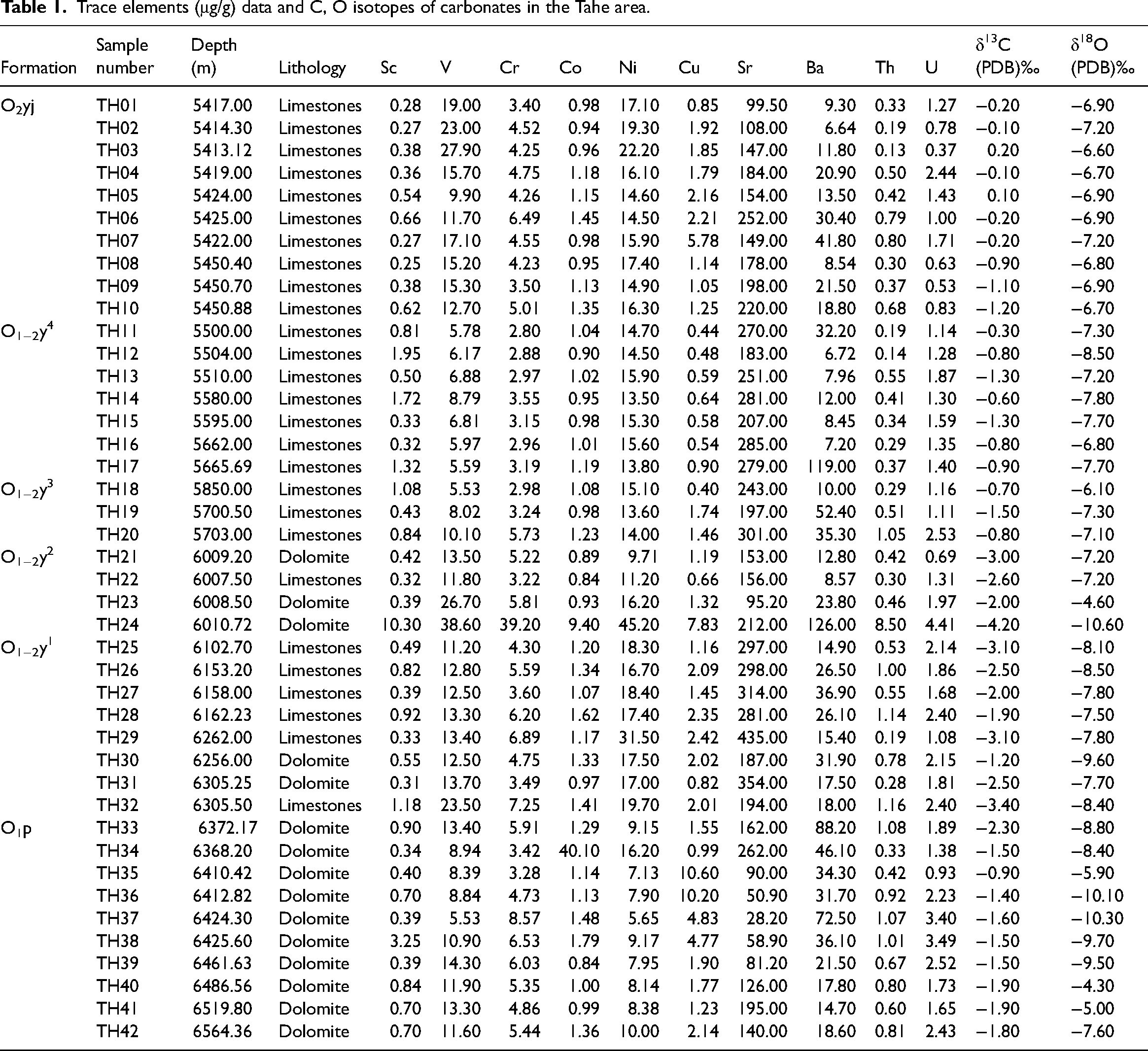
Forty-two stable carbon and oxygen isotopic compositions were measured on core samples in wells of S88 (N = 12), Ad11(N = 10), Ts3(N = 3), Yq6(N = 6), S110(N = 5), and S106(N = 6), which are all in the Tahe oilfield. Trace element analyses were also performed by High Resolution Inductively Coupled Plasma Mass Spectrometry (ICAP6000 apparatus). Element concentrations are expressed in parts per million (ppm) and the measurement precision is ± 0.001 ppm. The test results are shown as Table 1.
Trace elements (μg/g) data and C, O isotopes of carbonates in the Tahe area.
The HXRF instrument used in Shuinichang profile was Thermo Scientific Niton XL3t 950 produced in 2011 in the United States. Test points were selected from the fresh surfaces of rocks and 30 kinds of different elements could be measured. The thickness of Yingshan Formation was 205 m in the Shuinichang profile. Element measuring points are 110 in total, with the averaged measuring interval of 1.86 meters. The gamma value of each sample point was also determined at the same time.
Lithofacies and depositional environment
Seven lithofacies types were identified, including laminar stromatolitic bindstones, domal stromatolitic bindstones, intraclastic rudstone, porohyritic fenestral wackestone, intraclastic packstone/grainstone, bioclastic grainstone, and mound-shaped algal bindstone (L1–L7). They were grouped into peritidal carbonate and subtidal carbonate. These facies were also described with interpretation of their depositional environments. This plays an important role in identifying the depositional sequences.
L1 laminar stromatolitic bindstones
Description
Laminar stromatolitic bindstones are restricted to the lower member of the Yingshan Formation, with the thickness of 0.5 m in Dabantage outcrop (Figure 3(a)). The thick layer (0.2–2 mm) is lighter in color and contains more crystal calcite, and the thin layer (0.10–0.5 mm) is darker and contains more micrite (Figure 3(b)). Alga laminate skeleton were often filled with calcite (Figure 4(a) and (b)). Laminar stromatolite is commonly associated with dolomite. Fine crystalline limpid dolomite has dark cores and bright rims (Figure 4(c)).
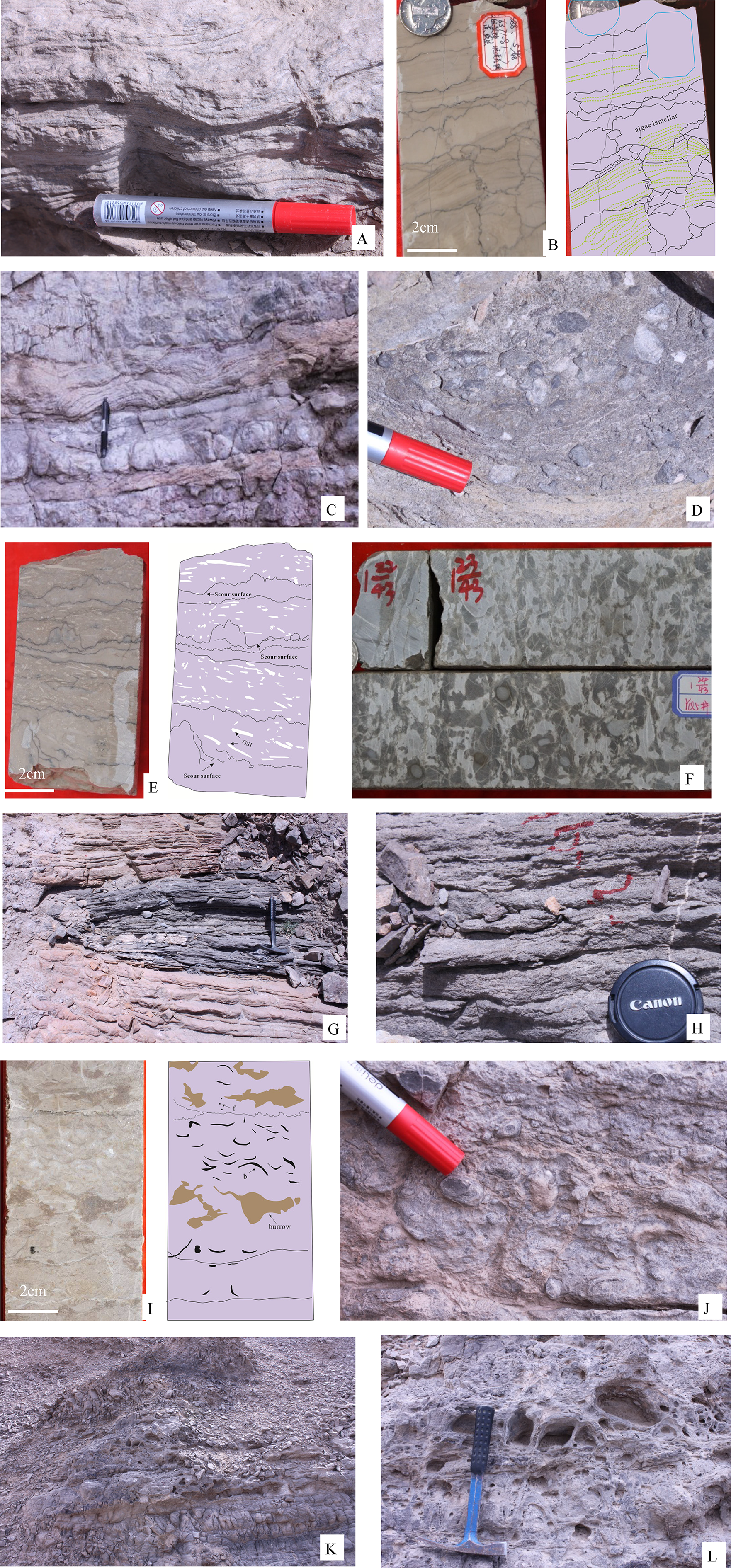
Outcrop and core lithofacies of Yingshan Formation in Tabei area. (a) Laminar stromatolite (Dabantage section). (b) Laminar stromatolite (well S88, depth 6371 m). (c) Domal stromatolites (Dabantage section). (d) Rudstone in Xiaoerbulake section. (e) Rudstone within multistages tidal channels and the erosion surface can be defined as low-order sequence boundary (well S88, depth 6305 m). (f) Porphyritic limestone, the dark patches represent limestone and the light patches represent the late dolomization (well YQ5, depth 5948 m). (g) Intraclasts with the flat bottom and convex top (Xiaoerbulake section). (h) Intraclasts (Xiaoerbulake section). (i) Bioclastic limestone (well YQ5, depth 5956 m). (j) Bioclastic limestone (Dabantage section). (k) Algal mounds (Dabantage section). (l) Algal limestone with kasrst (Dabantage section). Hammer for scale (30 cm long). GSI = Gravel-sized intraclasts; BF = Brachiopoda fragments.
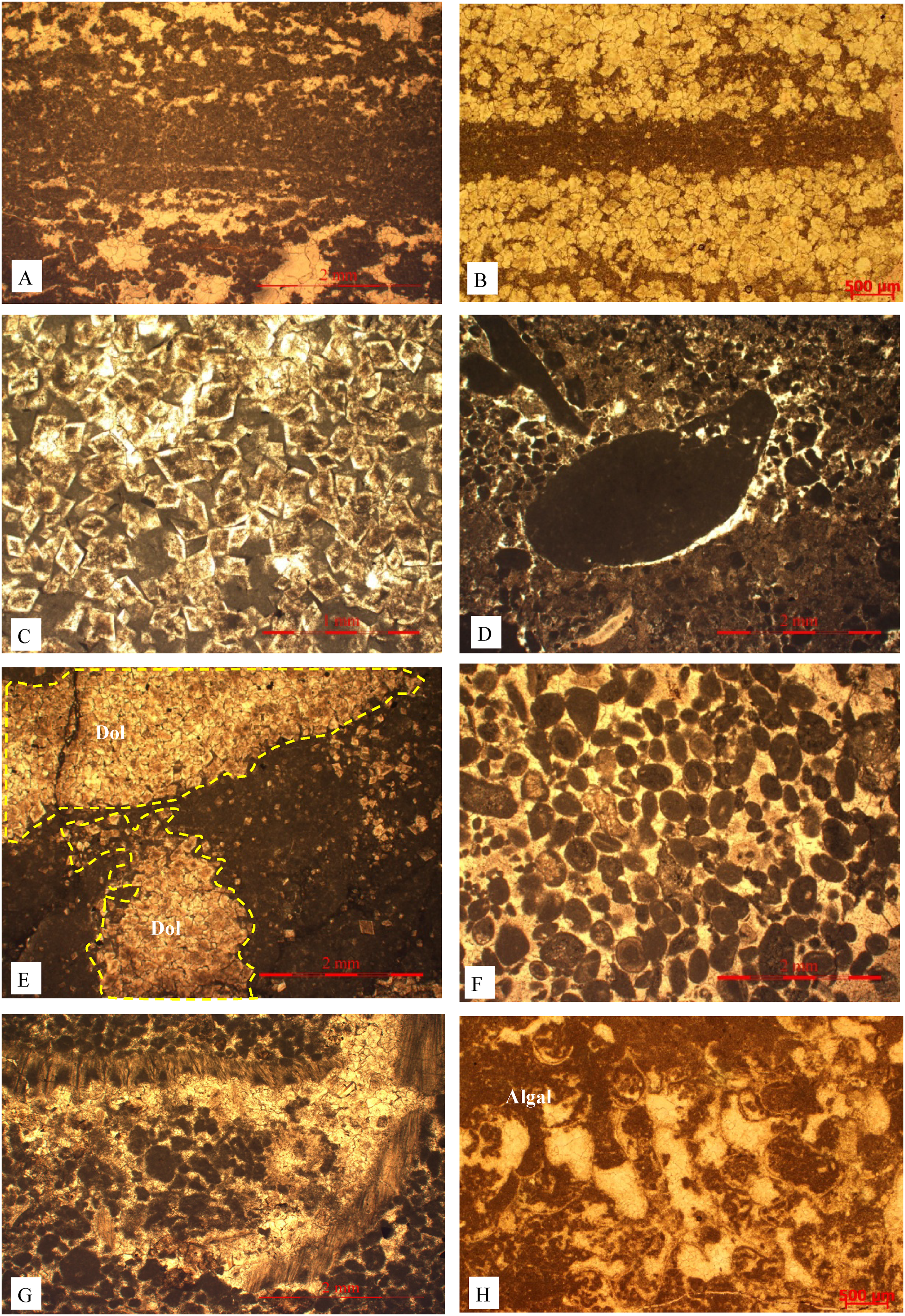
Thin section photos of the Yingshan Formation. (a) and (b) L1: Algal laminated limestone (NYG outcrop). (c) L2: Fine crystalline dolomite with dark cores and clear limpid rims (well AD11, depth 6109 m). (d) L3: Calcarenite with gravel-sized grain locally (well S106, depth 6062 m). Dol = Dolomite. (e) L4: Micrite porphyritic limestone (well YQ5, depth 5947 m). (f) L5: Sparite porphyritic limestone (well YQ5, depth 5955 m). (g) L6: Bio-limestone (well YQ5, depth 5955 m). (h) L7: Sparry algal limestone (NYG outcrop).
Interpretation
The stromatolite can effectively reflect the growth period of the sedimentary environment and conditions, so as an indicator of paleoenvironment and paleoclimate (Flügel and Kiessling, 2002). Laminated stromatolite reflects the emergence of the weak hydrodynamic environment. Most likely develop in low-energy supratidal zone and subtidal zone.
L2 domal stromatolitic bindstones
Description
The most remarkable characteristic of this lithofacies is with the top of half dome (Figure 3(c)). Bump height is around 10 cm. The thickness of the single lamination layer in domal stromatolites is much thicker than that in laminar stromatolite. The thickness of dark layer can be up to 2 cm. According to the shape, three different types: domal stromatolites, cone stromatolite, and low amplitude stromatolite can be identified.
Interpretation
The water energy of domal stromatolites is stronger than that of laminar stromatolite. Domal stromatolites are generally interpreted deposited in shallow subtidal (Logan et al., 1969).
L3 intraclastic rudstone
Description
In outcrop, the moderately sorted and rounded rudstone can be observed (Figure 3(d)). Rudstone lies on scoured surface (Figure 3(e)). Most grains are 2 to 5 mm in length, up to 20 mm. In thin sections, the grain could be up to 3 mm in length with lime mud matrix locally (Figure 4(d)). A scour surface was developed at the bottom of the gravel grains limestone, and a temporary marine flooding surface was developed on the top, showing fining upward (Figure 3(e)). The flat top and convex bottom are obvious. Stylolites that filled with black organic material or mud were commonly developed near the lithologic transitional surface.
Interpretation
Rudstone is the result of storm/wave reworking of mud cracked stromatolitic bindstone. At the top and bottom interfaces of the cycle, the lithology abruptly changed with an obvious scour surface, which showed the superimposition of multi-tidal channels.
L4 porohyritic fenestral wackestone
Description
Porohyritic fenestral wackestones show dolomitic carbonate focused as gray patches (Figure 3(f)). Dolomitization is occurred locally and sparse in the micritic limestone (Figure 4(e)). Some laminites of this group were fenestral (birds-eyes), and burrows can also be observed.
Interpretation
Fenestral patches may arise from bioturbation, the formation of gas bubble associated with organic matter decomposition (Scholle and Ulmer-Scholle, 2003). This phenomenon is mainly present in tidal flat setting.
L5 aggregate-grain grainstone
Description
This lithofacies are most common in the Yingshan Formation. The thin layer intraclasts have the flat bottom and convex top (Figure 3(g)). Grains are mainly sand-sized intraclasts, moderately to well sorted and rounded (Figure 3(h)). Grain-supported texture and sparry cementation among particles can be observed in the thin section (Figure 4(f)). Particles are mainly gray algal limestone sand, from weak consolidation, and consolidation of algal laminated limestone or algal limestone.
Interpretation
It is clearly that the sediments of this facies accumulated in a high-energy, shallow subtidal sand shoal originally (Longman, 1981). The difference between the intraclasts and rudstone with scour surface is the outer shape. The former is flat bottom and convex top while the latter is convex bottom, reflecting the different forming mechanism.
L6 bioclastic grainstone
Description
In the core, bioclastic limestone contained, in some cases, more than 60% brachiopoda fragments (Figure 3(i)). Some bioclasts are unidentifiable due to recrystallization. In the outcrop, unbroken brachiopoda can be observed (Figure 3(j)). This shell of brachiopod commonly associated with grainstone (Figure 4(g)).
Interpretation
Brachiopods show a distinct range of salinity, including brackish water (hyposaline) and slightly hypersaline environments (Scholle and Ulmer-Scholle, 2003).
L7 mound-shaped algal bindstone
Description
The algal mounds are mainly constituted of the alaga limestone, with the flat bottom and convex top. And this lithofacies is overlain by dark, well-bedded, cherty wackestones, and packstones (Figure 3(k)). The limestone core is easier to be weathered and eroded than the outer alga skeleton (Figure 3(l)). The cavities of this alga were filled with large sparry calcites showing the fenestral fabrics with elongate, spar-filled pores in algal limestone sediment (Figure 4(h)).
Interpretation
Contrast to domal stromatolites, algal mounds always deposit in the high-energy open platform.
Depositional models
Intertidal to supratidal facies, subtidal lagoon facies were mainly developed in restricted-marine peritidal environment, while shoal facies and interbank sea facies were mainly developed in open-marine subtidal environment (Figure 5). Subtidal lagoon facies consist of porohyritic fenestral wackestone, micritic to fine- and silt-crystalline dolomite. Subtidal lagoonal facies are generally mudstone and wackestone with occasional biodisturbance, and formed in relatively weak hydrodynamic environment (Flügel, 2010). The burrow-associated dolomites of porohyritic fenestral wackestone deposited in a relatively restricted setting. Limestone and dolomite described above were likely deposited in a quiet, but occasionally storm-affected lagoon environment. The lithology was mainly powder-fine crystal dolomite, which mainly resulted from postdepositional dolomitization. Sedimentary sequences and phase transition are relatively important to identify the lagoon facies.
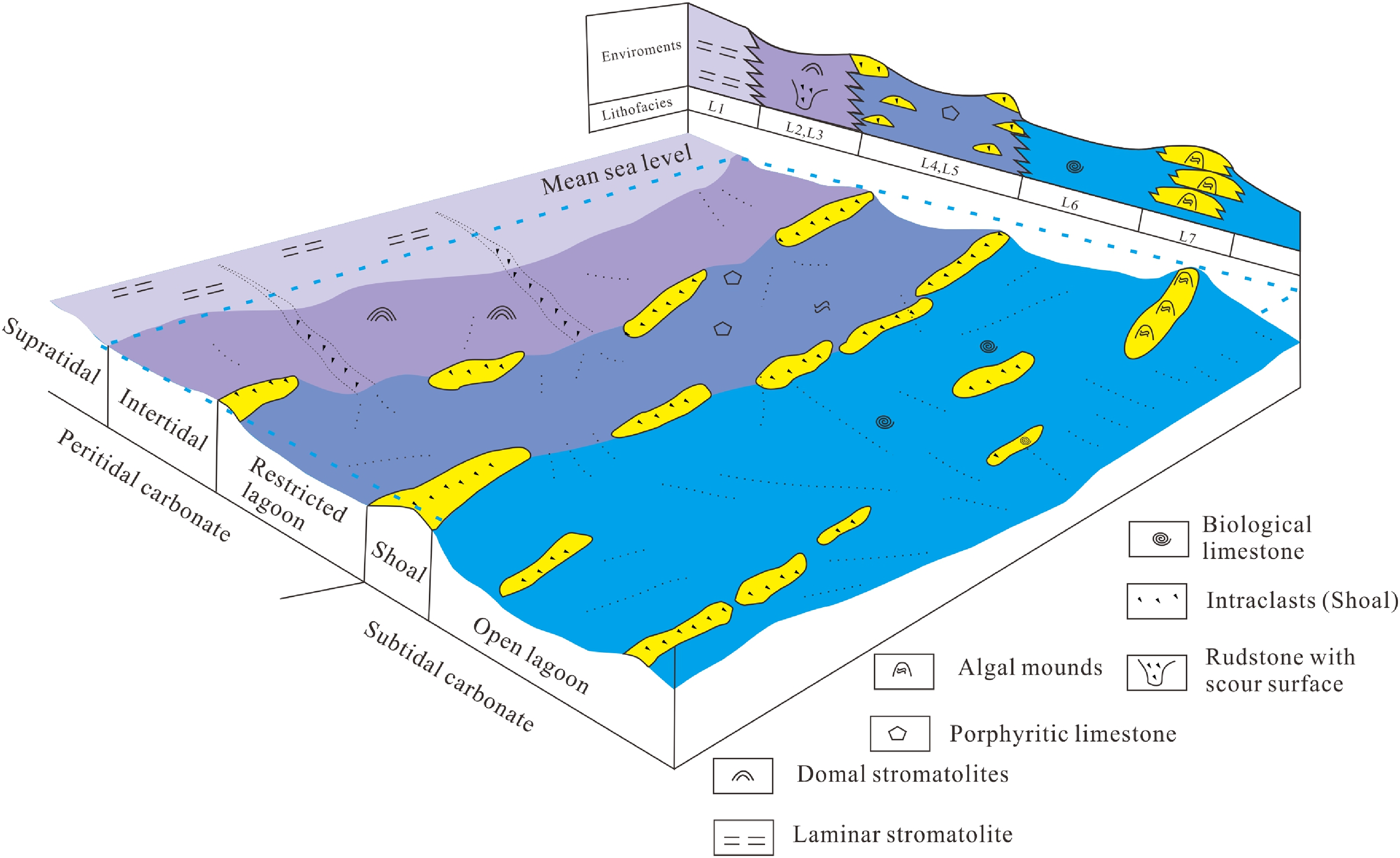
Schematic depositional model of the platform during deposition of the lower member of Yingshan Formation in Tahe area.
The sediment was dominated by micrite with few particles that were mainly deposited as deep gray limestone. Glauconite occurs in several beds of micrite, mostly in the upper member of Yingshan Formation, which were regarded as a facies mineral, and represent early transgressive sedimentation.
The geochemical characteristics
Isotopic trends
Tahe wells
δ13C ranged from −4.2‰ to 0.2‰, and δ13C was higher in the upper part of the Yingshan Formation than in the lower part, exhibiting a clear increase in δ13C (Figure 6). The δ18O ranged from −10.6‰ to −4.3‰ in the Middle-Lower Ordovician in the Tahe wells, Tarim Basin.
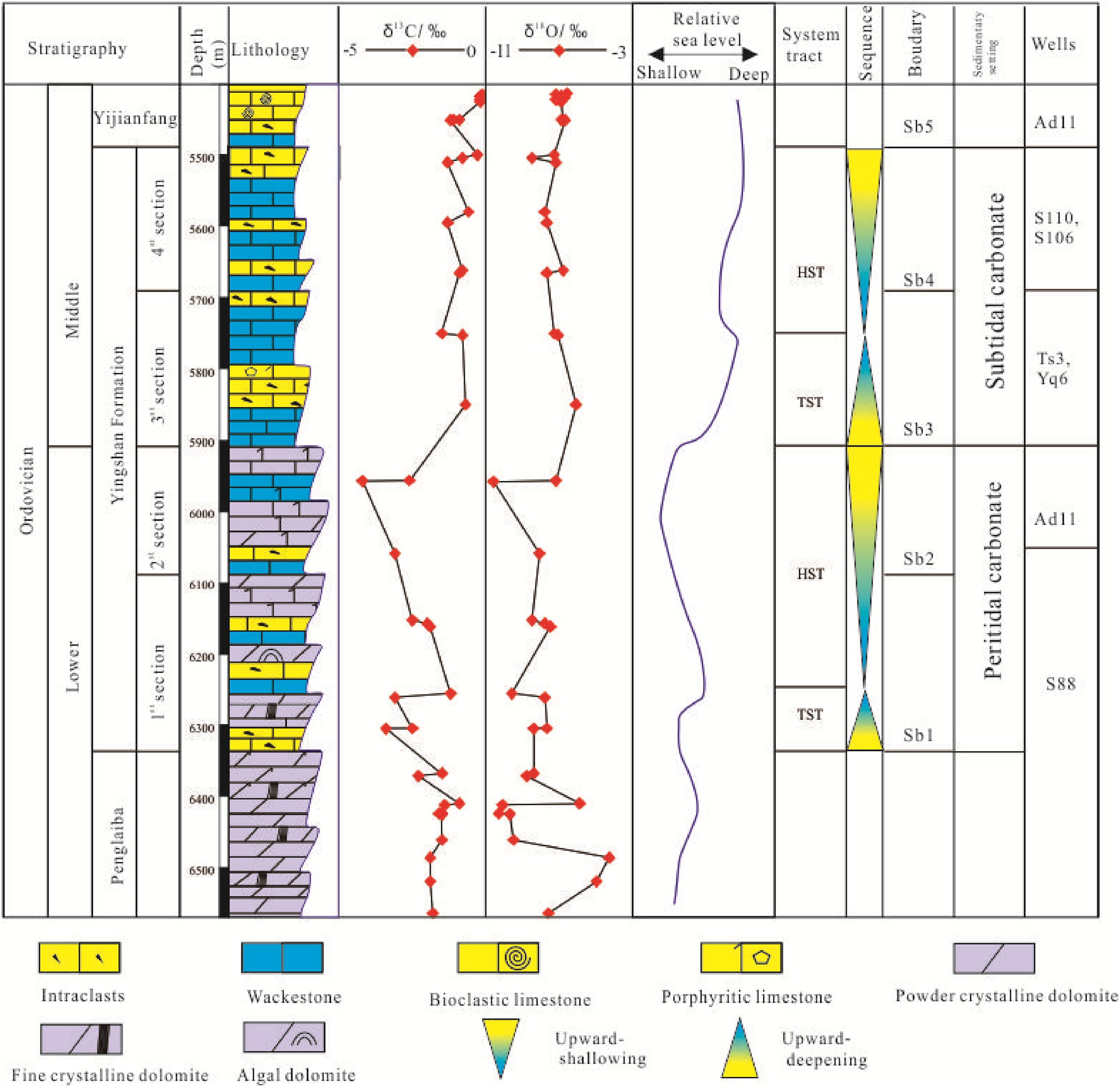
Chronostratigraphy, lithostratigraphy, facies analysis, chemostratigraphy, and sequence stratigraphy of Lower-Middel Ordovician Yingshan Formation stratigraphy of the wells in Tahe area (modified from Yang, 2017 and Yang et al., 2021).
Dabantage profile
Test results showed that the δ13C ranged from −4.2‰ to 0.2‰. Furthermore, the δ13C was higher in the upper part of the Yingshan Formation than the lower part, and showed a clear positive shift. The change is consistent with that in Tahe wells.
Trace elements
Tahe wells
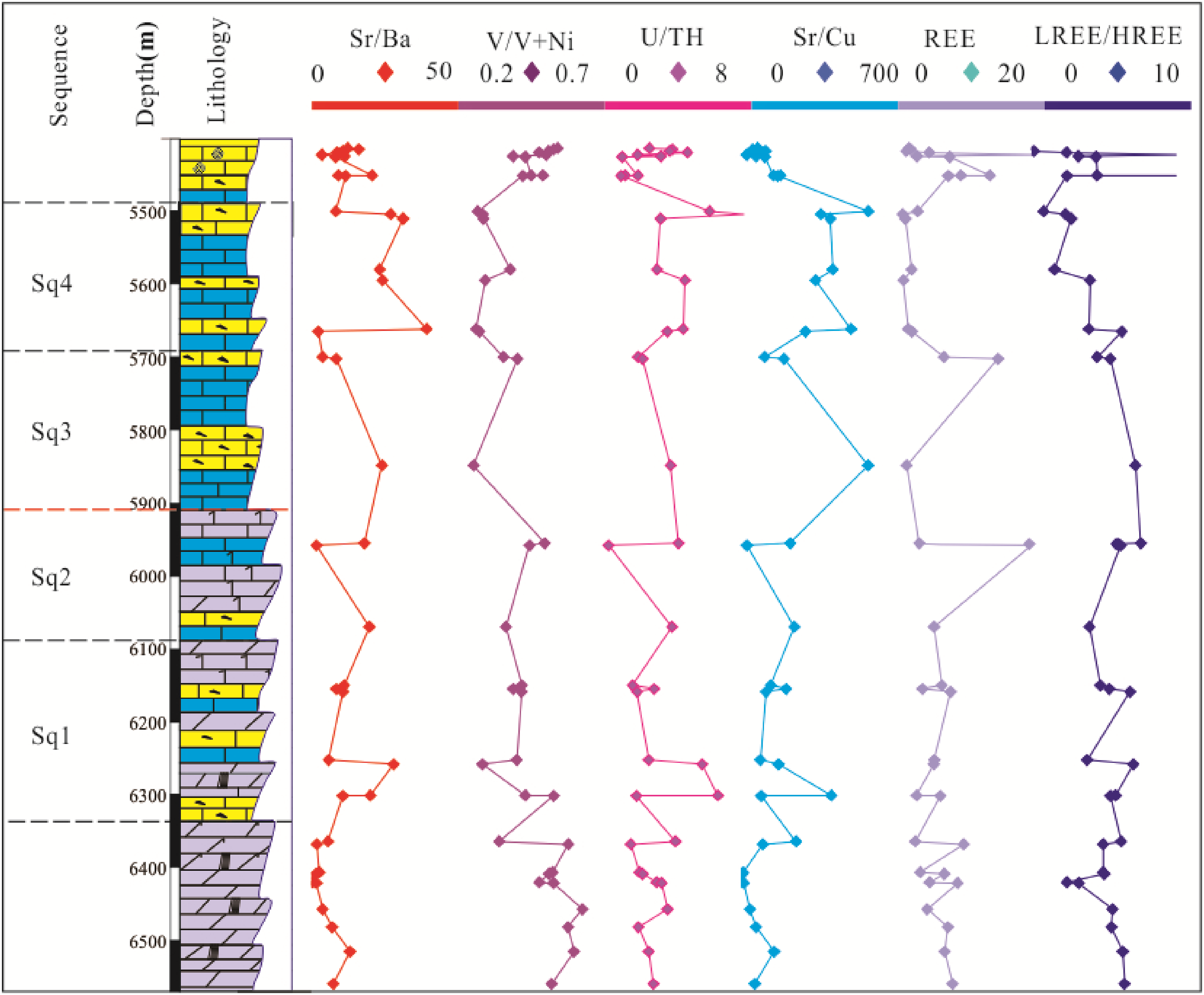
Redox environment indicators: The V/Cr、V/Sc、V/Ni、V/(V + Ni)、U/TH、Ni/Co can be the indicators for redox environment of paleo-ocean. Most of the ratios are higher under the Sb3 than that above the Sb3 (Figure 7).
The main sequence boundaries of Middile-Lower Ordovician Yingshan Formation in Tahe area. Symbols are as in Figure 6.
Paleosalinity indicators
The Sr/Ba、Sr/Cu、V/Ni can be the indicators for Paleosalinity of paleo-ocean. The Sr/Ba is ranges from 1.61 to 39.58, with a mean of 15.34 above the T76 boundary, and a mean of 9.04 under the T76 boundary, showing a positive shift. What is more, the REE increase under the Sb3 and the LREE/HREE decrease upward.
Shuinichang section
The Yingshan Formation is 200-meter thick in Shuinichang section with the clear boundaries. A 20 cm thick clay layer occurs between the Penglaiba Formation and the Yingshan Formation, which marks an interval of exposure and denudation. Overlying strata is nodular limestone of Dawangou Formation. The whole lithologic combination is the interstratum of the calcarenite and the mud-crystalline limestone, and algal limestone develops in the lower part. Two third-order sequences (SQ1 and SQ2) and four fourth-order sequences (Sq1, Sq2, Sq3, and Sq4) were studied in the Yingshan Formation (Figure 8). The property indicators (Al, Ti, Fe) and salinity indicators (MgO/Al2O3 and K) of Ysq2 and Ysq3 show the characteristics of enrichment, indicating that the interface may have been exposed for a short time.
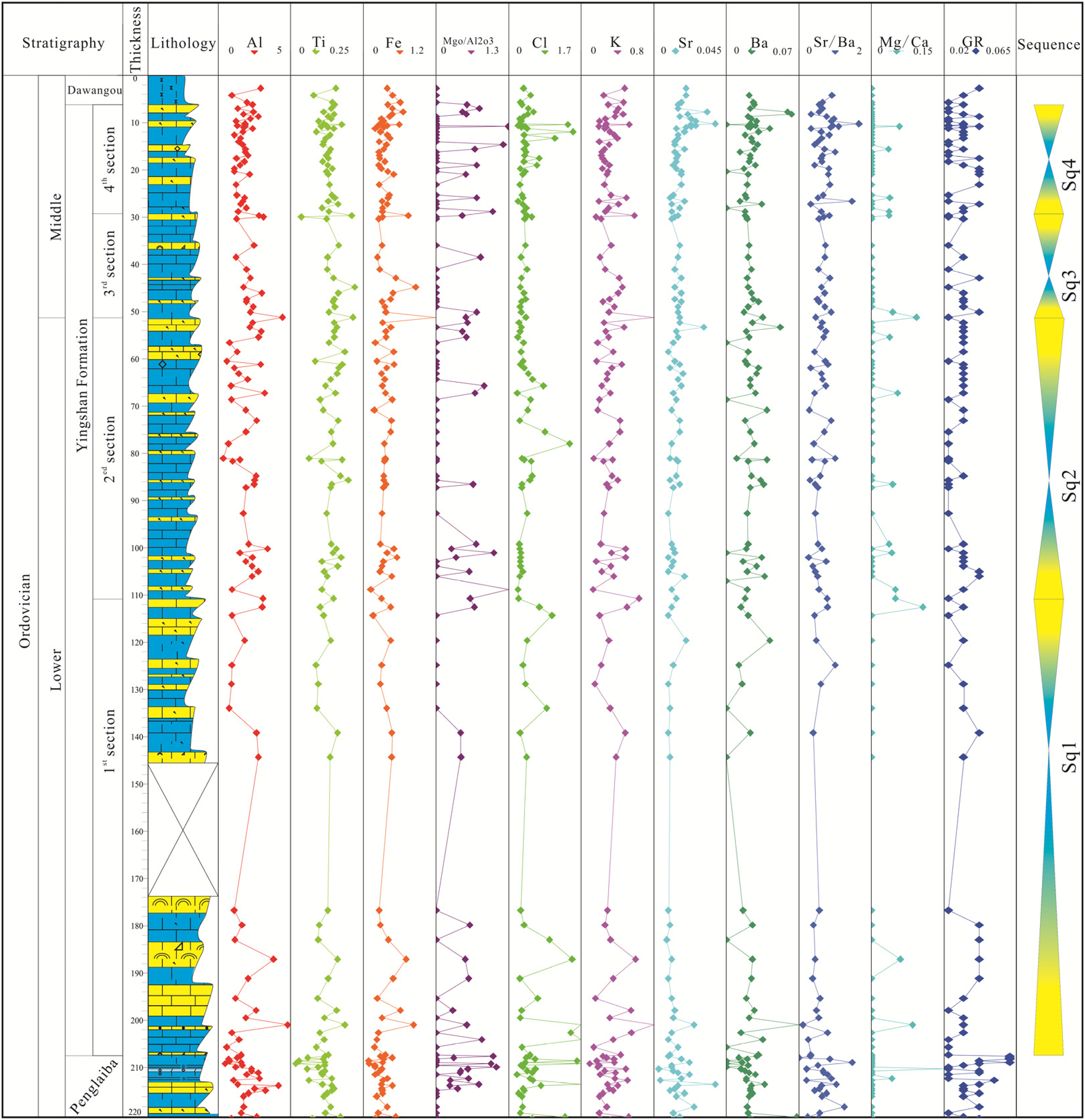
The trace elements characteristics of Middle-Lower Ordovician Yingshan Formation in Shuinichang section. Symbols are as in Figure 6.
The implication on the depositional sequences
Sequence boundaries
In addition to the analyses of facies, carbon and oxygen isotope values, two third-order sequences (SQ1 and SQ2) and four fourth-order sequences (Sq1, Sq2, Sq3, and Sq4) were studied in the Yingshan Formation (Figure 6).
The top and bottom of Yingshan Formation (sb1 and sb5) are both identified as third-order sequence boundaries (Lin et al., 2012; Zhao, 2015; Zhao et al., 2009). Gao et al. (2016) described the unconformity (Sb1) located between the carbonate dominated Lower Ordovician Penglaiba and Yingshan Formation and discussed the implications for reservoir development.
Sb3 has generally been relatively less studied compared to Sb1 and Sb2, due to the difficulty of identifying without a clear angular contact relationship. When the δ18O > −10% and there is no obvious linear relationship between δ13C and δ18O, the sample can reflect the original sedimentary characteristics (Kaufman and Knoll, 1995; Kaufman et al., 1993). The δ13C and δ18O are both meet conditions in this research. In peritidal carbonate, δ13C values are ranging mostly from −4.2‰ to −1.9‰, while in subtidal carbonate, δ13C values (−1.5‰ to −0.3‰) are higher than the peritidal carbonate (Table 1 and Figure 6). The upper part of Yingshan Formation exhibits a positive shift of δ13C values, which is consistent with the deepening-upward deposits and the changes from the peritidal carbonate to subtidal carbonate. The gamma ray curve exhibits high variability, and slightly higher in the lower section relative to the upper section. It is stable low GR value in the upper section. This kind of gamma ray pattern indicates the stable large set of limestone deposits in the upper section and interbedding of limestone and dolomite in the lower section. Below the fourth sequence boundary, with the sea-level falling after carbonate deposition, some textures such as solution voids and dolomitization are recognized from the core samples.
The high-frequency sequence stratigraphy
The Yingshan Formation is characterized by repeated shallowing-upward meter-scale cycles, with thickness ranged from 0.3 to 10 m averaging at 2.1 m. It is mainly two kinds of small-scale depositional sequences identified from their lithofacies evolution (Figure 9): (A, B) peritidal sequences, and (C, D) subtidal sequences. The distribution of four types of meter-scale cycles shows a general change from peritidal to subtidal.
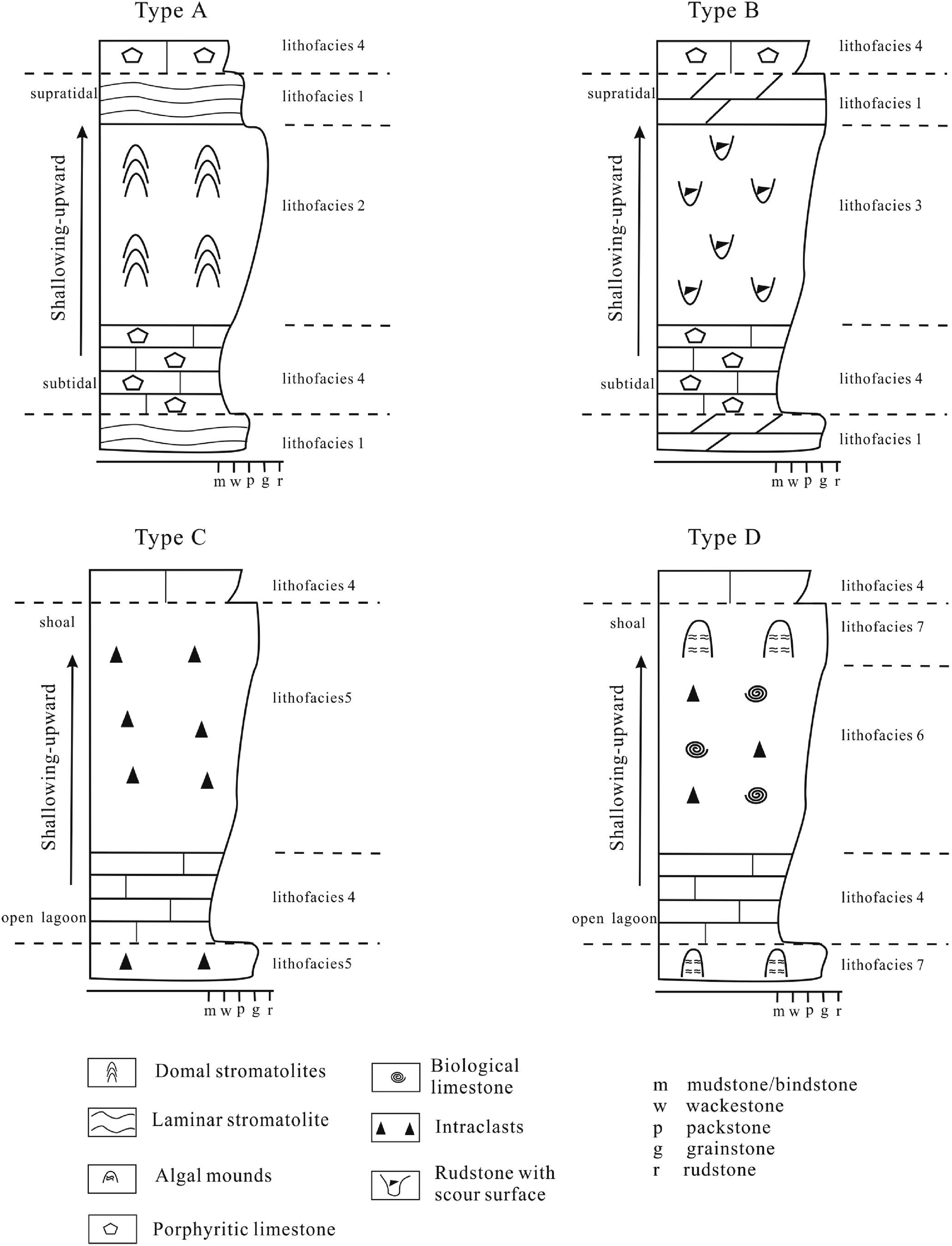
Sketch showing lithofacies evolution of the two types of shallowing-upward, small-scale, depositional sequences identified in the Yingshan Formation in Tahe area.
Peritidal carbonate
The peritidal cycles are dominant in the lower part of the Yingshan Formation. Type A meter-scale cycle has porohyritic fenestral wackestone at the base that is overlain by domal stromatolitic bindstones, and capped with laminar stromatolitic bindstones (Figure 9(a)). Type B meter-scale cycle has porohyritic fenestral wackestone at the base that is overlain by intraclastic rudstone, and capped with algal dolomite (Figure 9(b)). The gamma curve exhibits high variability, and gamma value is higher in the lower section relative to the upper section.
Subtidal carbonate
The upper part of the Yingshan Formation mainly develops shallow subtidal cycles. Type C meter-scale cycle has wackstone/micrite at the base that is overlain by intraclasts (Figure 9(c)). Type D meter-scale cycle has wackstone/micrite at the base that is overlain by intraclasts and bioclastic limestone, with algal mounds caps (Figure 9(d)).
In subtidal sequence, the interbank sea facies are followed by grainstone dominated shoal facies. It shows an upward-shallowing parasequence, which are mainly developed in Sq3 and Sq4. The sediment of the interbank sea facies was dominated by micrite, and mainly calcarenite in shoal facies.
Two third-order depositional sequences (SQ1 and SQ2) are identified on the basis of sequence boundaries and cycle stacking patterns, as revealed by Fischer plots.
Sequence 1 (SQ1): In Xiaoerbulake section, the sequence is characterized by an overall falling slope in the Fischer plots (Figure 10), indicating a long-term accumulation, with occasionally decreases in accommodation space (Zhang et al., 2015). The interbedding of intraclasts and micrites is common. Type A and B meter-scale cycles reflect the intertidal–tidal sedimentary environment. Sequence boundaries of peritidal sequences reflect corresponding sharp surfaces with subaerial exposure. A facies succession from lagoon into tidal-flat facies characterize the stacking pattern of peritidal sequence. The dolomites develop well with the interbeds of the limestones, showing the restricted setting.
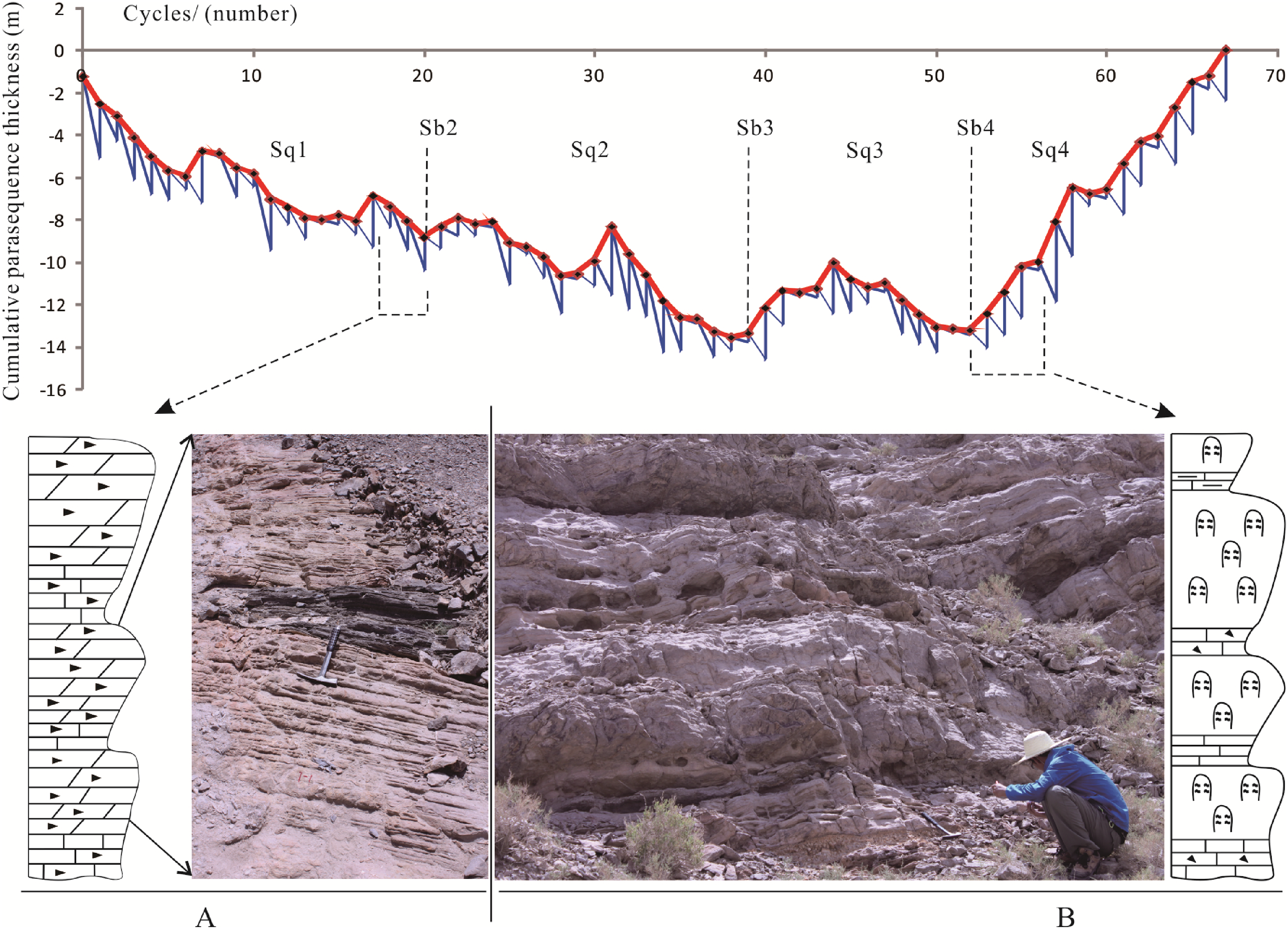
Fischer plots of cycle stacking patterns in the Yingshan Formation from Xiaoerbulake section in Keping area. A: Interbedding of intraclasts and micrites, showing prografation. B: Interbedding of micrites and algal bindstone, showing retrogradation.
Sequence 2 (SQ2): The sequence is characterized by an overall rising slope in the Fischer plots (Figure 10), indicating a long-term cumulative, although occasionally, increase in accommodation space (Zhang et al., 2015). Compared to the lower sequence (SQ1), this sequence is dominated by shallow subtidal facies, so that they are mainly composed of thicker cycles with thickness up to 10 m locally.
The upper part of Yingshan Formation exhibits a positive shift of δ13C values, showing the transgressive event (Immenhauser et al., 2002, 2003), which is consistent with the changes of the sedimentary setting from restricted platform to open platform. The distribution of the four meter-scale cycle types also show a general change from peritidal setting to open-marine subtidal setting in Yingshan Formation.
Under the constraints of the biostratigraphic framework, the cycles in Ordovician is comparable to the sea-level change curve of Haq and Schutter (2008) (Lin et al., 2012) (Figure 11). That also applies to the Yingshan Formation, which show sedimentary sequence in research area is mainly controlled by global sea-level change. The carbon isotopes shifting is consistent with the sea-level change.
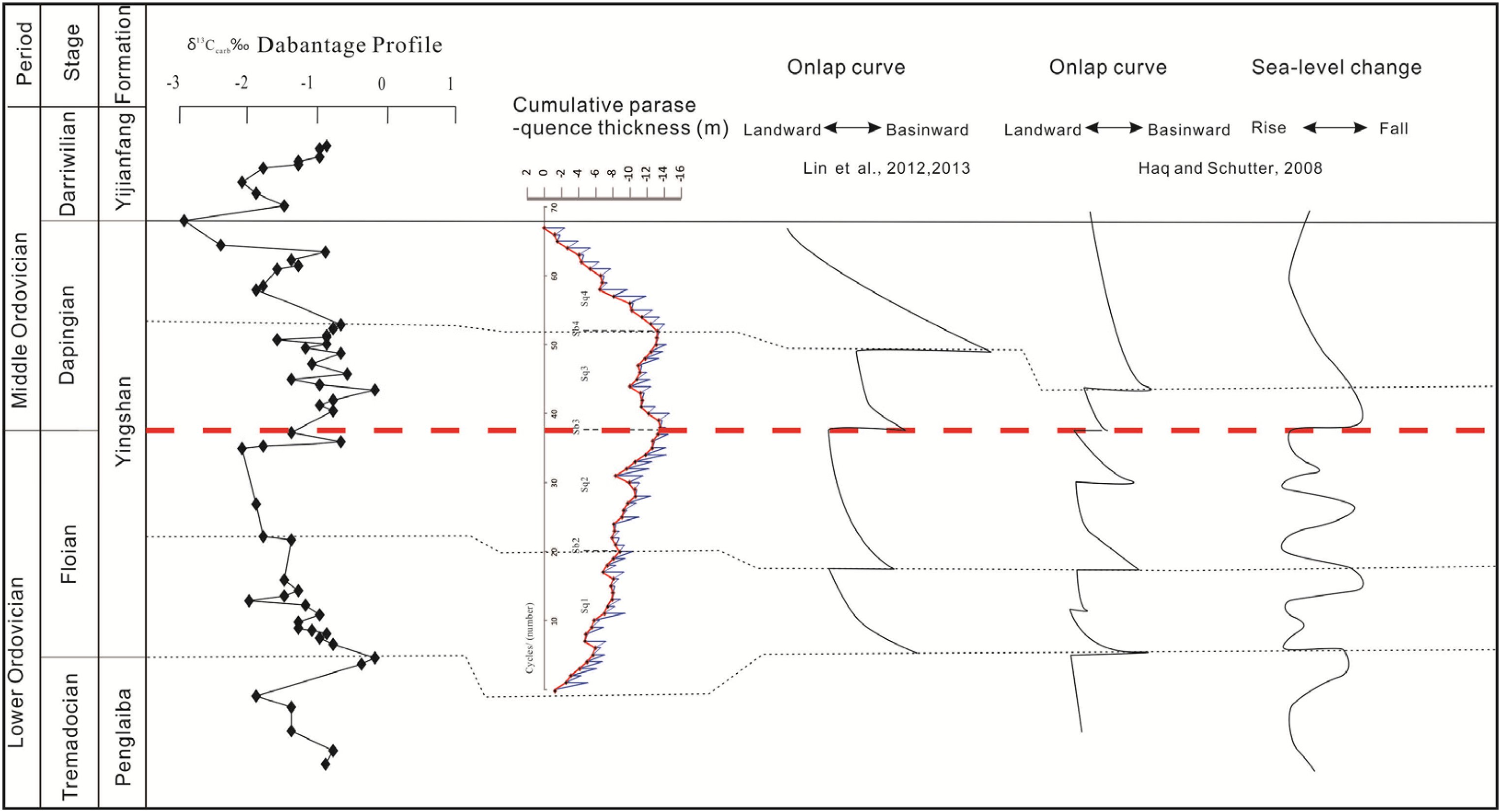
Correlation of δ13C data from Dabantage profile (Yang et al., 2021), Fischer plots of cycle stacking patterns from Xiaoerbulake profile, and sea-level onlap curves (Haq and Schutter, 2008; Lin et al., 2012).
Implications for potential reservoirs
Carbonate reservoirs are obviously controlled by the high-frequency sequence and sedimentation (Sequero et al., 2019). In the peritidal cycles, intraclastic rudstone, algal dolomite, and algal dolomite can serve as prospective reservoirs, and in the subtidal cycles, grainstone and bioclastic limestone, with algal mounds caps are more porous and thus can host petroleum. Microbialites commonly occur in the peritidal cycle, and there is a positive correlation between sorting coefficient and porosity in the microbialite facies (Hu et al., 2023).
The Yingshan Formation is an important hydrocarbon reservoir of the Tarim Basin (Qi, 2016; Wang et al., 2023). The oils in Ordovician reservoirs were derived from the Lower Cambrian source rock (Cai et al., 2009, 2015, 2016). There are three stages of hydrocarbon charging in the Yingshan Formation in Tahe area, including the late Caledonian, late Hercynian and late Himalayan (Ye, 2019). Intergranular pores, intercrystalline pores, dissolution pores, and fractures are the main reservoir space. Cementation was the main cause of reservoir deterioration (Shi et al., 2020). The high-energy facies are commonly exposed at the low sea level and go through dissolution and leaching, therefore, become favorable reservoirs in the high-frequency cycles (Wang et al., 2022). The high-energy facies with late dissolution diagenesis are the favorable reservoir facies belts for exploration.
Conclusions
Seven typical lithofacies (L1–L7) are identified and interpreted to occur in shallow subtidal, intertidal and supratidal environments in a carbonate platform system. In the peritidal carbonate deposition, characterizing the low sea level, the deposit sediments are mainly laminar stromatolitic bindstones, domal stromatolitic bindstones, intraclastic rudstone, porohyritic fenestral wackestone. In the upper subtidal carbonate deposition, sediments give priority to intraclastic packstone/grainstone, bioclastic grainstone, and mound-shaped algal bindstone with the rise of the relative sea level.
Subtidal and peritidal cycles are defined as two main types of meter-scale cycles in the Yingshan Formation. Peritidal cycles of intertidal-supratidal facies (types A and B) are predominant especially in the lower part of the Yingshan Formation. Shallow subtidal cycles (types C and D) mainly occur in the upper part of the Yingshan Formation. On the basis of the analyses of facies, connect with the carbon and oxygen isotope values, two third-order sequences and four fourth-order sequences (Sq1, Sq2, Sq3, and Sq4) were identified in the Yingshan Formation. The distribution of the four types of meter cycles shows a general change from peritidal setting to subtidal setting through the Yingshan Formation.
The recognized depositional sequences correlate well with those in coeval Middle-Lower Ordovician Yingshan successions elsewhere in the world. It indicates that the identified sequences are controlled by the third-order eustasy. It is the high-frequency eustatic sea-level fluctuation that resulted in the high-frequency, meter-scale, and shallowing-upward cycles.
Footnotes
Declaration of conflicting interests
The authors declared no potential conflicts of interest with respect to the research, authorship, and/or publication of this article.
Funding
The authors disclosed receipt of the following financial support for the research, authorship, and/or publication of this article: This work was supported by the Project of Science and Technology Department of China Petroleum and Chemical Corporation Limited (grant number P22122), and the National Natural Science Foundation of China (grant number 41802134).
