



Abstract
To investigate the development laws and genesis of the Maokou Formation dolomite in the Fengdu-Shizhu area, we analyzed core, thin section, logging, and geochemical data, and obtained the following understandings: 1. The Maokou Formation dolomite includes layered granular dolomite and leopard-spotted limy dolomite which are fine to medium, and moderately euhedral, and have intergranular pores and intergranular dissolved pores; 2. Vertically, the dolomite is the superimposition of multiple stages, 3–12 m a layer and cumulatively up to 30 m. The distribution of the dolomite is controlled by sedimentary cycles and is commonly found in the middle and upper parts of the cycle; 3. The analysis of rare earth distribution and carbon, oxygen, and strontium isotopes indicates that the dolomitizing fluid is the penecontemporaneous saline seawater, and some pore edges were affected by later hydrothermal dolomitization, resulting in recrystallization of dolomite and cementation of saddle-like dolomite; 4. The relationship between the plane distribution of the dolomite and the paleogeographic pattern during the sedimentary period indicates that the dolomite is concentrated in the granular shoals near geomorphic highlands and slope break zones. In summary, it is proposed that the overlap and migration of granular shoals and isolated seawater promoted the occurrence of reflux infiltration of dolomitizing fluid and dolomitization. Multistage granular shoals on the platform margin provide a good material foundation for the development of dolomite. Karstification is conducive to the occurrence of early dolomitization within the shoals and the preservation of pores. It is found that the early dolomite of the Maokou Formation is best developed in the highlands of faults 15 and 16. The basement faults controlled the sedimentary paleogeomorphology, thereby restricting the distribution of dolomite. This understanding provides a new idea for the exploration of dolomite in the Maokou Formation in the Sichuan Basin.
Introduction
In recent years, Maokou Formation dolomite reservoirs have been discovered in many areas in the Sichuan Basin (Yang et al., 2015; Zhang et al., 2022; He et al., 2023; Huang et al., 2023; Yin et al., 2023), and various wells have produced high gas flow from them, making Maokou Formation dolomite reservoirs a new exploration hotspot after fractured and fractured vuggy limestone reservoirs (Xiao et al., 2014, Xiao et al., 2015, Huang et al., 2019, Hao et al., 2020, Wang et al., 2022, Zhang et al., 2022, Zhu et al., 2024). Frequent success of high-yield wells drilled in the Maokou Formation in the eastern Sichuan Basin for many years demonstrates an enormous exploration potential. With deep exploration and development in the study area, differences appear between new drilling results and early research results. Unclear understandings of the distribution and genesis of the dolomite are still existent, which makes it difficult to guide hydrocarbon exploration. In terms of distribution, the dolomite belt on Fault 15 (Yang et al., 2015) is large and continuous. However, regional comparison on a smaller scale found that there are significant differences in the development of dolomite in different regions. Exploration wells Jiaotan 1 and Nanchong 1 obtained good results in the Bajiaochang-Nanchong area where the dolomite is relatively developed in the platform margin shoal. However, the distribution of dolomite in the eastern part is strongly heterogeneous, so it is urgent for further research. In terms of genesis, recent studies proposed two mainstream views. The first view suggests that the dolomitization of the Maokou Formation is mainly controlled by the upward emplacement of hydrothermal fluid caused by tectonic movements (Hu et al., 2016, Liu et al., 2016, Tang et al., 2016, Li et al., 2021). The second suggests that the dolomite was formed in multiple stages and by multiple diagenetic fluids (Li et al., 2021, Li et al., 2021, Wang et al., 2022, Zhu et al., 2022 ). In addition, early research proposed other viewpoints such as burial dolomitization (Wang et al., 2016), basalt leaching dolomitization (Jin and Feng, 1999), hydrothermal sedimentary dolomitization (Li et al., 2013, Wang et al., 2014), mixed water dolomitization (Yunsheng and Yizhong, 1997), and early seawater dolomitization (Zhou et al., 2019).
To investigate the strong heterogeneity, unclear distribution, and genetic mechanisms of the dolomite in the Maokou Formation in the Fengdu-Shizhu area, this paper analyzes the relationship between the distribution of Maokou Formation dolomite and sedimentary facies from the perspectives of petrology, geochemistry, and distribution in more than 30 wells and outcrops in the study area and proposes the distribution style and genetic model. It is expected that our findings provide new ideas for the exploration of dolomite in the Maokou Formation in eastern Sichuan Basin.
Geological background
The main part of the study area is located in the Fengdu-Shizhu-Zhongxian area, with a total area of approximately 8000 km2. The regional structure in the study area is sandwiched between the Qinling orogenic belt and the Jiangnan fold belt, located in the transitional zone between the eastern Sichuan barrier fold and the western Hunan trough fold. It is adjacent to the Qiyueshan structural belt to the east across the Shizhu syncline, and adjacent to the Zhongxian-Fengdu syncline and the Dachi-Ganjing structural belt to the west (Figure 1).
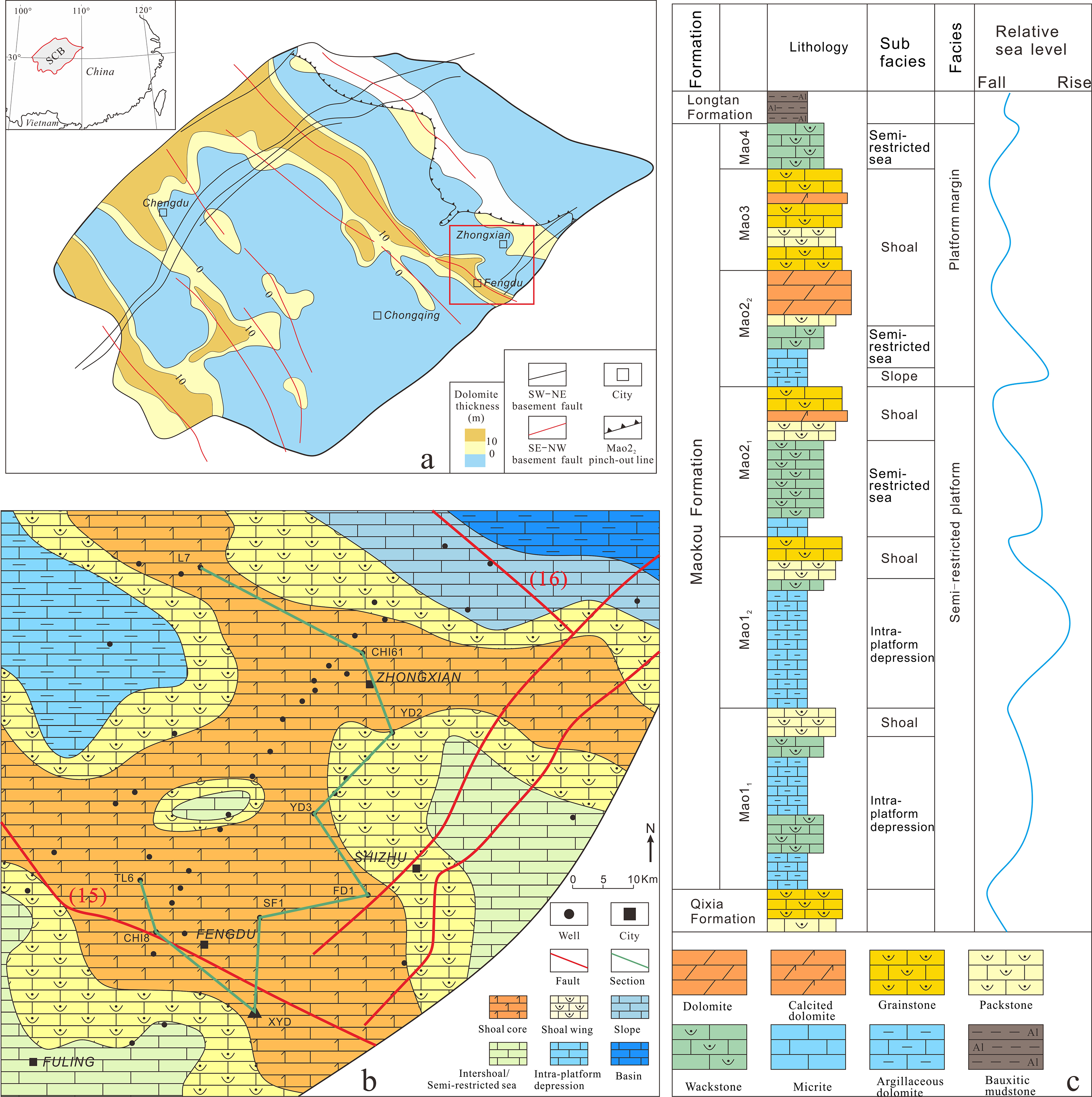
(a) Thickness contours of Maokou Formation dolomite (Yang et al., 2015) (adapted from Yang et al., 2015); (b) The sedimentary facies of Mao 22 + Mao 3; (c) Composite column of Maokou Formation in Fengdu-Shizhu area.
Before the Permian, the Yunnan Movement caused the Sichuan Basin to uplift and begin to experience exposure and erosion. In the early Permian, extensive transgression from east to west resulted in rapid deposition of Qixia Formation marine carbonate rocks in the eastern Sichuan Basin after the Liangshan Formation marine-continental transitional facies. At that time, due to tectonic movements, the sedimentary distribution mainly struck NE, supplemented by alternate occurrences of uplifts and depressions striking SE. In the early deposition of the Maokou Formation, as the sea level rose, Mao 1 + Mao 21 was a rhythm of limestone and marlite, with siliceous nodules or siliceous strips locally. Upwardly, it turned into bioclastic micrite limestone or micrite bioclastic limestone, but dolomite was relatively rare. The sedimentary pattern of Mao 22 + Mao 3 transformed into platform-depression differentiation. Dolomite was developed on the platform margin shoals trending NW-SE between Fault No.15 and Fault No.16 fault zones in the study area. Mao 4 was exposed and eroded at the top, leaving the middle and lower parts mainly composed of mudstone and granular limestone.
Samples and method
This study is mainly based on the data of the cutting samples taken from Well DF1, SF1, YD3, YD2, and field samples from the Xueyudong (abbr. XYD) outcrop (Figure 1(a)). About 325 thin sections were observed and described. The cathode luminescence (CL) was completed in the School of Geoscience and Technology, Southwest Petroleum University, China, by using the CL8200 MK5 CL microscope under the working mode of 7–10 kV and 400–500 mA. The carbon and oxygen isotope, strontium isotope, and rare earth element (REE) analysis were done in the Southwest Petroleum University division of Key Laboratory of Carbonate Reservoirs, CNPC, by using the MAT 253 Plus mass spectrometer, MC-ICP-MS and LA-ICP-MS (NWR193UC with Agilent 7800), respectively.
Characteristics of dolomite
According to the macroscopic occurrence and microscopic characteristics, there are layered granular dolomite, dolomitic limestone/limy dolomite, and saddle-like dolostone in the study area.
Layered granular dolomite
Granular dolomite is the primary type of dolomite in the study area, mainly composed of fine-medium crystalline dolostone (Figure 2(a) and (b)). Macroscopically, it is gray-white to dark gray, with visible dissolution channels. Rocks and surrounding rocks in the channels are dolomitized, and small dissolution pores (<3 mm) are visible. Microscopically, the particle size is in the range of 0.1–0.4 mm and is mainly semi-euhedral, with residual bioclastics larger than 0.5 mm occasionally. Karst pores (vugs) are found, 0.2–1.5 mm. Larger karst vugs are mostly filled with saddle-like dolomite or calcite, with rare debris remnants and particle illusions. Dolostone in some zones has been severely eroded. Macroscopically, evident dissolved strips can be observed, but the microscopic crystal structure is relatively incomplete (Figure 2(c)–(e)). Small eroded particle residues can be seen between crystals, and dissolution pores, about 0.1 mm, are developed in these dissolution fabrics. Clear estuary dissolution can be seen around pores. These pores are almost not filled and with fewer particle illusions.
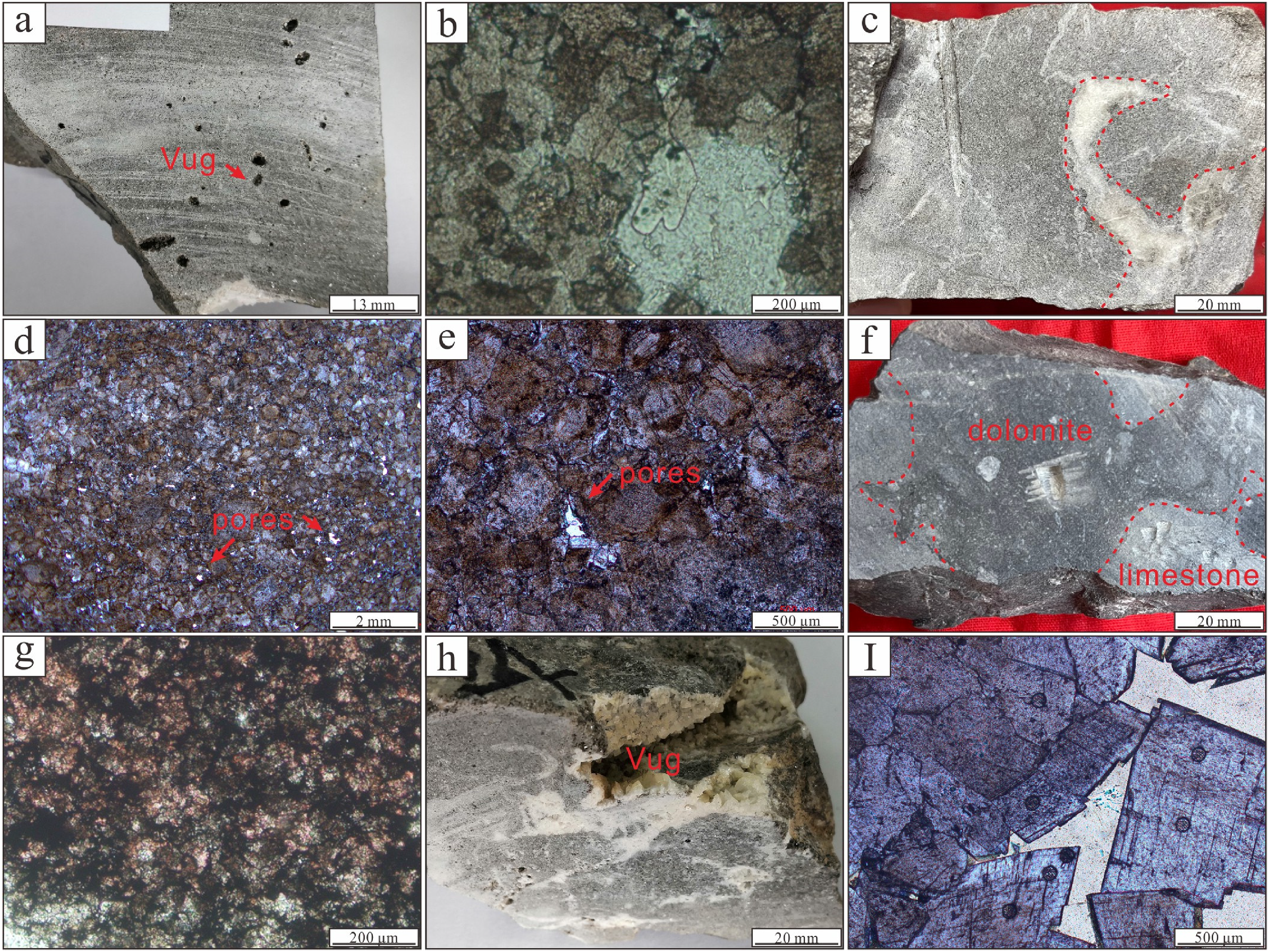
Petrological characteristics of dolomite. (a) Fine-medium crystalline dolomite, XYD Section, Mao 22, field rock sample; (b) Fine crystalline dolomite, 4766 m, Well FD1, Mao 3, thin core section; (c) Fine-medium karstified dolomite, XYD Section, Mao 22; (d) Pores in fine-medium karstified dolomite, XYD Section, Mao 22, thin field rock section; (e) Fine-medium karstified dolomite with evident dissolved strips, XYD Section, Mao 22, thin field rock section; (f) Dolomitized limestone, XYD Section, Mao 22, field rock sample; (g) Dolomitized limestone, 4822 m, Well FD1, Mao 3, thin core section; (h) Saddle-like dolostone, XYD Section, Mao 22, thin field rock section.
Spotted dolomitic limestone/limy dolomite
Spotted dolomitic limestone/limy dolomite is a transitional rock between limestone and dolomite and can be divided into spotted dolomitic limestone or limy dolomite according to the degree of dolomitization. Macroscopically, it appears dark gray with evident patch structures (Figure 2(f)). Fine crystalline dolostone is developed in areas with a high degree of dolomitization, with semi-euhedral or anhedral shapes and well-developed pores. But the pores are mostly filled with late saddle-like dolostone or calcite, and there are fewer biological debris and particle illusions. The areas with a low degree of dolomitization are mainly composed of crystalline dolostone, euhedral to semi-euhedral. There are many organic, muddy, and gray bioclastic particles filled among the crystals (Figure 2(g)). The surrounding rock is mainly composed of bright crystalline bioclastic limestone and muddy crystalline bioclastic limestone, without evident karst transformation. There are a few fractures, but some of them are severely crystallized, and the biological types are difficult to identify.
Saddle-like dolostone
Saddle-like dolostone is usually filled with cement in the pores and fractures in matrix dolomite. Macroscopically, it is white or grayish-white semitransparent crystals (Figure 2(h)), some with abundant occurrence space, indicating the development of crystal clusters (Figure 2(i)). Microscopically, it is medium- to coarse-grained dolostone. The particles are larger than 0.5 mm and very euhedral, and the crystal surface is relatively curved. Wavy extinction can be observed under cross-polarized light.
Distribution characteristics of dolomite
Vertical and horizontal distribution
Based on the petrological characteristics of field sections and cores, it is found that the lithology of the Maokou Formation is complex and covers multiple sedimentary sequences consisting of micrite limestone, bioclastic micrite limestone, micritic bioclastic limestone, and sparry bioclastic limestone, and showing the characteristics of being shallow and increasing hydraulic energy conditions, from the bottom to the top. The shoal at the top of the cycles in Mao 22 and Mao 3 was exposed to the sea level as a geomorphic highland under the influence of frequent regression and has been transformed by penecontemporaneous karstification. Previous studies have shown that carbon and oxygen isotopes are significantly negatively deviated when limestone is karstified (Li et al., 2020, Hu et al., 2020). Subjected to karstification, the carbon and oxygen isotopes are negatively deviated in the cycles of Mao 22 and Mao 3. This indicates that the time of karstification was controlled by sea-level fluctuation, resulting in penecontemporaneous exposure of karst. Early studies generally believed that large-scale early diagenetic or epigenetic karstification happened in the late depositional stage of the Maokou Formation, but they did not pay sufficient attention to the multiple internal episodes of exposed karst. The penecontemporaneous karst system can be seen at the top granular shoals in the multiple cycles in Mao 22 and Mao 3, with evident penecontemporaneous karst phenomena such as dissolution channels and dissolution pores. In the area with wide dissolution, large layered granular dolomite was developed, but locally, dolomitization took place only in the dissolution channels, resulting in coexistent spotted dolomite and limy limestone (Figure 3).
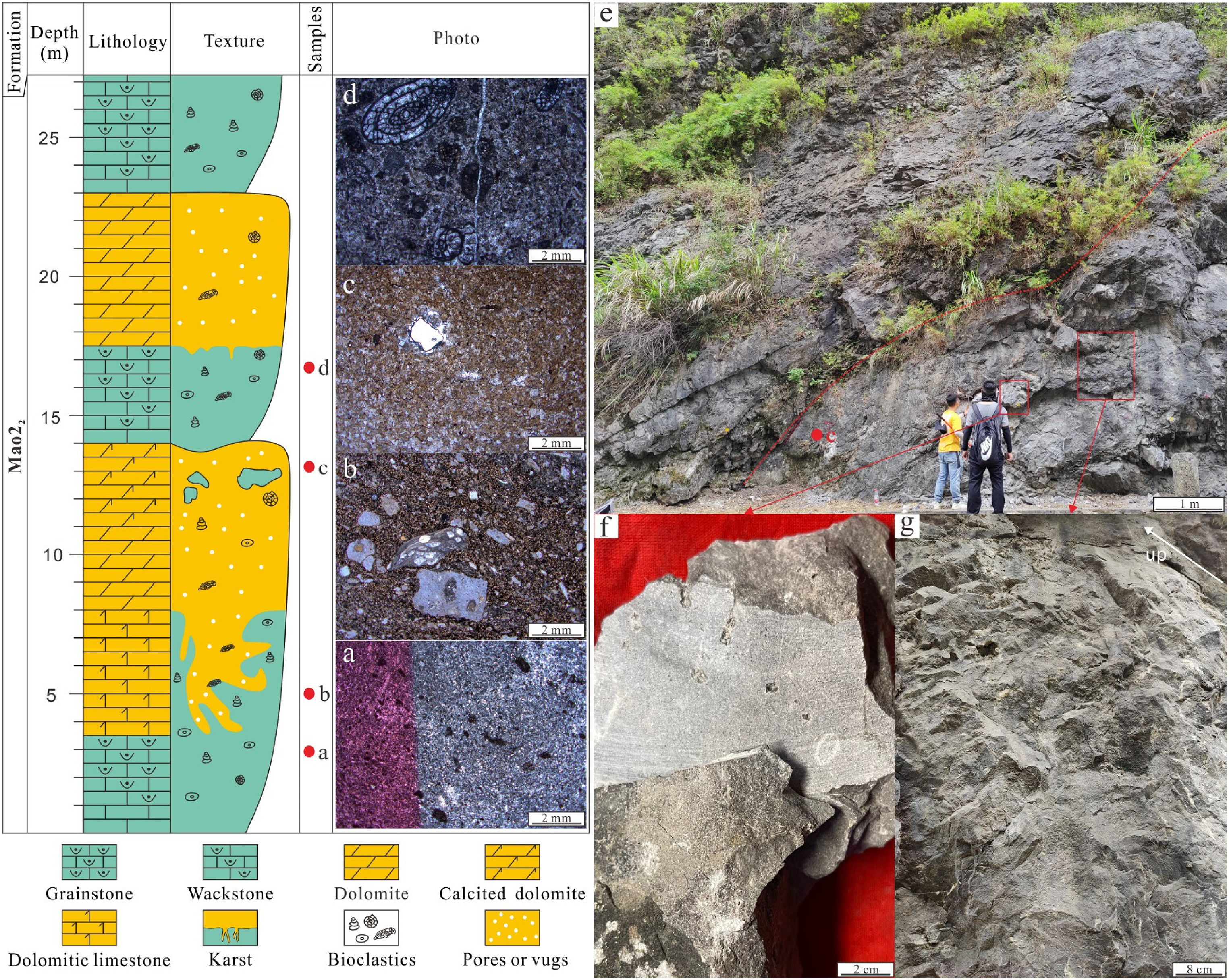
Vertical development of XYD dolomite. (a) Grainstone; (b) Fine crystalline dolomite, dolomitic karst system; (c) Fine-medium karstified dolomite; (d) Grainstone; (e) Macrofeature of vertical development of XYD dolomite, upward shallower granular shoal cycle with characteristics by uplift; (f) Vuggy dolomite; (g) Dolomitic karst system penetrating into the rocks.
The thickness and development scale of dolomite in Mao 22 are large (3–12 m a layer) and very continuous. Vertically, 2–5 m dolomite layers are developed, and 2–30 m thick in total. Layered dolomite is found in the dolomitized shoal in the XYD-Tailai area (Figure 4). The development of dolomite in Mao 3 is relatively independent, and the horizontal continuity is poor. There are 1–3 thin dolomite layers around Well TL6 and Well SF1. No dolomite or only small-scale spotted dolomitized limestone/limy dolomite are developed in other formations, but they rapidly become thin at the margin of the granular shoal.
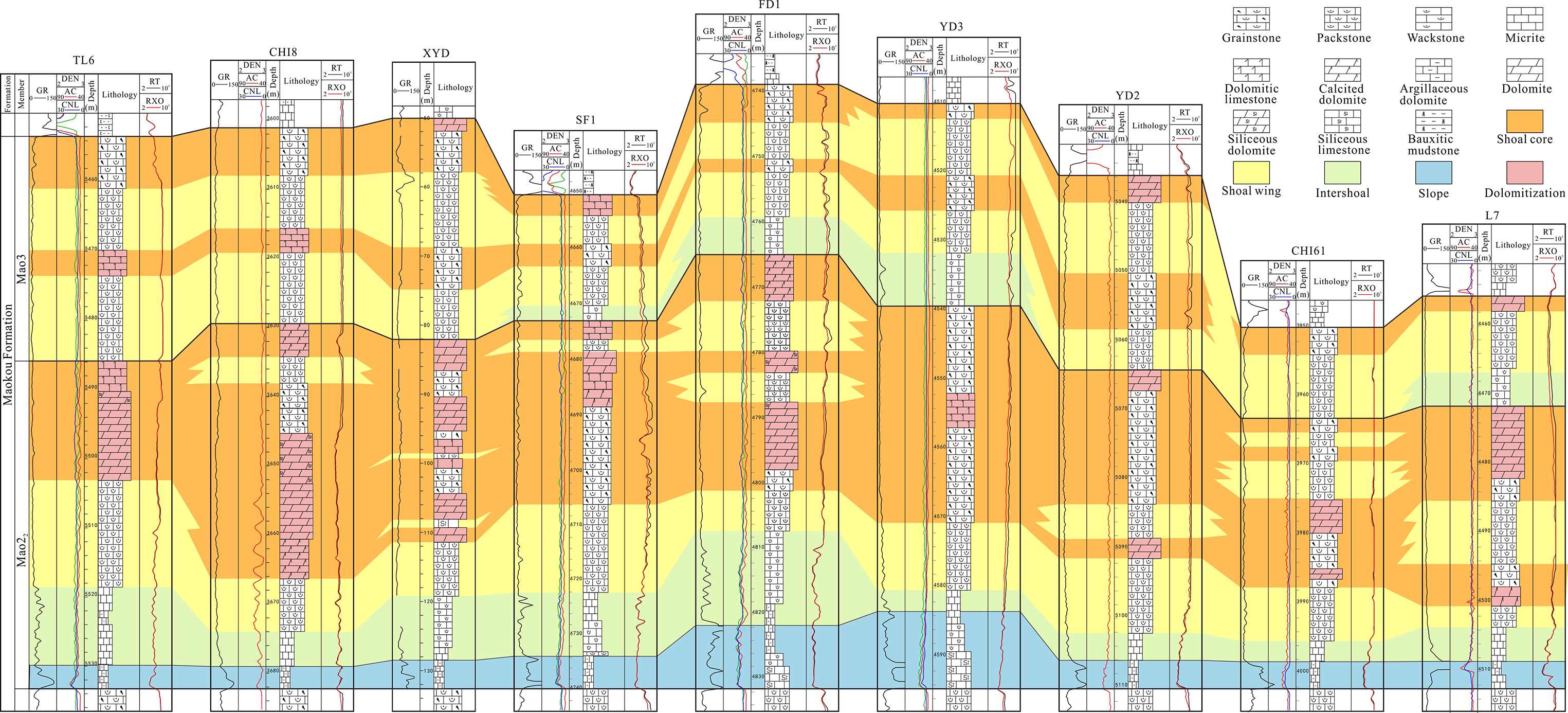
Dolomite on well-tie profile in Mao 22 and Mao 3. Caption of well logs: GR, gamma ray curve; DEN, density curve; AC, acoustic curve; CNL, compensated neutron log curve; RT, true formation resistivity curve; RXO, flushed zone formation resistivity curve.
In summary, dolomite is mainly concentrated in the granular shoals in Mao 22 and Mao 3, which may be suitable for the formation of dolomite.
Plane distribution
According to the core, logging and geochemical data from wells, and the statistics of the development of dolomite, the planar distribution characteristics of dolomite in the Maokou Formation in the Fengdu Shizhu area were analyzed (Figure 5). The dolomite is widely developed in Mao 22 + Mao 3. On plane, the dolomite is best developed in the No. 15 fault zone, and on a large scale in the No. 16 fault zone in the southern part of Zhongxian area, generally showing NW-SE distribution. The distribution pattern is similar to the NW-SE trending platform slope break zone formed under the influence of northeast tensile stress, indicating a close relationship between the development of dolomite and the paleogeographic pattern.
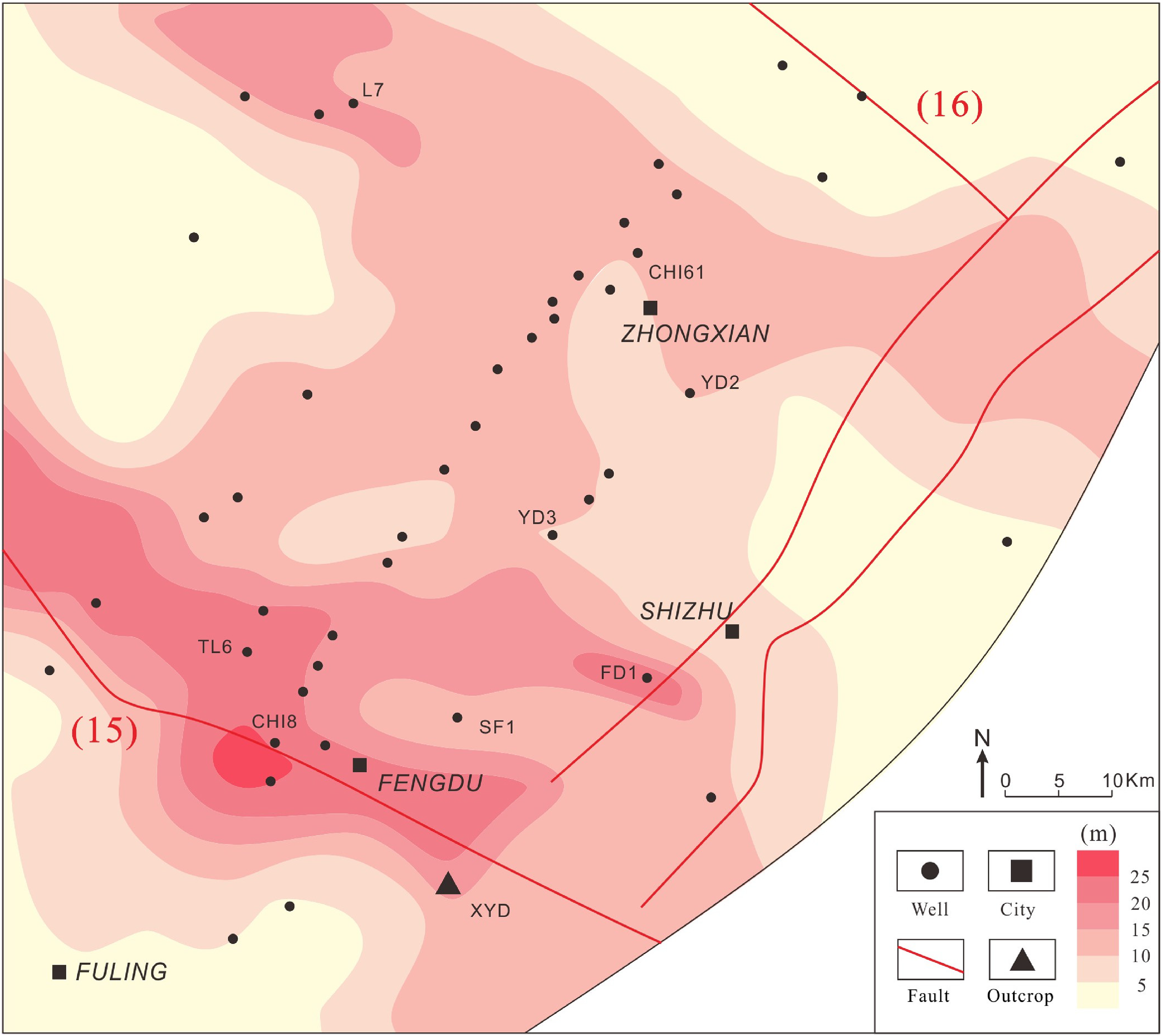
Distribution of dolomite thickness.
Origin of dolomite
Source of dolomitizing fluids
According to the distribution curves of the REEs with PAAS-normalized (Mclennan, 1989) of limestone and dolostone (Figure 6), both of these rock types exhibit left-leaning characteristics, and some exhibit positive Eu anomalies. Specifically, the distribution pattern of fine dolostone and fine dolostone in spotted dolomitic limestone is similar to that of limestone, characterized by negative Ce anomalies, loss of light REEs, and enrichment of heavy REEs. Coarse saddle-like dolostone (XYD-12, 13, 14) in some pores is accompanied by a positive anomaly of Eu based on a left-leaning pattern, δEu is 1.56, 1.58, and 1.43, respectively, higher than those of limestone (average value δEu = 0.92), spotted dolomitized limestone (average value δEu = 0.98), and granular dolomite (average value δEu = 0.87). However, the average Y/Ho ratios of powdered-fine crystalline dolostone and saddle-like dolomite in leopard-spotted limestone are close to the average Y/Ho ratio of limestone, all in the range of 44–72 representing marine sedimentation. The Y/Ho ratio of every sample is 57–74, with an average of 65. In addition, Ce can be used to judge the redox condition of ancient seawater. The average δCe of dolomite (including dolostone in dolomitic limestone and fine-medium dolostone) and saddle-like dolostone are 0.45 and 0.49, respectively, more negatively deviated than limestone, 0.43. δPr reflects the degree of Ce anomaly. δPr > 1 represents the negative anomaly of Ce. The average δPr of dolomitic rock, saddle-like dolostone, and limestone are 1.33, 1.29, and 1.33, respectively. The carbon and oxygen isotopes of limestone indicate the original seawater environment. As shown in Figure 7, the δ18O of crystalline dolomite (including dolostone in dolomitic limestone and fine-medium dolostone) is slightly more positively deviated than limestone, −8.01‰ to −6.73‰, and −7.30‰ on average (Figure 7 left). The 87Sr/86Sr ratio of most granular dolomite and spotted dolomitic limestone samples is similar to that of limestone, 0.707198–0.707533, in the Maokou Formation in eastern Sichuan Basin (Figure 7 right). The 87Sr/86Sr ratio of saddle-like dolostone samples is higher than that of seawater (Korte et al., 2006).
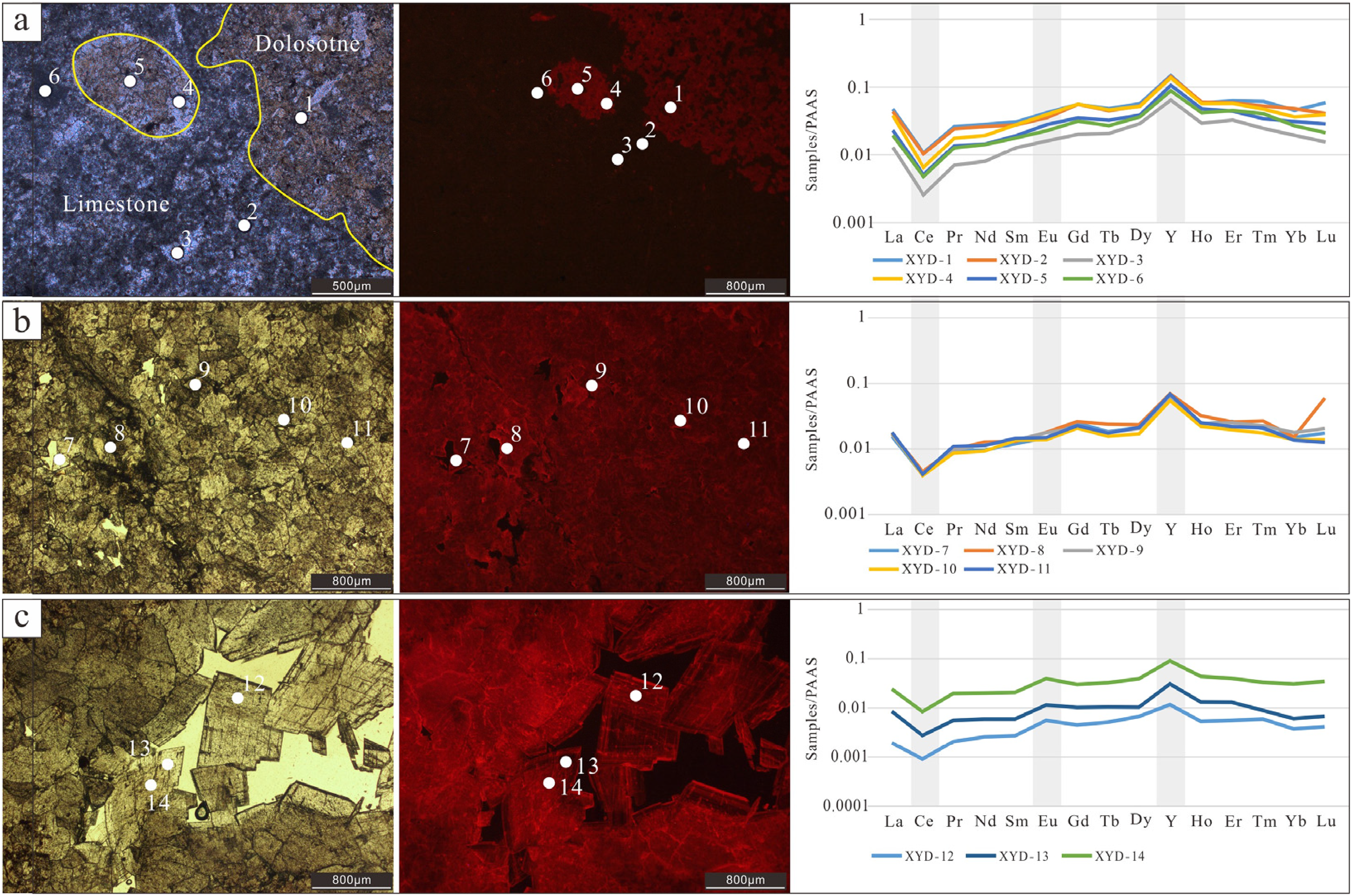
Cathodoluminescence and rare earth distribution of different types of dolomites. (a) Dolomitic limestone, XYD section; (b) Layered crystalline dolomite, XYD section; (c) Saddle-like dolostone, XYD section.
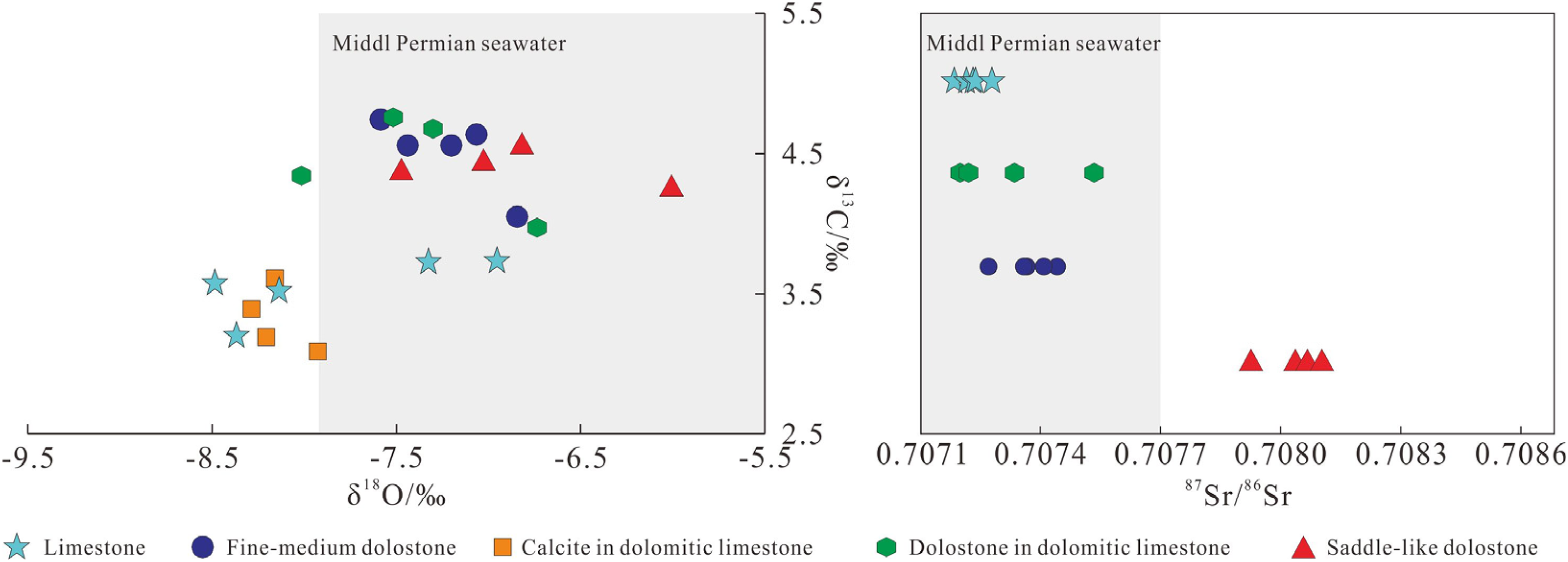
Scatters of carbon, oxygen, and strontium isotopes.
Based on the REE distribution curves and characteristics of each rock type mentioned above, it is found that the properties of the diagenetic fluid in the leopard-spotted dolomite are similar to those of limestone, indicating that the fluid source may be contemporaneous seawater. The saddle-like dolostone cement in the pores has a positive Eu anomaly and leans leftward. Some coarse to medium dolostone with bright edges also have slightly positive Eu anomaly, indicating that high-temperature hydrothermal fluid was involved in the modification of early marine dolostone. The slight modification indicates that hydrothermal fluid was not the primary diagenetic fluid. Negative δCe anomaly and Pr > 1 indicate that the environment for depositing dolomite was near-surface seawater with rich oxygen. In addition, the carbon, oxygen, and strontium isotope ratios of limestone are often considered to represent the seawater conditions at that time. The distribution of δ18O in granular dolomite is positive compared to limestone, indicating that the limited seawater is the main diagenetic fluid. The strontium isotope ratio of most granular dolomite is similar to that of limestone. The formation of granular dolomite should be related to early salinized seawater, but part of the dolomite was affected by hydrothermal conditions. It may be close to the hydrothermal channel and affected by high-temperature and high-strontium seawater surging up from the bottom, resulting in recrystallization and a higher 87Sr/86Sr ratio. In dolomitized limestone, the distribution of δ18O, δ13C, and 87Sr/86Sr ratio in the limy part is similar to that of limestone, while the distribution in the dolomitic part is similar to that of layered granular dolomite. This indicates that the dolomitizing fluid in dolomitized limestone is also related to seawater, similar to granular dolomite. The carbon and oxygen isotopes of saddle-like dolostone are similar to those of early crystalline dolostone, and the strontium isotope ratio is higher than that of seawater-derived dolomite. It is possible that the strontium element in clastic rock was carried out with the migration of deep hydrothermal through terrigenous rocks (Xiao et al., 2023), resulting in an increase in the 87Sr/86Sr values of high-temperature dolomitizing fluid in the later stage. A small amount of deep hydrothermal fluid can also increase the 87Sr/86Sr values. δ18O of saddle-like dolostone is positive compared to granular dolomite, indicating that the limestone before dolomitization was influenced by fresh water.
In addition, the cathodoluminescence characteristics of powdered fine crystalline dolomite, granular dolomite, and fine-medium crystalline dolomite in spotted dolomitic limestone samples are similar. Compared with the nonluminescence of limestone, they emit dark red light (Figure 6(a) and (b)), indicating that marine dolomite inherits the characteristics of poor Mn and Fe in sedimentary seawater, and therefore, the luminescence is not evident. In the later stage, sufficient Mn and Fe in a hydrothermal solution made saddle-like dolostone cement emit a bright red light (Figure 6(c)).
This study found that the primary fluid dolomitizing the Maokou Formation dolomite in the Fengdu-Shizhu area is a limited marine-sourced fluid. This is different from the previous research that believes the Maokou Formation dolomite was influenced by the Mount Emei Rift movement during the Dongwu Movement period, and the tectonic hydrothermal upwelling caused the Maokou Formation limestone to metasomatize and form dolomite. In addition, the underdevelopment of evaporite rocks such as gypsum rock means the limitation of the dolomitizing fluid itself was not high, which should be related to moderate salinity and the reflux infiltration of evaporated seawater into dolomitization. At the same time, it is found that some dolomite in the granular dolomite demonstrate estuarine corrosion characteristics, indicating that the dolomite is earlier than or next to penecontemporaneous karstification, and it is the product of early seawater refluxing and infiltrating into the original rock, and dolomitizing the rock.
Sedimentary facies control the development of dolomite
Various research have been conducted on the lithofacies and paleogeography of the Maokou Formation in the Sichuan Basin, and they have confirmed that there was a sedimentary transformation in the platform zone caused by tectonic activities during the sedimentary period from Mao 21 to Mao 22 from northeast to northwest. The sedimentary pattern in the study area has shifted from dispersed granular shoals in Mao 21 to platform margin shoals trending NW (Yang et al., 2021), and the water has gradually become shallower.
The early sedimentary pattern of the Maokou Formation was influenced by the subduction of the Paleo-Tethys Ocean and the extension movement of the Mianlue Ocean in the early Permian, inheriting the sedimentary pattern of the Qixia Formation mainly distributing NE and following the SE direction (Li et al., 2022). Mao 1 + Mao 21 is mainly composed of open sea sediments, with dispersed development of granular shoals. When Mao 22 + Mao 3 was deposited, the sea level became low. The interval was 35–67 m thick, and the highland was thicker, where the Maokou Formation shoals were very developed. The low sea level caused the rapid growth and thickening of granular shoals on the structural highs. The topography and the probability of granular shoals can be approximately inverted from the sedimentary thickness (Tan et al., 2011). Under the influence of fault activities, the sedimentary landform has the characteristics of “low in the north and high in the south” and separated by fault zones, deepwater troughs are distributed in the north (Yang et al., 2021, He et al., 2022). In addition, tectonic faults caused large elevation differences, and the highlands overlapped and migrated, resulting in extensive granular shoal depositions. The sedimentary pattern of the Maokou Formation is synergistic with regional tectonics. Influenced by the subduction of the Early Permian Paleo-Tethys Ocean and the extension of the Mianlue Ocean, Mao 1 and Mao 21 inherited the sedimentary pattern of the Qixia Formation primarily distributed in the NE direction and secondarily in the SE direction. After Mao 21, the No.15 structural fault induced northeast tensile stress and aroused corresponding tectonic-sedimentary responses (Li et al., 2019). Contemporaneous faults—controlled uplifted landform appeared with NW-oriented geomorphic high belts and sea troughs in the north, consequently a sedimentary pattern of platform-trough differentiation.
High-energy granular shoals are concentrated near the geomorphic highlands and slope break zones in Mao 22 + Mao 3. The most favorable shoal development areas are located near fault zones (Figure 1(b)). In the middle regression stage, a large area of geomorphic highlands around Well TL6 and Well SF1, caused by the No. 15 fault zone, first received granular shoals that accumulated vertically. When the top accommodation became insufficient, shoals began to overlap and migrate toward the slope break zone and isolated seawater. Under strong evaporation, the seawater isolated became salty and less, finally into medium saline brine water. Then the brine water migrated downward into channels and pores and dolomitized the rocks in the channels into dolomites. With further regression, the area around Well YD2 and Well L7, which was less affected by the uplift of the No. 16 base fault, began to experience a structural process similar to the area near the No. 15 fault. However, the shoals migrated late, and the formation and action of the dolomitizing fluid were later than the area near the fault, so the development scale of the dolomite is smaller than the geomorphic highland. In summary, the overlap and migration of granular shoals created conditions for the formation of dolomitizing fluid. The porous granular shoals allowed the dolomitizing fluid to fully interact with the surrounding rock, indicating that the granular shoals had a controlling effect on the development of dolomite.
Formation model of dolomite
Based on the above research, the dolomite of the Maokou Formation in the Fengdu-Shizhu area is mainly developed in the platform margin shoals, and the overlap and migration of granular shoals limited the seawater, resulting in the occurrence of penecontemporaneous dolomitization (Figure 8). Mao 1 and Mao 21 were at relatively high sea levels and in unlimited environments, so the development of granular shoals is relatively poor, and it is difficult for seawater to concentrate and salinize to reach the conditions of dolomitizing fluid, and therefore, it is difficult to trigger dolomitization. During Mao 22 depositional stage, relatively sea levels were low. The highlands caused by the No. 15 Fault created favorable conditions for the large-scale growth of granular shoals. The growth of upward-shallowing sedimentary sequences could cause superimposition and migration of mounds and shoals, which could isolate and restrict local sea areas. In this context, the paleoenvironmental could provide fluids for penecontemporaneous dolomitization. The granular shoals with karst systems characterized by high porosity were more likely to be influenced by seepage reflux dolomitization, leading to the development of layered dolomite in the shoal core, mainly fine-medium crystalline dolomite.
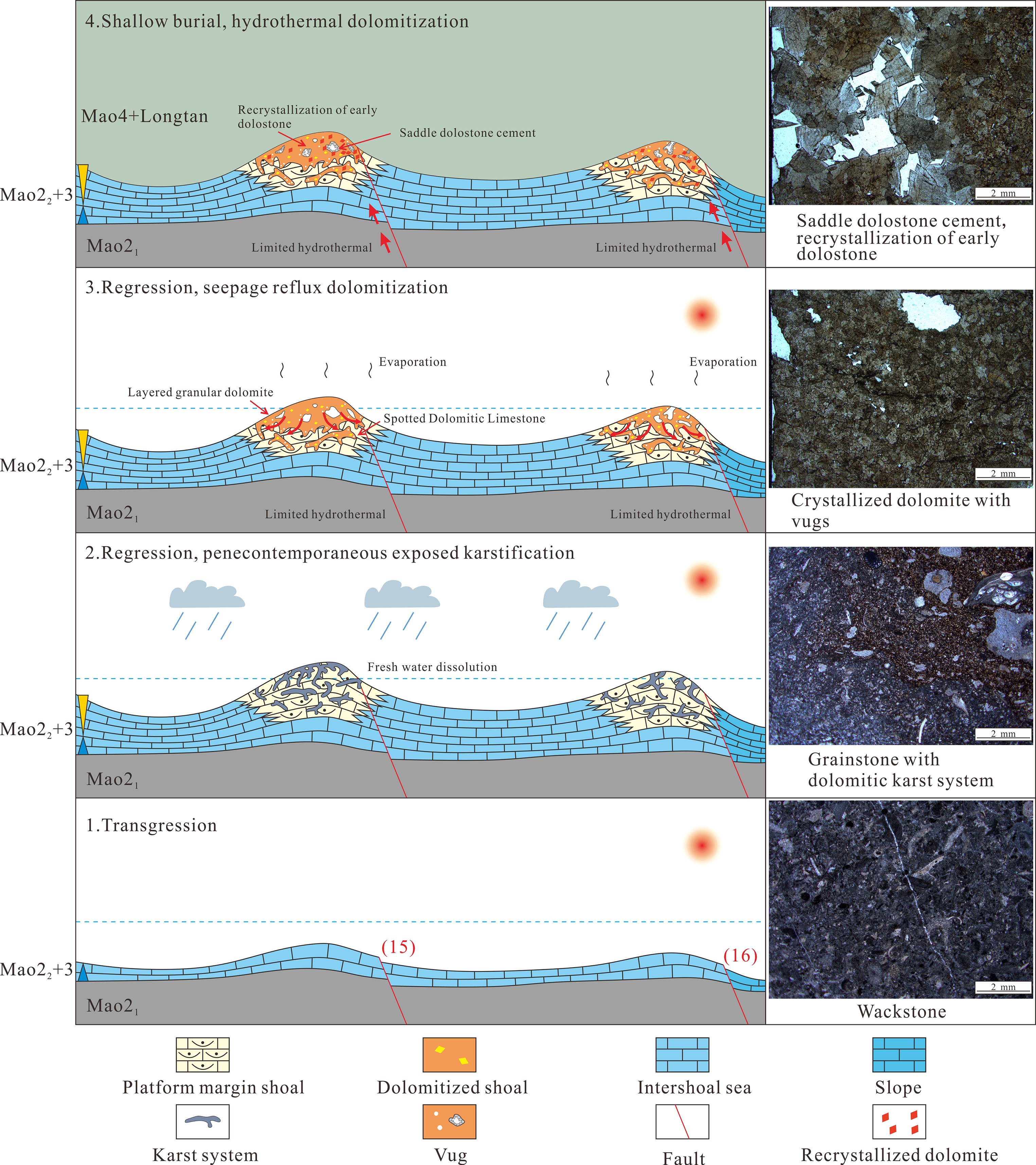
Models of dolomitization.
The formation of leopard-spotted dolomitic limestone is closely related to early exposed karst. During the sedimentary period of the Maokou Formation, the seawater fluctuated frequently, and the exposure of granular shoals provided a chance for meteoric fresh water to dissolve their tops, and then the freshwater flowed into the original pores and created fractures and pores in the shoals. Subsequently, dolomitizing fluid migrated downward through the channels, and started dolomitization and replacement of the surrounding rock. It can be concluded that the karst system controlled by shoal facies is the dominant channel for the occurrence of dolomitization, but the degree of dolomitization is also constrained by the karst system. In addition, the dolomite grains near the dissolution interface exhibit the characteristics of dissolution and fragmentation, indicating that karst and dolomitization occurred simultaneously. Layered granular dolomite is more common in the shoal core with higher sedimentary geomorphological units which may suffer stronger karstification, resulting in vugs and trenches in it. These vugs and trenches are advantageous channels for dolomitizing fluid to enter the granular rock and quickly metasomatize the surrounding rock to form large-scale, moderately euhedral porous-vuggy dolomite. The difference between the two types of dolomites is mainly controlled by the degree of shoal dissolution and the duration of dolomitization. Frequent sea-level fluctuation results in intermittent dolomitization and the formation of small-scale leopard-spotted limestone. When the shoal is close to sea level or exposed for a long time, dolomitizing fluid stably migrates within the shoal and continues dolomitization, ultimately forming large-scale high-porosity and high-permeability facies-controlled layered dolomite.
In summary, the Maokou Formation in the Fengdu-Shizhu area developed high-porosity and high-permeability granular shoals after multiple stages of regression, which provided favorable channels and material basis for dolomitizing fluid. The overlap and migration of the granular shoals limited the seawater and created high-magnesium dolomitizing fluid after the evaporation and concentration of the seawater. After flowing into the granular shoals along karst channels and primary pores, the dolomitizing fluid started penecontemporaneous dolomitization.
Geological significance of oil and gas
In the past, research on the dolomite reservoirs of the Maokou Formation in the Sichuan Basin mainly focused on the genesis of hydrothermal dolomitization, but less on penecontemporaneous dolomite reservoirs. Based on a large number ofdrilling and geochemical data, this paper confirms the development of large-scale shoal dolomite in the Fengdu-Shizhu area on the platform margin in the eastern Sichuan Basin, and the dolomitizing fluid is the seawater controlled by sedimentary facies during the same period. The Maokou Formation in the study area has good oil and gas shows and well test results. The phenomenon of lost circulation and drilling breaks caused by caves confirms that early karst and dolomitization jointly promoted the development of porous reservoirs.
Porous dolomite reservoirs in the Maokou Formation are the most favorable exploration targets. The source–reservoir–caprock conditions are good. The Longtan Formation composed of shale and siltstone is the direct caprock on the Maokou Formation reservoir. Above the Longtan Formation, there are several regional caprocks. The Triassic Shizhu paleo-uplift built good lithologic-structural traps (Chen et al., 2022). In addition to the lower limestone-mudstone rhythmic interval in Mao 1, the Qixia Formation and the Upper Ordovician-Lower Silurian are primary source rocks of the Maokou Formation (Jiang et al., 2021, Kane et al., 2023, Sun et al., 2023). The Maokou Formation dolomite reservoir in the Fengdu-Shizhu area has good conditions for hydrocarbon accumulation. Exploration should focus on good reservoir–caprock systems with hydrocarbon source supply.
The distribution and characteristics of the dolomite reservoirs in the Maokou Formation are controlled by sedimentary facies, dolomitization, and karstification. The shoals provide a material basis for reservoir development. Karstification increases reservoir space and creates channels for dolomitizing fluid. Penecontemporaneous dolomitization builds a reservoir framework and protects pores. It should be mentioned that some scholars have proposed a dolomite reservoir model based on early seawater dolomitization and shoal facies control for the Maokou Formation dolomite near Well JT1 in the central Sichuan Basin (Xiao et al., 2023), indicating the dolomite belt developed around the No. 15 fault is related to the penecontemporaneous seawater.
Conclusion
The dolomite of the Maokou Formation in the Fengdu-Shizhu area in the Sichuan Basin includes layered granular dolomite and leopard-spotted dolomitic limestone. Under a microscope, the crystalline dolomite is mainly composed of fine-medium crystalline dolomite with dissolution pores (vugs) whose edges are filled with saddle-like dolostone, and the leopard-spotted dolomitic limestone is mostly composed of fine dolostone around dissolution channels, and with saddle-like dolostone filled in the edges of dissolution pores. Dolomitization and karstification are almost penecontemporaneous, so karst characteristics are common in the dolomite.
The distribution of dolomite in the Maokou Formation is regular. Vertically, there are multiple stages of dolomite, distributed in the granular shoals in the upper and middle parts of upwardly shallow cycles, extensive in Mao 22 and Mao 3, and sparse in Mao 1 and Mao 21. The horizontal distribution is controlled by the distribution of granular shoals in geomorphic highlands and slope break zones.
Geochemical analysis shows that the dolomitizing fluid entering the Maokou Formation is medium-salinity seawater near the surface. During the regression period, the granular shoals in the geomorphic highlands migrated toward the slope break zone, limiting and salinizing the seawater. The process was accompanied by evaporation, forming a moderately saline seawater-sourced dolomitizing fluid. The primary pores in the granular rocks and penecontemporaneous karst channels are favorable channels for the migration of dolomitizing fluid which moves toward the deep part of the granular shoals and starts reflux infiltration and dolomitization, forming layered crystalline dolomite.
The overlap and migration of granular shoals driven by sea-level fluctuation promote the occurrence of penecontemporaneous dolomitization. The relatively high part of the Maokou Formation is a favorable zone for the development of layered dolomite. The distribution of sedimentary facies shows that the terrain in the northeast of Mao 22 and Mao 3 in the study area is relatively low. It is a trough zone with little development of dolomite. The central and eastern parts were weakly affected by the tectonic belt, so the shoal dolomite is moderately developed. The SE-NW structural area is relatively high with the best development of dolomite. The distribution of dolomite reveals that its development is consistent with the distribution of shoal facies. Therefore, thick sediment zones are future exploration targets for predicting the Maokou Formation dolomite reservoir.
Supplemental Material
sj-xlsx-1-eea-10.1177_01445987241228321 - Supplemental material for Distribution and genesis of the Maokou Formation dolomite in Fengdu-Shizhu area, eastern Sichuan Basin
Supplemental material, sj-xlsx-1-eea-10.1177_01445987241228321 for Distribution and genesis of the Maokou Formation dolomite in Fengdu-Shizhu area, eastern Sichuan Basin by Fabo Xu, Li Li, Nina Luo, Sizhe Tang, Di Xiao, Wenjie Yang, Minglong Li, Qilong Yang and Yuxin Tang in Energy Exploration & Exploitation
Supplemental Material
sj-xlsx-2-eea-10.1177_01445987241228321 - Supplemental material for Distribution and genesis of the Maokou Formation dolomite in Fengdu-Shizhu area, eastern Sichuan Basin
Supplemental material, sj-xlsx-2-eea-10.1177_01445987241228321 for Distribution and genesis of the Maokou Formation dolomite in Fengdu-Shizhu area, eastern Sichuan Basin by Fabo Xu, Li Li, Nina Luo, Sizhe Tang, Di Xiao, Wenjie Yang, Minglong Li, Qilong Yang and Yuxin Tang in Energy Exploration & Exploitation
Footnotes
Declaration of conflicting interests
The author(s) declared no potential conflicts of interest with respect to the research, authorship, and/or publication of this article.
Funding
The author(s) disclosed receipt of the following financial support for the research, authorship, and/or publication of this article: This work was supported by the PetroChina and Southwest Petroleum University Innovation Consortium Science and Technology Cooperation Project, General Program of NSFC, (grant number 2020CX010000, 42172166).

Supplemental material
Supplemental material for this article is available online.
References
Supplementary Material
Please find the following supplemental material available below.
For Open Access articles published under a Creative Commons License, all supplemental material carries the same license as the article it is associated with.
For non-Open Access articles published, all supplemental material carries a non-exclusive license, and permission requests for re-use of supplemental material or any part of supplemental material shall be sent directly to the copyright owner as specified in the copyright notice associated with the article.
