




Abstract
This work describes a Ge-bearing mineral in the Carboniferous medium-ash, high-sulfur and low-volatile bituminous coal of the Yuzhou Coalfield, southern part of the North China Basin. Germanium (Ge) in the investigated coals ranges from 10.4 to 57.6 μg/g, with an average of 32.8 μg/g. Average concentrations of Ge in coal samples are about 16 times higher than that of world hard coals (2.4 μg/g). Ge-bearing mineral was found in the coal sample. It occurs as a vein and is closely associated with copper zinc tin sulfide, and illite. To the best of our knowledge, this is the first record of this mineral in coal. The average chemical composition based on the electron microprobe analyses is (in wt. %): Al 23.42, Ge 32.92, O 35.24, F 7.82, total 99.39, corresponding to (Al1.97Ge0.03)2GeO4(F0.93, OH)1.93. Krieselite has the ideal chemical formula Al2GeO4(F, OH)2, and is most likely the Ge-bearing mineral found in the investigated coal sample. The appearance of Ge-bearing mineral indicates an origin later than peat deposition and also demonstrates that Ge mineralization could take place during coalification.
Introduction
Germanium (Ge) is one of the critical elements of high-tech economies, such as infrared systems, fiber optics, polymer catalysis, electronics, and solar cells. An increased demand for Ge is predicted (European Commission, 2020; Patel and Karamalidis, 2021), and Ge has been listed as a critical raw material (European Commission, 2020). The geologic environments, such as iron meteorites and terrestrial iron-nickel, sulfide ore deposits, oxidized zones of Ge-bearing sulfied deposits, and coal, are beneficial to the enrichment of germanium (Bernstein, 1985). Sulfidic Pb–Zn deposits and high-Ge coal deposits are the two most important types of known germanium deposits (Frenzel et al., 2014). Ge is recovered as a byproduct from Zn-refineries and coal fly ash (Patel and Karamalidis, 2021). High-Ge lignite is one of the most important types of known germanium deposits, and coal-hosted germanium ore deposits have been reported in the Spetsugli deposit in the Russian Far East (Arbuzov et al., 2021; Seredin and Danilcheva, 2001), the Wulantuga deposit in Inner Mongolia (northern China) (Dai et al., 2012; Zhuang et al., 2006), and the Lincang deposit in Yunnan Province (southwestern China) (Hu et al., 2009; Zhuang et al., 1998).
In nature, germanium is found as a trace element in several minerals with a common oxidation state of + 2 and most commonly + 4 (Höll et al., 2007; Melcher and Buchholz, 2013). Ge-bearing minerals have been reported in the Cu-Pb-Zn-Ag sulfide deposit, such alburnite, Ag8GeTe2S4, germanite, Cu13Ge2Fe2S16, renierite, (Cu, Zn)11(Ge, As)2Fe4S16, argyrodite, Ag8GeS6, and calvertite, Cu5Ge0.5S4 (Frenzel et al., 2014; Jambor et al., 2007; Rosenberg, 2009; Tamas et al., 2014). However, no primary Ge-bearing minerals have been found in high-Ge lignite deposits (Dai et al., 2020; Spears and Tewalt, 2009), and germanium is considered to be predominantly associated with the organic matter in coal (Dai et al., 2021). Recent study indicates that high-Ge coals of the Spetsugli deposit are characterized by different modes of germanium occurrence, and the importance of the mineral modes of germanium occurrence in the high-Ge coals is probably considerably greater than previously thought (Arbuzov et al., 2021). Similarly, Yakushevich et al. (2013) concluded that up to 25%–30% of germanium in the deposit can be associated with the mineral phase but with at least 60% of germanium associated with mobile organic matter.
This work provides new data on Ge-bearing mineral of the No.11 Coal in the Taiyuan Formation, Yuzhou Coalfield, in the southern part of the North China Basin (NCB). This information will help enhance geological and geochemical modeling, as well as the extraction of germanium.
Geological setting
The Yuzhou Coalfield is located in Henan Province, North China (Figure 1(a)). Tectonically, the Yuzhou Coalfield is situated in the southern belt of the NCB and in the north of the Qinling-Dabie Orogenic Belt (Figure 1(b)) (Zhu et al., 2012). During the Late Paleozoic era, the NCB was an intracratonic basin and was bounded by the southernmost branch of the Central Asian Orogenic Belt to the north and by the Qinling Orogenic Belt to the south (Zhai, 2019). During this period, the NCB was tectonically inactive with little magmatism and deformation but was affected by the Qinling and Central Asian Orogenic belts (Zhai, 2019). Mesozoic disruption and reconstruction likely affected the NCB (Meng et al., 2019).
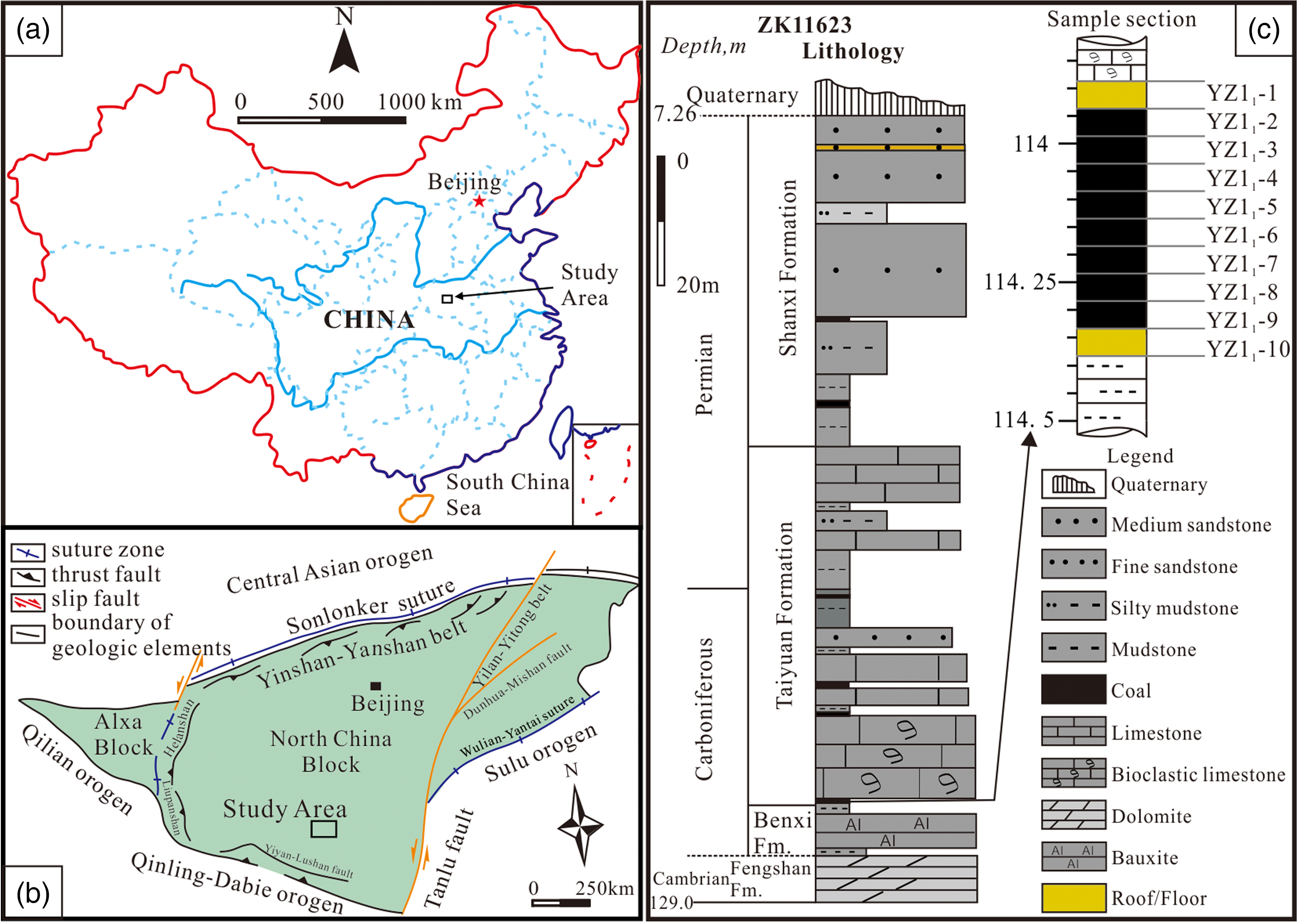
(a) Yuzhou Coalfield in Henan Province, China; (b) modified tectonic map showing the North China Block (Meng et al., 2019), the North China Block is bordered on all sides by orogenic or structural belts, with the Yinshan–Yanshan belt on the north, the Qinling–Dabie orogenic belt on the south, the Helanshan–Liupanshan belt on the west and Tanlu fault and Sulu orogenic belt on the East; (c) sedimentary sequences of the ZK11623 in the Zhutougou of the Yuzhou Coalfield, and the scheme of the coal sampling in the No.11 Coal.
The coal-bearing strata consist of Taiyuan, Shanxi, and Shihhotse formations (Yang et al., 1982). It should be noted that Well ZK11623 is located on the west margin of the Yuzhou Coalfield, and the coal-bearing strata in this well consist of Taiyuan and Shanxi formations (Figure 1(c)). The Taiyuan Formation was deposited in an open epicontinental sea and consists of shallow water carbonate sediments, clastic sediments, and several thin coal seams (Yang et al., 1982). Some of the No.11 Coal in the lower part of the Taiyuan Formation is minable in the Yuzhou Coalfield (Song, 2009).
Materials and methods
In total, 10 samples, comprising eight coal, one roof, and one-floor sample, were taken from the borehole ZK11623 (Figure 1(c)), Zhutougou, Yuzhou Coalfield, southern part of the NCB. The sequenced sampled in this work has been described by Zhao et al. (2023). Collected samples are numbered as YZ11-1 to YZ11-10 from top to bottom. The data of ash yield, sulfur content, and random vitrinite reflectance (Rr) for studied samples from Zhao et al. (2023) are used in this study.
After being crushed by mortar and pestle, the samples were ground to a fine powder (<200 mesh) for proximate analysis. Moisture and volatile matter were performed according to ASTM D3173/D3173M-17a (2017) and D3175-17 (2017), respectively. Mass spectrometry with inductively coupled plasma (ICP-MS, Thermo Fisher, ICAP RQ) was used to determine germanium in the samples.
Coal samples were also prepared as polished blocks that were coated by conductive carbon materials. Electron probe micro-analyzer (EPMA, JXA-8230, JEOL) in conjunction with energy dispersive X-ray spectrometers (EDS, TEAM ELECT SUPER, EDAX) was used to study morphology and microstructure of the minerals, and also to determine the distribution of some elements in polished coal samples. We used kyanite (Al2SiO5) as a standard for Al (Kα), bismuth germanate (Bi4Ge3O12) for Ge (LKα), hematite (Fe2O3) for O (Kα) and fluorite (CaF2) for F (Kα).
Results and discussion
Coal geochemistry
The proximate analysis is shown in Table 1. Ash yields range from 6.06 to 21.07% with an average of 12.79%, and the coal is classified as medium-ash coal according to the Chinese Standard Method GB/T 15224 1-2010. The No. 11 Coal is a low volatile bituminous coal according to the ASTM D388-18a (2018) with volatile matter yields ranging from 9.11 to 13.47% (average of 10.9%) and random vitrinite reflectance between 1.83% and 1.98% (average of 1.89%). A high sulfur content of 5.08% to 9.82% (average of 6.39%) classifies the coal as the high-sulfur coal (Chou, 2012).
Proximate analysis (%), vitrinite reflectance (%), and concentrations germanium (μg/g)of No. 11 coal seam from the ZK11623, Yuzhou coalfield.
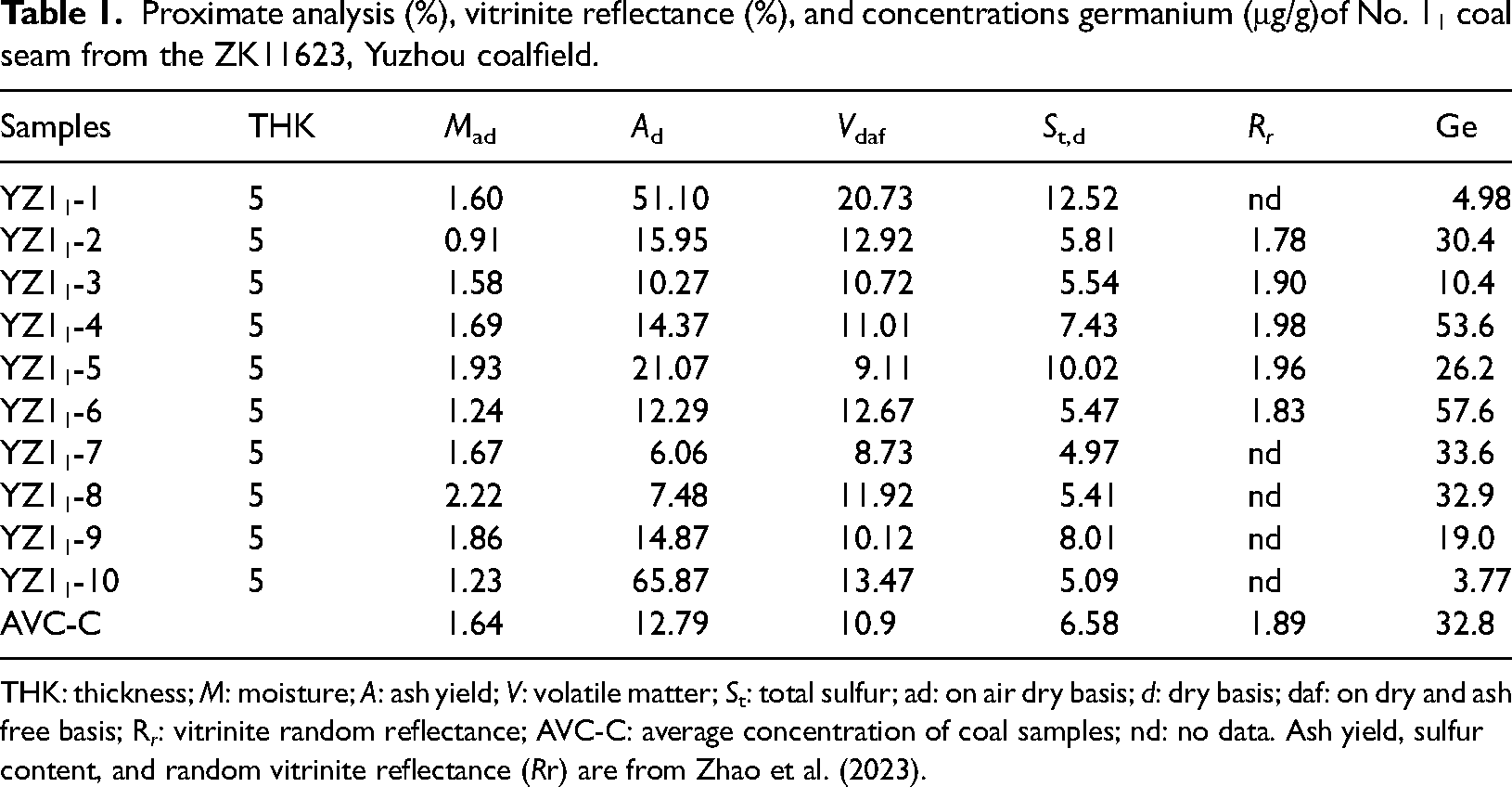
THK: thickness; M: moisture; A: ash yield; V: volatile matter; St: total sulfur; ad: on air dry basis; d: dry basis; daf: on dry and ash free basis; R r : vitrinite random reflectance; AVC-C: average concentration of coal samples; nd: no data. Ash yield, sulfur content, and random vitrinite reflectance (Rr) are from Zhao et al. (2023).
Content and origin of Germanium
Ge in the studied coal samples ranges from 10.4 to 57.6 μg/g, with an average of 32.8 μg/g (Table 1), which is much higher than average Chinese coals (2.78 μg/g) (Dai et al., 2018), and world hard coals (2.4 μg/g) (Ketris and Yudovich, 2009). The Ge content in the roof and floor samples is 4.98 and 3.77 μg/g, respectively. Ge is more enriched in the coal samples than in the roof and floor samples (Figure 2).
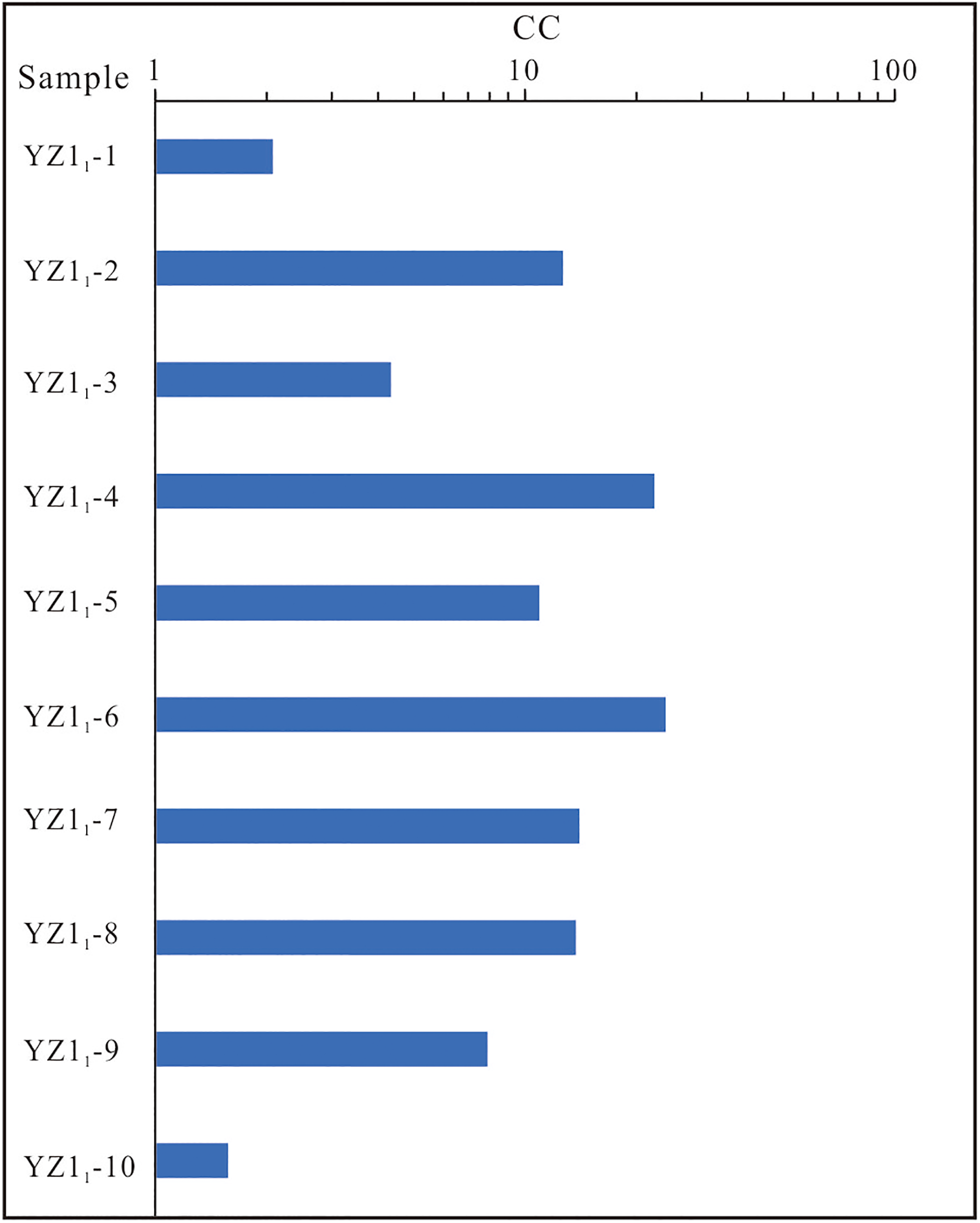
Concentration coefficients (CC) of Ge through the vertical section of the No. 11 Coal. Normalized by average Ge concentration in world hard coals (Ketris and Yudovich, 2009).
The average content of germanium (32.8 μg/g) in the Yuzhou No.11 Coal is lower than that in the Lincang, Wulantuga and Spetzugli coals. Nonetheless, the average concentration in the studied coal samples is more than 15-times higher compared to the average of Chinese coals and world hard coals (Dai et al., 2018; Ketris and Yudovich, 2009). The No.11 Coal in the Yuzhou Coalfield also has potential for germanium recovery, in spite of the thin thickness of the studied coal seam (No. 11). It has been noted that thin coal seams generally have a higher germanium content than thick ones in the high germanium coal basin (Hower et al., 2002). Höll et al. (2007) also proposed that coal basin with thin coal seams is one of the criteria for Ge exploration in lignite and coal. Based on this evidence, the Yuzhou Coalfield could be good targets for geochemical prospecting of germanium ores.
The Mesoproterozoic and Early Paleozoic Pb-Cu-Zn deposits are abundant in the North Qinling Orogenic Belts (NQOB) (Zhang et al., 2014), and germanium deposits have also been reported in the Liushanyan Cu-Zn deposits (formed during early Paleozoic) in the Tongbai area (Wei et al., 2004; Zhao et al., 2019). The Yuzhou Coalfield is situated in the north of the NQOB (Zhu et al., 2012), and the NQOB was the main provenance for the study area (Zhu et al., 2014). It is therefore concluded that the most probable sources of germanium were the Pb-Cu-Zn deposits in the NQOB.
Ge-bearing mineral
Ge-bearing minerals in coals have only been identified in micron and nanometer mineral phases in Wulantuga and Spetsugli coals (Arbuzov et al., 2021; Zhuang et al., 2006). Large particles of Ge-bearing minerals have not been reported in coals. In the YZ11-6 sample, a Ge-bearing mineral occurs as vein, and has a length of 245 μm and an approximate width of 25 μm (Figure 3(a) and (b)). This veined Ge-bearing mineral coexists with copper zinc tin sulfide (Figure 3(b) and (d)), and is surrounded by illite (Figure 3(a)). The fractures observed are a secondary feature that occurs after the deposition process, and this is consistent with the presence of sulfides. It is worth noting that the YZ11-6 sample containing germanium-bearing mineral also has high germanium content (Table 1).
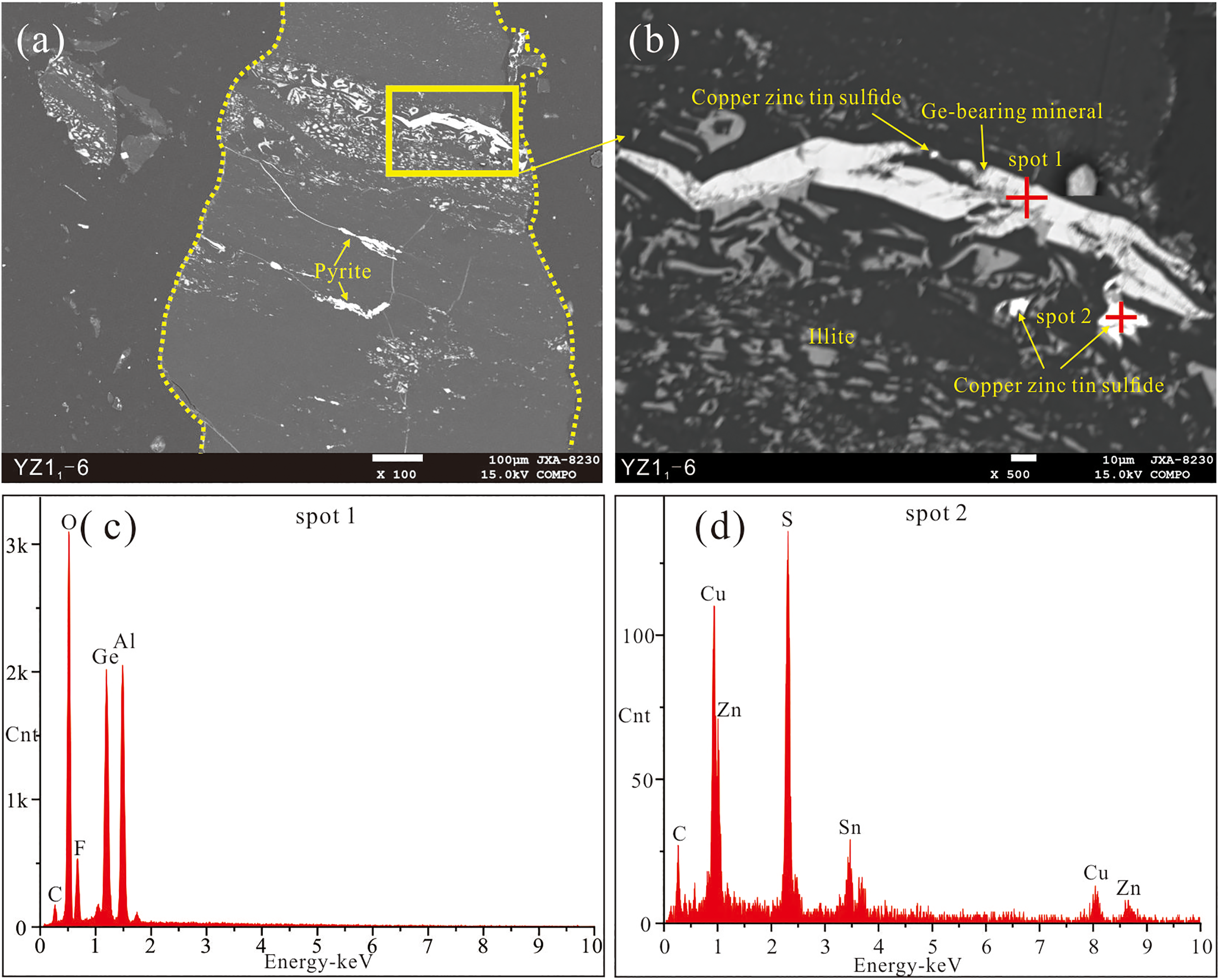
EPMA BSE, and EDS images of Ge-bearing mineral in the coal sample (YZ11-6). (a) The part between the two yellow dashed lines is the coal particle. The part circled by the yellow box is shown in (b). (a) (b) Vein pyrite, Ge-bearing mineral, co-existing with copper zinc tin sulfide and surrounded by illite. (c) EDS of Ge-bearing mineral. (d) EDS of copper zinc tin sulfide. EPMA: electron probe microanalyzer; BSE: backscattered electron; EDS: X-ray energy dispersive spectrogram.
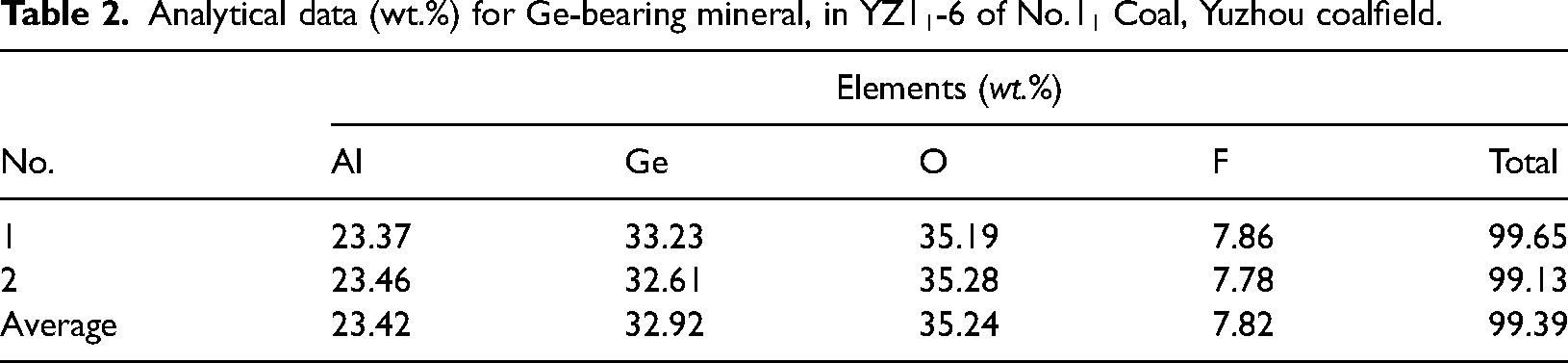
The element composition (Al, O, F, and Ge) of the Ge-bearing mineral is given in Table 2. The average chemical composition based on two electron microprobe analyses in one grain is (in wt. %): Al 23.42, Ge 32.92, O 35.24, F 7.82. The total analytical sum of average of all detected elements is 99.39 wt. %, which may indicate that the OH position is not fully filled with F. The empirical chemical formular: (Al1.97Ge0.03)2GeO4(F0.93, OH)1.93, is based on four oxygen and two OH groups per formula unit and the assumption that Ge occupies Al sites. The chemical composition of Ge-bearing mineral is comparable to the krieselite, Al2GeO4(F, OH)2, which has been identified in the Tsumeb mine, Tsumeb, Namibia (Schlüter et al., 2010).
Analytical data (wt.%) for Ge-bearing mineral, in YZ11-6 of No.11 Coal, Yuzhou coalfield.
Origin of Ge-bearing mineral
Pyrite is deposited in cleats and veins through migrating hydrothermal solutions after the compaction of peat into coal (Chou, 2012; Ward, 2016). The paragenetic sequence of cleat infill with an early sulfide phase was recognized by Hatch et al. (1976) and Spears and Caswell (1986). The presence of veined Ge-bearing mineral in the studied sample, copper zinc tin sulfide, and pyrite veinlet suggests a similar origin. Hu et al. (2000) suggested that germanium could be concentrated in topaz, spodumene, dipolitase, cesium garnet and garnet, and it is likely that isomorphous substitution occurs between Ge4+ and Al3+ in these minerals. As discussed in the “Content and origin of germanium” section , we believe germanium originates from weathering solutions of Pb-Cu-Zn deposits in the NQOB. Dai et al. (2021) indicate that germanium is dominantly associated with organic matter during the peat stage. It is hypothesized that germanium in the vein was initially bounded by organic matter during the peat stage. However, it was subsequently released and formed Ge-bearing minerals under the influence of hydrothermal fluids during diagenesis. Significantly, the coal is bituminous in the study area, which differs from the Lincang, Wulantuga and Spetsugli coal-hosted germanium ore deposits (Arbuzov et al., 2021; Dai et al., 2012; Hu et al., 2009; Seredin and Danilcheva, 2001; Zhuang et al., 1998, 2006). The occurrence of a Ge-bearing mineral in the bituminous coal in the study area suggests that germanium mineralization could occur during the transition from low-rank to higher-rank coal. Arbuzov et al. (2021) also indicated that germanium mineralization can be polychronous and not limited to the peat stage.
Conclusions
The Carboniferous No. 11 Coal in the Yuzhou Coalfield, as a medium-ash, high-sulfur and low-volatile bituminous coal, has a high concentration of Ge. Ge probably originated from the Pb-Cu-Zn deposits in the NQOBs. A large particle of Ge-bearing mineral is described for the first time in coal, and an electron microprobe analysis gave Al 23.42, Ge 32.92, O 35.24, F 7.82, total 99.39 wt. %, corresponding to (Al1.97Ge0.03)2GeO4(F0.93, OH)1.93. This mineral observed in coal is most likely krieselite, ideally Al2GeO4(F, OH)2. Presence of Ge-bearing mineral indicates that Ge mineralization could take place during the transition from the low-rank to higher-rank coal. Although there is still uncertainty and further analyses are needed, the Taiyuan Formation coals in the Yuzhou Coalfield may be good targets for geochemical prospecting of Ge ores.
Footnotes
Acknowledgements
The authors are very grateful to Mr. Zhizhong Xie and Guibin Zuo for their help in field and laboratory work.
Declaration of conflicting interests
The author(s) declared no potential conflicts of interest with respect to the research, authorship, and/or publication of this article.
Funding
The author(s) disclosed receipt of the following financial support for the research, authorship, and/or publication of this article: This work was supported by the Natural Science Foundation of Hebei Province (grant number D2021402017), and the Innovation Fund of Hebei University of Engineering (grant number SJ010002218, SJ2101003005).
