




Abstract
Hydraulic fracturing plays a vital role in the development of coalbed methane (CBM). Coal seam structures can, however, affect the fracturing operations, further affecting gas and water production from the coal seam. Within the research area—the Shizhuangnan Block, Southern Qinshui Basin, China—three types of coal body textures are relevant, including original, cataclastic, and granulated structure. This research describes the impacts of different coal seam types on fracturing operations and gas and water production. The results show that different types of coal seams have different impacts on hydraulic fracturing and the resultant production of gas and water. The coal seams are classified according to the vertical variation characteristics of the coal seam structures. The first type of coal seam (Type I) only develops the original and cataclastic coal structure. The effects of fracturing reconstruction for Type I are good. A high degree of coal breakage and fracture formation is observed. Gas production from CBM wells in Type I coalbeds is usually high because the water in the coal reservoir can be discharged smoothly at an early stage. The second type of coal seam (Type II) develops an additional layer of granulated coal compared with Type I. During the fracturing process, breakage of the coal seam is obvious, and the granulated coal can easily produce fine-grained coal that can block the pores and fractures, which causes an increase and fluctuation of oil pressure and can affect the effectiveness of fracturing. The gas production curve from CBM wells in Type II coal seams is mostly bimodal and water production depends on whether the pulverized coal blocks the pores and fractures. The third type of coal seam (Type III) develops two additional layers of granulated coal compared with Type I, with a greater proportion of granulated coal present. A low degree of coal breakage and fracture formation is observed, and fractures are easily blocked by pulverized coal. The effects of fracturing reconstruction for Type III are bad. Forming an effective seepage channel in this type of coal seam and extending the fracture to the far end is difficult. The gas production from CBM wells in Type III coal seams is usually low, and water production is generally low during the whole drainage period.
Keywords
Introduction
The coalbed methane (CBM) geology theory is lacking for China's geological conditions, and current technologies restrict CBM exploration and development. CBM storage and its production process are incredibly complicated, and more research should be conducted (Tao et al., 2019a). Tectonic movement within coal seams may cause varying degrees of breakage within coal seams. Based on the degree of breakage, coal body textures are divided into four types: original, cataclastic, granular, and mylonitic structure. The degree of structural breakage in the coal seams increases from original to mylonitic. Coal body texture classification is generally done via site observations and assessment of geophysical logging data (Fu et al., 2009; Tang et al., 2004; Liu et al., 2013; Xue et al., 2012; Lv et al., 2019).
As the primary fracture systems of original and cataclastic coals are well developed, large fractures easily form after fracturing transformation, and these coal seams ultimately form good seepage channels with a high permeability after hydraulic fracturing (Chen et al., 2012; Liu et al., 2013; Yao et al., 2014; Li et al., 2020). In the case of granulated and mylonitic coal, however, the primary pore and fracture system of the coal is damaged. This coal is composed of granular particles, which is not conducive to fracture reconstruction. More importantly, due to the lack of large pores and fractures, the permeability of this coal is low (Li et al., 2011; Meng et al., 2011a, 2011b).
As many coal reservoirs have low permeabilities, hydraulic fracturing is necessary during CBM development. It is however often found during CBM development that when using the same fracturing technology within one area with similar gas content, quite different gas volumes are produced. The shape of fracturing curves of different CBM wells within the same area, with the same fracturing technology, also differs significantly. Therefore, the vertical variation characteristics of different coal seam structure types have significant impacts on the effects of fracturing construction and the gas production capacity of CBM wells.
Previous studies mainly focused on the impacts of coal body texture on the physical properties (porosity and permeability) of coal reservoirs and the identification method of coal body texture. Coal structure is also used to determine the well type (vertical wells and directional wells) in CBM development (Tao et al., 2019b). Few studies discussed the impacts of coal body texture on gas and water production during fracturing (Xie et al., 2016; Tao et al., 2017; Tang et al., 2017). The novelty of this work is that this paper firstly divides the coal seam into three types based on the vertical variation of coal seam structure, and secondly that it investigates the effects of three types of coal seam structures on the effectiveness of hydraulic fracturing and resultant gas and water production.
Taking the Shizhuangnan Block, Southern Qinshui Basin, China as an example, this paper identified the vertical variation characteristics of coal seam structures of CBM wells based on conventional logging data and analyzed the fracturing construction process combined with fracturing curves. Additionally, the impacts of coal body texture on the fracturing construction process and gas production are summarized and may provide a reference for the later fracturing construction of coal reservoirs.
Geological setting
The Shizhuangnan Block, located in the southern Qinshui Basin, is one of the main areas for CBM development in China (Figure 1, Cai et al., 2011; Su et al., 2005; Zhang et al., 2015). This area has experienced multi-stage compressional and extensional tectonic movements and a monoclinal structure inclined to the west is present. Faults occur in the north of the study area. The Carboniferous Taiyuan Formation and Permian Shanxi Formation are the main coal-bearing strata (Wei et al., 2007; Zhang et al., 2015, 2016). The No. 3 coal seam of the Shanxi Formation and the No. 15 coal seam of the Taiyuan Formation are thick, stable, and widely distributed. Currently, the No. 3 coal seam is the main CBM development target (Yang et al., 2017, 2020; Zhang et al., 2016) and is also investigated in this study. There are three types of coal body texture in the No.3 coal seam: original, cataclastic, and granulated structure. All the CBM in the study area is developed via vertical wells, and hydraulic fracturing is used on all CBM wells to improve the permeability of the coal reservoir. Most CBM wells in the study area have been drained for more than five years.
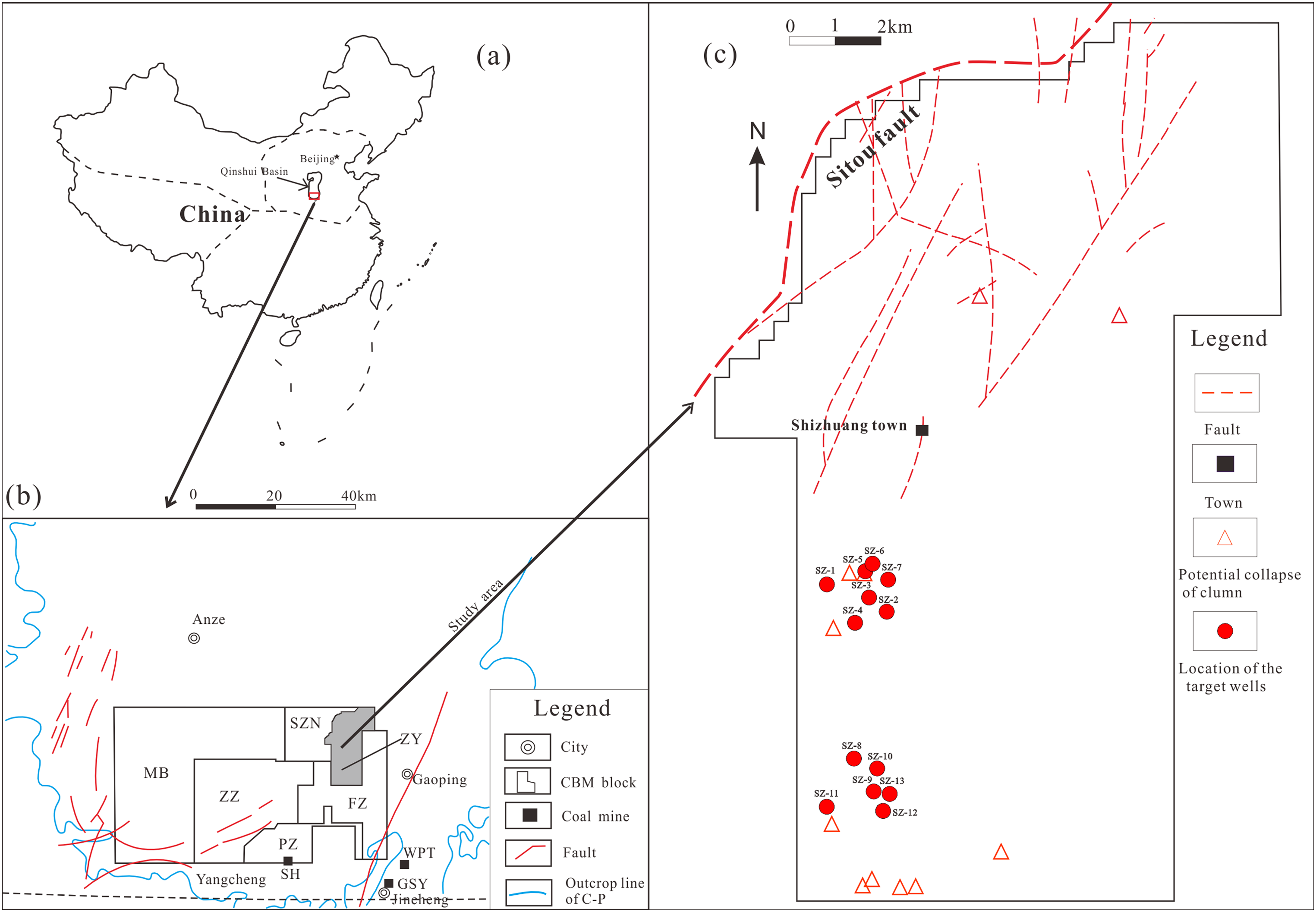
Location of the study area and the target wells. (a) Location of the study area in China; (b) the study area, showing CBM blocks in the southern Qinhsui basin; and (c) structural outline of the study area. SZN, Shizhuangnan CBM Block; MB, Mabi CBM Block; ZZ, Zhengzhuang CBM Block; FZ, Fanzhuang CBM Block; PZ, Panzhuang CBM Block.
Identification of coal body texture
Coal body texture is essential in the research of CBM development. Even though the most accurate method of coal body texture analysis may be via on-site core observation for each CBM well; this is difficult to do due to cost constraints. Coals with different textures can return corresponding responses from geophysical logs (Fu et al., 2009; Peng et al., 2008; Teng et al., 2013). Geophysical logs can therefore be used to identify coal body textures (Frodsham and Gayer, 1999; Fu et al., 2009). The well-logging response to coal body texture in the study area has been studied (Teng et al. 2015) and can be used to identify the coal body texture with well-logging data. Well-logging data were collected from 13 producing wells including natural gamma ray (GR), interval transit time (AC), deep lateral resistivity (RD), and density (DEN), and were used to identify the texture of No. 3 coal seam. These wells are next to each other and they have similar geological conditions. The wells considered in this study also cover the whole local area of the coal seam in the Shizhuangnan block. For the No.3 coal seam in Southern Qinshui Basin, the original coal has much higher DEN and GR values than cataclastic and granulated coal. Granulated coal has higher response values of RD and AC than cataclastic coal, and the three coal body texture types can therefore be distinguished from each other (more details can be found in Teng et al. 2015). Also, the more crushed the coal is, the lower the DEN and GR values and the higher the RD and AC values (Figure 2).
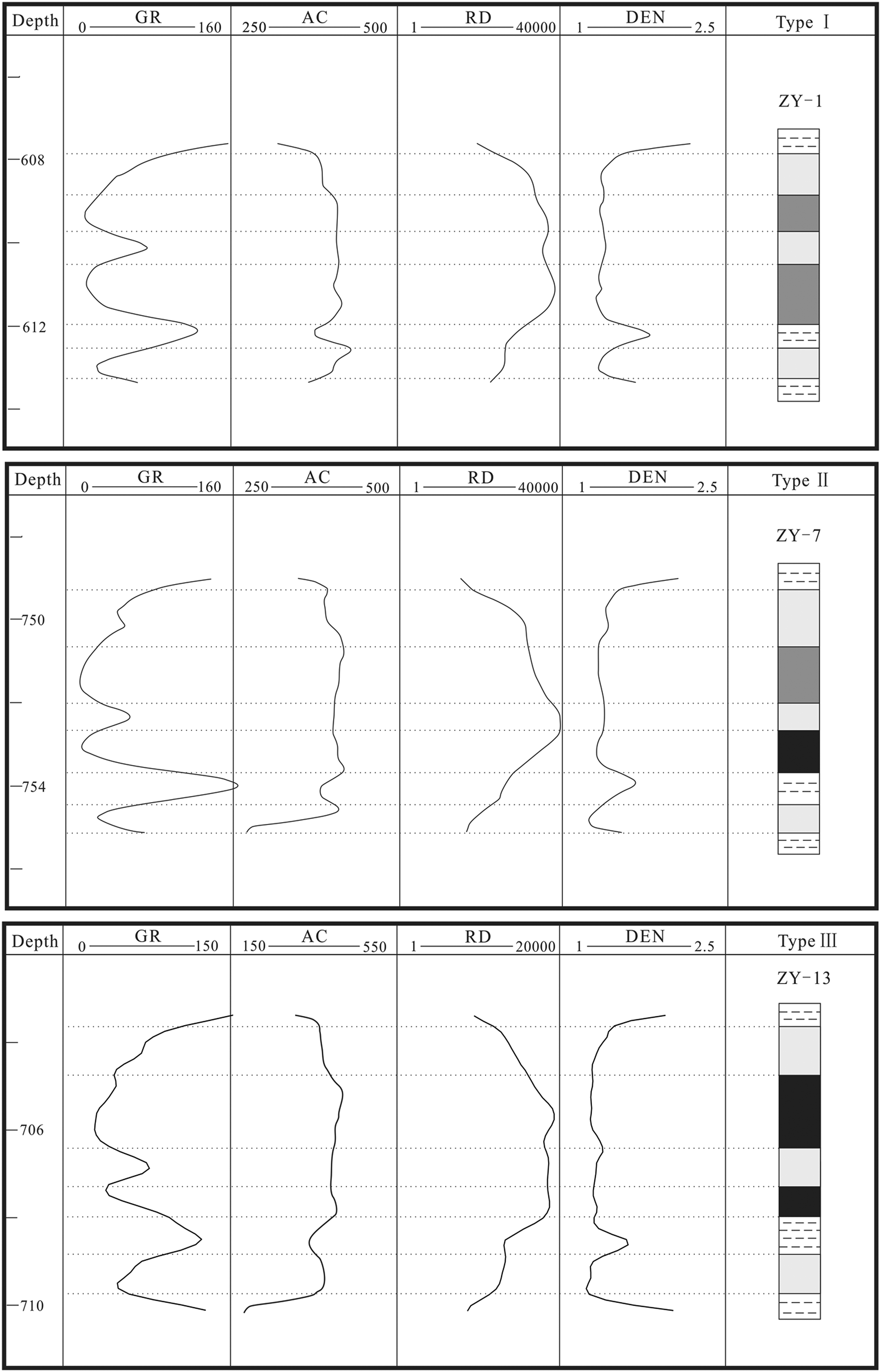
Logging curve characteristics of well ZY-1(Type I), well ZY-7 (Type II), and well ZY-13 (Type III).
According to the vertical variation characteristics of coal seam structure for the 13 wells, the coal seams can be divided into three categories. The first type of coal seam (Type I) is composed mainly of original and cataclastic coal (Figure 3(a)). The two kinds of coal body textures overlay vertically. The top of the coal seam is mostly original coal, and the bottom of the coal seam has a thin layer of mudstone. The second type of coal seam (Type II) is mainly composed of original, cataclastic, and granulated coal (Figure 3(b)). The three kinds of coal body textures overlay each other vertically. The top of the coal seam is mostly original coal, and the granulated coal mainly occurs in the middle. The difference between Type I and Type II is that there is an extra layer of granulated coal in the middle. The third type of coal seam (Type III) is mainly composed of original, cataclastic and granulated coal, and the three coal body textures overlay each other vertically (Figure 3(c)). Unlike Type I and Type II coal seams, this type of coal seam has two layers of granulated coal.
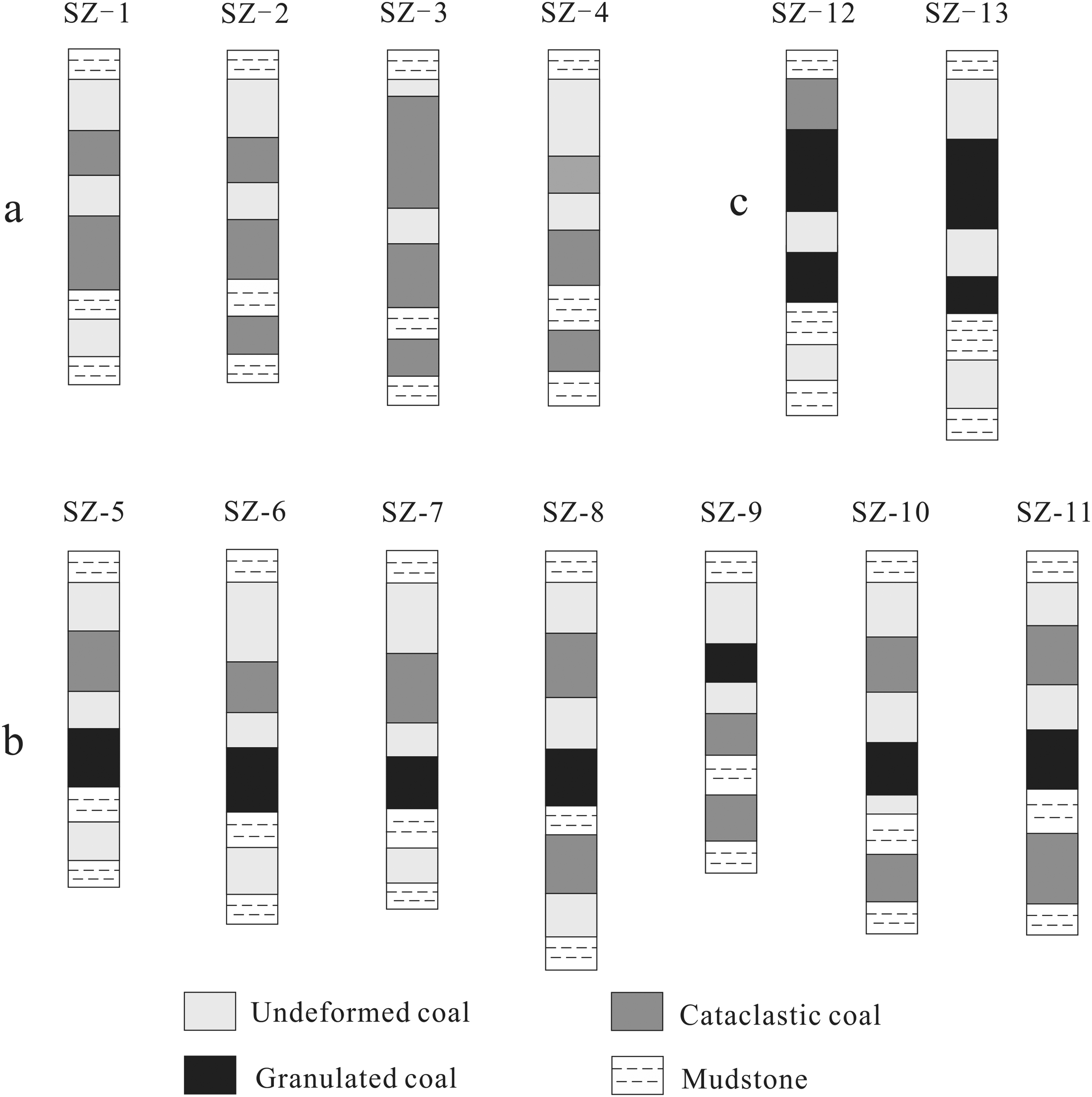
Sketch map of coal body textures vertical distribution of 13 CBM vertical wells: (a) Type I; (b) Type II; (c) Type III.
Influences of coal seam structures on hydraulic fracturing operation
Through analysis of the fracturing curve characteristics of the three types of coal seams, it is found that the vertical variation of coal seam structures has important influences on fracturing construction. The vertical variation of coal seam structures determines the characteristics of fracturing curves. Fracturing construction is divided into three stages—the pressure test stage, the formal fracturing stage, and the pressure drop stage. For the coal seam of Type I, the curves of the formal fracturing stage of different wells have similar characteristics (Figure 4). During the constant injection phase, the oil pressure in the initial stage of formal fracturing reaches the highest point, then it gradually declines. The phenomenon of breakage is obvious. Similar to well SZ-1, sometimes the oil pressure drops rapidly after breakage occurrs and fracturing fluid quickly pushes into the crack of the coal seam. Like well SZ-3, sometimes original cleat and fracture in cataclastic coal may be developed, and the oil pressure drops with a moderate rate as the fracturing fracture extends forward gradually in the coal seam. In the middle and later stages of fracturing, the oil pressure stabilizes at a lower value, and the fracture keeps extending and expanding. Compared with granulated and mylonitized coal, original and cataclastic coal have greater strength, higher fracture pressure, and better brittleness. Therefore, for this kind of coal seam, composed of original and cataclastic coal, the oil pressure is high in the initial stage of formal fracturing and the coal breakage occurs easily. The development of original cleat and fracture in cataclastic coal is also more conducive to fracture expansion. In the later stage, with the increase of proppant concentration, the oil pressure stays stable with little fluctuation. This phenomenon shows that the fractures continue to extend outwards and the proppants gradually fill the fracture, forming a good seepage channel.
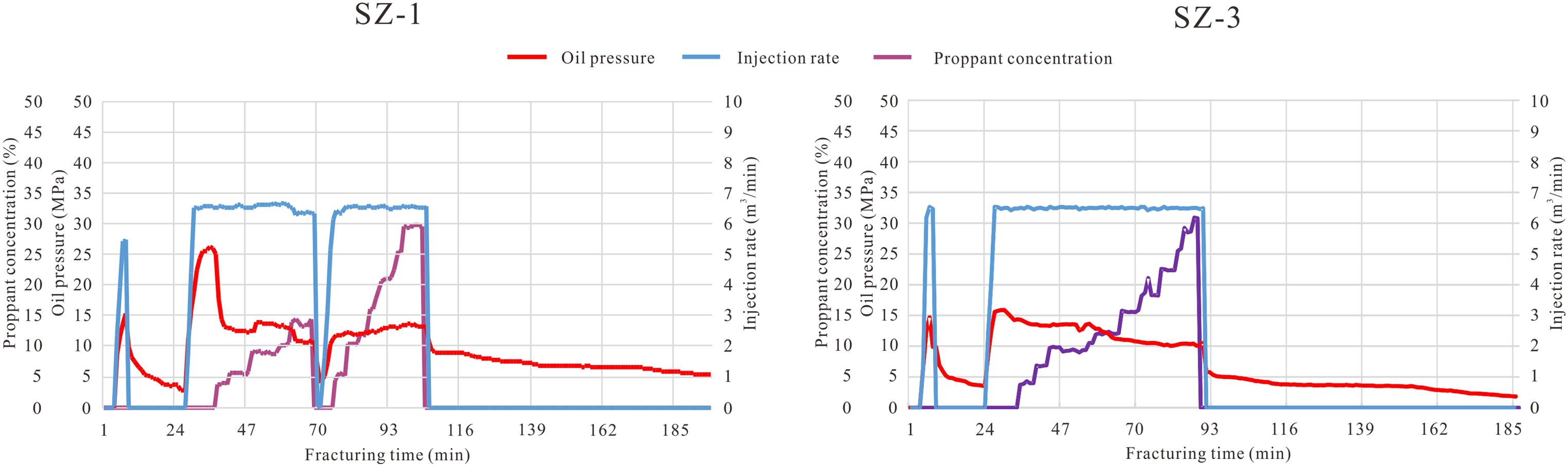
Fracturing curves of Type I coal seam in typical wells SZ-1 and SZ-3.
For the Type II coal seam, the obvious breakage of the coal seam and fracture blockage caused by pulverized coal can be observed from the fracturing curves. The fracturing curves can be divided into two types according to the fluctuation characteristics of the oil curve in the stage of formal fracturing. The first one has characteristics of decreasing oil pressure curve after the breakage of the coal seam, and the second one has characteristics of a rising oil pressure curve after the breakage of the coal seam (Figure 5). For the decreasing type, like the wells SZ-6 and SZ-7, in the initial stage of formal fracturing, the coal seam break up when the oil pressure reaches the highest point and then the oil pressure gradually decreases. In the middle and late stages of formal fracturing, the overall curve of oil pressure often shows a downward trend, but there are obvious drastic fluctuations. The obvious drastic fluctuation of oil pressure is typically due to blockage in the crack caused by pulverized coal. For the rising type, like the wells SZ-8 and SZ-10, in the initial stage of formal fracturing, the coal seam breaks when the oil pressure reaches a relatively high point and then the oil pressure gradually decreases. However, in the middle and late stages of formal fracturing, the oil pressure rises gradually with only slight fluctuation. Like the Type I coal seam, the Type II coal seam is mainly composed of original and cataclastic coal. The only difference is that the middle part of the coal seam has a thin interlayer of granulated coal, which can produce numerous pulverized coal particles. Therefore, in the initial stage of formal fracturing, the Type II coal seam can form hydraulic fractures as well as Type I. The difference is that Type II coal seam can easily cause blockages in the fracture that lead to the rise of oil pressure during the fracturing process because of the migration and accumulation of pulverized coal particles. Because of the different degrees of blockage, different oil pressure trends are observed. The degree of blockage is weaker in the decreasing type than in the rising type.
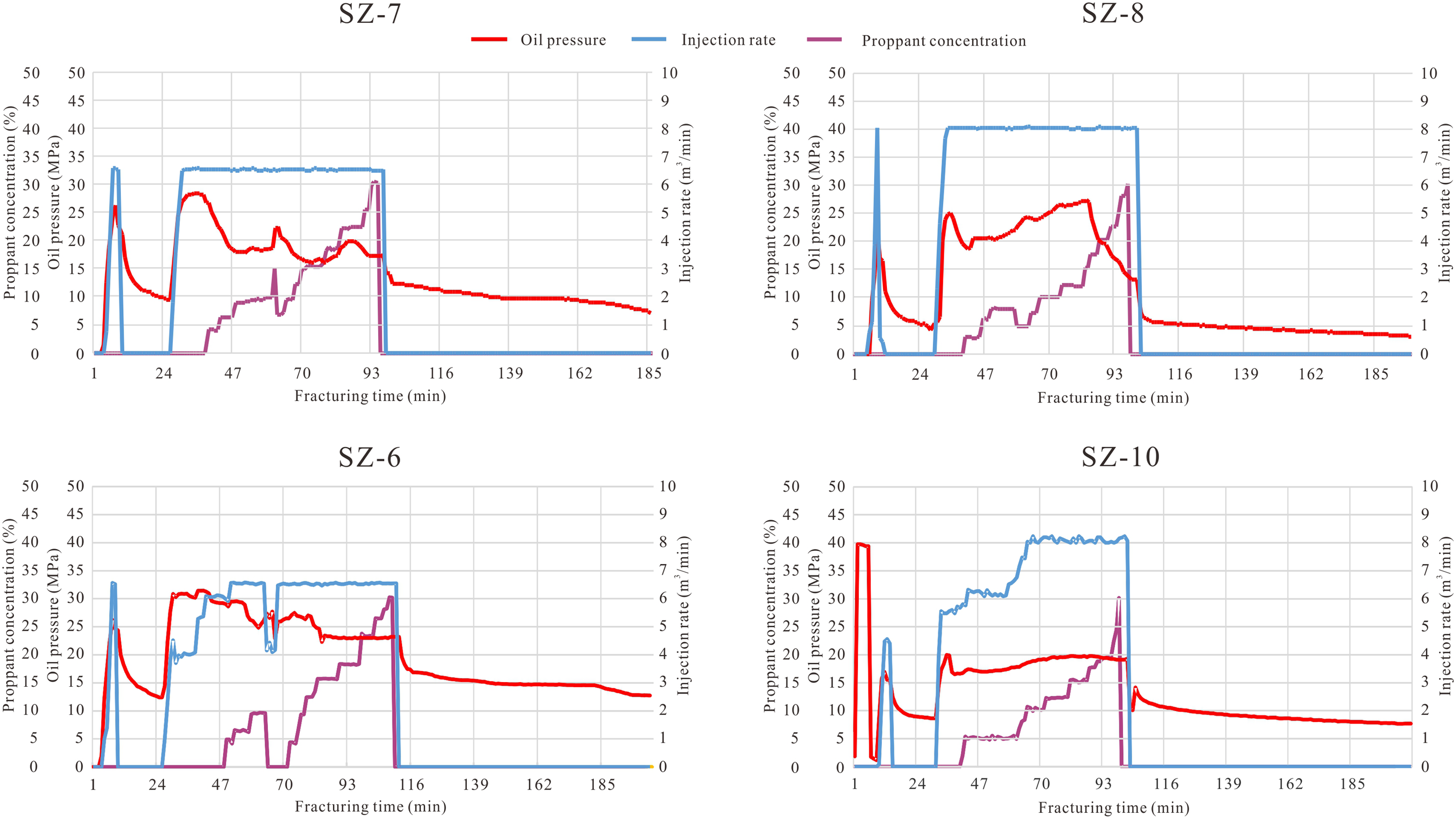
Fracturing curves of Type II coal seam in typical wells SZ-6, SZ-7 (declining type) and SZ-8, SZ-10 (rising type).
Although there are only two wells in our research for Type III coal seams, the fracturing curve characteristics can still provide a reference. The breakage phenomenon of coal seam is not obvious, and fracture blockage caused by pulverized coal generally is more severe than Type I and Type II (Figure 6). This kind of coal seam differs from the previous two types in that it has two interlayers of granulated coal. The total thickness of the granulated coal body accounts for a relatively high proportion of the whole coal seam. Granulated coal has lower strength than original and cataclastic coal, resulting in lower fracture pressure and an unobvious breakage phenomenon. In addition, the oil pressure remained relatively high throughout the formal fracturing stage due to the blockage of the seepage channel by pulverized coal. The oil pressure in well SZ-12 experienced a slightly weaker fluctuation than in well SZ-13 (Figure 6). The fluctuation of the oil pressure in well SZ-13 is significant in the formal fracturing stage, which may be related to the existence of original coal and the lack of cataclastic coal. As the degree of fracture development in original coal is weaker than that of cataclastic coal, fractures in cataclastic coal are more likely to be blocked during fracturing fluid injection.
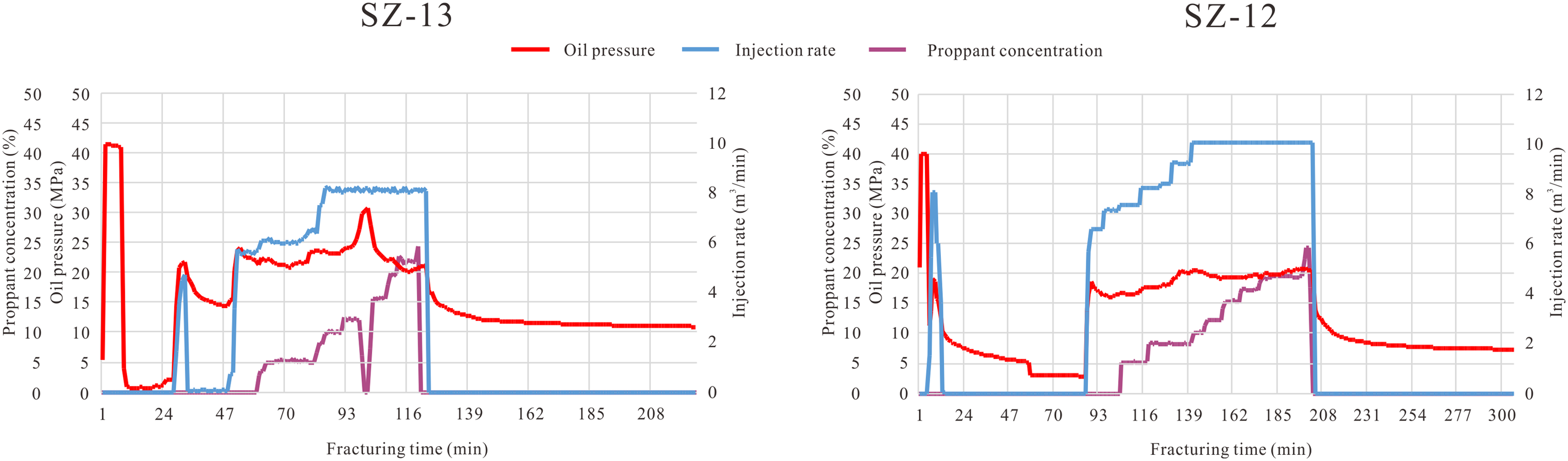
Fracturing curves of Type III coal seam in typical wells SZ-12 and SZ-13.
The above analysis shows that coal seam structure can affect the hydraulic fracturing operation. An obvious breakage phenomenon generally can be observed for original and cataclastic coal body as the oil pressure would decline rapidly. The granulated coal body is prone to produce pulverized coal particles, increasing the difficulty of fracturing construction. The fluctuation of the oil pressure curve is more obvious for a coal seam with a relatively high proportion of granulated coal body.
Effects of coal seam structures on gas and water production
Observations of the production curves of CBM wells in these three types of coal seams show that CBM wells in different types of coal seams have different production characteristics. Vertical variations in coal seam structures may influence water drainage. For the production curves of CBM wells in the Type I coal seam, the gas production mainly rises during the initial stage of fracturing and then decreases gradually, showing a single peak (Figure 7). Gas production is large, and the peak value of gas production is generally more than 1500 m3/day. The water production curve shows high water production volumes during the early fracturing stage and low water production in the middle and late stages. For the Type I coal seam, the fracture system is well developed after fracturing and is favorable for gas and water seepage. Large volumes of water can be discharged smoothly from the coal seam during the early drainage stage, which is conducive to gas production in the later period.
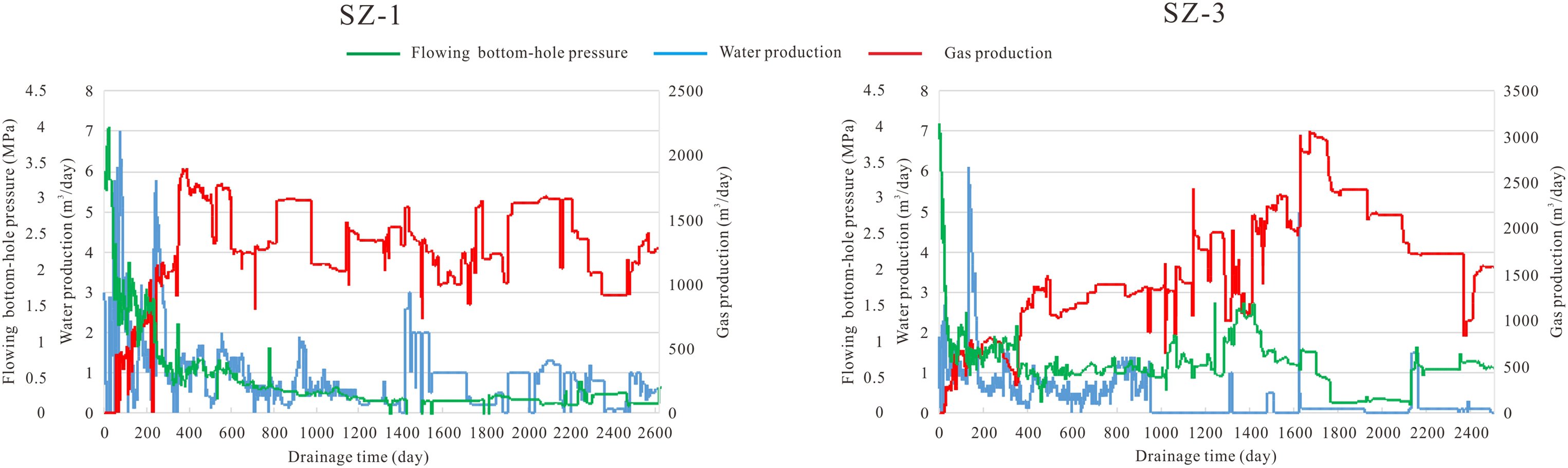
Drainage curves of Type I coal seam in typical wells SZ-1 and SZ-3.
For the Type II coal seam, the gas production curves mainly present the shape of double peaks (Figure 8). At the start of fracturing, original and cataclastic coal form good seepage channels after fracturing transformation, and the gas existing in them can flow into the wellbore quickly and smoothly, forming the first gas production peak. However, during the later stages of the fracturing process, pulverized coal particles produced from the interlayer of granulated coal block the pores and fractures in the original and cataclastic coal to different degrees. This leads to different degrees of difficulty in gas seepage, determining when the first gas production peak arrives. For CBM wells with a small influence of pulverized coal particles, the first peak of gas production arrives earlier, while for those with a significant influence, the first peak of gas production arrives later. The fracturing transformation effect of granulated coal is poor, and it is difficult to form a good seepage channel in this coal, so the gas in granulated coal has a slower flow rate than original and cataclastic coal (Type I). The second gas production peak may be due to a large amount of gas escaping from granulated coal at this stage. The different wells have different water production characteristics for Type II coal seam (Figure 8), as water production depends on whether and how the pulverized coal blocks the pores and fractures. High water production in the early drainage stage may mean that the pores and fractures are hardly affected by pulverized coal, and high gas production can be obtained in the later period. Low water production in the early drainage stage often means that the pores and fractures are affected by pulverized coal, and the gas production would be low in the later period as the coal reservoir can hardly be depressurized.
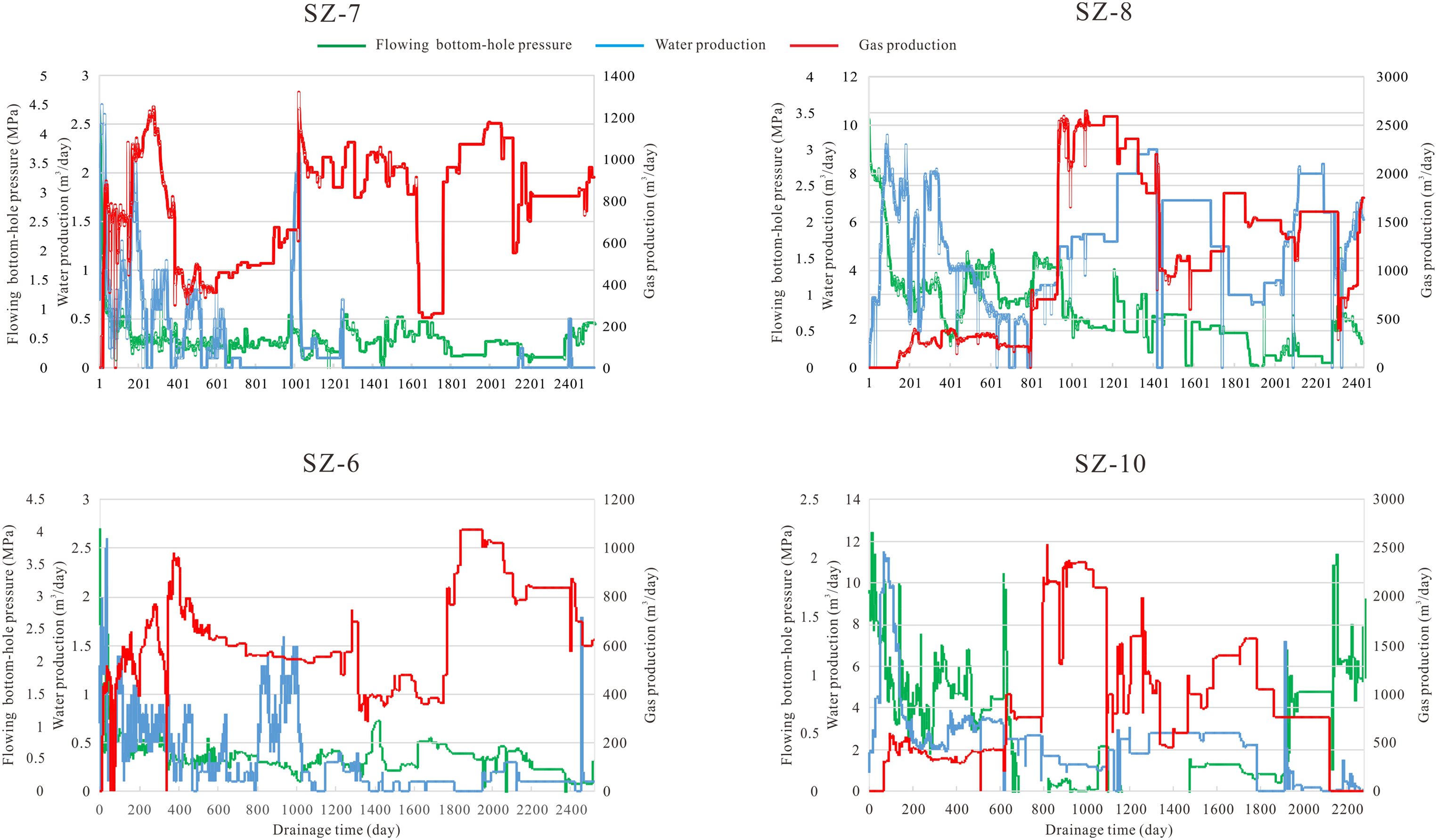
Drainage curves of Type II coal seam in typical wells SZ-6, SZ-7, SZ-8, and SZ-10.
For the Type III coal seam, gas production is low for a long time, and there is nearly no gas production in the later period of fracturing (Figure 9). Type III coal seams have two layers of granulated coal, which is not conducive to fracturing transformation. During the fracturing process, it is difficult for fractures to extend far into the coal seam, and the coal seam can hardly form complex fractures and effective seepage channels. Therefore, the long-term low gas levels of production in Type III coal seams are due to the short extension range of fractures, the small area over which pressure drop occurs, and limited gas desorption volume in the coal seam. Water production from Type III coal seams is generally low during the whole drainage period. As the fractures are poorly developed and a large volume of pulverized coal can also easily block the pores and fractures in Type III coal seams, water and gas cannot easily flow from the wellbore to the coal seam.
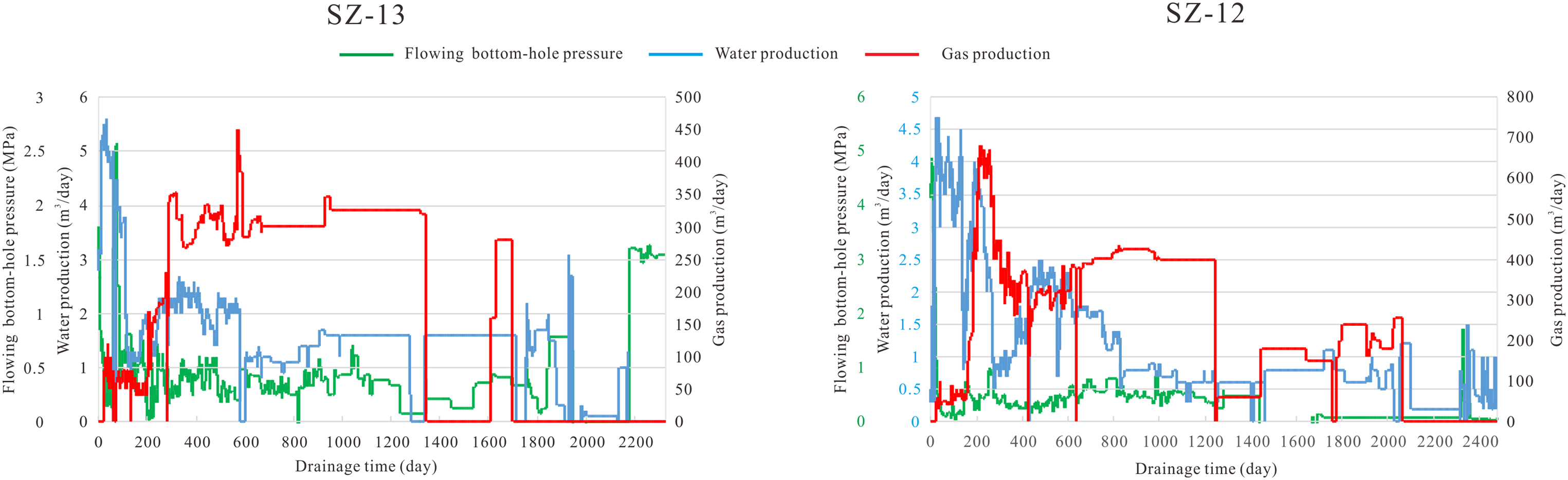
Drainage curves of Type III coal seam in typical wells SZ-12 and SZ-13.
The above analysis shows that coal seam structure is essential to gas and water production. After fracturing, the coal seam dominated by the original and cataclastic coal body generally has good seepage channels and depressurization effect, thus high gas production. The existence of a granulated coal body could reduce the depressurization range of coal seam as the pulverized coal could block the seepage channels and slow the rate of water and gas production. The thicker the granulated coal body, the worse the water and gas production.
These wells are next to each other and have similar geological conditions. Though there are a few collapse columns around CBM wells, the collapse columns do not affect the production wells. The fracturing fluid leakage and abnormally high yield water that collapse columns may bring are not found. Therefore, the research does not discuss other factors affecting gas and water production. This paper focuses on the impacts of coal seam structure on gas and water production. More research must be done on other factors affecting gas and water production from fractured CBM sites.
Conclusion
This paper identifies the vertical variation characteristics of coal textures in Shizhuangnan Block, southern Qinshui Basin. In the study area, three kinds of coal body textures are observed, including original, cataclastic, and granulated structure, where the coal body textures overlay vertically. The coal seams in the study area are classified into three types according to the vertical variation characteristics of coal seam structure. This study analyzed hydraulic fracturing construction and water and gas production curves for the different types of coal seams. The following conclusions are drawn from the analyses:
Type I coal seams only develop the original and cataclastic structure. The obvious breakage of the coal seam can be observed for Type I. The oil pressure is generally stable with little fluctuation during the fracturing process. The results of fracturing reconstruction for Type I are good, and the gas production of CBM wells in Type I coal seams is usually high. The gas production curve of CBM wells often presents a single peak. The water production curve shows high volumes of water production in the early stage of hydraulic fracturing and low volumes of water production in the middle and late stages.
Type II coal seams develop an additional layer of granulated coal compared with Type I. The obvious breakage of the coal seam can also be observed for Type II. However, during hydraulic fracturing, the granulated coal easily produces fine coal that can block the pores and fractures of the coal seam, increasing oil pressure. The gas production curve of CBM wells in Type II coal seams is mostly bimodal. The first gas production peak may be mainly caused by the gas desorbed from the original and cataclastic coal, and the second gas production peak may be mainly caused by the gas desorbed from granulated coal. Different wells have different water production characteristics for Type II coal seams, which depend on whether the pulverized coal blocks the pores and fractures of the coal seam.
Type III coal seams develop two extra layers of granulated coal compared with Type I, which means that a more significant proportion of granulated coal is present in Type III coal seams. The breakage phenomenon of coal seams is not apparent, and fracture blockage caused by pulverized coal generally is more severe than Type I and Type II. The results of fracturing reconstruction for Type III are bad. Seepage channels do not form easily in Type III coal seams after hydraulic fracturing and resultant fractures do not extend far into the coal seam. Gas production from CBM wells in Type III coal seams is usually low, while water production is generally low during the whole drainage period. This paper summarizes and analyzes the influence of different coal seam structures (classified according to coal body texture characteristics) on hydraulic fracturing construction and resultant water and gas production, which can provide helpful reference information for future fracturing construction of CBM wells.
Footnotes
Declaration of conflicting interests
The author(s) declared no potential conflicts of interest with respect to the research, authorship, and/or publication of this article.
Funding
The author(s) disclosed receipt of the following financial support for the research, authorship, and/or publication of this article: This work was supported by the National Science and Technology Major Project of China, National Natural Science Foundation of China, (grant number 2017ZX05036-001-008, 2017ZX05064003, 41772159, 41872178, U1910205).
