




Abstract
Paste composite filling mining is one of the effective ways to realize green mining. In order to study the movement and deformation characteristics of overlying stratum in paste composite filling stope, taking the test mine as the engineering background, a mechanical model of movement and deformation of roof rock beam in paste composite filling mining was established by combining theoretical analysis, physical simulation and numerical simulation. The movement and deformation laws of main roof, sub-key stratum and main key stratum in the process of working face advancing under the conditions of multiple factors (mining height, filling ratio and buried depth) were analyzed. The results show that the displacement contour of overlying stratum is inverted trapezoid in the process of advancing working face which is unfilling or filling 2/3. The subsidence of stratum near the coal seam is larger, and the subsidence of stratum with higher distance from the coal seam is smaller, and the maximum subsidence point of overlying rock appears near the side of the open-off cut. With the increase of mining height, the range of overlying rock caving zone becomes larger, and the maximum subsidence value gradually increases. When the paste filling ratio of the working face increases, the collapse range of the roof decreases, the overall compression of the collapsed rock decreases, and the effect of control on the movement and deformation of the overlying rock is obvious. The subsidence of overlying stratum increases with the increase of buried depth of working face, but it does not change much. The deflection value of the roof rock beam changes slowly at both ends of the propulsion due to the support of the coal wall. The closer to the middle, the greater the change. The results of this study can provide an important reference for the control of the roof stability and surface subsidence of the paste composite filling mining.
Introduction
The edge of the Maowusu Desert in western China is rich in coal reserves. There are very precious aquifers in this area that have been seriously polluted and destroyed due to underground mining, making contradictions between coal mining and environmental protection increase (Miao et al., 2015; Zhang et al., 2015; Li et al., 2018; Ju et al., 2020). Filling mining is one of the effective ways to solve the above problems. In order to solve the main problem of filling mining, which is, the mutual restriction between coal mining and filling, an economical and reasonable partial filling method can be selected (Qian et al., 2003; Wang et al., 2020). Scholars at home and abroad have done a lot of research on overlying stratum migration of filling mining. Xu et al. (2006) put forward the idea of partial filling with corresponding explanations. In their study, the partial filling is divided into three categories, and taking the principle of collaborative control of overlying stratum by filling body—key stratum—coal pillar as the basis of partial filling mining design. Li et al. (2008) studied the roadway gangue filling body and the coal pillars on both sides as a plane strain problem, and established a mechanical model using elastic theory. On this basis, the Maxwell rheological model was introduced to solve the displacement of the coal pillars on both sides, and the relationship between the transverse and longitudinal deformation of the coal pillars, the filling material and filling time was obtained. In order to solve the problem of overlying stratum movement and surface subsidence in paste filling mining, Chang (2009) studied the change of abutment pressure and overlying stratum movement in the process of paste filling mining by means of physical simulation and numerical analysis. The mechanical model of overlying stratum movement of filling body was established by using Winkler elastic foundation theory. The main factors affecting overlying stratum movement in the process of paste filling mining were analyzed, and the mechanism of overlying stratum movement and surface subsidence control in filling mining was revealed. The experiment of Zhu Cun Mine confirmed the practicability of the filling model. Taking the 2351 paste filling working face of Daizhuang Coal Mine as an example, Chen et al. (2011) established a model of the characteristics of the cemented body. The model was studied the space–time structure model and movement law of overlying stratum in strip coal pillar paste filling mining. Helinski et al. (2011) used numerical methods for sensitivity research, highlighting some important characteristics of the cemented filling behavior, and revealing the complex interaction mechanism between various attributes. Based on the field measurement and modeling analysis of two cement-based paste filling stopes, the mine pressure behavior and the mechanical behavior of the surrounding rock were studied.
At present, scholars at home and abroad have made a lot of achievements in overlying stratum stress and deformation in caving mining and full filling mining (Chen et al., 2011; Xu et al., 2015), but the characteristics of overlying stratum movement and deformation in partial filling mining, especially in the paste composite filling mining (PCFM) of paste filling body and caving roof, need to be further expanded and developed. This paper takes the 112201working face of the experimental mine as the research background, and uses physical simulation and numerical simulation to study the movement and deformation characteristics of overlying stratum under the influence of multiple factors (mining height, filling amount, buried depth). It provides an important theoretical basis for the study of overlying rock migration law in PCFM stope.
Mechanical model analysis
PCFM is combined with the bulkiness of loose rock, and the composite filling body formed by paste filling body and caving roof is used to support the overlying stratum (Yu et al., 2016; Yin et al., 2016; Guo, 2020; Lv et al., 2022), as shown in Figure 1. Compared with other filling methods, this filling method can also effectively reduce the filling cost, simplify the filling process, reduce the amount of filling materials, improve the filling speed, and minimize the impact on production (Xu et al., 2015; Yang et al., 2017; He et al., 2021; Qiu et al., 2022; Wang et al., 2022).
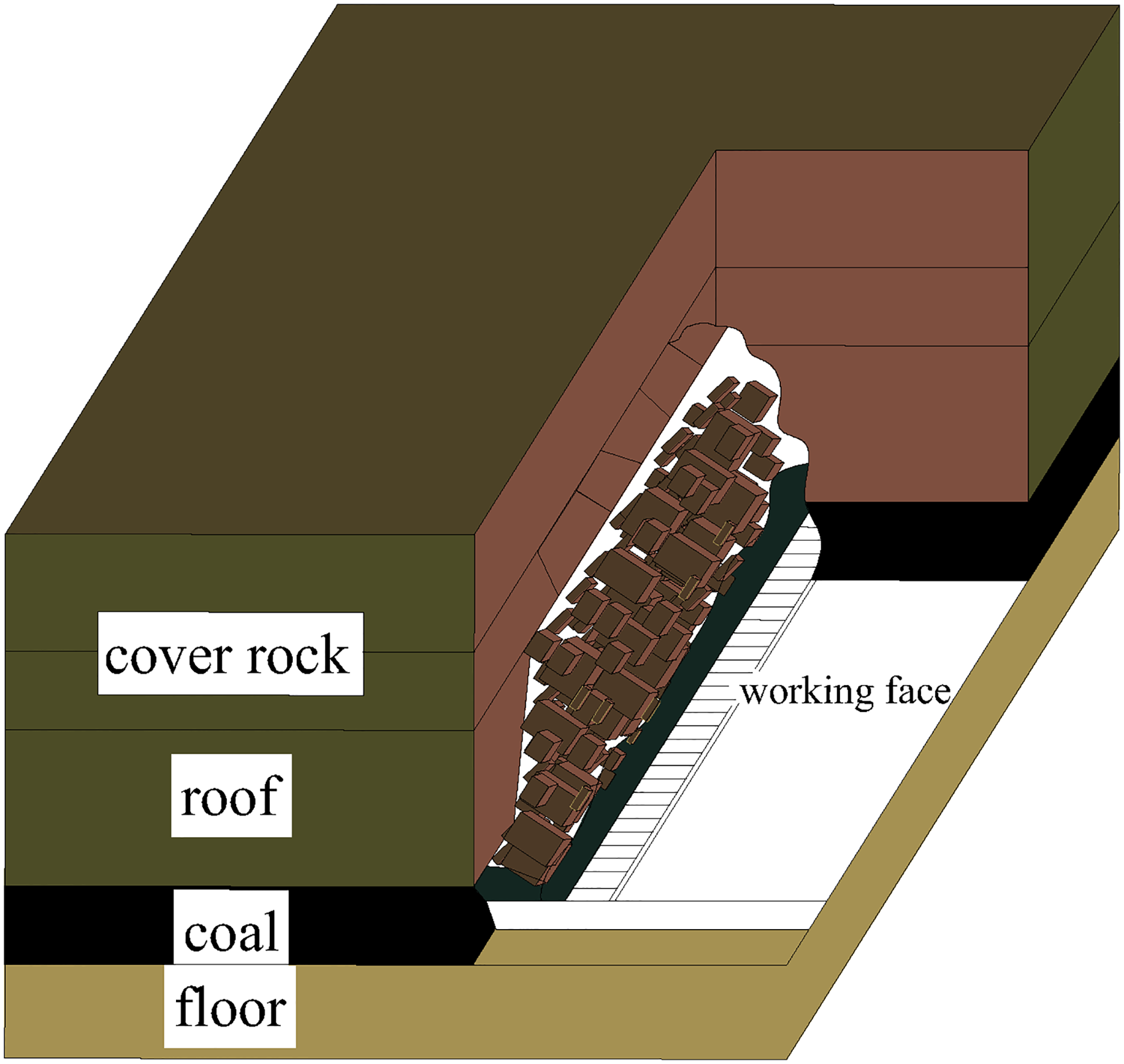
Schematic diagram of paste composite filling.
The dynamic change process of overlying stratum of PCFM is complex because the goaf is occupied by part of the paste filling body (Yang et al., 2021; Dudek and Tajduś, 2021; Wen et al., 2022). Compared with the caving method, the stope is affected by the filling body, and a new dynamic space of “support-surrounding rock (working face coal body, roof, floor)—composite filling body” is formed in the stope. In the method, new characteristics can be found for the stress state, movement, deformation and failure law of overlying stratum (Al Heib et al., 2010; Yilmaz et al., 2014; Kostecki and Spearing, 2015; Ke et al., 2016; Hefni and Ali, 2021; Huang et al., 2021). There will be a part of the roof on the side of the coal wall in a suspended roof state in the process of working face advancement through field test and physical similarity simulation experiments, and a mechanical model of overlying rock movement change is established, such as Figure 2, the working face advances from left to right, x = 0 is the opening of the working face, and the empty area is filled from this position, x = L is the position of the working face coal wall. The whole section is divided into three areas, area one is the uncapped area, area two is the filling area, and area three is the uncapped area; filling body and coal are regarded as elastic medium. By analyzing the stress distribution characteristics, the analytical solution of overlying rock subsidence is finally obtained.
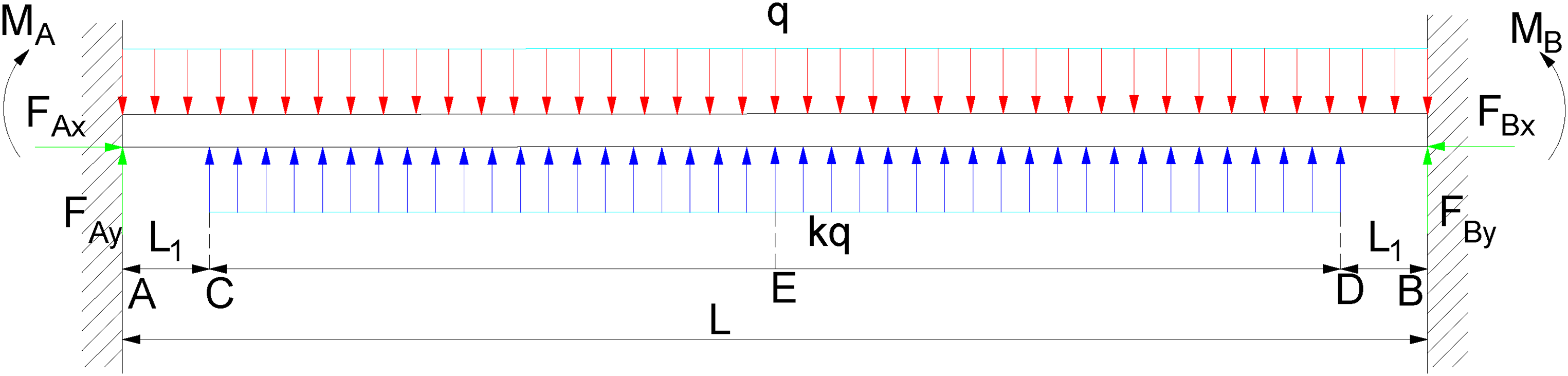
PCFM mechanics model.
As shown in Figure 2, point E is the center point; L is advancing length for working face, m;
By Figure 2, it can be concluded that:




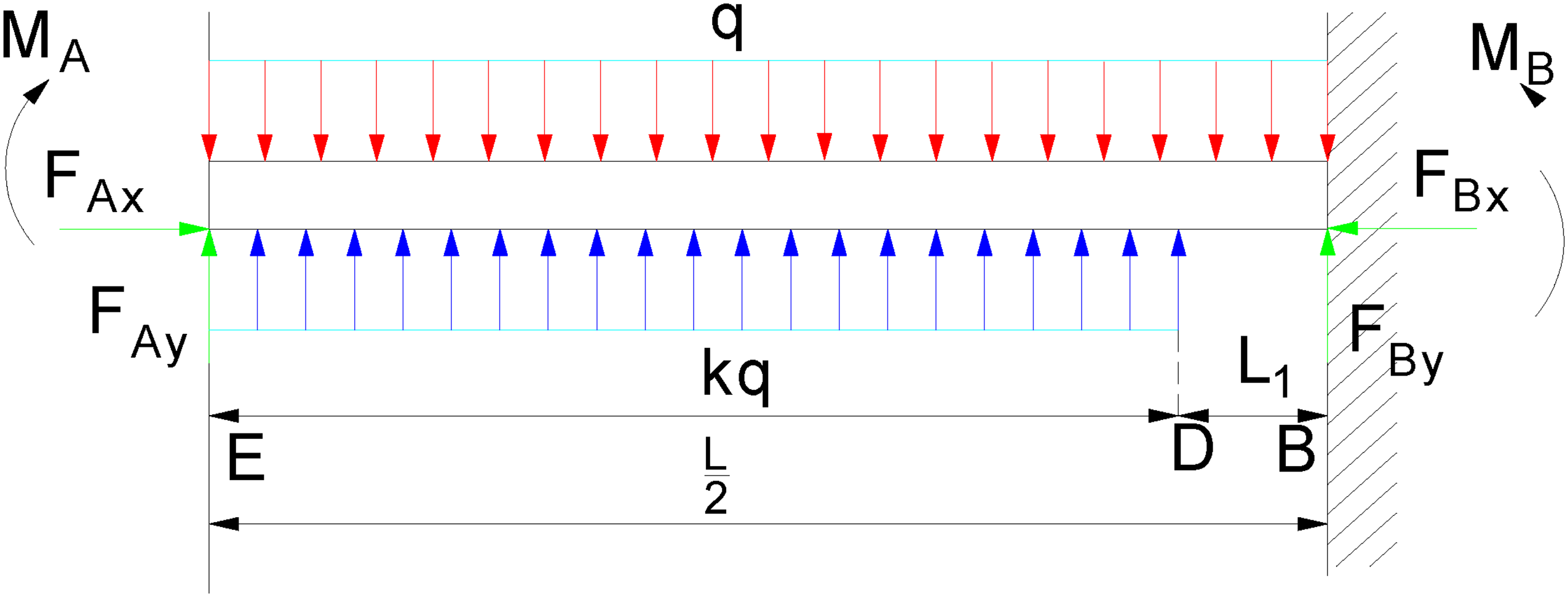
Roof rock beam stress distribution.
Let the moment of the BD segment be Under PCFM, the bending moment value of roof rock beam shows a trend of “decrease-increase.” The deflection shows a trend of “increase-decrease.” It shows that the roof rock beam is affected by the support of the filling body, and the effect is most obvious in the middle of the stope. Due to the support of the coal wall at both ends of the advancing direction, the effect of the filling body is weakened, so the difference of deflection value of the roof rock beam becomes smaller. The deflection and bending moment curves of the roof rock beam have only one peak and are symmetrically distributed. After the goaf is filled, the goaf of the stope of PCFM is occupied by the filling body, and the filling body has a supporting effect on the goaf. Therefore, the stress conditions of the main roof rock beam in the goaf are changed, and the filling body has a better bearing effect on the roof.






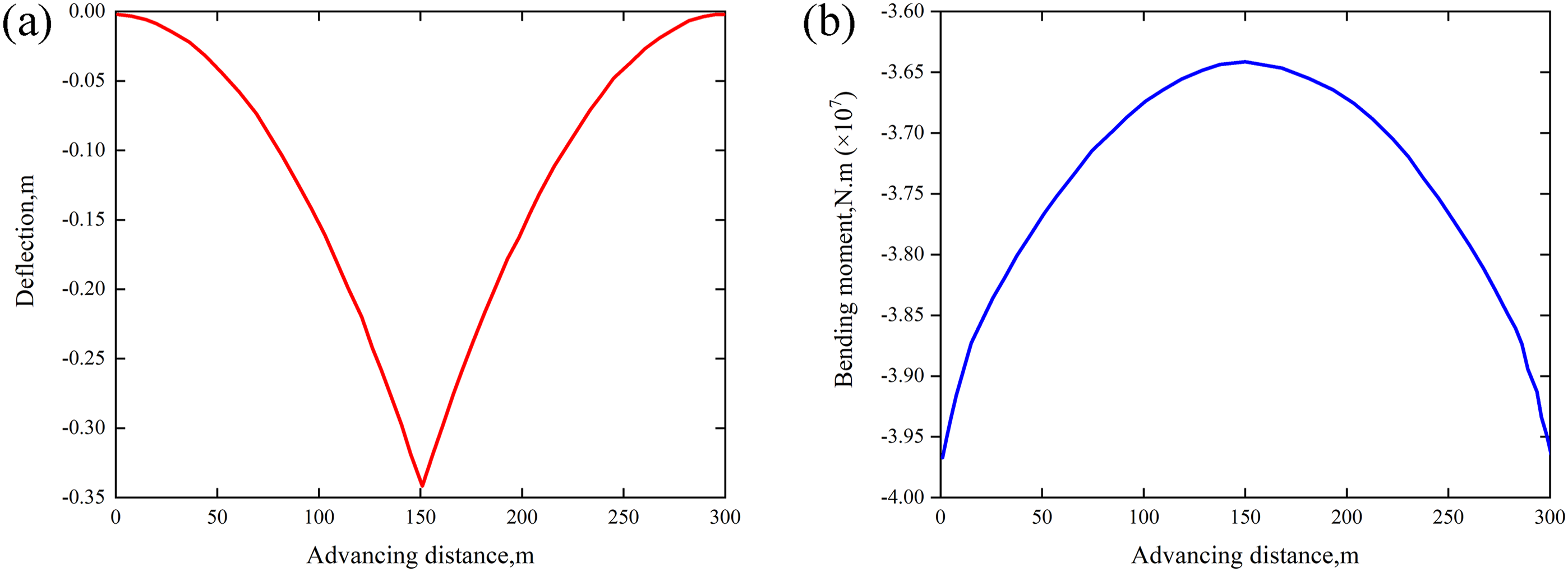
Deflection and bending moment values of roof rock beam: (a) deflection and (b) bending moment.
Computer numerical simulation
Engineering overview
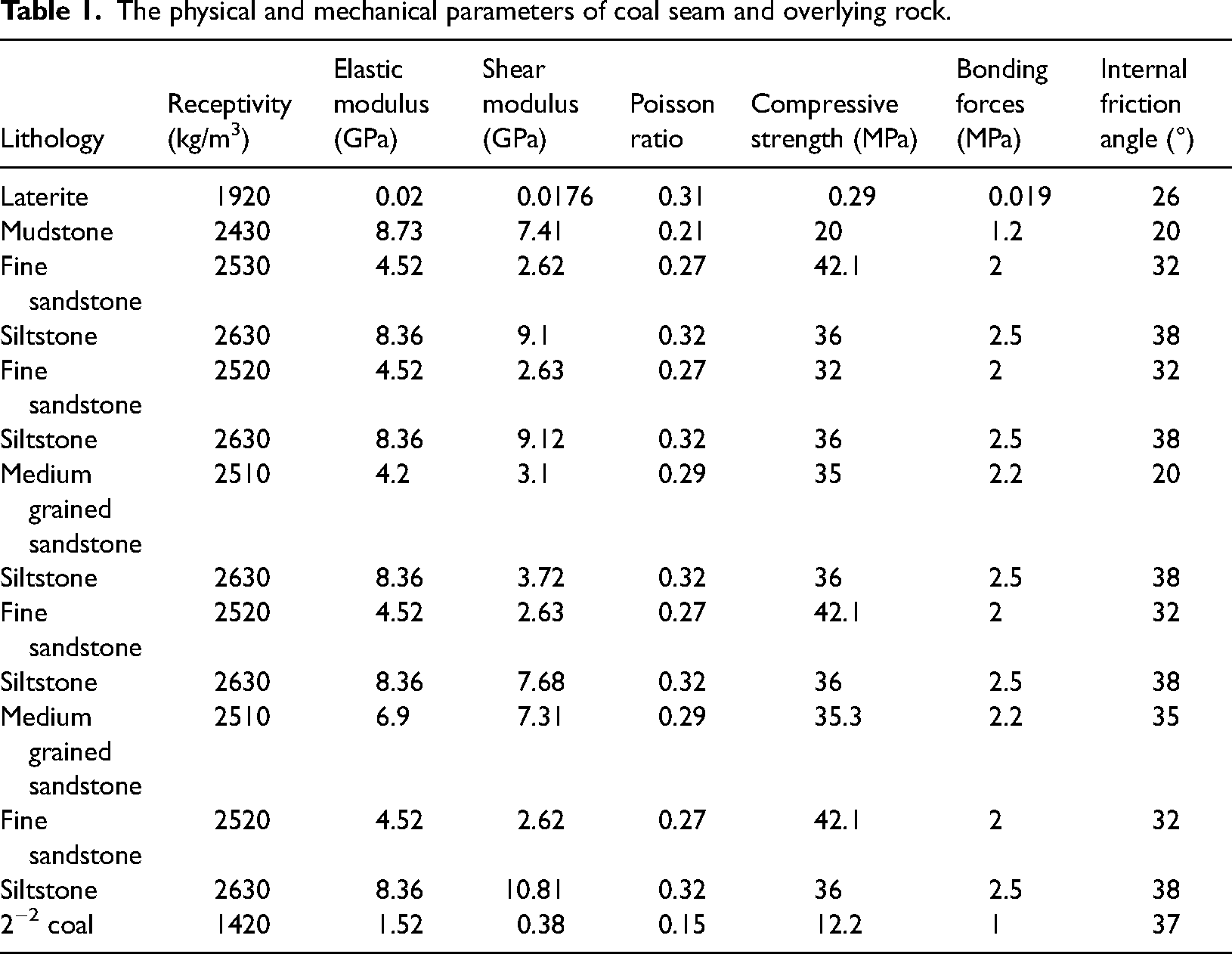
The experimental mine is currently mining 2−2 coal seam, which is the thickest main minable coal seam in the well area. The dip angle is 1° to 3°, and the average dip angle is 2°. The average buried depth of coal seam is 277.75–387.99 m. The thickness of coal seam is 3.58–8.06 m, with an average thickness of 6 m. Thick coal seam is the main part in 2−2 coal seam. The coal seam belongs to medium-thick to thick coal seam. The thickness changes greatly and the regularity is obvious. The coal seam structure is simple. The coal is mainly non-caking coal, and some long flame coal. The lithology of immediate roof is mainly thin siltstone and fine-grained sandstone, and the thickness is generally 1–7.81 m, with an average thickness of 3.7 m. The lithology of the main roof is mainly siltstone and fine sandstone, with a thickness of 3.37–16.11 m, with an average thickness of 10 m. The false roof is composed of dark gray carbonaceous mudstone with a thickness of about 0.4 m, only local occurrence. The immediate floor is mainly composed of sandy mudstone and siltstone, which is a medium-hard rock that is easy to soften. The main floor is mainly composed of siltstone and fine sandstone, which belong to medium-hard rock that is easy to soften. The physical and mechanical parameters of coal seam and overlying rock are shown in Table 1.
The physical and mechanical parameters of coal seam and overlying rock.
Model building
UDEC6.0 numerical simulation software is used to establish numerical models under different mining height, filling ratio (the ratio of paste filling body height to mining height) and buried depth. Taking the mining height of 6 m, the filling of 1/3, and the buried depth of 250 m as the benchmark, the benchmark of the PCFM model is shown in Table 2.
Benchmark table of influencing factors of PCFM model.

The bottom boundary, the left and right boundaries of the model are fixed to limit the boundary movement. When the model is established on the surface, the stress condition of the upper boundary of the model is set to zero. When the working face is mined under the same buried depth, stress is applied to the upper surface of the model. When the buried depth is 300 m, 350 m, 400 m, 1.25 MPa, 2.5 MPa, 3.75 MPa vertical downward stress were applied. Mohr–Coulomb model is adopted in the constitutive model of coal rock and paste filling body. A coal pillar of 100 m is set on both sides of the model to reduce the boundary effect caused by model excavation. The working face is advanced by means of mining and filling, 5 m is advanced each time, and the advancing distance of the whole model is 300 m.
The migration characteristics under different mining heights
Figure 5 is the subsidence curve of the roof stratum with the mining height of 4 m, 5 m, 6 m, 7 m and 8 m under the condition of filling 1/3 and buried depth of 250 m. It can be seen from the figure that the displacement contour of the overlying rock presents an inverted trapezoidal shape. The closer the overlying rock are to the coal seam, the larger the subsidence is. The farther the overlying rock are from the coal seam, the smaller the subsidence is. With the increase of coal seam mining height, the overall subsidence of overlying rock increases. When the mining height is gradually increased from 4 to 8 m, the corresponding maximum subsidence values of the main roof are 2.5 m, 3.2 m, 3.9 m, 4.6 m, 5.4 m, the maximum subsidence values of the sub-key stratum are 1.5 m, 2.1 m, 2.6 m, 3.2 m, 3.6 m, and the maximum subsidence values of the main key stratum are 1.04 m, 1.4 m, 1.7 m, 2.2 m, 2.5 m. The subsidence of main roof, sub-key stratum and main key stratum increases gradually. It shows that when the mining height of the working face is larger, the height of the goaf formed is larger, and the range of the roof caving zone becomes larger, which provides a larger space for the movement and subsidence of the roof stratum and makes an increase in the overall subsidence value of the stratum.
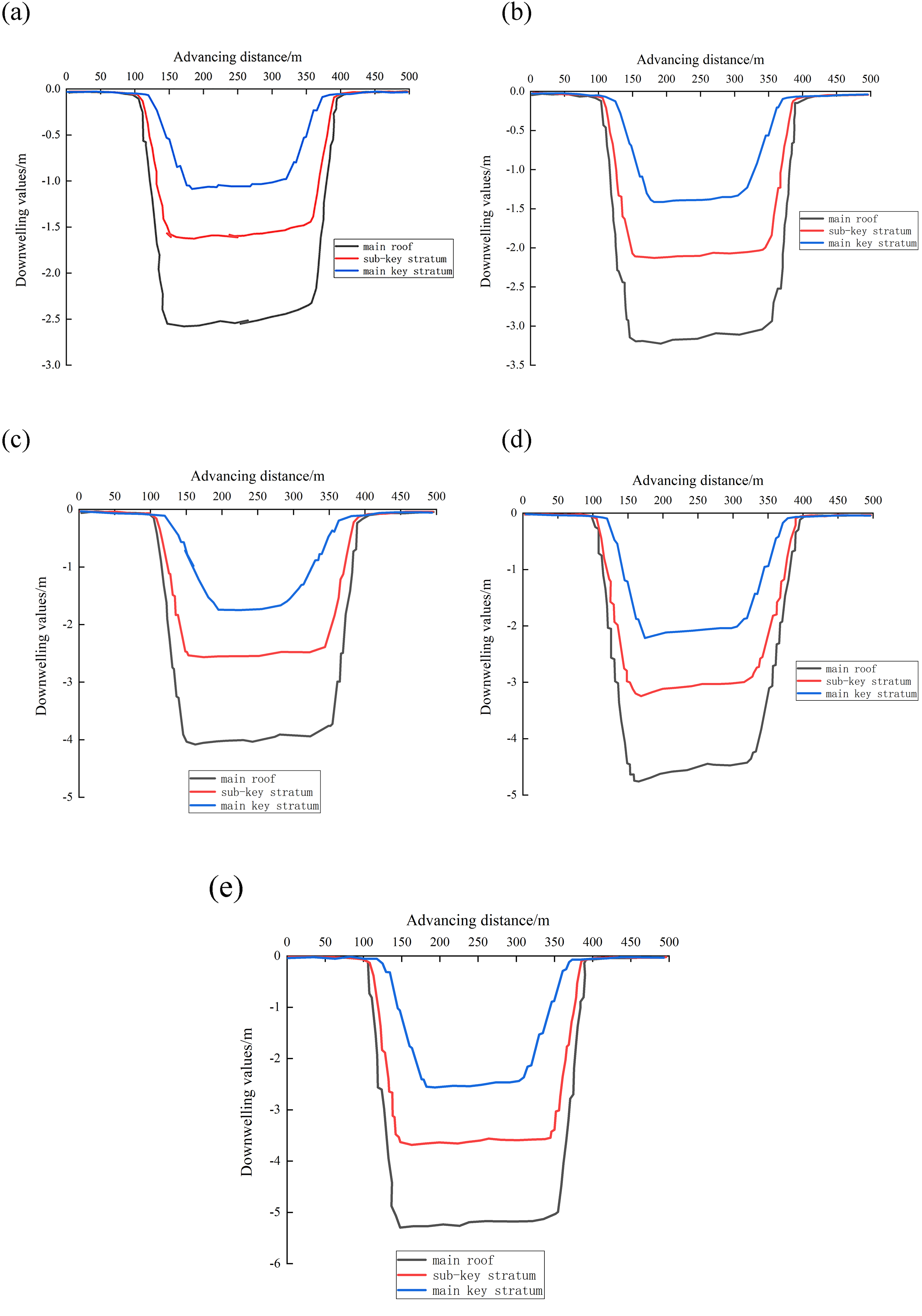
Overlying stratum migration characteristics under different mining heights: (a) mining height 4 m, (b) mining height 5 m, (c) mining height 6 m, (d) mining height 7 m and (e) mining height 8 m.
Migration characteristics under different paste filling ratios
Figure 6 is the filling ratio of 0, 1/5, 1/3, 1/2, 2/3, 3/4 and 1, respectively, and the corresponding roof stratum subsidence curve after the mining of the working face is completed. The figure shows that when the filling ratio of the working face is low, the movement and subsidence value of the roof stratum are large. When the filling ratio of the working face increases, the overall subsidence of the roof stratum decreases. When the filling ratio of the working face reaches 100%, the subsidence value of the roof stratum reaches the minimum. When the filling ratio gradually increases from 0% to 100%, the corresponding maximum subsidence values of main roof are 5.9 m, 4.6 m, 3.8 m, 2.9 m, 1.9 m, 1.5 m and 0.4 m, the maximum subsidence values of the sub-key stratum are 3.9 m, 2.9 m, 2.6 m, 2.1 m, 1.4 m, 1.1 m and 0.3 m, and the maximum subsidence values of the main key stratum are 2.8 m, 2.0 m, 1.7 m, 1.3 m, 0.8 m, 0.6 m and 0.1 m. The maximum subsidence values of main roof, sub-key stratum and main key stratum gradually decrease. It can be seen that when the paste filling ratio of the working face increases, the free space of the goaf is smaller, the roof caving range is reduced, the overall compression of the caving rock is reduced, and the subsidence of the roof is reduced. It is proved that with the increase of paste filling ratio, the composite filling body formed by paste filling body and caving rock has better control effect on the movement of roof surrounding rock.
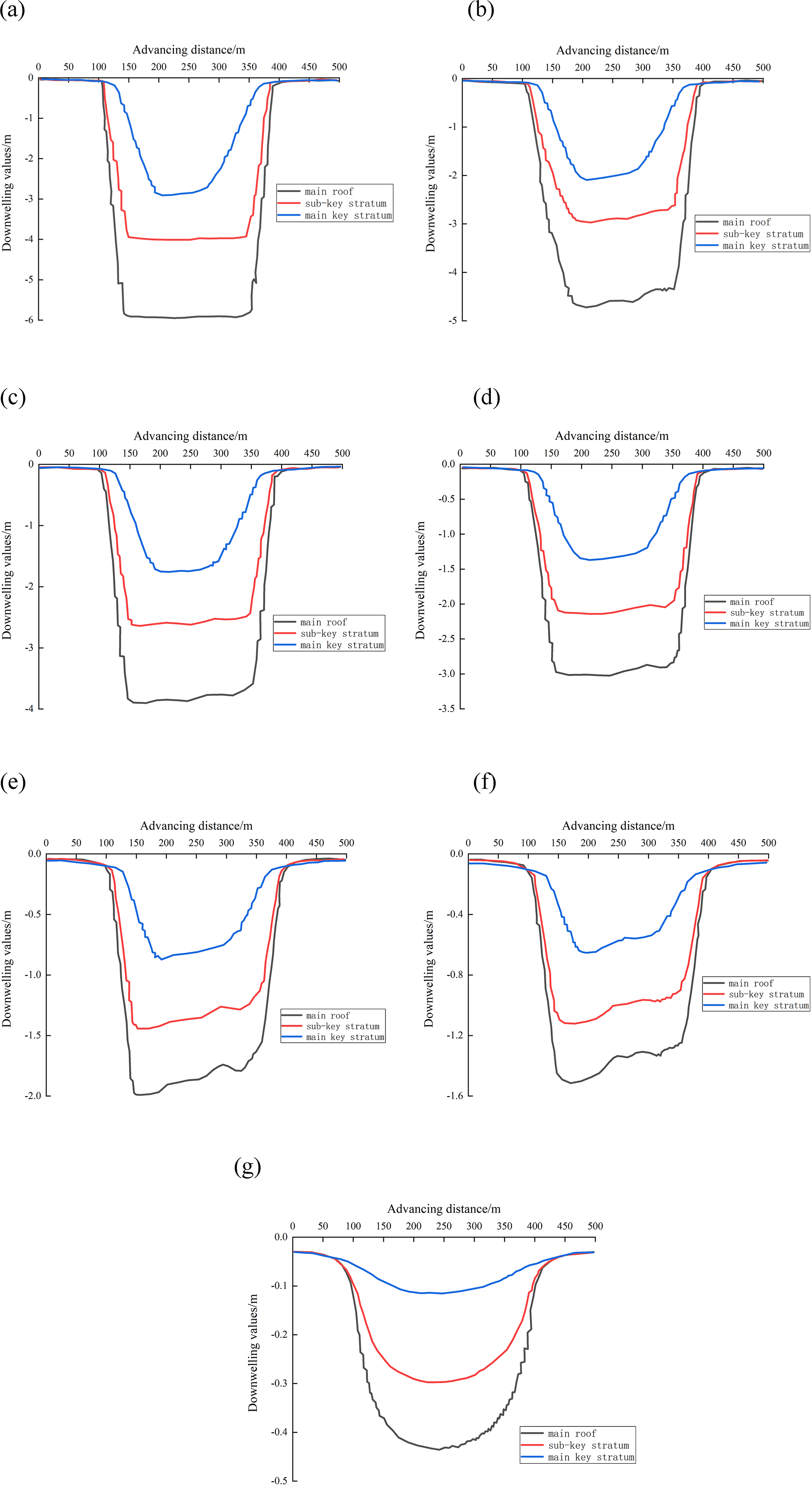
Overlying stratum migration characteristics under different filling ratios: (a) unfilled, (b) filling 1/5, (c) filling 1/3, (d) filling 1/2, (e) filling 2/3, (f) filling 3/4 and (g) full filling.
Migration characteristics under different burial depths
Figure 7 shows the curves of roof stratum subsidence after mining when the mining height is 200 m, 250 m, 300 m, 350 m and 400 m. It can be seen from the figure that the maximum subsidence value of overlying stratum appears near the side of open-off cut. With the increase of buried depth of coal seam, the vertical displacement of roof stratum increases, but the increase is small. When the buried depth is from 200 to 400 m, the corresponding maximum subsidence value of main roof is 3.93 m, 3.94 m, 3.96 m, 3.98 m and 3.99 m, the maximum subsidence value of sub-key stratum is 2.65 m, 2.67 m, 2.69 m, 2.71 m and 2.73 m, the maximum subsidence value of main key stratum is 1.72 m, 1.73 m, 1.74 m, 1.73 m and 1.74 m; it can be seen that with the increase of working face mining height, the maximum subsidence of main roof, sub-key stratum and main key stratum increases and fluctuates, but the increase is not large, which fully shows that when the buried depth of working face increases, it has little effect on roof movement and subsidence.
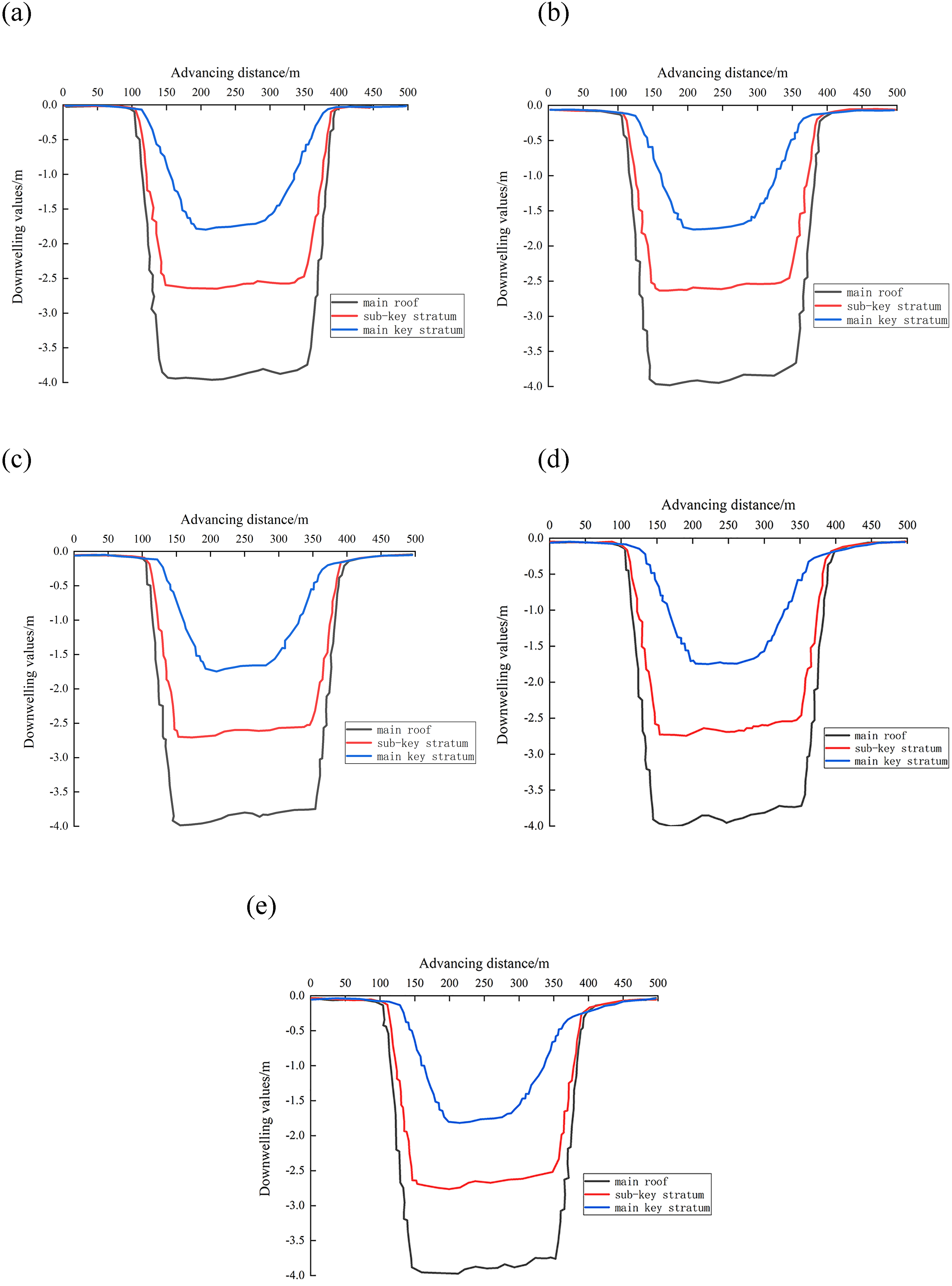
Overlying stratum migration characteristics under different burial depth: (a) burial depth 200 m, (b) burial depth 250 m, (c) burial depth 300 m, (d) burial depth 350 m and (e) burial depth 400 m.
Physical similarity simulation
Experimental design
In this experiment, the two-dimensional similar simulation experiment frame is used to simulate the distribution characteristics of the advanced support pressure of the coal wall and the support pressure of the floor during the advancement of the working face. According to the experimental purpose, length × width × height = 300 × 20 × 180 cm is selected. According to the size of the physical similar simulation experiment frame, the geometric similarity constant
Proportioning of physical similarity simulation materials (1:150).
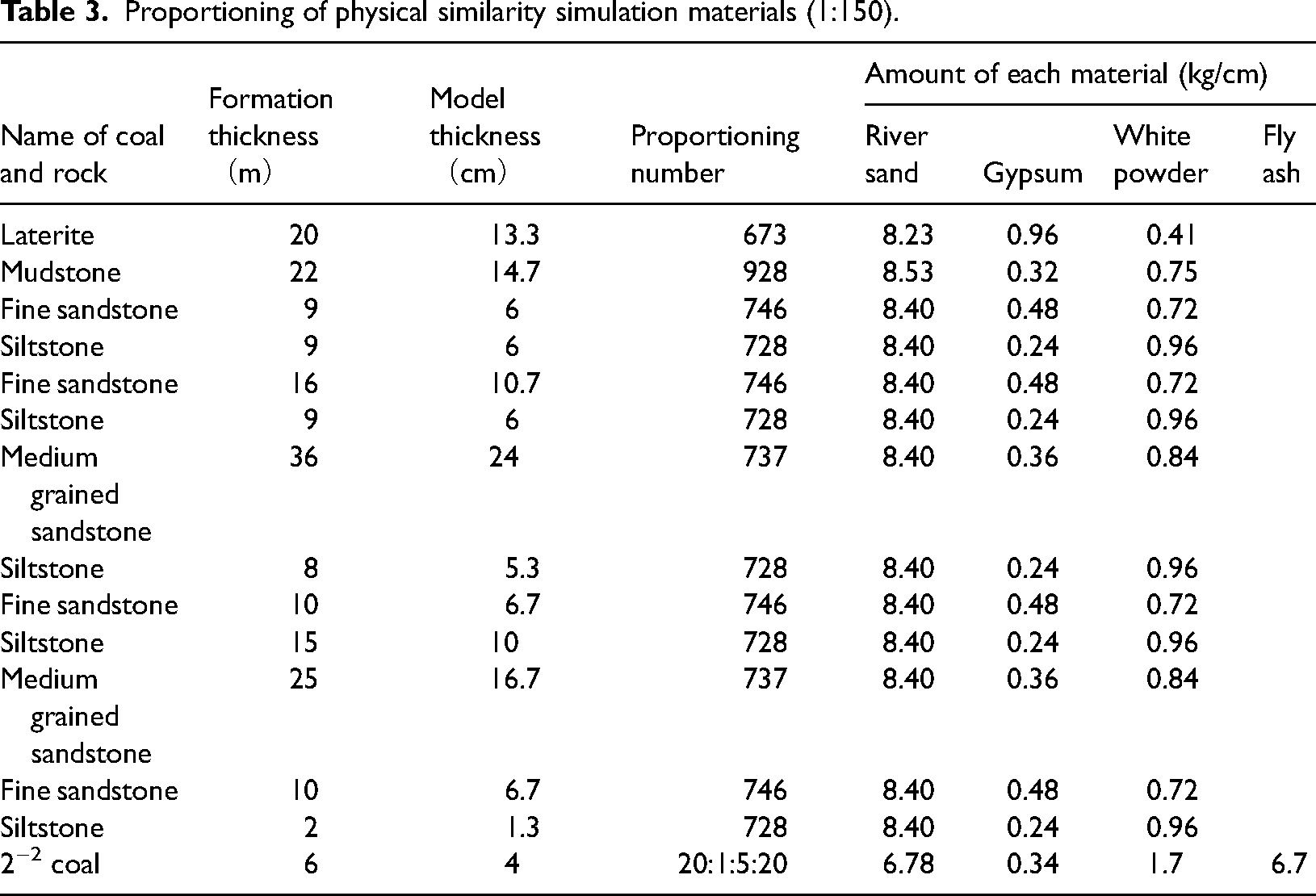
According to the proportion table of similar materials, the experimental materials of corresponding quality are weighed, and the proportion materials are fully mixed and stirred evenly by manual stirring. Immediately after the completion of mixing, the material is loaded, and the simulated rock layer is prefabricated after artificial leveling and compaction. Finally, the mica powder is sprinkled on the surface of the simulated rock stratum to realize the stratification between the simulated rock stratums. The thickness of each loading from the immediate roof to the sub-key stratum is 1 cm, and the thickness of each paving above the sub-key stratum is 1.5 cm. Foam was used to simulate the paste filling body. Similar simulation test laying model is the length of 300 cm, left and right sides are set boundary coal pillar 30 cm, the actual mining is the length of 240 cm, open-off cut is 4 cm, model mining height is 4 cm, each excavation is 2 cm. The simulated stratum thickness is 253 m in total, and wireless pressure sensors are laid under the coal seam to monitor the advance support pressure of the working face. Similar simulation test model is shown in Figure 8. The specific survey line layout position is as shown in Figure 9.
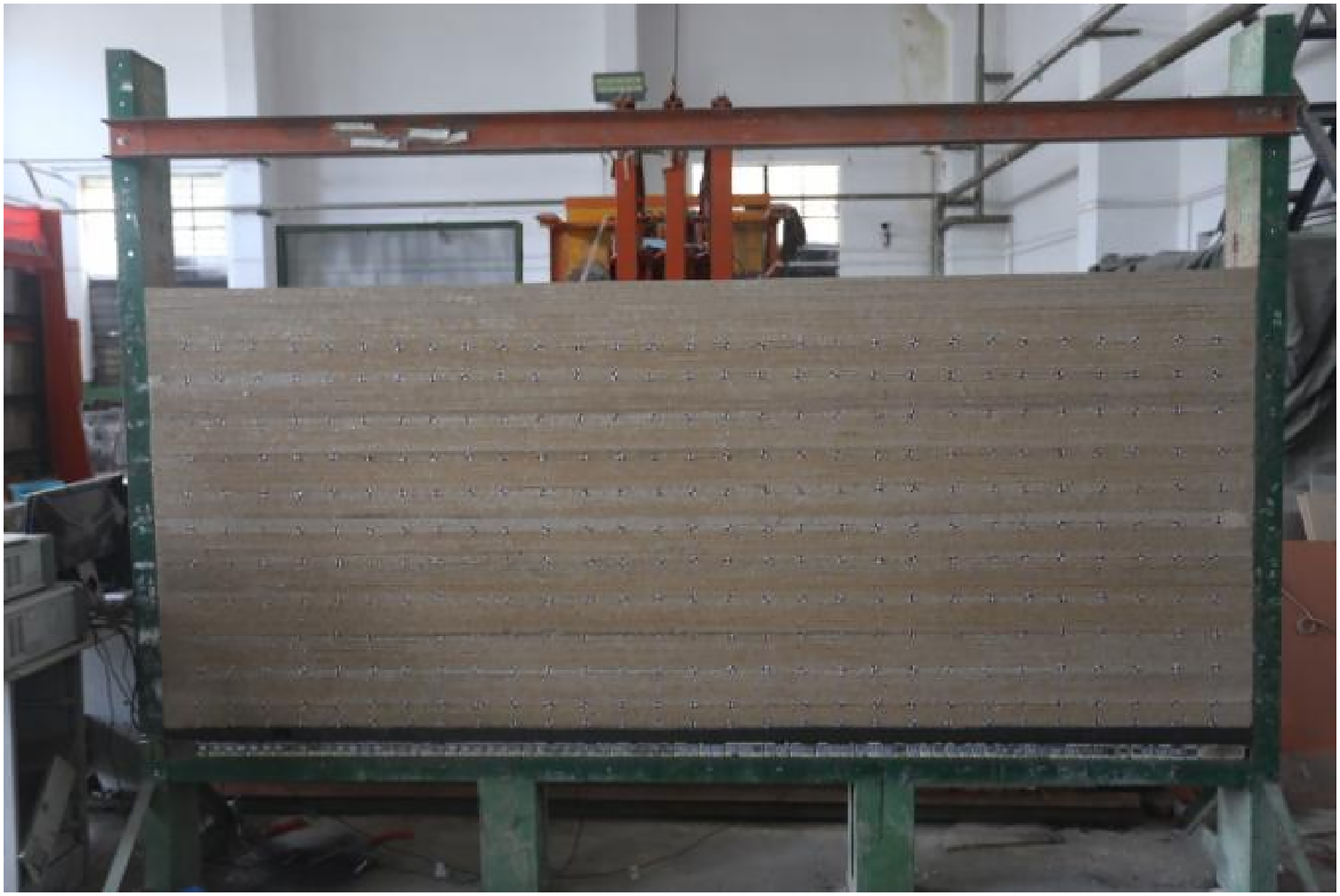
Similar simulation test model.
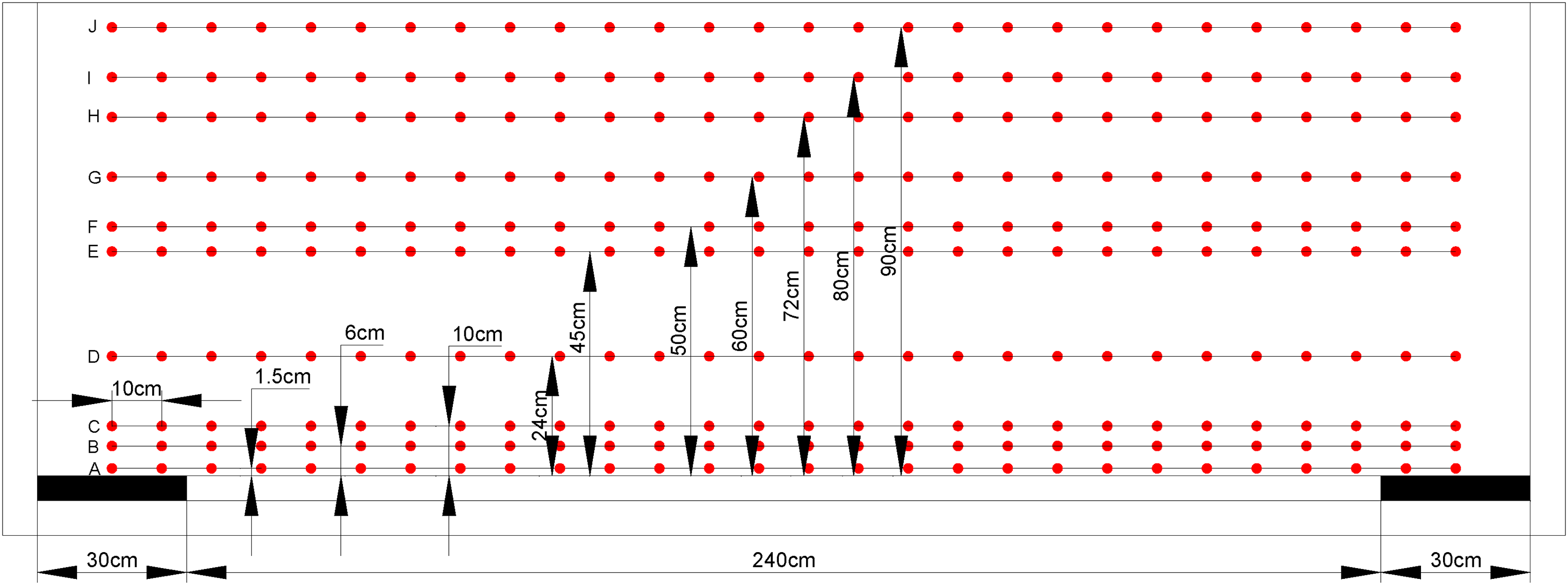
Layout of physical model displacement measuring line.
Analysis of overlying rock movement and deformation characteristics in caving mining
From the displacement curve of the lower part of main roof in the process of the advancing working face in Figure 10, when the working face advances to 65 m, a large area of immediate roof collapses, and the overlying stratum sink, and the maximum subsidence of the lower part of main roof reaches 0.5 m. When the working face continues to advance to 75 m, the maximum displacement of the survey line is 5.8 m, indicating that the lower part of main roof collapses to the goaf, and then with the advance of the working face, main roof breaks and sinks periodically, and the maximum subsidence value is stable at about 5.8 m. After the mining of the working face, the maximum subsidence coefficient of main roof is 0.98.
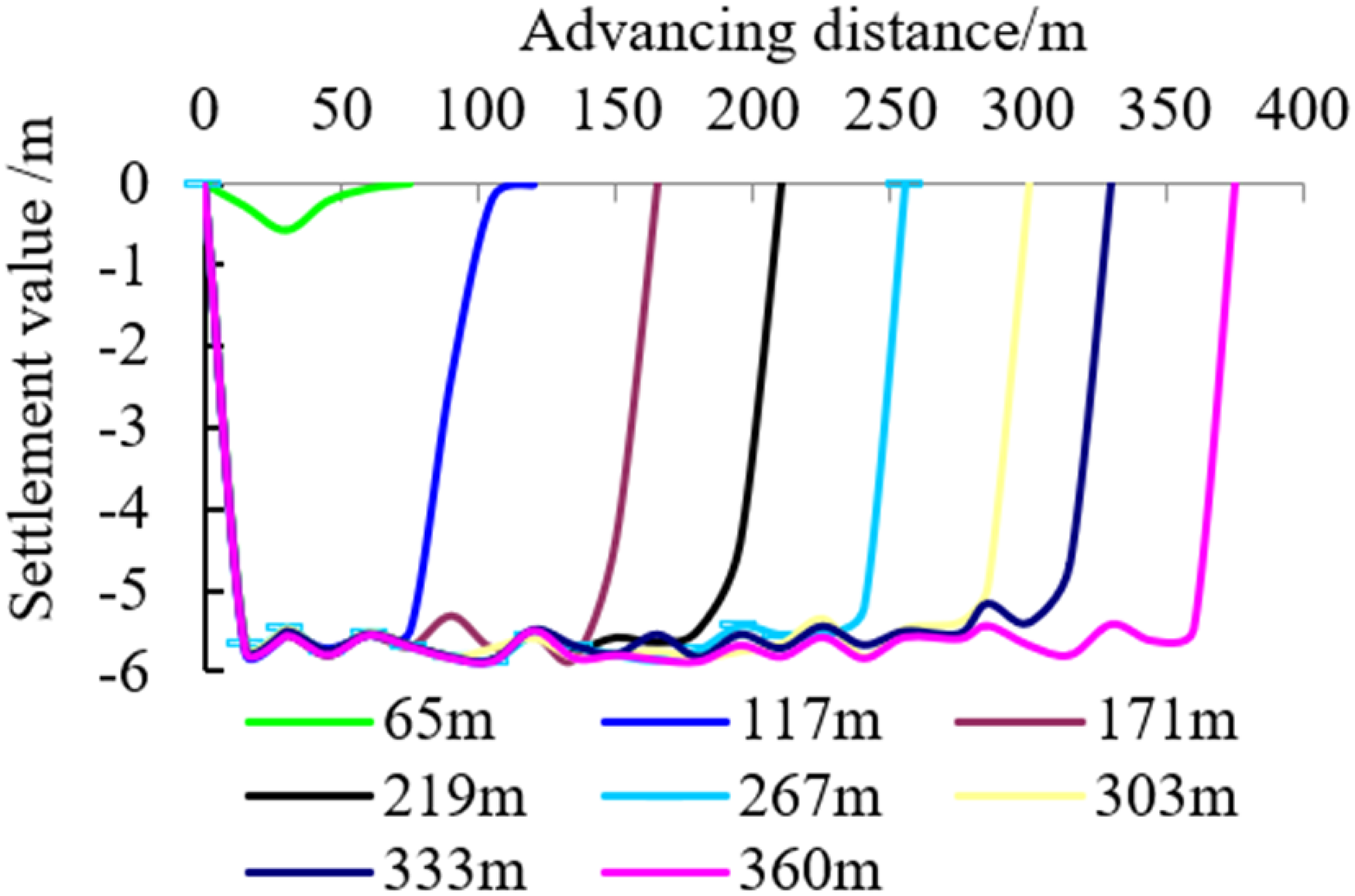
Migration curve of the bottom of main roof.
It can be seen from the migration curve of the upper part of the main roof in the process of the advancing working face in Figure 11 that when the working face advances to 75 m, the rock stratum above the main roof sinks, and the maximum subsidence value is 0.11 m. When the working face advances to the 99 m position, the rock stratum above main roof also breaks and collapses. At this time, the maximum subsidence is 5.03 m. The vertical displacement value of the rock stratum above main roof gradually increases during the continuous advancement of the working face. Taking 150 m as an example, when the working face is located at 171 m, 219 m, 267 m and 360 m, the vertical displacements are 3.74 m, 4.26 m, 4.56 m and 5.03 m respectively. It shows that with the increase of mining distance, the rock in caving zone is gradually compacted under the overlying rock pressure and gets a result of the increase of vertical displacement.
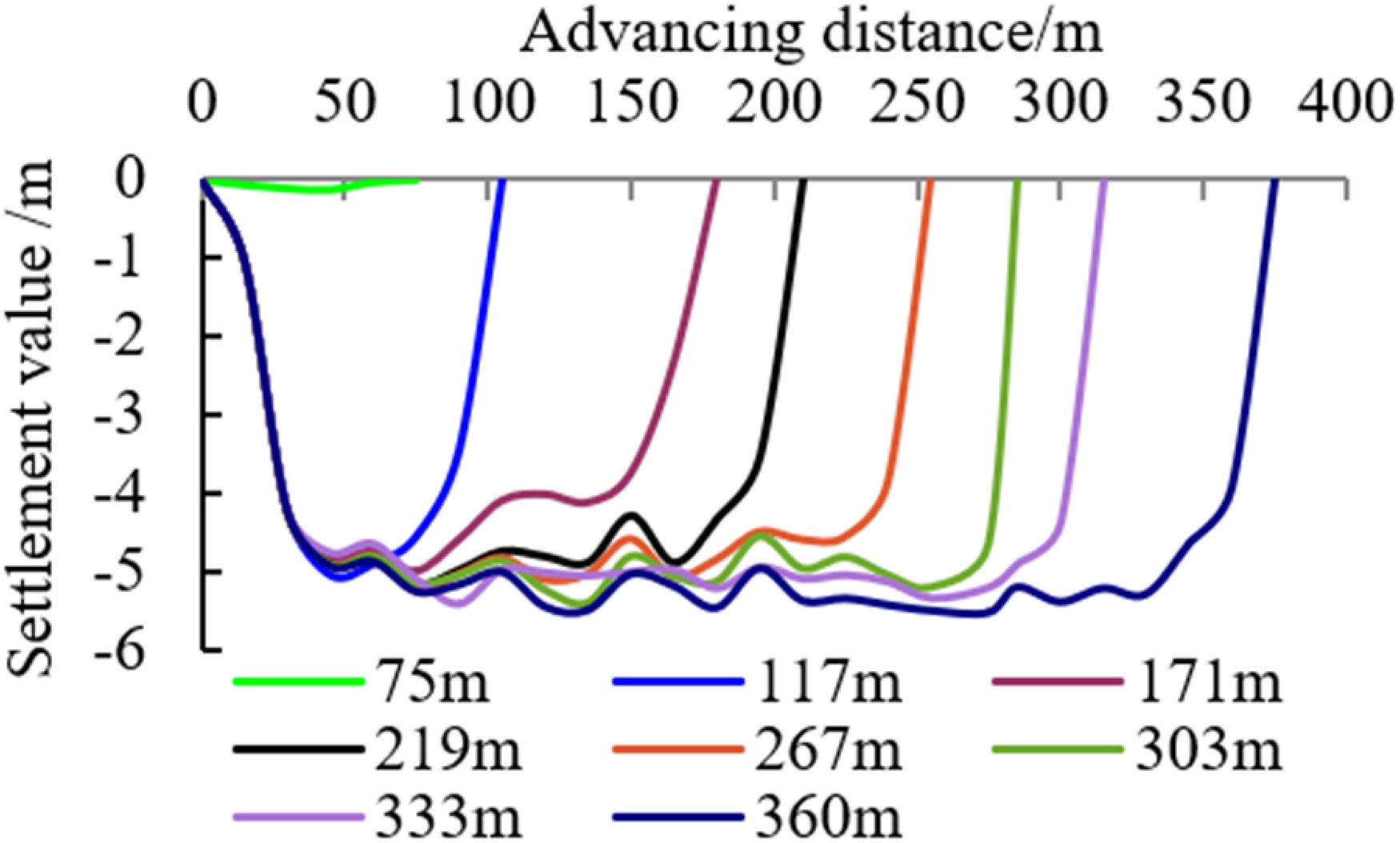
Migration curve of the upper part of the main roof.
It can be seen from the migration curves of the lower and upper parts of the sub-key stratum in Figures 12 and 13 that when the working face advances to 99 m, the sub-key stratum breaks and collapses, and the lower stratum are located in the caving zone, while the upper stratum are in the fracture zone. The overall subsidence value of the lower rock stratum is 3.3 m, and the overall subsidence value of the upper rock stratum is 2.7 m. This is because the rock in the caving zone is relatively broken, there are large and many voids between the rocks, and the degree of compaction is higher under the pressure of overlying rock, while the rock cracks in the fractured zone are smaller and less, so the degree of compaction is smaller.
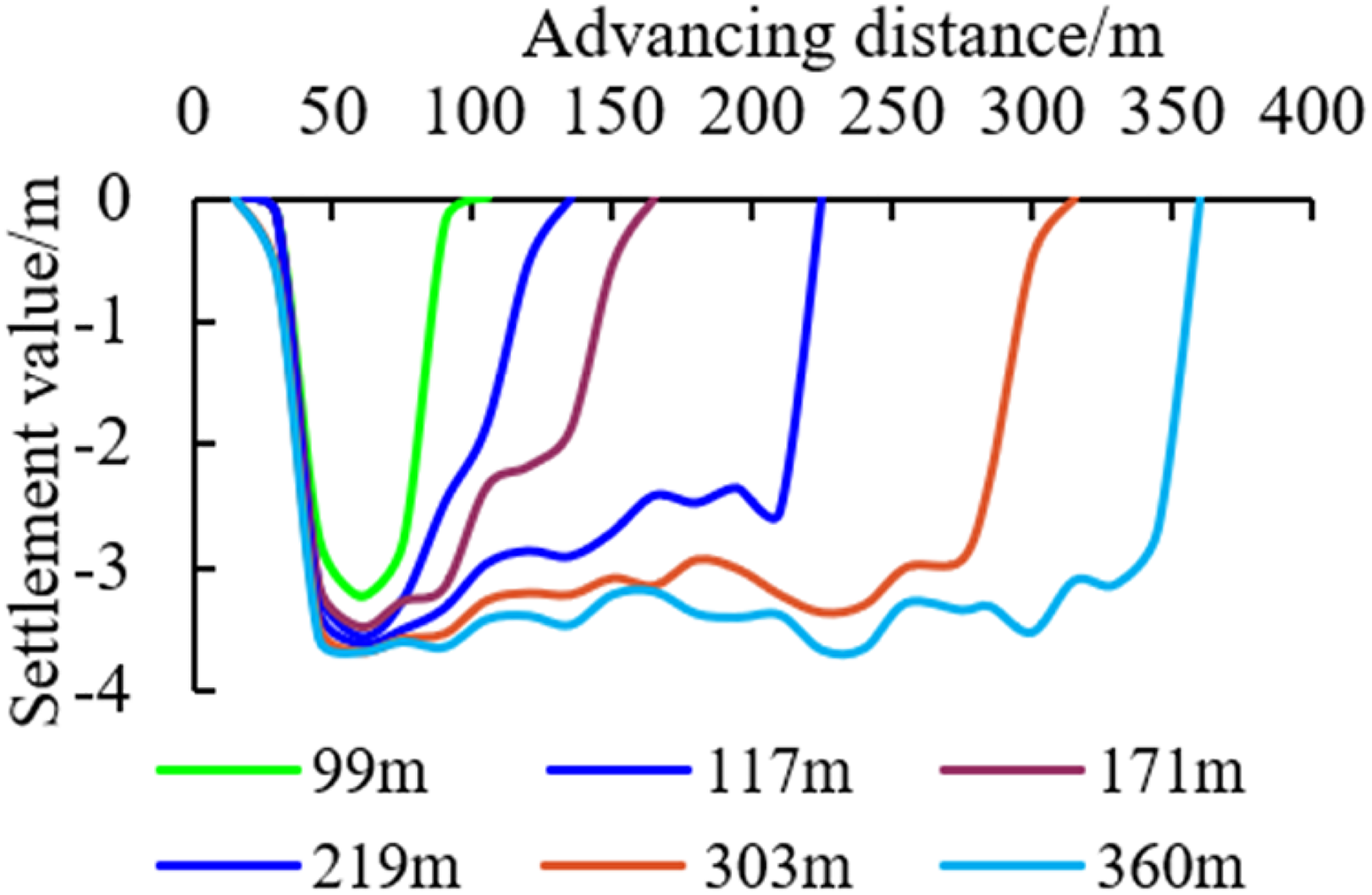
Migration curve of lower sub-key stratum.
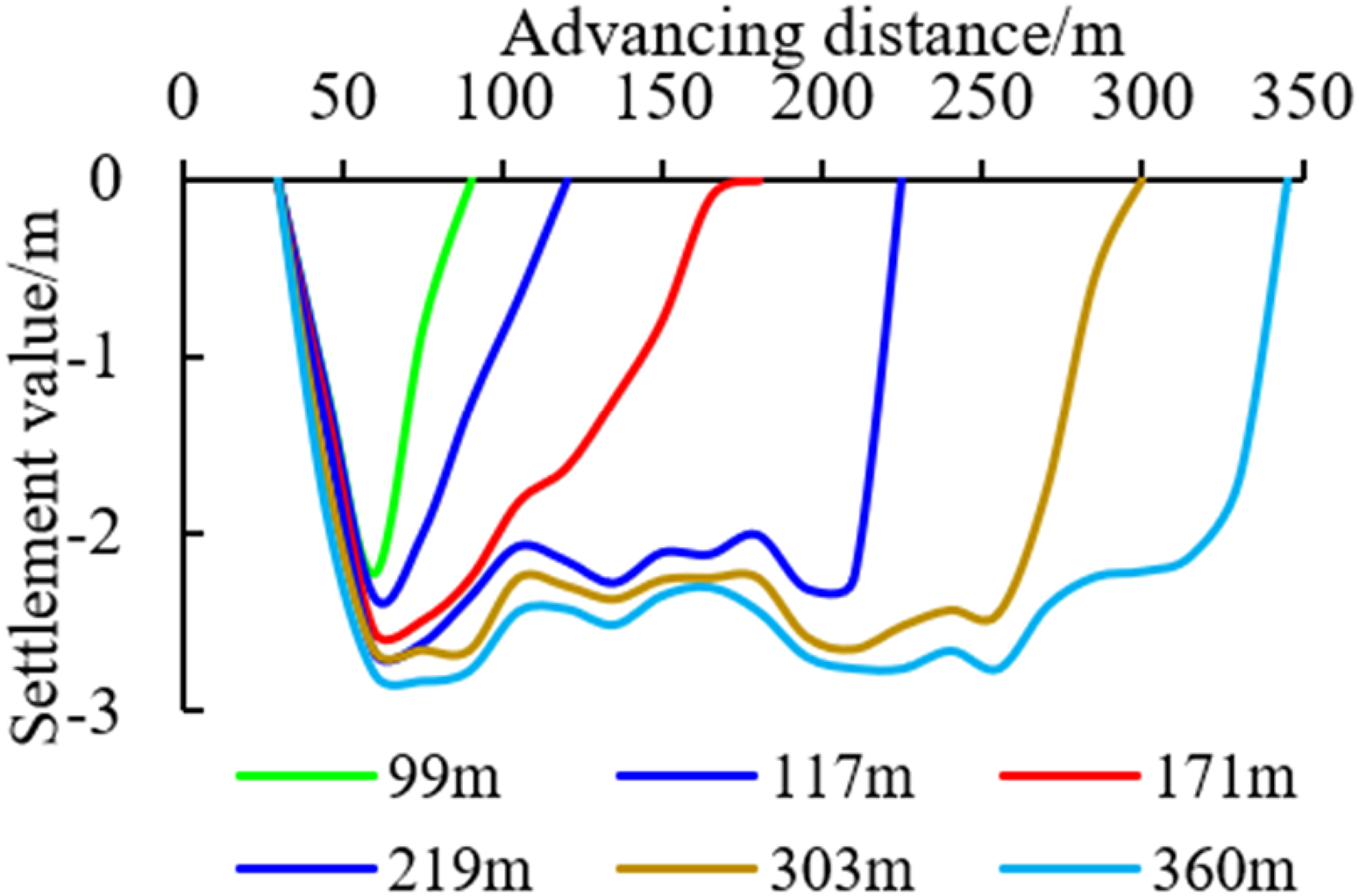
Migration curve of upper sub-key stratum.
From the migration curve of the main key stratum during the advancing process of the working face in Figure 14, it can be seen that when the working face is mined to 171 m, the maximum subsidence of the key stratum reaches 0.6 m. At 219 m, the vertical displacement of the key stratum suddenly increases to 2.1 m, which means that the key stratum breaks and sinks at this time. With the continuous advancement of the working face, the subsidence of the rock stratum gradually stabilizes. When the advancing of working face is completed, the maximum subsidence of the key stratum is 2.63 m.
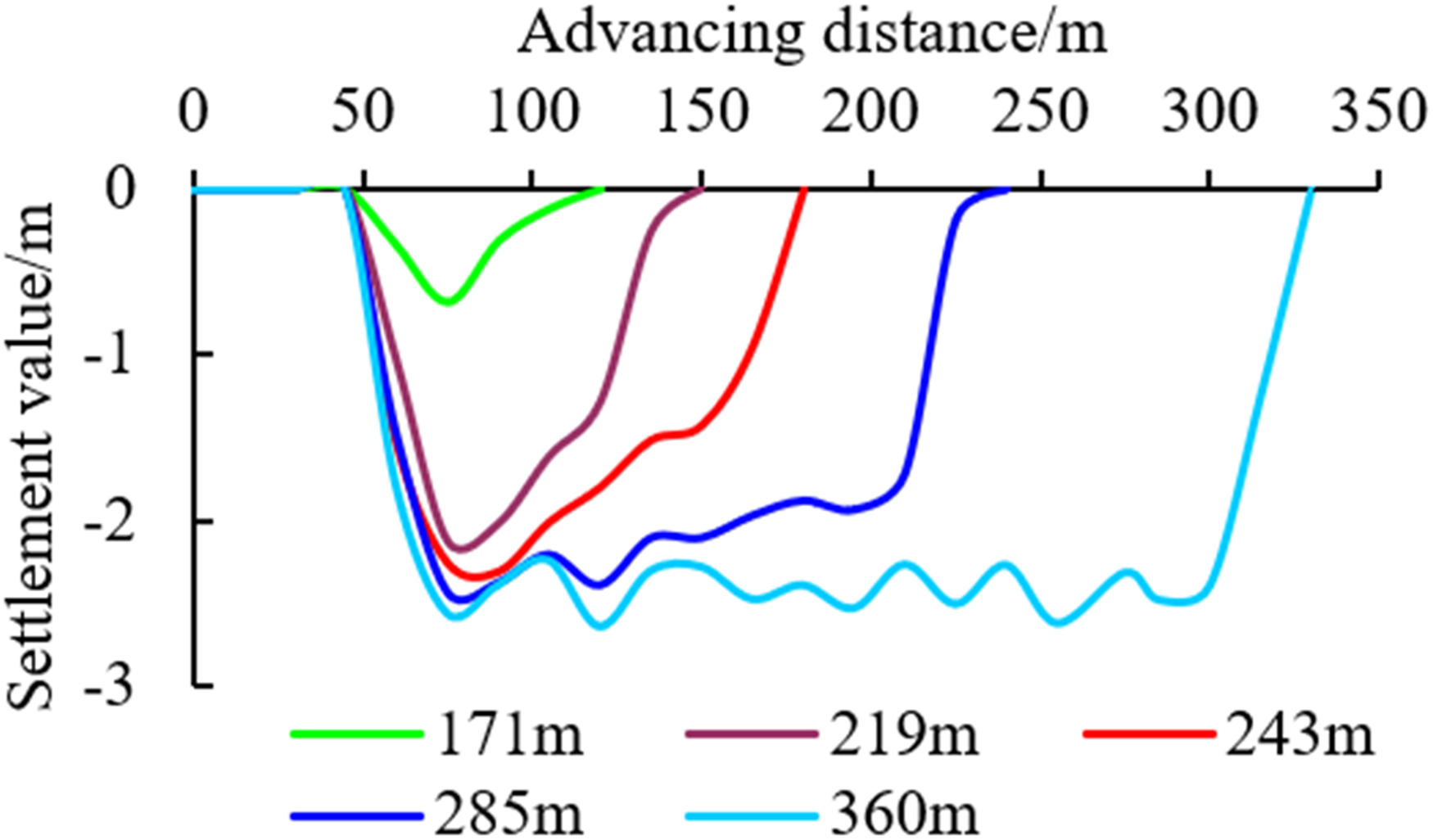
Migration curve of main key stratum.
The curve of roof subsidence after coal mining is shown in Figure 15. The maximum subsidence coefficients of lower and upper main roof are 0.96 and 0.86, respectively. The maximum subsidence coefficient of the lower and upper parts of the sub-key stratum reaches 0.7 and 0.58, respectively, and the maximum subsidence coefficient of line G of the main key stratum reaches 0.53. From Figure 15, it can be seen that the difference of the survey lines between the main roof and the lower part of the sub-key stratum is large, indicating that the degree of compaction of rocks at different positions in the caving zone under the action of overlying rock pressure is also different. The degree of rock compaction in the lower part of the caving zone is larger than that in the upper part of the caving zone. The overall subsidence of the rock stratum in the fracture zone is smaller than that in the caving zone.
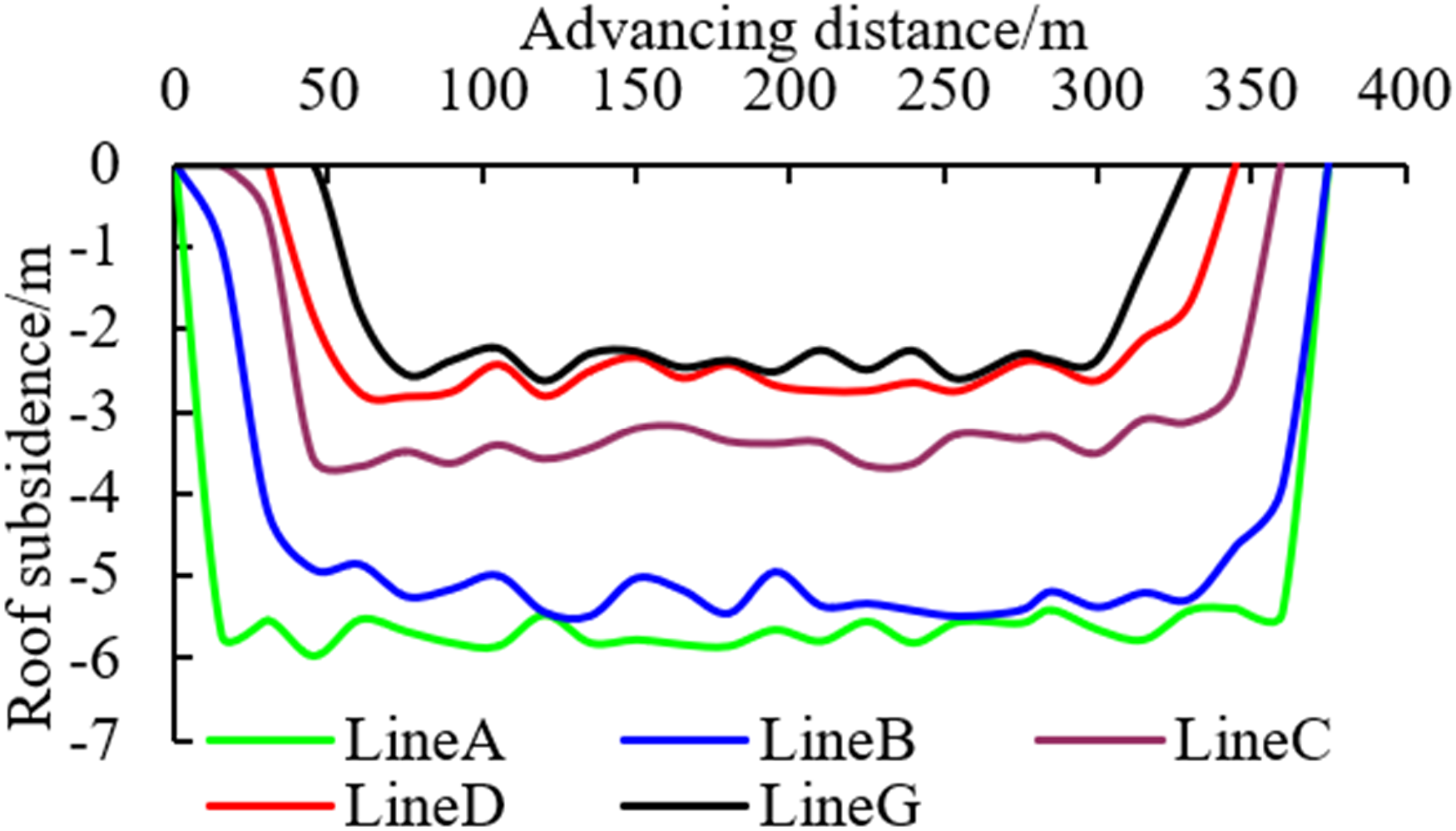
Roof subsidence change curve.
Analysis of overlying rock movement and deformation characteristics in 2/3 filling mining
From the migration curve of the lower part of the main roof in Figure 16, it can be seen that when the filling 2/3 mining is carried out, the lower part of the main roof rock stratum breaks and sinks when the working face advances to 75 m, and the maximum subsidence is 1.9 m. When the working face advances to 150 m, under the pressure of the caving rock stratum, the filling body is compressed and sinking, which leads to the overall downward movement of the lower part of the main roof rock stratum. With the increase of the mining distance of the working face, the movement range of the overlying rock fracture gradually increases, so that the main roof also moves downward, and the maximum subsidence of the main roof can reach 2.1 m after the coal seam mining is completed.
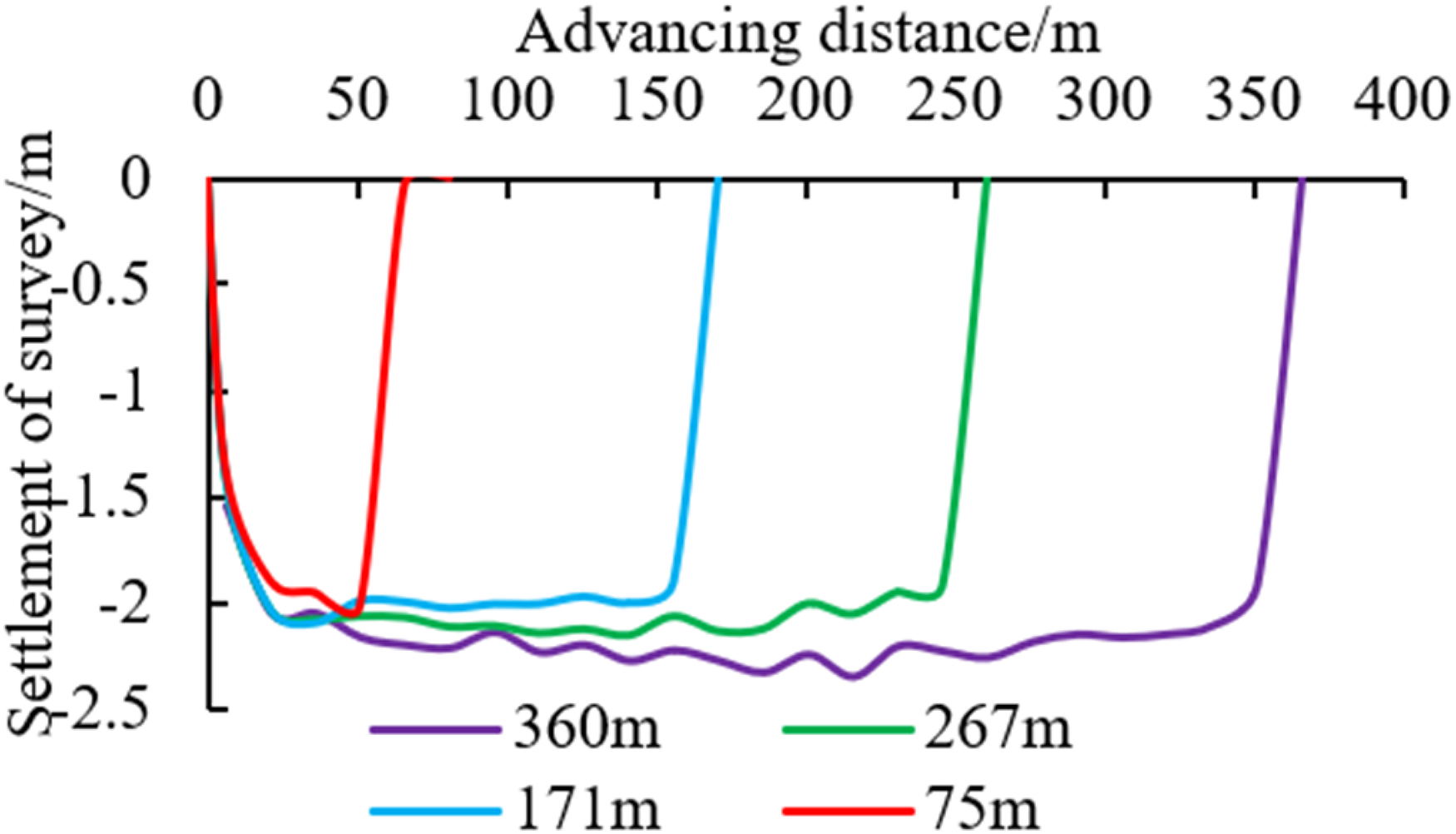
Migration curve of the bottom of main roof.
As can be seen from the migration curve of the upper part of the main roof in Figure 17, the maximum subsidence of the main roof is 1.2 m when the working face is mined to the position of 99 m. As the working face advances, the subsidence of the upper part of the main roof gradually increases, and the subsidence of the working face reaches the maximum, with a maximum of 1.7 m. The final subsidence coefficient is 0.85, and the subsidence coefficient of the lower part of the main roof is 0.91, which is 10% lower than that of the caving method.
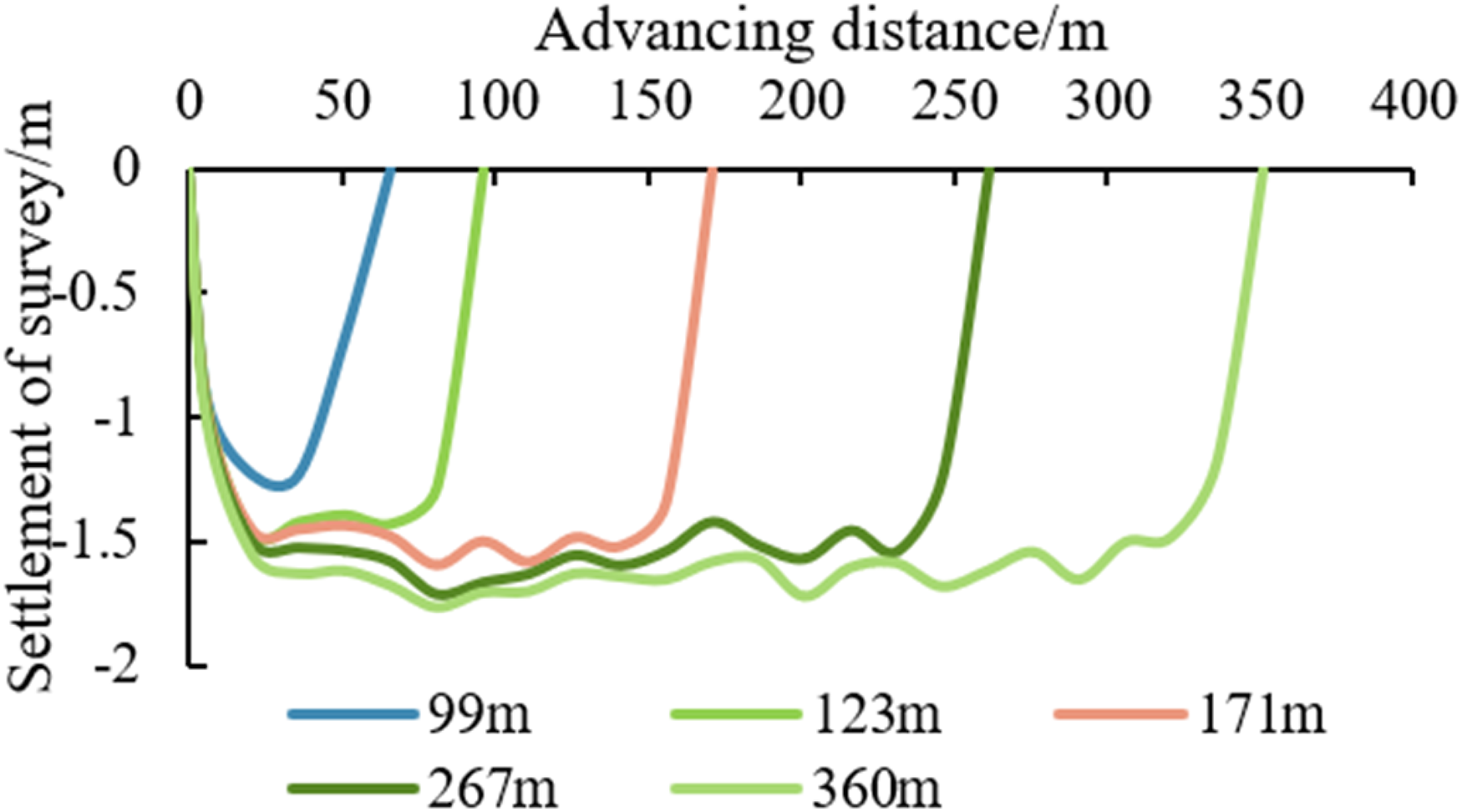
Migration curve of the upper part of the main roof.
From the migration curves of the lower part of the sub-key stratum in Figure 18 and the upper part of the sub-key stratum in Figure 19, it can be seen that when the working face is mined to 123 m, the sub-key stratum is unstable and sinking as a whole. The maximum subsidence of the lower rock stratum is 1.29 m and the maximum subsidence of the upper rock stratum is 0.6 m. Since then, the subsidence value of the rock stratum gradually increases and finally tends to be stable. After mining, the difference between the maximum amount of subsidence between the two is not large, the difference is 0.2 m.
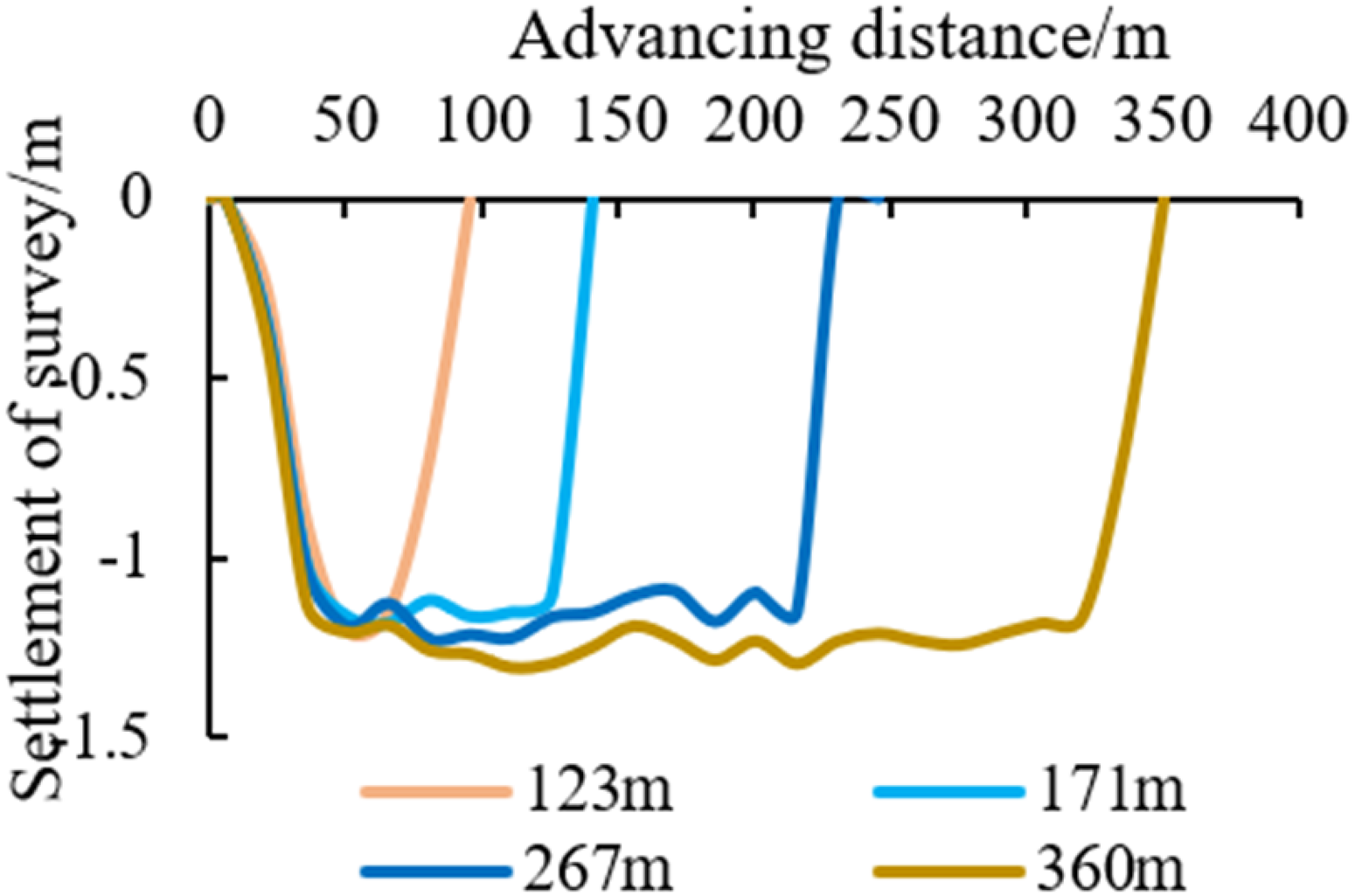
Migration curve of lower sub-key stratum.
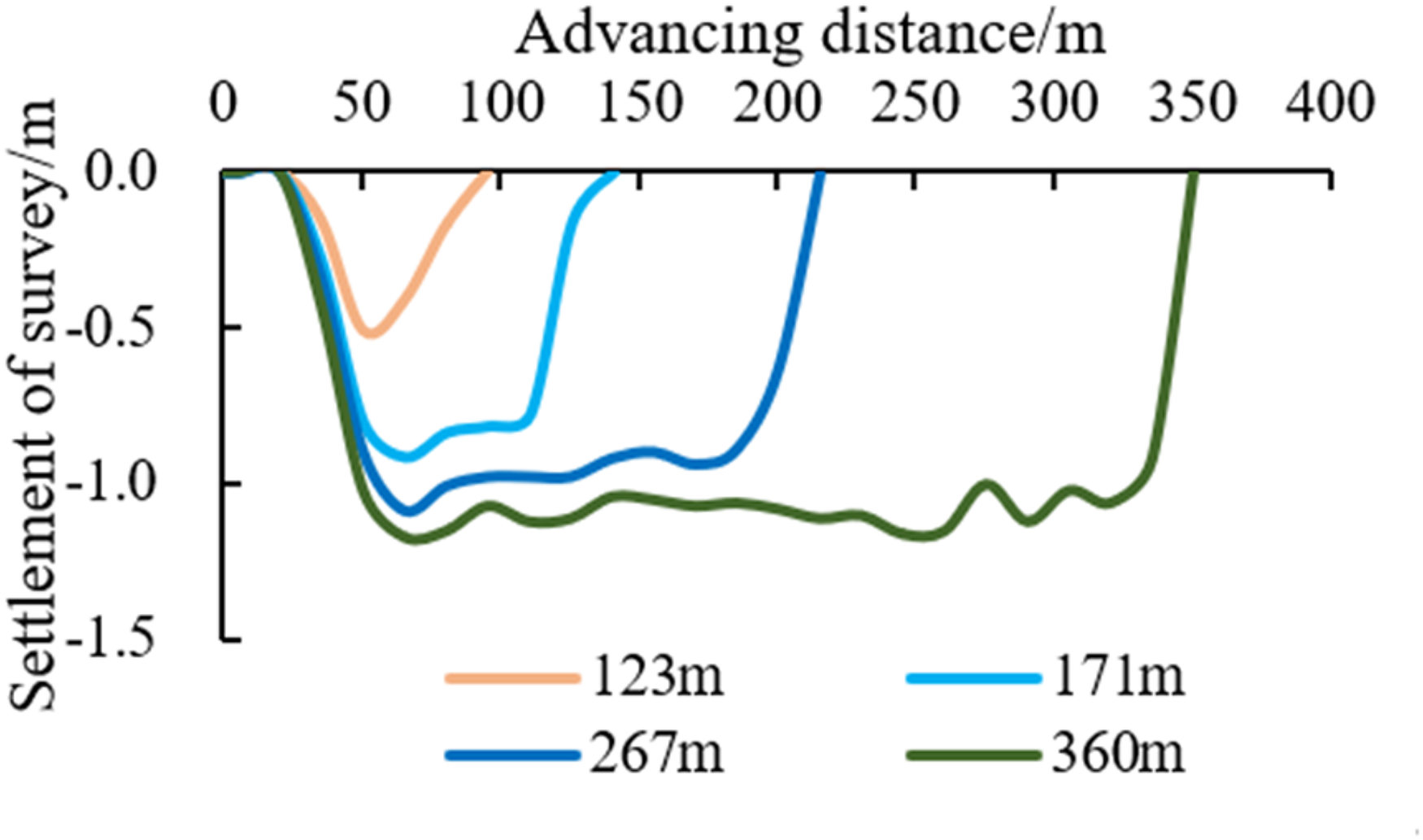
Migration curve of upper sub-key stratum.
From the migration curve of the main key stratum in Figure 20, it can be seen that the migration amount of the main key stratum is small in the whole mining process of the working face. When the working face advances to 267 m, the maximum sinking value is 0.6 m. After the mining of the working face is completed, the maximum sinking value increases to 0.72 m. In the whole mining process, the main key stratum only bends and sinks, indicating that under the condition of filling 2/3 mining, the composite filling body can protect the overall integrity of the main key stratum.
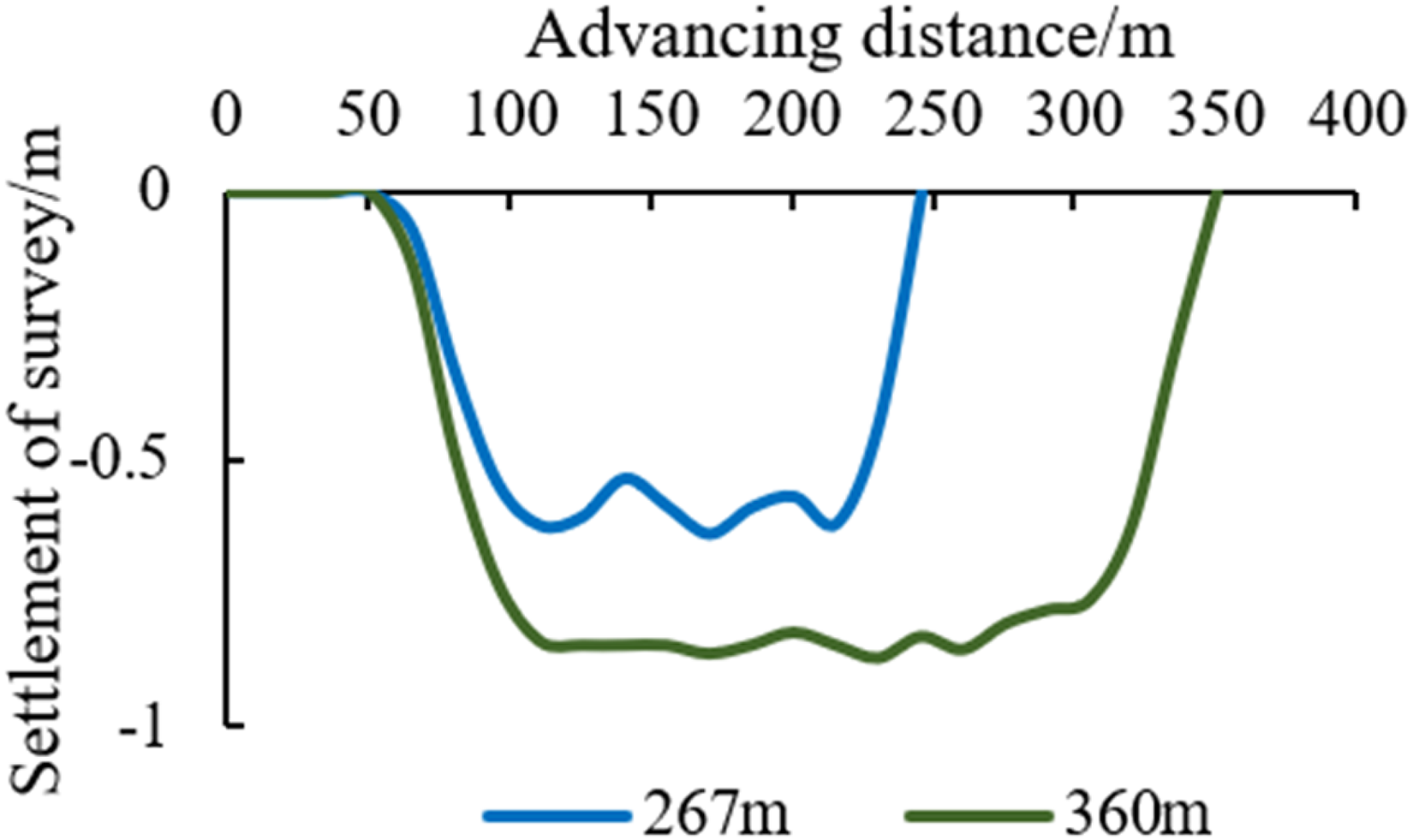
Migration curve of main key stratum.
When the filling is 2/3, the roof subsidence curve after the coal seam mining is completed is shown in Figure 21. The maximum immediate roof subsidence value is 2.2 m, and the maximum subsidence coefficient reaches 1.1, indicating that the caving rock and the filling body will undergo certain compression deformation under the pressure of overlying rock. The maximum subsidence coefficient of main roof reaches 0.85. The maximum subsidence coefficient of the lower and upper parts of the sub-key stratum reaches 0.65 and 0.55, respectively, and the maximum subsidence coefficient of main key stratum reaches 0.4. The higher the stratum position of the roof, the smaller the subsidence coefficient. The maximum subsidence of the main key stratum under the conditions of unfilling and filling 2/3 is 2.63 m and 0.72 m, respectively. Compared with the unfilled mining conditions, the subsidence of the main key stratum will be significantly reduced. The PCFM can keep the main key stratum away from breaking and sinking, and then control the overall stability of overlying rock.
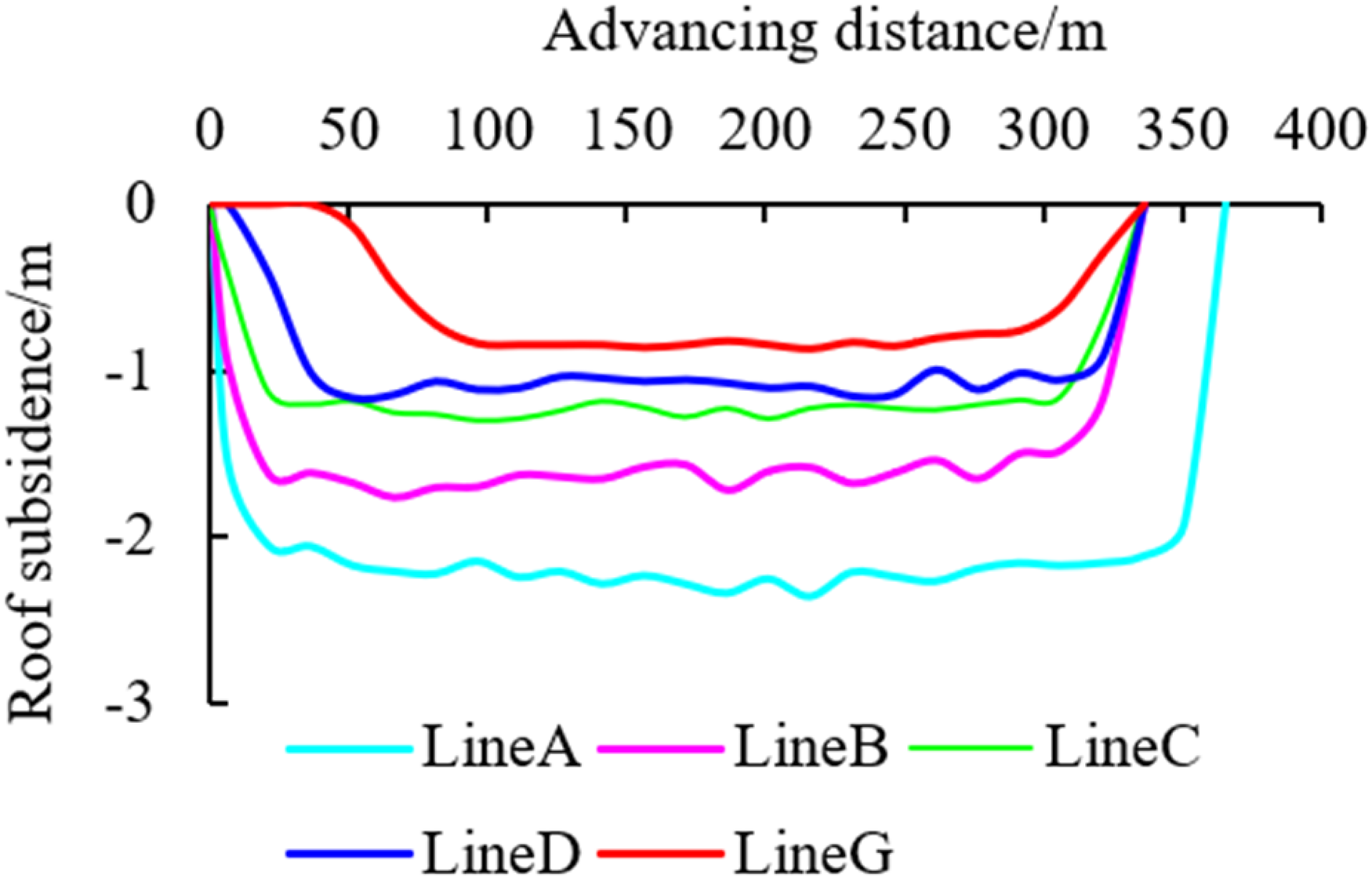
Roof subsidence change curve.
Conclusion
PCFM stope formed a new “support-surrounding rock-composite filling body” dynamic space. The mechanical model of the roof rock beam is established, and the deflection and bending moment curves of the roof rock beam of the working face are obtained. The bending moment is “decrease-increase” trend, while the deflection value is “increase-decrease” trend, but little change.
Compared with the caving method, under the condition of 2/3 filling, the maximum subsidence of the main key stratum is significantly reduced, and the main key stratum is transferred from the fracture zone to the bending subsidence zone, which proves that the composite filling body can effectively control the movement and deformation of the overlying rock.
Under different working conditions, the displacement contour of overlying stratum is inverted trapezoidal, the displacement of stratum close to the coal seam is larger, the displacement of stratum higher than the coal seam is smaller, and the maximum subsidence point of overlying stratum appears near the open-off cut side. With the increase of coal seam mining height, the maximum subsidence value of roof stratum is increasing. Because the mining height of coal seam provides subsidence space for roof stratum, it has a great influence on the movement of overlying stratum. When the filling ratio increases, the maximum subsidence value of roof stratum decreases obviously, which can effectively restrain the movement of overlying rock. The change of the buried depth of the working face has little effect on the movement of the overlying stratum.
To a certain extent, this paper reveals influence of the mining height, filling ratio and buried depth on the movement and deformation characteristics of overlying stratum in PCFM stope. The relevant experimental research and field monitoring analysis on the mechanical properties of composite filling body and the control mechanism of overlying stratum stability are lacking at present, which needs to be supplemented in the follow-up researches.
Footnotes
Declaration of conflicting interests
The author(s) declared no potential conflicts of interest with respect to the research, authorship and/or publication of this article.
Funding
The author(s) disclosed receipt of the following financial support for the research, authorship and/or publication of this article: This work was supported by the National Natural Science Foundation of China (NO 51974226, 52174127), Key Research and Development Program of Shaanxi (NO 2023-YBGY-318), Funds of Distinguished Young Scholars of Shaanxi (NO 2023-JC-JQ-42), and Youth Innovation Team of Shaanxi University.
