




Abstract
To improve the gas drainage effect of low-permeability coal seams, the influence of the hole arrangement on the static blasting effect was studied through single-hole, double-hole, and guiding-hole blasting tests. A stress-damage coupling model was established to reveal the evolution of the stress field and the distribution of the damage zone under different construction parameters, and the evolution law of the damage zone under a multi-hole arrangement was investigated. The following can be inferred from the research results. (1) The crack initiation of double holes depends on the stress superposition between blasting holes, whereas that of guiding holes depends on the free surface inside the coal body. The increase in borehole diameter and spacing reduction between boreholes could improve the static superposition breaking effect. (2) The relationship between the guiding hole, borehole diameter, and borehole spacing was revealed from the two aspects of the stress field and damage zone. The purpose is to strengthen the blasting effect. The drilling diameter and spacing are measured, and the guiding hole strengthens the blasting effect. At the measurement level, it should be analyzed from the two dimensions of time and stress. The time dimension accelerates the migration of the stress turning point, whereas the stress dimension realizes stress superposition and finally strengthens the static cracking effect. (3) The damage zone evolution of static blasting technology is influenced by expansion pressure, construction parameters, and elastic modulus. The increase in the expansion pressure caused the damage zone of the coal body and a decrease in the elastic modulus. Under the combined action of the expansion pressure and elastic modulus, the damage zone expanded and penetrated. The guiding borehole would not only have a guiding function but could also enhance the breaking effect. (4) In the simulation test scheme, the reasonable ratio of borehole spacing to borehole diameter is approximately 13 to 14, and the reasonable construction parameters are 113 mm of borehole diameter, 1.4 m of borehole spacing, and the layout of multi-hole-guiding hole. Static blasting technology can increase the distribution of the damaged areas of coal seams, realize pressure relief and permeability enhancement of coal seams, and improve the safe construction of coal mining.
Keywords
Introduction
With an increase in the mining depth of coal seams, coal mining is faced with the characteristics of high ground stress, high gas pressure and low gas permeability. Coal and gas outbursts and rock burst disasters are becoming increasingly severe. Improving the permeability of the coal seam and removing the ground stress have become technical problems to be solved urgently in gas control. Jiang (2017) studied the mechanism and technology of static directional fracture of rock. Static fracturing technology also known as static blasting technology, uses the swelling pressure generated by a mixture of a blasting agent and water to act on the coal to create cracks. This technology can effectively increase the gas drainage rate and realize the safe construction of coal mining operations. The main component of static blasting agent is calcium oxide (CaO), which uses calcium oxide (CaO) to react with water to generate calcium hydroxide, and releases a lot of heat. The specific reaction equation is as follows:

With the progress of static blasting, the coal seam gas pressure is continuously reduced, and the scope of influence of drainage is expanded. The specific evolution process is as follows: Coal compaction stage: the coal body near the blast hole is compacted, and the coal seam permeability decreases, resulting in an increase in local gas pressure; The micro-crack stage: the coal seam gas pressure in the fracture area near the blast hole decreases, but in the unfractured area between the blasting holes, the gas pressure increases; The formation of large cracks/crack expansion stage: after the cracks and the drainage holes are connected, the influence range of the drainage holes increases greatly, and the gas pressure drops sharply. The gas pressure in the fractured coal seam and the area between blast holes decreases significantly; The stable extraction stage: with the extension of the extraction time, the gas pressure of the fractured coal seam decreases significantly compared with the unfractured coal seam, and the gas pressure between the blasting holes drops to below 0.74MPa.The dynamic evolution process of static blasting gas seepage shows that static blasting technology can realize coal pressure relief and permeability enhancement. After the fractured coal seam, the gas permeability is greatly increased, and the gas flow of coal seam is accelerated, resulting in fracturing near the extraction hole. The regional gas pressure drops sharply, that is, the “pressure relief and anti-reflection effect”. The research shows that the permeability coefficient of the coal seam with static blasting and permeability enhancement increases, which accelerates the gas flow in the coal seam, resulting in a significant decrease in the gas pressure around the extraction hole, and realizes the safe and efficient mining of the coal seam.0
Xie et al. (2016) used laboratory and field tests to demonstrate the mechanism and feasibility of static blasting technology and investigated the blasting effects of different methods of hole placement on site. Ma et al. (2014) analyzed the effect of air temperature and water temperature on the expansion performance of static crushing agent. Cui (2017) studied the law of permeability enhancement characteristics of coal seam expansion and cracking. Zheng et al. (2016) simulated the expansion pressure of a static blasting agent under different borehole diameters using five types of high-strength steel pipes with different diameters. Dai et al. (2016) observed that the axial expansion pressure output of a static blasting agent was lower than the radial expansion pressure. Increasing the pore size weakened the self-sealing pore effect of the water-hardening substance, and the difference between the axial expansion pressure and radial expansion gradually disappeared. Hao et al. (2014) used acoustic emission to study the evolution of static fracture cracks under a uni-axial stress load and established the relationship between the force and crack propagation radius of the static fracture agent. According to Wu et al. (2019) and Zhai et al. (2019), vertical stress inhabits the cracking effect of a static crushing agent, and the plastic zone of single-hole crushing is smaller than that of the double-hole model. To establish a static blasting mechanics model, Guo and Zhu (2020) used the realistic failure process analysis numerical simulation software to study related parameters, such as expansion pressure, blasting aging, and drilling layout. Wang et al. (2020) an studied the influence of the hole layout method on the static fracture effect and used numerical simulation software to analyze the effect of the equilateral triangle drilling layout in terms of material consumption and crushing effect. Gao and Wang (2011) analyzed the principle of a static blasting agent and studied the optimal construction parameters and construction technology of static blasting in tunnel expansion. Li et al. (2011) analyzed the principles of static crushing technology, fracture mechanics process, and on-site construction parameters and concluded that static blasting has the advantages of safety, no open flame, and no vibration. Xu (2019) used the methods of numerical simulation, laboratory testing, and field verification to study the process parameters required for static blasting of through-bed drilling. Zhai et al. (2015) analyzed the effects of rupture time, fracture surface density, and the number of fractures, and concluded that guiding-hole fractures can guide the expansion of fractures, and proposed an optimized layout scheme to network coal seam fractures. Through theoretical analysis and field tests, Zhang et al. (2013) concluded that the effects of deep-hole directional static crushing and depressurization are significant. Zhang et al. (2017) carried out a numerical simulation on the static blasting cracking radius of coal seam drilling. Liu et al. (2008) studied the technology of rapid excavation and deep hole pre-split blasting and pre-draining gas in outburst coal seam, which greatly improved the gas content. Busch et al. (2004) and Han et al. (2013) show that the smaller the particle size of the coal sample is, the greater the diffusion coefficient. Zhang (2019) proposed the influence of the temperature of the drilling expansion agent on the development of coal fractures. Guo et al. (2011) studied the sealing technology of coal seam deep hole charged blasting. Li et al. (2018) conducted an experimental study on the reasonable components and proportions of coal and rock static crushers. Zhang et al. (2018) studied the liquid CO2 phase change directional perforation blasting and anti-reflection technology and its application in low permeability coal seam. Yan et al. (2008) and Wang (2005) expounded the development history of static cracking agents and put forward the development prospects of cracking agents. Li (2017) carried out experimental research on static blasting and permeability-enhancing low-permeability coal seam foundations. According to research of Li (2016) the directional fracture of plain concrete shows a certain regularity under the action of static cracking agent. Ma and Geng (2020) proposed that different guiding grooves have different weakening effects on the static crusher of the coal seam roof. Cheng (2020) analyzed the law of static expansion cracks in hard roof of fully mechanized mining face. Li and Shi (2019) analyzed the exothermic properties of static expansion agents and their effects on coal spontaneous combustion. Jiang et al. and Ren analyzed the large-diameter static crushing expansion pressure characteristics and hole distribution parameters, and obtained the outburst coal seam expansion cracking and anti-penetration mechanism and gas enhanced drainage method. Jiang et al. (2015) and Ren (2015) analyzed the large-diameter static crushing expansion pressure characteristics and hole distribution parameters, and obtained the outburst coal seam expansion cracking and anti-penetration mechanism and gas enhanced drainage method.
The static blasting technology is safe and easy to manage, and the static blasting agent is a non-explosive dangerous item. No detonator explosives, safety licenses and special types of blasting are required during construction. The blasting agent can be purchased and transported freely. And in use, there is no sound, no vibration, no flying stones, no poisonous gas, no dust, and it meets the requirements of pollution-free environmental protection products. The blasting project is simple, convenient and easy to operate. The static blasting technology solves the structures that are not allowed to be demolished by conventional explosives in some cases and special environments in engineering, there is no impact on traditional blasting disasters. It can not only achieve engineering results, but also effectively protect the surrounding environment. With the development of social construction, the requirements for blasting operations are becoming more and more strict, and in some cases, blasting operations are strictly restricted, and the engineering is extremely difficult. The static blasting technology can improve this situation and exert the effect, which has a good effect on economic and construction period benefits.
By discretizing the time nodes and considering the correction of the elastic modulus of the coal body during the static blasting process, the stress field and the evolution law of the damage zone of the static blasting technology are revealed. For low-permeability coal seams, static blasting technology is used to increase permeability and promote drainage in coal seams, which provides a fundamental theoretical basis for promoting coal seam gas drainage. The parameters of the static cracking agent are optimized, and the cracking effect of the static cracking agent is investigated, which provides basic data for numerical simulation. Finally, the evolution law of stress field and damage zone is studied through numerical simulation, which provides a theoretical basis for field application in coal mines.
Optimization of test parameters of the static blasting technology
Expansion pressure test of the static cracking agent
The swelling pressure is an important index that influences the effect of static blasting, and measuring the swelling pressure is an important link in studies on static blasting technology. Since the diameters of the commonly used drill bits are generally 63mm, 75mm, 89mm, 94mm and 113mm, this paper selects 63mm, 89mm and 113mm for experimental research.
the strain processes of 63 mm, 89 mm, and 113 mm steel pipes were tested. The expansion pressure of a static blasting agent can be determined as follows:

where
The test results for the swelling pressure of the static cracking agent are shown in Figure 1(a). As shown in Figure 1(a), this pressure experienced slow, rapid, and stable energy release, and finally stabilized at 30–40 MPa; as the diameter of the borehole and time increased, the expansion pressure of the static blasting agent also increased. The schematic diagram of the equipment is shown in Figure 1(b).
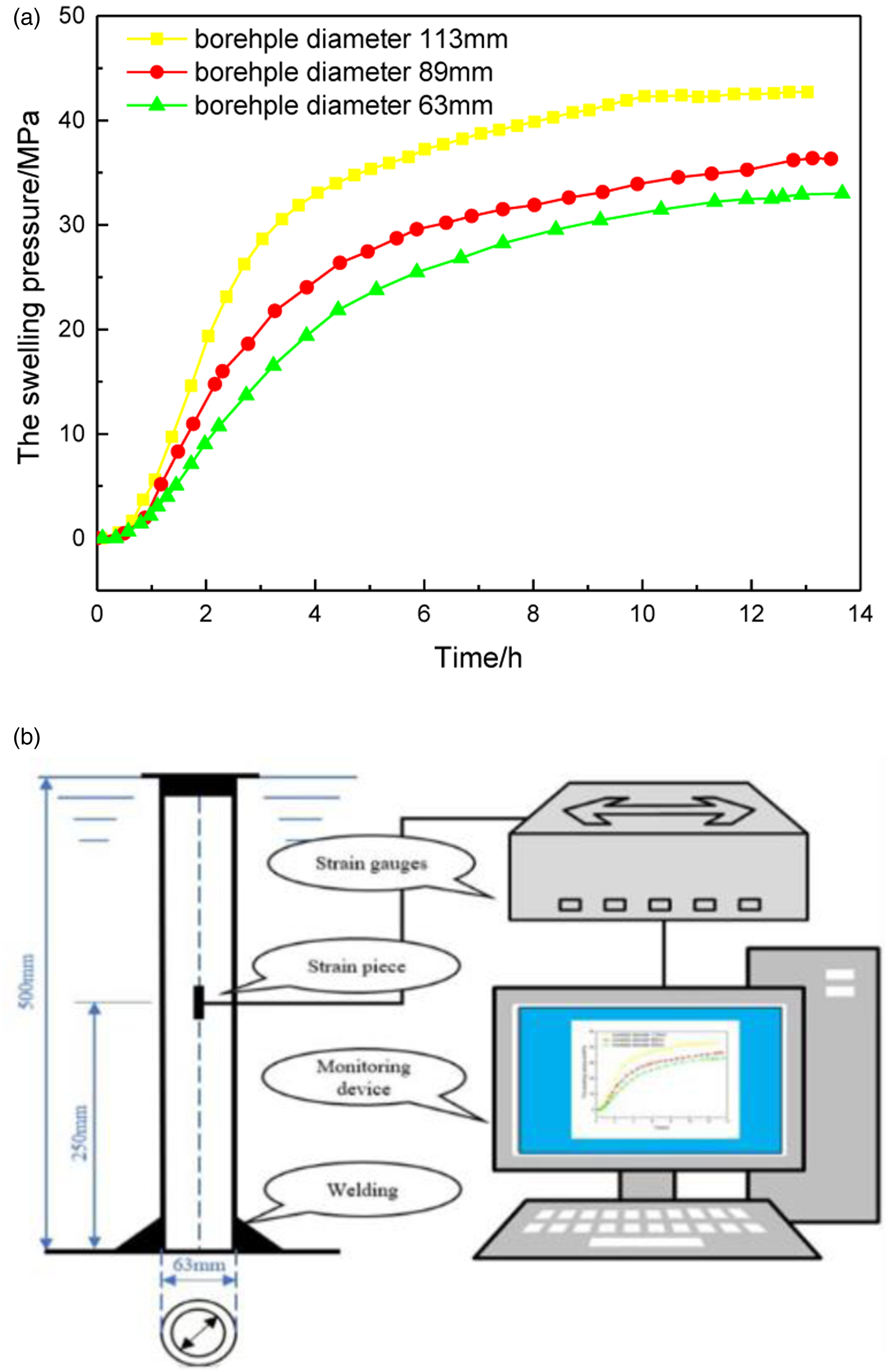
(a) Radial swelling pressure with different diameters. (b) Principal diagram of equipment.
Investigation of the blasting effect of static blasting technology
In order to study the static blasting hole arrangement and the corresponding crushing effect, rock breaking tests under different conditions were carried out. The rock blocks used in the test were artificially made briquette based on similar principles. Cement: Gypsum Powder: Coal Powder: Water = 1: 2: 2: 2, the mechanical parameters of the briquette were measured after curing for 28 days, the tensile strength was 0.92MPa, the compressive strength was 13.07MPa, the side length of the briquette was 200mm, and flexible constraints were adopted around it. The diameter of the blasting hole and the pilot hole is 32mm, and the hole depth is 200mm. The test plan is as follows:
Option 1: Single-hole blasting test A blast hole was arranged in the center of the surface to investigate the effect of single-hole cracking. Option 2: Double-hole blasting test Two blast holes were arranged at a diagonal position with a distance of 110 mm to investigate the cracking effect of the double holes. Option 3: Guiding-hole blasting test One blast hole was arranged in the center of the surface and four guiding holes were arranged along a diagonal line. The distances between the guiding hole and the blast hole were 55 mm and 85 mm, respectively, and the cracking effect of the guiding hole was investigated.
The third option is described in detail in the following section. According to the third option, a guiding-hole blasting test was performed on the briquette. The guiding-hole blasting process is illustrated in Figure 2.
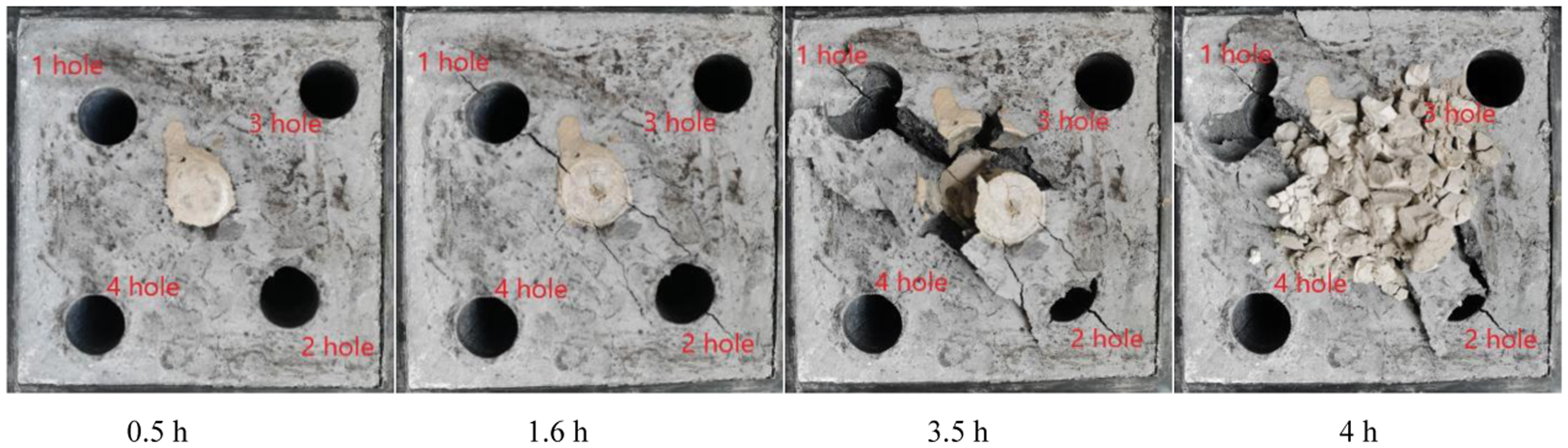
The fracture development process of guiding hole test.
After swelling for 1.6 h, a guiding crack appeared in the diagonal direction of holes 1 and 2, and microcracks were observed around the blasting hole, as shown in Figure 2(b). After 3.5 h of swelling, the static blasting agent entered the rapid energy release stage, a large crack formed along the diagonal direction of the blasting hole and the block fell off around the blasting hole, as shown in Figure 2(c). After 4 h of swelling, several tiny cracks developed around holes 3 and 4; all cracks expanded to varying degrees; finally, two pieces of briquette specimens fractured, the maximum crack width was approximately 18 mm, and microcracks were developed, as shown in Figure 2(d). According to the test process, a guiding crack appeared along the diagonal direction of holes 1 and 2, and several microcracks appeared around holes 3 and 4. The cracking effect in the direction of the guiding hole was evident, and the distance between hole 1 and the blasting hole was small. Therefore, the cracking effect of the guiding crack along the diagonal direction of holes 1 and 2 is evident.
Comparative analysis of blasting effect of the drilling layout
To investigate the impact of the three-hole layout methods on the cracking effect, the number of cracks, width of the cracks, number of broken blocks, number of collapsed blocks, height of the nozzle hole, and crack initiation time during the static blasting process were quantitatively analyzed. The results are presented in Table 1.
Statistics on the crushing effect of the static blasting technology.
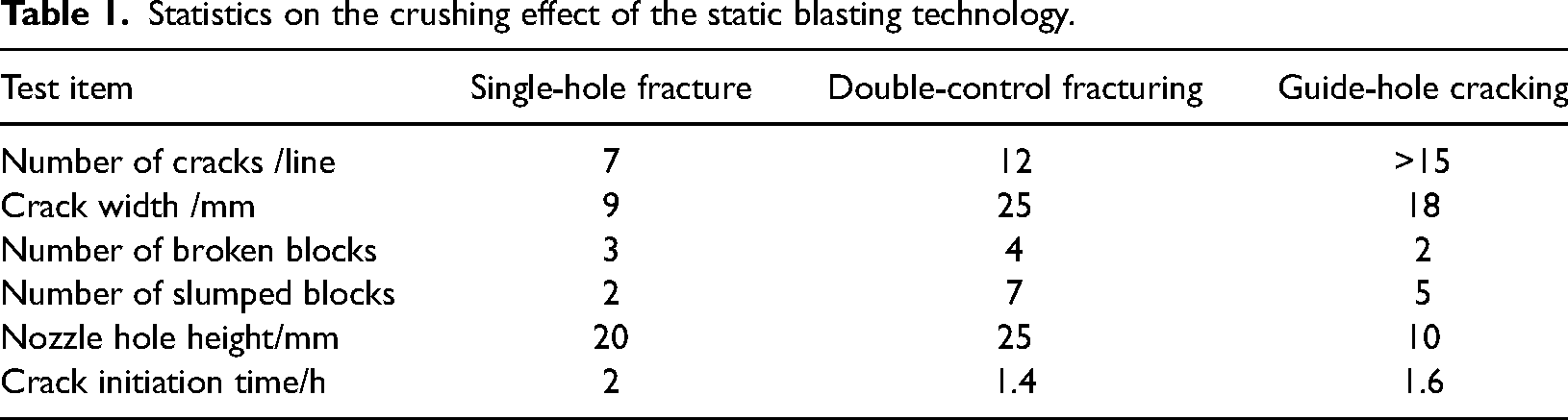
From Table 1, it can be concluded that the dual-hole blasting effect is better than single-hole blasting, the initiation time is significantly shortened, and other quantitative indicators are also better than single-hole blasting; thus, dual-hole blasting can significantly improve the blasting efficiency. Compared with single-hole blasting, only four guiding holes are arranged; however, the time of initiation is significantly shortened, the number of cracks is increased by 2, and the blasting effect is significantly enhanced. Compared with the guiding hole, the number of cracks caused by the guiding hole was less; however, the guiding hole was mostly composed of microcracks. The lengths of the two cracks are almost the same. From the perspective of the nozzle height, the double-hole blasting effect is poor. The main reason is that there is no free surface inside the coal briquette specimen, and the superposition of the cracking stress of the double holes eventually leads to a large injection hole height. when various indicators are comprehensively considered, the overall order of the blasting effect is: double-hole crushing>guiding hole crushing>single-hole crushing.
According to the test results, both double-hole and guiding-hole blasting enhanced the static blasting effect. Double-hole blasting primarily relies on the superposition of stresses. Guiding hole blasting mainly depends on the free surface of the coal and guiding hole; to a certain extent, it can prevent the occurrence of injection hole accidents during the application process. Accordingly, the "multi-hole and guiding hole" arrangement method can be applied in coal seam blasting and penetration, and reasonable construction parameters (guiding hole, drilling diameter, and drilling spacing). The released energy of the static blasting agent is spread to the maximum, and finally, a fracture network is formed to realize the pressure relief of the coal seam and increase the permeability.
In this paper, the influence of drilling arrangement on blasting is analyzed from the two dimensions of time and stress. From the point of view of mechanics, the expansion pressure generated by static blasting agent is 35–45MPa. Therefore, under the action of static blasting agent, the coal body will shatter. In the process of static blasting, the chemical reaction of the static cracking agent results in an increase in the volume of the borehole, and expansion pressure is generated inside the borehole. The expansion pressure exerts compressive stress and tensile stress on the coal body. When the stress is greater than the failure strength of the coal body, the coal body is damaged. Cracks are developed, and the area where the cracks are developed is called the damage zone. Under the action of crack development, the coal body goes through elastic stage and inelastic stage in the process of analyzing the mechanism of cracking coal seam by static blasting technology. Theoretical analysis shows that in the single-hole fracturing model, the stress on the coal body decreases with the increase of the distance, and the smaller the distance, the greater the tensile stress and compressive stress of the coal body around the borehole; in the double-hole fracturing model, the stress superposition effect occurs on the coal body on the connecting line of the blasting holes, and with the increase of the expansion pressure in the borehole, the cracks expand and extend along the connecting line of the blasting holes until they penetrate; in the equidistant multi-hole fracturing model, the interaction between the blasting holes forms a resultant force, and the cracks penetrate each other between the blasting holes, which accelerates the fracture of the coal body, enhances the fracturing effect, and promotes the stress turning point migration in the time dimension. In the field application process of static blasting technology, construction parameters such as pilot hole arrangement, borehole diameter, and borehole spacing should be considered, and reasonable construction parameters should be selected to obtain the best blasting effect.
Numerical simulation of static blasting technology
Through theoretical analysis, experimental research, numerical simulation and other methods, this paper mainly uses the numerical simulation software COMSOL Multiphysics to study the static blasting, permeability-enhancing and pumping-increasing technology of low-permeability coal seams.
It mainly includes the following steps. model establishment, preprocessing, model calculation, and postprocessing.
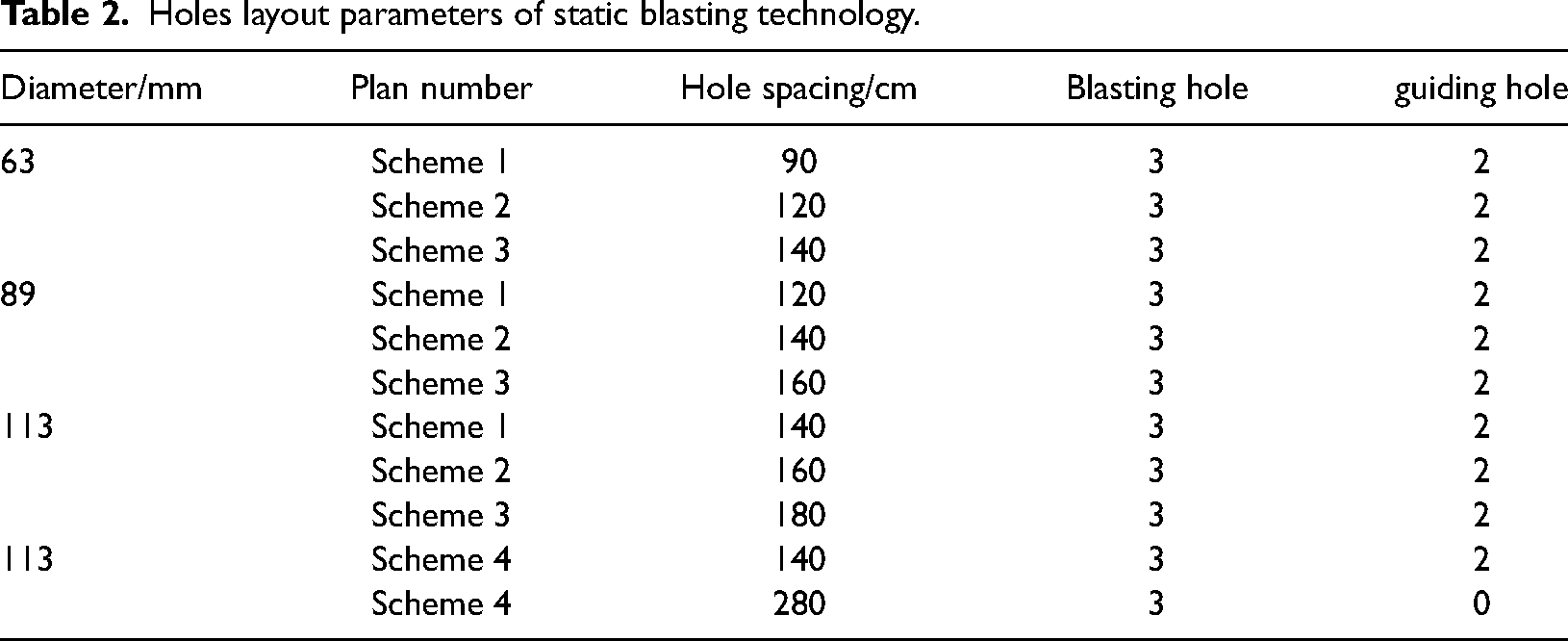
In this section, the stress-damage coupling model is used to study the influence of the guiding hole layout, drill diameter, and drill spacing on the stress field and damage zone. Based on the field construction experience and the equation of the static blasting technical experience, this simulation selected the drill spacing and drill holes with a diameter ratio of 12–19, and the arrangement of holes was selected as a multi-hole and guiding hole. The test plans are listed in Table 2.
Holes layout parameters of static blasting technology.
The damage evolution equation of static blasting technology
The static blasting technology is to use the expansion pressure to produce the compressive expansion effect on the coal body. In the initial stage of stress, the coal body is elastically deformed. The displacement representation is derived from the momentum conservation equation, the coal body deformation geometric equation, the constitutive equation and the effective stress principle. The equilibrium equation for the elastic case is as follows:
where
The Mohr-Coulomb criterion was used to express the stress state of the element.
where F1 and F2 are functions of the stress state, MPa;
When the stress state of the element reaches the threshold, the damage variable D of the element is as follows: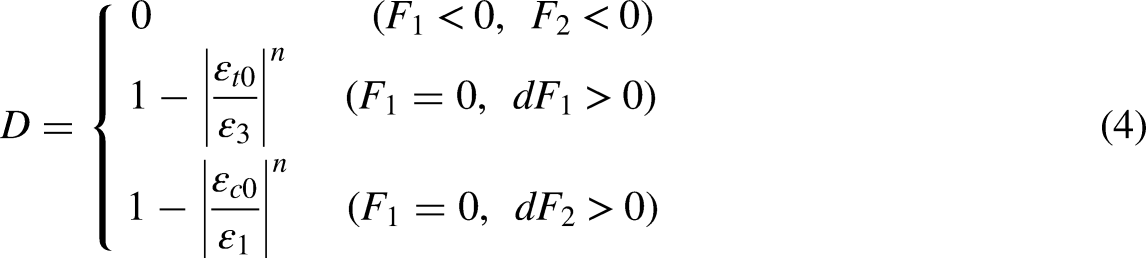
where D is the coal damage variable,
According to elastic damage theory, the evolution of the elastic modulus during static cracking is in accordance with the following relationship:
where E0 and E are the elastic moduli before and after damage (MPa), respectively.
Equations (2), (3), (4), and (5) simultaneously constitute a stress-damage coupling model during static blasting, and COMSOL software is used to study the evolution of the damage zone during static blasting loading.
Physical model establishment and parameter selection
The buried depth of the coal seam in a coal mine in Shanxi Province is 450m, with a thickness of 5.12–6.20m, and an average of 5.25m. According to the results of geological survey data, the firmness coefficient of No. 3 coal seam is between 0.45 and 1.09, the permeability coefficient of the coal seam is 0.000375m2/MPa2.d, the maximum original gas content is 7.13 to 21.71 m3/t, and the maximum original gas pressure is 0.25 to 2.1 MPa. No.3 coal seam has the characteristics of hard coal, high gas content, high gas pressure, and low coal seam permeability. Therefore, the No. 3 coal seam needs to adopt static blasting technology to realize a coal seam fissure network and finally realize coal seam pressure relief and permeability enhancement.
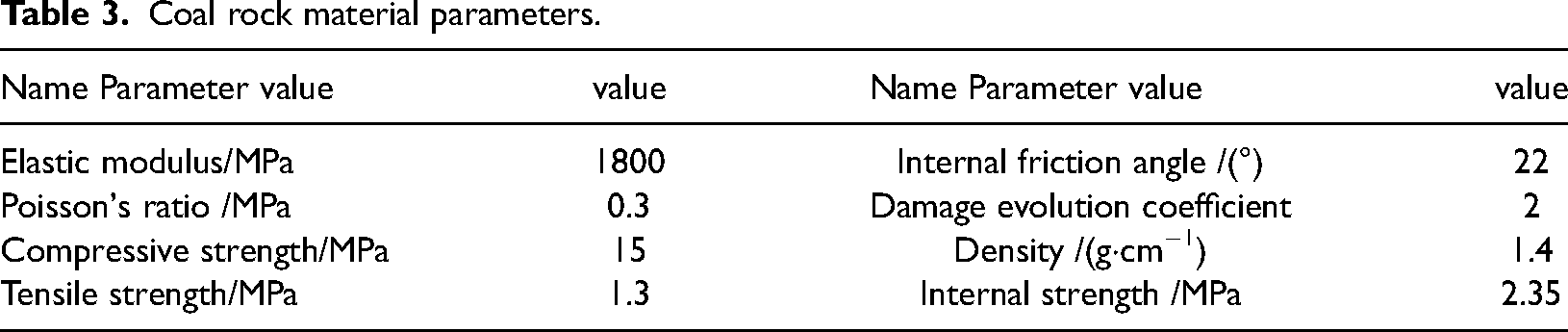
COMSOL numerical simulation software was used to study the evolution of the stress field in the coal body and the distribution of the damage zone during the stress loading process of the blast hole. A three-dimensional numerical model was established. The model was 12m long, 6m wide, and 6m high. Confining pressure was applied in the X-axis direction at 4MPa, and roller support was applied in the Y-axis direction. The guiding hole had a free boundary condition of 89 mm, 113 mm, and a depth of 3.5 m. The model was coupled with five solid mechanic components. A blast hole was selected, as shown in Figure 1. The stress value of the expansion pressure test curve at 1 h, 2 h, 3 h, 5h, 8 h under different borehole diameters applies stress boundary conditions. For example, the stress load in the 113 mm blast hole is 9 MPa (1 h), 18 MPa (2 h), 26 MPa (3 h), 37 MPa (5h), and 43 MPa (8 h), using this 5-step stress loading to study the evolution of static blasting technology. This 5-step stress loading is used to study the evolution law of static blasting technology, and the model considers the stress-damage coupling model. When the first-step loading stress value (Equation 3) is greater than the ultimate strength of the coal, damage zone D (Equation 4) is generated. The modulus E (Equation 5) decreases as the damaged area develops. After 1, 3, 4, and 5 stress loadings are performed again, the elastic modulus of the damaged area is the residual elastic modulus E, and the undamaged area is the original elastic modulus. Before each step of stress loading, the elastic modulus changed with the development of the damage zone (Figure 3 for the evolution of elastic modulus), and the mechanical parameters are listed in Table 3.
Elastic modulus evolution of static blasting technology in coal seam.
Coal rock material parameters.
Stress field analysis of static blasting technology
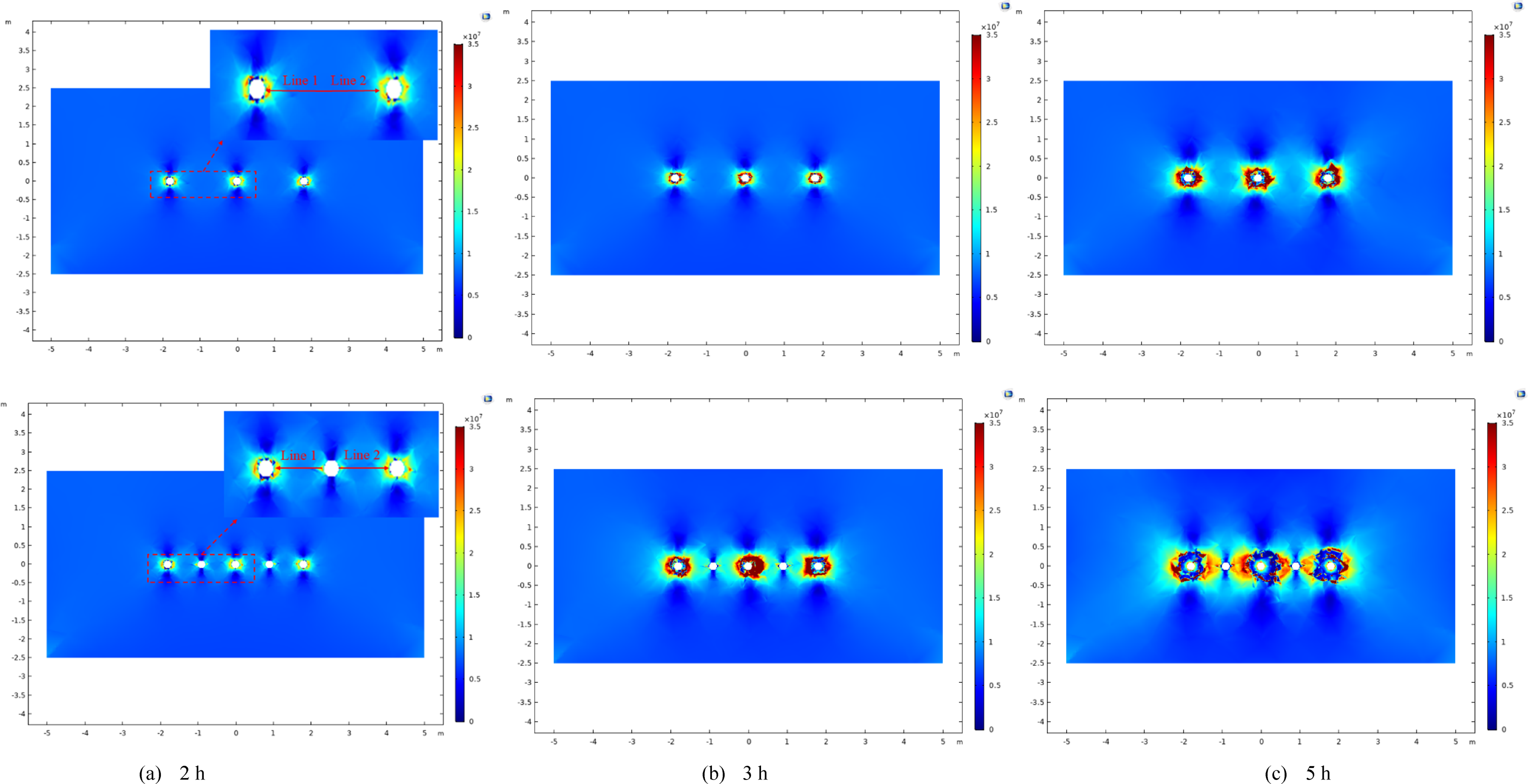
The influence of the guiding hole on the evolution of the stress field and the simulation results of the evolution of the stress field is shown in Figure 4. To accurately analyze the stress evolution in the static blasting process, the horizontal stress data of Sections 1 and 2 between the blasting holes were extracted. The stress data for coal with and without guiding holes at 5h are shown in Figure 5. As the expansion pressure of the blast hole increases, the coal forms a three-zone distribution of the pressure relief zone, stress concentration zone, and original stress zone. The stress-turning point is defined as the point at which the stress concentration zone turns into the original stress zone.
In the late stage of static blasting (5 h), the coal body of the guiding hole shows a stress amplification effect under the combined effect of the expansion pressure and free surface. The stress in the coal body with no guiding hole is finally stabilized at 10.5 MPa, and the minimum stress in the coal body with a guiding hole is 15.3 MPa. The stress amplification is 1.46 times compared with the stress in the coal body with no guiding hole. As the expansion pressure increases, the stress between the blasting holes gradually increases. The stress turning points at 1h, 2h, 3h, and 5h are −0.75m, −0.6m, −0.4m, and −0.3m, respectively, and the stress turning points are along. The direction of the guiding hole expands to realize the guiding effect, and the stress superposition effect is most significant in the late stage of static blasting.
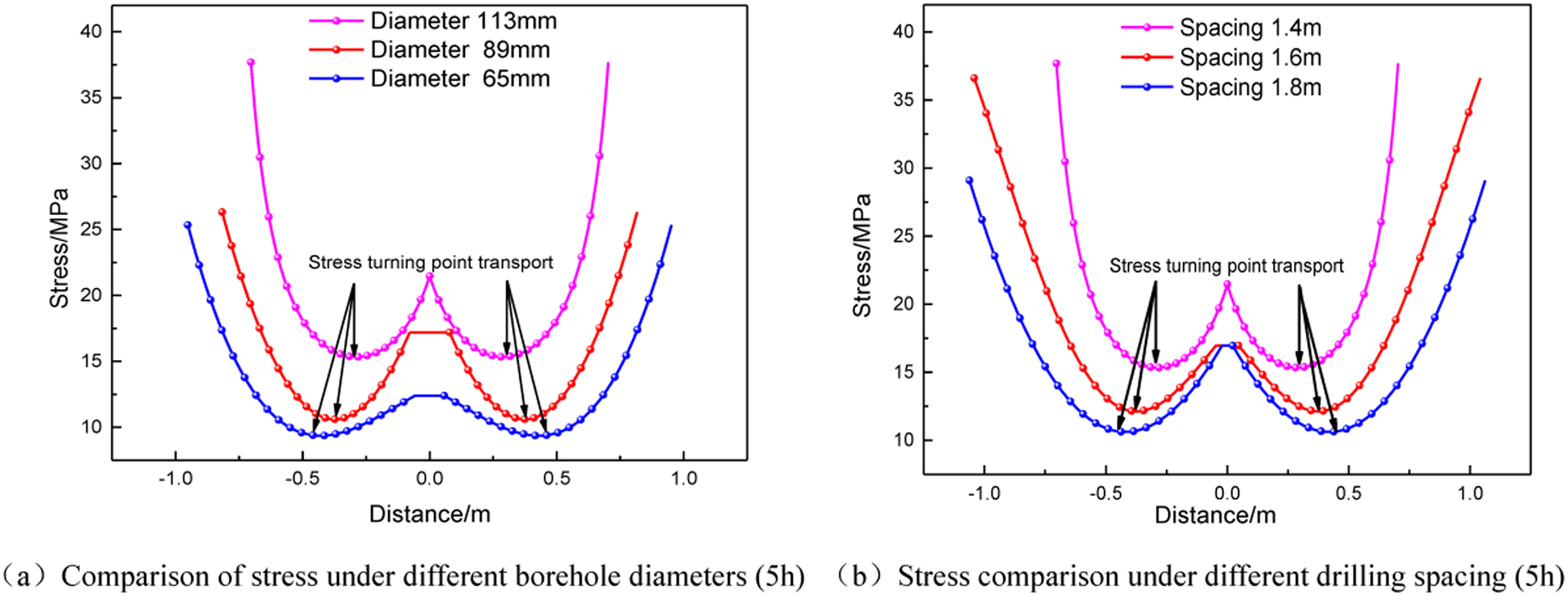
Impact of borehole diameter on the evolution of stress field. A comparison chart of the stress data for different borehole diameters in the late stage of static blasting (5 h) is shown in Figure 6(a).
In the late stage of static blasting (5 h), the expansion pressure in the blast holes with drill diameters of 63, 89, and 113 mm increased to 23 MPa, 27 MPa, and 36 MPa, respectively. Owing to the large difference in expansion pressure in the blast holes, the coal body was stressed. The difference is significant, and a coal body with a borehole diameter of 113 mm had a stress superimposition effect. As shown in Figure 6(a), the stress turning points of the coal with borehole diameters of 63 mm, 89 mm, and 113 mm are −0.43 m, −0.35 m, and −0.27 m, respectively, and the stress values of the stress turning points are 9.36 MPa, 10.6 MPa, and 15.3 MPa, respectively. Compared with the borehole diameter of 63 mm, the stress was magnified by 1.63 times. As the diameter of the borehole increases, the stress turning point is transmitted to the vicinity of the guiding hole speedily, and the larger the borehole diameter, the more significant the stress stacking effect in the post-static fracture stage, and the stress stacking effect is significant.
The impact of borehole spacing on the evolution of the stress field and the stress data comparison chart for different borehole spacings in the later stage of static blasting (5 h) are shown in Figure 6(b).
In the later stage of static blasting (5 h), the swelling pressure in the blast hole reaches 37 MPa. The smaller the drill hole spacing, the more significant the stress superimposition effect, resulting in more significant stress differences in the coal body, and the stress amplification effect appeared in the coal body when the drill hole spacing was 1.4 m. As seen in Figure 6(b), the stress turning points of the coal body with the drill spacing of 1.4 m, 1.6 m, and 1.8 m are −0.27 m, −0.38 m, and −0.45 m, respectively, and the stress values of the stress turning points are 15.3 MPa, 12.1 MPa, and 10.6 MPa, respectively; compared to the drill hole of 1.8 m spacing, the stress is magnified by 1.44 times. In summary, under the same expansion pressure loading condition, the smaller the drill hole spacing, the faster the stress turning point transmitted to the vicinity of the guiding hole; the smaller the drill hole spacing, the more significant the stress stacking effect in the post-static fracture stage, and the obvious the stress amplification effect.
Analysis of the damage zone of static blasting technology
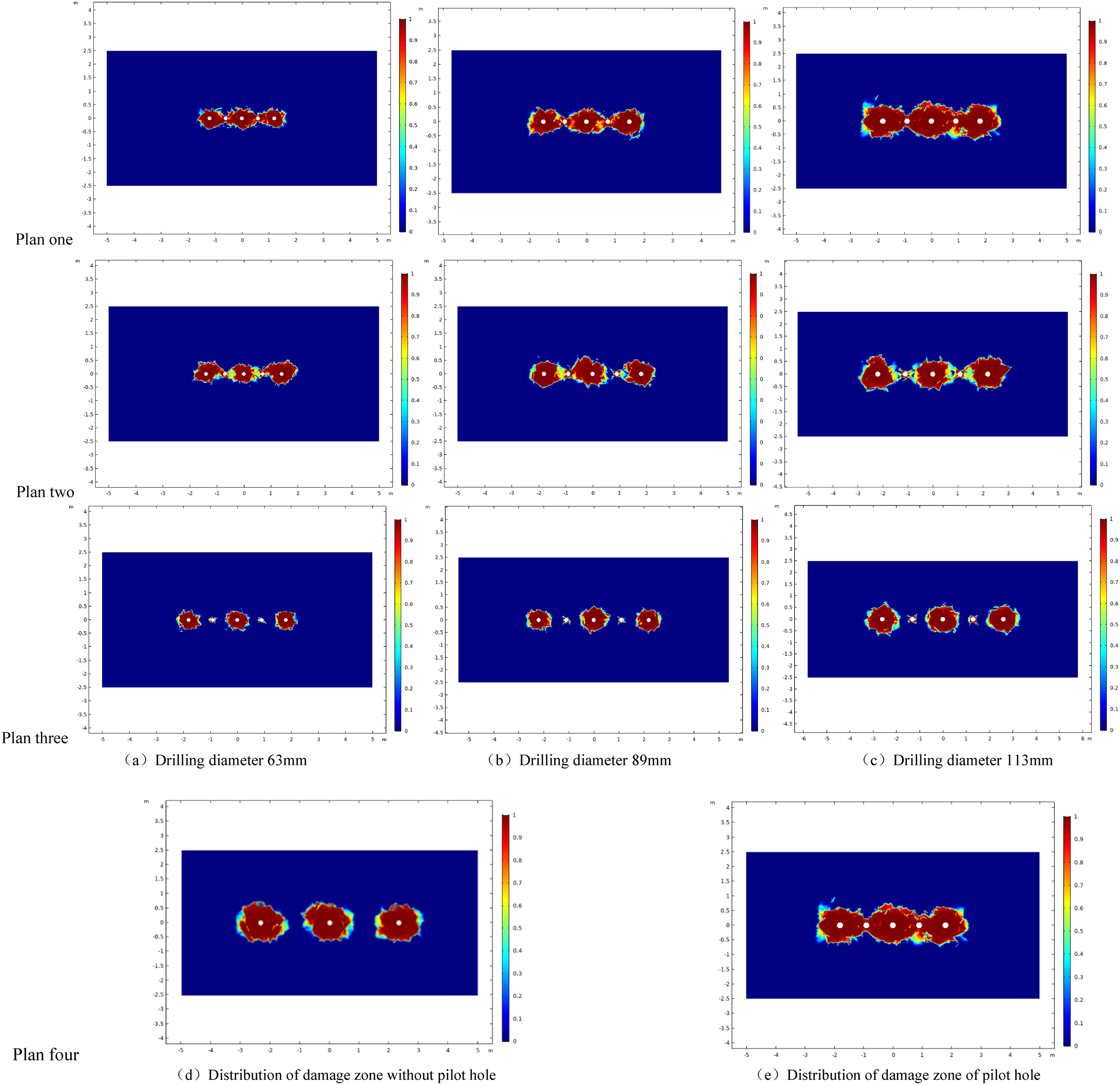
The guiding hole influenced the distribution of the damaged area. The simulation results for the influence of the guiding hole on the distribution of the damage zone are shown in Figure 7. The simulation results with a blast hole spacing of 2.8m were selected for the analysis. When the static fracture is completed (when the expansion pressure is 43 MPa), a circular damage zone with a radius of 0.8 m appears around the coal blast hole without distribution of the guiding holes, which contains guiding holes. The coal blasting hole and guiding hole were completely connected to each other and penetrated, and the cracking range was significantly enlarged. Compared with static blasting without a guiding hole, static blasting with a guiding hole can enhance the blasting effect of the static blasting technology. This is because the static fracture of the guiding hole accelerates the migration of the stress turning point from the time dimension in the early stage and realizes the stress superposition from the stress dimension in the later stage. Under the combined action of stress and free surface, the static cracking effect was enhanced.
Impact of borehole diameter on the damage area distribution. The simulation results of the influence of borehole diameter on the damage zone distribution are shown in Figure 7. The simulation results with a drill spacing of 1.4m were selected for the analysis. The drill diameters were 63 mm, 89 mm, and 113 mm. After the static cracking agent was released, the damage radii of the coal seam were 0.6, 0.8, and 1.4m, respectively. As shown in Figure 7, as the borehole diameter increased, the damage radius of the coal seam increased. This is because when the borehole diameter increases, the circumferential tensile stress in the blasting hole increases; thus, the circumferential stress is transmitted to the guiding hole as soon as possible (time dimension), and the stress superposition (stress dimension) in the latter stage promotes the tension effect and increases the damaged area of the coal seam. Compared with the vertical direction, owing to the existence of free surfaces in the horizontal direction, guiding cracks develop along the horizontal direction; thus, the damage radius in the horizontal direction is larger, and the cracking effect is enhanced.
The hole spacing influenced the distribution of the damaged area. Figure 7 shows the simulation results of the influence of drill hole spacing on the damage zone distribution. The simulation results for a borehole diameter of 113 mm were selected for analysis. The hole spacings are 1.4m, 1.6m, and 1.8m. After the static fracture agent was released, the damage radii of the coal seam were 1.4m, 1.1m, and 0.9m, respectively.
As shown in Figure 7, as the drill hole spacing increased, the damage radius of the coal seam decreased. The stress superimposition effect of the multi-hole and guiding hole layouts needs to meet a prerequisite; that is, the drill hole spacing is within the damage radius. The hole spacing was too large and the resistance line was large. Under the same swelling pressure loading conditions, the migration time of the initial stress turning point was longer (time dimension). A stress superposition effect was produced (stress dimension); therefore, a reasonable drilling distance should be selected in the field construction to achieve a better cracking effect.
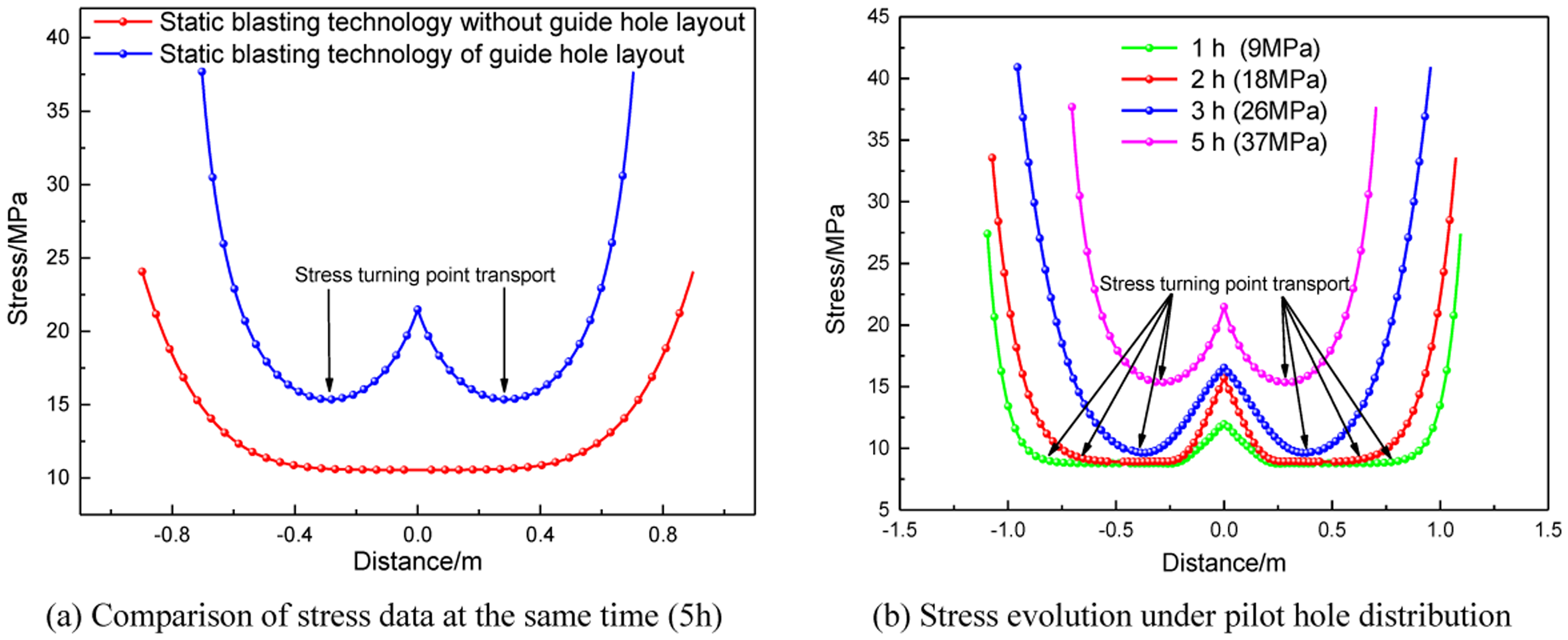
Stress evolution cloud picture with (without) guiding hole distribution.
Comparison of stress data with (without) guiding hole distribution.
Comparison of stress data under different construction parameters.
Damage zone distribution of static blasting technology.
The following conclusions can be drawn from the distribution map of the static fracture damage zone shown in Figure 7.
The static blasting technology can increase the permeability and pressure relief of coal seams. A large range of damaged areas was distributed around the blast hole. The guiding hole has a guiding effect and can enhance the blasting effect. Under the conditions of this simulation, when the borehole diameter is 63 mm, the radius of the damage zone is 0.9 m, when the borehole diameter is 89 mm, the radius of the damage zone is 1.2 m, and when the borehole diameter is 113 mm, the radius of the damage zone is 1.4 m; thus, it is reasonable. The ratio of hole spacing to hole diameter was 13–14. In the same borehole diameter test plan, the plan has the best consistent cracking effect, and the blast hole and the guiding hole communicate with each other to form a macroscopic crack. In the second cracking effect, the macrocrack develops around the blast hole, and the guiding hole around microcrack also developed. Scheme 3 has a poor blasting effect, with the development of small-scale macro-fractures around the blast hole, and no cracks around the guiding hole. The reasonable construction parameters for the simulation of this number of times are the drilling diameter of 113 mm, drilling spacing of 1.4m, and arrangement of holes with multi-holes and guiding holes.
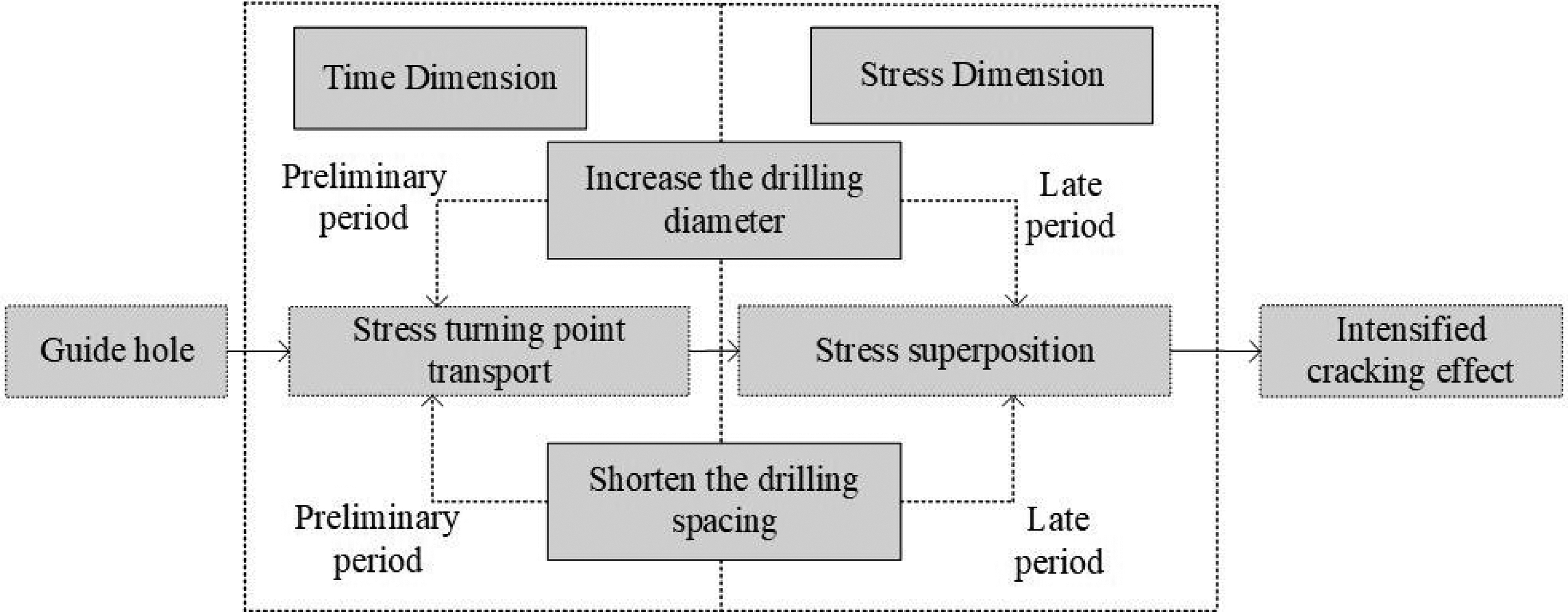
In summary, through the analysis of the stress field and damage zone of the static blasting technology, a flowchart of the enhanced blasting effect can be obtained, as shown in Figure 8. This paper studies the relationship among pilot holes, borehole diameter, and borehole spacing from two dimensions of time and stress. In the early stage, by increasing the borehole diameter, shortening the borehole spacing, and speeding up the transfer of stress turning points, stress superposition is realized in the later stage. For the purpose of strengthening the blasting effect, the diameter of the drill hole and the spacing of the drill holes are the measures, and the pilot hole is the premise of strengthening the blasting effect. The larger the hole diameter is, the more significant the stress superposition effect is in the post-static blasting stage, and the stress amplification effect is obvious. The stress superposition effect is more significant in the later stage of blasting, the stress amplification effect is obvious. Compared with static blasting without pilot hole, the static blasting of the pilot hole can reduce the resistance of the fracture surface, speed up the migration of the stress inflection point, and make the stress inflection point expand along the direction of the pilot hole to realize the guiding effect. The pilot hole can form a free surface inside the coal body. Under the combined effect of expansion pressure and free surface, the static blasting of the pilot hole shows a stress amplification effect, which finally strengthens the static blasting effect.
Flow chart of enhanced blasting effect.
Evolution analysis of the damage zone of static blasting technology under the multi-hole layout
COMSOL software was used to establish a three-dimensional numerical model. The length, width, and height were 12 m, 7 m, and 7 m, respectively. The blasting and guiding holes were both 113 mm, the drilling distance was 1.4 m, and the depth was 3.5 m. Swelling pressures of 26 MPa (3 h), 37 MPa (5 h), and 43 MPa (8 h) impose stress boundary conditions. The remaining boundary conditions are the same as those described above.
The evolution law of the damage zone of static blasting technology under a multi-hole arrangement was studied. The mechanical parameters are listed in Table 3.
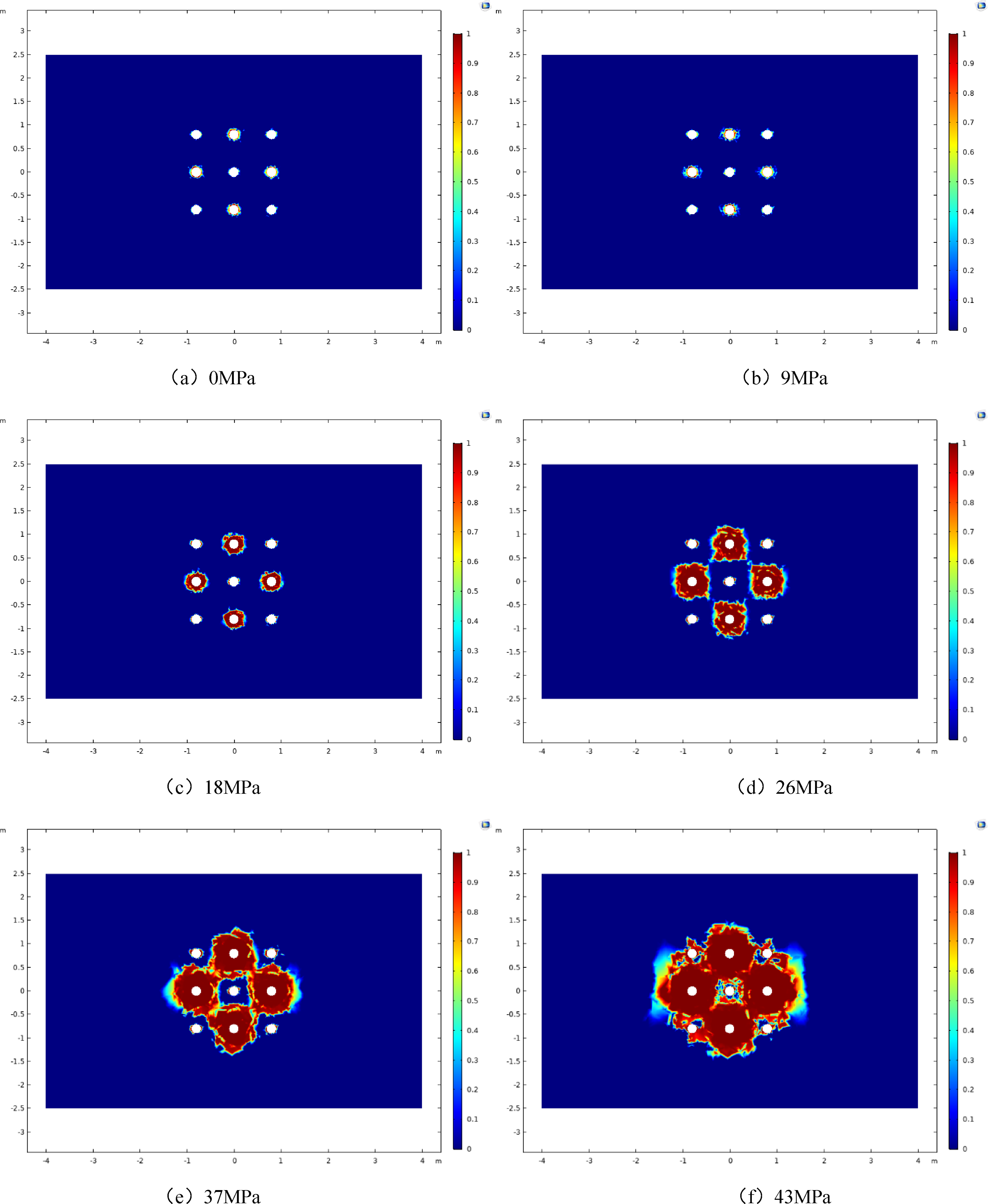
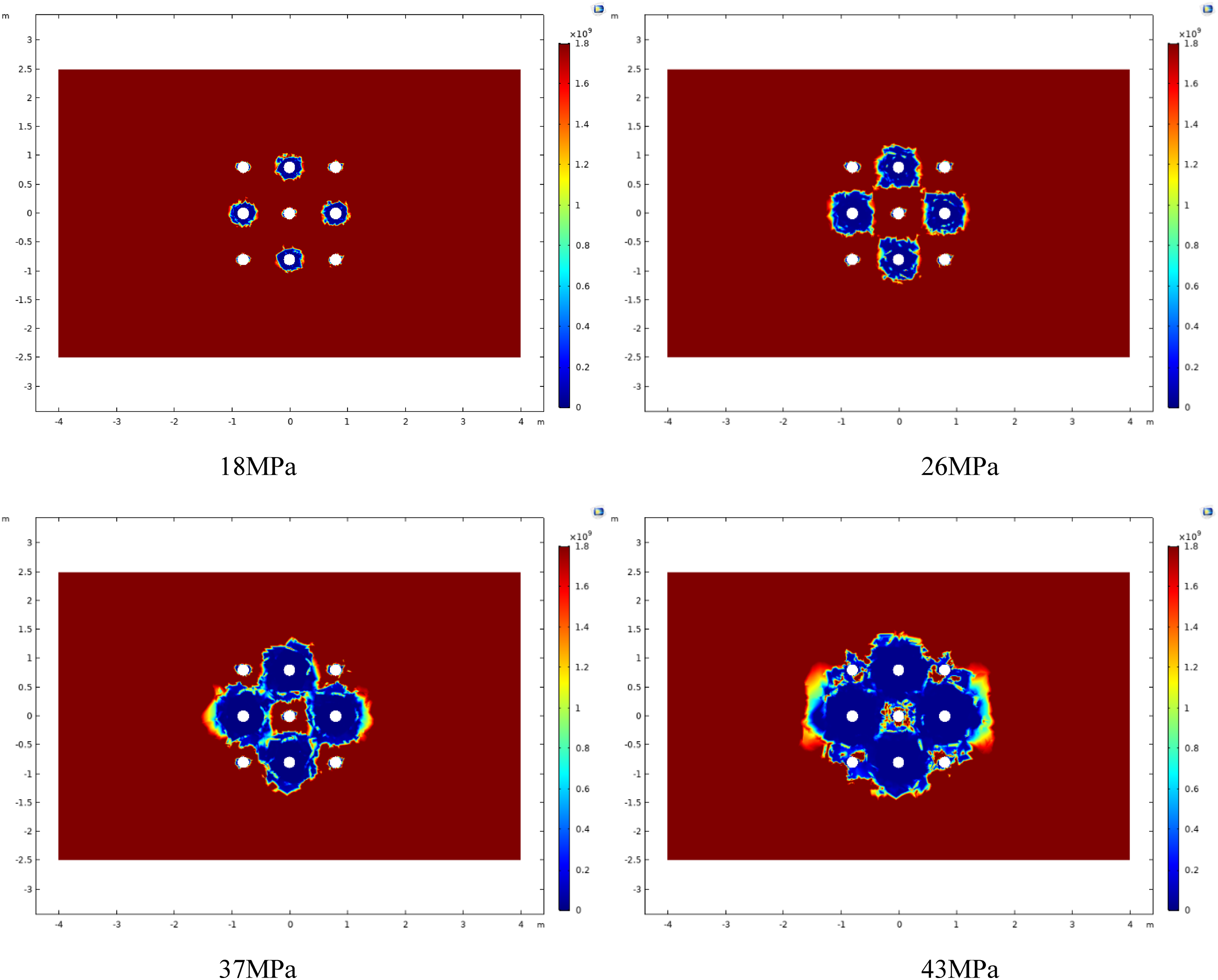
The evolution of the damage zone of the static blasting technology under a multi-hole arrangement is shown in Figure 9. When stress of 9MPa is applied in the blast hole, the weaker unit around the blast hole appears micro-damage; when the expansion pressure in the blast hole reaches 18 MPa, the static blasting agent expands. When the pressure far exceeds the tensile strength of the coal, the damage radius around the blast hole is 0.2m, and a tiny damage zone is formed around the guiding hole; when the expansion pressure in the blast hole reaches 26MPa, the damage radius around the blast hole is 0.6m. When the expansion pressure in the blast hole reaches 37 MPa, the stress superposition effect of the multi-hole arrangement appears gradually, the damage zone no longer develops along the guiding hole, and the damage zone between the blast holes starts penetrating, which further proves that the double-hole blasting effect is better than that of guiding hole cracking. When the expansion pressure in the blast hole is stable at 43MPa, the damage radius around the blast hole is 1.4m, macro cracks are formed around the blast hole, micro cracks develop around the guiding hole, the cracks penetrate each other, and finally form a crack network, together with the cracking agent. When the energy release is over, the expansion pressure is reduced, and static fracture is completed.
Damaged zone evolution under multi-hole arrangement.
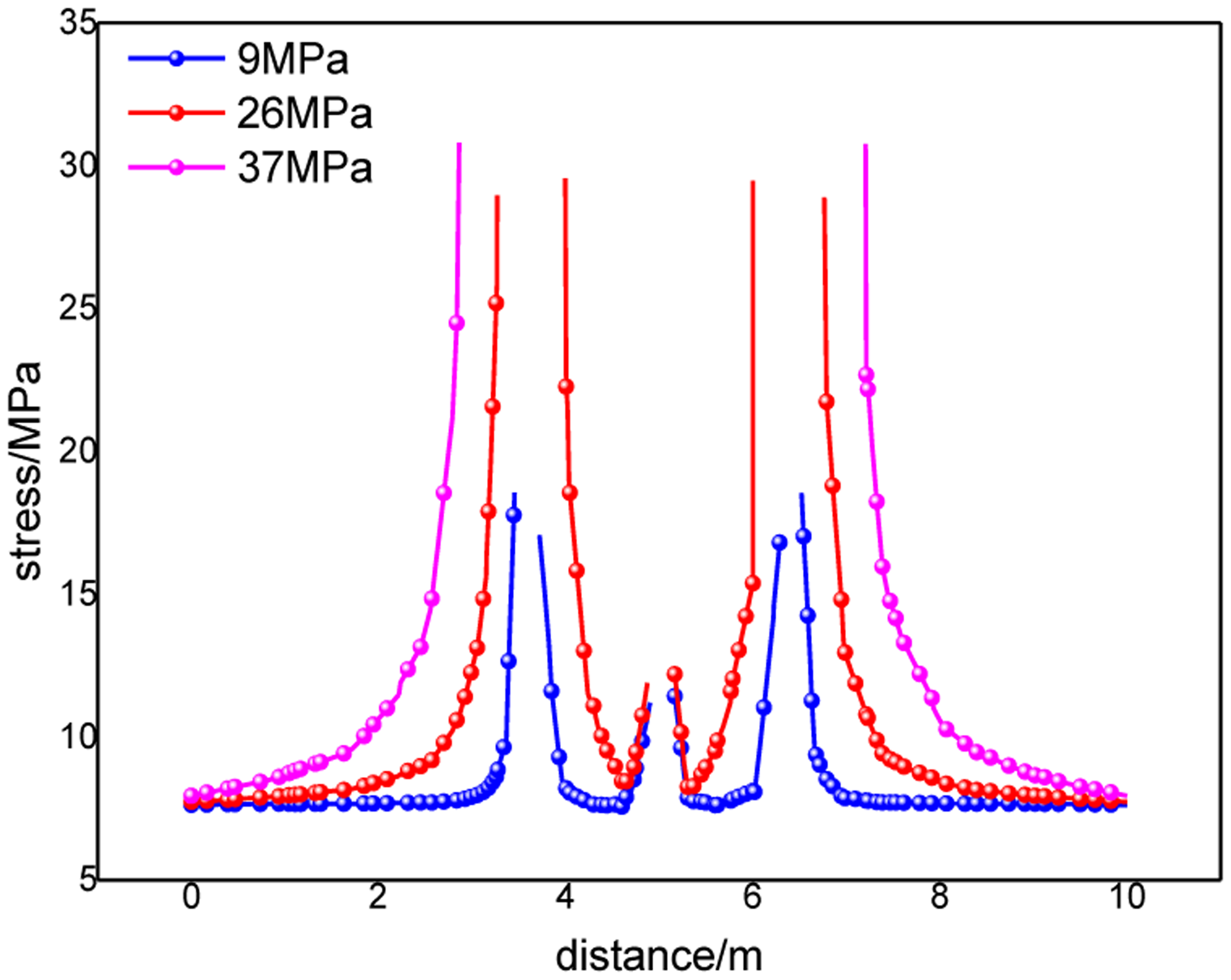
The evolution of the damage zone of the multi-hole layout static blasting technology needs to be analyzed from three aspects: rock stress state, elastic modulus, and occurrence state. The stress evolution law during the COMSOL simulation blasting process is shown in Figure 10. Figure 10 shows the horizontal coal stress state at expansion pressures of 9MPa, 26MPa, and 37MPa in the blast hole. From the figure, the greater the coal stress near the blast hole, the farther the distance from the blast hole, and the coal stress gradually drops to the original stress state. Under the combined action of the expansion pressure and the ground stress, the coal stress near the guiding hole is also greater than the original coal stress state. At 1 m from the blasting hole (x = 2.6), the coal stresses were 7.7MPa, 9.4MPa, and 16MPa, respectively. In summary, with an increase in expansion pressure, the coal stress gradually increases. When the stress state exceeds the tensile and shear stresses, the coal body is slightly damaged, which leads to a decrease in the elastic modulus, leading to the development of damaged areas in the coal body. To explore the evolution law of the elastic modulus during the cracking process, the elastic moduli of coal under 18MPa, 26MPa, 37MPa, and 43MPa were selected. The elastic evolution of the modulus during the static cracking process is shown in Figure 10. From the evolution, it can be concluded that as the expansion pressure of the blast hole increases, the elastic modulus near the coal body gradually decreases, and finally reaches the residual elastic modulus. The evolution of the elastic modulus was essentially the same as that of the damage zone. This is because after a damage zone is generated in the coal body, the elastic modulus decreases as the damage zone develops. When the blast hole is subjected to stress loading, the elastic modulus of the damaged zone is residual elasticity. The undamaged area is the original elastic modulus; therefore, the evolution of the elastic modulus is the same as the evolution of the damaged area. The lower the modulus of elasticity, the more prone the coal is to form damage zones, and the heterogeneity of the coal is considered during the blasting process, which is more in line with the real situation in the field application process.
Stress evolution of static blasting technology.
The evolution of the damage zone during the static blasting process was influenced by the expansion pressure, construction parameters, and elastic modulus. An increase in the expansion pressure causes the damage zone of the coal body, which leads to an increase in the elastic modulus, and the expansion pressure and elastic modulus function together. This causes the damaged area to expand and penetrate; In addition, the guiding hole can guide the development direction of the damaged area.
Conclusions
In this study, static blasting laboratory experiments were first performed to study the layout of blasting holes and the evolution of cracks. Second, a stress-damage coupling model was established. The stress-field evolution and damage-zone distribution under different construction parameters were studied through numerical simulations. The evolution law of the damage zone under the multi-hole arrangement was analyzed, and the following conclusions were obtained:
From the analysis of the blasting effect, the double-hole blasting effect is the best, followed by the guiding-hole blasting effect. Large borehole diameters and reduced borehole spacing improved the cracking effect of the blast holes. The guiding hole can guide the direction of expansion of the damage zone and also enhance the cracking effect. The relationship between the guiding hole, borehole diameter, and borehole spacing was revealed based on the stress field and damage zone. To enhance the blasting effect, the borehole diameter and spacing are measured, the guiding hole is used to strengthen the blasting effect, and the analysis should be performed from the two dimensions of time and stress at the measurement level. In the early stage, the migration of the stress turning point was accelerated from the time dimension, the stress superimposition was realized from the stress dimension in the later stage, and the static blasting effect was finally strengthened. The evolution of the damage zone during static blasting was influenced by three factors: expansion pressure, construction parameters, and elastic modulus. The increase in expansion pressure caused damage zones to appear in the coal body, resulting in a decrease in the elastic modulus. Under the combined action of mass, the damaged area expanded and penetrated. In the same borehole diameter test plan, the reasonable ratio of hole spacing to borehole diameter was approximately 12 to 13. In the same borehole spacing test plan, the 113 mm borehole produced the largest damage area, the larger the borehole diameter, the better the coal seam blasting effect. Therefore, the reasonable construction parameters for the simulation of this number of times are a borehole diameter of 113 mm, borehole spacing of 1.4 m, and the hole layout multi-hole and guiding hole arrangement.
The static blasting technology can increase the permeability of coal seams and effectively improve the gas extraction rate. During the field application of static blasting technology, the temperature of coal body increases, and the increase of temperature promotes the desorption of coal body gas. It is necessary to further consider the evolution law of temperature field in the process of static blasting. A reasonable ratio of blasting agent will enhance the static cracking effect, so further research is needed on the preferred composition ratio of silent cracking agent, which is especially important for this technology.
Footnotes
Acknowledgements
We appreciate the support of coal mine, and the help of the workers in coal samples collection. We are also grateful to laboratory staff of Henan Polytechnic University, who provided instrument and equipment to accomplish the tests. The authors want to thank the anonymous reviewers for their valuable suggestions.
Declaration of conflicting interests
The author(s) declared no potential conflicts of interest with respect to the research, authorship, and/or publication of this article.
Funding
The author(s) disclosed receipt of the following financial support for the research, authorship, and/or publication of this article: This work was supported by the Fundamental Research Funds for the Universities of Henan Province, Key R&D, and Extension Projects of Henan Province, National Natural Science Foundation of China, (grant number NSFRF210426, 222102320050, 51874122, 52074107).
