




Abstract
The low-frequency pulse wave makes the velocity of the fluid in the reservoir fluctuate dramatically, which results in a remarkable inertia force. The Darcy’s law was inapplicable to the pulse flow with strong effect of inertial force. In this paper, the non-Darcy flow equation and the calculation method of capillary number of pressure pulse displacement are established. The pressure pulse experiments of single-phase and two- phase flow are carried out. The results show that the periodic change of velocity can decrease the seepage resistance and enhance apparent permeability by generating the inertial force. The higher the pulse frequency improves the apparent permeability by enhancing influence of inertial force. The increase of apparent permeability of high permeability core is larger than that of low permeability core, which indicates that inertial force is more prominent in high permeability reservoir. For the water-oil two-phase flow, inertia force makes the relative permeability curve move towards right, and the equal permeability point becomes higher. In other words, with the increase of capillary number, part of residual oil is activated, and the displacement efficiency is improved.
Introduction
Low oil prices concerns lead to an increased interest in pulse wave as an economic enhanced oil recovery (EOR) technology (Mikhail et al., 2014; Wooden, 2018). Wavefront Technology Solutions Inc. (Canada) has taken an advantage of the pulse wave EOR technology to serve 23 clients in 2019, including Shell, Chevron, Petrobras, etc (Wavefront Inc., 2020). Applied Seismic Research Inc. (US) has provided pulse wave technical support for more than 50 locations, including oilfields in US, Canada, Egypt, Mexico, and Oman (Kostrov and Wooden, 2008, 2011, 2016; Wooden, 2018). Petroteq Energy, Inc. (US) proposed a SWEPT Technology and applied it to the Wardlaw oilfield in Permian Basin to reduce the cost of heavy oil from $50/b to $16.5/b (Saudi America, 2017). The Canasonics Inc. (Canada) offered has a number of innovative pulse wave technologies, e.g. Pulse Stimulation Tool (PST). The Haliburton (US) (2020) devised pulse wave technologies, e.g. Pulsonix tool.
It has been experimentally proven that there is a substantial increase in the net fluid flow through porous space under elastic waves (De Haro et al., 1996; Kostrov and Wooden, 2008, 2011; Kostrov and Wooden, 2016; Agi, 2018; Jeong, 2015; Katterbauer, 2015; Mullakaev, 2015; Tsiklauri and Beresnev, 2003). Since inertial force is well consider as a secondary factor, the impacts of local acceleration and the resulting inertial force were usually no mention. As generally believed, the velocity of fluid flow in the reservoir is relatively small and the inertial force can be ignored (the inertial force is often considered in the gas reservoir). But the pulse water injection, because of the high frequency, the speed changes violently, produces the large acceleration, and then forms the inertia force which cannot be ignored. Therefore, the influence of the inertia force on the flow characteristics in porous media and the displacement effect needs to be studied.
Darcy’s law assumes that the driving force is in equilibrium with the viscous resistance, the fluid has no acceleration, and the inertial force is ignored. Thus, Darcy’s law is not applicable to describe the process of pressure pulse displacement. As for the research of inertial force, it was found that the relationship between seepage velocity and pressure gradient gradually deviates from the linear relationship with the increase of flow velocity in the laboratory experiment by Forchheimer. It is proposed by Forchheimer’s law for the first time that the larger flow velocity will lead to a more obvious the nonlinear characteristic (Chen, 2019b). After that, many researchers (Kang and Yun, 2019; Nissan and Berkowitz, 2018; De Haro et al., 1996) think that the nonlinear seepage is mainly caused by forming the inertial force.

When the Reynolds number is small enough, the viscous force far outweigh the inertial force so that the Forchheimer’s law equals to Darcy’s Law. For the larger Reynolds number, the inertial force gradually plays the main role, and the Forchheimer’s law is in the form of quadratic. Then, the Forchheimer’s law becomes the basic equation to describe the non-Darcy flow in porous media (Chen, 2019a; Lagziri and Bezzazi, 2019; Wen, 2006; Thauvin and Mohanty, 1998), and some study focus on the determination method of equation correlation coefficient and its application in engineering practice (Thauvin and Mohanty, 1998; Guo et al., 2021; Agi, 2018; Jeong, 2015; Katterbauer, 2015; Kouznetsov, 1998; Mullakaev, 2015). However, the formation mechanism of non-linear flow caused by pulse injection is obviously different from previous studies. It is not caused by excessive velocity, but by periodic changes. Therefore, the existing high-speed non-Darcy flow equation cannot describe the pulse injection.
Therefore, in this paper, theoretical analysis and physical simulation are combined to explore the influence of inertial force on the seepage law under the condition of pulse injection, and to analyze the effect of inertial force on oil displacement.
Single phase flow equation and apparent permeability
The basic reason for the inertial force is pressure pulse, and the velocity of flow varies greatly, resulting in acceleration (Tikekar et al., 2010). For a capillary unit with size of Ac×dx, assuming that the fluid flow is affected by a pressure difference dpc, the viscous force and the inertia force, which is different from Darcy’s law. According to the Newton’s second law, we can get


For one-dimensional flow with equal cross-sectional area, ∂v/∂x = 0. Thus


According to Newton’s internal friction law, the shear stress on the tube surface

Based on Darcy’s law and Poiseuille’s law in capillary bundle model

Put them into equation (4) and the tortuosity C can be lost due to Lc=CL, dp/dx=Cdpc/dx

For constant injection rate, dQ/dt = 0, Darcy’s law is presented. When flow rate is constant, the permeability calculated by Darcy’s law is Darcy permeability. For dQ/dt ≠ 0, the inertia force and the additional pressure gradient are generated. During the case of pressure pulse injection, the permeability still calculated according to Darcy’s law can be called apparent permeability (apparent permeability). It is worth noting that this permeability is time-varying permeability.
According to equation (7), we can obtain the instantaneous apparent permeability
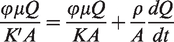

It is easy to see that when dQ/dt > 0, the injection rate is increased, K' is less than K, the apparent permeability is lower than Darcy’s permeability. On the contrary, when dQ/dt < 0, injection rate reduces so that the apparent permeability is higher than Darcy’s permeability.
The pressure pulse is periodic and can be described by sine function

Then, the instantaneous permeability with different frequencies and amplitudes can be obtained

The apparent permeability is the average of instantaneous permeability K'

According to Forchheimer’s law, we can obtain the average apparent permeability


Jordan (2013) derived parameter β as negative value. The result exhibited an increase in apparent permeability under Forchheimerʼs law, comparisons with predictions based on Darcyʼs law.
Experiment of single phase flow
According to the waveform of the pressure pulse wave in the field, ISCO pump is used to simulate the pressure pulse by changing the injection velocity instantaneously. Experimental procedures and system (Figure 1) of the indoor pressure pulse displacement has established in the door. The main experimental device includes: constant pressure and constant speed pump, intermediate vessel, pressure collector, flow models and annular pressure pump. It can meet the requirements of pulse wave with different amplitudes under 50 Hz.
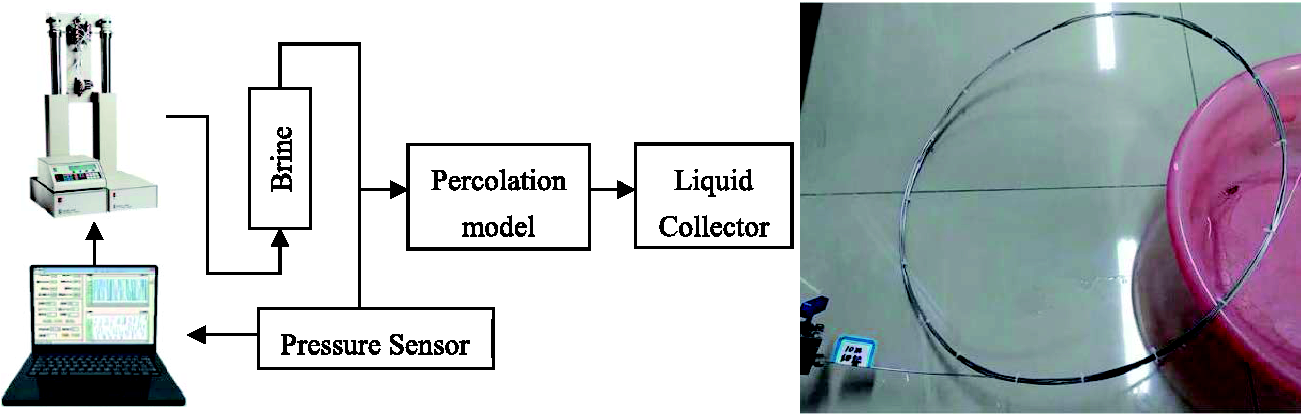
Experimental system of the pressure pulse.
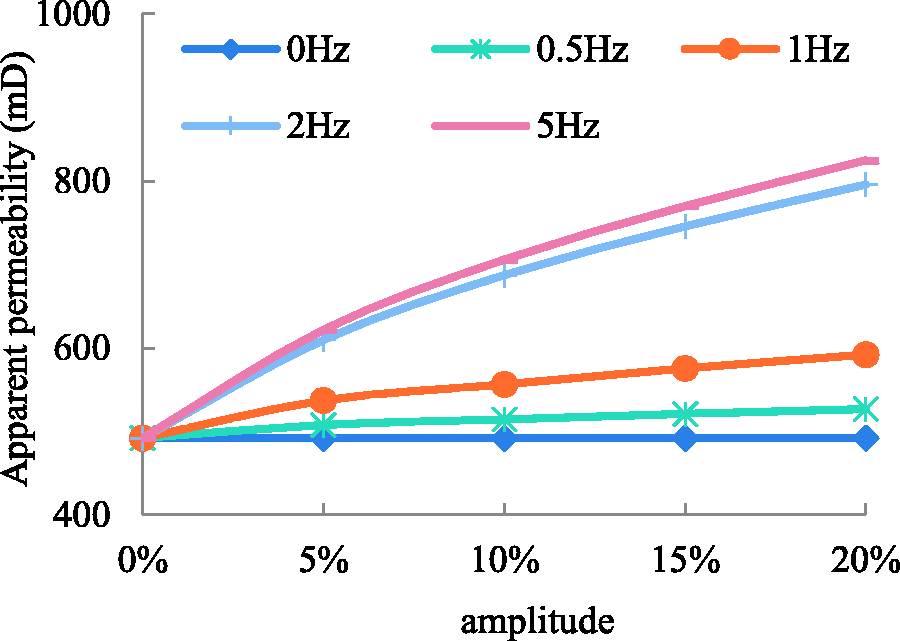
Experimental results of No. 1 core sample.
We provided two kinds of flow models. One model is stainless steel pipelines with outer diameter of 1/16 inch, inner diameter of 0.127 mm (0.005 inch) and length of 10 m. The other model is rock plug samples. To prevent the influence of mineral migration, the core plugs are phenolic consolidated quartz sands with mono-size. Table 1 lists the parameters of the core samples used in the pressure pulse experiments. The simulated water used in the experiment is 6 g/ml KCl aqueous solution to prevent water sensitivity. The density of simulated water is about 1 g/ml, and the viscosity is 0. 948mpa·s.
The parameters of the core samples used in the pressure pulse experiments.

Results analysis
The experimental results of the influence of pressure pulse with different frequencies and amplitudes on rock permeability are shown in Figures 2 to 6. When the pressure pulse is applied, the apparent permeability increases obviously. The higher the Darcy permeability is, the higher the apparent permeability is. For example, under the condition of 5 Hz and 20% amplitude, the apparent permeability of No. 1 core reached 824mD, 67% increase compared with Darcy permeability, while the permeability of No. 4 core increased from 9.73 mD to 11.2 mD, only increased by 15%.
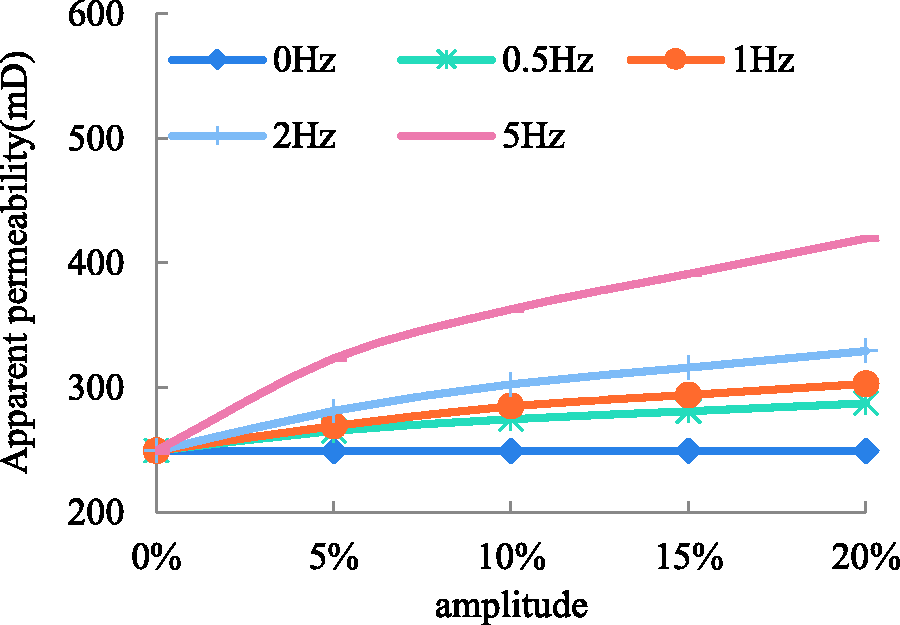
Experimental results of No. 2 core sample.
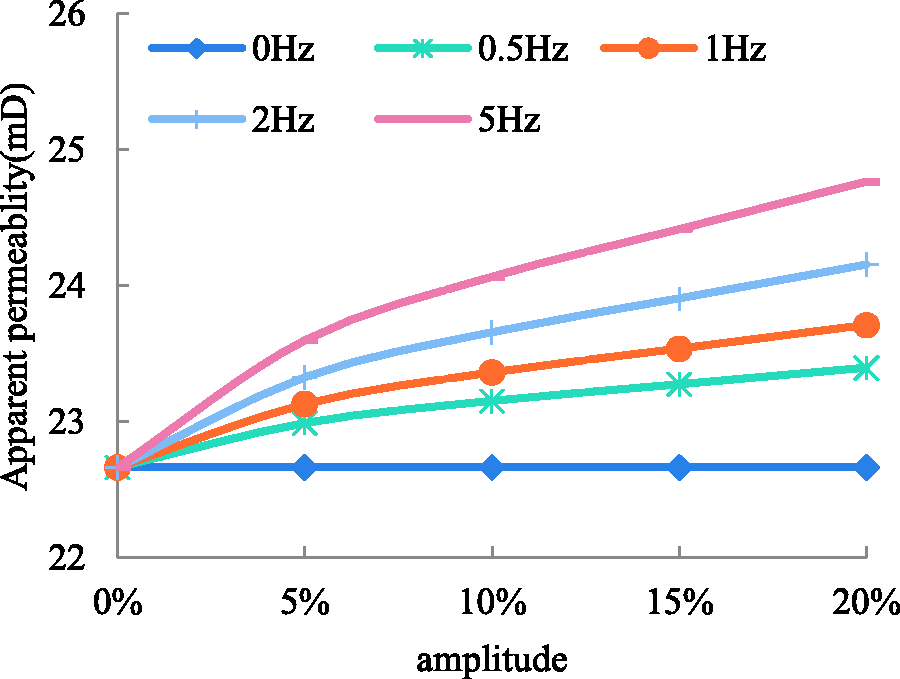
Experimental results of No. 3 core sample.
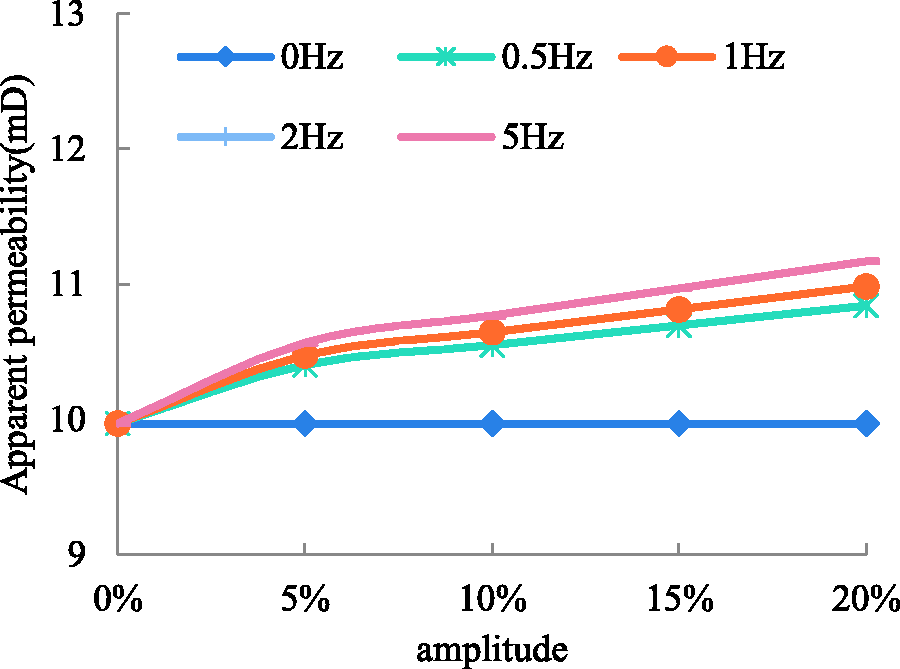
Experimental results of No. 4 core sample.
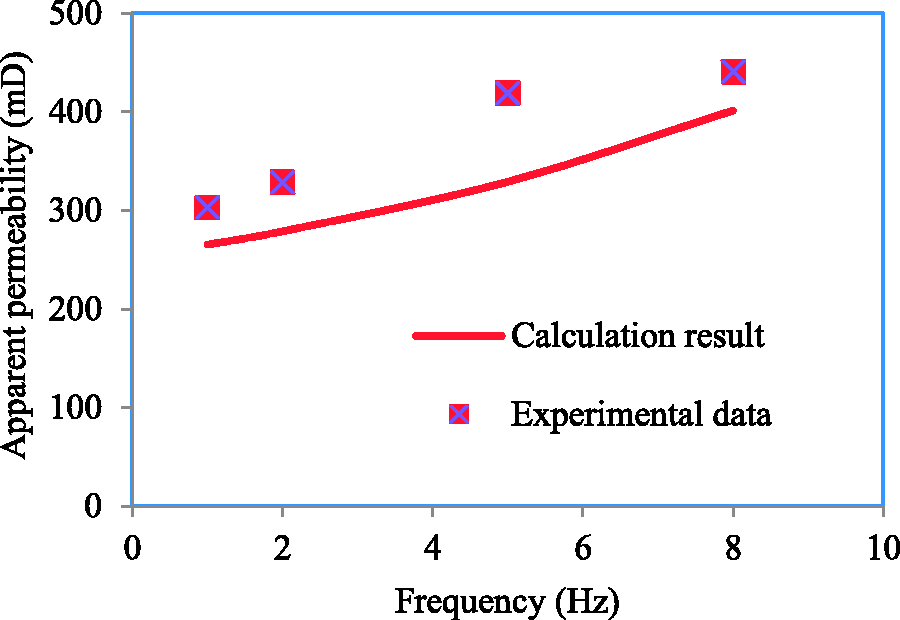
The calculated apparent permeability and the measured apparent permeability of No. 2 core (20% amplitude).
Figure 6 shows the comparison between the calculated apparent permeability and the measured apparent permeability of No. 2 core at 20% amplitude of pressure pulse. Considering that the inertia force is mainly generated at the time of flow change, the average apparent permeability of 10 points before and after the flow change is compared with the measured permeability. It can be seen from the calculation results that although the apparent permeability at different frequencies is lower than that measured in the laboratory (only 10–20% lower than the measured permeability), it increases significantly compared with the Darcy permeability, indicating that the inertial force plays an important role. Therefore, the influence of inertia force must be considered in the theoretical analysis and numerical calculation of pressurepulse displacement.
In general, experimental and theoretical analysis show that: ①pressure pulse will produce inertia force, which will increase the apparent permeability, and the larger the amplitude is, the greater the apparent permeability is; ②the increase of apparent permeability of high permeability core is significantly larger than that of low permeability core, which indicates that inertia force is more prominent in high permeability reservoir.
Influence of inertial force on water flooding effect
Capillary number
According to the single-phase seepage equation (9), the displacement phase velocity expression in the traditional capillary number can be replaced by the following formula

Then, new formula of capillary number


It is similar to the single-phase seepage equation,

The formula of capillary number changes to

or

It can be seen that the capillary number of pressure pulse displacement can be divided into two parts, one is the capillary number of constant velocity injection(the traditional capillary number), the other is the additional term caused by speed change. The additional terms are related to the density of the injected fluid, frequency and amplitude of pulse, interfacial tension and permeability. For constant velocity injection, the pulse amplitude and frequency are equal to 0, that is to say, the first term is equal to 0, and the capillary number is reduced to the traditional formula. In the case of pressure pulse, the capillary number will be greatly increased. It can be explained that pressure pulse produces instantaneous impact force and activate residual oil drop to pass through the roar channel so as to improve oil displacement efficiency.
Relative permeability experiment
The change of relative permeability curve shows that pressure pulse can improve oil displacement efficiency. The core with a permeability of 250md was selected in the experiment. The pulse frequency was 10 Hz and the amplitude was set as 0%, 5%, 10% and 15% respectively. The experiment process is carried out according to the standard of China’s oil and gas industry(SY/T 5345–2007). The experimental results are shown in Figure 7.
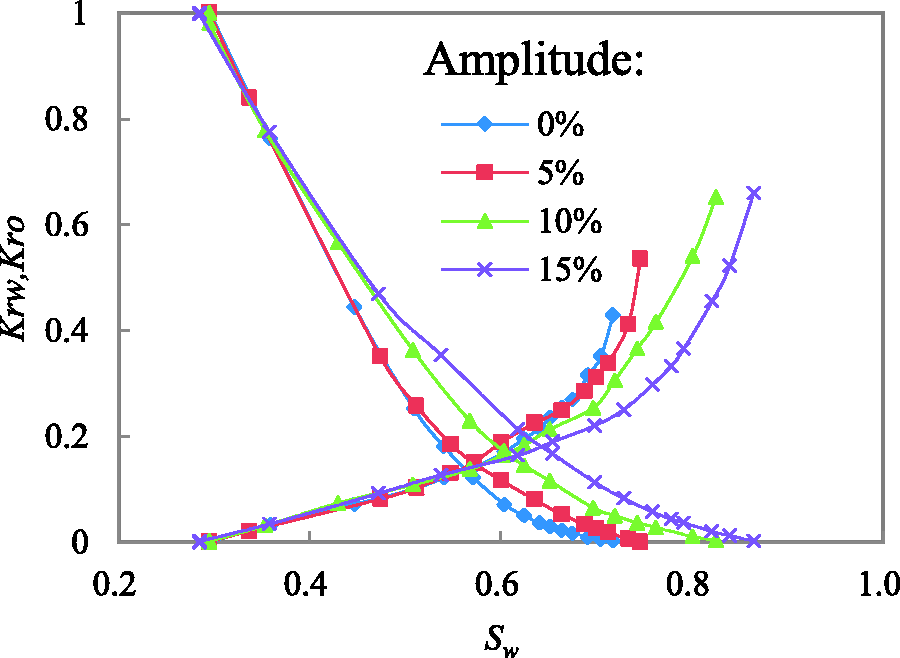
Relative permeability curve of pressure pulse with different amplitudes.
The experimental results (Figure 7) show that relative permeability curve moves to the right, relative permeability of oil phase increases, and oil-water two-phase seepage area widens, with the maximum increase of 14.72% compared with conventional water injection (amplitude 0%). The greater the amplitude is, the higher the equal permeability point is, and the corresponding water saturation at the equal permeability point increases, with a maximum increase of 7. 9%. The larger the amplitude is, the greater the water saturation is under the condition of residual oil, and the corresponding relative permeability of water phase is also significantly increased. The maximum increase of relative permeability of water phase is 23. 07%. That is to say, under the condition of pressure pulse, it can reduce the residual oil saturation and improve the oil displacement efficiency, and the larger the amplitude is at the same frequency, the more obvious the effect is.
Conclusion
Under the condition of pressure pulse injection, the influence of inertia force is considerable. The changes of apparent permeability increase with the frequency. The capillary number increases greatly under the effect of pressure pulse, and some of the residual oil is activated to improve the oil recovery of water flooding. Pressure pulse injection can generate wave and propagate in reservoir.
Footnotes
Declaration of conflicting interests
The author(s) declared no potential conflicts of interest with respect to the research, authorship, and/or publication of this article.
Funding
The author(s) disclosed receipt of the following financial support for the research, authorship, and/or publication of this article: This paper was funded by the National Key Research and Development Program of China (NO. 2018YFA0702400).
