




Abstract
The impact of neglected well bore pressure losses due to fluid accumulation and kinetic energy in the fundamental energy equation used for derivation of flowing bottom-hole pressure in horizontal well have been conceived to be a considerable reason for the discrepancy between computed rates from the existing models and actual rates got from production tests. In the study, a new model that investigate all possible well bore pressure losses effect on the production rate of a horizontal oil well have been established. The newly developed model has been validated using the field data obtained from the literature and outcome got from the new model yields more satisfactory results. A more realistic results that evident all flow phenomena in petroleum production well include the initial unsteady, pseudo-steady and steady state flow condition hence flow rate at any given production time has been established for flow of oil along horizontal production well. The concept is useful to estimate flowing bottom-hole pressure and analyze its effect on production rate value of a horizontal oil well without ignoring any pressure resisting terms in the governing thermodynamic equation. The unsteadiness fluid flow period that generally observed after shut in a well have also been demonstrated. Closer agreement between the results obtained using the newly developed model and real life field measurement was observed when compared with the previous model in the literature. The study gives reservoir engineer an exact and helpful device for estimating and assessing horizontal oil well production rate.
Introduction
Horizontal well productivity has become more prominent to meet the demand for global energy resources than vertical wells, this is due to ability to be in contact with more territory in the reservoir, tending to recover higher volumes of hydrocarbons. They can be drilled perpendicular to position of fractures present in the reservoir and intersect a lot more fractures than vertical wells and lead to improved productivity (Tabatabaei et al., 2011; Moosavi et al., 2020). Most of the flow assurance issues and their corresponding magnitude of damage discussed in the several literature (Davarpanah et al., 2020; Davarpanah and Mirshekari, 2019; Fadairo et al., 2008; Nesic et al., 2020; Zhong et al., 2020) could be alleviated by the use of horizontal well design. Several experts have proved that production and injectivity could be significantly optimized in different reservoir types when combine various operational techniques reported in literature (Fadairo et al., 2016; Guo et al., 2020; Liu et al., 2019; Sun and Davarpanah, 2020) with accurate design of horizontal well. The concept has been useful in various ways such as production from multiple fractures et al (2019), reduction of gas and water coning, improved sweep efficiency and a larger drainage area. As a result of excellence performance, horizontal well remains better choice in various reservoir setting like marginal and thin reservoirs, naturally fractured reservoirs, reservoirs with water and gas coning issues, reservoirs with good vertical permeability, offshore conditions; as multiple wells can be drilled from a single platform. The use of horizontal wells has become and established practice in the oil and gas industry. Horizontal wells have also been used for oil and gas recovery, which is now a common practice in the petroleum industry. It has been generally accepted that production in horizontal well increases as the horizontal length section of the well increases until optimum ratio of length to diameter of pipe is attained (Folefac et al., 1991; Novy, 1995; Renard and Duppy, 1990;Yuan et al., 1998). It is also generally recognized that most horizontal wells do not produce at expected production rate which is basically linked to excessive restriction forces experienced in a long horizontal section of the well (Guo et al., 2007; Fadairo et al., 2011) This restriction forces generate large discrepancy between the production rate obtained from various available models and that obtained from the real time gauge measurement. The huge variance was mainly due to the fact that the available flow equations for a drain hole developed by past researchers have been attributed to various assumption in the fundamental govern equation used for their derivation. With current innovation in technology, the petroleum industry has generally moved to horizontal wells, as it is fast becoming the traditional practice, advancing to multilateral well to recover hydrocarbon simultaneously from more than one reservoir. However horizontal well is costlier to drill and complete, accurate prediction of flow rate at any production time highly demanding to offer significant benefit in horizontal well planning and economics.
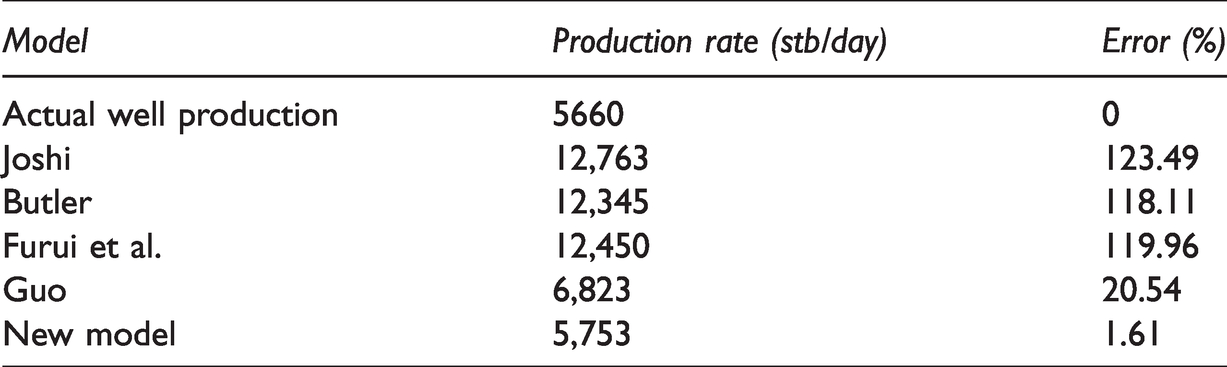
Several models (Butler, 1994; Guo et al., 2007; Hill and Zhu, 2008; Ouyang and Huang, 2005) in the literature have been formulated to describe the behavior of flow and pressure transverse in horizontal drain hole but unattractive to be used due to diverse erroneous generated when compared with oilfield real time value. Previous models used for predicting horizontal drain hole productivity can be grouped into three categories: simple analytical solutions derived in late 1980s and early 1990s based on the assumption of frictionless drain holes, sophisticated analytical models developed after 1990s for drain holes of finite conductivity and lately considered numerical models that time consuming in computation. A considerable amount of analytical work has been published on various aspects of horizontal well performance since the 1980’s. The early part of the studies that published in the open literature includes stabilized inflow models including both steady state and pseudo-steady state (Giger, 1985; Joshi, 1988), transient flow models (Kuchuk et al., 1991; Ozkan et al., 1989), and gas and water coning behavior (Geiger, 1989; Goode and Kuchuk, 1991), and reservoir simulation concepts of using horizontal wells (Economides et al., 1991). Although these methods have provided insight into the performance of horizontal wells, they were generally based on a common assumption of the well-being a line sink with a uniform influx boundary condition at the wellbore (Fadairo et al., 2019, 2020a; Kamkom and Zhu, 2005). This assumption leads to an equal well flow pressure along the entire horizontal length of the wellbore, and hence, ignores any impact of the fluid flowing within the wellbore on the well’s inflow performance. Dikken (1990) is one of the pioneers in mathematical modeling of reservoir-wellbore cross flow. He derived an analytical model assuming the boundary condition that the pressure drawdown is equal to zero at the toe of the drain hole. Studies have shown that Dikken (1990) is unrealistic based on assumption of infinite flow conductivity in the horizontal section of the well that was applied in his model derivation. Though several accessible mathematical models (Landman, 1994; Ozkan et al., 1993; Penmatcha et al., 1997; Siu and Subramanian, 1995; Yildiz and Ozkan, 1998) that considered finite flow conductivity in derivation for predicting the productivity of horizontal wells have been coded and generated into commercial software in the oil industry, but rarely attractive due to the common nature of either simplicity if it too analytical or rigorous and time consuming in computation if it too numerical. The mathematical models used for predicting horizontal drain hole productivity that are available fall into three categories: (1) simple analytical solutions derived in late 1980s and early 1990s based on the assumption of frictionless drain holes, Generally, these models are embraced because they are simple and very easy to use. Notwithstanding, that they are largely inaccurate and give wrong prediction of the performance of the well because the models disregard the pressure drop along the length of the wellbore. Since the wells oftentimes are thousands of feet in long, disregarding pressure drop has misled engineers by giving an overestimation of well productivity. The models are useful in first calculations and to study the impact of a few parameters, yet most certainly they are not appropriate for field applications. (2) Sophisticated analytical models developed after 1990s for drain holes of finite conductivity, and (3) numerical models considering wellbore hydraulic. Guo et al. (2007) research output have successfully demonstrated that simple analytical model can closely sufficient for prediction of flow rate in long horizontal drain hole with a low error margin of 20.5% compared with the existing models accessible in the literature. Recently, Al-Rheawi (2019) explicitly reported the concept of combining pressure derivatives for transient and semi-steady finite acting porous media and used it for evaluating the onset of boundary effect on the productivity index of the reservoir. The method was also used to identify different reservoir properties and flow types that influence reservoir performance. The optimal reservoir configuration for optimizing the reservoir performance was determined, Al-Rheawi (2018). However the accessible pressure restrictions in horizontal well bore were overlooked in his two literatures (Al-Rheawi, 2018, 2019). In light of the Guo et al. (2007) claim that pressure restriction generated by frictional force along the horizontal section of a well is a key factor to be considered in model derivation of flow rate equation for finite conductivity of long horizontal drain hole. There are other obtainable pressure restriction generated by kinetic and accumulation terms reported by Fadairo et al. (2020b) that constituted to flow rate of finite conductivity of long horizontal oil well considering in the new study. The current study has demonstrated the effect of all possible pressure restriction terms that were ignored in the energy flow equation used for previous model derivation. The inclusion of all obtainable restriction factors into the governing energy equation and being resolved before subjecting to boundary conditions has resulted to more exact model for predicting long horizontal oil flow rate. The outcome of the study have established functional relationship that produced more realistic and accurate models that gives percentage error of 1.61% compared with previously developed Joshi, Butler, Furui et al. and Guo et al. models that reported percentage errors of 123.49, 118.11, 119.96 and 20.54, respectively, in their literature using the real life value as the benchmark. The new study has shown that the improved simple analytical flow rate equation is sufficiently reliable to evaluate the oil production rate in long horizontal drain hole if all possible restriction terms that constituted to flow of fluid are accurately considered.
Governing equations
The study investigated the effect of pressure restriction as a result of kinetic and accumulation on horizontal well performance that was initially ignored by previous experts. In the derivation of the model the basic assumptions considered are
homogenous porous media and single-phase flow system external work-done on the system is zero mean temperature is assumed same at some intervals
The derivation
Considering general simple relationship that describes flow of oil stream in horizontal drain hole as a function of unit pressure drop as

The fluid flow rate into the hole-segment can be expressed in field units as

The specific productivity equation reported by Furui et al. (2003) is

The permeability anisotropy formula used is

Integration of equation (2) yields the fluid flow rate formula in the drain hole at point x as

The formula for the average flow velocity in the drain hole at point x is given by Guo et al. (2007) as

Substituting equations (5) into (6) gives

The
The first law of thermodynamics considering the pressure drop due to friction, fluid accumulation and kinetic energy is given in U.S engineering units as (Fadairo et al., 2015, 2018, 2020)

Rearranging in field units gives

For simplicity sake, equation (9) can be simply re-arranged as


Substituting equation (7) into equation (10) and re-arranging, we have



Take derivatives of equation (14) with respect to x and re-arranging, we have

Defining

The fanning friction factor which depends on hole roughness and the Reynolds number which is defined by Jain correlation as

Equation (15) can be written as

Equation (18) can be solved. Following the procedure reported by Guo et al. (2007), we have


Recall equation (5)

Assuming the transition from laminar flow regime to turbulent flow regime can be overlooked, the fluid flow rate will therefore be a combination of both the laminar and turbulent flow regimes and equation (5) can therefore be expressed as

Assuming the critical Reynold number is 2000, an expression for critical flow rate is obtained as (Guo et al., 2007)

Substituting equation (20) into equation (22) gives

Let


Hence we have

Integration of equation (27) yields


The final equation can be expressed as

Model analysis
This modified model is an extension of Guo et al. (2007) model to account for all flow behaviors that evident at the beginning of flow of fluid in pipe after shut in operation. The illustration to evaluate flow rate at the stabilized state after production time of 120 days using the modified equation has been demonstrated in Appendix 1.
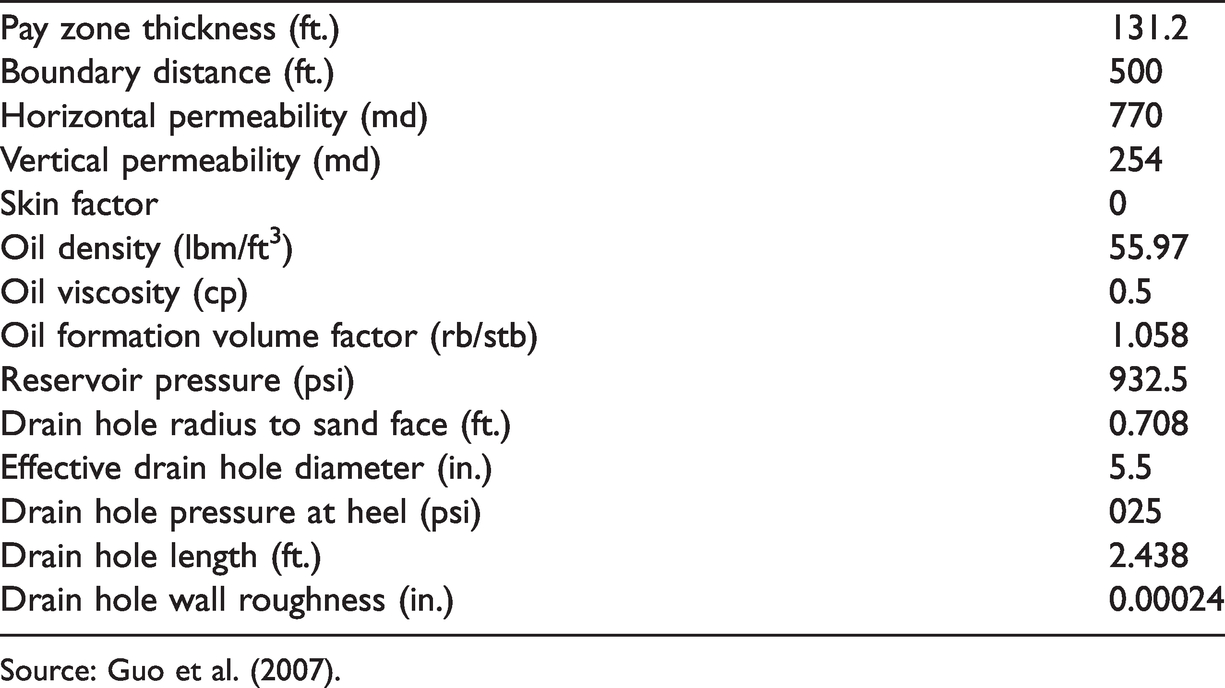
A field case information (Table 1) reported in the literature Guo et al. (2007) was taken into consideration in the calculation; the wellbore has a pay zone thickness of 131.2 ft, the length from the toe to the heel of the wellbore is 2438 ft with an effective drain-hole diameter of 5.5 in. with a well production rate of 5660 stb/day. The different models predicted different flow rates and the superiority of this model was evident as it gave a much better prediction using gauge measurement of the field case for benchmark. Table 2 shows a comparison of the flow rates calculated at stabilized state by the modified model and other existing models with their corresponding error percentage.
Fluid and reservoir parameters.
Source: Guo et al. (2007).
Final model comparison, after Guo et al. (2007).
Results analysis
The result obtained from modified model demonstrated the flow behaviors that are closer to realistic flow dynamic in oil and gas well after shut in as the flow changes from the non-stabilized to stabilized condition in the drain hole from the reservoir were established and reported in Figure 1. The results obtained in Figure 1 also show the effect of all neglected possible wellbore pressure losses such as losses due to accumulation term and kinetic term on flow phenomena in horizontal oil production well. It has been demonstrated from the outcomes of this study that the inconsistency in the results obtained by gauge and that obtained by the past developed models in the literature were not just because of the impact of pressure losses due to friction term as suggested by previous authors however may likely be caused by losses due to kinetic and accumulation experienced by the flowing fluid in a channel. The result from the modified model has been sufficiently more correct and demonstrated an error margin that is less than 2% validating with other past models that gave higher error margins after benchmarking with the gauge measurement value. This study gives reservoir engineer an exact and helpful device for estimating and easy assessment of oil wells production rate.
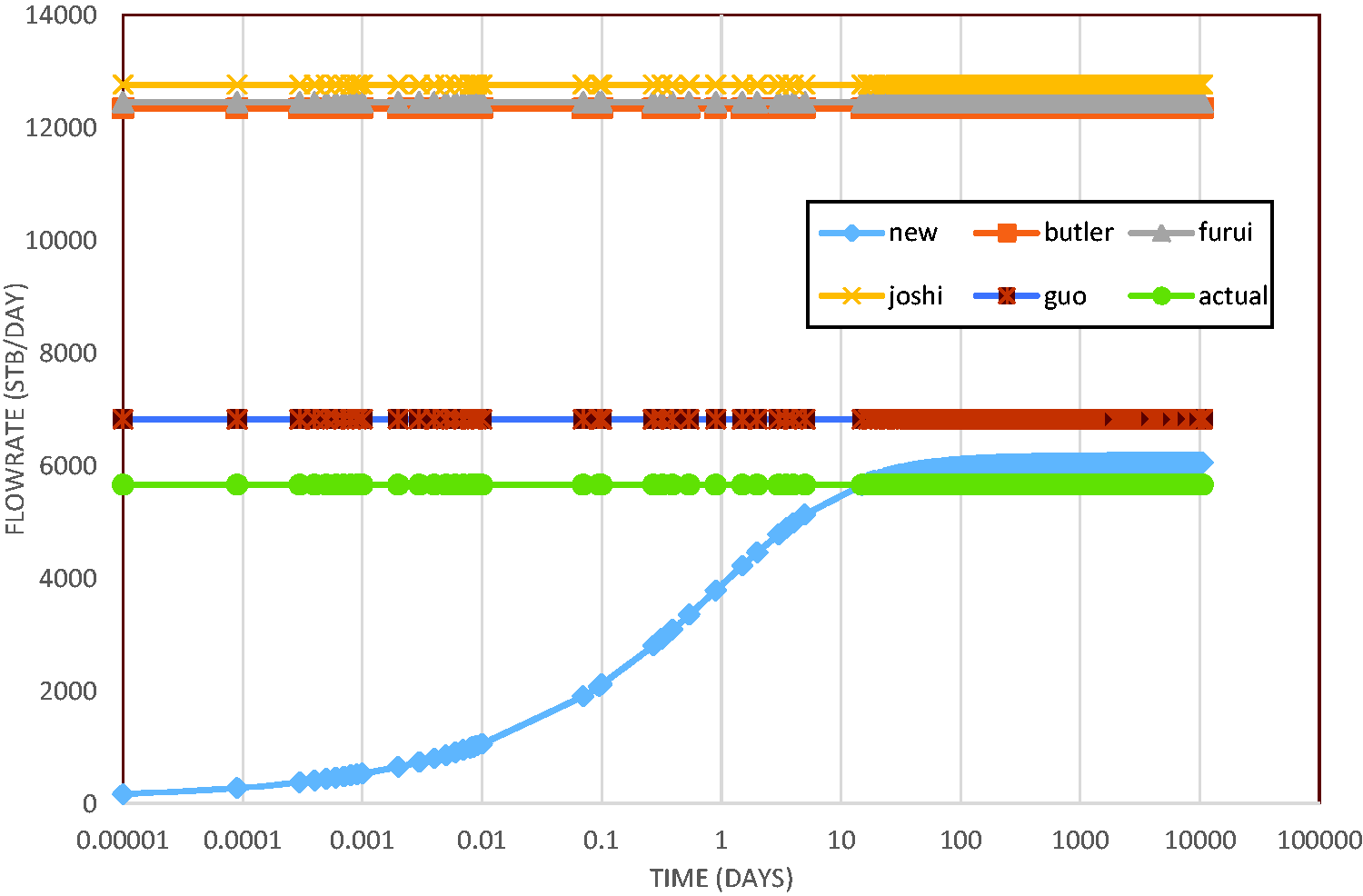
Flow rate calculated against time from existing models and the current model using actual field data for validation.
Figure 2 presents flowing pressure results at different production time and shows improvement over previous study as the initial unsteadiness experience in reality phenomena occurs at the onset of flow after shut-in in oil well was evident and assumptions previously neglected by previous studies were all considered.
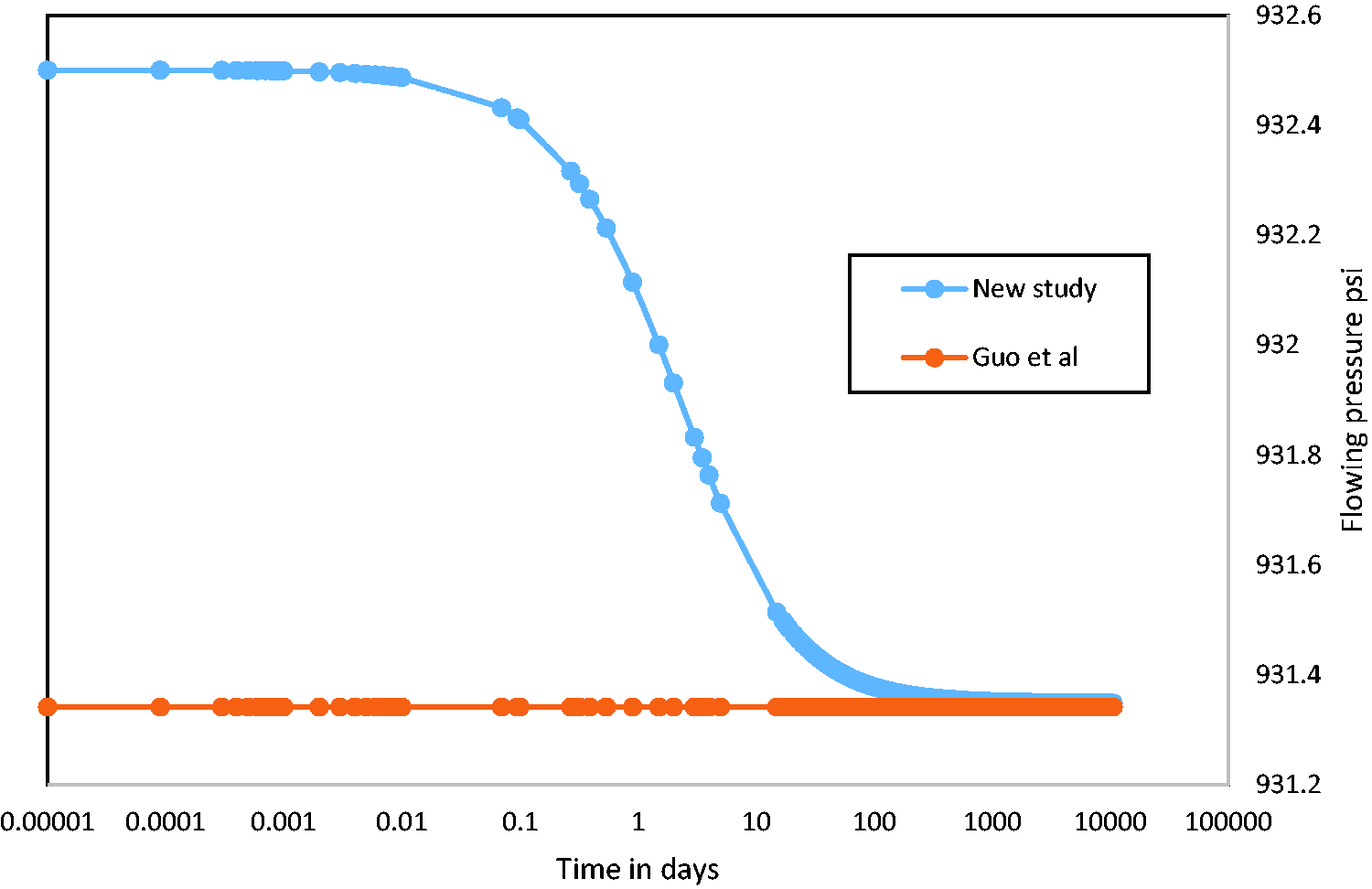
Flowing pressure against time calculated from past model and current model.
The modified concept gives functional relationship between flow rate and pressure transverse at any point in flowing well at any given production time as reported in Figures 3 and 4, respectively. Figures 3 and 4 have demonstrated high initial unsteadiness at the early of production time due to possible pressure losses encountered in long horizontal section of drain hole and decline gradually to match up the Guo et al. (2007) result as production time increases. This implies well bore pressure loss induced by accumulation term and kinetic term are responsible for higher unsteadiness experienced at the beginning of production and continue till approximately 21 days (504 h) where the flow becomes stabilize hence catch up with the Guo et al. (2007) that only considered losses due to friction. The study suggests that the huge pressure drop surge associated with initial unsteadiness encounter at the early flow of fluid after shut-in should be incorporated as a key factor during material design of production tubing and pipe to avoiding high pressure induced burst.
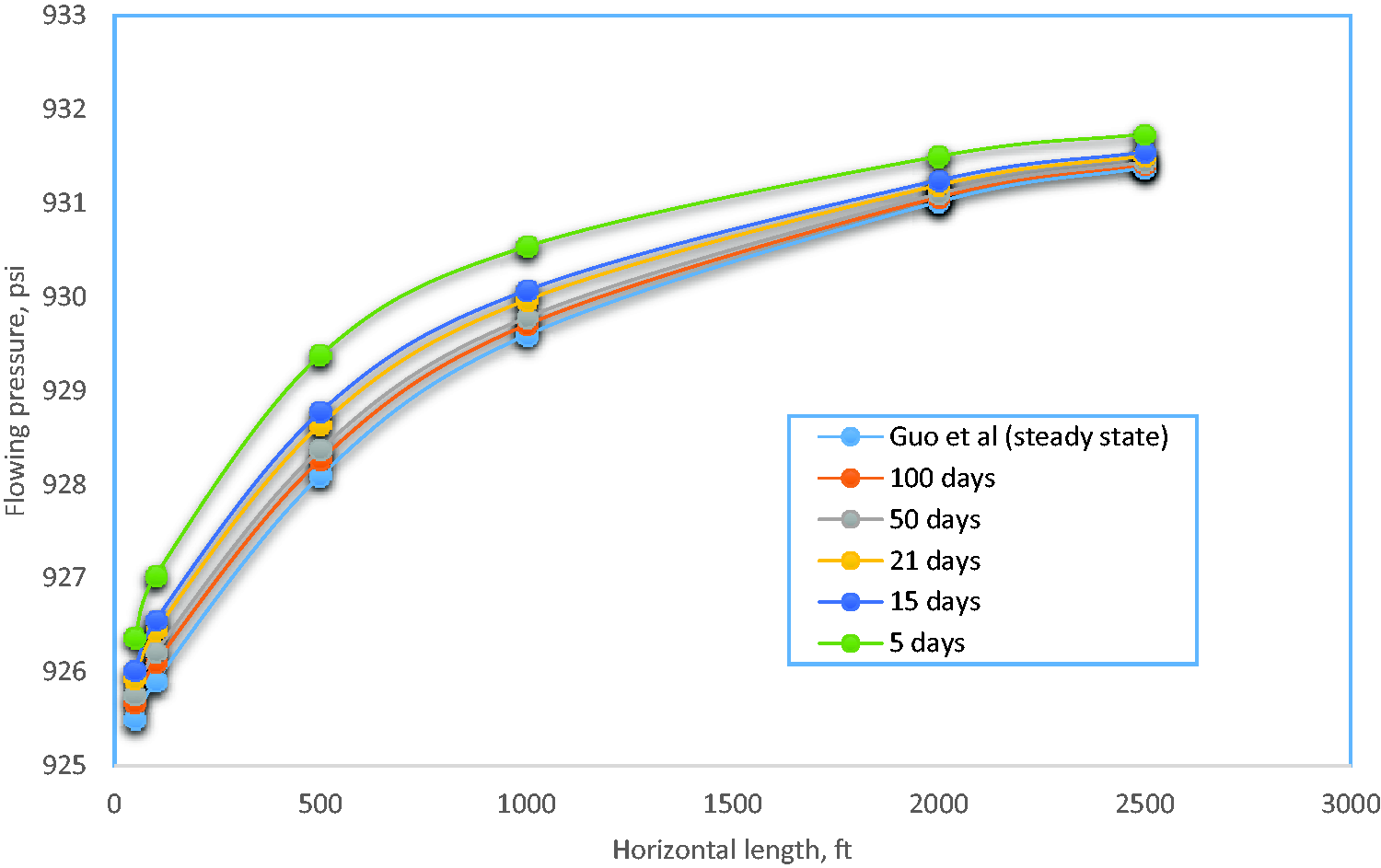
Shows flowing pressure against horizontal length at production time compared with past model at steady state.
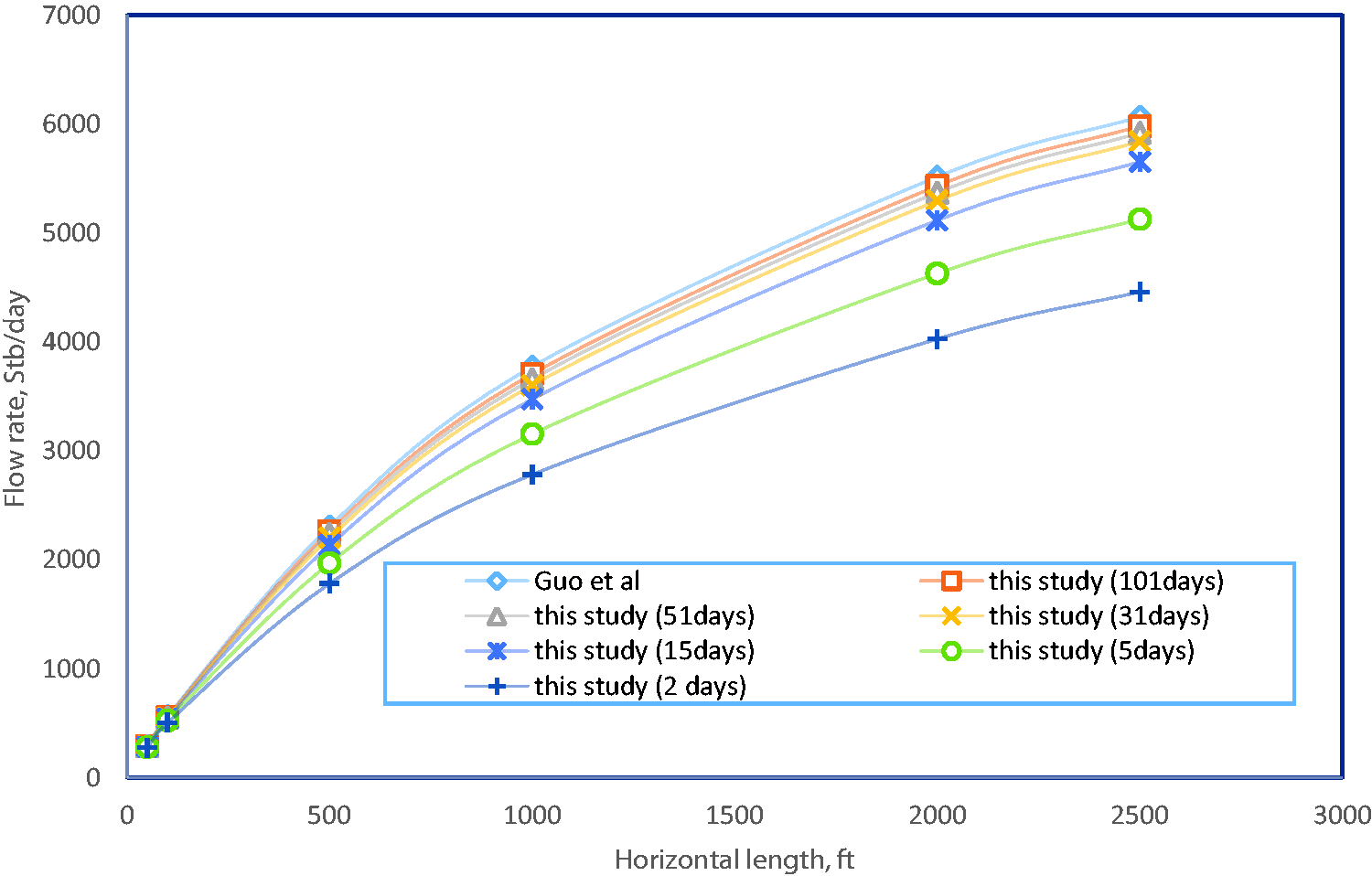
Shows flow rate against horizontal length at production time compared with past model at steady state.
Conclusion
The newly developed model for predicting flow rate in horizontal drain hole has revealed that the early available models for this purpose can only be valid for short horizontal drain hole where accumulation and kinetic induced restriction are negligible. The new study presents an exact model that includes essential restriction terms that were previously neglected by the past investigators. Huge discrepancies obtained when compared the past models with the actual field value measured indicate that optimum field development and economic analysis are difficult to achieve using the existing models. The following conclusions can be deduced based on sample field scenario investigated using the newly developed model.
The new model can be used to simulate the flow rate for long horizontal oil well and established functional relationship that produced the most accurate result that gives percentage error of 1.61% compared with previously developed models of Joshi, Butler, Furui et al. and Guo et al. steady state models that reported percentage errors of 123.49, 118.11, 119.96, and 20.54, respectively, in their literature using the real life value reported in Guo et al. (2007) as the benchmark.
The results obtained from the newly developed model are practically represented as the initial unsteadiness phenomena experience in real life was clearly demonstrated at the onset of flow after shut-in in a long horizontal well.
This study gives an improvement over previous investigations as the vital assumptions previously neglected by previous studies on flow rate for long horizontal well were all considered. However further validation with experimental and field results that showcase the transient flow behavior is recommended to ascertain the accuracy of the improved model at the transient flow region.
The study suggests to the completion engineer that the huge pressure drop surge associated with initial unsteadiness encounter at the early flow of fluid after shut-in should be considered as a key factor during the material design of production tubing and pipe. This enable the proper management of risk associated with high pressure induced burst that may occur at the onset of fluid flow under high pressure-high temperature condition.
Limitation
This study was based on the assumption of single-phase flow, hence the new model can only be valid for horizontal oil well production system. The version of this study that is valid for horizontal gas production system has been reported in previous work done by Fadairo et al. (2019). Further research need to be done to accommodate horizontal multiphase production system and to demonstrate the effect of flow regime on the horizontal well performance.
Footnotes
Declaration of conflicting interests
The author(s) declared no potential conflicts of interest with respect to the research, authorship, and/or publication of this article.
Funding
The author(s) received no financial support for the research, authorship, and/or publication of this article.

Appendix 1. Comparison of mathematical models with field data
The outcome of the study have established functional relationship that produced more realistic and accurate models that gives percentage error of 1.61 compared with previously developed Joshi, Butler, Furui et al. and Guo et al. models that reported percentage errors of 123.49, 118.11, 119.96 and 20.54 respectively in their literature using the real life value as the benchmark.