




Abstract
The glutenite reservoir rock of the fan delta facies is associated with a complex sedimentary environment and high heterogeneity, and by far the characteristics and controlling factors of the reservoir rock quality have not been well understood. By comprehensively investigating the lithofacies, petrology, physical properties and diagenesis of the Upper Wuerhe Formation of the Mahu Sag, the Junggar Basin, it is concluded that the Upper Wuerhe Formation develops three major groups of lithofacies, totally consisting of 11 sub-types, and reservoir rock properties of different lithofacies are greatly varied. This research shows that the lithofacies attributed to the tractive current and density current have well-sorted rock particles, low mud content, well-developed secondary dissolved pores, and thus high overall reservoir rock quality. On the contrary, the lithofacies based on debris flow and sheet flow, are observed with high mud content, suppressed development of intergranular and dissolved pores, and thus poor reservoir rock quality. The system tract controls the macro variation of the reservoir rock quality. The best quality is found in the highstand system tract, followed by those of the lake transgression and at last lowstand system tracts. The micro variation of the reservoir rock quality is determined by the mud content, rock particle size and dissolution. The muddy matrix mainly damages the pore connectivity, and presents the strongest correlation with permeability. The reservoir rock with concentrated particle sizes and well-sorted particles has quality better than those of reservoir rocks composed of excessively large or small particles. Dissolution effectively improves the storage capability of the reservoir rock, resulting in an average porosity increment by 4.2%.
Introduction
The research on fan deltas was originated from Gilbert (1886), who studied the sedimentary characteristics of Pleistocene lacustrine deltas in Lake Bonneville and proposed an example of coarse-grained deltas with a three-fold structure. Barrell (1912, 1913, 1914) studied the sedimentary characteristics of the Catskill Delta based on Gilbert’s description, and divided the top, fore and bottom set beds. The study results set off a research boom in coarse-grained deltas, which have been successfully applied in petroleum exploration. In 1934, the first glutenite oil field (Tupungaton oil field) was discovered in the Cuyo Basin of Argentina (Urien, 2001). From 1948 to 1968, the United States discovered the Garfield glutenite oil field in the Kansas Uplift, the McArthur River and Prudhoe Bay glutenite oil fields in the Cook Inlet Basin (Rogers, 2007). In 1953, the Pembina glutenite oil field was discovered in the Western Basin of Canada (Krausc et al., 1986). From 1955 to 2012, China discovered Karamay, Shuanghe, Yanjia, Shanshan, Mahu and other glutenite oil fields (Tang et al., 2018).
Holmes (1965) proposed the concept of fan delta based on previous research and oil exploration. Fan delta, of which sediments are provided by the alluvial fan at the adjacent higher land, is a clastic sedimentary body formed above or under water at the basin margin. According to the correlation between the lake basin space volume and provenance supply during deposition, fan deltas can be divided into the retrogradational, progradational, and Gilbert types (Nemec, 1990; Wescott and Ethridge Fg, 1990). During deposition of the retrogradational fan delta, the lake basin is experiencing transgression and resultant expansion. sediments retrograde from the basin center to the basin margin, with radial size shrinkage of fan bodies and upward fining of grains (Bull, 1972; Heward, 1978; Liu et al., 2014). The structural classification and reservoir characteristics of fan delta glutenite are complex. Folk (1980) called glutenite with gravel content greater than 30% as conglomerate. Cant and Ethier (1984) classified glutenite into three types according to the supporting structure: including unimodal grain structure conglomerate (lack of matrix), bimodal grain supported conglomerate (matrix is medium-fine sandstone), and bimodal sandy supporting conglomerate. Hu (1986) believed that the distribution of glutenite reservoirs is characterized by clusters and belts. From the perspective of fluid dynamics, Middleton and Hampton (1973) believes that glutenite deposits are developed in debris flow and turbidity, while Walker (1975) believes that glutenite deposits have multiple causes such as debris flow, flood current, turbidity, tractive current, etc. However, the cause of fluid dynamics and the criteria for discrimination are still controversial.
Retrogradational fan delta-based glutenite deposition develops in the Upper Wuerhe Formation in the Mahu Sag, the Junggar Basin (Tang et al., 2018). Extensive studies have been carried out, regarding the macroscopic sedimentary pattern and regularity of hydrocarbon accumulation for such sedimentary facies. First, during deposition of the Upper Wuerhe Formation, the peripheral ancient mountains was continuously uplifted, which, together with the palaeogeographic setting of a large gentle slope for the sedimentary area, constituted an excellent sediment source-sink system (Zhu et al., 2013). Second, this set of glutenite deposition presents apparent differences of rock and interstitial material compositions between the above- and under-water environments (Meng et al., 2017; Zhang et al., 2009, 2010). Third, the oil reservoir types are various, including thick low-abundance lithologic oil reservoirs, interbedding lithologic oil reservoirs, and “sand-in-mud” thin lithologic oil reservoirs (Du et al., 2019; Zhi et al., 2018). At last, the complex sedimentary characteristics lead to obscure seismic response features of these glutenite reservoir rocks, and thus high difficulties in predicting and high solution multiplicity of prediction results (Cai et al., 2017; Li et al., 2019). The aforementioned research findings are mainly related to the macroscopic characteristics and sedimentary pattern of the glutenite reservoir rocks. This paper, on the basis of the sedimentary environment, probes deep into the microscopic characteristics, formation mechanisms, and macro and micro controlling factors of reservoir rock quality for the glutenite reservoir, via investigation of lithofacies, petrology, physical properties and diagenesis. Findings of this research provide theoretical references for the high-quality glutenite reservoir rock prediction and favorable zone evaluation.
Geological setting
The Junggar Basin is one of the major petroliferous basins in the western China (Figure 1(a)). The Mahu Sag, with a long spreading axis along NE-SW and an area of about 5000 km2 (Figure 1(b)), is located in the westernmost part of the Central Depression, the Junggar Basin. The Mahu Sag is bounded by the Kebai and Wuxia fault zones on the west, by the Shiyingtan, Sangequan, Xiayan Uplifts and Yingxi Sag on the east, and against the Zhongguai and Dabasong Uplifts on the southwest and south (Kuang et al., 2014; Zhi et al., 2019; Zou et al., 2015) (Figure 1(c)).
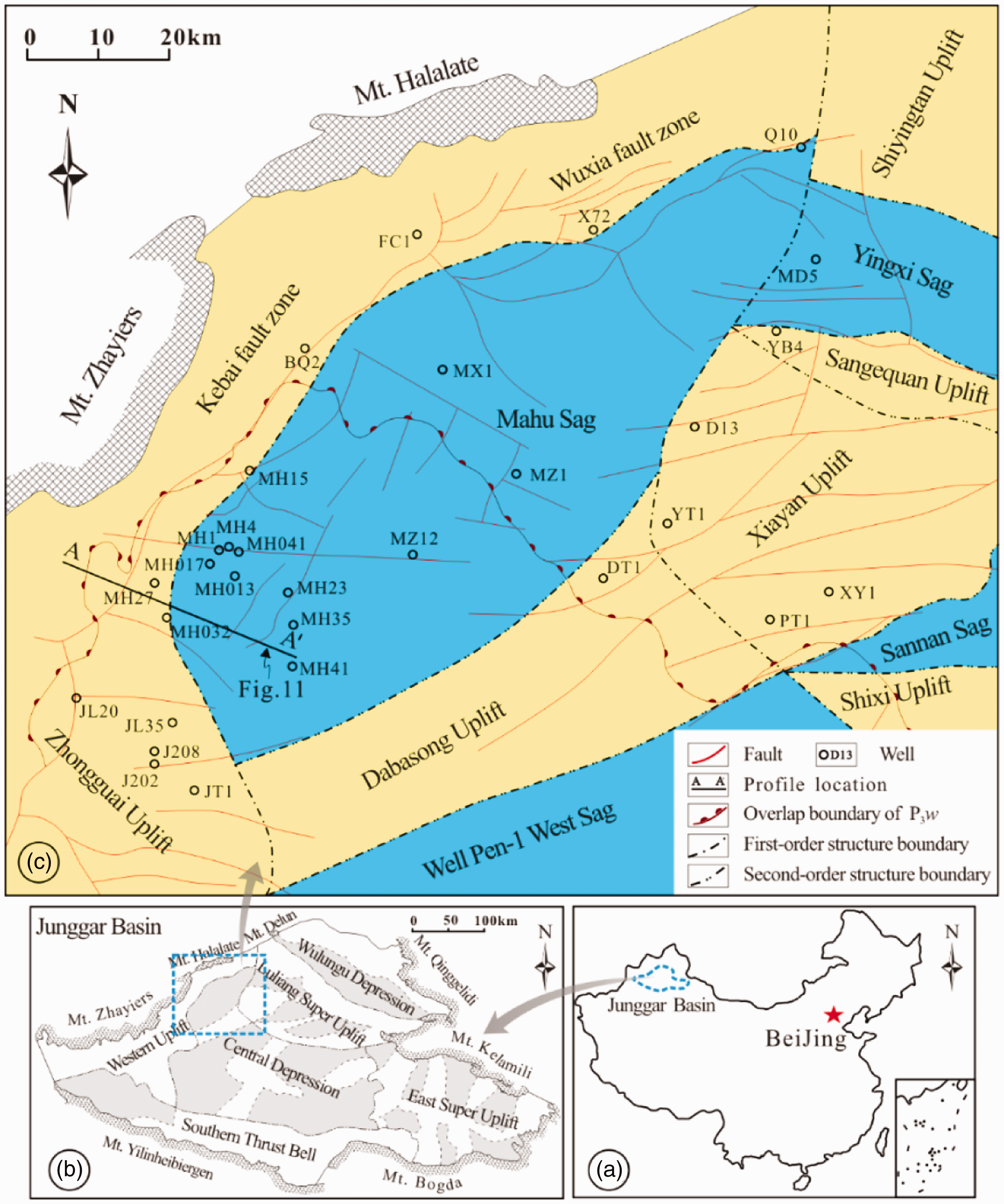
(a) Location of the Junggar Basin; (b) structural units of the Junggar Basin and location of the Mahu Sag; (c) structural units of the Mahu Sag and the pinch-out boundary of the Upper Wuerhe Formation overlap.
The Upper Wuerhe Formation develops in the southern and southwestern parts of the Mahu Sag (Figure 1(c)), overlapping the Lower Wuerhe Formation of the Permian from west to east. There are large unconformities between the Upper and Lower Wuerhe Formation as well as between the Upper Wuerhe and the Baikouquan Formation of the Triassic. In accordance with the principles of sequence stratigraphy, the Upper Wuerhe Formation is divided as three members (P3w1, P3w2, and P3w3) from bottom to top, representing the lowstand, lake transgression, and highstand system tracts respectively. The lithology is mainly composed of glutenite, pebbly sandstone, sandstone, muddy siltstone, and mudstone. Glutenite is mostly grey-brown and grey, while mudstone is mainly brown. The strata are upward fining with declining gravel contents, indicating the characteristics of retrogradational deposition of lake transgression (Figure 2).
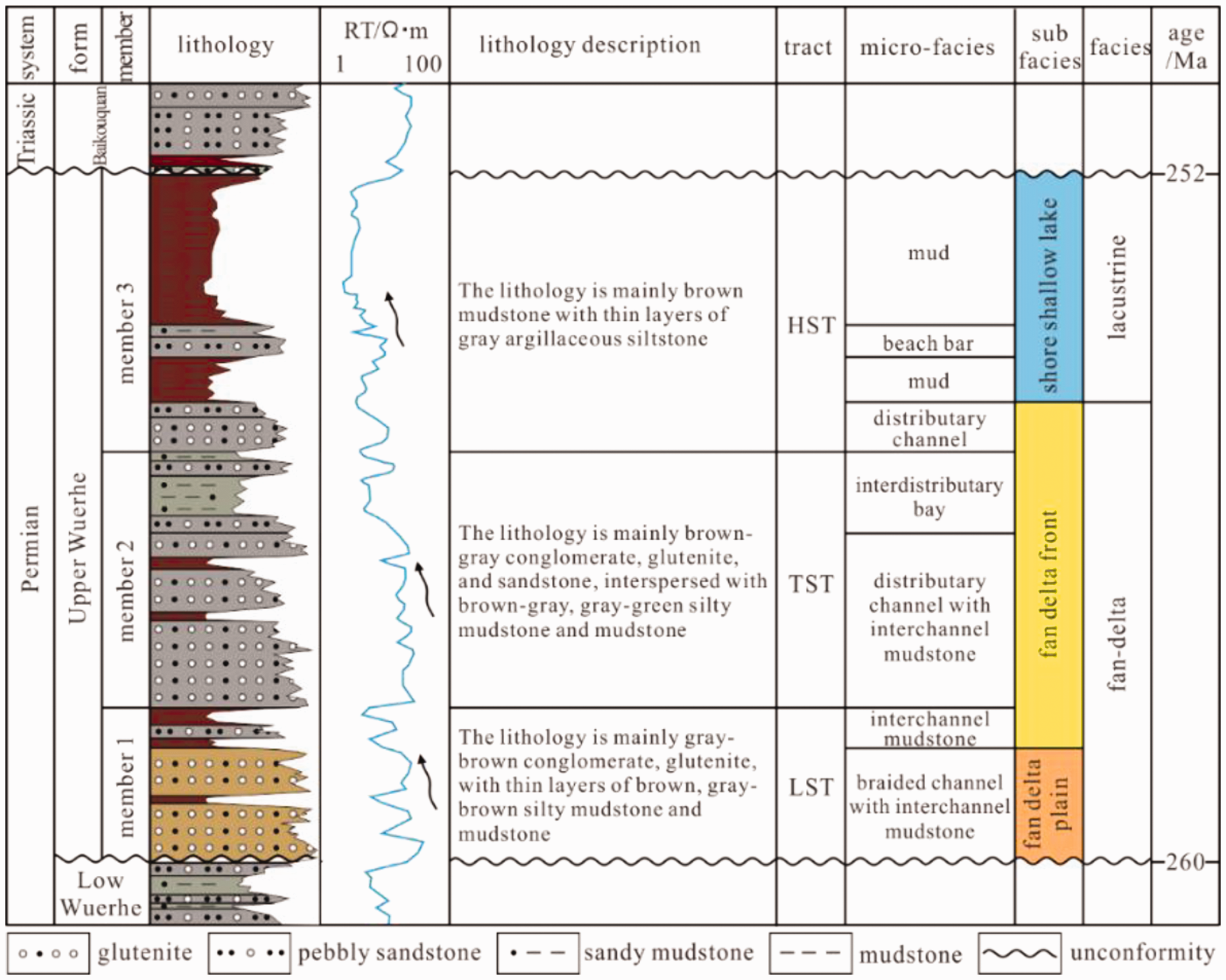
Sequence stratigraphic framework, lithology, system tract and sedimentary facies characteristics of the Upper Wuerhe Formation of the Mahu Sag.
The Upper Wuerhe Formation develops the fan delta and lacustrine facies from bottom to top. The fan delta can be divided into the fan delta plain and front sub-facies, and further sub-divided into the braided channel, inter-channel mudstone micro facies of the fan delta plain, and the distributary channel, inter-distributary channel bay, and inter-channel mudstone micro facies of the fan delta front. As for the lacustrine facies, it is mainly composed of the shore-shallow lake mudstone, with some beach-bar sand micro facies (Ablimit et al., 2016; Yu et al., 2020) (Figure 2).
Samples and methods
Data used in this research mainly originate from the drilling data of the Mahu Sag, the Junggar Basin, by courtesy of the Xinjiang oilfield, CNPC. Core samples from 26 wells, with total length of 160 m, were observed and described. Porosity and permeability measurements of 843 core samples; 1073 micrographs of the casting thin sections of 326 core samples; 684 scanning electron microscopy (SEM) photos of 89 core samples; X-ray diffraction (XRD) analysis data of 76 samples were collected.
The core porosity and permeability were analyzed using AP-608 Core Measurement system with a confining pressure of 6 MPa.
Casting thin sections were prepared by vacuum impregnation with blue-dyed epoxy resin and stained with Alizarin Red S to facilitate recognition of carbonate cements. Through thin section observations, the detrital mineralogy, grain sizes and pore types were determined.
SEM analyses was conducted to characterize the diagenetic relationships, authigenic clay mineral characteristics, and pore structures. SEM observation was conducted using a FEI Quanta 400 FEG scanning electron microscope.
The relative abundances of the clay minerals were determined by XRD analysis. All selected samples were analyzed with an X'Pert Pro X-ray diffractometer with Cu-Kα radiation, which was operated at 200 mA and 40 kV. After the samples were air-dried, saturated with glycol and heated at 500°C for 2.5 h, the samples were ready for XRD analysis.
Results
Lithofacies types
Lithofacies refers to the rock or rock association formed in a specific sedimentary environment, representing hydrodynamic variation during deposition (Oluwadebi et al., 2018; Sfidari et al., 2019). According to the observed mud content, grain size, support pattern, and sedimentary texture and conclusions of previous studies (Jia et al., 2017; Miall, 1977; Yu et al., 2014), the lithofacies of the Upper Wuerhe Formation is divided into three major types, consisting of 11 subordinate types.
Conglomerate lithofacies
Conglomerate lithofacies is the most-developed lithofacies type in the Upper Wuerhe Formation, accounting for more than 50% of the total formation thickness. It mainly presents itself as matrix- or grain- supported gravel clastic (Lu et al., 2012). Conglomerate includes the fine- and middle- grained conglomerate. The sedimentary texture is mainly observed as the blocky texture, trough cross bedding, and graded bedding (Figure 3).
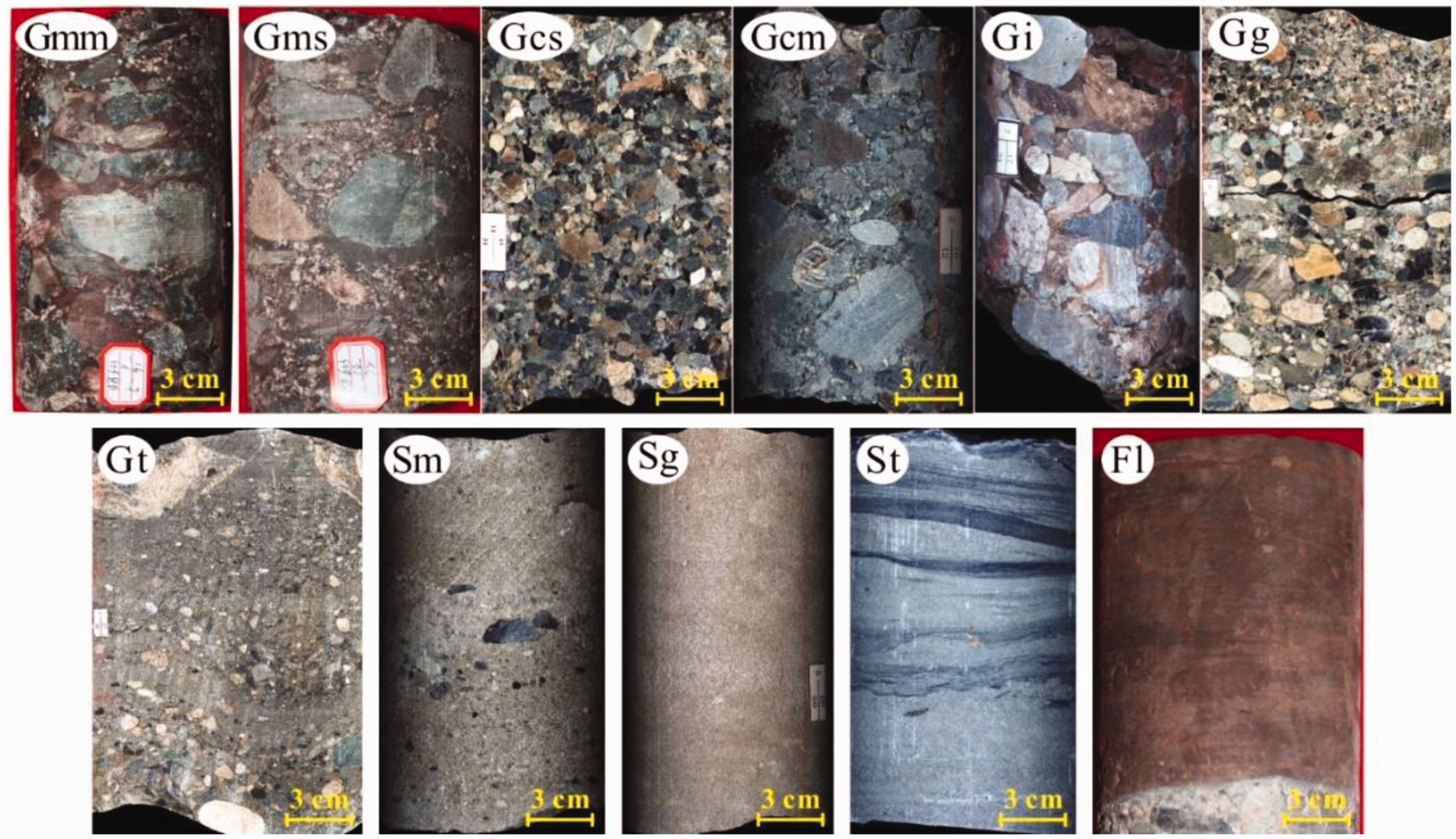
Photos of core samples of varied lithofacies of the Upper Wuerhe Formation in the Mahu Sag.
Matrix-supported conglomerate lithofacies (Gm)
Such lithofacies is often blocky, and can be divided into the muddy (Gmm) and sandy (Gms) matrix-supported conglomerate lithofacies, according to types of matrix. The muddy matrix-supported conglomerate lithofacies is of debris flow deposition with high mud content (Davis et al., 2009). Mudstone is generally brown or red-brown, gravels with varied sizes are suspended in the mudstone matrix, and the long axis of gravels is typically parallel to bedding. The sandy matrix-supported lithofacies is of sand-rich debris flow deposition of sands serving as interstitial materials, and composed of sediments of above-water or underwater fluvial channel facies of the fan delta, representing strong hydrodynamics. Sandstone is grey-brown or grey, with gravels suspended among sandy particles. The long axis of gravels mostly obliquely intersects the bedding plane.
Grain-supported conglomerate lithofacies (Gc)
According to degrees of grain sorting, the grain-supported conglomerate lithofacies can be sub-divided into the uniformly-graded and multi-graded grain-supported conglomerate lithofacies. The former is of the tractive current deposition of the underwater distributary fluvial channel, with well sorted and rounded gravels, and generally occurs in the mid-upper part of the sedimentary sequence. The latter is seen with large variation of gravel sizes, with fine gravels and sandy contents filling among mid-coarse gravels, and is mainly of the flood current deposition of the fan delta plain (Mahmic et al., 2018), primarily presenting itself as a thick blocky texture.
Conglomerate facies with oriented gravel arrangement (Gi)
This lithofacies consists of the sandy matrix and well sorted and rounded imbricate gravels, and is typical representation of the underwater distributary fluvial channel deposition of the fan delta front. Gravels are seen with layered or imbricate oriented arrangement, with a relatively concentrated range of particle diameters. The lithofacies is dominated by fine-grained conglomerate.
Conglomerate facies with graded bedding (Gg)
This lithofacies, one of the main lithofacies types in the study area, is composed of multiple successions of normal-grading conglomerate or glutenite stacking over each other. It is mainly of intermittent flood deposition, generally occurring in the mid-upper parts of the fan delta plain and the front fluvial channel.
Conglomerate facies with trough cross bedding (Gt)
This lithofacies, mostly sandy matrix-supported, is primarily composed of middle- and fine- grained conglomerate with medium sorting. Gravels are seen with trough-like arrangement, and erosion and cutting are observed among gravels. This lithofacies is formed by sediments in the mid-lower part of the underwater distributary channel of the fan delta front, representing strong hydrodynamics.
Sandstone lithofacies
The sandstone lithofacies of the Upper Wuerhe Formation in the Mahu Sag is found with limited distribution range and thickness. It mainly occurs in the distal area and late stage of deposition of the fan delta system (Meng et al., 2017), accounting for about 20% of the total thickness (Figure 3).
Massive (blocky) pebbly sandstone facies (Sm)
This lithofacies is composed of coarse- and middle- grained sandstones, with a small quantity of gravels. The sandstone is found with good sorting and high roundness of particles, while the long axis of gravels is nearly parallel to the bedding plane. It represents high-density turbidite deposition of the fan delta front with strong hydrodynamics, and is one of the major reservoir rock types in the study area.
Sandstone lithofacies with graded bedding (Sg)
This lithofacies, mostly grey with normal grading (upward fining), consists of fine- and coarse- grained sandstone. Rock particles are well sorted and rounded. It is the embodiment of deposition at the mid-upper part of the underwater distributary fluvial channel of the fan delta front.
Sandstone lithofacies with trough cross bedding (St)
This lithofacies, mainly composed of grey sandstone, develops with trough cross bedding and poor particle sorting. It is of the deposition of the underwater distributary fluvial channel of the fan delta front, with relatively strong hydrodynamics.
Mudstone lithofacies (Fl)
A succession of brown or grey-brown mudstone occurs at the top of the Upper Wuerhe Formation in the Mahu Sag, and serves as an effective cap rock to assist hydrocarbon accumulation (Yang et al., 2016). This mudstone often contains a small quantities of siltstone and sandstone, and occasionally gravels. It generally presents itself as a blocky texture, and represents the process of the fan delta sedimentary system being modified by the oscillating lake transgression (Figure 3).
Petrologic characteristics
In terms of rock types, the Upper Wuerhe Formation of the Mahu Sag includes conglomerate, glutenite, pebbly sandstone, etc. The rocks are mainly grey and brown-grey. The glutenite is composed of the volcanic lithics (tuff, felsite, granite, and andesite), quartz, feldspar, metamorphic lithics and sedimentary lithics (Figure 4(a)). The average volumetric fraction of tuff lithics exceeds 50%.
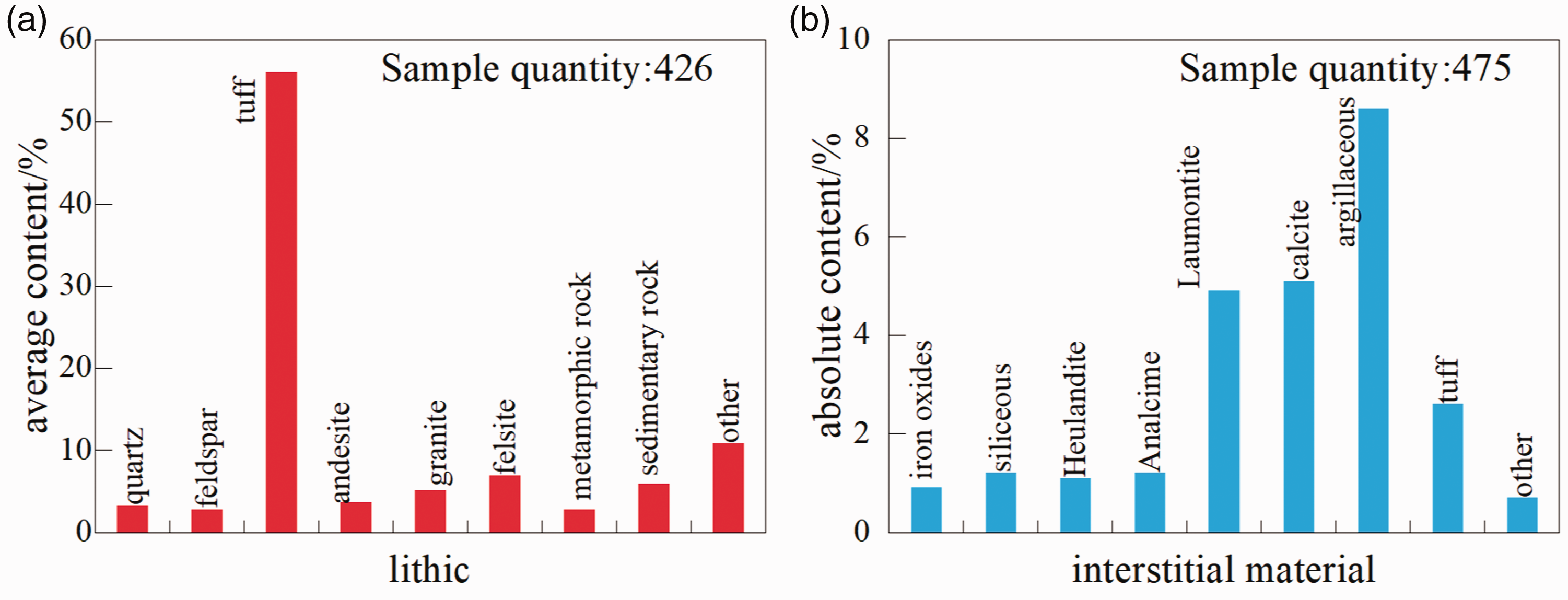
Histograms of lithic (a) and interstitial (b) content of the Upper Wuerhe Formation in the Mahu Sag.
The interstitial material includes cements and matrix (Figure 4(b)). Cements are zeolites, calcite, and siliceous and tuffaceous substances, among which soluble cements such as laumontite, calcite, tuffaceous substances, and analcite are seen with high concentrations, providing the material basis for later dissolution-based modification of reservoir rocks. The matrix is mainly argillaceous, accounting for a volumetric fraction of about 8%, and regarded as one of the main reasons for massive loss of primary intergranular pores and deterioration of pore connectivity (Chen et al., 2016).
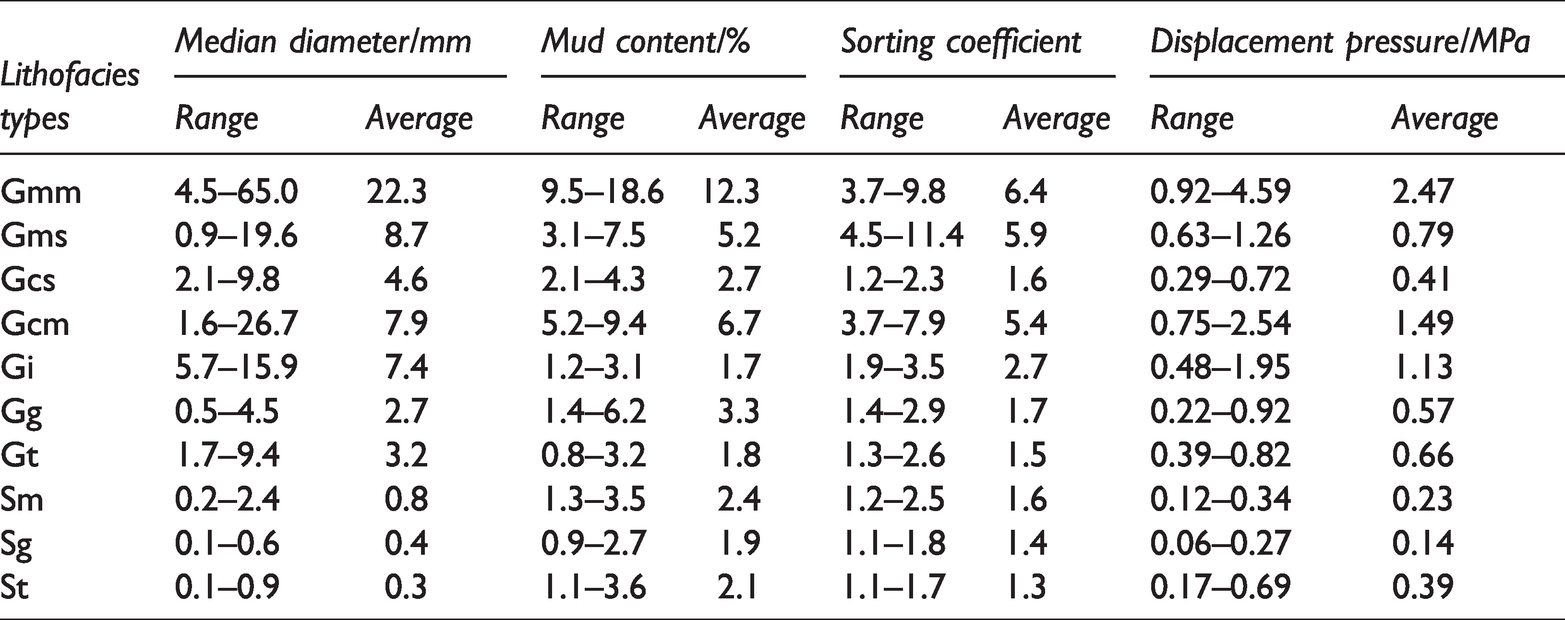
Lithofacies occurring in the glutenite sedimentary system of the fan delta are seen with multiple origins, and rock textures of different lithofacies are considerably different (Table 1). The rock texture attributed to the tractive current and high-density turbidite deposition is generally good, with the low mud content (a volumetric fraction lower than 2.5%), the concentrated range of particle diameters (less than 10.0 mm), good sorting (a sorting coefficient below 2.0), and a low displacement pressure (below 0.5 MPa). On the contrary, the rock texture based on the debris flow and flood deposition is, in most cases, inferior, with the high mud content (a volumetric fraction beyond 3%), an expanded range of particle sizes (1.5–65.0 mm), poor sorting (sorting coefficients averaging 1.5–6.4) and a high displacement pressure (above 0.5 MPa).
Rock texture parameters for different lithofacies of the Upper Wuerhe Formation in the Mahu Sag.
Characteristics of physical properties
Porosity of the Upper Wuerhe Formation is mainly of 6.0–15.0%, averaging 8.3% and following the normal distribution (Figure 5(a)). Permeability ranges from 0.02 mD to 100.00 mD, with an average of 2.15 mD, and two peaks occur at 0.08 and 1.94 mD respectively, in terms of its distribution (Figure 5(b)); 53% of the tested samples (270 samples) have permeability lower than 1.20 mD, and 36% (184 samples) have permeability between 1.20 and 10.00 mD, which demonstrate that the Upper Wuerhe reservoir rock is mostly low-permeability. On an overall basis, the reservoir rock of interest is low-porosity and low-permeability.
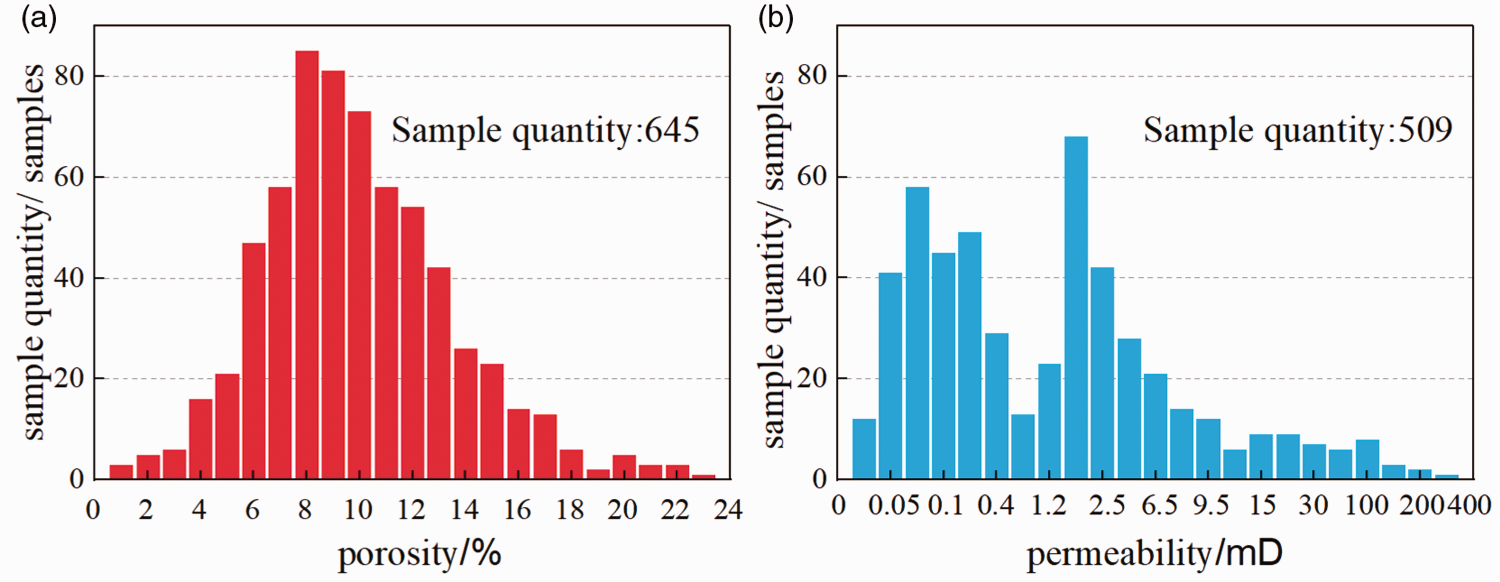
Histograms of porosity (a) and permeability (b) of the Upper Wuerhe Formation in the Mahu Sag.
Statistics of physical properties of different lithofacies show that the blocky, sandy matrix-supported conglomerate and sandstone lithofacies, mainly attributed to tractive current deposition, have higher porosity and permeability (Figure 6). Specifically, the sandstone lithofacies with graded bedding, massive pebbly sandstone lithofacies, conglomerate lithofacies with graded bedding, uniformly-graded particle-supported conglomerate lithofacies, and sandy matrix-supported conglomerate lithofacies are associated with the optimal physical properties, with average porosity of 7.2–11.4% and permeability of 1.34–29.85 mD. They are the main lithofacies types contributing the high-quality reservoir rock of the Upper Wuerhe Formation.
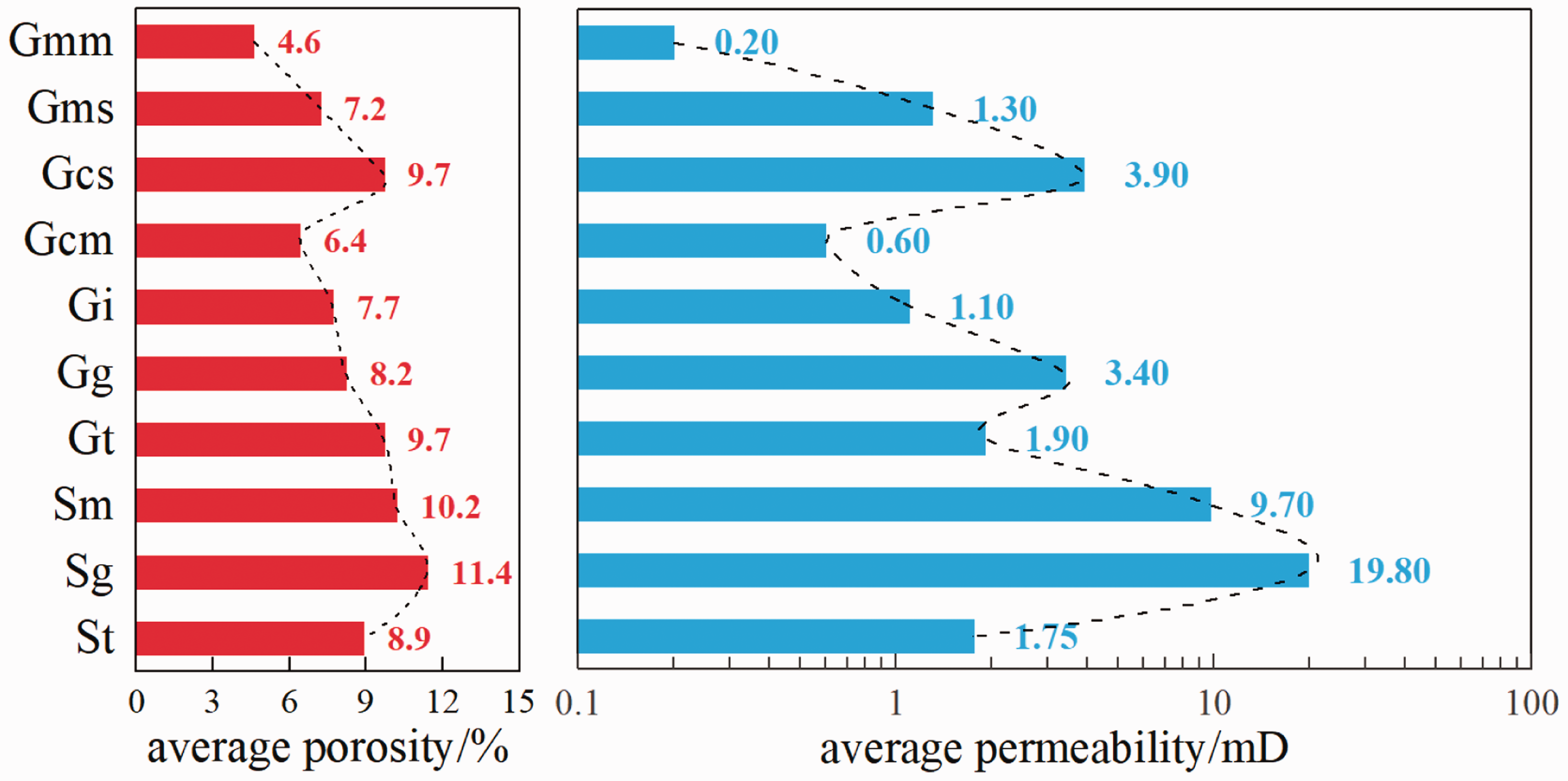
Characteristics of porosity and permeability for different lithofacies of the Upper Wuerhe Formation in the Mahu Sag.
Diagenesis
The diagenetic effects upon reservoir rock quality can be productive or destructive (Salama et al., 2018; Yu et al., 2015). Productive processes include early formation of chlorite films on particle surfaces, dissolution, and crushing of rigid particles during compaction, while destructive processes can be grouped into compaction and cementation (Qian et al., 2018; Xu et al., 2020; Yan et al., 2020).
Compaction
The casting thin section observation reveals that the contact types of clastic particles of the glutenite reservoir of the Upper Wuerhe Formation are dominated by the point-line contacts (Figure 7(a)), with some line-convex/concave contacts or suture line contact (Figure 7(b)). Then, the compaction intensity Cl (equation (1)) of the reservoir rock can be calculated using equation (1) (Shi et al., 2015)


Compaction features of the glutenite reservoir rock, observed using a microscope. (a) point-point and line-line contacts of particles, blue casting thin section, plane-polarized light, MH017 well, 3497.31 m; (b) line-line and concave/convex contacts of particles, blue casting thin section, plane-polarized light, MH23 well, 3641.29 m; (c) crushing of rigid particles, blue casting thin section, plane-polarized light, MH032 well, 3456.06 m; (d) crushing of rigid particles, blue casting thin section, plane-polarized light, MH15 well, 3812.15 m.
In general, Cl of 1.0–1.5 represents weak compaction; 1.5–2.5, medium compaction; 2.5–3.5, strong compaction.
For the glutenite reservoir rock of the Upper Wuerhe Formation, Cl is of 1.5–3.0, indicating medium-strong compaction. Thus, it is concluded that compaction is the key driver to massive loss of primary pores of the reservoir rock.
In addition to tight packing of particles and loss of primary pores, compaction can also lead to structural fractures (Figures 7(c) and (d)), formed by crushing of rigid particles. These structural fractures can serve as pathways for later hydrocarbon charging and migration, and improve pore connectivity of the reservoir rock.
Cementation
The glutenite reservoir rock of the Upper Wuerhe Formation in the Mahu Sag is highly cemented, with various cements.
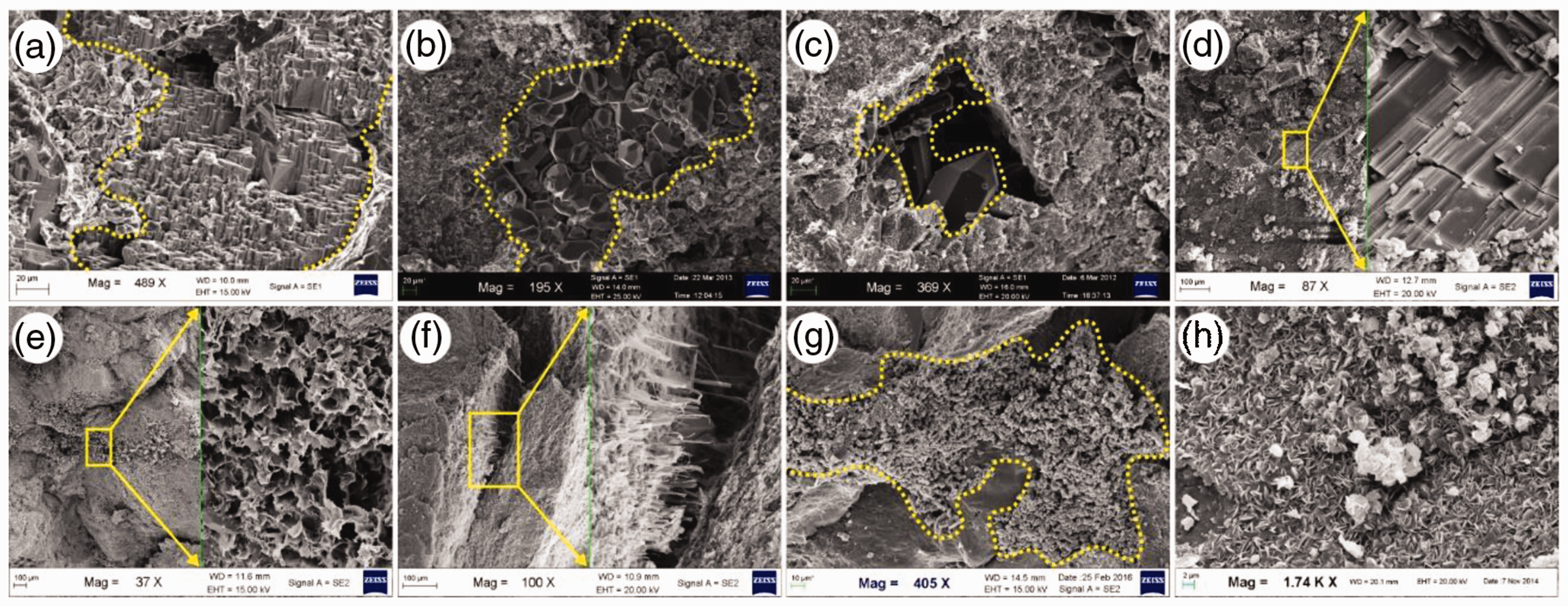
The carbonate cement is mainly calcite, often presenting itself in forms of imbedding, boundary lining, grains or overgrowth (Figure 8(a)).
SEM imaging of cementation features of the glutenite reservoir rock. (a) imbedded calcite cementation among particles, MH27 well, 3703.08 m; (b) authigenic quartz particles, J208 well, 4135.28 m; (c) authigenic quartz particles and drusy laumontite cementation, J202 well, 4066.52 m; (d) drusy laumontite cementation, MH35 well, MH35 well, 4711.00 m; (e) celullar illite/smectite mixed layer cementation, MH23 well, 4288.50 m; (f) silk-sheet illite cementation, MH013 well, 3649.52 m; (g) vermicular kaolinite cementation, JL20 well, 2703.24 m; (h) leaf-shaped chlorite cementation, MH4 well, 3299.11 m. The siliceous cement occurs on the surface of the intergranular pore at the clastic particle boundary or in the intragranular dissolved pore of the clastic particle (Figure 8(b) and (c)). The glutenite reservoir rock of the Upper Wuerhe Formation has low compositional maturity and low content of quartz, with no quartz overgrowth. The authigenic clay minerals include zeolite cements among particles in the complete drusy form (Figure 8(d)), cellular or pseudo-celullar illite/smectite mixed layer on the particle surface (Figure 8(e)), silk-sheet and bridging illite among particles (Figure 8(f)), vermicular and book-like kaolinite (Figure 8(g)), and leaf-shaped chlorite on the particle surface (Figure 8(h)).
With respect to reservoir rock quality, cements, which fill the primary intergranular pore, are mostly harmful. However, some soluble cements, such as carbonate and zeolite cements, can also provide a material basis for the subsequent dissolution process. The chlorite film, early formed on the particle surface, can resist the normal compaction, and preserve some primary pores. Therefore, cementation has a dual role (both destructive and productive) in reservoir rock evolution.
Dissolution
The glutenite reservoir rock of the Upper Wuerhe Formation commonly experience dissolution, which happens to unstable particles such as lithics and feldspar, and cements such as calcite, zeolite, and siliceous substances.
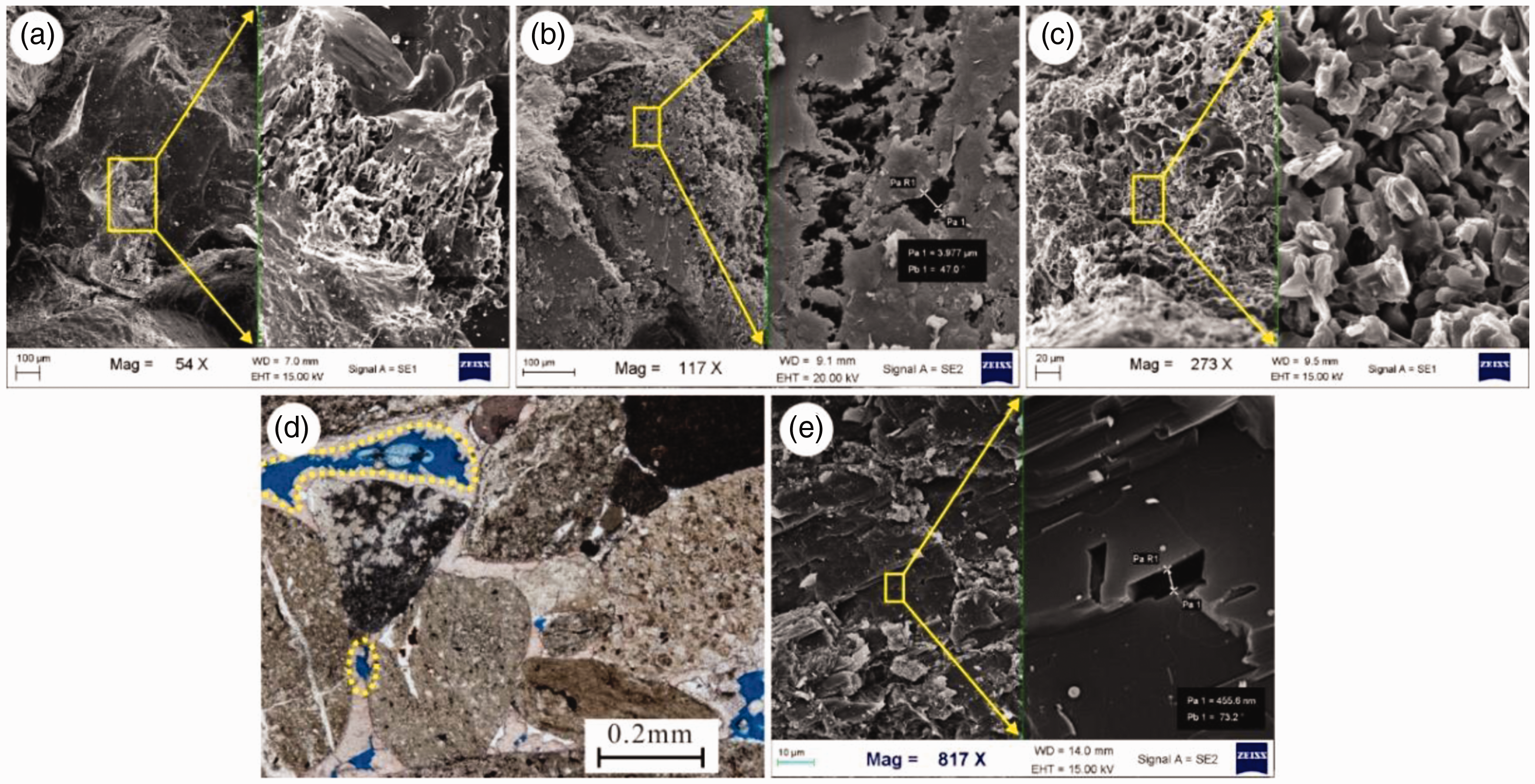
Lithic particle dissolution. Gravels are mainly composed of volcanic lithics (mainly tuffaceous), which provides the material basis for coming into being of secondary dissolved pores. Dissolution occurs on the particle surface or inside the particle, leaving strip-like, patch-like or cellular dissolved pores (Figure 9(a)).
Micrographs of dissolution features of the glutenite reservoir rock. (a) intergranular pores of volcanic lithics, SEM, MH27 well, 3070.92 m; (b) intragranular pores of feldspar, SEM, MH401 well, 3382.65 m; (c) inter-crystal pores attributed to felspar alteration, SEM, MH27 well, 3043.27 m; (d) calcite dissolved pores, blue casting thin section, plane-polarized light, MH032 well, 3495.35 m; (e) laumontite dissolved pores, SEM, MH41 well, 3826.50 m. Feldspar dissolution often occurs along the cleavage plane or boundary of feldspar and produces dissolved pores (Figure 9(b)). Alternatively, feldspar can be altered into kaolinite, which creates inter-crystal pores (Figure 9(c)). Cement dissolution. Calcite and laumontite formed by cementation can be dissolved by acid pore fluids, which creates new intergranular dissolved pores or inter-crystal pores (Figures 9(d) and (e)).
Stages of diagenetic evolution
According to SY/T 5477-2003 The Division of Diagenetic Stages in Clastic Rocks (Lei et al., 2020) together with the particle contact relationship, pore development characteristics, authigenic mineral types, and fluid inclusion thermometry, diagenetic stages were divided (Ma et al., 2019) (Figure 10). Our research shows that the glutenite reservoir rock of the Upper Wuerhe Formation is buried at 2000–5000 m, having experienced medium-strong compaction; rigid particles are tightly packed, with development of structural fractures; particles mainly present the point-to-point and line-to-line contacts, with no development of primary intergranular pores (Figure 7). Due to weakly acid formation water, the reservoir rock is extensively dissolved, with the pore type dominated by the secondary dissolved pore. Dissolution mainly happens to the carbonate and zeolite interstitial materials, volcanic clasts and feldspar (Figures 9 and 10). XRD analysis indicates that authigenic minerals include the illite/smectite mixed layer, kaolinite, chlorite, illite, calcite, quartz overgrowth particles and zeolites (Figure 8), and the relative content of smectite in the illite/smectite mixed layer is extremely low (with a volumetric fraction below 10%). The vitrinite reflectance Ro is of 1.38–1.90%, averaging 1.76%. Fluid inclusion thermometry demonstrates two stages of fluid activity, with the homogenization temperatures of 80–100°C and 110–120°C (Cao et al., 2006), respectively. To sum up, it is determined that the glutenite reservoir rock of the Upper Wuerhe Formation in the Mahu Sag stays at the medium diagenesis B stage.
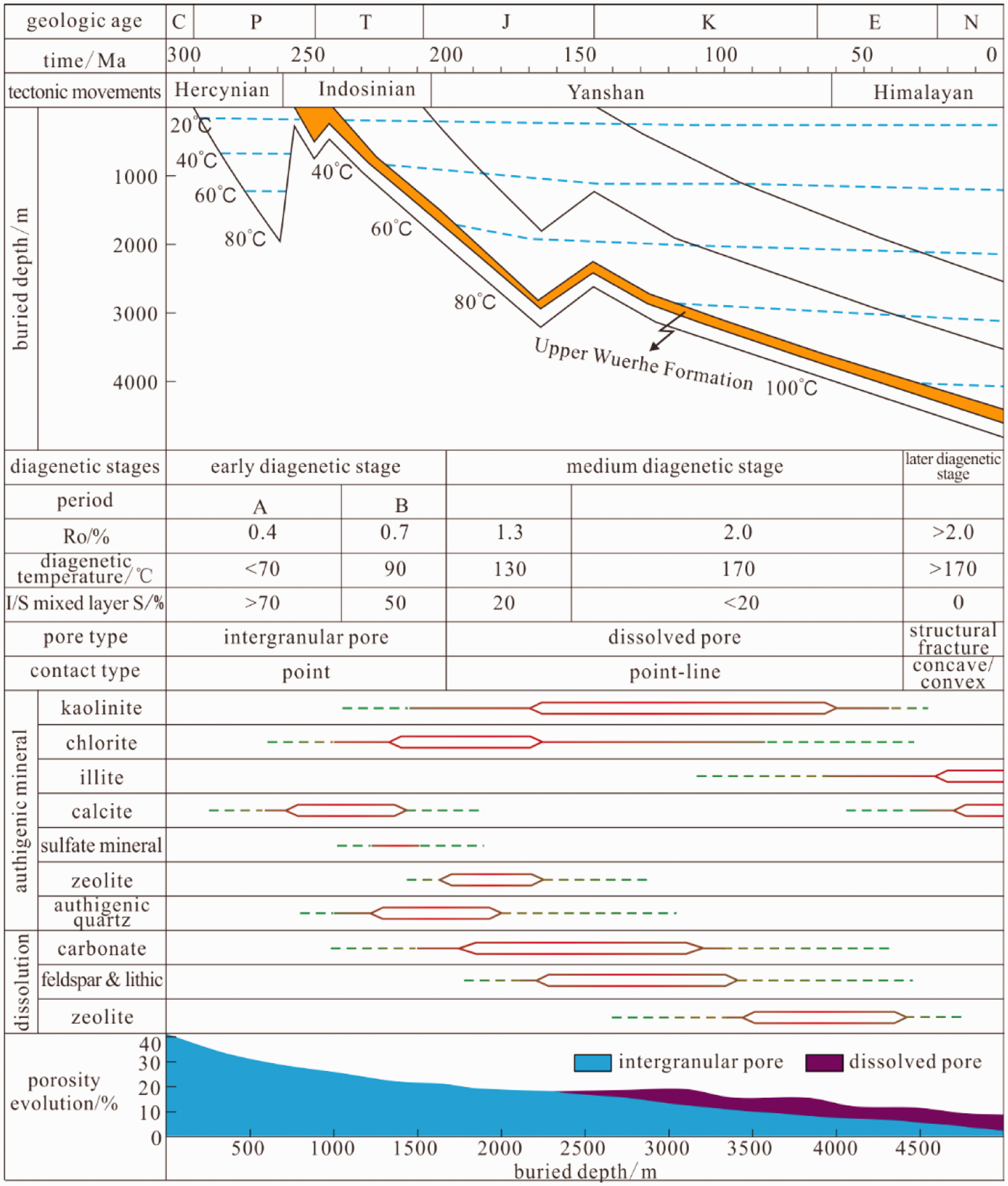
Diagenetic sequence and pore evolution characteristics of the Upper Wuerhe Formation in the Mahu Sag.
Discussion
The glutenite reservoir rock of the Upper Wuerhe Formation in the Mahu Sag develops in the fan delta sedimentary system (Yuan et al., 2017). The well-seismic analysis shows that the lowstand, lake-transgression, and highstand system tracts are developed in the Upper Wuerhe Formation, corresponding to the P3w1, P3w2, and P3w3 Members (Figure 2). The lithofacies types, petrologic characteristics and physical properties of varied sedimentary environment are obviously differentiated from each other. Moreover, modified via diagenesis, the current glutenite reservoir rock shows high heterogeneity.
Macroscopic control factors for the quality of different lithofacies reservoirs
Sedimentary environment is the macroscopic control factor for the quality of different lithofacies reservoirs.
The muddy matrix-supported and multi-graded grain-supported conglomerate lithofacies are mainly deposited in the lowstand system tract (P3w1). During that period, the lake basin had a small area and shall water depth. The fan delta front occurred only below the lake surface at the deposition center, and the slope area develops a large-area fan delta plain. Due to the seasonal water flow, sediments rapidly accumulated in the low area to flatten the sediment level, and formed multiple blocky glutenite complexes with thickness of several tens of meters. The reservoir rock has high mud content, poor rock particle sorting, and no development of primary and dissolved pores. Such reservoir rocks are found with the worst quality, with average porosity of 6.9% and average permeability of 0.85 mD (Figure 11).
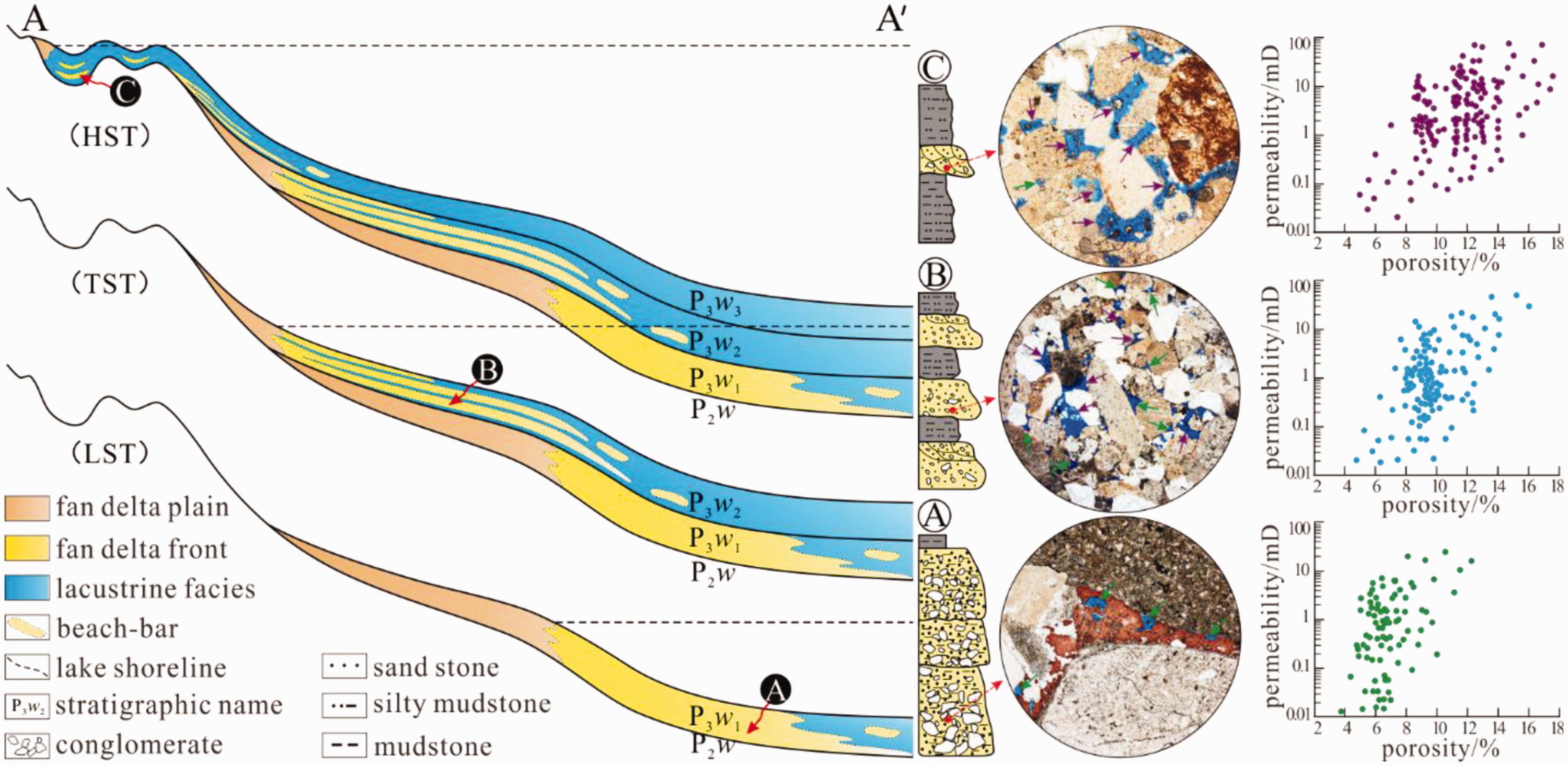
Reservoir rock quality for different sedimentary system tracts (see Figure 1 for the profile location).
The conglomerate lithofacies (including sandy matrix-supported, uniformly-graded grain-supported, oriented gravel arrangement, graded bedding, trough cross bedding)and sandstone lithofacies (including graded bedding, rough cross bedding) are mainly deposited in the lake transgression system tract (P3w2). During that period, expansion of lake transgression led to rapid retreating of the fan delta plain. With the tractive current, a series of lobate fan bodies of the fan delta front, stacking over each other, occurred in the slope zone. The reservoir rock is mainly of the underwater distributary fluvial channel micro facies. The reservoir rock presents relatively low mud content, good particle sorting, and extensive dissolution, with average porosity of 9.7% and average permeability of 2.35 mD (Figure 11). This reservoir rock is the major field for large-scale hydrocarbon exploration.
Mudstone lithofacies is mainly deposited in the highstand system tract (P3w3), which is a set of stable caprocks distributed throughout the region of the Upper Wuerhe Formation. These is only with lenticular reservoir rocks scattered in grooves of the paleo-geomorphological higher area. The developed lithofacies include the massive pebbly sandstone facies and the sandstone facies with graded bedding. The reservoir rock is seen with good sorting and high roundness of rock particles, extremely low mud content, and extensive secondary dissolved pores, with average porosity of 12.4% and average permeability of 6.94 mD (Figure 11). “Small and hydrocarbon-abundant” lithologic oil and reservoirs tend to form in such reservoir rocks.
Therefore, the conglomerate lithofacies and sandstone lithofacies deposited in the lake transgression and the highstand system tract have good reservoir quality, while the reservoir quality of the lowstand system tract is poor.
Microscopic control factors for the quality of different lithofacies reservoirs
Control of mud content on the quality of different lithofacies reservoirs
Porosity and permeability are both negatively correlated with the mud content (Figure 12), and the correlation between the mud content and permeability (R2 = 0.8672) is apparently higher than that between the mud content and porosity (R2 = 0.6664). With the declining mud content, permeability grows by increments up to an order of magnitude, which implies that the mud content has important effects upon the fluid flow capability of the glutenite reservoir rock. As shown in Figures 6 and 12, the mud content of sandstone lithofacies is generally lower than that of conglomerate lithofacies, while the quality of the reservoir is higher than the latter. However, higher quality reservoirs can still be developed in the conglomerate lithofacies with lower mud content, such as the uniformly-graded grain-supported conglomerate lithofacies and conglomerate facies with graded bedding.
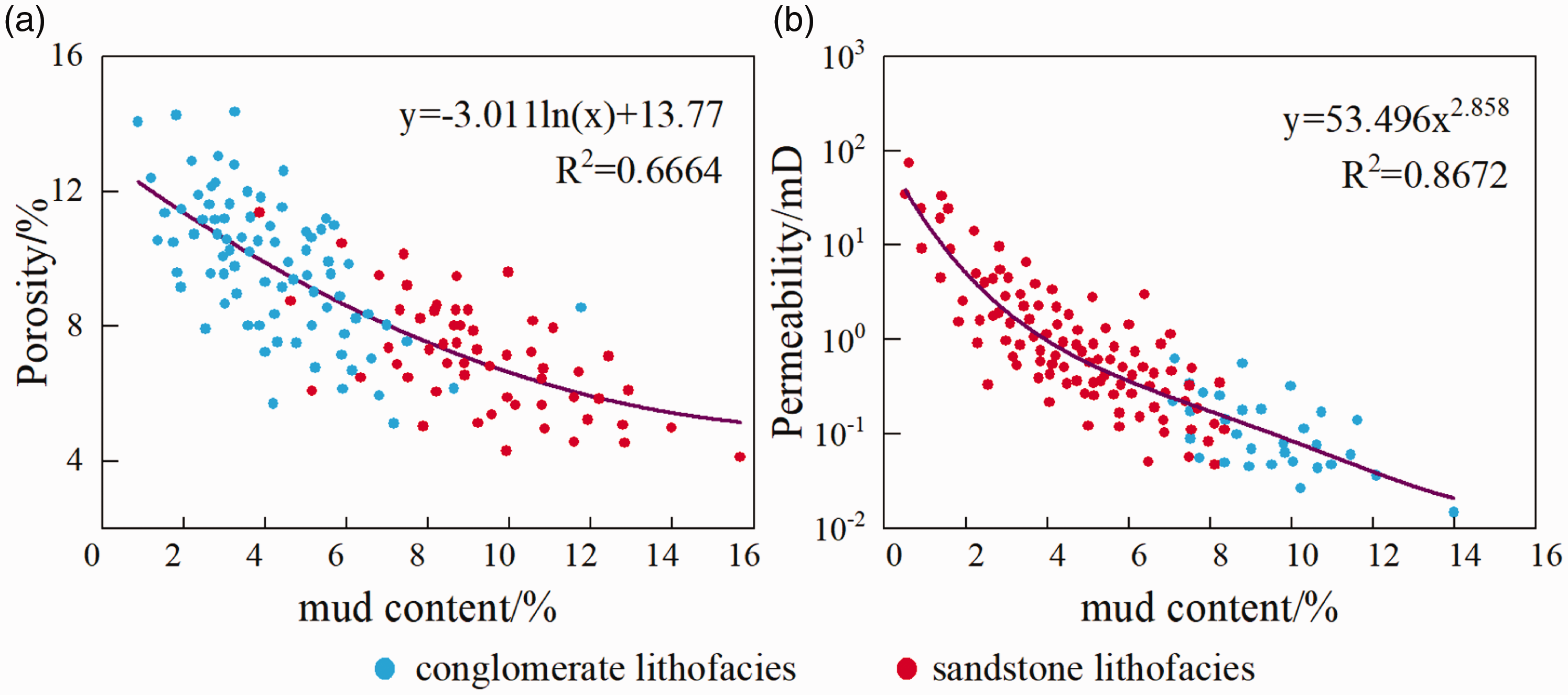
Mud content vs. porosity (a) and permeability (b).
Control of grain sizes on the quality of different lithofacies reservoirs
If other conditions are similar, excessively large or small particle sizes of reservoir rocks are both unfavorable for gaining good physical properties (Lien et al., 2006). Excessively large particles may lead to proneness of intergranular pores to filling of fine-grained sediments, as the cases of the muddy matrix-supported, and multi-graded particle-supported conglomerate facies. Also, rock particles may be too small to resist compaction, which results in tight packing and immense loss of intergranular pores.
Porosity and permeability of reservoir rocks with different particle sizes are cross-plotted (Figure 13). Clearly, the pebbly sandstone, middle- and fine- grained sandstones, coarse sandstone, and glutenite, with a relatively restrained range and small values of particle sizes, are found with higher porosity and permeability. As for the middle-grained conglomerate with excessively large particles, and siltstone with excessively small particles, the worst physical properties are observed.
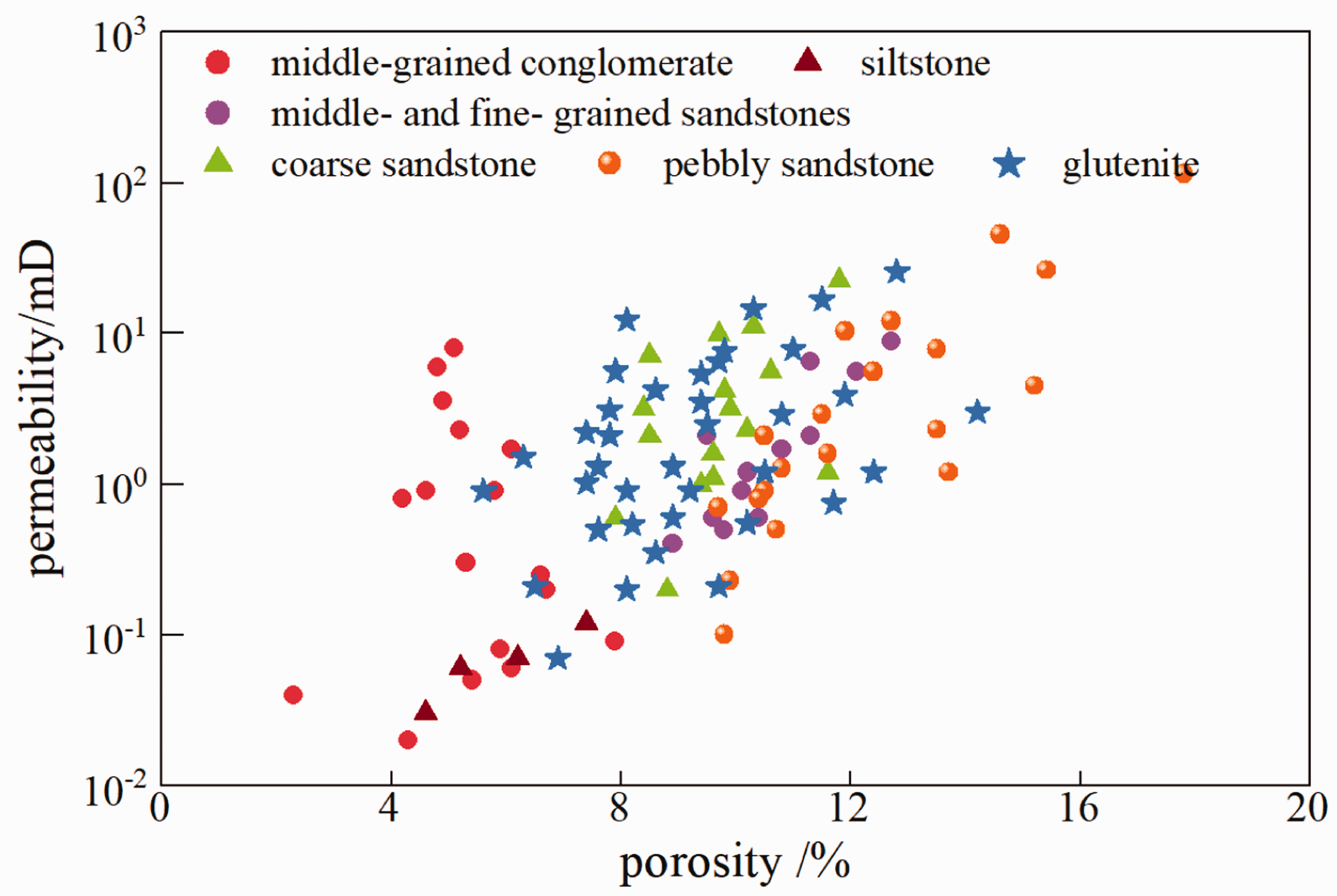
Porosity vs. permeability for rocks of different particle sizes.
Control of diagenesis on the quality of different lithofacies reservoirs
After mechanical compaction and cementation, massive loss of primary intergranular pores occurs in the glutenite reservoir rock, of which porosity considerably declines with the increasing depth. However, apparent porosity enhancement is observed at 2500–3800 m, where the evolution tendency of porosity deviates from the theoretical compaction trend. This suggests dissolution greatly improves the physical property of this section (Figure 14). Statistics on the cast thin sections (Figures 7 to 9) show that the dissolution of the uniformly-graded grain-supported (Gcs), graded bedding (Gg), trough cross bedding (Gt) conglomerate facies and sandstone lithofacies is developed. calculation of dissolution-based porosity increments φr (equation (2)) show that the dissolution-based porosity increment of the Upper Wuerhe Formation averages 4.2%.

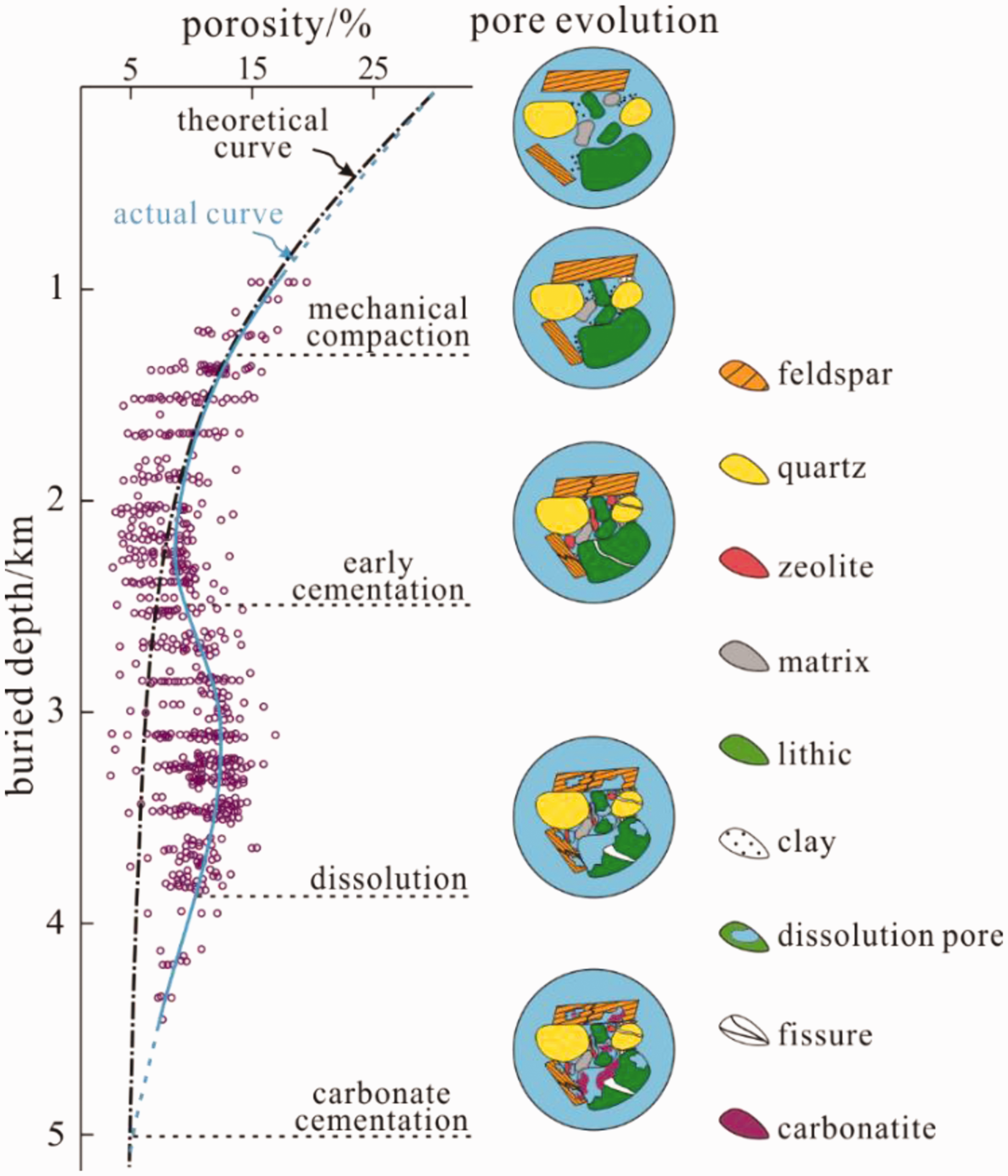
Porosity and pore evolution of the Upper Wuerhe Formation in the Mahu Sag.
Conclusions
The glutenite reservoir rock of the Upper Wuerhe Formation in the Mahu Sag, the Junggar Basin, occurs in the retrogradational fan delta system. The reservoir rock is generally found with poor quality. Controlled by the sedimentary environment, hydrodynamics, and diagenesis, the reservoir rocks of the sandstone facies with graded bedding, massive pebbly sandstone facies, conglomerate facies with graded bedding, uniformly-graded particle-supported conglomerate facies, and the sand matrix-supported conglomerate facies, have relatively good rock textures, low mud content, and extensive dissolved pores, thus with higher porosity and permeability.
Quality of the glutenite reservoir rock is under the joint control of macro and micro factors. The system tract decides the macro variation of the reservoir rock quality, which improves from the lowstand to highstand system tracts. The lake transgression system tract develops thick reservoir rocks with large distribution and overall good properties, and high-quality reservoir rocks locally occur in this system tract. Thus, it is the major field for oil and gas exploration. The micro variation of reservoir rocks is controlled by the mud content, rock particle size, and dissolution. Besides that the muddy matrix fills primary pores and greatly reduces the storage capacity of the reservoir rock, permeability is highly correlated to the mud content, and the muddy matrix can severely damage pore connectivity. The reservoir rock with good sorting of particles and a restrained range of particle sizes has physical properties better than those of reservoir rocks composed of excessively large or small particles. Tremendous dissolution of clastic particles, tuffaceous lithics, and carbonate and zeolite cements can effectively improve the reservoir rock quality.
Footnotes
Declaration of conflicting interests
The author(s) declared no potential conflicts of interest with respect to the research, authorship, and/or publication of this article.
Funding
The author(s) disclosed receipt of the following financial support for the research, authorship, and/or publication of this article: This study was financially supported by the National Natural Science Foundation of China (Grant Nos. 41872116).
