




Abstract
In order to solve the problem of difficult gas extraction in coal mine, a method of gas extraction from coal seam by interval hydraulic flushing is put forward. Based on the coal seam gas occurrence conditions of 7609 working face in Wuyang Coal Mine, the numerical simulation research on gas drainage by ordinary drilling and hydraulic flushing drilling was carried out by using COMSOL numerical simulation software. The results show that with the increase of hydraulic flushing coal quantity, the effective gas drainage radius also increases. The effective extraction radius of ordinary drilling is 0.5 m, and the effective extraction radius is 1.0 m, 1.2 m and 1.3 m respectively when the coal flushing quantity is 0.5t/m, 1.0t/m and 1.5t/m. As multiple boreholes are drained at the same time, the boreholes will affect each other, which will reduce the gas pressure and increase the effective drainage radius, the spacing between boreholes can be greater than twice the effective drainage radius of a single borehole when arranging boreholes. And the smaller the flushing interval, the more uniform the gas pressure reduction area. According to the numerical simulation results, the ordinary drilling and 1.0t/m interval hydraulic flushing test were carried out in the field. Through observation and analysis, the gas concentration of the interval hydraulic flushing drilling module was increased by 31.2% and the drainage purity was increased by 5.77 times compared with the ordinary drilling module. It shows that the interval hydraulic flushing drilling can effectively improve the gas drainage effect.
Keywords
Introduction
With the gradual deep mining of coal mines in China, the coal seams show the characteristics of high stress, high gas content and pressure. In the production process, coal and gas outbursts, gas explosions and other disasters easily occur, seriously threatening the personal safety of coal miners and the safe and efficient production of coal mines (Gonzatti et al., 2014; Hu et al., 2014; Xie et al., 2015; Wang et al., 2012, 2014). At the same time, mine gas is also a kind of clean energy and greenhouse gas, which will not only waste resources, but also cause environmental pollution (Bamberger, 2014; Petrow and Tanev, 2015). Therefore, it is necessary to control coal seam gas. The research shows that the extraction of coal seam gas can reduce the gas content and pressure of coal seam, reduce the possibility of coal and gas outburst and other disasters, and ensure the personal safety of underground workers; the use of extracted gas can increase the utilization rate of resources, reduce greenhouse gas emissions and protect the atmospheric environment (Hook and Tang, 2013; Wang and Cheng, 2012; Wang et al., 2012; Yan et al., 2015). However, more than 95% of high gas and coal and gas outburst mines in China are low permeability coal seams. Ordinary drilling is ineffective, needs more drilling holes, and has a long extraction period (Ge et al., 2014; Wang et al., 2015; Wei et al., 2016; Zhou et al., 2016). In order to solve these problems, many scholars have studied and put forward some methods to increase permeability and improve gas extraction effect, such as mining protective layer method, deep hole pre-splitting blasting method, floor roadway extraction method, carbon dioxide displacement method and so on (Li et al., 2015; Rodrigues et al., 2013; Yuan et al., 2011; Wang et al., 2008). These methods play a certain role in improving coal seam permeability, which is worth learning from, but they also have some shortcomings. Mining protective seam is an effective measure to control gas in multi-seam mines, but in a single coal seam, there are some problems such as high cost and slow advance speed, so this method is not suitable for a single coal seam (Cao et al., 2017). Deep hole pre-splitting blasting method has not fundamentally solved the charge parameters and sealing technology of long-hole blasting, and the examination and approval of explosives is difficult, transportation and storage are strictly controlled (Huo, 2015; Qin et al., 2017). The floor roadway extraction method has many problems, such as many drilling holes, high cost and difficult popularization (Cao et al., 2017). Carbon dioxide displacement technology is not suitable for deep mining of high gas and low permeability coal seams. There is still a risk of coal and gas outburst after using this method (Sobczyk, 2014).
With the introduction of high-pressure water jet technology, scholars at home and abroad have carried out in-depth research on coal seam permeability enhancement and outburst elimination, forming hydraulic slotting, pulse jet, hydraulic flushing and other technologies to improve coal seam permeability (Feng et al., 2015; Zou et al., 2016). Especially hydraulic flushing pressure relief and permeability enhancement technology has been widely used in coal mines because of its safe operation, simple process and fast outburst elimination speed, and has formed a set of theory, technology and evaluation methods (Li et al., 2016). Zhang et al. (2017) adopted the method of using different flushing diameters at different distances from the drilling site to solve the problems of low permeability and difficult gas extraction in soft coal seams. Gao et al. (2015) has studied the application of cross-measure boreholes of hydraulic flushing in high gas soft coal seam. It is found that the use of cross-measure boreholes of hydraulic flushing can reduce the number of boreholes and improve the speed of roadway excavation. The multi-factor coupling analysis of the effective radius of hydraulic flushing was carried out by Kong et al. (2016). It was found that the increase of one factor among the three influencing factors of gas pressure, permeability and flushing radius would limit the influence of other factors on the effective radius of hydraulic flushing, which has important guiding significance for improving the efficiency of hydraulic flushing extraction. Shen et al. (2018) used electromagnetic radiation method to evaluate the effect of cross-measure boreholes of hydraulic flushing. After cross-measure boreholes of hydraulic flushing, the stress release and permeability of coal seam increased significantly. Other studies have reached similar conclusions (Hao et al., 2014, 2015; Wang et al., 2013).
However, the predecessors mainly studied the application of hydraulic flushing in perforation drilling or tunneling face, while the research on gas extraction by hydraulic flushing in working face was less, and most of them were full-range hydraulic flushing. For this reason, this paper puts forward a construction technology of interval hydraulic flushing, which flushes coal seam every certain distance, and the flushing length is 1 m. It is applied to extract gas in working face with low gas pressure. Compared with the whole hydraulic flushing, it has the characteristics of small construction quantity (Figure. 1).
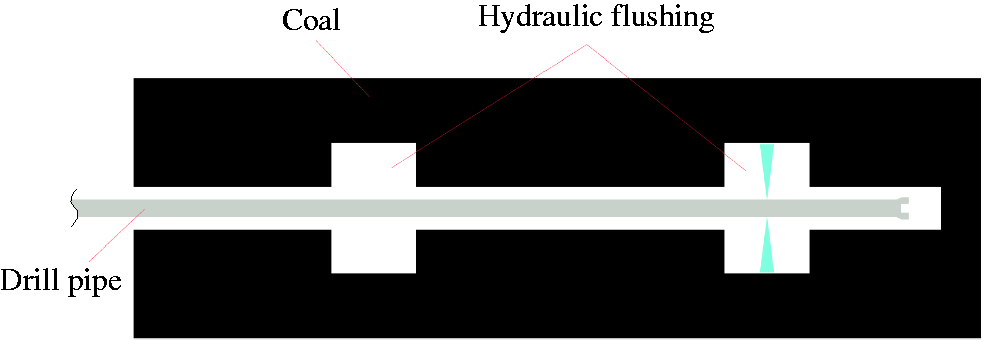
Diagram of interval hydraulic flushing.
Gas seepage equation of coal seam
The seepage equation of coal seam gas conforms to the law of conservation of mass

In the formula, m is the gas mass in the coal body containing gas per unit volume, kg/m3; ρg is the gas density, kg/m3; qg is the gas seepage velocity, m/s; Qm is the source sink term, kg/(m3·s).
Gas content of coal seam includes free gas content and adsorbed gas content. Free gas content can be calculated according to gas state equation (mallott's law) and adsorbed gas content can be calculated according to Langmuir’s equation.
Free gas content

In the formula, Xy is the free gas volume in the unit weight coal body, m3/t; V is the pore volume of the unit weight coal body, m3/t; P is the gas pressure of coal seam, MPa; T0 is the absolute temperature under the standard condition, 273 K; P0 is the pressure under the standard condition, 0.0103 MPa; T is the temperature of coal seam, K; ε is the gas compression coefficient.

In the formula, ϕ is the porosity of coal seam, %; ρc is the density of coal seam, t/m3.
Adsorbed gas content

In the formula, Xx is the volume of adsorbed gas in unit weight gas bearing coal, m3/t; a, b is the adsorption constant of coal mass, m3/t, MPa−1; A is the ash content of coal mass, %; W is the moisture content of coal mass, %; Ts is the temperature at which the adsorption constant of coal is tested in laboratory, K; n is the empirical coefficient.
When the laboratory test temperature is the same as the coal temperature, the adsorbed gas content can be converted into

Then the gas volume in the unit weight gas bearing coal seam

In the formula, X is the gas content of unit weight gas bearing coal seam, m3/t.
The gas volume in the unit weight gas bearing coal seam is converted into the gas mass in the unit volume gas bearing coal seam

In the formula, ρc is the density of coal mass, t/m3.
The gas is compressible, assuming that it is an ideal gas, then

In the formula, Mg is the relative molecular mass of gas, 16 g/mol; R is the ideal gas constant, 8.31451 J/(mol·K).
The flow of gas in coal is in accordance with Darcy’s Law

In the formula, K is the permeability of coal seam, m2; μ is the dynamic viscosity of gas, Pa·s.
The gas seepage equation of coal seam can be obtained by combining (1)–(3) and (5)–(9)

Geological conditions and construction technology
Geological conditions
Wuyang Coal Mine is located in Changzhi City, southern Shanxi Province. Its terrain is relatively flat, with the highest altitude +945.50 m and the lowest altitude +854.00 m. The main coal seams in the mining area are 3# and 5# coal seams, and the strike longwall mining method is adopted. The 7609 working face of Wuyang Coal Mine is located in 76 mining area. The main mining area is 3# coal seam. The thickness of coal seam is 4.69–6.34m, the average thickness is 6.0 m, the gas pressure of coal seam is 0.5 MPa, the permeability is 1.03
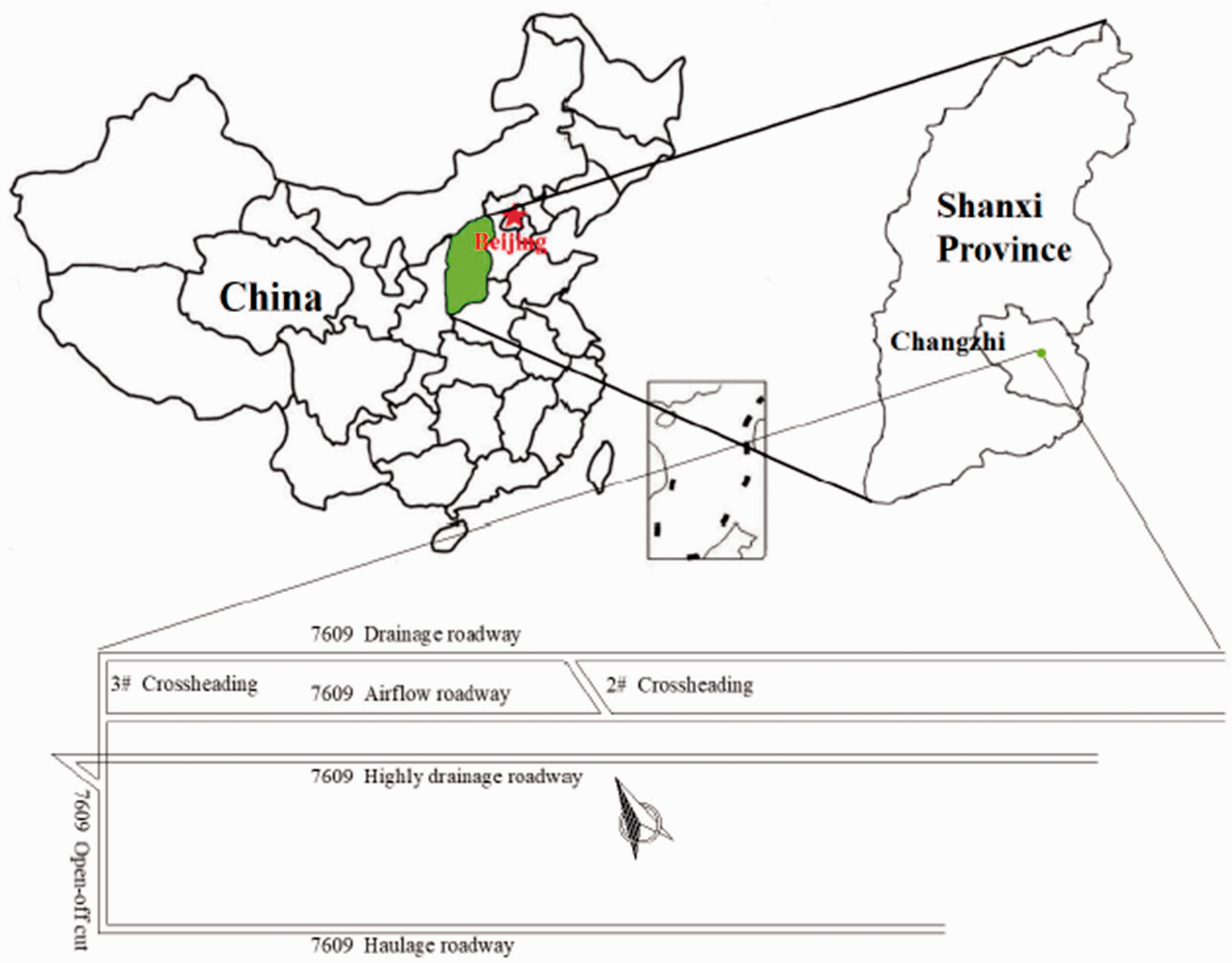
Location and working face layout of Wuyang coal mine.
Construction equipment and technology
Interval hydraulic flushing construction adopts integrated hydraulic flushing equipment, mainly including ZDY4500LXY crawler hydraulic drill for coal mine, BQWL200/31.5-XQ200/12 clean water pumping station, KFS-50/11 mine vibrating sieve solid-liquid separator and high-pressure sealed drill pipe (Figure 3). The drill bit uses a special hydraulic punching bit (Figure 4). Water pressure is 2 MPa in conventional drilling, and water is ejected from the drilling nozzle. When flushing is needed, the water pressure rises to about 20 MPa, the drilling nozzle closes, and water is ejected from the jet nozzle to flush.
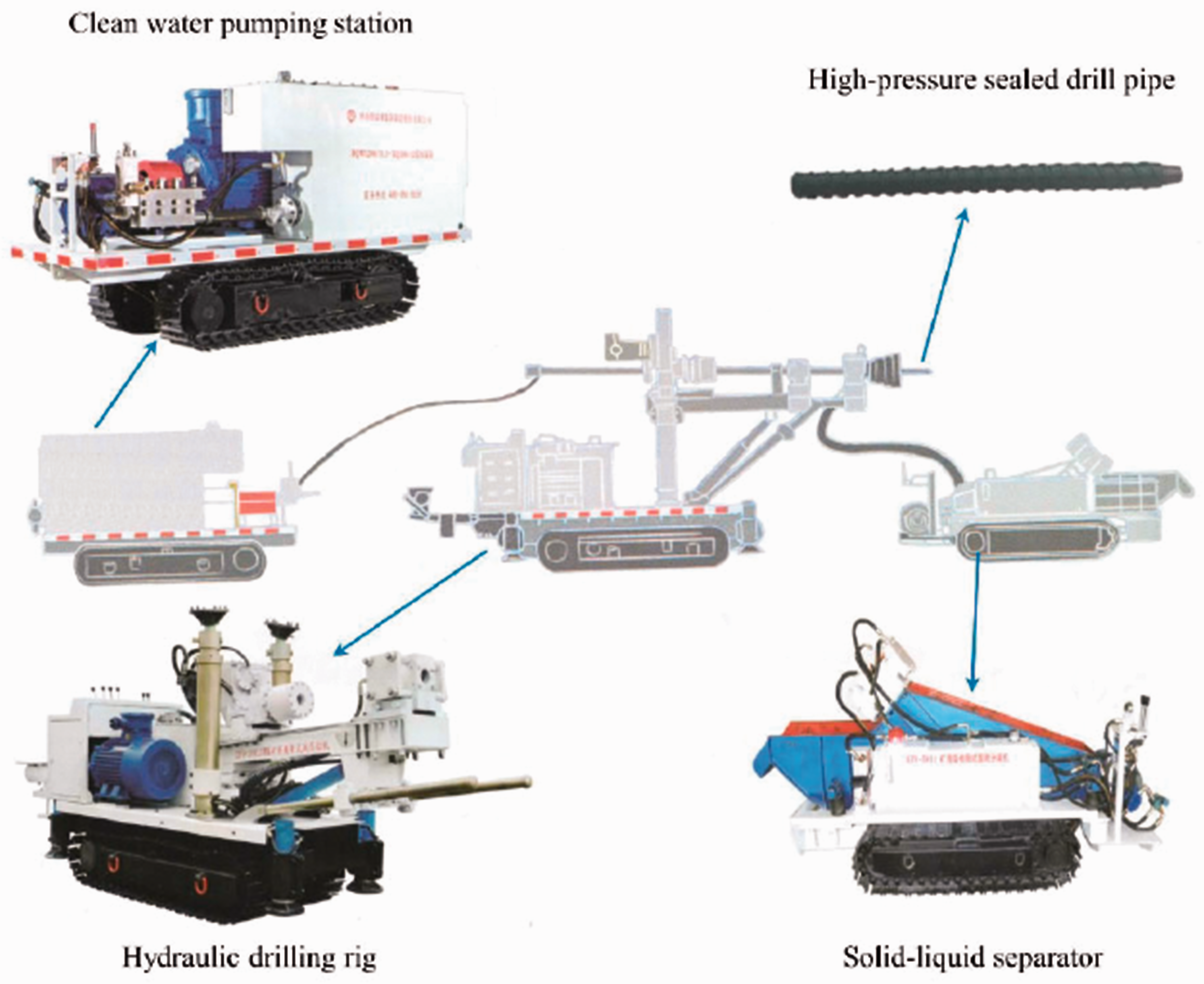
Construction equipment drawing, including hydraulic drilling rig, clean water pumping station, solid–liquid separator and high-pressure sealed drill pipe.
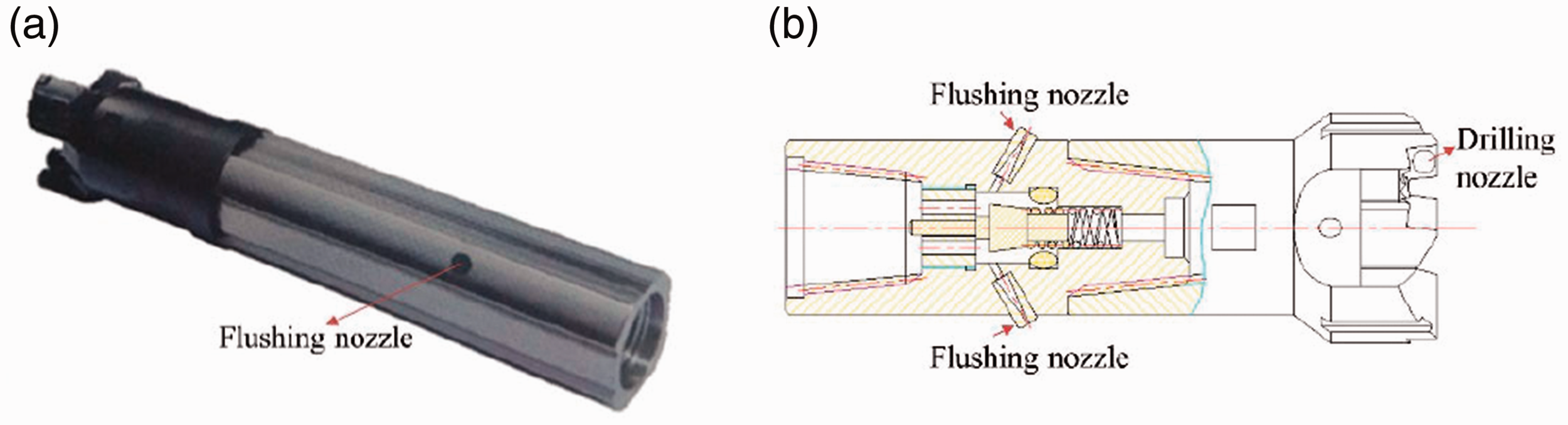
Special drill bit for hydraulic flushing: (a) physical diagram and (b) structural diagram.
The concrete construction steps of this technology are as follows:
Flush the water pressure to 2MPa and drill along the coal seam routinely. After drilling to a certain distance from the coal wall of the working face, raise the water pressure to 20MPa, move the drill pipe back and forth, flush the coal seam and punch out the hole of 1m in length. When the amount of flushing coal reaches the design, it means that the flushing is completed, then the water pressure is adjusted back to 2MPa, and the ordinary drilling is continued. After a certain distance of drilling, the water pressure is raised to flush. Repeat steps (1) and (2) until the drilling hole reaches the specified depth. The drilling holes are flushed with large flow of hydrostatic water, and the remaining coal debris is washed out as much as possible to prevent the flushing holes from being re-buried by coal debris. After the completion of the construction, lower the screen pipe, artificially retain the gas flow passage, prevent the collapse hole from blocking the gas flow passage, and reduce the drainage effect.
Study on gas drainage by interval hydraulic flushing
The three main parameters in the technology of coal seam gas extraction by interval hydraulic punching are coal output, drilling interval and punching interval. When the amount of coal flushing is small, the pressure relief range of coal seam is small, which affects the effect of gas drainage. When the amount of coal flushing is too large, it will increase the punching time, increase the work amount, and affect the construction progress; when the spacing between boreholes is too small, it will increase the work amount, and when the spacing between boreholes is too large, it will reduce the extraction effect and increase the extraction time; the punching interval refers to the distance between punching and punching in a single borehole.
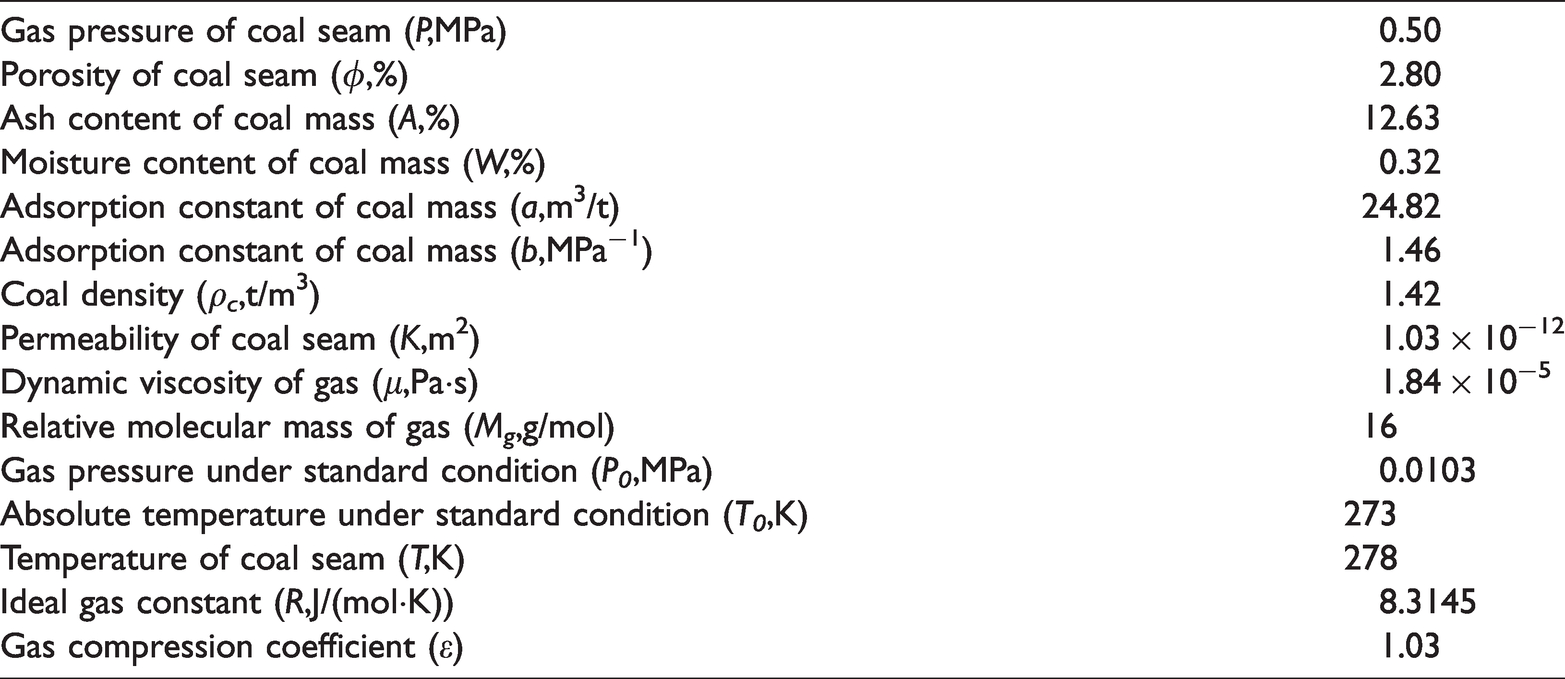
The PDE module in COMSOL is used to establish and solve the gas drainage model combined with the gas seepage equation and gas parameters of the coal seam. The gas drainage effect of interval hydraulic punching is studied. See Table 1 for the gas parameters.
Gas parameter table.
Safety Regulations for Coal Mines (Safety Administration of Work Safety, 2016) require that the gas extraction rate of coal seam should be more than 30%, that is, the residual gas content after extraction should be less than 70% of the original gas content.

In the formula, the
Academician Zhou Shining (Wang, 2003) put forward the relationship between gas content and gas pressure according to the variation law of measured gas content curve and considering the allowable error range in practical engineering application.

In the formula, 
In the formula,
Influence of different coal flushing on extraction
Model Establishment. In order to determine the reasonable single-hole coal flushing quantity, according to the coal seam thickness and gas parameters of Wuyang Coal Mine, this paper establishes gas pressure distribution models of ordinary drilling boreholes and hydraulic flushing boreholes with coal flushing quantity of 0.5t/m, 1.0t/m and 1.5t/m respectively (Figure 5). The model has a length of 30 m, a width of 10 m, a height of 6 m, and a height of coal seam thickness. And a measuring line from the middle to the boundary of the model is arranged to monitor the change of gas pressure around the borehole.
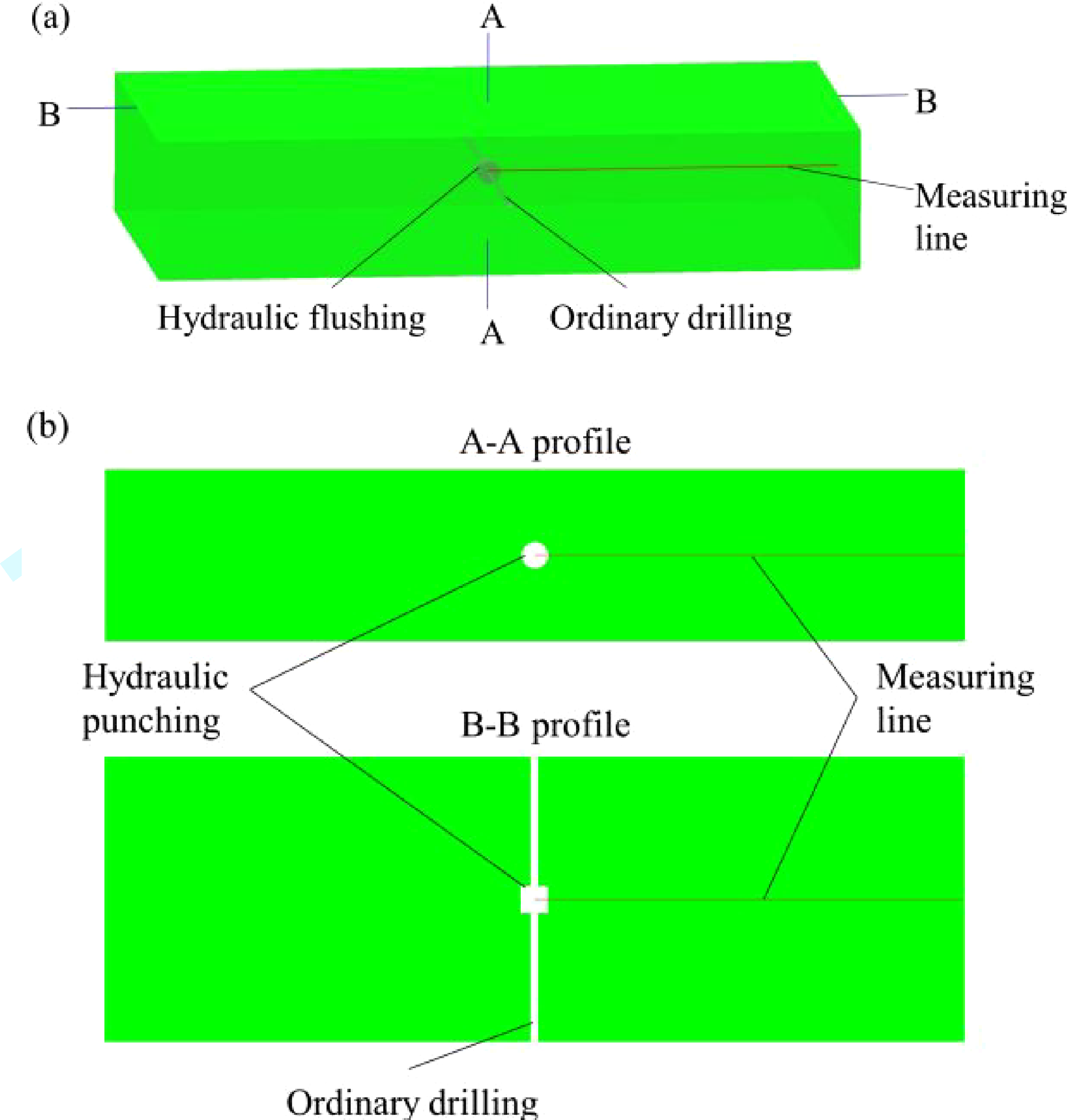
Schematic diagram of gas pressure distribution model for different coal flushing amounts: (a) three-dimensional model and (b) model section.
Analysis of simulation results. The numerical simulation results after 30 days gas extraction are shown in Figure 6 (B-B profile). It can be seen from the figure that after hydraulic flushing, a nearly circular gas pressure reduction zone will be formed around the hydraulic flushing hole. With the increase of coal flushing, the range of pressure reduction area around borehole is larger. It shows that the pressure relief range around boreholes will increase and the gas extraction capacity will also increase with the increase of coal flushing. After the coal seam is flushed out, a cylindrical cavity is formed, and the gas flow state at the joint of hydraulic flushing borehole and conventional borehole will change from radial flow to spherical flow.
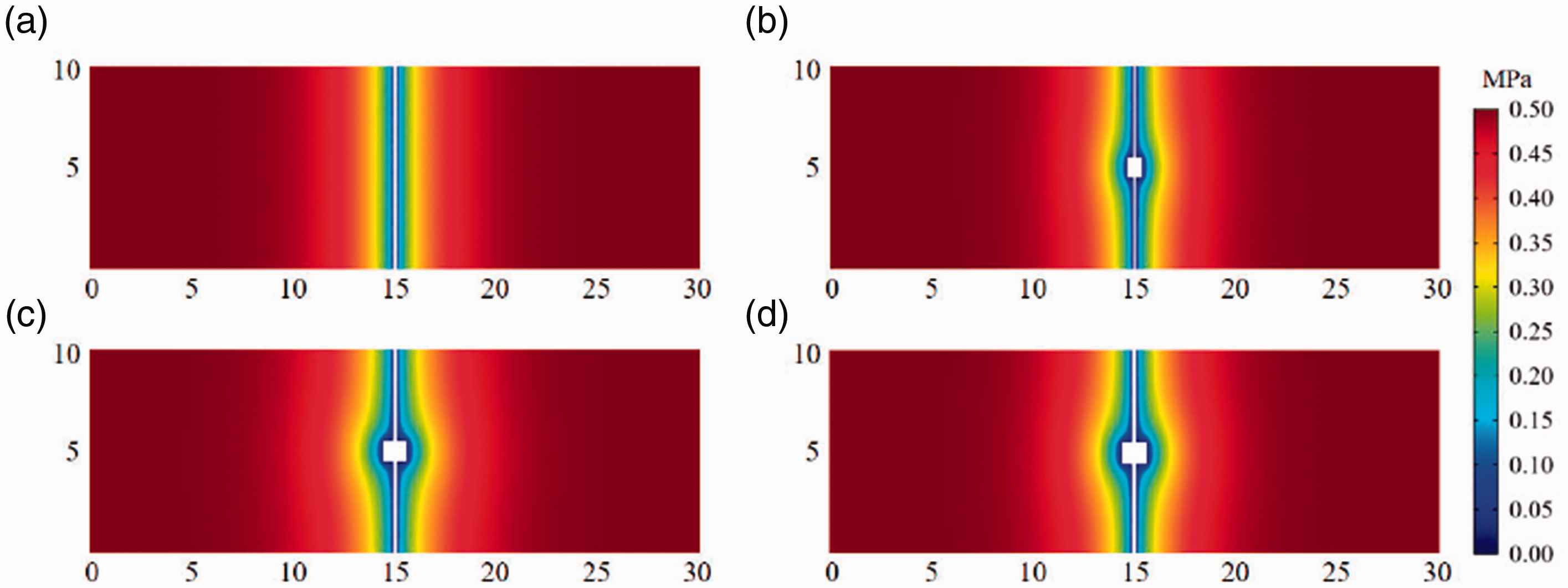
Distribution of gas pressure around boreholes with different coal flushing rates of after 30 days gas extraction: (a) ordinary drilling; (b) flushing coal 0.5t/m; (c) flushing coal 1.0t/m; (d) flushing coal 1.5t/m.
Figure 7 shows the distribution of gas pressure at different distances from the drilling center. From the figure, it can be seen that with the increase of distance from borehole, gas pressure also increases, and finally reaches the original coal seam gas pressure. At the same distance from the borehole, the gas pressure decreases with the increase of coal flush. According to the analysis of 3.1, 0.245 MPa is taken as the effective gas extraction radius boundary. From Figure 7, it can be seen that when the effective gas extraction radius of conventional boreholes is 0.5 m, and the coal flushing amount is 0.5t/m, 1.0t/m and 1.5t/m, the effective gas extraction radius is 1.0 m, 1.2 m and 1.3 m, respectively. That is to say, with the increase of the coal flushing amount, the effective gas extraction radius also increases.
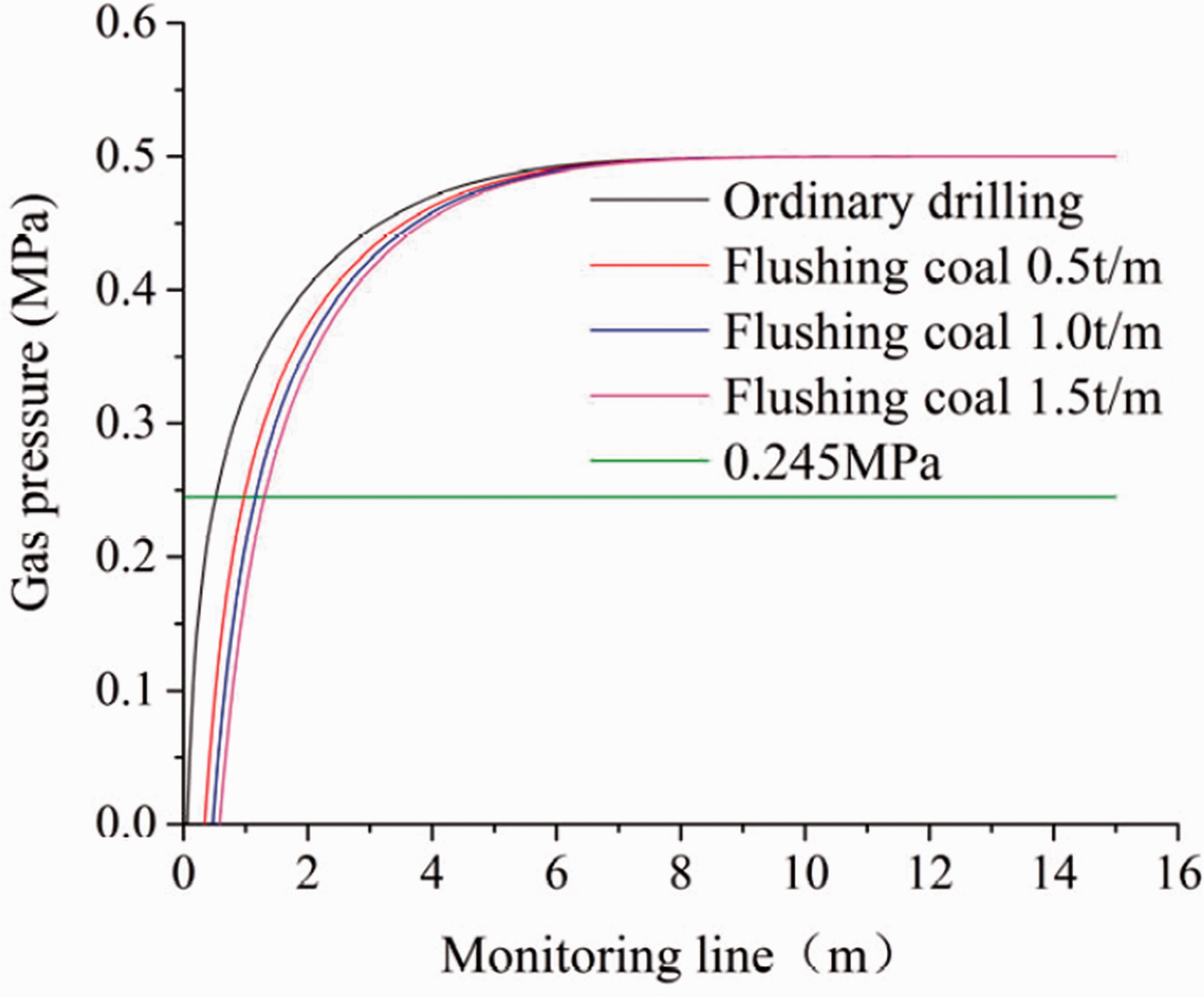
Distribution curve of gas pressure at different distances from boreholes.
In order to observe more intuitively the relationship between the amount of coal flushed and the effective extraction radius, the situation of the graph is presented. The diameter of ordinary boreholes is 120 mm, which is equivalent to the amount of coal washed 0.016t/m, as shown in Figure 8. From the figure, it can be seen that the relationship between the amount of coal flushed and the effective extraction radius is not linear. With the increase of the amount of flushing coal, the speed of the increase of the effective extraction radius decreases gradually. It shows that in practical engineering, the appropriate amount of coal flushing should be selected. Increasing the amount of coal flushing blindly will not only increase the extraction radius significantly, but also increase the construction quantity and slow down the construction progress.
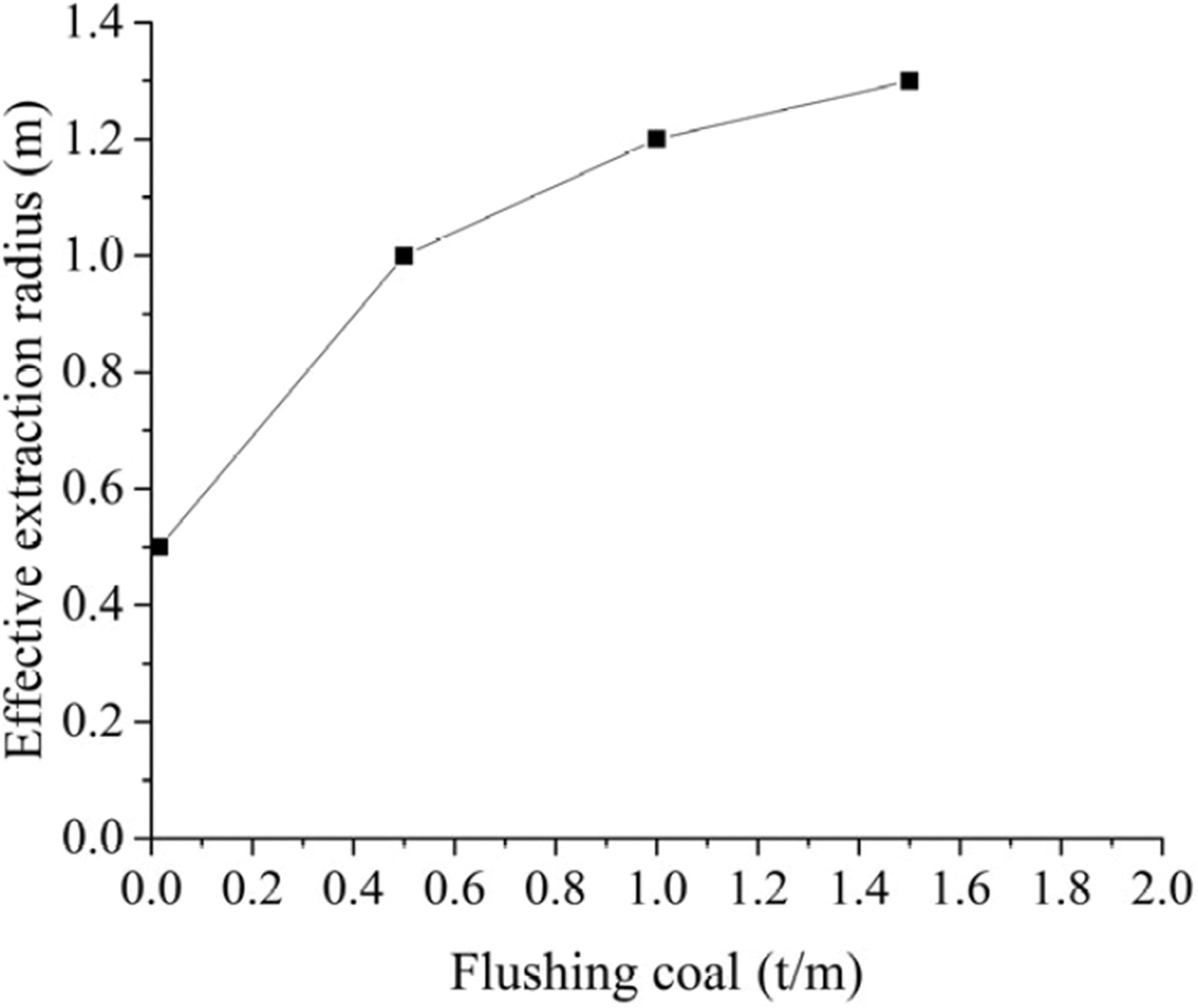
Relation between coal punching quantity and effective drainage radius.
Effect of different borehole spacing on extraction effect
Model Establishment. On the basis of the 3.1 model, the gas pressure distribution model of different borehole spacing under different coal flushing rates is established (Figure 9).
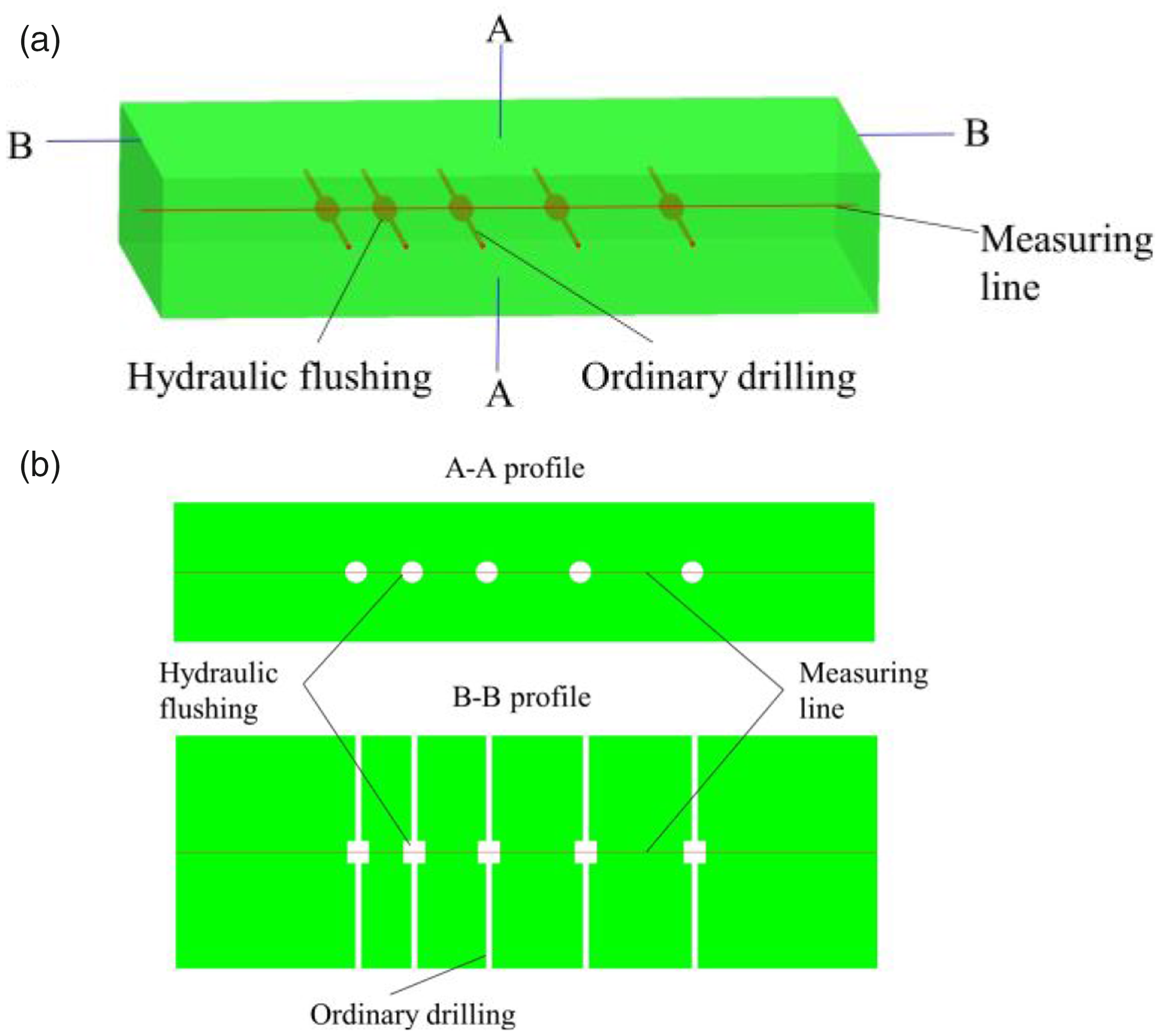
Schematic diagram of gas pressure distribution model for different coal flushing amounts: (a) three-dimensional model and (b) model section.
The effective extraction radius of a single borehole with 2 times the borehole spacing increases gradually. Ordinary borehole spacing is 1.0 m, 1.5 m, 2.0 m and 2.5 m, respectively; coal flushing 0.5t/m the borehole spacing is 2.0 m, 2.5 m, 3.0 m and 3.5 m; coal flushing 1.0t/m the borehole spacing is 2.4 m, 3.2 m, 4.0 m and 4.8 m; coal flushing 1.5t/m the borehole spacing is 2.6 m, 3.4 m, 4.2 m and 5 m, respectively.
Analysis of simulation results. Figure 10 (B-B profile) shows the numerical simulation results after 30 days gas extraction. From the figure, it can be seen that the gas pressure is different at the same distance on both sides of the borehole. The nearer the borehole is, the lower the gas pressure is. It shows that when multi-boreholes are used to extract gas together, the gas pressure between boreholes will be reduced, and the closer the boreholes are, the greater the influence between them will be.
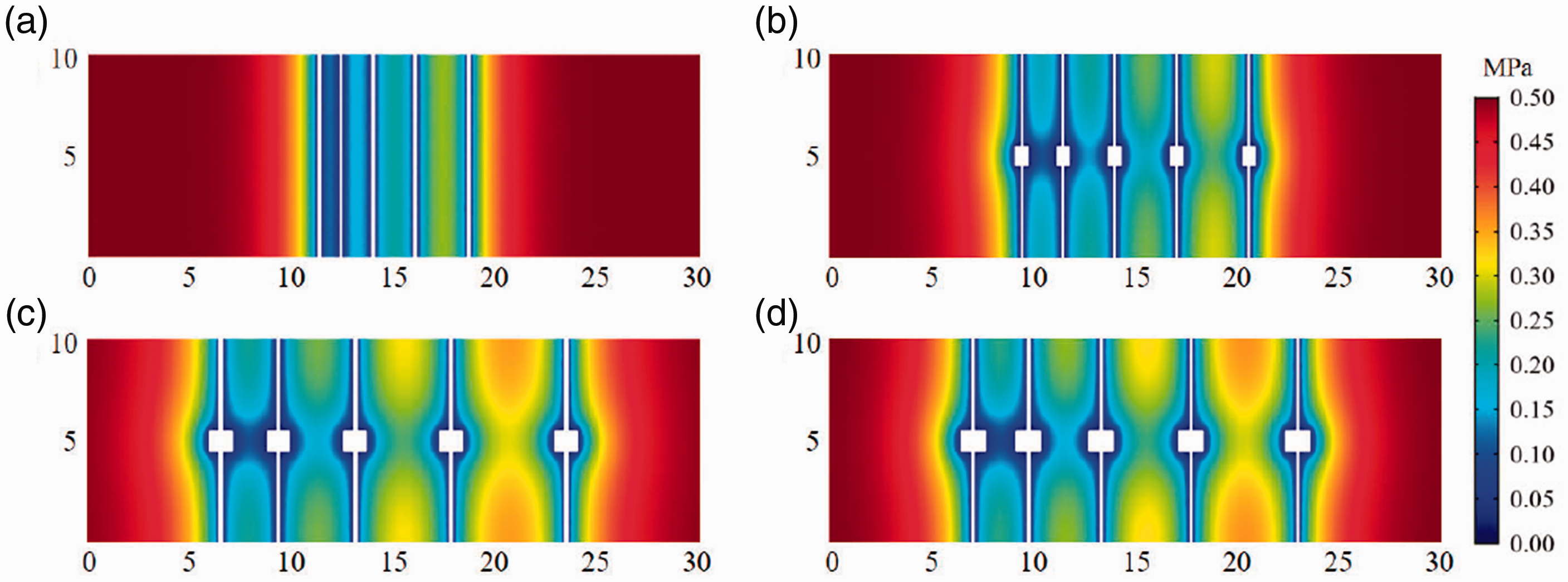
Gas pressure distribution with different borehole spacing under different coal flushing conditions of after 30 days gas extraction: (a) ordinary drilling; (b) flushing coal 0.5t/m; (c) flushing coal 1.0t/m; (d) flushing coal 1.5t/m.
Figure 11 shows the pressure monitoring curve. It can be seen from the figure that when the distance between two ordinary drillings is 1.0 m, the gas pressure between two boreholes is 0.15 MPa, which is 40.0% lower than that of 0.25 MPa at the same location of a single borehole. When the amount of coal flushed is 0.5t/m, 1.0t/m, 1.5t/m and the distance between boreholes is twice the effective extraction radius of a single borehole, the gas pressure in the middle is 0.11 MPa, 0.12 MPa and 0.11 MPa, respectively. The gas pressure in the same position of a single borehole decreases by 56.0%, 52.0% and 56.0%, respectively. At the same time, it can be seen that the effective extraction radius of ordinary drilling is 1.1 m, which is 0.6 m higher than that of single borehole, and the effective extraction radius of 0.5t/m, 1.0t/m and 1.5t/m boreholes are 1.75 m, 2.0 m and 2.1 m respectively, which are 0.75 m, 0.8 m and 0.7 m higher than that of single borehole.
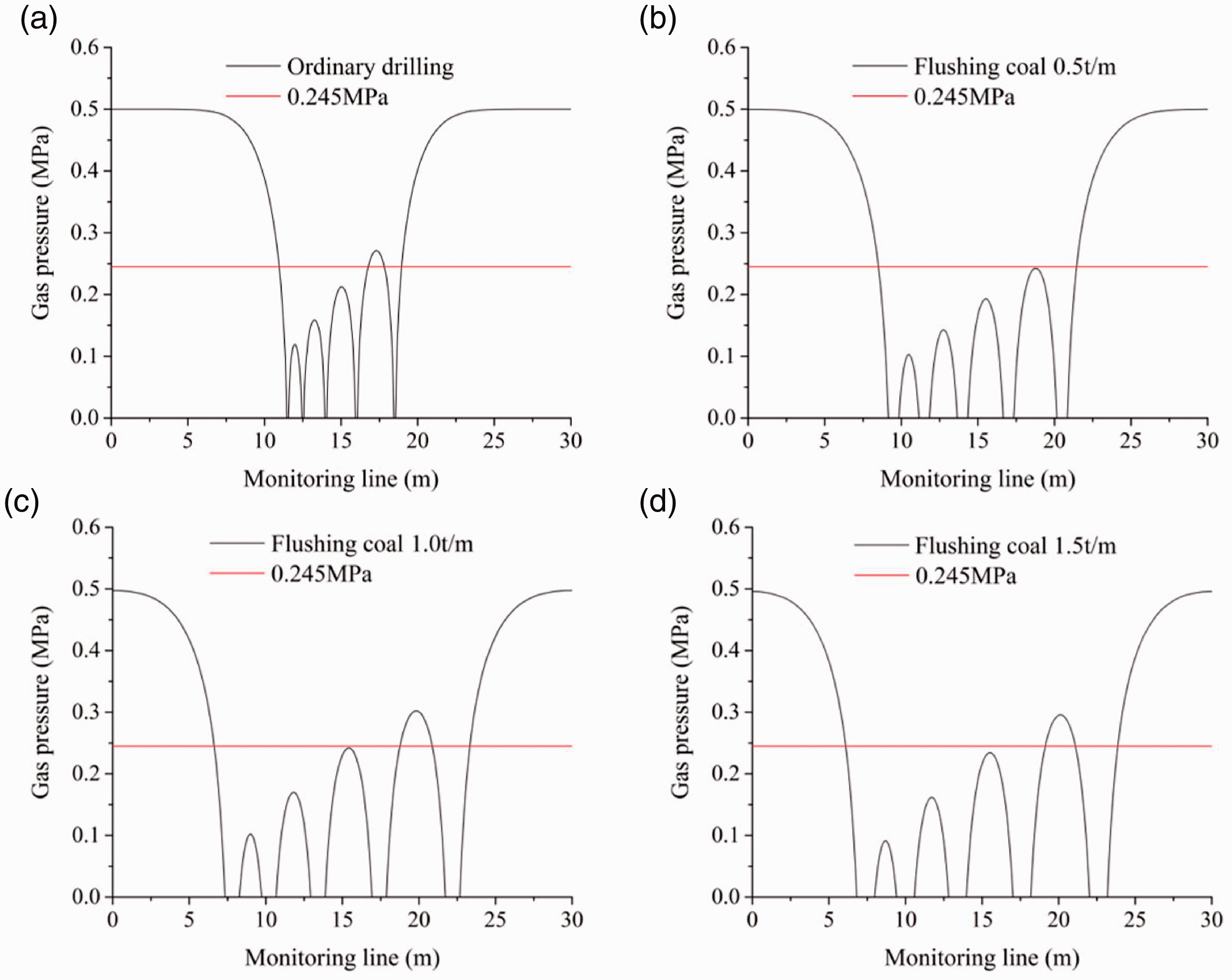
Gas pressure monitoring lines with different borehole spacing under different coal flushing conditions: (a) ordinary drilling; (b) flushing coal 0.5t/m; (c) flushing coal 1.0t/m; (b) flushing coal 1.5t/m.
Through the above analysis, it can be seen that the effective extraction radius of multi-boreholes drilling, whether ordinary drilling or hydraulic flushing drilling, will increase significantly, and the increase of effective extraction radius of hydraulic flushing drilling is larger than that of ordinary drilling. Therefore, when multi-boreholes are used to extract gas, the effective extraction radius of single borehole can be greater than twice the distance between boreholes.
Effect of different flushing spaces on gas drainage
Model Establishment. In order to study the influence of different flushing intervals on gas extraction under different coal flushing conditions, a three-dimensional numerical model with different flushing intervals is established. The schematic diagram of the model is shown in Figure 12. The size of the model is 40 m × 15 m × 6 m, and the amount of coal flushed is still 0.5t/m, 1.0t/m and 1.5t/m. The flushing intervals are 6 m, 8 m and 10 m under the conditions of each amount of coal flushed.
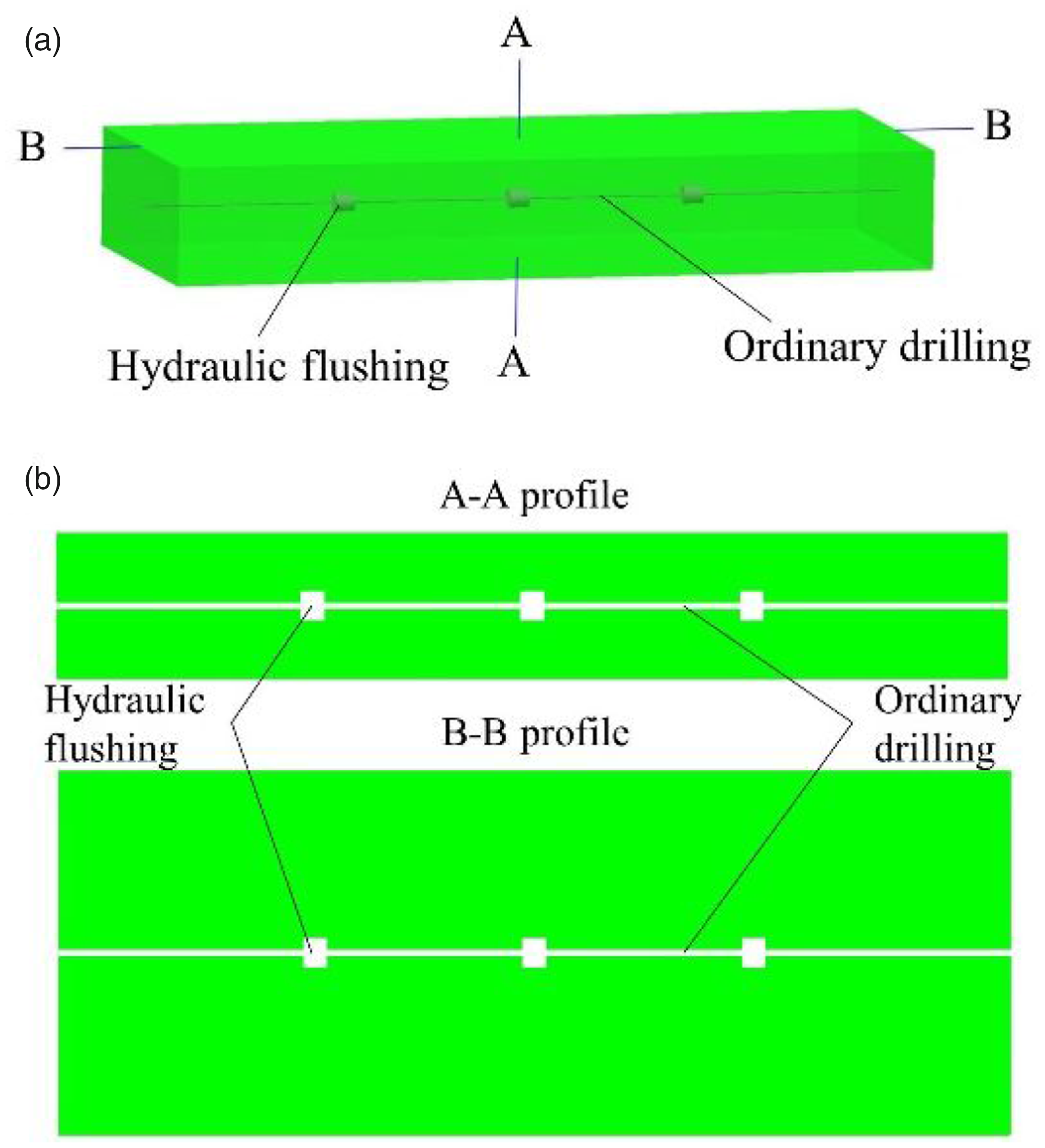
Diagram of gas pressure model for different punching spaces: (a) three-dimensional model and (b) model section.
Analysis of simulation results. Figure 13 is the numerical simulation result after 30 days gas extraction. From Figure 13 (B-B profile), it can be seen that the range of gas pressure reduction zone in the vertical direction between two flushes increases with the increase of coal amount when the flushing interval is constant, and that the gas pressure reduction zone between punches and flushes becomes more uneven with the increase of flushing interval when the coal amount is constant. The gas pressure between flushes will decrease because of the interaction between them. Through the above analysis, it can be seen that when the flushing interval reaches a reasonable value, the flushing effect is consistent with the whole hydraulic flushing, and the interval hydraulic flushing can replace the whole hydraulic flushing, so as to reduce the amount of construction and construction time.
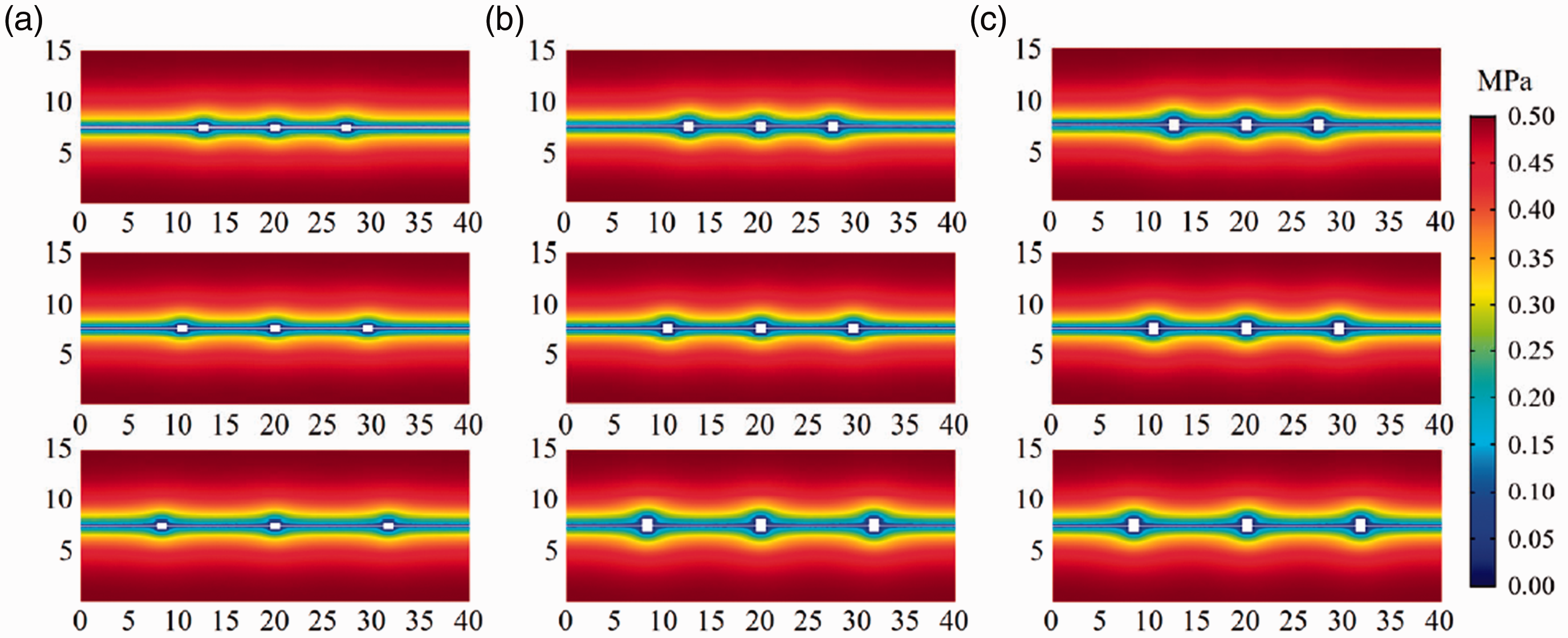
Gas pressure distribution with different borehole spacing under different coal flushing conditions of after 30 days gas extraction: (a) flushing coal 0.5 t/m; (b) flushing coal 1.0 t/m; and (c) flushing coal 1.5 t/m.
Field test
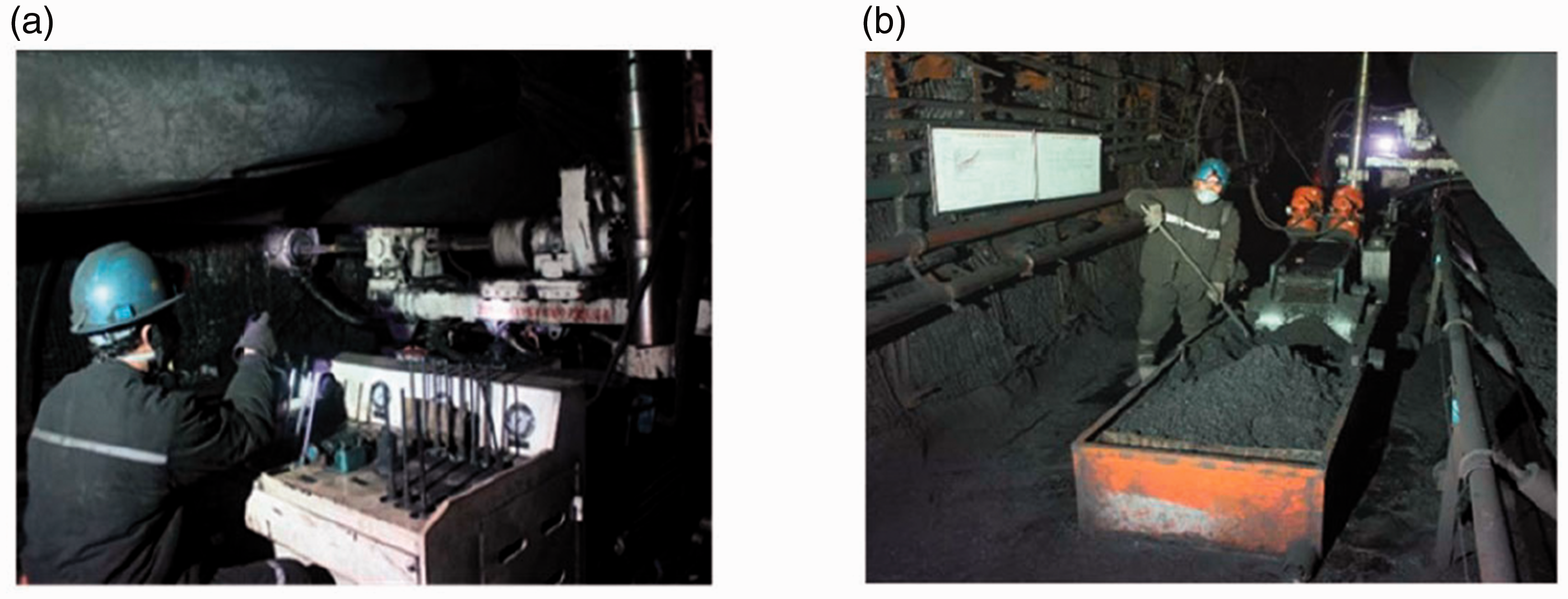
The test site is at 7609 working face of Wuyang Coal Mine, which is divided into two modules. Module 1 is ordinary drilling module, the drilling spacing is 2.0 m; Module 2 is spacing hydraulic flushing module, the coal volume is 1.0 t/m, the flushing spacing is 8 m, the drilling spacing is 4 m, and the initial flushing length is 30 m. The drilling depth of the two modules is 70 m, the total length of module 1 is 80 m, and module 2 is 95 m. The boundary of the two modules is 25 m away from the inlet and return air roadways. The drilling layout and site construction drawings are shown in Figures 14 and 15.
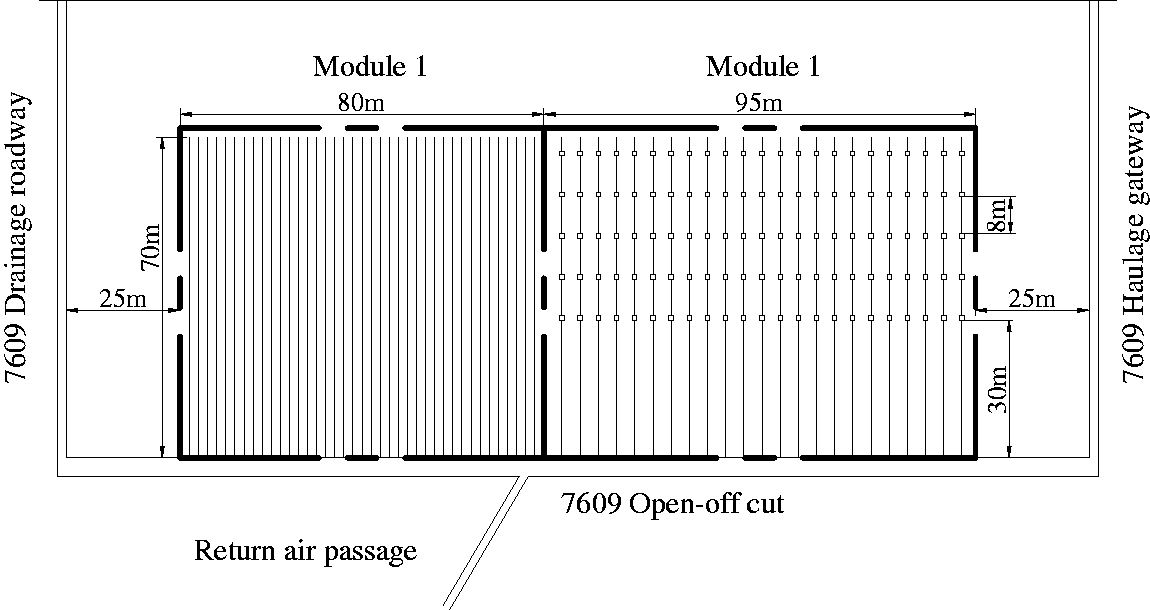
Borehole layout: module 1 is ordinary drilling; module 2 is interval hydraulic flushing drilling.
Construction time comparison
During the test construction, the time required for each part of a single hydraulic flushing hole and a ordinary drilling hole is recorded. The comparison table is shown in Table 2.
Comparisons of construction time between hydraulic flushing drilling and ordinary drilling (h).
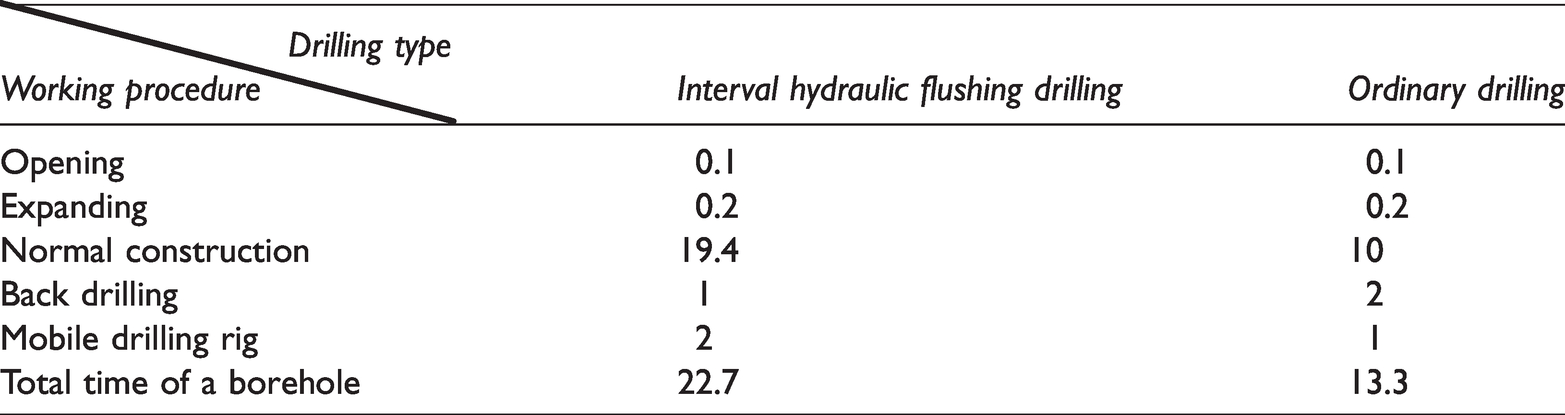
From Table 2, it can be seen that the construction time of single borehole with interval hydraulic flushing is 9.4 hours longer than that of ordinary boreholes. However, the spacing of spacing hydraulic flushing holes is larger than that of ordinary drilling holes. When the construction length is longer than a certain value, because the number of spacing hydraulic flushing holes is less than that of ordinary drilling holes, it will take less time than that of ordinary drilling holes. For example, in the test construction, the number of ordinary drilling is 39 in the 80 m construction range, which takes 518.7 hours; the number of interval hydraulic flushing drilling is 19, which takes 431.3 hours and saves 87.4 hours. The length of underground construction in coal mine is generally more than 80 m, and the use of interval hydraulic flushing can save a lot of construction time.
Comparison of extraction effect
In order to compare the extraction effect of the two modules, the gas concentration and total extraction purity of borehole gas extraction are taken as indicators. The extraction effect of the two modules is shown in Figures.16 and 17.
From Figure 16, it can be seen that the gas concentration of module 2 (interval hydraulic flushing module) is generally higher than that of module 1 (ordinary drilling module). The maximum gas extraction concentration of module 1 is 30%, module 2 is 90%, and the extraction concentration is increased by 60%. The average gas concentration of module 1 is 11.2%, module 2 is 42.4%, and the average gas concentration is increased by 31.2%.
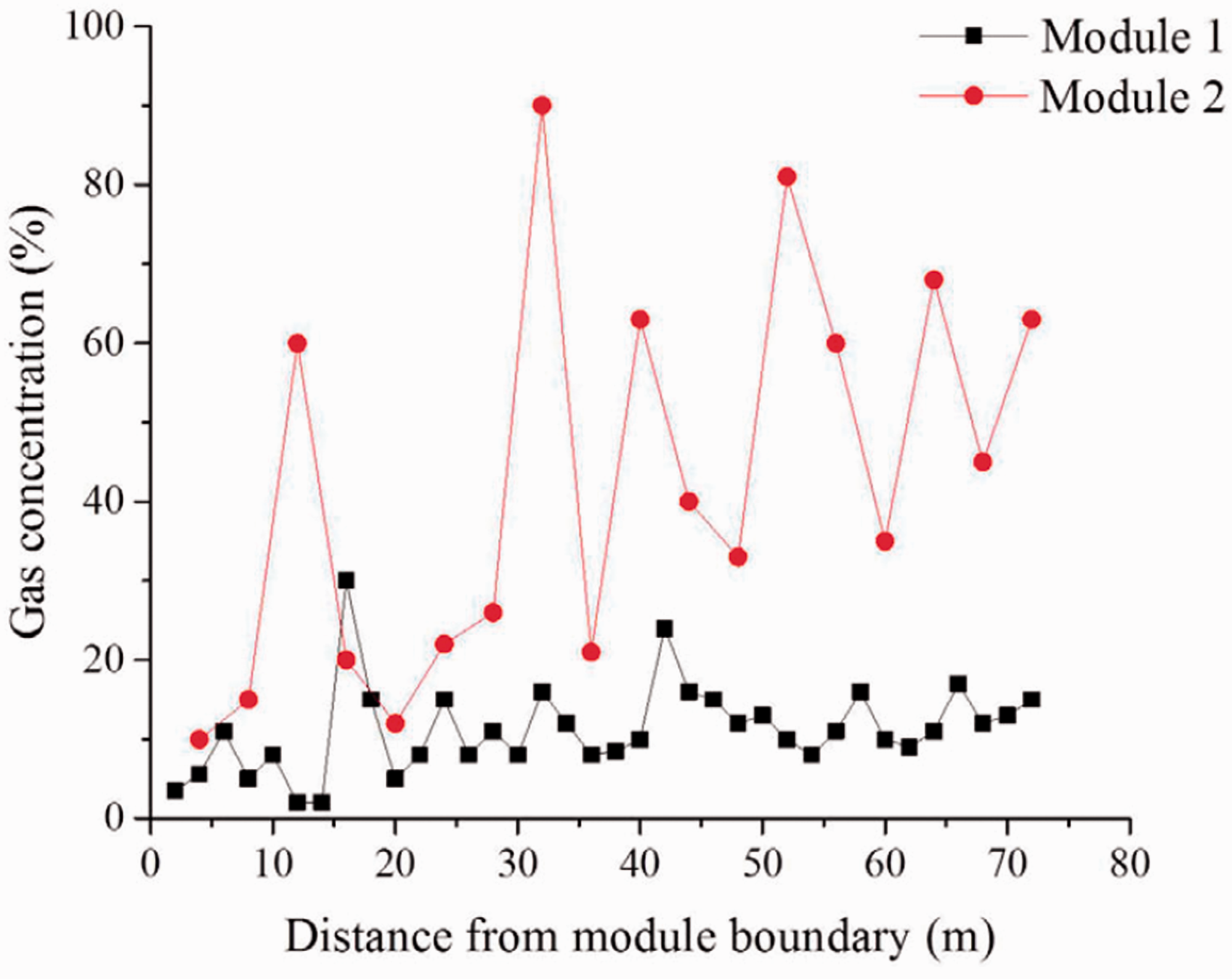
Compute with gas concentration.
From Figure 17, it can be seen that the gas extraction purity of module 2 is obviously higher than that of module 1. The average gas extraction purity of module 1 is 0.229 m3/min, and that of module 2 is 1.321 m3/min. The average gas extraction purity of module 2 is 5.77 times higher than that of module 1.
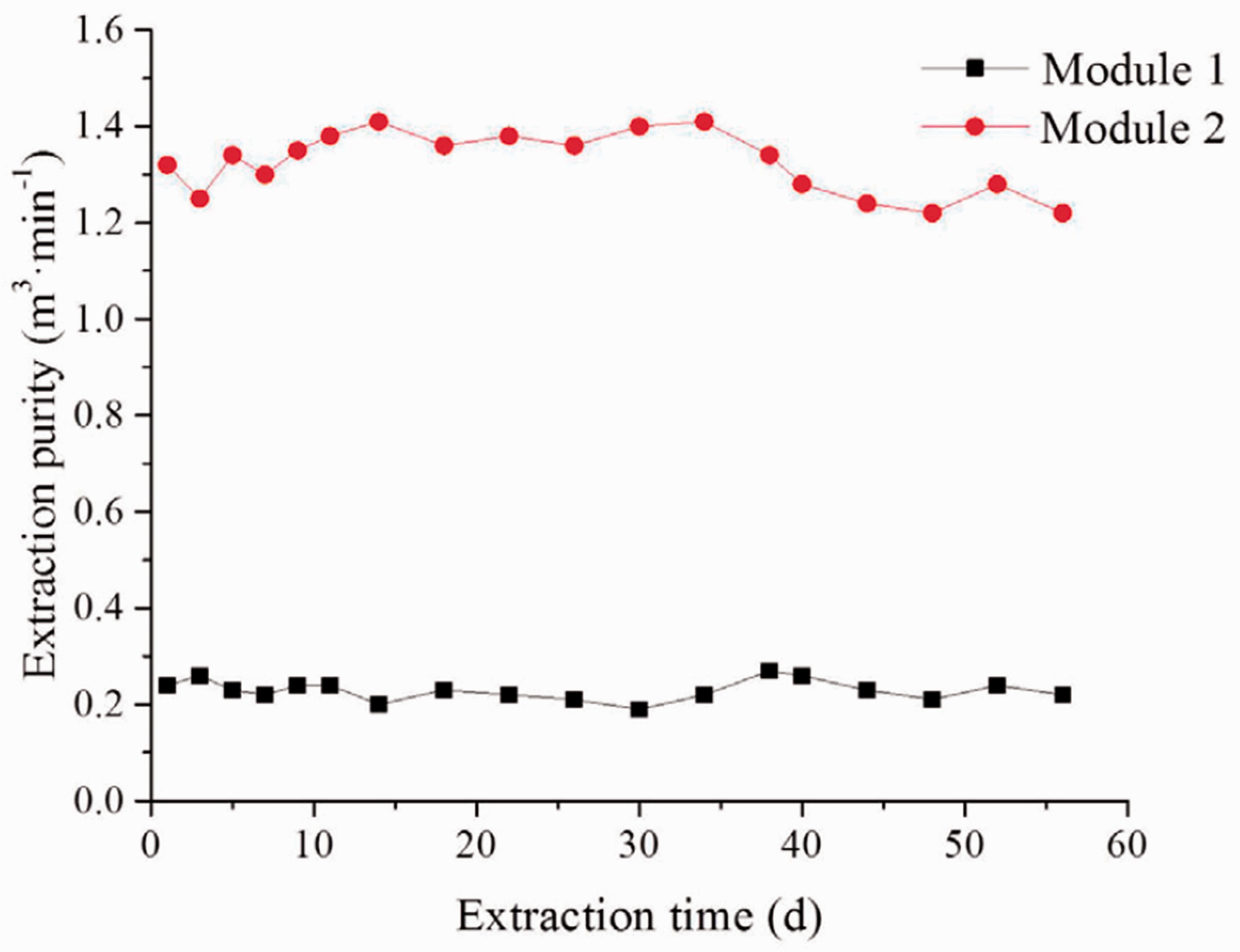
Compute with extraction purity.
From the above analysis, it can be seen that the interval hydraulic flushing module is significantly higher than the ordinary drilling module in gas extraction concentration and purity. The results show that the gas extraction effect of interval hydraulic flushing borehole is obviously better than that of ordinary borehole, and it can be used in this coal seam.
Conclusions
Through the above numerical simulation and field test in coal mine, the following conclusions can be drawn:
According to the coal seam gas parameters of 7609 working face in Wuyang Coal Mine, the gas pressure model around boreholes under different coal wash rates was established. The numerical simulation shows that the effective extraction radius of interval hydraulic flushing for ordinary boreholes and coal flush is 0.5 t/m, 1.0 t/m and 1.5 t/m, which is 0.5m, 1.0m, 1.2m and 1.3m. That is, with the increase of coal flush, the effective gas extraction radius of boreholes increases, but the increase of effective extraction radius decreases gradually. In site construction, reasonable coal flushing quantity should be selected according to the situation. Increasing the coal flushing quantity blindly will not only not increase the effective extraction radius, but also increase the engineering quantity. When multiple boreholes extract gas at the same time, the gas pressure between boreholes will be reduced, the effective extraction radius will be increased compared with that of single borehole, and the increase of effective extraction radius of interval hydraulic flushing holes is larger than that of ordinary boreholes, so the distance between boreholes can be more than twice effective extraction radius that of single borehole. Flushing also affects each other. The closer the flushing interval is, the more uniform the gas pressure reduction area is. Interval hydraulic flushing can replace the whole hydraulic flushing to reduce the amount of construction. Through field test and comparison, the gas extraction concentration and gas extraction purity of drilling holes with interval hydraulic flushing drilling module are higher than those of ordinary drilling module, in which the gas concentration is increased by 31.2%, and the gas extraction purity is increased by 5.77 times. Interval hydraulic flushing drilling can effectively improve the effect of gas extraction, can be used for gas extraction in this coal seam.
Footnotes
Declaration of conflicting interests
The author(s) declared no potential conflicts of interest with respect to the research, authorship, and/or publication of this article.
Funding
The author(s) disclosed the following financial support for the research, authorship, and publication of this article: This work was financially supported by the National Natural Science Foundation of China (52074296 and 52004286), the China Postdoctoral Science Foundation (2020T130701 and 2019M650895), the Fundamental Research Funds for the Central Universities (2020YJSNY06), and the Yue Qi Young Scholar Project, China University of Mining & Technology, Beijing (800015Z1104).
