




Abstract
Influenced by the complex sedimentary environment, a well always penetrates multiple layers with different properties, which leads to the difficulty of analyzing the production behavior for each layer. Therefore, in this paper, a semi-analytical model to evaluate the production performance of each layer in a stress-sensitive multilayer carbonated gas reservoir is proposed. The flow of fluids in layers composed of matrix, fractures, and vugs can be described by triple-porosity/single permeability model, and the other layers could be characterized by single porosity media. The stress-sensitive exponents for different layers are determined by laboratory experiments and curve fitting, which are considered in pseudo-pressure and pseudo-time factor. Laplace transformation, Duhamel convolution, Stehfest inversion algorithm are used to solve the proposed model. Through the comparison with the classical solution, and the matching with real bottom-hole pressure data, the accuracy of the presented model is verified. A synthetic case which has two layers, where the first one is tight and the second one is full of fractures and vugs, is utilized to study the effects of stress-sensitive exponents, skin factors, formation radius and permeability for these two layers on production performance. The results demonstrate that the initial well production is mainly derived from high permeable layer, which causes that with the rise of formation permeability and radius, and the decrease of stress-sensitive exponents and skin factors, in the early stage, the bottom-hole pressure and the second layer production rate will increase. While the first layer contributes a lot to the total production in the later period, the well bottom-hole pressure is more influenced by the variation of formation and well condition parameters at the later stage. Compared with the second layer, the scales of formation permeability and skin factor for first layer have significant impacts on production behaviors.
Keywords
Introduction
Gaoshiti-Moxi carbonate gas reservoir is located in the Sichuan Basin and mainly developed in formation Z2dn4 (Meng et al., 2018; Zhou et al., 2016). According to the characteristics of lithology, resistance and sedimentary cycle, the formation Z2dn4 can be divided into two stratums, Z2dn4-1 and Z2dn4-2. Well logging and core analysis show that there are great differences in physical properties between these two stratums. Z2dn4-1 has abundant natural fractures and vugs, which has large porosity, permeability and stress-sensitivity. While Z2dn4-2 is tight and has few fractures and cavities, the porosity and permeability are much lower than Z2dn4-1. To improve the well performance and obtain better economic benefits, these two stratums are always seen as one layer and penetrated by vertical wells to produce. However, the contribution of each layer is still not clear until now, which may lead to the unreasonable plan for production schemes. So it is imperative to propose an appropriate mathematical model to simulate the production process in a multilayer carbonate gas reservoir with serious vertical heterogeneity and stress-sensitivity.
In terms of the modeling of multilayer commingled reservoirs with no-crossflow, investigators have presented various analytical or semi-analytical models to study the pressure transient behavior or production performance. For pressure transient analysis in multilayer reservoirs, Lefkovits et al. (1961) made a rigorous study on the pressure behavior for the reservoirs composed of stratified layers with uniform initial pressure. Since Lefkovits et al. (1961) pointed that it was hard to determine the properties of individual layers, the methods of estimating the formation properties were extended through the utilization of single layer plotting forms (Cobb et al., 1972; Raghavan et al., 1974). To solve the analytical model in Laplace space for layered reservoirs, Tariq and Ramey (1978) firstly introduced the Stehfest numerical inversion method, and Spath et al. (1990) presented an efficient algorithm to compute pressure response through the application of single layer solution and Duhamel’s theorem. Additionally, Sun et al. (2003) used a Crump numerical inversion method to give exact solutions and typical curves for a commingled reservoir. However, due to the difference of depth for each layer, it is unrealistic for the assumption of layers with uniform pressure. Larsen (1981, 1989) investigated the pressure and flow-rate transients caused by unequal initial pressure and various boundary conditions of individual zones in a commingled multilayer reservoir. Subsequently, numerous researchers presented a lot of mathematical models to study the pressure response in commingled reservoirs with different layer pressures, pressure-dependent or independent fluids, formation properties, and boundary conditions (Agarwal et al., 1992; Ahmed and Lee, 1995; Anisur Rahman and Mattar, 2007; Gao and Lee, 1993; Kuchuk and Wilkinson, 1991; Shah and Spath, 1993). Furthermore, some of studies also proposed approaches, such as derivative extreme method (DEM), single-layer Mathews-Brown-Hazebroek function and layered reservoir test (LRT), for the interpretation of individual layer permeability, porosity, skin factor, and average reservoir pressure (Aly, 1994; Aly et al., 1994; Aly and Lee, 1994, 1995; Chao et al., 1994; Chen et al., 1997; Raghavan, 1989). Recently, Sui and Zhu (2012) presented a wellbore/reservoir coupled model for multilayer commingled gas reservoir, which considered the non-Darcy and damage skin effect for each layer, as well as the variation of wellbore pressure with strategic locations. Shi et al. (2020) proposed an analytical model to characterize the bottom-hole pressure behavior for acid fracturing stimulated wells in multilayer carbonate gas reservoir. Vieira Bela et al. (2019) extended the existing the falloff formulation to multilayer reservoirs.
With regard to the production performance analysis in multilayer reservoirs, El-Banbi and Wattenbarger (1996, 1997) presented a method coupling the material balance equation and the stabilized non-Darcy gas flow equation with varied or constant bottom-hole flowing pressure, to match production data and then estimate OGIP and productivity of an individual zone. Arevalo-Villagran et al. (2000) improved the model developed by El-Banbi and Wattenbarger (1996, 1997), to allow modeling of recompletions and different initial pressure in layers for multilayer commingled systems. Onwunyili and Onyekonwu (2013) coupled wellbore hydraulics and pay-zone fluid behavior with considering the pressure difference between producing zones, and estimated the production contribution of various zones in multilayer reservoirs. Since then, hydraulically fractured vertical wells are always used in tight gas reservoirs. Ali et al. (2010) proposed a robust methodology to estimate fracture properties, permeability and drainage area of individual layers in multilayer commingled tight gas reservoir produced with fractured vertical gas wells. Wang et al. (2019) presented a case study of multilayer tight gas sands reservoir in eastern Ordos Basin, and investigated the influence of interference between different layers on production.
Through the above reviews on the pressure transient analysis and production performance evaluation in multilayer commingled reservoirs, it can be seen that the presented mathematical models do not consider the great differences of porous media types for individual layers. For most of presented analytical models, the fluids are assumed to be slightly compressible with constant viscosity, however, in gas reservoir, the gas compressibility and viscosity are pressure-dependent, which must be considered appropriately. Otherwise, it may lead to huge deviation of calculated bottom-hole pressure or production rate in comparison with the real production data. Moreover, the studies on stress sensitivity in naturally fractured vuggy carbonate gas reservoir indicate that there are strong stress sensitive effects which severely affects the production performance (Seabra et al., 2017; Wang et al., 2016a; 2016b; Zhao et al., 2013). Therefore, in this paper, we propose a semi-analytical model that considers the differences of porous characteristics and stress sensitivity for each layer in a multilayer commingled reservoir, in which some layers are naturally fractured vuggy formations represented by triple porous medium, and the others are tight formations characterized by single porous medium. To solve the model, Laplace transformation, Stehfest numerical inversion and Duhamel’s principle are employed. Finally, with the proposed model, the effects of prevailing factors on wellbore pressure and production performance of individual zone are studied.
Laboratory experiments for formation stress sensitivity
Two typical core samples collected from formations Z2dn4-1 and Z2dn4-2 in the Gaoshiti-Moxi carbonate gas reservoir are used to conduct stress-sensitive experiments by applying a core flooding apparatus. In these two experiments, the flowing pressure in core samples is decreased by 5 MPa to simulate reservoir depletion while the confining pressure keeps constant, then the core permeability is measured at each point. Figure 1 shows the results of two experiments and curve fitting with two mathematical functions (power function and exponential function). Since the natural fractures act as main channels for fractured core sample, the measured core permeability can be seen as fracture permeability.
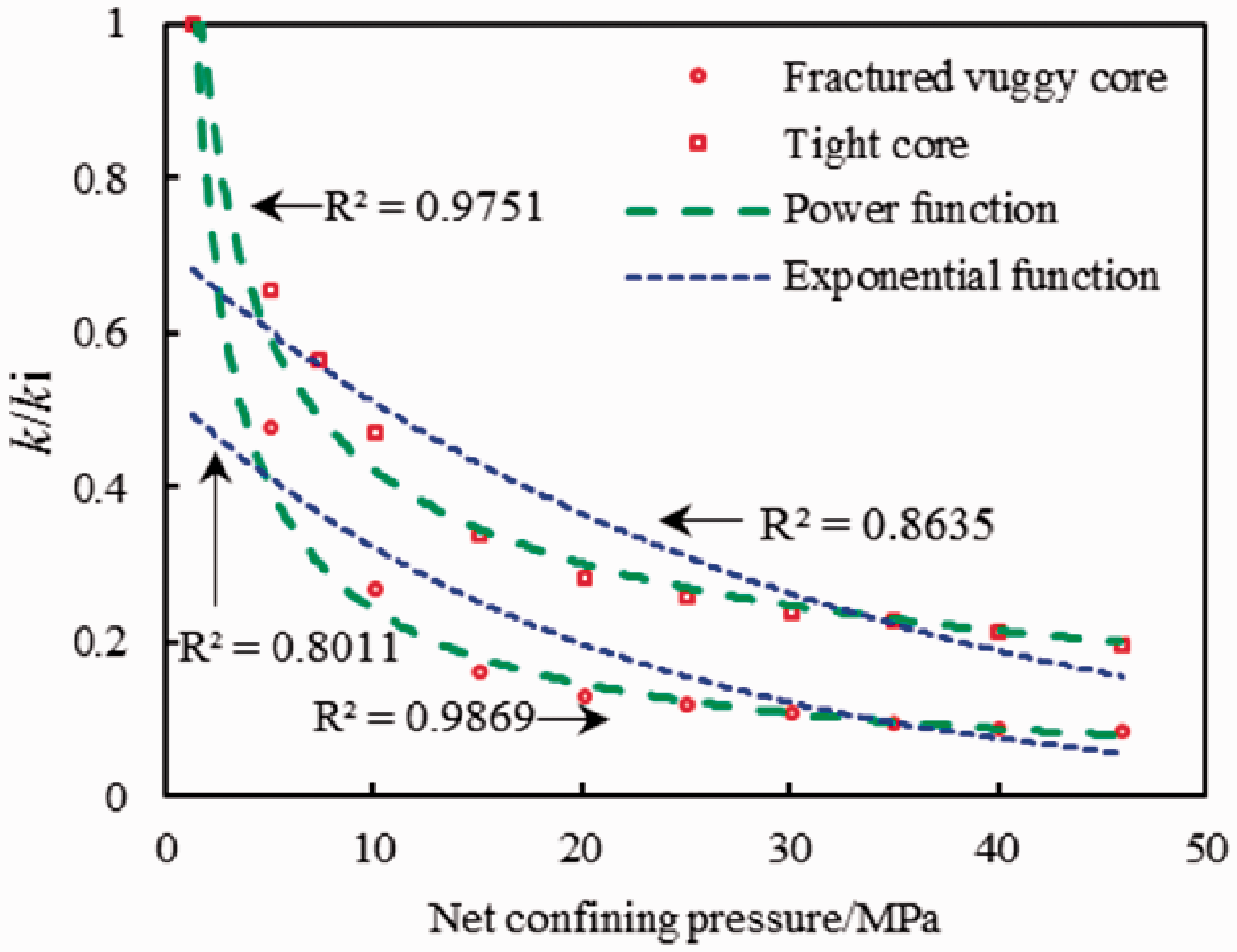
The permeability stress sensitivity for naturally fractured vuggy and tight formations.
In Figure 1, the net confining stress in the horizontal axis is defined as the difference between overburden pressure and formation fluid pressure, and the dimensionless permeability in the vertical axis represents the ratio of measured permeability to initial values. As Figure 1 shows, for these two kinds of formations, the experimental data could be matched with power function suitably, which is in compliance with the previous studies (Wang et al., 2016b). Thus the relation between net confining pressure and dimensionless permeability can be determined, as shown in equation (1).

Where α is named as the stress-sensitive exponent, in this case, it equals to 0.738 and 0.493 for naturally fractured vuggy and tight formations, respectively. In addition, it can also be seen that the natural fractures in fractured vuggy formation are more sensitive to pressure variation compared with tight formation, thus the permeability stress sensitivity for fractured vuggy formation is more serious than tight formation, as shown in Figure 1.
Physical model and mathematical model
Physical model
Figure 2 shows a schematic of a multilayer commingled carbonate gas reservoir under study in this paper. In this reservoir, some upper layers are naturally fractured vuggy formations, and the other lower layers are tight formations with few fractures and cavities.
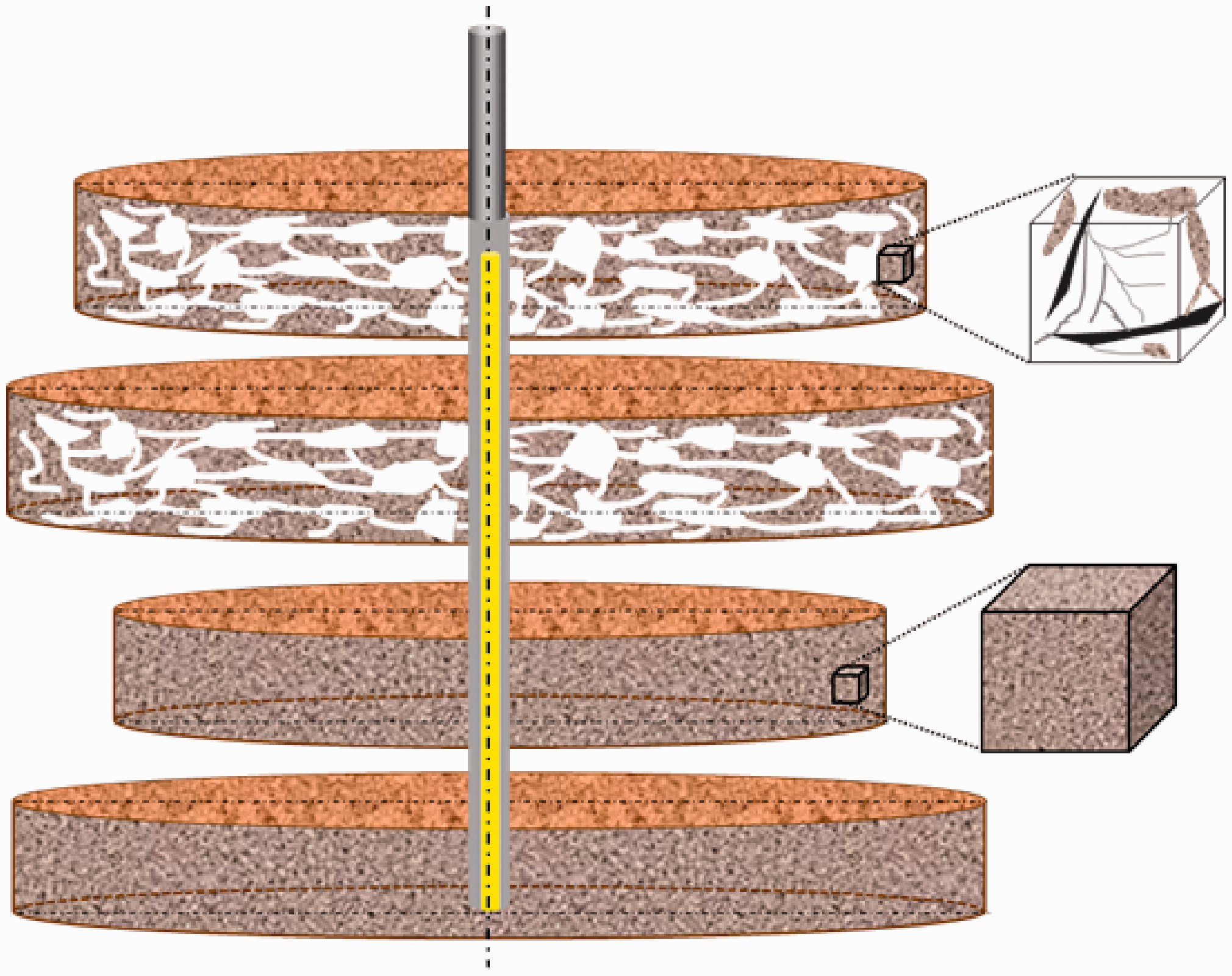
Schematic of multilayer commingled carbonate gas reservoir.
The assumptions of this model are listed as follows: (1) the reservoir is composed of n cylindrical, homogenous and isotropic layers, and any of these layers are bounded. The formation radius and initial pressure prior to production for layer j are Re j and pi j (j = 1, 2, 3, …, j, …, n). (2) In the fractured vuggy formation, matrix and vugs are the storage spaces of fluids, and fractures act as main channels to the wellbore, provided that the transfer flow between fractures and matrix or vugs is a pseudo-steady state (PSS). (3) Permeability stress sensitivity for naturally fractured vuggy and tight formations can be described with equation (1), in which stress-sensitive exponents are 0.738 and 0.493, respectively. (4) The gas is compressible and has pressure-dependent properties, and the compressibility of rock and connate water is ignored. Gas flow in porous media follows Darcy’s law, and the gravity and capillary force are neglected. (5) The well is located in the center of the reservoir and produces with a constant production rate qg, and the wellbore radius is rw. All layers are completely penetrated by the vertical well, and the skin effect is considered. There is no inter-layer flow and the crossflow between layers merely occurs through the wellbore.
In addition, it should be noted that for naturally fractured vuggy formations, if matrix and vuggs are ignored, and the natural fractures properties, such as porosity and permeability are assumed to be equal to the matrix parameters in tight formation, then the governing equations and the initial and boundary conditions for triple porous medium with matrix, natural fractures and vuggs can be simplified into a single medium with matrix only. Therefore, to derive the mathematical model for commingled carbonate gas reservoir, all layers are assumed to be triple porous medium.
Mathematical model
According to the governing equations for layer j, the solution of dimensionless pseudo-pressure in Laplace domain can be obtained and expressed by (see Appendix 1) equation (2), and the definition of dimensionless variables in this equation and the other equations is given by equations (23) to (30).

In equation (2), mi
j
D/s is a characteristic solution for the governing equation, and the other parts are the general solution when mi
j
D is set to be zero. The production rate for any of layers varies with time, which can be dealt with Duhamel’s principle (Spath et al., 1990), and the general equation can be given by:

The dimensionless expression of equation (3) is:


To obtain the solution of mf
j
D in Laplace space, qjD should be equal to 1, on the basis of Duhamel’s principle; then the equation (36) can be simplified as:

Substituting equation (2) into equation (5) and equation (22), then the parameters A and B in equation (2) can be given by:
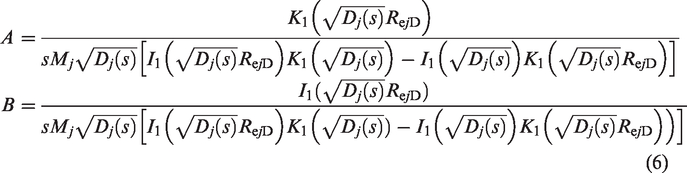
Thus the solution of mwf
j
rD in Laplace domain with consideration of damage skin effects can be expressed by:
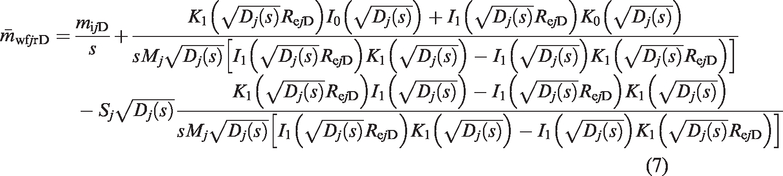
In equation (7),

For simplicity, the well bottom-hole pseudo-pressure for different layers is assumed to be equal:

After simple transformation of equation (8), the dimensionless production rate in Laplace domain,

Substituting equation (10) into equation (40), and taking appropriate transformation, the dimensionless well bottom-hole pseudo-pressure in Laplace space can be given by:

Furthermore,


The detailed solution process for this model is similar with the method proposed by Meng et al. (2018), and can be divided into five steps: (1) Calculate the cumulative production of individual layer (see Appendix 2), and determine the formation average pressure of each layer with MBE (material balance equation). (2) Compute the pseudo-time factor and dimensionless time after obtaining the values of stress-sensitive permeability, pressure-dependent gas viscosity and compressibility. (3) Calculate the dimensionless well bottom-hole pseudo-pressure and dimensionless production rate of individual zone. (4) Apply the Stehfest numerical inversion to calculate the above values in real space, according to equations (12) and (13), and the relationship of mw and pwf, calculate pwf and qg j , then go to step (1) and repeat above steps.
Results and discussion
Validation
Comparisons with the classical results
Lefkovits et al. (1961) firstly presented the analytical solutions to study the production and pressure behaviors in a two-layer reservoir with uniform pressure, in which the fluids properties, such as viscosity and compressibility, are assumed to be constant, and the formations merely have matrix. They designed two cases that assumed that in the first case diffusivity ratio for the first and second layers are 0.91 and 0.09, for the second case the diffusivity ratio of the first and second layers are 0.55 and 0.45. The dimensionless radius for both cases is 2000. Additionally, they assumed that the mobility ratio is identical to the diffusivity ratio for each layer.
To verify the accuracy of the proposed model in this paper, the presented model is simplified and the above parameters are used to calculate the fractional flow rate of the high permeable layer and the wellbore pressure. Although during the derivation of proposed model the fluids properties are assumed to be dependent on pressure, in dimensionless space the solution has no relationship with the pressure-dependent fluids properties. In addition, according to the assumption in physical model section, all layers can be simplified into the single medium with matrix only. Then, it is reasonable to compare the results of Lefkovits et al. (1961) with the solution in this model. Figure 3 shows the comparisons of the results in dimensionless space obtained by Lefkovits et al. (1961) and the presented model in this paper. It can be seen that there is a good agreement of production and pressure for two cases between the published results and this paper, which indicates that the proposed model for a two-layer reservoir with uniform pressure is valid.
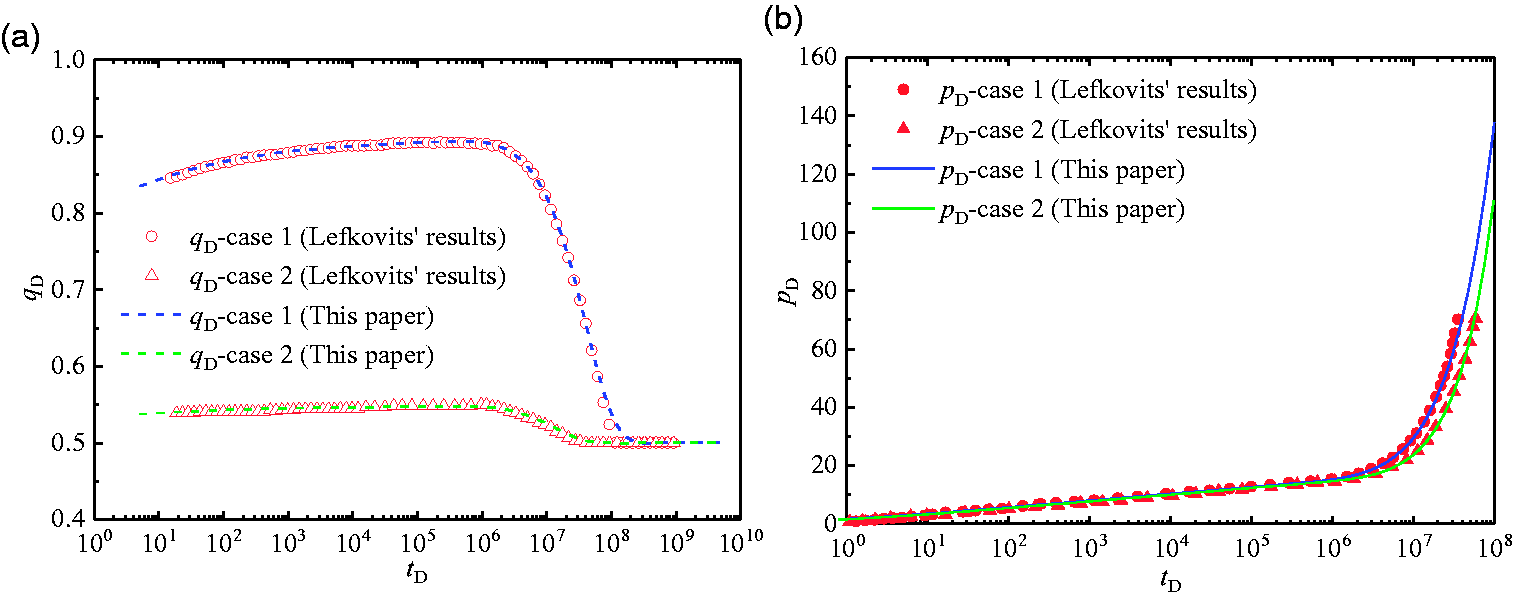
Comparisons of (a) dimensionless production and (b) dimensionless pressure data taken from Lefkovits et al. (1961) in Figures 2 and 3.
Field data matching
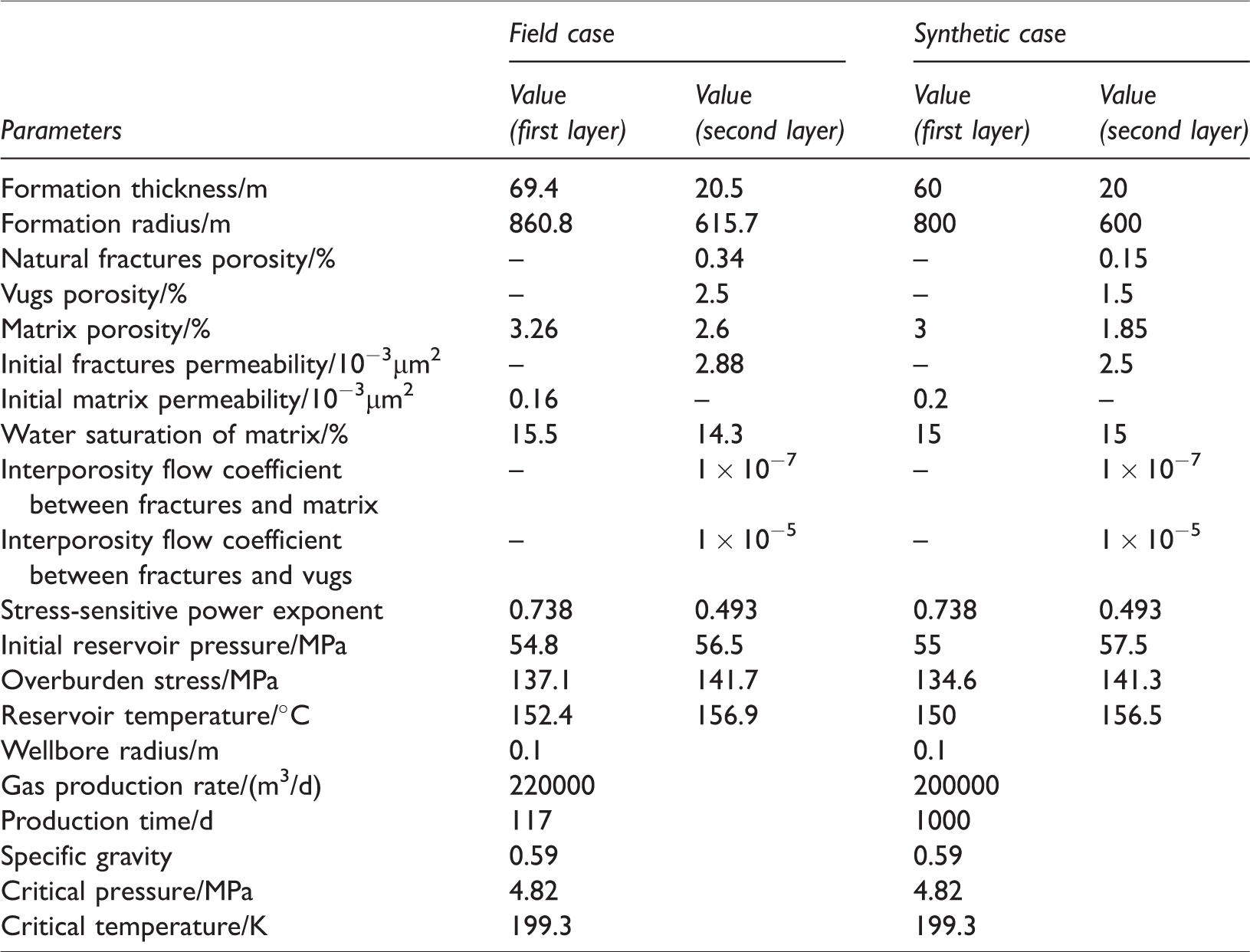
To verify the validity of the presented model further and demonstrate the application in practice, a field case with two layers from the Gaoshiti-Moxi carbonate gas reservoir is utilized to validate the accuracy of the proposed model. To calculate the well bottom-hole pressure accurately, it is crucial to collect the reliable formation and fluids parameters, which are listed in the first two columns of Table 1. In this case, formation thickness, water saturation and porosity for natural fractures, vuggs and matrix are determined through well logging. Natural fractures and matrix permeability, interporosity flow coefficients, and initial reservoir pressure and temperature are obtained from well testing analysis. As the gas reservoir is in the initial stage of the exploitation, the well always produces with a constant flow rate, but it is difficult to estimate the production rate for each layer. Therefore, the well bottom-hole pressure data are monitored and collected to match the results calculated with the proposed model, as shown in Figure 4. It can be seen from Figure 4 that although in semi-log scale initially the calculated results with this model is lower than field data due to the effect of wellbore storage, generally, the curve matching between the field data and the presented model is excellent, which indicates that the model can predict the well bottom-hole pressure in the future accurately. Moreover, the excellent match in Figure 4 also demonstrates the validity of this model.
Formation, fluids and production parameters used in field and synthetic cases.
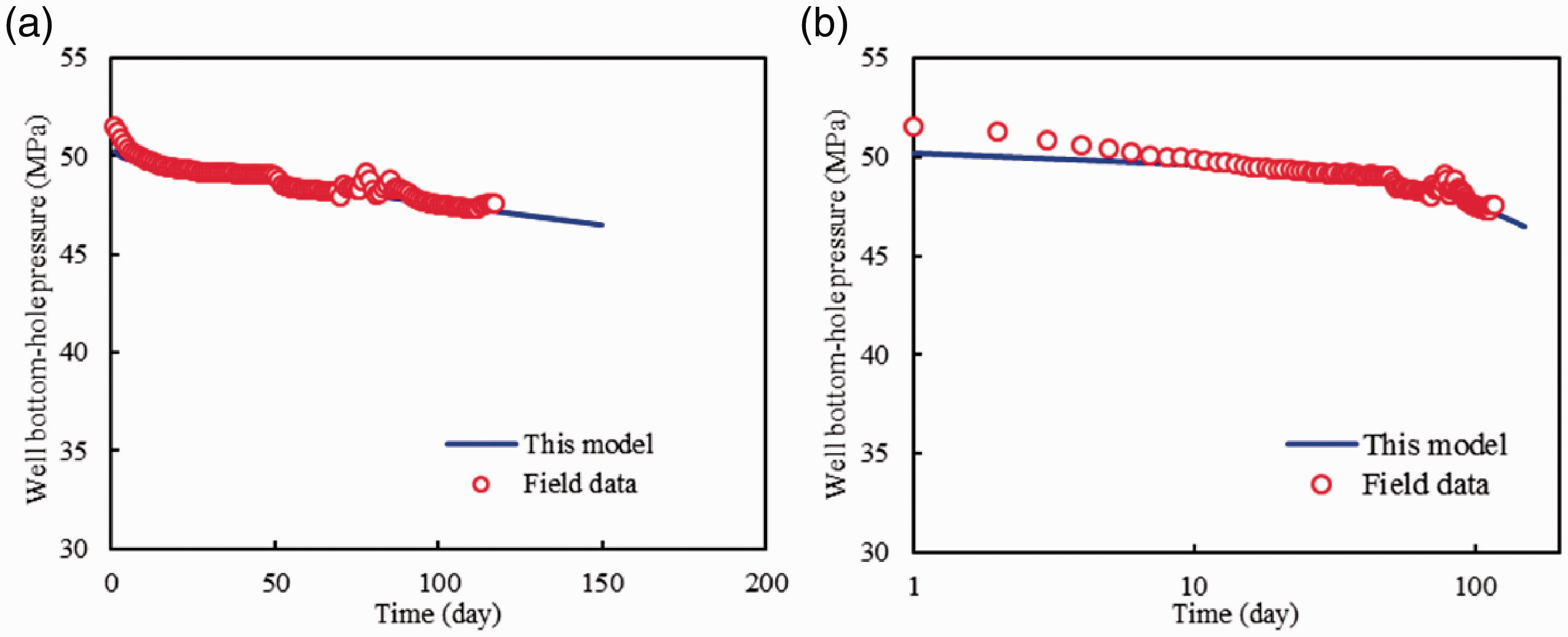
Match of well bottom-hole pressure data with the proposed model in (a) Cartesian coordination system and (b) semi-log coordination system.
Sensitivity analysis
Formation properties and well conditions, which include stress-sensitive power exponents, formation radius, permeability, and skin factors for each layer, have significant impacts on production performance in multilayer stress-sensitive carbonate gas reservoir. Therefore, based on the data of field case, a synthetic case is set up (the last two columns in Table 1) to analyze the above key factors on gas well production behaviors in multilayer commingled stress-sensitive carbonate gas reservoir.
Stress-sensitive power exponents
Figures 5 and 6 show the effects of stress-sensitive power exponent for the first and second layers on the production performance of each layer and gas well. In the figures of production rate for each layer, for instance, in Figures 5(a) and 6(a), the dashed and solid lines represent the production rate of the first and second layer, respectively. Figures 5 and 6 show that the formation permeability declines with the rise of stress-sensitive power exponent. Consequently, with the increase of stress-sensitive power exponents, it is obvious that the gas well bottom-hole pressure decreases, and the contribution of gas production rate declines, for both layers. As the initial gas production mainly comes from the second layer, in Figure 6(b), the bottom-hole pressure decreases drastically and the differences of bottom-hole pressure are large for three cases at the initial stage. While the first layer contributes mostly to the well production in the later period, with the increase of time, the differences in bottom-hole pressure reduce in Figure 6(b) and enlarge to some extent in Figure 5(b).
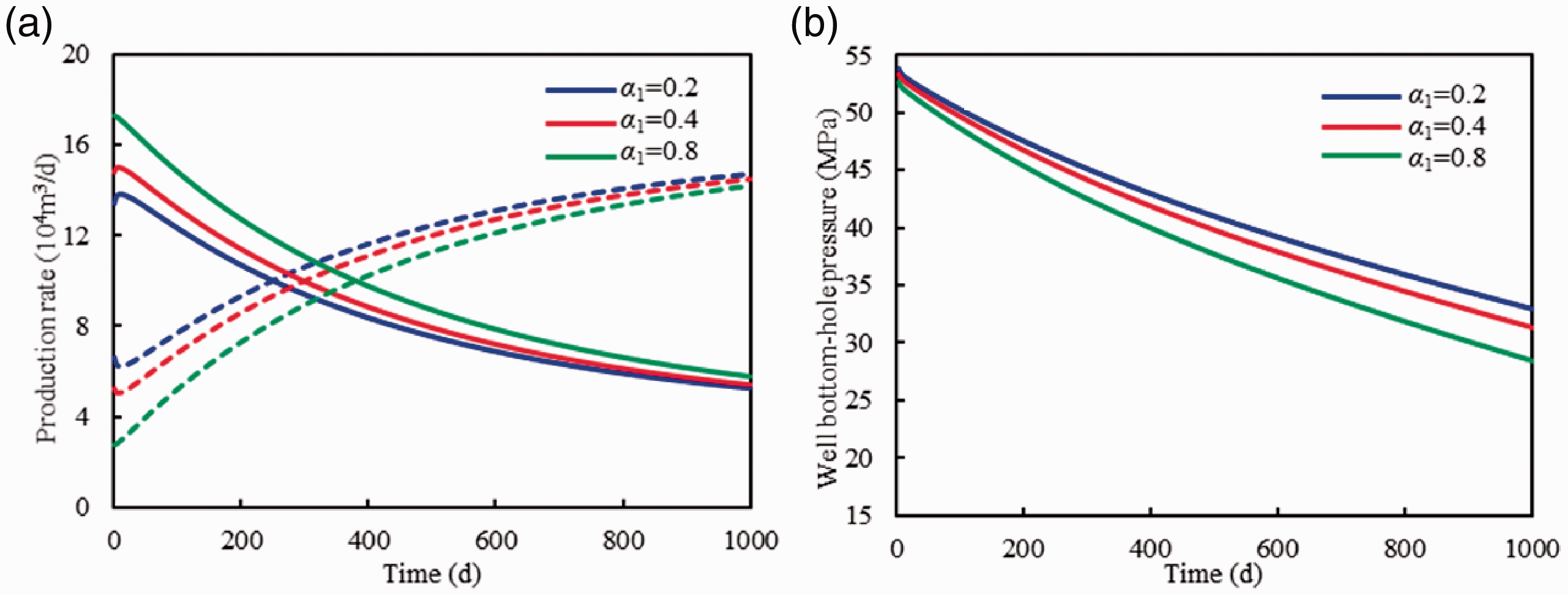
Effect of stress-sensitive power exponent for first layer on (a) production rate for each layer and (b) well bottom-hole pressure.
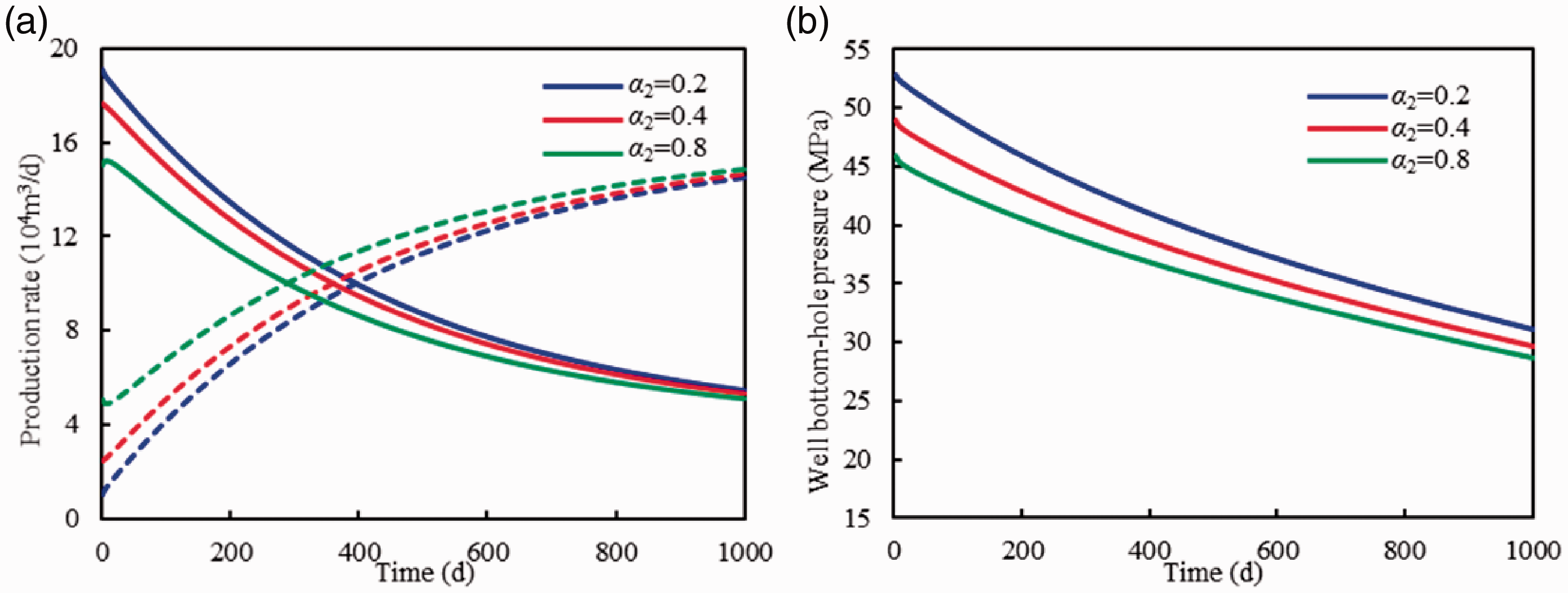
Effect of stress-sensitive power exponent for second layer on (a) production rate for each layer and (b) well bottom-hole pressure.
Formation radius
Figures 7 and 8 show that the size of the formation radius for the first and second layers has a diverse effect on the production behavior of each layer and gas well. When formation radius for certain layer enlarge, then the gas reserve of this layer will increase, while other formation parameters keep constant. The first layer is tight and has lower permeability, and contributes to the gas well production at a later stage. Hence, it can be seen from Figure 7 that initially for cases with different formation radius of the first layer, the production rate for each layer and the bottom-hole pressure are almost identical. When the time is longer than 400d, the first layer begins to contribute to the well production, which causes the production of this layer and bottom-hole pressure to increase with the formation radius. Whereas, the second layer with larger permeability is full of fractures and vugs, and contributes to the well production initially, which leads to the rapid rise of production rate for the second layer and bottom-hole pressure, with the increase of formation radius, as shown in Figure 8.
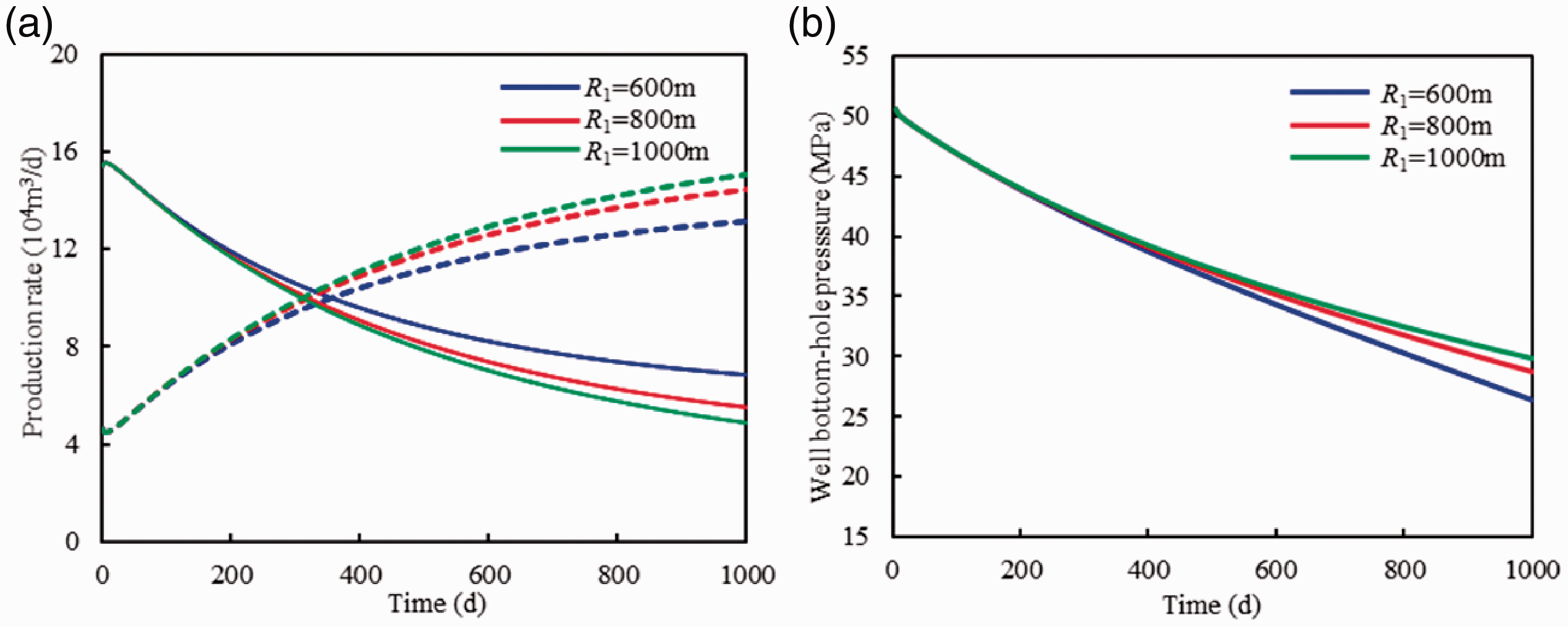
Effect of formation radius for first layer on (a) production rate for each layer and (b) well bottom-hole pressure.
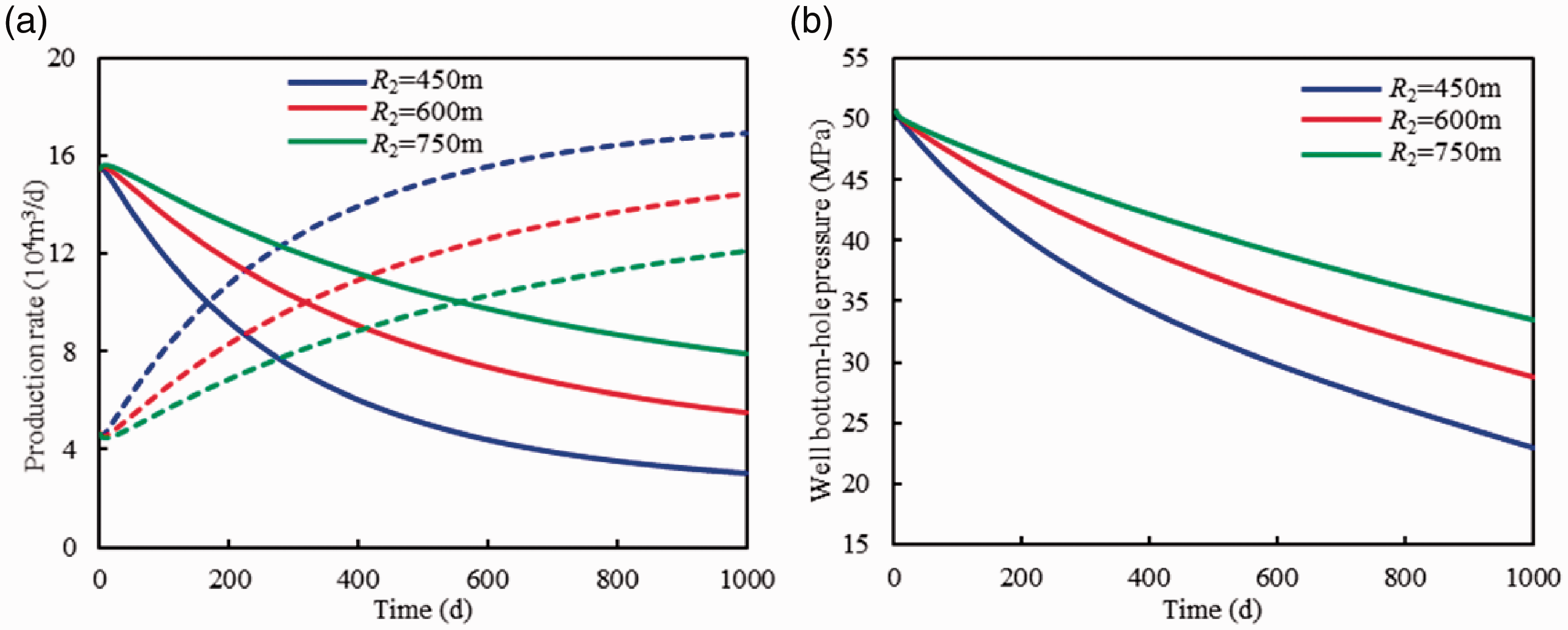
Effect of formation radius for second layer on (a) production rate for each layer and (b) well bottom-hole pressure.
Formation permeability
The influences of formation permeability for each layer on production performances are shown in Figures 9 and 10. Compared Figure 9 with Figure 10, it is obvious that the permeability of first layer has a significant impact on production behavior, which means that the flow capacity of tight layer determines the well production performance. The increase of permeability for the first layer improves fluids flowing ability, which leads to the dramatic rise of production rate for this layer. The characteristics of successive production for different layers in a multilayer reservoir have conspicuous influence on production behavior. For instance, in Figure 10, initially, the production rate of second layer and bottom-hole pressure increase with the permeability, whereas in Figure 9, the discrepancies of bottom-hole pressure for different scenarios become larger in the later period. In addition, Figure 9 also shows that, as the increase of first layer permeability, the differences of bottom-hole pressure and production rate for first layer minimize, which indicates that there is optimal permeability to make the tight layer be exploited efficiently.
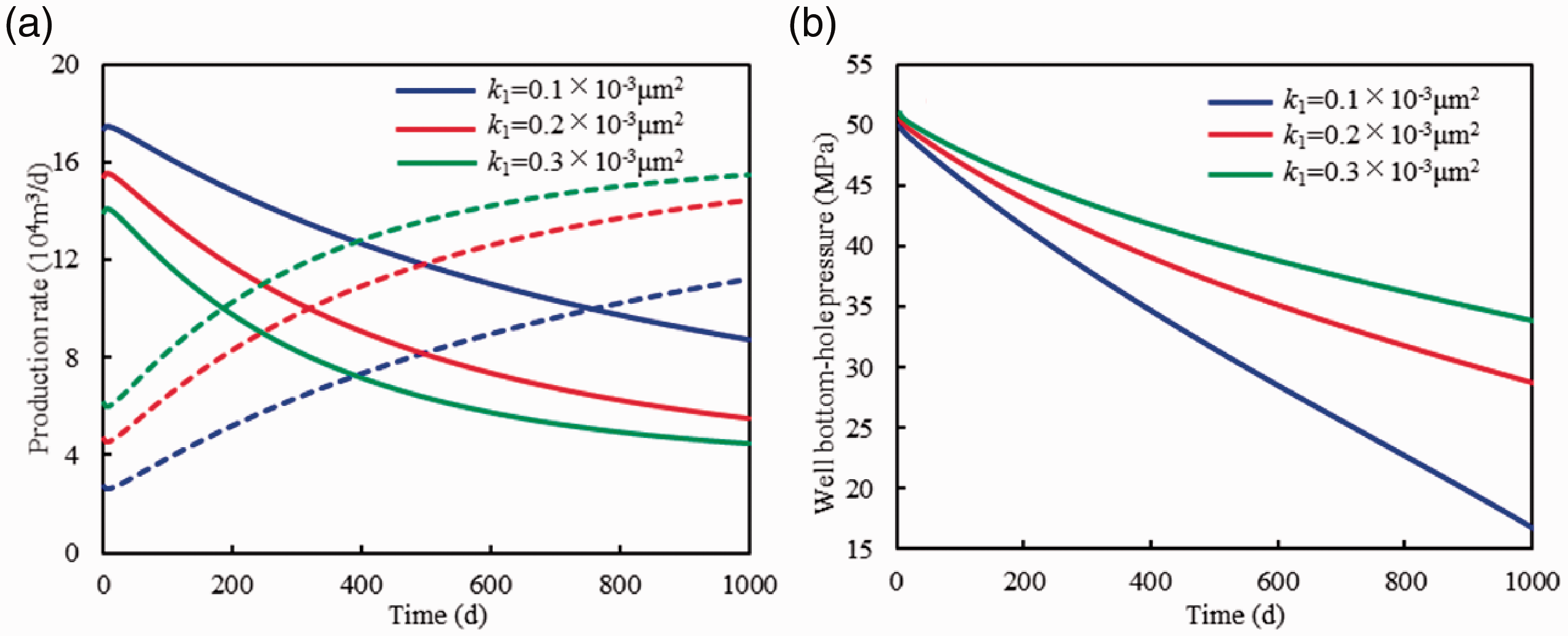
Effect of formation permeability for first layer on (a) production rate for each layer and (b) well bottom-hole pressure.
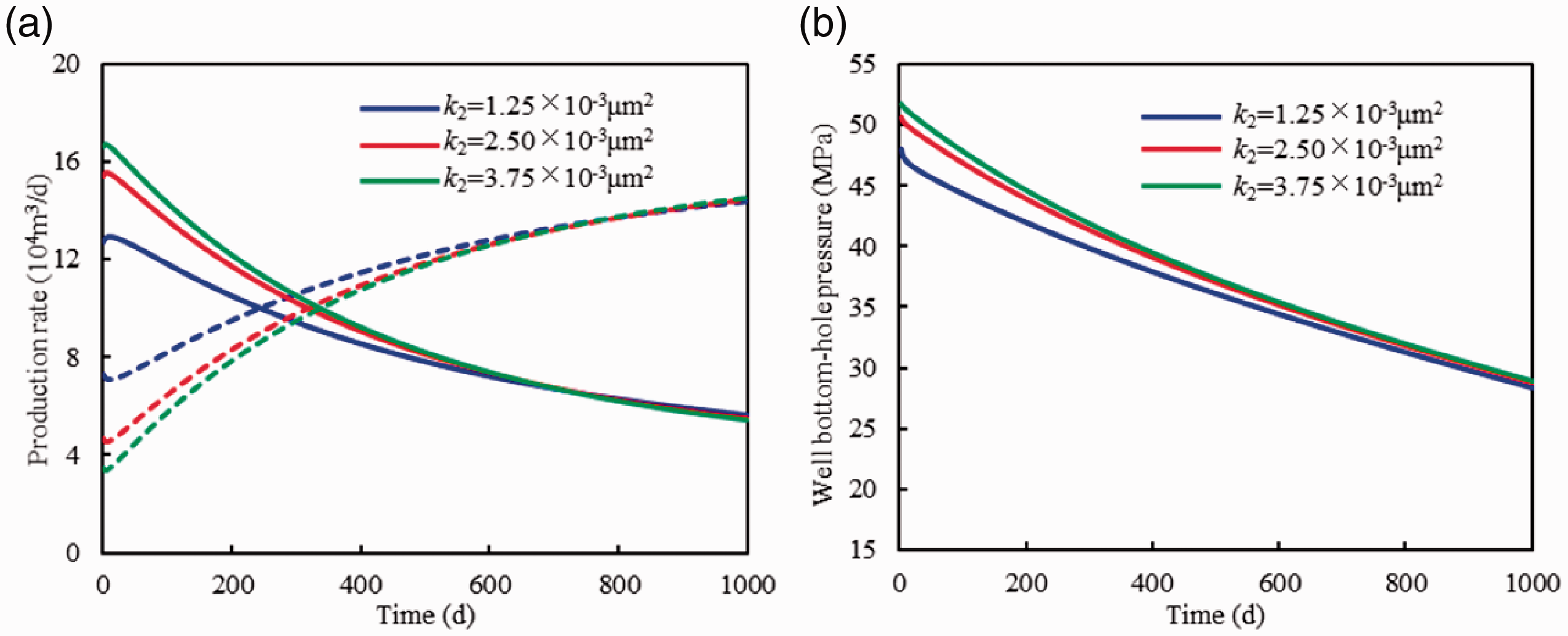
Effect of formation permeability for second layer on (a) production rate for each layer and (b) well bottom-hole pressure.
Skin factors
Figures 11 and 12 show that the skin factor for each layer has an important effect on the production proportion of individual layers and well bottom-hole pressure. The formation damage surrounding the wellbore increases with the skin factor, which results in the reduction of production rate and the decline of bottom-hole pressure. Thus, it can be seen from Figures 11 and 12 that the production rate for the first or second layer and well bottom-hole pressure decrease with the rise of skin factor. However, there exist conspicuous differences in the production rate for each layer and bottom-hole pressure, in Figures 11 and 12. The well condition of the first layer on production behavior is more significant than the second layer. The production rate of the first layer and the bottom-hole pressure decrease greatly with the increase of skin factor of this layer, and with the extension of production time, the gaps for different cases become larger. While for the second layer in Figure 12(a), when the time is earlier than 400d, the production rate and the bottom-hole pressure decline moderately with the rise of skin factor. The above variation features for production behaviors can also be explained with the theory of successive production for a multilayer system. Additionally, through the comparisons of Figures 11 and 12, it can also be concluded that mitigation of formation damage for the tight layer could improve the gas well production performance.
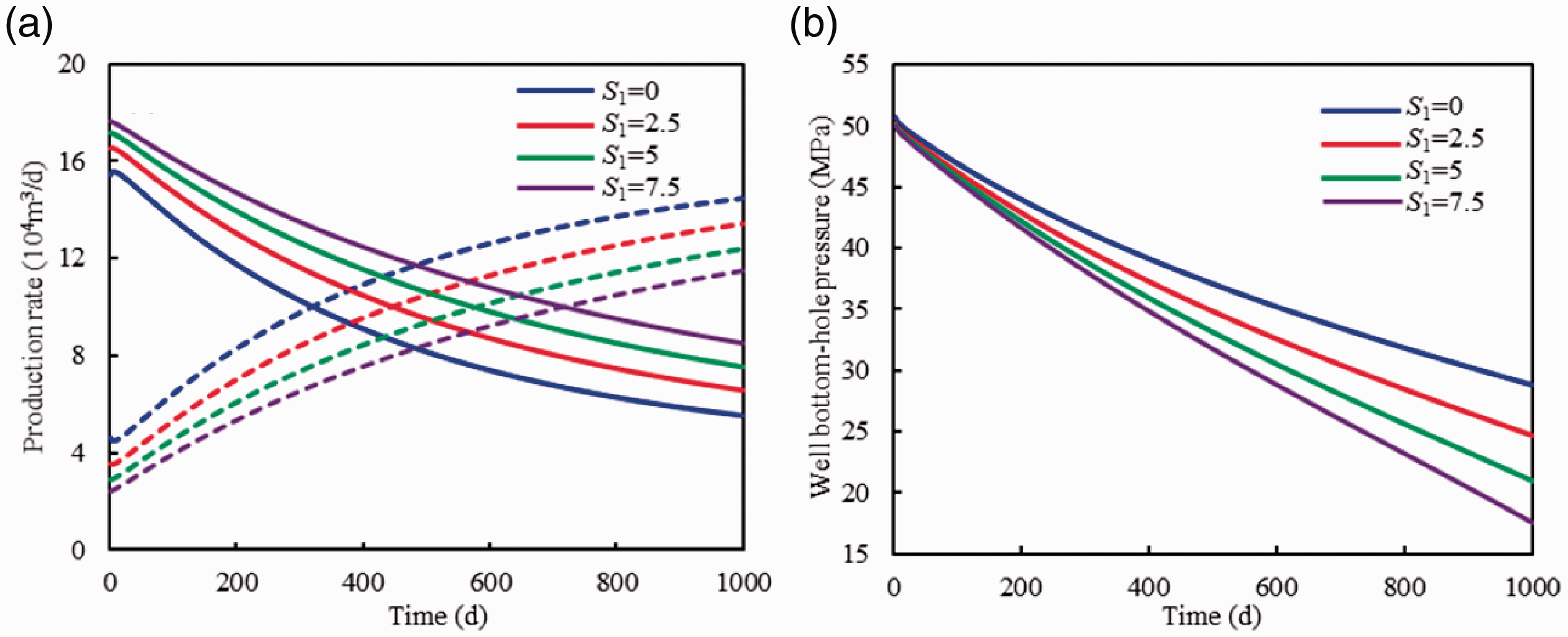
Effect of skin factor for first layer on (a) production rate for each layer and (b) well bottom-hole pressure.
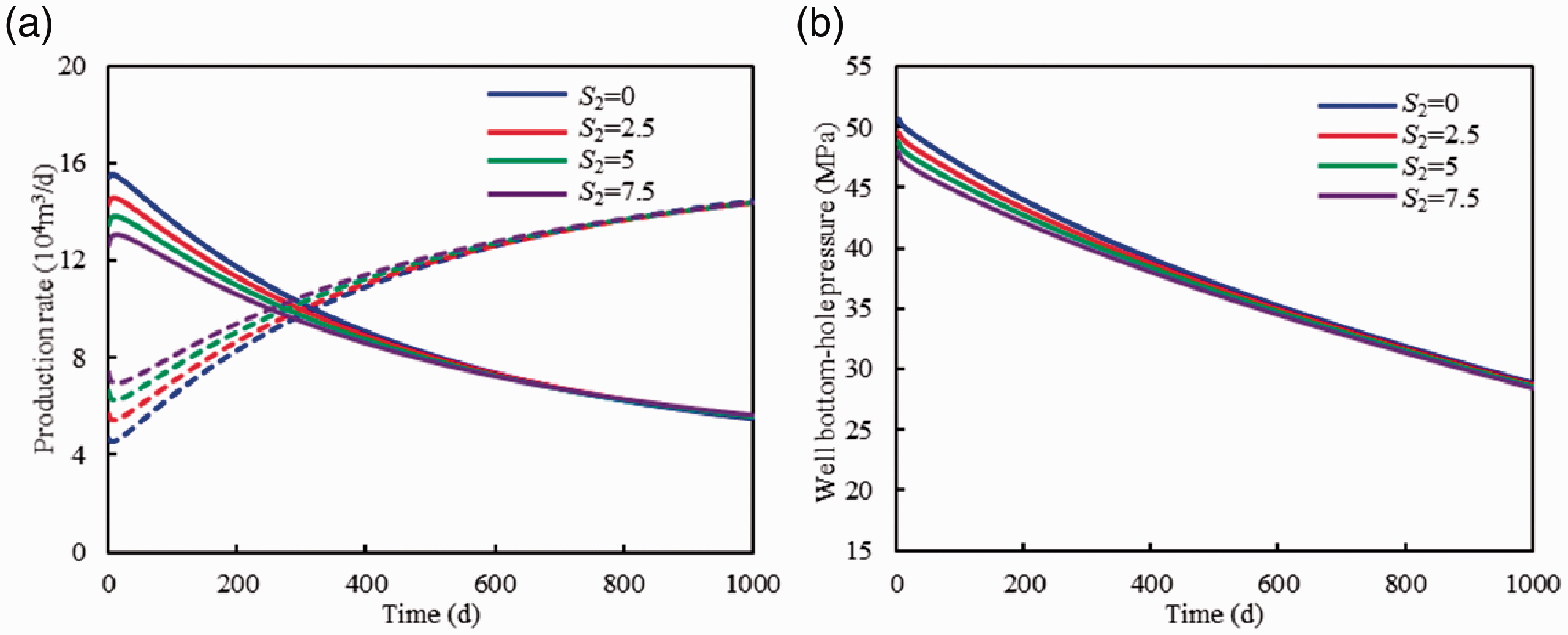
Effect of skin factor for second layer on (a) production rate for each layer and (b) well bottom-hole pressure.
Conclusions
A semi-analytical model is established to study the production performances in a multilayer stress-sensitive carbonate gas reservoir, in which the stress-sensitive permeability is determined with the laboratory experiments. The validity of the proposed model is verified with the Lefkovits’s results, and a field case in the Gaoshiti-Moxi carbonate reservoir illustrates the applicability of this model. In addition, the effects of relevant factors on production behaviors are investigated. Several observations are highlighted:
Stress sensitivity of permeability for carbonate gas reservoir can be described appropriately with power function rather than the exponential function, and the stress-sensitive power exponents are estimated through the experiments. A large stress-sensitive power exponent for any of the layers will lead to the reduction of production rate for this layer and the decline of well bottom-hole pressure. The characteristics of successive production for a multilayer system are demonstrated through the analysis of production behaviors of gas wells. Initially, the gas production primarily comes from the layer with larger flow capacity, whereas the tight layer with lower permeability contributes mostly to the production in the later period. The formation permeability and skin effect for the tight layer have more significant influences on production performance than the layer with multiple fractures and cavities. The larger formation radius and permeability and the lower skin factor for the layer with high permeability can improve the production rate of this layer and the well bottom-hole pressure, at the initial stage.
Footnotes
Declaration of conflicting interests
The author(s) declared no potential conflicts of interest with respect to the research, authorship, and/or publication of this article.
Funding
The author(s) disclosed receipt of the following financial support for the research, authorship, and/or publication of this article: This work is supported by the National Science and Technology Major Project (2016ZX05015), CNPC Science and Technology Major Project (2016E-06) and the Recruitment and Cultivation Plan for Youth Innovation of University in Shandong Province.

Appendix
Appendix 1. Derivation of dimensionless pseudo-pressure for layer j
According to the presented physical model and assumptions, transport equation, equation of state and continuity equation are combined to derive the governing equations for layer j in multilayer commingled stress-sensitive carbonate gas reservoir. To consider the permeability stress-sensitivity and the other pressure-dependent gas properties, such as viscosity and density, pseudo-time factor and pseudo-pressure are introduced. Thus the governing equations for natural fractures, matrix and vuggs systems in layer j can be given by:
Natural fractures:
Matrix:
Vugs:
Initial conditions
Initially, the pressure prior to production for layer j is uniform and equal to pi
j
, so the initial conditions can be written as
Boundary conditions
The outer boundary is assumed to be laterally closed, thus
In addition, the outer boundary condition can also be assumed to be infinite or constant-pressure. For different layers, the outer boundary condition may not be identical.
The damage skin effect for the individual layer is considered, and then the inner boundary condition with constant production rate can be given by
In equations (13) to (20), mf
j
, mm
j
, mc
j
, mwf
j
and mi
j
are the pseudo-pressure of natural fractures, matrix, vugs, well bottom-hole and initial condition for layer j, respectively. βj is defined as the pseudo-time factor of layer j, and can be computed approximately under the formation average pressure. The definition for these parameters can be expressed by
To simplify the presented mathematical model, we assume that β1=β2=…=βj=…=βn, and some specific parameters and dimensionless variables are defined, as shown in equations (22) to (30):
In equations (28) to (30), ηjD, Mj and qjD should satisfy the following equation:
Through the application of dimensionless variables shown in equations (23) to (30) and the Laplace transformation, the governing equations, the initial and boundary conditions (equations (13) to (20)), can be transformed into dimensionless terms in Laplace domain:
Substituting equations (33) and (34) into equation (32) yields:
The general solution of equation (37) can be expressed by
Furthermore, in equation (31), the term about the sum of dimensionless production can be transformed into Laplace space:
Appendix 2. Calculation of pseudo-pressure and pseudo-time factor
To obtain well bottom-hole pressure through the method of interpolation, it is crucial to construct the relationship between the real pressure and pseudo-pressure. In equation (21), pseudo-pressure and pseudo-time factors are the functions of fracture permeability, viscosity, deviation factor, and compressibility. Fracture or matrix permeability of layer j, kf
j
, is pressure-dependent, and can be calculated with equation (1) at different pressure. The stress-sensitive exponent is varied with the types of formation. Gas deviation factor zj, gas viscosity μg
j
, and gas compressibility Cg
j
in layer j can be computed by the methods of Lee et al. (1966), Hall and Yarborough (1973) and Dranchuk et al. (1973), respectively. Since it is essential to estimate the average pressure of layer j during the calculation of pseudo-time factor βj, then MBE is used:
When the production rate of layer j is obtained with equation (13) at time step k, the cumulative gas production can be expressed by:
The integral for pseudo-time factor can be calculated with following equation: