




Abstract
Application of Weibull distribution in a generalized way to estimate wind potential cannot always be advisable. The novelty of this work is to estimate wind potential using Normal probability density function. A comparison of five probability distributions namely Normal, Gamma, Chi-Squared, Weibull, and Rayleigh was done using three performance evaluation criteria. Four years (2015–2018) hourly wind data at 50 m height at five stations near the coastline of Pakistan was used. It was found that normal distribution gives the best fit at each of these stations and against each evaluation criterion followed by Weibull distribution while Rayleigh distribution gives the poorest fit. Further energy generation by fifteen turbine models was calculated and GE 45.7 was found the best in terms of amount of energy generation and capacity factors while Vestas V42 shows the worst. However, GE/1.5 SL is the most economical while Vestas V63 is the least. Among five locations, Shahbandar is the best potential site while Manora is the least.
Keywords
Introduction
Continuous probability distributions are widely used to model various phenomenon in science, engineering, technology, and sociology, etc. (Silveira et al., 2019). Such distributions help a lot in solving real life problems e.g. analysis of material failure estimation, estimation of rainfall, prediction of water level, and various resource assessments (Sumair et al., 2020e; Seguro and Lambert, 2000); among resource assessments, one of the attractive field is wind resource assessment (WRA). As wind is an extremely random phenomenon, its magnitude varies diurnally, monthly, seasonally, and annually. Therefore, there is a dire need to model this widely varying random phenomenon before its exploitation at a particular area.
Wind power production potential at Hyderabad was estimated (Gul et al., 2019) using Weibull distribution. Two-years meteorological data (at 10 m height) was used to investigate the wind characteristics. Wind pattern were found to be steady based on monthly and seasonal variation analysis. Moreover, it was found that a wind speed of about 6 m/s can be observed throughout the year. Average annual wind power density and energy density were found to be 255 W/m2 and 2245 kWh/m2, respectively. Also, commercially available wind turbines could produces wind energy at $0.019 to $0.032 per unit of energy.
Analysis of incorporation of windmills in Karachi has been conducted and presented in (Aman et al., 2013). Four years wind data was used which was measured at five different hub heights of 10, 30, 50, 75, and 100 m was utilized. A case study was performed to show the effect of windmills installation, which showed that there would be an approximate savings of about 1678 MWh of energy provided that 50% of residential consumers make use of windmills.
Exploration of wind energy at Keti Bandar was made with the purpose of finding its feasibility to contribute towards the electrical energy generation of country (Ullah et al., 2010) using one-year wind data. Site was recognized with good wind potential. Hence, the site was shown to be a good candidate of wind energy utilization for both small scale and stand-alone systems. To model wind data, Weibull distribution has widely been used throughout the world (Andrade et al., 2014; Arslan et al., 2014; Bagiorgas et al., 2012, 2016; Baseer et al., 2017; Bassyouni et al., 2015; Safari and Gasore, 2010; Shami et al., 2016; Sumair et al., 2020c, 2020d; Khahro et al., 2014a, 2014b).
Many researchers have suggested that no single distribution should be used for wind potential estimation but a comparison of various probability distributions should be made to identify the best fit prior to the estimation of wind potential (Sumair et al., 2020e; Kollu et al., 2012; Lollchund et al., 2014; Pobočíková et al., 2017; Rajapaksha and Perera, 2016). Hence, it is neither advisable nor rational to always apply Weibull distribution for wind potential estimation without a comparison of various distributions.
The novelty of this work is to compare five probability distributions as no such comparison has been conducted in literature prior to estimate the wind potential using the best fit found. Moreover, current work estimates the wind potential using Normal distribution (rather than using Weibull distribution) which has not been used so far for WRA. As coastal area of Pakistan has been reported to possess about 43 GW of wind potential (Shoaib et al., 2017) but site-specific wind potential for many locations still needs to be investigated. Therefore, this work is concerned about the exploration of wind potential of five such locations situated in the coastal area of Pakistan as shown in Figure 1.
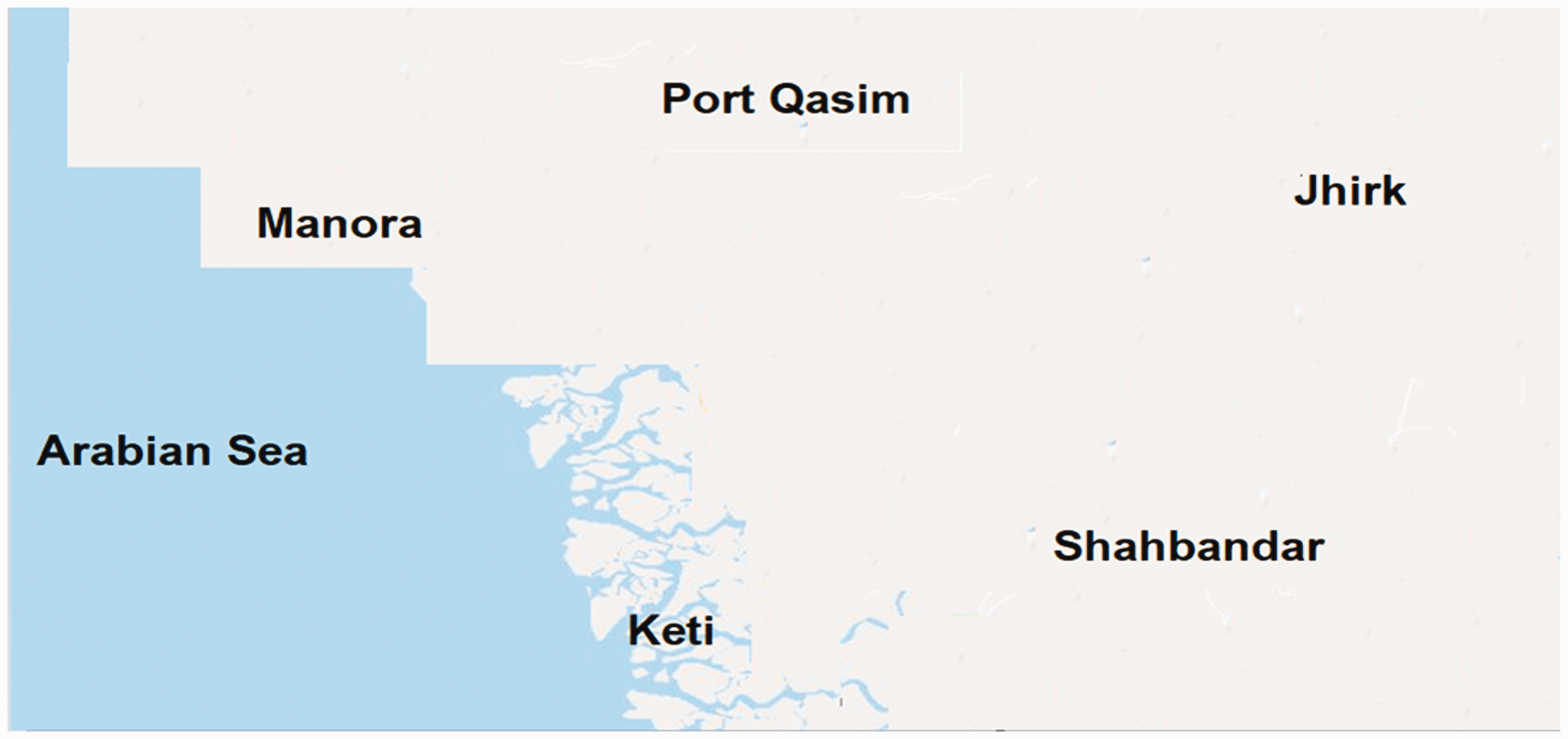
Geographical map showing five stations in the coastal area of Pakistan.
Materials and methods
A comparison among five probability distributions i.e. Normal, Gamma, Chi-Squared, Weibull, and Rayleigh distribution were carried out using four years hourly recorded wind data. Wind data was collected at 50 m height at five stations namely Jhirk, Keti, Manora, Port Qasim, and Shahbandar by Pakistan Metrological Department (PMD). Parameters of these distributions were estimated using Moment Method. Comparison was made using three performance evaluation criteria. Each distribution was ranked against each evaluation criteria followed by an overall ranking. Detailed effectiveness of wind energy production by turbines at selected sites was carried out. Finally, the results were validated using historical data approach.
Following five probability distributions were used in the foregoing study.
Normal distribution
The most widely used distribution throughout the entire statistical field is Normal or Gaussian probability distribution with two variables as µ and σ is given as follows (Ross, 2009, 2014; Walpole et al., 2011)

µ and σ are given by equations (2) and (3), respectively


Gamma distribution
Although Normal distribution is the most widely used distributions, some other distributions are also required to model some phenomenon. One such distribution is Gamma distribution, given as follows (Pobočíková et al., 2017; Ross, 2014; Walpole et al., 2011)


Method of moment (MOM) estimates of Gamma distribution are given as follows


Chi square distribution
As Gamma distribution is a generalized distribution; its special case is Chi Square distribution with α = µ/2 and β = 2 (Walpole et al., 2011). With these modifications, equation (4) becomes

Weibull distribution
Two parameters of this distribution are represented by K and C, and its density function is given below (Aized et al., 2019; Bagiorgas et al., 2012; Khahro et al., 2014a, 2014b; Shoaib et al., 2017; Sumair et al., 2020a; 2020b).



Rayleigh distribution
Just as Chi Square distribution is deduced from Gamma distribution; so is the case of Rayleigh distribution deduction with Weibull distribution with K = 2 and C = µ (Khahro et al., 2014a, 2014b). Thus, equation (9) assumes the following form

Performance comparison of distributions
Well-known and widely used statistical parameters have been applied to compare the performance of these distributions. These parameters i.e. R2, RMSE, and MAPE have been calculated using equations (13) to (15), respectively



Wind power density
Wind power density is calculated using following relationship

However, while modeling the wind data using probability density functions, a more realistic approach to find power density is to use equation (17) (Manwell et al., 2010).

Applying normal probability density function in equation (17), we get the following relationship for wind power density estimation


Energy Generation Effectiveness Analysis
Theoretically, wind carries a certain amount of potential but this whole potential can never be exploited because of the limitations imposed by turbine and energy extraction system's inefficiencies. Therefore, to take into account these facts, power produced by a typical extraction system is evaluated by equation (20) (Manwell et al., 2010).

Cp in equation (20) is power coefficient, given by Betz criterion (16/27) (Khahro et al., 2014b) and η is drive train effcicnecy (assumed 100%). As there are always fluctuations in wind speeds and the occurrence with which a certain wind blows, hence a more realistic approach is to evaluate average power using following equation (21)

Once the power is evaluated, energy, AEP, can simply be evaluated by multiplying it with time T over which energy generation is under consideration

As mentioned above that any energy or power extraction system has its own inherent inefficiencies which cause the reduction of power production, there is a need to describe how well a system or turbine is performing relative to its maximum possible capacity. One such parameter used to describe this performance is capacity factor (CF), given in equation (23)

However, economic feasibility of a power project cannot be determined from CF only. A turbine having low CF is not necessarily unfeasible. Thus to evalutae the economic feasibility, other parameters such as given in equation (24) and (25) below, are required to be calculated.

PP is the time period (usually measured in years) in which a project recovers its total cost. And

NPV is algebraic difference between two quantities; input to any project and output form that project, both in terms of money. NPV can be evaluated with the help of equation (26) with I as investment, j as rate of interest, m is a constant which is taken as 0.3I and t as approximate lifetime of power extraction system

Results and discussions
Comparison of probability distributions
As there are certain parameters or variables needed to completely define any distribution and to apply it for probability determination, these required parameters were estimated and separately written in Tables 1 to 3. As the purpose of applying more than one distributions was to compare them before actually making a wind potential estimation, therefore, efficiency of these distributions were analyzed and compared, as written in Table 4. Each distribution has been ranked (at a scale of 1–5 with 1 as the best performance and 5 as the least) against each evaluation criteria for each station and then an overall ranking has been done. Comparison of performance of all these five distributions shows that, for each of the studied station, it is not the Weibull distribution which can evaluate wind potential with the highest accuracy but is the Normal distribution. However, Weibull distribution has been found to generate second highest degree of accuracy. Whereas the performance of Rayleigh distribution is the worst with Gamma and Chi-Square distributions lying in between these extremes with Gamma distribution giving superior performance than Chi square. Graphical representation of these distributions has been shown in Figures 2 to 6, respectively.
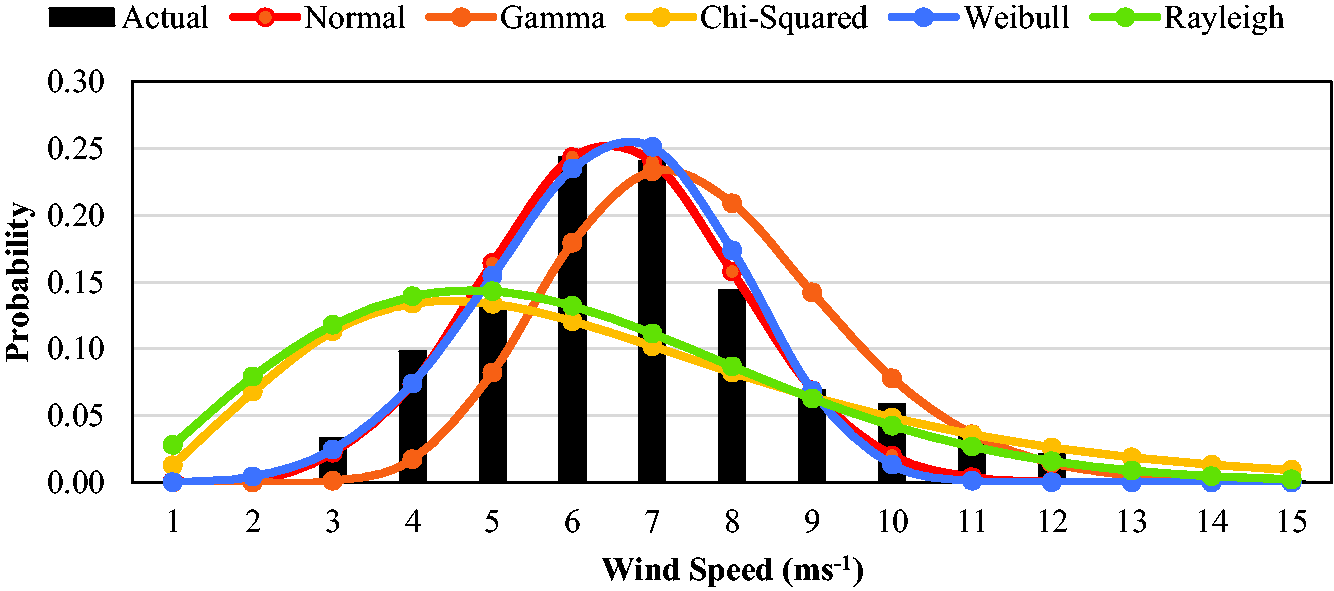
Performance assessment of all distributions at Jhirk station.
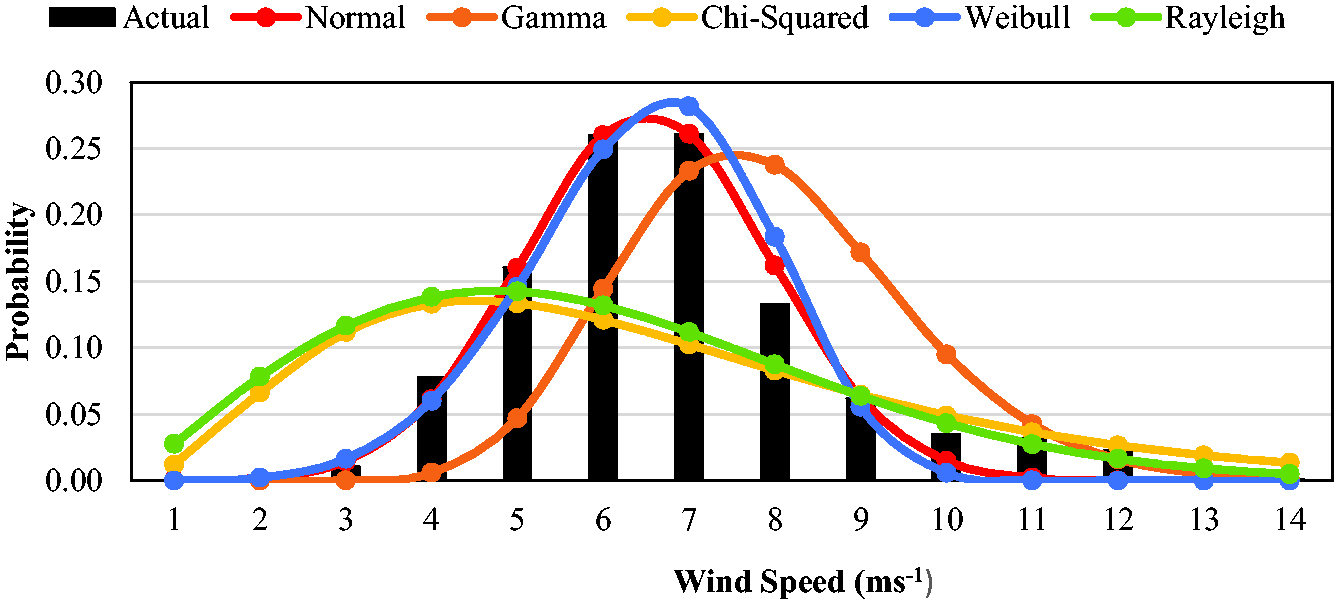
Performance assessment of all distributions at Keti station.
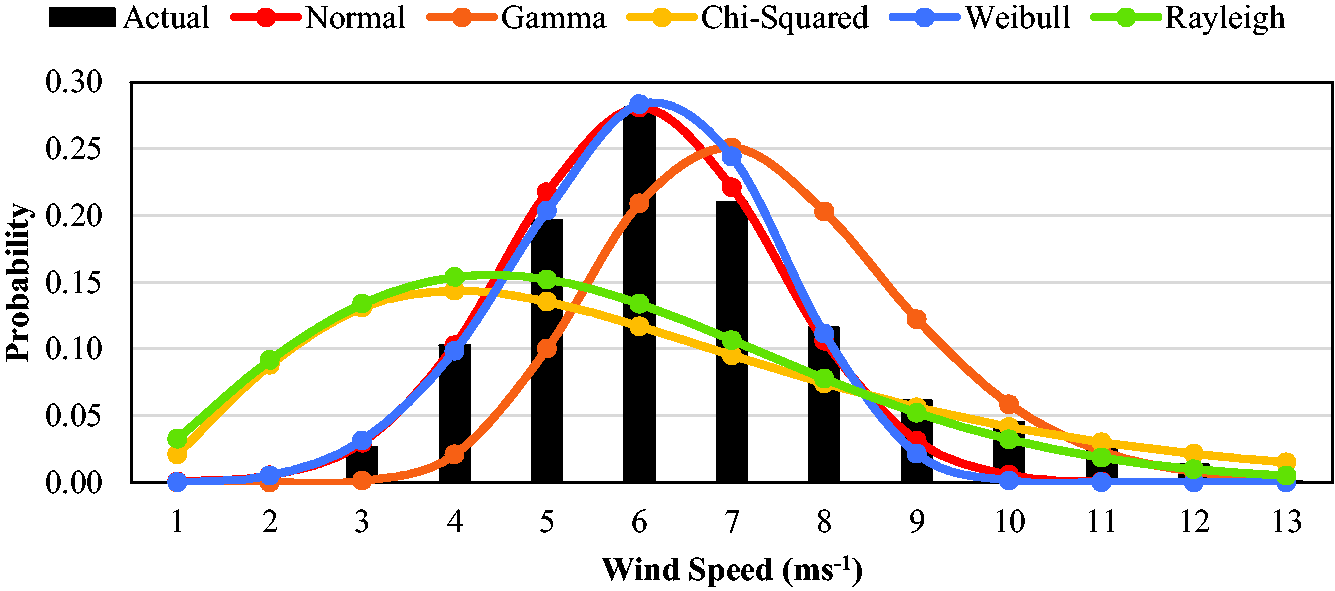
Performance assessment of all distributions at Manora station.
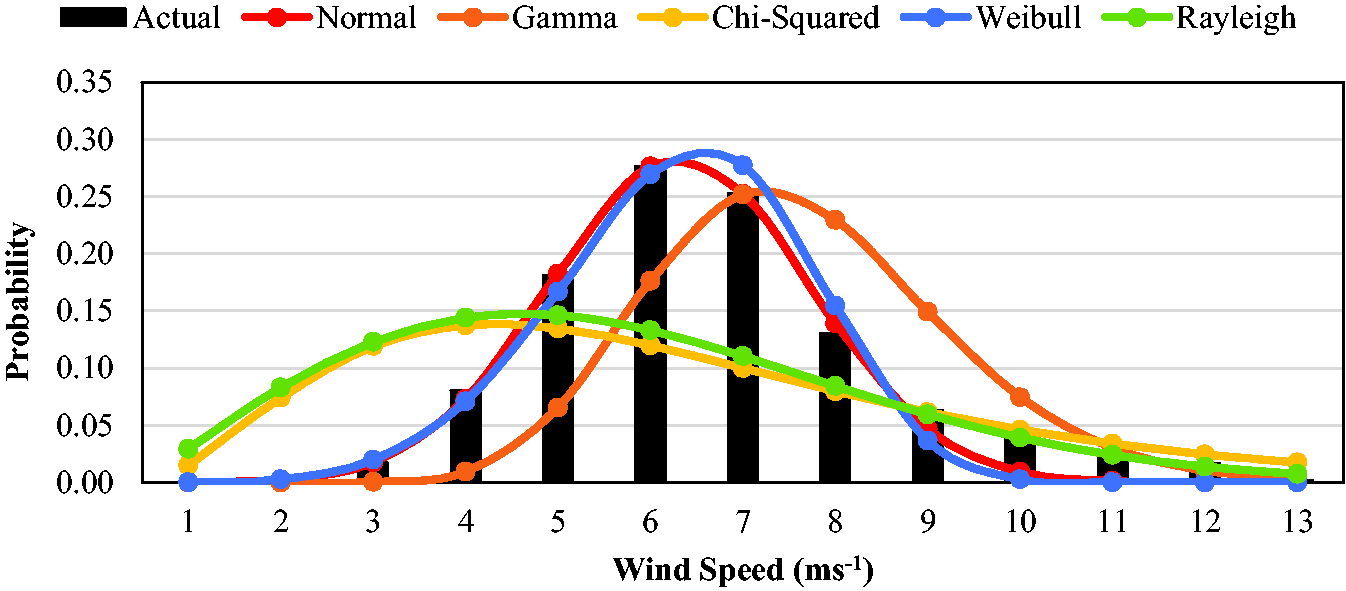
Performance assessment of all distributions at Port Qasim station.
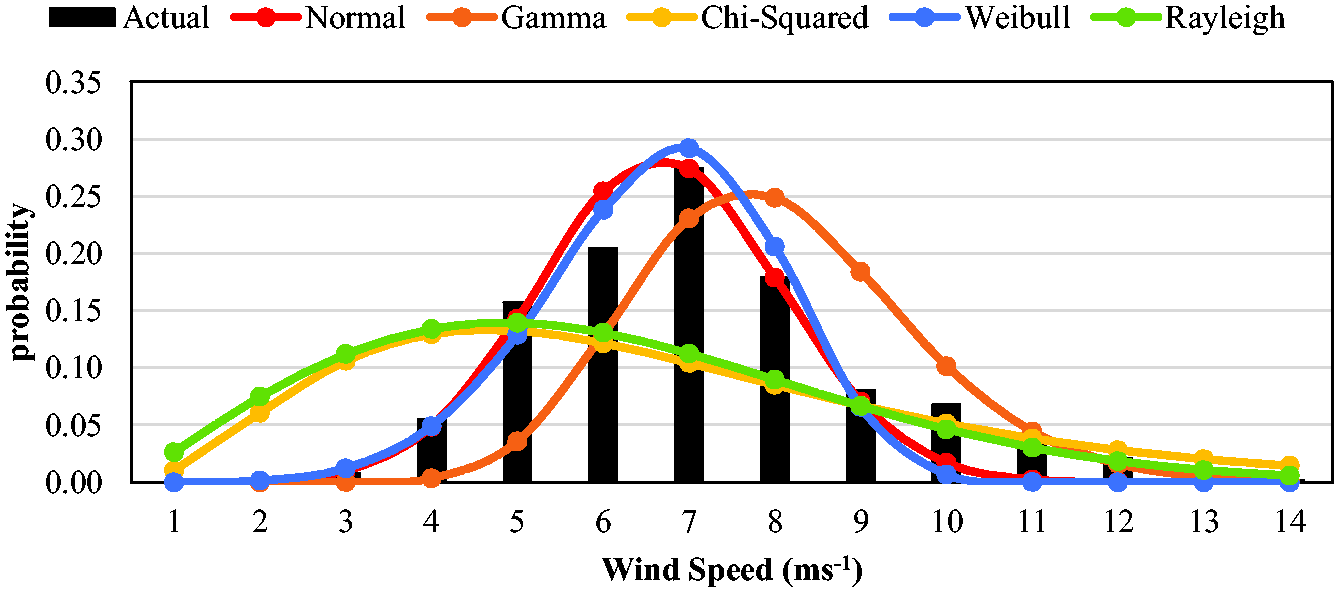
Performance assessment of all distributions at Shahbandar station.
Monthly average values of normal distribution parameters at each station.
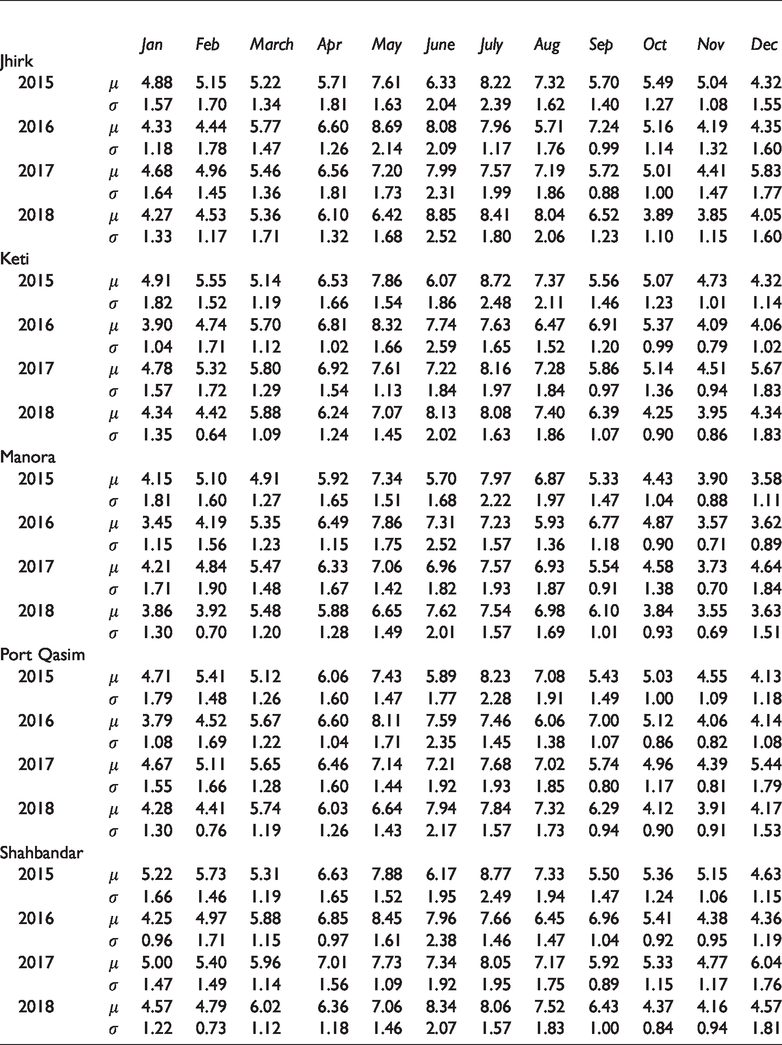
Monthly average values of gamma distribution parameters at each station.
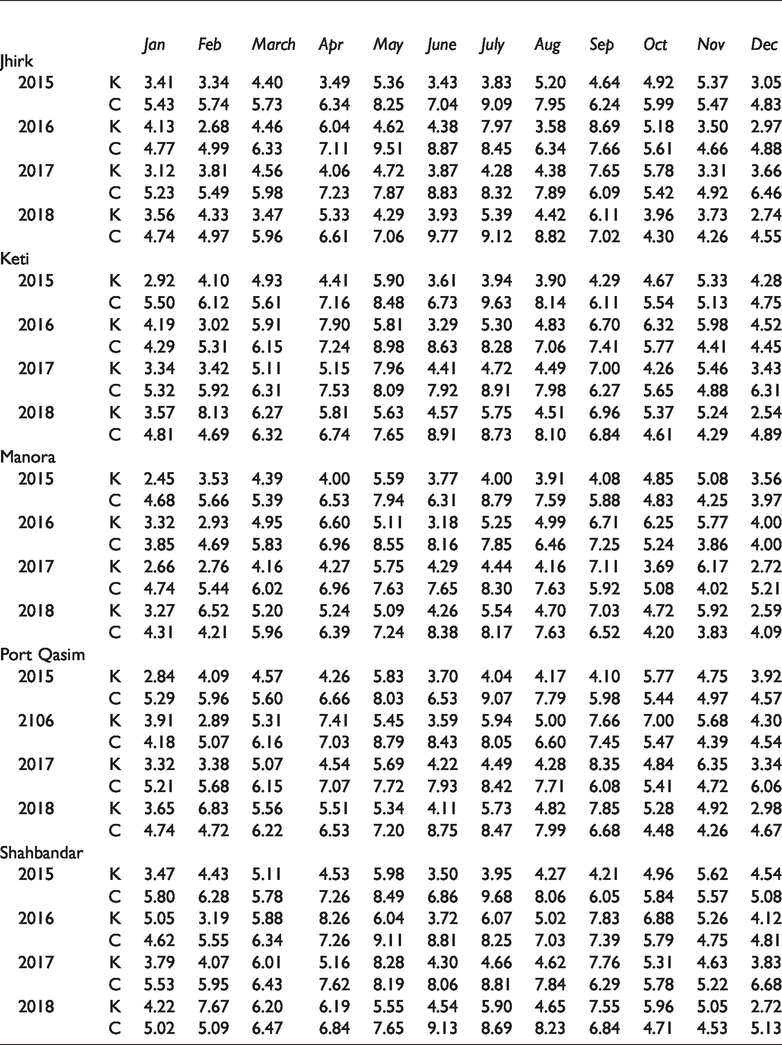
Monthly average values of Weibull parameters at each station.
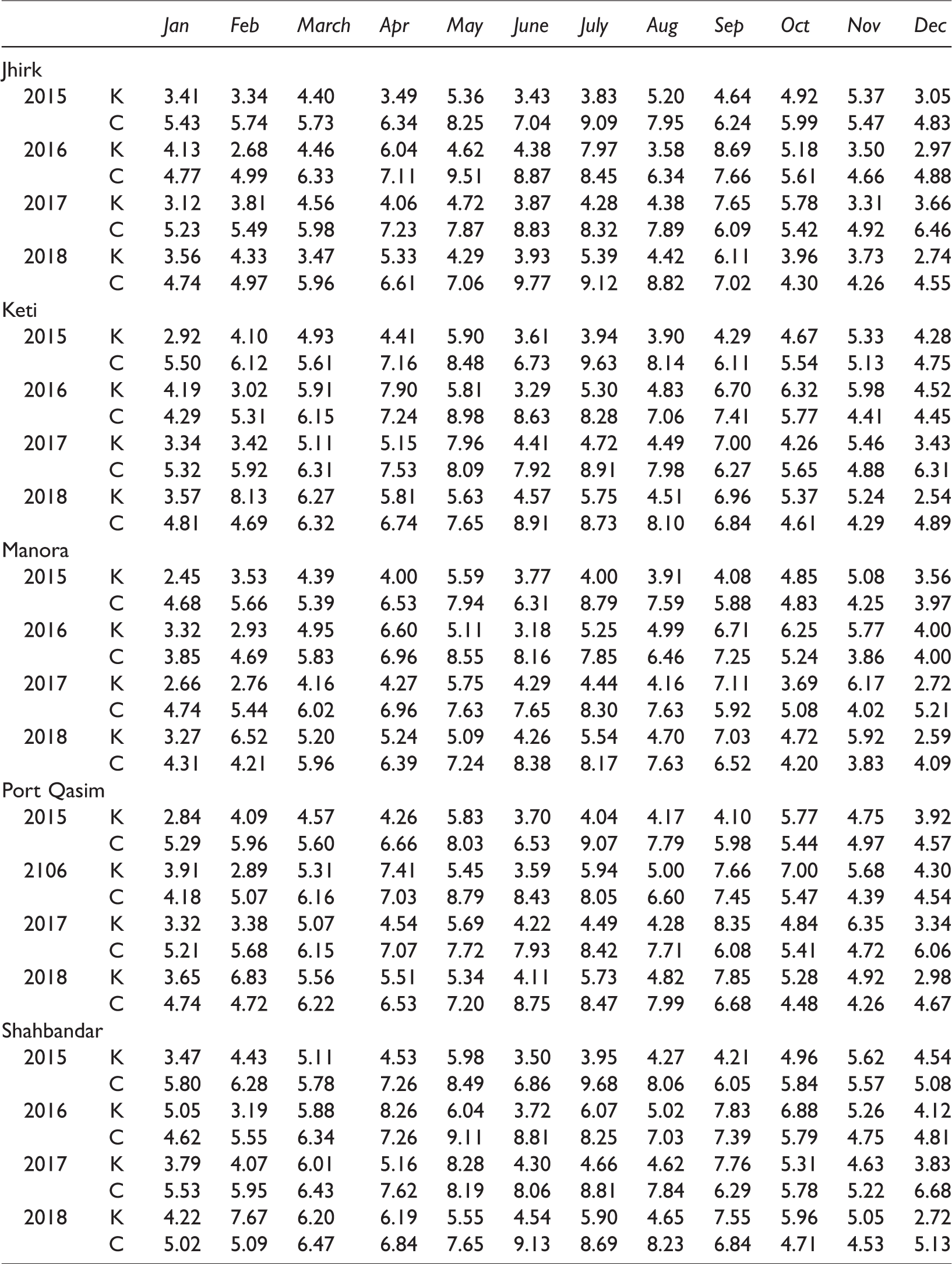
Comparison of five probability distributions based on R2, RMSE and MAPE.
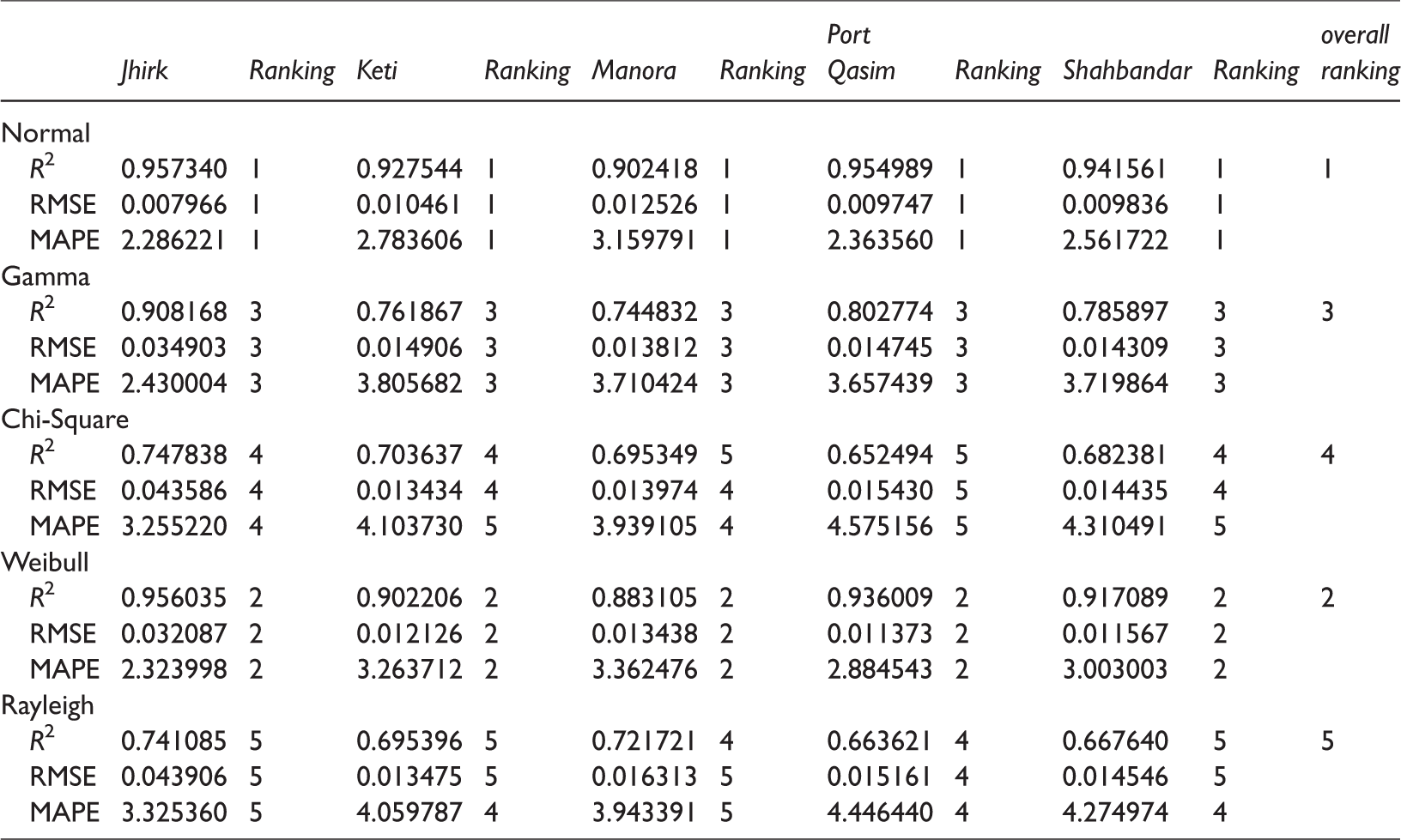
Monthly and seasonal variation in wind speed and wind power density
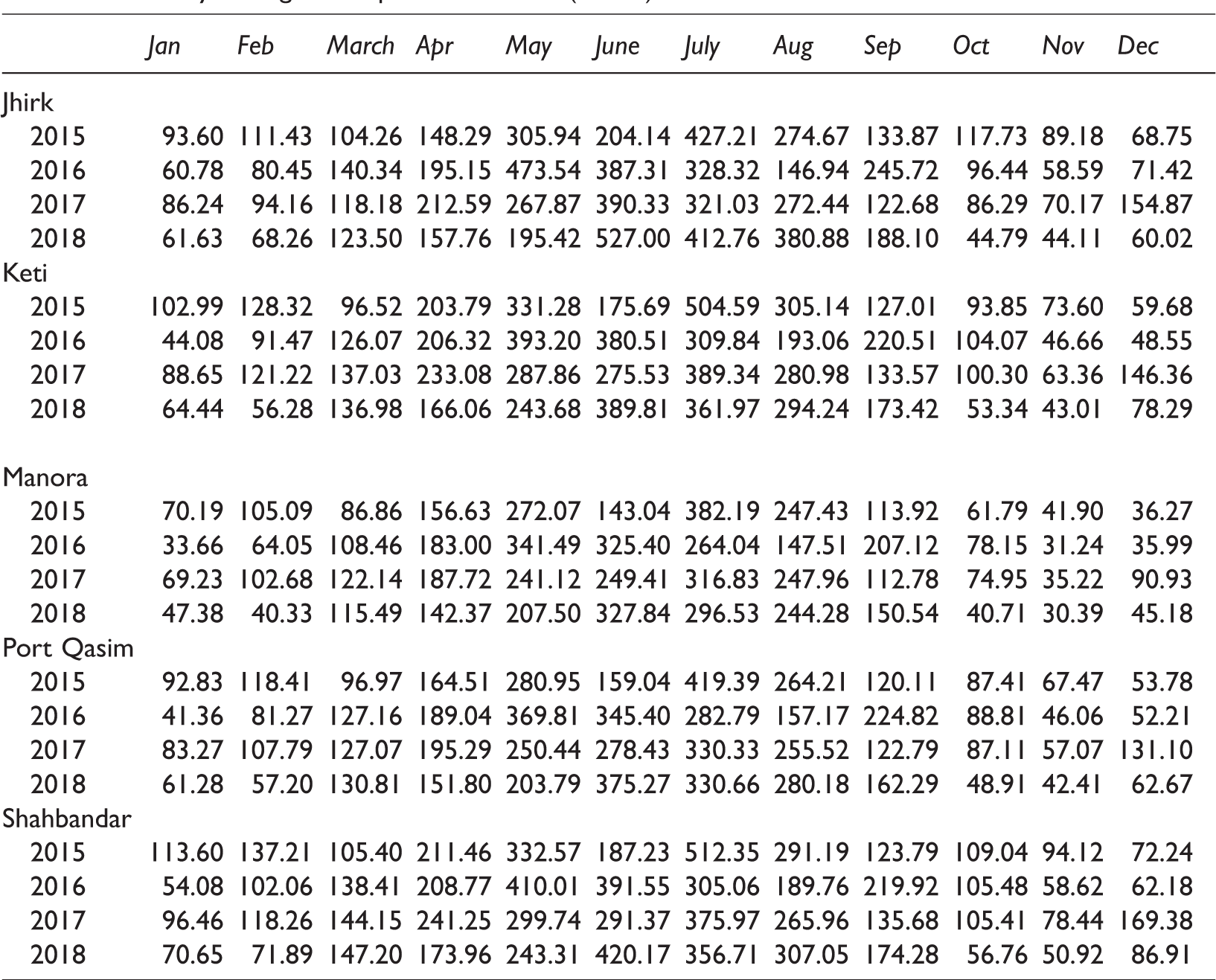
Figures 7 to 16 represent the variation observed in wind speeds on monthly and seasonal basis at all investigated locations. Analysis shows that wind blows with maximum speed in July and with minimum speed in January at all locations. Moreover, comparison of overall mean wind speed is depicted in Figure 17, which shows that Shahbandar has the highest mean wind speed while Manora has the lowest among all investigated locations with mean values of 6.15 and 5.52 m/s, respectively. Similarly, monthly and seasonal variation in wind power density has been shown in Figures 18 to 27 at all investigated locations as listed in Table 5. Analysis shows that maximum wind power density is observed in summer (July) and minimum in winter (January). Moreover, comparison of four years average values of wind power densities at all locations has been shown in Figure 28, which shows that Shahbandar has the highest value of wind power density while Manora has the lowest with values of 187.87 and 147.44 W/m2, respectively.
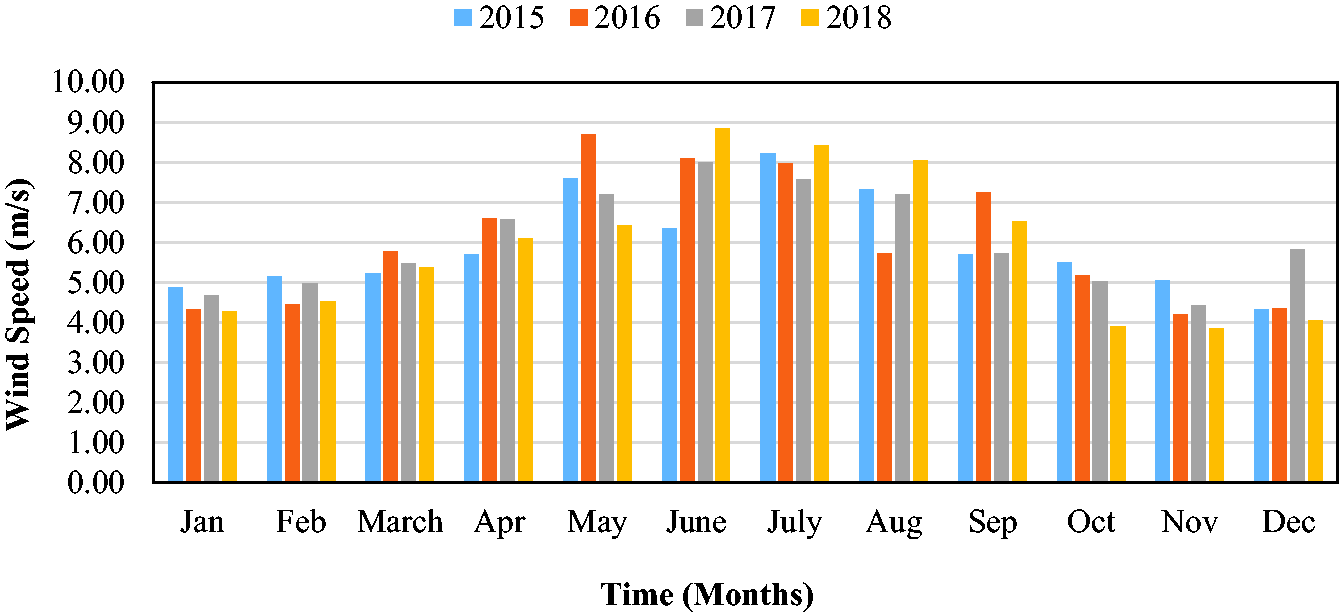
Variation observed in wind speed at Jhirk on monthly basis.
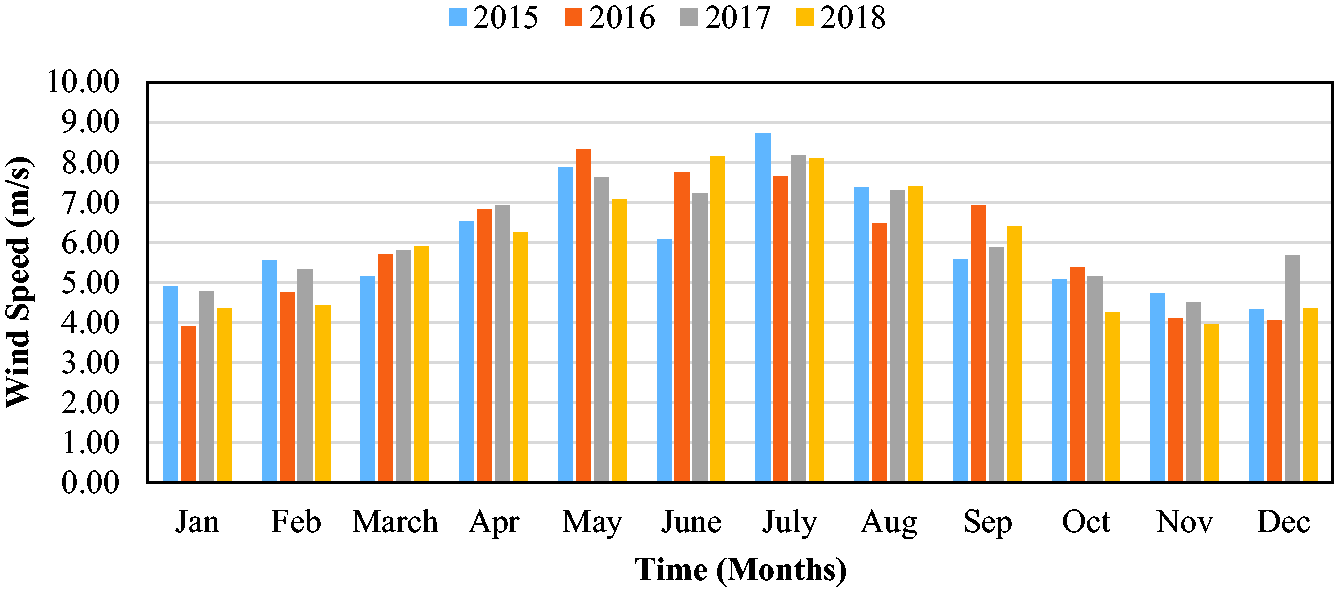
Variation observed in wind speed at Keti on monthly basis.
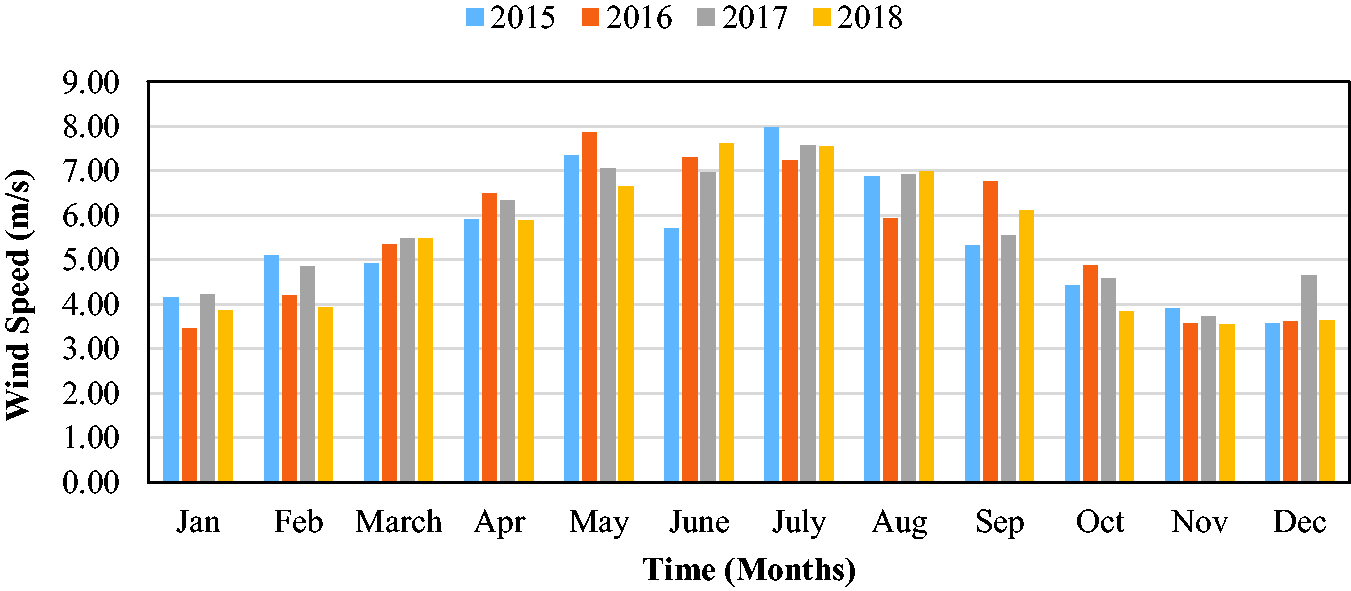
Variation observed in wind speed at Manora on monthly basis.
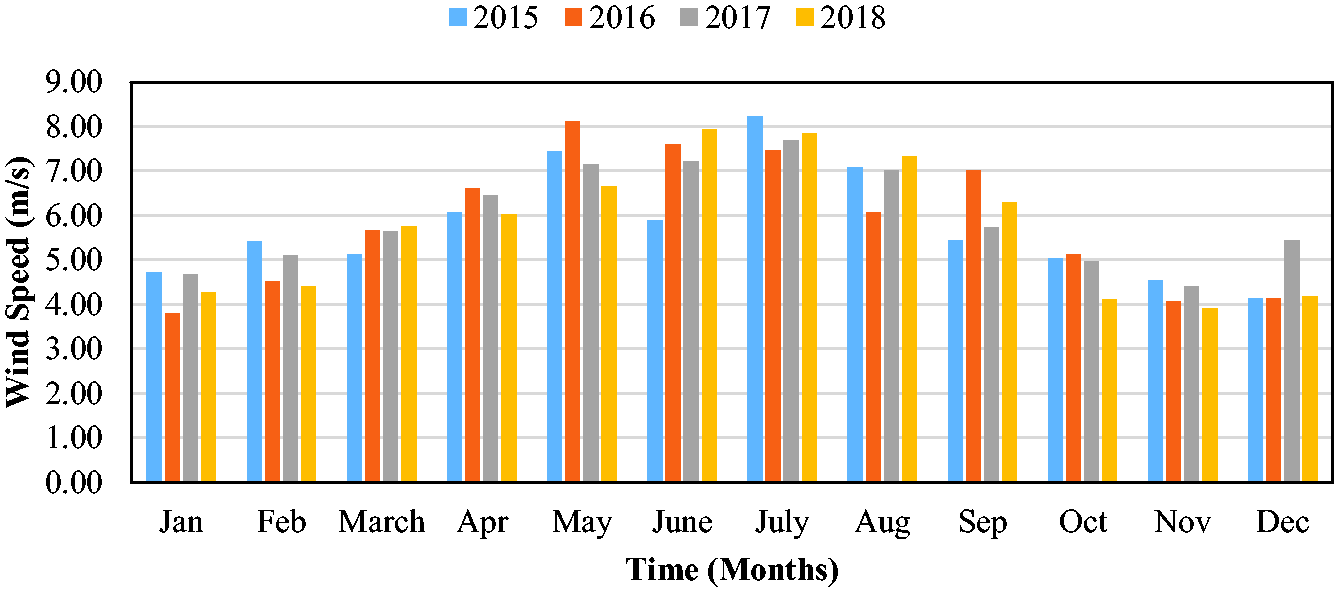
Variation observed in wind speed at Port Qasim on monthly basis.
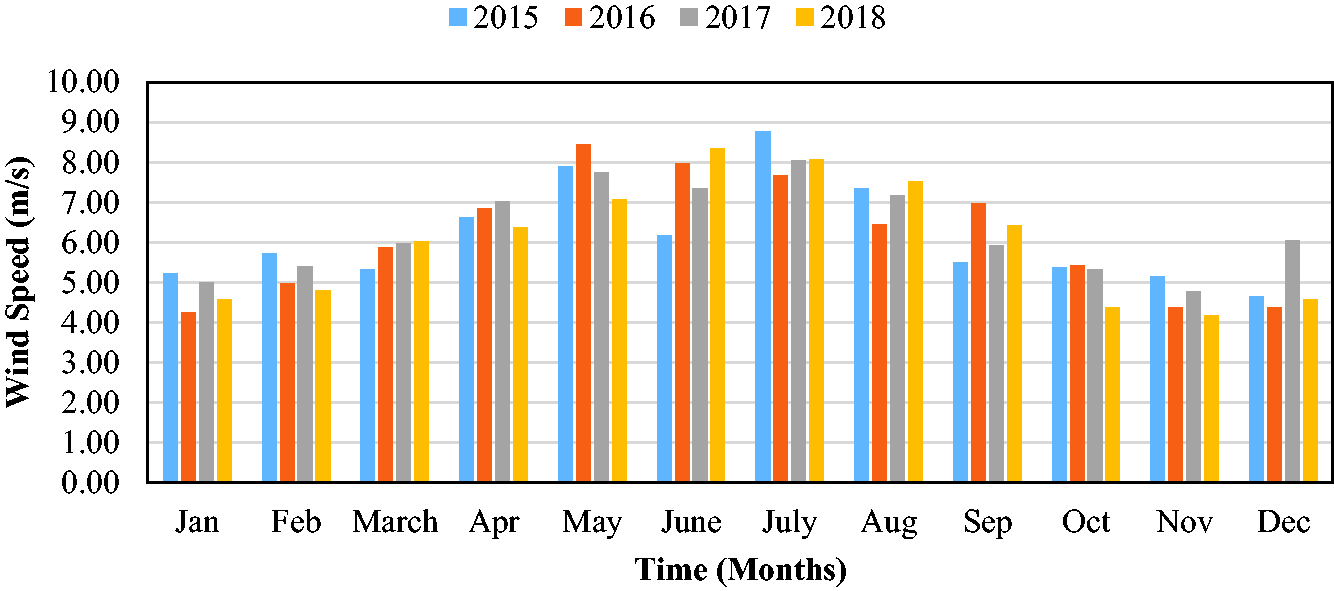
Variation observed in wind speed at Shahbandar on monthly basis.
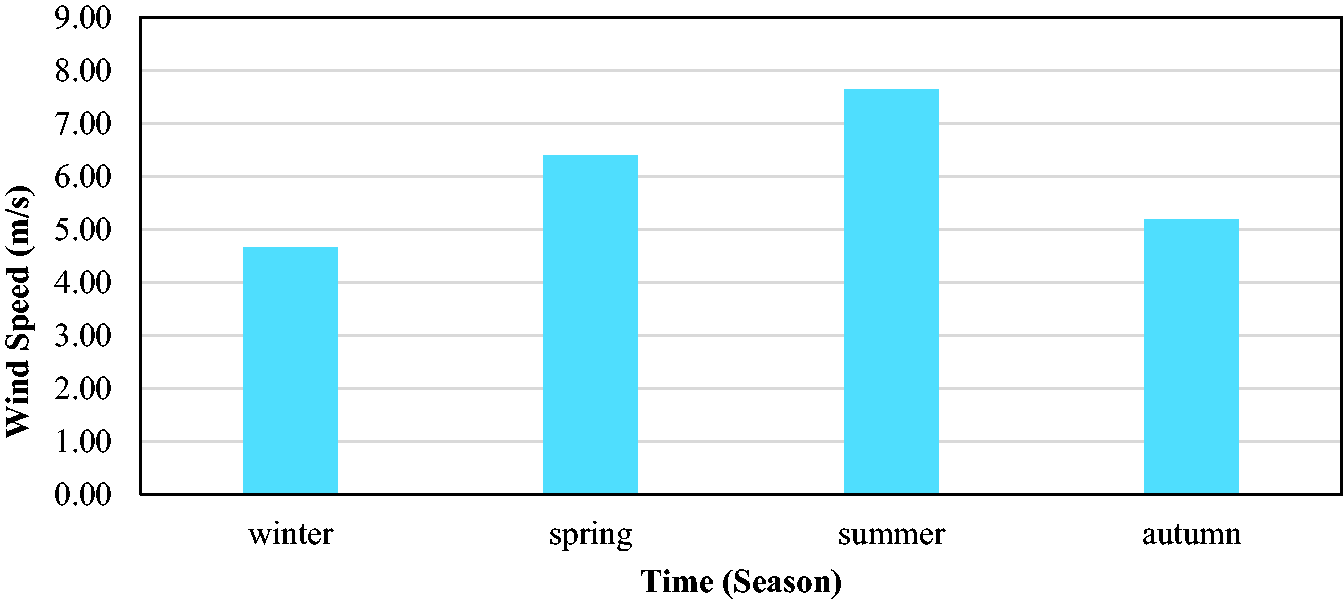
Variation observed in wind speed at Jhirk on Seasonal basis.
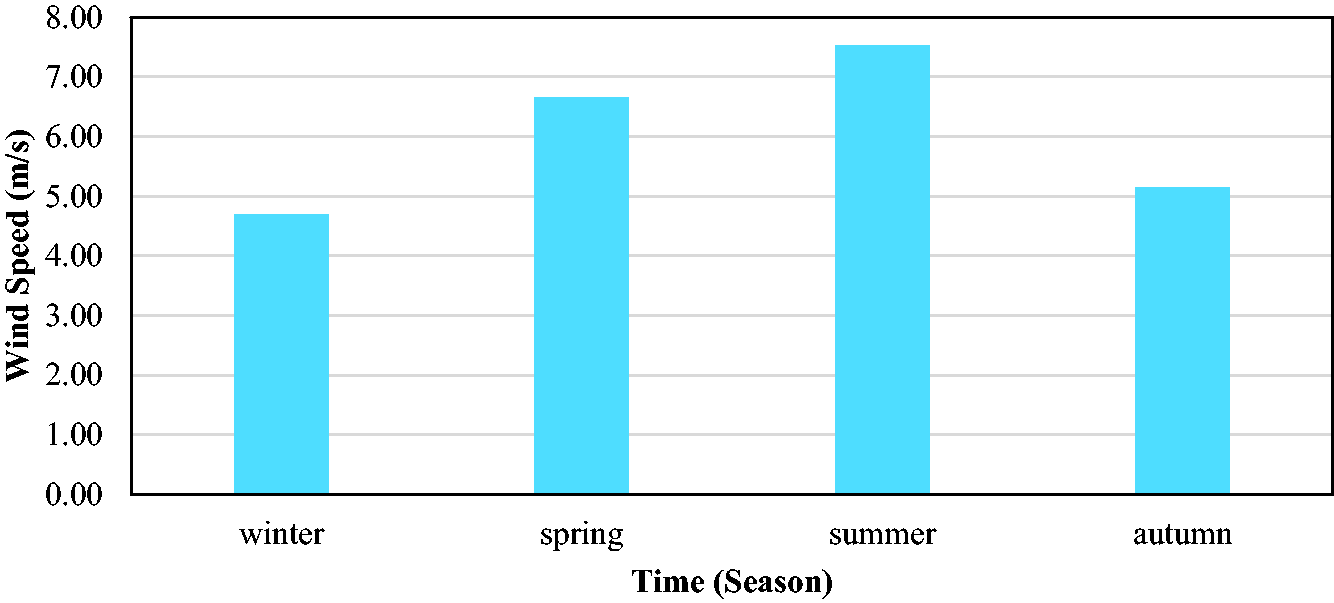
Variation observed in wind speed at Keti on Seasonal basis.
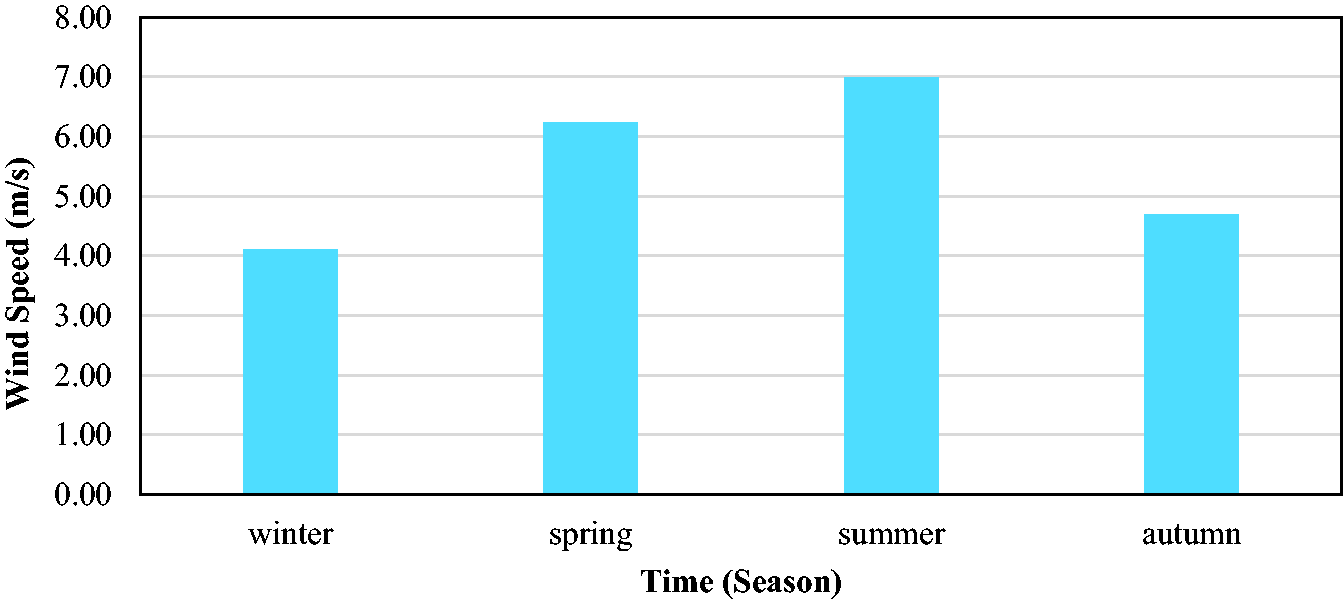
Variation observed in wind speed at Manora on Seasonal basis.
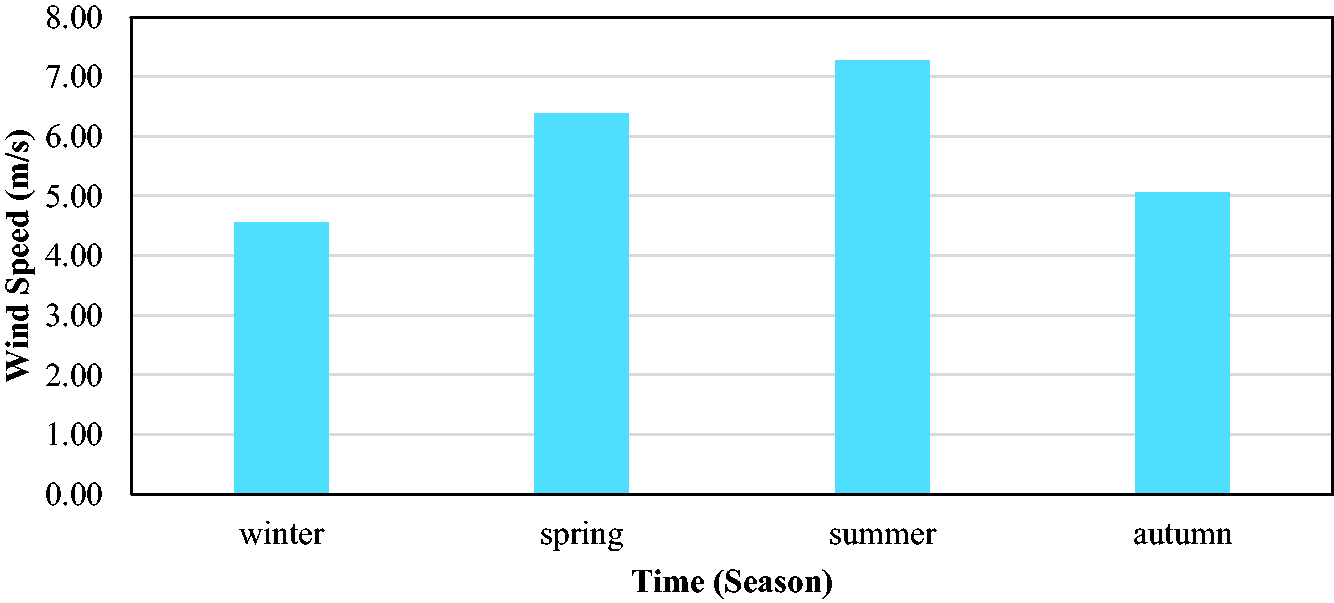
Variation observed in wind speed at Port Qasim on Seasonal basis.
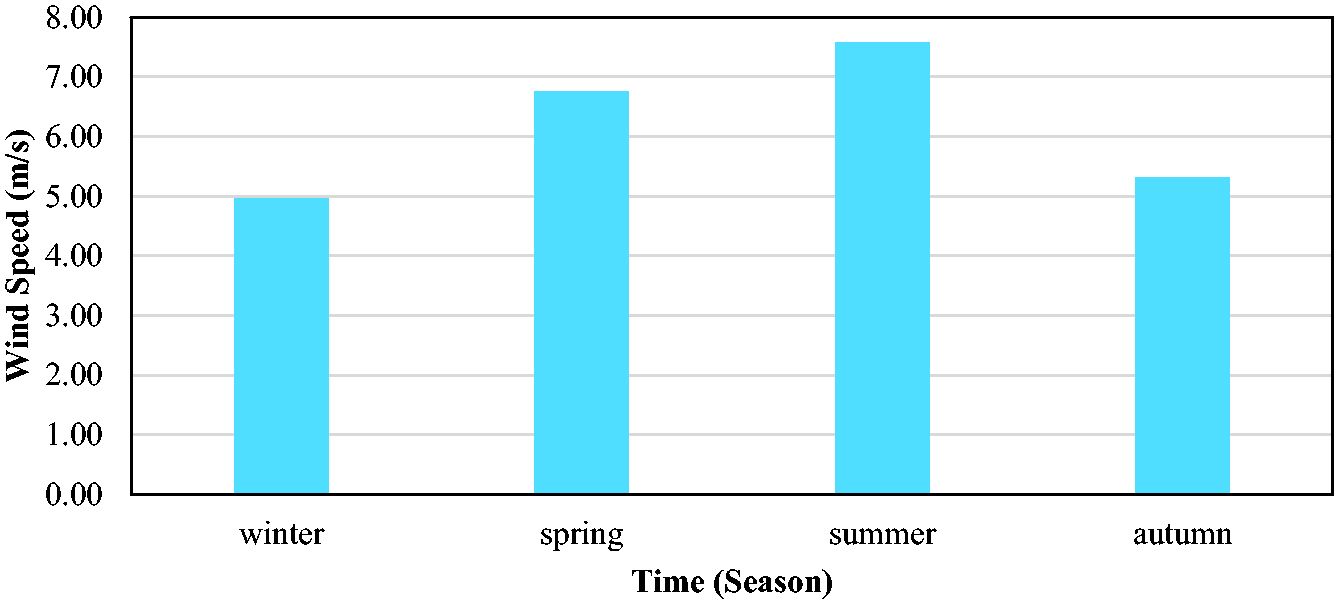
Variation observed in wind speed at Shahbandar on Seasonal basis.
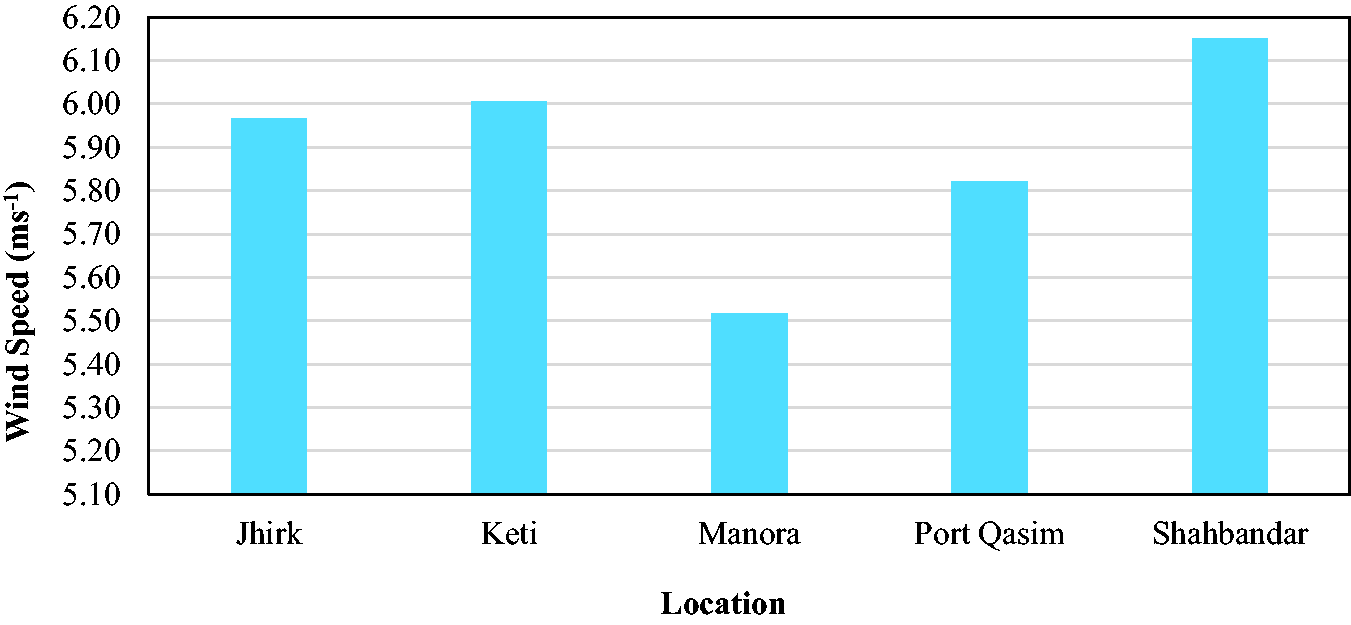
Comparison of Average wind speeds at five investigated stations.
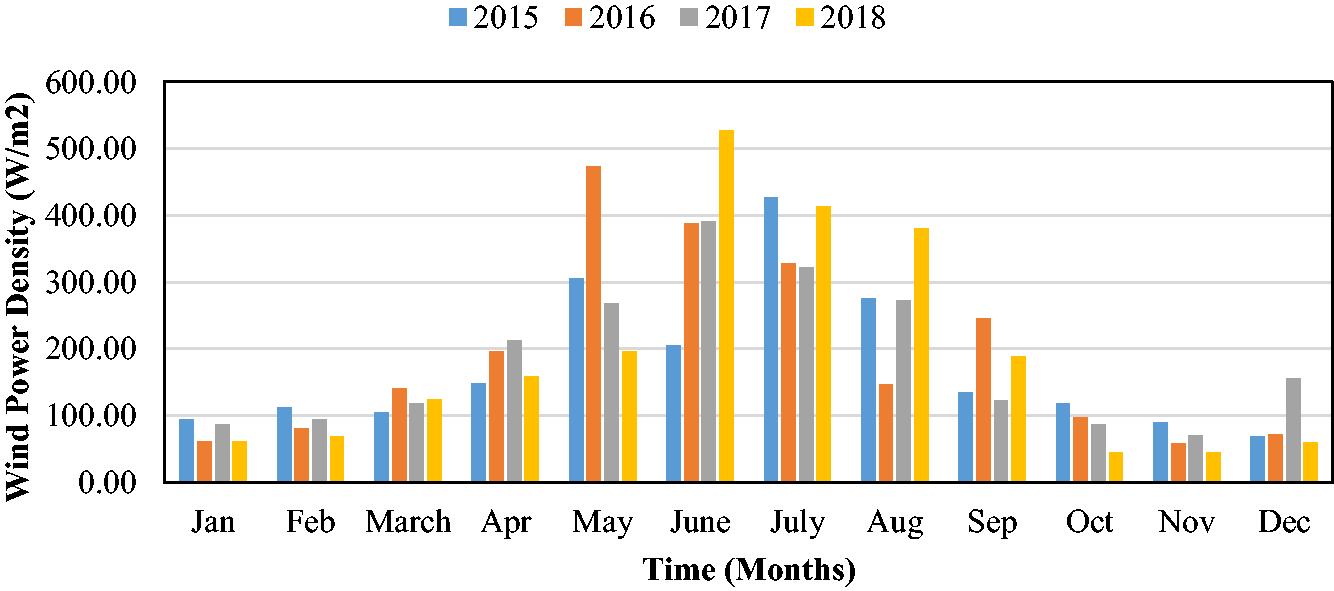
Variation observed in wind power density at Jhirk on monthly basis.
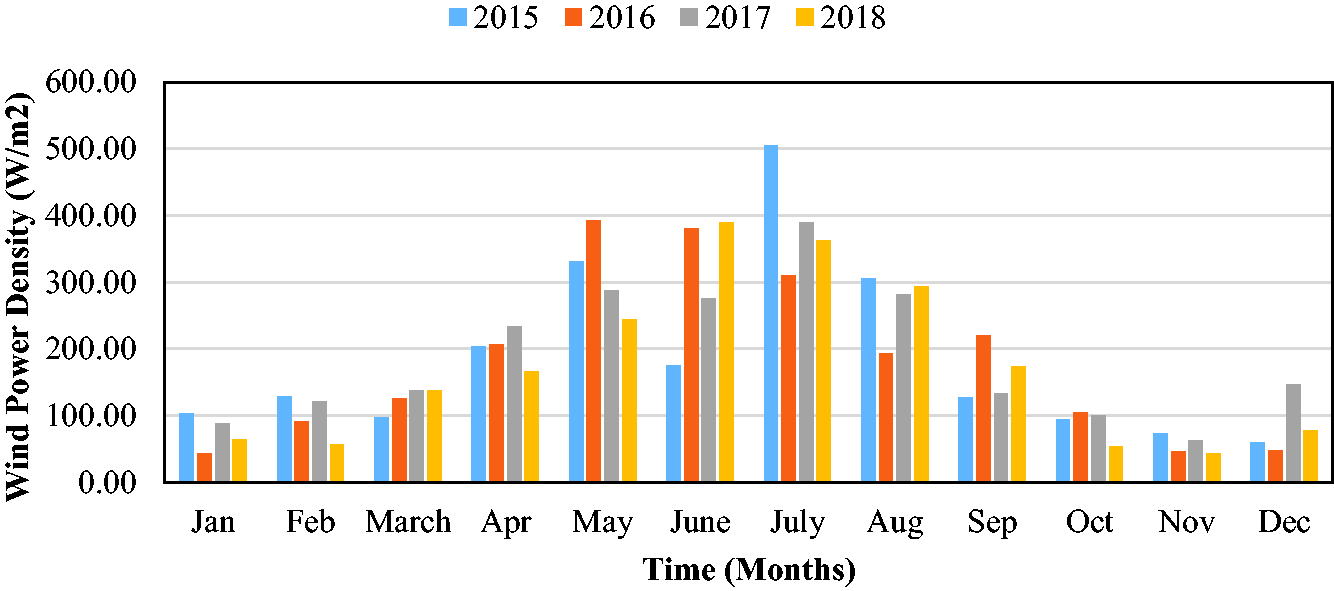
Variation observed in wind power density at Keti on monthly basis.
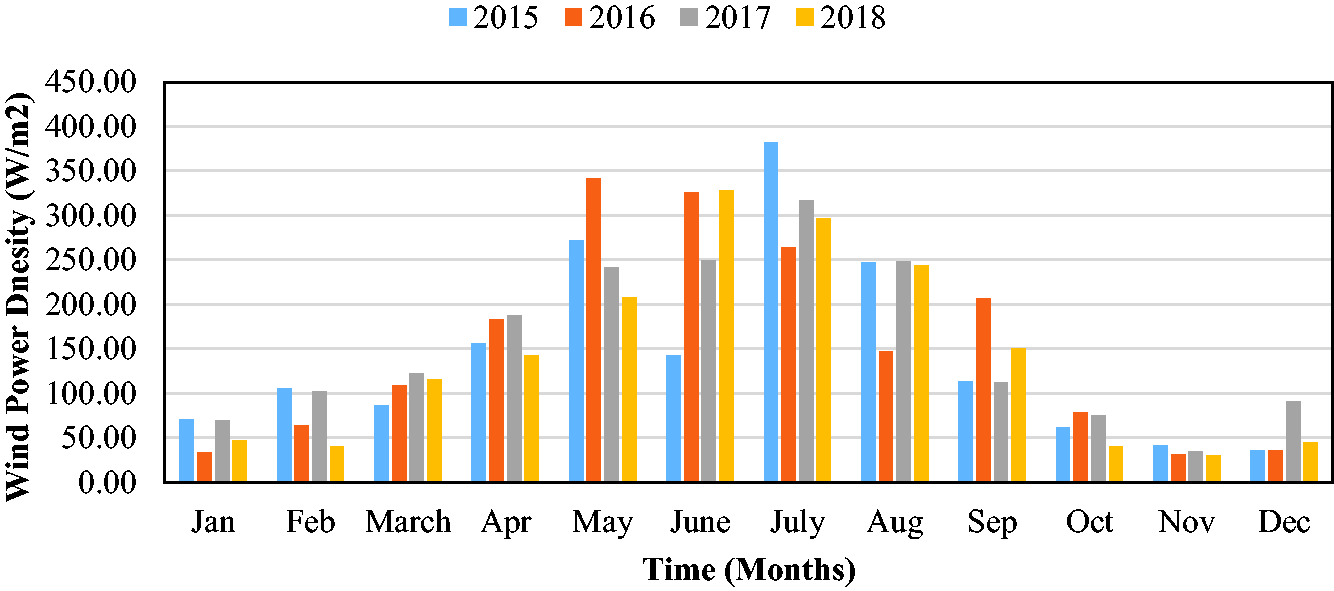
Variation observed in wind power density at Manora on monthly basis.
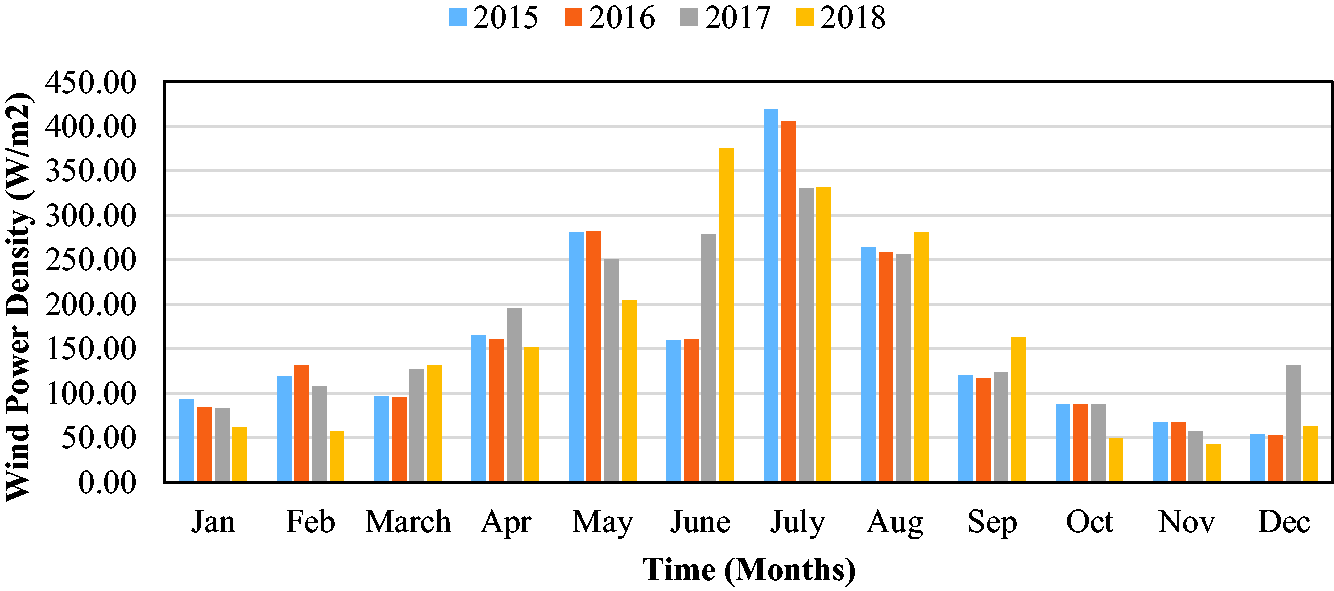
Variation observed in wind power density at Port Qasim on monthly basis.
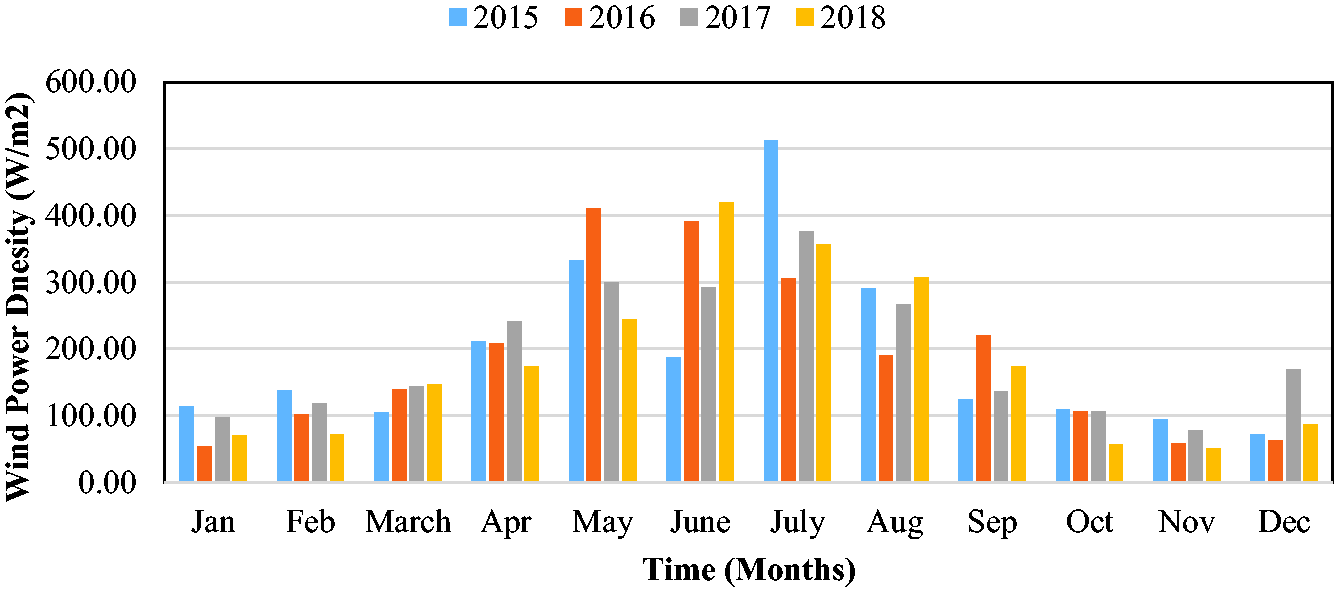
Variation observed in wind power density at Shahbandar on monthly basis.
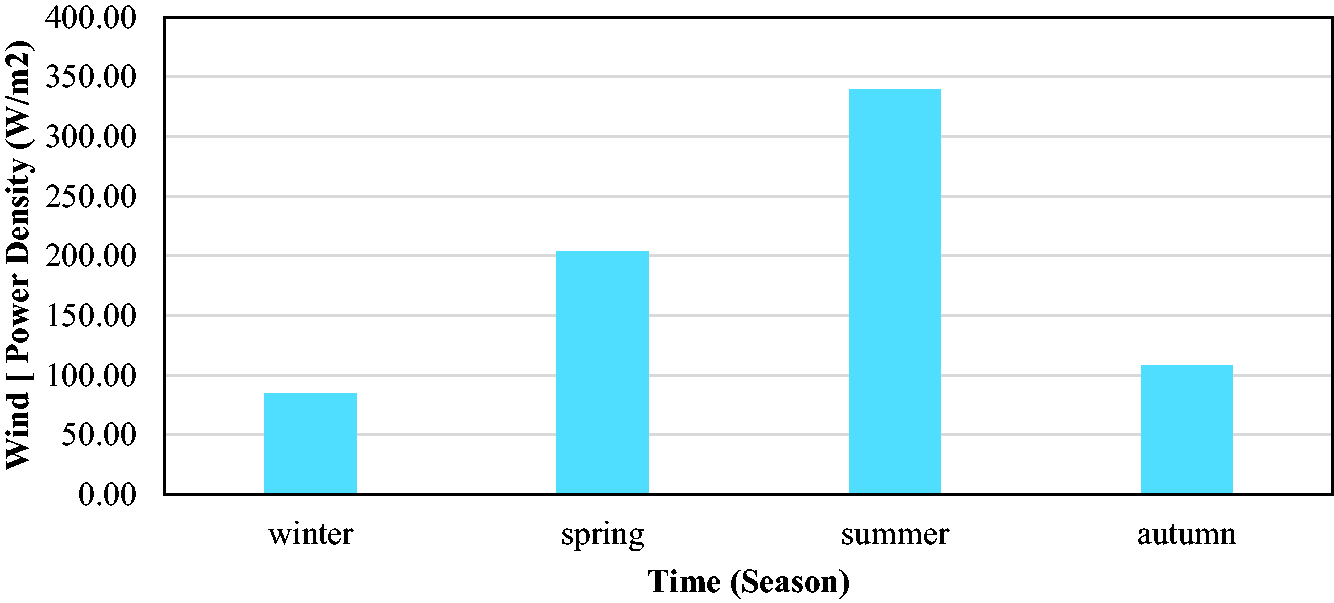
Variation observed in wind power density at Jhirk on seasonal basis.
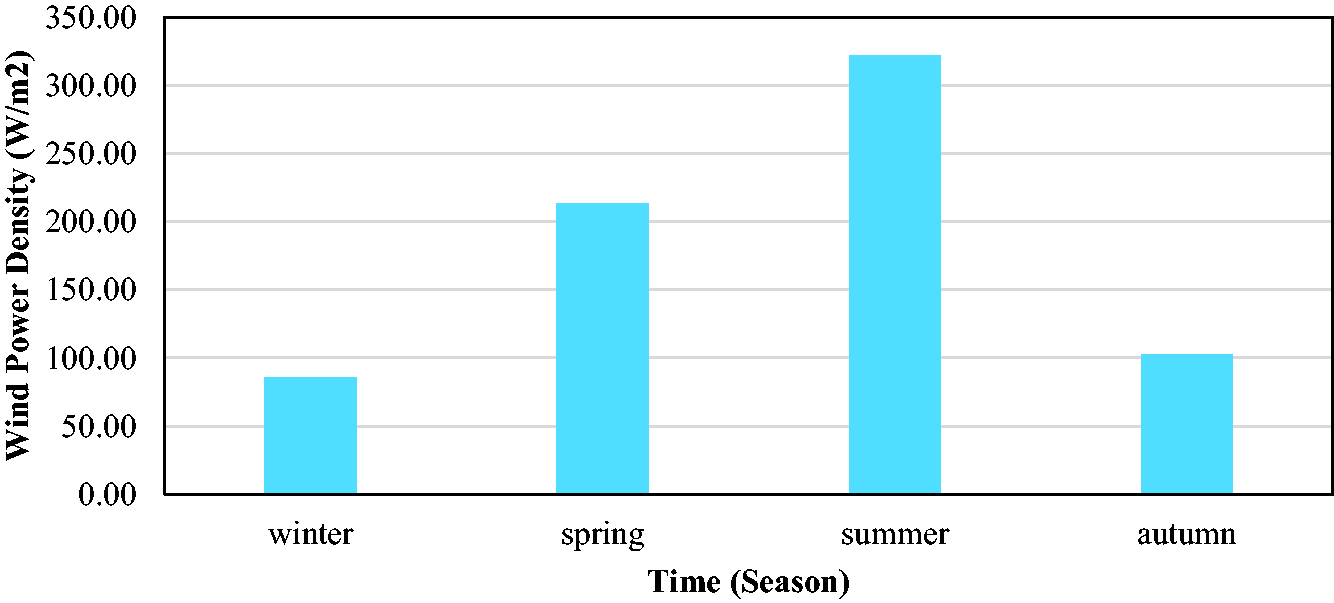
Variation observed in wind power density at Keti on seasonal basis.
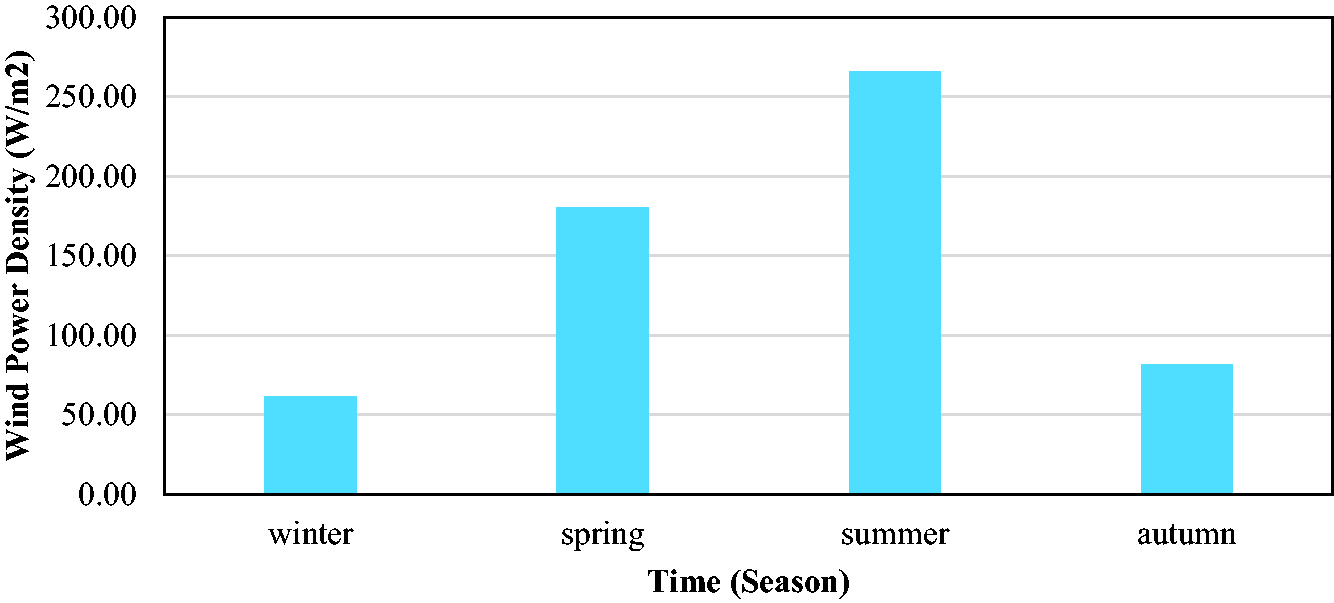
Variation observed in wind power density at Manora on seasonal basis.
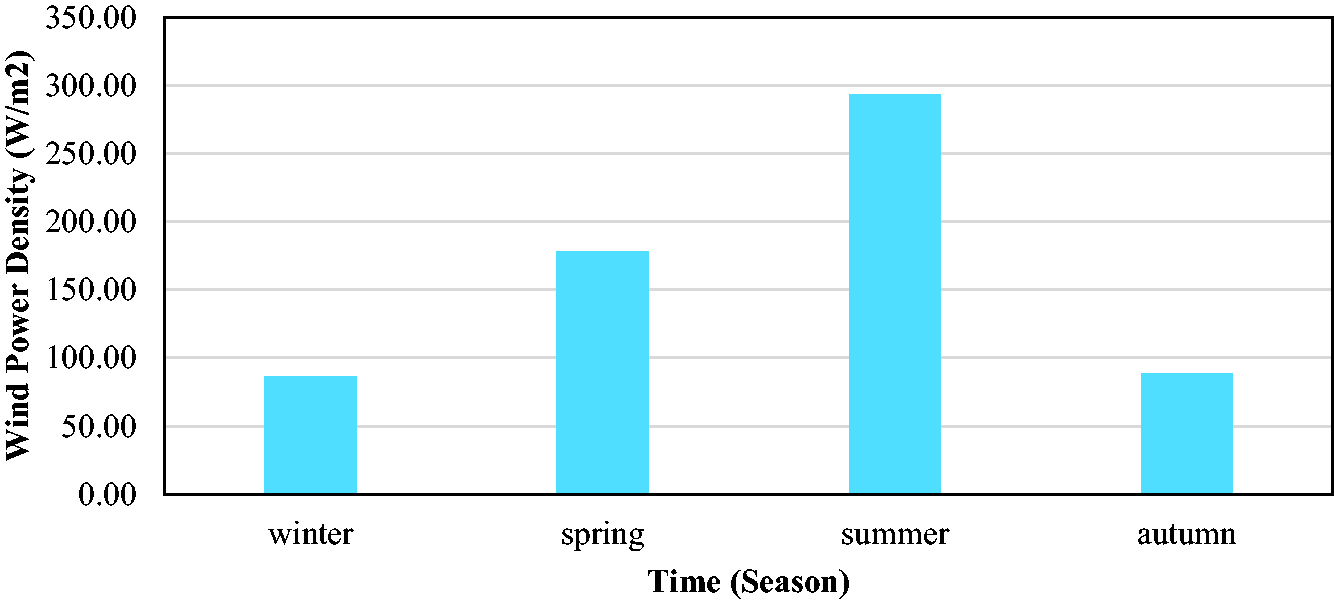
Variation observed in wind power density at Port Qasim on seasonal basis.
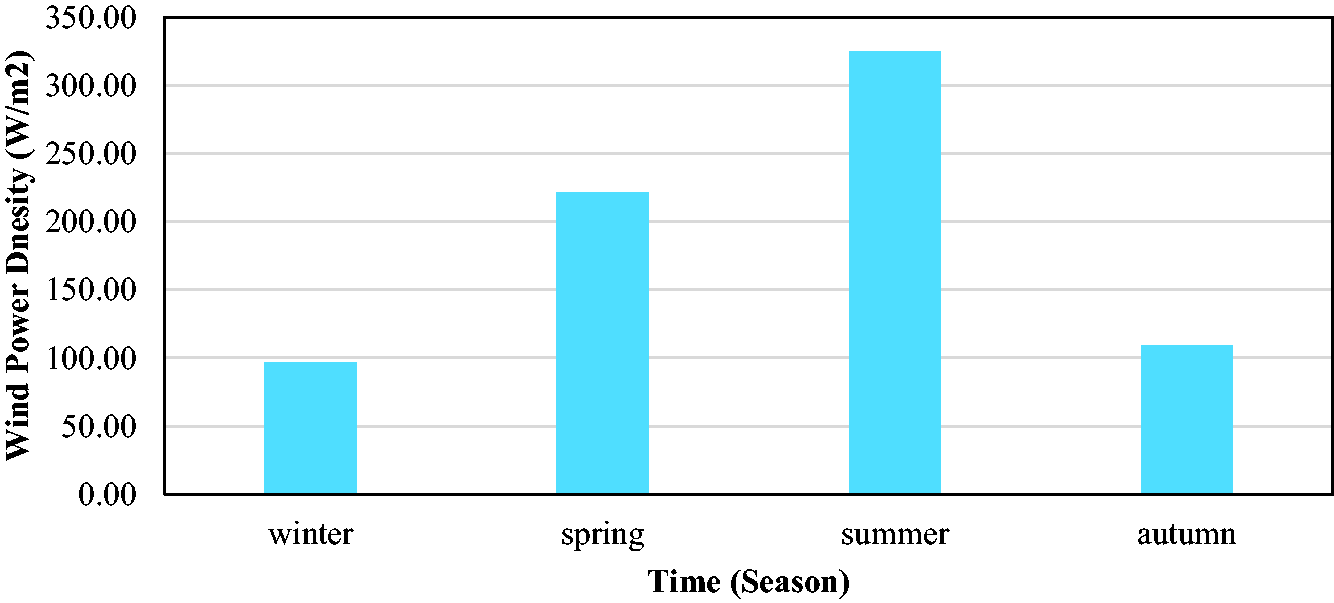
Variation observed in wind power density at Shahbandar on seasonal basis.
Monthly average wind power densities (W/m2) at each station.
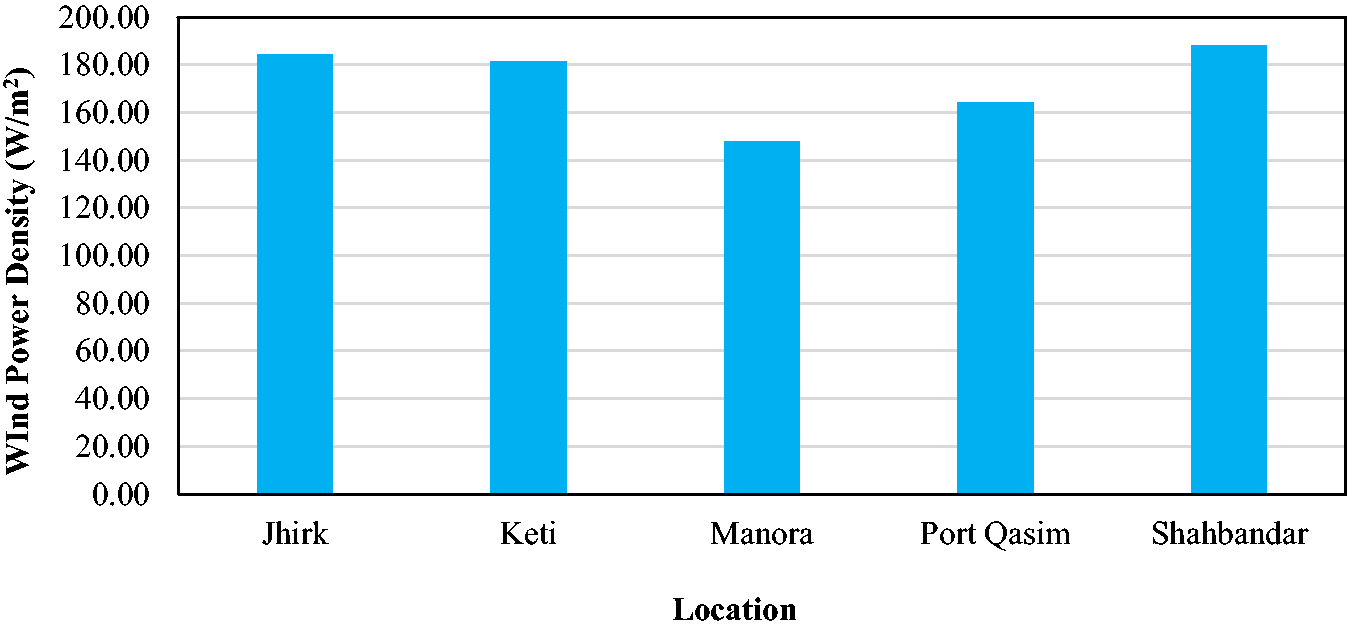
Comparison of average wind power density values at five investigated stations.
Techno economic evaluation of energy generation
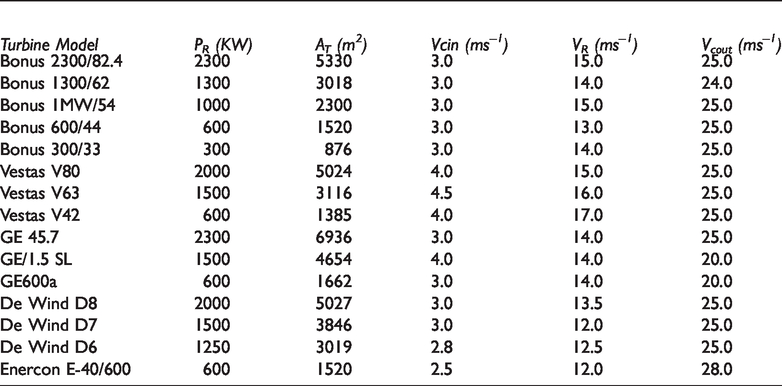
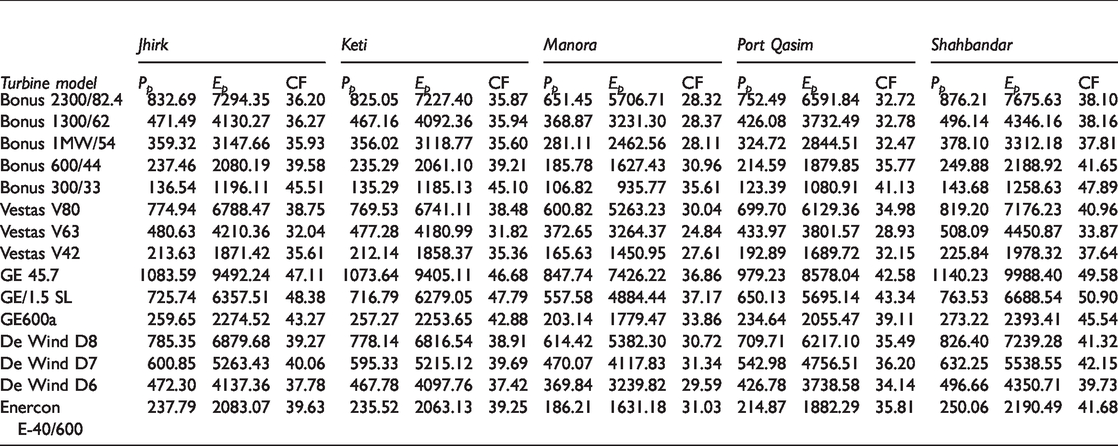
Techno-economic analysis of wind energy generation at selected locations has been made using 15 different turbines. Table 6 lists the specifications of these turbines. Based on the power produced using each turbine at each site, CFs are calculated and listed in Table 7. GE 45.7 model has been found to produce the highest amount of wind energy while Vestas V42 shows the worst performance with lowest power generation and lowest CF. Comparison among five stations shows that Shahbandar has the highest annual energy produced and Manora has the lowest for any of the turbine under consideration. This agrees with highest wind speed at Shahbandar and lowest at Manora.
Specifications of various turbine models.
Power produced, PP (kW), annual energy produced, EP, (MWh and CF, (%) at each station using 15 turbines.
As previously explained that only the CF cannot be a decisive parameter in the selection of a turbine, but economic analysis is also an important consideration. It is quite possible that a turbine having high CF would be relatively costly compared to some other turbine. Therefore, an economic feasibility assessment is required. Table 8 enlists values of PP and unit C against each turbine at each location. It can be observed that for all investigated locations, GE/1.5 SL (not GE 45.7) is the most economical (having lowest PP and unit C) while Vestas V63 (not Vestas V42) is the least economical among all turbines. This result strengthens our argument initially made that only the CF cannot be a performance representative. Therefore, in real life, a compromise must be made in the final selection of a turbine.
Economic feasibility analysis of various turbine models using PP and unit cost of energy at each station.
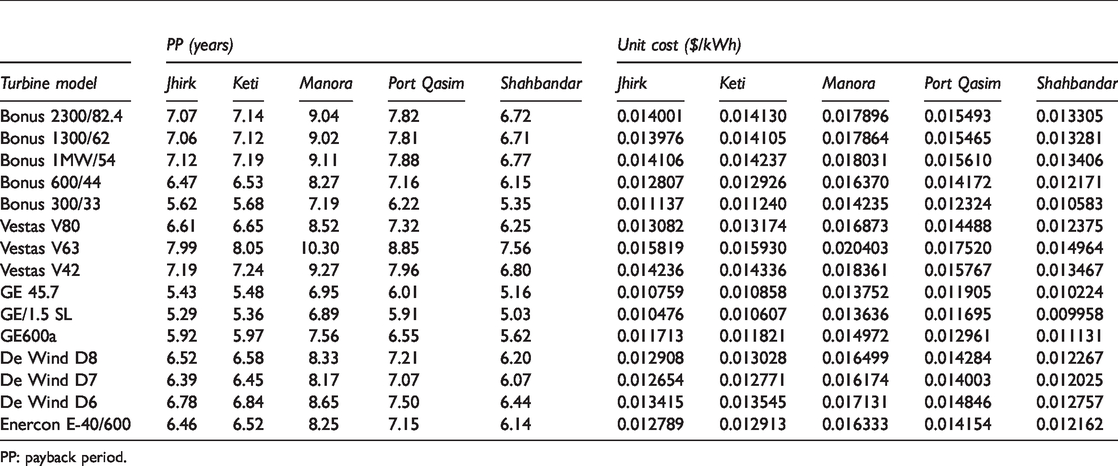
PP: payback period.
Validation of results
What is the validity of the results obtained in a study? This important question has been answered using historical data validation technique. Various probability distributions have been applied and compared and the results, thus obtained, have been validated using historical data (Khahro et al., 2014a, 2014b; Manwell et al., 2010; Morgan et al., 2011; Pobočíková et al., 2017; Rajapaksha and Perera, 2016; Sumair et al., 2020e; Silveira et al., 2019; Yilmaz and Çelik, 2011; Zhou et al., 2010).
Conclusion
Key points concluded from this work are given below:
For each of the investigated location, Normal distribution has been found the best distribution followed by Weibull, Gamma, Chi-Squared, and Rayleigh. Therefore, reliance on Weibull distribution at each location is not reasonable and advised. Monthly and seasonal variation shows that wind resource potential is highest in July and lowest in January at all locations. Among all locations under study, Shahbandar possesses the maximum potential whereas Manora possesses the minimum. With respect to energy generation, GE 45.7 shows the best performance while Vestas V42 shows the least. However, economic analysis shows that GE/1.5 SL is the most economical while Vestas V63 is the least. Therefore, turbine selection should be based on not only the energy production but also the economy depending upon which of these two factors is the main concern for wind power projects investors.
Footnotes
Declaration of conflicting interests
The author(s) declared no potential conflicts of interest with respect to the research, authorship, and/or publication of this article.
Funding
The author(s) received no financial support for the research, authorship, and/or publication of this article.
