




Abstract
In this paper, the experiment simulates the salt gradient solar pond with heat extraction and that without heat extraction, setting temperature sensors in the solar pond to monitor the temperature change of each measuring point in real time, extracting heat in the low convective zone and nonconvective zone at the same time. The experimental results show that heat extraction can improve the heat storage capacity of solar pond. The heat storage of solar pond with heat extraction is 40.3% more than that without heat extraction according to the experimental results. The heat extraction can increase the overall thermal efficiency of the solar pond; the efficiency of solar pond with heat extraction and that without heat extraction is 22.2 and 28.7%, respectively.
Introduction
Many countries have realized the importance of renewable energy development and utilization in reducing the dependence on fossil energy and mitigating climate change (Liu et al., 2018). China has made substantial efforts in promoting the development and utilization of renewable energy. Chinese government has set the target of increasing the share of renewable energy consumption to 15% by 2020 (Zhang et al., 2016). Solar energy is a rich and nonpolluting renewable energy, theoretically believing that the solar radiation to earth about 1 h of energy can supply the global energy demand for a year, so that the collection of solar energy becomes increasingly significant for industrial, domestic, and commercial buildings (Liu et al., 2017). The salt gradient solar pond (SGSP) is a kind of device which can absorb the solar energy and store it as heat energy, and its biggest characteristic is that it can collect and store heat for a long time, providing the low-temperature heat energy, and it is a kind of low-temperature heat source with long-term stability(Bakirci, 2008; Hosseini and Hosseini, 2012; Rui, 2003).
SGSP is described to be consisting of three layers. The top surface layer is known as the upper convection zone (UCZ) which is a zone of constant temperature and salinity. The second layer is the none-convective zone (NCZ) which acts as an insulating layer of the solar pond. The density in the NCZ increases with increasing depth of the gradient layer. The thickness of the gradient layer depends on the desired temperature, solar transmission property, and thermal conductance of water. The bottom or the third layer is a high-temperature layer known as the storage layer or the storage zone (low convective zone (LCZ)). This layer has a constant temperature and salinity. Useful heat is usually extracted from this layer and its thickness depends on the temperature and the amount of the thermal energy to be stored (El-Sebaii et al., 2011; Hull, 1989; John, 1989; Kalecsinsky, 1902; Kaushika, 1984).
Although the solar pond is a simple and low-cost solar energy use device, the thermal efficiency of the solar pond is limited, so that how to improve the thermal efficiency of solar pond has become the research direction of researchers in recent years. Some researchers have studied reducing the heat dissipation of solar pond and increasing the heat storage of solar pond to improve the thermal efficiency of solar pond. R. Jayaprakash established a small solar pond with a surface area of 5.712 m2 and 0.9 m depth. The thermal insulation of bottom was made of clay, sand, sawdust, and low-density benzene plates. The side walls were constructed of bricks and cement. Then the experiment analyzed the variation of the small solar pond salinity with depth and temperature, temperature drop at night, and evaporation loss of surface water; the result showed that the insulating material of sidewall has a positive effect on heat storage inside the solar pond (Jayaprakash and Perumal, 1998). Porous materials were added on the bottom layer in the SGSP to improve the thermal performance of solar pond (Al-Juwayhel and El-Refaee, 1998; Arulanantham et al., 1997; Hill and Carr, 2013; Shi et al., 2011). The application of the porous medium in the solar pond made the research of SGSP enter a new stage. H. Wang proposed a method of adding slag and cobblestone composite porous media at the bottom of the SGSP to increase LCZ heat storage capacity to reduce heat loss and to improve the thermal efficiency of the solar pond. The view has been verified by experiments and numerical simulation (Wang et al., 2018a, 2015, 2014, 2018b). Some researchers tried to improve the thermal efficiency of the solar pond by heat extraction. M.R. Jaefarzadeh set up a small solar pond with an area of 4 m2 and 1.1 m depth, which was passed through the internal heat exchanger in LCZ to transfer heat energy to an external heat exchanger. Experiments were carried out in winter and summer, respectively, with 10 and 22% thermal efficiency, respectively (Jaefarzadeh, 2006). Researchers have tried to improve the thermal efficiency of the solar pond by extracting heat in the NCZ instead of the traditional method of extracting heat from the LCZ (Alcaraz et al., 2016; Andrews and Akbarzadeh, 2005; Leblanc et al., 2011). However, none of the current studies have systematically compared and analyzed on the efficiency of the solar pond with heat extraction and that without heat extraction.
According to the above situation, this paper is based on a self-developed experimental solar pond system through programmable logic controller (PLC) controlling solar pond operating time and heating power, and the computer terminal records temperature changes in different depths of the solar pond. In this paper, the comparison between the solar pond with heat extraction and that without heat extraction is carried out; the experimental results are analyzed theoretically; and the effects of the heat extraction on the temperature development, the heat storage of the LCZ, and the NCZ and the thermal efficiency of the solar pond are studied.
Material and methods
SGSP experimental system’s design and construction
The PLC controls heating power to simulate SGSP experimental system which is designed and constructed as shown in Figure 1. The system consists of solar pond, PLC control cabinet, computer terminal, and temperature sensors transmission line. The SGSP is with an area of 0.48 m2 and depth of 1.1 m, and its capacity is 528 l. Thickness of the walls is 0.1 m. The walls of the pond are constructed with hollow stainless steel which is full of SiO2 aerogel thermal insulation material with a thermal conductivity of 0.021 W/m2°C. An electric heater is set as the heat source of the solar pond at the position of 0.1 m from the bottom of the pond, and the heating power of the heater is controlled by the PLC. The computation of the heating power is mainly based on geographical location (latitude), depth, date, time (time step is 1 min), and water turbidity; all of these parameters are set as input data through the computer to the PLC. The PLC calculates the theoretical heating power according to the input data and then controls the heating power of the electric heater according to the calculated result. The heating power error between the objective power and the actual power which is controlled by PLC is not more than 4%.
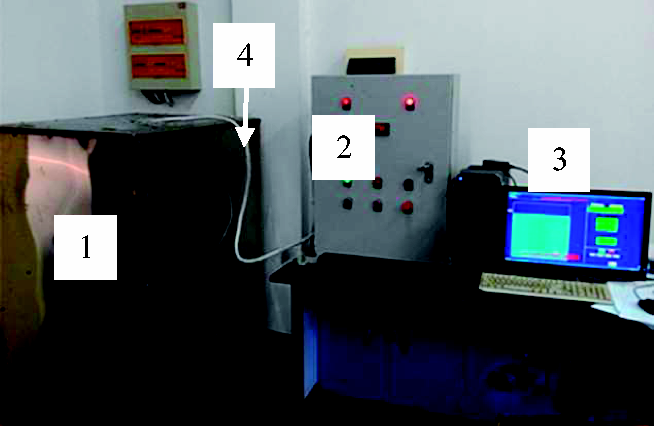
Experimental solar pond system. 1. Solar pond, 2. PLC control cabinet, 3. Computer terminal, 4. Temperature sensors transmission line.
Methods
A vertical rod is installed in the center of the solar pond, with 15 temperature sensors fixed on it to transmit temperature data to the computer terminal in real time to record the temperature transient changes of different depths. The heat exchanger is horizontally set at 0.35 m distance from the bottom of the solar pond. Two temperature sensors are, respectively, set at inlet and outlet of the heat exchanger to measure the temperature change, and the liquid flow meter is used to record the water flow. The inner view solar pond is shown in Figure 2. The thicknesses of the LCZ, NCZ, and UCZ are 0.35, 0.35, and 0.2 m, respectively. The salinity of LCZ is 25%; UCZ is a freshwater layer; NCZ is with the downward salinity increment of 3%/5 cm. The following methods are used to fill the solar pond. The brine with a salinity of 25% is added to the solar pond up to 0.35 m, and the brine with a salinity of 22% is slowly added to the diffuse plate on the surface of the brine (rose slowly with water level) up to 0.40 m. The brine with a salinity of 19, 16, 13, 10, 7, and 4% is added slowly to the pond 0.45, 0.50, 0.55, 0.60, 0.65, and 0.70 m, respectively, in order to form the salt gradient layer, and then slowly add the water up to 0.9 m. Temperature sensors with polytetrafluoroethylene corrosion-resistant coating are set in the center of solar pond each at 0.05 m on the vertical rod from 0.05 to 0.70 m (except for the location of the heat source at 0.1 m), and two temperature sensors are set in the clear water layer at 0.75 and 0.85 m, respectively, from the bottom of the pond. The model of the sensors is Pt-100 and accuracy is 0.01°C. To avoid the heat transfer between the rod and temperature sensors, the insulating material (foam rubber) is used as the lining with the vertical rod contacted place. The temperature sensors are labeled as 1–15 points from bottom to top in the solar pond, and the temperature of each point of the SGSP is monitored in real time by the computer terminal.
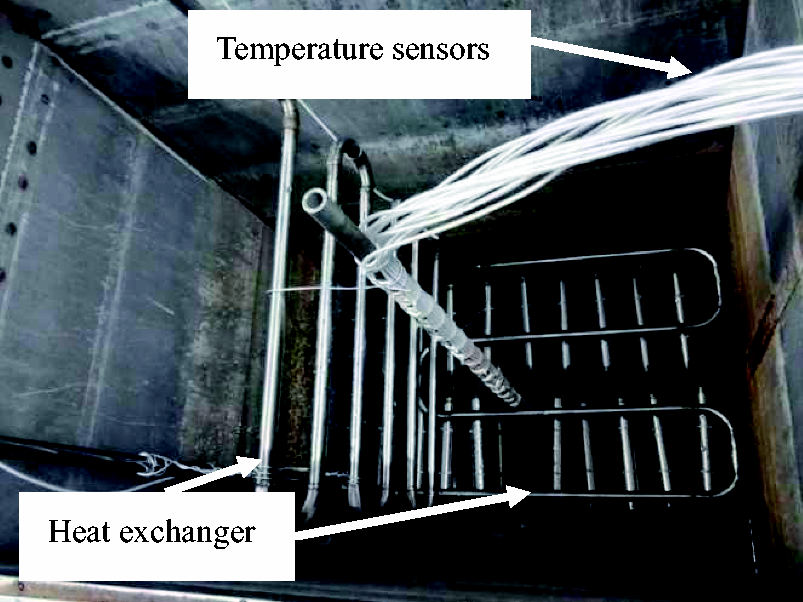
Interior view of the experimental solar pond.
Energy analysis
Calculation of solar radiation
Solar radiation received from solar pond mainly depends on the position of the sun, the local latitude, the water turbidity of the solar pond, the depth of the solar pond, and the experimental time (Wang et al., 2018a, 2018b). Daily solar radiation in ground plane can be obtained by the following equation



In equations (2) and (3), δ is the declination angle of the sun (rad)

In equation (1), N is the astronomical hours of sunshine (rad)

The heat storage of the solar pond
The capacity of each layer of solar pond to absorb heat storage is different, relating to the density and salinity as well as the volume of each layer, and the heat storage can be obtained by the following equation



Heat extraction
The tap water flows into the heat exchanger and absorbs heat from the solar pond when the heat extraction experiment is carried out. The heat extraction Qext obtained is related to the specific heat and flow rate of water. The experiment gets a set of data per minute, which can calculate the amount of heat extraction per minute, and accumulate to obtain the total amount of heat extraction. The equation is as follows

Thermal efficiency
The thermal efficiency of solar pond without heat extraction ηn can be obtained by heat stored in the solar pond divided by the amount of solar radiation and it can be calculated by

The thermal efficiency of solar pond with heat extraction ηext can be obtained by heat stored in the solar pond plus the amount of heat extracted and divided by the amount of solar radiation. The equation is as follows

Results and discussion
Experimental process and results
The experiments set the time from 1 June 2017 to 8 June 2017, a total of 168 h. The experiments are divided into two cases: one is the solar pond with heat extraction and the other is without heat extraction. On the fourth day of the experiment, solar pond with first heat extraction is carried out when the temperature of the LCZ reaches 65°C. To regulate the flow, a liquid speed control valve is set at the inlet of the heat exchanger, and then access to pipes with 15°C tap water, the outlet of heat exchanger access to a liquid flow meter, adjust speed control valve control flow, so that the water flow through the heat exchanger to absorb heat, and stop extracting heat when the temperature of the LCZ drops to 45°C. On the sixth day, the second heat extraction is carried out when the temperature of LCZ rises to 65°C. The experimental conditions of the solar pond without heat extraction are identical with the solar pond with heat extraction, except that the heat extraction experiment is not carried out.
Comparison and analysis of total temperature of solar pond
Figure 3 shows the temperature evolutions of each measuring point in two cases of experimental solar ponds. Figure 3(a) shows the temperature of LCZ without heat extraction warms up obviously in the beginning phase, and the temperature rises gradually with time, NCZ temperature is closer to the LCZ after 80 h, after 160 h the temperature exceeds 70°C. The continuous rise of temperature makes the temperature difference increase; heat convection caused by temperature difference is aggravated, so that the driving force caused by the density difference is affected by a certain degree. Figure 3(b) is the case for the temperature evolutions of solar pond with heat extraction. Heat extraction experiments are carried out twice at 80 and 140 h, respectively, where LCZ temperature reaches 65°C. The temperature of the LCZ and NCZ is decreased rapidly during the experiment. As Figure 3(a) and (b) shows, the heat extraction in the LCZ also causes the NCZ temperature to decline, so that the interference of temperature on the NCZ is reduced.
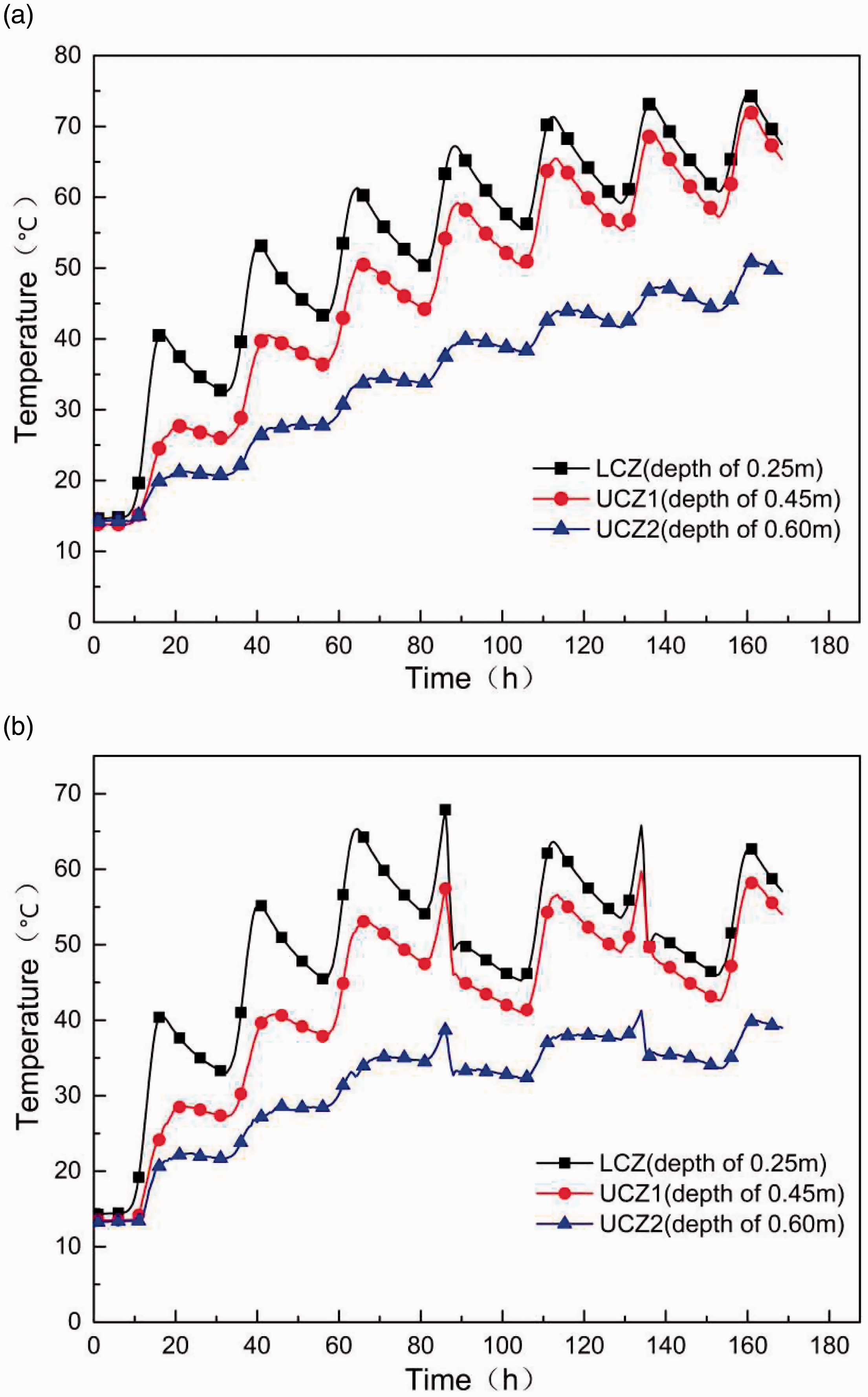
Internal temperature variation of two cases of experimental solar pond: (a) without heat extraction and (b) with heat extraction. LCZ: low convective zone; UCZ: upper convection zone.
Solar pond temperature varies with depth
Figure 4 shows the daily temperature variation of the two cases of experimental solar pond at different depths. As shown in Figure 4(a), the temperature on the first three days of the solar pond without heat extraction continues to rise; the temperature gradient appeared obviously on the following days. On the fourth day, the temperature of the lower half of the NCZ close to LCZ has gradually increased to the temperature of the LCZ. On the seventh day, half of the NCZ is heated up obviously, the temperature at 0.5 m is close to that of LCZ, and the upper half of the NCZ also maintains a certain temperature gradient, which shows that it has not been affected by temperature rising. Figure 4(b) shows the temperature change at different depths of the solar pond with heat extraction. It can be seen that the heating trend is consistent with the heating trend of the solar pond without heat extraction, but heat extraction controls the temperature gradient in a stable range. It can be seen from the local amplification chart in Figure 4(b), caused by the heat extraction experiments on the fourth day and the sixth day, the NCZ temperature at the same depth has a significant reduction trend indicating the temperature of NCZ overall reduction by heat extraction. The temperature gradient continues to remain within a certain range, the driving force produced by the temperature difference is reduced, and the solar pond tends to be more stable. This suggests that heat extraction improves the stability of the solar pond and contributes to the long-term stable operation of the solar pond.
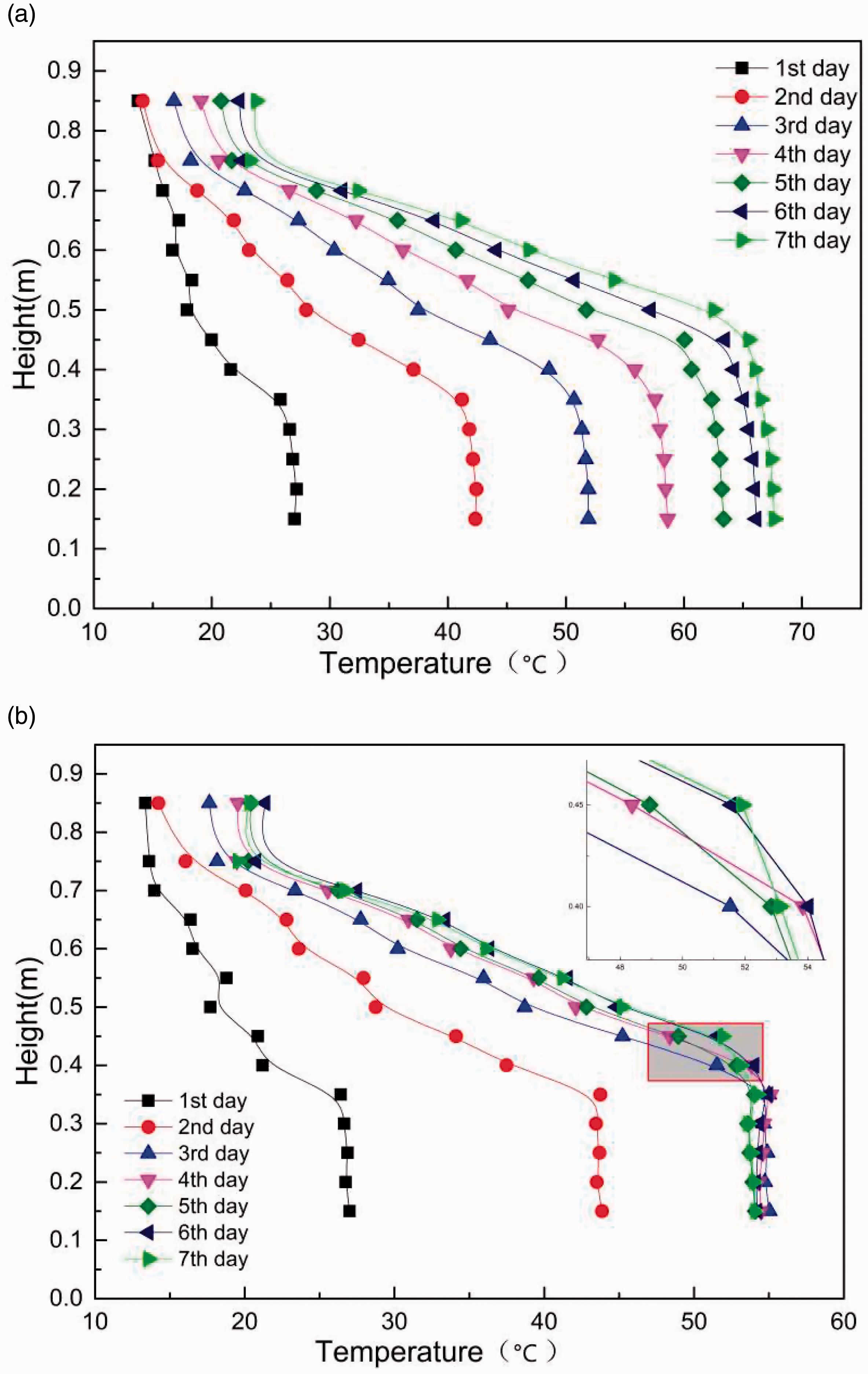
Variation of daily temperature with depth in two cases of experimental solar pond: (a) without heat extraction and (b) with heat extraction.
Energy and efficiency analysis
Daily heat storage
According to the equations in “The heat storage of the solar pond” and “Heat extraction” sections, Figure 5 shows a comparison of heat storage increment of LCZ and NCZ for two cases of experimental solar pond. As shown in Figure 5(a), the heat storage in the LCZ of the two cases is basically the same during the first three days, and the solar pond temperature with heat extraction is slightly higher than that without heat extraction. This may be caused by the small difference of daily heat dissipations of the two cases of experiment. The heat dissipation of solar pond without heat extraction is slightly higher than that with heat extraction. On the fourth day, the heat stored by the LCZ of solar pond with heat extraction is much higher than the solar pond without heat extraction, which can be understood that heat extraction enhances the solar pond’s heat storage capacity, since the heat dissipation is decreased with the decreasing of the temperature difference between solar pond and environment. On the fifth day, the heat storage in the LCZ of solar pond with heat extraction is also higher than that without heat extraction, because the solar pond has not been reheated to the temperature before the last heat extraction, and the overall heat dissipation of the solar pond becomes less, so that the net heat stored is greater than the solar pond without heat extraction. The heat stored in the LCZ of solar pond without heat extraction from the third day gradually declined, on the sixth day and the seventh day is far low for the case with heat extraction. It indicates that the temperature rising not only has impact on the stability of the solar pond, but also affects the solar pond’s heat storage capacity. The regular heat extraction helps to control the temperature of the solar pond, so that the heat stored by the solar pond is continuously output, while the solar pond has relatively enhanced heat storage capacity, which contributes to prolong the solar pond’s operating life.
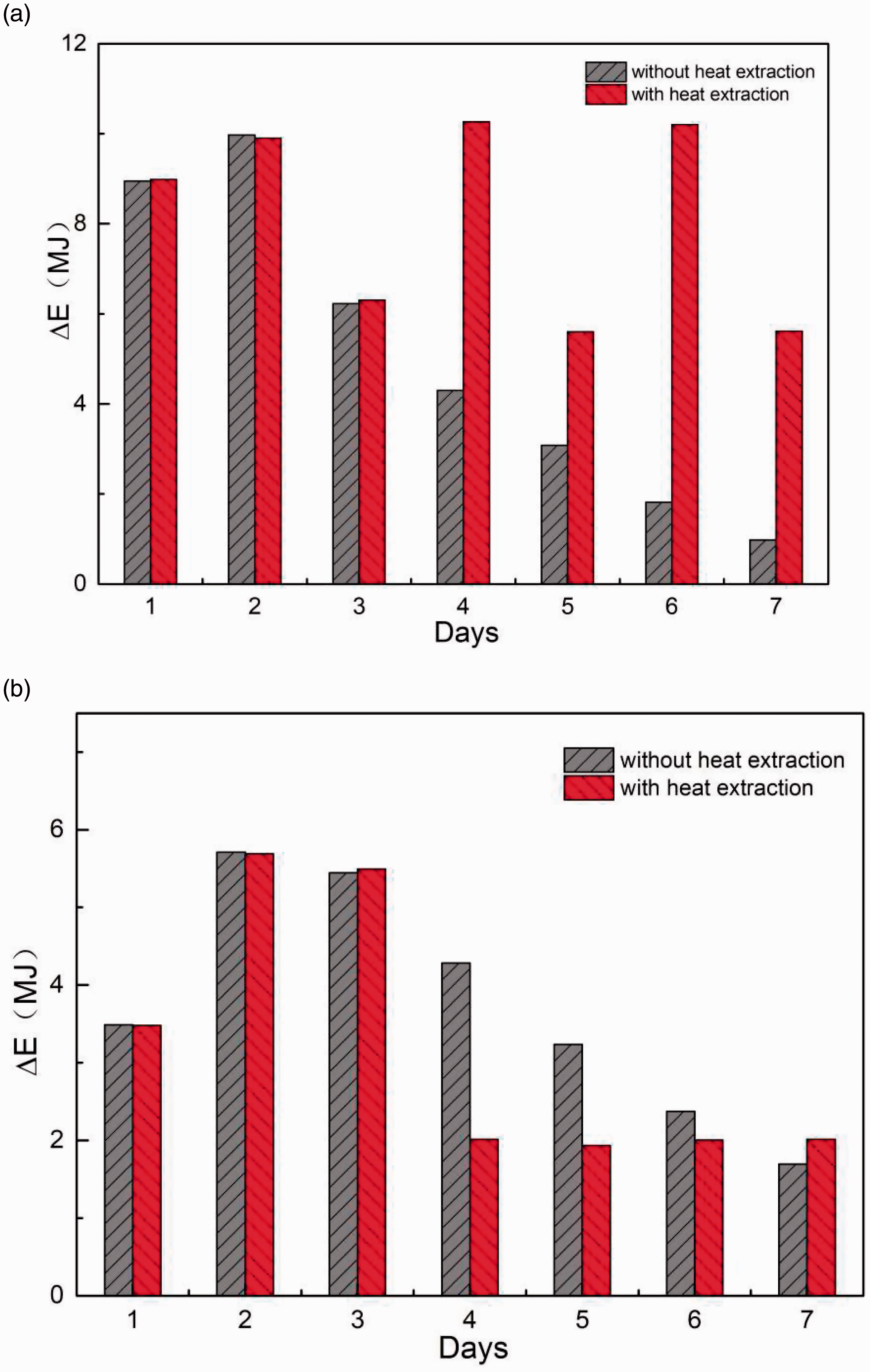
Comparison of daily heat storage between LCZ and NCZ in two cases of experimental solar pond: (a) LCZ and (b) NCZ.
Figure 5(b) shows the comparison of daily increment of heat storage for two cases of NCZ. It is shown that the heat storage increment of NCZ is smaller than LCZ for the first three days. On the fourth day, the heat storage increment in the NCZ without heat extraction is much more than that of with extraction. It is due to that the cold fluid through the heat exchanger also carries out heat transfer from the NCZ, so that the temperature of NCZ is reduced. It can be seen that the NCZ heat storage increment of the solar pond without heat extraction is growing slowly after the fifth day. This is because the temperature of NCZ is getting higher, and the temperature difference between NCZ and environment getting bigger, so that the heat loss is increasing. Heat storage increment of NCZ is basically consistent between the fifth day and the fourth day; on the fourth day, the heat extraction experiment is mainly carried out in the LCZ, so that the temperature of LCZ drops greatly. If the temperature of the NCZ is higher than that of LCZ, the direction of the heat exchange is opposite to the salt diffusion. Therefore, it can be seen that the heat extraction has a positive effect on the stability of the solar pond. According to the experimental results and following the computing method (“The heat storage of the solar pond” and “Heat extraction” sections), it can be calculated that the heat storage of solar pond with heat extraction is 40.3% more than that of without heat extraction. The data will be further improved if it is a long-term operation of the solar pond.
Analysis of daily thermal efficiency of solar pond
Figure 6 shows comparison of the daily thermal efficiency of two cases of experimental solar pond in terms of equations (3) and (4) in this paper. As shown in Figure 6, the solar pond is still in the heating stage on the first three days. The thermal efficiency of the solar pond without heat extraction and that with heat extraction is basically same, which are 35.4 and 35.3%, respectively. The thermal efficiency of the second day is higher than that of the first day, which are 42.9 and 42.5%, respectively. It is due to the first day of heating mainly occurring in the LCZ, while the NCZ temperature gradient has not been fully formed. The temperature gradient of NCZ obviously begins to form from the second day. The thermal efficiency of the third day is reduced to 34.6 and 35%, respectively. It is because the NCZ has been formed at a significant temperature gradient, the driving force direction produced by the temperature difference is opposite to that of the salt concentration difference. So that heat conduction is subjected to certain resistance and the thermal efficiency will be decreased.
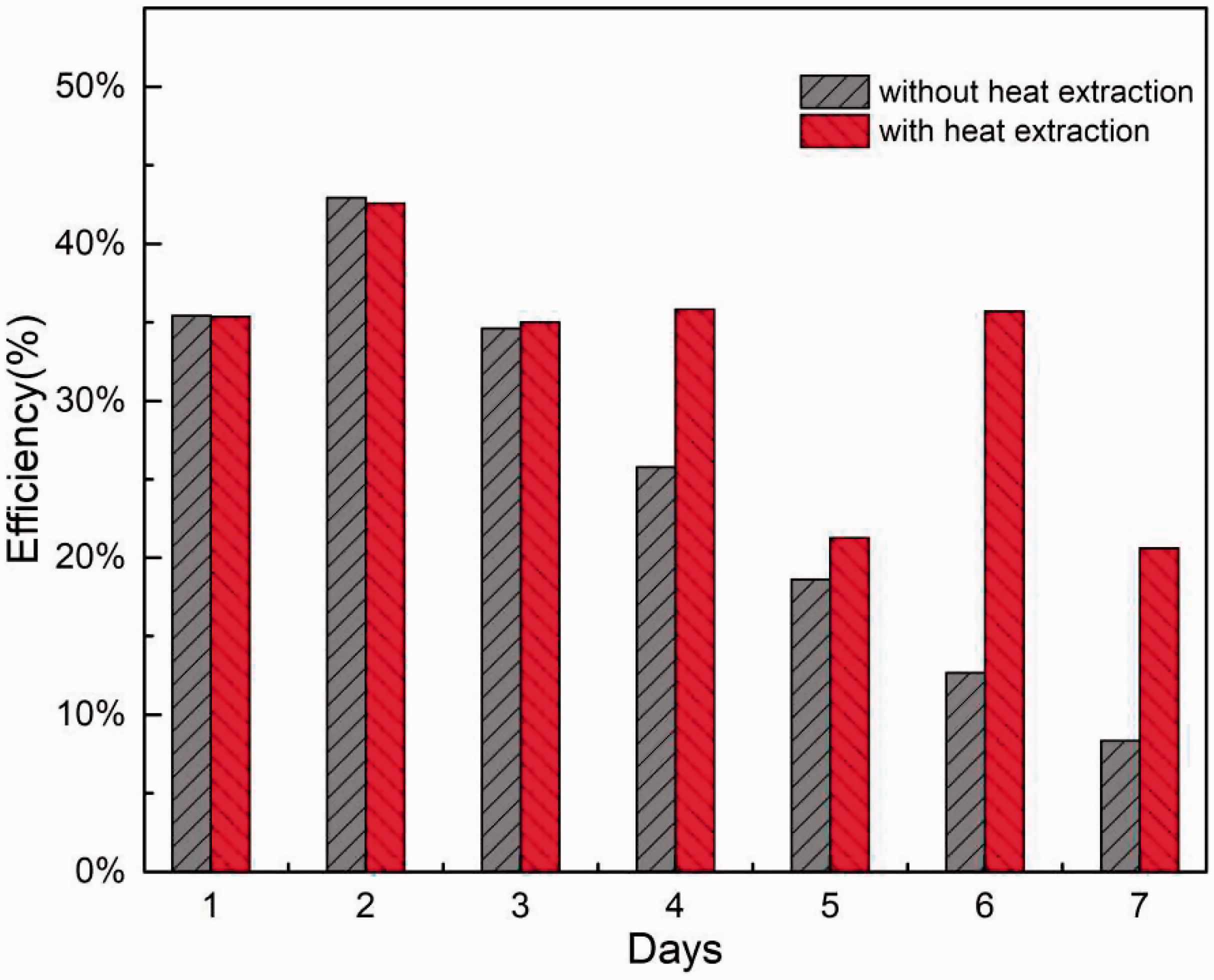
Comparison of daily thermal efficiency of two cases of experimental solar pond.
On the fourth day, the thermal efficiency of the solar pond with heat extraction and without heat extraction is 25.7 and 35.6%, respectively. Owing to the heat extraction being carried out on the fourth day, in the thermal efficiency calculation, energy increment involves heat storage and heat extraction. The thermal efficiency of the case with heat extraction is higher than that of without heat extraction. The thermal efficiency on the fifth day is 18.6 and 21.2%, respectively, and the thermal efficiency of the solar pond with heat extraction is slightly higher than that without heat extraction. When the solar pond heats up to a certain temperature, the increasing of the temperature difference between solar pond and environment results in the increasing of heat dissipation, which decreases the net heat storage of solar pond, and the thermal efficiency is reduced. Solar pond with heat extraction keeps a higher thermal efficiency due to the daily heat dissipation being small. On the sixth and seventh days, the thermal efficiency of the solar pond without heat extraction reduces continuously, which is 12.6 and 8.3%, respectively. The thermal efficiency of solar pond with heat extraction on the sixth day and seventh day is 35.3 and 20.5%, respectively. This heat extraction experiment is carried out twice; thermal efficiency is basically consistent; and it shows that the experimental device has good repeatability, heat extraction does control the solar pond temperature and reaches a higher thermal efficiency, and it can also contribute to the stability of the solar pond.
Conclusion
In this paper, the experiment simulates the solar pond with and without heat extraction, setting temperature sensors in the experimental solar pond to monitor the temperature evolution. Heat is extracted from the LCZ and NCZ simultaneously. The following conclusions can be obtained:
Compared with the solar pond without heat extraction, the heat extraction can increase the overall thermal efficiency of the solar pond. Solar pond with heat extraction gets a thermal efficiency increment of 6.76%. It can be deduced that in the long-term operation of the solar pond, due to the increase of heat storage, this value will be higher. The heat storage of the solar pond can be increased by extracting heat regularly. According to the calculation result, the heat storage of solar pond with heat extraction is 40.3% more than that without heat extraction. Heat extraction keeps temperature of LCZ and NCZ in a certain range, which decreases heat loss from solar pond and is of benefit to the stability of solar pond.
This paper analyses two cases of solar pond from the aspects of temperature, energy, and efficiency and concludes that regular heat extraction has contributed to improve the service life of the solar pond. This study may be used for residential heating, low-temperature power generation, and other aspects.
Footnotes
Declaration of conflicting interests
The author(s) declared no potential conflicts of interest with respect to the research, authorship, and/or publication of this article.
Funding
The author(s) disclosed receipt of the following financial support for the research, authorship, and/or publication of this article: This work has been carried out with the financial support of the Natural Science Foundation of China (NSFC) (U1404520).