




Abstract
Solar oven based on sunlight condensation is a promising energy conservation and sustainable solar thermal utility way. However, the temperature of solar oven is greatly affected by the sunshine conditions. In this research, adding phase-change heat storage layer in the solar vacuum tubular collector has been proposed, and the thermal performance has been numerically studied. The influence of the food initial temperature on the temperature distribution of the heat storage layer has been investigated. The results show that adding phase-change heat storage layer (φ40 mm/80 mm × 770 mm) makes the oven inner wall temperature 30°C–80°C higher than that without phase-change heat storage layer when the oven cavity temperature is at a constant of 100°C; and the oven inner wall temperature fluctuation caused by sunshine is obviously reduced from 100°C to 18°C–35°C. It indicates that the food initial temperature has little effect on the temperature field of the heat storage layer with the food initial temperature being 10°C–50°C. The analysis of the heat storage performance shows that the heat storage layer has a certain heat storage capacity in all seasons, and the daily heat storage is up to 2718 kJ.
Introduction
The reduction of global fossil energy and the aggravation of environmental pollution have promoted the development of solar energy in the world (Kannan and Vakeesan, 2016). Solar energy has been widely used in power generation, construction, automobiles, electrical appliances, farmland irrigation, sewage treatment, food cooking, and other fields (Cho et al., 2014; Ghodake and Mulani, 2016; Runge and Downie, 2011). At present, water-in-glass evacuated tube solar water heaters are becoming the prevalent technique to take advantage of solar energy (Liu et al., 2017), and solar ovens are widely concerned by virtue of energy-saving and eco-friendly characteristics. The promotion of solar ovens in daily life is significant to green and healthy diet of people for outdoor cooking, especially for 1.1 billion (Agency, 2017) people living in areas without electricity supply. However, the temperature of traditional solar oven is greatly affected by the sunshine conditions.
To improve the thermal performance of solar oven, researchers have used water, engine oil, desert sand, and carbon particles as heat storage media in the oven and studied the effect of heat storage materials. The result proved that heat storage materials can improve the efficiency of the oven and the application effect (Nahar, 2003; Saxena et al., 2011). However, the oven space is limited, and only a small amount of heat storage material can be placed, which greatly limits the heat storage capacity of the oven. Phase-change materials (PCMs) can store more heat by the absorption and release of latent heat under phase change in limited space (Koca et al., 2008; Zhang et al., 2015), and it is one of the ways to decrease temperature fluctuation and increase the heat storage capacity (Khadiran et al., 2015; Pandey et al., 2018; Rabha and Muthukumar, 2017; Reyes et al., 2015). The combination of PCMs and solar energy applications is a promising research focus. Soares et al. (2013) proposed and evaluated numerically a new kind of PCM-shutter system to take advantage of solar energy for winter nighttime indoor heating in Coimbra, Portugal with people’s pursuit of indoor air quality (Liu et al., 2018). Guan (2014) analyzed the performance of a three-layer wall with phase-change thermal storage in a Chinese solar greenhouse. Mehla and Yadav (2016) studied the performance on the PCM-based evacuated tube solar air collector under consecutive and simultaneous charging and discharging modes. Zheng et al. (2017) analyzed different PCM cold storage system applied to solar-powered air-conditioning system. However, it is a relatively novel research focus to combine PCMs with solar ovens to improve the efficiency and heat storage capacity.
In this study, the conceptual design of insert PCM layer in the solar oven is presented, and its thermal performance is studied by numerical simulation. As shown in Figure 1, the model increases the phase-change heat storage layer based on the existing glass vacuum tube structure of solar oven, the effects of phase-change heat storage layer on the thermal performance of the solar oven are studied, and the influence of the food initial temperature on the temperature field of the heat storage layer is compared. The aim of this study is to investigate the heat transfer and heat storage performance of glass vacuum tube solar ovens with phase-change heat storage layer.
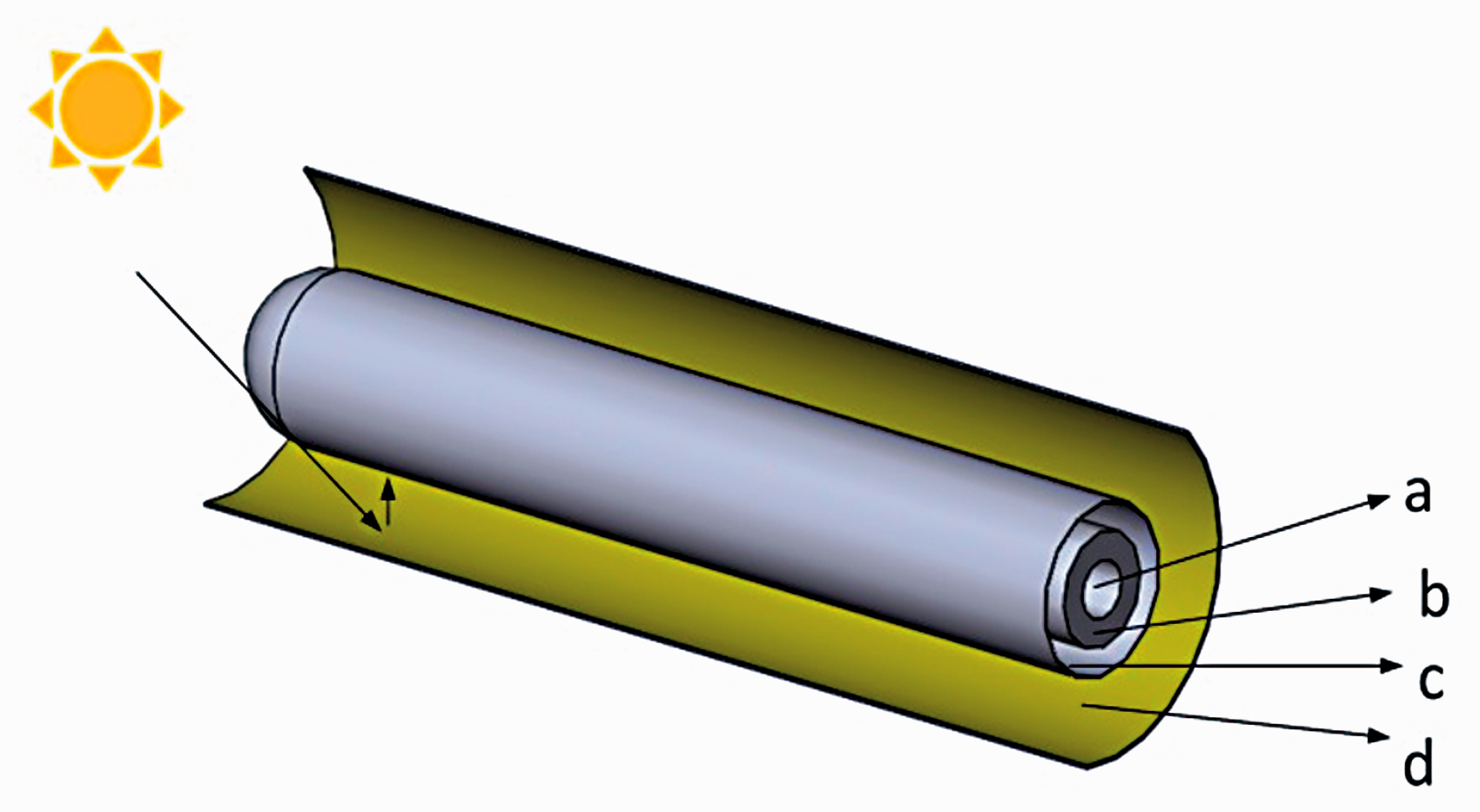
The structure of the oven for adding phase-change heat storage layer (a: oven cavity, b: phase-change heat storage layer, c: vacuum layer, and d: reflector).
Modeling
To simplify the problem, in this study, the model makes the following assumptions:
In order to make the research focuses clearer, only the phase-change heat storage layer and the oven cavity are constructed in the model (Figure 2). The effective solar radiation absorbed by the oven (see equation (6)) is used as the heat source of boundary. The physical parameters (thermal conductivity and specific heat capacity) of PCM do not change with temperature under the same phase. Because the change in ambient temperature is very small relative to the phase-change thermal storage layer, the transient change in ambient temperature has been ignored.
PCMs selection
The selection of PCMs directly affects the heat transfer and heat storage performance of the solar oven. Considering the application of the oven and material characteristics, the PCM should have a suitable phase-change temperature within the application temperature range. Materials with too low phase-change temperature will decompose or gasify under the sun for a long time, and the material with too high temperature is not suitable for cooking food because it has a longer period of phase change. In this research, the solar salt molten salt (60% NaNO3–40% KNO3) is selected as heat storage material due to its phase-change temperature of 220°C and stable thermal properties under 600°C, and the physical parameters (Bauer et al., 2013; Iverson et al., 2012; Zhang et al., 2016) are shown in Table 1.
Physical parameters of phase-change heat storage materials (60% NaNO3–40% KNO3).

Geometry, size, and operating conditions
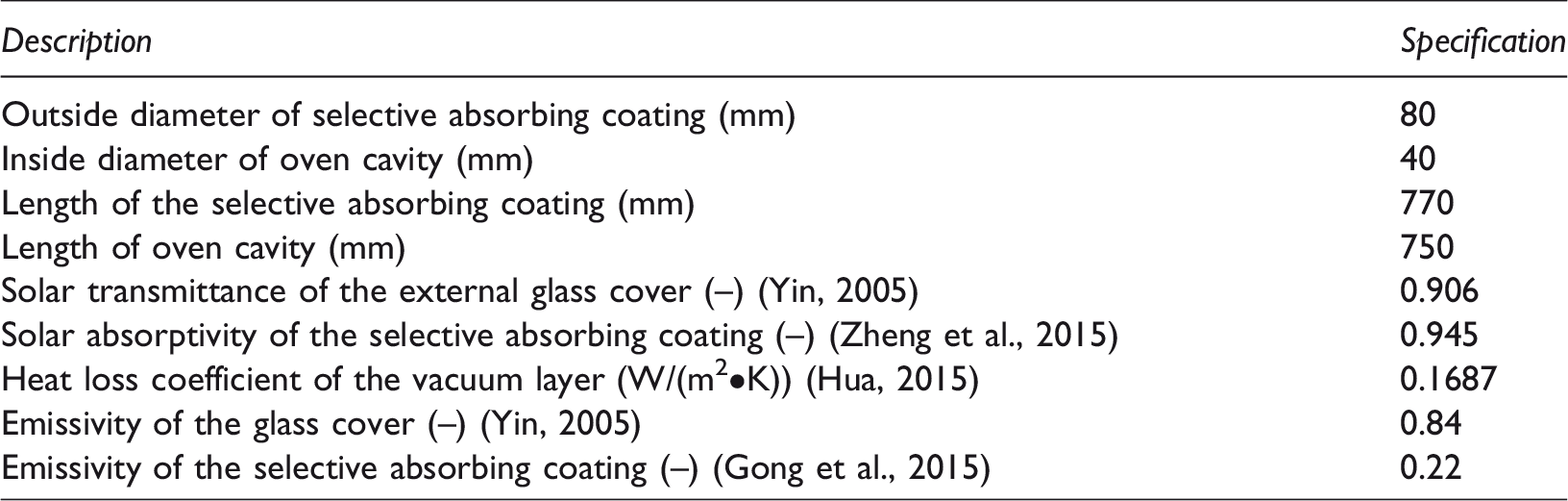
The three-dimensional geometrical model with the typical solar oven size is used in the simulation (see Figure 2). This study selects the solar radiation of the first day in the middle month of every season (April 1, July 1, October 1, and January 1) in Jiaozuo city (N35°10′, E113°3′) as heat source condition and chooses general room temperature of 25°C as ambient temperature conditions. The effects of phase-change heat storage layer on the thermal performance of solar ovens at all seasons are studied. The other constants and thermophysical parameters used in the model are listed in Table 2.
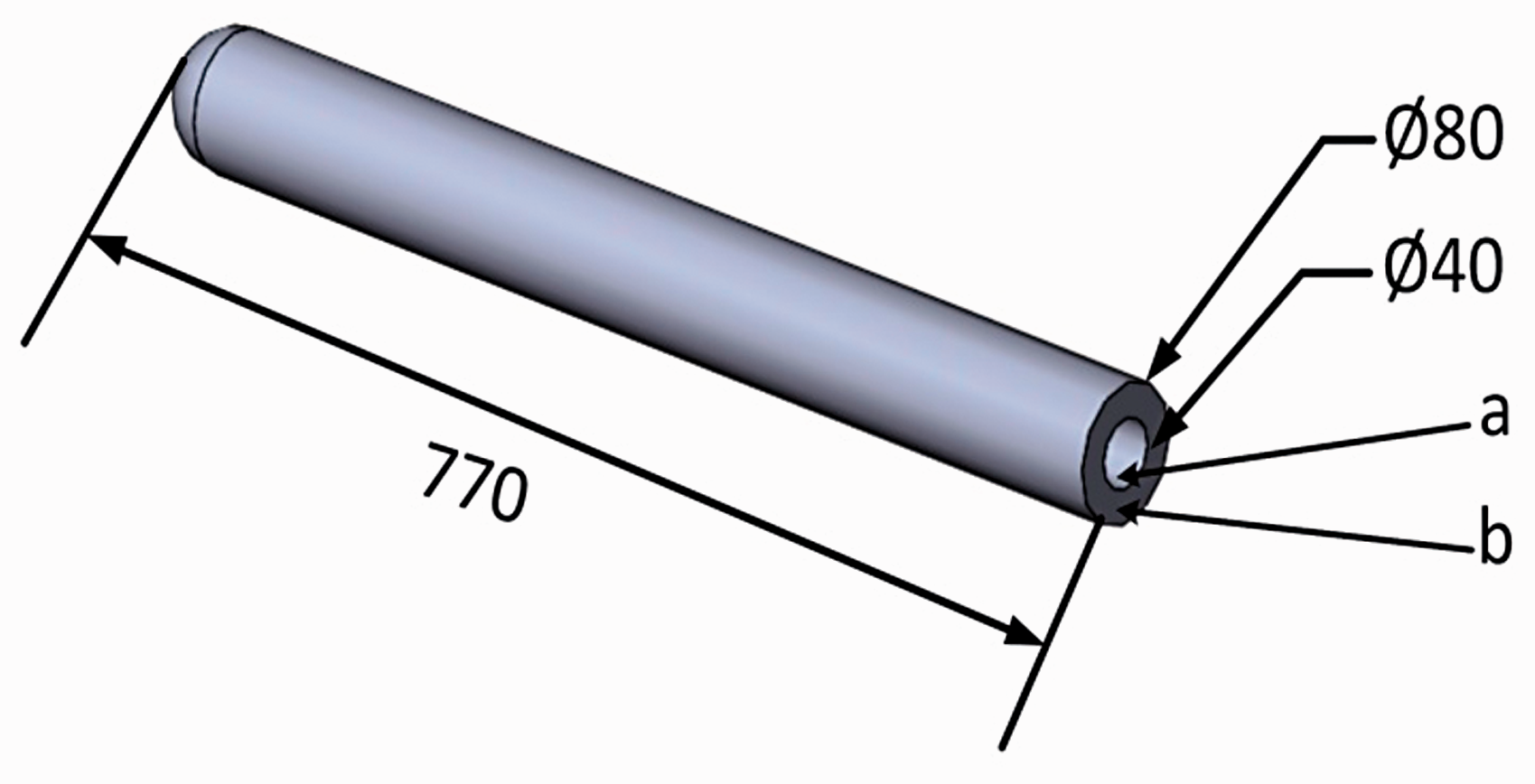
Model diagram of numerical simulation (a: oven cavity and b: phase-change heat storage layer, unit: mm).
Values of constants and thermophysical parameters used in the model.
Model equations
This model mainly involves the phase-change heat transfer physical field, and three kinds of basic heat transfer modes (heat conduction, convection, and radiation) have been considered. The governing heat transfer equation is as follows





The solar radiation source
The effective solar radiation is the outer boundary heat source condition of the phase-change heat storage layer. The effective solar radiation absorbed by the oven per unit area is calculated according to equation (6) (Yin and Xuan, 2001).





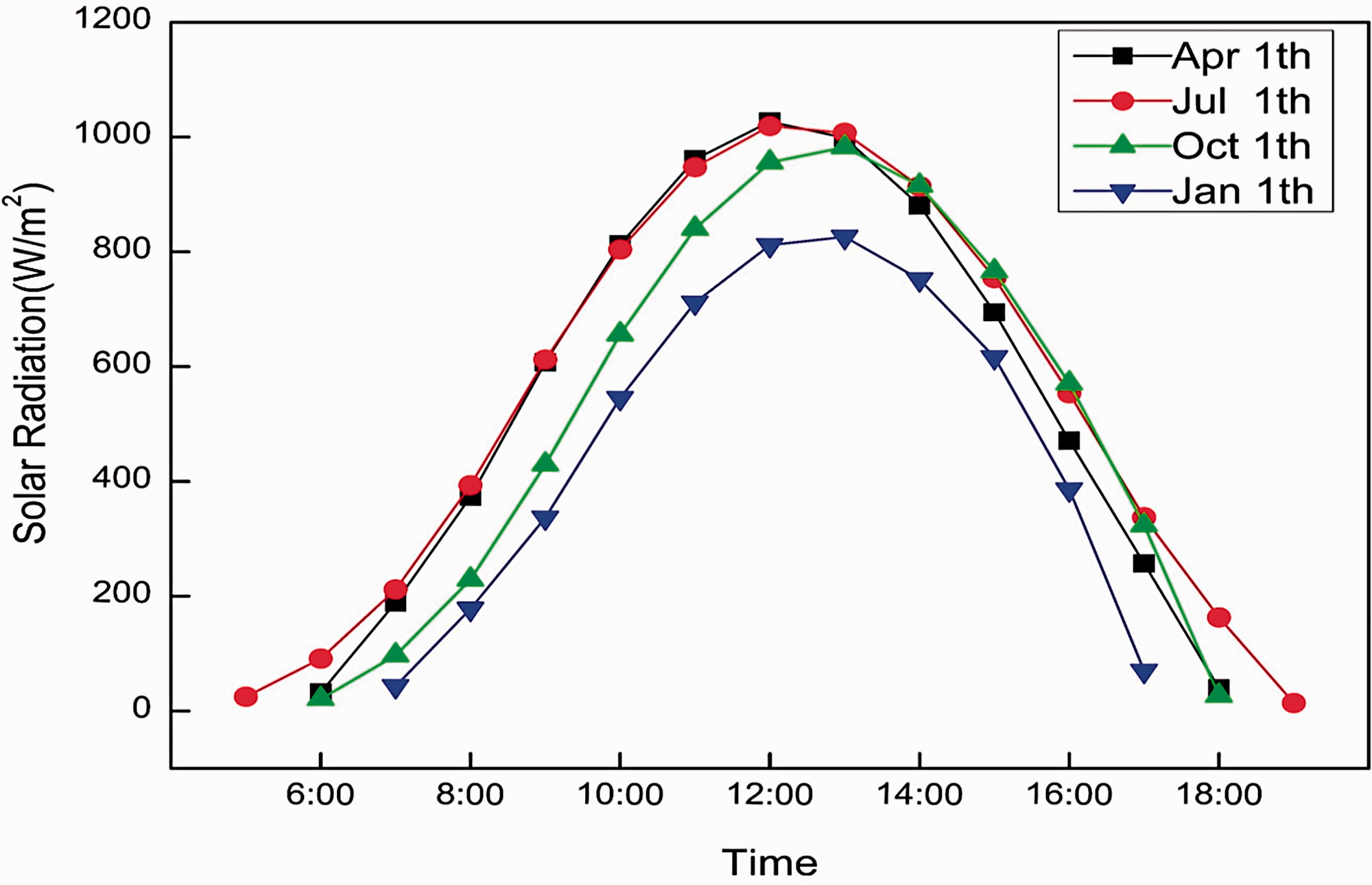
The variation curve of solar radiation.
Boundary conditions
The setting of boundary conditions is the key to get correct results of the model solution. In the cooking process, the air in the oven cavity is closed and the flow rate is slow; therefore, heat is transmitted to food through the inner wall of the oven cavity in the form of heat conduction and radiation. Most of the heat is lost by constantly taking the baked food out when solar oven is used. In order to simplify the problem, the model adopts Dirichlet boundary condition that the oven cavity takes a constant temperature of 100°C (Collares-Pereira et al., 2018) and the excess heat is extracted by default. The heat conduction and radiation of the inner wall of the oven are calculated by equation (11) and equation (12), respectively.


Heat storage performance
Heat storage capacity of PCMs is the main index to evaluate the heat storage performance of solar ovens. In this study, the heat storage capacity of the PCM is composed of the sensible heat when the material is pure solid or pure liquid and the latent heat when the material has a phase change. The sensible heat and latent heat are calculated by equation (13) and equation (14), respectively.


Results and discussions
The effects of phase-change heat storage layer on the solar oven heat transfer characteristics
Figure 4 compares the temperature field of solar oven for adding phase-change heat storage layer (a) and the traditional solar oven without the phase-change heat storage layer (b). It can be seen that the inner wall temperature of the oven for adding phase-change heat storage layer is 30°C–80°C higher than that without phase-change heat storage layer under the same solar radiation and irradiation time. This is mainly because the temperature of the PCM gradually increased in the sunlight, and heat is stored in the PCM in the form of sensible heat and phase-change latent heat. The result shows that the heat storage effect of adding phase-change heat storage layer is obvious.
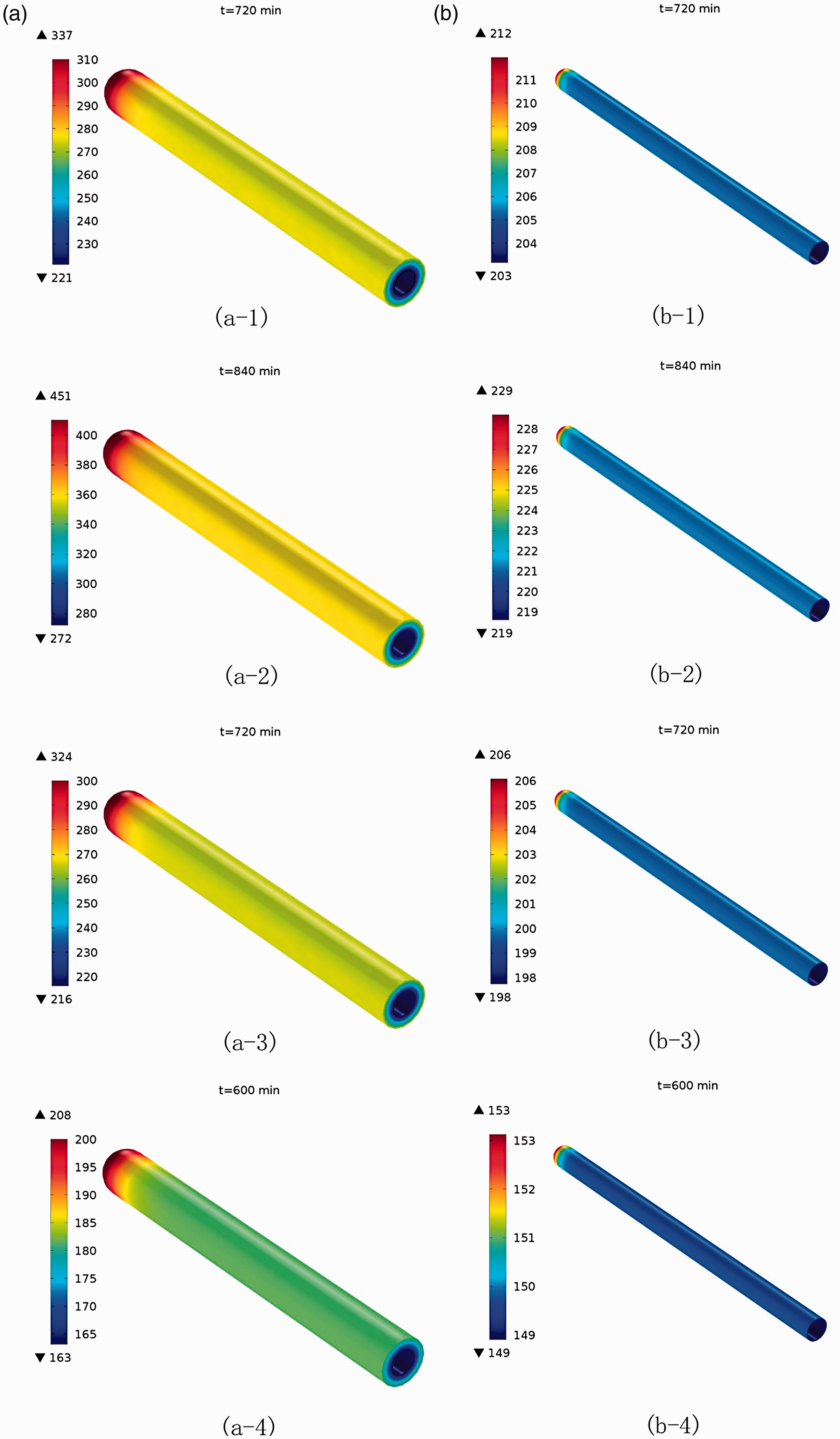
The temperature field of oven for adding phase-change heat storage layer (a) and without the phase-change heat storage layer (b) (subscript: 1: April 1, 2: July 1, 3: October 1, and 4: January 1).
Figure 5 shows that the curves of temperature changing with time in axial center point of inner wall in the oven, which gives two forms of adding phase-change heat storage layer and without phase-change heat storage layer. It can be seen in Figure 5(a) to (d) that the highest temperature of the oven with phase-change heat storage layer is 18°C–92°C higher than that without phase-change heat storage layer. The temperature of the oven without phase-change heat storage layer reaches the first peak in about 15 min after sunrise, which is 3.5 h earlier than the first temperature peak of the oven with phase-change heat storage layer. Because the thermal conductivity of the PCM is relatively small, it spends a certain time to transfer heat to the inner wall of the oven cavity, which slows down the heat dissipation rate. After 6 h under the sunshine, the temperature of the oven without phase-change heat storage layer reduces to about 115°C. And the temperature of the oven for adding phase-change heat storage layer reaches the lowest temperature of about 165°C after 7 h in the sunlight exposure. In Figure 5, it can be found that the temperature difference between the first peak-valley without phase-change heat storage layer is up to 100°C, and the temperature difference is reduced to 18°C–35°C after adding the phase-change heat storage layer. It indicates that adding phase-change heat storage layer obviously reduces the temperature fluctuations.
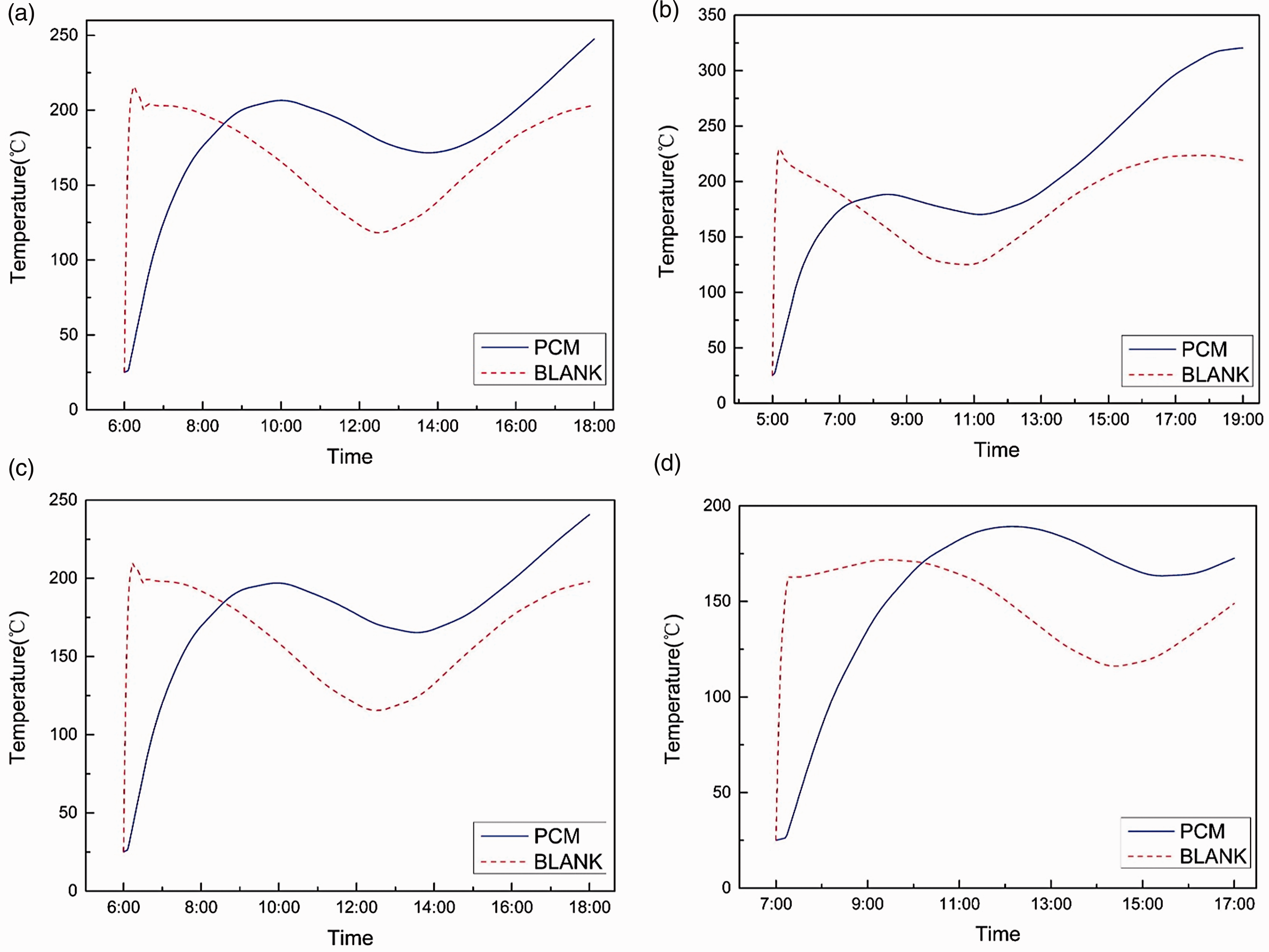
The temperature curve of oven for adding phase-change heat storage layer and without phase-change heat storage layer. (a) April 1th. (b) July 1th. (c) October 1th. (d) January 1th. PCM: phase-change material; Blank: the oven without phase-change materials.
The influence of the food initial temperature on the temperature field of the heat storage layer
To study the influence of the food initial temperature on the temperature field of the heat storage layer, take 10°C as the temperature gradient. Figure 6 shows the curves of temperature changing with time in axial center point of inner wall in the heat storage layer when the food initial temperature condition is 10°C–50°C. As can be seen in Figure 6, the temperature change trend of the inner wall in the heat storage layer is the same in the whole year regardless of food initial temperature. With the increase in irradiation time, the difference between the inner wall temperature of three groups is decreased. The results show that the food initial temperature in the oven has little effect on the temperature field of the heat storage layer.
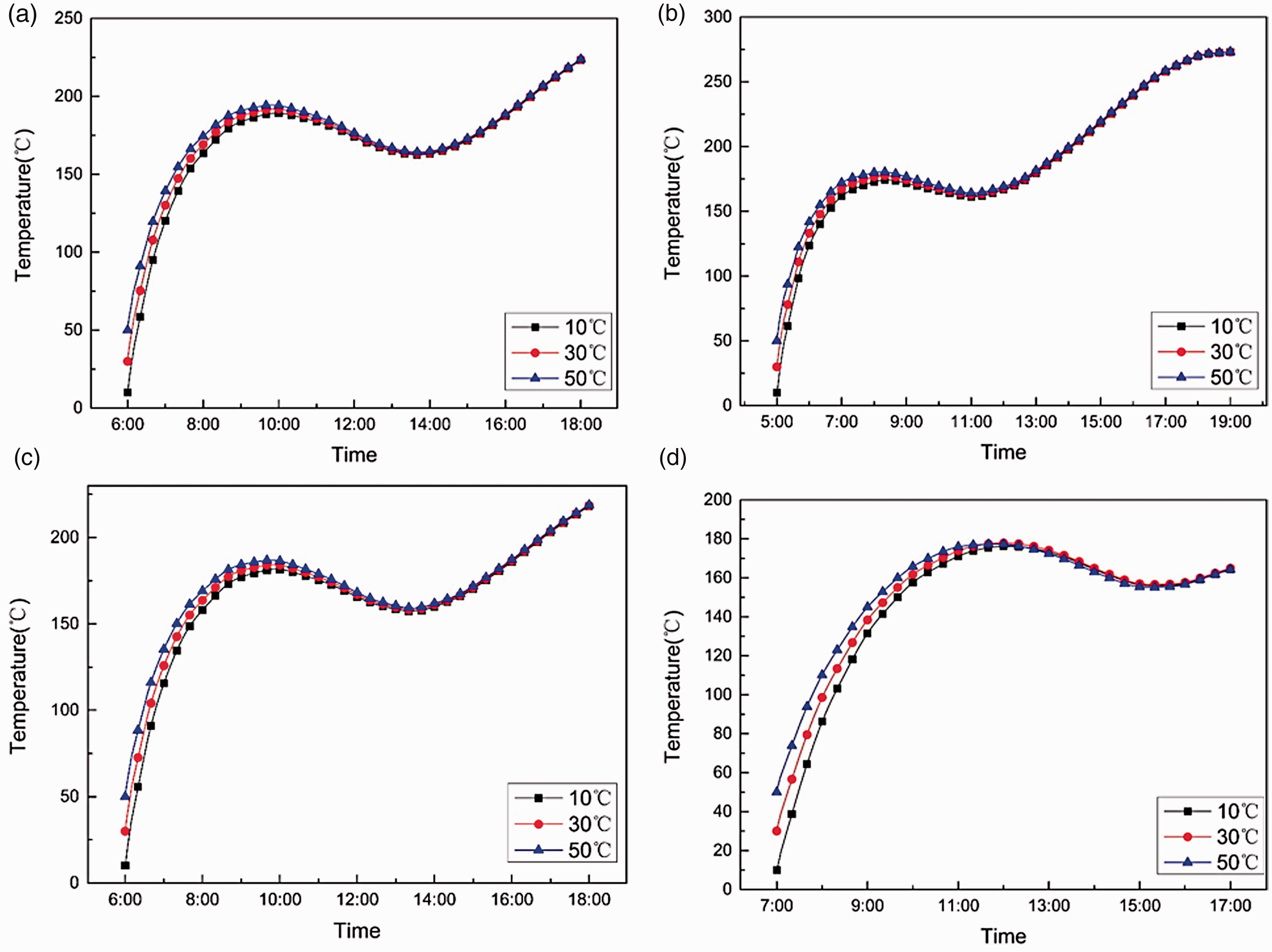
The temperature curve changing with time under the temperature condition of the object in the oven. (a) April 1th. (b) July 1th. (c) October 1th. (d) January 1th.
Heat storage performance of phase-change heat storage layer
In this study, the total volume of the phase-change heat storage layer is 2.87 × 10⁻³ m3, and 5.27 kg molten salt can be placed. Figure 7 shows the heat storage on April 1, July 1, October 1, and January 1. As can be seen in the figure, the sensible and total heat storage on July 1 reach the highest temperature, which are 1870 kJ and 2718 kJ, respectively. Because the solar radiation is large and the irradiation time is rather long in the summer, PCM can absorb more heat. The latent heat is 848 kJ on April 1, July 1, and October 1 and the latent heat on January 1 is 0, which indicate that PCM can completely melt after sunshine in a single day and absorb the same latent heat of phase change in the spring, summer, and autumn. However, the solar radiation is small and the irradiation time is short in winter, the material cannot reach the phase-change temperature, so there is no latent heat available. It can be concluded that the phase-change heat storage layer can store a certain amount of heat throughout the year, and the heat can boil 2.5–8.6 kg water whose initial temperature is 25°C in the absence of sunlight.
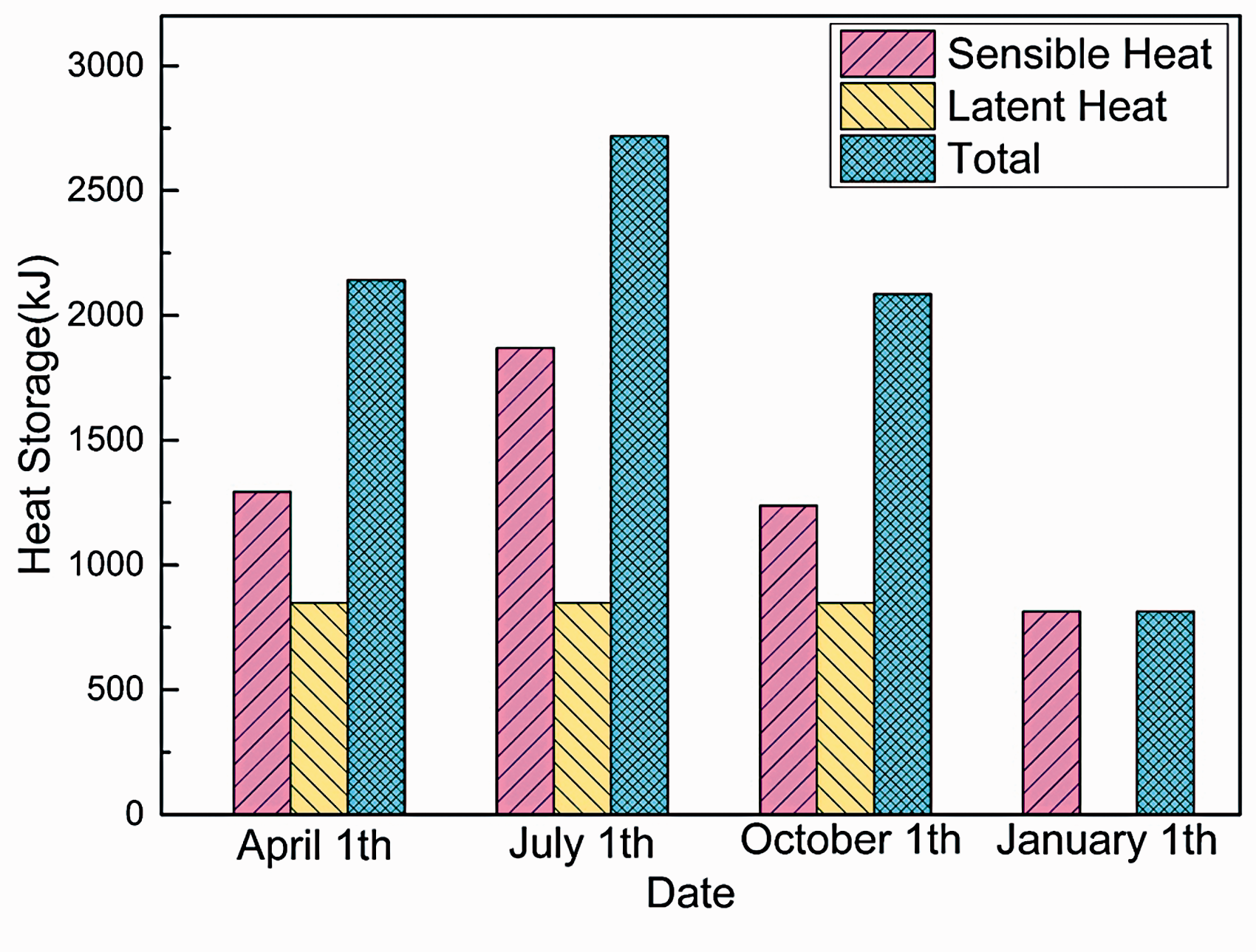
Heat storage of phase-change heat storage layer on different typical dates.
Conclusions
Based on the phase-change heat storage principle, the heat transfer and heat storage performance of solar ovens with and without phase-change heat storage layer are numerically studied. The following results are shown:
The temperature of solar oven with phase-change heat storage layer is 30°C–80°C higher than that without phase-change heat storage layer under the same solar radiation and irradiation time. The temperature fluctuation of solar oven can be effectively reduced to 18°C–35°C from 100°C after adding the phase-change heat storage layer, and the heat storage layer can store a certain amount of heat. In the absence of solar radiation, the heat stored can boil 2.5–8.6 kg water whose initial temperature is 25°C. The change trend of temperature field in the heat storage layer is not affected by the food initial temperatures in the oven.
Footnotes
Declaration of conflicting interests
The author(s) declared no potential conflicts of interest with respect to the research, authorship, and/or publication of this article.
Funding
The author(s) disclosed receipt of the following financial support for the research, authorship, and/or publication of this article: This work has been carried out with the financial support of the Natural Science Foundation of China (NSFC U1404520 and NSFC 51676064).