




Abstract
Despite considerable effort and a broad range of new approaches to safety management over the years, the upstream oil & gas industry has been frustrated by the sector’s stubbornly high rate of injuries and fatalities. This short communication points out, however, that the industry may be in a position to make considerable progress by applying “Big Data” analytical tools to the large volumes of safety-related data that have been collected by these organizations. Toward making this case, we examine existing safety-related information management practices in the upstream oil & gas industry, and specifically note that data in this sector often tends to be highly customized, difficult to analyze using conventional quantitative tools, and frequently ignored. We then contend that the application of new Big Data kinds of analytical techniques could potentially reveal patterns and trends that have been hidden or unknown thus far, and argue that these tools could help the upstream oil & gas sector to improve its injury and fatality statistics. Finally, we offer a research agenda toward accelerating the rate at which Big Data and new analytical capabilities could play a material role in helping the industry to improve its health and safety performance.
Introduction
Despite a broad range of ideas and approaches over the years to improve its health and safety performance (e.g., Cramwinckel and Thummarukudy, 2000; Flin et al., 1996), the upstream oil & gas industry has found it difficult to reduce stubbornly high fatality and injury rates among personnel (Curlee et al., 2005). In 2012, there were a total of 138 fatalities within the sector in the United States alone (King, 2013) and, because of the uncommonly global nature of the industry (Goldstein, 2009; Hatakenaka et al., 2006; Yergin, 1991), this unfortunate trend extends throughout the sector’s operations around the world. By comparison, the industry’s on-the-job fatality rate in the United States is approximately 7.6 times higher than the national average (King, 2013).
A major part of the oil & gas industry’s strategy toward mitigating these kinds of health, safety, and environment (HSE) incidents is to measure them in impressive detail. Vast amounts of data have been collected about these accidents (Veley, 2002) in the hope that this will improve the sector’s ability to spot trends and discover patterns that can shed light on potential solutions. But early attempts at finding these high-level trends have been thwarted by three factors. First, although some of the industry’s HSE data have been coded and categorized into numerical data such as lost-time incident statistics, much of it has been captured as written responses that were later converted to text (Campbell et al., 2012). Second, a significant fraction of this historical data resides within highly customized applications and bespoke files whose structures are relatively unique. As DeVol (2004) suggests, many of the people collecting this data had to rely on either custom-built data systems or use a system of e-mails and spreadsheets or simple standalone database applications for HSE incident reporting and information management. Incorporating injury, environmental, property/equipment damage, and vehicle incident reporting with medical case management, industrial hygiene monitoring, auditing and inspections, investigation results with corrective actions and insurance claims management into a single integrated system was not possible or worth the investment to build (1).
Third, the highly customized and fragmented nature of HSE data within the sector has created a problem that one operator refers to as “dark data”—that is, information collected during the course of business that remains in archives that frequently do not garner much attention, or that are not generally accessible or structured sufficiently for analysis (Akoum and Mahjoub, 2013).
This article explains how new tools and approaches unfolding within the Big Data revolution could be applied to data within the upstream oil & gas industry, and puts forward five specific research questions that, if answered, could materially improve the sector’s HSE performance.
Big Data and its applications for managing industrial risks
Large data sets captured by digital devices and application software have been successfully used by managers to gain valuable insights into market, product, and consumer behavior (Mayer-Schönberger and Cukier, 2013). Many firms have been able to leverage Big Data to increase operational efficiency, inform strategic direction, bring about better customer service, develop new products and services, and identify new markets (Demirkan and Delen, 2013; Fulgoni, 2013; Lohr, 2012a). These data-driven decisions have, in turn, enabled firms to create new and inventive types of competitive advantage for themselves (Davenport et al., 2012).
Examples of Big Data risk mitigation.
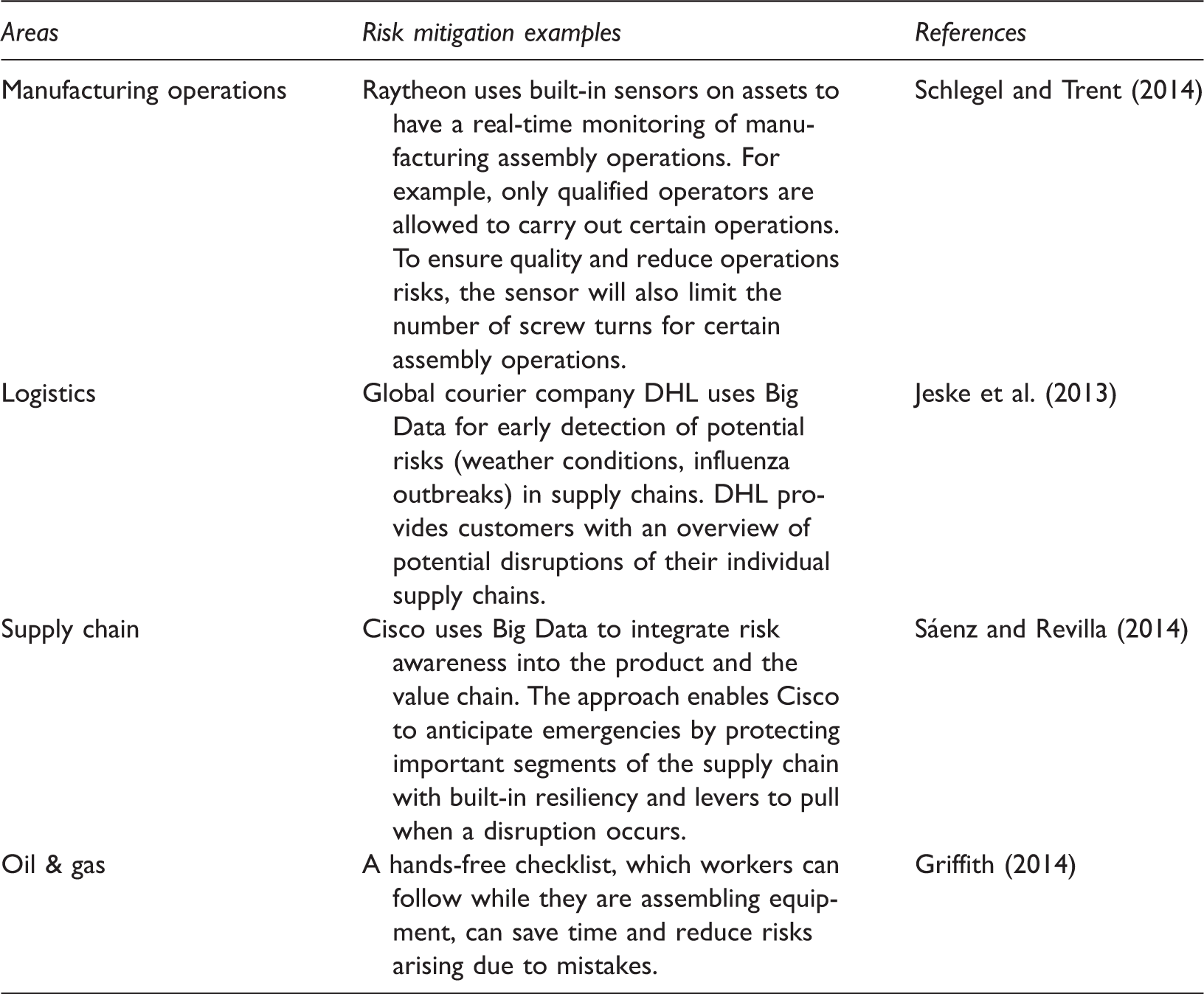
Several complementary technologies have also recently made impressive gains that are already starting to make significant impacts in how large volumes of data can be collected to manage industrial risks. In recent years, there has been a proliferation of new wearable devices such as watches, rings, glasses, and heads-up displays for consumers (Griffith, 2014). These wearable devices will enable experts to help less experienced industrial workers in oil & gas operational settings all around the world. For example, a relatively inexperienced worker at an oil & gas operating facility can wear special safety glasses equipped with a camera, microphone, speaker, and wireless antenna to send via live data feed information about their surroundings and the system around them to some kind of central command center staffed by seasoned veterans. The more experienced personnel can then advise their less experienced colleagues on the specifics of their situation, thereby imparting the wisdom and experience of the more senior staff member without actually having them physically present at the site.
Steering the industry’s Big Data agenda toward HSE
By most accounts, the oil & gas industry’s data are already “big.” Modern oil & gas seismic data centers can easily contain as much as 20 petabytes 1 of information, which is roughly equivalent to 926 times the size of the U.S. Library of Congress (Beckwith, 2011). And while the industry’s seismic data sets have been notoriously large and cumbersome for a long time, many of the operational aspects of the oil & gas industry are also generating significantly more data than they used to (Perrons, 2010).
Like many industries, the upstream oil & gas sector has seen a flurry of initiatives and high-profile publications (Anand, 2013; Beckwith, 2011) about Big Data, which have in turn translated into significant discussion about this topic within industry conferences (e.g., Feblowitz, 2013) and among practitioners. Critics of Big Data caution that the transformational potential of these analytical capabilities may be somewhat oversold and misunderstood (Harford, 2014; Lohr, 2012b), 2 but the oil & gas sector has already been noticeably impacted by several of the technologies underpinning these changes (e.g., Perrons and Jensen, 2015).
However, these inroads have largely been focused on more technical parts of the business such as reservoir characterization and drilling optimization (Akoum and Mahjoub, 2013; Holdaway, 2014). With the notable exception of a handful of extremely high-level conference papers (Batterson and Iovino, 2014; Pettinger, 2014), there have been few significant inroads in the application of Big Data specifically to the HSE-related parts of the industry. We therefore submit: Research Question 1: What barriers—technical, economic, or organizational—need to be overcome for Big Data technologies to be applied to the oil & gas industry’s HSE-related challenges with the same sense of urgency seen in more technical parts of the sector? Research Question 2: How will the oil & gas industry’s relatively slow adoption of cloud computing impede its uptake of Big Data technologies, and what can be done about it? Research Question 3: What is the most efficient way to bring together the industry’s myriad HSE-related data sets so that Big Data kinds of analytical tools and approaches can be brought to bear on this area? Big Data devices for HSE. Research Question 4: What barriers—legal, political, or organizational—need to be overcome for Big Data technologies to be applied to the oil & gas industry’s personnel records en route to discovering HSE-related trends?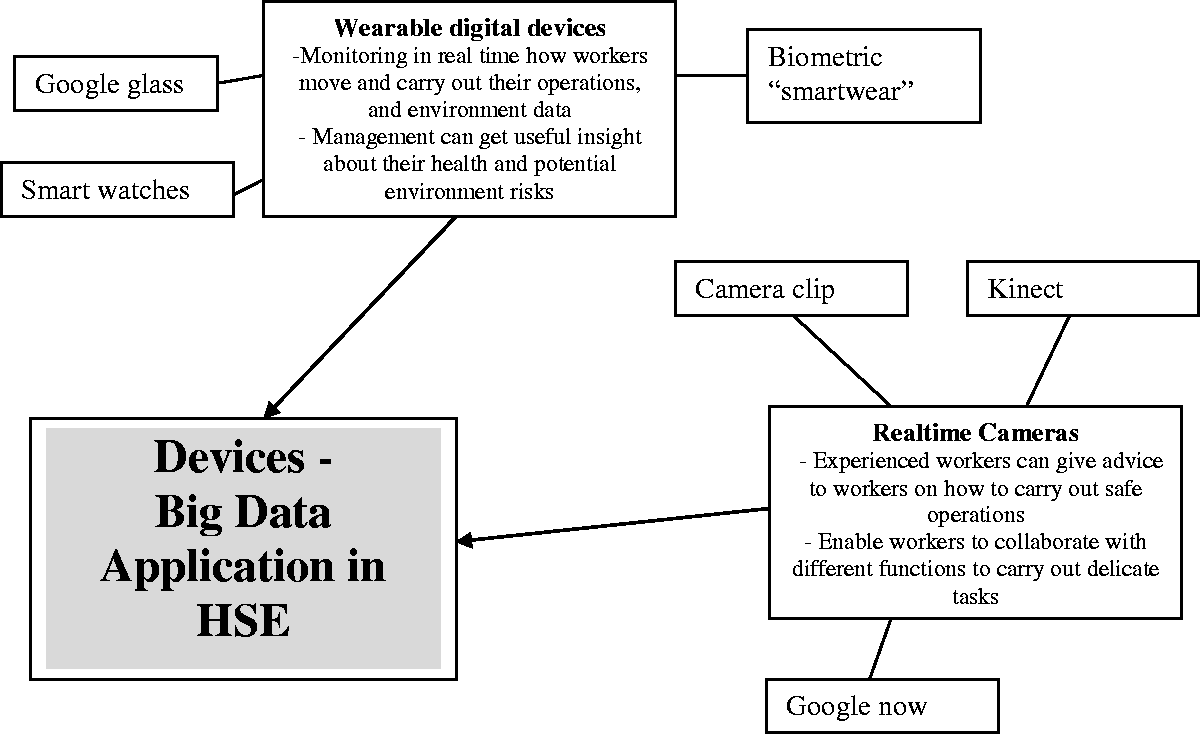
Finally, the literature has long sought to understand the link between HSE-related investments and safety performance (Zacharatos et al., 2005). Do some investment strategies yield better results than others in terms of their ability to reduce accidents and injuries? As noted earlier, Big Data technologies open up the possibility of joining organizations’ vast HSE data records with their financial and investment data to shed more light on the potency of different investment strategies in this domain. Thus: Research Question 5: How can Big Data bring together HSE and investment data sets to reveal the relative success or failure of different HSE-related investments?
Conclusions
This short communication explained how the upstream oil & gas industry has found it difficult to reduce stubbornly high fatality and injury rates among personnel, and examined existing HSE-related data management practices within the sector. In particular, we noted that data in this industry often tends to be highly customized, difficult to analyze using conventional quantitative tools, and frequently ignored. We argued that the application of new Big Data kinds of analytical techniques could potentially reveal patterns and trends that have been hidden or unknown thus far, and suggested that these tools could help the upstream oil & gas sector to improve its injury and fatality statistics. The article then offered a research agenda toward accelerating the rate at which Big Data and new analytical capabilities could play a material role in helping the industry to improve its health and safety performance.
It is our fervent hope that this contribution will be a catalyst for further research in the areas discussed here. The upstream oil & gas industry has been characterized as “the world’s biggest and most pervasive business” (Yergin, 1991) and, because of its uncommon size and scale, any breakthroughs that can be made with regards to the research questions put forward here would almost certainly translate to the saving of many lives and the avoiding of many serious accidents. Thus, although the research agenda suggested in this article may potentially be interesting from a theoretical point of view, the practical implications of getting this right—that is, of successfully applying Big Data to real-world HSE problems in the upstream oil & gas sector—would be far greater still.
Footnotes
Declaration of conflicting interests
The author(s) declared no potential conflicts of interest with respect to the research, authorship, and/or publication of this article.
Funding
The author(s) received no financial support for the research, authorship, and/or publication of this article.