




Abstract
This study attempted to raise new significant inspiration on effective development of tight reservoir in secondary exploitation by using rock mechanics method. After refitting the conventional tri-axial rock mechanics testing instruments, a set of probing experiments on rock mechanics determination were performed. Results show that mechanism of the influence of confining pressure on the Young's modulus is different from that of the pore pressure. The physical significance of the slope and intercept value in Young's modulus changing curves were analyzed; two kinds of mechanisms which cause changes of Young's modulus were raised. Meanwhile, we put forward the concept of “microscopic” anisotropy and introduce the coefficient of “S” and “H” to quantitatively characterize the relative difference on impact extent, where pore pressure and confining pressure could lead to change in Young's modulus and the size of microscopic anisotropy of Young's modulus. We predicted the size of microscopic anisotropy of Young's modulus in Qijiagulong district of Daqing Oilfield by using the above method. The conclusion could provide scientific basis for judging the well pattern adaptability, preponderant direction of water flooding, the reservoir rock fracturing, and optimization design of fracturing parameters.
Keywords
Introduction
Compared with the initial state of reservoir, pore pressure and confining pressure would change apparently during water flooding development (Zheng et al., 2013). As special materials with porous medium, factors which influence the mechanical properties of oil and gas reservoir are various, including pore pressure, confining pressure, temperature, fluid saturation, etc. (Cai et al., 2014). Change in pore pressure occurs within the rock, contacted with the microscopic pore structure of the rock directly, which can vary with confining pressure. As horizontal pressure is applied to the rock mass, confining pressure is closely related to the tectonic stress. As confining pressure is not directly contacted with rock internal pore throat, we believe that the mechanism of influence on rock mass mechanics parameters by confining pressure will be different from the pore pressure. At the same time, due to dominant direction of deposition which could occur when reservoir is constructed, the main seepage channel would also be produced, which could determine the microscopic anisotropy of pore structure rock and also lead to variations in anisotropy of rock mass mechanics parameters.
Predecessors have done a lot of research on factors affecting mechanical properties of rock mass in reservoir. Zhang et al. (2002) pointed out that the relationship between effective confining pressure and Young's modulus, compressive strength, is exponential through the core measurement but did not construct continuous changing model of mechanics properties in the process of water flooding; You (2003) believed that law of Young's modulus changing with the confining pressure reflects the rock internal damage state by measuring the cores with different lithology, and he thought that average Young's modulus value will be accurate relatively when considering the heterogeneity of the rock at the same time; Zeng et al. (2012) put forward the storage and seepage unit which consists of sedimentation, diagenesis, and tectogenesis by using the method of clustering analysis to evaluate reservoir anisotropy of low-permeability sandstones. Yu and Tian (2013) calculated the anisotropic coefficient when rock mass mechanics parameters changed with confining pressure and predicted the relationship between the elastic modulus and depth; Adebayo and Adetula (2013) determined the hardness, brittleness, Rock Abrasivity Index (RAI), penetration rate, and bit wear rate to study the condition of drilling categorization. Tang (2014) analyzed wave velocities and modulus of the anisotropic rock under the condition of quasi static and dynamic state, he believed that anisotropic characteristics was related to porosity, compaction history, and particle composition; Nishimura (2014) used a new type of tri-axial test instrument to quantify the small strain of rock material value in high precision, which could help to get more accurate determination of anisotropic Young's modulus; Kongkitkul et al. (2014) determined Young's modulus of two kinds of new asphalt materials, and concluded that the vertical of Young's modulus is greater than that of the horizontal. Actually, there are also lots of scholars at home and abroad who have studied the relationship between natural resources and rock mechanics method (Fan et al., 2014; Lee and Bobet, 2014; Liu et al., 2014; Markov et al., 2014; Song and Hu, 2014; Wasantha and Ranjith, 2014; Wu et al., 2014; Yang et al., 2014).
Concerned about the above research status at home and abroad, the following three aspects of problems could be referred (Xing et al., 2014; You and Su, 2003; Du et al., 2015; Ghassemi, 2012; Kukudzhanov, 2011; Kurek et al., 2011; Markides and Kourkoulis, 2012; Menéndez and David, 2007; Turner, 2013):
Most of the sampling methods in rock measurements are sampled from a certain single direction, which is not from three directions of X, Y, and Z. Little measurements are based on synchronous measurement on structure of the reservoir rock, composition and so on, thus the factors that influence anisotropy of mechanical properties in rock mass are relatively poor. At present, most of the research and experiments are based on the determination of dry samples, or just loading one or two conditions like the confining pressure, pore pressure, temperature and fluid, etc. Little measurements were designed under specific underground reservoir conditions of temperature, confining pressure, pore pressure, the determination of oil–water saturation, and so the results of most experiments could not reflect reservoir accurately.
In this article, we select samples from wells “A”, “Q”, “G”, drill three pieces of small samples respectively from the horizontal X direction, Y direction and the vertical Z direction to perform the rock mechanics parameters determination under the condition of changing pore pressure or confining pressure, and do some research and analysis on the mechanism which affects Young's modulus and the anisotropy of rock mass mechanics parameters.
Geologic setting
The study area is located in the central depression belt of Songliao basin, China. The tectonics is characterized by the juxtaposition of uplifted and depression units and the fault systems are complex and various.
Delta was the main facies of this area, including distributary channel and inter-distributary bay. Sedimentary sequence of distributary channel consisted of scour surface, detainment sedimentation, large fine sandstone facies, small silty sand lithofacies, and horizontal bedding phase composition. Inter-distributary bay is given priority to mudstone and silty mudstone, horizontal bedding, plastic deformation bedding, and intermittent sand layer. Sedimentary facies model of pay zone is shown in Figure 1.
Sedimentary micro-facies.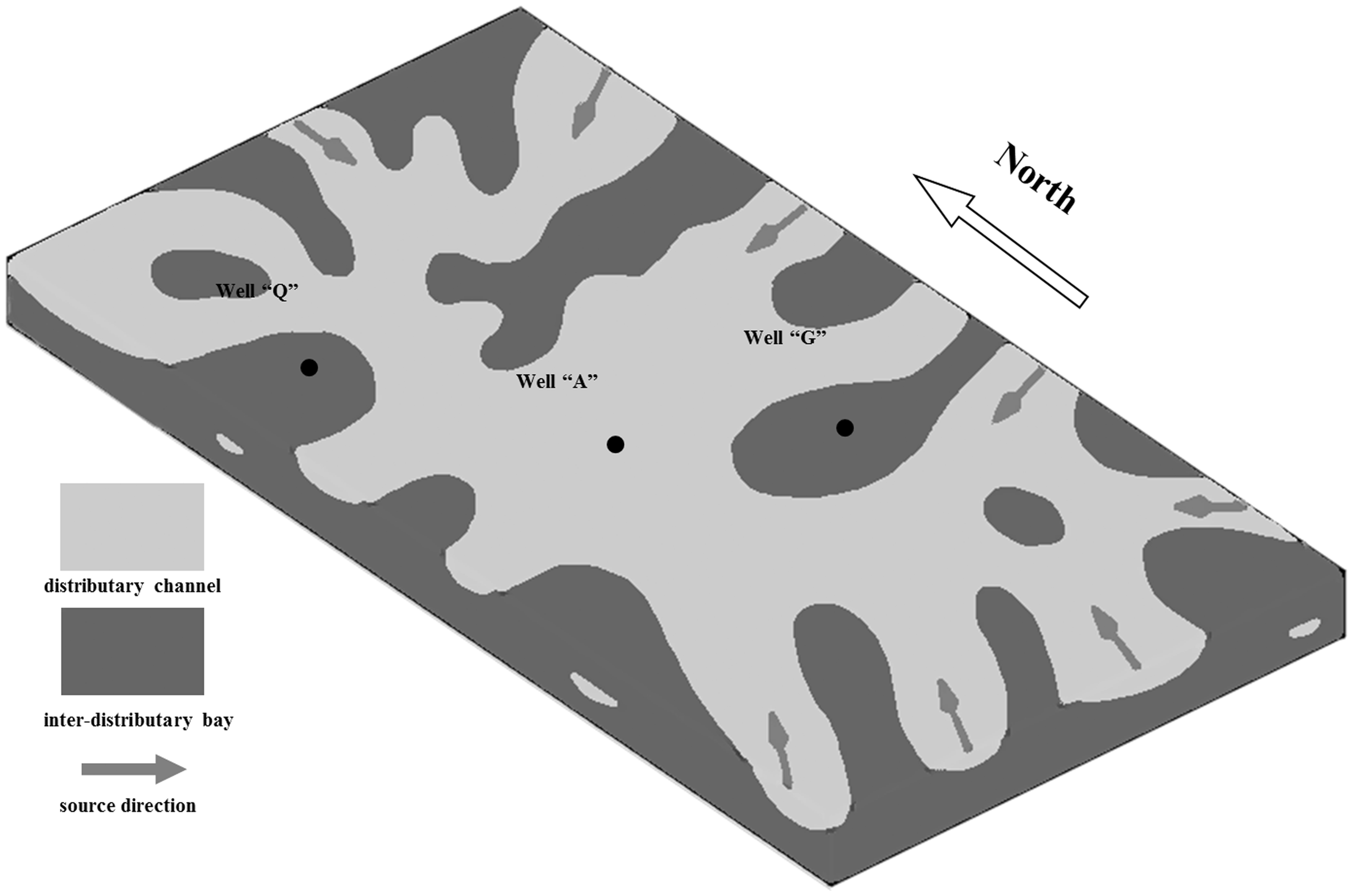
Determination of anisotropic Young's modulus
Samples of well “A”
Rock sample of well “A” lies at a depth of 1883.0 m, logging interpretation results show that the porosity is 13.4%, the permeability is 2.62 × 10⁻³ µm2, and lithology is fine-grained feldspar lithic sandstone.
Experimental equipment used is the servo rock mechanics tri-axial stress test system (Figure 2). The system mainly includes the axial pressure control system, pore pressure control system (peak could be up to 40 MPa), confining pressure control system (peak could be up to 70 MPa), and computer acquisition and control system.
Experimental equipment and samples.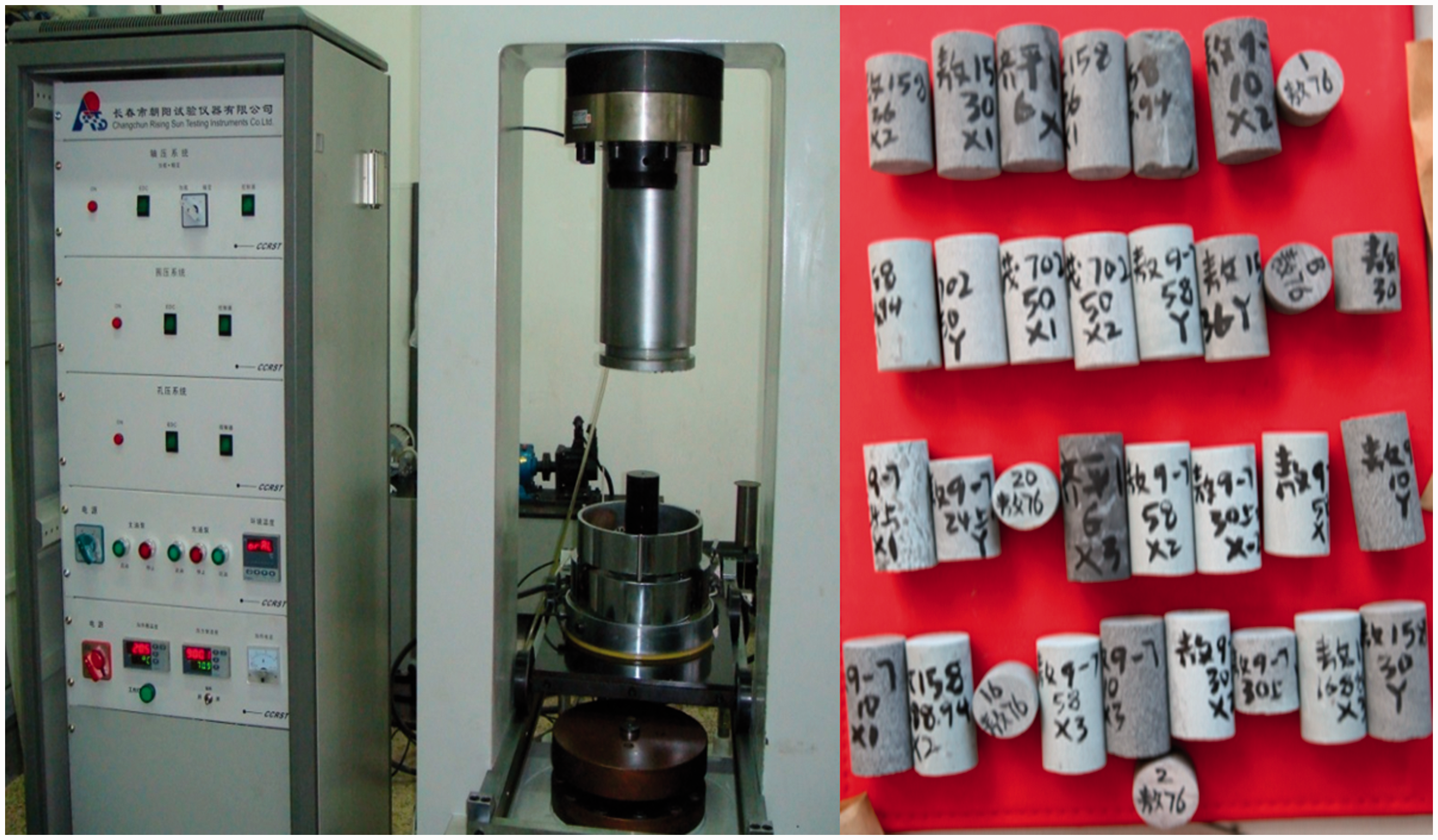
We drill three pieces of small samples respectively from the horizontal X direction, Y direction and the vertical Z direction to perform the rock mechanics parameters determination under the condition of changing pore pressure or confining pressure. Before determination, according to the actual sample of formation conditions, we set the fluid conditions to oil and water saturation; the volume ratio is 6:4 and the temperature is set to 45°. We keep the confining pressure constant, increasing pore pressure in the interval of 2 MPa and then keep pore pressure constant, increasing confining pressure in the interval of 2 MPa to perform the experiment. Finally we draw the cross-plot between effective confining pressure (the difference between the confining pressure and pore pressure) and Young's modulus, respectively, the result is shown in Figure 3.
As can be seen in Figure 3, with the increase of effective confining pressure, Young's modulus increases linearly. As to samples of Y, Z direction, the slopes of Young's modulus for two pressures are basically the same but intercept values are different. Only the slopes of the X direction sample are rather different. Values measured under changing pore pressure are greater than those under confining pressure, but the slope values are the opposite. It could prove that there are differences between the mechanism of the changing pore pressure and confining pressure, reflecting the anisotropy of rock mechanics properties.
Cross-plot between effective confining pressures (the difference between the confining pressure and pore pressure) and Young's modulus of “A”.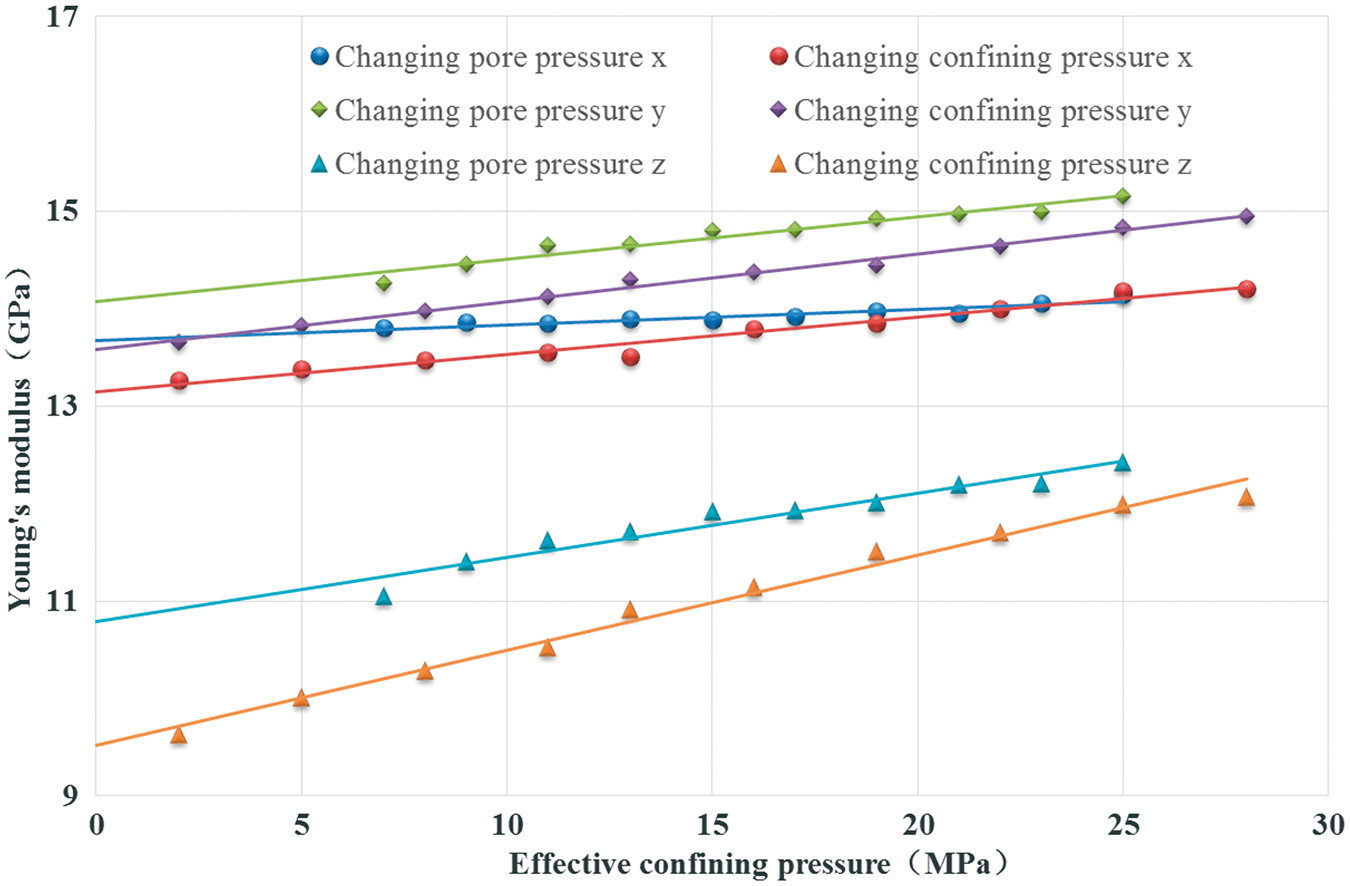
Samples of well “Q”
We select samples from well “Q” at a depth of 1926.5 m. The lithology is silty mudstone. We select in-situ conditions to perform the similar experiments and draw the cross-plot, as shown in Figure 4.
Cross-plot between effective confining pressures (the difference between the confining pressure and pore pressure) and Young's modulus of “Q”.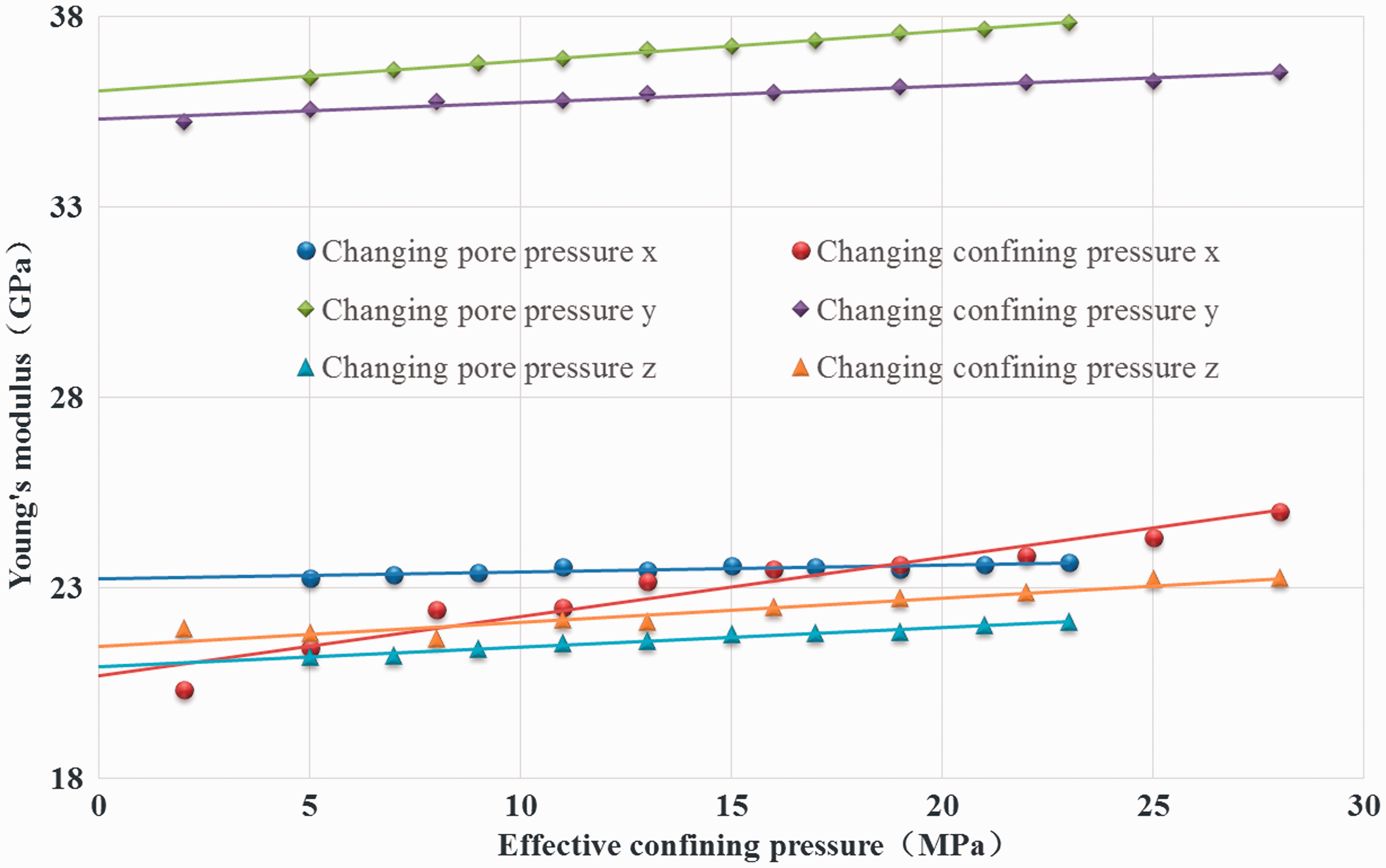
Discussion on mechanisms by which microscopic anisotropy of Young's modulus change
In fact, as a kind of force applied onto the outer rock, confining pressure will cause the compression of pore fluid thus increasing the pore pressure inevitably. In the above experiments, when increasing the confining pressure and keeping pore pressure constant it will lead to the decrease of the Young's modulus. Conversely, Young's modulus is growing. It can be seen that the degree of rock pore shape compression caused by the increase of confining pressure without artificial change in pore pressure is greater than the degree of rock pore morphology restoration caused by the increase of pore pressure induced by increasing confining pressure.
As reaction of formation pressure, pore pressure is a kind of stress induced by gravity, which is “hidden” within the rock particles and applied to the rock skeleton by fluid. By keeping either the confining pressure or pore pressure constant and changing the other, we could get the same effective confining pressure value, but results on pore structure under these two different phenomena are apparently completely different.
The introduction of coefficient “S” and “H”
Theory of “Biot” pointed that energy of seismic wave is lost partly due to the interaction between fluid and solid skeleton; “Biot’s coefficient” could quantitatively characterize the viscoelasticity of pore and fluid, which promote the development of the theory of viscoelasticity (Liu et al., 2014; Song and Hu, 2014; Wu et al., 2014; Yang et al., 2014).
In this paper, based on the above experiments, considering that the mechanism of two kinds of pressure is different, we introduce two new coefficients to quantitatively characterize viscoelastic properties of particles and pore fluid, called the S coefficient and H coefficient, respectively.
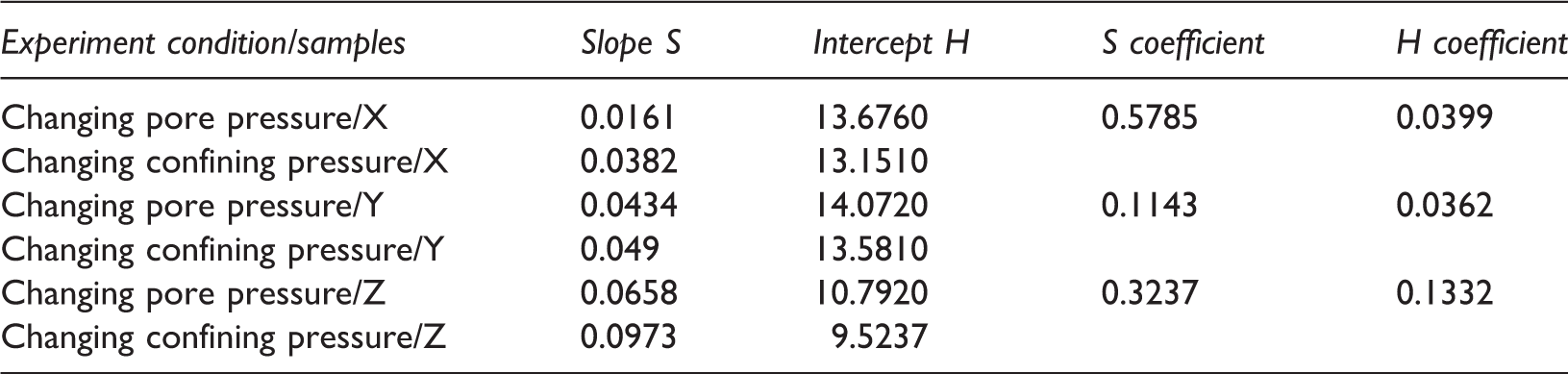
Calculation of S coefficient and H coefficient is based on slope of Young's modulus’s change called “S” and intercept of vertical axis called “B” (Figures 3 and 4), So these two coefficients can be represented as:
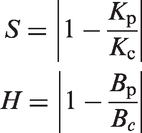
Among them, the coefficient of S and H is dimensionless, Kp—slope of pore pressure change, Kc—slope of confining pressure change, Bp—intercept of pore pressure change, and Bc—intercept of confining pressure change.
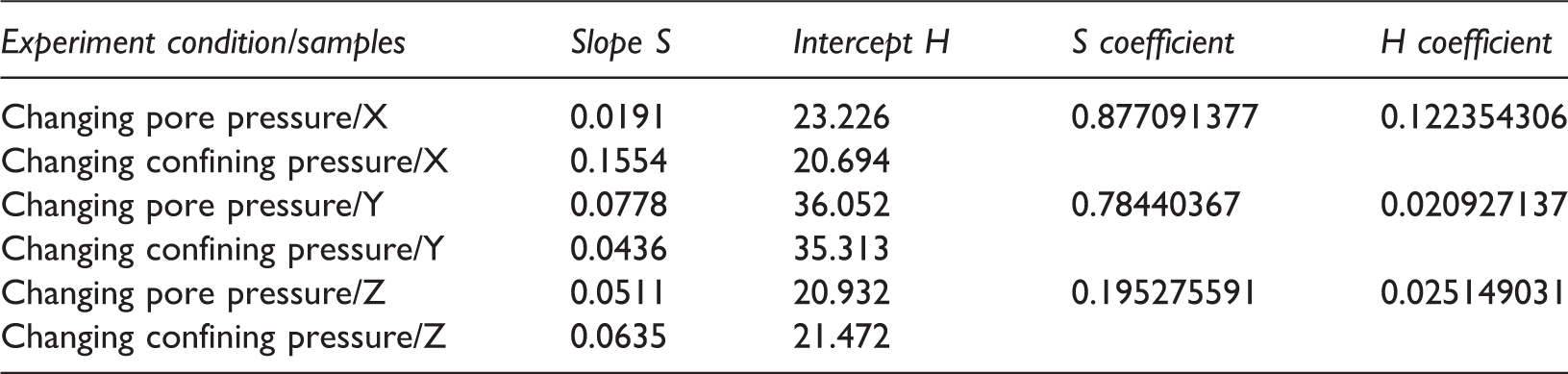
S coefficient and H coefficient calculation on samples of well “Q”.
Physical significance of S coefficient and H coefficient
Rock slices taken from three directions of samples from well “A” and “Q” are shown in the microscope (Figures 5 and 6). As can be seen from Figure 5, brittle minerals like quartz and feldspar accounted for more than 50% pore and throat is not obviously found. Seepage channels of Y direction sample are not oriented, so that whether we change pore pressure in a certain value or change confining pressure in the same value reversely the influence on Young's modulus could be substantially the same. Meanwhile, as to samples of Z and X, particles and seepage channels oriented well, so that whether we change pore pressure in some range or change confining pressure in the same range reversely, both the influence on young's modulus could be almost different. So S coefficient could be used to characterize the size of “micro” anisotropy of Young's modulus which is affected by characteristics of the pore and throat. A large value could reflect that the degree of influence on “micro” anisotropy of Young's modulus caused by pore and throat structure is great. The “micro” anisotropy referred to here were paid more attention to emphasize the respective different characteristics of three different drill strings large core taken from X, Y, Z direction. This is different from the traditional method that focuses on the whole anisotropy of a large core without drilling strings from different directions. So this research method and perspective can be more comprehensive to reflect the overall properties of the core.
Characteristics of horizontal and vertical rock slices of well “A”. Note: A—X direction slice under orthogonal light, B—X direction slice under single polarization direction, C—Y direction slice under orthogonal light, D—Y direction slice under single polarization direction, E—Z direction slice under orthogonal light, F—Z direction slice under single polarization direction. Characteristics of horizontal and vertical rock slices of well “Q”. Note: A—X direction slice under orthogonal light, B—X direction slice under single polarization direction, C—Y direction slice under orthogonal light, D—Y direction slice under single polarization direction, E—Z direction slice under orthogonal light, F—Z direction slice under single polarization direction.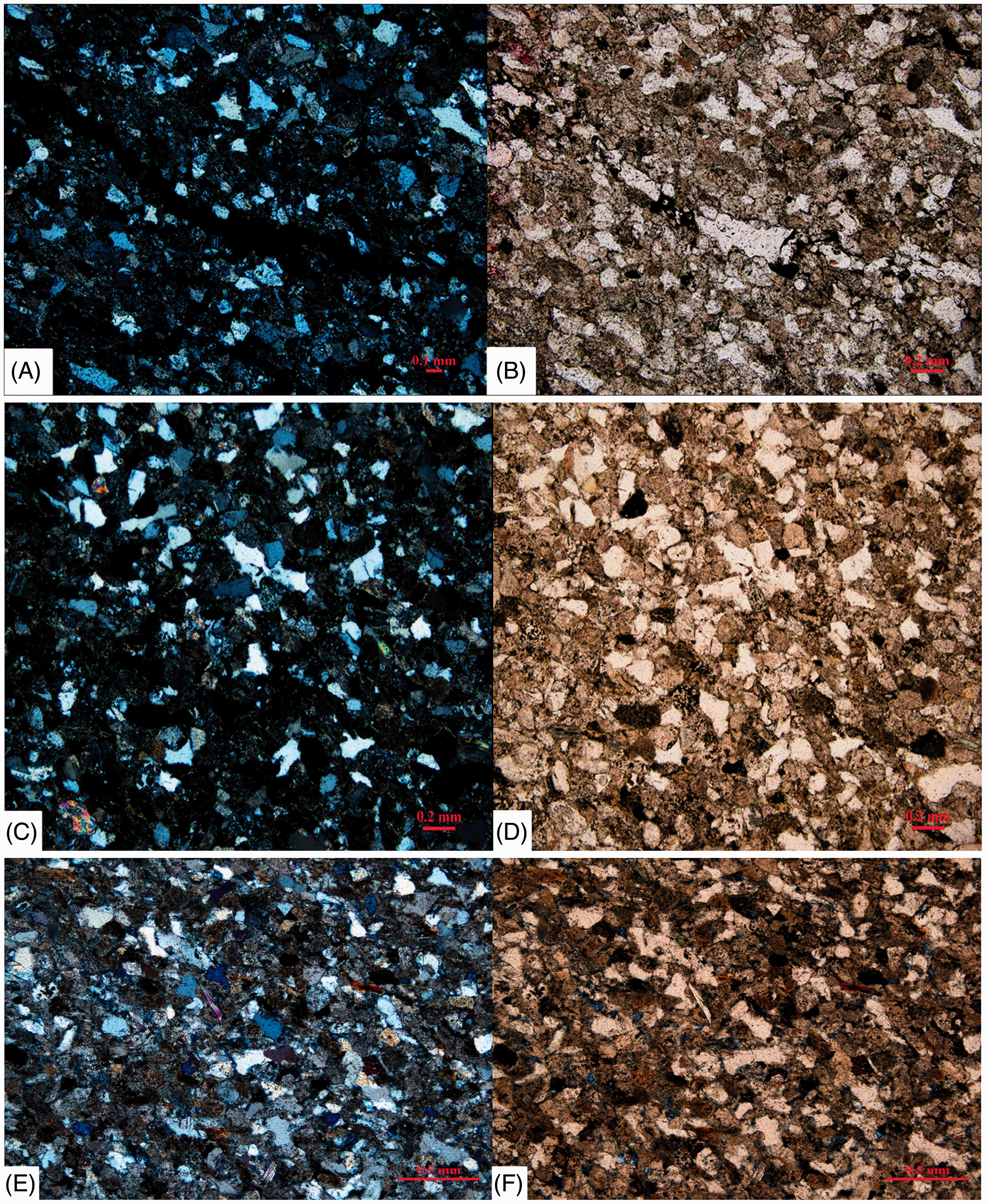
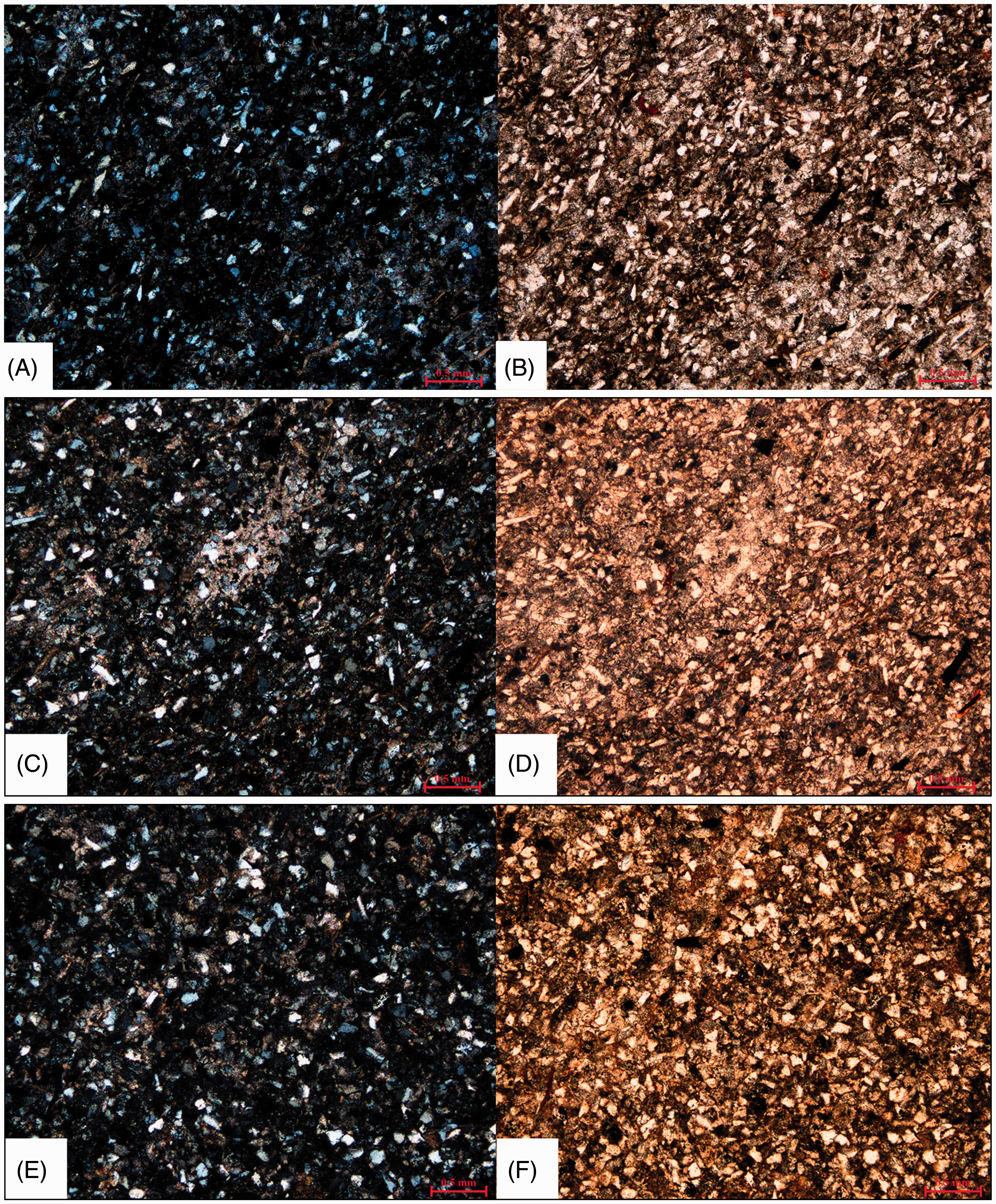
As can be seen in Figure 6, for samples of X and Y directions in “Q”, particles and seepage channel, the arrangement is good. On the contrary, sample of the Z direction is the opposite, which is also reflected in size of S coefficient which is X > Y > Z. Similar conclusions could also be achieved.
Therefore S coefficient characterizes the relative difference of capability to refactor pore throat structure by changing pore pressure or confining pressure. The coefficient range is [0,1].
For H coefficient, as can be seen in Figure 5, difference in S coefficient is large between the X and Y direction samples of well “A”, but H coefficient values of these two samples are nearly equal. Similar conclusion could be found in well “Q”. As we know pore throat, fluid, and skeleton materials (including solid material such as rock particles, filler content) could be treated as the three major elements in rock. For well “A”, take the example of X and Y, since there are apparent differences on the properties of pore size and structure between them, so we have enough evidence to believe that the reason which X and Y have the nearly equal H coefficient value may be related to properties of their skeleton materials. It means that the inherent properties of rock materials (such as rock stiffness) of these two samples are nearly the same, resulting that if we changed pressure condition, the inherent nature of these two samples may damage in the the same extent. Thus it would cause that when the pressure is increasing, micro fracture would have the same possibility to occur.
Therefore H coefficient can be used as characterization of the extent of the damage in inherent nature of these two samples by changing pressure conditions, and the possibility of breaking to produce micro cracks are nearly the same in the process of changing pressure. Large H coefficient reflects that this relative difference of influence on Young’s modulus when changing pore pressure in a certain value or change confining pressure in the same value reversely. The greater the H coefficient, the higher the extent of influence, where rock skeleton material damage leads to change in microscopic anisotropy of Young's modulus, the value range of H coefficient is generally [0,1]. For well “A”, H coefficient of sample in Z direction is the highest among the three samples, which reflected that skeleton materials of Z direction is relatively hard to be damaged. Similarly, skeleton materials of X direction sample of well “Q” are relatively hard to be damaged.
For special low permeability reservoir, “dead pores” which are not connected to each other could be commonly found in sandstone samples. As the compressibility of pore and fluid is higher than that of the skeleton material, when the pore and fluid was not fully compressed, it penetrated between the skeleton materials, and could buffer the occurrence of fracturing the skeleton material caused by compression. Only if effective confining pressure and degree of rock pore throat closed turned out to be high, skeleton material contacted with each other. The function of “buffer” resulted from pore throat and fluid would be greatly weakened; skeleton material may rupture into micro cracks due to compression, leading to changes in Young's modulus. Accordingly, there are two microscopic mechanisms which could influence Young's modulus, which are “change in the pore throat and fluid property” and “skeleton materials crack in the process of compression”. At a certain time during water flooding development, one of these two mechanisms will be the dominant factor. In the development process, the irregular change of pore fluid pressure and confining pressure, then led to the irregular change of the effective confining pressure, and finally led to the dominant factors which cause the change of Young's modulus at different time to be different, resulting in unsteady change in microscopic anisotropy of Young's modulus.
Significance about difference of Young's modulus under two kinds of pressure changes
We treated difference of Young's modulus under two kinds of pressure change as the Y axis, and effective confining pressure value as X axis to draw the cross-plots (Figures 7 and 8).
Cross-plot for difference of Young's modulus under two kinds of pressure change and effective confining pressure value of well “A”. Cross-plot of difference of Young's modulus under two kinds of pressure change and effective confining pressure value of well “Q”.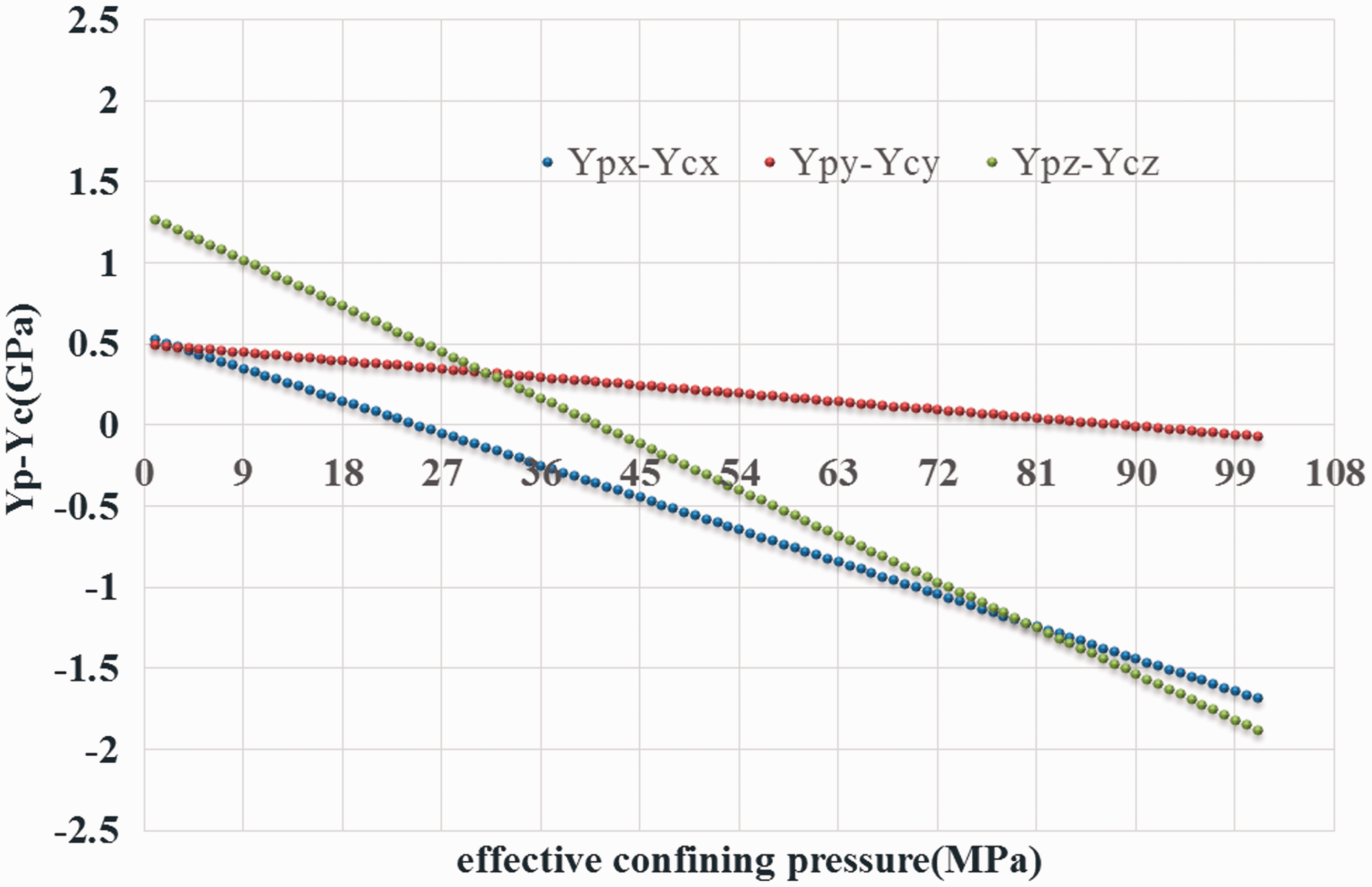
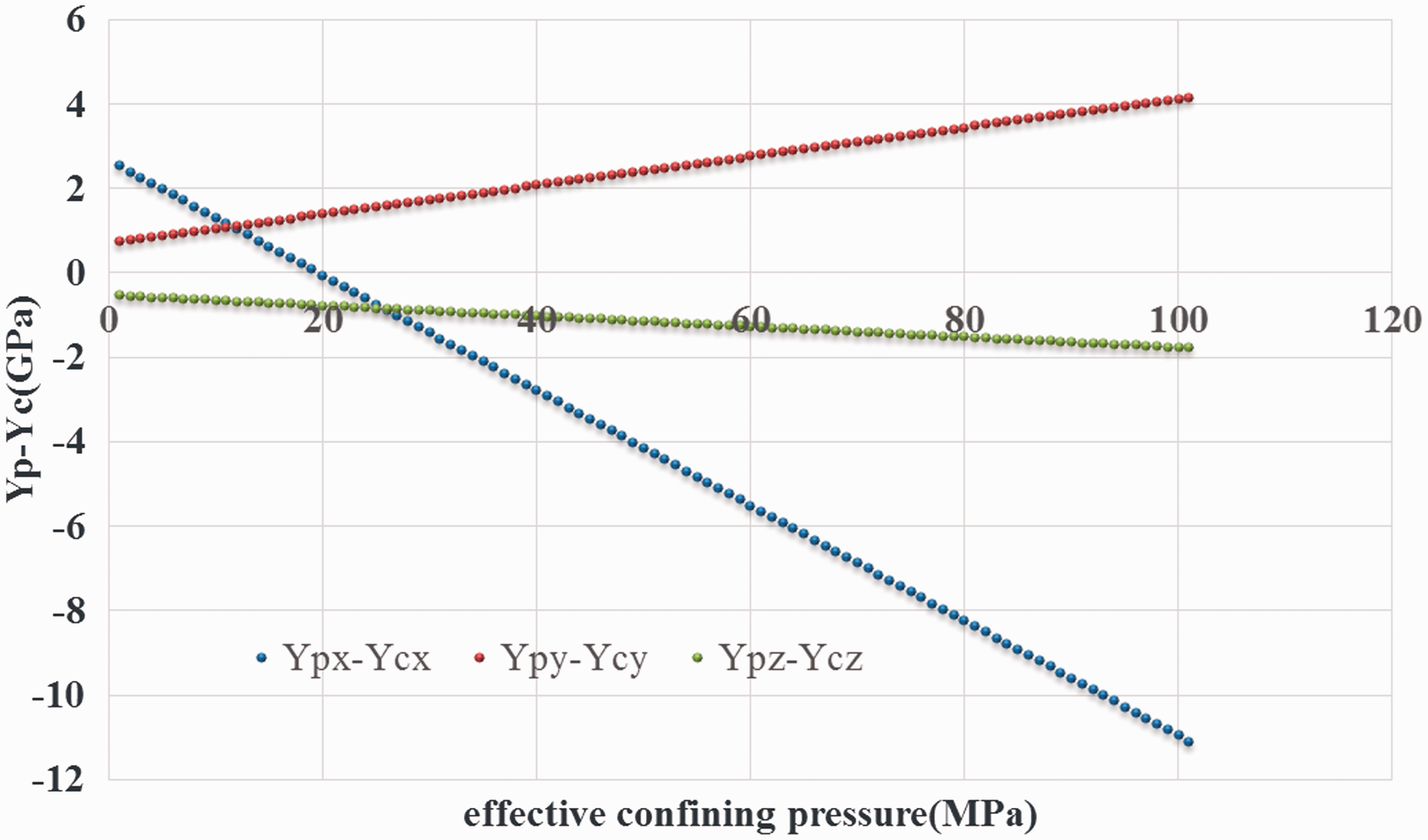
In Figures 7 and 8, Ypx, Ypy, and Ypz represent the variable Young's modulus of X, Y and Z direction under the condition of changing pore pressure, respectively, Ycx, Ycy, and Ycz represent the variable young's modulus of X, Y and Z direction under the condition of changing confining pressure, respectively.
S coefficient and H coefficient calculation on samples of well “A”.
When pore throat property is the dominant factor to influence microscopic anisotropy under the premise of within rock skeleton material stiffness, from the perspective of the micro mechanism analysis, we found that influence on pore throat structure with obvious grain orientation reconstruction by changing pressure could be reflected (Figure 9). First of all, keep pore pressure constant in 8 MPa, increasing confining pressure by the step of 2 MPa from 15 MPa. When the confining pressure increased to 19 MPa, keep the confining pressure constant, start to increase pore pressure by the step of 2 MPa to 12 MPa. As can be seen from (a) and (f), (b) and (e) in Figure 9, effective pressure values of above two groups are the same which is 7MPa and 9 MPa respectively. But according to the above experimental conclusion, the degree of compression on rock pore and throat by increasing confining pressure per 2 MPa is bigger than the degree of making rock pore and throat reopen by increasing pore pressure per 2 MPa. So even under the condition of the same effective stress, structures of rock particles are also not identical. It is totally related to the absolute value of pore pressure and confining pressure, respectively, so that anisotropy of petro physical parameters and mechanical properties of anisotropic rock mass are closely related, the greater the S coefficient, the greater anisotropy of rock mechanics properties.
Schema graph of influence on pore throat structure with obvious grain orientation by changing pressure. Note: each circle represents a low permeable reservoir rock section, black color shape represents rock particles, shape filled with light gray in the background represents the filler content and other skeleton materials, colorless part represents pore throat structure of special low permeability reservoir rock.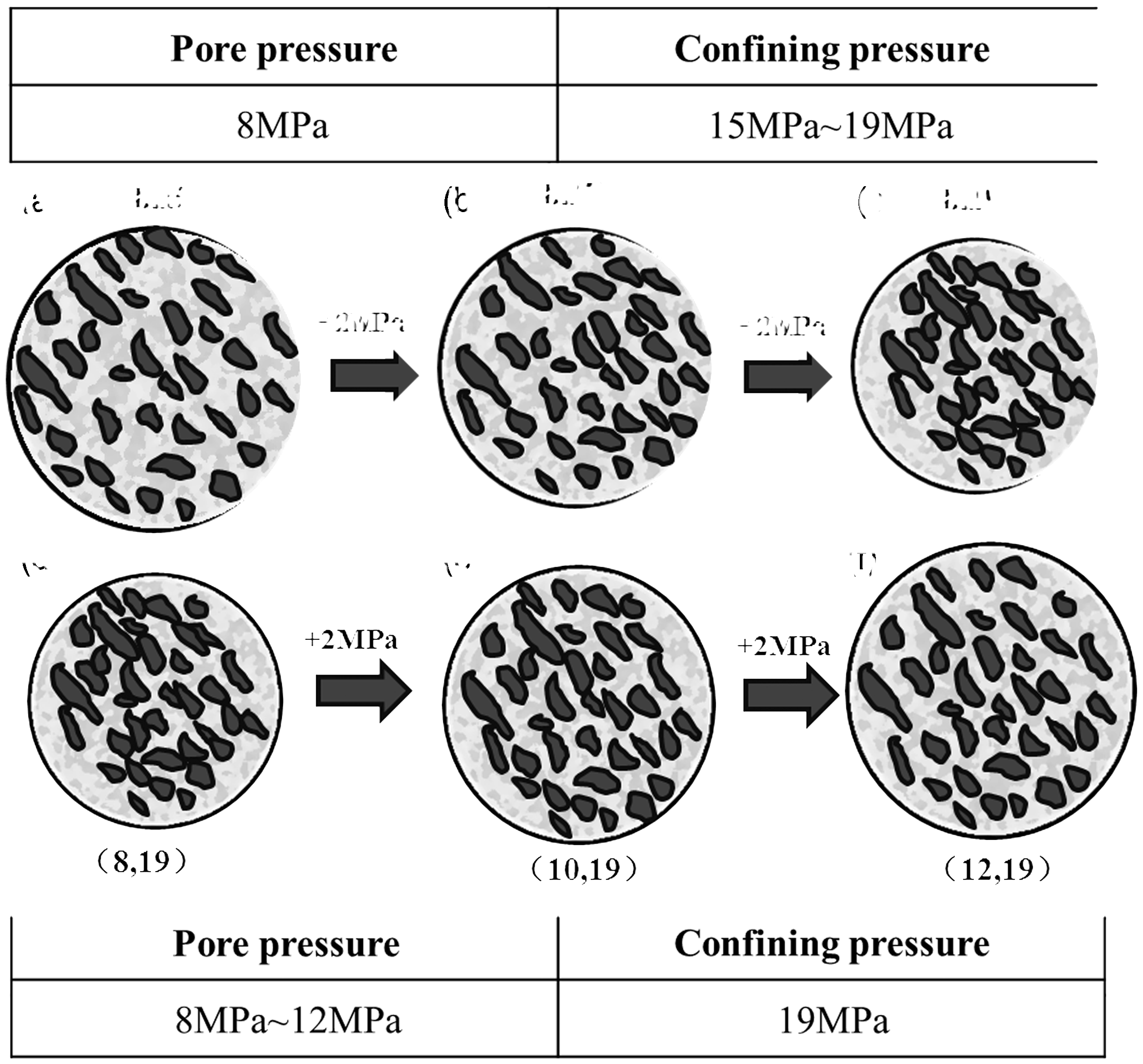
Reversely, influence on irregular pore and throat structure’s reconstruction by changing pressure could be reflected (Figure 10). Pore pressure and confining pressure values in different stages are the same as in Figure 9. According to the experimental conclusion, as a result of small S coefficient and no obvious directionality, the degree of compression on rock pore and throat by increasing confining pressure per 2 MPa is nearly the same as the degree of making rock pore and throat reopen by increasing pore pressure per 2 MPa. Anisotropy reflected by the change of the rock mass mechanics parameters is not obvious.
Schema graph of influence on irregular pore and throat structure by changing pressure. Note: each circle represents a low permeable reservoir rock section, black color shape represents rock particles, shape filled with light gray in the background represents the filler content and other skeleton materials, colorless part represents pore throat structure of special low permeability reservoir rock.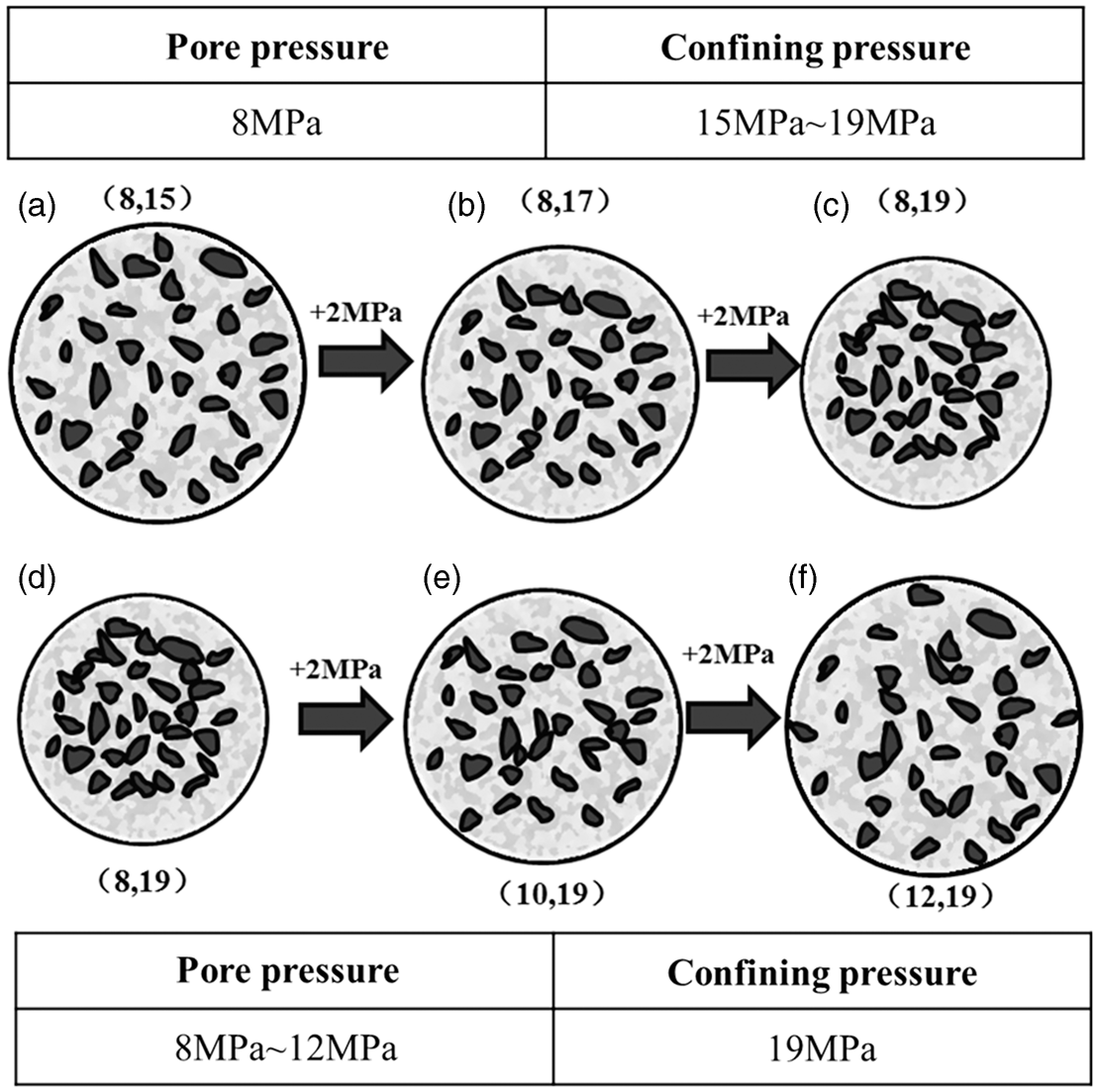
Application
We select samples from well “G” at a depth of 2804 m in another area of Daqing oilfield, the lithology is silty mudstone. We selected its in-situ conditions to perform the similar experiments and draw the cross-plot as, as shown in Figure 11.
Cross-plot between effective confining pressures (the difference between the confining pressure and pore pressure) and Young's modulus of well “G”.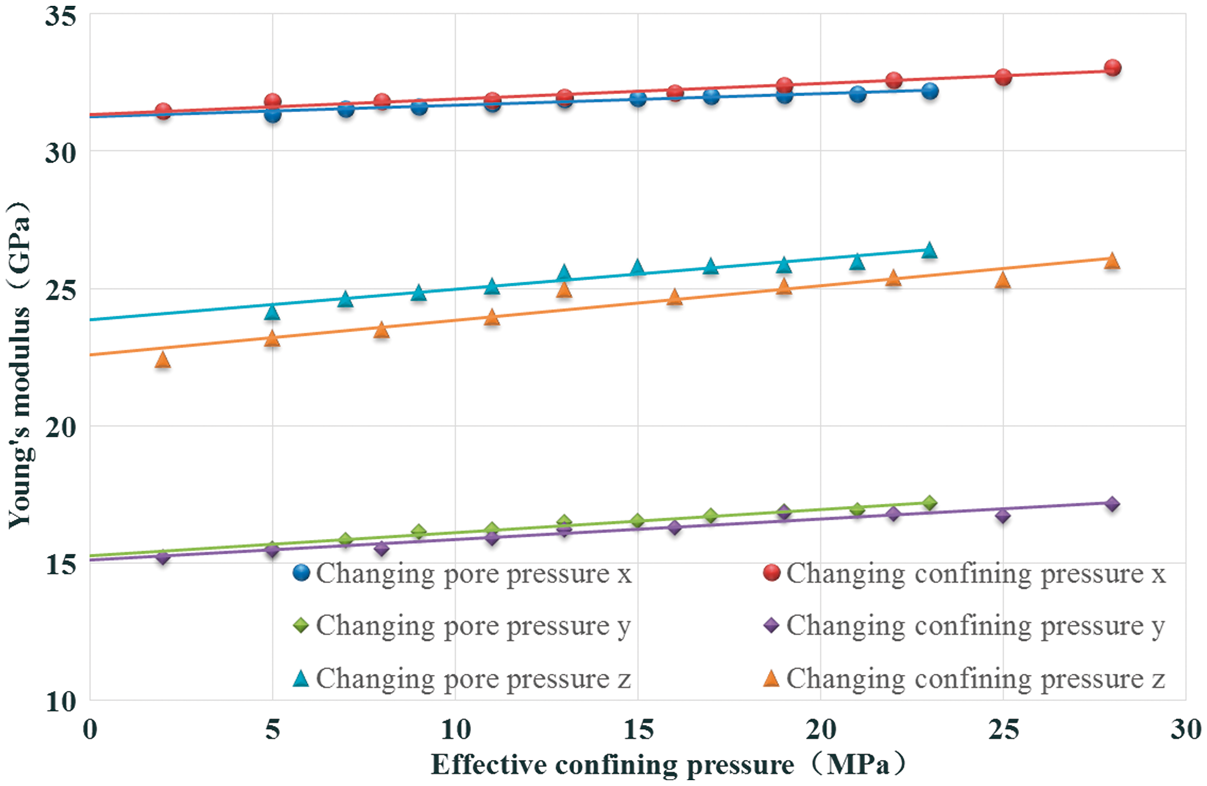
S coefficient and H coefficient calculation on samples of well “G”.
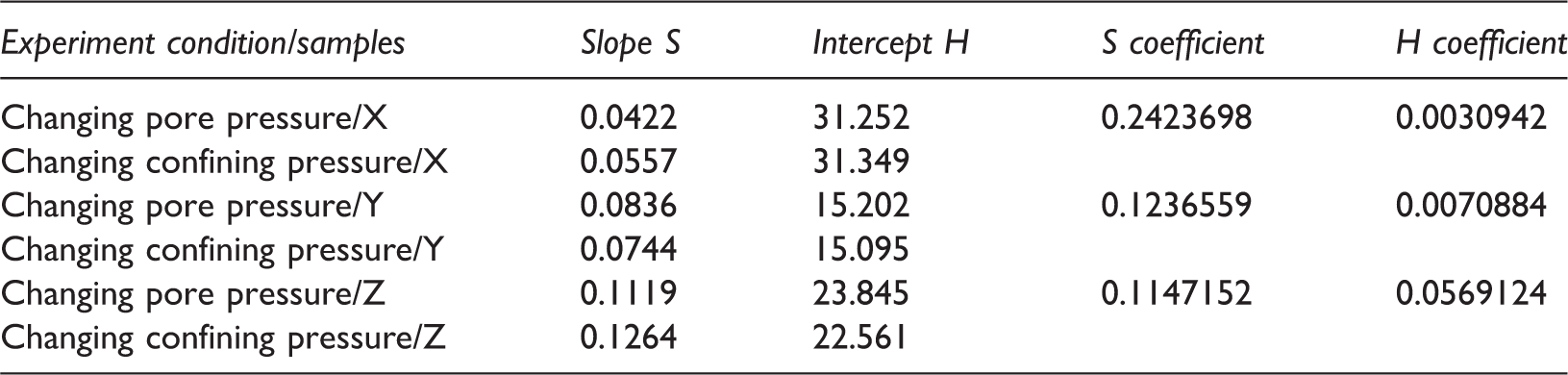
As can be seen from Figure 11 and Table 3, order of S coefficient size is X > Y > Z, order of H coefficient is Z > Y > X. So we could conclude as follows: when the pore and throat properties turned out to be the dominant factor that result in the change of Young's modulus, order of anisotropy size is X > Y > Z; when the dominant factor turned out to be inherent rock skeleton materials, order of anisotropy size is Z > X > Y. This conclusion will play a significant role in fracture distribution in the process of hydraulic fracturing.
Conclusion
Change in the pressure conditions will play a significant role on rock mass mechanics parameters of the reservoir, like Young’s modulus. Generally, amplitude and mechanism of leading to the change of Young's modulus by pore pressure or confining pressure are rather different. Based on the fact that influence mechanisms of two kinds of pressure are different, we introduce two new coefficients to quantitatively characterize viscoelastic properties of particles and pore fluid, called the S coefficient and H coefficient, respectively, which can better reflect pore and throat and viscoelastic fluid properties, fracture properties of rock skeleton materials and the microscopic anisotropy size of Young's modulus. Large S coefficient reflects that the relative difference of influence on Young’s modulus, when changing pore pressure in a certain value or change confining pressure in the same value reversely, is large. It could also reflect that the degree of influence on microscopic anisotropy of Young's modulus caused by pore and throat structure is great. Large H coefficient reflect that the relative difference of influence on Young’s modulus, when changing pore pressure in a certain value or change confining pressure in the same value reversely, is large. The greater the H coefficient, the higher the extent of influence which rock skeleton material damage leads to change in microscopic anisotropy of Young's modulus. At a certain time during water flooding development, one of above two mechanisms will be the dominant factor, which should be analyzed and considered separately. Judgment on microscopic anisotropy of Young's modulus plays a crucial role on research about change rule of in-situ stress in secondary exploitation, which should be highly valued in the process of fracturing parameters design.
Footnotes
Declaration of conflicting interests
The author(s) declared no potential conflicts of interest with respect to the research, authorship, and/or publication of this article.
Funding
The author(s) disclosed receipt of the following financial support for the research, authorship, and/or publication of this article: Chinese national key basic research development plan (973 program, No. 2009CB219302).