




Abstract
This article expands knowledge on the (inter)sectoral dimension of industrial relations, specifically how sectoral differences in product market competition, scope and mobility have shaped organized actors’ regulative responses to the rising cross-border labour and services mobility in the post-2004 EU/EEA Single Market. We compare how organized employers and labour in the (non-tradeable) construction sector and the (tradeable) shipbuilding sector approached the extension of collective agreements and navigated EU posting rules in wake of the 2004 enlargement. Showing how organized employer interests in tradeable and non-tradeable sectors are oppositely affected by enhanced cross-border mobility, competition and national re-regulation of migrant workers’ rights, we explain why shipbuilding employers acted as antagonists while organized construction employers in alliance with their union counterparts served as protagonists in the strife over extension.
Keywords
Introduction
The 2004/2007 EU eastern enlargements radically broadened and intensified cross-border mobility and competition within the EU Single Market. The industrial relations literature has explored how labour market regimes and organized actors have responded to international market integration, both in terms of national and sectoral studies (Bechter et al., 2012; Menz, 2005). Still, how differently, potentially conflicting, sectoral interests regarding cross-border product mobility and market competition influence organized actors’ response strategies remains underexplored. As argued by Afonso (2012), national response strategies to international market integration are shaped by the interplay of sectoral interests, both within and between employer associations and trade unions.
This article seeks to expand knowledge on such inter-sectoral dynamics, by analysing how the competitive and regulative interests of organized sectoral actors – especially among employers – were differently affected by the intensified competition in European product and labour markets flowing from the EU/EEA enlargement in 2004/2007. More specifically, we compare how employer and labour organizations in the Norwegian shipyard and construction sectors responded to the post-enlargement surge in (low-cost) labour and services mobility by demanding or opposing a strengthening of the rights of labour migrants and posted workers through collective agreement extensions and associated state enforcement measures.
Contrasting the consequences of (1) rising inflows of low-cost subcontracted Eastern labour, and of (2) establishing a statutory wage floor through collective agreement extension for the competitiveness of organized companies (and workers) in the two sectors, we shed light on the inter-sectoral conflicts of interest that arose among (core) affiliates in the main Norwegian employer confederation (NHO: Næringslivets Hovedorganisasjon). Further, we analyse how these conflicts impacted interest intermediation and coalition-building within and across the organizations of capital and labour associated with these transformative, EU-instigated changes in the Norwegian industrial relations regime.
In Norway, the largest post-enlargement recruitment of labour from the accession countries occurred in the construction and shipbuilding sectors, where the combination of the eastward market-opening and economic boom brought rising supply of and demand for subcontracted labour, creating a sprawling market for low-cost providers, cheap labour and illicit work (Alsos and Eldring, 2008). In the following years, the liberalizing effects of the market-opening and the unregulated market for cross-border subcontracting in Norway sparked heated debates in political, judicial and social partner arenas, about whether and how national regulation and enforcement practices should be adjusted in order to handle the rise in low wage competition and circumvention of rules within the EU free movement regime. As this article will show, the long-dormant national extension mechanism, established as Norway entered the EEA in 1994, emerged as a central but highly contested instrument in adapting the Norwegian industrial relations system to the enlarged Single Market with widened wage gaps and surging cross-border mobility after 2004.
Using the disputed application of the Norwegian collective agreement extension scheme as a case, we compare how organized actors’ approaches to extension in construction and shipbuilding were conditioned by sectoral differences in cross-border product market integration and competition (Dølvik and Marginson, 2018). As pointed out by Afonso (2012), tradeable and non-tradeable sectors tend to have divergent interests in de/re-regulation of cross-border labour and services mobility, as their competitive positions in the product markets are differently affected: while national regulations provide a common wage floor for domestic and foreign companies in the non-tradeable sectors, they have no impact on the wage costs of foreign competitors in the tradeable sectors. By studying how rising low-cost competition and cross-border mobility affected the sectoral organizations’ interests and approaches to collective agreement extension in shipbuilding and construction, we shed light on the impact of sectoral divisions in cross- and intra-class coalition-building, conflict and power relations in adjusting the national IR system to the evolving regime for transnational work in EU/EEA.
The study addresses, firstly, how the EU/EEA enlargement propelled divergent sectoral employer interests in non-tradeable construction and tradeable shipbuilding; secondly, how it fostered convergence of interests between organized labour and employers in the former, and conflict in the latter sector. Thirdly, it explores how such inter-sectoral dynamics instigated processes of associational conflict and compromise on the confederal level, accompanied by judicial dispute over the application of EU/EEA law, which shaped the development and institutionalization of the Norwegian extension scheme.
The article aims at answering the following research questions:
How have sectoral differences in product market competition and product mobility shaped actors’ interests in, and approaches to, extending collective agreement terms to (re)regulate cross-border work?
How has the liberalization and growth of cross-border work since the 2004/2007 EU enlargement, and the subsequent use of extension in construction and shipbuilding ramified by EU rules, influenced coalition-building, conflict and power relations among organized actors at the sectoral and confederal levels?
How have the diverging sectoral strategies – particularly among employers – shaped the development and institutionalization of the extension scheme, and what role has it come to play in the Norwegian system?
The article draws on data from several research projects: first, the Shipping Off Labour project, 1 where we conducted semi-structured interviews with former and current management and trade unionists in the shipbuilding industry, supplemented by interviews with social partners in the construction sector (Dølvik et al., 2024); second, the European Strains project studying changes in collective wage regulation in northern Europe, built on interviews with organized actors in construction, manufacturing, cleaning and temporary work agencies (Dølvik et al., 2018; Arnholtz et al., 2018; Müller et al., 2018).
Cross-border flows: Sectoral interests and strategic responses
The Single Market establishment in the early 1990s sparked debate on how the free movement of labour, capital, goods and services would impact national systems of industrial relations and labour market regulation (Gobin, 1997; Gold, 1993; Martin and Ross, 1999; Rhodes and Mazey, 1995; Streeck and Schmitter, 1991; Teague, 1993). The overarching question was whether national industrial relations systems could adapt to and persist in a ‘borderless’ EU market increasingly ramified by EU minimum regulation of worker rights. Early studies of national actor responses to the deregulatory dynamics of the Single Market often attributed variations in response strategies to differences in the national IR systems, distinguishing, for example, between systems characterized as (neo)corporatist, statist, coordinated or liberal market economies and so forth (Krings, 2016; Menz, 2005; Traxler et al., 2001). Adjustments in these national systems have mostly been explored through comparative cross-sectoral studies (Ferner and Hyman, 1998; Marginson and Dølvik, 2020), and occasionally also through sectoral lenses (Arnholtz et al., 2018; Marginson and Sisson, 2006).
Yet, how national industrial relations responses are shaped by the intersecting power and interests of different sectoral actors has received less attention (Bechter et al., 2012). While it is generally acknowledged that ‘[i]ndustrial relations are profoundly affected by the nature of the markets in which firms compete’ (Brown, 2008: 113), how sectoral actors situated in different product markets are affected by and respond to international market integration, and seek to influence adjustments of national industrial relations systems remains understudied. The few studies that have explored such inter-sectoral dynamics indicate that this aspect plays an important role in the adjustment of national IR systems (Refslund, 2016). Just as workers can have conflicting interests (Refslund and Arnholtz, 2022), the same arguably goes for employers, which in turn implies that the interests of workers and employers can differ both within and across sectors (Lillie, 2012). Comparing post-enlargement employer responses in Austria, Switzerland and Ireland, Afonso (2012) found that employer associations dominated by non-tradeable sectors were commonly positive towards statutory wage regulation. By contrast, associations dominated by companies in tradeable sectors tended to oppose such regulations as heightened national wage floors ultimately increase production costs, thereby ceteris paribus weakening their competitiveness in international markets.
In the Scandinavian countries, the social partners have traditionally opposed all regulatory measures that might interfere with the national systems of collective bargaining (Furåker, 2020). When preparing the EU/EEA Single Market, the Delors Commission’s push towards securing a ‘social floor’ under competition was welcomed by the Scandinavian countries, given that it would not interfere with their national bargaining regimes. During the 1990s, Sweden and Finland joined the EU – Denmark had been member since 1972 — while EU membership was narrowly rejected in referendum in Norway, which still joined the Single Market in 1994 via the EEA agreement. During this process, Norway introduced a new law aimed to prevent wage dumping of foreign labour by enabling a modest scheme for extension of collective agreement terms in 1993, in contrast to Denmark and Sweden, who have always opposed such measures. Initially, the Norwegian Ministry of Labour had floated a suggestion to introduce statutory minimum wage regulations at branch level. While the employer side was generally positive, the trade union confederations LO (Landsorganisasjonen i Norge) and YS (Yrkesorganisasjonenes Sentralforbund) argued for the alternative of extending sectoral collective agreements in instances where foreign labour was paid less than national workers, which ended up being implemented (Evju, 2009).
To secure the powerful union confederation LO’s support for EEA membership, the political drive to secure Norwegian access to the Single Market gave the trade unions extra power to demand protection of national workers against wage dumping through extension, similarly to the development of extension legislation in Switzerland during their struggle over Single Market entry (Afonso, 2012). The Norwegian extension mechanism was conceived as a safety lever to be invoked only in exceptional circumstances (NOU 2011:7). As long as the EU/EEA only included 12–15 western countries with relatively modest unit labour cost differences, the erosional impact of the Single Market on Norwegian (and Nordic) industrial relations feared by organized labour did not materialize: in the 1990s, real wages and employment rose strongly while unionization and collective bargaining coverage remained high and stable, whereas inward EU labour mobility was very low (and no major shift in inward investment flows or ‘race to the bottom’ was discernible) (NOU 2011:7). Thus, Norway’s extension act remained dormant.
This changed dramatically after the 2004/2007 enlargements, when, respectively, eight and two Central and Eastern European (CEE) countries, with vastly lower wages and living conditions and mass unemployment, entered the EU/EEA Single Market. In the ensuing years, 10,000 CEE workers moved to Norway for work, and a decade later international labour accounted for almost 10% of the Norwegian labour force (Friberg, 2016). Norway’s transitional arrangements for CEE labour, requiring national wages and full-time jobs to obtain a work permit (2004–2009/2011), only applied to regular labour migrants, while cross-border subcontracting of EU labour (posting) was initially unregulated. This provided strong employer incentives to hire CEE labour via foreign subcontractors or temp agencies. Especially in construction and shipbuilding, this propelled outsourcing of work to foreign firms with CEE labour, accompanied by proliferating social dumping and abuse, severely breaching the national legacy of equal pay (Dølvik and Eldring, 2008). Eventually, the trade union Fellesforbundet called for an extension of collective agreement terms in construction (2005/2007) and shipbuilding (2007) – a move that, as we will see, employers responded to differently.
As stated by Hayter and Visser (2018: 22), ‘extension is intended to affect outsiders. It is a method for making a collective agreement that already covers the majority of enterprises and workers in a branch or industry, the common rule. It extends labour protection in a collective agreement to all workers that fall within the scope of that agreement.’ Hence, with the further integration of markets for labour and services, ‘extension has proved to be an important means of providing inclusive labour protection to migrant and posted workers’, at the same time providing ‘a guarantee to organized enterprises that they will not be undercut by below-standard competition, whether from national enterprises or service providers from other countries’ (Hayter and Visser, 2018: 27).
Still, for trade unions, extension is a double-edged sword: by strengthening the unions’ ability to regulate competition in the labour (and product) market, and protecting multiemployer sectoral bargaining, ‘extension constitutes a central institutional power resource. On the other hand, it might impede collective action if workers are covered without contributing’ (Günther, 2021: 1). While the latter is the reason why Norwegian unions traditionally opposed extension, the rise in cross-border low-wage competition and circumvention of collective agreements after EU/EEA enlargement made the former aspect of extension – its broadening of collective agreements market-regulating effect, including also posted CEE labour – a more burning issue for Fellesforbundet than the potential loss of domestic members. In Norway, several studies have shown that collective agreement extensions have led to sizeable increases in collective bargaining coverage – adding about 11 percentage points in the private sector (Nergaard, 2024) 2 – as well as pay rises in the lower deciles reducing wage inequality (Benedictow et al., 2021; Bjørnstad et al., 2015), while the findings are mixed as regards the effects on union density (Benedictow et al., 2021; Flaarønning, 2025). 3
Collective agreement extensions are ambiguous also for employers: the reduced leeway for low-wage competition in national markets is beneficial for most companies covered by collective agreements (Traxler, 2003), but the diminished access to low-cost subcontractors may even in non-tradeable sectors be regarded as a drawback for larger, organized firms (Afonso, 2016). For employers not covered by collective agreements, extension weakens their cost competitiveness, a side-effect of which, ceteris paribus, can be to strengthen their incentives to organize and partake in bargaining of the collective agreements they will anyway be bound by (Hayter and Visser, 2018; Traxler, 2003; Traxler and Behrens, 2002). A less discussed issue, however, is that extension, as explained above, may have different effects for employers competing in domestic markets and those competing internationally, as also indicated by the rise in posting extensions in home-market sectors in Germany and the absence of such extensions in export manufacturing (Dølvik and Marginson, 2018; Günther and Höpner, 2023).
Studying the development of Statutory Bargaining Extensions (SBEs) in Germany, Günther and Höpner (2023) found that the employers confederation (BDA: Bundesverband Deutscher Arbeitgeberverbände) – dominated by export manufacturing – increasingly uses its veto power to block the demand for SBEs in non-tradeable sectors, in order to keep input costs down and protect tradeable sectors’ competitiveness. Hence, when exploring the interests and strategies of employer associations and trade unions regarding extension, one must consider how their sectoral composition can imply conflicting internal interests on both sides (Günther, 2021; Günther and Höpner, 2023). For instance, while some associations are sector specific, others cover a variety of sectors. Multi-sectoral associations can strengthen their power resources through a larger pool of (potential) members, which also increases the potential for internal conflicts of interests.
By comparing shipbuilding and construction – where Fellesforbundet represents workers of both sectors, while the employers are organized along sectoral lines – we explore the impact of such inter-sectoral dynamics on their approaches to extension, and the repercussions for the stances of their respective umbrella associations (LO and NHO). As shipbuilding is part of the frontrunning, pattern-setting manufacturing industry in the Norwegian collective bargaining system, and construction is the first bargaining area in the home-market sector, their associations are crucial in shaping adjustments in the Norwegian industrial relations and collective bargaining systems. In doing this, we also shed light on the institutionalization of the Norwegian extension mechanism, and how the resulting adjustment of the Norwegian labour market regime to the EU/EEA regime has been shaped by sectoral interests and intersectoral power struggles (Alsos and Ødegård, 2019; Arnholtz et al., 2018; Mahoney and Thelen, 2009).
We pay special attention to variations in patterns and causes of conflict and coalition-building between organized actors in the two sectors, and how such dynamics feed into decision-making in the respective confederations. Inspired by Afonso (2012), we draw on Korpi’s (2006) distinction of antagonists, protagonists and consenters when categorizing the organized actors’ approaches to the strife over labour market re-regulation. As summarized by Afonso, employers can ‘(a) promote market regulation because they can derive economic benefits from it (protagonists); (b) consent to it as part of a political exchange involving other issues (consenters); or (c) oppose it (antagonists)’ (Afonso, 2012: 711). In our analysis we apply this typology to distinguish the various sectoral actors’ approaches to extension.
The case sectors: Production, mobility and sectoral actors
Sectoral characteristics in production and cross-border flows
As a central argument of the article is that the actors’ approaches to extension depend on the divergent competitive impact of cross-border mobility on sectoral interests, it is important to carve out the main differences between shipbuilding and construction in this respect. Inspired by Marginson and Dølvik’s (2020) scheme of cross-border flows, Table 1 summarizes the importance of different kinds of cross-border mobility, trade and product market competition in the respective sectors.
Different types of cross-border flows by sector.
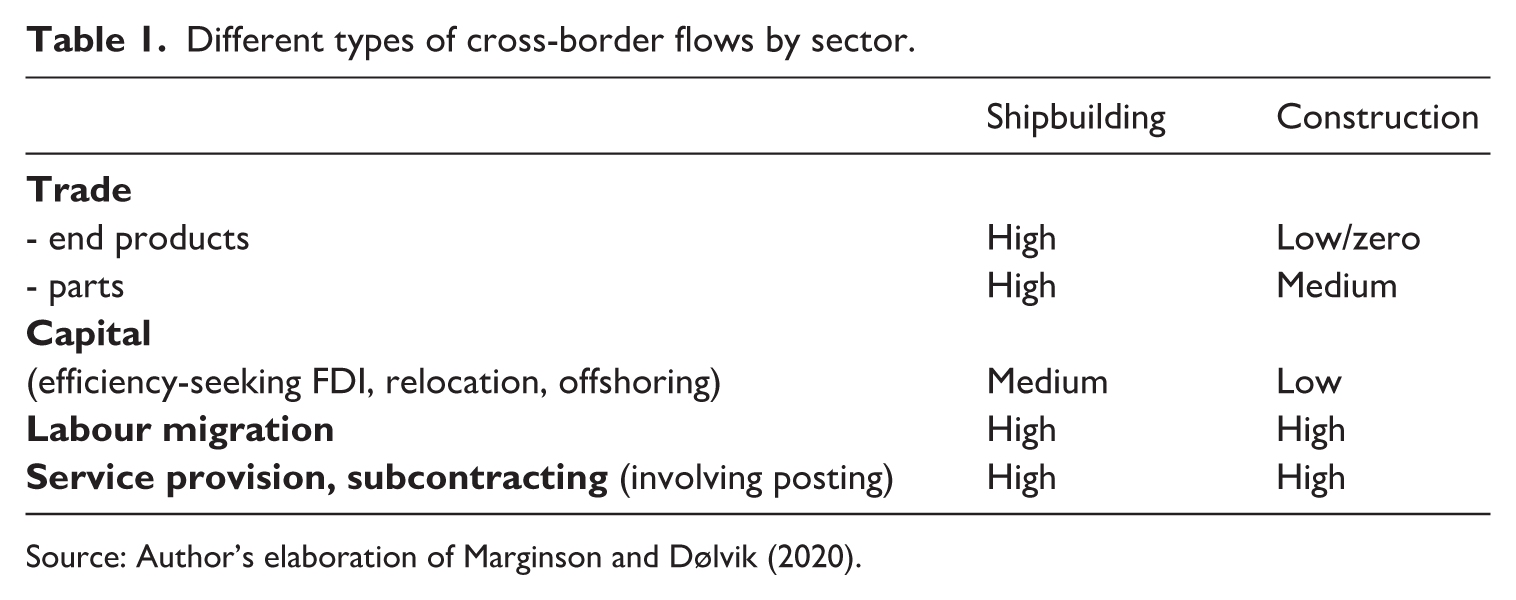
Source: Author’s elaboration of Marginson and Dølvik (2020).
In terms of sectoral similarities, both are characterized by project-based production largely structured around one-of-a-kind projects tailored to customer needs. This results in fluctuating demand for labour and skills, varying with order cycles, projects and stages of the production processes. Further, both industries are highly labour intensive, meaning that labour represents a major cost factor in production. Given prolonged booms and shortages of national labour in recent decades, this has resulted in heavy reliance on migrant and posted labour in the two sectors, mostly hired via subcontractors and temporary work agencies and to less extent through direct employment.
A major sectoral difference relates to the nature of product market competition. The shipbuilding industry competes internationally, with mobile end products, while the construction industry mainly competes in national markets with immobile end products; although international companies compete in the national market for orders, and prefabrication in construction is increasing, buildings cannot be finished in one location and then ‘towed’ to another, as in shipbuilding. In consequence, production can much more easily be offshored in shipbuilding than in construction. Although the considerable amount of fixed capital in shipyards – e.g. spatially bound docks – limits the options for production relocation mainly to pre-existing yards abroad, the increased availability of CEE yards in recent decades has implied that production chains in shipbuilding have become much more internationalized or Europeanized. This has also made shipbuilding workers more prone to management regime shopping across borders (Lillie, 2012).
These sectoral differences entail distinct patterns of competition and production strategies. As Norwegian shipyards operate in international markets, they compete with foreign shipyards with substantially lower labour costs. Norwegian construction companies, by contrast, mainly compete for orders in the home market where foreign contenders’ competitiveness largely depends on the labour costs and thus the regulation of wages for cross-border labour in Norway. As we shall see, these sectoral differences have heavily influenced the actors’ approaches in the struggle over extension of collective agreements.
Sectoral actors
The multi-sectoral Fellesforbundet is the dominant blue-collar trade union in both construction and shipbuilding. Affiliated with the Norwegian Confederation of Trade Unions, LO, it is Norway’s largest private sector union, with nearly175,000 members (Table 2). Following the merger of unions in metal manufacturing and construction – now also comprising hotels and restaurants and several smaller sectors – Fellesforbundet represents workers in both domestic/non-tradeable and exporting/tradeable sectors. In construction, Fellesforbundet organizes around 17,800 workers. 4
Direct workforce, main employer associations and trade unions.
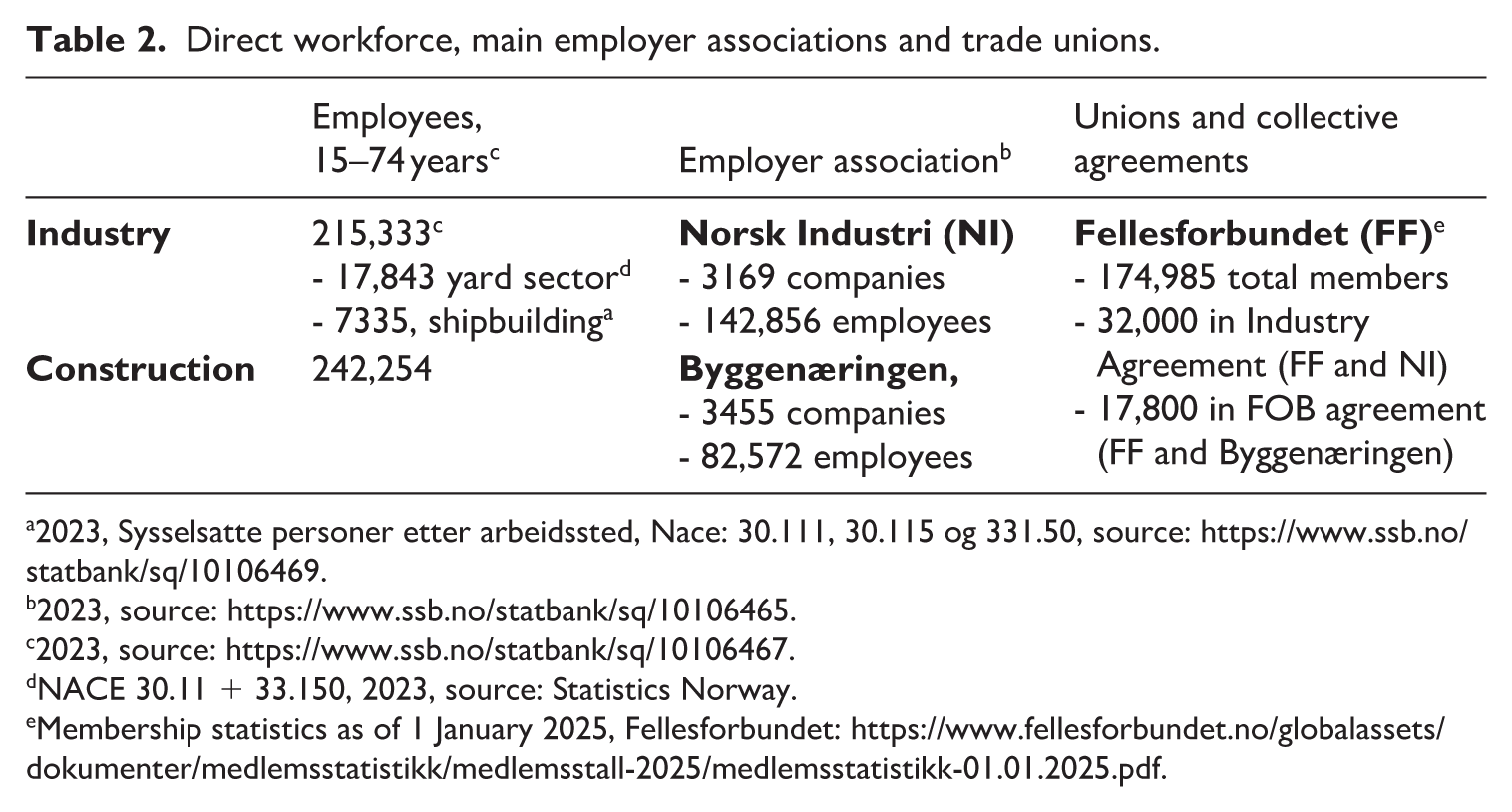
2023, Sysselsatte personer etter arbeidssted, Nace: 30.111, 30.115 og 331.50, source: https://www.ssb.no/statbank/sq/10106469.
2023, source: https://www.ssb.no/statbank/sq/10106465.
2023, source: https://www.ssb.no/statbank/sq/10106467.
NACE 30.11 + 33.150, 2023, source: Statistics Norway.
Membership statistics as of 1 January 2025, Fellesforbundet: https://www.fellesforbundet.no/globalassets/dokumenter/medlemsstatistikk/medlemsstall-2025/medlemsstatistikk-01.01.2025.pdf.
Shipbuilding is part of the pacesetting ‘frontrunning industries’ of export manufacturing covered by the industry agreement between Fellesforbundet and the employer’s association Norsk Industri (Norwegian Industry). More than 30,000 Fellesforbundet members fall under this agreement. Union density in the shipyards has historically been high (above 70%), but the share of organized permanent workers has in recent decades been shrinking relative to the largely non-unionized migrant workforce provided by subcontractors and temporary work agencies (author’s research in progress).
While workers in both sectors are represented by the same union, the employers are sectorally split within the Confederation of Norwegian Enterprises, NHO. Construction is organized by the sector association NHO Byggenæringen (hereafter just Byggenæringen 5 ), which includes 13 different branch affiliates, covering more than 3450 companies and close to 72,000 employees. 6 The branch affiliates represent various parts of the construction value chain, from large entrepreneurs (EBA: Entreprenørforeningen - Bygg og Anlegg) to smaller building and craftsman companies. After the 2004 enlargement, internal tension developed between entrepreneur corporations and the affiliate of building and craftsman firms, eventually leading to Byggmesterforbundet leaving Byggenæringen in 2020 (Brekkhus, 2020).
Most of the shipyards, except a few smaller yards, belong to Norsk Industri, which was formed in 2005 through a merger of the Federation of Norwegian Manufacturing Industries and the Federation of Norwegian Process Industries. Norsk Industri comprises most of Norway’s export manufacturing and is the largest and most influential association within NHO, representing more than 3000 companies with around 142,000 employees. Exporting appr. 300 billion NOK annually, a major part of Norwegian exports excluding oil and gas, Norsk Industri spawns industries ranging from manufacturing of machines, metals and chemicals to products for oil, gas and maritime industries. 7 Shipbuilding thus accounts for only a minor part of Norsk Industri affiliates’ production and is together with yards building offshore platforms the only Norsk Industri sector where the trade unions have called for extension. While small in terms of direct employment, the shipyards are considered a hub in the Norwegian ‘maritime cluster’ which employs around 70,000 and has 60–70 billion NOK sales annually. Some 200 companies within Norsk Industri are also affiliated with the Maritime Industry Association, a business organization for the broader web of shipyards, equipment suppliers for ships, aquaculture and consultants.
Worth underscoring, finally, is that Fellesforbundet and Norsk Industri are the leading private sector affiliates of the powerful confederations of employers and labour, NHO and LO, who play key roles in Norwegian working life politics and tripartite dialogue with government where all major changes in labour market regulation and enforcement are subject to consultation and hearings (Stokke et al., 2013).
Sectoral dynamics and strategic responses in construction and shipbuilding
In this empirical section, we describe how companies in construction and shipbuilding were affected by changes in cross-border factor mobility and competition in product and labour markets after the 2004 enlargement, how these changes impacted sectoral employer and labour associations, and, in turn, how this influenced their approaches towards collective bargaining extension.
Construction – defending positions and contracts in domestic markets
Given Norway’s transitional restrictions on regular labour migration from the accession countries (see next subsection), and the absence of statutory minimum wage or regulation of wages and working conditions for posted EU/EEA workers, construction firms had strong incentives to hire CEE labour posted by cross-border subcontractors and temporary work agencies post-enlargement. As the dormant extension option was not invoked, posted workers could legally be paid at home country rates, leading to soaring use of posted construction workers, while reports of inferior working conditions and wage dumping flourished. 8
Strained by the fragmented and shifting nature of the construction industry, with a high number of changing worksites, locations and subcontracting firms, Fellesforbundet failed to control the massive flows of foreign companies and labour, not to speak of organizing foreign workers. Seen from unionized workers’ perspective, this was threatening as they were outnumbered on the worksites and had to compete for jobs and orders with companies with migrant labour paid substantially below collectively agreed rates. For Fellesforbundet the steep fall in density and the collective agreement’s regulative force represented an existential challenge to its position, bargaining power and ability to protect workers, threatening to undermine both its associational and structural power resources.
Failing to resolve matters through dialogue with the companies involved in low wage hiring or the employer counterpart Byggenæringen, Fellesforbundet soon won support from LO 9 in appealing for extension in construction for the Oslofjord region. 10 Invoking the extension mechanism was regarded as ‘a purely defensive move’ (Trade union rep 1): with insufficient associational capacity to resolve matters through conventional union means, and lacking other tools for halting social dumping, ‘extensions were our only option’ (Trade union rep 1). In the official consultation statement to the Tariff Board, 11 Fellesforbundet cited evidence of grave evasion of labour standards and exploitation of foreign labour through inferior wages.
Seen from the perspective of construction companies and the employer association Byggenæringen, the picture was more ambivalent. Although the labour ‘supply shock’ offered easy access to cheaper, ‘flexible’ labour and subcontractors during the prolonged construction boom, benefits were not equally shared among all employers. Besides the reputational effects of the revelations of grave exploitation in the industry, the ample supply of ‘cheap labour’ brought more chaotic hiring and staffing practices, eventually leading to stagnant productivity and quality (Friberg, 2016).
More urgent for Byggenæringen was that organized construction firms, especially among SMEs in the building and craftsman branch, lost competitiveness compared to unorganized companies and subcontractors – of foreign as well as national origin – offering lower prices by means of migrant labour. Hence, the easy access to CEE labour implied a shift in the terms of product market competition in favour of foreign and unorganized national companies unbound by collective agreements (and their rules regarding subcontracting), also strengthening organized firms’ incentives to circumvent or exit the collective agreements. Resembling the effects described for the union counterpart, the immediate consequence was a loss of orders and market shares among Byggenæringen affiliates, which in the longer term represented a threat to Byggenæringen’s membership base. A more acute worry was that Byggenæringen’s ability to secure a level playing field through collective agreements was evaporating, altogether challenging both its associational and structural power resources.
This sparked concern among many organized construction companies and in Byggenæringen, most forcefully voiced by the crafts building branch. By the time of Fellesforbundet/LO’s extension call, the employer side had in fact already discussed the possibility of calling for extension within their own ranks. Byggmestrene, the crafts association within Byggenæringen, argued early on that extension was needed: ‘It was not primarily about protecting foreign workers but rather protecting our own members from foreign competition’ (Employer rep 1). National craft building companies were being outcompeted by foreign, unorganized companies reportedly sometimes ‘paying as low as 5 NOK an hour’ (Employer rep 1).
The extension route was initially opposed by Byggenæringen’s largest branch association, the entrepreneurs in EBA, which was dominated by large general contractors with limited in-house production, relying on a web of multi-tiered subcontracting chains with rising shares of migrant labour. Such entrepreneurial companies could benefit from the lowered subcontractor costs, without coming in conflict with their own workforce. Reflecting also the mood in the employer confederation, NHO, the floated extension idea was thus initially ‘shot down with a cannon’ (Employer rep 1).
However, due to internal pressure especially from the smaller branch organizations representing the majority of affiliates and workplaces – where debates ran high with the unions – the attitude in Byggenæringen soon turned in favour of extensions, as EBA, due to pressure from key members, was convinced to change its position. Once Byggenæringen agreed internally that extension was the only available tool for securing a level field for the organized companies, NHO also finally accepted the idea of extension for the construction sector, initially only in the Oslofjord region. Hence, when the Tariff Board processed the first plea for extension in construction, the employers’ side was already in favour. The initial employer opposition had turned into a mix of protagonism in Byggenæringen, and pragmatic consent from NHO.
In June 2005, the Tariff Board decided to follow Fellesforbundet/LO’s claim, by decree extending the construction (‘FOB’) agreement in the Oslofiord region. 12 The NHO representative did not oppose the extension decision but had reservations regarding the scope of the extension. While Fellesforbundet/LO wanted to extend the entire collective agreement, the outcome was, in line with the EU Posted Workers Directive (96/71/EC), a partial extension of minimum wage rates and some other conditions such as working time, compensation for travel, board and lodging costs, and working away-from-home allowance. Subsequently, with support from both sides, extension of general terms in the collective agreements in construction was implemented in Hordaland county in 2006, and then nationally in 2007, and has remained in place since.
Importantly, the Extension Act mandated the labour inspectorate to control and enforce compliance with the extended collective agreement rules. Moreover, in the ensuing years the centre-left government introduced legislation with a range of new control and enforcement measures conditioned on the presence of an extension decree, amongst others see-to-it-duty, chain liability and right to collective legal action, providing the unions with a host of novel tools to secure that posted workers and employees not covered by collective agreements were treated in accordance with the legal rights prescribed by the extension decrees (Eldring et al., 2011). In parallel, the organized actors in construction initiated a series of joint branch programmes, aimed to combat ‘unserious actors’, bogus business and health and safety practices, and to promote decent work and good corporate governance, often citing that not only the workers but also the companies and entire industry were vulnerable to bad customer reputation, negative public attention and media exposure.
Further notable is that since the initial extension decision, Byggenæringen has never challenged the extension’s content and has advocated the institution of extension in public and NHO contexts. In company surveys conducted in 2006 and 2009, the employers in construction generally expressed a positive stance towards the extension scheme (Andersen et al., 2009). Byggenæringen’s embrace of the extension regime has over time nurtured a climate of cooperation and partnership regarding decent work within the organized companies and between Byggenæringen and Fellesforbundet, together acting as pattern-setting vanguards in shaping the evolving Norwegian extension regime. 13 As further discussed in the ensuing subsection on developments in shipbuilding, Byggenæringen’s protagonist role became evident in its support for extending the right to away-from-home allowance and compensation for travel, board and lodging, which was at the heart of the protracted struggle over extension in shipbuilding.
The shipyard industry – struggling to remain competitive in global markets
As in construction, the shipbuilding industry began hiring CEE labour immediately after the 2004 EU enlargement. The reason argued resembled that of construction: a lack of available (Norwegian) labour during a bonanza driven by the demand for supply-ships in oil and gas production in the 2000s. Since the 1989 fall of the iron curtain, the shipbuilding industry had already offshored much of its hull production to low-cost yards in Poland, Romania and Ukraine. This way the shipbuilding industry – competing in international markets for ships – compensated for its high domestic production and labour costs, also benefitting from increased output of completed ships. With the 2004 enlargement, this offshoring of part production could be combined with unlimited access to ‘cheap’ CEE labour at ‘the home site’, via foreign subcontractors and temporary work agencies in particular (Thorbjørnsen, 2025).
The shipyards, supported by Norsk Industri, saw the low-cost providers and labour from the accession countries as an opportunity to strengthen their competitiveness and further boost production capacity. With vast numbers of redundant craft shipbuilders and manual labour in Romania and Poland, a flourishing business of labour intermediaries and networks of recruitment agents, subcontractors and temporary work agencies emerged. This fuelled the supply of flexible and acquiescent labour to the booming shipbuilding industry and strengthened its competitiveness in international markets dominated by yards located in countries with lower labour costs.
Meanwhile, similar concerns as those seen in construction arose in the shipyard industry, related to reports of exploitative working conditions, grave breaches of labour law and circumvention of collective agreements (Dagens Næringsliv, 2005, 2007). The trade unions at some of the large yards therefore tried to address the problems via collective bargaining, leading for instance the Aker Yards Group to draft an agreement on conditions for posting of Romanian workers (Möhring, 2007). The ‘Aker Yards Agreement’ stipulated that for each worker posted to Norway from its Romanian subsidiaries, Aker would pay 120 NOK/hour, of which the Romanian workers would get 70 NOK/hour – roughly half of Norwegian wages – while 50 NOK/hour would be deducted to a social fund for the workers in Romania. Seen from the local union’s perspective, this deal would grant posted Romanian workers better pay and conditions than at home, dampen downward wage pressure for national workers and secure continued access to lower-cost, flexible labour (Local trade union rep 1).
However, for actors centrally placed in Fellesforbundet, not least those involved in the struggle against low-wage competition in the building industry (Skjervø, 2009), this form of ‘micro-corporatist’ concession bargaining broke with the union’s central collective agreement and its credo of ‘equal pay’. Consequently, Fellesforbundet decided to reject the Aker Yards Agreement and turn towards the extension route. Rumoured parallel attempts to negotiate a central agreement with Norsk Industri about posting of labour apparently also failed. Soon after, in 2007, Fellesforbundet therefore appealed for extension of the Industry Agreement in shipbuilding (and offshore yards) along the same lines as in construction, despite employers in shipbuilding and other manufacturing export industries having voiced strong opposition against any form of extension.
The extension claim immediately met forceful employer protests/antagonism. According to the yards, the sole reason for using migrant workers was labour shortage and need for flexibility, adding that the hiring of, and catering for, foreign workers was in fact more expensive than employing domestic workers. They also argued that extension would violate the principle of free movement of services (Alsos and Ødegård, 2019), undermine the competitiveness of Norwegian shipyards and forge increased offshoring of shipyard production (Ødegård, 2014). After protracted strife in the Tariff Board, where the employer representatives on several items questioned the compatibility of the proposed extension with EU/EEA rules on posting and service mobility, the Tariff Board majority eventually decided to declare key terms in the industry collective agreement generally binding for the Norwegian shipbuilding and offshore yard industries from 1 January 2008.
The decision sparked loud protest from the shipyards, Norsk Industri and NHO, who maintained that it breached the EU/EEA rules for free movement of services, and soon turned to the judicial path. In February 2009, NHO sued the Tariff Board on behalf of Norsk Industri and nine shipyards, headed by STX/Aker Yards, 14 for breaching EU law on numerous counts, pertaining, amongst others, to working time, away-from-home allowances and compensation for travel, board and lodging (Alsos and Ødegård, 2019). This marked the start of a protracted, conspicuous court process, 15 with NHO and Norsk Industri on one side, and the Norwegian state, LO and Fellesforbundet on the other. In a legacy of cooperative negotiations and social partnership, such a situation of peak-level judicial conflict over the application of EU/EEA law was previously unseen in the Norwegian model.
The employers lost the case in the first court instance and decided to appeal. The appeal court then decided to ask the EFTA court for a preliminary assessment. Despite the EFTA court assessment lending support to several of the employers’ complaints, the employers lost both in the appeal court and finally in the Supreme Court in 2013. Although the Supreme Court conceded that the extended right to compensation for travel and board and lodging might be in conflict with the Posted Workers Directive (PWD), it argued that without extension the vast labour cost advantage of companies relying on posted workers would imply such a challenge to the Norwegian model of coordinated collective bargaining that it represented a threat to public order, justifying a breach with the posting and free movement rules of the EEA agreement.
The five years of legal battle that meanwhile had brought the Norwegian extension almost to a halt did in no way mark the end of the conflict, reflecting that broader interests were at stake for the employer side. Given that the shipbuilding case was the first instance of industry-wide extension within manufacturing, it could be assumed to set a precedent, shaping potentially ensuing extension cases in export manufacturing. Thus, for NHO and Norsk Industri, this was not only a shipbuilding issue, but a matter of determining the path for future extensions in the entire manufacturing sector where most affiliates were deeply sceptical of any form of extension. Accordingly, on 29 November 2013, NHO launched a complaint to ESA (the EFTA surveillance authority) suggesting that Norwegian authorities, i.e. the Government and the Supreme Court, were breaching EU/EEA law. Apart from winning loud support from the EFTA court chairman, the decision to leave the fate of the Norwegian extension and determination of a national peak conflict between labour and capital to anonymous bureaucrats in Brussels, accountable to no one, caused consternation in the labour movement.
From intra-sectoral to inter-sectoral employer strife and tripartite concertation
The court cases and judicialization of the struggle against low-wage competition caused frustration among the construction employers in Byggenæringen. They had supported the extension decision in the yard sector, as the yards shared the same dynamics of wage dumping, inferior working conditions and dubious subcontractors as seen in construction. As NHO affiliate, Byggenæringen was unhappy with the court battles NHO had launched, which were likely to influence extension practices also in construction, and required loyalty in a conflict they saw as strictly Norsk Industri’s and at odds with Byggenæringen’s interests. As construction had been a commuting sector since its very beginning, covering travel and board and lodging costs had been central to its collective agreements way before the 2004 EU enlargement. In shipbuilding, with its fixed yard sites, this had been a less salient issue. Thus, Byggenæringen and Norsk Industri had divergent interests regarding the substance of the strife (travel, board and lodging) (Employer rep 2), which in the view of Byggenæringen was also much more crucial in their industry and collective bargaining (CB) system. For Byggenæringen it was therefore unthinkable that Norsk Industri – with strong support from NHO – should use the court system to attack travel allowance and board and lodging, which it was in Byggenæringen’s interest to keep (Employer rep 1).
For the conservative coalition government that took office in 2013, the dialogue with ESA on how to resolve the issue entailed a delicate balancing act as it did not only affect a Supreme Court decision and a conflict between NHO and LO – cornerstones of the Norwegian model – but also involved an unarticulated conflict of interests between NHO’s two largest affiliates. Unsurprisingly, the government’s replies to ESA’s enquiries were strictly attuned to the wording of the Supreme Court’s decision.
Unable to come up with any feasible solution, the government agreed with ESA to send the case back to the social partners, who were called on to resolve the strife in the context of the 2018 bargaining round. As Fellesforbundet and Norsk Industri failed to find a negotiated solution, a pragmatic way out was eventually found when the Tariff Board in late 2018 came to renew the extension for shipbuilding, exerting pressure on the actors who in informal understanding, and ‘in lieu of the draft revision of the PWD [Posted Workers Directive]’ (Employer rep 2), commended the Tariff Board to land on a compromise, limiting the reach of travel, board and lodging coverage to inland commuting (Alsos and Ødegård, 2019). As one informant put it, the decade-long strife thus ‘ended in a draw’ (Trade union rep 2): travel, board and lodging was maintained, but for subcontracted international labour only within Norwegian borders. The reason why such a compromise wasn’t reached before was mainly that the court process and institutional struggle between ESA and Norway took almost a decade before the case was sent back to the social partners, when also the revised PWD – entailing a similar interpretation of the travel, board and lodging rules – was in the pipeline, indicating that the compromise was stuck ‘in the shadow of EU legislation’ (Bercusson, 1992).
This marked the end of the judicial battles and power struggles over the shipyard extension, and, apparently, also of the strife over how to apply the Norwegian extension mechanism in accordance with EU/EEA rules. In the meantime, several extension decrees had been adopted along the same template in new industries (see Table 4), followed by subsequent, undisputed renewals in construction and shipbuilding.
In the aftermath of the decade-long strife ending in the 2018 compromise, NHO adopted a new conciliatory approach: faced with resurging strife in the unions over the EEA agreement, the NHO director of employer issues publicly denounced NHO’s former pursuit of the judicial route. Coining it a deviation from the national tradition of tripartite cooperation, she suggested that NHO and LO in the future ought to resolve such quandaries through dialogue at home, and not through litigation and appeals at European level. In retrospect, NHO employees have found it puzzling that the resistance to the shipbuilding extension became so forceful in NHO (Employer rep 2); at present, the general view in NHO is apparently that the extension mechanism has been indispensable and useful in securing orderly working life conditions. In some instances, NHO federations have even advocated extensions in new sectors, though only in industries predominantly competing in domestic markets. Interviewees on both the employer and trade union side also of the shipyard sector tend to agree that the extension mechanism now – after the 40% depreciation of the Norwegian currency since 2014 — is working well.
Still, in every interview we conducted with shipyard employers, the competitive disadvantage caused by the ‘uniquely Norwegian’ extension mechanism was emphasized – pointing to the initially very high minimum wage compared to those of yards located in other countries. However, the anger of the shipyard employers has abated notably, apparently also reflecting the rising shortage of skilled shipbuilding workers all over Europe, implying that the relatively high Norwegian wage floor has become a competitive advantage in the struggle to attract and retain CEE labour.
Discussion: Sectoral interests, product markets and power resources
Why did the rise in cross-border work and shifts in product market competition after the 2004 enlargement lead to such different regulative responses and patterns of conflict and coalition-building among the organized actors in construction and shipbuilding, and their respective confederations?
Sectoral interest and product market differences
A starting premise of this article was the argument that the interaction between sectoral interests plays an important, yet underexplored role in the study of change in national industrial relations, and that product markets are fundamental in shaping sectoral interests. These dynamics have been illustrated by the (different) ways companies and workers in construction and shipbuilding were affected by the rise in cross-border labour mobility after the 2004 enlargement, and how these discrepant effects shaped the strategies of organized sectoral actors when it came to labour market re-regulation through extension of collective agreements. In both sectors, it was the trade union Fellesforbundet that called for extension, supported by LO, to counter the surge in low-wage competition.
However, Fellesforbundet’s construction section was clearly the instigator of this agenda, while the shipbuilding section was far more hesitant. As pointed out by Erlien and Picot (2025), the initiative in construction accorded with pressures from below, where unionists also nurtured support from employer counterparts in the craft trades in particular. In contrast, the Fellesforbundet extension initiative in shipbuilding emerged unilaterally from the top, after shop stewards in Aker Yards had signed a concessional company accord accepting wages for posted workers way below the manufacturing collective agreement terms. While the employer side in construction soon welcomed Fellesforbundet’s call and adopted a protagonist role, the situation was the opposite in shipbuilding where employers were deeply hostile to extension, and Norsk Industri affiliates representing other export-manufacturing industries, supported by NHO, feared spillover to their branches.
These contrasting approaches were directly linked to characteristics of sectoral product markets, most notably through the divide between tradeable and non-tradeable sectors as highlighted by Afonso (2012). In the non-tradeable construction sector, the competitive positions of both organized employers and labour were negatively affected by the explosion in cross-border posting and service provision, which undercut workers’ wages and organized companies’ competitiveness vis-a-vis foreign subcontractors and unorganized national firms increasingly relying on foreign labour. For the organized actors, re-regulation through collective agreement extension became a way of rebalancing the distorted competition in both the product and job markets, as the extended de facto minimum wage could not legally be undercut.
Thus, they not only restored their competitive position and secured a level playing field through extension but also curbed incentives to circumvent collective agreements, thereby enhancing its regulative scope and impact. Further, with a product market of non-mobile, fixed end products, construction companies could more easily shift rising subcontracting and labour costs onto the customers, curbing scepticism in their own ranks. This shows how, in the liberalized Single Market context, where posting of workers facilitates ‘trading non-tradables’ (Muñoz, 2024), collective agreement extension becomes a way of regulating competition and restoring a level playing field in both the product and labour markets in construction.
Turning to the shipbuilding sector, where local trade unions first sought a micro-corporatist middle ground, Norsk Industri’s and NHO’s fierce antagonism towards extension was also rooted in its impact on product market competition, which was entirely different from in construction. As a tradeable sector with highly mobile end and part products, shipyards compete in international markets, and are dependent on complex, transnational production chains (Müller, 2007). For the Norwegian shipyards, the virtually unlimited access to cheap labour post-enlargement had dramatically cut labour costs and boosted capacity and competitiveness, as they competed with yards in countries with substantially lower wages and cost levels. When Fellesforbundet eventually called for extension, the hostile response of the shipyards and Norsk Industri reflected the foreseen loss of the competitiveness gains they had reaped from enlargement, due to the labour cost hike imposed by extension. In their view, the extension decision burdened the yards with ‘uniquely Norwegian’ extra costs compared to competing yards in other countries. And although some other shipbuilding countries also practise varieties of collective agreement extension (e.g. Finland, France and the Netherlands), it is evident that the extension decision, ceteris paribus, negatively impacted the competitiveness also of organized Norwegian shipyards, that is, the opposite effect to that in construction.
This is because in export-reliant, tradeable sectors such as shipbuilding, national extension decisions, covering also cross-border workers, regulate labour costs domestically, but not in competing countries. Inasfar as the Norwegian extension decision was not followed by similar re-regulation and enforcement in competing shipbuilding countries, 16 as foreseen in the EU Posted Workers Directive, it only affected the costs of Norwegian shipyards and therefore impaired their competitiveness. The main beneficiaries of the extension were thus the transnational workers and Fellesforbundet, who achieved a wider reach of its collective agreements, while preventing the collective agreement was undermined by circumvention. Although extension also shielded the rights of inhouse yard workers, an ambiguous consequence for them was that the yards – to save costs – outsourced even more of the jobs in Norway to transnational subcontractors and offshored more part-production to yards located in lower-cost countries (Thorbjørnsen, 2025).
These dynamics confirm the initial argument, that sectoral product market interests decisively influence organized actor responses, implying that the conflicts of interests regarding regulation of cross-border work do not always follow traditional class lines, and sometimes are superseded by cross-class sector coalitions and intra-class conflicts. How the sectoral conflicts over extension, especially on the employer side, fed into the broader strife over adjustment of the Norwegian IR system at the confederal level and in judicial and political arenas at national and European levels is discussed further in the ensuing section.
Extension as an institutional power resource
In addition to the product market dimension of sectoral interest formation, the case comparison has also demonstrated how the sectoral actors’ interests in extension are related to its perceived impact on their power resources. As shown, the labour supply shock following the 2004 enlargement not only affected the position of workers and companies, but also the resources and policy tools of their organizations, most importantly the regulative impact of collective agreements (see Table 3).
Collective agreement (CA) extensions – sectoral views and effects of extension on competition and power resources.
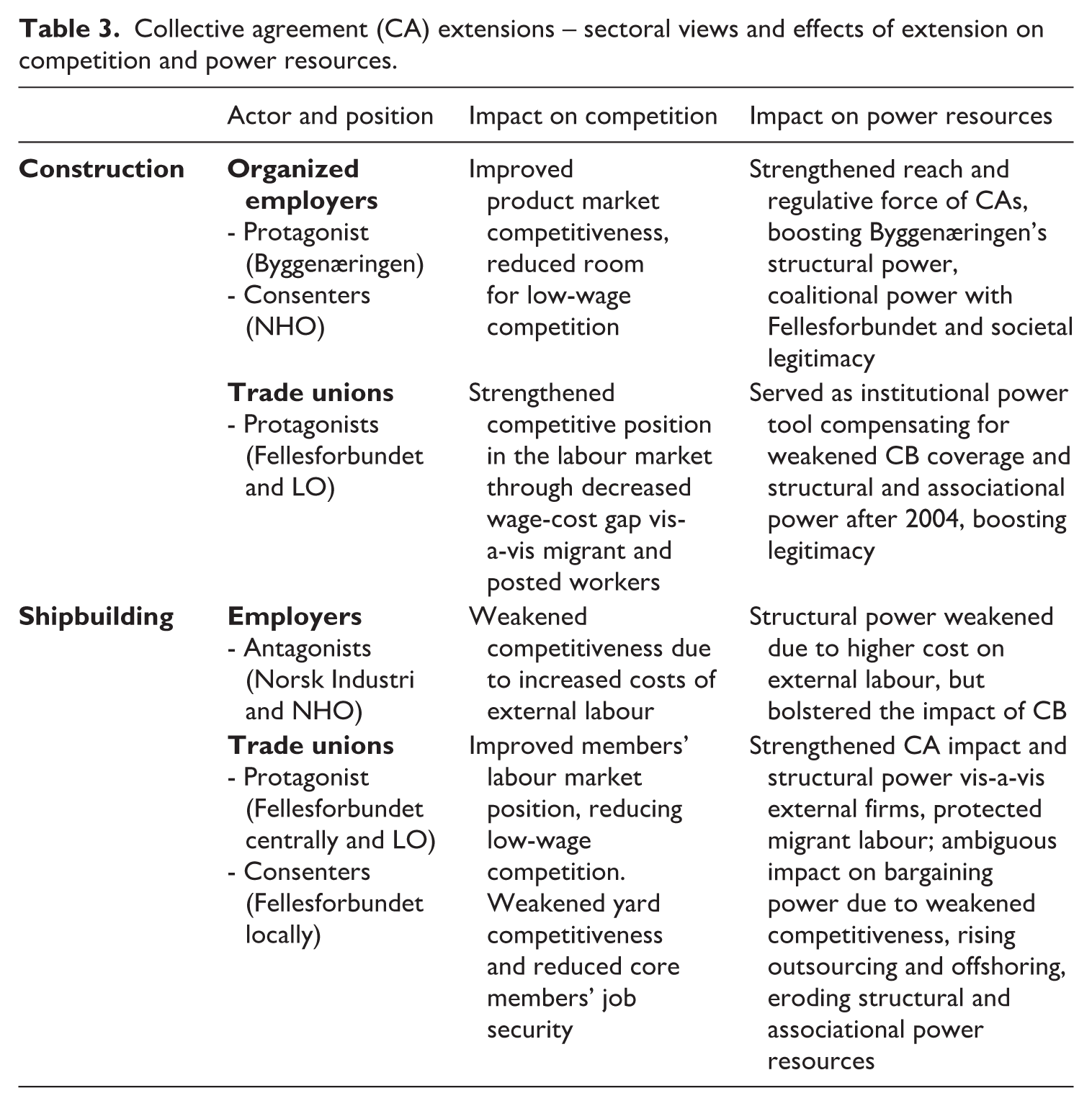
In construction, we have shown how organized employers and trade unions have had largely coinciding interests in establishing and prolonging the use of extension. For both Fellesforbundet and Byggenæringen, the proliferating low-wage competition post-enlargement entailed shrinking membership and growing circumvention of their collective agreements, thus weakening their joint regulative power in the product and labour markets. As organized employers were increasingly losing orders to ‘unserious’ national and international low-wage competitors bypassing the collective agreement, it was perceived by Fellesforbundet and Byggenæringen as a threat that could erode their structural and associational power resources as well as their public and political legitimacy. By establishing a statutory wage floor under competition in the product markets, the extension mechanism served for both sides as an institutional power resource that contributed to preserving and broadening the market regulating impact of their collective agreement, effectively bolstering their associational and structural power resources. Thereby it also strengthened their common voice and influence in the struggles over working life policies in their respective confederations as well as in political and judicial arenas.
Both in construction and shipbuilding it was the trade union Fellesforbundet – supported by LO – that called for industry-wide extensions with similar positions and arguments (inferior pay and unequal treatment of foreign labour). As Fellesforbundet organized workers in both sectors, the rising subcontracting of foreign workers and declining unionization represented a double challenge to Fellesforbundet’s associational power resources. Invoking extension was seen as the only way to turn the trend and shore up Fellesforbundet’s power in the labour market. However, due to the sectoral differences in product market competition, the extensions had very different impact on the market-related structural position and bargaining power of the organized actors in the two sectors. In construction, extension evidently bolstered the trade union’s structural power and bargaining strength, as also foreign and unorganized workers became bound by the collectively agreed minimum terms and unionized workers could compete for jobs on fairer terms. Bolstering also the regulative market power of Byggenæringen, the joint restoring of a more level playing field thus weakened the incentives to ‘free ride’ and protected the member bases on both sides.
In shipbuilding, by contrast, using cheaper subcontracted labour had partially strengthened the structural bargaining position of the unionized in-house workers, as it boosted the shipyards’ competitiveness, securing activity and jobs in the Norwegian yards. This also weakened the threat of production offshoring, which had tended to undermine the local unions’ bargaining power, a dynamic that became more salient when the pace of offshoring rose after the 2008 extension.
In other words, while organized labour and employers in construction were unequivocally strengthened by the loss of competitiveness that extension implied for unorganized firms – raising their costs of using cross-border labour – the extension effects for the organized actors in shipbuilding were much more ambiguous. By increasing the costs of the foreign/posted labour the yards had become dependent on, the extension weakened their competitiveness and profitability, thereby also causing pressure on the jobs, wages and bargaining power of the organized (in-house) workforces, and increasing the offshoring risk.
This ambiguity was visibly illustrated by the Aker Yards Agreement. While Fellesforbundet’s local actors pragmatically sought to strike a balance between competitiveness considerations and securing decent conditions for posted workers, Fellesforbundet’s central actors emphasized the principal view and collective interests of the union as a whole in securing equal treatment of foreign labour in line with what had just been achieved in construction. Instigating the decision to call for extension also in shipbuilding, this incidence illustrates how the perceived interests and strategic choices of trade union actors can differ between the levels of decision-making (Kochan et al., 1984; Weil, 2005): for the local unionists in Aker, what mattered most was to secure jobs and wages for its members; for the union headquarters it was imperative to secure strategic coherence and adherence to the unions’ legacy of equality and solidarity with CEE workers, thereby also preserving its credibility in the context of heated public and political conflict over the issue.
Our case comparison also underscores how the sectoral composition of associations and the sequence of events can influence strategic choices; once Fellesforbundet had established a norm and practice for combatting wage dumping via collective agreement extension in construction, it would be organizationally impossible for Fellesforbundet/LO to pursue a completely different approach in shipbuilding and accept the path of ‘concessional corporatism’ locally pursued by the union in Aker. On the employer side, the associational constellations were entirely different, as the two largest NHO affiliates, Byggenæringen and Norsk Industri, were pulling in opposite directions. In the context of arising judicial and political strife with LO, the state and EU/EEA rules over the issue, this posed a delicate dilemma not only in NHO decision-making but even in the courts, and the peak levels of government and tripartite governance in the Norwegian model.
Conclusions: Institutional change through sectoral interaction
This article has demonstrated the importance of understanding how national labour market regime adjustments to internationalization/Europeanization are shaped by the interplay between sectoral actors and interests. The post-enlargement rise of extension as a central tool to regulate the conditions for cross-border labour and services has been the most important innovation in the Norwegian labour market regime in the past 30–40 years. As shown, this development has been driven by distinct sectoral dynamics, where the differnt nature of product market competition and sectoral interests in cross-border flows of goods, services and workers have shaped organized actors’ approaches to extensions.
The article has further shown how such sector-specific dynamics are interrelated with the organizational landscape in which sectoral interests are intermediated. On the trade union side, workers of both construction and shipyards were part of the same trade union, which shaped Fellesforbundet’s strategic approach to extensions, effectively curtailing alternative strategies which might have emerged if these workers had belonged to different unions. 17 On the employer side, the dynamic between Byggenæringen and Norsk Industri illustrated how conflicting sectoral interests played out more publicly and contributed to tension between domestic and export-sector interests, complicating interest intermediation within the confederation NHO.
The article has also shown how sectoral organized actors directly influence national institutional change and adjustment to the EU regime. The sectoral tug between construction and yard industries has decisively shaped the evolution and institutionalization of the Norwegian extension scheme, which has become a central pillar in the system of collective bargaining and labour market regulation. In response to the threat that unfettered cross-border subcontracting and posting of workers in the enlarged Single Market posed to the existing collective bargaining system, extension became a way for the social partners to reinvigorate and broaden the regulative impact of collective bargaining, simultaneously strengthening the role of the state and the judiciary in securing labour rights. This way it took the form of an institutional layering of the existing system (Streeck and Thelen, 2005), adding a new pillar of statutory regulation and enforcement of minimum pay and conditions onto the pre-existing industrial relations system, benefitting migrant labour in particular.
While the aim of the extension mechanism initially was to protect foreign workers and prevent low-wage competition across the border, and eventually being practised in accordance with the EU Posted Workers Directive, it has over time come to serve much broader functions. Initially extensions were only enacted in sectors with considerable cross-border subcontracting, such as construction and shipbuilding. Over time, its application has been broadened to covering sectors marked by high shares of employees with immigrant background, many of whom are permanent residents employed by Norwegian companies. As of October 2025, nine sectors are covered by different collective agreement extensions (see Table 4). This way, the extension mechanism has increasingly been applied in industries where trade unions and employers face difficulties in organizing and developing collective bargaining, in effect contributing to tendencies of dualization of the domestic industrial relations regime.
Current sectors with extension and rates as of 15 June 2025.
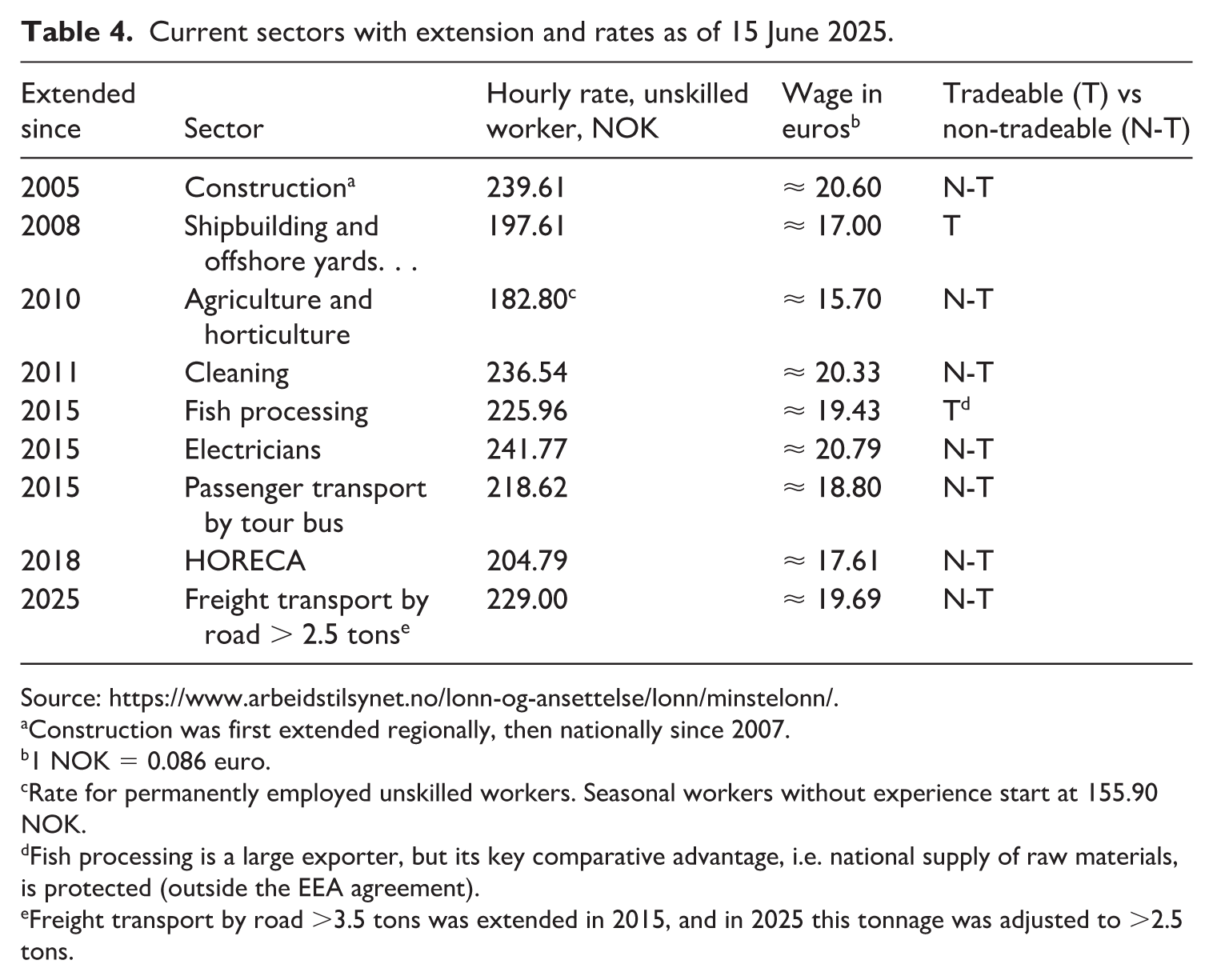
Construction was first extended regionally, then nationally since 2007.
1 NOK = 0.086 euro.
Rate for permanently employed unskilled workers. Seasonal workers without experience start at 155.90 NOK.
Fish processing is a large exporter, but its key comparative advantage, i.e. national supply of raw materials, is protected (outside the EEA agreement).
Freight transport by road >3.5 tons was extended in 2015, and in 2025 this tonnage was adjusted to >2.5 tons.
In media coverage of recent examples of inferior working conditions and suspicions of organized crime in the light parcel-transport sector, several public authorities pointed to extension as a possible tool to combat work-life crime and secure decent work (Jesnes and Svarstad, 2025). Despite very low density and collective bargaining coverage, this branch recently became subject to an extension decree. This way it can be argued that while the initial use of extensions constituted a layering of industrial relations, its scope has eventually drifted towards resolving broader sets of problems. However, as extensions cannot be applied to self-employed labour, it seems insufficient to address the problems related to abuse of workers on the fringes of the labour market, for instance, in the so-called platform economy where self-employment is still common.
Footnotes
Acknowledgements
An early draft of this article was presented at the CES conference in Reykjavik in June 2023, where we received useful comments that have contributed to advancing the article.

Funding
This article has been written as part of the large research project ‘Shipping Off Labour: Changing Staffing Strategies in Globalized Workplaces’ (Grant number 301541).
Declaration of conflicting interests
The authors declared no potential conflicts of interest with respect to the research, authorship, and/or publication of this article.