



Abstract
This article examines the evolving relationship between self-employed creative workers and trade unions, exploring the reconfiguration of collective engagement during the COVID-19 pandemic within a specific case study. Using a mixed-methods approach, we first analyse two decades (2002–2018) of European Social Survey data across different models of capitalism to provide an overview of unionisation trends among creative workers. We then integrate findings with qualitative insights from an Italian case study, focusing on workers’ changing strategies. While Varieties of Capitalism (VoC) contextualises institutional constraints to unionisation, Crozier’s Strategic Actor Theory (SAT) highlights worker agency in responding to them. Drawing primarily on SAT, we argue that, despite institutional barriers and occupational fragmentation, the pandemic created opportunities for workers to engage with unions, recognising their lobbying power in shaping emergency employment protection and income support. This study contributes to the debate on union revitalisation by showing how workers’ agency influences collective strategies in changing labour market conditions.
Introduction
Over the past two decades, the nature of work has undergone profound transformations, particularly in creative industries. Creative labour offers a nuanced view on the shifting role of work in post-industrial societies. In Europe and Italy, self-employment has increased remarkably, with ‘solo’ self-employment experiencing the highest growth rates (OECD, 2020). This trend has impacted both high- and low-skilled workers (Gallie, 2013), often in production sectors developed or reconfigured due to digital innovation (Conen and Schippers, 2019). In the creative field, the rise of self-employment has heightened precariousness (Pulignano, 2019), as workers across a wide range of occupational domains contend with disruptions linked to individualisation (Beck and Beck-Gernsheim, 2002) and deregulation (De Vita et al., 2018; Pichault and Semenza, 2019). Against this background, traditional collective protections have weakened, leading workers to seek alternative solidarity mechanisms.
Scholars from different areas of study have helped advance the understanding of changes affecting collective interest organisations. These authors have highlighted two critical processes. The first concerns how trade unions represent self-employed workers and, more broadly, vulnerable workers – facing new social risks such as difficulties in market access, job insecurity, low income and limited social protection (Bonoli, 2007; Clement et al., 2009; Taylor-Gooby, 2004). This perspective has focused on strategies and ‘repertoires’ of action for union renewal or revitalisation (see Frege and Kelly, 2003, 2004), a central topic of debate for many years (see Gumbrell-McCormick and Hyman, 2013; Moore, 2010; Schnabel, 2013; Vandaele, 2019). The second process involves the paths of identity construction and collective action beyond traditional unionism, notably through new mutualism (Milkman and Ott, 2014) and organisational experimentation (Murray et al., 2020) as responses to market pressures (Franzini and Lucciarini, 2022; Lucciarini and Pulignano, 2023). This approach emphasises solidarity over competition, critiquing the classic macroeconomic mainstream, based on market supremacy, rational choice and the failure of trickle-down rhetoric.
Institutional theories inspired by Varieties of Capitalism (VoC) (Hall and Soskice, 2001) have been widely used to explain national differences in labour market structures and unionisation rates (see Busemeyer and Trampusch, 2012; Crouch, 2011; Emmenegger et al., 2012; Hassel, 2007; Thelen, 2014). While these approaches have significantly contributed to our understanding of institutional diversity and change – including processes of institutional evolution, hybridisation and actor-led transformation – their application often focuses on the structural characteristics of national models, placing less emphasis on the micro-level strategies of individual and collective actors. Building on these insights, we propose that Strategic Actor Theory (SAT) (Crozier, 1971 [1965], 1973 [1970]; Crozier and Friedberg, 1977; Crozier and Thoenig, 1976) offers a complementary lens to analyse how self-employed creative workers in fragmented and deregulated fields navigate institutional constraints and participate in shaping new forms of solidarity. Rather than suggesting that actors are absent from the VoC perspective, we aim to show how SAT helps to illuminate the situated and strategic reasoning behind their actions in contexts often overlooked by macro-institutional analyses.
In line with Suddaby’s (2025) emphasis on strong theoretical work, this study does not merely apply existing frameworks but seeks to extend them by integrating multiple levels of analysis. The VoC framework serves as a contextual backdrop to analyse institutional constraints on unionisation among self-employed creative workers. SAT, in turn, provides an overarching logic that links these constraints with actors’ responses, offering a more nuanced understanding of how individuals engage with these challenges. Additionally, new mutualism and organisational experimentation are framed as strategic adaptations within Crozier’s logic, underscoring how actors develop innovative solutions to overcome institutional barriers. Although not our primary focus, the debate on union revitalisation remains a relevant reference point, as this research contributes to broader discussions on how worker agency influences the evolution of collective strategies in changing labour market conditions.
Building on this theoretical framework, this article examines three interrelated questions: (1) How have unionisation trends evolved among self-employed creative workers in recent years? (2) What institutional factors facilitate or hinder the inclusion of creative workers within union structures? (3) How did the COVID-19 pandemic influence the relationship between these workers and trade unions?
The analysis, centred on the Italian case, investigates the mechanisms that have led to a growing ‘mismatch’ between workers’ needs and institutional responses, a gap intensified by the pandemic crisis. To contextualise this dynamic, we first compare Italy’s unionisation path with those of other European countries, identifying key moments that influenced the impact of the pandemic. This comparative lens helps determine whether Italy aligns with European trends or follows a distinct trajectory in how self-employed creative workers interact with trade unions. We argue that many of these workers initially perceived unions as peripheral actors in the institutional arena during the emergency (Grimshaw et al., 2016). Nevertheless, the pandemic prompted them to not only explore alternative organisational forms, such as cooperative social enterprises, but also engage with unions, recognising their ability to pressure state institutions and shape emergency measures for employment protection and income support. As a push factor, the pandemic created new opportunities to reconnect the missing threads between unions and disintermediated workers (Armaroli, 2022).
By tackling these issues, this work demonstrates originality and utility, key criteria for a strong theoretical contribution (Aguinis and Cronin, 2022). It sheds light on the undertheorised agency of self-employed workers and links theoretical insights with practical implications for labour policies and collective action.
Understanding creative labour
A working definition
Since the early 1980s, cultural economists, statisticians and sociologists have attempted to develop a coherent framework for defining creative labour, reflecting its multifaceted and evolving nature. However, despite growing interest in both academic and policy circles, a clear and standardised framework remains lacking, along with verifiable and reliable data on the creative industries. This study provides a production-based perspective, prioritising activities directly involved in cultural and creative production rather than broader value chain elements (e.g. retail and distribution). This approach aligns with existing classifications in cultural economics and labour studies (Hesmondhalgh and Baker, 2019; McRobbie, 2016) and ensures a focused examination of employment conditions in the sector. In other words, while many national and international studies also include trade activities related to cultural and creative industries – such as wholesale trade in furniture or retail trade in musical instruments – we primarily examine production activities with a cultural and creative basis. These activities can be grouped into four macro-categories: (1) cultural industries, including activities related to the production of goods closely tied to artistic endeavours with a strong creative component, such as film, television, music and publishing; (2) creative industries, including activities related to the production of goods with a strong creative component that also serve additional functions, such as architecture, design and advertising; (3) historic-artistic heritage, referring to activities related to the preservation, enjoyment and enhancement of both tangible and intangible heritage, including museums, libraries, archives and the management of historical sites or monuments; (4) performing and visual arts, encompassing live performances, theatre, dance and visual arts.
Labour market segmentation and institutional frameworks
The impact of the COVID-19 crisis on creative industries was profound and uneven, exacerbating existing labour market segmentation. This segmentation, shaped by contractual arrangements and institutional frameworks (Pedersini and Coletto, 2009), highlights longstanding disparities in social protection, with self-employed creative workers particularly vulnerable due to their exclusion from traditional employment-based benefits. Nevertheless, the workforce within this domain has borne the brunt of these repercussions in a markedly unequal manner. On the one hand, this disparity has been intensified by discrepancies in access to protective measures, reflecting the well-established boundary that demarcates salaried employment from self-employment, as elucidated by many scholars (Murgia et al., 2020; Pedersini and Coletto, 2009). On the other hand, deeper segmentation has manifested within the domain of creative self-employment, influenced by distinctive employment dynamics and contractual arrangements.
In many instances, self-employed creative workers are categorised as ‘intermittent’ workers, meaning their employment is irregular and project-based. Such classification focuses on the periods in which they are actively engaged in paid work, overlooking the preparatory phases or gaps between projects. This situation is particularly evident in industries such as performing arts or audiovisual production, where work is highly seasonal. As a result, these workers often fail to meet the minimum number of working days required to qualify for benefits that are typically available to salaried workers, leaving them without adequate social protection.
Unionisation and alternative forms of collective solidarity
Faced with significant inequities in protective measures, certain creative workers – especially those in technical roles in the audiovisual sector – have turned to labour unions for support in securing representation and access to social protections. Yet, self-employed workers prioritise individual strategies and prefer to bypass traditional intermediaries, a tendency often referred to as a ‘culture of disintermediation’ (Armaroli, 2022). In this context, cooperatives and grassroots organisations have arisen as alternative forms of solidarity. These organisations primarily focus on providing economic security and mutual support for creative workers constrained by institutional barriers. Additionally, they engage in organising, servicing and lobbying activities while experimenting with organisational innovations that occasionally exert ‘institutional pressure’ (Murray et al., 2020) to expand social protection rights, from which these workers are currently excluded (Franzini and Lucciarini, 2022).
The Italian case shows how the pandemic reshaped the dynamics between creative workers and trade unions, creating an opportunity for the latter to strengthen their presence in the sector. The pressures of the pandemic drove unions to innovate their ‘repertoires’ of action (Heckscher, 1988), enabling them to reach previously unrepresented workers. These innovations reinforced their role in advocating for improved protections and institutional recognition. National governmental resolutions such as the ‘ristori’ (economic relief measures) have demonstrated the effectiveness of these efforts leading to the extension of benefits to intermittent workers through fiscal measures that required a temporary deviation from the state budget. Notably, a 2012 constitutional amendment mandated a balanced budget at both national and sub-national levels, which necessitated parliamentary approval for any budget deviations. In public discourse, substantial support has emerged for these ristori as safeguards for workers affected by pandemic-related employment disruptions. This endorsement has facilitated the extension of support not only to employees meeting the eligibility criteria but also to self-employed workers lacking sufficient financial reserves.
From the perspective of workers, a complex system of action emerges, shaped by the interplay of individual and collective dimensions. This study draws on Crozier’s framework from The World of the Office Worker (1971 [1965]) to examine this, which oscillates between individual instrumentalism and opportunistic mechanisms, on the one side, and collective strategic reasoning, on the other. As Crozier and Friedberg (1977) argue, these individual and collective logics are not mutually exclusive but dynamically interact within structured fields of action. In this sense, the strategic choices of workers, whether oriented towards autonomy or collaboration, can only be understood in relation to the constraints and opportunities embedded in the system.
This complexity is further heightened by the frequent ‘plural’ employment status of workers, often referred to as ‘multiple-job holders’ (Piasna et al., 2021; Lucciarini et al., 2025), who combine self-employment with temporary salaried work and, in some cases, also operate as self-employed with employees. These workers continuously adjust their strategies to manage uncertainty and access resources. For instance, creative workers may hire assistants or collaborators for specific projects, temporarily assuming the role of employers. This fluidity aligns with Crozier and Friedberg’s (1977) concept of ‘collective learning’, where actors develop and institutionalise new patterns of action through interaction. As demonstrated by cooperatives and unions in the creative sector, this dynamic process fosters new forms of solidarity while simultaneously altering the constraints that initially shaped the actors’ choices. This corresponds with Crozier’s (1973 [1970]) argument that ‘institutional inertia’ can drive strategic adaptations by actors seeking to overcome rigid structures. The interaction between creative workers, cooperatives and unions illustrates this dynamic, as unions had to modify their approach to effectively integrate these workers into their organisational framework.
The effects of the pandemic on creative workers and trade unions highlight two additional, underexplored phenomena. The first pertains to a deepening segmentation within self-employment in terms of occupational security and working conditions. These divisions depend on an individual worker’s position in the market, client base and access to stable income streams. The second key aspect is that, despite its imperfections, the implementation of the ristori represents the first time in Italy that the self-employed have received such support. This development appears to be a response to pressures in various governance arenas, including industrial relations and welfare (Crouch, 2008), and is linked to what some authors have termed ‘shifting solidarities’ (Van Hoyweghen et al., 2020). It signals an incipient reaction to the labour market transformations, focusing not solely on capitalist systems but on their democratic governance (Beramendi et al., 2015). This perspective aligns with recent contributions by scholars such as Iversen and Soskice (2019) and Rueda and Stegmueller (2019), who build upon the insights of Esping-Andersen (1990) and Pizzorno (1973).
Research design and methods
To address our research questions, we employed a convergent parallel mixed-methods design, which integrates quantitative and qualitative data to provide a comprehensive understanding of the research problem (Creswell and Creswell, 2018). This approach leverages the strengths of both methods: the large sample size, objectivity and generalisability of quantitative analysis, and the depth, contextual richness and interpretative power of qualitative research (Creswell and Plano Clark, 2018). In the quantitative strand, we analysed secondary data to explore the social, economic and institutional contexts of labour markets. This choice aligns with the core ideas of Entangled Political Economy, from a socio-economic perspective (Wagner, 2016), and Contextual Political Analysis, from a political science standpoint (Gooden and Tilly, 2006). Both approaches recognise the interdependence of private and public actors, engaging in a dynamic where national capitalisms, considered as ‘growth models’, decide to either maximise liberty or minimise coercion to protect liberalism (Garzarelli et al., 2023). The qualitative component consisted of narrative interviews and focus groups, which helped shape and interpret our case studies. This methodological integration allowed the two datasets to ‘talk to each other’ (Teddlie and Tashakkori, 2009), strengthening the robustness of our findings.
Quantitative analysis
We used European Social Survey (ESS) data to examine long-term trends in unionisation among creative workers. The ESS, conducted biennially since 2002, is an academic research project that covers multiple European countries and provides a reliable longitudinal dataset for analysing social attitudes. To capture key shifts over time, we selected three rounds of the ESS, with two distant points in time, one before (2002), one amid (2012) and one after (2018) another unexpected shock in the 2000s: the Great Recession. These time points allowed us to assess how economic crises and structural labour market changes influenced union membership among creative workers. ESS data allowed us to investigate a range of factors related to union membership, including personal and occupational features, as well as workplace issues. Additionally, we utilised ESS data to estimate specified empirical models for each country group included in the analysis.
The study sample was defined using various criteria. Consistently with the assumptions of the VoC theory (as initially proposed by Hall and Soskice [2001], and subsequently revised by Hancké et al. [2007]; see specifically Soskice [2007] and Molina and Rhodes [2007]), countries were classified based on models of capitalism, characterised by specific configurations of labour market institutions (Bosch et al., 2009): the UK and Ireland as Liberal Market Economies (LMEs); Denmark, Finland, Norway and Sweden as Nordic Coordinated Market Economies (Nordic CMEs); Belgium, Germany, France and the Netherlands as Continental Coordinated Market Economies (Continental CMEs); and Spain, Italy and Portugal as Mixed Market Economies (MMEs).
Since our focus is on creative workers’ unionisation, we restricted the sample to respondents in paid employment at the time of the interview. The respective sample sizes per round were 42,359 (ESS1), 52,177 (ESS6) and 46,276 (ESS9). After applying our occupational criteria, we retained 13,544, 13,056 and 12,538 cases respectively.
The primary independent variable was occupation, classified using four-digit ISCO codes. Categories included creative workers, high-skilled service workers, low-skilled service workers and other workers. For the latter three categories, we used the conventional approach, which considers only the first digit of ISCO codes: high-skilled service workers (ISCO 1–3), low-skilled service workers (ISCO 4–5) and other workers (ISCO 6–9). For creative workers, however, our operationalisation was based on the cultural and creative occupations listed in the annual reports provided by the Symbola Foundation and Unioncamere (the Italian Union of Chambers of Commerce, Industry, Crafts and Agriculture). We relied on these reports since they refer to the most detailed level of the Istat (Italian National Institute of Statistics) classification of occupations, although we reviewed various international proposals, such those of UNESCO (2009) and Eurostat (2018). The challenge was to avoid proposing new definitions of cultural professions, adding to a variety of concepts already existing. Therefore, our approach integrates Santagata’s (2009) model, which influenced these reports, characterised by traditional welfarist elements and emphasising the cultural sector as a distinctive sector of the economy, within the ESSnet-Culture’s (2012) framework, used by Eurostat to produce comparable statistics on culture at the European level. Specifically, for creative employment, we considered everyone working in economic activities deemed creative, regardless of whether they were employed in a specifically creative occupation. For instance, we classified as creative workers those performing jobs characterised by routine and repetitive tasks in cognitive and production activities. These include occupations such as handicraft work in textile, pastry-cooks, confectionery makers, making jewellery and precious metalware, making pottery, porcelain ware, ceramics and glassware, etc. (i.e. occupations within ISCO major groups 6–9). We also considered as creative workers individuals with a creative occupation, whether or not they were employed in a creative economic activity (e.g. books and press, visual and performing arts, audiovisual, multimedia, architecture, advertising, art crafts). To ensure consistency across countries, we employed correspondence tables that linked the Istat classification with the ISCO system. In light of the below discussion, we point out that the category of creative workers cuts across the other three, with a prevalence among the most skilled workers: 51.6% of high-skilled creative workers, 21.8% of low-skilled creative workers, 26.6% of other creative workers.
Another key independent variable is the employment type: employee with an open-ended contract, employee with a fixed-term contract, employee with no contract and self-employed.
We then used the prism of union membership while being aware that workers’ perceptions and attitudes towards trade unions extend beyond the mere increase or decrease in union affiliations. Therefore, the findings should not be interpreted as an exhaustive mapping but rather as a means to capture the trajectories of self-employment within the European context over the past two decades.
To correct for potential errors, we applied two weighting factors: sample weight and population weight. Sample weight adjusted for the fact that, in some countries, respondents have different probabilities of being included in the sample due to the employed sampling design, thus making the sample more representative of a ‘true’ sample of individuals aged 15 and above in each country. Population weight provided compensation to ensure that each country is represented in proportion to its population size. Without this weight, any figures combining data from two or more countries could be subject to errors that overrepresent smaller countries at the expense of larger ones.
Qualitative analysis
Furthermore, an empirical study was carried out to investigate the Italian context from September to November 2020. A qualitative analysis was employed to conduct an in-depth thematic exploration of the collected data. The data were gathered through 30 interviews with key informants, targeting three union officials from SLC-CGIL (Sindacato Lavoratori della Comunicazione-Confederazione Generale Italiana del Lavoro) (int_1–3_union), three managers of the leading cooperative social enterprise in the sector (int_1–3_assoc) and 24 workers, namely audio and video technicians, all male, aged 25–45 (int_1–24_worker). The focus on audio and video technicians is justified by their high representation in social cooperative enterprises (Lucciarini and Pulignano, 2023) and active participation in associative activities. This group possesses a distinctive professional identity and has developed in-group mechanisms, largely facilitated by their affiliation with social cooperatives, which they join to access welfare benefits (Franzini and Lucciarini, 2022).
The sample selection technique relied on readily available individuals, while ensuring the internal consistency and specificity within the respondent group by adopting a snowball sampling method. Therefore, the sample cannot be claimed to be representative. A ‘narrative’ thematic analysis (Kartch, 2017) was used for interviews to examine how workers’ needs have evolved and whether unions were perceived as legitimised or delegitimised. The analysis followed a trade-off pattern, identifying the push and restraint factors influencing the decision to join a union. This diversity of strategic actions aligns with Crozier’s framework (Crozier, 1973 [1970]; Crozier and Thoenig, 1976), which suggests that workers alternate between individual and collective logic in a strategic and non-oppositional manner to enhance their conditions.
Analysis
Trends and determinants of unionisation
In this section, we provide a general overview of the data, employing descriptive statistics to compare the group of creative workers with other major occupational categories, including high-skilled service workers, low-skilled service workers and other workers. We also address the internal heterogeneity of creative workers comparing sub-groups within creative workers. Finally, we conduct a binary logistic regression to assess the influence of various social, economic and political variables on the unionisation of creative workers.
Over the period from 2002 to 2018, a marked decline has been observed in the proportion of creative workers, decreasing by 10 percentage points. More specifically, their share fell from 30.7% (ESS1) to 20.5% (ESS6) and further to 19.4% (ESS9). Conversely, high-skilled service workers exhibited an opposing trend, with their proportion oscillating between 26.9% in 2002 and 34.9% in 2018. The patterns for low-skilled service workers and other workers were less linear. The former experienced fluctuations, with shares of 17.3, 25.4 and 23.8%, while the latter maintained more stable figures at 25.0, 22.1 and 22.0%.
At first glance, these figures may seem counterintuitive, but they become more understandable when considering two key factors. First, creative work has only recently undergone a process of professionalisation. Second, creative industries have long been characterised by atypical employment situations, including unconventional working hours, project-based arrangements, self-employment (including economically dependent self-employment), ambiguous contractual arrangements and unclear employment statuses (Florin and Pichault, 2020). The global recession following the 2008 financial crisis exacerbated these trends, contributing to the proliferation of novel employment forms and work modalities. Creative workers who lost regular salaried positions – evidenced by a decline of 12.9 percentage points for fixed-term contracts and 11.5 for open-ended contracts – did not simply shift to atypical positions in formal employment but often reverted to informal work and occasional engagements.
However, the impact of the economic crisis varied across models of capitalism and individual countries. The two groups of countries classified as LMEs and MMEs experienced the most pronounced declines in creative professions between 2002 and 2018, with reductions of 14.1 and 13.1 percentage points, respectively. On the other hand, employment grew modestly between 2012 and 2018 in Nordic CMEs, where the share of creative workers increased from 19.7% in ESS6 to 22.4% in ESS9, and, to a lesser extent, in Continental CMEs, where it rose from 19.3 to 20.8%. In this context, Italy aligns with other MMEs, exhibiting a steady decline in the percentage of creative workers, from 30.6 in 2002 to 25.0 in 2012 and further to 17.5% in 2018.
By limiting the sample to workers (thus excluding retirees and the unemployed), we calculated net union density rates, defined as the ratios of workers who are union members among all workers in each country. The sample included 4032 union members and 12,186 non-members in ESS1 (corresponding to a union density rate of 24.9%), 3657 members and 13,605 non-members in ESS6 (21.2%) and 3610 members and 15,046 non-members in ESS9 (19.4%).
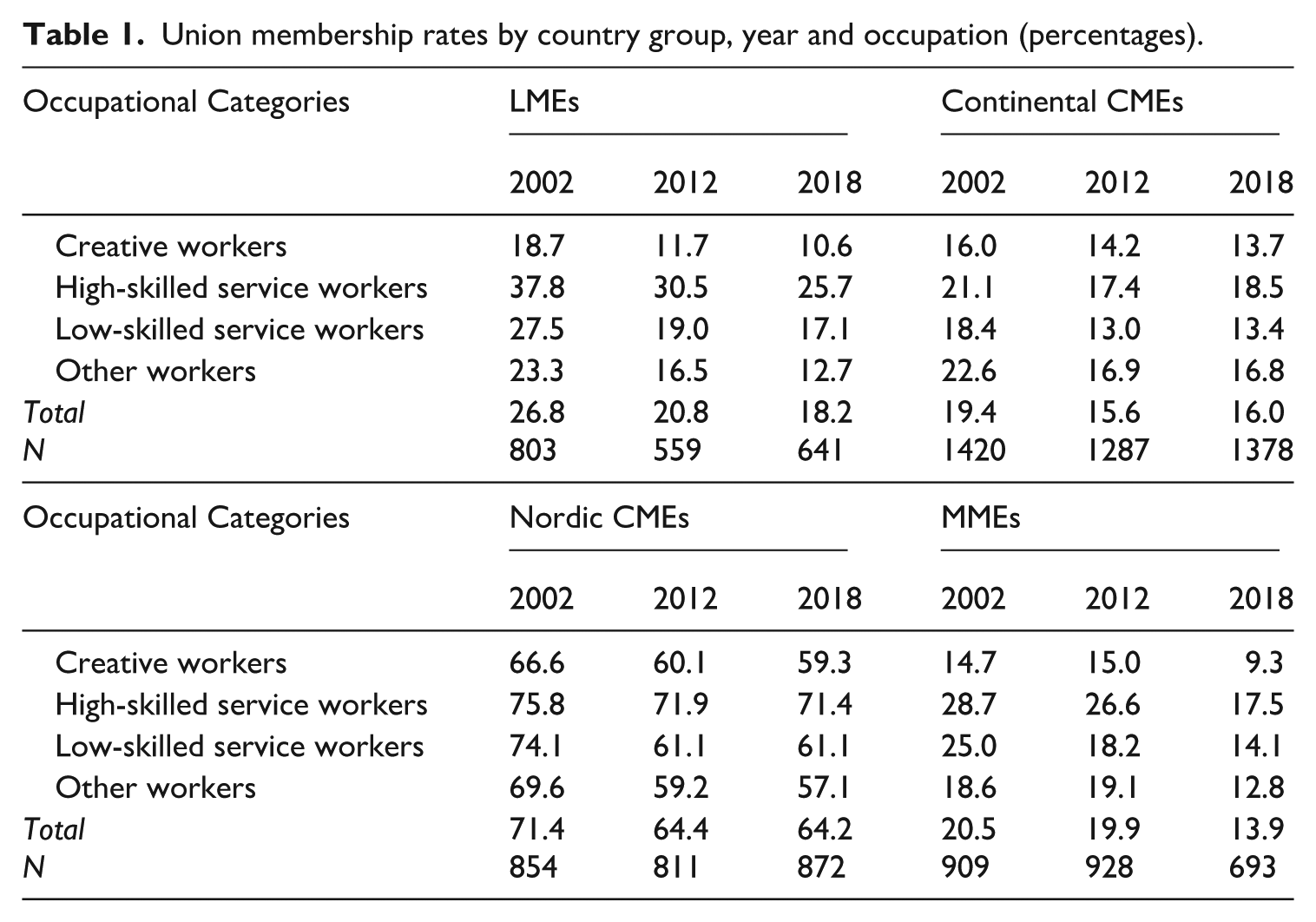
As anticipated, descriptive statistics reveal significant disparities among countries in unionisation rates. Overall, Nordic CMEs recorded higher union density (64.2% in 2018), while LMEs (18.2%), Continental CMEs (16.0%) and MMEs (13.9%) lagged behind (see Table 1). The percentage of individuals who were previously enrolled in a union but are no longer members is higher in LMEs (16.3%) and Nordic CMEs (16.2%) compared to Continental CMEs (11.9%) and MMEs (9.1%). These patterns extend beyond a simple analysis of union membership and likely reflect structural transformations in industrial relations within each model of capitalism.
Union membership rates by country group, year and occupation (percentages).
A crucial explanatory factor for high unionisation in Northern Europe is the Ghent unemployment insurance system. This voluntary system, subsidised by public funds and administration by unions or union-affiliated institutions, provides workers ‘selective incentives’ to join unions. Although this mechanism has weakened in recent years (Lind, 2009), it continues to be a major factor underpinning high union density in Denmark, Finland and Sweden.
Nevertheless, growing global competition has exerted intense pressure towards the liberalisation of national industrial relations systems (Streeck and Thelen, 2005), leading to a convergence of declining unionisation rates across European models of capitalism (Baccaro and Howell, 2017). The share of individuals who have never been union members has increased across all country groups: by 12.0 percentage points in LMEs, 6.9 in MMEs, 5.9 in Continental CMEs and 2.9 in Nordic CMEs. Italy follows a similar trajectory, with unionisation rates halving from 25.9 in 2002 to 12.5% in 2018, while the proportion of workers who have never joined a union has risen from 62.3 to 78.8% over the same period.
The nature of employment plays a pivotal role in determining unionisation rates. Across Europe, creative workers exhibit significantly lower union membership than other categories of workers. In 2018, unionisation rates stood at 16.0% for creative workers compared to 24.1% for high-skilled service workers, 17.5% for low-skilled service workers and 17.1% for other workers (see Table 1 for variations across countries and over time). However, the starkest contrast is observed between workers with permanent contracts and those with no formal contract (26.8% compared to 8.7%), while self-employed workers fared slightly better (11.0%).
A consistent pattern emerges when analysing unionisation rates by contract type. Creative workers without a contract and those who are self-employed demonstrate particularly low levels of union membership, standing at 7.0 and 7.8%, respectively, in ESS9. These figures represent marginal declines of 2.2 and 3.1 percentage points compared to ESS6. As previously highlighted, in the context of economic recession, increasing labour flexibility and heightened mobility, many creative workers have encountered unstable job opportunities and have sought alternative avenues for collective solidarity outside traditional unions. Standard and non-standard workers often have divergent interests, making collective representation challenging. This divide can weaken cohesion within an organisation, hindering unified negotiations with managers or business owners. Moreover, unionised members in standard employment arrangements may perceive non-standard workers as a competitive threat, as employers might prefer hiring them to bypass unionisation. Finally, increased employer flexibility in restructuring and relocation can diminish incentives to engage in collective bargaining with unions.
Among European countries, those classified as MMEs recorded the lowest unionisation rates in 2018 for creative workers, particularly among permanent workers (12.6%), temporary workers (3.8%), self-employed workers (5.8%) and contract workers (0%). Italy follows this trend, showing similar patterns. Notably, these disparities between countries have persisted over time rather than converging.
An important issue that must be addressed concerns the segmentation within creative occupations, given the significant heterogeneity of this category. Unfortunately, our sample does not allow for a further subdivision into multiple categories. For simplicity, we classify creative workers in three sub-categories, namely: high-skilled creative workers, low-skilled creative workers and other creative workers. The most apparent difference across labour markets is that high-skilled creative workers are disproportionately fewer in MMEs compared to the other country groups. In 2018, they constituted 40.6% of total creative workers in MMEs, 73.2% in LMEs, 66.6% in Continental CMEs and 70.0% in Nordic CMEs. Specifically, Italy exhibited the highest share of low-skilled creative workers (25.5% in 2018), exceeding the average (11.9%) by over 13 percentage points. However, the 2000s saw a rapid and continuous increase in the qualification levels of creative workers across all models of capitalism (+40.3% in LMES, +24.6% in Nordic CMEs, +19.3% in Continental CMEs and +8.1% in MMEs). The decline in union membership was evident in all categories of creative workers. While differences between the four country groups are not substantial, they remain noteworthy, particularly in those with initially higher unionisation rates. From 2002 to 2018, the proportion of high-skilled creative workers affiliated with unions decreased by 9.4% in Nordic CMEs, 7.3% in LMES, 3.3% in Continental CMEs and 2.9% in MMEs.
In our analysis, the dependent variable is a binary variable (1/0), indicating whether respondents currently belong to a union (1) or were previously or have never been affiliated with a union (0). Thus, a binary logistic analysis, which estimates the probability of union membership, is appropriate. In the subsequent binary logistic regressions, we examined whether the observed general patterns persist when controlling for a range of variables. The first set of variables includes socio-demographic characteristics such as gender, age, education (measured in years of schooling) and country of birth. These variables consistently correlate with union membership in cross-sectional studies across various countries. The second set of variables pertains to job-related factors influencing unionisation, including working hours (part-time or full-time) and firm size. The third set of variables accounts for the economic circumstances of the respondents and their perception of uncertainty, such as their unemployment status over the past five years and their perceived adequacy of available income. Additionally, we included political attitudes as an explanatory variable, given its established relationship with collectivist orientation and, consequently, union membership. We assessed political attitudes through self-placement along the left–right political scale.
Union membership and its determinants have been scrutinised from multiple angles, yet establishing a universal model of unionisation has proven difficult, if not unattainable. A key focus is to determine whether the same set of variables can consistently explain union membership across different countries and to identify which factors exert the strongest influence on unionisation.
Table 2 presents estimates for the main independent variables alongside all control variables in the form of odds ratios. Yet, since the secondary effects of these control variables do not constitute our primary theoretical focus, they are omitted from the ensuing discussion.
Binomial logistic regression of union membership by country group and year (odds ratios).
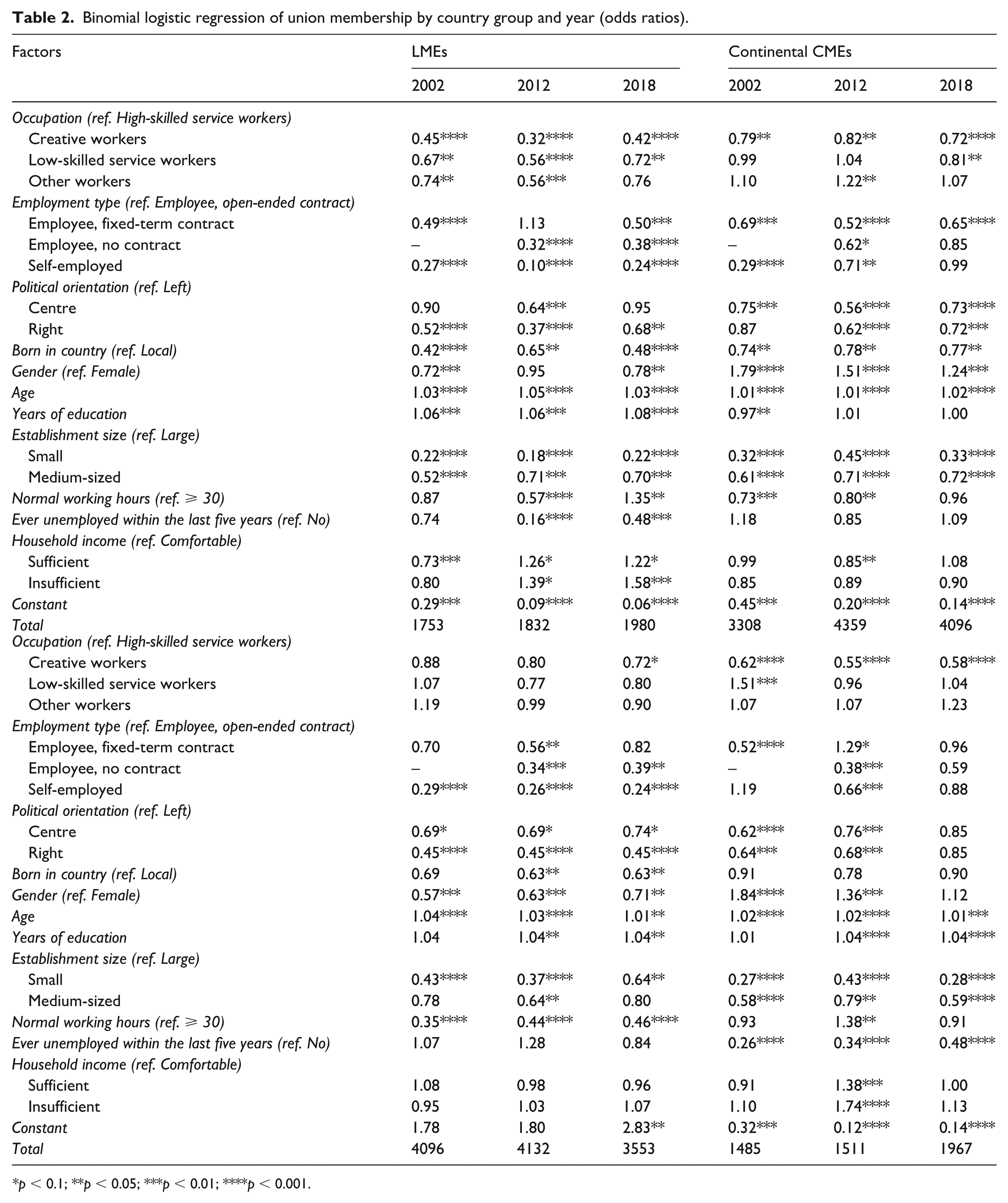
p < 0.1; **p < 0.05; ***p < 0.01; ****p < 0.001.
Our findings show that labour market institutions do not function in a neutral manner but produce selective effects. These effects influence the likelihood of membership and determine who joins or remains a member. Creative workers consistently exhibit lower odds of union membership compared to high-skilled service workers. In LMEs, for instance, the odds of creative workers being union members are approximately 0.40 times those of high-skilled service workers. In MMEs, these odds range from 0.62 in 2002 to 0.58 in 2018. In Continental CMEs, they rose to 0.82 in 2012 before stabilising at 0.72 in 2018. Notably, in Nordic CMEs, union membership does not appear statistically significant, as the coefficients lack significance. Nevertheless, creative workers still show lower membership odds compared to high-skilled service workers. It is important to note that the significance of a categorical variable, unlike a numerical one, does not necessarily imply a difference from zero (although it may); rather, it indicates variations between the categories.
The data presented in Table 2 confirm that the use of fixed-term contracts, temporary employment or self-employment negatively affects union membership probabilities. Except for Southern European countries, the coefficients consistently show statistical significance at the p < 0.001 level. This indicates that, on average, workers facing greater job insecurity diverge significantly from permanent employees, although these differences become less pronounced over time. In MMEs, differentiation from the reference category produces no significant effects on the dependent variable in 2018.
We conducted robustness checks by employing a more granular classification of the employment variable, distinguishing among various classes of service workers, and incorporating additional control variables such as marital status and parental education level. Despite these refinements, the results remained qualitatively consistent with those presented below.
By integrating these data, we can develop a worker choice model to examine the benefits and challenges of union membership for different groups of workers. This framework helps clarify disparities in unionisation across various social groups. When these disparities remain consistent across multiple countries, it highlights how pervasive labour market changes – including shifts in business organisational practices and gaps in labour regulation – influence union membership.
This perspective on union membership takes into account individualisation processes, suggesting that individuals act as rational actors. Based on this premise, union membership can be understood as the outcome of workers’ demand for union representation (and associated services) in relation to unions’ supply of these goods (Bellini et al., 2023). This approach does not imply that individuals inherently avoid joining unions. Subsequently, in the following paragraph, we will explore this issue in greater depth.
Connecting the dots: Examining how an Italian union intermediates the disintermediated amidst the pandemic crisis
The analysis conducted thus far highlights the decline in the average number of creative workers over the past 20 years across all country groups. These data should nevertheless be interpreted with caution, considering certain caveats. The impact of digitalisation has expanded the range of creative jobs, many of which may escape official statistics due to a mismatch between emerging professional roles and their formal classification (e.g. content creators). At the same time, a clear discrepancy exists between public narratives – where jobs related to the valorisation of cultural and immaterial heritage receive significant investment, both symbolically and materially – and the actual working conditions of many creative workers. For example, in the National Recovery and Resilience Plan (NRRP), substantial attention is devoted to the renewal pillar rooted in cultural and creative services and organisations. Yet, this is driven by temporary employment contracts and the absence of a medium- to long-term plan capable of guiding a sector still characterised by areas of immaturity and dysfunction (e.g. informal/undeclared work and misalignment between work and public recognition).
These new jobs not only elude formal classifications but also lack industry-wide agreements to represent them adequately. Lighting and sound technicians, for instance, are frequently employed under the metalworking agreement, which does not reflect the specificities of their profession. This mismatch, as reported by a union leader of SLC-CGIL (int_1_union), is a key factor behind the low unionisation levels among creative workers, as being misclassified means not accruing sufficient contributions to access certain benefits. Additionally, the working hours of creative workers do not align well with those in traditional sectors. Their schedules depend on event calendars and, therefore, cannot conform to the logic of indefinite work found in standard jobs, resulting in work discontinuity. This misclassification as intermittent or discontinuous workers is not due to the workers themselves but rather to a ‘sector effect’ – a structural characteristic of the industry that enforces irregular employment patterns – leading to disadvantages in terms of benefits, career contributions and protections, as explained by another union leader of SLC-CGIL (int_2_union). This reflects broader institutional constraints, as discussed in the literature on the segmentation of creative labour markets. According to the same interviewee, this configuration has contributed to distancing creative workers in emerging sectors from trade unions. Traditional figures, such as orchestral musicians or workers in publishing, have a positive relationship with unions, largely due to the representation work that has recognised the seasonal nature of their employment. This has led to the formal acknowledgement of seasonality, as seen in the case of resident theatre workers (De Vita and Lucciarini, 2019).
Demonstrating self-reflection and a critical approach, the union management we interviewed (int_1,2,3_union) believes that the support and representation work carried out in traditional creative industries have given rise to a division between protected and emerging, unprotected creative workers, reinforcing a perception of workers as ‘enemies’ rather than ‘allies’ (Gumbrell-McCormick and Hyman, 2013). Within the associative landscape, organisations have emerged in Italy, often as cooperative social enterprises. These organisations engage in lobbying and influence activities while also expanding protections provided by subordinate work contracts (Bellini et al., 2018; Franzini and Lucciarini, 2022) through mechanisms of ‘salaried self-employment’ (Murgia and de Heusch, 2020). However, they are not exempt from internal segmentation (Lucciarini and Pulignano, 2023). In the Italian case, their relationships with trade unions, despite some tensions reported by their respective managements (int_3_union; int_2_assoc), have normalised through regular meetings, discussions and the development of joint documents and policy proposals for policymakers, made possible by reciprocal recognition between workers and trade union (Eriksen, 2022).
The interorganisational relationships between cooperative social enterprises and trade unions have served as ‘bridging’ social capital, using Putnam’s (2000) category, between unionised creative workers and the disintermediated. During the pandemic, amid strict lockdowns and restrictions on social and recreational activities, the FAS (Forum Arte e Spettacolo/Forum for Arts and Performative Arts) was launched. This virtual space allowed creative workers to exchange information about available protections and strategies for coping with the emergency. The FAS is facilitated by cooperatives and the sectoral union SLC-CGIL. As these two actors engaged in exchanges, it became evident that developing joint strategies – such as policy proposals, direct interventions and awareness campaigns – was essential to expanding the pool of beneficiaries of government protections (int_2_union; int_1_assoc). Through the FAS, a dialogue was initiated between creative workers and the union, with the support of cooperatives. These organisations enjoy strong legitimacy among creative workers, especially in emerging sectors (int_2_assoc).
The emergence of informal discussion spaces from interactions between the union and workers led to a redefinition of communication approaches, relational methods and terminology (int_2_union). For example, instead of referring to the workers as potential representatives of a homogeneous group based on territorial or professional criteria, the union chose to use the term ‘antennas’ (int_2_union), emphasising their ability to identify and address needs and requirements within the group of peers (int_1_union). Its primary activity focuses on ‘explaining the purpose and role of a union’ (int_1_union). Initially, workers viewed its utility as low, marked by ambiguity and uncertainty (int_8_worker). Many assumed that the union did not represent self-employed or cooperative workers (int_10_worker) or that it focused only on ‘strong’ creative industries like telecommunications and journalism (int_18_worker). Workers’ engagement with the union was primarily instrumental (int_1,2,3,4,8,12,16,20,24_worker), aimed at obtaining benefits through advocacy, which they gradually became aware of through digital discussion spaces. However, several workers expressed a desire to maintain their relationship with the union (int_ 5,6,7,9,10,11,21_worker), not just instrumentally but also for its ability to reinforce professional identities, which are challenged by ‘public ignorance and disinterest from institutions and politics’ (int_21_worker).
In Figure 1, we have outlined push and restraint factors towards unionisation, gathered through interviews with workers. These findings align with the statistical trends emerged from the quantitative analysis, illustrating the barriers to union membership and the factors that incentivise engagement. Restraint factors include not only a lack of awareness of the union’s activities but also widespread storytelling about one’s work as a path defined by single projects and experiences – a mosaic based on individual journeys. On the other hand, push factors included the union’s ability to develop a new vocabulary and experiment with incremental and less radical forms of engagement. However, the key triggering element was the interruption of work due to pandemic lockdowns, combined with exclusion from social protection schemes.
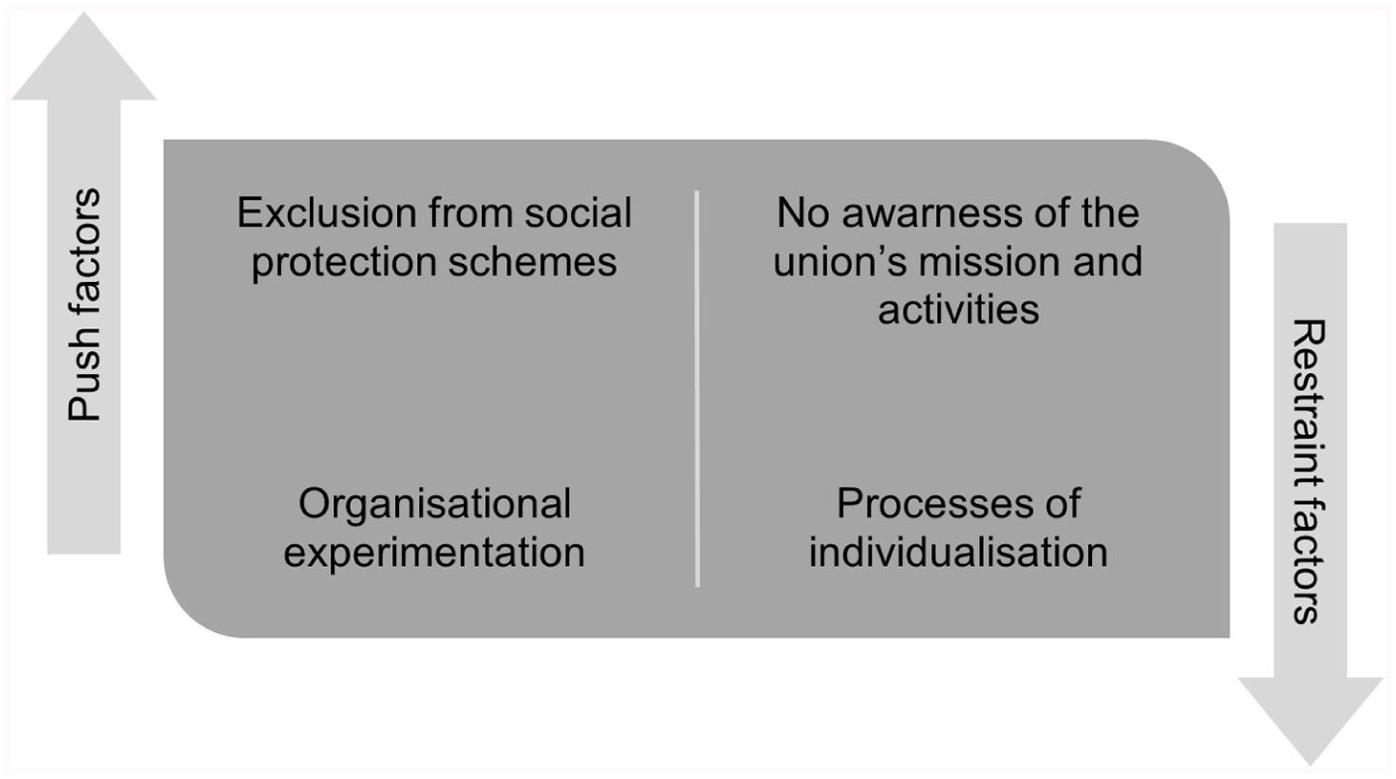
Push and restraint factors towards unionisation.
The work of the discussion spaces has provided visibility and a platform for fragmented workers. It also generated specific demands that contributed to the approval of important emergency decrees (decreti legge, DL) issued by the government (int_2,3_union; int_1,2_assoc; int_1–24_worker). These emergency decrees expanded on what was established by the initial intervention, known as Decreto Rilancio (Recovery Decree, DL No. 34/2020), by extending the disbursement of non-repayable contributions to creative workers as well. This expansion was made possible through the Decreto Ristori Ter (Relief Decree III, DL 154/2020) and the Decreto Ristori Quater (Relief Decree IV, DL 157/2020).
Discussion
When closely examining the data derived from the ESS, a clear and compelling trend emerges: a significant decline in the proportion of individuals engaged in creative occupations over the past two decades. The Great Recession has further accentuated the ‘atypical’ nature of employment within the creative industries, leading many formerly salaried workers to transition into non-standard or informal employment arrangements. However, these trends have manifested with varying degrees of intensity across different countries. Among them, LMEs and MMEs have experienced the most substantial employment losses in creative industries between 2002 and 2018. In contrast, Continental CMEs and, particularly, Nordic CMEs have witnessed relative growth in creative occupations from 2012 to 2018. Notably, Italy aligns with the broader trends observed in other MMEs.
Descriptive statistics reveal substantial disparities in unionisation levels among countries. Nordic CMEs consistently exhibit the highest rates, while MMEs and Continental CMEs remain at the lower end. Across all models of capitalism, unionisation rates have declined, with the core group of ‘never-members’ expanding significantly since 2002. Specifically, unionisation levels halved between 2002 and 2018, while the share of never-members has increased. The nature of employment influences these trends. Creative workers show the lowest unionisation rates, both in high- and low-skilled positions. Moreover, unionisation is highly segmented based on employment type. The starkest contrast emerges between workers with permanent contracts, who are the most unionised, and those working without any contract at all. Self-employed workers marginally surpass no-contract workers in unionisation rates, though they also exhibit a gradual decline over time. This trend mirrors the growing involvement of associative and mutual actors as intermediaries in interest representation (Bellini and Lucciarini, 2019; Franzini and Lucciarini, 2022; Xhauflair et al., 2018). Among these workers, MMEs demonstrate the lowest unionisation rates, highlighting the pronounced dualism in the labour market and the stark divide between core workers – who benefit from protection and representation – and a substantial segment of workers oscillating between outsider and middling positions.
Italy serves as a case study illustrating both the persistence and evolution of these dynamics. The pandemic has acted as a catalyst, forging new connections between creative workers and trade unions. Many creative workers, previously excluded from social protection schemes, sought institutional representation, leading to an unprecedented and experimental relationship with unions. This engagement resulted in expanded protection schemes for certain creative workers. At the same time, it triggered a renewal of union strategies and repertoires of action – particularly in terms of language and communication – and a shift in values and attitudes among workers. These changes marked a shift from a strong advocacy for disintermediation to the recognition and legitimisation of the unions’ role.
However, every actor participating in a concrete action system must contend with the structural constraints that shape their field of operation. Understanding these interactions requires investigating both the strategic actions of individuals and the broader system in which they operate. This dual perspective involves two types of reasoning: strategic and systemic. Crozier and Friedberg (1977) analyse the actor’s strategic reasoning, emphasising that what may seem like irrational behaviour is often a rational response to systemic constraints. They argue that the broader system shapes individual choices. Conversely, systemic reasoning examines the structure as a whole to understand how constraints influence actors while also acknowledging the contingent and sometimes arbitrary nature of these constraints.
In the case of creative workers, the starting point is low unionisation and widespread distrust of intermediation and collective action, particularly in achieving tangible benefits. This sector is characterised by strong individualism and atomisation, with workers often experiencing precarious and intermittent employment situations. The dialogue between unions, social enterprise cooperatives and creative workers within the FAS can be viewed as a form ‘collective learning’ (Crozier and Friedberg, 1977). This process enables actors within an action system to ‘learn’ – that is, invent and establish – new patterns of ‘play’, incorporating affective, cognitive and relational components.
These games, as emerging social practices, reshape the structured field, introducing not only new methods but also challenges and solutions, leading to a differently regulated action system. The two emerging action logics within this system – the ‘selfish actor’s strategy’ and the ‘focused coherence of the whole’ – contribute to identify the ‘social integration mechanism’ that allows the system itself to exist (Crozier and Friedberg, 1977).
Games function as tools for regulating cooperation and enabling organised action. They balance individual freedom with strategic decision-making. While individuals retain autonomy, they must develop rational strategies aligned with the game’s structure and adhere to its rules if they aim to succeed. This means that they must accept the constraints imposed to achieve desired outcomes. In cooperative arrangements, as in any organisation, the outcome of the game is the collective goal pursued by the organisation. In this context, where multiple organisations are involved, the game produces a shared outcome that reflects their mutual objectives.
Conclusion
This study provides a fresh perspective on the representation of creative labour by exploring the evolving dynamics of self-employment and the innovative strategies trade unions have adopted to engage with an increasingly fragmented workforce. By integrating nearly two decades of quantitative data from the European Social Survey (ESS) with qualitative insights from the Italian context, we uncover key dynamics that are reshaping the labour landscape for creative workers.
The analysis highlighted a significant shift towards self-employment within the creative sector, a trend exacerbated by both the Great Recession and the COVID-19 pandemic. This transition signals a broader transformation in the nature of creative work, characterised by growing fragmentation and instability. These challenges are compounded by institutional constraints that reinforce segmentation, particularly through the exclusion of self-employed and intermittent workers from traditional social protections. As traditional salaried positions decline, creative workers face precarious, non-standard employment arrangements that lack the benefits and protections associated with formal work. This shift has been particularly pronounced in MMEs, where unionisation rates remain notably low. This resulting divide between well-protected core workers and a substantial segment of marginalised, less secure workers underscores the challenges trade unions face in addressing the needs of this diverse workforce.
In response to these challenges, unions have adapted by developing new engagement and advocacy strategies. The pandemic accelerated this transformation, prompting unions to experiment with innovative forms of communication and representation. The creation of platforms such as the FAS exemplifies how unions can bridge the gap between traditional structures and the disintermediated creative workforce. Through virtual dialogues and collaborative strategies, unions have expanded their reach, effectively addressing the needs of self-employed workers, particularly in emerging sectors. This shift marks a departure from conventional union practices, underscoring the need for adaptability in a rapidly changing labour environment.
The collaboration between unions, cooperatives and creative workers has also contributed to significant advancements in social protection for the sector. Emergency decrees, such as the Recovery Decree and subsequent Relief Decrees, demonstrate the impact of collective action in securing vital support for marginalised workers. These efforts not only provided immediate relief but also laid the groundwork for long-term regulatory reforms that could strengthen protections for creative workers. The push for regularisation and professionalisation, driven by these collective efforts, is crucial for establishing clear occupational boundaries and enhancing workers’ rights.
However, a major challenge remains: the persistent ambiguity surrounding creative job roles and the limited understanding of these roles among policymakers. Overcoming these barriers requires a concerted effort to clarify the nature of creative work and advocate for policies that accurately reflect its diverse realities. Our findings indicate that while self-employed creative workers face institutional constraints to unionisation, they do not disengage from collective action entirely. Instead, they engage selectively and strategically, often through alternative solidarity mechanisms. This suggests the need for unions and policymakers to adapt to evolving worker needs in non-standard employment contexts.
Traditional union membership models do not align with self-employed creative work, making it necessary for unions to develop hybrid membership structures that integrate freelancer cooperatives, sectoral alliances and legal advocacy groups. Expanding these networks could improve access to collective bargaining, training opportunities and legal protections for creative workers who currently lack formal representation. Additionally, unions must take an active role in shaping labour policies by advocating for legal recognition of hybrid worker statuses, such as those combining freelance and salaried work, and by lobbying for social protections that better accommodate self-employed workers.
This adaptation process aligns with Crozier and Friedberg’s (1977) concept of ‘collective learning’, wherein trade unions and workers jointly develop new mechanisms for engagement, advocacy and representation. By embracing innovative strategies and expanding protections, unions have the potential to reshape the creative work landscape, fostering a more equitable and resilient sector. The lessons learned from the Italian case provide valuable insights for addressing the challenges faced by creative workers globally, offering a path towards a more inclusive and supportive future in the creative industries.
Footnotes

Funding
This work was supported by the European Commission, Horizon 2021–2027 (project ‘Sustainable transitions. Action research and training in urban perspective – Startup’, ID: 101178523) and the Sapienza University of Rome, SEED PNR 2021 (project ‘Nuove forme di solidarietà nell’era dell’individualismo: le cooperative mutualistiche in supporto dei lavoratori delle industrie culturali e creative’).
Declaration of conflicting interests
The authors declared no potential conflicts of interest with respect to the research, authorship and/or publication of this article.