



Abstract
This study investigates the determinants of female underemployment in Australia. The presence of offspring reduces the likelihood of underemployment, especially for part-time employed females, suggestive of mothers taking the burden of domestic duties, thus voluntarily reducing their working hours. Age of offspring matters: younger (older) offspring reduces (increases) the likelihood of underemployment. This impact is generally, but not wholly, accentuated for casual workers. Relevant labour market policies should have a gender lens that better accounts for the heterogeneity in characteristics of the female labour force. Better integration between the labour market and childcare would be a valuable starting point to address the issue of female underemployment.
Introduction
Australia has witnessed a sizeable influx of females entering the labour force in recent decades, with their labour market participation (as a percentage of the eligible female population) rising from 43.70% (July 1978) to 61.7% (February 2020) prior to the COVID-19 lockdown 1 (Australian Bureau of Statistics [ABS], 2021a), partially due to the rise of flexible (i.e. part-time and casual 2 ) work that allows females with young offspring to maintain a presence both in paid work and unpaid domestic duties (Johnstone et al., 2011). This gives rise to the need to provide a gender lens on labour market research, given the significant gender variation in labour market characteristics (Kifle et al., 2014). For instance, while males (irrespective of offspring status) tend to share more uniform labour market characteristics, deviations are greater among working females, especially when accounting for offspring status. Indeed, the ubiquitous ‘average’ female labour market participant may not adequately reflect many female participants, given the labour market needs and wants of a young, educated and childless female may bear far closer relation to the average male labour market participant than, say, an older married female with two young children with no post-school qualifications (Kler et al., 2023).
For example, when focusing on the youngest (16–24) age group in this study, where the presence of offspring is minimal, the female labour force participation rate (March 2021) at 70.6% is nearly identical to their male peers (69.2%) 3 (ABS, 2021a). This changes markedly when looking at just the next age grouping (25–34). Now the female rate (80.4%) is substantially lower than the male rate (91.3%), significantly attributable by the presence of young offspring requiring substantial care, which falls primarily on the female member of the family unit (Stephanie, 2019). While this forces out some females from the labour market, it also re-distributes away their share of full-time work toward part-time hours. The part-time share of employment for females (35.48%) in this age group is far higher compared to males (15.62%). If one were to go through every age group, one would conclude with the relatively uncontroversial statement that females in the labour market are a far more heterogeneous group relative to their male peers, and this can largely be explained by both offspring presence (referring to the fact that many females have offspring at different stages of their lives) and age of offspring, as well as the disproportionate role females play in childrearing relative to males (Kler et al., 2023).
Hence, headline figures of female labour force metrics provide an ‘average’ figure and are debate starters rather than definitive statements, given heterogeneity within the female workforce. Breaking up the female sample to account for the role of offspring (both presence of offspring and age) would allow for a deeper understanding of female labour market success and issues.
Time-related underemployment in Australia: A brief survey of the plains
The bulk of research into labour market outcomes for female participants that do delve deeper into the varying female labour market characteristics are those that look at more established measures of labour market phenomena such as unemployment, labour market participation and wage growth. What the literature lacks is an encompassing understanding of less traditional labour market phenomena, particularly time-related underemployment, which refers to a time deficit between actual and preferred hours 4 (Wilkins, 2004, 2006, 2007). This form of underemployment assists in providing for a richer understanding of labour market efficiency insofar as it probes deeper into employment by investigating the phenomenon of hours worked.
Underemployment matters in Australia because it is becoming more ubiquitous, and partially influenced by offspring presence, which impacts upon females more than males (Kler et al., 2018). Indeed, a traditionally solid gender ideology combined with parenthood’s responsibility will cause an unequal division of paid and unpaid work for most couples. For instance, females will bear a disproportionate share of the timing and responsibility for the children and household duties, and this holds even if they spend roughly equal hours of paid work compared to their male partner (Baxter and Evans, 2013). Therefore, on average, females with offspring tend towards part-time employment, unlike males with offspring. This has an impact on the likelihood of underemployment, given that those working limited hours are more likely to want more hours, ceteris paribus.
The decades long disproportionate rise in part-time work vis-a-vis full-time work means that jobs growth has exceeded the growth in total hours worked, thus resulting in a reduction of average hours worked (ABS, 2021b). Between July 1978 and February 2020, part-time work expanded by 440.88%, far greater than the growth of full-time work (174.36%). This also has a gender dimension, with the move away of males almost exclusively from full-time work to a greater mix of hours. Their growth in part-time hours grew by 636.40%, though the growth for females was also high (386.03%). In terms of average weekly hours (in the same time frame), hours worked fell from 37.61 to 33.88, and this occurred for females as well (from 31.31 to 29.64), and not just males (from 41.14 to 37.71) (ABS, 2021b). This is important to note because, despite part-time work being predominantly female, the bulk of work continues to be done full-time, and as such, the majority of females in the labour force are undertaking full-time, and not part-time hours. Indeed, in this dataset, 24,630 (58.81%) females are taking full-time hours, while 17,254 (41.19%) are taking part-time work. From these data, 5754 females engaged in casual hours, and the percentage of casuals working part-time is relatively higher (33.35%) than casuals in full-time jobs (5.47%).
The first significant Australian underemployment study (Wilkins, 2004) utilised the 2001 Household, Income and Labour Dynamics in Australia (HILDA) survey dataset (Wave 1 only, thus a cross-sectional study) and reported gender variations with females less likely to report underemployment. In a follow-up study using the same data but concentrating on part-timers only, Wilkins (2006) studied the factors associated with underemployment. Some notable results include underemployment being negatively associated with older age groups as well as the higher educated. Contrary to more recent HILDA studies that exploit the panel nature of the dataset, females with older children are found less likely to be underemployed. Further, Wilkins (2007), using the same cross-sectional dataset, explored the consequences of underemployment for those who would like to work more hours at prevailing wage rates. Adverse effects on wage rates, job satisfaction and tenure in employment and/or occupation are found for both part-time and full-time employees who would prefer to work more hours, though not necessarily on a uniform basis. Moreover, since part-time work is mainly associated with employment on a casual basis, he asserted that the ‘involuntary part-time and casually employed’ are a disadvantaged group in the labour market. Li et al. (2015), utilising the first 12 waves (thus a panel analysis), analysed factors contributing to an increased risk of underemployment in Australia, revealing that prior spells of underemployment increased the propensity towards further underemployment in the current period, even after controlling for human capital, current earning potential, demographic and local labour market characteristics.
In more contemporaneous HILDA studies, Kler et al. (2018), using 13 waves, note that 33% of part-time employees reported underemployment, disproportionately affecting males, casuals, immigrants, youth and blue collars. From a similar perspective, Kler et al. (2023) investigated the determinants of underemployment, focusing on part-time females, given the high and growing rate of underemployment among them. Utilising the 2001–2017 HILDA panel dataset, they suggest that the key factors determining part-time employed females’ underemployment to be (1) age, (2) qualifications and (3) the presence of offspring. Specifically, relative to the base case of being young (under 35 years), tertiary educated with no offspring (indicating the highest likelihood of reporting underemployment), every other of the remaining seven combinations of age (young/old), education (tertiary/non-tertiary) and offspring status (yes/no) bar one had a lower probability of underemployment, positing that not only do offspring matter in reducing underemployment, but also that younger offspring requiring more care reduce the likelihood of underemployment even more. This is consistent with the argument that the presence of offspring has a drawback in shaping females’ careers in reducing their efficiency level in the labour market (Damaske and Frech, 2016; Livermore et al., 2011), as females with offspring often choose flexible employment (Argyrous et al., 2017) to achieve a better balance between work and family domains (Stephanie, 2019).
Gender roles and the labour market
Exchange theory has become a prominent framework for understanding the division of labour between males and females in the family unit. For instance, ongoing pressure for males to live up to breadwinning expectations remains strong, and it has the power to restrict the degree to which they engage in unpaid work considerably and even in contexts where males are particularly likely to exchange housework for income, it is not enough to create parity (Thebaud, 2010). Similarly, this also holds for females with more traditional attitudes, who are less likely to participate in the labour market during the first year of parenthood (Preston, 2023). As well, studies show that motherhood is a crucial determinant of female underemployment and childbearing, and its relationship to paid work is primarily a female issue (Argyrous et al., 2017), and they are more likely to stay at home with preschool-aged children than males. Moreover, females with school-aged offspring are also less likely to be underemployed (Kler et al., 2023), which may imply that they are satisfied with their work hours, given that their priority is to balance work and family.
This study includes mother’s employment status when the current female in this dataset was aged 14 as a control variable when running regressions, as according to McGinn et al. (2018), having a working mother improves daughters’ employment rates and incomes as adults.
Female underemployment in Australia: Statistical analysis (2001–2018 HILDA data)
The heterogeneity within the female workforce shows up in their varying underemployment rates, shown in Figure 1. Unsurprisingly, given the definition of time-related underemployment, part-timers are more likely to be underemployed. Casuals are more prone to want more hours (averaging 37.01% across the surveyed years), and combining the two, we note that underemployment is particularly acute among part-time employed casuals (42.47%). One can also witness that their rate of underemployment has largely been on an upward trajectory since 2010, indicating a suboptimal allocation of hours.
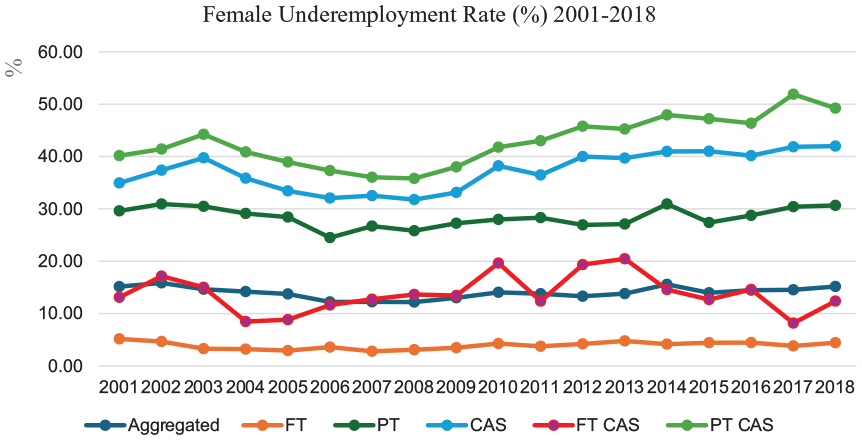
Trend in the female underemployment rate (%) 2001–2018 (HILDA survey, 2001–2018).
As previously noted, female underemployment is also linked to both the presence and age of offspring (Kler et al., 2023). For example, we find that a significant minority of young, educated and childless females in part-time work are largely dissatisfied with their current hours (20.78% stating they are unable to find full-time work), largely consistent with males in general, whereas for females with offspring, this rate is much lower (2.75%), and even more so for those with children yet to start school (1.29%). This difference needs to be accounted for when attempting to make definitive statements on female labour market success.
Thus, at this point, we reiterate that this study posits that underemployment is a labour market phenomenon that requires further study as it pertains to the female labour market cohort given that underemployment may be a lesser issue for certain female participants (e.g. females with young offspring) but may be more pronounced for others, such as young, educated females with no offspring.
Raison d’etre and hypotheses
From the reading of the literature, data availability and contemporary conditions facing females in the Australian labour market, we posit the hypotheses below for testing:
The determinants of female underemployment in Australia between 2001 and 2018 will not be uniformly distributed given differences in hours worked (full-time and part-time work) and contract type (casual or otherwise), thus justifying sub-categorisation.
More specifically, we postulate the following to expand upon the statement above:
H1: The presence and age of offspring will impact the likelihood of underemployment differently between those who work full-time and part-time. This is as part-time employed females with offspring (specifically young offspring) will voluntarily seek limited hours of work and thus be less likely to be underemployed (i.e. given they are voluntarily reducing their paid hours of work, thus reducing also their preferred hours of paid work), especially if they are secondary income earners. As well, the likelihood of underemployment of casual workers will be higher given past studies in Australia (Kler et al., 2018, 2023), and this would apply for those with offspring as well; in other words, the presence and age of offspring at home will have a stronger positive relationship on the determinants of underemployment among the female casual workforce.
In Table 1, the hypothesis on presence of offspring is tested via interacting offspring presence with both working hours and casual status alongside educational qualification as a socioeconomic status, discussed in more detail in the Data and Method section. For age of offspring (see Table 2), due to sample size limitations for sub-groups, the casual/non-casual nomenclature is dropped from the interactions, and displayed as a separate control variable.
Determinants of underemployment: presence of offspring (marginal efects). Selected variables.
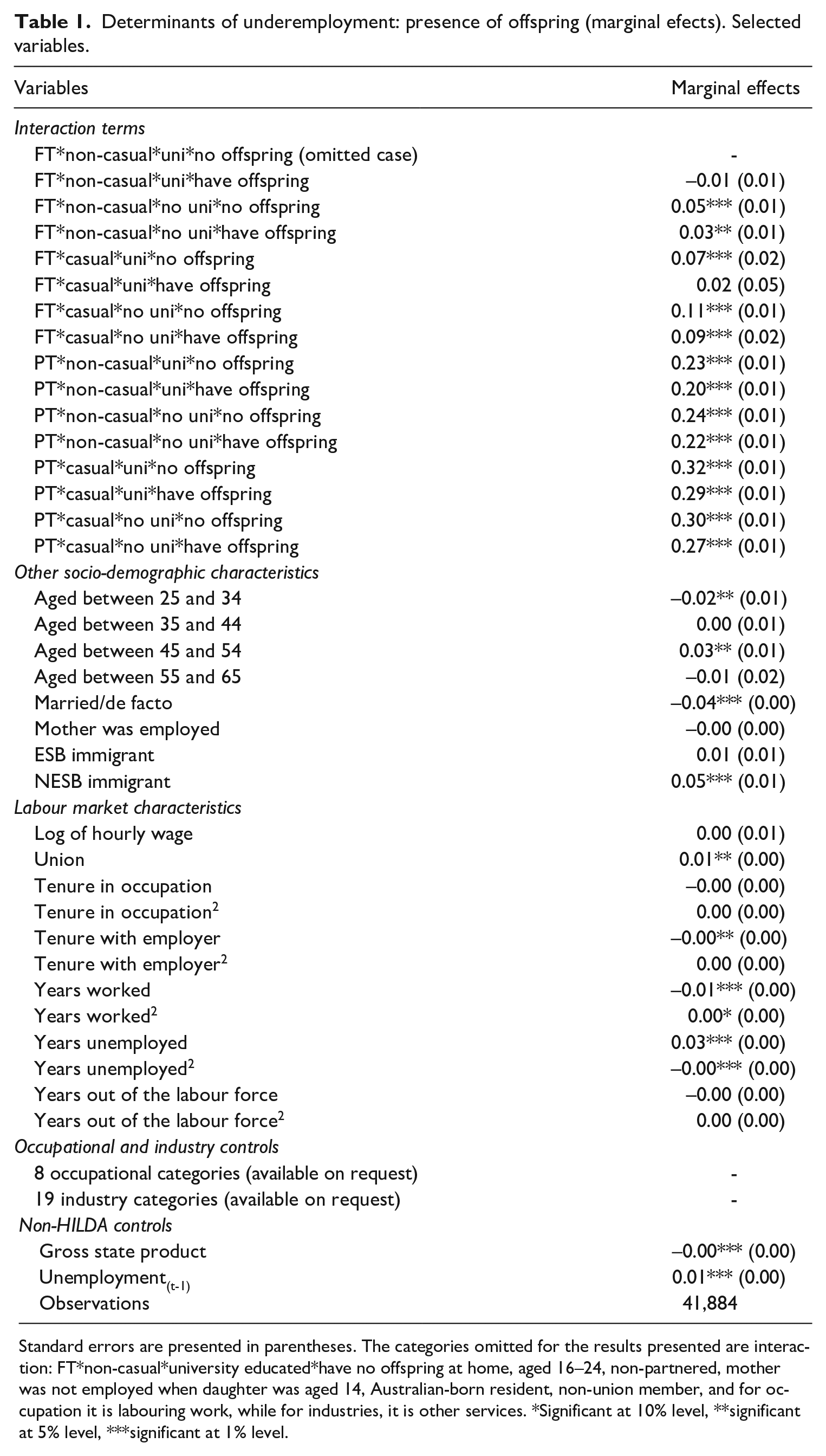
Standard errors are presented in parentheses. The categories omitted for the results presented are interaction: FT*non-casual*university educated*have no offspring at home, aged 16–24, non-partnered, mother was not employed when daughter was aged 14, Australian-born resident, non-union member, and for occupation it is labouring work, while for industries, it is other services. *Significant at 10% level, **significant at 5% level, ***significant at 1% level.
Determinants of underemployment: age of offspring (marginal efects). Selected variables.
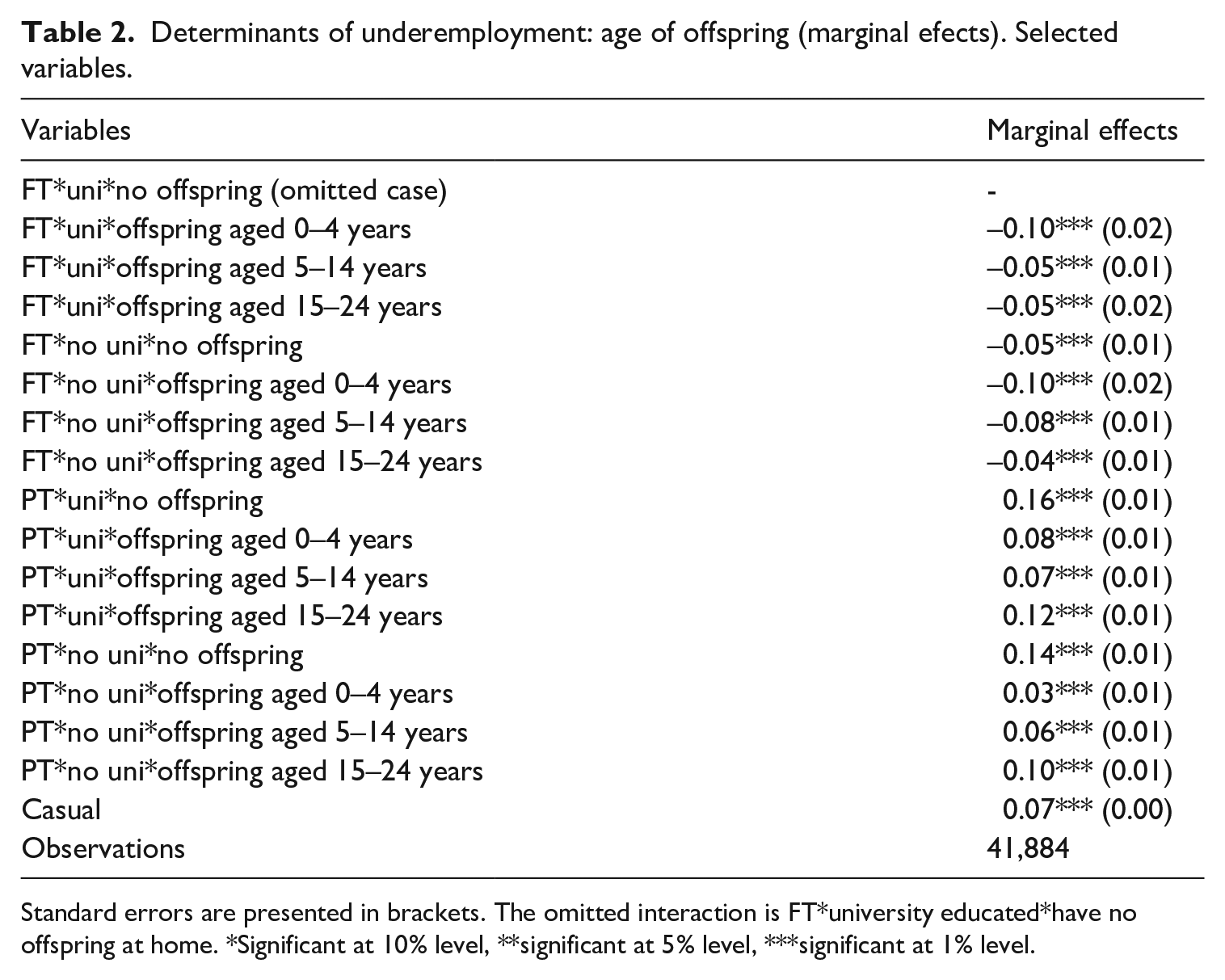
Standard errors are presented in brackets. The omitted interaction is FT*university educated*have no offspring at home. *Significant at 10% level, **significant at 5% level, ***significant at 1% level.
H2: In addition, we postulate that a stronger relationship with the labour market generally, if not wholly, matters in determining underemployment, as those with a greater connection with occupations and employers are better able to gain appropriate hours, a statement based on findings by Kler et al. (2018, 2023). For instance, longer tenure with employer and occupation should reduce the likelihood of reporting underemployment, as would be the case with years worked. Years unemployed would have the opposite impact whereas the relationship between years out of the labour force and underemployment is indeterminate, depending instead on the nature of the time away from the labour force. For instance, time away to enrich skills may impact the probability of underemployment differently from, say, taking time away to have and rear young children.
This study differs from others in the literature by explicitly (1) investigating the underemployment of casuals, including incorporating their hours worked, and (2) accounting for both presence of and age of offspring. As well, it does not minimise the role of full-time workers, who are often-times excluded from research on underemployment on the grounds that the underemployment of full-time workers is not a significant policy issue for governments, given the income earned to support a family is likely to be enough to avoid deep privations (Kler et al., 2018). This study, on the other hand, seeks to understand the nature and determinants of underemployment on employed females in Australia, and it would be remiss to then ignore the fact that the majority of females in Australia are employed in full-time work.
Data and method
This study utilises a quantitative method using secondary data extracted from the first 18 waves (2001–2018) of the HILDA survey, which is a household-based panel data that provides a rich source of information on socio-demographics, labour market participation and workplace satisfaction where a single sample of individuals is surveyed over multiple time points at different waves. After excluding observations with incomplete information and restricting the sample to those females aged between 15 and 65 who are employed in one job and not in full-time study, the dataset is left with an unbalanced panel of 41,884 employee-year observations, of whom 58.81% (24,630) are working full-time, with 41.19% (17,254) in restricted hours work. Casuals make up 16.95% of this sample, the overwhelming majority of whom (81.03%) work restricted hours. The full list of variables used in this study can be found in Table A1 in the Appendix.
Rather than creating sub-groups by hours of work and casual status, this study utilises interaction terms to ensure minimal loss of information. Sixteen interaction terms are created to capture presence of offspring, working hours, casual status and also education, an indicator of socioeconomic status, given socioeconomic status may also impact on the likelihood of underemployment (Kler et al., 2023). The 16 interactions are set out as follows:
(i) Full-time hours*non-casual*university educated*no offspring
(ii) Full-time hours*non-casual*university educated*have offspring
(iii) Full-time hours*non-casual*non-university educated*no offspring
(iv) Full-time hours*non-casual*non-university educated*have offspring
(v) Full-time hours*casual*university educated*no offspring
(vi) Full-time hours*casual*university educated*have offspring
(vii) Full-time hours*casual*non-university educated*no offspring
(viii) Full-time hours*casual*non-university educated*have offspring
(ix) Part-time hours*non-casual*university educated*no offspring
(x) Part-time hours*non-casual*university educated*have offspring
(xi) Part-time hours*non-casual*non-university educated*no offspring
(xii) Part-time hours*non-casual*non-university educated*have offspring
(xiii) Part-time hours*casual*university educated*no offspring
(xiv) Part-time hours*casual*university educated*have offspring
(xv) Part-time hours *casual*non-university educated*no offspring
(xvi) Part-time hours*casual*non-university educated*have offspring
In unreported results, the number of offspring (one offspring or more than one offspring), rather than simply the presence of offspring, was used in place of offspring presence, as this theoretically produces a richer insight into the role of offspring in determining female underemployment in Australia. However, the above was preferred for two reasons. First, there was only minute differences in magnitude when testing for the presence of one offspring or more than one offspring, and more pertinently, the creation of 24 interaction terms yielded smaller sub-group sizes, producing unreliable estimates. Overcoming this would have required removing casual/non-casual status from the interactions, reducing the interaction terms to 12, and placing casual status as a standalone control variable only. This would have resulted in a less comprehensive and less nuanced view of the underemployment phenomenon as it impacts upon Australian females.
Interactions for age of offspring would have produced 32 interactions; however, much like number of offspring, the issue of estimate reliability due to small sub-groups resulted in the exclusion of the use of casual/non-casual status in the interactions. This then produces the 16 interactions noted below:
(i) Full-time hours*university educated*no offspring
(ii) Full-time hours*university educated*offspring aged 0–4 years
(iii) Full-time hours*university educated*offspring aged 5–14 years
(iv) Full-time hours*university educated*offspring aged 15–24 years
(v) Full-time hours*non-university educated*no offspring
(vi) Full-time hours*non-university educated*offspring aged 0–4 years
(vii) Full-time hours*non-university educated*offspring aged 5–14 years
(viii) Full-time hours*non-university educated*offspring aged 15–24 years
(ix) Part-time hours*university educated*no offspring
(x) Part-time hours*university educated*offspring aged 0–4 years
(xi) Part-time hours*university educated*offspring aged 5–14 years
(xii) Part-time hours*university educated*offspring aged 15–24 years
(xiii) Part-time hours*non-university educated*no offspring
(xiv) Part-time hours*non-university educated*offspring aged 0–4 years
(xv) Part-time hours*non-university educated*offspring aged 5–14 years
(xvi) Part-time hours*non-university educated*offspring aged 15–24 years
The tables in the supplementary materials provide the baseline (parsimonious), extended and full model estimates.
Econometric method
The determinants of underemployed are econometrically tested using a random effects probit model augmented with Mundlak (1978) corrections to control for unobserved time-invariant individual heterogeneity.

where
However, not all possible types of unobserved heterogeneity can be solved using Mundlak corrections. There could still exist an issue of time-varying unobserved heterogeneity that stems from macro-level shocks that impact upon each individual unit differently, and biased estimates will result if this is unaccounted for. Thus, following on from Kler et al. (2018, 2023), we incorporate two explanatory variables (for each model). These are state and territory-wide unemployment rate (lagged by one year) and gross state product (GSP), again for each jurisdiction.
Econometric results
Table 1 highlights selected econometric results for the specification that accounts for the presence of offspring with the results reported as marginal effects. For ease of exposition, results are discussed by interactions, followed by characteristics.
Deciphering the interactions
Relative to the base case, two points are immediately evident in Table 1. First, within the interactions, the part-time employed are more likely to report underemployment, ranging from 20% to 32%. Given the definition of underemployment, this is to be expected. Second, bar one instance of statistical non-significance, casual workers also report a higher rate of working less than their preferred hours. Given the close relationship between part-time work and casual work (see Figure 1), this is also unsurprising.
The question arises, however, as to whether the presence of offspring can mitigate against this, given mothers may be more likely to voluntarily reduce their hours and seek more flexible employment. Here we report that the presence of offspring does generally, magnitude-wise, reduce the scale of underemployment vis-a-vis females with no offspring, irrespective of educational status, working hours or casual status. For example, part-time, non-casual, university educated females with no offspring are 23% more likely to be underemployed relative to the base case, but if we look at the same set of interactions bar substituting having offspring for no offspring, the commensurate figure is lower at 20%. The same is evident when part-time employed, non-casual females without university education are compared, with those without offspring (24%) more prone to reporting underemployment relative to those with offspring (22%).
Overall, we find partial support for hypothesis 1. Part-time and/or casual work does indicate a greater likelihood of underemployment, but the presence of offspring at home mitigates the magnitude of the phenomenon. Thus, having offspring and undertaking fewer hours of paid work in less secure employment is less likely involuntary in the case of mothers as opposed to females with no offspring. The role of education as a proxy for socioeconomic status does not seem to suggest a clear relationship between socioeconomic status and female underemployment, at least as far as the presence of offspring is concerned, though further work is required in this direction.
Other socioeconomic characteristics
For females who are either married or living in a de facto relationship, the propensity to report underemployment is 4% lower relative to those not in such relationships. This is as expected, given that the allocation of time in paid and unpaid working among Australian couples has remained very gendered, with males predominantly in full-time employment, while females are predominantly in part-time employment and most females are likely to be the primary carers of offspring at home (Stephanie, 2019). As well, in unreported results without the use of interactions, the magnitude of the negative relationship accentuates when looking at part-time and casual workers, and/or those with offspring. These findings are generally supportive of hypothesis 1, which posits underemployment among the female workforce will differ by the presence of offspring, and that those females in part-time work with offspring would be less likely to seek additional hours of paid work relative to their current allocation, suggesting a more voluntary entry into restricted hours employment.
Females who witnessed their mothers employed when they were children (14 years old) are no more or less likely to report underemployment relative to those whose mother did not have a paid job. Given the literature finds having a working mother boosts the employability and income of their daughters when they reach adulthood (McGinn et al., 2018), our a priori expectation was that this should also reduce their underemployment rate, given better labour market outcomes. However, there is scant literature on this relationship, and further research is required to delve deeper into this matter. Those aged between 25 and 34 are 2% less likely to be underemployed compared to those aged 16–24; this is unsurprising given this age group are more likely to have younger offspring requiring greater attention. As well, NESB (non-English speaking background) immigrants are 5% more prone to underemployment relative to the native-born, but for ESB (English speaking background) immigrants, no penalty applies.
Labour market characteristics
Hypothesis 2 takes the view that a stronger relationship with the labour market will result in better matches between an employee’s wants and the job’s ability to fulfil those wants. The negative relationship between underemployment and tenure with employer is confirmed, though magnitude effects are minimal. The negative relationship between underemployment and tenure with occupation is however statistically insignificant. The a priori expectations for years worked and years unemployed are met. Greater work experience reduces underemployment by 1%, and greater spells of unemployment raise the likelihood of searching for extra hours by 3%. Years out of the labour force bear no significant relationship with underemployment; this was also anticipated, given the varied reasons for being out of the labour force (Kler et al., 2023). Overall, hypothesis 2 remains largely unrefuted.
Non-HILDA controls
Economic conditions matter in determining underemployment. Stronger economic growth of the state the individual resides in will reduce the probability of reporting underemployment (magnitude effects are however minimal), whereas an elevated unemployment rate in that state a year earlier would increase the chance of wanting to work more hours by 1%, as the job market would be competitive.
In Table 2 the focus turns to the age of offspring, and as such the age of the mother is excluded given the high correlation between age of offspring and age of mother, as per Kler et al. (2023). Only selected variables are presented with respect to hypothesis 1 as variations with other explanatory variables with Table 1 are minute; in other words, hypothesis 2 is again largely met, as seen when discussing Table 1 results. Following Kler et al. (2023) and a priori expectations following unreported results on regressions without interactions, younger offspring are expected to lower the likelihood of females reporting underemployment (relative to those with no offspring at home) due to the higher level of care young children require; this forces these working mothers to trade their working hours for non-paid domestic labour hours. This is generally more pronounced for those with non-school going aged offspring (0–4 years) as opposed to still young, but school-going offspring (5–14 years). The impact of having older offspring (15–24 years) on underemployment, however, is not expected to be significantly different relative to females with no offspring, as these children are largely able to act independently of parental supervision.
The base case interaction is chosen as the one that best reflects the strongest relationship with the labour market: in this case those females working full-time, with high levels of investment in their education and no offspring. It is evident that results differ by hours worked. Those mothers working full-time, particularly with preschool offspring (0–4 years) are 10% less likely to be underemployed relative to the base case (no offspring); this fits in well with the narrative that when faced with juveniles who require a lot of care, the mother is likely to choose the number of hours of paid work that suits her circumstances. This should reduce as the offspring age as less care is required, and this is indeed the case, though only so in magnitude, as parity (i.e. statistical insignificance) is not attained. However, we caution that they are already working at least 35 hours a week, and as such the upper bound of hours available must also be limited, even if simply by logical deduction. 5 More interesting is the case of part-time employed mothers, as their upper bound of preferred hours is potentially further from their current hours of paid work.
The picture for the part-time employed is somewhat similar with respect to those working full-time. One difference, as expected, is that the part-time employed are more prone to reporting underemployment; as noted previously, this is simply a product of the definition of underemployment. What is worth elucidating is that in the case of part-time employed mothers, the likelihood of reporting underemployment rises as offspring age, matching expectations, given older offspring require less care and attention. For example, looking at part-time employed, non-university educated females, the reporting of underemployment is 3% greater than the base case when offspring are still not in school, rising to 6% when aged 5–14, and rising further to 10% when older than 14 years of age. This is likely due to these mothers now being able to search for additional hours, but who are constrained by their more tenuous labour market history that limits their ability to land jobs that offer the additional hours they now seek to have (Kler et al., 2023). For both full- and part-time work, the difference between university educated and less than university educated females with respect to reporting underemployment is minimal, with some divergence in magnitude effects, consistent with the presence of offspring exhibited in Table 1. Given this study has proxied education as a form of socioeconomic status, this would imply that socioeconomic status plays a minimal role in determining female underemployment, but further study is required as this is merely an initial attempt to look at socioeconomic impacts of the determinants of underemployment.
Overall, we find a pattern in the role of age of offspring on female underemployment, even when interactions are utilised. For instance, mothers working full-time are less likely to report being underemployed vis-a-vis their peers with no offspring, but this gap diminishes (though it remains statistically significant) as age of offspring rises. This matches with Kler et al. (2023) and a priori expectations, suggestive of a case where these mothers are freer to work more hours as offspring gain independence, but may not always gain the requisite hours they seek, and thus report underemployment rates closer to their ‘full-time, no offspring’ peers, though still not as much as the latter. With part-time employed mothers, the same pattern ensues. The likelihood of underemployment rises as age of offspring rises, again indicative of a mismatch whereby the desire to work more is limited by constrained opportunities given their truncated work history (Gregory and Connelly, 2008).
Summary
This panel study has investigated the determinants of female underemployment, by including the overlapping role of hours worked and casual status while expressly noting the role played by offspring presence and their age, while controlling for socioeconomic status (education level). Results on interactions indicate that the underemployment phenomenon is more prevalent, magnitude-wise, among part-timers, specifically part-time casuals, and partially due to the presence of offspring, while socioeconomic status, at least with respect to educational qualifications, plays only a marginal role in affecting female underemployment. For instance, relative to the base case of an educated female with no offspring working full-time in non-casual roles, every interaction involving part-time work increased the likelihood of reporting a surplus of preferred hours over actual hours worked, ranging from 20% to 32%. This was also largely, but not wholly, the case for those in casual employment, because those casuals in full-time work were only slightly more likely to report underemployment relative to the omitted case, and indeed, in one case, not even that. Having offspring mitigated underemployment somewhat, as can be witnessed by comparing interactions where the only difference in characteristics lay in comparing those with and without offspring.
The age of offspring does impact upon female underemployment, and is somewhat sensitive to hours worked. In the case of full-time working mothers, they report lower likelihoods of underemployment (range between –4% and –10%) relative to the base case (university educated, full-time worker without offspring), whereas for those in part-time work, it raises the likelihood instead, between 7% and 12%. However, when comparing the age groups of offspring, irrespective of full-time or part-time work, the incidences of underemployment are smaller than when offspring are older. It is postulated that this is the case as mothers tend to obtain working hours that match their preference when the offspring require significant attention, but underemployment rises when offspring become more independent, as mothers seek greater hours of paid work but find (at least with respect to part-time employees) that their truncated work experience has diluted their human capital portfolio. Overall, these outcomes suggest that adult females within a family unit are more likely to undertake a disproportionate burden of unpaid domestic labour, and thus be either out of the labour force (out of the scope of this study) or secondary income earners (Stephanie, 2019).
In sum, results largely, but not wholly, meet the a priori expectations of hypothesis 1. The presence and age of offspring do play a significant role in explaining the likelihood of underemployment of female labour force participants, for both full- and part-time employees, and for casuals, at least as far as it could be tested with respect to the presence of offspring. Indeed, the small number of casuals in full-time work did render more exhaustive interactions moot with respect to potentially testing for the number of children (leading to a preference to test for the presence of offspring irrespective of the number of offspring) and age of offspring, so the role of casual work and its relationship with underemployment remains somewhat debatable, although this study does conclude that the relationship does lean towards the positive.
Findings for socioeconomic controls are worthy of further investigation, both for theoretical accuracy and use of appropriate proxies; for this study, suffice to say that educational qualifications play a lesser role in explaining the female underemployment phenomenon, if at all. The expectation that stronger labour market relationships would reduce the chance of experiencing deficit hours (hypothesis 2) remains largely unrefuted. Greater years worked does reduce underemployment, and longer periods of unemployment raise the probability of underemployment. Periods out of the labour force have no systematic relationship with underemployment, which is likely due to the varied reasons for such absences from work or work search. Tenure with employer is negatively related to underemployment, though there is no statistical significance between tenure in occupation and the likelihood of underemployment among female workers in Australia.
Policy implications and future research
Underemployment is often reported in the press, but the governmental response to ameliorate its incidence, and indeed, persistence, is marginal. Governments of all shapes and sizes are understandably more concerned with increasing employment and, in effect, reducing unemployment, and are by implication not focused on underemployment at a policy level. The fact that it remains persistent despite strong economic growth rates suggests that a sizeable amount of the growth of part-time and casual work is taken up by those who would prefer to work full-time hours, or at least more hours even if they prefer to remain part-time employed. Tackling underemployment would necessitate a nuanced approach; it would require ensuring that flexible jobs remain for those who seek it, particularly females with young offspring, young labour market entrants, and even those preparing to exit into retirement. It would necessitate a gender lens given that underemployment impacts different groups of females differently.
Policies that seek to create more full-time jobs at the expense of flexible jobs may suit males more, but not necessarily females, as seeking more hours does not necessarily mean seeking full-time hours, but more hours (for example, from 20 to 25 hours). Another question that the authorities need to ask is ‘why underemployment?’ Are the underemployed wanting more hours because they wish to move up the occupational ladder, or is it financial, a combination, or other reasons? Once again, a gender lens may well suggest a difference between males and females that would require finessing policies to ameliorate the underemployment phenomenon. At a practical level, greater integration between the labour market and childcare policies would assist parents, but especially female parents to better manage the trade-off between domestic and work duties.
At a national level, the ABS produces information on underemployment but does not explicitly ask respondents to account for the impact of their preferred hours on income, unlike the HILDA dataset. Our unreported results are consistent with Kifle et al. (2018); using HILDA data produces higher reporting of underemployment relative to ABS data, reflecting the greater depth of its questions on underemployment as it accounts for the impact of preferred hours on income. An improvement in the quality of the ABS underemployment survey would assist in producing more accurate results, as would a sharper distinction between flexible and non-flexible jobs. As well, not much research explaining the root causes of underemployment has occurred, and more research needs to be undertaken into the genesis of this phenomenon. It should also highlight gender differences, and the role played by offspring. The depth of underemployment is under-researched, and worthy of future focus. We need not just attempt to understand why someone is underemployed, but whether their depth of underemployment is marginal, thus indicating a lesser problem to tackle, or severe, indicating a need for policies to overcome the issue. Finally, the impact of underemployment on productivity, and its impact on the economy is not well understood. Studies on this relationship would allow governments to enact policies with clear goals in mind with respect to boosting productivity, hence national output and employment.
Supplemental Material
sj-docx-1-eid-10.1177_0143831X251362119 – Supplemental material for Female underemployment in Australia: Do offspring (children) matter?
Supplemental material, sj-docx-1-eid-10.1177_0143831X251362119 for Female underemployment in Australia: Do offspring (children) matter? by Thanam Murugan, Temesgen Kifle and Parvinder Kler in Economic and Industrial Democracy
Footnotes
Appendix
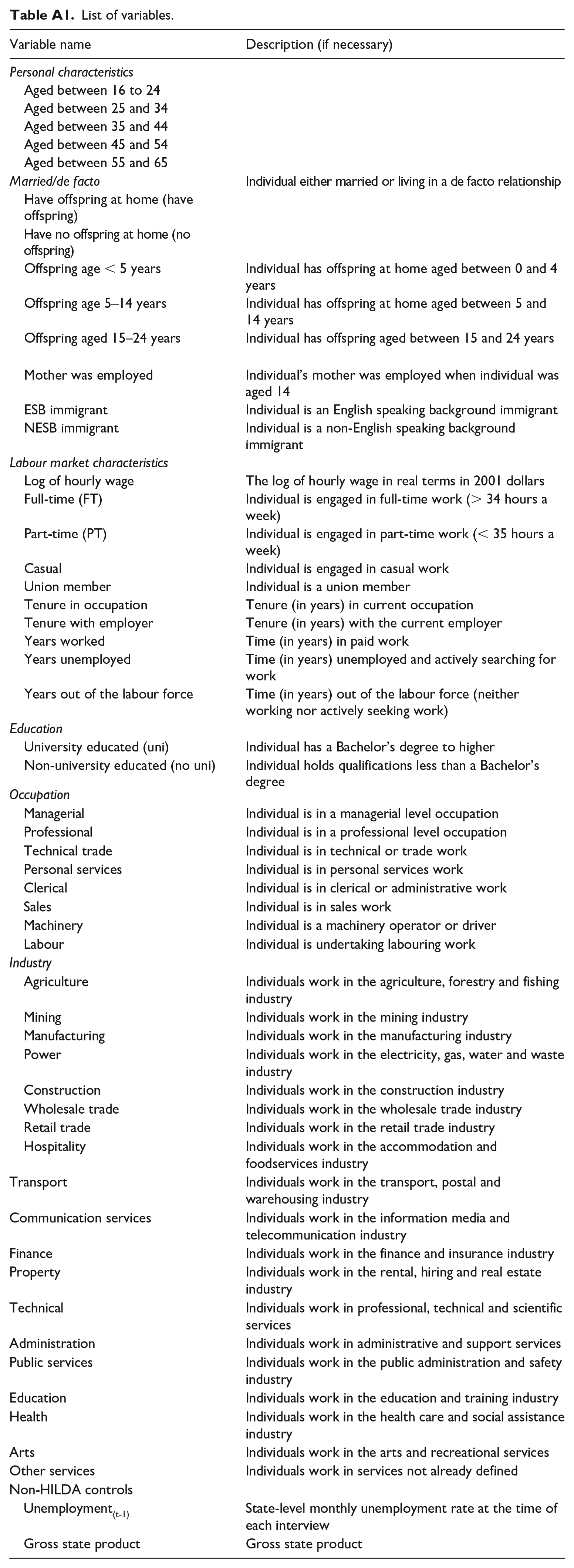
List of variables.
| Variable name | Description (if necessary) |
|---|---|
| Personal characteristics | |
| Aged between 16 to 24 | |
| Aged between 25 and 34 | |
| Aged between 35 and 44 | |
| Aged between 45 and 54 | |
| Aged between 55 and 65 | |
| Married/de facto | Individual either married or living in a de facto relationship |
| Have offspring at home (have offspring) | |
| Have no offspring at home (no offspring) | |
| Offspring age < 5 years | Individual has offspring at home aged between 0 and 4 years |
| Offspring age 5–14 years | Individual has offspring at home aged between 5 and 14 years |
| Offspring aged 15–24 years | Individual has offspring aged between 15 and 24 years |
| Mother was employed | Individual’s mother was employed when individual was aged 14 |
| ESB immigrant | Individual is an English speaking background immigrant |
| NESB immigrant | Individual is a non-English speaking background immigrant |
| Labour market characteristics | |
| Log of hourly wage | The log of hourly wage in real terms in 2001 dollars |
| Full-time (FT) | Individual is engaged in full-time work (> 34 hours a week) |
| Part-time (PT) | Individual is engaged in part-time work (< 35 hours a week) |
| Casual | Individual is engaged in casual work |
| Union member | Individual is a union member |
| Tenure in occupation | Tenure (in years) in current occupation |
| Tenure with employer | Tenure (in years) with the current employer |
| Years worked | Time (in years) in paid work |
| Years unemployed | Time (in years) unemployed and actively searching for work |
| Years out of the labour force | Time (in years) out of the labour force (neither working nor actively seeking work) |
| Education | |
| University educated (uni) | Individual has a Bachelor’s degree to higher |
| Non-university educated (no uni) | Individual holds qualifications less than a Bachelor’s degree |
| Occupation | |
| Managerial | Individual is in a managerial level occupation |
| Professional | Individual is in a professional level occupation |
| Technical trade | Individual is in technical or trade work |
| Personal services | Individual is in personal services work |
| Clerical | Individual is in clerical or administrative work |
| Sales | Individual is in sales work |
| Machinery | Individual is a machinery operator or driver |
| Labour | Individual is undertaking labouring work |
| Industry | |
| Agriculture | Individuals work in the agriculture, forestry and fishing industry |
| Mining | Individuals work in the mining industry |
| Manufacturing | Individuals work in the manufacturing industry |
| Power | Individuals work in the electricity, gas, water and waste industry |
| Construction | Individuals work in the construction industry |
| Wholesale trade | Individuals work in the wholesale trade industry |
| Retail trade | Individuals work in the retail trade industry |
| Hospitality | Individuals work in the accommodation and foodservices industry |
| Transport | Individuals work in the transport, postal and warehousing industry |
| Communication services | Individuals work in the information media and telecommunication industry |
| Finance | Individuals work in the finance and insurance industry |
| Property | Individuals work in the rental, hiring and real estate industry |
| Technical | Individuals work in professional, technical and scientific services |
| Administration | Individuals work in administrative and support services |
| Public services | Individuals work in the public administration and safety industry |
| Education | Individuals work in the education and training industry |
| Health | Individuals work in the health care and social assistance industry |
| Arts | Individuals work in the arts and recreational services |
| Other services | Individuals work in services not already defined |
| Non-HILDA controls | |
| Unemployment(t-1) | State-level monthly unemployment rate at the time of each interview |
| Gross state product | Gross state product |
Acknowledgements
This article uses unit record data from the Household, Income and Labour Dynamics in Australia (HILDA) survey. The HILDA project was initiated and is funded by the Australian Government Department of Social Services (DSS) and is managed by the Melbourne Institute of Applied Economic and Social Research (Melbourne Institute). The findings and views reported in this article, however, are those of the authors and should not be attributed to either DSS or the Melbourne Institute.

Funding
The authors received no financial support for the research, authorship, and/or publication of this article.
Declaration of conflicting interests
The authors declared no potential conflicts of interest with respect to the research, authorship, and/or publication of this article.
Supplemental material
Supplemental material for this article is available online.
Notes
Author biographies
References
Supplementary Material
Please find the following supplemental material available below.
For Open Access articles published under a Creative Commons License, all supplemental material carries the same license as the article it is associated with.
For non-Open Access articles published, all supplemental material carries a non-exclusive license, and permission requests for re-use of supplemental material or any part of supplemental material shall be sent directly to the copyright owner as specified in the copyright notice associated with the article.
