



Abstract
This article explores female blue-collar workers’ professional positions and integration into workplace democracy within the self-managed industry in socialist Yugoslavia. Drawing on an extensive analysis of contemporary reports archived by Yugoslavia’s central women’s organisation, the article explores female blue-collar workers’ professional qualifications and participation in worker education programmes and worker councils – Yugoslavia’s self-managed industry’s core democratic body. The article aims to shows that the prevailing gender and class-based social order within Yugoslav industry hindered female workers’ professional advancement and representation in workplace democracy, perpetuating their secondary status, which was manifested through poor representation in workplace democracy and predominantly low professional qualifications.
Introduction
From the outset of socialist Yugoslavia’s development, women’s labour had been crucial for the country’s reconstruction, industrialisation and modernisation, and for bridging the gap between its primitive means of production and its economic ambitions (Jambrešić Kirin and Blagaić, 2013; Maksić and Tomašević, 2018). Yugoslavia’s development occurred within a hybrid framework of workers’ self-management and market socialism, which combined the socialist principles of development with an openness to the global market and its influences. Although this framework included the communist establishment’s resignation from the socialist promise of full employment, which disproportionally affected women (Woodward, 1995), the socialist notion of women’s emancipation and empowerment through employment remained officially essential to the country’s social and economic development.
Women’s path to emancipation and empowerment collided with aspects that impeded Yugoslavia’s modernisation and fostered the survival of conventional social patterns and norms. Despite considerable socioeconomic development, Yugoslavia struggled with recurring economic crises, high unemployment, the scarcity of consumer goods, uneven development and increasing social stratification (Dobrivojević Tomić, 2019), which the Yugoslav establishment tackled with frequent social and economic engineering. Such efforts, and their numerous shortcomings, gradually eroded the socialist image of a working (wo)man and the status of the working class, and expanded social stratifications and class-based animosities (Škokić and Potkonjak, 2016). These developments were most intense in state-owned, self-managed factories, as they were social microcosms that largely dictated the daily lives of working people and their communities (Archer and Musić, 2017).
Recent studies on working and social environments in Yugoslavia’s self-managed factories suggest that the economy’s instability, the shortcomings of Yugoslav gender policies and social stratifications negatively impacted primarily female employees (Bonfiglioli, 2022; Bonfiglioli and Žerić, 2022; Musić, 2016; Schult, 2014). Studies of women’s experiences in Yugoslav industry suggest that women’s recognition and acknowledgement of gender-based inequalities coexisted with their increased economic emancipation and social mobility (Jambrešić Kirin and Blagaić, 2013; Maksić and Tomašević, 2018). Despite this, women were not passive observers within the factories’ working and social environments, as studies of women’s work and activism in textile factories demonstrate women’s ongoing struggle for equal access to social and economic opportunities. However, country’s uneven development and its deficiencies in equality policies significantly impeded their capacity to engage in the sociopolitical life of factories and their ability to thrive within the self-management system, eroding their trust and fostering indifference towards the system (Bonfiglioli, 2020, 2022; Bonfiglioli and Žerić, 2022).
This article approaches women’s status in Yugoslav industry from a macro perspective. It explores positions of female blue-collar workers (hereafter ‘female workers’) during the post-Second World War decades, focusing mainly on the 1960s and the first half of the 1970s. The period is marked by the restructuring of Yugoslavia’s economy, increasing decentralisation, liberalisation and Yugoslavia’s increased global integration, culminating in constitutional changes which accelerated the country’s decentralisation and disintegration. The article draws from written sources archived by Yugoslavia’s central platform for discussing women’s issues and their solutions. Inspired by Joan Acker’s concept of inequality regimes, the article explores female workers’ status in Yugoslav industry. The analysis focuses on female workers’ qualifications and working positions, memberships in workers’ councils (self-management’s core democratic bodies), and their participation in workers’ education programmes (hereafter ‘internal education’), as these aspects had a profound impact on workers’ professional and social status and access to opportunity structures within Yugoslav industry. The article aims to show that the unofficial social order based on gender and class and their intersection have undermined the status of female workers within the industry. This framework has facilitated positioning of female workers into a mainly unqualified workforce and a workforce underrepresented in workplace democracy, thus perpetuating their secondary status and segregation according to gender and professional qualifications. In doing so, this article highlights the workplace democracy of the Yugoslav self-management system as an unrealised utopia, demonstrating its failure to empower all workers, particularly female blue-collar workers.
Studies of women’s work under state socialism show patterns of working women’s limited access to opportunity structures manifested similarly across socialist countries, and communist establishments’ full dedication to women’s employment only during the time of post-war reconstruction and accelerated industrialisation (Darbaidze and Niparishvili, 2023; Fidelis, 2004; Haney, 1994; Jambrešić Kirin and Blagaić, 2013; Këlliçi and Danay, 2016; Schrand, 1999; von Oertzen and Rietzschel, 1997). As Massino (2009) points out, by promoting women’s employment, socialist states could simultaneously achieve two objectives: expedite industrialisation and advocate for women’s emancipation. Nevertheless, emancipation and empowerment of women remained officially essential to the development of state socialism across socialist countries. As Ghodsee and Mead (2018) demonstrate, despite the many shortcomings of socialist gender policies, this principle provided women in socialist countries with significantly more education, employment and career opportunities than their predecessors – often even more than women in developed capitalist countries (Ghodsee and Mead, 2018).
With few exceptions, the numbers of working women in socialist countries continuously increased, eventually constituting over 40% of the workforce in most socialist countries (Ghodsee and Mead, 2018), with East Germany and the Soviet Union – where women eventually comprised half of the workforce – as the primary examples (Buckley, 1981; von Oertzen and Rietzschel, 1997). However, conventional views on women’s work and social roles have shown strong resistance across socialist countries. Communist establishments and dominant social groups, both comprised mainly of men, often discussed and reevaluated women’s employment, considering women’s work as inferior and their wage as supplemental to the family budget (Fidelis, 2004; Fodor, 2002; Jarska, 2019, 2022; Nečasová, 2021; von Oertzen and Rietzschel, 1997). Accordingly, women quickly became and largely remained concentrated in less-valued jobs and ‘female appropriate’ occupations, remaining generally less qualified and worse paid than men (Haney and Dragomir, 2002).
Discussions on the social and economic meaning of women’s employment usually intensified after initial labour shortages were no longer the case, job scarcity emerged or birth rates declined. Communist establishments usually responded by expanding the already generous family-related welfare system (Brunnbauer, 2020; Fodor, 2020; Haney, 1994; Hoffmann, 2000; Massino, 2009) or by reducing women’s work in certain industries (Fidelis, 2004). These and similar measures have further reinforced unpaid household work as a female obligation, but they rarely reduced women’s double burden of employment and unpaid domestic labour (Bonfiglioli, 2020). Maternity benefits could not compensate wages and family-related facilities were consistently lacking, while frequent shortages of essential consumer goods further intensified women’s unpaid work (Haney and Dragomir, 2002; Nečasová, 2021; Perkowski, 2017).
Inequality regimes in organisations
This article is inspired by Joan Acker’s concept of inequality regimes, which takes an intersectional perspective on inequalities and provides a framework for exploring how inequalities based on class, gender and race and ethnicity are perpetuated, legitimised and normalised in organisations. As inequalities in organisations, Acker (2006: 443) defines ‘systematic disparities between participants in power and control over goals, resources, and outcomes; workplace decisions, such as how to organise work; opportunities for promotion and interesting work; security in employment and benefits; pay and other monetary rewards; respect; and pleasures in work and work relations’. These inequalities are generated and reproduced by inequality regimes which Acker (2006: 443) defines as ‘loosely interrelated practices, processes, actions, and meanings that result in and maintain class, gender and racial inequalities’ in organisations. According to Acker, class, gender and race or ethnicity constitute the primary foundations of inequality regimes. While these factors can operate independently, it is their multiple intersection that perpetuates inequalities within organisations. Additional variables, such as sexuality, religion, age or physical disability, often contribute to organisational inequalities, but they are not as pervasive or deeply embedded as class, gender and race (2006: 445).
Acker (2006: 444) defines ‘class’ as ‘enduring and systematic differences in access to and control over resources necessary for provisioning and survival’. These differences are congruent with hierarchical positions, as higher positions provide access to greater resources and privileges, thereby perpetuating class-based differences among employees occupying different hierarchical levels. Class differences are significantly influenced by gendered, racial or ethnic attitudes and assumptions, which are present to varying extents in all organisations (Acker, 2006, 2011). According to Acker (2006: 444), gender – as socially constructed differences between men and women, along with the beliefs and identities that uphold these differences – is embedded in hierarchical structures, occupational roles, labour divisions and wage distributions. It is manifested and reproduced through processes like recruitment and renumeration, organisational hierarchy, the portrayals of employees and supervisors, and the nexus between work and family life. Namely, jobs are typically feminised or masculinised, with male employees generally occupying higher hierarchical positions and receiving higher remuneration. Women, on the other hand, are often perceived as unsuitable for leadership roles, eligible for subordinate positions and lower wages, and burdened by motherhood. Race and ethnicity, while distinct categories, frequently overlap, as ethnicity may encompass differences in skin colour and other aspects of physical appearance. Both categories are deeply rooted in historical and ideological contexts, and in economic and social practices that perpetuate stereotypes and sustain social and cultural distinctions between races and ethnicities (Acker, 2006, 2011).
Acker (2011: 65) argues that studying organisations can reveal many of the practices through which inequalities of gender, class and race and ethnicity, and their intersections are reproduced, as organisations are a major source of income and a platform for the unequal distribution of power and control. By taking the macro perspective, this article considers Yugoslav industry as an organisation operating on the same principles of the self-management system and national economic policies and aims. This approach is challenging, given Yugoslavia’s cultural diversity, the social and economic discrepancies between republics and between urban and rural areas, and the country’s increasingly decentralised economy. However, by applying the concept of inequality regimes, the analysis has identified mechanisms and their intersections that operated across Yugoslav industry and influenced the professional status of female workers.
This article’s analysis includes only the notions of class and gender and their interactions, as race and ethnicity are absent in the sources under examination. This absence could be attributed to the fact that socialist Yugoslavia was predominantly a monoracial country, despite being populated by a significant number of Roma population who generally had limited access to opportunity structures. Additionally, during the post-war decades, the Yugoslav establishment managed to suppress overt ethnic animosities and conflicts. Although class was highly visible in Yugoslavia (Archer et al., 2016), socialist ideology and the self-management system theoretically excluded class-based divisions within the working class, making them blurred in the contemporary discourse and sources analysed for this article. Therefore, by applying Acker’s notion of class, the analysis has identified and examined enduring and systematic differences between female and male workers in Yugoslav industry, based on educational and professional attainment and how these aspects impacted female workers’ working positions, participation in internal education and membership in workers’ councils. The analysis has focused on these aspects due to their significant impact on workers’ status in Yugoslav industry. Working positions generally affect workers’ access to internal education, as skilled working positions usually provide more opportunities for internal education than unskilled working positions. Consequently, this disparity impacts unskilled workers’ prospects to acquire vocational knowledge and skills necessary for professional advancement. Workers’ councils, on the other hand, constituted the self-management system’s core democratic body, where participation confirmed workers’ enhanced status through election by their colleagues.
Unlike class, gender is prominently visible in the analysed sources. However, it is either presented as a statistical variable, discussed as a biological and professional category, or a factor undermining women’s equality by intersecting with Yugoslavia’s slow socioeconomic development. Acker’s conceptualisation of gender-based inequalities has enabled the analysis to examine the underlying factors and the socioeconomic context for female workers’ initial occupational distribution, the types of jobs they performed, and their access to decision-making positions and membership in workers’ councils. Gender’s intersection with class is applied to further examine and contextualise female workers’ limited access to jobs and professions, opportunities for further education and professional advancement, and membership in workers’ councils.
Intersection between class and gender is mostly evident in the sources analysed for this article, as they clearly show female workers’ initial and perpetual concentration into subordinate and unskilled working positions. It is less apparent how this inequality regime was forged and maintained over time and across the industry, despite self-management’s egalitarian goals and Yugoslavia’s progressive gender policies. According to Acker (2006, 2011), the persistence of inequality regimes in organisations is inevitable because organisations constitute an area of social life and, thereby, they are intrinsically linked to pervasive inequalities operating in the surrounding society. Thus, the concept of inequality regimes has enabled this article’s analysis to look beyond workers’ professional characteristics as determinants of their working positions and access to opportunities, and to link inequalities within Yugoslav industry to broader societal, economic and historical contexts. Furthermore, the analysis has utilised the concept to examine how female workers are portrayed in the analysed sources and how their working positions and participation in internal education and workers’ councils are discussed, contextualised and legitimised. Namely, Acker (2006, 2011) argues that inequalities in organisations are usually legitimised through arguments that naturalise inequality. Class-based inequalities, resulting from the unequal distribution of power and resources within hierarchical structures, are mostly perceived as legitimate. In contrast, gender-based inequalities (and inequalities based on race and ethnicity) are difficult to justify and legitimise. In the case of gender, inequalities are usually legitimised through informal practices such as highlighting the differences between genders or by reinforcing the belief that certain masculine traits are superior and that parenting is solely the woman’s responsibility.
Conclusively, by applying the concept of inequality regimes this article’s analysis was able to examine and correlate formal determinants that generate and reproduce class in organisations, the informal class and gender-based regulations operating in Yugoslav industry, and gender-based attitudes and assumptions prevalent in the Yugoslav society.
Sources and method
This article draws on a comparative content analysis of written reports preserved by the Conference for the Social Activity of Women (hereafter ‘The Women’s Conference’), a central platform for discussing women’s issues in Yugoslavia and proposing solutions for them. The Women’s Conference convened various stakeholders, such as employment authorities, prominent employers, workers’ unions and academics, who contributed with discussions based on reports from their fields of operation or expertise. The Women’s Conference as a platform produced most reports analysed for this article. Those reports are mainly general and approach Yugoslavia as a homogeneous entity, reporting on women’s and female youth’s education and employment, only referring to local and specific cases to exemplify arguments or give them factual support.
Given the principally open nature of The Women’s Conference and its embedding into the communist establishment, analysed reports are aligned with the Yugoslav establishment’s official discourse on the country’s social, political and economic development. However, The Women’s Conference advocated a scientific approach to female issues (Bonfiglioli, 2020) and the reports analysed critically approach female workers’ detrimental private and professional positions. Moreover, the Yugoslav communist establishment advocated socialist pluralism and fostered an open dialogue, considering critique and self-critique aligned with the Yugoslav notion of socialism as beneficial for the country’s development (Archer and Musić, 2017). Guided by these principles, the analysed sources discuss discriminatory practices, gender-based inequalities and the unfavourable treatment of women within the industry and society, frequently pointing to particular cases to exemplify and illustrate arguments. To further support their arguments, the reports analysed for this article frequently refer to surveys and data collected from contemporary sources, such as statistical data from annual statistics books, the federal statistics institute and employment bureaus, as well as the findings from contemporary academic studies. This article primarily draws from those facts.
Furthermore, the article utilises the discussions of specific examples of discriminatory and controversial practices towards female workers presented in the analysed reports. These discussions provide valuable insights into the gendered assumptions and conventional attitudes pervasive in Yugoslav industry, the informal practices that produced and reproduced gender-based inequalities, and the arguments legitimising and normalising these inequalities. The analysis is further supported by official statistical data available in the Yugoslav statistical yearbooks.
The analysis primarily focuses on women’s membership in workers’ councils, participation in internal education and qualifications. The objective was not merely to collect and analyse the statistical data and The Women’s Conference’s and its delegates’ relevant reporting, but to identify, contextualise and analyse patterns prevalent across the analysed reports and, thus, within Yugoslav industry. It is worth noting that the analysed reports present data inconsistently, depending on their purposes and aims. They sometimes use percentages and other times absolute numbers to present the figures on workers’ qualifications. To add to the inconsistency, the reports sometimes relate women’s qualifications to male workers, and at other times, to all employed women. Furthermore, semi-qualified female and male blue-collar workers who gained their qualifications through experience are inconsistently described in the reports as ‘trained’, ‘semi-qualified’ or ‘semi-skilled’. However, closer readings reveal that all these terms generally refer to workers who acquired skills through work experience and not through education. Therefore, for the sake of clarity, this article uses the term ‘semi-qualified’ to refer to such workers. Furthermore, reports on women’s participation in internal education rarely distinguish between female and male blue-collar and white-collar workers. A closer examination reveals or indicates categories, as the reports either specify the type of education attended by a particular group or adhere to Yugoslav terminology and employee categorisation as ‘workers’ and ‘clerks’. Regarding women’s membership in workers’ councils, the reports do not differentiate between female blue-collar and white-collar workers. Consequently, this article follows the same approach.
This article’s author scanned all the reports and converted them to searchable text, which allowed for multiple readings and connections to be made between reports written by different authors in different years and for different purposes. This process facilitated the identification of persistent patterns across Yugoslavia, thus overcoming fluid events such as the annual election of workers’ councils, the gradual increase in women’s employment and unemployment, and the country’s social, economic and cultural diversity.
Utopian premise of the Yugoslav self-management system
The Yugoslav self-management system envisioned that workers would manage factories through their representatives in workers’ councils. Every worker had the right to vote in elections for workers’ councils and to be elected as a member of a workers’ council. To prevent the councils from becoming alienated from common workers, three-quarters of the members of working councils were required to consist of production workers (Musić, 2016). Workers’ councils elected professional management boards, oversaw their routine operational decisions, and voted on strategic aspects such as business plans, final accounts and the distribution of profits (Musić, 2016). The state held the right to appoint the factory director, but from 1963, this appointment had to be approved by the workers’ councils (Jurkat, 2017).
Research shows that the workplace democracy of the Yugoslav self-management system was inaugurated and maintained without a genuine intention to transform work relations and truly empower workers. The Yugoslav government introduced the self-management system foremost for economic reasons – to control labour expenses and industrial managements, facilitate workers’ specialisation, correlate wages and workers’ productivity, legitimise discharges and income disparities, and facilitate Yugoslavia’s economic interaction with the world market (Unkovski-Korica, 2014; Woodward, 1995). To control and correlate labour expenses and productivity, the communist leadership linked wages directly to workers’ productivity, excluding factors such as labour shortages or collective bargaining (Woodward, 1995). Workers’ perceived or actual low productivity or alternative means of subsistence, like ownership of arable land for subsistence, usually motivated and legitimised their being discharged (Simic, 2016; Woodward, 1995). Workers’ councils served as a platform for sanctioning and legitimising these objectives through workplace democracy.
The Yugoslav government subsequently expanded the self-management system to institutions and public service and extended the jurisdiction of workers’ councils. However, from the outset and throughout its existence, the system’s democratic character was mostly a facade, regardless of its sporadically successful implementation. In practice, networks of privileged, economically strong and politically influential individuals controlled the enterprises. Such networks operated from the shop floor and throughout the hierarchies, often ‘privatising’ enterprises for their interests and economic gain. The shop floor and workers’ councils were dominated by experienced workers who strongly identified with a given enterprise and its leadership (Archer and Musić, 2017). Educated, politically eligible, and often authoritative individuals dominated the leading positions and maintained connections with institutions, banks and domestic and foreign economic actors mostly independently from workers’ councils (Archer and Musić, 2017; Škokić and Potkonjak, 2016). Workers’ councils influenced foremost the setting of wage levels and the distribution of provisions and subsidies (Estrin, 1991).
Nevertheless, the self-management system’s ideological foundations and operational framework carried a vision of empowered and emancipated workers who tailor their own destiny and enabled critical examination of the society and an ongoing discussion on social equality and workers’ empowerment. Thus, the system nurtured a utopian promise of ending workers’ exploitation, projecting itself as a primary driving force for the realisation of the Yugoslav concept of a classless society (Škokić and Potkonjak, 2016). This image was further enhanced by the system’s ideological foundation that producers, and not the state, owned the means of production, and by the transformation of a self-managed organisation into a workplace, a platform for workers’ social and sociopolitical life, and a provider of welfare and numerous subsidies to workers and their families. This transformation shaped self-managed organisations into epicentres of local communities, influencing their daily lives, futures and identities.
However, the Yugoslav self-management system lacked a solid foundation in Yugoslavia’s social and economic conditions. Županov (1989: 27) pointed out that the system was utopian because it was not adopted to the needs, attitudes and motivations of ‘real people’. These ‘real people’ lived in a predominantly agrarian and still-developing Yugoslavia – a country diverse in almost every respect and composed of areas lacking a strong democratic tradition. They were mostly peasants and crafts workers who were drawn into accelerated urbanisation and industrialisation. The majority became part of a class of peasant-labourers who maintained their connection to the land, family and local networks in order to compensate for the country’s uneven social and economic development (Schierup, 1992). In their translation into the working class, Yugoslav ideologists invested major theoretical efforts, compromising in the end by calling them ‘working people’ (Tomić-Koludrović and Petrić, 2014). In other words, the self-management system lacked a sufficiently developed working class that could self-appropriate its principles, values and practices (Toplak, 2014; Županov, 1989).
Yugoslav working people’s self-appropriation, interests, motivations and standpoints remained diverse, but the self-management system assumed their ‘unity and harmony of interests’ (Županov, 1989: 27). As such, the system did not consider deterministic properties entrenched in every society, particularly in societies with strong traditional roots like those of Yugoslavia, namely, conventional social order and self-regulating social mechanisms based on informal hierarchies and class-based, age-based and gender-based differences, power relations and animosities. Instead, the self-management system utopianly envisioned that a workplace democracy inaugurated from above would disregard social orders maintained outside a workplace and regulate conflicting interests between social categories.
Thus, the workplace democracy within the Yugoslav self-management system carried dual connotations of utopia. While it possessed aspirational value in envisioning a more equitable workplace and the considerable potential to induce transformative change in work relations, it lacked the foundations necessary for the realisation of workplace equality and workers’ empowerment. As the article’s subsequent sections will demonstrate, it also lacked comprehensive acknowledgement of the social and economic forces that perpetuate inequalities, as well as efficient mechanisms that would address their deterministic properties. Inevitably, the utopian vision of workers’ equality within the Yugoslav self-managed industry remained an unrealised utopia.
Findings and discussion
The analysed reports reveal their authors’ awareness of the downsides to the self-management system and industrial working environments and their negative impact on female workers. However, the reports also maintain the hope that women’s equal status in self-managed factories and organisations is possible through women’s broader inclusion into self-management’s decision-making organs and sociopolitical activities within factories, and sociopolitical bodies, through employment of younger and educated women and their integration in upper-level positions in hierarchies. This hope stemmed primarily from the platform’s alignment with the official view that the self-management system was still developing, and that the system was the most viable and exclusive method for the development of the Yugoslav notion of socialism.
Self-management’s pivotal social and political significance and the significance of membership in its organs illustrates The Women’s Conference statement that ‘for the actual accomplishment of law-guaranteed rights, participation in self-managing organs is crucial for Yugoslav women’ (AJ [Arhiv Jugoslavije]: KŽ; 142/I-625, Položaj zaposlene žene, Podaci, 1966: 2). Active participation in factories’ self-management and numerous social and sociopolitical activities also presented a platform for the elevation of workers’ social and professional status and identification with Yugoslav socialism (Archer and Musić, 2017). It was also an unofficial duty of every worker to contribute to the development of socialism and self-management. Working women, who were also burdened with household work, could rarely fulfil that duty, which women’s sociopolitical organisations became aware of early on (Bonfiglioli, 2020). However, women’s increasing employment and educational progress, and Yugoslavia’s notable social and economic development, supported the hope that working women could achieve equal status.
Women’s employment steadily increased during the post-war years, as did their participation in workers’ councils and self-management bodies. During the 1950s, women’s employment nearly doubled, reaching 28% of all employed persons in 1960, and this figure continued to grow during following years. Women performed mainly low-paid, manual and feminised jobs, and they constituted the majority of unqualified and semi-qualified workers. They perpetually made up the majority of those officially unemployed, especially among unqualified workers. Nevertheless, the analysed reports assert that women’s rapid integration into various industrial branches, even in areas with an unyielding conventional social order, further nurtured their hope that equality within the industry and the self-management system was imminent (AJ: KŽ; 142/I-619, Savjetovanja, Dalja modernizacija, 1961; AJ: KŽ; 142/I-625, Položaj zaposlene žene, Društveni položaj, 1966).
Women’s share among those employed in industry and among the entire workforce was mostly equal, around 32% respectively, depending on the year, with considerable discrepancies between more and less developed Yugoslav republics. Table 1 shows the industries with the largest shares of female employees and highlights their concentration into low accumulative industries, typically based on unqualified and semi-qualified manual labour.
Women’s share in Yugoslavian industry in 1970.
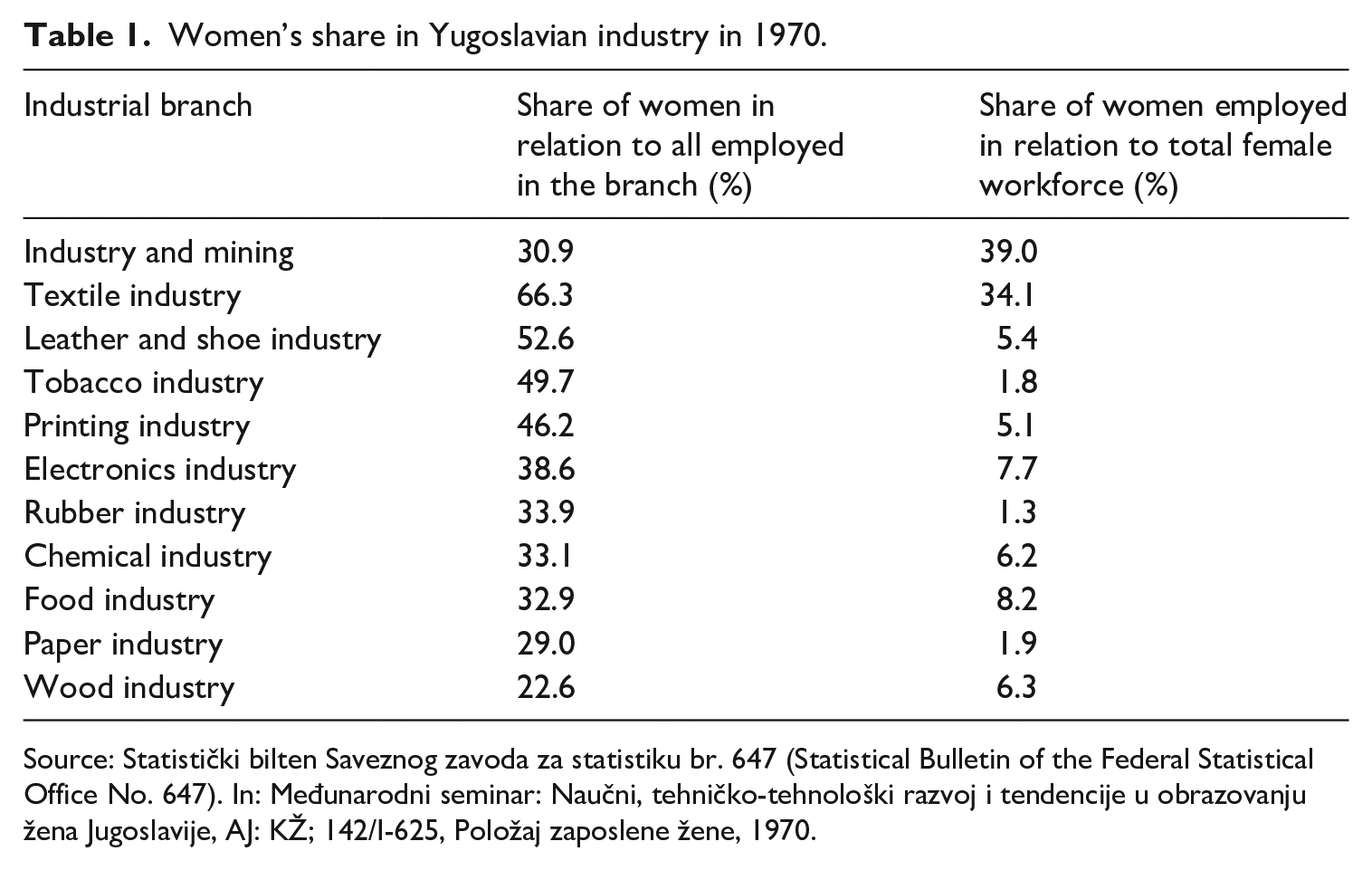
Source: Statistički bilten Saveznog zavoda za statistiku br. 647 (Statistical Bulletin of the Federal Statistical Office No. 647). In: Međunarodni seminar: Naučni, tehničko-tehnološki razvoj i tendencije u obrazovanju žena Jugoslavije, AJ: KŽ; 142/I-625, Položaj zaposlene žene, 1970.
Coincidently, with women’s accelerated integration into the labour market, Yugoslavia’s post-war policy of mass education significantly improved educational capacities among women and female youth. Although the majority remained undereducated or unqualified, illiteracy, which had been widespread among women, was significantly decreased, as well as social practice of excluding female children from elementary and further education (AJ: KŽ; 142/I-625, Položaj zaposlene žene, Društveni položaj, 1966). The most substantial progress occurred among the post-war generation of female youth, who, during the 1960s, nearly reached the same educational level as men. Although women’s education was mostly female-typical, women became present in all corners of the educational system and the labour market (AJ: KŽ; 142/A-484, Obrazovanje, vaspitanje, 1974). Seen through a contemporary lens, official records on women’s employment and education and Yugoslavia’s notable economic progress supported the hope that women’s emancipation and gender-based equality within the labour market were on the horizon, realised in a truly Marxist manner through women’s education and employment, and self-management’s social and economic mechanisms.
Women as ineligible self-managers and industrial workers
Simic’s (2016) study of Yugoslavia’s post-war gender policies shows that, during self-management’s initial years, industrial workers’ and management’s entrenched perceptions of women were that they were predetermined for household work, less productive workers and unfit for industrial jobs. The reports analysed for this article argue that principally the same perceptions of women operated within industry throughout the period under investigation. Moreover, reports frequently stress the omnipresence of gendered assumptions, such as woman’s inability to operate machines, supervise production and manage factories (AJ: KŽ; 142/I-619, Savjetovanja, 1961; AJ: KŽ; 142/I-625, Položaj zaposlene žene, 1966–1970). Reports rarely point out who nurtured such perceptions and translated them into practice. However, given that official statistical data show that men strongly dominated Yugoslav industry and its hierarchies, the workers’ unions and self-management organs (Savezni zavod za statistiku, 1967, 1973), it seems fair to assume that it was male blue- and white-collar workers. Two statements from union representatives support this assumption. In a report on women’s roles in an engine manufacturing factory in the Republic of Serbia, the factory’s union representative stated that ‘female workers’ equal position can result only from change of people’s (conventional) perceptions’ (AJ: KŽ; 142/I-619, Savjetovanja, Neki radni i socijalni problemi, 1961: 2). In the same forum, a union representative from the Republic of Slovenia argued that ‘the belief that a women’s place is by a stove and that only a man is able to manage is deeply rooted among men’ (AJ: KŽ; 142/I-619, Savjetovanja, Mariboru, 1961: 17). These views are not linked to a certain group, for example, industrial management workers or male blue-collar workers, making it safe to assume that the perception of women’s work as socially predetermined was entrenched across the male-dominated environments within industry. Moreover, these conventional views offer further explanation for women’s strong concentration in subordinate and intermediate working positions and in occupations regarded as female-appropriate (Savezni zavod za statistiku, 1967: 95; 1973: 77, 98), despite Yugoslavia’s policy of integrating women both horizontally and vertically across all sectors of the labour market.
The survival of such perceptions is unsurprising, as is their replication into working environments. As Acker (2006, 2011) has stressed, organisations are embedded in the surrounding society; they operate under its influences and absorb its inequalities. Accordingly, Yugoslavia’s ‘working people’ have replicated in industrial working environments the social order and inequalities they have maintained in their private sphere and broader society. Despite considerable development and urbanisation, much of Yugoslavia’s society maintained traditional values throughout the post-war decades (Šuvar, 1970). As mentioned, a major share of the industrial workforce constituted migrants who came from rural areas to urban areas (Suvin, 2012) and peasant labourers, as in women and men from rural areas and the urban peripheries (Schierup, 1992; Suvin, 2012). Analysed reports and research suggest that, in such areas, traditional gender-based divisions of work and the limitation and exclusion of women from opportunity structures endured alongside Yugoslavia’s industrialisation and modernisation (AJ: KŽ; 142/I-625, Položaj zaposlene žene, Aktuelni problemi, 1970; First, 1979; Hofman, 2009). Men from urbanised middle and higher classes were not immune to these values, as studies show their endorsement of patriarchal gendered attitudes and indifference towards women’s social standing (Feldman and Kardum, 2022; Simic, 2016). Further illustration of these trends is provided by data presented by representatives of Yugoslavia’s metal industry, showing that in seven factories in urbanised industrial centres across Yugoslavia, which jointly employed 5450 women, only 36 women were members of workers’ councils and only four were members of management boards in 1961 (AJ: KŽ; 142/I-619, Savjetovanja, Koreferat O problemu opšteg, 1961: 8).
Female workers’ isolation from workers’ councils also conditioned unofficial, class-based regulating that emerged immediately after self-management’s introduction (Simic, 2016) and endured throughout the investigated period: namely, through workers’ tendency to elect qualified and highly qualified workers as their representatives in workers’ councils. As Table 2 illustrates, qualified and highly qualified workers, as well as employees with higher educational merits, dominated workers’ councils. The table also indicates workers’ councils’ increasing class-based stratification, mostly in favour of employees with higher educational merits. This practice has automatically and continuously excluded female workers from workers’ councils, which is illustrated in Table 3. Namely, because of their historical isolation from educational opportunities, female workers entered Yugoslavia’s industry mainly as undereducated and unqualified workers, and, as the next sections will demonstrate, their limited access to education continued within the industry. These patterns illustrate the profound influence of the intersection of gender and class in limiting female workers’ participation in workers’ councils from the outset of the self-management system’s implementation.
Educational attainment among workers’ council members (%).
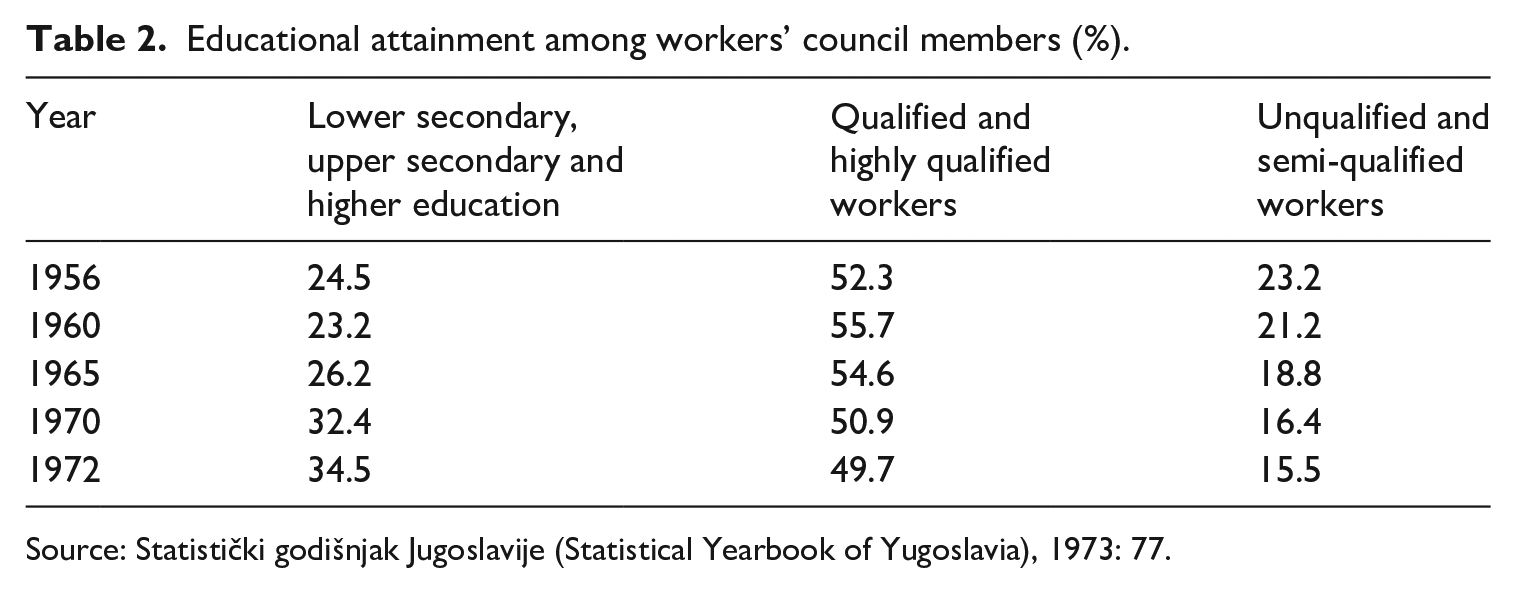
Source: Statistički godišnjak Jugoslavije (Statistical Yearbook of Yugoslavia), 1973: 77.
Women’s share in workers’ councils and management boards in productive sectors (%).
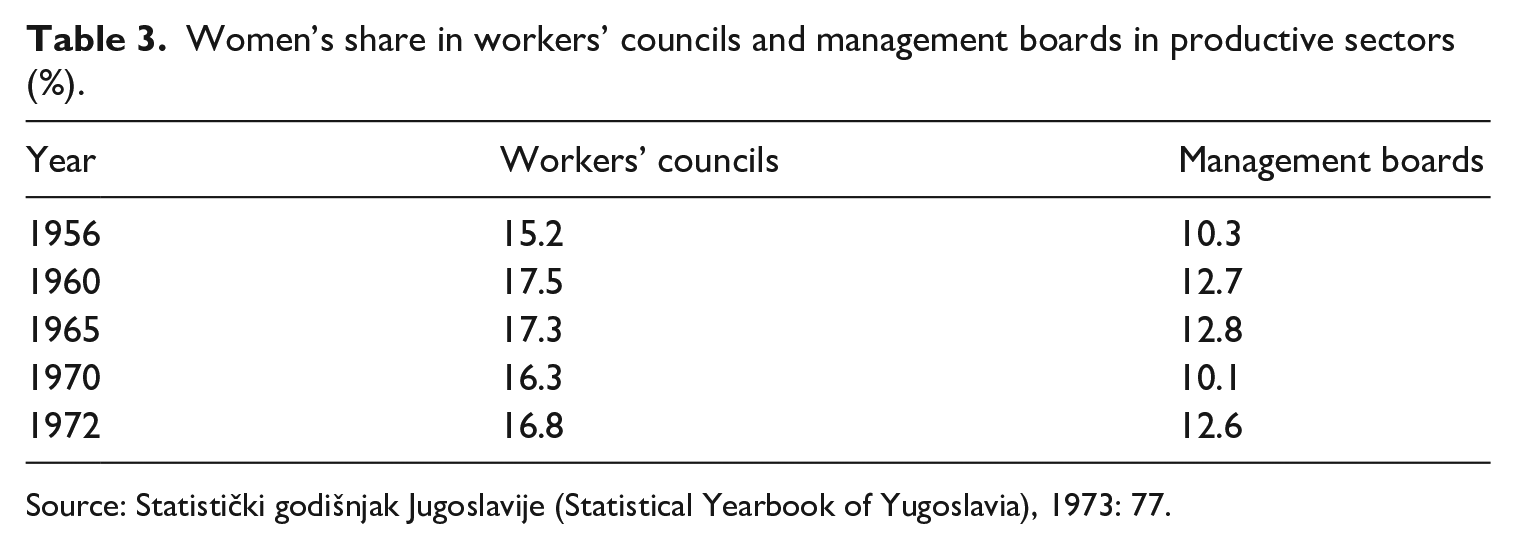
Source: Statistički godišnjak Jugoslavije (Statistical Yearbook of Yugoslavia), 1973: 77.
Table 2 shows educational attainment among workers’ council members in industry, mining and publicly owned organisations of the economy’s productive sector, excluding self-managed agricultural cooperatives. The productive sector in this case includes industry and mining, agriculture, fishery and forestry, construction, traffic and transport, sales and service, public housing and community development. Of all the employed women in Yugoslavia, production sectors employed approximately 70%, of which approximately 55% worked in industry.
However, the analysed reports and statistical records indicate that the perception of women’s inability to manage was also held to some extent by female employees themselves. For example, even in factories where women constituted the majority of employees, and thereby the majority of voters, men nevertheless held most of the positions in the workers’ councils (AJ: KŽ; 142/I-625, Položaj zaposlene žene, Štip,1967). In female-dominated institutions and public service sectors, women participated more in workers’ councils than in industry, but men constituted the majority. For instance, in healthcare and social care sectors, women comprised approximately 25% and 45% of the members of workers’ councils respectively, while in primary and secondary schools combined, women comprised approximately 39% of the members of workers’ councils (AJ: KŽ; 142/I-625, Položaj zaposlene žene, Statistički podaci, 1966; Savezni zavod za statistiku, 1966, 1973).
Within industry, the percentage of women in workers’ councils was arguably lower, as reports mainly show their insignificant participation. For instance, in an engineering and energy enterprise in the Republic of Bosnia and Hercegovina, women constituted 25% of employees, but only two were members of workers’ councils (compared to 64 men). In a factory of non-ferrous metal processing in the Republic of Croatia, women constituted 50% of the employees but only 8 of 35 members of workers’ councils were women (AJ: KŽ; 142/I-619, Savjetovanja, Koreferat O problemu opšteg, 1961: 8). The only example in the analysed reports of women’s larger participation in workers’ councils is a textile factory in the Republic of Macedonia, where women accounted for 21 of 68 members of the workers’ council. However, their share was still proportionally less than half of the factory’s female workforce, which accounted for 67% of the employees (AJ: KŽ; 142/I-625, Položaj zaposlene žene, Štip, 1967). This example, however, seems to be an exception to the rule of women’s nationwide absence from workers’ councils, as well as management boards, as Table 3 illustrates.
The low percentage of women in workers’ councils reflected an unequal distribution of decision-making positions in Yugoslav society, namely, women’s disproportionally low membership in political and sociopolitical bodies. For instance, the percentage of women who were board members of working communities was 12% in 1967, 5% in municipal assemblies and only 3% in republican assemblies (AJ: KŽ; 142/I-625, Položaj zaposlene žene, Učešće žena, 1968: 5). The masculine character of the self-managing organs confirms the resolution of the Congress of Self-Managers, which, in 1971, stated that women (and youth) should participate more in self-management bodies and called for the ‘eradication of practices of their exclusion’ (AJ: KŽ; 142/I-625, Položaj zaposlene žene, Rezolucije, 1968).
Although the authors of reports analysed for this article frequently explain women’s meagre integration into self-management’s decision-making bodies, and various social and sociopolitical forums, with widespread conventional perceptions of women, they never support their arguments with evidence. Instead, the authors confirm deep and vertical embedment of such perceptions by frequently blaming female workers for their own exclusion from professional opportunities, self-managing bodies and sociopolitical life within enterprises. They frequently describe female workers as passive workers who lack self-esteem and professional ambitions and generally accept subordination because of their conventional understandings. In other cases, they explain female workers’ absence as caused by invisible forces embedded in slow socioeconomic development, which, for unexplained or insufficiently elucidated reasons, hindered mainly female workers’ engagement (AJ: KŽ; 142/I-619, Savetovanja, 1961; AJ: KŽ; 142/I-625, Položaj zaposlene žene, 1966–1970). According to Bonfiglioli (2020), similar understandings informed the perspectives of The Women’s Conference’s local representatives, as they frequently noted female workers’ backwardness in their writings, implying that it hindered their broader engagement in sociopolitical life and professional opportunities within factories, thereby impeding their social mobility. Such arguments have legitimised and naturalised inequality regimes operating within self-managed factories and organisations and female workers’ isolation from workers’ councils by explaining them as a natural product of social regularities operating beyond the confines of the self-managed industry and organisations like The Women’s Conference.
Female workers’ internal education
Despite the expanding educational system, the most accessible educational platform for blue-collar workers remained the education provided by factories and designed by the Yugoslav government to address workers’ educational deficiencies and enhance their professional skills. Like other socialist countries, Yugoslavia developed a welfare system in which the workplace provided a large share of services and subsidies, such as childcare facilities and adult education. The Yugoslav government introduced various measures to facilitate working women’s equal access to education but delegated the implementation of these to the self-managed workplaces to finance and distribute. Analysed reports suggest industry’s reluctance to invest in additional resources for female workers’ education or for childcare services. This reluctance is typically associated with pregnant women’s and mothers’ frequent absence from work, which reduced factories’ productivity and budgetary capacities. Furthermore, insufficient economic capacities among less-profitable factories and factories in less-developed areas frequently reappear as an argument for limiting female workers’ access to internal education (AJ: KŽ; 142/I-619, Savjetovanja, 1961; AJ: KŽ; 142/I-625, Položaj zaposlene žene, 1966–1970).
The burden of household work constantly hindered female workers’ participation in internal education, as it was mainly carried out after working hours. For female peasant labourers, the demands of household agriculture, which intensified during seasonal work, further exacerbated this obstacle (AJ: KŽ; 142/I-619, Savjetovanja, 1961). The Women’s Conference and its delegates frequently advocated for the equal distribution of internal education and the construction of welfare facilities that could facilitate female workers’ enrolment (AJ: KŽ; 142/I-619, Savjetovanja, 1961; AJ: KŽ; 142/I-625, Položaj zaposlene žene, 1966–1970). However, they neither contested nor questioned the conventional gender-based division of household labour, thereby supporting the perception of gender-based division of work and of household work as solely a woman’s responsibility. Moreover, as in the case of women’s absence from workers’ councils, arguments based on conventional gendered perceptions or explained by socioeconomic forces are reiterated in reports, legitimising and naturalising women’s absence from internal education. Several reports describe female workers as uninterested in longer and more challenging education, indifferent towards professional advancement or afraid of supervisory positions (AJ: KŽ; 142/I-619, Savetovanja, 1961; AJ: KŽ; 142/I-625, Položaj zaposlene žene, 1966–1970).
The intersection of gendered assumptions and internal education’s class-based distribution perpetually hindered female workers’ participation. Acker (2006: 446) argued that, even during employment, employers segregate the workforce according to gender, as women and men are deemed suitable for different jobs. According to the reports from industry and union representatives, in male-dominated industries, mistrust in women’s professional competence and abilities to operate machines mandated women’s allocation to low-valued manual jobs or to temporary jobs and positions that experienced sudden shortages of male manual workers (AJ: KŽ; 142/I-619, Savetovanja, 1961). Reports on women’s and female youth’s education and choices of occupations highlight the pervasiveness of gendered assumptions in Yugoslav society regarding appropriate occupations and educational pathways for females and males, and their strong influence on the concentration of women in low-accumulative, feminised industries, and female youth into educational programmes that provided qualifications for jobs in the same sectors (AJ: KŽ; 142/I-625, Položaj zaposlene žene, Zaposlenost, zapošljavanje, 1968). In both instances, female workers occupied mainly positions requiring unqualified and semi-qualified labour. Such positions rarely require any further development of the workers’ skills and typically offer limited opportunities for internal education, as employers prefer to invest in specialising the skills of those higher up the hierarchy (Piore, 1972).
The distribution of education in a textile factory in Macedonia provides an illustrative example of the classed and gendered distribution of education. Although unqualified and semi-qualified female workers constituted 91% of the factory’s female workforce, over the course of two years, the factory gave specialist training to only 53 female workers. Concurrently, the factory subsidised the higher education of 51 male and 10 female students (AJ: KŽ; 142/I-625, Položaj zaposlene žene, Štip, 1967). Reports from industry and union representatives show similar patterns in the metals industry. For instance, out of 50 women participating in internal education in a factory that manufactured tractors and agricultural machines in Serbia, 27 were white-collar workers, constituting fewer than 15% of the factory’s female workforce. Coincidently, the factory subsidised the specialist training of 292 male workers. Similarly, out of 57 female employees in internal education in a Serbian engine factory, only 12 were production workers, attending elementary school or courses for qualified (AJ: KŽ; 142/I-619, Savjetovanja, Koreferat Neki radni i sociajalni, 1961). The lethargy in female workers’ inclusion into internal education in the metals industry was so widespread that union and industry representatives anticipated that, at the current rate, it would take more than 15 years just to certify the skills of those female workers who acquired them through work (AJ: KŽ; 142/I-619, Savjetovanja, Koreferat O problemu opšteg, 1961: 7).
Acker (2011: 67) contends that employers usually perceive women as encumbered workers, burdened by children and domestic responsibilities. Consequently, women are a poor fit for the ideal of the perfect, unencumbered worker who is consistently available and fully dedicated to work. As mentioned, industry employed female workers in male-typical branches often as temporary workers, which limited their chances of educational opportunities within the factories. According to The Women’s Conference, even when women held permanent employment contracts, factory managements often considered them as temporary workers who would most likely resign upon marriage or childbirth, and perceived the allocation of resources for women’s education and specialisation as unprofitable (AJ: KŽ; 142/I-625, Položaj zaposlene žene, Neka aktuelna pitanja, 1967: 9). The Yugoslav Communist Party officially acknowledged the detrimental labelling of women as a temporary and unstable workforce and resolved that the ‘party will act persistently to eradicate conservative understandings that women’s employment is only temporary and that women constitute a reserve labour force’ (AJ: KŽ; 142/I-625, Položaj zaposlene žene, Zaposlenost, zapošljavanje, 1968: 6). However, later reports on women’s continuing low participation in educational opportunities and data on working women’s educational attainments suggest that the Party’s resolution remained mostly a dead letter.
Female workers as an undereducated and unqualified workforce
The distribution of internal education based on gender and class and their intersection, which exacerbated female workers’ fractional participation in such programmes, inevitably resulted in their remaining a predominantly undereducated and unqualified workforce. According to The Women’s Conference, it was common for many female workers to have only completed elementary school, but in some factories, they were severely undereducated and even illiterate. For instance, in an engine factory in the Republic of Montenegro, of 600 female workers, 360 were illiterate. In a textile factory in Serbia, women accounted for 70% of the factory’s illiterate workers, and in a factory producing artificial manures, this figure was 99% (AJ: KŽ; 142/I-625, Položaj zaposlene žene, Neka aktuelna pitanja, 1967: 5). Although low levels of education and a lack of certified skills characterised male workers as well, the number of men who were qualified and highly qualified workers was significantly higher than that of female workers. For example, in a factory producing wooden products in Serbia, where women constituted 40% of the workforce, fewer than 4% were qualified or highly qualified compared to almost 30% of the male workers. Furthermore, in a textile factory in Bosnia and Hercegovina, 65% of the employees were women, but men accounted for 80% of qualified and 97% of highly qualified workers (AJ: KŽ; 142/I-625, Položaj zaposlene žene, Neka aktuelna pitanja, 1967: 5).
In more developed parts of the country, female workers did not possess significantly better qualifications. A report from Slovenia shows that, even in the most developed Yugoslav republic, where women experienced the highest social and professional mobility and employment rates, female workers were still mostly unqualified workers, or they lacked formal qualifications. In the wood industry, women constituted 60% of formally unqualified workers, 73% in the leather and footwear industry, 75% in the electronics industry, 79% in the food industry and 85% in the textile industry. Only in the leather and footwear industry did women constitute the majority, even among the qualified workers, constituting 56% (AJ: KŽ; 142/A-484, Svesno društveno, 1971–1974: 8). As Table 4 illustrates, these proportions were comparable to female workers’ qualifications in production sectors of the Yugoslav economy.
Employed women’s qualifications in production sectors in 1967 (%).
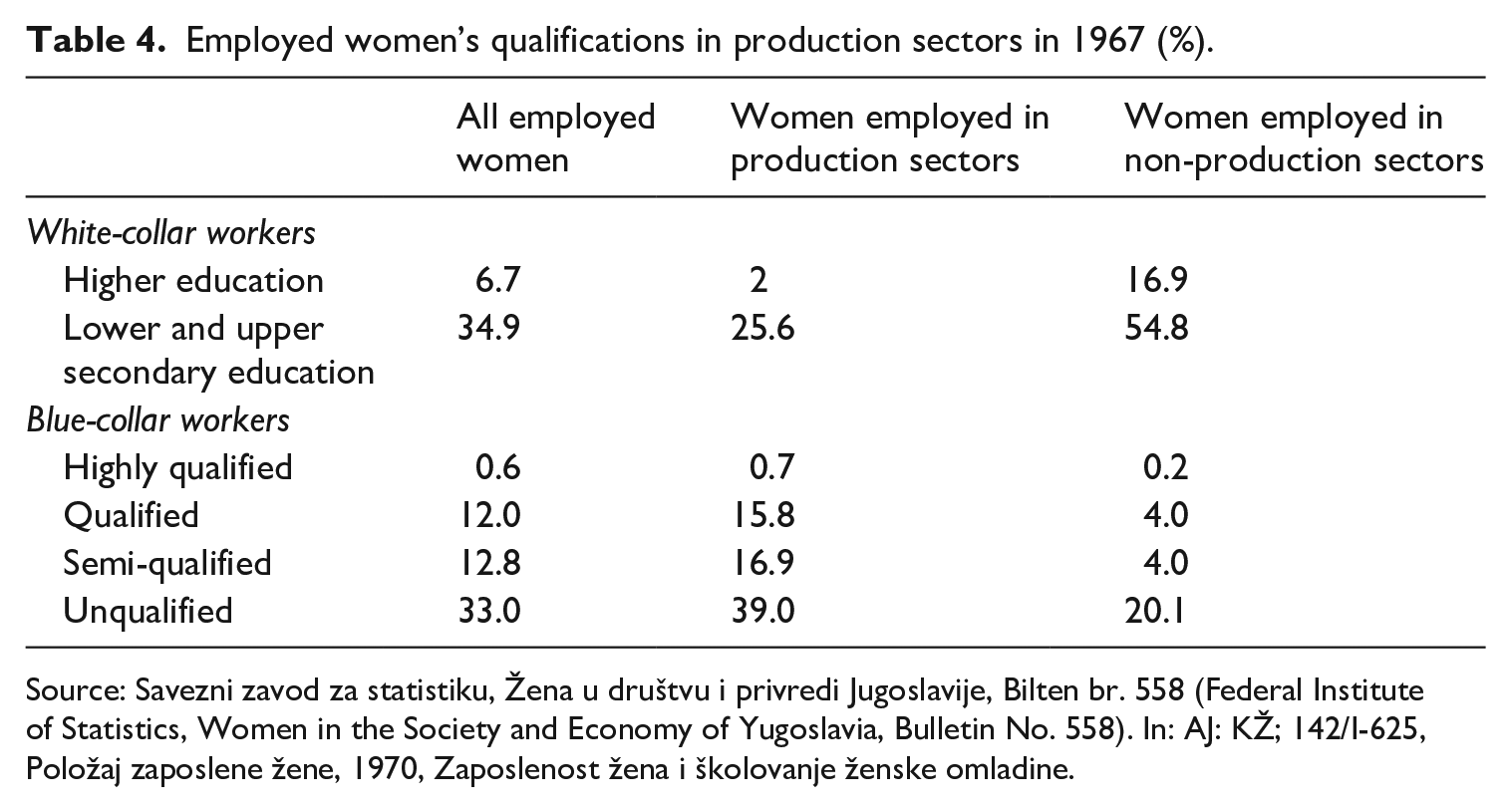
Source: Savezni zavod za statistiku, Žena u društvu i privredi Jugoslavije, Bilten br. 558 (Federal Institute of Statistics, Women in the Society and Economy of Yugoslavia, Bulletin No. 558). In: AJ: KŽ; 142/I-625, Položaj zaposlene žene, 1970, Zaposlenost žena i školovanje ženske omladine.
The analysed reports suggest that even if female workers performed or managed to advance to qualified or highly qualified positions, they commonly lacked certifications for their jobs, which further illustrates their isolation from internal education. For instance, of all the women who performed skilled work in the metals industry, only 27% had certification, and of 41 women performing highly skilled work, only one had certification (AJ: KŽ; 142/I-619, Savjetovanja, Koreferat O problemu opšteg, 1961: 6). According to The Women’s Conference, enterprises occasionally reclassified job positions to legitimately increase wages. As a typical example, The Women’s Conference referenced a textile factory in Slovenia which reclassified textile weaving positions as skilled work, thereby designating female workers as qualified workers without providing them with internal education (AJ: KŽ; 142/I-625, Položaj zaposlene žene, Neka aktuelna pitanja, 1967: 9). The disproportionate number of women among workers with educational merits was eventually recognised by the Congress of Self-Managers in 1971, setting women’s education as one of its future tasks, ‘since they constitute the majority among uneducated and unqualified’ (AJ: KŽ; 142/I-625, Položaj zaposlene žene, Rezolucije, 1968: 3).
The Congress of Self-Managers’ resolution coincided with a flurry of reports authored by The Women’s Conference and its republican outlets, reporting on women’s rapidly decreasing employment and career opportunities (AJ: KŽ; 142/I-625, Položaj zaposlene žene, 1970; AJ: KŽ; 142/I-625, 1971–1974). Those reports and data on unemployment in Yugoslavia suggest two additional reasons for the perpetuation of female workers’ low education levels. Both reasons are intricately linked to the economic reform which the Yugoslav government implemented in 1965 to rapidly increase factories’ productivity and budgetary effectiveness. The reform brought forth widespread discharging of workers, a halt in new recruitment, and rapidly increasing unemployment, and consequently, a massive labour migration to western countries (Dobrivojević Tomić, 2019). According to The Women’s Conference, after the reform, seeking productivity and implementing budgetary restraints, factories reluctantly financed workers’ elementary education and preferred to invest in workers’ vocational education and further specialisation. The same report argued that an elementary education was increasingly becoming a prerequisite to be considered for workers’ specialisation training (AJ: KŽ; 142/I-625, Položaj zaposlene žene, Neka aktuelna, 1967: 6). These arguments suggest that female workers encountered additional barriers to their educational and professional progress since many lacked an elementary education. Moreover, after the reform, unemployment increased rapidly among women, particularly among qualified and highly educated young women aged 18–35. Unqualified women were always the majority among the unemployed, but the share of women with upper secondary and higher education increased from 9% in 1965 to 28% in 1969 and to 36% in 1974 (Malačić, 1979: 94). The Federal Bureau of Employment’s data from 1969 show that women constituted 69% of all unemployed jobseekers with upper secondary and higher education (AJ: KŽ; 142/I-625, Položaj zaposlene žene, Zaposlenost žena, 1970: 10).
Conclusion
This article has illuminated gender-based inequalities within Yugoslav self-managed industry by examining the underlying impacts of gender and class on female workers’ professional status and position in workplace democracy. It aimed to show female workers’ secondary status in Yugoslav industry by demonstrating their widespread segregation into an underqualified workforce and a worker category underrepresented in workplace democracy. Based on contemporary reports and inspired by Joan Acker’s concept of inequality regimes, the article has investigated female workers’ membership in workers’ councils, participation in internal education and their qualifications. Although women theoretically had equal access to these, their access within Yugoslav industry was undermined by an overarching inequality regime based on socially constructed differences between genders that operated within and beyond factories, and the unofficial, class-based regulating of membership in workers’ councils and participation in internal education.
Women’s heavy burden of household work, shown by scholars to be a perpetual obstacle to their empowerment under state socialism, has consistently contributed to female workers’ isolation from opportunity structures in self-managed factories. Communist and industrial establishments’ uncontested view of household work as solely a woman’s duty was used as a rationale for female workers’ isolation, confirmed the gender-based division of work and legitimised female workers’ isolation from workers’ councils and internal education. Furthermore, it perpetuated the image of female workers as encumbered by household duties and reinforced the conventional perception of a woman as socially and professionally predetermined.
The intersection of gender and class within factories was a factor that further undermined female workers’ status in Yugoslav industry. Gendered assumptions of women as being incapable of performing advanced jobs and as ineligible leaders undermined female workers’ access to membership in workers’ councils. The unofficial, class-based regulation of worker council elections within Yugoslav industry – manifested through workers choosing to elect mainly their qualified and highly qualified colleagues – further undermined female workers and their status as they mainly worked as unqualified and semi-qualified workers. Moreover, the gendered distribution of jobs and occupations and female workers’ lack of qualifications conditioned their occupational distribution and narrowed their access to jobs. The industry predominantly employed women as unqualified and semi-qualified workers, concentrating them mainly in low-accumulating industries, most often strongly feminised, in temporary and seasonal work, and in positions that did not demand qualifications. More accumulative, male-dominated industries employed female workers mainly to perform manual jobs experiencing shortages of male labour.
These aspects jointly relegated female workers to a secondary workforce in a segmented labour market, where social and economic forces operating beyond the gender category conditioned their secondary status. Jobs that female workers performed were characterised by insecurity and discontinuity, insufficient access to opportunities for specialisation, and rarely constituted a link within regular mobility chains enabling professional upward mobility. Intersecting with women’s uncontested duty to perform unpaid household work, this fundamental principle of internal labour markets consistently hindered women’s participation in internal education and their eventual professional advancement. Their secondary status was confirmed by their low membership in workers’ councils, where, despite the predominantly trivial nature of the councils, membership signified enhanced professional status and recognition among colleagues.
Thus, this article has demonstrated that while the utopian vision of workers’ empowerment and workplace equality inspired progressive changes in Yugoslav industry, enabling women’s integration into decision-making bodies and challenging the masculinity of certain industries, this vision was ultimately undermined by the persistent inequality regime based on gender and class. This regime was further exacerbated by historical and societal factors, as well as Yugoslavia’s modest socioeconomic development, which reinforced conventional understandings of woman’s work, maintaining additional barriers that hindered female workers’ equality, professional progress, and consequently, empowerment.
Footnotes
Acknowledgements
The author is very grateful to Associate Professor Elin Ennerberg and Associate Professor Peter Gladoic Håkansson for their support and constructive feedback, and to the peer reviewers for their detailed and helpful comments on this article.
Declaration of conflicting interests
The author declared no potential conflicts of interest with respect to the research, authorship, and/or publication of this article.
Funding
This work was supported by the Swedish Research Council under Grant VR 2021-00528.
