



Abstract
Underemployment in the UK and other European economies – that is people looking for a new job with longer hours, or wanting longer hours in their current job – has risen since the 2008–9 financial crisis. This article informs policy debates on how underemployment can be addressed in the UK. It deploys a mixed methods research design, which is necessary to identify how labour market conditions shape workforce planning, including establishment-level labour hoarding over a variety of temporal scales through underemployment. The authors analyse quantitative data identifying greater underemployment risks in less productive local economies and ‘slacker’ local labour markets (but note complex differences across rural and urban areas). They complement this with qualitative data drawing on exploratory interviews with employer representatives and identify the potential importance of both labour market conditions and business models in shaping workforce planning decisions that affect underemployment risks. The authors discuss priorities for labour market and employment policy.
Keywords
Introduction
Policymakers in Western economies have expressed concern over high levels of underemployment – i.e. that some employees want to work more hours, but are unable to secure these. In the UK, high underemployment has become a permanent feature of the labour market throughout the slow recovery from the 2008–9 financial crisis as productivity and wage growth stagnated (Bell and Blanchflower, 2018). Now, as policymakers seek to spur economic recovery from the COVID-19 pandemic, there is an opportunity to promote employment and labour market policies that mitigate the risk of underemployment and so prevent the negative impacts that are often experienced by workers, and to aid productivity. However, this requires a fuller understanding of the drivers of the problem, not least to counteract processes operating to institutionalize non-standard employment, including underemployment, and lock weaker regions into ultra-flexible but low-productivity pathways (Grekousis and Gialis, 2019; Herod et al., 2021).
To inform policy we need a better understanding of how underemployment plays out in different spatial and organizational contexts. We add to existing evidence by focusing on two neglected aspects of underemployment: the uneven spatial distribution of underemployment and its relationship with other aspects of labour market fragility and ‘slack’, defined as unmet needs for employment due to unemployment and/or other forms of labour market exclusion (Eurostat, 2022); and, at an organizational level, how business models, associated HR practices and workforce planning are influenced by local labour market and geographical context to produce and/or mitigate underemployment.
There is a well-developed evidence base on the individual, occupational and sectoral factors associated with underemployment. We add to this in two key areas through a mixed methods research design. First, we provide a spatially fine-grained analysis to answer the question of how local labour market conditions and geographical context shape spatial patterns in low hours and underemployment, including analysis of U-shaped relationships of underemployment with the size of local labour markets, informed by our qualitative findings. Second, we draw on qualitative research with human resource (HR) managers and business leaders to explore the micro-level decision-making processes that generate underemployment risks in local labour markets, informed by the association between labour market slack and underemployment revealed in our quantitative analysis. A mixed methods approach reveals how employer behaviour is informed both by local labour market conditions and business models, how spatial and labour market factors shape the context for varying underemployment risks and how labour market slack and/or demand may be framing employers’ workforce practices and staffing strategies.
Our research aims to investigate how labour market factors, and established business models and workplace practices shape employers’ understandings of, and actions around, underemployment, and the consequences for productivity and growth. By an ‘established business model’ we mean ‘the logic of the firm, the way it operates and how it creates value for its stakeholders’ (Casadesus-Masanell and Ricart, 2010: 196). There are concerns that business models based on maximizing shareholder value and minimizing costs in the short-term can impact negatively on job quality, whereas more ‘stakeholder-oriented’ models acknowledge a broader range of stakeholders – not just business owners/shareholders – are involved in value creation, potentially informing workplace practices that deliver better job quality (Freudenreich et al., 2020). Workplace practices that affect employees’ job quality can range from pay and reward strategies to learning and development opportunities (Taylor, 2017), but the main focus for this article is the extent to which workforce planning practices affect the ability of employees to access sufficient hours and shifts, or alternatively contribute to the risk of underemployment.
The labour market factors we investigate are labour market slack (captured by unemployment), labour supply (captured by the size of the local workforce) and labour demand (captured by the number of local jobs). Our broader aim is to inform policy as the UK continues to recover from the COVID-19 crisis. There is evidence of lasting post-COVID-19 impacts on business models and working practices, but is there scope to build on these apparently resilient changes in workplaces to tackle underemployment? Is ‘building back’ without underemployment a realistic objective?
Underemployment as a priority for labour market policy
Underemployment has been defined in multiple ways, referring to both insufficient working hours and skills under-utilization. Our research focuses on the former. Thus defined, underemployment is when workers find themselves involuntarily in part-time work or otherwise unable to secure sufficient hours of work, including those on ‘zero-hours’ or casual contracts. The UK Office for National Statistics defines the underemployed as those who:
want to work more hours in their current job, or are looking for an additional job or a different job with more hours;
are available to start working more hours within two weeks; and
are currently working 48 hours or less per week (40 hours for those under the age of 18 years).
In neoliberal economies, the growth and scale of underemployment has captured policymakers’ attention, yet little research has been undertaken on the geography of underemployment. Underemployment rates in the UK have declined slightly since their peak of 10.6% (of employed people) in 2012, but have remained persistently around or above 7–8% in the years since. Underemployment fell at slower rate than unemployment as the UK labour market recovered following the Global Financial Crisis and ensuing Great Recession between mid-2012 and mid-2017, by 2.6 percentage points (from 10.6% to 8.0%; ONS, 2024a) compared to 3.7 percentage points for unemployment (from 8.0% to 4.3%; ONS, 2024b). Higher levels of underemployment have become a ‘new normal’ in an expanding bundle of flexible, precarious ‘non-standard’ forms of employment, particularly in weaker UK regional economies (Green and Livanos, 2017) and in southern Europe fuelled by labour market deregulation after the Global Financial Crisis (Gialis et al., 2017). Bell and Blanchflower (2013: 8) argue that the persistently high underemployment in the UK calls for a re-think of how labour markets are discussed by policymakers, analysts and media: ‘the unemployment rate is now a poorer indicator of the degree of slack in the labour market than it has been in the recent past’.
Accordingly, there is a growing consensus that underemployment is a key indicator of labour market slack and an important contributing factor to sluggish wage and productivity growth and rising in-work poverty since the 2008 crisis (Clarke and Gregg, 2018). Underemployment is associated with multiple negative impacts. First, the underemployed are more likely to experience low pay and in-work poverty (Warren, 2015) with longer-term negative impacts on their employability, earnings and income (Bell and Blanchflower, 2018). Gialis et al. (2018: 317) note that many workers face ‘a vicious cycle of disadvantage as they frequently alternate between unemployment and underemployment, unable to find a more stable and prosperous job’. International survey evidence reported by MacDonald (2019) found that underemployed workers felt more insecure and less confident about future job prospects.
Evidence reviews conducted in the UK, US, Canada and elsewhere agree about the relationship between underemployment and poorer wellbeing in terms of low self-esteem (Friedland and Price, 2003), less control (De Moortel, 2020), increased despair and frustration (Blustein et al., 2013), and poorer self-reported health, anxiety and depression (De Moortel, 2020; Heyes et al., 2017). Underemployed workers are often required to make themselves available for shifts across a wide range of timeslots, impacting negatively on work–life balance and family wellbeing (McCrate et al., 2019). Burris’s (1983) seminal study of US clerical workers found that underemployment was negatively associated with perceptions of job involvement and co-worker relationships. Underemployment is also associated with reduced job satisfaction (Golden and Kim, 2020), commitment (Feldman et al., 2002) and higher staff turnover (Wang, 2018). All these negative outcomes, in turn, are associated with reduced establishment-level productivity.
Drivers of underemployment and challenges for policy
There is ample evidence about some of the key individual, occupational and sectoral characteristics associated with heightened risks of underemployment. Specifically, underemployment is more prevalent in service occupations (Bell and Blanchflower, 2018; Golden and Kim, 2020), lower-skilled occupations (Warren, 2015) and among women, younger people, migrant workers and disabled workers (Newlands, 2022). Labour market groups with non-linear and fragmented career pathways are at risk of longer-term rather than transient underemployment. This especially applies to women (Kjeldstad and Nymoen, 2012), those re-entering the labour market following redundancy (Feldman and Leana, 2000) and the longer-term unemployed (Green and Livanos, 2017).
It is unclear, however, why and how certain jobs and sectors drive underemployment. One explanation concerns the services that are delivered in sectors like social care, retail and hospitality where irregular customer demand patterns require high levels of staffing at certain peak times (MacDonald, 2019). Another is that in neoliberal economies, the decline of labour movements and employment deregulation have undermined workers’ individual and collective power in the face of managerialist cost containment strategies (Carré et al., 2012) and seen the widespread adoption of precarious, platform-based forms of employment, including pay insecurity, limited progression opportunities and underemployment (Barratt et al., 2020). All this has occurred alongside a significant decline in the availability of paid overtime (Bell and Hart, 2019). Employers in sectors such as retail and hospitality are accused of over-recruiting part-time staff to allow for maximum flexibility and to instil discipline among employees who fear being denied hours. While such flexibilization may bring cost savings in the short-run which can raise productivity, it is less clear to what extent underemployment may harm productivity in the long-term, for example through reduced employee engagement and increased staff turnover.
A broader critical literature points to the deeper entrenchment of business models that require poorer quality jobs and underemployment to function (Findlay et al., 2021). These business models often involve staff outsourcing and hollowed out HR/workforce planning – meaning that their sole consideration is the design of hours and shifts to minimize costs. Here, workforce planning strategies seek to maximize the use of short and flexible hours contracts to contain wage costs and labour overheads, which has helped embed underemployment (Wang, 2018). Such practices may have a spatial dimension: more prevalent in urban labour markets where employers can readily tap migrant, student and female labour and ‘there is little need for HR planning, as it is assumed that workers can be readily resourced from the external labour market as and when needed’ (Kispal-Vitai and Wood, 2018: 257). Furthermore, management decision-making may be influenced by similar factors that have been identified as important to the resilience of low-pay strategies in sectors such as retail and hospitality: inertia arising from a ‘satisficing’ strategy where employers see no need to change a profitable way of working; and isomorphic processes whereby employers tend to replicate perceived norms (Green et al., 2021).
Finally, evidence on the role of labour markets in shaping underemployment is limited. De Moortel et al.’s (2018) cross-national research suggested that labour market ‘weakness’ is associated with greater underemployment. However, it is the increasing dislocation between underemployment and other labour market indicators, especially since the global crisis of 2008–9 and its aftermath, that has contributed to renewed interest in the labour market effects on underemployment, with MacDonald (2019: 8) concluding, ‘where unemployment has declined underemployment has been slow to follow, suggesting that additional factors beyond the economic cycle have influenced the incidence of underemployment’.
Cross-national evidence also suggests that there is no simple relationship between urbanity/ rurality and underemployment risks (MacDonald, 2019). However, as argued above, large urban centres where there is ample and flexible labour drawn from student and/or migrant worker populations may facilitate workplace strategies that give rise to underemployment, just as they help to explain concentrations of low-paid work in some cities (Green et al., 2021). There may also be specific risks associated with remote rural labour markets with a few large-scale employers and higher levels of part-time and seasonal working (MacDonald, 2019). There is evidence that post-recession or micro-level shocks in local labour market (e.g. plant closures) spikes in underemployment can be more ‘sticky’/slow to clear in rural labour markets (Wu and Eamon, 2011).
Methods
We adopted a mixed methods approach to explore the interactions between local labour market and organizational-level drivers of underemployment. Initial quantitative analysis of spatial patterns and the relationships of underemployment with unemployment and productivity informed some of the questions asked in qualitative interviews with employers. As an iterative process, emerging findings from the qualitative analysis recursively prompted further quantitative analysis of the roles of the scale of local labour demand and supply in shaping the geography of underemployment. In Scotland, the base for our qualitative research, underemployment largely follows the UK trend (8.0% at the time of the research).
Local labour market factors shaping underemployment
We gained insights by examining relationships between underemployment and labour market conditions across different geographical contexts. Local labour markets vary in their levels of underemployment, unemployment, productivity and labour demand and supply, thus allowing relationships to be revealed that may not be observable in either national time-series or in establishment-level data. We constructed a dataset for 179 NUTS3 regions across the UK of key measures of underemployment, unemployment, productivity and labour demand and supply (Table 1).
Definition of variables.
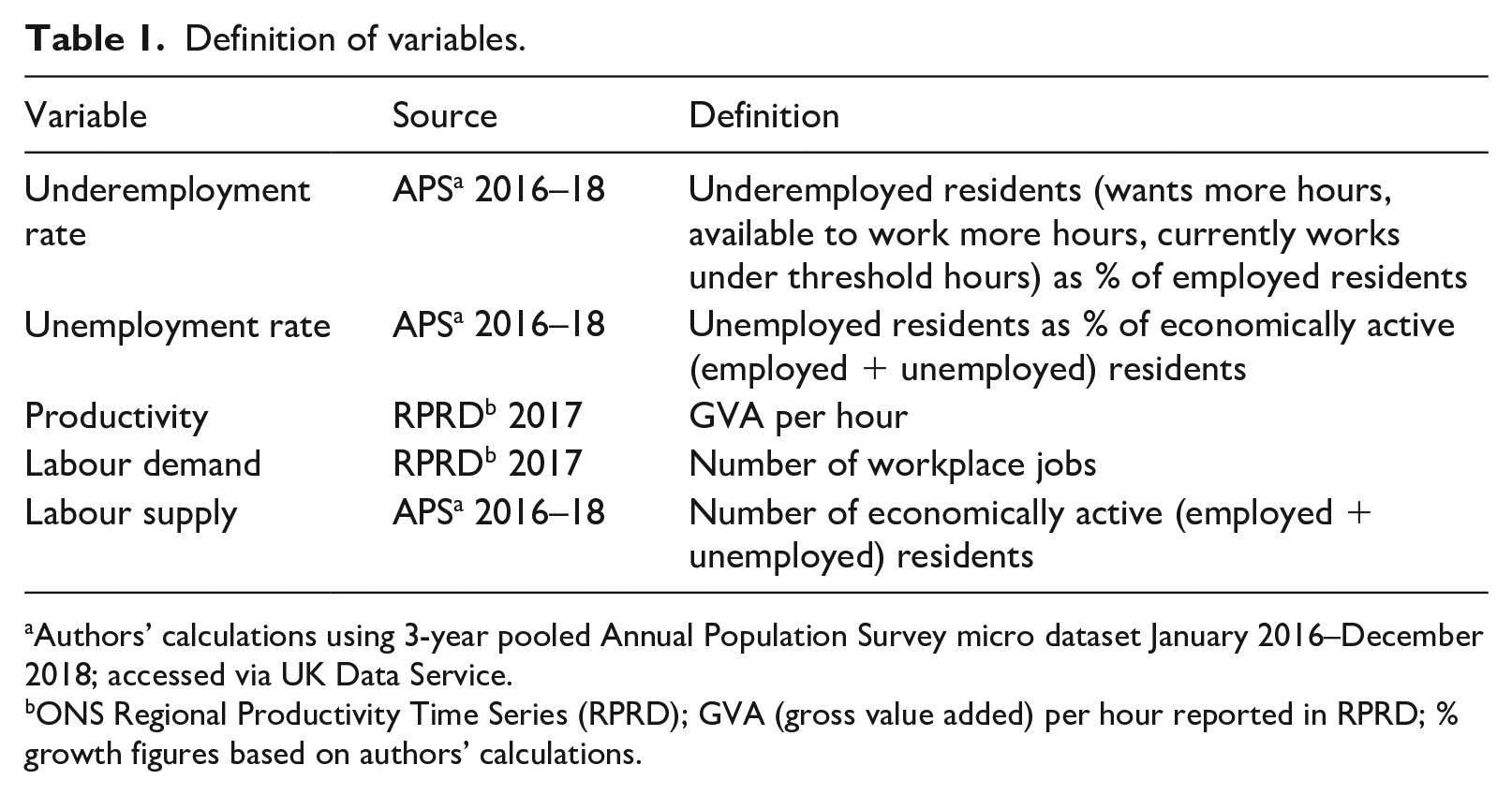
Authors’ calculations using 3-year pooled Annual Population Survey micro dataset January 2016–December 2018; accessed via UK Data Service.
ONS Regional Productivity Time Series (RPRD); GVA (gross value added) per hour reported in RPRD; % growth figures based on authors’ calculations.
We analysed spatial relationships between these measures in order to understand: (1) the impacts of underemployment, particularly on productivity; and (2) the factors shaping underemployment, in particular the effect of the availability of labour. We report correlation coefficients and bivariate linear regression best-fit lines displayed in scatterplots. We follow the definition of underemployment used by the UK ONS reported earlier.
We calculated underemployment rates, and other labour market indicators, for local areas using the three-year pooled Annual Population Survey/Labour Force Survey (APS/LFS) microdata for 2016–18. The advantage of the APL/LFS microdata is that they provide a sample size sufficient (N = 307,711 persons aged 16–64) to calculate local underemployment and unemployment rates for local areas. The smallest geographical identifier in this dataset is EU NUTS3 regions, with an average population aged 16–64 of 232,000. Metropolitan areas (e.g. London, Greater Manchester, West Midlands) are broken into sub-areas, while most small and medium-sized cities correspond with an NUTS3 region. In urban areas, NUTS3 areas offer an appropriate scale for analysis, as they correspond to the spatial scale at which lower-skilled labour demand and supply matching take place (Kitsos and Bishop, 2018). In remoter rural areas, some NUTS3 regions may be somewhat larger than job search and commuting fields, which could be expected to weaken statistical associations found in our analysis.
Organizational factors shaping underemployment
Our qualitative research involved 17 in-depth interviews with business leaders and HR managers in Scotland, the base for our research team. As noted above, levels and trends in underemployment in Scotland largely mirror those in other regions of the UK. A purposive sampling frame captured employers of various sizes in sectors that have reported relatively high levels of underemployment, such as retail, hospitality and health/social care (MacDonald, 2019). Following consultation with sector stakeholders that highlighted potential underemployment risks, we were also persuaded to include financial and business services employers within the sample. As noted above, our sample framework was designed to provide access to sectors where we were more likely to encounter employers grappling with workforce planning and underemployment challenges. We make no claims as to the representativeness of this sample in relation to the Scottish or UK labour market, nor was it intended to ‘match’ the quantitative data deployed in our labour market analysis. Rather, in order to explore in depth how business models and management decision-making processes can contribute to underemployment risks, in line with established practice, we adopted an exploratory, qualitative approach (Bryman, 2016). Given the complex and highly contextualized nature of workplace practices, this exploratory approach was less concerned with the representativeness of the sample, and more with identifying respondents who could provide in-depth insights on previously unreported decision-making processes. Similar priorities in sampling and research design are found in other in-depth studies of management decision-making around work organization (e.g. Harsch and Festing, 2020). While most of the employers we engaged with operated in the urban central belt of Scotland, some were national-level businesses operating across a range of locations, and we included organizations in rural communities.
In-depth interviews focused on workforce planning and HR practices, broader issues of business models and organizational priorities, concerns around and responses to underemployment, and the extent to which the COVID-19 crisis had changed the organizational and business context (interviews were undertaken during mid-2020). While interviews covered the impact of the then emerging COVID-19 crisis, our main focus was on long-term, established experiences and practices related to underemployment. The research team identified and refined themes from an initial review of interview data, before finalizing the analysis and identifying illustrative quotations. A summary of the organizations participating in the qualitative research is provided in Table 2.
Qualitative interviews.
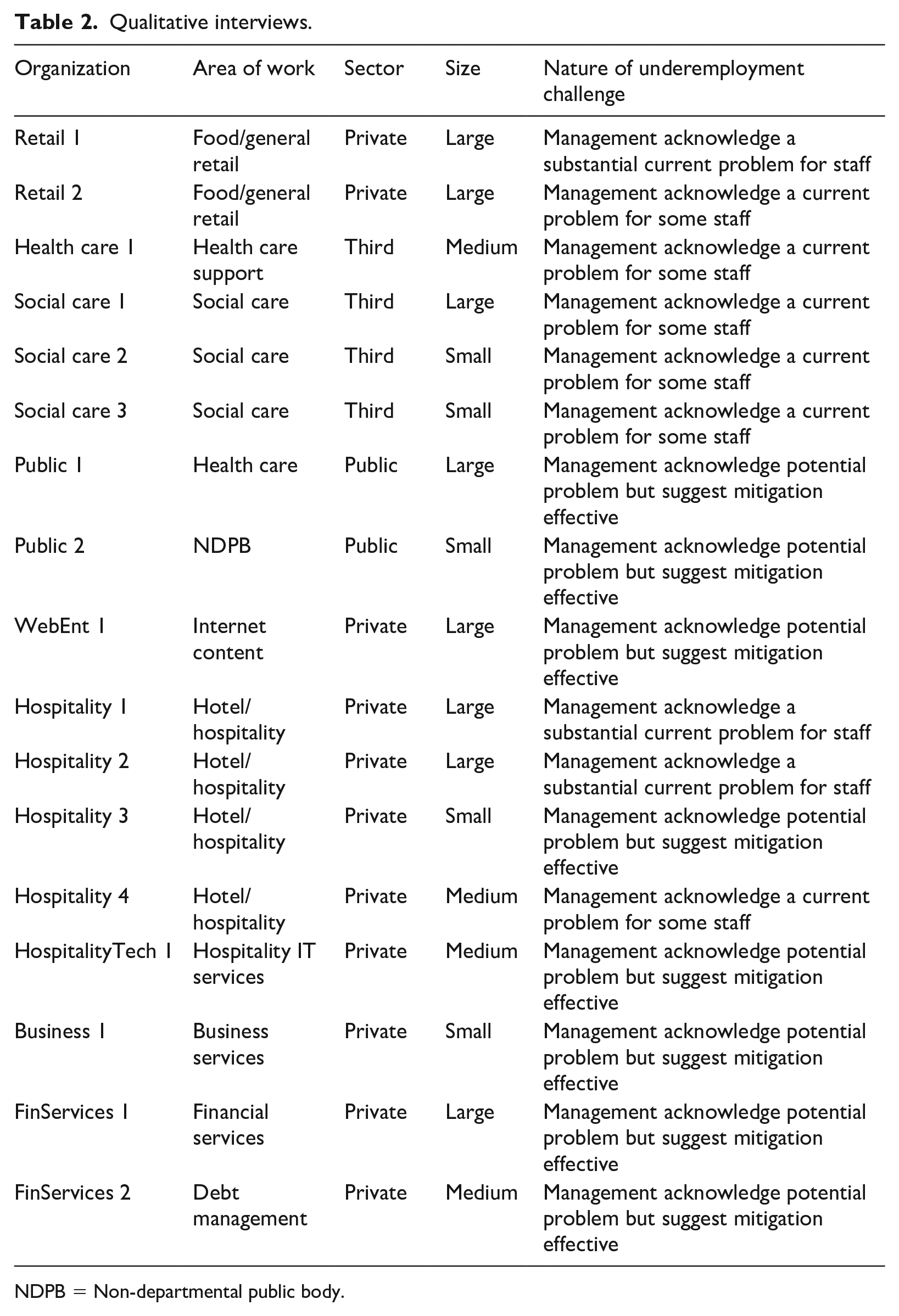
NDPB = Non-departmental public body.
Results
Underemployment, geography and labour markets
The geography of underemployment
The highest rates of underemployment are in more rural areas (Table 3), particularly geographically large remoter areas in western and coastal areas (Figure 1) characterized by seasonal labour demands and weak supply. Underemployment is also quite high in some cities, standing out as a series of geographically small areas (Figure 1) characterized by high unemployment with labour supply typically outstripping demand. However, across all areas there is little difference between overall urban and rural underemployment rates (Table 3).
Hours worked, extra hours wanted, underemployment and unemployment by urbanity/rurality (working-age population, 16–64 years).
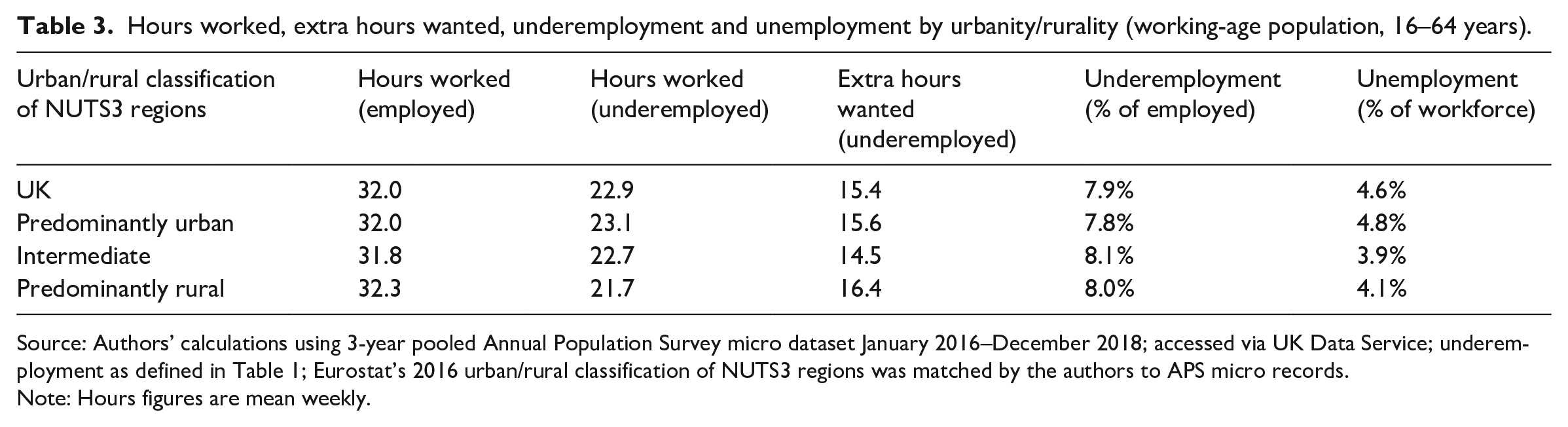
Source: Authors’ calculations using 3-year pooled Annual Population Survey micro dataset January 2016–December 2018; accessed via UK Data Service; underemployment as defined in Table 1; Eurostat’s 2016 urban/rural classification of NUTS3 regions was matched by the authors to APS micro records.
Note: Hours figures are mean weekly.
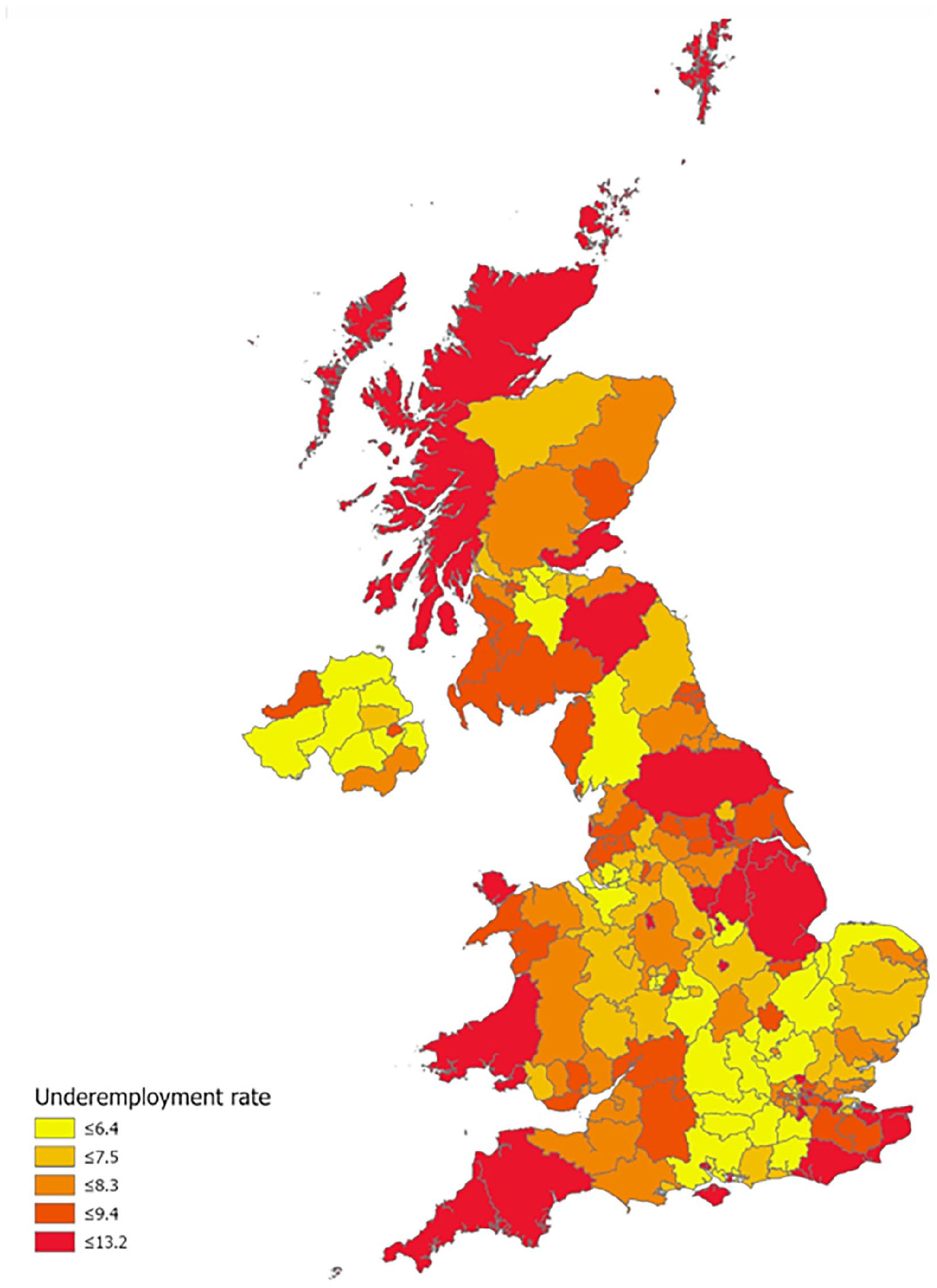
Underemployment rate (% of employed persons) across NUTS3 regions.
Broader UK regional (NUTS1) differences in underemployment range from 6.1% in Northern Ireland to 8.8% in the South West of England (Table 4). Within Great Britain, the East of England has the lowest underemployment rate, at 7.1%, while the highest rates are in remoter rural regions (South West England, Wales and parts of Scotland) and the former industrial East Midlands and Yorkshire & The Humber. London is distinctive in having the highest hours worked but also the highest extra hours wanted of all regions; likely to be linked to London’s young age profile, higher cost of living and, possibly, the selective movement of people into the UK’s capital who want to work long hours.
Hours worked, extra hours wanted, underemployment and unemployment by region (working-age population, 16–64 years).
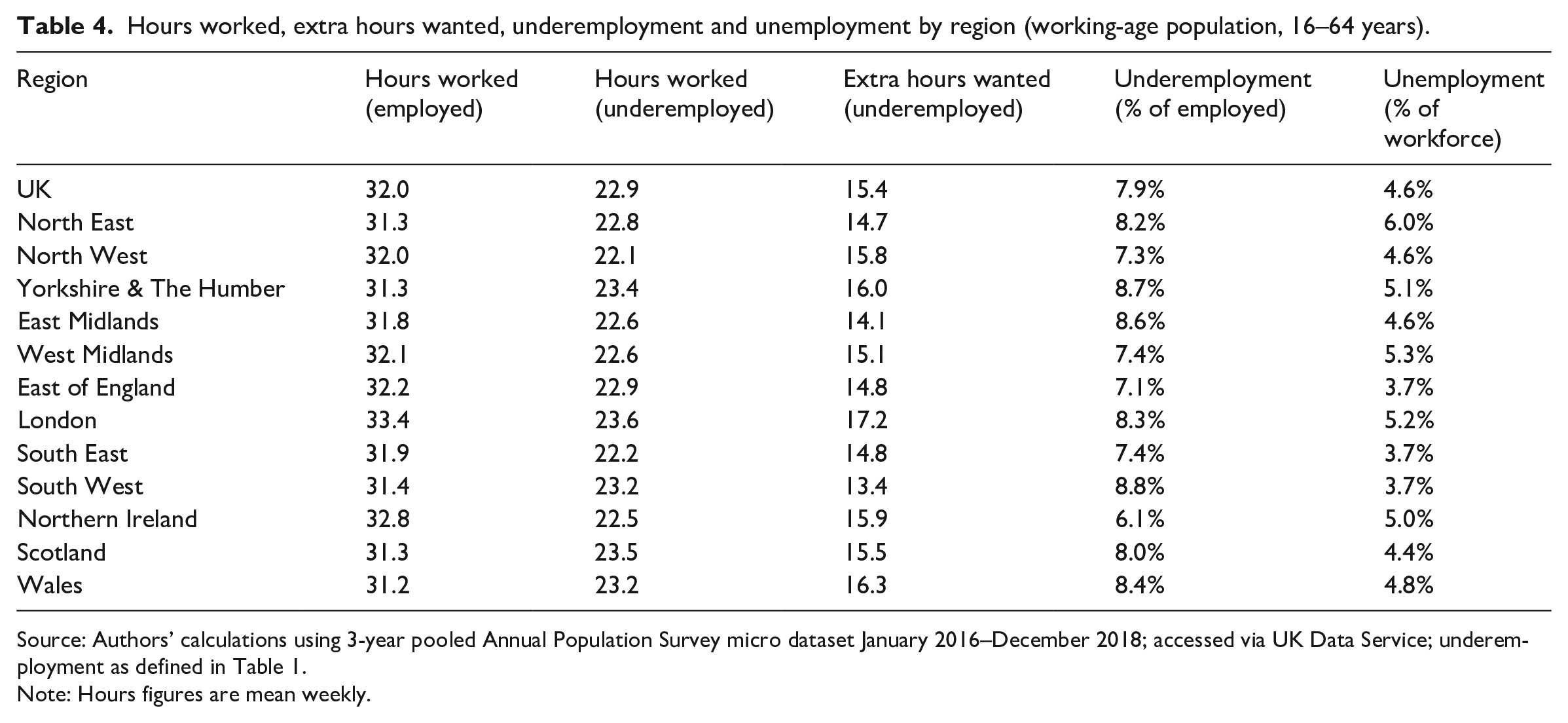
Source: Authors’ calculations using 3-year pooled Annual Population Survey micro dataset January 2016–December 2018; accessed via UK Data Service; underemployment as defined in Table 1.
Note: Hours figures are mean weekly.
What does the geography of underemployment tell us about its causes, in particular low productivity and labour market slack? Would underemployment be expected to follow the same geography as unemployment and the converse geography of productivity? We explored the relationships of local labour demand and the availability of local supply with underemployment, to assess if easily accessible/replaceable labour influences underemployment, as suggested to us in qualitative interviews.
The geographical pattern of underemployment shows key similarities and differences with unemployment (r = 0.235 across NUTS3 regions, Figure 2). The key similarity is that both are higher in weaker regional economies (e.g. North East, Yorkshire & The Humber, Wales, Table 4) and lower in stronger regional economies (e.g. East of England and South East, Table 4), suggesting that tight local labour markets and high productivity keep underemployment down. The key difference is that underemployment is highest in rural areas – by contrast, unemployment is highest in urban areas (Figure 1 and Table 4). London is high on both dimensions, consistent with its dynamic and diverse labour market with strong labour demand and supply (Table 4). The rural South West has the highest underemployment rate of all UK regions but the lowest unemployment rate (Table 4), consistent with the hoarding of staff on low hours to cope with seasonal fluctuations in demand in the face of low labour supply. Overall, while underemployment across NUTS3 regions is linked with unemployment, the correlation is not strong, suggesting that there is no simple relationship between underemployment and other measures of labour market weakness (Figure 2).
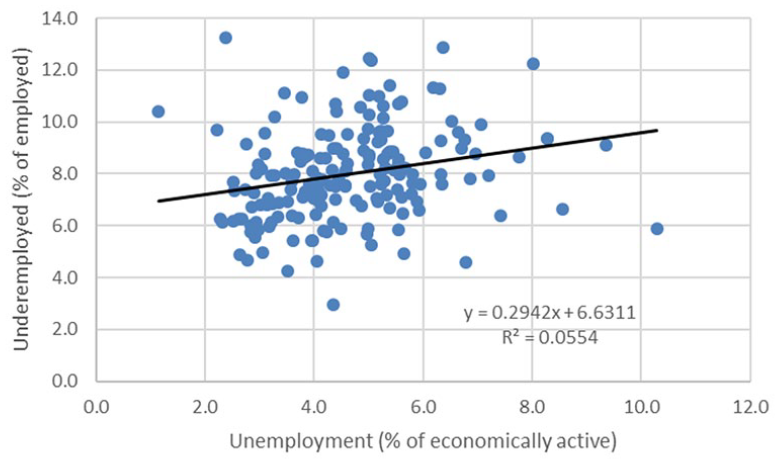
Underemployment and unemployment, NUTS3 regions, 2016–18.
Underemployment is weakly negatively correlated with productivity per hour worked (r = −0.110 across NUTS3 regions, Figure 3). There is no evidence to suggest that underemployment enhances productivity, and weak evidence to suggest that underemployment harms productivity.
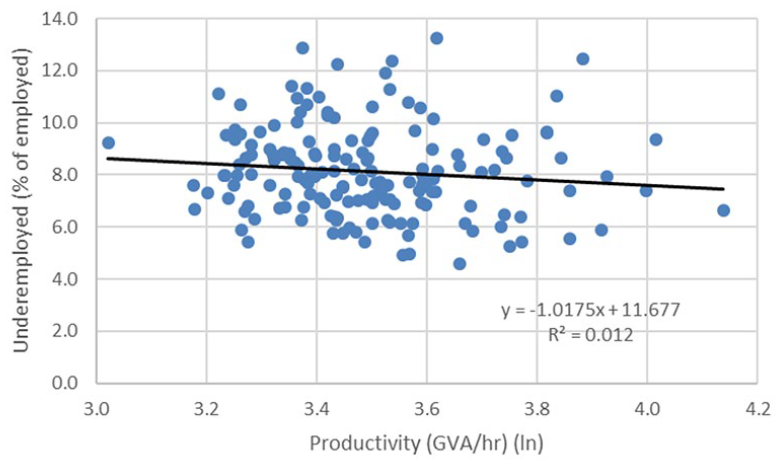
Productivity and underemployment, NUTS3 regions, 2017.
The overall scale of local labour supply and availability is associated with underemployment in complex ways: higher in remoter rural (weak supply) and larger urban (strong supply) local labour markets. There a polynomial relationship between underemployment and labour supply (Figure 4), which explains almost 10% (R2 = 0.0954) of the spatial variation in underemployment rates across NUTS3 regions. Outside large local labour markets, the relationship of labour supply with underemployment is negative: underemployment falls as the size of the local workforce increases (Figure 3). This finding is consistent with employers responding to low labour supply by maintaining a pool of ‘on demand’ staff ready to increase hours. However, as the size of the local labour market increases, the relationship with underemployment becomes positive, perhaps linked to greater ease of recruitment meaning employers no longer fear losing staff who may leave in favour of more hours from an alternative employer. Local labour demand has almost no relationship with underemployment (Figure 5), but this may be masked by strong labour supply in higher demand urban markets.
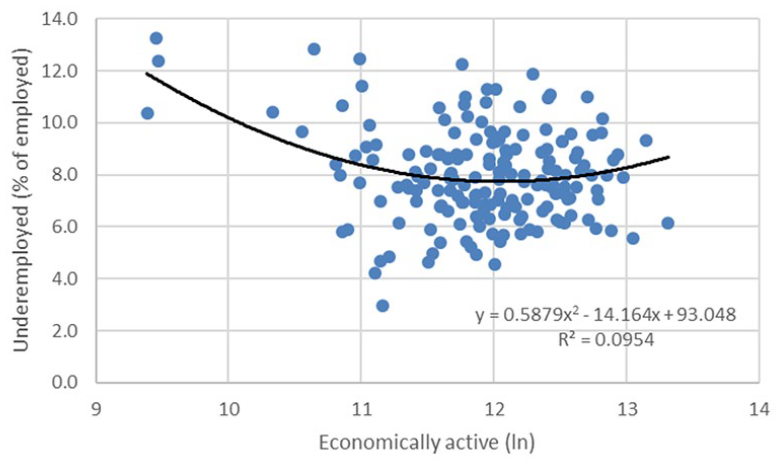
Underemployment and labour supply, NUTS3 regions, 2016–18.
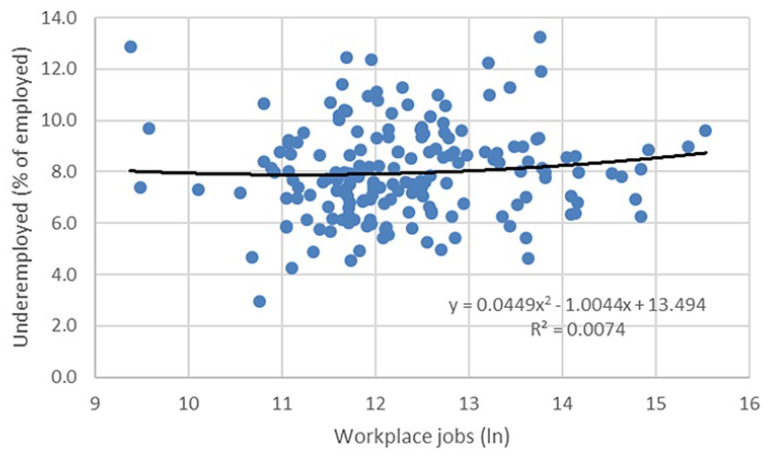
Underemployment and labour demand, NUTS3 regions, 2017.
Perspectives of employer representatives on underemployment and workforce planning
Business models and approaches to underemployment
Some employers mitigated the risk of underemployment because their business models depended on minimizing staff turnover, reflecting challenges in recruiting valued skills and/or the availability of labour. This was particularly true of hospitality employers in sparsely populated rural areas, who feared losing difficult to replace staff. Elsewhere, some larger public and third sector organizations were willing to absorb the costs of having large workforces on longer fixed hours contracts, and pointed to investments in workforce planning capacity (often IT systems) as a means of improving fit between sought and contracted hours.
However, some employers in retail, hospitality and social care saw maximizing staffing flexibilities as essential – because their businesses provided time and place-specific, face-to-face services, and/or because their model was based on minimizing access to costly, ‘long hours’ contracts. Some employers acknowledged that many of their employees were underemployed. For example, a representative of a large retailer indicated that many employees wanted more hours. While there was – as with some other employers – an attempt to characterize this as a problem of employees not demonstrating the flexibility to fit with shift demands, there was also an acceptance that underemployment was a problem.
It definitely comes through loud and clear to me. . . that people would like more hours and to have larger contracts. Again, it is that agility and that kind of flexibility that we need them to do. More often than not, the hours are there. It’s just if they’re there when they want to do them. (Retail 1)
The same manager acknowledged that being underemployed meant having to work multiple jobs to earn sufficient money. It was also accepted that an increasing use of shorter hours contracts meant fewer opportunities for learning, development and progression.
It’s been heart-breaking. . . you’re talking to colleagues and they’re like, ‘I’m on my way to my other job now.’ That really upsets me. . . that’s also had a knock-on effect in terms of development for people as well. . . I’m talking team manager, so a first level of management. It’s harder to be able to do when people are in the business less. (Retail 1)
A number of employers acknowledged that ‘some’ employees were likely to experience underemployment, but often saw this as a product of a combination of variable staffing demands and a lack of individual staff flexibility (especially people with caring responsibilities).
. . .why we can’t give more hours is that the availability of hours is all at the same time. So, if the person wants to do hours at a particular time, then we don’t need everybody in at that time, so those additional hours fall out with that. (Hospitality 3)
Even hospitality sector employers offering relatively long hours part-time contracts (e.g. 30 hours per week) acknowledged that the demand for ‘full flexibility’ in the shifts allocated to staff meant that employees would struggle to find second jobs with complementary hours, again creating the risk of underemployment.
Although we offer a thirty hour a week contract, we expect full flexibility from them, which I think is. . . a little bit unfair, because. . . if you are only offering somebody thirty hours a week and no flexibility their second job has to fit round what you want to do. I think getting another job to fit round what another job wants to do is quite difficult. (Hospitality 4)
Public service (e.g. health and care) employers were reluctant to acknowledge that demands for flexibility could contribute to underemployment risks. They suggested that the need for 24-7 services to be staffed instead meant that there was usually ample demand for more hours to be fulfilled. They did not recognize that conflicts between shift demands and, for example, caring responsibilities could contribute to a risk of underemployment, despite prior evidence of high levels in some areas of the public sector (Bell and Blanchflower, 2013). Rather, among third sector and for-profit social care employers, there tended to be a similar belief that the sheer volume of work available meant that few employees would report being short of hours, but some of our interviewees acknowledged that fitting shifts with caring responsibilities (especially in female-dominated occupations) could be challenging.
Some employers tended to assume that women preferred to work part-time or variable hours. Where women were a large proportion of the workforce (particularly in social care), interviewees were able to cite a range of workforce planning practices designed to manage work and family demands. However, even in these organizations, flexibility for employees appeared secondary to the demands/needs of service users.
We are led by client need. We. . . provide 24/7 services. First and foremost, we are building our services around what the clients need, so that will drive all the hours we have available. So internally, say for example, I’ve got eighty hours of care that are required. Potentially I’ve then got two people at forty hours a week but actually you’d be better with four people at twenty hours a week and there’s a number of reasons for that: if somebody’s off sick, or on holiday there’s less time to cover; for the person it’s a better work–life balance. (Social care 1)
Ultimately, for many employers, where there was a clash between business needs and flexibility for employees, business needs came first. Our interviews also suggested that there may be a link between managers’ awareness of (and action on) underemployment and the capacity and centrality of the HR function. Organizations able to describe systematic workforce planning processes and well-resourced HR functions were more likely to accommodate employees’ shift pattern needs. Representatives of these (larger and/or public) employers provided examples of workforce planning and HR metrics at team/business unit level to identify potential mismatches, including: absence levels, retention/turnover and, in some cases, performance data. Employee engagement exercises, forums and managerial discussions were seen as important in allowing people to voice concerns about working hours. In organizations where trade unions were recognized and/or there was substantial membership, managers reported that constructive relationships with unions provided better informed workforce planning.
However, we also heard of examples of centralized workforce planning focused almost entirely on maximizing flexibility for employer benefit and minimizing staffing costs. In these cases, financial accounting trumped HR management, with workforce planning dominated by top-down budgets and HR and/or business unit managers instructed to prioritize cost containment/reduction.
In some of those organizations that reported most concerns regarding underemployment, the ‘financialization’ of workforce planning was a key feature, i.e. that this and other aspects of HR practice were informed by the need to achieve short-term labour cost reductions, rather than to pursue long-term business objectives (Colombo et al., 2022). A representative of a large hospitality employer (owned by an asset management company) expressed frustration at local managers’ lack of power to challenge financial imperatives and short-term cost containment strategies.
It is quite challenging not having any HR leadership in the middle. . . because you often get the asset manager saying, ‘This is what I want to happen.’ Then [senior management] says, ‘Make it happen.’. . . That can be very, very frustrating, because although you are a well-paid HR manager you are doing a HR administrator’s job and moving spreadsheets about. I think it depends what you want in a job. (Hospitality 4)
Some employers in sectors such as retail and financial services described a similar financialization of workforce planning, and pressure consistently applied by senior management to ‘flexibilize’ working hours. For example, a retail employer representative described outlets with too many people on longer hours contracts as ‘over-contracted’, and discussed how local managers were encouraged to reduce contracted hours.
We’ve simplified our operating model. Jobs that, perhaps, used to take a full day to do have become simpler, therefore reducing the amount of hours that are actually needed within that department and that store. . . We’ve had to look at how we can get people to adapt their hours and have a lot more conversations around availability. (Retail 1)
Our interviews with employers confirmed that a complex range of factors play into decision-making on workforce planning. Of greatest concern, we found that in some organizations the financialization of HR means that cost containment through maximum staffing flexibility is the dominant consideration in designing contracts.
Place, labour markets and approaches to underemployment
Our quantitative analysis identified that underemployment appears to be higher in lower productivity regions, and in both tight low-unemployment remote rural labour markets and in large, dynamic but slacker high-unemployment urban labour markets. Underemployment is associated with different labour market fragilities but the quantitative relationships are weak and complex. Similarly, labour market context was a theme in only some of our interviews, but shaped the thinking of rural and urban employers. For example, rural employers reported recruitment problems, especially in low-paid service jobs, leading some to improve hours and flexible working opportunities, thus reducing underemployment. However, a more dominant process seemed to involve seasonal, weekly and daily peaks and troughs in demand, especially in tourism, leisure and hospitality, leading employers to maintain a staff pool who could rapidly increase hours or be deployed at short notice to cover absence or unexpected customer demand. In remoter rural areas, the twin parameters of low labour supply/recruitment challenges and seasonal/temporal variation in labour demand pressurized employers to retain staff on low hours, leading to underemployment.
Employers in urban areas were less concerned by recruitment problems and less inclined to offer flexibility in terms of hours and shift times. Larger pools of available labour meant that hospitality and retail employers encountered few staffing challenges. High staff turnover was a concern, but this rarely led to changes in contractual practices, given the ease with which employers could replace low-skilled labour. Strong urban labour supply, particularly in demographic groups looking for part-time and flexible hours, made it easier for employers to underemploy staff. Conversely, weak labour supply in remoter rural areas placed an imperative on employers to retain workers on low hours during troughs in demand to enable rapid staffing increases when demand picked up. Local labour market conditions, including the level and variability of both labour demand and supply, therefore influenced workforce planning and underemployment risks in complex and varying ways.
Students are a crucial part of flexible workforces for some employers in urban areas, and the large number of part-time, short hours contracts is viable because of an extensive supply of those who accept flexible hours and shifts (Iaoannou, 2023). It was acknowledged that those who wanted more hours outside of term time could be frustrated and underemployed. Employees – or potential employees – who wanted to work but not in the available hours were generally characterized as lacking flexibility.
You’ve always got that student population that are quite happy, probably, just doing a reasonably low contract if they’re trying to tie it in with uni, college, school. . . When those are off, yes, there’s absolutely that appetite there for more. (Retail 1) We have a lot of students. . . they tend to be students that want to just work the evenings after school or college, or uni. . . and we wouldn’t have full-time contracts for them, because you wouldn’t be able to work full-time across seven evenings, there wouldn’t be enough hours to be able to do that and they’re not flexible enough to work mornings, afternoons and evenings. . . (Hospitality 3)
While it is understandable that employers take advantage of their available local labour pools, these insights highlight how supply provides the context for workforce planning and underemployment. Whereas employers in urban labour markets with access to plentiful, inexpensive labour absorbed the turnover and disengagement sometimes caused by underemployment, those who struggled to recruit in rural labour markets were more likely to offer increased benefits to retain employees. Encouragingly from public policy and HR management perspectives, this means that employers could re-balance flexibilities and give ground to employees where labour market conditions demanded.
Discussion and conclusions
This article used mixed methods to explore the roles of local labour market conditions and employer business models in shaping spatial patterns of underemployment. Initial quantitative analysis of the spatial relationships of underemployment with unemployment and productivity helped inform some questions to ask in the qualitative interviews, while qualitative findings prompted further data analysis of the roles of local labour demand and supply in shaping underemployment. We used qualitative data to explore how these labour market factors, and business models and workplace/HR practices together inform employers’ approaches to underemployment. We acknowledge that the qualitative insights summarized below derive from a small sample of employers that was not designed to be representative of sectoral or geographical concentrations of underemployment. Rather, we sought to recruit employers most likely to provide in-depth insights on how labour markets, business models and HR capabilities come together to shape decision-making around workforce planning, with implications for the underemployment risks encountered by employees. The insights derived, while clearly not generalizable, can be used as a starting point for future, more extensive research on this topic. To the best of our knowledge, this is the first study to provide in-depth qualitative insights on why and how employers arrive at workforce planning strategies that might impact employees’ experiences of underemployment, so we suggest that the findings, though limited, provide important new information. Thus, we now summarize our key findings and discuss the implications for employment policy and ‘building back better’ following the COVID-19 pandemic.
Underemployment has a unique geography, which is related to, but distinct from, that of unemployment and low productivity. Generally, underemployment is more prevalent in weaker, less productive local economies and in ‘slacker’ local labour markets with lower unemployment. However, these geographical associations are weak across NUTS3 UK regions and there are important exceptions that hint at some of the contrasting processes producing underemployment in different local labour market and geographical contexts. Remoter rural areas and, to a slightly lesser extent, large cities with high unemployment display the highest rates of underemployment. In rural areas, underemployment occurs alongside low unemployment. In urban areas, underemployment occurs alongside higher unemployment.
Labour supply can have contrasting effects on underemployment in different local labour market and geographical contexts. Remoter rural and some coastal areas dependent on the seasonal ‘visitor’ economy display low labour supply and weak labour demand. The combination of weak labour supply and demand seems to produce high levels of underemployment, consistent with employers hoarding labour on low hours during troughs in demand in order to avoid difficulties hiring when demand picks up, as suggested in our qualitative findings.
Weak labour supply encourages underemployment in rural labour markets. In contrast, large urban labour markets appear to have plentiful labour supply, including demographic groups wanting to work part-time and flexible hours, which also appears to produce high levels of underemployment, but through a different incentive mechanism – employers can maximize flexibility by maintaining a workforce ready and willing to increase hours at short notice. Strong labour supply encourages underemployment in urban labour markets, as workers are readily replaceable and therefore employers invest less in retention and do not fear losing staff leaving for alternative employers offering more hours.
The research reported above adds to the literature by moving beyond discussions of which employees are more likely to experience underemployment and its consequences, to begin to address why and how questions. Our quantitative analysis breaks new ground in seeking to understand how place and labour market effects might relate to underemployment. Our qualitative analysis explores themes that might help to explain how labour market conditions combine with the constraints of business models and management capabilities to shape decisions on workforce planning that feed through to underemployment risks. There would be value in more extensive employer-facing research to further explore these emerging themes.
Our analysis also has a number of policy implications. First, low levels of unemployment and underemployment are linked with greater local productivity, so local and regional development strategies focused on increasing average hours of work and the creation of ‘good jobs’ (in higher skilled and higher paying sectors) may help boost labour utilization and productivity in less buoyant labour markets. There is increasing focus among some policymakers in the UK nations and regions on ‘fair work’ agendas (Fair Work Commission, 2019; Scottish Government, 2022; Taylor, 2017), and promoting better jobs should be a priority at all levels of government. It is therefore of concern that the UK Government’s (2017) Industrial Strategy did not specifically prioritize tackling underemployment and there has been little by way of policy content to suggest that the UK Government in power at the time of writing sees improving job quality as part of its ‘levelling up’ regional development strategy (Moore and Collins, 2020). Our mapping of underemployment dynamics also points to very specific challenges in remote rural labour markets, which require tailored policy responses ranging from investments in connectivity and affordable housing in order to boost labour availability (Black et al., 2019).
Given the sectoral concentrations of underemployment, the diversification of weaker and rural labour markets is also a priority (MacDonald, 2019). The fundamental shifts that we continue to see in post-COVID-19 labour markets throw up both challenges and opportunities. Shifts in consumer behaviour such as changes to commuting, travel habits and/or a preference for online retail, as well as a drop or geographical shift in footfall in cities, mean that there may be fewer jobs in ‘low end’, time and place-specific, face-to-face services. Hybrid and homeworking is likely to remain an essential part of new forms of work organization, and a strong preference for many employees, which will influence the attractiveness of jobs (Findlay et al., 2021). Policymakers and industry representatives may be denied the excuse that their business models and sector norms require ‘full flexibility’ by employees. Consequently, there is value in governments adopting interventionist approaches to encourage building back based on jobs and sectors where underemployment has been less prevalent, while engaging employers in discussion on the need to balance business needs with a respect for flexibility that benefits the employee as well as the employer.
However, there may be limited scope for public policy to persuade some employers in underemploying sectors to act differently. A key finding from our qualitative interviews is that some employers in hospitality, retail and care have underemployment ‘hardwired’ into their workforce planning practices because of overarching business models predicated on maximizing flexibility (for the employer) and minimizing staffing costs. More specifically, our findings point to underemployment problems in organizations where there has been a ‘financialization’ of the HR function and little capacity to challenge top-down cost containment strategies. The embedded nature of these priorities may require regulatory responses that demand more of employers to justify their use of short hours contracts. A broader policy agenda might focus on encouraging employers and investors to consider ‘stakeholder-oriented’ business models, which allow for a range of voices, including employees and trade unions, in decision-making and have a longer-term focus of the contribution of the organization and its people to value creation (Mazzucato et al., 2020).
On the supply-side of labour market policy, countries like the UK should re-think their reliance on ‘work-first’ activation and welfare conditionality policies, used to force the unemployed to accept any job, irrespective of its suitability, with many ‘successful’ jobseekers experiencing underemployment (Rafferty and Wiggan, 2017). Green and Livanos (2017: 189) argue that the rise in involuntary non-standard employment in different EU states may be related to the prevalence of these ‘stringent job activation regimes in which the onus is on claimants to take non-standard work even if their preference is for a full-time permanent job’. A better focus for supply-side policy might involve investment in further education and training to ensure that young people and other vulnerable groups have the opportunity to upskill as a route out of underemployment (Gable et al., 2020). Indeed, given prior evidence that young people are more likely to experience underemployment, ‘Young Person’s Guarantee’ initiatives – which operate in all nations of the UK to provide people aged 16–25 with access to education, training or employment – should be calibrated to ensure that employment outcomes do not contribute to underemployment. Raising awareness among employers of the consequences of underemployment among young people should be a priority for these initiatives and apprenticeship programmes.
Women are also more likely than men to experience underemployment, at 8.6% and 7.2% of employed persons, respectively, in contrast to unemployment, which women are less likely to experience than men, at 4.5% and 4.7%, respectively, in 2016–18 (Lindsay et al., 2020), and the sectors that have provided a focus for our discussion above all employ more women than men. There is a clear gendered component to underemployment. Domestic caring responsibilities and gaps in affordable and accessible childcare or adult care provision limit the ability of some women to take up additional hours. Policymakers need to consider re-investing in flexible, ‘wraparound’ childcare and adult care services (Reuschke, 2019).
Finally, while the role of employee voice was beyond the scope of our research, we acknowledge MacDonald’s (2019: 31) review of international evidence on underemployment that concludes that ‘collective bargaining and social dialogue can help to improve the quality of jobs by improving the bargaining power of workers . . . including the underemployed’. We concur with the argument that employee voice and worker representation can be important foundational conditions for better job quality and fair work, so recent policy interest led by the left-of-centre Labour Party in the UK in improving employees’ rights in this space is welcome. When disseminating the research reported above, we engaged with a range of trade union representatives, who consistently reiterated the need for stronger organizing and bargaining rights in the face of the financialization of business models that we have discussed.
In conclusion, underemployment can impoverish and disempower workers, and impact negatively on their wellbeing. Underemployed workers may be less committed and productive. The evidence suggests that far from being a transient experience for a few on the margins of the labour market, underemployment has become a larger-scale problem affecting the long-term employment prospects of a wide range of workers. That’s why we are arguing for urgent policy action to enable the UK to build back without underemployment.
Footnotes
Declaration of conflicting interests
The authors declared no potential conflicts of interest with respect to the research, authorship, and/or publication of this article.
Funding
The author(s) disclosed receipt of the following financial support for the research, authorship, and/or publication of this article: The study was funded by ESRC Productivity Insights Network.
