



Abstract
Right-wing extremist attitudes are a severe challenge to democracies and trade union movements around the world. Moreover, changes in the world of work, economic insecurities, and the effects of globalized capitalism – all bread-and-butter topics for trade unions – are a breeding ground for right-wing extremism also in countries with comparatively strong social security and co-determination rights like Germany. In this article, the authors focus on democratic efficacy at the workplace as a protective factor against far-right politicisation among workers. They argue that experiencing control and influence on decision-making at the workplace is related to lower right-wing extremist attitudes. The article introduces a new measure employed in a representative survey in Germany. The findings strongly suggest that perceived democratic efficacy at the workplace reduces right-wing extremist attitude. This holds even when authoritarianism and standard socio-demographics are controlled for. The findings suggest an empowerment effect of efficacy experiences at the workplace. Such empowerment makes it less ‘necessary’ for individuals to devalue out-groups and deisre strong a (national) leadership. Practical implications and limitations of the study are discussed.
Introduction
The question of how workplace democratization could benefit political democracy seems more pressing today than ever (Almond and Verba, 1963; Ferreras et al., 2022; Marshall, 1950; Pateman, 1970). In many industrialized countries, including Germany, the rise of the far right is putting democracy under pressure. It has also sparked debates on how work experiences might fuel far-right sentiment and whether we can identify levers in the workplace to counter attraction of the far-right among the population (Azzellini, 2021; Dörre et al., 2018; Hövermann et al., 2021). In this article, we follow up on these urgent debates and explore a new link in the ‘work-politics-nexus’ (Peterson, 1992), the connection between individuals’ sense of democratic efficacy at the workplace (DEW), and their susceptibility to far-right ideology. We ask whether democratic efficacy at the workplace (DEW), which results from experiencing control and influence at work, may directly reduce individuals’ support for right-wing extremist attitudes. In doing so, we extend previous work on the political ‘spillover effects’ of workplace democratization in three ways (Kim, 2021; Rybnikova, 2022):
First, we address individuals’ rejection of far-right attitudes as an outcome of workplace experience. To date, studies have mainly examined how workplace democratization fosters political participation (Budd et al., 2018; Geurkink et al., 2020), democratic legitimacy and political trust (Hassan, 2024; Ryan and Turner, 2021; Timming and Summers, 2020), and contributes to employees’ moral development (Unterrainer et al., 2011; Verdorfer et al., 2013; Weber et al., 2009). However, there are no studies comprehensively examining the effects on right-wing extremist attitudes. We argue that the rejection of right-wing extremist attitudes should be included in research on the political consequences of workplace democratization as it is not only a highly relevant social problem but can also serve as a strong indicator of democratization.
Second, we contribute to a deeper understanding of the role that individual efficacy beliefs play for the spillover effects of workplace democratization. Previous research has seen workplace democratization as increasing individuals’ sense of political efficacy, i.e. their belief in their influence in the political arena and the responsiveness of the political system (Craig and Maggiotto, 1982), which then encourages individuals to be more engaged citizens (Pateman, 1970). Attempts to confirm this mediating role of political efficacy have yielded mixed results (Carter, 2006; Elden, 1981; Greenberg et al., 1996; Jian and Jeffres, 2008; Peterson, 1992; Sobel, 1993). We argue that a more comprehensive understanding of the democratic spillover effects of workplace democratization, and the crucial role of efficacy beliefs in this, can be achieved by distinguishing individuals’ sense of political efficacy from their efficacy beliefs in relation to democratic participation at work itself (Elden, 1981; Geurkink et al., 2020; Peterson, 1992). If employees feel that they can influence authority structures and decision-making at the workplace, or on the contrary, mainly experience a lack of participation and co-determination, this may directly influence their support for (anti-)democratic attitudes, we further argue. Thus, we introduce democratic efficacy at the workplace (DEW) as a new, more focused measure of efficacy beliefs in relation to the workplace.
Third, if there is a direct link between higher democratic efficacy at the workplace (DEW) and lower far-right attitudes, this suggests that it is the empowerment of employees at work, including a shift in power between management and employees, which makes them less susceptible to far-right attitudes (Wu and Paluck, 2020). This effect can be understood in terms of the classic theory of authoritarianism, according to which individuals are attracted to far-right thinking because it provides an ideological compensation for excessive feelings of powerlessness, lack of control, and recognition in everyday life (Decker et al., 2018; Fromm, 1937; Horkheimer et al., 2005 [1936]). This ‘empowerment effect’ constitutes, in our view, an important addition to existing explanations of the spillover effects of workplace democratization, which have seen the transfer of participation skills acquired at work (Budd and Lamare, 2021; Geurkink et al., 2020) or the influence of organizational culture on individuals’ moral development (Verdorfer et al., 2013: 426; Weber et al., 2009) as central mechanisms of political spillover effects.
In the following, we introduce the concept of DEW as a new measure of efficacy beliefs at work and relate it to the existing literature on spillover phenomena and powerlessness at work as a breeding ground for far-right sentiment in Germany. Thereafter, we introduce our dataset, a 2020 representative survey focused on political attitudes in Germany, as well as our methods. In the subsequent section, we present our findings. Finally, we comment on the limitations of our study, ways of advancing this important research topic, and potential practical implications.
Spillover effects of workplace democratization
For some time now, scholars have pointed to the world of work as an agent of political socialization (Almond and Verba, 1963; Marsh, 1971; Peterson, 1992; Sigel, 1989). Given the time spent at work as well as the importance of work for social integration and identity formation, the workplace presents one of the central spheres of shared experience in adult life (Jahoda, 1984). The ‘civic deficit’ (Lockwood, 1996), which structurally characterizes the workplace, has therefore led to calls for the democratization of work (Arrighi and Maume, 1994; Frega et al., 2019; Pateman, 1970). Following Elden (1981: 51), ‘workplace democratization’ has two facets and manifests in employees’ control over their work as well as their influence on organizational decision-making (see also Hassan, 2024; Peterson, 1992). It is seen not only as an end in itself (Frega et al., 2019), but also as bearing the potential to strengthen political democracy (Almond and Verba, 1963; Marshall, 1950; Pateman, 1970).
Carole Pateman’s (1970) argument of a democratic ‘spillover’ from the workplace to the political arena has been the most influential conceptualization of these democratization effects to date. It argues that participation in the workplace enables and encourages employees to engage as citizens, leading to greater political participation and a stronger belief in democracy (Pateman, 1970: 45–66). Pateman attributed a crucial role to workers’ efficacy beliefs as the central factor enabling the spillover effects and mediating between workplace experience and the political arena. This is usually understood in terms of skill transfer and generalization: When employees are able to participate at work, they learn participatory skills that are useful in the political arena. In addition, they generalize the expectation of successful participation at work to the political arena, participate more and thus become more satisfied with democracy (Adman, 2008; Almond and Verba, 1963; Carter, 2006; Greenberg et al., 1996; Hassan, 2024; Timming and Summers, 2020). In this model, workplace democratization is seen as strengthening political efficacy, i.e. a person’s sense of influence over the political process, consisting of a belief in his or her ability for effective political action (e.g. voting, protesting, etc.) as well as assumptions about the responsiveness of the political system (Balch, 1974; Craig, 1979: 227; Craig and Maggiotto, 1982). However, studies examining the mediating role of political efficacy produce mixed results and our understanding of the role of efficacy beliefs in spillover effects remains somewhat underdeveloped (Kim, 2021; Rybnikova, 2022).
The idea of a democratic spillover also implies the possibility of an empowerment effect at the workplace itself that has further political implications (Elden, 1981; Geurkink et al., 2020; Peterson, 1992): If employees feel that they can influence authority structures and decision-making processes at work, rather than experiencing a lack of influence and control in their working lives, this may directly shape their political subjectivity. This does not necessarily imply a mediation via political efficacy, but suggests that individuals also develop efficacy beliefs with regard to democratic participation at the workplace which are relevant for democracy in the political arena. Therefore, we contribute to understanding the spillover effects of workplace democratization by distinguishing individuals’ sense of political efficacy from their sense of democratic efficacy at work (Geurkink et al., 2020). Hence, we suggest to elaborate on individuals’ democratic efficacy at the workplace (DEW) and investigate its potential consequences for political attitudes.
Democratic efficacy at the workplace
We conceptualize democratic efficacy at the workplace (DEW) as an individual’s perceived ability to exert control and influence at the workplace. The concept of DEW draws on the notion of political efficacy and specifies it for the context of democratic participation in the workplace. Scholars suggest that in domains of everyday life where authority structures and bottom-up participation are negotiated, individuals develop a sense of efficacy similar to political efficacy. In the few studies that examine workplace efficacy, its conceptualization and measurement closely mirror established measures of political efficacy (Geurkink et al., 2020; Peterson, 1992). We argue that these operationalizations of efficacy beliefs remain too abstract to capture the specific conditions of democratic participation at work, as opposed to the political arena. It enhances our understanding of workplace-related efficacy beliefs to relate them to the two dimensions of ‘workplace democratization’ as suggested by Elden (1981: 51): control in the labor process and influence on decision-making in the company. Both control and influence at the workplace are not only experienced and exercised individually but also collectively, as the literature suggests (Budd and Lamare, 2021).
Against this theoretical background, we can elaborate further on the dimensions of democratic efficacy at the workplace. In its first instance, perceived individual control, DEW refers to the extent to which employees expect to make decisions about the organization of their daily work, rather than having it determined by management. Individual control of everyday job routines involves defining competencies, tasks, and their distribution, working hours and work density, as well as imagining and designing new work processes, and is often referred to as ‘job autonomy’ (Arrighi and Maume, 1994; Cotton et al., 1988). Individuals can exert varying degrees of control over their work routines, ranging from complete autonomy to veto rights or, at a minimum, being consulted in decision-making processes about work routines (Cotton et al., 1988: 12). While the experience of heteronomy at work has been shown to evoke feelings of powerlessness and self-alienation that transfer to other domains of life (Blauner, 1964; Lipsitz, 1964; Seeman, 1959, 1975; Sheppard and Herrick, 1972), we expect individual control to contribute to employees’ DEW. It points to a shift in the balance of power in the workplace, implying that employees have a say over their supervisors (Arrighi and Maume, 1994: 159; Greenberg et al., 1996: 316), and indicates a degree of recognition of employees as responsible individuals (Jansen, 2016).
Control at the workplace is experienced and exercised collectively, too. How employees experience (possibilities for) collective agency together with colleagues, we argue, also feeds into a sense of democratic efficacy at the workplace. Collective agency can be experienced in institutionalized forms of participation such as cooperation in teamwork. But it also includes an informal culture of collegiality that ranges from helping each other troubleshoot to resolving conflicts independently, as well as covert forms of workers’ control that can lead to collective activism and more conflictual forms of solidarity (Hodson, 1995: 80). Through such activities, employees experience themselves as a solidarity group (Markovsky and Lawler, 1994) and they achieve benefits by supporting each other (Hechter, 1988). Furthermore, practices of collective control reflect employees’ confidence in their ability to self-manage affairs (Geurkink et al., 2020). At the same time, collective control requires corporate authority structures that are responsive to collective participation, rather than advocating for a strictly centralized control regime.
The notion of perceived influence in our definition of DEW describes employees’ sense of being able to influence policies and authority structures in the company beyond participating in the organization of their daily work, i.e. to change things in the company through their actions. This aspect differs from the previously discussed aspect of (individual and collective) control (Peterson, 1992). Peterson described giving personal input into organizational decision-making as a central aspect of ‘workplace politicization’ (Peterson, 1992: 513–517). We argue that a firm’s responsiveness to workers’ concerns and expertise is central to democratic efficacy at the workplace. When organizational decision-making acknowledges employee input, it makes employees feel recognized and valued, which fosters their sense of democratic efficacy at work (Greenberg et al., 1996: 316ff.; Elden, 1981: 49; Jansen, 2016).
Last but not least, employees’ influence on decision-making at the workplace includes institutions of co-determination such as trade unions or works councils. Such participation goes along with a greater shift in a company’s power structure in favor of employees and has been shown to raise awareness about the interconnections between the politics of the plant or company and the politics of society (Arrighi and Maume, 1994: 154ff.; Budd and Lamare, 2021: 4; Hadziabdic and Baccaro, 2020). The literature thus regards co-determination, i.e. the collective exercise of influence, to be inherently more political than job autonomy, and emphasizes its significance for political socialization. Representative forms of collective influence like unions or works councils share substantial similarities with democratic decision-making in civic democracy (Frymer and Grumbrach, 2020). Experiences of co-determination and unionization are thus assumed to ‘instill beliefs about the importance of democratic decision-making’, i.e. to foster democratic legitimacy (Budd and Lamare, 2021: 4; see also Frymer and Grumbrach, 2020). Unions are further said to represent an institutional reservoir of solidarity practices shaping their members’ political outlook (Morgan and Pulignano, 2020: 14). While union membership in itself may not automatically increase workers’ sense of democratic efficacy at the workplace (Hassan, 2024), the actual presence and policies of a union in a workplace may well have an impact. On the other hand, we argue, that it is crucial for co-determination as a part of democratic efficacy at the workplace, whether workplace authority structures are responsive to workers’ organized demands or hostile against unions or works councils (Bryson et al., 2015).
To sum up, we argue that the perceived ability to individually as well as collectively exercise control and influence at work leads to an individual’s overall feeling of democratic efficacy at the workplace (DEW). As a perceptual concept, DEW differs from measures of actual participatory behavior applied in studies on workplace participation (Greenberg, 1983; Greenberg et al., 1996; Kim, 2021) and is also distinct from concepts analyzing the democratic quality of organizational structures (Unterrainer et al., 2011; Verdorfer et al., 2013). Likewise, DEW is distinct from measures of employees’ perception of workplace climate, which refer to the organizational level as the unit of analysis and take workgroup performance or work humanization as their normative and conceptual point of departure (Kaptein, 2008; Morrison et al., 2011; Naumann and Bennett, 2002). 1 And, finally, DEW is different from notions of ‘workplace efficacy’ in management literature and work psychology, which commonly refer to individuals’ self-efficacy beliefs regarding work performance (e.g. Edward and Munro, 2008). Rather, DEW describes a sense of democratic efficacy in the domain of work which is distinct from individuals’ political efficacy and reflects processes of workplace democratization.
Workplace democratization and far-right attitudes
The question of whether workplace democratization not only fosters political participation but also strengthens employees’ democratic beliefs is the subject of an ongoing debate. The literature examining the impact of workplace democratization on political attitudes has focused on democratic legitimacy, political trust, and political interest, and has produced mixed results (Hassan, 2024; Ryan and Turner, 2021; Timming and Summers, 2020). Only a few studies have addressed aspects of far-right attitudes as the outcome of spillover processes. Wu and Paluck (2020: 5) report lower-status workers in China and the USA who enjoyed increased participation opportunities at work to be ‘less authoritarian and more critical about societal authority and justice’. Stanojevic et al. find a U-shaped relation between experienced voice suppression by supervisors at work and political authoritarianism among Dutch employees (Stanojevic et al., 2020a, 2020b). They also find employees to be more likely to support a populist style of politics if they experienced voice suppression (Stanojevic et al., 2020b). 2 Weber and Unterrainer show in various studies that stronger democratic structures and more responsive organizational culture, among other factors, foster humanitarian-egalitarian ethics and liberal-democratic norms among employees (Unterrainer et al., 2011; Verdorfer et al., 2013; Weber et al., 2009). Ryan and Turner (2021) find individuals working in a more democratic environment to report less anti-immigrant sentiment. But, as Greenberg’s seminal studies show, there are also conflicting results indicating that cooperative workers had more anti-solidarity, anti-egalitarian and conservative attitudes than their counterparts in conventional workplaces (Greenberg, 1981: 37–40; 1983: 191–199). These results from international studies indicate that workplace democratization may have an effect on particular aspects of far-right attitudes. Research that comprehensively explores support for or rejection of far-right extremism as an outcome of workplace democratization is hitherto missing.
Powerlessness at work as a breeding ground for far-right sentiment in Germany
A similar assessment can be derived from a strand of German literature that examines the appeal of the far right among German workers. Here, studies point to workers’ feelings of powerlessness and lack of control and recognition at work as a catalyst for far-right politicization. However, these studies are either non-representative case studies or address only partial aspects of employees’ workplace-related efficacy beliefs. The case of Germany is particularly interesting since the German model of co-determination is characterized by a high degree of collective rights including mandatory works councils for big companies (Holst and Dörre, 2013; Unger, 2015). However, the institutions of social partnership have come under pressure in Germany, too; the level of unionization, collective agreement coverage, and the coverage by works councils have suffered from (growing) imbalances between employers’ associations and trade unions (Baccaro and Benassi, 2017; Baccaro and Howell, 2011; Hyman, 2016; Schulze-Cleven and Rothstein, 2021). Therefore, recent studies have been conducted against the background of ‘post-democratic trends’ in German industrial relations (Brinkmann and Nachtwey, 2013), which threaten to undermine democratic efficacy at the workplace.
In a representative survey, Hövermann et al. (2021:6) find that a perceived lack of control over daily work routines fuels anti-democratic attitudes among German employees, while Hilmer et al. (2017) find that it pushes employees toward the far-right Alternative für Deutschland (AfD) party. Based on qualitative case studies, Sauer and Detje (2019) describe how feelings of powerlessness, lack of control, and devaluation originating from the restructuring of work processes and intra-company relations drive union members towards right-wing populist movements and parties. Based on a case study with right-wing unionists in East Germany, Dörre et al. (2018) conclude that experiencing rigid hierarchies at work while expecting social and political deprivation in the future makes workers express racist forms of social criticism. Workers’ emphatic reference to identitarian, ethnic concepts of democracy stemmes in part from their experience of the company as a ‘co-determination-free zone’ where they were excluded from participation (Dörre et al., 2018). However, as these studies indicate ‘negative’ spillover effects, we still lack representative research that comprehensively examines the potential of democratic efficacy at the workplace to counter right-wing extremist attitudes.
Based on the considerations laid out so far, in the remainder of this article we will investigate the effect of democratic efficacy at the workplace on right-wing-extremist attitudes. We argue that research hitherto did not comprehensively explore and operationalize individuals’ efficacy beliefs related to democratic participation at the workplace and investigate their impact on extreme right-wing attitudes. This limits our understanding of democratization processes emanating from the workplace. We therefore suggest democratic efficacy at the workplace (DEW) as a distinct sense of efficacy that reflects individuals’ perceived ability to control work-related matters and influence workplace authority structures. Based on our discussion of the existing literature we assume that DEW directly affects political attitudes and is negatively associated with right-wing extremist attitudes. Hence,
H1: Democratic efficacy at the workplace (DEW) is negatively associated with right-wing extremist attitudes.
Data and methods
Sample and procedures
To test our hypothesis, we used a representative survey focusing on right-wing extremist attitudes and authoritarianism in which we were able to implement our newly developed measure of DEW. The survey was conducted in May and June 2020 using paper-and-pencil interviews with a total of 2,503 respondents and following the established rules of randomized sampling. For an overview of the composition of the data see Decker et al. (2020). The data were collected in the first phase of the Covid-19 pandemic. We may expect growing affection towards authoritarianism and far-right sentiment during economic crises (Decker et al., 2013b; Sprong et al., 2019). However, in May/June 2020, the economic consequences of the pandemic had not yet fully unfolded. Overall, the study reported decreasing levels of right-wing extremist attitudes at that point (Decker et al., 2020). To account for discrepancies with the official population statistics, in the regression model below we use a sampling weight adjusting age, gender, and education accordingly (our findings, however, are robust to using or not using this weight). Moreover, we only include those respondents currently in employment (N = 1,480) and exclude students, retired, and other persons not currently having a job, since our items measuring DEW were only administered to respondents in employment. The number of cases is only slightly reduced further by missing values of our central independent variable (DEW). We opted for listwise deletion because the composition of the sample was not affected by the small number of deleted cases. Our analysis proceeds in two steps. First, we provide pairwise correlation estimates for the association hypothesized above. Second, we include our main variables as well as controls into a linear regression model to estimate the relative importance of the independent variables and, most importantly, assess whether democratic efficacy at the workplace remains relevant after including other factors.
Measures
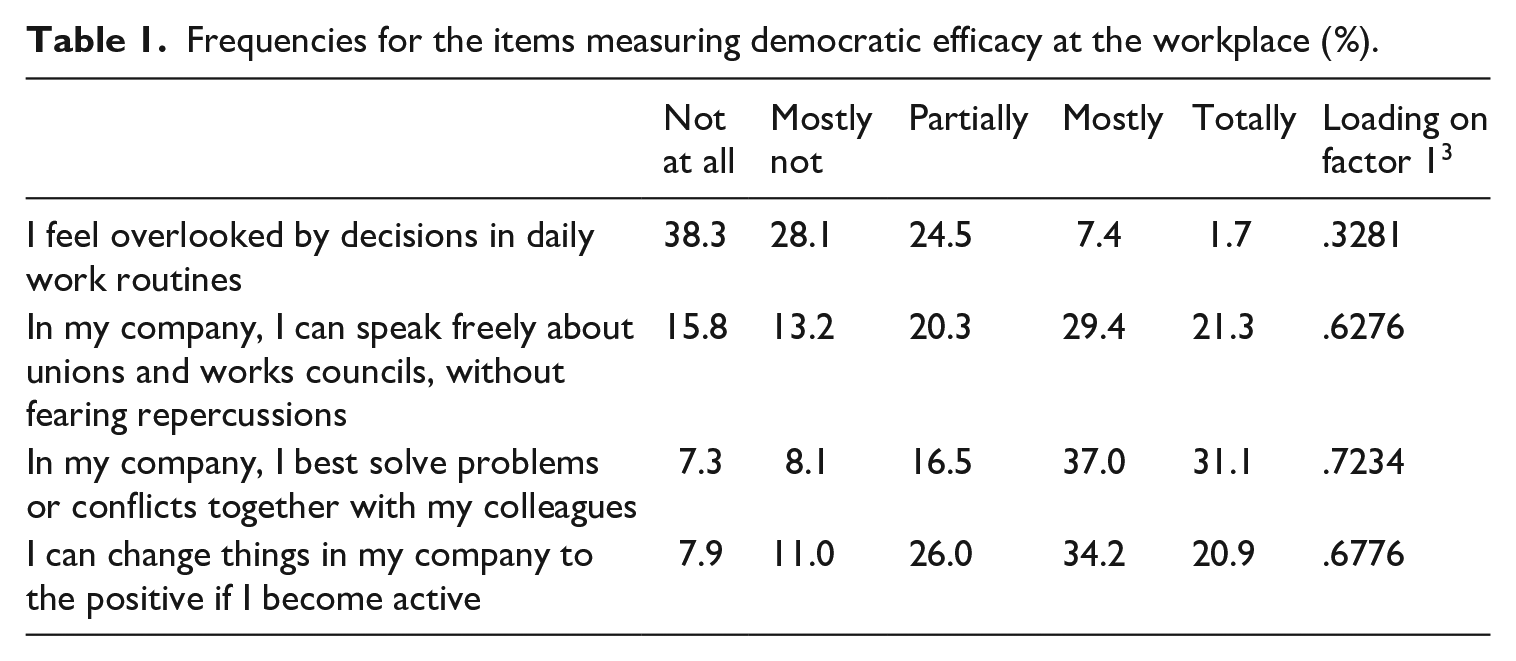
To measure our main independent variable, democratic efficacy at the workplace (DEW), we developed four items that cover perceptions of individual as well as collective control and influence as described above (see Table 1). We combined the four items into an additive scale that reaches a satisfactory Cronbach’s alpha of .72 and a McDonald’s omega of .73. Principal factor analysis reveals that the first (reverse formulated) item loads only weakly on the first factor with the other three items loading much more strongly. For a three-item scale, Cronbach’s alpha increases to .74, and our findings below do not change in any substantial way. To keep the theoretically relevant experience of feeling overlooked and because a reverse formulated item also has the merit of strengthening the measure theoretically, we decided to keep all four items and form one scale by taking the mean across all items (allowing for one missing item response).
Frequencies for the items measuring democratic efficacy at the workplace (%).
As is typical for the German context, we operationalized far-right attitudes, our dependent variable, with the concept of right-wing extremism (REX). Right-wing extremism is considered to describe a relatively stable and consistent pattern of attitudes (Heller et al., 2020). Its core consists of rejecting democratic mediation, favoring dictatorship, and denying the democratic norm of equality of all human beings (Decker et al., 2022; Kiess et al., 2016). We measured REX using a questionnaire containing 18 items covering six dimensions, namely approval of dictatorship, xenophobia, chauvinism, anti-Semitism, social-Darwinism, and downplaying of National Socialism. While the questionnaire can be used to build scales on these subdimensions, it has also been shown to measure one overarching concept (Heller et al., 2020): right-wing extremist attitude. Principal factor analysis supports this by revealing one main factor that all items load on. The Cronbach’s alpha of the additive scale we use is .94 and McDonald’s omega is .94. 4 Decker et al. (2020) report in detail results for these items, showing, for example, that 17% of respondents agree with the statement ‘Germany needs a strong single party that represents the ethnic community (Volksgemeinschaft) as a whole’, with another 21.2% choosing the middle category (partly agree, partly disagree). Approval of single xenophobic and chauvinist statements is considerably higher, suggesting that these sub-dimensions of right-wing extremist ideology are much more widespread in German society. In general, the mean of 2.07 (on a scale from 1 to 5, see Table A2) of the scale shows that approval of right-wing extremist ideology is rather low. As studies repeatedly show, support for right-wing extremism depends only to a limited extent on socioeconomic factors (Decker et al., 2022). However, perceived economic deprivation and the combination of cultural deprivation and authoritarian values are relevant predictors (Decker et al., 2013a; Kiess et al., 2017; Pettigrew, 2016; Yoxon et al., 2019).
In our regression models below we include authoritarianism and union membership as central control variables. These predictors offer competing explanations for the approval or rejection of right-wing extremism for they represent various domains of political socialization. Authoritarianism is the most reliable predictor of extreme right-wing attitudes (Cohrs and Asbrock, 2009; Decker et al., 2022). The concept describes a stable personality trait formed primarily through education in childhood and adolescence and further formed and reactivated in the life course (Wu and Paluck, 2020). This underlying character trait makes individuals prone to anti-democratic sentiment. Authoritarianism was measured with a short scale encompassing three dimensions of the personality trait, namely aggression, submission, and conventionalism. Again, the scale shows high reliability (Cronbach’s alpha = .86) and exploratory factor analysis confirms the original findings of Beierlein et al. (2015), who introduced the scale as a highly reliable measure. For a measurement model investigating the relationship between right-wing extremism and authoritarianism see Dilling et al. (2023). Generally, research on German union members’ attitudes mostly confirms the ‘mirror thesis’, i.e. among union members anti-democratic orientations are similarly distributed as in the general population (Hilmer et al., 2017; Stöss, 2017; Zeuner et al., 2007). Therefore, we assume no significant relationship between union membership and right-wing extremist attitudes. Union membership was assessed with a question simply asking for current membership in any trade union.
As further control variables we include left–right self-placement (continuous), the residence of the respondent in East and West Germany (dummy) because of the often-addressed differences between the two parts in terms of political attitudes but also working conditions, pay, and co-determination structures, (Decker and Brähler, 2020) educational attainment (dummy), age (continuous), gender (dummy), migrant background (dummy), income group (categorical), and previous unemployment (dummy).
Results
In general, German respondents tend to report rather positive perceptions of their democratic efficacy at the workplace (see Table 1): only a minority feel mostly or totally overlooked by decisions in the company or organization, most can speak freely about trade unions and works councils – though a third of the respondents in employment cannot – two-thirds report that they solve conflicts and problems together with their colleagues, and more than half of the sub-sample believe that they can change things in their company that are to their disliking. It is interesting to note that item 2 on union voice and item 4 on the ability to change things at work tend to receive less agreement than items 1 and 3, which measure employees’ perceived ability for control in the labor process and are predominantly affirmed. Thus, on the one hand, the vast majority of employees experience a rather high degree of individual and collective control and responsive authority structures at work. On the other hand, the findings point to a lower degree of efficacy experienced when trying to influence company decision-making or even change workplace structures, especially with regard to the free exercise of workers’ voice in institutions of co-determination like unions or works councils. However, interpretating the descriptive statistics poses a challenge as we lack comparative data from other countries or time periods. This is due to the fact that we were using the survey questionnaire for the first time.
As Table 2 shows, our assumption of a statistical link between DEW and right-wing extremist attitude is supported by bivariate correlation analysis. For the total scale as well as all but one sub-dimension of right-wing extremist attitude the effect of the correlation is significant: democratic efficacy at the workplace is negatively correlated with right-wing extremist attitude. For the sub-dimension of chauvinism, however, we find only a weak correlation. We will return to this in the discussion. More importantly, though, all other correlations are strong. Below, we will test if this preliminary corroboration of our hypothesis H1 holds when control variables are included. To provide a wider picture, Table 2 also reports a weak correlation between trade union membership and DEW and an insignificant correlation between authoritarianism and DEW. We will use both variables as controls in our multivariate analysis below.
Correlation estimates between right-wing extremist attitudes and DEW.
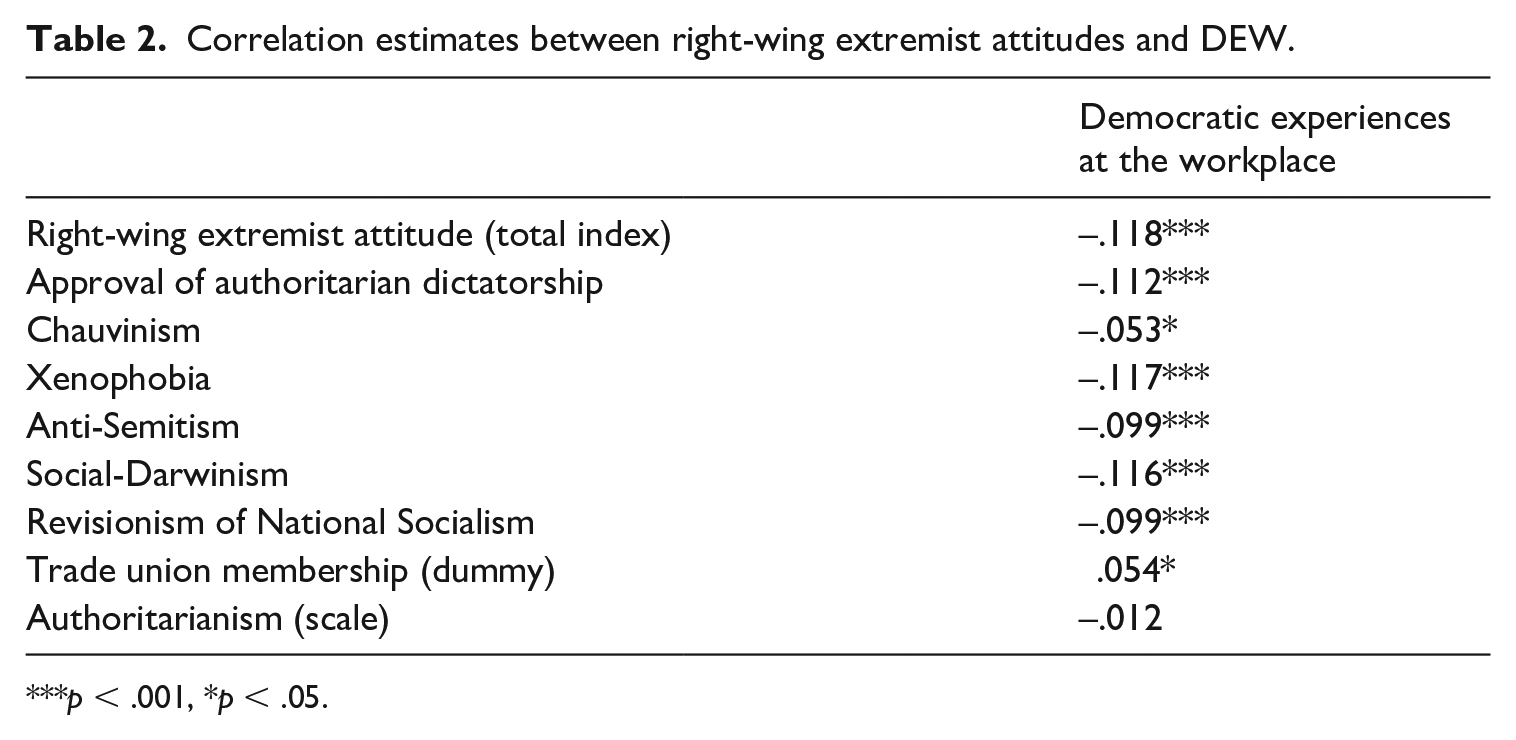
p < .001, *p < .05.
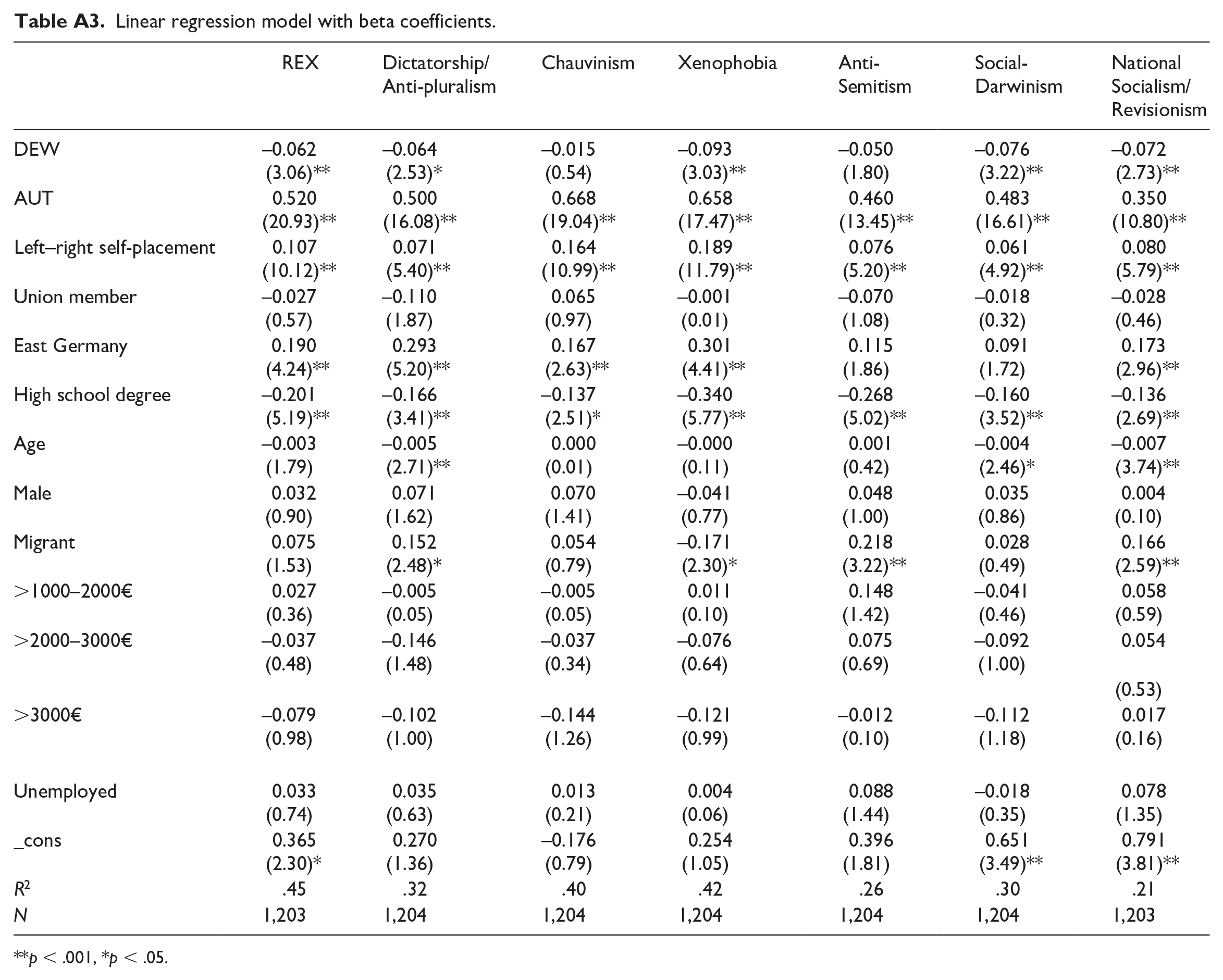
In a second step, we calculated a linear regression model with right-wing extremist attitude as the dependent variable and included additional variables to test if our hypothesis, the association between DEW and right-wing extremist attitude, holds. We ran standard regression diagnostics, detecting no outliers on our main variables, confirming our assumption of linearity of the relationships between the dependent variable and the independent variables, as well as the normality of residuals. In addition, we excluded the possibility of collinearity by looking at variance inflation factors. We also tested for heteroskedasticity and found minor issues. However, when specifying robust standard errors and modeling a robust regression, our results remained robust. Table A3 in the Appendix also provides results of regression models for each sub-dimension of our right-wing extremist attitude scale. For all except chauvinism and anti-Semitism, we can corroborate the effect of DEW on right-wing extremist attitudes.
Figure 1 displays the coefficient plots for the full scale of right-wing extremist attitude for a model containing 1,247 cases and with an explained variance of R2 = .454 (see for a full display Table A3 in the Appendix). The beta coefficient of our authoritarianism scale exceeds those of all other variables highlighting the importance of this predictor. The socioeconomic controls turn out as expected: higher educational attainment is negatively related to right-wing extremist attitudes, while living in East Germany is positively correlated with higher scores on the right-wing extremism scale. Other variables in our model, including trade union membership, remain insignificant. Regarding this particular variable, we have to keep in mind its fuzziness as it captures a wide variety of trade unions. However, DEW retains a significant, negative relation to right-wing extremist attitudes. Therefore, our regression model further corroborates our main hypothesis that DEW is negatively associated with right-wing extremist attitude, even if we control for authoritarianism, the main driving force of right-wing extremist attitude, and education, another important driver. We would suspect that higher educational attainment not only results in higher status and social capital, but also comes with more opportunities for democratic experiences during adolescence (Kiess, 2022).
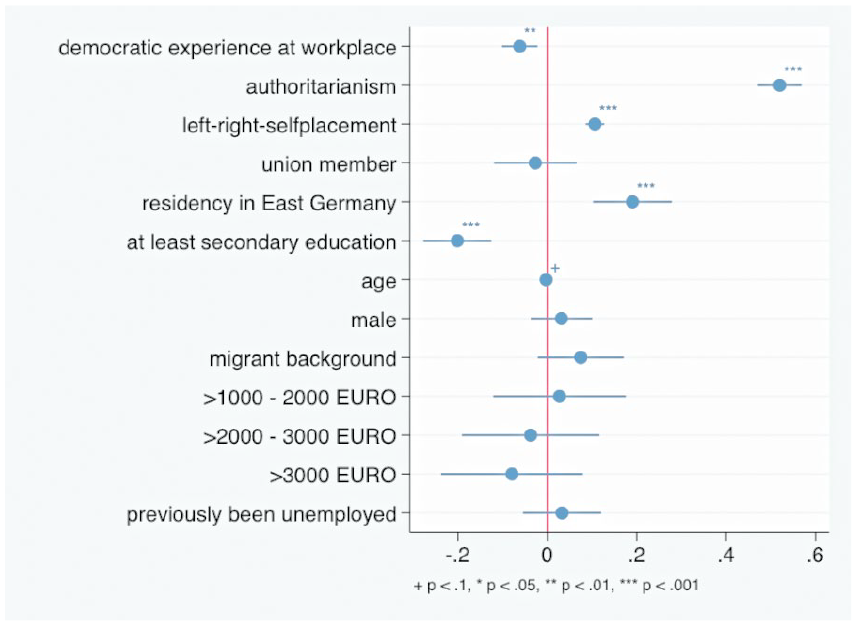
Linear regression model with right-wing extremism as dependent variable (standardized coefficients, weighted).
Discussion
In this article, we examined the relationship between individuals’ sense of democratic efficacy at the workplace (DEW) and their support for right-wing extremist attitudes. In doing so, we contributed to a more comprehensive understanding of the spillover effects of workplace democratization by, first, introducing a new and more focused measure of individuals’ efficacy beliefs in relation to workplace democratization, second, finding that the rejection of extreme right-wing attitudes is related to workplace democratization, and, third, proposing to understand the direct, reducing effect of DEW on extreme right-wing attitudes as an empowerment effect. In the following, we summarize our findings and point out the limitations of our study as well as possible future research questions.
Central findings
In general, we found respondents in our study to be positive about their perceived ability to influence the workplace democratically. In particular, many employees in our German sample experienced high levels of efficacy with respect to their participation in the organization of daily work routines, as well as collective control in the sense of collegiality and mutual help. Respondents experienced slightly fewer possibilities to actually change workplace structures. The free exercise of workers’ voice via institutions of co-determination seems to be somewhat constrained with nearly 30% of the respondents reporting fear of negative consequences when talking about unions or works councils at their workplace. This is likely to reflect the ongoing practice of union busting, which is repeatedly problematized in studies on co-determination in Germany (Behrens and Dribbusch, 2020; Boewe and Schulten, 2013; Rügemer and Wigand, 2014; Thünken et al., 2019). However, these descriptive results must be interpreted with caution since we do not yet have comparative data from other countries or over time. Moreover, here we are interested in the effects of DEW rather than in evaluating the distribution.
Our main finding then is that DEW is negatively associated with right-wing extremism, and the effect of DEW remains significant even after controlling for socioeconomic variables, as well as respondents’ union membership and authoritarian attitudes. DEW can thus be identified as a relevant factor of political socialization at work, which cannot simply be attributed to institutional co-determination on the one hand or personality traits on the other and has not yet received sufficient empirical and theoretical attention. Nevertheless, authoritarianism remains the strongest predictor of right-wing extremist attitude in our analysis, which is in line with the literature (Pettigrew, 2016; Yoxon et al., 2019) and with what we would expect from socialization processes starting in (early) childhood. Union membership, however, did not show a significant correlation with right-wing extremist attitudes in our analysis. This result is in line with studies showing that union members in Germany do not differ from the general population regarding far-right attitudes (Hilmer et al., 2017; Stöss, 2017; Zeuner et al., 2007) and also corresponds to recent results from Hassan (2024), who concludes that union membership does not influence democratic legitimacy. When comparing DEW’s influence on different dimensions of right-wing extremism, we found a weaker link between DEW and chauvinist attitudes which becomes insignificant when control variables are included. This may indicate that experiences of national competition and ‘politics of social closure’ (Mackert, 2019) have become quite persistently imprinted in employees’ political consciousness.
Theoretical implications
Building on participatory theory of democracy and industrial sociology (Pateman, 1970), we theorize the direct effect of DEW on right-wing extremist attitude as a process of democratization of political attitudes that emanates from a positive workplace experience: Individuals, who experience democratic efficacy at work become less susceptible to far-right attitudes. This effect is an important addition to the political consequences of workplace democratization examined in the literature, which describes increased political participation (Budd et al., 2018; Geurkink et al., 2020) or increased democratic legitimacy as the main outcomes of a democratic spillover (Hassan, 2024; Timming and Summers, 2020). While the literature suggests the spillover effects to transmit via the learning of democratic skills (Almond and Verba, 1963; Geurkink et al., 2022) or the influence of more moral organizational settings on individuals’ moral development (Verdorfer et al., 2013; Weber et al., 2009), our results suggest a further explanation. If individuals’ greater democratic efficacy at the workplace directly reduces far-right attitudes, this indicates that empowerment at the workplace itself has political consequences.
To understand this ‘empowerment effect’ (Wu and Paluck, 2020), research on workplace socialization and its sociopolitical repercussions could benefit from taking into account how critical political sociology has classically explained right-wing extremist appeal. This literature emphasizes that right-wing extremist sentiment functions as a ‘crooked cure’ (Freud, 1921 as cited in Brunner, 2011: 203), i.e. an ideological compensation, with which individuals process excessive feelings of powerlessness and lack of recognition that they experience in various spheres of everyday life (Decker, 2018; Fromm, 1937; Honneth, 1992). Increased democratic efficacy in everyday life, e.g. resulting from workplace democratization, in this explanation, makes it less ‘necessary’ for individuals to devalue out-groups and desire strong (national) leadership or belonging to an ethnic community. Indeed, recent empirical research already points to the particular importance of the economic sphere and workplace experiences for authoritarian dynamics in society. (Hürtgen, 2020, 2023; Kiess et al., 2023).
Still, and in direct relation to that same body of literature, in our analysis, authoritarianism remains the most important predictor for right-wing extremist attitudes: general socialization and the development of authoritarian personality traits seem to play a more decisive role in right-wing attraction than engagement with more empowering or more repressive workplace structures. However, authoritarian socialization and workplace experiences may also interact. For example, we can assume that an authoritarian attitude acquired in childhood is reinforced by experiences of powerlessness at the workplace. Empowering experiences at work, on the other hand, will only slowly dissolve authoritarian dispositions (Decker, 2018; Wu and Paluck, 2020). However, authoritarian dispositions may also prevent employees from developing a sense of democratic efficacy at the workplace. Even if the conditions in the company are objectively good in terms of opportunities for democratic participation, responsiveness of supervisors, solidarity among colleagues, etc., authoritarian employees may not see it that way. After all, DEW is a subjective and perceptual measure.
Practical implications
Identifying individuals’ democratic efficacy at work as a protective factor against right-wing extremism has a number of practical implications. For labor, our findings point to the political implications and democratic potentials of workplace organizing and co-determination. Combating the growing influence of the far right, which contributes to an anti-union climate, should not only rely on raising awareness of issues such as racism. The central task of trade unions and works councils is to translate institutions of co-determination into everyday experiences of democratic efficacy for employees. Examples show that this can be achieved above all through a grassroots trade union policy based on activation and employee participation. Hence, contrary to what it may sometimes seem, there is no fundamental clash of interests for labor between mobilization and the fight against the far right (Azzellini, 2021; Bose and Schmidt, 2023).
Policymakers can support DEW and thus its positive effects on democracy by protecting existing institutions of co-determination: for example, by making it easier to set up works councils or by taking more decisive action against union busting. In current debates on the reform of co-determination laws in Germany and Europe, some voices are calling for an expansion of workplace democratization (Däubler et al., 2022; Ferreras et al., 2022). Our results show that this claim can also be supported from a democratic policy perspective. Finally, companies benefit from a democratically oriented and empowered workforce, too. They can contribute by accepting co-determination and allowing for participation and autonomy in the labor process. This also means valuing employees’ knowledge, by promoting a culture of cooperation and establishing responsive authority structures in the workplace. Both can help to strengthen employees’ democratic orientations, as our results show. While our findings in general point to the importance of workplace democratization for political democracy and society as a whole, strengthening participation and co-determination at work is not a panacea in the fight against right-wing attitudes. It is important to bear in mind that other factors like authoritarian personality traits or a low level of education strongly influence right-wing extremist attitudes, too.
Limitations and future research
Moreover, it is important to note certain limitations of our study. A concern for our study is the possibility of reverse causality, which is also discussed controversially in the literature (Budd and Lamare, 2021; Kim, 2021). Previous studies had the same problem and already pointed to other studies testing for causality (Geurkink et al., 2020; Peterson, 1992). Research testing for endogeneity and reverse causality, indeed, already provides evidence for a causal mechanism from workplace democratization to several forms of political participation (Budd et al., 2018; Lopes et al., 2014). Schur (2003: 758) shows that job selection does not change the impact of job experiences on political participation. Similarly, a study from China provides evidence that differences between job sectors regarding political efficacy do not stem from people with initially higher political efficacy tending to join the nonprofit sector (Liu et al., 2023). Still, it remains a limitation of our analysis that it cannot itself provide proof for such a causal claim for methodological reasons and we can only provide theoretical justification. It could be that respondents in our study holding right-wing extremist views tend to stick to certain jobs or perceive their workplace and experiences with colleagues more negatively – be it that they feel deprived in social, political, and economic terms which may affect their (reported) experiences, or that people holding right-wing extremist views generally tend to be more destructive and negative. While we think this is the less plausible effect direction, the interconnections between the workplace and democratic practice remain an important field of study. Another limitation of our study is that we focus exclusively on one country. In our view, it is plausible that the link between democratic efficacy at the workplace and political attitudes holds also in other (national) contexts with different collective bargaining systems as well as traditions of trade unions and co-determination. Unfortunately, so far there are no comparative data available. Moreover, while we argued in the methods section that our data were not (yet) severely impacted by the Covid-19 pandemic, we also lack longitudinal data or at least data from different studies at different points in time which would allow further verification of our new measure.
An important task for further research is to examine how DEW, as a perceptual and subjective measure of employees’ efficacy experiences, is (a) influenced by individuals’ further political orientations and personality, (b) related to structural factors in the workplace, as well as socioeconomic influences, and (c) relates to other concepts like voice, autonomy, or participatory climate. This would mean above all to further investigate how DEW and authoritarianism may interact. We have already described some interactions that seem plausible based on our theoretical considerations. A mediation analysis could examine the extent to which the effect of authoritarianism on right-wing extremist attitudes is mediated by DEW and vice versa. Further research could relate DEW (e.g. via multilevel modeling) to employees’ actual participatory behavior at work, to existing institutions of co-determination and their politics (e.g. works councils), as well as to the organizational structures at the workplace (Unterrainer et al., 2011; Weber et al., 2020). Here, research also needs to take into account the economic situation of the respective company. For, as Greenberg et al. (1996) have rightly observed, workers can also feel powerless in the face of market forces, even if they have a say in the company. Finally, further research needs to examine how individuals’ socioeconomic conditions (education, income) but also organizational factors, such as size of the company, position in the value chain, and economic situation of the company, as well as diversity of the workforce influence their perceived ability to influence the workplace. We also need to elaborate on how the effect of DEW is related to or maybe interacts with organizational policies such as diversity and anti-discrimination, corporate democracy education, or even corporate volunteering, which at first glance seem more directly related to the question of democratic attitudes than employee participation. This would allow for situating individual workplace experiences and corresponding efficacy beliefs better as well as understanding the mechanisms and limitations of the assumed democratization effects from the workplace to the political sphere.
Footnotes
Appendix
Linear regression model with beta coefficients.
| REX | Dictatorship/Anti-pluralism | Chauvinism | Xenophobia | Anti-Semitism | Social-Darwinism | National Socialism/ Revisionism | |
|---|---|---|---|---|---|---|---|
| DEW | –0.062 (3.06)** |
–0.064 (2.53)* |
–0.015 (0.54) |
–0.093 (3.03)** |
–0.050 (1.80) |
–0.076 (3.22)** |
–0.072 (2.73)** |
| AUT | 0.520 (20.93)** |
0.500 (16.08)** |
0.668 (19.04)** |
0.658 (17.47)** |
0.460 (13.45)** |
0.483 (16.61)** |
0.350 (10.80)** |
| Left–right self-placement | 0.107 (10.12)** |
0.071 (5.40)** |
0.164 (10.99)** |
0.189 (11.79)** |
0.076 (5.20)** |
0.061 (4.92)** |
0.080 (5.79)** |
| Union member | –0.027 (0.57) |
–0.110 (1.87) |
0.065 (0.97) |
–0.001 (0.01) |
–0.070 (1.08) |
–0.018 (0.32) |
–0.028 (0.46) |
| East Germany | 0.190 (4.24)** |
0.293 (5.20)** |
0.167 (2.63)** |
0.301 (4.41)** |
0.115 (1.86) |
0.091 (1.72) |
0.173 (2.96)** |
| High school degree | –0.201 (5.19)** |
–0.166 (3.41)** |
–0.137 (2.51)* |
–0.340 (5.77)** |
–0.268 (5.02)** |
–0.160 (3.52)** |
–0.136 (2.69)** |
| Age | –0.003 (1.79) |
–0.005 (2.71)** |
0.000 (0.01) |
–0.000 (0.11) |
0.001 (0.42) |
–0.004 (2.46)* |
–0.007 (3.74)** |
| Male | 0.032 (0.90) |
0.071 (1.62) |
0.070 (1.41) |
–0.041 (0.77) |
0.048 (1.00) |
0.035 (0.86) |
0.004 (0.10) |
| Migrant | 0.075 (1.53) |
0.152 (2.48)* |
0.054 (0.79) |
–0.171 (2.30)* |
0.218 (3.22)** |
0.028 (0.49) |
0.166 (2.59)** |
| >1000–2000€ | 0.027 (0.36) |
–0.005 (0.05) |
–0.005 (0.05) |
0.011 (0.10) |
0.148 (1.42) |
–0.041 (0.46) |
0.058 (0.59) |
| >2000–3000€ | –0.037 (0.48) |
–0.146 (1.48) |
–0.037 (0.34) |
–0.076 (0.64) |
0.075 (0.69) |
–0.092 (1.00) |
0.054 |
| (0.53) | |||||||
| >3000€ | –0.079 |
–0.102 |
–0.144 |
–0.121 |
–0.012 |
–0.112 |
0.017 |
| Unemployed | 0.033 |
0.035 |
0.013 |
0.004 |
0.088 |
–0.018 |
0.078 |
| _cons | 0.365 |
0.270 |
–0.176 |
0.254 |
0.396 |
0.651 |
0.791 |
| R 2 | .45 | .32 | .40 | .42 | .26 | .30 | .21 |
| N | 1,203 | 1,204 | 1,204 | 1,204 | 1,204 | 1,204 | 1,203 |
p < .001, *p < .05.
Correction (September 2024):
Article has been updated to correct the following sentence in the Abstract “The article introduces a new measure employed in a representative survey....”., since its original publication.
Declaration of conflicting interests
The authors declared no potential conflicts of interest with respect to the research, authorship, and/or publication of this article.
Funding
The author(s) disclosed receipt of the following financial support for the research, authorship, and/or publication of this article: The survey was orginally supported financially by the Otto-Brenner-Foundation.
