




Abstract
This study investigates the political spillover and stealth democracy hypotheses as complementary mechanisms to account for any relationship between workplace democracy and democratic legitimacy in Europe from micro (employee-level) and macro (country-level) perspectives. The results from the micro-level analyses reveal that neither workplace democracy nor self-reported membership in trade unions has any direct impact on democratic legitimacy; rather, past union membership produces a negative impact. However, the effect of workplace democracy on democratic legitimacy becomes salient only when mediated by job satisfaction and political interest. On the other hand, the macro-level analysis demonstrates that union density, a measure of workplace democracy at the country level, plays a significant role in explaining democratic legitimacy. The relevance of union density may indicate that employees wish to keep democratic institutions in check by recruiting into the trade unions and applying legal and mobilizational pressure on the mainstream political institutions.
Introduction
Workplace democracy, it is claimed, reduces employee turnover (Blau and Boal, 1989; Iverson and Currivan, 2003), improves organizational commitment and citizenship behaviour (Ahmed et al., 2019), induces a high level of sociopsychological well-being (Knudsen et al., 2011), improves prosocial and sociomoral behavioural orientations (Weber et al., 2009), and increases overall job satisfaction (Scott-Ladd et al., 2006). Participation and unionization (Bryson et al., 2011; Doucouliagos and Laroche, 2003; Laroche and Salesina, 2017) and employee ownership programmes improve both return on investment and organizational productivity at the same time (Kim and Patel, 2017). The current article aims to investigate whether workplace democracy drives democratic legitimacy in light of the literature suggesting substantial variation in democratic legitimacy, as manifested through fluctuating levels of political trust, support for democracy and participation (Armingeon and Guthmann, 2014; Dalton, 2004; Foa and Mounk, 2017; Hay, 2007; Huntington et al., 1975; Kriesi, 2020; Norris, 2017; Poguntke et al., 2015; Wuttke et al., 2022).
The relationship between workplace democracy and democratic legitimacy could be examined from the spillover perspective, which assumes that workplace democracy serves as a social learning function to instil the necessary knowledge, skills and abilities in employees, resulting in spillover into political life beyond the organizational domain (Pateman, 1970). A recent review of 19 studies published between 1981 and 2020 found that workplace democracy had mixed effects on politics, depending on how the two concepts were operationalized, the research design, the analytical approach and the geographical distribution of the studies (Rybnikova, 2022: 2–6). However, four recent studies showing positive spillover on political participation and democratic legitimacy warrant close examination.
One study examined data from the European Values Survey from 11 countries in 1990, 1999 and 2008 and discovered that the significant effects of union membership, a measure of workplace democracy, on political participation and support for democracy vanish when examined through cohort analysis (Turner et al., 2020). The remaining three studies made use of data from different rounds of the European Social Survey (ESS). Using probit modelling to analyse ESS5 data for 27 countries, one of these studies discovered that the opportunity to take initiative at work positively influences nine types of political activities performed in the past and the current level of interest in politics (Budd et al., 2018). Another analysed aggregated data from 20 countries and eight rounds of ESS to demonstrate that democratic workplace socialization computed via firm size, unionization and employee participation affects voting behaviour, political activism, social and political trust and attitudes towards immigrants (Ryan and Turner, 2021). These studies have theoretical limitations in that they use current workplace participation as an independent variable to predict past political participation, which contradicts the main tenant of spillover theory (Adman, 2008).
The spillover hypothesis postulates the direct and indirect associations between workplace democracy and democratic politics through political efficacy (Pateman, 1970: 46) and/or the promotion of such intrinsic values as justice, equality, freedom, the rights of citizens and the protection of the interests of citizens (Pateman, 1970: 22–23). Extant literature, on the other hand, asserts only direct relationships and fails to demonstrate their underlying indirect mechanisms. The fourth of the abovementioned studies, by Timming and Summers (2020), addresses these issues by theoretically demonstrating and empirically showing through structural equation modelling of ESS5 data that democratic participation, measured by the extent to which the workplace provides opportunities to influence daily work schedules, task identity, pace of work and working times, affects democratic attitudes – called democratic legitimacy in the current article. The positive impacts reported in these four studies, however, are more likely to be highly biased because they converge data from 27 countries into single-level data, producing biased estimates by ignoring the structural and cultural differences between the countries studied.
Along with expanding upon and extending Timming and Summers’ work, the current study also adds another theoretical viewpoint. First, it generates multilevel data in which employee-level observations are nested within two country-level factors – union density and right to bargain – and employs multilevel ordinary least squares (OLS) regression analysis instead of structural equation modelling. The data are then restricted to employees in the expectation that they will be better evaluators of workplace democracy than entire populations within countries. It also controls for other variables that may affect the relationship between workplace democracy and democratic legitimacy, which previous studies did not. Finally, using stealth democracy as an additional theoretical perspective also distinguishes this study from previous research. The stealth democracy thesis contradicts the spillover hypothesis in that it denies any direct relationship between workplace democracy and democratic legitimacy by emphasizing citizens as political free riders (Hibbing and Theiss-Morse, 2004). Thus, it demonstrates both theoretically and empirically that the perspectives of spillover and stealth democracy complement one another in explaining democratic legitimacy.
The current study created hierarchical data by nesting employee-level observations within country-level factors, which it then analysed using multilevel analysis. Aside from finding no direct effect of workplace democracy, this study discovers that employees’ prior union membership was negatively associated with democratic legitimacy. Furthermore, union density – a country-level measure of workplace democracy – had a positive impact on democratic legitimacy. This article makes two important contributions to the existing literature in light of these findings. Even if there is no direct relationship between workplace democracy and democratic legitimacy at the employee level, the stealth democratic theory’s claim that employees do not want to participate in organizational decision-making is not supported by evidence (Hibbing and Theiss-Morse, 2004). Rather, they wish to keep an eye on both the organization and the larger political system through an intermediary mechanism, such as job satisfaction and political interest, and by increasing union density. While they do not wish to participate directly in workplace decisions, they place a check on the system to ensure that it continues to produce their desired outcomes even in the absence of their constant scrutiny. This could imply that stealth democracy and spillover theory are complementary rather than mutually exclusive explanations. Second, these findings, which are based on employees’ evaluations of workplace democracy and variation in factors associated with union democracy at the country level, support the micro–macro literature linking citizens’ evaluations of day-to-day performance within and between countries with democratic legitimacy (Hakhverdian and Mayne, 2012; Noordzij et al., 2021; Wilkes, 2014).
Theoretical framework and hypotheses
Conceptual notes
Current political and organizational research reveals legitimacy to be a nebulous concept. It is frequently equated with trust, compliance, legal obligation and shared moral values (Dowling and Pfeffer, 1975; Sunshine and Tyler, 2003). The researcher then differentiates cognitive, moral, pragmatic, affective and behavioural legitimacy (Alexiou and Wiggins, 2019; Gobena and Van Dijke, 2016). This article defines democratic legitimacy as (1) citizens’ cognitive and affective feelings that existing democratic institutions are appropriate ones for the society (Lipset, 1960: 77), and conforming to the norms of those institutions on the one hand, and (2) their evaluation of the effectiveness of the political institutions in meeting their preferred expectations of policy outcome on the other (Easton, 1965; Lipset, 1960; Miller and Listhaug, 1990).
Workplace democracy, also known as industrial democracy, was first conceived in 1897 in the context of striking similarities between trade unions and political democracy as work by and for the people (Gumbrell-McCormick and Hyman, 2019). In contrast to the latter, which emphasizes accountability of public officials by elected authorities, the former emphasizes accountability of managers in front of employees (Harrison, 2001: 237). It now represents an umbrella term associated with workplace participation and workplace involvement on the one hand (Greenberg, 1983; Litwin and Eaton, 2018) and shopfloor democracy, union democracy and organizational democracy on the other hand (Hirschsohn, 2007) and comes in many forms and shapes. It may be related to the development of local self-managed teams and quality circles with the goal of replacing traditional organizational structures with other alternatives, and it may range from informal movements aimed at replacing traditional hierarchical structures to extremely formal methods of codetermination of economic policymaking (Cheney, 1995). At the same time, it is a decision-making mechanism that allows workers to determine the form and objectives of organizational outcomes rather than the mere existence of such mechanisms (Foley and Polanyi, 2006; Greenberg, 1983; Weber et al., 2020).
More specifically, workplace democracy combines autonomy and involvement. While autonomy refers to the extent to which employees can manage the performance of their work tasks through means, methods and schedules, involvement reflects the extent to which employees influence the work through communication (Lopes et al., 2017). This article examines workplace democracy at the employee level and the country level: the former refers to employees’ perceptions and experiences of control over workplace design, while the latter denotes the degree of unionization at the country level. While the former pertains to employees’ assessments of democratic norms and practices within organizations, the latter refers to union democracy centred on the formation of a separate entity that may resemble national political parties.
Job satisfaction and political interest are two additional variables mediating the association between workplace democracy and democratic legitimacy. ‘Job satisfaction is the pleasurable emotional state resulting from the appraisal of one’s job as achieving or facilitating the achievement of one’s job values’ (Locke, 1969: 316). ‘Political interest may resemble a well-rehearsed attitude, a personality trait, or a part of people’s political identity’; suffice to say, for this study, political interest ‘reflects ongoing evaluations of politics’ (Prior, 2010: 748).
Workplace democracy and democratic legitimacy
Figure 1 illustrates the central premises of this study, which suggest a direct and indirect relationship between workplace democracy and democratic legitimacy. What the notable extant accounts (Almond and Verba, 1989; Bandura, 1971; Hibbing and Theiss-Morse, 2004; Lipset and Rokkan, 1967; Norris, 1999; Putnam, 1993) have in common is that they see the dynamics of democratic politics, including democratic legitimacy, as sociocultural and sociopsychological learning. Sociocultural and sociopsychological accounts are not mutually exclusive; rather, they are endogenous, emphasizing that democratic legitimacy is produced outside democratic institutions. According to these perspectives, sociocultural participatory attitudes (norms, affects and behaviours) learned in schools, workplaces and associations shape individuals’ attitudes towards democratic legitimacy. Sociopsychological theories, on the other hand, emphasize personality traits and the role of the formal organization in which an individual receives training and employment in shaping legitimacy beliefs. Such a learning process begins on the mother’s lap and culminates in higher-level political institutions, in addition to being a personality trait.
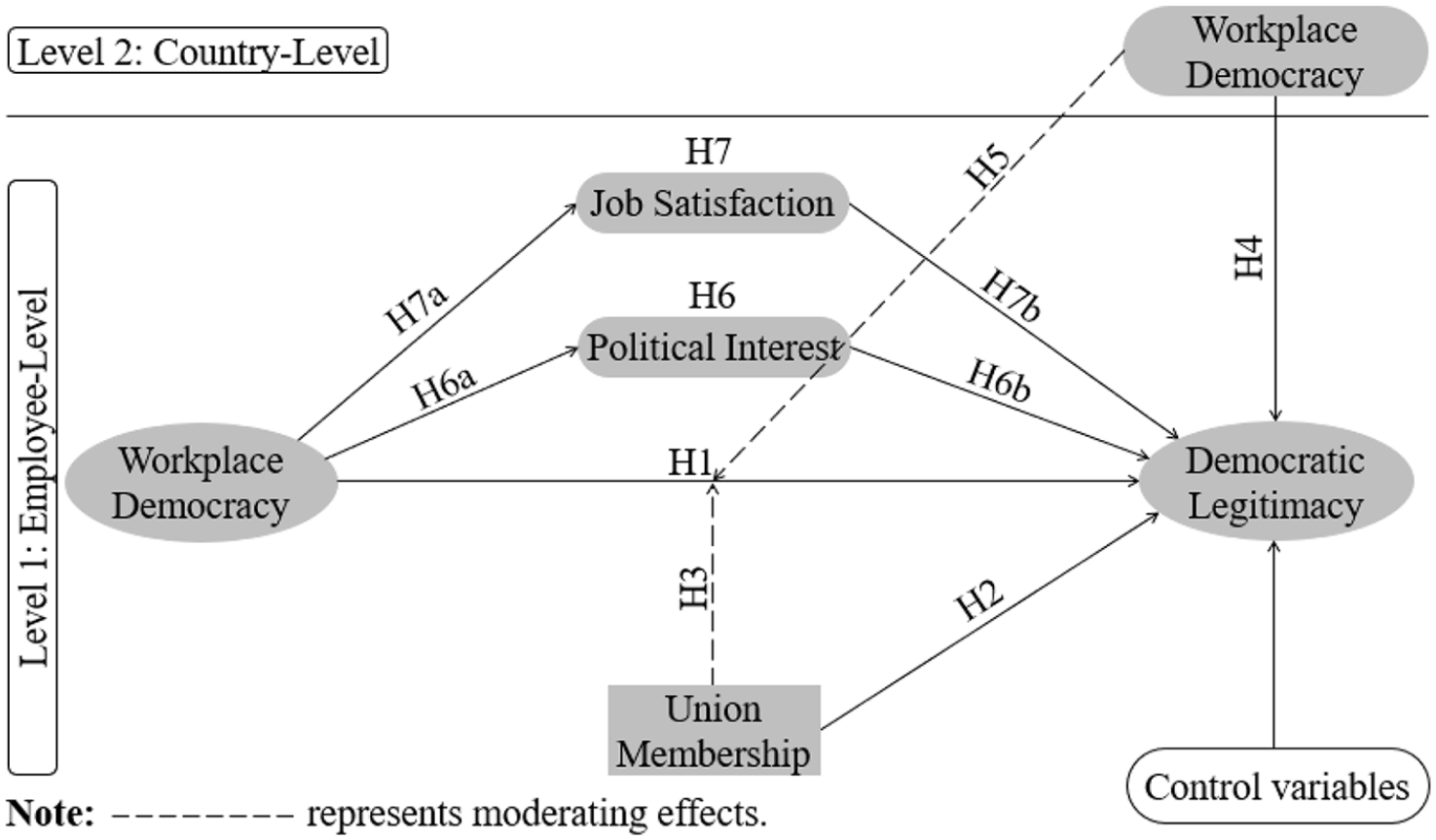
Hypothesized model of democratic legitimacy.
Further, workplace rewards and sanctions are likely to reinforce and reshape these participatory characteristics. So, employees with efficacy and direct and indirect opportunities to determine work procedures and outcomes are more likely to demonstrate these characteristics in the political realm. Given that sociocultural theories consider the internalization of participatory attitudes within and via social and civic organizations, the workplace is, from this perspective, an important source of social capital and democratic legitimacy. Moreover, members of organizations are simultaneously employees and citizens. This dual role would necessitate that organizations’ resources – a component of a larger political system – be consumed in accordance with their professional and social values.
Spillover theory posits that educational and integrative functions instil in employees the psychological and practical skills necessary for the stability and legitimacy of a democratic political system. For a democratic government to exist, a participatory society is essential. Given that social reproduction of these critical democratic requirements occurs in the workplace, the industry is viewed as a component of the larger political system rather than as an autonomous entity (Pateman, 1970: 42–43). While practising organizational democracy may not improve efficiency and effectiveness, it does advance democracy by promoting values such as ‘justice, equality, freedom, citizen rights, and citizen interests’, which are intrinsic to democracy itself (Pateman, 1970: 18–19).
Extensive research has been conducted on the correlation between workplace democracy and a broader spectrum of political attitudes. It is contended that the nature of this relationship is substantially influenced by the research design (data, measurement and model) employed (van der Meer and Hakhverdian, 2017: 84). For instance, Greenberg et al. (1996) found through the OLS method that job involvement was a more consistent predictor and that control over work design did not affect the voting, campaigning and community participation behaviours of employees representing 15 mills in the USA. In contrast, Sobel’s (1993) linear probability modelling analysis of the American National Election Studies data revealed that while workplace participation was associated with both campaigning and community participation, job participation only affected campaigning. These findings indicate the absence of a universal and consistent effect of all workplace environment measures on the outcome variables of Greenberg et al.
Timming and Summers’ (2020) structural equation modelling of ESS data from 27 nations showed that workplace democracy increased democratic legitimacy, but the mediated effect through political interest was lower than the direct effect. Geurkink et al. (2022) used structural equation modelling to examine the Work and Politics 2017 Survey in their study of voice handling and political participation in the Netherlands. They found that the forms of political participation are closely associated with the nature of voice experienced at work. While supervisors’ support for employees has an indirect impact on various forms of political participation, suppressing employees’ voice has a direct impact on party activities, and punishing employees encourages them to contact political actors as well as participate in protests. D’Art and Turner’s (2007) analysis of ESS2 data for 15 European nations using logistic and OLS methods revealed that while workplace participation had a negligible effect on only one of six political activities, union membership and the presence of union membership positively affected all forms of participation. Godard’s (2007) logistic regression analysis of data from England and Canada showed that workplace experiences did not affect voting behaviour and political participation. Whereas workplace coercion had a negative effect on voting behaviour in both countries, job satisfaction had a positive effect, and unionization had a negative effect only in Canada. Based on cross-sectional and panel data from the Swedish Citizen Study, Adman’s (2008) OLS models could not provide evidence of the abovementioned association. Other studies provide inconsistent support for the spillover hypothesis, with some showing a positive effect and others showing no effect at all (Jian and Jeffres, 2008).
Pateman suggests that the relationship between workplace democracy and political behaviours and attitudes might be shaped by political efficacy (1970: 46) and the value orientations one holds (pp. 22–23). That past studies could only provide mixed support for the spillover hypothesis might be attributed to the fact they ignored these indirect pathways through which workplace democracy can exert influence on politics. Given this context, union democracy may play a significant role, both in terms of self-reported employee membership in trade unions and the presence of such a structure at the country level. Participation in union democracy on two levels will expose employees to the debates and discussions inherent to the decision-making processes of organizations and democracies. Two scenarios might emerge. First, it is plausible that union membership among employees and the presence of union democratic structures at the national level will have a direct impact on democratic legitimacy. Second, these factors will moderate the relationship between workplace democracy and democratic legitimacy at the employee level. The following hypotheses summarize this discussion:
Hypothesis 1 (H1): Workplace democracy will be positively associated with democratic legitimacy.
Hypothesis 2 (H2): Union membership will be positively associated with democratic legitimacy.
Hypothesis 3 (H3): Union membership will moderate the association between workplace democracy and democratic legitimacy; thus, the positive association will be stronger among members than non-members.
Hypothesis 4 (H4): Union democracy (country-level) will be positively associated with democratic legitimacy.
Hypothesis 5 (H5): Union democracy (country-level) will moderate the association between workplace democracy and democratic legitimacy; thus, the positive association will be stronger in countries with higher opportunities than their counterparts (country-level).
Job satisfaction and political interest as mediators
Participatory workplaces may boost political interest and efficacy, influencing political behaviours and attitudes (Pateman, 1970: 105). Existing literature, on the other hand, ignored this call for theoretical demonstrations by focusing solely on theoretical assertions; as a result, the spillover hypothesis was heavily criticized (Carter, 2006). Bringing in political interest and job satisfaction might be one way to correct the theoretical demonstrations. There may be no direct relationship between workplace democracy and democratic legitimacy, and job satisfaction and political interest may be intervening mechanisms. One proposal highlights the spillover of discourses, emphasizing the role of workplace debates and political issues in producing political interest and job satisfaction (Peterson, 1992). This increases employees’ political cognition about broader democratic institutions, actors and interests. A better awareness of the complexities and compulsions under which organizations perform helps employees differentiate and prioritize democratic processes over non-democratic ones.
Numerous studies have shown the effects of workplace democratic practices on a series of individual and organizational outcomes. Research, for instance, showed that workplace autonomy and job satisfaction go hand in hand, but work pressure was detrimental to satisfaction (Lopes et al., 2014). Such an outcome is a feature of local government systems that practise participatory management styles, ensure effective communication and engage employees in strategic processes (Kim, 2002). Studies also reported a significant association between job involvement and turnover intentions (Blau and Boal, 1989). Compared to only a few studies that have focused on the relationship between political interest and workplace democracy (Brady et al., 1995; Mutz and Mondak, 2006), a considerable body of research has shown that political interest is one of the influential determinants, along with a host of other variables, of democratic legitimacy in both developed and developing societies (Anderson and Guillory, 1997; Bratton and Mattes, 2001; Catterberg, 2006; Cordero and Simón, 2016). However, they rarely demonstrate the theoretical relevance of political interest by considering it as a control variable.
The workplace performs intrinsic and extrinsic functions. The bulk of management theory and literature emphasizing its role in job satisfaction is based on the intrinsic values regarding control over job design and job satisfaction (Kim, 2002). Politics and political efficacy may be extrinsic job factors, but they become intrinsic when employees relate them to their jobs and organizations design them as inclusive components of their polity’s broader economic and social order. Thus, the workplace might be an important source of political discussion and debate from democratic theory (Pateman, 1970: 105), civil culture (Almond and Verba, 1989) and social capital (Putnam, 1993) perspectives. These works suggest that notwithstanding the direct association between workplace democracy and democratic legitimacy, their effects might be changed if mediated by political interest and job satisfaction. This discussion is summarized in the following hypotheses.
Hypothesis 6 (H6): Workplace democracy will affect political interest positively (H6a), which in turn will influence democratic legitimacy positively (H6b). Together, political interest will positively mediate the relationship between workplace democracy and democratic legitimacy (H6).
Hypothesis 7 (H7): Workplace democracy will affect job satisfaction positively (H7a), which in turn will influence democratic legitimacy positively (H7b). Combined, job satisfaction will positively mediate the relationship between workplace democracy and democratic legitimacy (H7).
Stealth democracy and democratic legitimacy
If the evidence negating the spillover hypothesis is true, stealth democracy might provide an alternative explanation. According to this account
[Stealth democrats] do not want to make political decisions themselves; they do not want to provide much input to those who are assigned to make these decisions; and they would rather not know the details of the decision-making process. . . . This does not mean that people think no mechanism for government accountability is necessary; they just do not want the mechanism to come into play except in unusual circumstances. (Hibbing and Theiss-Morse, 2004: 1–2)
Although stealth democrats or ‘economic men’ (self-interested people) would avoid participation costs by being free riders (Shapiro, 2003: 498), conflicts engendering frustration within and between organizational entities about relationships, procedures, tasks, resources and organizational goals and structures (Rahim, 2002; Thomas, 1992) may affect participatory attitudes and behaviours. As an example, in general, preventing task-related conflicts improves employee performance (De Dreu and Weingart, 2003). If the task involves making highly complex strategic decisions, only employees with specific self-efficacy in strategic decision-making and leadership should consider taking on this responsibility. These employees might instead favour having someone else carry out these tasks on their behalf. This line of thinking has drawn interest in some studies as comparable to the stealth democracy hypothesis. Furthermore, some studies from developed democracies provide evidence for the stealth hypothesis. For example, a study in the American setting (VanderMolen, 2017) revealed that citizens’ participatory preferences are waning and are shallow at best. They want independent experts and the bureaucratic elite to take care of the policymaking process on their behalf. Likewise, a Spanish study concluded that stealth democracy supports new and challenger parties characterized by low-intensity citizen participation compared to participation-enhancing parties (Lavezzolo and Ramiro, 2018).
It is plausible to systematically reject critical and disengaged employees as two alternative routes to democratic legitimacy, and instead emphasize that the said relationships (H1–H7) would emerge according to stealth democracy or political spillover theories. The critical citizens and postmodernization theories argue that postmodern individuals like democracy as a form of regime organization as they hold democratic norms and principles very dear; however, their frustration rises at the poor performance of democratic regimes (Inglehart, 1977; Norris, 1999). This is reflected in some of the recent studies suggesting a negative association between democratic expectations and political trust (Oser and Hooghe, 2018; Wang, 2005). Given that the current study focuses on employees’ evaluations of workplace democratic practices rather than their orientations towards democratic expectations, the said relationship is highly unlikely to perform negatively. Finally, it is reasonable to assume that disengaged citizens would identify neither with workplace democracy nor democratic institutions. They are most probably those who do not attempt to answer survey questions.
Research method
Data from Round 5 of the European Social Survey (ESS5, www.europeansocialsurvey.org) were employed for this study. Based on random probability sampling, this high-quality biennial survey has been capturing 15 plus year old citizens’ attitudes towards various aspects of the state, society, economy and business in Europe and beyond since 2002. ESS5 collected data from 27 countries between September and December 2010 and contains all the necessary information required to examine the relationship between workplace democracy and democratic legitimacy. Bulgaria, Cyprus, Croatia and Russia were dropped from the analysis due to a lack of country-level measures of democratic participation. Furthermore, the data were submitted from only those respondents who had mentioned that the job satisfaction condition applied to them (46%). Almost a similar number of respondents reported that they were/are members of a trade union (40%). Setting these conditions offers data from respondents who have a more inner and informed opinion about workplace democracy in practice, thus generating more appropriate estimates. The final data set contains 21,123 employee-level observations from 23 countries, to which three country-level variables were added to generate hierarchical data ready for analysis. The employee-level main variables are replicated from Timming and Summers (2020). The following sections present a brief operationalization of the main variables, with the complete wording of the question given in Online Appendix A. All the analyses presented hereafter were performed after applying design weight.
Democratic legitimacy
The dependent variable is democratic legitimacy, an additive index of democratic satisfaction, institutional trust and attitudes towards antidemocratic parties. Satisfaction with democracy was measured through a question tapping into the extent to which respondents were satisfied with the working of democracy in their home countries. Institutional trust represented respondents’ trust in their home countries’ parliament, political parties, politicians, courts and police. And attitude towards antidemocratic parties captured the extent to which respondents agreed that such parties should be banned. These items were converged to represent democratic legitimacy based on meeting the requirements of reliability analysis (Online Appendix B).
Employee-level predictors
Two measures of workplace democracy, the predictor variables, were adopted. The first three items asked respondents how much influence they have had over their daily work, organizational decisions and the pace of work. The fourth item tapped into whether they had control over the work schedule. These items met the requirements of reliability statistics (Online Appendix B) and were converged to represent workplace democracy. The second measure was self-reported trade union membership, which captured whether the respondent was a current member, had previously been a member, or was not a member at all.
Country-level predictors
Trade union density and collective bargaining coverage were used as two country-level measures of workplace democracy based on OECD data for 2010, the year the ESS5 survey was conducted. Trade union density measures the proportion of employees in a country who are union members, whereas bargaining coverage measures the proportion of employees having the right to bargain. These measures may be problematic because they do not necessarily and precisely reflect the manner in which union democracy is practised in individual nations. At the same time, the presence of these structures may imply that, even if members do not participate in trade union activities, the existence of institutional mechanisms and union strength may be associated with translating workplace demands into outputs. In other words, the strength of union democracy at the country level lays the groundwork for the possibility that the strength of union democracy at the country level will directly (H4) and indirectly (H5) drive democratic legitimacy at the individual level (H5). It is worth reiterating that Bulgaria, Cyprus, Croatia and Russia were excluded from the analysis due to a lack of country-level data.
Control variables
Gender, age, education in years, domicile, country of birth, felt income, satisfaction with the economy, left–right orientation and social capital were employee-level variables, and having communist experience in the past was a country-level control variable (Goubin and Hooghe, 2020; Hassan, 2021; Obydenkova and Arpino, 2018; van der Meer and Hakhverdian, 2017).
Analytical strategy
Hierarchical data of employee-level observations nested within country-level ones are used; therefore, multilevel regression analysis is employed as the main modelling technique (Höckertin and Härenstam, 2006; Hox and Maas, 2005; Snijders and Bosker, 2012). Thereafter, a four-fold strategy is adopted. First, descriptive statistics are presented (Figure 2; Online Appendices C–D) and a correlation analysis (Online Appendix E). Then intercept-only, predictors-only (Appendix 1) and fuller models (Tables 1 and 2) are performed to assess the variance in estimates as models extend from simple to complex ones. Third, a simple fuller model (Model 1) is performed followed by two models involving interactions between level 1 predictors (Model 2) and cross-level interactions (Models 3–4).
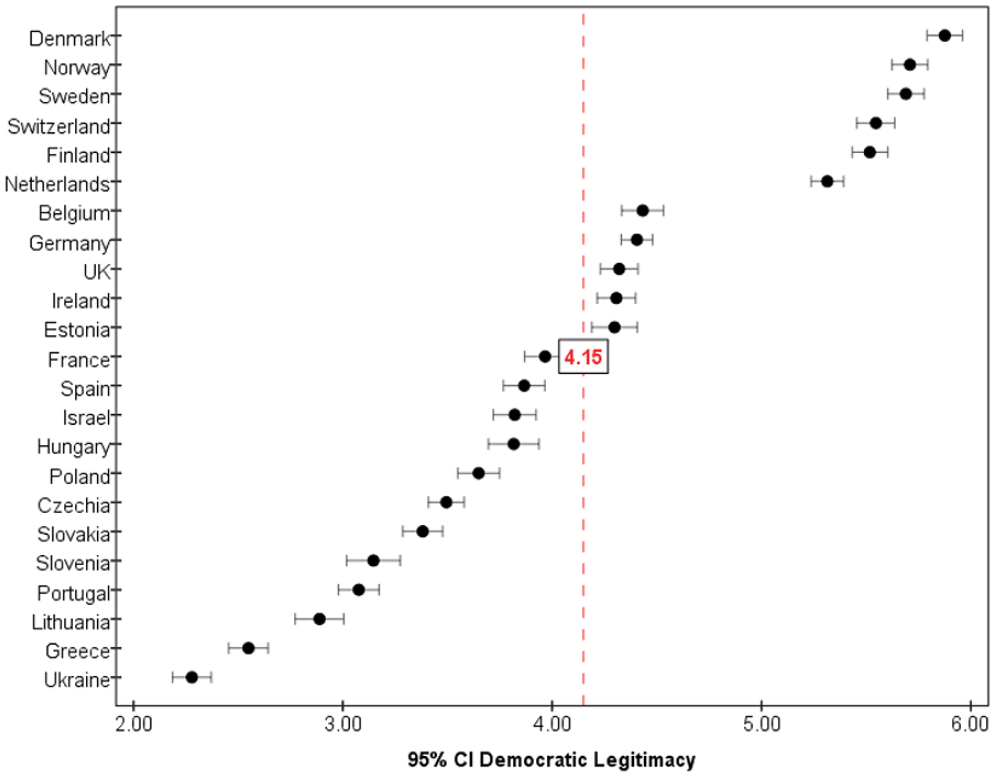
Cross-national differences in democratic legitimacy.
Effects of workplace democracy on democratic legitimacy by unionization.
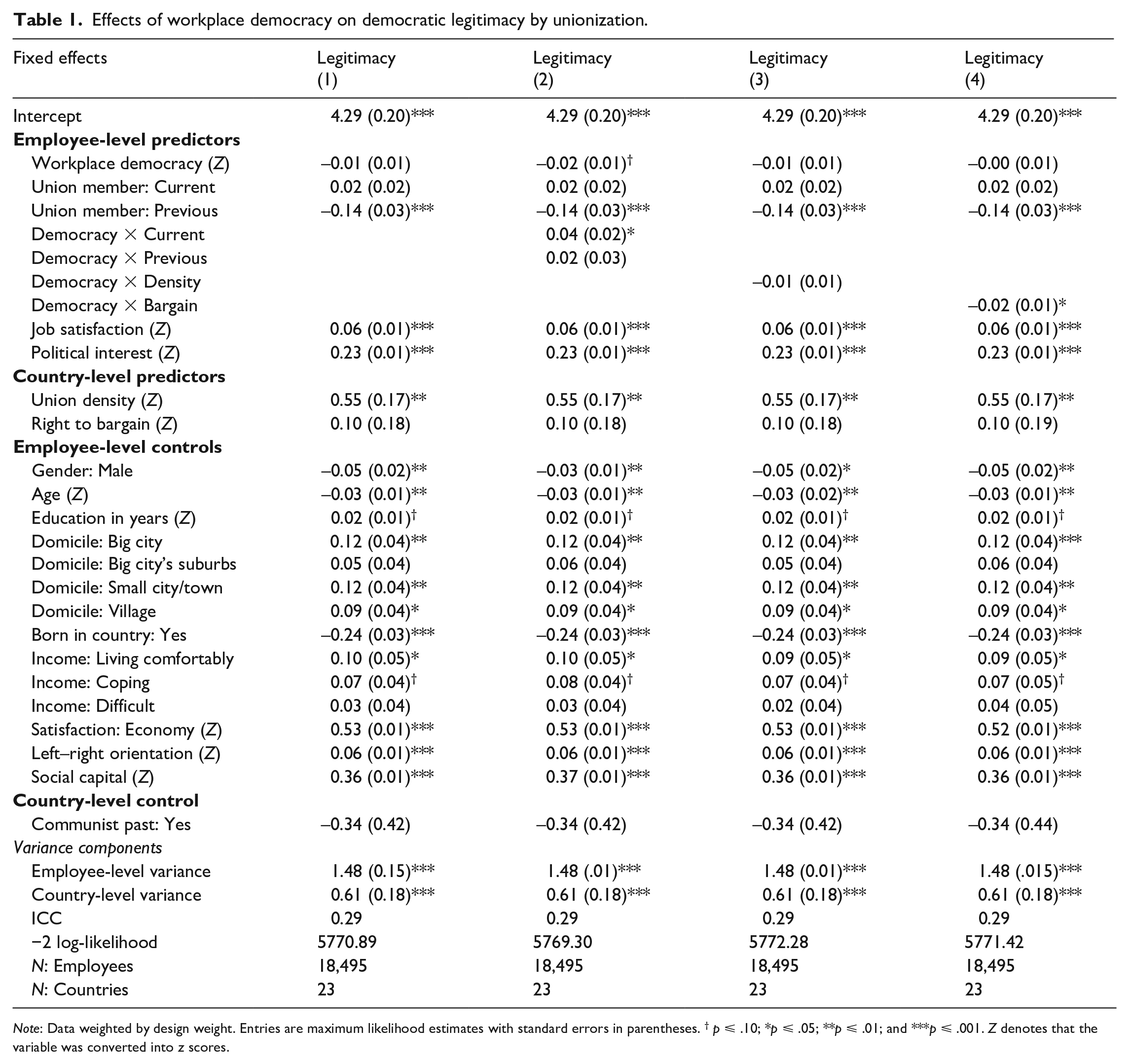
Note: Data weighted by design weight. Entries are maximum likelihood estimates with standard errors in parentheses. † p ⩽ .10; *p ⩽ .05; **p ⩽ .01; and ***p ⩽ .001. Z denotes that the variable was converted into z scores.
Effects of workplace democracy on democratic legitimacy through job satisfaction and political interest.
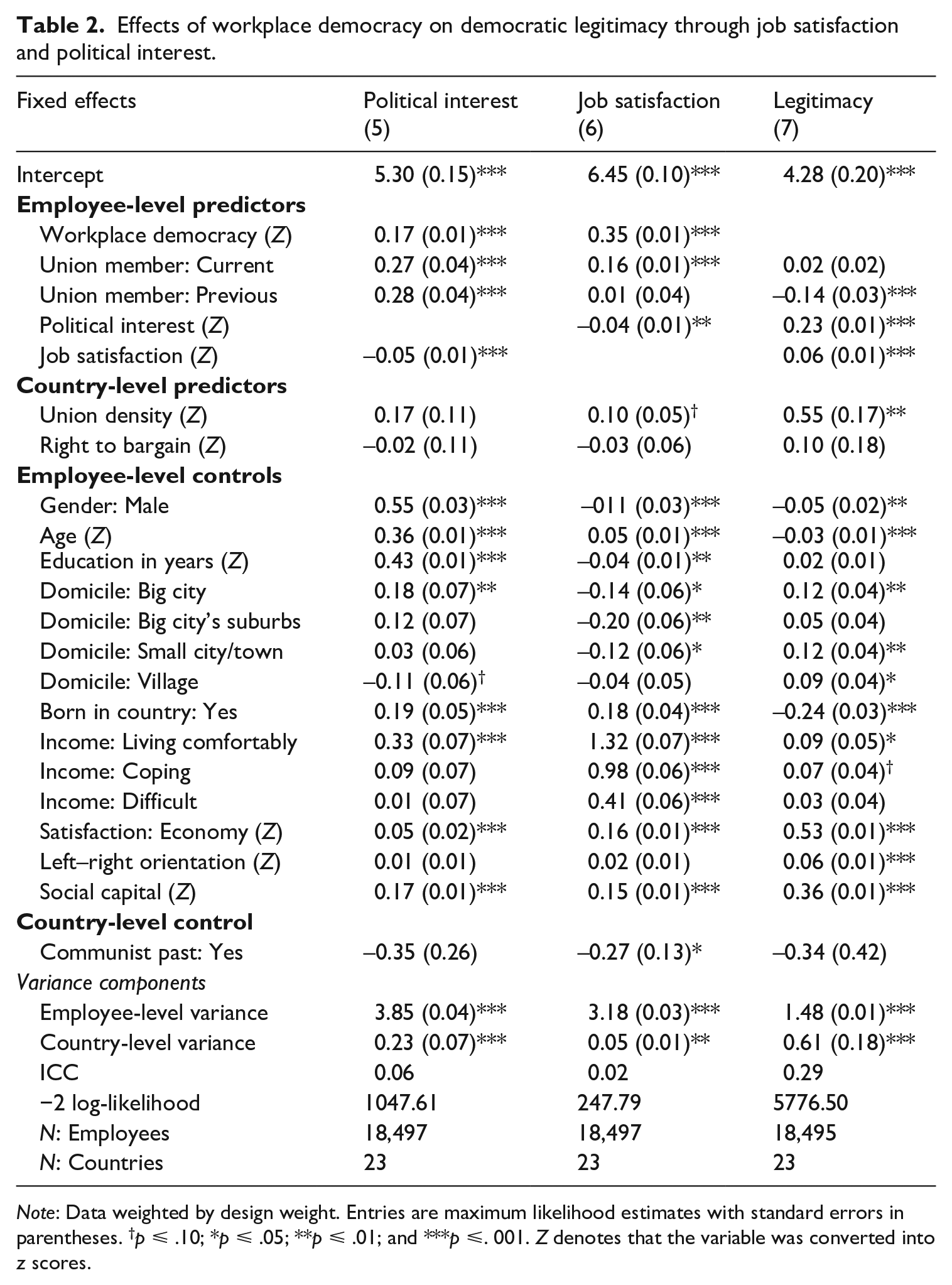
Note: Data weighted by design weight. Entries are maximum likelihood estimates with standard errors in parentheses. †p ⩽ .10; *p ⩽ .05; **p ⩽ .01; and ***p ⩽. 001. Z denotes that the variable was converted into z scores.
The mediating effects of political interest and job satisfaction were tested through three equations. The first equation was Model 1 – the direct effect of predictors (workplace democracy) on the main dependent variable (democratic legitimacy). The second set of equations tests the indirect effect of the main predictors on the two intervening variables – political interest (Model 5) and job satisfaction (Model 6). The third equation determines the effect of the intervening variable on the main dependent variable (Model 7). Finally, the products of the coefficients from Models 5–7 represent the total mediated effects of workplace democracy on democratic legitimacy through political interest and job satisfaction.
Results
Cross-national differences in democratic legitimacy and workplace democracy
Figure 2 plots the distribution of democratic legitimacy across 23 European nations. In 2010, the overall democratic legitimacy across Europe was distributed with a mean of 4.15, with Estonia and France falling quite close to this overall mean. Moreover, Denmark and Norway were the best, and Greece and Ukraine were the worst-performing nations on the democratic legitimacy scale. It can also be observed that democratic legitimacy varies significantly between the countries.
Online Appendix C presents the distribution of main employee-level and country-level predictors. Danish (mean 5.80) and Norwegian (mean 5.65) respondents gave the highest scores to workplace democracy at the employee level. Around 57.6% of the Danish and 50.1% of the Finnish respondents were self-reported current members of trade unions. Conversely, only 4.0% and 4.8% of Estonians and Portuguese, respectively, were self-reported members of trade unions. Overall mean political interest in Europe is 5.97. Danish (mean 7.30) and Germans (mean 6.79) exhibited the highest level, and Czechs (mean 4.80) and Portuguese (mean 5.05) demonstrated the lowest level of political interest. Moreover, the overall level of job satisfaction was relatively very high in Europe (mean 7.37). On average, Danish (mean 8.25) and Swiss (mean 8.03) were the most, and Czech (mean 6.82) and Greeks/Ukrainians (mean 6.57) were the least satisfied with their jobs.
At the country level, trade union density was highest in Sweden (78.8%), followed by Finland (76.6%), and it was lowest in Estonia (14.0%) and France (10.8%). Finally, 100% of Greeks and 98.0% of French employees who were members of a trade union had the right to bargain. Online Appendices D and E report the descriptive statistics of control variables and plot the correlation analyses, respectively.
Effects of workplace democracy on democratic legitimacy
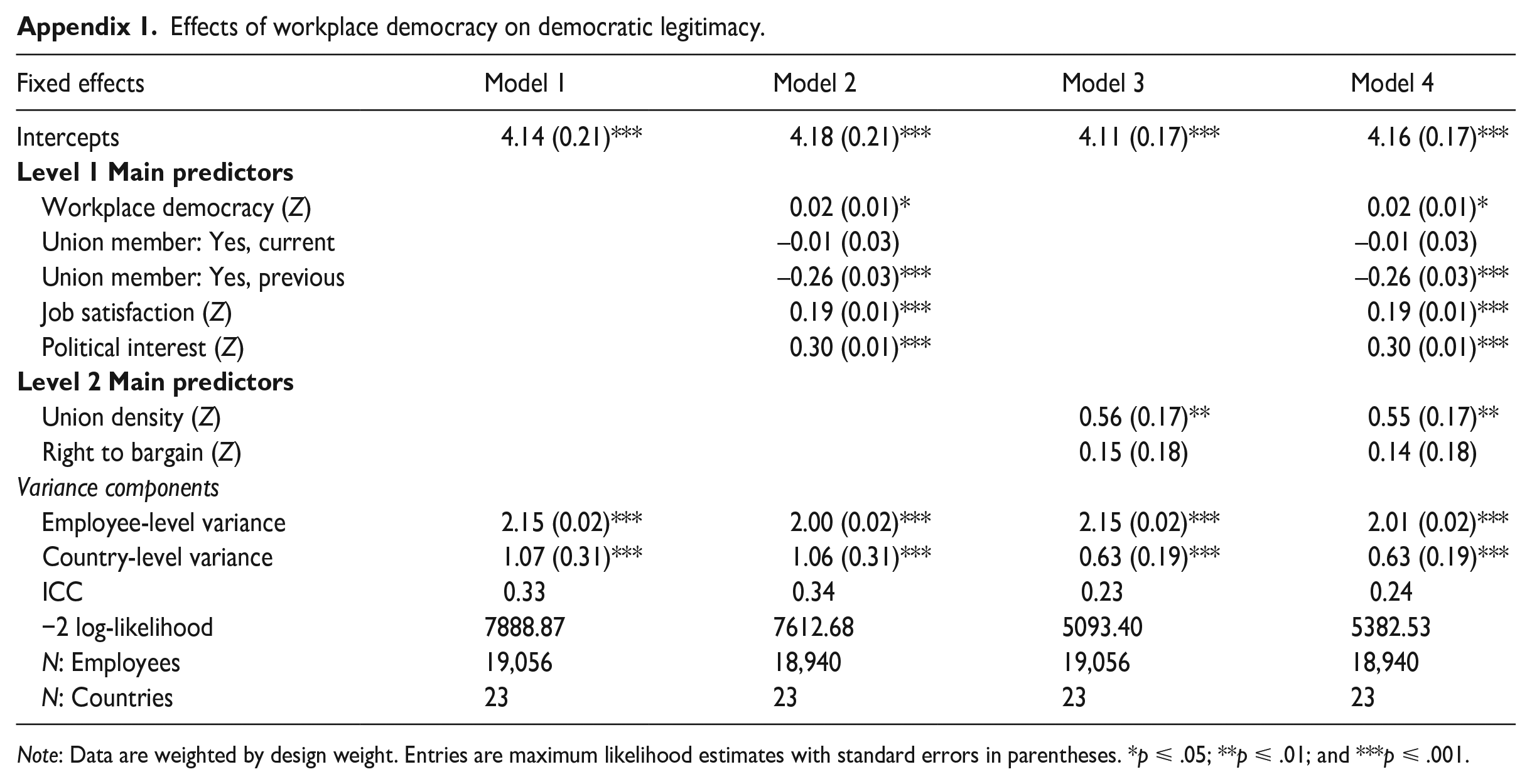
Since multilevel analysis is the main modelling strategy, inspecting some important descriptive statistics and model fitness indices is useful. Appendix 1 presents estimates of intercept-only and three baseline models involving the employee-level and the country-level predictors only. The intercept-only model (Model 1) shows that democratic legitimacy in Europe is distributed with overall means and standard deviations of 4.14 and 0.21, respectively, and the country-level means differ significantly from each other (Wald = 3.38; p < .001). Most often, the interclass correlation coefficient (ICC), reflecting the percentage of variance each level in the model accounts for, and the log-likelihood ratio, showing whether nested and non-nested models significantly differ from each other, are two commonly used fitness evaluation criteria (Steele, 2008). ICC shows that in the intercept-only model, the country level accounts for 33% of the variance in democratic legitimacy, which decreases by 9 percentage points when main predictors are added to the equation (Appendix 1; Model 4) and is 28% when a fuller model is performed (Table 1; Model 1). −2 Log-likelihood statistics demonstrate that all nested models are significantly different from their non-nested counterparts (note: one additional degree of freedom is associated with a chi-square distribution of 6.64 at a significance level of .01). Together, these statistics confirm the appropriateness of multilevel modelling.
Table 1 plots the estimates of the direct and moderating effects of various employee-level and country-level measures of workplace democracy. The results reported under Models 1–4 consistently negate any direct and significant association between employees’ perceptions and experiences of workplace democracy and democratic legitimacy. In the same vein, the findings also consistently reject any direct relationship between the self-reported measure of membership of trade unions and democratic legitimacy. Rather, those associated with such a union organization in the past were negatively associated with democratic legitimacy. These findings support the stealth democracy hypothesis, stating that, on average, citizens do not want any participation in the democratic decision-making process. Rather, they want their systems to solve their socioeconomic problems effectively and efficiently, which is reflected in the very strong effect of their evaluation of the state of the economy on democratic legitimacy.
The absence of any negative relations between workplace democracy and democratic legitimacy suggests rejection of the critical citizens hypothesis and automatic support for the stealth hypothesis. Such a conclusion is further strengthened by two additional routes suggesting the null effect of self-reported membership in trade unions (H2) and the absence of any interaction between workplace democracy and membership (H3). Employees’ past membership with the union is negatively associated with democratic legitimacy, which might suggest accepting the critical employee hypothesis. Only union density positively influenced the two country-level measures, and the right to bargain did not affect democratic legitimacy (H4). These associations remained stable even when their interaction with employee-level measures of workplace democracy was controlled for, thus, negating H5; that is, the country-level measures of workplace democracy might condition H1. Systematically rejecting alternative accounts provides clear support for the stealth hypothesis at the employee level, except that a past association with a union is negatively associated with democratic legitimacy (H3).
The mediational roles of political interest and job satisfaction were tested through a two-step procedure in line with the extant literature (Schmidthuber et al., 2021; VanYperen et al., 1999). The first step tests whether the independent variable affects the mediator, which in turn influences the dependent variable. Mediation occurs if both effects are significant. The two coefficients are multiplied in the second step to estimate the mediated effect. Table 2 reports the estimates extracted from testing the mediational role of political interest and job satisfaction. Model 5 and Model 7 provide support for H6a and H6b. Workplace democracy significantly affects political interest with a coefficient of 0.17 (p < .001), which in turn affects democratic legitimacy with a coefficient of 0.23 (p < .001). Thus, compared to the null direct effect, the mediated effect of workplace democracy through political interest is 0.04. Likewise, Model 6 and Model 7 provide support for H7a and H7b. The coefficient of workplace democracy and job satisfaction is 0.35 (p < .001) and the coefficient of job satisfaction and democratic legitimacy is 0.06 (p < .001). Their product, which represents the mediated effect of job satisfaction, is 0.02. Whereas the analyses confirm the mediational role of political interest and job satisfaction unequivocally and concur with support for H6 and H7, the latter’s effect is half that of the former’s.
Discussion and conclusion
This study sheds new light on the suggested links between workplace democracy and democratic legitimacy through the lens of political spillover and stealth democracy hypotheses and analysis of multilevel data extracted from ESS5 and the OECD. The findings reported in this study challenge the existing literature by suggesting a strong and positive direct and indirect relationship between workplace democracy and democratic legitimacy in Europe (Timming and Summers, 2020). The results of this study indicate that, at the employee level, the relationship between workplace democracy and democratic legitimacy is non-significant unless mediated by political interest and job satisfaction. Likewise, union density, the country-level measure of workplace democracy, and employee-level feelings of democratic legitimacy went hand in hand. The following sections discuss the findings at these two levels of analysis and consider the implications and limitations of the results in terms of their contribution to the literature on political spillover and stealth democracy theories.
After Timming and Summers (2020), this is the second study to examine the relationship between workplace democracy and democratic legitimacy in Europe. However, compared to the prior study showing the direct and indirect effects of political interest, the findings of this study clearly rejected the hypothesis about the political spillover effects of workplace democracy (H1). These results add to the extant literature that, besides having no effect on political behaviours such as campaign and voting behaviour (Adman, 2008; Godard, 2007; Jian and Jeffres, 2008), employees’ evaluations of workplace democracy bear no significant relevance for political cognition and affects that are tapped into through a syndrome of institutional trust, satisfaction with democracy and banning antidemocratic parties.
The lack of any direction in association, however, should not lead one to believe that Europeans prefer to free ride in politics. Rather, the evidence from other employee-level and country-level factors suggests that they keep a vigilant eye on three sets of other mechanisms that their workplace and political systems keep on performing without constant scrutiny. The first set of employee-level mechanisms postulated that union membership would affect democratic legitimacy directly (H2) and that the relationship between workplace democracy and democratic legitimacy would perform better for union members than non-members (H3). Whereas H3 received no empirical support at all, H2 received consistent support across all models but in the opposite direction from its prototype study (Timming and Summers, 2020). Past self-reported membership consistently, significantly and negatively affected democratic legitimacy, with the present membership having no role at all.
However, one must exercise caution when interpreting these findings. Current union membership having no role in producing democratic legitimacy or affecting the latter’s association with workplace democracy might seem to corroborate the stealth hypothesis (Hibbing and Theiss-Morse, 2004): employees want to be free riders within organizations and in political realms. Such reasoning might be true or false. Nevertheless, one must be conscious that the past couple of decades have introduced a host of employment reforms, including contractual, part-time and seasonal work schemes. With employers having full control of job design and tenure, union membership and allied activities might further expose these employees to precarious situations. The stealth hypothesis might prove false because past union membership is negatively associated with democratic legitimacy. This result might be interpreted through the lens of critical citizens theory (Norris, 1999, 2011) and/or the voice hypothesis (Laroche, 2017). Critical employees with very high expectations compared to the average employee and negative experiences gained within unions are likely to become dissatisfied with organizations and the political system. However, this negativism is less frustrating than a healthy criticism of how the organizations are embedded in and work within a political system.
The second set of mechanisms postulated that country-level workplace democracy would positively affect democratic legitimacy (H4) and that the relationship between employee-level workplace democracy and democratic legitimacy would perform better in countries with higher country-level workplace democracy (H5). The results show that the two country-level measures of democracy, labour union density and democratic legitimacy, go hand in hand. The third set of employee-level mechanisms suggested that the relationship between workplace democracy and democratic legitimacy would be mediated by political interest (H6) and job satisfaction (H7). Combined, this evidence clearly shows that spillover theory works differently than most extant literature suggests. These findings show that the workplace was directly responsible for the variation in democratic legitimacy in Europe, which runs counter to the findings of studies using single-level data from several European countries. Although the influence of workplace democracy through job satisfaction and political interest echoes the findings of Timming and Summers, the overall findings of this current study call into question the existence of any ‘compelling evidence that employee participation engenders pro-democracy affects’ directly (Timming and Summers, 2020: 721). Support for H6 and H7 at the employee level plus an overemphasis on union density and the insignificance of membership in bargaining units at the country level (H4) together suggest that, on the one hand, employees might not care whether they practise democracy within their organizations to accord legitimacy to their democratic political system. On the other hand, they might keep a constant check on their organizations and democratic systems by taking an interest in politics and expressing job satisfaction at the employee level. They can further strengthen this check by enlarging union density. Thus, a larger union size might enhance unions’ capacity for protests, demonstrations and negotiations regarding employment conditions. Whether organizational employees or citizens in the polity, they neither want to act as free riders nor excessively engage in politics; rather, they invoke mechanisms to legitimize their political systems at the intersection of political spillover and stealth.
These findings, based on employee-level data on workplace democracy from within the country and country-level factors associated with union democracy, shed new light on the drivers of democratic legitimacy in Europe through spillover theory (Pateman, 1970), the stealth democracy thesis (Hibbing and Theiss-Morse, 2004) and micro–macro perspectives (Hakhverdian and Mayne, 2012; Mishler and Rose, 2001; Noordzij et al., 2021; Wilkes, 2014). But there are some important things to keep in mind before drawing conclusions from these results. Although submitting the ESS5 data to employees reduced the sample size to half of the original data set within each country, the sample size within countries was sufficient to produce unbiased estimates. Nonetheless, these data are not a representative sample of all employees in a country’s various industries. Second, this study was unable to predict democratic legitimacy based on the argument that participation forms and organization types influence political participation (Greenberg et al., 1996). Third, democratic legitimacy and workplace democracy may be dependent on and conditioned by employment and occupational status at the employee level, which this study did not examine (Lopes et al., 2017). Finally, while extant literature has noted the direct and indirect effects of the 2007–2008 financial crisis on political trust in Europe (Foster and Frieden, 2017; Kroknes et al., 2015), this study could not evaluate the impact of the crisis because the main variables employed here were only floated in ESS5, which was administered between 2010 and 2013. Notwithstanding that the results are robust and fit well with the theoretical expectations, it still demands further research in this area in the light of these shortcomings.
This study has contributed to understanding how workplace democracy can enhance democratic legitimacy, a central theoretical and practical issue confronting even highly developed polities in Western Europe. Whereas the extant literature is tilted towards the nonexistence of any relationship between workplace democracy and democratic participation, these works ignore Pateman’s original emphasis that workplace participation enhances political efficiency and interests, affecting political attitudes. Thus, this study developed and tested a set of additional hypotheses besides re-testing some from the past studies (Timming and Summers, 2020). This article shows that the relationship between workplace democracy and democratic legitimacy at the employee level is only maintained through interventional mechanisms. Conversely, the country-level measure of workplace democracy positively affects democratic legitimacy. Combined, these findings show that while citizens might not like direct participatory decision-making within their organizations or their countries, they prefer to keep certain structures and mechanisms in place to keep an eye on how these systems work. There is substantial scope for further research, which could play an important role in understanding how workplace democracies work in practice at the two levels and their links with democratic legitimacy.
Supplemental Material
sj-pdf-1-eid-10.1177_0143831X231161837 – Supplemental material for Workplace democracy and democratic legitimacy in Europe
Supplemental material, sj-pdf-1-eid-10.1177_0143831X231161837 for Workplace democracy and democratic legitimacy in Europe by Bilal Hassan in Economic and Industrial Democracy
Footnotes
Appendix
Effects of workplace democracy on democratic legitimacy.
| Fixed effects | Model 1 | Model 2 | Model 3 | Model 4 |
|---|---|---|---|---|
| Intercepts | 4.14 (0.21)*** | 4.18 (0.21)*** | 4.11 (0.17)*** | 4.16 (0.17)*** |
|
|
||||
| Workplace democracy (Z) | 0.02 (0.01)* | 0.02 (0.01)* | ||
| Union member: Yes, current | –0.01 (0.03) | –0.01 (0.03) | ||
| Union member: Yes, previous | –0.26 (0.03)*** | –0.26 (0.03)*** | ||
| Job satisfaction (Z) | 0.19 (0.01)*** | 0.19 (0.01)*** | ||
| Political interest (Z) | 0.30 (0.01)*** | 0.30 (0.01)*** | ||
|
|
||||
| Union density (Z) | 0.56 (0.17)** | 0.55 (0.17)** | ||
| Right to bargain (Z) | 0.15 (0.18) | 0.14 (0.18) | ||
| Variance components | ||||
| Employee-level variance | 2.15 (0.02)*** | 2.00 (0.02)*** | 2.15 (0.02)*** | 2.01 (0.02)*** |
| Country-level variance | 1.07 (0.31)*** | 1.06 (0.31)*** | 0.63 (0.19)*** | 0.63 (0.19)*** |
| ICC | 0.33 | 0.34 | 0.23 | 0.24 |
| −2 log-likelihood | 7888.87 | 7612.68 | 5093.40 | 5382.53 |
| N: Employees | 19,056 | 18,940 | 19,056 | 18,940 |
| N: Countries | 23 | 23 | 23 | 23 |
Note: Data are weighted by design weight. Entries are maximum likelihood estimates with standard errors in parentheses. *p ⩽ .05; **p ⩽ .01; and ***p ⩽ .001.
Acknowledgements
The author is grateful for comments and feedback from anonymous reviewers.
Declaration of conflicting interests
The author declared no potential conflicts of interest with respect to the research, authorship, and/or publication of this article.
Funding
This project has received funding from the European Research Council (ERC) under the European Union’s Horizon 2020 research and innovation programme (grant agreement no. 724460). Disclaimer: Publications from the project reflects only the author’s views and the funding agency is not responsible for any use that may be made of the information contained therein.

Supplemental material
Supplemental material for this article is available online.
Author biography
References
Supplementary Material
Please find the following supplemental material available below.
For Open Access articles published under a Creative Commons License, all supplemental material carries the same license as the article it is associated with.
For non-Open Access articles published, all supplemental material carries a non-exclusive license, and permission requests for re-use of supplemental material or any part of supplemental material shall be sent directly to the copyright owner as specified in the copyright notice associated with the article.
