




Abstract
The proliferation of ride-hailing platforms in the last decade has been challenged by workers’ mobilization around the world. In order to complement the existing research on successful organizing, in this article the authors investigate the lack of collective resistance in two cases. By comparing the ride-hailing industry in Berlin (Germany) and Tallinn (Estonia), the authors explain the absence of collective mobilization in these different contexts. While ride-hailing in Berlin is more regulated than in Tallinn, drivers in both cities are structurally located in the weakest position within labour relations. Their isolation presents common features found in the business model and the work process, but also within wider societal structures and ideological landscape.
Introduction
Fifteen years after the financial crisis of 2008, its long-term manifestations can be observed by passengers around the world. Tech companies such as Uber and Didi have developed into a disruptive vector of incumbent taxi industries worldwide. Similarly, the rise of ride-hailing platforms stands symbolically for a recent history of resistance carried out by workers and citizens against the platform economy: app drivers have taken to the streets and organized against precarious conditions, employment misclassification and other issues (Bessa et al., 2022). Taxi drivers and their associations have mobilized against unfair competition, the relaxation of qualification standards and tax evasion through the platforms. Due to these mobilizations, regulators have started to take on ride-hailing firms by introducing measures such as the AB5 legislation in California or the European Union (EU) directive on platform work. The mobilization of platform workers has been crucial to these regulatory innovations and illustrates how collective action and workers’ agency can shape working conditions and structural conditions at large. Existing research has looked at several causes for collective resistance in the platform economy (Vandaele, 2021). Some stem from internal processes, such as the ability to build ties of solidarity among workers due to their common situation, others from external processes, such as the presence and activity of local unions (Tassinari and Maccarrone, 2020). As research has shown, workers’ resistance can also be present when it is not articulated collectively. Workers might develop individual and scattered forms of agency in order either to maximize their income or to achieve better conditions individually (Altenried and Niebler, 2024; Anwar and Graham, 2020).
While much of the contemporary literature on the platform economy has focused on the development of collective worker agency, we want to interrogate the lack of collective action in specific contexts. More precisely, we address the question why app drivers focus on individual agency and coping strategies, instead of addressing their labour conditions through collective organization. Which factors prevent them from exercising organized resistance? Acknowledging that institutional setting, including regulatory framework, but also ideas popular in a given society and companies’ business strategies may constrain the agency of drivers in different ways, our article focuses on reasons for the lack of collective action by app drivers in Berlin and Tallinn, two cities with conspicuously different settings. We chose the ride-hailing in these two contexts according to the logic of contrasting cases, as this enables us to ascertain the factors that are similar in hindering collective organization. We look at the interactions between the regulatory frameworks, Uber’s business strategies and the ways how the platform economies and their workers are ideologically framed in the two cities as well as how the workers themselves identify.
Berlin and Tallinn are cities in which app drivers have not been engaged in significant protests and collective struggles. In the two cities ride-hailing platforms have applied different business models to cope with different regulatory settings. In Berlin the taxi industry is highly regulated, and the platform economy considerably contested; labour struggles as well as urban movements have attacked directly big tech and several platform companies (with exception of ride-hailing platforms). In contrast to this, the taxi industry in Tallinn is loosely regulated and has experienced further liberalization since the arrival of ride-hailing platforms. Moreover, the local public opinion and politics are generally techno-optimistic, favouring and leaning towards further liberalization of platforms. As the contexts are different, we ask why the level of collective organizing of app drivers is so low in comparison to many other cities around the globe.
We join the debate about the conditions for organizing and mobilizing and the factors which might favour the consolidation of ties among workers, and thus their ability to develop common claims and act for their implementation. Acknowledging that app drivers develop individual forms of agency, we focus on factors playing a decisive role in isolating workers and preventing them from joining forces and developing claims which go beyond the betterment of their individual situations. We show that while the dynamics of how regulations and wider urban societies interact in the two cities are quite different, the outcomes of these result, in both cases, in a lack of collective action on the part of platform drivers. Our comparative analysis shows how the drivers’ agency to mobilize is bounded and filtered by specific features of the business model, interacting with each urban space, with its own institutional setting, including ideological underpinnings and regulatory frameworks. We argue that across such different contexts such as Berlin and Tallinn, the factors leading to workers’ isolation present common features found in the business model, in the work process, and also in the wider societal structures and ideological landscapes. By developing a comparison based on the logic of contrast and difference, we suggest that the hindering of labour organizing is a quintessential and foundational element of platform economies worldwide and our analysis shows how this can happen via quite different channels. Thus, and in line with other literature (De Stefano et al., 2022; Englert et al., 2021), we suggest that this acknowledgement should be the starting point for policies aimed at making platform economies more just and democratic. It follows that such policies should be aimed at strengthening labour and the unionizing rights of workers.
Resistance in the platform economy
Platform capitalism (Srnicek, 2017) should be considered in its interaction with (late) neoliberal practices, economies and ideas. Platform workers worldwide appear as entrepreneurial subjects, who cannot be reductively portrayed as passive factors within ‘operations of capital’ (Mezzadra and Neilson, 2019). Much of the research has shown how discourses around freedom, autonomy and self-realization are at the core of identification processes of platform workers (Dubal, 2020; Purcell and Brook, 2022). Platform workers maximize their income and gain spaces of freedom within their interaction with the app (Parth et al., 2023; Vasudevan and Chan, 2022). Also, they have engaged in a myriad of protests, mobilizations and strikes as well as traditional unionization (see Bessa et al., 2022 for an overview). In other words, platform capitalism produces resistance against and within a system of exploitation facilitated by algorithmic management and misclassification.
Given the considerable number of labour struggles in the field, research on the platform economy has focused widely on the forms of collective and individual resistance of platform workers. Research on collective forms of organization includes investigations of mobilizations which have led both to obtaining substantial improvements in working conditions and to less successful outcomes (Cant, 2019; Heiland, 2020; Wood and Lehdonvirta, 2021). The ride-hailing sector is an excellent case for investigating resistance and resilience, consent and denial, coping and reworking. App drivers develop elaborate ways of manipulating the algorithms in their own interests (Ferrari and Graham, 2021), they actively engage in gamification (Vasudevan and Chan, 2022) or combine digital and physical infrastructure to create manager-free spaces (Parth et al., 2023). Meanwhile, app drivers have taken to the streets in many cities of the world, challenging their classification as self-employees (Dubal, 2020).
However, the question about the absence of protests and organizing is often neglected. While we endorse the view that workers’ agency is much wider and more diverse than organized strikes, demonstrations and street protests, we want to address the nexus between individual and collective practices and agency. Why in some settings do the individual micro-practices of resistance not scale up into collective organization?
To do so, we focus on two central aspects which affect the agency of workers, i.e. the institutional dimension (Haidar, 2023; Vallas and Schor, 2020), including the shape of labour relations (Lopez, 2010), and the ideological dimension (Gebrial, 2022; Haidar, 2023; Purcell and Brook, 2022). Previous research shows that the type of labour relationships concerning platform work constrain platform workers’ ability to develop solidarity (Tassinari and Maccarrone, 2020). Following Vallas and Schor (2020) we agree that platforms adapt to the local context in such a way as to maintain low labour costs and fragment the labour force. The resulting structural powerlessness and isolation of drivers is a fundamental element to understand their difficulties in developing forms of collective action. Furthermore, it is important to consider the ways the platform economy is framed in the urban context, as this too impacts the coalitional power of app workers (Vandaele, 2021). Tassinari and Maccarrone (2020) compare two cases of successful protests, exploring the factors which play a major role in enabling the formation of a common identity and interest and collective agency. They identify ‘common facilitating factors’, such as the availability of meeting places, and ‘contextual enabling factors’, such as the presence of unions and/or local social movements (Tassinari and Maccarrone, 2020: 49). We follow this approach and focus on the urban contexts in our cases, in particular looking at the local reception of platforms and the struggles around them.
Methodology
The article analyses the lack of collective mobilization in the ride-hailing sectors of Berlin and Tallinn. Our analysis is based on data obtained from a comparative, interdisciplinary research project examining the platform economy across various European cities. For the purposes of this article, a methodological approach employing a comparative contrasting case study method was utilized, using the data on the distinct city cases of Berlin and Tallinn. Both cities have an active ride-hailing sector yet present many differences, including with regard to regulations and the relationship between the traditional taxi sector and the platform-mediated ride-hailing business. The case study methodology is deemed particularly suitable for delving deeply into a contemporary phenomenon within its context, especially when the boundaries between the case and its context are not clear (cf. Campbell, 2010; Yin, 2018). The selection of the cities of Berlin and Tallinn adhered to the principles of maximal contrasting design, anticipating that the variation in their different conditions would offer fresh theoretical insights (Lee and Saunders, 2017). As typical for a comparative case study, the individual cities as urban cases were first analysed separately by using the conceptual framework as a common reference, and the comparison of cases followed (cf. Campbell, 2010). In the following, the two city cases and data are described in more detail.
Since the 2010s Berlin has developed into a core city for start-ups and tech companies in Europe. It is the current or former home of several platform firms, such as Helpling, Gorillas and Delivery Hero (Niebler and Animento, 2023: 693). In particular, in the wake of the global crisis of 2008, the population of the city started to grow, mostly due to migration. After having remained isolated for several decades, Berlin has undergone a process of globalization of its economy and of financialization of the housing market. While the city is widely known for its lively subcultures and leftist grassroots movements, the recent economic growth and internationalization have widely impacted the politics of the city. Once branded as the ‘poor but sexy city’, and the ‘social city’, Berlin has become a ‘creative city’ with a strong start-up culture and a growing part of the population working in the tech sector (Lanz, 2013). Uber started its operations in Berlin in 2014. Since then, other competitors (FreeNow, Bolt) have entered the urban taxi market, which (in its traditional form) is relatively highly regulated.
Tallinn, the capital of Estonia, has undergone several disruptions in the last decades. The profound societal transformation during the 1990s from state socialism towards a neoliberal market economy needs to be considered also in order to understand the more recent arrival of the platform economy. Openness to digitalization and a publicly recognized start-up sector, together with a general neoliberal policy context, have resulted in a relatively weak regulatory framing for the platform economy. In comparison to Berlin, the different scale of the city also needs to be considered. With 458,000 residents, Tallinn is among the smallest capitals in Europe, with a relatively low population density at the same time. In Tallinn, the ride-hailing sector comprises different platforms with the domination of Estonian-origin platform Bolt.
The data used for the comparative case analysis comprise interviews carried out with Uber drivers as well as relevant documents (policy papers, regulatory materials, media sources, etc.). Data were initially coded according to the conceptual framework used as a common reference, and later organized into more general categories.
The interviewees were recruited via a variety of approaches, including social media, online job hunters, taking rides with Uber and snowballing. In Berlin, the research on Uber is based on 14 interviews with drivers, one interview with a representative of Uber, and one with three taxi drivers who had engaged in a mobilization against Uber. Twelve of the interviewees were drivers, one was a subcontractor (‘Subunternehmer’) and one was an employee at a large subcontractor firm. The interviewees were mostly male (two were female) and between 21 and 54 years old; most of them were migrants of first or second generation, from Turkey and Arab countries. The educational level of drivers was generally low (10th grade, secondary schooling) with some exceptions. Most of the interviewees worked full-time through Uber. The interviews were held between 2019 and 2020. Due to the outbreak of the pandemic, some drivers we talked to were not actively working at the time of our interview.
The data for the Tallinn case comprise interviews with Uber drivers (15) and experts (8) from the fields of social security, taxation, public transport, labour rights and platform work in general. Individual semi-structured interviews were conducted in 2019–2021. The final pool of interviewees was rather diverse in terms of age (24–66 years), forms of platform work and experiences of taxi driving, and working hours per week. The sample was over-represented by men (13 out of 15), people with higher education (10 out of 15) and Estonians (11 out of 15); at the same time the sample also includes drivers from ethnic minorities and recent immigrants. All interviewees combined Uber with other taxi platforms or traditional taxis. In addition, focus group events in both cities were conducted with platform workers and with different stakeholders.
Explaining the lack of collective action in Berlin
Regulatory environment, work organization and business model
As noted above, Uber began its operation in the German market for ride-hailing in 2014, where it competes with similar firms such as Bolt and FreeNow as well as the local taxi sector. After several lawsuits against Uber’s business model of offering transportation by private drivers, the company (and later its competitors alike) had to adapt to Germany’s Passenger Transportation Act (Personenbeförderungsgesetz, or PbfG), a regulative framework that governs both taxis and chauffeur services. Since then, Uber operates through a system of subcontracting companies, so-called ‘Uber-partners’, which are obliged to employ drivers as employees (Niebler et al., 2023: 293ff.). These sub-companies are run by private hire operators. While in some cases these rental car entrepreneurs are drivers themselves, they usually operate as subcontractors in a managing position for Uber and employ a workforce of anything from 5 to 500 workers. Sub-companies provide drivers with a labour contract and a car, which they rent on special conditions (and through the help of Uber) from rental companies. Sub-companies usually work with Uber, Bolt and FreeNow, so that drivers can use all apps at the same time (multi-apping) to maximize revenues.
This complex system leads to a particular model of labour relationship. On the one hand, drivers are employed by the subcontractors, which decide formally and according to existing labour law on their wage, the work contract, the hiring process as well the termination of the labour relationship. Companies have a physical location, often on the outskirts of the city, where drivers can (at least in theory) meet their colleagues and the employer. On the other hand, drivers stand in relationship with Uber with regard to the organization of the labour process and the control over their work across the city. Through the app, drivers get in contact with clients. Uber has a small office in a central location in the city, where drivers get an initial short training, and where they can resort to when they have problems with the app or trouble with clients. In other words, the labour model of Uber in the German capital can be understood as a mixed one, with elements of formal labour relationship in the low-wage sector and elements of (fake) self-employment (see Niebler et al., 2023). From this point of view, Uber drivers in Berlin have to deal with the algorithmic management carried out by Uber, with a labour relationship to the subcontractor, and with the clients, who have the power to endanger their job through low reviews.
The above-mentioned regulation was meant originally to set standards in the sector of ride-hailing and to regulate the entry of new taxi drivers through the acquisition of a taxi driver licence. However, its application to the activities of Uber has strongly affected the condition of drivers, adding a further layer of control over them, who now face multiple forms of exploitation. A larger number of workers had the possibility to enter the ride-hailing sector via working for subcontracting companies, but they are now exposed to much higher control. According to the interviews, many drivers had switched to working for Uber after job experiences in the low-wage sectors of gastronomy, construction, call-centres, customer care and security. The reasons for working for the platform relate to the possibility of earning more by working flexibly but for longer hours, with the appealing idea of working in the city with no direct human control, as well as valuing their experiences in the service economy and in customer care.
Despite such advantages, our interviews (such as the one below) indicate that the working conditions at many subcontracting companies are extremely harsh for drivers, who usually work more hours than those written in their contracts, thus receiving an even lower hourly pay than the minimum wage. Many interviewees spoke of 50–60 hours of work a week to obtain a decent wage at the end of the month. Also, rights to holidays and paid sick leave are often subverted by the companies. In other words, much of the work carried out for these companies can be considered as illegalized or informal work. This is not surprising, as the sub-company model is widely applied in many other sectors in the highly segmented German labour market, such as in craft trade, the construction industry or delivery logistics, in which labour rights are also undermined (Holst and Singe, 2011). In Germany, labour exploitation is widely based on a strong segmentation of the labour market and on a system of internal ‘outsourcing’, in which labour relations within the same production process or service are segmented and delegated to more companies, often along racial lines. Uber has inscribed its operations into such a context, leveraging the sub-company model in order to find its own way of dealing with the German market (Animento, 2024).
As an Uber driver, you have to have nerves of steel. So, let’s say, be strong. You might underestimate it, but it’s really hard, it’s exhausting, it’s not that easy. It’s a thrill, because we have to do what Uber tells you. . . You’re not relaxed, you’re like: ‘Do 50 trips’ and if you haven’t done that, then you won’t get your money and if you don’t get your money, then your subcontractor is unhappy with you and then puts pressure on you. [. . .] He [the subcontractor] also puts pressure on you, he wants turnover. Because of, for example, all other [drivers] work thirteen or fourteen hours and if you come and say: ‘No, I want my rules. Only my nine hours’ he doesn’t take you on at all. Because it’s not worth it for him. It’s as simple as that. (U_M_Ber_4)
Thus, working for Uber represents both an opportunity and an obstacle to decent work. The company attracts drivers, who try the job and then find themselves in a contradictory situation, in which it is not easy to evaluate the pros and cons. The presence of a broadly developed low-wage sector seems to favour acceptance of working for Uber even under such bad conditions, as it at least offers the chance of spending time moving across the city, without direct human supervision, in comparison with other jobs in restaurants or bars, or at call-centres.
In gastronomy, there’s a lot of stress and then I got older and then. . . I didn’t see that for myself, I thought to myself: ‘Well, when I turn fifty, I won’t be able to wait tables anymore at some point.’ Then no one will take you in. . . And then I thought to myself, I’ll do the [ride-hailing] licence, although I tried to get in as a cab driver, but I didn’t make it. . . and then I thought to myself: ‘Well, okay, try Uber.’ (U_M_Ber_6)
Our research suggests that the complex model of subcontracting at Uber in Berlin is a major reason for the lack of collective organizing. The dispersion of Uber drivers among the many (often small) subcontracting companies is an obstacle to the creation of a common agency and common claims. In our interviews, drivers reported vastly different and heterogeneous circumstances of work (different forms of payment, contracting, fees, management), which made it difficult to generalize about the conditions for workers across sub-companies. If organizing efforts were made, they never succeeded to go beyond the level of a single subcontractor. One worker, who had tried to organize together with around 50 colleagues through a WhatsApp group, explains the situation:
If we work[ed] for Uber directly, then it [would be] really easy, then I can create a works council instantly, it goes really quick, then taktaktak and then to Uber directly. But now you have an employer [sub-company, saying:] ‘No, if you do that, I’ll fire you’ [. . .] Then the employee is scared and then he just doesn’t want to do it, because he isn’t at Uber directly. Because that are always intermediaries. You don’t have this influence [. . .], you can’t convince them. (U_M_Ber_5)
Interviewed drivers were usually fully aware that their pay is way too low for the job they do, and for the risks which they undergo in contact with clients and driving on the streets. However, their potential for conflict and antagonism is split between the different actors of their labour relationship. Their discontent is oriented both towards the platform with regard to the relationship with clients, the reviewing system and the algorithmic management, and towards the sub-company with regard to the pay percentage which they get and their contractual conditions. In other words, it seems that the complex matrix of employer, platform and clients in which their labour force is placed makes the development of common action harder to accomplish.
An important aspect of the regulation of the ride-hailing sector is the so-called obligation to return (Rückkehrpflicht), which already existed before the start of Uber’s operations in the country. In contrast to taxi drivers, drivers of private hire vehicles are not entitled to roam freely through the city but have to go back to their company address after picking up a passenger (see Altenried and Niebler, 2024: 359ff.). The Rückkehrpflicht was enforced via a GPS-based function on the app which would log-off drivers if they moved away from the company after the end of a ride. The Rückkehrpflicht constitutes a significant impairment for the business model of Uber, as it cuts the possibilities to find clients, thus stifling revenue possibilities. This has dramatic consequences, considering that most sub-companies are located on the outskirts of the city. Thus, in order to comply with the law, after every ride drivers should drive back outside of the city, wasting precious time and the chance to get a new fare. The application of the Rückkehrpflicht at Uber has been welcomed with enthusiasm by the traditional taxi associations, as it weakens the role of disruptive competitor which Uber has been since its arrival. At the same time, these actors constantly tried to bring to the media attention the fact that Uber drivers do not respect the regulation. In fact, drivers had ways of circumventing it or attenuating the effect, in order to limit their loss of income – for example, by instead of driving back to the company, turning around towards the city centre as soon as they have been registered as close enough (in proximity) to the company office.
However, several interviewees referred to this aspect of the regulation as a major problem, which adversely affected their working conditions, notwithstanding their attempts to circumvent it. Of course, even the acts of coping developed through the tactic explained above and multi-apping result in more work for the drivers, and add a further layer of management of their work activities. From the perspective of labour struggles and organization, the introduction of the Rückkehrpflicht could have been a ‘trigger point’ (O’Sullivan and Turner, 2013) for the mobilization of Uber drivers, but no such action took place. Our analysis points to the above-mentioned aspects of working at Uber, considering the contradictions related to the labour condition, as among the reasons for the inability to act collectively.
Ideologies, othering and lack of coalitional power
In Berlin, widespread techno-scepticism seems to be a crucial factor affecting labour relations in the platform economy. As we have shown above, Uber drivers in Berlin were cautious about the benefits of platforms. In the interviews, they praised the possibility of working on the streets with no direct control of a physical boss, but expressed concerns about being surveilled by the app, and about their labour conditions. At the same time, many Uber drivers interviewed in the research experience high barriers of access to the primary labour market. As migrants from non-European countries in a highly racialized labour market and society, they generally tend to have scarce job opportunities. Although most of them expressed criticisms, they maintained that working for Uber was comparatively better than many other jobs available to them.
More widely, the arrival of Uber in the German and Berliner market for ride-hailing has not been viewed positively by established actors in the sector. Traditional taxi associations have mobilized against Uber publicly, organizing cab demonstrations on the streets of Berlin, mobilizing the press to write about their concerns, and contacting politicians and government departments such as the Federal Ministry for Digital and Transport. As our interview with a group of taxi drivers who founded a Facebook group against Uber showed, arguments used against the company spanned from some well-known aspects of its business model, such as the fact that it operates in legal ‘grey spaces’, or that it fosters a system of urban mobility which is harmful for the environment, to arguments more related to Uber drivers themselves, who were said to be uneducated, unable to carry out their work because they lacked language skills and knowledge of the city. At the same time, during the cab demonstrations across the city, several cases of verbal and physical attacks against Uber drivers were reported in the press (Ringelstein, 2020) and also by our interviewees:
They hated us personally. They had no understanding that we are also workers ourselves, that we also want to earn our bread. There were, let’s say, 80 percent of cab drivers who acted terribly, at every corner, at every lane change, so that they wouldn’t let us [through] or things like that. Or when we stopped and [a] customer got in, then started like ‘Buuuup Buuup’, honking and stuff like that. (U_M_Ber_4)
In the very lively local leftist scene in Berlin, which has historically been able to largely impact urban politics, scepticism towards digitalization of big tech and platforms is wide-ranging. Leftist groups and local resident initiatives have organized protests against the project of a Google Campus, a Tesla factory and Amazon’s plan to locate in the city centre. Uber has not been perceived yet as a major risk by civil society actors or political groups, who are mostly concerned with Amazon, Google or other platforms such as those for food delivery. In fact, in the past five years important labour struggles in platform companies like Gorillas, Lieferando and Flink have taken place (Fielder and Westendarp, 2022). To a smaller extent, some groups also supported the organizing of platform cleaning workers (Niebler and Animento, 2023). However, while riders have received solidarity from many sides, no actors, either in the leftist scene or in politics, have expressed solidarity with Uber drivers. Further, while other platform workers such as in the food delivery sector are more visible on the streets and have gained much more media attention, for a long time Uber cars were not even recognizable, as they had no visible ads. As a consequence, Uber drivers remain largely unrecognized in public space, while at the same time they have been publicly targeted by attacks by taxi drivers.
In other words, in the case of Uber drivers, the lack of solidarity from more established organizing groups has contributed towards creating a vacuum of coalitional power (Schmalz et al., 2018) around Uber drivers. It seems that the widespread techno-scepticism and the general suspicion of Uber might have been partly passed on to the drivers themselves, in conjunction with a racist fragmentation of the ride-hailing sector. While traditional taxi driver unions have not been able to attract Uber drivers, and taxi associations have openly attacked Uber without making an explicit distinction between the company and the drivers working with the app, no other grassroots organizations have picked up the topic or confronted openly the racist matrix of those attacks against Uber drivers.
Explaining the lack of collective action in Tallinn
Regulatory environment, work organization and business model
Ride-hailing platforms emerged in Tallinn in the mid-2010s: the Estonian Taxify (now Bolt) in 2013 was followed by Uber in 2015. Initially, ride-hailing as a service was unregulated and thus much more cost-efficient for both clients and drivers compared to the traditional taxi service. Traditional taxi services were under several regulations, e.g. different licences and training were mandatory. The first and main outbursts against platforms in the taxi industry were initiated by taxi drivers and traditional taxi companies who felt threatened by the unfair competition. Heated debates took place in 2016 when the changes in the Public Transport Act were discussed at the state level. Traditional taxi companies and drivers demanded that platform and regular taxi services should be subject to the same regulations. There were public debates in the mass media, but also a demonstration in front of the Parliament (Kall et al., 2021).
The result was the overall deregulation of the taxi industry due to the inclusion of ride-hailing as a taxi service at the end of 2017. This change included lowering the barriers to becoming a taxi driver, causing a de-professionalization of the job. For example, before the changes to the Public Transport Act, training was mandatory for all taxi drivers. According to an interviewed representative of a taxi company, very few companies train their drivers now as it is voluntary (Tallinn taxi industry focus group, March 2021). However, there are still some differences between platform-based and traditional taxis. Importantly, local governments cannot effectively control platform taxis but can refuse to provide the licence if the driver does not speak Estonian well enough, as the Act falls short in providing means to do that. Latterly, a similar practice of deregulating the entire sector to embrace new platform business models has taken place in the case of hospitality/Airbnb as well (Ojamäe et al., 2021), indicating a common trend in Estonia.
It is important to outline that the starting point was very liberal in Estonia compared to other European countries, with only a lightly regulated taxi industry before the arrival of platforms. In Tallinn, even one-person companies can hold a taxi licence. Most ‘traditional’ taxi services do not employ taxi drivers, but drivers are either self-employed or working through their own company. Thus, no paradigmatic change occurred due to platforms: it stretched further the already weak labour relations. Nevertheless, platforms introduced a new practice that made the situation of drivers more precarious, i.e. the possibility of working as an individual, without any kind of contract with the platform. These freelancers declare taxes (if at all) as occasional income or through a newly established business account for solo workers. On occasional income only income tax is paid, which does not provide social security (including healthcare insurance) coverage. Paying social taxes lowers earning opportunities significantly, so these are rarely paid (Kall et al., 2021).
Accordingly, a central regulatory barrier against organizing is related to the legal ambivalence of the rights of app drivers to form and become the members of trade unions. As platform workers are formally independent contractors, not employees, they do not have the possibility to negotiate collective agreements. In any case, there exist no specific unions for platform workers, and traditional unions have also been rather reluctant to organize platform workers. The Estonian Trade Union Confederation has outlined that legal ambivalence hinders recruiting platform workers and change in the law is needed to accommodate the specific needs of platform workers (email interview with the representative of the Estonian Trade Union Confederation, 2021). Furthermore, platform workers deal with specific issue like high mobility between platforms – most engage in multi-apping as a practical necessity – and the need to get drivers’ data from the platforms causes extra effort for established unions and reduces their willingness to engage with platform workers (Holts, 2022).
A recently established community organization, Estonian Taxi Association (Eesti Taksokoondis), representing the interests of both traditional and platform taxi drivers has expressed clear dissatisfaction – mainly in social media – with the current situation and has highlighted that taxi platforms should be considered regular taxi companies (Eesti Taksokoondis, 2021). While an innovative labour organization in the overall context of a low number of labour rights organizations, they are not registered as a trade union, are very small and have not yet done any major campaigns to mobilize platform taxi drivers.
A second crucial event in the mobilization of workers in the taxi industry was triggered by a change in pricing by Bolt. This can also be considered the only highly visible collective action of platform workers in Tallinn, organized via social media. Initially ride-hailing platforms provided rather good compensation, but it got worse and worse and the competition between taxi drivers and platforms got fierce. In January and February 2018, Taxify drivers gathered in front of the company office to demonstrate against the platform’s new dynamic price policy – meaning that in the area where there are a lot of clients the prices will be higher/doubled, but otherwise the price will be low. According to the protesting drivers, that would have decreased their income by 30% (Holts, 2022). However, the protests did not lead to the hoped for outcomes, as explained by one of our interviewees:
Well, those who stood against Bolt’s system, they were all blocked. So like, tried to make a trade union or something like that. [. . .] The process stayed unfinished. That was [in 2018]. So we do not have a trade union here in Estonia. We have the power of the app. Let’s say that the drivers do not have a right to say anything. (U_M_Tln_9)
Thus, the interviewed drivers have interpreted the uprising rather as a demonstration of power of the platform over drivers: blocking the driver without due process and negotiation in cases where drivers ‘act out’. Being blocked by a platform is a major problem for app drivers, even if they mostly work for more than one app at a time. Diversifying their work through multi-apping is necessary to earn a decent income.
In addition to blocking, isolation of drivers plays a central role in hindering the agency of workers and the development of a collective identity. In Tallinn, differently from Berlin, there is no physical space for meeting other drivers if you work for a platform. Therefore, the platform work can be quite isolating, as some drivers do not know any colleagues that use taxi-apps. However, as in case of other types of platform work, encounters with other drivers take place within digital spaces, especially in Facebook. There are at least five platform taxi drivers’ virtual communities. However, there have been cases where these communities have been closed all of a sudden (Holts, 2022) and some interviewees claimed that they had to be careful about what they wrote, as in the worst-case scenario being blocked by the app could follow. Their isolation is exacerbated by the lack of (face-to-face) communication with the platforms. Uber closed their office in 2020 related to the first wave of COVID-19, but it seems that Uber drivers were not even notified about this. Thus, according to interviewees, sometimes (mainly Facebook) forums are the only place to discuss work-related matters. Since then driver support for Tallinn drivers is delivered through Uber’s Polish office. The isolation of app drivers reduces the possibility of sharing the difficulties encountered in this line of work and discourages the development of a collective sense and the ideas of resistance.
Isolation and algorithmic management effectively silence the voice of platform workers as drivers have little possibilities to negotiate with platforms. As one interviewee mentioned, she has heard of some talk about establishing a union for the app drivers, but until now no trustworthy leaders for the movement have appeared. She did not have any hope for the benefits it could bring, as she stated: ‘What damage could a small breeze do to the fence?!’ (U_F_Tln_13).
Ideologies, identities and othering
The platform business model in Estonia links with neoliberalism on the one hand and techno-optimism on the other. Discourses from both ideologies could be found in the interviews as well. Although some interviewees perceived the management strategies of the platforms to be somewhat constraining and to generate precariousness, most of the drivers also mentioned that this kind of work offers them freedom. Even if not satisfied with the work situation, the flexibility of platform taxi driving was seen by some drivers as an ultimate advantage – even though they cannot set the service price and are at the mercy of the availability of clients and bonus systems. But because of the perceived flexibility, other, more problematic issues could be looked over:
Well, speaking of the platform economy in general, I do believe that being one’s own master is a really good thing. I imagine, when one works for a taxi company there will emerge a completely different interaction [. . .] maybe there are also those with more flexible schedules and such, well, schedules and plans and whatever. I am not very interested in that sort of thing. (U_M_Tln_6)
Indeed, platforms have been successful in emphasizing the flexibility aspect of the work and this also attracts people who are not interested in improving the work situation, but rather using it as a side-job, a short-term option.
What we see in the case of Tallinn illustrates internalized neoliberal discourses: expressing techno-optimism rather than concerns over digital platforms; seeing taxi-apps as client-providing platforms, not employers; perceiving lack of regulations as a desired situation; and using individual strategies instead of collective voice. Even during the pandemic when drivers felt the worsening of working conditions on the one hand and tightening of control exercised over them by platforms on the other, they were not very demanding towards platforms, but just wanted them to ‘play fair’ and to provide the entrepreneurial freedom, complaining that taxi platforms want total control over drivers, without having to explain anything and without drivers deciding anything:
If we have a free platform, then it should be free in every way. If there are constraints [towards drivers] then there should be due process [not just blocking of drivers without explanations]. (Drivers’ focus group, November 2020)
The belief and trust in the free market needs to be emphasized here. After gaining re-independence from the Soviet Union, Estonia firmly chose the road to a liberal market economy. This course has been vividly expressed in the slogan ‘return to the West’ (Saar, 2011) of the 1990s, which affirmed the transforming Estonia’s wish to dissociate itself from anything considered socialist or overtly left-wing. The transition from Soviet planned economy to a market economy has come with a swing of the pendulum to the other extreme and the ideas of the free market and individual choice have during recent decades been seen in a particularly positive light.
Estonia prides itself in its technologically progressive image, especially in the field of IT and e-services, and those techno-optimistic neoliberal views in the wider society were strongly echoed among the interviewees as well. The discourse of Estonia being a ‘small but smart country’ is frequently used by local politicians, entrepreneurs, educational institutions and media. Therefore, it continues to serve as the basis and explanation for routine political decisions, and thus functions as a sort of narrative for national identity. It can also be highlighted that on several occasions, the same interviewees who were positive with regard to the freedom platforms give them, also spoke about low wages and lack of social guarantees. But at the same time, the popularity of entrepreneurial strivings seems to inhibit our interviewees from recognizing these contradictions. Instead of drawing connections between the negative sides of their working conditions and dominant economic ideas, many interviewees saw these two as separate things and talked positively about the latter. Relying on this kind of narrative strategy easily becomes a barrier to finding collective voice: if anyone is free to become an entrepreneur, then entrepreneurs should be celebrated and their example followed.
Rather than complaining about the working conditions or taking (collective) action trying to improve them, platform workers often take a lot of pride in the risks related to the work and the ways they face these. As the interviews indicate, being able to ‘be your own boss’ is felt to go inevitably hand in hand with deregulation – that is, keeping the government from intervening in platforms’ business models. As praised by one interviewee: ‘Being a taxi driver is a lone ranger kind of job. You are alone really [. . .] Everything depends on yourself’ (U_M_Tln_15). This image of aloneness, while emphasizing, perhaps even in terms of longing, the intrinsic core quality of the pursuit – professional solitude – clearly prevents seeking collaboration with other drivers based on one’s identity as worker subject to being in the power of the platforms.
Relaxed requirements after the deregulation of the taxi industry in 2017 lowered the access barriers. The socio-demographic composition of drivers changed, such as more involvement of recent immigrants. Although it is obligatory to provide the service in Estonian, there are no efficient ways to control it. This makes working for platforms an easy access route to the labour market for non-Estonian speakers, with otherwise a higher risk of labour market exclusion. Lack of common identity in the case of Tallinn platform drivers may also have roots in the high level of (perceived) diversity within the group of drivers. This is reflected in their age, gender, race/ethnicity, as well as their socio-economic status and the extent to which they rely on platform work in terms of income or social security, and, relatedly, their identity as drivers. Among those we interviewed, a lot of distinctions were explicitly made based on the professional identity and racial background of other drivers. On several occasions, drivers mentioned recalling racist attacks by customers, thinly veiled as concerns over the lowering of the quality of the service because of drivers not knowing the language of the customer or being unfamiliar with the city or traffic in general. Knowledge of language serves as subjectively legitimate justification for actively performing othering among the platform drivers. This became clearer in the ways that some interviewees took pride in being a good driver (and knowing the city) by comparing themselves with others. Sometimes this led to racist distinctions:
I have heard [from customers] many complaints that there are in this business. . . well, how to put it. . . those foreign students as drivers? Now, how am I allowed to say it. . . well, those with darker skin colour that clearly do not know the city. So, they only stare at their maps, and they follow their maps, and this results in dangerous situations in traffic. (U_F_Tln_2)
This kind of self-distancing from a subgroup of drivers can easily serve as an additional barrier to collective action. Moreover, there have been disputes between ‘real’ taxi drivers and platform drivers, further complicating matters when collective action is considered. While it is true that traditional taxi drivers also display an entrepreneurial identity, they pride themselves in the level of professionalism they deny the platform drivers. They are not likely to support, or join forces with the platform drivers in the fight over their working conditions on the online platforms. Indeed, they might worry that such a coalition would complicate their own position, leading to further de-skilling and de-professionalization of the job of taxi driver. Thus, any coalition building between the traditional taxi drivers and platform drivers remains unlikely.
Comparative discussion
Neither in Tallinn nor in Berlin have drivers of ride-hailing platforms yet expressed any substantial or effective forms of collective resistance, despite quite distinct regulatory environments and ideological contexts. We have identified two interacting, overarching issues that play a role in both cities, summarized in Table 1. Firstly, the regulatory environment, corresponding to the platforms’ business models and related work organization, is hampering joint action. Secondly, factors at the ideological level produce outcomes that are not conducive for collective organization.
Factors contributing to the lack of collective action of platform taxi drivers in Berlin and Tallinn.
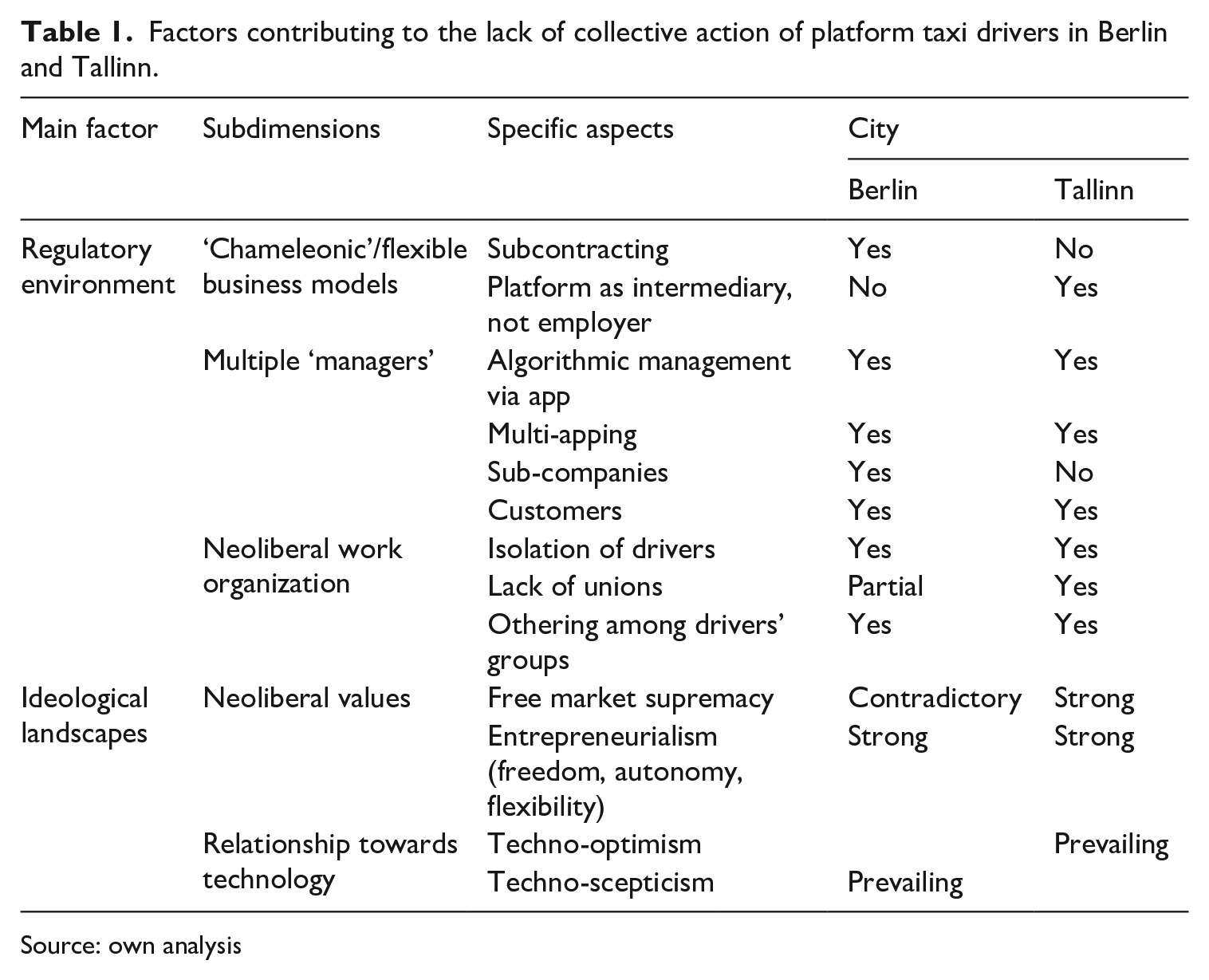
Source: own analysis
Uber and its competitors adopt different business models and labour processes in each city, thereby acting as ‘institutional chameleons’ (Thelen, 2018; Vallas and Schor, 2020). Although this can bring different outcomes for different contexts, our analysis shows how Uber (successfully) tries to avoid traditional responsibility of being an employer using different strategies even in more tightly regulated environments, like diffusing responsibilities in the work relationship. The central difference between the business models of platform-mediated ride-hailing in Tallinn and Berlin concerns the role of the platform and the employment status of drivers. In Tallinn, the business model applied by Uber is the more typical/ideal one for them, with the company functioning as an intermediary between drivers and customers, thus escaping the classification as employer. In Tallinn, the dominant attitude towards praise of the neoliberalist credo and technological innovations has created the possibility for Uber and competitors to set their own rules and to become actors perceived to regulate markets in a more efficient way than the state. The entry of platforms into the taxi industry set the conditions for enabling the liberalization of the sector. In a context dominated by the economic imperative of maximization of profits and downsizing of labour costs, Uber and its competitors offered the best-practice model to be adopted. This puts platform workers in a position where collective organization for the improvement of working conditions is both practically and ideologically difficult.
In Berlin, on the other hand, politics and lobbying of taxi associations forced Uber to comply with the Passenger Transportation Act and required it to label its services as a private hire vehicle service. While according to this law, drivers of private hire vehicles are can have lower qualifications than taxi drivers, they are also subjected to a specific status which differs from that in Tallinn. Drivers are formally employed by small and medium subcontracting companies, which themselves function as intermediaries between Uber and the drivers. While, on paper, drivers in Berlin should be endowed with standard labour rights, sub-companies are informally allowed to practise forms of ‘bogus employment’ (Niebler et al., 2023), deviating in several ways from those standards.
Although the status of the drivers in the two cities differs, in both cases Uber maintains that it is not an employer and does not need to behave as such. While in Tallinn Uber ‘partners’ with drivers, in Berlin it ‘partners’ with the sub-companies. As a consequence, drivers occupy the weakest and most precarious position. In order to highlight the power mechanisms underlying the ‘partnerships’ which Uber creates, we draw on an institutional analysis of the service economy. The service economy is typically characterized by a triadic power relation (Lopez, 2010) linking workers with managers and customers. In the case of platform work, the understanding of power relations as triadic can help to understand only partly the condition of platform workers, as they are usually confronted with more than two sources of power. In the case of ride-hailing, both in Berlin and Tallinn the triadic power relationship is augmented: in Berlin there is the addition of sub-companies, but in Tallinn also workers simultaneously use more than one platform in order to make a decent living.
Augmented control takes place also through algorithmic management, i.e. workers are constantly surveilled by the app (even if they do not experience the surveillance and can still make claims about freedom at work). However, the multiplication of bosses (including their own self, see Purcell and Brook, 2022) weakens the capacity to organize. As in the case of Tallinn, workers’ potential for collective agency has been tackled by the platforms in simply blocking those drivers who have made critical comments about the platform in online forums. Since they are formally not employees, their ‘partnership’ with platforms can be ended at any time for no reason and with no possibility to appeal. In Berlin, drivers have to deal both with algorithmic management and with the employer of the sub-company. While according to German labour law, they are entitled to form local works councils at their companies, this has not happened yet – one important reason being workers’ confusion over the ‘the real’ employer. These obstacles to collective voice in the labour process are not only materialistic, but supported ideologically. Discourses around technology, digitalization and entrepreneurialism, bringing with them ideas of freedom related to the app-driving and ‘being your own boss’ are prevalent in both cities, and often carried by drivers themselves, legitimating Uber’s business model.
Another factor related to the type of work making the building of a collective identity harder is the isolation of drivers. In Tallinn drivers report that they feel very isolated and resort to fragile online communities to share their troubles at work. In Berlin, instead, drivers might meet at the headquarters of the sub-companies, when they get the car or return it. Nonetheless, encounters with colleagues do not seem to enable the development of durable ties. No interviewees talked about having drinks or participating in other social events with their colleagues. Labour time is mostly spent alone and in the more or less silent company of the clients. In both cases, online forums seem a more convenient place to meet, especially considering that waiting time, which constitutes a large part of labour time for taxi drivers, can be filled with participation in them, thus escaping solitude.
Finally, lack of unions and lack of interest by unions in app drivers is a common feature of both cities. It can relate to the difficulty of unions in dealing with the conflict between traditional taxi drivers and app drivers, mostly driven by traditional taxi drivers mobilizing against the latter. While in Tallinn the main constraint to unionization is related to the formal classification of platform workers as self-employed and the weakness of unionism, in Berlin lack of unionization has common characteristics with other sectors in which the model of subcontracting companies is dominant. The factors mentioned above do not only concern people working for platform taxis – the argument can be generalized to all platform workers. They are placed structurally in the weakest position, which has its own specific traits according to the type of work and the business model involved. The comparison between Berlin and Tallinn enabled us to analyse two quite different types of business model and urban settings, to find that the outputs are very similar. The platforms seem to adapt very quickly and effectively to the requests, obligations and bans put in place by state institutions. We show different lines of coercion, all pointing along the same axis of creating unequal labour relationships in which driver is in the weakest position.
Conclusion
The article investigated comparatively the factors which play a role in preventing app drivers from building collective agency aimed at bettering their working conditions. We chose Tallinn and Berlin as contrasting case studies with regard to the type of regulatory frameworks and the local infrastructure of resistance against platform capitalism. Considering the highly regulated market of ride-hailing and the strong leftist subculture in Berlin, and the loosely regulated market and the techno-optimist attitude dominant in Tallinn, one could expect different outcomes in terms of collective action by app drivers. However, our research could not discover any form of organization in Berlin, and only occasional efforts in Tallinn.
We identified several factors hindering app drivers from joining forces. Some derive directly from the work organization, or in accepted business practices in precarious jobs more widely: in both cases the business models are aimed at putting drivers in the structurally weakest position. Exploiting the demand for autonomy and flexibility by workers, platforms have developed a neoliberal system of coercion and control hidden behind a promise of freedom and self-realization. Drivers are exposed to augmented forms of oppression at work, and the physical isolation and dispersion of drivers, who spend most of their work time in the car alone or with clients, reduce the chances of developing social ties with their colleagues.
We can also determine common factors hindering collective action that relate more directly to the general social context: the weakness of unions in Tallinn, and the lack of interest in migrant labour and in particular Uber drivers from the unions in Berlin makes organizing harder. Furthermore, ride-hailing drivers occupy the lowest place in the (ethnically/racially) segmented taxi industry; in the case of Berlin even the lowest place in the urban platform economy, and racism and othering play a role in dividing drivers.
Although we have provided here various causes that hinder collective action in Berlin and Tallinn, we remain far from claiming that cooperative workers’ struggles in these cities are not possible. Especially, grassroot developments and informal strikes by workers have often proven researchers wrong (Fantasia, 1989: 5ff.). Given the amount (and severity) of grievances among drivers in the ride-hailing industry, even small changes of circumstances might shift the terrain of power significantly. At the same time, some of the rifts and fragmentations we have described (such as racialized competition between drivers) will then likely also be present within such struggles and need to be taken into consideration.
Footnotes
Declaration of conflicting interests
The authors declared no potential conflicts of interest with respect to the research, authorship, and/or publication of this article.
Funding
The data were collected and analysed during the project ‘Platform Labour in Urban Spaces’ (PLUS – grant agreement No 822638), funded by the European Commission under the Horizon 2020 programme. The European Commission’s support for the production of this article does not constitute an endorsement of its contents, which reflect the views only of the authors, and the Commission cannot be held responsible for any use which may be made of the information contained therein
