




Abstract
This article explores recent trade union efforts in Ireland to re-engage activists and members and promote revitalization following the termination of a 22-year period of tripartite social partnership. It analyses four case studies of major unions’ strategies to involve activists and members in a workplace-anchored model of firm-level collective bargaining. The findings indicate that decentralized bargaining has become the preferred model of pay determination for Irish unions, and they express little interest in returning to national-level centralized bargaining. Union leaders are enthusiastic about company-level bargaining primarily for three reasons. First, it revitalizes unions by sustaining and expanding union membership at the workplace. Second, it supports local bargaining arrangements that produce tangible benefits for workers, showcasing the effectiveness of unions in advocating for their members. Third, workplace arrangements enhance union influence over management decision-making, both directly through firm-level collective bargaining and indirectly by fostering incentives for continuous dialogue and information exchange.
Keywords
Introduction
Revitalization and renewal are perennial concerns of trade unions internationally faced with declining density and influence. This article examines the recent efforts of unions in Ireland to ‘re-engage’ activists and members to promote revitalization under decentralized collective bargaining, following the ending of a 22-year period of tripartite social partnership and centralized pay bargaining. It reports research based on case studies in four firms in four sectors of economic activity: pharmaceuticals, retailing, financial services and the food and drink industry, where unions are recognized and collective bargaining occurs. The case studies show that despite most of the unions studied having been strong supporters of social partnership, union leaders and company-level negotiators have no nostalgia for the social partnership era. Rather they have reached the view that social partnership weakened unions in firms and workplaces by disengaging activists and members and marginalizing collective bargaining. Company-level bargaining is seen to have revitalized unions by strengthening organizational capacity, by involving skilled activists in organizing and negotiating, and by reconnecting with members. Specifically, union leaders’ enthusiasm for workplace bargaining revolves around three outcomes. First, it reinvigorates unions by sustaining and increasing union organization at the workplace. Second, it supports local bargaining arrangements that facilitate measurable benefits for workers – and highlights the effectiveness of unions in representing their members’ interests. Third, workplace arrangements increase union influence over management decision-making both directly, via company-level collective bargaining, and, indirectly, by creating incentives for open, ongoing dialogue and information exchange.
The article has theoretical and strategic implications. It contributes to the literature on the effects of social partnership and company-level collective bargaining on union revitalization by highlighting the theoretical implications of developments in the Irish case. The article is also relevant to recent strategic developments affecting the Irish trade union movement. Attempts, prior to Covid-19, to reinstitute tripartite ‘social dialogue’ around major economic and social challenges intensified during the pandemic when unions, employers and government reached agreements on such areas as employment supports, new unemployment payments and safe working arrangements. Since the pandemic social dialogue has further intensified and broadened to include other areas such as extending collective bargaining and the housing crisis. Some union and employer leaders and government ministers have tentatively envisaged linking pay restraint and the social wage directly with social dialogue in a manner reminiscent of the earlier social partnership regime (Industrial Relations News, 26 May 2022; McCoy, 2022). This raises the strategic issue for union leaders as to whether an extended form of social dialogue or return to some kind of linkage between pay restraint and public policy along the lines of social partnership may be compatible with union revitalization activities.
The article begins by reviewing the literature on social partnership and union revitalization. It then examines how unions in Ireland sought to promote revitalization through social partnership and reviews debates on the effects of social partnership and company-level collective bargaining post-partnership on membership and influence. A parallel strategy of promoting union organizing, begun during the social partnership era, is also examined. A set of research questions follow the literature review. Subsequent sections of the article describe the research methods adopted, report the case study findings and discuss their implications for our theoretical understanding of union revitalization under contrasting centralized and decentralized collective bargaining regimes.
Social partnership and union revitalization
The international literature on trade union 1 revival or ‘revitalization’ considers social partnerships as one pathway that may support union efforts to stabilize membership and density, to engage activists and members and in these ways stem declining union influence (for reviews see Frege and Kelly, 2004; Gall, 2009; Heery et al., 2000; Simms et al., 2013). Social partnership is understood to involve bipartite and tripartite cooperative industrial relations arrangements at multiple levels from the firm and sector to communities and the macro-economy (Fichter and Greer, 2004; Frege and Kelly, 2004). In a series of works, Kelly disavows ‘union moderation’ as an effective means of extracting concessions such as recognition, collective bargaining and influence in decision-making from employers (Kelly, 1998: 60; and see Kelly, 1996, 2004). Applying ‘mobilization theory’ Kelly argues that in a context marked by years of economic recession, right-wing governments and anti-union laws, union moderation had failed to promote union revival. Employers saw little benefit in cooperating with unions, favouring instead resistance to recognition, union derecognition, narrowing the scope of collective bargaining and marginalizing union activists (Kelly, 1998: 59–64). Partnership with employers only held positive prospects for unions in exceptional circumstances marked by ‘labour parity’, where unions had power to extract concessions from employers (Kelly, 2004). ‘Union militancy’ as a form of mobilization, relying on forceful collective bargaining and a willingness to threaten or undertake industrial action was assessed as a more effective means of promoting revival (Kelly, 1996).
Moving beyond the firm and workplace, the most comprehensive general assessment of the effects of social partnership arrangements on union revitalization draws on research from the UK, US, Germany, Spain and Italy (Fichter and Greer, 2004). This research presents a ‘heavily qualified affirmative’ as to the effectiveness of social partnership as a channel for union revitalization (Fichter and Greer, 2004: 87). The conditions for success are seen as exacting and as seldom encountered in more than a partial or fragmentary manner in the country case studies. These conditions involve institutionally well-embedded multi-level partnership arrangements integrated into proactive union strategies that encompass wider social goals (Fichter and Greer, 2004: 72). Partnership arrangements in Anglo-American countries are seen as frequently involving isolated ventures in workplace-level ‘mutual gains’ bargaining, limited in incidence due to union scepticism of such initiatives and vacillating employer postures. In Germany, Italy and Spain, despite union engagement with bipartite and tripartite initiatives and reforms in such areas as pensions, the regulation of temporary employment, labour market and welfare reforms, partnership initiatives are also seen to have had but modest effects on revitalizing union influence (Fichter and Greer, 2004).
Reflecting the paucity of multi-level and indeed firm- and workplace-level social partnership initiatives, the wider Anglo-American literature on union revival focuses on ‘union organizing’ and, to a lesser extent, on the promotion of workplace partnership (Heery, 2002; Heery et al., 2000; Simms et al., 2013). Initiatives of both kinds are seen to have had a limited overall effect on revitalizing union density or promoting the involvement of activists and members in union decision-making structures (Simms et al., 2013: Ch. 6). The involvement and self-organization of activists and members tend to be viewed through the lens of allowing unions to shift from ‘servicing models’. There is a lack of emphasis on strategies for engaging activists and members to enhance representation and collective bargaining within firms and workplaces, especially in settings devoid of social partnership institutions (Urban, 2012).
The conclusion of the literature suggests that neither social partnership nor the organizing approach has proven highly effective for unions in terms of revitalization. The prospects of forceful company-level collective bargaining – union ‘militancy’ in Kelly’s terms – as a revitalization avenue remain a subject of debate with limited empirical support to date.
Social partnership and union revitalization in Ireland
From 1987 to 2009 unions, employers and governments in Ireland engaged in a series of seven social partnership programmes. Each spanned about three years, was built around a centralized pay agreement, provided for phased pay increases and involved commitments by government on a progressively wider range of economic and social policy concessions. The global financial crisis in 2008 rapidly led to the demise of social partnership – the parties proving unable to agree on a strategy to address one of the most serious economic and fiscal collapses of all developed economies (Roche, 2011; Roche et al., 2016).
The Irish social partnership model attracted a great deal of international interest, not least because of its widely heralded association with the exceptional performance of the Irish economy in the years from the mid-1990s to 2008. Much of this focused around the emergence and stability of tripartite social pacts in institutional circumstances largely devoid of the structural underpinnings thought to be required to sustain centralized tripartite concertation, the links between centralized bargaining, pay restraint competitiveness and job creation and the qualitative features of ‘deliberation’ between unions, employers and government at multiple levels (Avdagic et al., 2011; Baccaro and Sang-Hoon, 2007; Baccaro and Simoni, 2007; Hassel, 2003, 2005; Sabel, 1996). While these themes were also prominent in the literature on social partnership within Ireland, considerable debate also surrounded the effects of social partnership on union membership, density and influence.
During the period of social partnership union leaders were well aware that the decline in density that began in the early 1980s – when density, measured by unions’ records, peaked at 62% – continued and at times accelerated thereafter. Figure 1 presents the trend based on union membership data and includes arguably more reliable data derived from surveys from the mid-1990s by Ireland’s state statistical authority, the CSO. While over the period of social partnership union membership rose from 458,000 to 678,000, union density declined from 57% to 40%. 2 Had density kept pace with employment, unions would have registered 870,000 members by 2008. The picture was hardly flattering for a ‘social partner’ engaged in ongoing dialogue and concertation with employers and government on a wide range of economic and social policies at national level, and, from the late 1990s, putatively as well with employers within firms and workplaces.
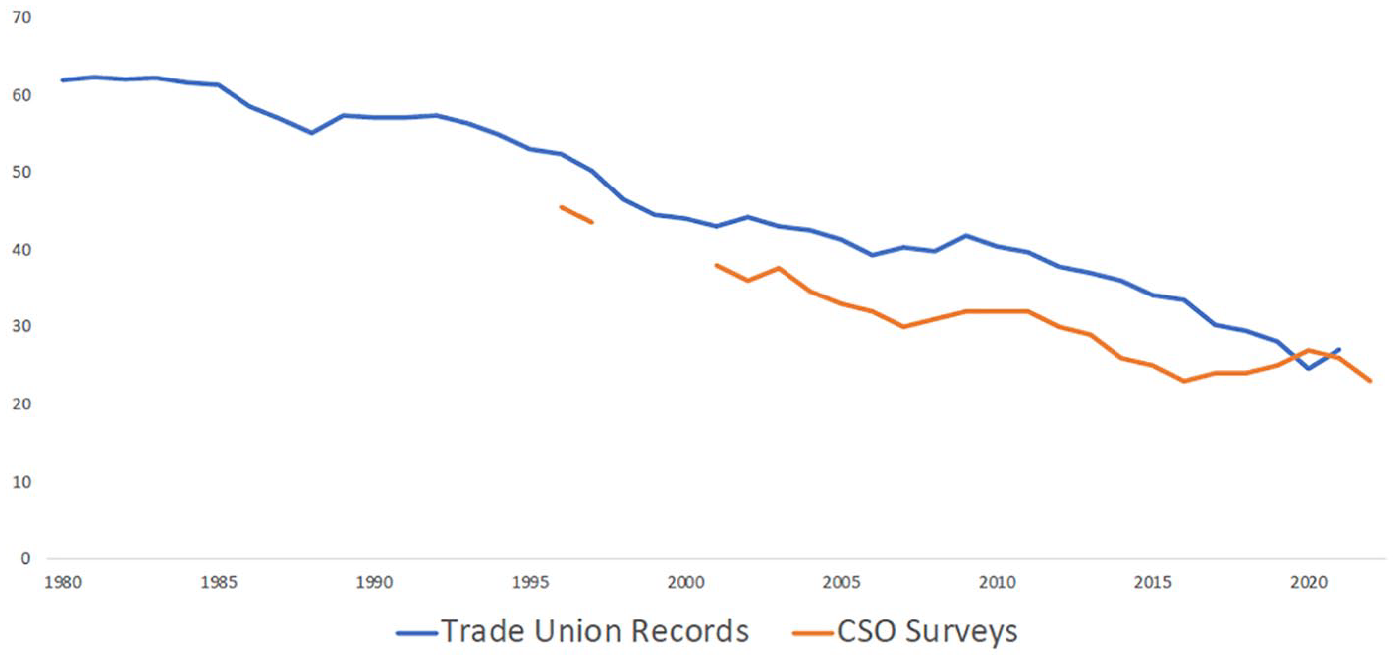
Trade union density during social partnership.
Unions pursued a number of strategies within social partnership focused around sustaining and reversing their long-run decline and responding to concerns that they were being hollowed out within workplaces. Union subscriptions for a time could be offset against personal taxation. 3 More significantly, from 2001 changes were introduced in industrial relations law to permit unions to represent members and improve pay and conditions in firms where employers refused to concede recognition. The so-called ‘right to bargain’ procedure could result in enforceable determinations by the Labour Court covering, inter alia, improvements in pay and conditions, in circumstances where unions could successfully demonstrate that their members were out of line with employees performing comparable work in similar employments. 4 From 1997 onwards unions sponsored a series of national framework agreements intended to foster ‘workplace partnership’ and to institutionalize at workplace level the kind of cooperative engagement with employers seen to be a cardinal feature of national-level social partnership.
The effects of social partnership and parallel organizing campaigns on Irish unions and their members were widely assessed in the literature. Union members enjoyed significant improvements in real pay, living standards, job creation and employment opportunities during the social partnership era (see Baccaro and Simoni, 2007). One of the cardinal features of the social partnership era was the remarkable expansion in employment. From the outset of social partnership to its demise, employment in Ireland nearly doubled – a remarkable achievement by Irish and European standards (CSO, 2023). Notwithstanding the macro-economic achievements with which it was associated in some of the literature (Baccaro and Simoni, 2007), the effects of social partnership and union organizing, union density and influence remain moot. Despite being regarded as ‘social partners’ in the management of the macro-economy, unions often faced strong and abiding hostility from employers reluctant to conceded recognition and engage in collective bargaining within workplaces (D’Art and Turner, 2005, 2011; McDonagh and Dundon, 2010). While strongly supported by unions, the ‘right to bargain’ procedure had limited quantitative effects on union membership and density until its effective abolition in 2007, following a judgement by the Supreme Court in a challenge by Ryanair (Cullinane and Dobbins, 2014; Dobbins et al., 2020; Murphy and Turner, 2019). 5
Union efforts from the late 1990s to expand and deepen ‘workplace partnership’ were severely constrained by employer hostility or indifference (Roche and Teague, 2014). The willingness of some unions to offer partnership-linked recognition arrangements largely fell on deaf ears (D’Art and Turner, 2005). Workplace partnership arrangements were restricted in the main to workplaces where unions were already strong and influential, especially in the public sector (Dundon and Dobbins, 2016; Roche and Teague, 2015). In parallel with initiatives promoted through social partnership, unions participated in the international vogue in union organizing. Major unions allocated increased resources to traditional organizing strategies, acknowledging past efforts as ‘lamentable’ (Begg, 2008: 47–64). Organizing campaigns in Ireland mirrored global organizing efforts, employing specialized organizers and units, investing in recruitment and recognition efforts, involving activists and members in workplace organizing, running publicity campaigns, and forming partnerships with community and civil society groups (Argueros-Fernández, 2009; Geary and Gamwell, 2017; Murphy and Turner, 2014, 2016). These campaigns yielded uneven results, with notable successes in sectors like meat processing, contract cleaning and domiciliary care, while progress was more limited in other areas like mushroom growers and hotel workers (Argueros-Fernández, 2009; Geary and Gamwell, 2017; Murphy and Turner, 2014, 2016). An overall quantitative assessment of union officials’ views and experiences with organizing methods revealed modest impacts on membership growth or retention, aligning with the broader trend in union density (Turner et al., 2013).
The issue of activists’ and members’ perceptions of their unions’ effectiveness under social partnership was strongly contested. One view was that unions introduced a range of innovative democratic communication and electoral measures geared to building activist and rank-and-file engagement with the centralized pay agreements negotiated by top-level union leaders. Baccaro (2003) and Baccaro and Simoni (2007) contended that aggregative balloting procedures contributed to union members’ acceptance of negotiated agreements even where they, or their unions, may have voted for rejection. ‘Deliberative’ mechanisms and ‘persuasive communications’ deployed in ‘workplace assemblies’ were claimed to have promoted activist and rank-and-file engagement and dialogue around the merits of agreements. The empirical support provided for the prevalence or effects of such mechanisms was however very thin and arguably nugatory (see Baccaro, 2003: 692–695).
Other commentators – again adducing little systematic empirical evidence – viewed union leaders as having colluded in successive social partnership agreements that delivered highly asymmetrical outcomes that favoured employers over union members. Leaders, who benefited from elite membership and access, were seen to have deployed ‘patronage’, and to have controlled union communications, internal decision-making and balloting procedures to win support for partnership agreements and marginalize dissenting voices among activists and members (Allen, 2000, 2003, 2009). Again, little systematic empirical evidence is presented to support a position which, like that of Kelly, explicitly favours collective bargaining and union militancy as the pathway to union revitalization. A survey of members of a major general union, ATGWU (subsequently Unite), consistently opposed to centralized pay agreements, identified negative attitudes towards the union’s effectiveness at national and workplace level under social partnership (D’Art and Turner, 2002: 265–266). 6
In summary, the Irish literature on social partnership and union revitalization parallels the international debate in offering conflicting views and assessments of whether social partnership, union organizing or company-level collective bargaining are effective pathways to union revitalization.
The collapse of social partnership in 2009 led to a shift towards decentralized company-level collective bargaining across much of the private sector. While unions had initially attempted to preserve social partnership, they quickly accepted that centralized bargaining would not be restored for the foreseeable future. In response they set about developing new bargaining structures at firm level and beyond, pivoted around company-level bargaining strategies.
The literature review prompts three research questions that underpin the empirical research undertaken for this study:
How do union officials centrally involved in the new collective bargaining strategy assess the effects of social partnership on activists and members in workplaces?
In what ways have they sought to develop new collective bargaining arrangements that involve activists and members in collective bargaining?
Have these arrangements led to outcomes that have promoted union revitalization within firms and workplaces?
Research methods
This article adopts a combined qualitative and quantitative research approach to explore union revitalization at workplace level after the collapse of national social partnership in Ireland. It focuses on the new bargaining strategy and the mechanisms devised by union leaders and officials to involve activists and members in claim formulations and support negotiated terms and conditions. The research is carried out across different core sectors of economic activity: namely, pharmaceuticals, the financial services industry, retailing and the food and drink sector.
Research case studies and primary data sources
This research focuses on union strategies to (re)engage activists and members and promote revitalization in what might be described as ‘union heartlands’. Four case studies were conducted in companies recognizing unions for collective bargaining. These companies are all prominent within their sectors and beyond. The unions involved are major national organizations with significant reach and ambitions. Our study differs from efforts to gain recognition or expand membership in newly organized firms. Nonetheless, as will be shown, the insights from union leaders and officials in the case studies have broader implications for union revitalization beyond union heartlands. Collectively, these cases offer a comprehensive examination of post-social partnership strategies to engage union activists and members across various industries, economic conditions and union types.
The rationale for choosing, and major features of, the four sectors and companies are as follows:
The pharmaceutical sector, vital to the Irish economy, houses all top 10 global biopharmaceutical companies. The Service and Professional Trade Union (SIPTU), Ireland’s largest union, strategically targeted this sector for company-level bargaining after the collapse of social partnership. Data collection took place at a subsidiary of a major US multinational company known as PharmCo, recognized as a pattern-setter in pay bargaining. PharmCo consists of three specialized plants within a vertically integrated production chain, which sheltered the company from relocation threats and secured jobs over time. The studied site, established in the late 1960s, employs over 600 workers and has never undergone restructuring. SIPTU represents the majority of workers, around 260 in various roles, while Connect represents 50 craft workers. The two unions do not negotiate together but often sign the same collective agreements. Information from the Industrial Relations News (IRN) 7 website regarding newly signed collective agreements in the company estimates union density in the company as over 50%.
In the financial services industry, Irish banks faced a severe crisis after 2008, compounded by significant technological changes driven by automation and online banking. The Financial Services Union (FSU), the sector’s largest union, played a central role in managing job losses during this period. Data were collected from one of the largest Irish banks, referred to as FinCo, which was heavily impacted by the financial crisis. Following a government bailout in 2010, only 0.2% of the bank’s stock remained in private ownership, leading to several restructuring phases (Brennan, 2017). In 2012, the bank announced plans to cut 2500 jobs, with a subsequent goal of reducing costs by 10% by 2023 (Brennan, 2021). This involved closing three of the six Dublin head offices and merging operations across 15 branches in Ireland. FSU is the union recognized by FinCo for collective bargaining. Redundancy procedures have been subject to collective bargaining with FSU over time. Despite a decline in the overall industrial relations climate in the banking sector post-crisis, FinCo maintains a workplace partnership approach alongside collective bargaining. FSU benefits from a longstanding tradition of unionization within the bank, with interviewees estimating a union density of 50–60%.
Retailing is Ireland’s largest industry, employing nearly 300,000 employees, constituting 14% of the workforce. Between 2011 and 2012, 57% of retailers saw reduced turnover, leading to cost-cutting measures and narrower profit margins. While the market rebounded in 2014, intense competition and limited enthusiasm for collective bargaining and union hostility persist among larger employers. The company under investigation, RetailCo, is a major player in the grocery and food distribution sector, holding a substantial market share and ranking among Ireland’s largest private sector employers. Following a 2011 merger that initially resulted in losses, the company returned to profitability in 2016. RetailCo exhibits a more favourable disposition toward union recognition and collective bargaining than many counterparts in the sector, making it an illustrative case for union strategies in firms with established recognition and bargaining capacities. The company is known for its positive employer reputation and has an industrial relations model centred on workplace partnership. It operates under a closed-shop agreement, mandating union membership for all its workers, with Mandate representing shop assistants and SIPTU representing butchers and bakers. Unionization extends to all employees, up to the ‘duty manager’ level, resulting in near 100% collective bargaining coverage due to the high union density.
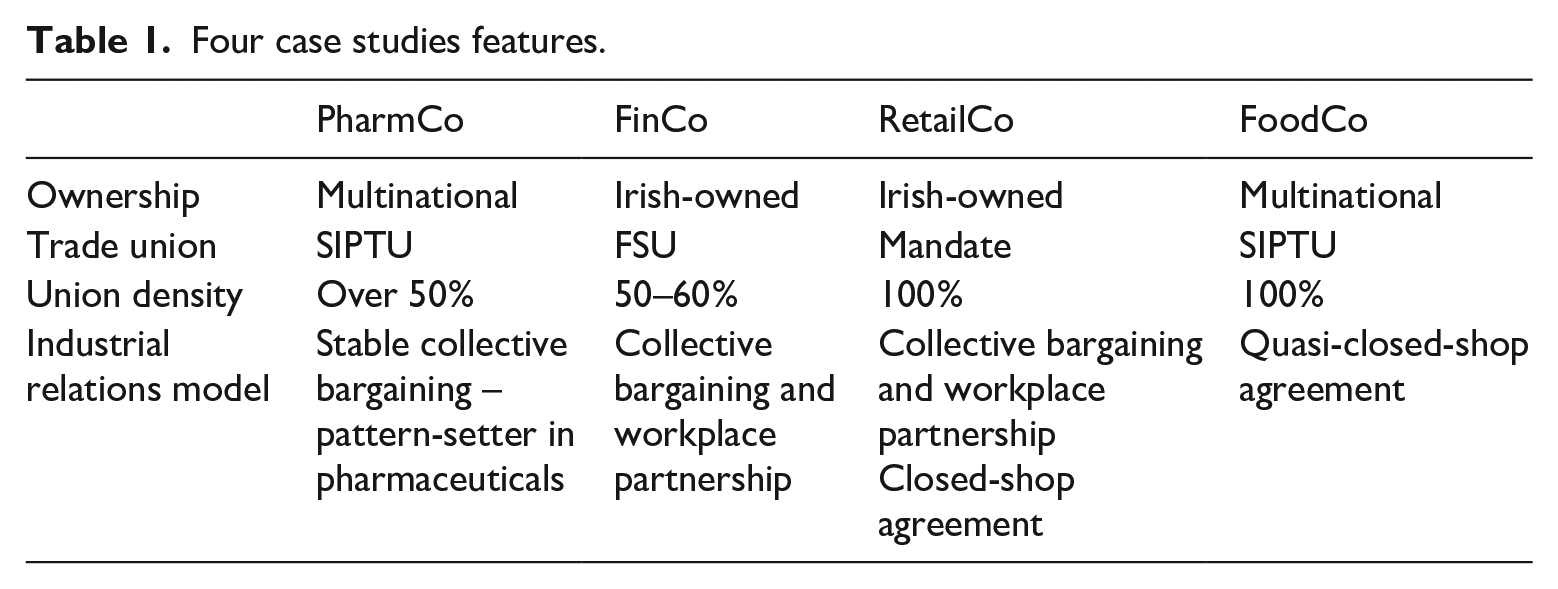
The food and drinks sector is a significant part of the Irish economy, contributing nearly 8% of all jobs and 10% of exports. Major companies in this sector are multinational enterprises primarily engaged in export-oriented production, and it has witnessed consistent volume growth over the past decade. The sector faced commercial fluctuations during and after the financial crisis due to price pressures and currency variations, coupled with intense international competition. Data on union strategies were gathered from a subsidiary of one of the world’s largest infant formula producers, referred to as FoodCo. This company invested over €250 million in its Irish facilities in the last decade, positioning Ireland as a crucial hub for new product launches and innovation. The site under examination employs approximately 200 workers, including 134 SIPTU members. Another union represents a small number of craft workers (4), but unlike in other industry firms, they do not negotiate jointly. Collective bargaining has been in practice since the 1980s, with the company committed to negotiating with the unions. An informal closed-shop agreement ensures 100% SIPTU membership and extensive collective bargaining coverage. All companies’ characteristics are summarised in Table 1.
Four case studies features.
Reports in IRN and business sources indicate that during the era of social partnership the case study companies enjoyed broadly similar business conditions to those reported above, other than less acute cost pressures than endured after social partnership by RetailCo and fewer swingeing layoff cycles in FinCo. Industrial relations arrangements also appeared similar in most respects to those recorded in the case studies – other than the significant differences in activist and member engagement recorded in the interviews.
Of the three unions involved in the cases, SIPTU and Mandate were avid supporters of social partnership and associated centralized pay agreements. FSU’s position was more complex. Until the early 1990s when the union affiliated with the Irish Congress of Trade Unions (ICTU), FSU declined to engage in centralized agreements and were frequently accused of breaching centrally agreed deals. Thereafter, FSU became involved in the negotiation and ratification of centralized pay deals.
Interviews and pay deals dataset
To gain a comprehensive understanding of the national context characterizing the four case studies, an open-ended semi-structured interview was first conducted with the industrial officer of the ICTU, the umbrella organization representing unions in both the Republic of Ireland and Northern Ireland. This interview provided insights into the strategies that all unions have developed to re-engage with and strengthen company-level bargaining following the collapse of national social partnership.
Secondly, interviews were conducted with key union sectoral leaders, each representing the unions involved in the case studies (refer to Table 1). A senior official from SIPTU provided a detailed description of the context in which activists and negotiators operate in the pharmaceutical and food and drinks sectors for which they were responsible. Similarly, a senior official from FSU elaborated on the union’s overarching strategy in the primary Irish banks where collective bargaining takes place. Lastly, a senior official from Mandate, the union representing a significant majority of workers in the retailing sector, discussed the challenges and opportunities arising from the decentralization of collective bargaining after the collapse of national social partnership.
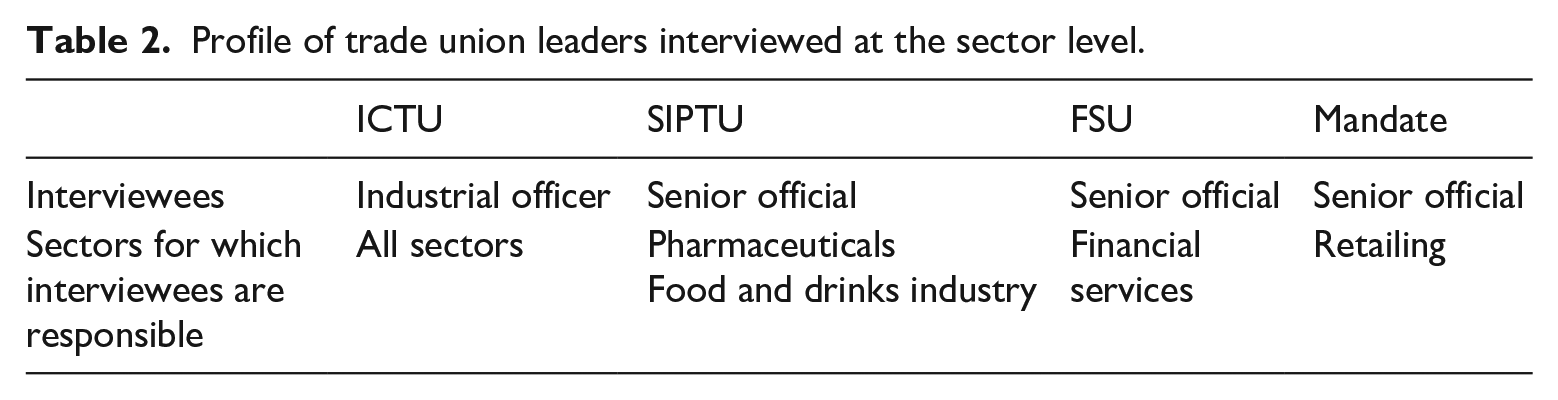
All the leaders interviewed are members of the ICTU Private Sector Committee, a forum where individual unions share their experiences and perspectives on organizing members and negotiating collective agreements within their respective sectors. Details about the key national and sectoral union leaders involved in the study can be found in Table 2.
Profile of trade union leaders interviewed at the sector level.
Thirdly, four semi-structured online interviews were conducted via Teams with lead company-level negotiators from PharmCo, FinCo, RetailCo and FoodCo, representing SIPTU, FSU and Mandate members. Each interview lasted approximately 1.5 hours and aimed to capture the negotiators’ positions, bargaining experiences and outcomes, as well as their efforts to (re)engage members and activists following the collapse of social partnership. The interviews were guided by four key areas of enquiry, aligned with the research focus: (1) actors involved in company-level negotiations and union strategies; (2) instruments of internal union democracy; (3) the evolution of collective agreement content; and (4) union perspectives on bargaining outcomes and their impact on revitalization. As will be reported, those interviewed commonly also gave their views on union revitalization beyond collective bargaining in companies with features that marked them out as union heartlands. The interview notes were reviewed, and follow-up emails were sent for clarification if needed. Video recordings were transcribed and coded based on the above themes. Table 3 provides an overview of the roles of the union leaders involved in negotiations at the four companies. To further explore union revitalization strategies across various companies, including those with different industrial relations features from our cases, and to ensure the valid interpretation of interview findings, a focus group was conducted with the same research participants after completing the fieldwork.
Profile of trade union leaders interviewed at the company level.

Finally, a dataset compiled by the authors, comprising over 1300 pay deals negotiated at company level between 2011 and 2022, was used to identify national, sectoral and company-level trends in pay bargaining, lengths of collective agreements, and other features of terms and conditions of employment agreed between unions and employers. The dataset draws on IRN reports on collective agreements in the private sector in Ireland, including the companies selected for the study.
Secondary data sources
In order to frame the choice of case studies and inform the analysis of collective bargaining in the four companies, a range of secondary data sources were examined. These included reports on collective bargaining and union activities in the selected companies in weekly news reports published in IRN and relevant news reports in national newspapers; and a range of union and the employers’ organization documents and reports were also examined. Business media sources and reports were additionally used to understand the commercial conditions of companies and the sectors in which they were located.
Findings: Engaging activists and members through decentralized bargaining
Members’ disengagement under social partnership: The views of union officials
This section covers the views of union officials on activists’ and members’ levels of engagement under social partnership and their perceptions around unions’ ability to pursue their goals. It shows that during centralized bargaining, unions in all the companies investigated were of the view that they had lost touch with their members.
Union leaders at PharmCo and RetailCo report that there were clear signs of activists’ disengagement during social partnership. Pay increases were credited to government policy rather than to the actions of unions and, as a result, unions lost members.
[Social partnership] doesn’t make sense for us as a union [. . .] it’s not benefiting us. It makes us distant from our membership and our activists. Whereas [local bargaining] makes our officials far more skilled at the job they do in negotiating, as it should be, in dealing with our members, the activists on the ground – You know people would have said: this was the ‘government increase’ – even though it was negotiated nationally by unions. Our members would not link that pay increase to the union. So that has changed [. . .]. (SIPTU senior official pharmaceuticals) We believe, looking back, that social partnership actually led to a decline in membership in trade unions. Because they couldn’t see that the unions were fighting [. . .]. There were no people out fighting for their own rights. They were getting given increases from a national level. (Mandate lead negotiator at RetailCo, member of the National Negotiating Team)
Similarly, at both FinCo and FoodCo, the lead negotiators at firm level indicated that based on their experience centralized bargaining weakened the union movement. FSU, in particular, being a relatively small union, does not see any advantage in national negotiations. The union was less capable of directly influencing the terms and conditions of employment for their members when the confederal union (ICTU) negotiated nation-wide with the Irish Business and Employers Confederation (IBEC). However, since the return to decentralized bargaining, FSU is of the view that it has shown to members that the union can make a clear contribution by meeting their company-specific interests: I mean, there were 20,000 people working in FinCo in 2012, there are 10,000 now, and there will be 7,500 in a few years’ time. That’s a huge loss of jobs in any sector, but they were all done on an agreed basis; we secured pay rises during that period as well. [. . .] We protected pensions, so we’ve done an awful lot, you know? So I think we have been successful at that local level where others haven’t been as successful. (FSU lead negotiator and member of the FinCo Sector Committee)
At FoodCo shop stewards are responsible for the negotiation process under local bargaining, and union members, following 10 years o decentralized agreements, expect their pay to be negotiated at the company level: I think decentralized bargaining is good for SIPTU and good for the union movement – because it’s given the power to members – that ‘feel good’ factor to shop stewards and activists who negotiate the deals themselves – and it’s not seen as [a deal] done by the leaders ‘above in Dublin’ – that’s what it was viewed at the time [of national social partnership] – oftentimes we had members thinking that they were getting the government pay increase instead of unions’ one. (SIPTU lead negotiator at FoodCo)
In the main, the interview findings show that when collective bargaining was centralized, union officials and shop stewards across the companies investigated shared the view that they were not credited with a significant role in improving wages and working conditions for members. Bargaining activity at the company level was marginal and, as a result, local shop stewards were seen to have progressively lost their negotiating capacity. Meanwhile, activists and members were perceived by unions as disconnected from their local union representatives and membership and organization suffered.
Mechanisms to engage activists and members in decentralized collective bargaining
This section examines the various ways in which shop stewards and members have been involved by unions in pay bargaining in the selected companies after the collapse of national social partnership. It shows that members’ disengagement was one of the greatest concerns of unions, and that union leaders invested significant resources to address the problem.
With the shift of collective bargaining to the company level, shop stewards and activists required extensive training to participate effectively in negotiations with management counterparts. During the era of social partnership agreements, unions were restricted from making cost-increasing claims while national agreements were in effect, which kept workplace and company-level bargaining marginal. 8 Although stewards nominally contributed to shaping their unions’ national bargaining agendas, their role in collective bargaining diminished over time, along with their negotiation skills. However, as company-level bargaining (re)gained traction, shop stewards assumed more prominent roles in negotiations.
SIPTU identified the pharmaceutical sector as a key industry for collective bargaining, driven by the sector’s demand for skilled employees, stable demand patterns and international pharmaceutical product markets. This presented SIPTU with an opportunity to negotiate company-level agreements which in turn were intended to animate company-level bargaining more widely (Roche and Gormley, 2018). In companies represented by SIPTU, the union organized member meetings to address concerns and influence the bargaining agenda, complemented by regular member surveys to gauge employees’ evolving priorities. In rare instances, they launched small campaigns, including overtime bans and work-to-rules – where workers refused to give their input into companies’ teams and structures. SIPTU also leveraged their internal training resources to enhance shop stewards’ negotiation skills.
The benefits of this company-focused strategy within the sector are apparent in the case of PharmCo, where SIPTU established a formal workplace representation structure called ‘The Committee’. The Committee comprises 10 shop stewards, each representing a specific division of the company. It is led by a chairperson, who is democratically elected by the members, and by a sector-level union official, external to the company, and directly employed by SIPTU. The Committee is the locus where all the discussions that are relevant to collective bargaining take place. While the Committee defines a bargaining agenda, taking into account the view of members previously surveyed, only the chair and the sectoral official sit at the bargaining table. Within the Committee shop stewards can directly regulate terms and conditions of employment and represent the specific interests of their members in the company.
All shop stewards at PharmCo regularly attend the SIPTU College, where they acquire a wide range of industrial relations competences, from how to handle disciplinary cases to how to improve workers’ participation in the life of the company. The College plays an important role also in educating members around activities that are instrumental to the business such as team-based activities, digital training and suggestion schemes, whereby workers learn how to contribute with innovative production processes. According to the union, these initiatives have contributed to (re)qualify shop stewards and give them a prominent role in negotiations.
By contrast, the retail sector is a more challenging context in which to engage and organize workers. In this respect, retail stands at the opposite pole from the pharmaceutical sector. Replaceable skills and high labour turnover make employers less vulnerable to industrial action by unions. Moreover, the tight competition between the major retailers keeps profit margins relatively low, and companies are required to adapt to constant changes in customers’ tastes. Union leaders, despite their commitment to strengthening local bargaining, have limited leeway to demand wage increases and secure the so-called ‘union premium’.
Nevertheless, Mandate strengthened collective agreements in companies in which employers engage in negotiations. At RetailCo, collective bargaining occurs and all workers are unionized. The company operates under an IR model defined as ‘Day One’, according to which, on the first day of employment, employees automatically join the union that represents their job category. Mandate is the largest union, representing most workers in the shops and stores (2500), while butchers (200) are represented by SIPTU. Here, collective negotiations are carried out by a company-specific negotiating structure – the so-called ‘National Negotiating Team’ – that includes two Mandate full-time officials, one of whom acts as the lead negotiator, one official from SIPTU, and an elected committee of five shop stewards. The committee is elected by all shop stewards, who represent workers in each store, and it remains in office for the duration of the collective agreement. In addition, collective bargaining takes place at the store level. At this level, negotiations are handled by the regional mandate official and the relevant shop stewards from Mandate and SIPTU.
To keep activists and members engaged outside of the bargaining process, each store contains a formal workplace representation structure known as the ‘House Committee’ for discussing organizational and local issues among workers. Additionally, to address potential conflicts, a ‘Store Forum Committee’ convenes approximately 12 times annually. Comprising the store manager, personnel manager, shop stewards from Mandate and SIPTU, and a House Committee member, this committee deliberates on various matters, including store performance and essential agreements. When disputes arise, they are escalated to the National Forum, which meets biannually and includes all shop stewards, three Mandate officials and HR team members. Both the House and Store Forum Committees serve as crucial avenues for member participation and voicing their demands. Mandate and SIPTU offer training through their respective centres to maintain these committees active and functioning, as they play a pivotal role in enhancing the industrial relations skills of newly appointed shop stewards.
In the banking sector, unions report that they have faced an increasing number of challenges to organizing workers – first and foremost, greater hostility from management. However, FSU can still rely on a long tradition of unionization, particularly in Irish-owned banks, such as FinCo, in which the interviews for this study were conducted. A relatively high level of density in the company compared to the wider banking sector has enabled FSU officials and shop stewards to continue organizing members and participating in decision-making.
At FinCo, FSU set up a formal representation structure called a ‘Sectoral Committee’, which negotiates on behalf of all workers employed by FinCo in Ireland and the UK. FinCo employees who are FSU members elect their Committee representatives in each region where the bank operates for a duration of three years. The elected Committee appoints one member as the lead negotiator, ‘the Officer’, who is seconded into the FSU and paid by the company to perform union duties as a full-time employee representative. There is a training department at FSU that provides the Committee’s members with ‘workplace training’. At FinCo local activists (points of contact in each branch) are supported by the elected ‘Area Coordinators’ who are a key link between FSU and their members at the workplace level. Their role is to report to the Sector Committee the issues that are important to the union members and the challenges that they face in each individual workplace. They communicate with members and mediate between potentially diverging interests and are strategically significant.
So we would get them together [Area Coordinators] and we would go through the details with them first and say, ‘listen, that’s here [in FinCo] what it is’, and then send out details to members of the outcome – and then we would arrange meetings. We would meet with members, and have our meetings, and inform them of the details of the deal and then we would organize a ballot. (FSU lead negotiator and member of the FinCo Sector Committee)
Given this interaction between different groups of activists and representatives at varying levels, at FinCo, an increasing number of items has progressively appeared on the bargaining agenda. This is the result of an iterative process whereby the union engages with ad hoc issues as they become important to members. According to the union, the effort and the resources invested in the creation of both formal and informal workplace representation structures were key in facilitating a two-way communication system encompassing the members and the unions’ views in the bargaining process. This enabled FSU to overcome the more traditional top-down internal communication approach which characterized the phase of national social partnership.
Finally, at FoodCo, SIPTU negotiated effectively at the company level. The union’s high level of density on the one hand created an incentive for the management to develop a collaborative relationship with the union and, on the other, strengthened the role of local shop stewards. Shop stewards have been proactive in recruiting members and in ensuring that a quasi-closed-shop agreement remained in force. SIPTU at FoodCo relies on a formal representation structure, referred to as the Committee, where highly trained shop stewards are responsible for shaping the agenda items and handling the bargaining process.
Our committee is so strong that it ensures that whoever joins the company will also become a member of SIPTU. (SIPTU lead negotiator at FoodCo)
The Committee consists of seven members: four shop stewards, each representing a small group of 15–20 employees working in shifts, one shop steward for the laboratory and quality control operators, one shop steward representing the warehouse workers, and the SIPTU sector-level lead negotiator. It is elected by the union members, based on their job role and key responsibilities, and remains in charge for one year. The chief shop steward is nominated by the Committee.
The SIPTU lead negotiator meets with the shop stewards prior to opening a bargaining round, and they bring forward the issues that are important to members and articulate their concerns. The lead negotiator reports that it is extremely common for members, as well as for shop stewards, to develop unrealistic expectations of what can be obtained through collective bargaining. One of SIPTU’s main objectives within a company, including FoodCo, is to manage those expectations. It achieves this in different ways depending on the issues discussed. For example, the Committee may hold several in-house meetings to persuade the members that reaching a 5–6% pay increase is not feasible. Additional meetings, involving FoodCo’s chief negotiators, may be organized at the sectoral level to show data on other deals in similar companies. This strategy is amongst the most effective as it offers shop stewards the confidence that they need to face their constituencies and lower their demands.
The Committee at FoodCo is particularly active in the preparatory stage of collective bargaining and during the negotiation. All the shop stewards sit at the bargaining table while giving regular feedback to their constituencies. There is no formal instrument to voice members’ concerns, but meetings in the canteen intensify at this time. Outside the bargaining process, shop stewards interact daily with their colleagues and have a clear sense of what their needs and demands are. These demands become part of the bargaining strategy. As a result, members see for themselves that they are able to make a direct contribution to the terms and conditions collectively agreed.
In summary, the collapse of centralized bargaining pushed unions to mobilize their own resources by investing in company-level structures and arrangements to re-engage activists and their membership base at workplace level. They have relied on developing the leadership skills of their activists, (re)trained their shop stewards, and set up a variety of mechanisms of internal democracy, such as ballots, surveys and elected workplace committees to facilitate participation. Through these initiatives, unions believe that they have demonstrated to members that they are effective in representing their interests and improving working conditions through local collective bargaining within workplaces.
Outcomes of workplace engagement
This section describes the outcomes of the new workplace bargaining mechanisms that were set up by unions in the four companies investigated. It presents the following indicators of union revitalization which emerged from the interviews: (1) preserving or strengthening union organization; (2) improving pay and other terms and conditions of employment; (3) widening the scope of collective bargaining; (4) gaining greater influence over management decision-making; and (5) revitalization beyond union heartlands.
Preserving or strengthening union organization
Company-level bargaining arrangements, pivoting around the involvement of activists and members in workplaces and what are seen generally as robust and constructive relations between unions and management, have all contributed to the maintenance of union organization in the case firms.
But other direct measures also play a crucial role in maintaining union organization. At FoodCo, SIPTU’s early access to newly hired staff and the opportunity to introduce them to the union’s role within the company significantly contribute to achieving and sustaining a 100% union density, as stated by the SIPTU lead negotiator. This is facilitated by proactive shop stewards who actively listen to colleagues’ concerns on the shop floor and relay them to the negotiating team continuously. Drawing on this knowledge, negotiators identify the most suitable collective bargaining strategy. Increased member involvement in prioritizing local negotiations and shaping the bargaining agenda has created stronger incentives for workers to join the union compared to the social partnership era, according to the SIPTU representative. Enhanced member support has also streamlined the union’s primary objective of safeguarding members’ interests and meeting their demands within the workplace. SIPTU shop stewards take proactive steps to manage members’ expectations before negotiations and ensure the implementation of negotiated employment terms throughout the agreement’s duration. In the case of conflicts concerning working conditions, they strive to resolve issues before they escalate and threaten industrial peace. Furthermore, FoodCo’s shop stewards have effectively employed the threat of industrial action as a means to galvanize members and compel the company to address their demands. A significant moment of tension arose in 2018 when management attempted to extend an agreement signed by another union to FoodCo without SIPTU’s ratification. Conflict escalated rapidly, dissuading the company from further attempts to circumvent the union. This incident underscored the effectiveness of unions at the workplace and emphasized the importance of member support for the union, even in the presence of a profitable company with a benevolent HR department, as it can jeopardize working conditions.
At PharmCo, SIPTU has demonstrated a readiness for industrial action where the terms of the collective agreements are seen to be threatened. In a series of negotiations concerning pension contributions, the union adopted a militant stance that resonated with its members and activists. The dispute emerged in 2014 when the HR team proposed transitioning existing members of the non-contributory defined pension scheme to defined contributions for future service. The unions declined to endorse the agreement, and members consistently rejected further proposals. In 2019, the unions issued a strike notice (averted by the Workplace Relations Commission’s intervention), and after five years of negotiations, the company ultimately abandoned its pension-restructuring plan. SIPTU’s leaders engaged members throughout this process and supported their intent to resort to industrial action, underscoring the significant impact of direct worker participation, mediated by a union, in safeguarding employment terms and conditions. Similar to the FoodCo case, SIPTU has shown its members that by mutually supporting each other in the workplace, where employment relationships are formed and working conditions are shaped and implemented, the potential for workers to make substantial advancements is enhanced.
At RetailCo, the ‘Day One’ membership model mandates that employees join a union, either Mandate or SIPTU, on their first day of employment. The unions view the IR model at RetailCo as a means to foster an industrial democracy company culture, where unions, shop stewards and managers collaborate. Given the sector’s characteristics, marked by relatively narrow financial margins and precarious working conditions, traditional union measures like the threat of strikes are not deemed effective for organizing or mobilizing workers by union leaders. Therefore, Mandate, the largest union at RetailCo, opted for a workplace partnership approach since company-level bargaining resumed. Unions work with management on various issues within the Store Forum and the House Committee, both of which have representation from both bargaining parties. Within these structures, they jointly train new HR managers and shop stewards to ensure the development and retention of negotiating skills while maintaining their collaborative IR model. They routinely resolve disagreements, as exemplified when all the bakers in 2021 refused to bake certain products, even though they were scheduled to be sold to customers. Unions mediated between management and the bakers’ expectations, averting further disruptions in business operations. Increased workplace interactions facilitated by local bargaining have opened up greater opportunities for collaboration between unions and management. This was evident during the pandemic, when RetailCo’s shop stewards took the lead in ensuring the health and safety of frontline workers. Mandate introduced a digital Covid course for local representatives responsible for monitoring the shop floor and ensuring employer compliance with all obligations. Furthermore, to maximize the benefits of local bargaining and increase member participation, the union created the Union Charter for Decency and Respect in Retail and standardized the bargaining strategy across all companies. At RetailCo, this involves conducting regular surveys where members list their preferred bargaining items, analysing the results and sharing them with their constituencies, and finally, reaching agreement on a potential bargaining agenda subject to a ballot before negotiations. This democratization of the decision-making process, as reported by the Mandate lead negotiator at RetailCo, has strengthened the union’s relationship with members, enabling them to articulate their demands more effectively. A Mandate senior official also emphasized the primary advantage of local negotiations, which is the increased direct participation of shop stewards in the negotiation process, where they not only sit at the bargaining table but also work closely with members.
What we say to the shop stewards is ‘our jobs is to negotiate [. . .] and I won’t go in and negotiate on behalf of workers, you, the workers, will be sitting beside me’ so they [shop stewards/workers] buy into the whole agenda from the very start – that kind of concept seems to work [to gain members’ support]. (Mandate senior national official)
In summary, the primary goal of the unions in the case firms is to rebuild and maintain their member relationships while sustaining high-density levels. They achieve this through well-trained shop stewards, who play a crucial role in organizing newly hired staff and retaining existing members. Shop stewards engage with employees, providing support for various work-related issues, shaping expectations for collective bargaining, and contributing to the definition of a shared negotiating agenda. Consequently, workers gain a better understanding of the advantages of union membership, particularly in terms of improved working conditions and peaceful industrial relations. Additionally, unions occasionally utilize the threat of industrial action to keep their members engaged, albeit infrequently. Unions assert that they have become more effective in representing and organizing members since bargaining decentralized, as their contribution has become more evident to their constituents, who, in turn, display increased willingness to support and participate in union activities.
Improvements in pay. 9
Collective bargaining has allowed unions to make steady gains in pay and conditions for members across all the companies investigated. SIPTU, at PharmCo, has been particularly effective in this regard. While up to 2016, the pay deals in the company were comparable to median pay rises in the sector – which is to be expected given PharmCo’s reputation among unions as a ‘trend setter’ for pharmaceuticals – since, the union has negotiated deals that significantly exceeded the 2.5% sectoral median rise. In 2018, a deal that secured a 3.6% pay increase was reached. The pay increase negotiated in 2021 (2.7% per year over four years) remains significant.
At RetailCo several agreements have been concluded since 2011. These range from 12 to 24 and 36 months’ duration. Pay developments show a progressive rise from the earlier to the later agreements, reflecting the economy- and sector-wide upward drift in pay rises. In 2022, a two-year agreement ensured a minimum 4% increase for all employees for the duration of the agreement and was aimed at reducing the gap between the highest and lowest paid workers. The RetailCo agreements record a series of other improvements in pay and conditions, for example, pensions, lump-sums and Christmas vouchers – and only one agreement obliged the union and its members to cooperate to achieve specific business targets.
In the case of FinCo, the FSU was unable to negotiate pay deals with management following the financial crisis, when the bank underwent a recapitalization process that involved the sale of multiple assets, a state bailout and significant job losses. This however occurred across the banking sector in Ireland. Pay deals resumed in 2015 at FinCo. Thereafter, the annualized pay rises provided for in collective agreements exceeded the median pay rises in the finance sector for most of the period.
A pay agreement that secured a 2.25% base pay increase for all staff, independent of performance, was negotiated in 2020. The terms of the agreement were considered to be exceptional given the Covid-19 pandemic, and the commitment to performance-related pay (agreed in 2019) was temporarily set aside. Subsequently, in 2022 FSU and the bank agreed another substantial pay increase, 10% over three years, an increase in the entry-level salary and a ‘cost of living’ voucher payment. Concerning the substantive content of the collective agreements pay, severance plans and pensions are important items for negotiation. Except for the year of the pandemic, FSU successfully negotiated two elements of pay: (1) a flat-rate increase, based on inflation, and (2) a performance-related increase. Overall, the pattern of pay rises in FinCo shows a progressive increase above the 2% pattern-bargaining norm from around 2018 onwards.
Finally, at FoodCo, the last agreement was concluded in January 2022 for the duration of three years and provided for a 2.5% pay rise each year. During the years from 2015 to 2018, the deals were particularly beneficial to members: SIPTU and FoodCo agreed a 48-month pay agreement, providing for average pay rises of just above 4% per year. These pay rises were above and, in the case of the 2015–2018 agreement, significantly above, the median pay rise as a whole within the food, drink and agribusiness sector.
Overall, except for RetailCo, where no clear trend is apparent in the size of the pay increases negotiated in comparison with the wider sector trend, the findings show that unions were able to negotiate steady year-on-year improvements in pay that exceeded median pay rises in their respective sectors. Both the average increase per year and the duration of the agreements vary across companies, suggesting that the unions have been capable (or not) of seizing local opportunities to make gains that are tailored to their specific conditions.
Widening the scope of collective bargaining
Over and above the pay rises achieved, the breadth and scope of company-level bargaining has substantially widened over the past 10 years in all the companies examined. Health insurance, parental leave, sick pay, holidays, training and education have all become common items in negotiations. At PharmCo, these issues are exchanged by the company in return for flexibility in work organization and improved digital skills among workers.
Similar patterns emerge at RetailCo, where Mandate highlights the positive effects of company-level bargaining in terms of the great variety of items that local negotiators can engage with. Collective agreements at RetailCo have in recent times offered additional paid time off work, increased the staff discount, which is currently 12.5%, and awarded monetary hourly increases to the lowest-paid employees to further reduce the gap between different categories of workers. This was considered a significant improvement for the weakest and most precarious category of workers in the company.
Maternity leave, parental leave, the right to disconnect and protection of remote working are the most recent issues that have entered into collective agreements at FinCo. SIPTU at FoodCo reports that the scope of collective bargaining is wide and that issues such as health insurance, ‘sick and accident scheme’ and annual leave have become increasingly important to members in recent years. Thus, unions have responded by engaging with these items in local negotiations.
The interview findings demonstrate that since collective bargaining was decentralized, the scope of collective agreements has substantially widened in the companies investigated. In addition to pay, which remains a prominent bargaining item, unions have made significant advances on a wide range of issues. It is worth noting that these issues vary across cases suggesting that the proximity of the negotiators to the different conditions that arise and interests at stake – flexibility, precarious working conditions, greater (or lower) financial margins – facilitates deals that are company specific. In particular, through decentralized bargaining, unions are able to adapt the collective agreements to the specific demands of their constituencies and, thus, make more visible and measurable gains for their members.
More influence over management decision-making
In addition to reconnecting with activists and members, strengthening organization, gaining significant advances in pay and widening the scope of collective bargaining, unions have sought to use the return to company-level collective bargaining to increase their influence and leverage over management decision-making.
At PharmCo, the relationship between the union representatives and their employer counterparts is described as ‘collaborative, cordial, and professional’. Dialogue remains ongoing between negotiating teams, even outside the formal negotiating process. SIPTU maintains that local negotiations and more open and intensive dialogue have helped in deepening the exchange of views and information between shop stewards and HR managers. This has enabled the union to exert greater influence in shaping the bargaining agenda and gaining a better understanding of the overall company strategy regarding the allocation of tasks and responsibilities, the introduction of new technologies, and the organization of the production lines. While there is often a misalignment of expectations between members and activists, who want to be compensated for all variations that occur in the organization of work, and management, who see such variations as ‘normal on-going change’, the SIPTU lead negotiator indicates that his role is to mediate between these apparently opposing positions. Dialogue is instrumental, in his view, as it highlights areas of collaboration that cannot be anticipated by members and opens up the possibility for a resolution that may satisfy both negotiating parties.
We [lead SIPTU negotiators] say to the members sometimes – when they might want you to be more forceful, intense: ‘I say look I could bang the table, but what this will do is only to hurt my hand – you’ll still get your point across if you talk’. And I think it’s best using that time [talking] to have a good working relationship, so when issues do get tense, at least we can speak and try and resolve the issue. If people do get very, very cross both sides would stamp their feet, and then there’s no sign of agreement so at least if we keep the discussions and negotiations cordial there, there’s more chance of a moment when I can get to reach an agreement. (SIPTU lead negotiator at PharmCo)
At both RetailCo and FinCo, unions have successfully revitalized workplace partnership arrangements, which they view as advantageous for their members. These arrangements operate independently of collective bargaining, which continues to be the primary avenue for negotiations and wage determination. In RetailCo, the ‘House Committee’ and ‘Store Forum’ are pivotal in fostering a collaborative relationship between union members and store managers on the shop floor. The Store Forum that meets monthly brings together the store manager, personnel manager, shop steward and a House Committee member to address and resolve issues. If the Store Forum cannot resolve a problem, it is escalated to the National Forum, where Mandate and SIPTU officials, along with relevant shop stewards, work with HR managers to find solutions. This partnership model complements collective bargaining by maintaining ongoing dialogue between parties and reducing the need for third-party intervention. Formal workplace channels are available for both members and HR managers to voice concerns, shortening the negotiation process. Moreover, stable industrial relations have preserved the employer’s support for the ‘Day One’ membership model, resulting in a 100% union density and extensive collective bargaining coverage.
FinCo also historically operated under a partnership approach and, within it, the relationship between the management and FSU was collaborative. Following the 2008 crisis, however, and the concomitant collapse of the national social partnership, the FinCo IR model did not survive. In 2012–2013, a new head of employment relations was appointed and a series of initiatives led to the reopening of a channel of cooperation with unions, renamed Alliance. Under Alliance management and shop stewards maintain regular contact both formally and informally. The Alliance was instrumental during the pandemic in agreeing decisions concerning health and safety for workers and remote working. But it was particularly active during the company’s downturn, after the financial crisis, when the involvement of FSU was sought by management to restructure the organization and contain its impact on workers. Seven outsourcing agreements were signed by the Alliance to regulate the transfer of the tech business. The union contributed to shaping the terms of an important severance plan including voluntary redundancies, as well as the right to redeployment and forms of income protection. According to the FSU lead negotiators at FinCo, the Alliance has given the union influence.
For the first two months of the pandemic we were meeting with the bank every day. And it could be about branches, or working from home, people isolating all that kind of stuff – we worked really well together. Had it not been for the Alliance, it would have been far more difficult [for the union to be involved].
At FoodCo, SIPTU representatives report satisfaction with the level of interaction between management and shop stewards resulting from local bargaining. Decentralized bargaining is considered to be extremely valuable for members to participate actively in the definition of the agenda for collective bargaining and to make sure that the union is involved in all the company’s decisions that concern their terms and conditions of employment. At FoodCo no workplace partnership is in operation but after the decentralization of collective bargaining negotiations intensified and SIPTU gained greater influence. This is demonstrated by the commitment of the employer to a ‘quasi-closed-shop agreement’ that has promoted dialogue between management and SIPTU and facilitated the extension to all staff of local agreements. Even despite a substantial increase in temporary employment contracts over the past decade, the union has not lost its hold on developments in the workforce. On the contrary, it gained agreement that temporary workers are to be made permanent after 12 months in the company, and they also succeeded in organizing these workers. As a result, SIPTU membership is extremely high.
The findings suggest that company-level collective bargaining has enhanced union interactions with management in the four companies, enabling them to have a greater influence over matters important to their members. Negotiating parties consistently exchange information and collaborate to prevent or address conflicts on the shop floor. Unions leverage their open relationships with managers to handle specific issues that may arise for their members. Union leaders concur that decentralizing bargaining has made it more likely for local activists and shop stewards to engage with management when decisions impacting members are under consideration.
Union views on promoting revitalization beyond union heartlands
A major objective of SIPTU’s company-level bargaining strategy, as outlined in the case analysis of PharmCo, was to animate pay bargaining more widely following the economic collapse caused by the global financial crisis. This ‘pattern bargaining’ strategy was highly successful in shaping pay rises beyond union heartlands. Other unions, including Mandate and FSU, followed early pattern bargaining pay rise norms, until economic revival loosened standard pay rises and led to a rise in pay dispersion (Roche and Gormley, 2018). The pattern bargaining strategy was nonetheless instrumental in ensuring that workplace negotiators in union heartlands firms, including the case study firms, contributed to instituting a floor to pay rises across the private sector.
Beyond this effect of company-level bargaining, union representatives interviewed freely acknowledged that the benefits of decentralized bargaining for members, identified in the four case studies, were significantly more limited outside union heartlands involving large, profitable internationalized companies, in which unions are well organized. In low-pay sectors, in organizations that struggle to remain competitive, or in companies refusing recognition, union officials and shop stewards are said to have encountered increasing hostility from employers. The officials interviewed were of the view that these wider problems surrounding revitalization required legislative change instituting a stronger right to win recognition, or a more rigorous ‘right to bargain’.
I think we need the right to collective bargaining. It’s a constitutional right. I have gone through a couple of organizing campaigns, where the vast majority of people want SIPTU to represent them and companies are refusing that, and that should not be allowed to happen; so I would like to see a change in that [right to bargain] and the new Directive coming from the EU, I think would be very, very helpful towards that and for collective bargaining in this country. (SIPTU lead negotiator at PharmCo) We have about 10 sectors where the current system doesn’t work and a change in legislation would be very helpful for us. And they’re all in the low pay area in the private service sector. [. . .] Legislative changes [EU Directive on minimum wage] would probably have a smaller impact on manufacturing, but there we’re fine, we can manage and access the employees. But if a right to bargain is recognized, we would have a legal ability to go and talk to employees about joining a trade union and that would be key. (SIPTU senior national official) There is a need to address that [the lack of engagement of employers] in terms of the right to collective bargaining and the right for our unions to have access to workers. [. . .] And I think you know that we need to change the law to ensure that you have a right to collectively bargain. (FSU lead negotiator at FinCo)
Current proposals – animated by the EU Directive on Adequate Minimum Wages – to introduce legislation imposing a ‘good faith engagement’ obligation on employers refusing to concede recognition or collective bargaining have met with strong support from unions (LEEF High-Level Group on Collective Bargaining, 2022). ICTU and SIPTU leadership have played key roles in developing and gaining support for these legislative proposals to widen and strengthen company-level bargaining and are viewed as essential counterparts to unions’ company-level bargaining strategy. A further proposal supported by unions to reactivate joint labour committees, including a JLC for retailing and allied sectors, which set legally binding minimum pay rates until 2013, would further support wage regulation in the wider retail sector.
Conclusions and discussion
We begin by acknowledging the limitations of the research undertaken. The data presented in the article are confined in the main to union officials, and further research would benefit from including the direct experiences of union activists and members. At the same time, union officials are the principal architects of the new bargaining arrangements within firms and workplaces, so their work, views and experiences are pivotal to any account of these arrangements and assessment of their outcomes.
In response to our first research question about union officials’ views on the impact of social partnership on activists and members, the case studies reveal that unions have no nostalgia for the social partnership era. Notwithstanding the macro-economic achievements credited to social partnership, such as robust job creation, improved living standards, social policy enhancements and union access to government, union leaders and officials see little benefit in reverting to centralized pay agreements and frameworks. While union (and employer) leaders, with support from the government, have recently advocated a deepening of tripartite ‘social dialogue’ to address a range of public policies, including housing, most parties have thus far resisted tying social dialogue to pay bargaining on the model of social partnership (Industrial Relations News, 2 February 2023; 3 November 2022; 12 January 2020). Union leaders interviewed in the cases are emphatic that social partnership weakened unions in firms and workplaces by effectively marginalizing collective bargaining at these levels and fostering the view that regular pay rises had little to do with the efforts of unions. Activists and members were seen, as a result, to have become disengaged from unions. No mention was made by union officials interviewed of any arrangements, such as ‘deliberative’ mechanisms, ‘persuasive communications’ or ‘workplace assemblies’ (Baccaro, 2003: 692–695), or indeed of anything else that had promoted activist and rank-and-file involvement and dialogue around the merits of social partnership agreements. The consensus rather was that a collective bargaining void at firm and workplace levels had contributed to the hollowing out of union influence and organization.
Regarding our second research question concerning the features of company-level bargaining arrangements, decentralized pay determination, combined with the creation of a new architecture for workplace-anchored company-level bargaining based on activist and member involvement in establishing bargaining priorities, is seen to have revitalized unions by strengthening organizational capacity, by involving skilled activists in organizing, and negotiating and by reconnecting with members.
Our third research question addresses whether new bargaining arrangements have promoted union revitalization within firms and workplaces and beyond union heartlands. Unions’ enthusiasm for local bargaining revolves around three outcomes. Firstly, it reinvigorates unions by sustaining and expanding union membership and organization at workplace level, increasing the direct role of activists and members in recruitment, organization and protecting closed-shop arrangements – where they are found. Secondly, the new bargaining arrangements involve measurable benefits for workers such as continuous improvements in pay and conditions and a significant widening of the collective bargaining agenda – highlighting the effectiveness of unions in representing their members’ interests. Thirdly, the new arrangements increase union influence over management decision-making both directly via company-level collective bargaining which addresses members’ priorities in the context of firms’ financial and commercial capacities, and, indirectly, by creating incentives for open, ongoing, dialogue and information exchange – in some instances involving renewed workplace partnership arrangements. The cases involving renewed partnership arrangements reveal how strong and robust company-level collective bargaining both supports and renders effective parallel workplace partnership arrangements. Under social partnership, such arrangements operated largely in the absence of company-level collective bargaining over pay, conditions of employment and other significant membership concerns, diluting both the impetus to establish and operate partnership arrangements and the quality and relevance of joint dialogue under those arrangements.
The effects of company-level bargaining on pay and conditions outside of union heartlands companies are more moot. The company-level pattern bargaining strategy, primarily led by SIPTU and significantly involving PharmCo, played a crucial role in establishing minimum pay increases that often extended to other companies. However, union officials interviewed in the case studies agreed that achieving sustained improvements in pay and conditions for companies beyond union heartlands would necessitate legislative changes that introduce stronger bargaining rights and reinstate minimum wage-fixing mechanisms. In this regard, their approach indicates a dual revitalization strategy, which includes the continuation of workplace-centred company-level bargaining alongside legislative reforms to bolster collective bargaining more generally.
Crucially, by shedding light on the implications of developments in Ireland for union revitalization under contrasting regimes involving social partnership and company-level collective bargaining, our study contributes to Kelly’s work on union revitalization and his mobilization theory of industrial relations. Kelly posited a distinction between two revitalization strategies: ‘moderation’ and ‘militancy’. Moderation involving workplace partnership was presented as largely ineffective in contributing to union revitalization. Militancy involving an exclusive reliance on collective bargaining and a frequent threat or use of industrial action was deemed to be more effective (Kelly, 1996, 1998). The polarity involved in this distinction contrasts sharply with the findings of research. Insofar as it may be valid to portray the unions’ company-level bargaining strategy as ‘militancy’ – the union officials interviewed would not recognize such a portrayal – it operated hand-in-hand with union involvement in workplace partnership arrangements of either a formal (RetailCo and FinanceCo) or informal character (PharmCo, FoodCo). The officials interviewed were unanimous that the revitalization outcomes outlined depended on both aspects of union engagement at company- and workplace-level. Partnership was viewed as one route to exert greater influence on management and to obtain information rather than as a source of moderation in pursuing better pay and conditions and cementing the engagement and support of activists and members.
Moreover, with respect to the track record of social partnership in promoting union revitalization, the Irish case again has wider or more general theoretical import. Although commonly classified as a ‘liberal market economy’, Ireland shared ‘overarching’ partnership arrangements associated in the union revitalization literature with Germany, Italy and Spain (Fichter and Greer, 2004: 80–86). Developments in Ireland under social partnership are consistent with the conclusion that prevailing social partnership arrangements ‘feed into the process of union decline’ (Fichter and Greer, 2004: 88). As in these national cases, the limited or even counterproductive outcomes of social partnership in Ireland with respect to union revitalization may be attributed to the weakness of consistent multi-level supports to collective bargaining of the kind identified as key to promoting union revival (Fichter and Greer, 2004; Frege and Kelly, 2004). The acceptance by all parties to Irish social partnership of extensive national-level collective bargaining had never extended to workplace level. Weak and largely hortatory national supports set out in workplace partnership framework agreements and by national partnership agencies, such as the National Centre for Partnership and Performance, were never effective in countering growing employer resistance to union recognition or to extending union influence through mutual gains principles (Roche and Teague, 2015).
Contra Baccaro (2003) and Baccaro and Simoni (2007), no significant attempts were evident under social partnership to develop a robust and effective company-level architecture to involve union activists and members in deliberations surrounding national tripartite agreements, resulting in a void at firm and workplace level that served to weaken and marginalize unions. Nor has any compelling empirical evidence been adduced in support of the view (Allen, 2000, 2003, 2009) that assent for partnership agreements was contrived by union leaders through suppressing and manipulating activists and rank-and-file members (see Roche and Cradden, 2003). Activists and members appear rather to have been disempowered and disengaged by the more straightforward expedient of having little role or involvement in companies or workplaces under social partnership. Another major plank in unions’ efforts to promote revitalization under social partnership, the ‘right to bargain’ procedure, targeting companies refusing to recognize unions, was of marginal quantitative significance. Unions pursued no more than 100 employers at the Labour Court, while also failing to persuade employers to concede pre-emptive recognition agreements to avoid having cases taken against them under the procedure (Cullinane and Dobbins, 2014; D’Art and Turner, 2005). The uneven but ultimately limited effectiveness of parallel organizing initiatives in promoting union revitalization under both social partnership and company-level bargaining (Argueros-Fernández, 2009; Geary and Gamwell, 2017; Murphy and Turner, 2014, 2016; Turner et al., 2013) also means that the burden falls in the main on collective bargaining as the primary route for reversing the hollowing out of union organization in workplaces and on pending legislative measures to strengthen collective bargaining beyond union heartlands.
While the trend in aggregate union density in Figure 1 suggests a bottoming out and even revival in recent years, ultimately, unions’ capacity to promote revitalization within companies where they are recognized will be a major determinant of their success in remaining central players in workplaces, the labour market and wider economy. This study has revealed how unions are seeking to do this and some of the key outcomes that have resulted.
Footnotes
Acknowledgements
We would like to express our gratitude to Dr Tom Gormley for his invaluable advice during the stages of data collection and analysis. Our thanks also go to the trade union participants, whose cooperation and contributions were instrumental to our project. Additionally, we extend our appreciation to the editor and the anonymous reviewers for their constructive comments.
Declaration of conflicting interests
The authors declared no potential conflicts of interest with respect to the research, authorship, and/or publication of this article.
Funding
This work was supported by the European Commission, DG Employment Social Affairs and Inclusion (grant number VS/2020/0111 CODEBAR).
