



Abstract
The intractable challenges faced by female mine workers have come to dominate the discourse and scholarship on artisanal and small-scale mining (ASM) operations. However, the extensive focus on the informal and labour-intensive segments has engendered a failure to capture the nuances in the duality of ASM operations and how it impacts female outcomes. Drawing on intersectionality as a lens, in this article the authors map the dynamics on how issues related to the gender, situatedness and positionality of female mine workers interact to shape their situated labour outcomes. Highlighting the differentiated outcomes for female mine workers within the contingencies of the broader socio-cultural context in which ASM work is organised, the article sheds light on how the social identity structures such as gender, sexuality and class interact to give form to the marginalisation, occupational roles, the ‘boom town’ narrative and occupational and health challenges that characterise the ASM gendered economic space.
Introduction
A group of South African male miners dig mineralised ores from pits. The ores are loaded into sacks and head pans, and another group, comprising females only, transport the ores by head porting the sacks and head pans to a processing plant. At one end of a mine site in Tanzania, some women are seen crushing and grinding mineralised stones, while others are seen washing sand. Another group of female mine workers in the DRC surround a foreman who is handing out monies as payment for the completion of the daily work. Elsewhere, in the Philippines, a mine supervisor shouts at mine workers to take a lunch break. The workers quickly disperse, some moving to an adjoining restaurant, populated almost entirely by female food sellers. At another site in another country, a male mine worker who has just completed his daily activities is seen negotiating with a female sex worker at a nearby bar. In a Ghanaian setting, a female researcher is interviewing the project manager of a small-scale mining company on the reasons why there are so few female mine workers at the site.
These workplace encounters of men and women sharing the mining space have become very common in many mineral-rich regions across the world. Images of female mine workers in mine sites have become an important area of interest in much of the reporting on artisanal and small-scale mining (ASM) encounters (see, for example, Arthur-Holmes et al., 2023b; Jenkins, 2014; Lahiri-Dutt, 2015). What these images have in common is that the sector has become a vibrant albeit informal employer for women in many parts of poverty-stricken but mineral-rich settings. What these images also portray is the ‘feminisation of mining’, thus defying the notion of ASM as an archetypically masculine industry (Lahiri-Dutt, 2015). Underpinned by rising levels of unemployment, high gold prices and the negative effects of structural-adjustment programmes, ASM operations have continued to serve as an engine of employment for most miners, and notably, for women (Arthur-Holmes et al., 2023b; Yakovleva, 2007). Even if some figures still highlight an image of agrarian-based and manufacturing-related economies, the opportunities arising from investments in ASM for women, especially in sub-Saharan Africa, are highly visible (see, for example, Arthur-Holmes and Busia, 2022; Eftimie et al., 2012; Stewart et al., 2020; Weldegiorgis et al., 2018; Yakovleva, 2007).
ASM is commonly defined as a low-tech, labour-intensive form of mining. However, the identification of a clear and universal definition of what constitutes ‘artisanal and small-scale mining’ continues to prove difficult (ILO, 1999). The dynamic characteristics, context-specific nature and lack of distinct boundaries between different types of ASM operations mean that there is no internationally agreed definition (ILO, 1999; McQuilken and Hilson, 2016). Notwithstanding this lack of a definition, a commonly made distinction is between artisanal miners and small-scale miners, with the former using labour-intensive techniques, manual means and low technology methods, and the latter having some degree of mechanisation and sophistication (ILO, 1999). This distinction often refers to differences not only in technology but also in legality (formality) and illegality (informality) where artisanal mining operations imply operations without the requisite mining and mineral licence (Fisher, 2007; Holloway, 1998). According to IGF (2017b), the ASM sector ranges from poverty-stricken informal individual miners and groups seeking to eke out or supplement a subsistence livelihood to small-scale formal commercial mining activities that can produce minerals in a responsible way respecting local laws.
Although the sector is associated with high rates of informality, it continues to serve as an avenue of employment for many women in most mineral-rich rural communities especially in sub-Saharan Africa (IGF, 2017a; Yakovleva, 2007). Despite the growing number of women involved in the sector and the fact that the sector serves as an economic stepping stone for them (Labonne, 1996), findings have revealed that norms and values, predominantly constructed on gender practices, produce gender-specific work patterns in ASM production (Arthur-Holmes, 2021; Arthur-Holmes and Abrefa Busia, 2021; Buss et al., 2020, 2021; Hausermann et al., 2020; Koomson, 2019; Rutherford and Buss, 2019). These norms, which ultimately dictate roles for women in ASM, restrict their entrepreneurial drive and capacities in the sector since they can undertake only specific marginal tasks (Arthur-Holmes and Busia, 2022; Koomson-Yalley and Kyei, 2022; Nsanzimana et al., 2020; Serwajja and Mukwaya, 2020).
The more lucrative tasks in ASM are often perceived as ‘masculine’ and thus become the preserve of men (Danielsen and Hinton, 2020). The basic tasks performed by men – digging and shovelling – are considered the productive elements of the operations compared to the tasks performed by women miners – carrying and washing – which are regarded as temporary and secondary (Byemba, 2020; Hinton et al., 2003). According to Koomson-Yalley and Kyei (2022), the tasks of women at ASM sites are commensurate with the household activities normally performed by women, e.g. cooking and washing. The widely held ‘the man is the miner’ belief limits women’s access to a range of resources including skills and higher incomes (Danielsen and Hinton, 2020). When ASM is done as a family business or within a family unit, women’s work is quite often unpaid (Amutabi and Lutta-Mukhebi, 2001). Although some women have sought to be game changers by showing agency in remuneration negotiations (Arthur-Holmes et al., 2023a), generally, when women are paid for their labour, they are often underpaid or restricted to the lowest paid positions (Armah et al., 2016; Danielsen and Hinton, 2020). In cases where informal ASM has improved the financial situation of women and increased their bargaining potential to demand more decision-making power from their husbands and society at large, the increase in women’s financial leverage has had nuanced effects on their empowerment since men have intervened in this issue by applying the rules of patriarchy (Adam et al., 2022). Thus, generally, women form the poorest entities in the small-scale mining economy that itself can, at times, be the repository of extreme poverty and exploitation (Lahiri-Dutt, 2008). In sum, women’s work in ASM, as highlighted by Jenkins (2014), is ‘under-recognised’. These developments have spawned an increase in academic interest and advocacy reports.
As with any research field that produces such an abundance of information over a certain period, it becomes relevant at a certain point in time to press the pause button and critically reflect on what has been learned so far (Papyrakis, 2017). It is also important to pinpoint the gaps in the literature that need to be filled. Thus, this study employs the contemporary turn to intersectionality in social theory as a lens to develop a nuanced view of how female mine workers are likely to be affected by multiple social justice and human rights issues (Roberts and Jesudason, 2013). In doing so, the study proposes different questions to help understand the dynamics in the often marginalised, formalised and mechanised segments of the industry. Further, although the aim is not to be exhaustive, the study seeks to provide a helpful guide to the recent literature on the ASM landscape for those interested in the gender-related ASM literature but for whom the ASM topic is new. We present our literature search strategy in the next section.
Literature search
In examining the rapidly growing ASM-gender related literature, we empirically orient ourselves along the literature synthesis approach (i.e. analysing and synthesising an accumulated body of research) as described by Webster and Watson (2002). In this case, we seek to analyse and synthesise the ASM and gender literature in alignment with our research aims of encapsulating the dominant areas of women in ASM: the numbers (Hinton et al., 2003), reasons for entry (Jenkins, 2014; Yakovleva, 2007), marginalisation (Arthur-Holmes and Abrefa Busia, 2021; Hinton et al., 2003), occupational roles (Hinton et al., 2003; Jenkins, 2014; Paschal and Kauangal, 2023; Zolnikov, 2020), the ‘boom town’ narrative (Werthmann, 2009) and the occupational and health challenges (Arthur-Holmes and Abrefa Busia, 2022; Paschal and Kauangal, 2023). Primarily, we first identified relevant studies based on our study’s primary objective of distilling evidence about women’s involvement in ASM and the interconnected entities associated with the phenomenon. Our search for literature was limited to works in English representing both the white literature (peer-reviewed publications in scientific databases – Google Scholar and Web of Science) and the grey literature. In the search of the white literature in the scientific databases, the main keyword search included the search strings ‘ASM’, ‘women’ and ‘ASM and gender’.
We focused principally on peer-reviewed works published from 2000 to 2023. Because published works are generally interlinked to a large degree – one ‘stem’ paper leading to other ‘branches’ of papers – we were able to find more relevant works by checking the references of seminal works. Here, in line with the methodological approach of, for example, Sarpong et al. (2020), our criterion for a seminal work is a published paper with 50 or more citations on Google Scholar. In this regard, the ASM seminal works included, for example, Yakovleva (2007), Buss et al. (2019) and Lahiri-Dutt (2012). However, because some major ASM studies appear not to be published in the traditional academic journals, our search for literature was also further expanded through the snowballing technique, i.e. by checking the references of the articles yielded by the initial search. Methodologically, we note that the literature mostly employed the qualitative and ethnographic research methods and was heavily focused on sub-Saharan Africa (because of its resource endowment) (see also Paschal and Kauangal, 2023) and Ghana (n = 19) because it is a ‘mature mining economy’ (Hilson, 2016). Although a broad section of the ASM literature was surveyed, we focused particularly on gender-related works. In all, about 60 peer-reviewed gender-related ASM works were captured in this study.
Women in ASM: The numbers
The proportion of women among the workers in ASM varies from country to country, according to the location, the nature and value of the mineral, the processing techniques employed and the marketing systems used (Hilson et al., 2018; Lahiri-Dutt, 2008). Mostly employed in informal settings, estimates suggest that over 40 million people were directly involved in ASM in 2017, with more than 150 million people directly dependent on the sector (IGF, 2017a). With particular reference to Africa, the figures indicate that there are about 9 million ASM operators with approximately 54 million livelihoods (in)directly dependent on the sector (IGF, 2017a). With regard to women’s engagement in ASM, the numbers suggest that, globally, women account for about 10–50% of the ASM workforce; Africa has the highest percentage, ranging between 40 and 50% according to Hinton et al. (2003).
Some case country studies have provided some significant findings regarding the numbers. According to Danielsen and Hinton (2020), for example, the ASM workforce producing 3Ts (tin, tantalum and tungsten) and gold in the Great Lakes Region (GLR) is estimated to be in the order of 300,000, with women and girls constituting significant proportions of the workforce (ca. 10–15% of which are women in 3T sites and 25–50% on gold sites). In Ghana, McQuilken and Hilson (2016) estimate that the ASM industry serves as an ideal income earning opportunity for about 1 million people and supports approximately 4.5 million others, with women accounting for about 50% of the workforce. Other researchers have reported women’s involvement to be 50% in Zimbabwe and 40% in Tanzania (ILO, 1999), and 20% in Papua New Guinea (Susapu and Crispin, 2001). Individual case studies also provide some insights. Fieldwork by Yakovleva et al. (2022), for example, revealed that 70–80% of workers at the informal ASM sites studied were women.
However, interestingly, a recent study by Ofosu and Sarpong (2022) on an archetypical formalised and mechanised small-scale mining operation in Ghana found a very low rate of female employees, thus complicating the long-held ‘employment engine’ view. Out of the total number of 98 employees, only five were females, constituting about 5%. Four of the female workers worked in ancillary roles with only one of them employed in direct mining activities. In another formalised and mechanised setting, only three female employees were found out of a total of 100 employees (Ofosu et al., 2022). Elsewhere, a survey of 124 formalised small-scale mining operators showed only 2% of respondents to be women (Botchwey et al., 2023). However, some scholars, about two decades ago, estimated that ‘women constitute some 15 per cent of the legalised segment of [the] Ghanaian small-scale mining labour force’ (Hilson, 2001: 766). Thus the findings of Ofosu and Sarpong (2022), Ofosu et al. (2022) and Botchwey et al. (2023) seem to suggest that the high percentage numbers, especially in relation to formalised operations, would need to be revisited.
The need for (re)visitation has become even more urgent in the case of sub-Saharan Africa. Here, the 40–50% figure, which is based on estimations dating back to the 1990s, continues to be quoted as the proportion of women in the ASM workforce, despite there being little clarification in the literature about how this figure was arrived at (Hilson et al., 2018). According to Hilson et al. (2018), there is the likelihood of Hinton et al. (2003) having developed this figure using country-level estimates provided by the ILO (ILO, 1999). Even so, the figure ought to be treated with caution since the ILO document, the supposed originator of the figure, seems to admit that the data collection was not comprehensive enough. Page 27 of the document reads as follows:
The few answers to the Office’s questionnaire that provided data on women’s employment showed that 5–50 per cent of the estimated small-scale mining workforce were women, ranging from 5 per cent in Malaysia to 30 per cent in India, 40 per cent in the United Republic of Tanzania and 50 per cent in Zimbabwe. Other estimates show that the proportion of women varies from about 10–30 per cent throughout Latin America to 60 per cent or more in several African countries. The proportion in Asia is lower, less than 10 per cent in many regions.
The phrase ‘The few answers’ is instructive. The surprise, however, is that despite the rapid growth the sector has since experienced throughout the continent, the most recent scholarly literature (see, for example, Arthur-Holmes, 2021; Kelly et al., 2014; Orleans-Boham et al., 2020) continues to quote this figure, implying a somehow static composition of the sector’s workforce and the labour dynamics (Hilson et al., 2018). However, the ASM sector is changing, and it is also diverse with many miners engaged in the extraction of base minerals such as salt and coal, heavy and industrial minerals, e.g. mica and chromite, and gemstones including diamonds (Hinton et al., 2003). Others are involved in the extraction of precious and semiprecious metals, e.g. gold, and bulk commodities including limestone, sand and gravel. ASM operators are found scattered across sub-Saharan Africa, Asia, Oceania and Central and South America (Hinton et al., 2003; IGF, 2017a). Many miners work in direct mining activities, such as digging, loading and processing, while others are involved in ancillary roles including washing, trading and administrative duties (Hinton et al., 2003).
It is appropriate to acknowledge the increasing challenge, with the limited information available, due, in part, to, for example, the lack of a universally agreed definition of ASM, to determine the precise number of people who work in the informal ASM economy globally. The challenge has been compounded by other complicated issues, such as property and land rights, which contribute shades of illegitimacy to this economic activity (see, for example, Lahiri-Dutt, 2015; Nyame and Blocher, 2010). Consequently, this has engendered a situation where there is little to no knowledge on the disaggregated number or percentage of female workers in informal and formal settings and on the kind of roles they play. Hence, further research that defines and contextualises ‘formal’ and ‘informal’ ASM settings would help in the determination of the numbers as to who does what and where. This would help in enacting the appropriate policies to cater for the needs of women miners and address the challenges they face. Also, going forward, and for the furtherance of the studies by Ofosu and Sarpong (2022), Ofosu et al. (2022) and Botchwey et al. (2023), further research in different mining regions and settings would help to bring more clarity to the question ‘Do ASM operations continue to serve as an engine of employment for the vast majority of female miners in formalised and mechanised settings where capital-labour substitution mechanisms are at play?’
Reasons for entry
The socio-economic importance of ASM activities to the economic emancipation of women, and the consequent urgent need to reform the sector, has been an ever-present theme in most studies by ASM scholars, development agencies and other international organisations (Bashwira et al., 2014; Buss et al., 2020; Hilson et al., 2018; Orleans-Boham et al., 2020). The ‘choices’ available to women and the reasons underpinning women’s participation in ASM have received a sizeable amount of coverage in the ever-growing literature (Buss and Rutherford, 2020; Huggins et al., 2017; Lahiri-Dutt, 2012; Yakovleva, 2007). Obviously, economic or financial-cum-subsistence needs are the main underlying reasons for women’s engagement in ASM (Arthur-Holmes and Busia, 2022; Yakovleva, 2007). Poverty and the lack of access to formal employment opportunities combine to form a major problem in most rural areas in the developing world. This is connected with a lack of education that limits employment opportunities (Banchirigah, 2006, 2008). Mining towns are seen as economic engines – providing an extremely rare opportunity of employment for women especially in rural areas where high-paying jobs are scarce and gender roles are typically more conservative than in cities (Heemskerk, 2003). Thus, women, just like men, migrate into ASM areas to look for income-earning opportunities because, generally, the sector has low entry barriers and requires low skills (Yakovleva, 2007). Other factors, such as natural disasters or environmental hazards, also encourage a large number of displaced rural landless, including women, to join the mining workforce (Lahiri-Dutt, 2008).
We note that the dominant framing of the ASM sector as ‘poverty-driven’ (see, for example, Hilson, 2009; Kumah et al., 2020) has mostly oriented empirical works towards a narrow analytical focus in mineral-rich areas. This has engendered a relative lack of focus on other sociologically indicative themes. However, there are many facets to the reasons behind women’s migration into ASM; it is not only a response to poverty or economic deprivation. Using an intersectional frame, women’s entry into these ASM spaces is also influenced by the various interrelated structural and socio-cultural contexts in which the lives of women and their lived experiences are embedded. In essence, there are sociological dimensions to women’s migration into ASM sites as well. In this regard, one notable study has shown that, in some cases, migration to ASM sites allows for a different lifestyle and greater personal freedom for women (Werthmann, 2009). ASM sites also serve as an escape route for women to evade patriarchal socio-cultural norms like forced and early marriages (Arthur-Holmes and Busia, 2022). Studies have established, for example, that ‘friendship’ is an important social means shaping social configurations at mine sites, as for many miners, making friends is one critical strategy to reduce uncertainty (Grätz, 2004). Further studies would therefore need to shift the focus from the single lens of the confines of the ‘economic-cum-poverty-driven’ narrative, and follow, for example, the ‘wifestyles and marriage’ arguments applied in Tanzania by Bryceson et al. (2013, 2014), and examine, in different mining contexts and settings, whether women also move to mining sites because their social positionings as ‘females’ intersecting with their ‘societal situatedness’ as ‘wife material/sexual objects’ serve to negotiate civil partnerships like marriages, and the consequences that follow. This would help to broadly recover the sociological diversity in the ASM dynamics.
The sheer number of women entering the ASM employment space, and the reasons provided for their entry, points to the need for a better understanding of female mine workers as shaped by the interaction of their differential social locations such as gender, class and occupational roles (Rosette et al., 2018). Occurring within a context of connected systems and structures of power as played out in ASM workplaces, our review suggests that gender, situatedness (in terms of socio-economic status) and positionality, with respect to occupational roles, have enduring implications for the labour outcomes and lived realities of female mine workers. In this regard, we turn our attention to the new turn to intersectionality in contemporary social theory as an innovative lens, and a metaphorical schema to unpack and understand how the mutually constitutive relations among the multiple identities of female mine workers constitutively shape their experiences, and challenge what we see as inequities in the ASM gendered space.
The contemporary turn to intersectionality
Intersectionality as a lens has been employed in the study of inequality, identity and power relations in contemporary scholarship (Cho et al., 2013; Petersen et al., 2023; Richards and Sang, 2019), emphasising the interconnectedness of categories of social difference such as race, gender, class, ethnicity and sexuality, as well as the systemic relations of power that emerge when multiple dimensions of social difference interact across individual, institutional and socio-cultural domains of power (Cam, 2017; McCall, 2005; Rodriguez et al., 2016; Tyrkko, 2002; Weber, 1998). Firmly rooted in American black feminism, the term ‘intersectionality’ was first coined in 1989 by Kimberlé Crenshaw, a critical legal race scholar, to describe the concept of how interconnected and interdependent systems of race, class and gender interact with institutions and structures in society to privilege some groups over others (Collins and Bilge, 2020).
Crenshaw’s discourse was further extended by feminist scholars such as Collins (1998), who maintained that the way in which people experience differences is shaped not only by gender but also by the interaction between gender and other social categories of difference. Likewise, Acker’s ‘inequality regimes’ (2006) highlight organisations as critical sites where inequalities are produced and reproduced in an effort to shed light on the complex relationships between individual identity, social systems and organisational and cultural practices (Bowleg, 2012; Holvino, 2003). This intersectional approach to research in organisations allows the redirection of many contemporary studies from the relationship between identities and work to the relationships between identities and organisational and societal-structural practices and how they produce dynamic, multifaceted and paradoxical systemic inequalities (Holvino, 2012; Purkayastha, 2012).
Intersectionality scholarship has blossomed, yet its effects have unquestionably been varied across disciplines (Rodriguez et al., 2016). For instance, although it is acknowledged that the workplace is a crucial location for the creation and maintenance of intersectional inequalities in the world of work and organisations (Acker, 2006), it has not been effectively utilised to investigate structures of discrimination and systems of power and inequality, resulting in a pressing demand in recent times for organisational studies to incorporate intersectional analyses (Banerjee, 2019; McBride et al., 2015; Zander et al., 2010). Similarly, scholars continue to differ on how intersectionality ought to be perceived, contending whether it be theory, methodology, paradigm or framework (Atewologun and Sealy, 2014; Hankivsky, 2014; Tariq and Syed, 2017). Nevertheless, intersectionality has become a widely used theoretical framework that can be utilised to explore the complex overlapping interactions between numerous groups and societal structures, outside the borders of women of colour and in a myriad of circumstances.
The foundation of intersectionality as a theoretical framework is the intersection of gender with other dimensions of social identity that occurs across organisations within a context of interconnected networks and power structures (Liani et al., 2020). This intersection produces privileges and disadvantages that result in complex inequalities that exceed the analysis of any single category or the simple sum of multiple categories (Cho et al., 2013; Crenshaw, 1989; Weber, 1998). Intersectionality theory thus illuminates how perceptions and nuanced experiences evolve differently when individuals navigate multiple, shifting identity categories (Wilkins-Yel et al., 2019). The intersectional approach enables us to highlight the disparities between different groups and the meaningful disparities in social and work processes or consequences such as worker marginalisation, workplace discrepancies, factors influencing the experience of identity politics or the proactive management of intersectionality (Liu et al., 2019).
Thus, our intersectional framework to studying the experiences of female mine workers, we argue, provides opportunities and potentialities to shed light on the related mechanisms associated with female mine workers’ intersectional identities as ‘poor’, ‘sexual objects’, ‘dispensables’ and low skilled. In the shadows of patriarchal norms frequently at play, such an approach, we surmise, brings to the fore the mechanisms affecting, for example, the female ASM employment generation numbers, and the dynamics on how issues related to the gender, situatedness and positionality of female mine workers interact to shape their differentiated labour outcomes within the contingencies of the broader socio-cultural context in which ASM work is organised.
An intersectionality approach to exploring the ASM gendered economic space
In the ASM literature, many of the representations of women’s disadvantages fail to account for overlapping disparities, thus necessitating the explicit incorporation of intersectionality into a comprehensive framework. Intersectionality, which describes how individuals and groups with marginalised identities may confront many forms of oppression within broader social, environmental and economic contexts, enables us to explore the challenges women face in the ASM space in greater detail. In this case, gender is the central category of analysis that is examined in connection with other categories such as position and situatedness (Hankivsky, 2014; Rodriguez and Scurry, 2019). Intersectionality thus offers an important means of exploring how the experiences of female mine workers in ASM operations are influenced by the various intersecting structural and cultural contexts in which they are embedded.
Intersectional approaches have sought to treat, for instance, gender and positions as not mutually exclusive, making the application of intersectionality appropriate to criticise and challenge taken-for-granted assumptions about the nuances of being a female mine worker in ASM operations and to incorporate a more holistic framework that permits examination of the dynamics unfolding across the contextual, organisational and individual levels (Rodriguez et al., 2016). The interaction of gender with position and situatedness enables the construction of a more complex ontology of intersecting categories of difference that extends beyond the ‘favoured triumvirate of gender, race and class and that could be more reflective of the dynamics and practices in work and organisations today’ (Rodriguez et al., 2016: 205). The application of an intersectional framework further enables us to comprehend how female mine workers in ASM environments are connected to larger structures and institutional mechanisms such as occupational regulations, labour policies and organisational culture.
From this perspective, our intersectionality approach as a lens through which to explore the social experiences and labour outcomes of female mine workers emphasises how their simultaneous identities as females working in a male-dominated workplace, within a context of connected systems and structures of power that prioritise ableism and patriarchy, account for their lived realities (Steinfeld and Holt, 2020). These markers of identity, we argue, are not simply additive. Together, they constitute the distinct experiences of female mine workers within the ASM gendered economic space. In this regard, our intersectionality approach places emphasis on what Adeoti et al. (2022) describe as intersectionality of the contexts, situatedness, positionalities and identities as played out, for example, in the health challenges this group of workers face (Horowitz, 2017). In doing this, we shed light on how the interactivity of social identity structures such as the female mine workers’ gender, the situatedness in terms of socio-economic status, and positionality with respect to occupational roles combine to shape and give form to labour rights and social justice outcomes. We develop our contribution along four lines of attention: situated on the interstitial margins; positionality and occupational roles; the ‘boom town’ narrative; and occupational and health challenges that characterise the ASM gendered economic space.
Situated on the interstitial margins of ASM
Female miners are generally found in marginal and ancillary roles in the management of ASM operations worldwide (Arthur-Holmes and Abrefa Busia, 2021; Fisher, 2007; Paschal and Kauangal, 2023). Women’s marginalised status (situatedness) generally stems from intersectional normative expectations of women as occupying subordinate positions to men, and pervasive cultural beliefs forming the basis for the construction of gender-specific roles especially in the household setting (Mengba et al., 2022). The widely accepted ‘man is the miner’ phenomenon means that women are rarely identified as miners (Danielsen and Hinton, 2020). This discriminates against women’s access to a variety of mineral resources and mineral rights. Despite the fact that many women spend long working hours on mining, performing the same dangerous and physically demanding tasks as men, they are often viewed only as supplementary workers employed temporarily in the sector (Ibrahim et al., 2020). At some sites, men allow women to work just out of sympathy, due to what Arthur-Holmes (2021) refers to as ‘gendered sympathy’. In most instances, women themselves rarely self-identify or are identified by others as ‘miners’ (Ibrahim et al., 2020).
Women rarely attain the same top-level, decision-making positions as their male counterparts (Moretti, 2005). Since their involvement in ASM is largely affected negatively/positively by land tenure systems (Brottem and Ba, 2019; Sebina-Zziwa and Kibombo, 2020), they rarely become concession owners and mine operators. In the Kaindi areas of Papua New Guinea, for example, Moretti (2005) reports:
In accordance with ‘traditional’ principles of landownership, almost all registered mining leases, tributary rights and customary land in Kaindi are held by men and transmitted patrilineally.
The study further highlights that even though patrilineal ideology is not always strictly observed, meaning that women can sometimes hold certain secondary rights to the land and resources of their kin, these secondary rights are for the most part claimed and exercised not by the women themselves but by their spouses and male relations (Moretti, 2005).
Although women form a significant portion of the total workforce in ASM, they are usually consigned to low-level, low-paying menial operations and, indeed, are underpaid for their labour (Arthur-Holmes and Abrefa Busia, 2021). The low payment has been occasioned by women’s usual performance in what is normally referred to as ‘ancillary’ roles in mining; these include, for example, the drawing of water and ore processing (Arthur-Holmes, 2021). Thus, the low payment is not surprising. Nonetheless, although not surprising, the low-payment phenomenon concerning women’s participation in ASM is very worrying considering their capital makes important economic contributions to the household, being used to pay for a variety of household expenses, such as school fees and supplies and medicines, and also, importantly, in many cases, is reinvested back into farming (Adam et al., 2022; Hilson et al., 2018; Zolnikov, 2020). The income women earn from their involvement in ASM operations has also provided them with bargaining power that they can employ to challenge unequal gender power relations in the household (Arthur-Holmes and Abrefa Busia, 2020).
Socio-cultural practices are transported into economic activities that receive political underpinnings in the form of unwritten laws that disproportionately affect the productive activities of women in the field of ASM (Koomson-Yalley and Kyei, 2022). Evidence from Sierra Leone, for example, highlights state interventions and governance issues, enmeshed in pre-existing male-dominated social relations, as factors contributing to keeping women in gendered roles and limiting their empowerment and effective participation in ASM (Ibrahim et al., 2020). In some cases, regardless of the activity pursued, a woman’s participation in ASM-related activities at mining camps may just ruin her social reputation due to notions of illicit sexual activities present at these camps (Werthmann, 2009).
In addition, limited access to capital and credit prevents women from effectively participating in ASM operations (Hilson and Ackah-Baidoo, 2011). This relegates them to menial, underpaid jobs (Ibrahim et al., 2020) which, given the depletable nature of natural resources, traps them in poverty (Kumah et al., 2020). Most women in ASM settings lack education and technical knowledge (Arthur-Holmes, 2021; Arthur-Holmes and Abrefa Busia, 2021). This phenomenon, compounded by illiteracy, especially in war-related areas like the DRC, ultimately inhibits women from completely engaging in the full spectrum of activities and processes of the ASM industry (Buss et al., 2019). Moreover, family commitments and cultural barriers impose heavy burdens on women; this impedes their independence and mobility to take the lead in ASM-related businesses (Yakovleva, 2007). In areas where conflict has been present, for example, the DRC, the vulnerability women face in mining contexts becomes extremely high (Perks, 2011a).
In some instances, women are excluded from mine shafts altogether for taboo-related reasons (Buss et al., 2020). In other instances, women are restricted to the use of particular tools, which eventually places limitations on their work and reduces their productive capacity (Koomson, 2019). In her study of ASM sites at the Talensi district in Ghana, Koomson (2019) discovered that:
Women were not expected to use digging tools such as pickaxes and hammers because these tools were regarded as ‘men’s’ tools. (p. 103)
In some communities, menstrual blood or traces of sexual activity on the bodies of women may be regarded as anathema to the production of mineral ores, especially gold (Werthmann, 2009); while in other communities, women are not allowed to work at the mine site because they may attract bad spirits (Dreschler, 2001).
In sum, the impediments to effective participation by women in ASM are co-constituted by the intersectionality of socio-cultural norms, state regulations, taboos and structural gender inequalities (see Hankivsky, 2014). These impediments push women to the margins and further entrench their ‘poverty’ and marginalised situatedness in an intersectional framework. These phenomena hinder women’s empowerment and further deepen the inequality between men and women. Thus, we suggest that policy initiatives are needed that comprehensively address societal norms through educational programmes especially on intersectional identities such as gender and class and their implications for women’s development opportunities. Beyond formal educational systems, however, policies such as land allocation and the provision of women-friendly equipment to help women to participate in the ASM economy fully and freely without restrictions would be beneficial.
Positionality and occupational roles
Women’s participation in ASM can be either direct (i.e. primary engagement in mining operations) or indirect (i.e. servicing the mine sites) (Danielsen and Hinton, 2020; Heemskerk, 2003). With regard to women’s direct involvement in especially informal ASM, Arthur-Holmes (2021), for example, sums up their roles, determined largely by socio-cultural norms, as being limited to the provision of water, the washing of mineralised sand and the transportation of mineral ores. Reporting findings from the eastern part of Ghana, Zolnikov (2020) extends our understanding of women’s roles to include panning, ore carrying, crushing, grinding, sieving, washing, amalgamation and amalgam decomposition. In Mali, the study by Brottem and Ba (2019) includes other tasks similar to those unearthed by Zolnikov (2020); for example, women are usually employed as collectors of waste rocks for re-processing. Similar evidence of women as mine-rock waste collectors is provided from Ecuador in the Latin American region (Velásquez-López et al., 2020). Indirectly, women perform roles such as cooks, nightclub entertainers, sex workers and merchants (Heemskerk, 2003).
Malpeli and Chirico (2013) contribute to the debate and explain that the geological and geomorphic expressions of mineral deposits, which primarily determine their location and accessibility and the types of effort and skill required, influence the occupational roles of women in ASM. Women seldom work underground; they participate in the extraction of ores only when deposits have thin overburden layers (Malpeli and Chirico, 2013). When deposits require a substantial amount of manual labour to access ores due to thick overburden layers, women are mostly relegated to other roles (Malpeli and Chirico, 2013). In this sense, women, being naturally weaker than men, tend to be automatically relegated to weaker roles when operations require difficult manual labour. In effect, women’s direct roles in informal ASM are determined by two basic intersecting phenomena: physical strength and socio-cultural norms.
A reading of these studies, however, reveals a certain particularity – a focus on informal and labour-intensive segments of ASM. Thus, a prime question remains: Do the intersecting economic, marginalised (situatedness) and socio-cultural phenomena that engender gender inequities in informal places play out in similar complex ways to affect women’s employment opportunities in formalised settings? Although research in this regard is scarce, findings from two recent studies provide important clues. Here, recent evidence from formalised situations suggests that in mechanised operations where mechanised skills are the prerequisite, socio-cultural norms seem to be relegated to the background (Ofosu and Sarpong, 2022; Ofosu et al., 2022). Findings suggest that although mechanisation affects the numbers, women do play differentiated, high-positional roles in formal settings contrary to their lower-to-middle rung roles of ASM labour structures in informal settings (Ofosu et al., 2022).
In sum, whereas women’s roles, generally in informal ASM, are determined primarily by intersecting factors such as socio-cultural norms and physical ability, a third determining intersecting factor – mechanised skills – is embedded in formal settings. These nuances in ASM operations are important, on the policy and scholarly level, for formulating effective policies; without proper recognition of these nuances, any one-size-fits-all policies aimed at addressing challenges of women in the sector would be ineffective. On the policy level, for example, whereas women in informal settings may require policies that aim to redress negative socio-cultural norms, those seeking to enter formalised settings may require specific training and competence demands in relation to the use of mining equipment. On the scholarly level, as more ASM workplaces become mechanised, resulting in the (re)configuring of types of work tasks in ASM employment domains, further research would be useful for exploring how changes in technology are redressing or reinforcing pre-existing gendered ASM constructions of work and the pervasive presence of hegemonic masculinities.
The question that arises further is: why does women’s employment in ASM not necessarily lead to gender equity (Lahiri-Dutt, 2022)? Further, we observe that one obvious reason why marginalisation and gender inequality are widespread is because women are mostly not concession owners and, therefore, do not have much power in determining the roles and remuneration of their fellow women. Or is it the case of women concession owners also discriminating against their fellow women in remuneration terms? Alternatively, is it that women have seemingly accepted their marginalised status by actually accepting the ‘man as the miner’ mantra, as the quotation below seems to suggest?
Women’s work in the mining communities is made possible by the men. We cannot work here without men’s expertise. In fact, we would have no small-scale gold-mining activities in this area if the men didn’t return from other mining communities in the southern part of Ghana to begin mining on our land. The men also have the money to acquire mining land. We are aware of the tedious way men have to go to acquire concessions [i.e. bureaucratic hurdles], besides the large sums of money invested in mining. (female interviewee in the Talensi district, Ghana; in Koomson, 2019: 104)
The evidence is not conclusive; however, existing research in this arena seems to depict women as passive victims of discrimination – although it ought to be mentioned that Hausermann et al. (2020) provide some empirical evidence of women’s agency and resistance to gender norms and their outcomes (see also Buss et al., 2020). Generally, though, what is actually missing from the discussions is the agency of women in the (re)production of inequalities in the ASM industry. While traditional systems may actually hinder women from access to mineralised land, mining acts which deal with the lease of lands and concessions, for example, in Ghana are gender blind. The basic arrangement in the Minerals and Mining Act (Act 703 of 2006) goes as follows:
82. (1) Despite a law to the contrary, a person shall not engage in or undertake a small-scale mining operation for a mineral unless there is in existence in respect of the mining operation a licence granted by the Minister for Mines or by an officer authorized by the Minister. (2) An application for a licence shall be made in a form the Minister may direct to the office of the Commission in the designated area and shall be submitted with a fee the Minister may determine. (3) Where a mineral licence has been granted over a parcel of land, another mineral licence of the same kind shall not be granted in respect of the same land. Qualification of applicant for small scale mining licence 83. A licence for small-scale mining operation shall not be granted to a person unless that person (a) is a citizen of Ghana, (b) has attained the age of eighteen years, and (c) is registered by the office of the Commission in an area designated under section 90(1).
Obviously, these arrangements being gender blind means that women can be concession owners. Apparently, however, this requires capital since the licensing fees and other payments are high. Nevertheless, access to capital is also gender blind. The collateral required by formal financial institutions in order to grant loans is not based on gender. Furthermore, research has shown that with access to mineralised lands certified by the relevant authorities, concession owners are able to secure the needed capital to run mining operations (Ofosu and Sarpong, 2022). The socio-economic motivations that encourage men to secure mining licences can be the same motivations that encourage women. Although societal norms may deprive women of access to land, women can be landowners through land purchasing and registration arrangements. Therefore, at the formal institutional level, studies could help examine whether women are actually active in land acquisition arrangements and the submission of applications to mining authorities for mining licences. In Ghana, for example, official records indicate fewer than 5% of ASM licence holders are women (Buss et al., 2021: 35). Other studies can help explore the number of licences granted so far in other mineral-rich countries and show how many are being funded by women mining entrepreneurs. These figures can serve as the base point to examine whether, at the formal institutional level, mining officials discriminate against women in the award of licences. If there are no discriminatory practices, and if women are not pursuing the acquisition of mining licences, would that mean that women have become trapped in the intersectional model as ‘poor’ and ‘dispensable’ beings unable to muster any agency? Related to the formal arena, have women accepted the ‘man as the miner’ phenomenon? These are questions additional research can help answer.
The ‘boom town’ narrative
Elsewhere, other studies have explored the narrative of the ‘boom town’, i.e. illicit sexual relationships and their socio-economic dynamics usually present in ASM communities (Bashwira et al., 2014; Kelly et al., 2014; Werthmann, 2009). According to Werthmann (2009), sexual ‘relationships with gold miners and the material benefits connected with them are among the lures of the gold mines’. In some instances, some women are sexually harassed by men at ASM camps, while some are forced into sexual intercourse, exchanging sexual favours with ASM bosses for an opportunity to get jobs (Kelly et al., 2014; Munir, 2022; Yakovleva, 2007). This phenomenon has also been observed in the DRC. In the case of the DRC, however, due to the dangers inherent in women’s exposure to a volatile community dominated by men and armed actors at mining locations (Rustad et al., 2016), many programmes are usually structured to help women exit artisanal mining sites. Accounts show that alternative livelihood programmes have been successful in transitioning many artisanal women miners out of artisanal mining into other economic opportunities in Katanga and other provinces (Perks, 2011a, 2011b).
Other studies have, however, argued that the mining ‘protectionist’ reforms have negative consequences for women – in particular, how the presentation of ‘conflict minerals’ and the ‘rape in war’ narratives has provided an inadequate framework for developing effective solutions to the problems of women in ASM towns (Autesserre, 2012; Kelly et al., 2014). Bashwira et al. (2014) argue that although the problem of sexual violence in DRC is a very serious one, the one-dimensional emphasis on rape has risked obscuring the complexity of gender dynamics in ASM particularly in eastern DRC (see also Bashwira and van der Haar, 2020; Laudati and Mertens, 2019; Maclin et al., 2017). The study further criticises the failure on the part of policymakers to acknowledge the economic importance of ASM in the livelihoods of women even in war zones. Their criticism focuses on ‘untested’ assumptions that have birthed alternative livelihood reform initiatives aimed at supporting women to leave the relatively viable mining industry; the assumptions fail to take notice of the fact that women sometimes move to mining sites because of the security afforded by armed guards (Maclin et al., 2017).
In this vein, Bryceson et al. (2013) highlight the nuances in the ‘prostitution’ at mining sites narrative, and provide evidence to the effect that:
. . . sexual negotiations and relations in mining settlements involve men and women making liaisons and co-habitation arrangements directly between each other without third-party intervention. Economic interdependence may evolve thereafter with the possibility of women, as well as men, offering material support to their sex partners. (p. 34)
In this regard, the focus on prostitution and rape-cum-resource extraction limits women to the position of victim, disregarding the active role women voluntarily seek and play in mining (Bryceson et al., 2013; Kelly et al., 2014; Maclin et al., 2017). The rape-resource toxic framing also masks the economic significance of ASM in the livelihood of women (Laudati and Mertens, 2019). Here we add that the deployment and an understanding of an intersectionality approach would help in extending our knowledge of the dynamics in the proliferation of illicit sexual activities at ASM sites. As has been highlighted earlier, in ASM contexts, the power differentials are large, with women generally occupying lower-rank positions, thus rendering them poor. Meanwhile, women’s lower ranked positionings, being largely peripheral, intersect with their marginalisation to render them ‘disposables’ (men can easily replace women and do the tasks women do). Marginalisation and ‘femaleship’ meanwhile create situations where sex could be the main thing women could offer to stay in position. Thus, emerging scholarship can move beyond the treatment of women as a singular category and seek an examination of the intersectionality entities to explore, beyond informal settings, whether illicit sexual activities exist in and around formalised ASM work and employment relations. Regarding policy arrangements, it would not be inappropriate to suggest that specific mining arrangements that create opportunities for women to own or have access to mineralised concessions (meaning women can become their own bosses) could help in the minimisation of the sexual harassment phenomenon at mining sites.
Occupational health and safety (OHS) and environmental challenges
Miners generally face serious occupational and health safety challenges (Gunningham, 2008), and this is true in the ASM sector in particular because the operators, usually, have a poor reputation for occupational safety and industrial relations (Kitula, 2006; Ofosu et al., 2020; Siaw et al., 2023). Health and safety issues receive very little attention at most ASM sites, as precautionary measures are neglected, and no training on health and safety issues is provided (Mantey et al., 2016; Stemn et al., 2021). Most miners are not well versed in work safety regulations, with observations showing that workers do not use personal protective equipment such as helmets, earplugs, masks or gloves (Arthur-Holmes and Abrefa Busia, 2022; Mantey et al., 2016). Within these working contexts, the health and safety of women are fundamentally disregarded despite their seemingly growing numbers in ASM. Even when OHS measures at ASM workplaces are available, they remain gender blind. Thus, OHS protocols in most ASM sites do not consider women’s unique health and safety concerns (Adomako and Hausermann, 2023; Arthur-Holmes and Abrefa Busia, 2022; Bose-O’Reilly et al., 2020; Geenen et al., 2022; Lynas, 2018).
A recent study provides detailed information on some of the OHS challenges women face at ASM sites. According to Arthur-Holmes and Busia (2022), the lack of regulations and guidelines regarding safety protocols at mine sites, the non-usage of personal protective equipment, the odd working hours and the poor physical conditions are some of the main OHS challenges women encounter at ASM sites. Other risks include dangerous pits within the abandoned open mine pits of large-scale mining companies, the carrying of mineralised materials in head pans and the lack of childcare support at ASM sites (Arthur-Holmes and Abrefa Busia, 2022). Endangering not only the health of the miners, the involvement of women in small-scale mineral exploration (Yakovleva, 2007) also endangers the life and education of children since most women are known to carry their children to mining sites (Arthur-Holmes and Abrefa Busia, 2022). Ofosu and Sarpong (2022) and Martinez et al. (2021), however, bring evidence from the operations of formalised small-scale mining operators to show that OHS challenges can be eliminated or minimised at mine sites. The challenges therefore seem to stem from the informality that encapsulates most of the operations. This again brings to the fore the need to remove the impediments discouraging most miners from formalising the operations.
The environmental degradation quagmire can also have (in)direct negative consequences for the livelihood of women and children. This is occasioned when governments, captivated by the environmental quagmire narrative, decide to suppress ASM operations through mining bans. The case of Ghana highlights this issue. In 2017, the increasing public outcry against the environmental degradation engendered by the activities of ASM operators morphed into the launch of #StopGalamsey, a campaign initiated by sections of the Ghanaian media (Hilson, 2017). Drawing on these environmental discourses, the Government of Ghana enacted a total ban on all small-scale mining activities including the cessation of the issuance of new mining licences (Hilson, 2017). The ban was meant to create the political space to address the dynamics of illegal mining and environmental degradation in mining communities.
Findings reveal that the cumulative impact of the ban on women’s livelihoods was massive, especially for poorer households. Indeed, the bans affected not only the livelihoods directly dependent on the ASM sector but also the livelihoods dependent on the ancillaries of the sector: petty traders, transport operators, etc. also felt the brunt of the mining bans (Eduful et al., 2020; Orleans-Boham et al., 2020; Zolnikov, 2020). Similar findings show that a ban on ASM has significant consequences for women. In the DRC, for example, although a ban on mining was not occasioned by environmental concerns, it is revealed that the socio-economic impact was dire (Geenen, 2012). The effect was reflected in the number of school drop-outs. Women and children became the worst sufferers with some mining sites experiencing malnourishment and the frequent occurrence of diseases (Geenen, 2012). This corroborates the findings of Parker et al. (2016), who estimate the impact of the Dodd-Frank Act (another ASM reform policy in the DRC) on the mortality of children and show that the probability of infant deaths in villages near the policy-targeted mines increased exponentially. The study further finds evidence to suggest that the legislation-induced ASM boycott increased infant mortality by reducing mothers’ consumption of infant health care goods and services, bringing into sharp relief the economic dimension of ASM.
Our own view is that an interconnected system of some poor environmental management practices on the part of some ASM operators, and poor reportage on the part of the media play a role in portraying ASM as a bad sector for the environment, leading to crackdowns on the operations with negative consequences for women. First, admittedly, the poor health and safety standards at mining sites have detrimental health consequences for women and children (Nyanza et al., 2019, 2020). Second, the extensive focus on the informal operations and the insistence on the institutional absences of ASM – an industry historically tagged as an enemy of the environment – have dovetailed with a lack of media and general attention to some of the responsible and ‘golden’ practices taking place in ASM settings. Hence, with little to no knowledge of what good and responsible ASM looks like, the interactivity of the larger governance structures and institutional mechanisms inevitably draws on the environmental discourses to impose a ban on ASM which, as already highlighted, engenders negative consequences on livelihoods, especially of women.
Reports and scholarship elsewhere have indicated the existence of responsible ASM operators – those who, in the midst of the environmental quagmire issues, at least continue to remediate mined lands, practise environmental management systems and provide adequate health and safety measures at mine sites (see, for example, Ofosu and Sarpong, 2022, 2023; Zavala, 2017). In the Ghanaian ASM discourse, however, the media seem to depict ASM operations majorly as an environmentally destructive activity, thereby stigmatising the industry as a whole (Hilson, 2017). Thus, responsible mining practices (Ofosu and Sarpong, 2022, 2023) seem to have escaped the attention of the media. It is therefore important that the media highlight the mechanisms through which the responsible mining activities have been achieved so as to educate and inform miners specifically and the governance policy as a whole. The media must highlight the fact that small-scale mines can also be efficient, well organised and respectful of environmental regulations (see Ofosu and Sarpong, 2023; Zavala, 2017). Even in the desert of mining dirt, some small-scale mining companies can be considered as islands of environmental excellence. Thus, efforts to ‘criminalise’ and tag the ASM sector as environmentally destructive should not overshadow work already under way to transform the ASM industry into a thriving, sustainable, rural economic sector.
In this regard, very useful empirical works and their allied recommendations have been published for many years now. Works by prominent ASM scholars, prime among them Gavin Hilson (Hilson, 2017; Hilson and Ackah-Baidoo, 2011; Hilson and Garforth, 2013; Hilson et al., 2018), have done much to inform the global debate on the positive outcomes of ASM activities and investments and their consequences for the ASM industrial landscape. These works have also highlighted how inappropriate regulatory and policy frameworks are engendering and exacerbating informal operations in the ASM zones; and that government policy would need to properly demarcate mineralised lands for ASM operations, reduce licensing fees and abolish the long bureaucratic procedures associated with ASM formalisation. Unfortunately, however, these works also appear to escape the attention of the media and the general public (see Hilson, 2017). The media would do well to disseminate information from the published empirical ASM studies and reports so as to shape environmental policy and inform the ASM debate. Responsible mining operations exist, and their operations should not be ignored. In addition, the media must exert its agency to coerce mining governance regimes to restructure their own inefficient mining governance policies.
Discussion and conclusion
This study began with the observation that after years of being portrayed as an archetypically masculine industry, mining in general, and ASM in particular, has undergone a process of ‘feminisation’ in recent decades (Lahiri-Dutt, 2015). The study also started by pointing out that the ASM sector, often labelled as informal, low-tech and labour intensive, is indeed diverse. In fact, there is a duality of operations that includes formalised and mechanised operators. The informal operations, however, dominate the sector, occasioning a situation where the numbers populating the sector have been difficult to examine. In Africa, for example, while most studies quote a 50% figure for women miners, this figure, which originated in the late 1990s, is difficult to ascertain. Hence, we highlight the need for the 40–50% figure to be explained and contextualised within the framework of informality, uncertainty and diversity when quoted in the academic literature and official circles.
Our intersectional approach to exploring the ASM gendered economic space provided us with the ‘grammar and metaphorical schema to unpack the mutually constitutive relations and interactivity’ (Adeoti et al., 2022: 6) among the multiple social identities or categories: gender, occupational positions and social situatedness assumed by female mine workers. Extending our understanding of the differentiated outcomes and experiences of these female ASM workers within the contingencies of the broader socio-cultural context in which ASM work is organised, we draw attention to these markers of identity as constituting the distinct experiences of female mine workers in the workplace. Our review suggests that the interaction between these multiple social categories occurs within a context of connected systems and structures of power, making the intractable inequality of power in ASM workplaces a key to the intersectional outcomes experienced by mining women. Our unifying model as shown in Figure 1 delineates how the multiple interconnected categories may operate in combination or serially to drive discrimination and multiple forms of inequality or disadvantage for women in the very gendered ASM economic space.
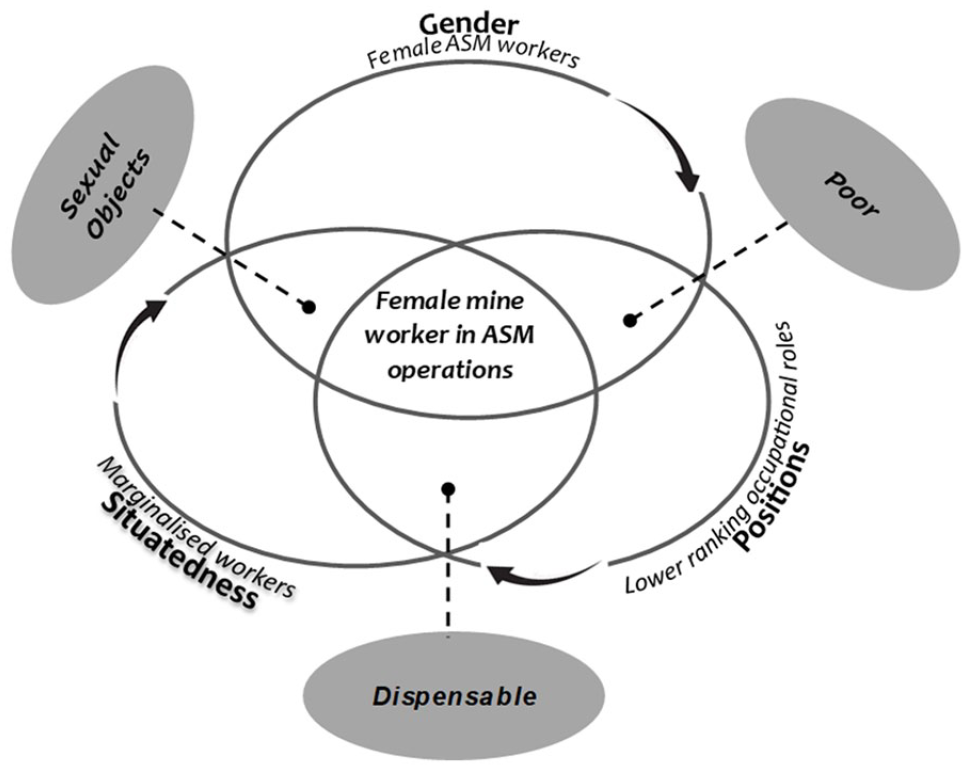
An intersectional model of female mine workers in ASM operations.
The potential outcomes of the connections between the multiple axes of the female mine worker identities, as suggested in our model, play out in the form of female ASM workers being treated as sexual objects, characterised as poor, and easily dispensable. It is imperative to note that it is the interaction or ‘intersection’ of these categories with the power dynamics observed in ASM working contexts that gives rise to the chronic inequality and adverse lived experiences mining women face, not just the presence of intersecting categories on their own.
In sum, the findings of this review suggest that (1) the ASM numbers have not been disaggregated in order to determine the specific numbers that encapsulate the duality of operations in the sector; (2) underpinned by the interactivity of the larger social structures and institutional mechanisms, women mostly occupy the lower-to-middle rungs of ASM labour structures; (3) illicit sexual activities associated with ASM engender regulations that are detrimental to the livelihoods of women in the sector; and (4) while the ASM sector serves as an economic stepping stone for women, the informal nature of operations spawns environmental and occupational health challenges for women and their children.
Also of interest, we note the following: first, the literature has focused mainly on the informal and labour-intensive segments of ASM. This is, however, not surprising considering that the vast majority of the operators are found in this segment. Although reports indicate the existence of duality in ASM operations (i.e. informal and labour-intensive operations vis-a-vis formal and mechanised operations), as indicated earlier, the activities of the formal and mechanised operators have remained on the margins in the dominant scholarship. These developments, we highlight, have engendered a limitation to our understanding of how formalised ASM affects women’s livelihoods and occupational roles. There is little to no knowledge on the disaggregated number or percentage of female workers in formalised settings, and the kind of roles they play. This has occasioned a lack of understanding of the strategies to be implemented to address the challenges female miners face in formalised settings. Although some studies (see, for example, Botchwey et al., 2023; Ofosu and Sarpong, 2022; Ofosu et al., 2022) provide some very useful insights into these issues, extensive research in different mining regions would help to bring more clarity to women’s roles and labour conditions, especially in formalised settings. For example, what becomes of the employment dynamics when women’s roles are taken over by capital-labour substitution mechanisms, that is, the replacement of manual work or workers with machines in an attempt to increase productivity and reduce the unit cost of production?
Despite the high rates of informality, however, the ASM sector provides employment opportunities for miners, especially women. Underpinned by rising levels of unemployment, high gold prices and the negative effects of structural adjustment, ASM operations have continued to serve as an engine of employment for most miners, notably women. Findings from recent research (see Botchwey et al., 2023; Ofosu and Sarpong, 2022; Ofosu et al., 2022), however, seem to suggest that the employment-generation narrative has been occasioned by the immense scholarly focus on the informal and labour-intensive segments of ASM operations. Thus, further research would help bring clarity. For example, it is worth answering the question ‘Do ASM operations still continue to serve as an engine of employment for the vast majority of female miners in formalised and mechanised settings where capital-labour substitution mechanisms are at play?’
Whatever the numbers and employment-generation situation might be, one thing is incontestable: women in informal ASM settings, merely based on their gender and class as encapsulated in the theory of intersectionality, are often marginalised, underpaid and undervalued. They are often relegated to low-rung roles and face sexual harassment and environmental pollution hazards. Many land tenure systems are inherently biased against women, especially in regard to traditional roles, thus causing extreme dysfunctions between decision-making, control and the use of mineralised land as a fruitful resource. Here we highlight that women’s lack of access to, and ownership of, mineralised lands underpins the discrimination and marginalisation quagmire. In this vein, we agree with, for example, Koomson (2019) that the acquisition of lands would not only improve the benefits women acquire from their work but would also help destabilise the ‘myth of the male mine worker’ and the phenomenon of ‘digging women’ only ‘digging to survive’ (Lahiri-Dutt, 2008, 2012). Although traditional systems may disadvantage women with regard to owning land resources, women mining entrepreneurs do not necessarily have to be landowners to benefit from the resources; they can be licence holders (relating to access). Women mining entrepreneurs would therefore need to exert agency and pursue access to land through the formal, institutional arenas. In this regard, further research would need to examine the obstacles, if any, that prevent women from seeking access to mining licences from formal and official circles. Apart from access to finance, which is a major impediment for both men and women miners, are there elements of discrimination and gender bias that hinder women in formal circles? Additional research can help bring clarity to these matters.
Footnotes
Declaration of conflicting interests
The authors declared no potential conflicts of interest with respect to the research, authorship, and/or publication of this article.
Funding
The authors received no financial support for the research, authorship, and/or publication of this article.
