




Abstract
This paper explores the essential components of University 4.0, which developed as a response to changing circumstances and needs in the 4th industrial era. Employing a comparative survey design, data was collected from 203 academics in three technical state universities of Türkiye through a scale devised by the researchers based on a comprehensive literature review, pilot study and expert opinion and advice. Essentials of University 4.0 emerged in four categories: knowledge management and communication, continuous improvement, global competitiveness and digitalization. Comparative analyses of data through SPSS indicated a negative correlation between age and importance attached to digitalization as well as more emphasis on practices related with digitalization in positive sciences compared to social sciences. Holding an administrative position and being actively involved in quality studies of an institution were found to have direct positive influences on global competitiveness. This study adds to the existing literature by addressing different aspects of U4.0 from an educational administration perspective collecting data from academics in a variety of disciplines across a number of universities. Practical implications are presented based on the findings of the study.
Introduction
The 4th industrial revolution has had major influences on the society leading to established changes in many aspects of life. Neaga mentions the first announcement of Industry 4.0 project (I4.0) in an industry fair in Hannover in 2011 (2019). The 4th wave of industrial revolutions is the innovation society which has emerged as a result of industry 4.0 (Demir et al., 2019). Although still in the development phase in many countries thereby requiring more practice and research, I4.0 pioneered service and production catering for the needs of customers in a more meticulous way (Sader et al., 2017) and gave rise to computerization of production operations (Aybek, 2017). Putting the emphasis on the needs of the customer, industry 4.0 entails a change that yields increased value to consumers in technology, innovation and services (Kankaev, 2019). ‘While Industry 4.0 is more technology centric (technology as a key driver) and quality is customer centric (technology as an enabler), both approaches aim for improved performance and results’ (Fonseca et al., 2021: 3), which forms the main pillars for I4.0.
Throughout history, education has consistently transformed in line with the new landscape brought by industrial revolutions. How education was reconstructed in centuries can be summarized as below (Demir, 2018; Miranda et al., 2021):
Education 1.0: Education was restricted to a few elites offered in personalized format and informal methods, with a focus on memorization.
Education 2.0: Literacy levels started to increase due to socio-economic advancements during the period, with a focus on computer and internet.
Education 3.0: Mode of course delivery was changed by information technology and internet; education was offered to students through platforms facilitated by technology, with a focus on knowledge generation.
Education 4.0: Learning structure has become more flexible due to complexities of technology putting emphasis on the needs of the learner, with a focus on innovation and production.
Although no primer has been devised so far to inform relevant parties about planning, teaching or delivering Education 4.0, the principal notion brought by I4.0 to Education 4.0 is flexibility, which requires provision of more flexible education standards due to ambiguities accompanying technology. According to Ramirez, transformation is expected in ‘academic performance, improved efficiency, adaptability to fast-changing environment and close collaboration with other sectors’ (2018, p. 12). This also confirms employers’ opinions about their employees’ lack of flexibility and adaptability skills when there are changes in roles or environments (Olsanova et al., 2022). As highlighted by Aybek (2017), it is the responsibility of higher education institutions to raise individuals with high standard competencies through transformations in parallel with the necessities of the related term, which are flexibility and adaptability in this case.
Within this context, University 4.0 (U4.0) reveals itself as ‘another entity corresponding to the new version of the world’ (Lapteva and Efimov, 2016). U4.0 is a new form of university where students are provided with learning opportunities through such different channels as traditional or hybrid; provision of short-term training programs leading to certificates while equipping them with multiple professional skills; expansion of students’ level of awareness about career management; permanent connection and endorsement programs to establish and maintain the relationship between students, academics, researchers and the industry (Dewar, 2017). Accordingly, it can be characterized as personalization of the learning experience for the students, which is expected to be valued by good universities through adaptations in their existing practices (Göker, 2019). As social transformation can only be realized through education, U4.0 has a concentration on solving the most complicated challenges of the contemporary industry, which cannot be solved by the industry itself for various reasons. Within this scope, as emphasized by Giesenbauer and Muller-Christ (2020), universities are expected to contribute to social progress by raising individuals that can respond to societal issues and deal with complex situations in our current date resting on knowledge-based society.
Fundamental constituents of university 4.0
The main focus of I4.0 is to use the potential of digitalization to improve companies’ adeptness and competitive advantage (Dovleac, 2021). The different ways of thinking, living, learning and interacting are transformed by means of the changes in the information and communication technology, which are reflected in higher education teaching and learning process (Buasuwan, 2018). ‘The educational industry is already inclined towards Industry 4.0 trends of cloud computing, IoT and other processes that directly impacts the industrial revolution and future manpower’ (Chitkara et al., 2020: pp. 46-47). In parallel with this, in the context of higher education, Kulik et al. (2020) list educational portals, learning content management systems, video conferencing systems, institutional e-mails, curricula repositories, distance learning systems, electronic catalogues, electronic libraries and databases as electronic tools of U4.0. It is a fact that releasing individuals from solving ordinary problems by means of digitalization and automation will also create a space to be allocated to research and development of new instruction technologies, contributing to the transformative role of universities.
Digital transformation in I4.0 involves strong leadership, appropriate skills and competences, professional ethics and management systems (Fonseca et al., 2021). Whichever tool is preferred aiming to cater for digitalization, it is important to note that the assessment criteria for Curriculum 4.0 need to focus on four particular competencies ‘programming, data analysis, ability in artificial intelligence, and soft skills flexibility and sustainability systems to produce superior and quality graduates’ (Lukita et al., 2020: p. 306), as will be required in the workforce of the 4th industrial era. This is evident in the outcomes of research by Torun and Cengiz (2019), where the students of management information systems have higher rates of awareness of I4.0 mostly due to their courses such as cloud computing systems, data analytics and algorithm and programming, so they follow a course curriculum appropriate for I4.0 technologies. As data shifts from traditional to big data in U4.0 (Alzahrani et al., 2021), the issue of determining relevant data and different ways to manage data have surfaced as critical factors influencing quality (Dovleac, 2021), thus being essential competencies to equip the students with.
This brings us to continuous improvement as another important constituent of U4.0, embedded in Quality 4.0, which is characterized as improvement of processes and practices associated with quality making use of the 4th industrial revolution (Alzahrani et al., 2021: 2). In this scope, continuous improvement is an indicator of quality showing the level of improvement of university during the course of study (Latif et al., 2019). It is a fact that quality management system, which is achieved by involvement of critical stakeholders such as the students, lecturers and the industry (Abubakar et al., 2019), substantially affects social sustainability appertaining to an institution’s impact on the society; therefore, to assure quality and continuously improve, the UN Sustainable Development Goals and professional ethics as advocated in European values are expected to be incorporated into U4.0 curricular practices (Fonseca et al., 2021) as an important pillar of continuous improvement practices of higher education institutions.
As ‘ideas and knowledge have become a true source of capital’ (Gavhane, N.D., p. (2) in the 4th industrial era, knowledge management in universities can be used as a response to emerging disputes in a highly competitive term where they need to maintain their leading role in creation and dissemination of knowledge. The primary education, pedagogy, research, organization and management activities need to be supported by contemporary technical equipment and up-to-date knowledge and information in U4.0 (Kulik et al., 2020). In the scope of knowledge management and communication in parallel with industry phases, there are four phases of networks; network type 4.0 is in line with integrative perspective and it focuses on co-creation of knowledge with open results (Giesenbauer and Muller-Christ 2020). Therefore, there must be an appropriate level of transparency and collaboration as well as emphasis on co-creation of knowledge to contribute to transformation to U4.0.
Based on the significance of co-creating knowledge with students and community in the scope of U4.0, regarding modifications necessary for education administration to contribute to an innovative society, the following summary of requisites are to be attached utmost importance (Buasuwan, 2018: 169):
Promotion of ICT usage in creating learning networks and sharing knowledge; support in the form of resources for and easing policy restrictions on interdisciplinary learning and research; creating systems for knowledge exchange and knowledge sharing among universities, public organization, NGOs, and the community; and organizing platforms for sharing knowledge and showing the innovations of public and private organizations.
It is a fact that modernization of universities in line with the requirements of I4.0 involves university’s promotion of educational innovations and indicators concerning global competitiveness. Within this scope, the rate of foreign students and lecturers in U4.0 are prevailing factors as highlighted by Nabokikh et al. (2019), which can be promoted by improvement of a university’s reputation through presentation of valid and reliable information concerning instructional quality. Also, research and innovation are very important for commercialization of higher education 4.0 (Buasuwan, 2018), where the number of students who want to be admitted and the research performance of professors are expected to show a continuous trend of improvement (Latif et al., 2019). In Russia, for example, after the reorganization of universities in accordance with requirements of I4.0, quality improved by 1.12 times on average in parallel with indicators (Cheglakova et al., 2019). In addition, making sustainability projections and producing sustainability reports can be considered contributing factors for U4.0 (Ramirez, 2018), and other strategic indicators for global competitiveness in the 4th industrial era.
Although many studies have been conducted to investigate different components and influences of Industry 4.0, the number of studies about U4.0 is limited to the extent of certain aspects and mostly applying case study methodology. Studies exploring the awareness level of university students and academics about I4.0 (Soyöz and Özyörük, 2021; Yıldız and Fırat, 2020); digitalization practices at university in the scope of I4.0 (Dobrosotskiy et al., 2019; Torun and Cengiz, 2019); teaching, learning and student competencies in higher education 4.0 (Cavalcanti et al., 2022; Hadiyanto et al., 2022; Miranda et al., 2021; Silva and Madeira, 2021) and university-industry partnership in the framework of U4.0 (Fonina et al., 2019) can be listed as studies related with the topic of the present article. However, being a novel topic in the field especially when compared to research concerning I4.0, U4.0 and the surrounding processes, practices and priorities have not extensively been the focus of attention by researchers. To this end, there is not a single study in the related literature addressing different aspects of U4.0 from an educational administration perspective and collecting data from academics from a variety of disciplines in a number of universities. While there is abundant evidence about I4.0 and limited amount of research mainly focusing on single components of U4.0, this study aims to reduce the knowledge gap by seeking responses to the following central research questions: 1. What are the essential components of U4.0 according to academics? 2. What are academics’ priorities and expectations concerning the processes and practices in the scope of U4.0?
Materials and methods
Data collection and analyses
Using a comparative survey design (Karasar, 2006), this study explored the perceptions of academics about fundamental constituents of U4.0 and their priorities and expectations about the processes and practices as part of essentials of U4.0 to propose the framework and critical indicators for U4.0. However, due to lack of an existing original and authentic instrument for data collection, a scale development study was also contained in the scope of the current research and U4.0 scale was developed for data collection. Data was collected through the questionnaire devised by the researchers based on a comprehensive literature review, examination of similar questionnaires, creation of an item pool and receiving expert opinion and advice. Four experts from the field of curriculum and instruction, three experts from the field of educational administration and supervision, one expert from the field of assessment and evaluation and one from foreign languages provided input about the preliminary form of the questionnaire. The final form of the questionnaire was formed in accordance with expert opinion and advice as well as relevant statistical analyses. KMO was found 0.882; >0.60 and Bartlett was also found highly meaningful 10,292.749 (p < .001), which led to the conclusion that data was appropriate for factor analysis. The final scale consisted of 61 items excluding the demographic section under four factors.
Sub-dimensions and items loading from these dimensions.
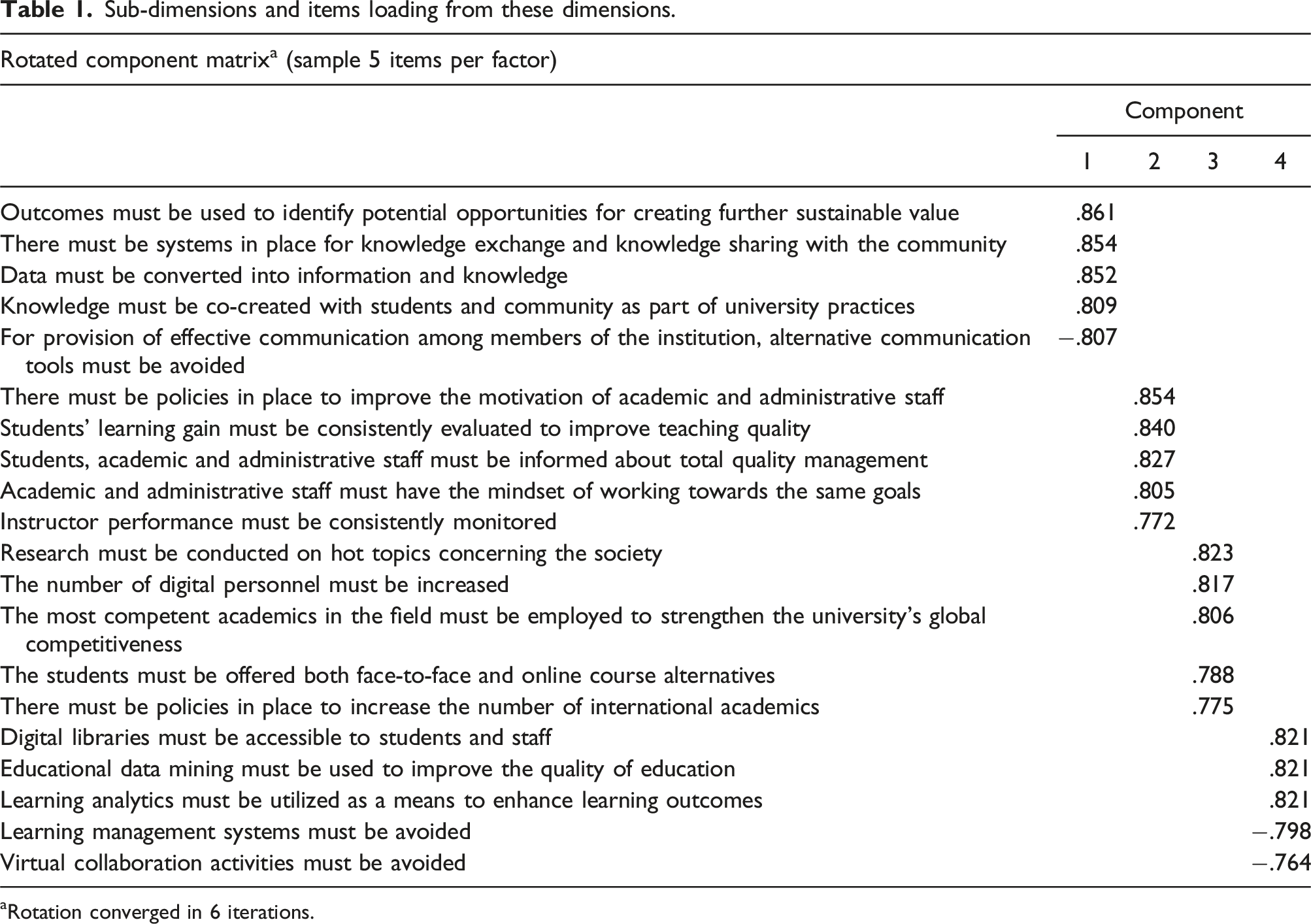
aRotation converged in 6 iterations.
Following the completion of EFA, Confirmatory Factor Analysis (CFA) was conducted with a second and different study group of participants, and the model showed good fit with quite decent values approving the construct of four factors: x2/df = 2.11; RMSEA = 0.07; CFI = 0.91; NFI = 0.91; GFI = 0.91; AGFI = 0.87.
The structural fit of the factors determined as a result of the CFA and EFA was also tested. The variances of the items and the relationships of the items with the structure they belong to are shown in the Standardized Path Diagram in Figure 1. Standardized path diagram.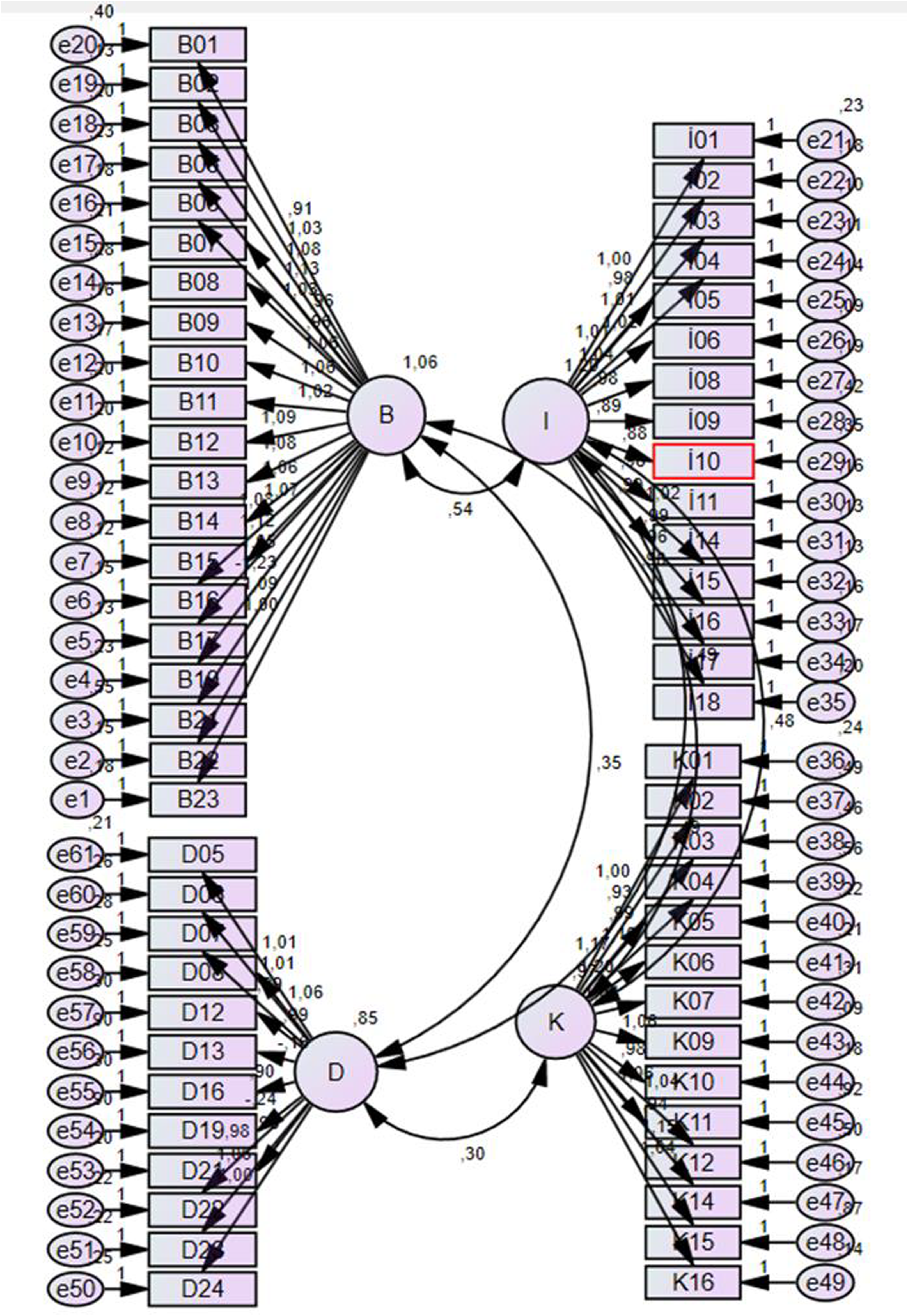
After completion of validity analyses through EFA and CFA, reliability analysis was executed through calculation of internal consistency coefficient. According to Creswell (2012), Cronbach alpha is a measure for reliability and more specifically internal consistency; since all the alpha values were above 0.60, which is considered the threshold for reliability, no item elimination was performed at this stage. The alpha value of the scale was calculated as 0.97; with varying value levels between 0.92 and 0.95 for factors-sub-scales. These figures demonstrate that the U4.0 scale devised by the researchers could be used as a valid and reliable instrument in the study.
Participants
The questionnaire was administered online through an institutional data collection platform and data was collected anonymously from three technical universities of Türkiye. Although they are limited in number across the country, technical universities were selected for data collection based on the assumption that these universities would have a higher rate of awareness and adaptability to U4.0 practices in line with their focus on advancing knowledge through quality education, research and innovation in the fields of engineering, technology and other technical areas. The participants were selected through convenience and random sampling as the commonly known non-probability sampling technique in accordance with ease of access and participants’ equal opportunity to participate in the study (Golzar et al., 2022). Ethical approval was received from Institutional Review Board of the University of one of the researchers before the initiation of the study. The participants were asked to give consent on the online questionnaire to be able to start answering the questions. As a consequence, the final sample comprised 203 respondents (N = 203) from three technical state universities of Türkiye.
Although there are different opinions on sample size in scale validity and reliability studies, especially in factor analyses, it is recommended to work with a large sample size whenever possible. While Kline (1994) states that the smallest sample size should be 100 participants, Büyüköztürk (2002) suggests that at least 200 individuals should be included in the sample. Therefore, a sample of 203 people was found sufficient in this context.
As part of dependent variables, female academics made up of 59.6% of the sample and the age range varied between 22 and 60. Similarly, experience levels of the academics ranged from 1 to 38 years. The academics in the study came from a wide range of disciplines such as engineering, life sciences and mathematics and educational sciences holding varying academic titles such as professor (23.6%), associate professor (25.6%) and assistant professors (27.1%). 114 (56.2%) did not have an administrative position, 117 (57.6%) did not participate in quality studies and none of the participants (100%) had training on U4.0.
Findings
In this study, priorities and expectations of academics regarding processes and practices of different aspects of U4.0 were investigated by means of a scale devised by the researchers. Various parametric and non-parametric analyses were conducted to test the research hypotheses, depending on whether the normality conditions were met. The central limit theorem was also taken as a reference for normality. According to this theory, in samples with n > 30, the shape of the distribution approaches normality regardless of the sample size (Armutlulu, 2008; Çil, 2008). So, parametric analyses were preferred in cases where this condition was met, and non-parametric analyses were conducted in the remaining cases where this condition was not met. In this context, the relationships between the scores obtained by the participants from the scale were examined with Pearson correlation analysis. Whether the scores obtained from the scales differed significantly according to various demographic and occupational characteristics was evaluated with independent group t test, one-way analysis of variance (ANOVA), Kruskal Wallis-H analysis, and the LSD test was used as a complementary post-hoc analysis in the significances after ANOVA.
Descriptive values for scale scores.
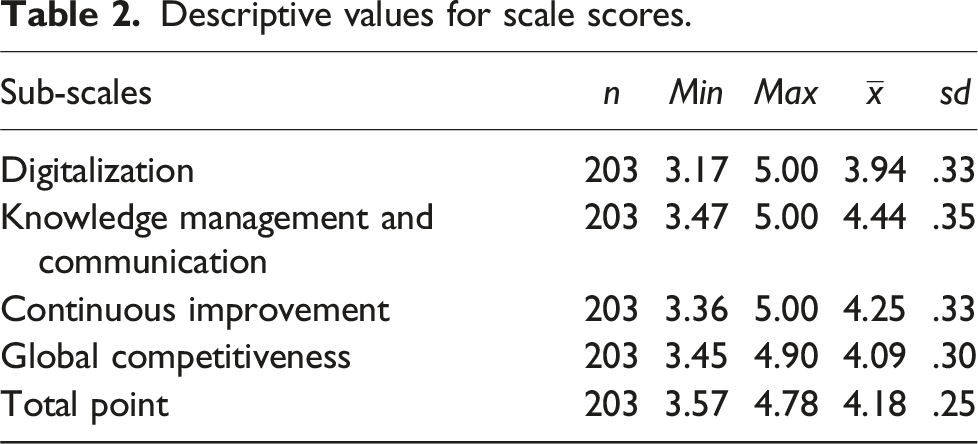
In the next step, we conducted comparative analyses of scale scores based on dependent variables. Accordingly, One-Way ANOVA, Independent Samples T tests, Pearson correlation, Kruskal Wallis-H and Mann Whitney-U tests were performed. The analyses revealed that academics expectations regarding University 4.0 processes and practices do not differ significantly according to academic titles of the sample group (
Regarding fields of study of academics who participated in the research, it was found that although digitalization, which is represented in the scale through such items as developing new expertise using technologies like Artificial Intelligence, Augmented Reality, and Virtual Reality; using software solutions in instructional practices; offering Massive Online Open Courses to extend reach and access to education is the least prioritized area in the overall scale compared to other dimensions, it is attached relatively more importance by academics working in the fields of life sciences and mathematics and engineering compared to those in the fields of social sciences. Considering different constituents of U4.0 as a whole, academics in the fields of educational sciences, engineering, life sciences and mathematics seem to have more awareness of and higher expectations from U4.0.
Similarly, the research revealed that academics holding an administrative position prioritize knowledge management and communication, which is presented in the scale through such items as co-creation of knowledge with students and community as part of university practices; creation of professional communities as a way of learning networks; systems in place for knowledge exchange and knowledge sharing and practices related with global competitiveness, which is reflected in the overall scale through such items as emphasis on global connectivity and production of sustainability reports in the scope of U4.0.
Another important finding of the study was that academics taking part in quality management activities of their institutions have more awareness and higher expectations in the area of global competitiveness.
A remarkable finding of the scale was the significant negative correlation between age of the academics and the area of digitalization, which demonstrates that as age increases, digitalization scores decrease significantly.
In addition to the comparative analyses, the responses were analysed based on particular items included in the scale as it was deemed appropriate and important to showcase the processes and practices included in the sub-dimensions of U4.0 reflecting the highest priorities and expectations of the academics.
Practices of highest priority in U4.0.

Discussion and conclusion
The growing interest in U4.0 in line with advancements in I4.0 has prompted an increasing number of studies investigating different constituents of University 4.0 (Buasuwan, 2018; Cavalcanti et al., 2022; Chitkara et al., 2020; Demir et al., 2019; Dobrosotskiy et al., 2019; Fonina et al., 2019; Gueye and Exposito, 2020; Hadiyanto et al., 2022; Kankaev, 2019; Kulik et al., 2020; Miranda et al., 2021; Silva and Madeira, 2021; Soyöz and Özyörük, 2021; Torun and Cengiz, 2019; Yıldız and Fırat, 2020).
The aim of this particular research was to explore priorities and expectations of academics about essential components of U4.0. Using the U4.0 scale that we devised in accordance with data from academics from various fields of study and years of experience, we investigated expectations of academics working in technical universities concerning processes and practices in the scope of U4.0. Therefore, our study not only led to creation of a valid and reliable instrument showing key indicators for U4.0 but it also explored academics’ perceptions about different constituents of U4.0 and whether their perceptions differ according to different dependent variables included in the research.
Capturing perceptions and expectations regarding multiple constituents of U4.0, the study revealed significant findings to contribute to the existing literature. One of the critical findings of the research is that academics expect knowledge management and communication to be more central to and prioritized in the framework of U4.0 practices. While knowledge and communication are central to transformation, individuals who think creatively are prominent in knowledge-based societies so that knowledge is transformed, which may be attributed to the situation in the current study (Resnick, 2007). It is a fact that the different ways of thinking, living, learning and interacting are transformed by means of the changes in the information and communication technology, which are reflected in higher education learning process (Buasuwan, 2018). This could also be because of the excessive focus and attention attached to digitalization as well as the needs of academics for communication and interaction especially as data collection was realized during the pandemic. As the pandemic was a reason for feeling of isolation and lack of communication, it is of utmost importance to create activities for knowledge exchange and communication to ease the burden and facilitate adaptation (Ramirez-Hurtado et al., 2021; Verawardina et al., 2020).
Another related important finding of the research was the negative correlation between the age of the academics and the area of digitalization, which led us to the conclusion that as the age increases, digitalization is less prioritized by academics, who in the current study were mainly Generation X, who according to Kohnova et al. have personal and virtual networks and use information technology confidently (2021) although not comparable to digital natives, Generation Z. Therefore, one of the causes of this particular finding may be related with academics’ preferences and habits; for example, while middle-aged and older adults prefer to follow news channels and TV shows, young people prefer computer activities and digital games (Zülfikar, 2020). This could also be attributed to the abundance of sources available for academics to be used during the instruction and they can find educational solutions via technology much more easily compared to conventional offerings (Lukita et al., 2020) and that thanks to pandemic many professors became acquainted with digital tools contributing to their self-esteem in this particular aspect (Camilleri, 2021).
In the scope of digitalization as part of U4.0 practices, when scientific fields of study are taken into consideration, life sciences and mathematics and engineering give more priority and have higher expectations, implying that positive sciences put more emphasis on such practices as creating specialties for digital personnel, using AR and VR technologies to contribute to student learning, using artificial intelligence and software solutions as a tool to increase the quality and efficiency of teaching and learning, as some of the examples included in the digitalization sub-scale. It can be inferred based on the finding that as the primary objective of positive sciences is advancement in technology, digitalization can be seen as the main tool to accomplish this in positive sciences. Through a more objective approach, positive sciences may consider advanced level calculations using digitalization tools can contribute to the formation of more effective and smarter systems leading to potential milestones in the advancement of technology. Social sciences, on the other hand, with their focus on human behaviours, perceptions and societal factors and through a more subjective perspective may be putting less emphasis on digitalization based on the idea that intelligence and human behaviour cannot be predicted and digitalization may be a misleading factor in this rather than contributing to its advancement.
Similarly, the finding that indicates that knowledge management and communication and practices related with global competitiveness are prioritized more by those holding an administrative position can be considered an indicator of their observations, engagement, contemplation and active involvement in these fields especially when such factors as communication, co-creation of knowledge, university-industry partnerships and university rankings have risen to prominence in the 4th industrial era. They must have witnessed the importance of these indicators as part of their jobs. As Fonseca et al. discuss, the transformation towards U4.0 requires solid leadership skills and competencies (2021). In this era of knowledge economy, higher education institutions must be administered through innovative and farsighted policies, adopting innovative and sustainable approaches for the establishment of technology infrastructure and employed human capital (Aybek 2017), supporting the relevant results of the current study in terms of practices that fall under the umbrella of knowledge management and communication and global competitiveness of universities. This also applies to the finding that academics taking part in quality management activities of their institutions have higher expectations in the area of global competitiveness, as there is a close connection between a university’s quality and its place in the world. Alzahrani et al. assert that there needs to be proper foundation, transparency and collaboration among various units to make a contribution towards quality 4.0 (2021), which directly influences a university’s reputation on a global scale. In order to provide the students with better quality education, community engagement is important for higher education institutions, which is expected to contribute to development by means of innovation (Buasuwan, 2018). The global competitiveness sub-scale includes many indicators of quality such as promotion of interdisciplinary and cross-disciplinary research, emphasis on global connectivity, increase in the quality and quantity of publications, the number of digital personnel, all of which contribute to strengthening the global reputation of a university, which, according to Polkinghorne et al. (2017) and Cheglakova et al. (2019) is a critical factor in attracting local and international students.
In sum, our findings demonstrate that academics have a certain level of awareness of and positive perceptions towards U4.0, placing special emphasis on processes and practices related with knowledge management and communication. To this end, we encourage leaders of higher education institutions and policy makers to prioritize communication, knowledge transfer and exchange and create policies and procedures to improve this particular area. Also, as age increases, digitalization is prioritized less, which means the new generation puts more emphasis on digitalization. To that respect, new practices should be initiated by higher education leaders to raise interest and to more actively engage academics of all ages in processes and practices related with digitalization. This also includes raising awareness of academics from the fields of social sciences about potential contributions of digitalization to university practices. In addition, academics holding an administrative position and those actively engaged in quality studies of their own institutions have a higher level of knowledge of and higher expectations from constituents of global competitiveness, which indicates that quality management activities and factors contributing to reputation of an institution on a global scale should be turned into an institution-wide practice rather than a group of individuals working towards the same goal, contributing directly to adoption and impropriation of U4.0 practices.
Limitations and future research
This study has some limitations which will be influential for designing further research and generalization of research findings. First of all, the research was conducted in three technical universities of a single country and the responses were limited to perceptions of academics working in the aforementioned universities. Therefore, it cannot be claimed that the findings of this study are generalizable to the whole population of academics working in different technical universities across the world.
Future research following the conclusions drawn from this study will benefit from implementation of the scale in wider populations to determine the current state about U4.0, in-depth investigation of the difference between perceptions between positive sciences and social sciences particularly in the area of digitalization, in-depth investigation of the subject through mixed research techniques, calculation of correlations for the scores obtained from the scale with various indicators (academics’ job satisfaction, opportunities offered by the university, etc), last but not least comparative analysis of findings of the current research with research from other countries.
Footnotes
Declaration of conflicting interests
The author(s) declared no potential conflicts of interest with respect to the research, authorship, and/or publication of this article.
Funding
The author(s) received no financial support for the research, authorship, and/or publication of this article.

Data availability statement
The data that support the findings of this study are available from the corresponding author, (NÜ), upon reasonable request.