




Abstract
Working conditions in platform work are often, yet rarely explicitly, assessed according to criteria similar to those applied to the quality of jobs outside the gig economy. In this article the authors argue that future research would benefit from analytical schemes that enable a systematic analysis of working conditions in platform work. They discuss the advantages and challenges of applying existing job-quality frameworks to platform work and present a suggestion for modifications that consider the particularities of platform work. The use of such a novel analytical framework could help systematise evidence from qualitative research, promote the heretofore rare initiatives of quantitative representative data collection, and inspire theoretical developments at the interface of job quality and platform work.
Introduction
Work in the platform or gig economy has attracted much attention in recent years. This is evident in the focus that platform labour has received in the public media, in the OECD’s and ILO’s ‘future of work’ agendas (e.g. ILO, 2021; OECD, 2019), and in recent voluntary and binding regulation activities. Efforts to improve working conditions in platform work include a recent proposal of a Directive by the European Commission (2021) and the development of principles for fair work by the Fairwork Foundation (Graham et al., 2020). Meanwhile, a large academic literature has emerged that draws a simultaneously complex and ambiguous picture of the working conditions associated with platform work. While various academic disciplines have taken an interest in platform work, the present article draws mainly on sociological and industrial relations approaches to the topic, as these disciplines have been particularly interested in the interface between job quality and platform work.
In the academic literature we examined, working conditions in platform work are often – although mainly implicitly – assessed according to criteria similar to those commonly emphasised in studies on multidimensional job quality (for an overview, see e.g. Muñoz de Bustillo et al., 2011; Warhurst et al., 2017). Such criteria include remuneration, autonomy and control, working time, employment quality, and representation and voice (e.g. Eurofound, 2012; Leschke and Watt, 2014; Muñoz de Bustillo et al., 2011; Warhurst et al., 2017). Several studies have found platform work to be characterised by low or variable and unpredictable pay (e.g. Berg, 2016; Berg and Johnston, 2019; Goods et al., 2019), limited control over working times or schedules (e.g. Bergvall-Kåreborn and Howcroft, 2014; Heiland, 2022) and limited scope for collective action and voice (e.g. Veen et al., 2020; Wood and Lehdonvirta, 2021). However, closer inspection of the relevant literature reveals the situation to be much more complex. This is largely because of the heterogeneous character of platform work, with some types of platforms providing better remuneration and more autonomy than others (e.g. De Stefano and Aloisi, 2018; Vallas and Schor, 2020; Wood et al., 2019). Overall, despite providing rich findings, the current state of research on working conditions in platform work lacks systematisation, making it difficult to get a clear sense of the underlying trends in working conditions and the variations therein.
In response, the present article argues that research on the quality of platform work would benefit from more coherent analytical frameworks tailored to heterogeneous platform work settings. Although existing job-quality frameworks cannot readily be applied to the context of platform work, they seem to provide a good starting point. As of yet, very few academic papers on working conditions in platform work draw explicitly on job-quality frameworks. The article outlines the potential and limitations of frameworks originally developed for assessing the quality of jobs outside the platform economy for analysing working conditions in platform work. Drawing on a comprehensive overview of studies on working conditions on labour platforms, we identify the areas in which existing job-quality frameworks need adapting specifically to platform work and make initial suggestions for modification. The use of such analytical frameworks can contribute to systematising the rich qualitative findings on working conditions in platform work and draw out their implications for regulatory initiatives. Moreover, such frameworks can promote the hitherto rare collection of quantitative representative data on the topic. Last but not least, we hope that our contribution might inspire theoretical developments at the interface of job quality and platform work.
Platform work: Terminology and definitions
Platform work is understood here as paid work mediated by digital labour platforms that match supply and demand and provide tools and services that enable the delivery of work in exchange for compensation (see e.g. Piasna and Drahokoupil, 2019). Thus, it entails a triangular relationship between platform workers, labour platforms that serve as digital intermediaries, and customers. This article focuses on platforms the primary purpose of which is mediating labour. Platforms primarily used for capital-generating activities such as letting or renting accommodation (Schor et al., 2020) are beyond our article’s scope, notwithstanding that such activities also involve certain types of labour including reservation services or communication with customers. Nor do we consider ‘speculative’ work, the remuneration of which depends on winning prize money (Howcroft and Bergvall-Kåreborn, 2019), or non-paid work, including the social media activities of influencers and suchlike (Vallas and Schor, 2020).
Labour platforms comprise a heterogeneous set of activities and are commonly divided along at least two major dimensions: type of service provision (digitally delivered vs on-location services) and skill level or task complexity. Digitally delivered services (also termed ‘remote work’, ‘virtual work’, ‘online work’ or ‘crowdwork’) encompass situations where tasks are completed through online platforms that potentially connect customers and workers on a global basis (e.g. De Stefano and Aloisi, 2018; Panteli et al., 2020; Piasna and Drahokoupil, 2019; Wood et al., 2019). On-location services (also termed ‘local work’, ‘offline work’ or ‘work-on-demand via apps’) include activities such as passenger transport, food delivery and cleaning, which are channelled and controlled through apps managed by firms (e.g. De Stefano and Aloisi, 2018; Goods et al., 2019; Tassinari and Maccarrone, 2020).
In the following, we use the term ‘local platform work’ for on-location services and ‘remote platform work’ for digitally delivered work, borrowing from Wood and Lehdonvirta (2021), who use similar terminology. Both local and remote platform work relate to a variety of tasks differing in skill levels and complexity. Remote platform work is often subdivided into micro- and macrowork. Microwork results from a decomposition of jobs into tiny standardised ‘micro’ tasks that require few or no skills and are paid on a piece-rate basis (Berg, 2016; Gegenhuber et al., 2021; Lehdonvirta, 2018; Vallas and Schor, 2020). Remote macrowork (also called ‘freelance work’) is more similar to traditional jobs in that it requires higher skills or expertise and refers to larger projects paid either hourly or upon task completion (Murgia and Pulignano, 2021; Shevchuk et al., 2022; Wood and Lehdonvirta, 2021; Wood et al., 2018).
While the common distinction between local and remote (micro and macro) platform work is widely accepted in academia and practice, it does not do full justice to the variety and complexity of platform work. Howcroft and Bergvall-Kåreborn (2019) propose an alternative typology whereby the focus of differentiation is on the type of remuneration (paid vs unpaid/speculative work) and the initiating actor (worker vs requester of services). Haidar (2022) suggests an analytical framework whereby three interdependent dimensions – technological-organisational, institutional and ideological – reinforce each other to configure platform work. In turn, Dunn (2018) classifies platform work according to location dependence and skill level as well as job duration and entry barriers. Pesole et al. (2018) propose differentiating more strongly according to task types. The identified task types and how they relate to sociodemographics and employment status provide a vivid picture of the heterogeneity of platform work.
One characteristic of all types of platform work with fundamental implications for working conditions is the shifting of economic risks to the worker. This is done, for example, by classifying platform workers as independent contractors (e.g. Veen et al., 2020). The assumption of independent-contractor status implies that workers rather than platforms are in charge of providing equipment and paying taxes. Importantly, it also means that platform workers are usually not covered by labour legislation or collective bargaining agreements on issues such as minimum wages, sick leave and other social benefits (for an overview, see De Stefano and Aloisi, 2018). While the overall share of directly employed platform workers is still relatively small (ILO, 2021), platforms operating in specific segments, notably local platform work, increasingly hire workers as dependent employees in line with their business model or in response to growing political pressure also triggered by court decisions. The contested status of independent contractors is one of the focal points of an EU directive proposal on working conditions in platform work (European Commission, 2021).
While in many cases labour platforms act as intermediaries rather than employers, they are nevertheless characterised by the exertion of substantial managerial power, in particular through algorithmic management techniques. Algorithmic management goes far beyond the automated matching of workers to work tasks. It includes the use of performance management systems based on digital tools that collect information from work process monitoring and customer ratings. By deliberately keeping their management systems untransparent to workers, platforms create information asymmetries and thus power imbalances to the disadvantage of workers (Veen et al., 2020). Exercise of managerial power through algorithmic management not only limits workers’ discretion on how to complete a task, but can also have direct consequences for access to tasks and thereby earnings possibilities (e.g. De Stefano and Aloisi, 2018; Veen et al., 2020). Moreover, disciplinary actions such as restricting workers’ access to tasks or discharging them are often done automatically based on previous performance ratings and without the involvement of human platform managers, which makes them difficult to challenge (e.g. Wood et al., 2019). Accordingly, the bargaining position of the worker vis-a-vis the platform and the customer is often weak (Piasna and Drahokoupil, 2019).
Platform work and working conditions: An overview of the literature
Below we provide an overview of the key aspects discussed in the sociological and industrial relations literature on working conditions in platform work. We present a thematic rather than exhaustive review or meta-analysis, since the primary goal of our article is not to summarise the state of research but to work out the challenges and potentials of evaluating platform work against established job-quality measures. 1 We selected the studies included in our literature overview with the aim to cover both local and remote platform work, encompassing a variety of task types. Research on working conditions in platform work is predominantly carried out by means of case studies based on qualitative interviews, log data from platforms or targeted surveys on selected platforms (e.g. Berg, 2016; Dunn, 2018; Goods et al., 2019; Gregory, 2021; Hall and Krueger, 2018; Lehdonvirta, 2018; Panteli et al., 2020; Piasna and Drahokoupil, 2021; Schor et al., 2020; Shevchuk et al., 2019; Tassinari and Maccarrone, 2020; Wood et al., 2019). A much smaller number of studies are based on large-scale surveys (e.g. ILO, 2021; Pesole et al., 2018; Piasna and Drahokoupil, 2019). It is striking that working conditions in platform work are often – although mostly implicitly and without reference to the relevant literature – assessed according to established job-quality dimensions developed and used for evaluating the quality of ‘traditional’ jobs. Most job-quality frameworks capture remuneration, workplace autonomy, skill requirements and skill development, physical and social work environment, work–life balance, employment status and job security, as well as worker representation and voice (for an overview, see e.g. Muñoz de Bustillo et al., 2011; Warhurst et al., 2017).
Autonomy, control and working-time flexibility
Autonomy, control and working-time flexibility have received particular attention as important and interrelated aspects of working conditions in platform work. A frequently cited motive for carrying out platform work is workers’ wish for autonomy over when, where or how they work (e.g. Goods et al., 2019; Hall and Krueger, 2018). However, evidence on platform workers’ actual scope of control over their working conditions is complex and inconclusive (e.g. Berg and Johnston, 2019; Bergvall-Kåreborn and Howcroft, 2014; Goods et al., 2019; Heiland, 2022; Howcroft and Bergvall-Kåreborn, 2019; Piasna and Drahokoupil, 2021; Schor et al., 2020; Shevchuk et al., 2019; Vandaele et al., 2019; Veen et al., 2020; Wood et al., 2018, 2019). From the literature, it can be concluded that the degree of autonomy, control and flexibility experienced by platform workers varies by context. This variation is partly attributable to the heterogeneity of platform work in terms of the nature, complexity and skill level of tasks. Workers’ scope for autonomy has been described as particularly narrow in the context of low-skilled work, including remote microtasks (e.g. Bergvall-Kåreborn and Howcroft, 2014; Wood et al., 2019), as well as local platform work such as food delivery (Goods et al., 2019; Heiland, 2022; Vandaele et al., 2019). In contrast, workers performing relatively high-skilled remote macrowork (‘online freelancers’) tend to have more autonomy (e.g. Wood et al., 2018). While this result seems to suggest there is more room for worker autonomy the higher the skill level of platform work, the picture is more complex on closer inspection.
Research suggests that limited worker autonomy is characteristic of platform work across task types and skill levels because of platforms’ wide use of technological or organisational forms of control. Many platform workers face what has been described as an ‘autonomy paradox’ (for an overview, see Shevchuk et al., 2019), a formally high degree of autonomy but de facto tight constraints on when or how to work (Goods et al., 2019; Heiland, 2022; Lehdonvirta, 2018; Piasna and Drahokoupil, 2021; Veen et al., 2020; Wood et al., 2019). On the one hand, the reasons for organising platform work in a way that limits worker autonomy can be task-related, resulting from the necessity to synchronise the work schedule with customers’ needs to ensure an efficient and reliable service, for example (Heiland, 2022). Such a scenario could be the requirement to meet deadlines imposed by customers of remote work (Bergvall-Kåreborn and Howcroft, 2014). This can be particularly challenging when workers on globally operating platforms interact with customers from different time zones (Wood et al., 2019). Similarly, autonomy over working time on passenger transportation or food delivery platforms is restricted by peak times of demand for rides or meal ordering (Berg and Johnston, 2019; Goods et al., 2019; Heiland, 2022). To facilitate and optimise the coordination of the labour process, platform operators commonly rely on algorithmic management tools, such as automatic task allocation, or on financial incentives to work at specific hours (Berg and Johnston, 2019; Veen et al., 2020) – at the expense of worker autonomy.
On the other hand, algorithmic management tools such as customer- or performance-based rating and task allocation are not primarily used to solve coordination problems, but are instead a means of exercising control and monitoring and enhancing workers’ productivity (Heiland, 2022). In addition, making the number and quality of tasks offered to workers contingent on scores for past performance – including task acceptance and the speed and quality of work as assessed by customers – increases workers’ dependence on a specific platform and binds them to it (Wood and Lehdonvirta, 2021).
Despite the pervasiveness of platform-based control mechanisms, workers are heterogeneous with respect to autonomy and flexibility. This is partly because of the diversity of platform work itself and how it is organised, but has also been attributed to variation in the power relations between platforms and workers. Competition is one factor that affects workers’ power and thus their scope for autonomy. When there is a shortage of workers, platforms are less successful at enforcing control mechanisms that curtail worker autonomy than in a situation of oversupply of workers competing for tasks (Heiland, 2022; Wood and Lehdonvirta, 2021; Wood et al., 2019). Another factor is workers’ economic dependence on labour platforms. Workers for whom platform work is not the main source of income can afford more freedom in choosing tasks and working times than those who earn their living from platform work (Schor et al., 2020).
Voice and collective action
Workers’ opportunities to voice collective interests and initiate collective action significantly affect power relations in traditional employment relationships. One strand of the literature explores platform workers’ attitudes to collective representation and highlights the conditions under which collective interests translate into collective action (Tassinari and Maccarrone, 2020; Vandaele et al., 2019; Wood and Lehdonvirta, 2021; Wood et al., 2018).
Research has pointed to elements of structured antagonism (see e.g. Wood and Lehdonvirta, 2021 with reference to Edwards, 1986) between workers and platform managers. Ultimately, conflicts of interest arise from power relations in platform work being unequally balanced in favour of the platforms because of platform dependency and platform authority (Wood and Lehdonvirta, 2021). Where platforms exert a high degree of technological and organisational control over the labour process, workers are likely to experience conflicts in dealing with the platforms’ terms and working conditions. This has, for example, been illustrated in a case study on worker protests against two major food delivery platforms in the UK and Italy, in which workers’ grievances included a lack of income and social security, non-transparency of algorithmic management and a perceived discrepancy between formally granted and actual flexibility levels (Tassinari and Maccarrone, 2020).
Whether the existence of shared grievances actually enhances workers’ awareness of and willingness to voice common interests depends on contextual factors. As the example of Tassinari and Maccarrone (2020) shows, local platform work can provide favourable conditions for the formation of worker protest. There are opportunities for encounters during work shifts, which facilitate the exchange of information and the organisation of activities. In the cases studied, this led to various highly visible forms of collective action, including protests on social media and strikes through mass logouts from the platform. A counterexample is provided by Veen et al. (2020), who point to a striking absence of significant collective action among Australian food delivery riders. They attribute this to a combination of high turnover rates and a particular vulnerability and economic dependence of the predominantly immigrant workforce.
Although power imbalance is also characteristic of remote platform work, obstacles to collective action appear comparatively higher in this context because of workers’ greater spatial dispersion (Vallas and Schor, 2020). Online communities and tools that enable workers to exchange their experiences address these problems (e.g. Silberman and Irani, 2016 for microworkers; Wood et al., 2018 for online freelancers). Panteli et al. (2020) argue that online communities foster awareness of shared interests and help generate a collective identity among remote microworkers. This can ultimately bring forth publicly visible collective action, as in their example of workers’ protests against MTurk.
Wood and Lehdonvirta (2021) provide ample evidence of worker–platform conflict even among remote macroworkers. This leads workers to support collective voice and unions in spite of identifying as self-employed freelancers. However, they conclude that collective action in remote platform work is often confined to ‘small acts of participation via the internet’ (Wood and Lehdonvirta, 2021: 1390), such as the posting of petitions on social media. It has also been shown that remote macroworkers who hold strong entrepreneurial identities and appreciate high levels of autonomy are reluctant to unionise despite being open to certain forms of worker collaboration (Murgia and Pulignano, 2021; Wood et al., 2018).
Workers’ willingness to voice their interests also depends on their economic reliance on platform work. Workers viewing platform work as a temporary side job tend to attach less importance to collective action (Vandaele et al., 2019). Meanwhile, those who depend on platform work as their main source of income might refrain from collective action for fear of counteraction from platforms (Tassinari and Maccarrone, 2020).
While platforms arguably have a strong interest in maintaining power and control, Gegenhuber et al. (2021) provide evidence of platforms supporting worker voice to varying degrees and for different reasons, including strategic interests in binding workers and promoting performance, but also to ensure fair treatment. Ilsøe and Larsen (2023) offer initial evidence that platform strategies regarding collective bargaining depend on initial growth rates, the customer base, platform ownership and the national regulatory context. However, most often platform-controlled voice channels are limited to task-related communication and consultation and do not provide scope for far-reaching worker participation or codetermination.
Earnings
Remuneration is often in focus in sociological or industrial relations studies on platform work (e.g. Berg, 2016; Berg and Johnston, 2019; De Stefano and Aloisi, 2018; Dunn, 2020; Goods et al., 2019; ILO, 2021; Pesole et al., 2018; Piasna et al., 2022; Schor et al., 2020; Veen et al., 2020; Wood et al., 2019). Earnings derived from platform work are typically characterised as variable, unpredictable and often low (e.g. Goods et al., 2019; ILO, 2021; Piasna et al., 2022). This is closely linked to other features of platform work, such as variability in working time because of unreliable and unstable working hours, unpaid time (waiting or searching for tasks) and the use of bonus systems (ILO, 2021; Piasna et al., 2022). A lack of transparency regarding the criteria applied to payments can further increase insecurities (e.g. De Stefano and Aloisi, 2018). Earnings insecurity also develops from the frequent classification of platform workers as independent contractors who are paid only for specific tasks executed and usually do not have the right to a statutory or collectively agreed minimum wage. Moreover, they must cover extra costs such as equipment, maintenance, commission fees, tax payments and work-related risks, all of which reduce their take-home pay (Berg and Johnston, 2019; Goods et al., 2019; ILO, 2021). The piece-rate payment systems often used for remote micro platform workers and local platform workers perpetuate these insecurities (De Stefano and Aloisi, 2018; Pesole et al., 2018). Veen et al. (2020), with reference to Australian food delivery platforms, highlight the existence of differences in payment systems within platforms consisting of, on the one hand, core workers receiving guaranteed deliveries as a proxy for hourly rates of pay and, on the other, supplementary precarious workers receiving fixed piece-rates.
Pay varies across different types of platforms but also within platforms and across geographic locations (ILO, 2021). This variation is linked to the degree of competition arising from the over- or undersupply of labour as impacted in particular by the skill level and specificity of the service provided (Piasna et al., 2022; Schor et al., 2020), as well as by the degree to which platforms expose workers to (geographic) competition (Wood and Lehdonvirta, 2021). Platform work in developing countries more commonly serves as the main source of income than in advanced economies (ILO, 2021; Wood et al., 2019). Moreover, some types of on-location platform work (passenger transport and delivery sector) pay more than traditional industries in developing countries (e.g. ILO, 2021). This stands in contrast to findings for microwork (with reference to India and the US), whereby platform work pays less than comparable traditional services (ILO, 2021). In advanced economies, platform work often serves as a side job and, when taking into account unpaid time, in most cases pays less than the national minimum wage (Goods et al., 2019; ILO, 2021; Pesole et al., 2018; Piasna and Drahokoupil, 2019; Piasna et al., 2022). Wood et al. (2019) also emphasise income disparities linked to reputation based on ratings.
Studies with an explicit focus on job quality
Only a few studies explicitly draw on theoretical job-quality frameworks when assessing the working conditions on labour platforms. Key examples include Goods et al. (2019), Myhill et al. (2021) and Wood et al. (2019).
The case study by Goods et al. (2019) builds on sociological, economic and psychological concepts of job quality to analyse working conditions on two major food delivery platforms in Australia. It uses qualitative interviews with platform workers and highlights (1) economic (in)security (earnings variability and economic risk because of independent-contractor status); (2) contradictions in autonomy over work because of a combination of high working-time flexibility and limited control over pay and constant control and monitoring of the labour process; and (3) high levels of enjoyment at work, including social interactions and cycling as an outdoor activity (Goods et al., 2019). The findings highlight that bad working conditions on one dimension can be compensated by advantages on other dimensions. Importantly, a worker’s perception of job quality is shaped by personal circumstances, the specific labour market environment and the broader societal context (Goods et al., 2019).
Myhill et al. (2021) conduct interviews with workers on three types of local platforms: personal transport, courier and hospitality services. Analytically, the study draws on Scotland’s Fair Work Convention, which was inspired by the ILO ‘decent work’ framework and identifies five job-quality dimensions: (1) voice and participation; (2) opportunity for career advancement; (3) security (stability of employment, security of income, predictability of work commitment); (4) fulfilment (psychological aspects and autonomy); and (5) respect at work (dignity at work, social support and trusting relationships). The findings suggest that the platforms examined fail to meet the above criteria for good jobs. However, the article also highlights the subjective experience of job quality of local platform workers, which differs, in particular, according to whether platform work is carried out as a side or main job.
Focusing on remote platform work in Southeast Asia and Sub-Saharan Africa, Wood et al. (2019) use the job-quality literature with a specific focus on low- and middle-income countries to devise a model of job-quality determinants of platform work. They survey and interview workers across different job types on two major platforms along the following dimensions: autonomy, pay, work intensity and control over working time. They conclude that algorithmic management techniques are central elements that impact job quality across country contexts and types of work. Moreover, job quality is largely determined by workers’ marketplace power, which depends on skills and reputation.
Some other articles are evidently influenced by the job-quality literature but do not explicitly or thoroughly engage with job-quality concepts in their theoretical and empirical approaches (see e.g. Berg and Johnston, 2019; Dunn, 2020; Schor et al., 2020; Vandaele et al., 2019).
Reflections on future directions of research on working conditions in platform work
Overall, our review of the literature shows that working conditions in platform work are heterogeneous, varying by context and task type. Moreover, many aspects of working conditions identified as critical in the platform literature resemble those commonly used to assess the quality of jobs outside the platform economy. It is therefore remarkable that, in many studies on platform work, theoretical concepts of job quality are disregarded or only noted in passing. This raises two questions: first, what are the advantages of analysing working conditions in platform work according to criteria that are identical or similar to those used for evaluating the quality of jobs outside the platform economy; and second, what are the challenges of applying established job-quality concepts to platform work, and how can these challenges be addressed? We will focus on the first question before discussing the second in detail in the following three subsections.
The literature impressively shows how platform work puts workers at risk in various respects, including with regard to income and participation rights. Thus, research has helped raise political awareness of the need to improve working conditions. To identify where regulatory measures are required, it appears beneficial to base the assessment of platform work on criteria that allow a systematic comparison with other types of gainful work, notably standard employment. The critical view of working conditions in platform work is in any case based on an implicit or explicit comparison with standard employment. A comparative approach can also inform academic and regulatory debates on whether (and under which conditions) platform work is to be considered a completely new category of work or rather a subtype of non-standard employment or self-employment.
To date, evidence has been based predominantly on case studies, each dealing with specific types of platform work and often focusing on particular aspects of working conditions. This research highlights the manifold risks associated with working in the platform economy and thus contributes greatly to increasing academic and policy interest in the wellbeing of platform workers. However, a comprehensive overview that enables policy makers to develop targeted regulatory measures also requires evidence on the relative importance of the identified risks and a good knowledge of how the risks vary by context.
Therefore, there has been a growing effort to compare working conditions across different types of platform work in recent years. For example, a report by ILO (2021) based on several large-scale standardised surveys and qualitative interviews shows how key aspects such as earnings, working time and social security differ between various types of remote and local platform work. This report illustrates that using a consistent set of job-quality criteria is helpful in connecting findings from quantitative and qualitative data. The ILO data cover more than 12,000 workers in 100 countries and thus go far beyond single case studies. However, the findings rest on non-representative samples and are not consistently comparable across all types of platform work as they refer to multiple surveys, each with a different country composition. Representative population surveys on platform work face major methodological challenges (for an overview see e.g. Current Population Survey staff, 2018; Piasna and Drahokoupil, 2019) and are therefore rare. A recent representative survey covering 14 European countries (Piasna et al., 2022) enables comparison of earnings and working hours in local, remote micro and remote macro platform work and shows substantial differences across these platform types. As its focus is on the prevalence of platform work and workers’ characteristics, the study does not, however, comprehensively address working conditions.
Particularly with regard to efforts to assess working conditions with standardised survey instruments, future research would benefit from analytical schemes that enable a systematic, comprehensive and differentiated analysis and a comparison between platform work and other forms of paid work. This would also promote comparability of survey instruments across studies. Moreover, such schemes could help place findings from case studies in the larger context of research. As outlined below, examples are available from the job-quality literature, but these need to be modified and supplemented. Evidence from qualitative and quantitative research on working conditions in platform work is key to informing this process. As highlighted in the literature overview, case studies and platform-specific surveys provide important and illustrative insights into the functioning and working conditions of labour platforms. This knowledge seems essential, especially at an early stage of the development of analytical schemes, because it can inform the choice of items for inclusion and their precise definition.
Challenges in applying established job-quality frameworks to platform work
There is a longstanding multidisciplinary social science literature 2 on the quality of work and employment in jobs outside the platform economy (Burchell et al., 2014; Gallie, 2007; Green, 2006; Kalleberg, 2011). In this context, ‘employment quality’ refers to formal employment characteristics such as contract type, remuneration or working hours, while ‘work quality’ denotes the intrinsic quality of work, including aspects like autonomy and opportunities for skill development in a job (e.g. Warhurst et al., 2017). A number of multidimensional job-quality frameworks drawing on different traditions in job-quality research have been conceived by researchers, political institutions and trade unions over the last two decades (see e.g. Eurofound, 2012; Leschke and Watt, 2014; Muñoz de Bustillo et al., 2011). The main dimensions captured by these frameworks include remuneration, intrinsic job quality (workplace autonomy, and skill requirements and development), physical and social work environment, working-time quality and work–life balance, employment status and job security, as well as representation and voice, while some frameworks also consider social security coverage. Job-quality indices usually provide a number of subdimensions that in turn comprise a set of indicators.
While the job-quality literature appears promising as a basis for developing analytical schemes that allow a systematic and contextualised analysis of working conditions in platform work, several factors make a simple application of established job-quality frameworks difficult. To begin with, the assessment of job quality traditionally refers to work in the context of employment relationships and rests on the assumption that employers are responsible for meeting quality standards. Self-employment is therefore rarely considered in job-quality research (but see Burchell and Coutts, 2019). Since many platform workers are, in legal terms, independent contractors, it may seem questionable whether measuring their working conditions against established job-quality criteria is at all appropriate. However, this view has been contested in cases when platform–contractor relationships bear similarity to employment relationships (De Stefano and Aloisi, 2018; Piasna and Drahokoupil, 2021). It can be argued that uncertainties regarding the legal status of platform workers make monitoring working conditions and the quality of work in the platform economy particularly important. This point appears all the more relevant because managers who are accountable and responsible for working conditions are for the most part absent or at least not visible to workers on labour platforms, where work processes and working conditions are predominantly managed by often untransparent algorithms. Put differently, even if platforms do not resemble traditional employers, they significantly shape working conditions through substantial control over workers (Wood and Lehdonvirta, 2021). The absence of legal employers does not reduce the importance of assessing the quality of working conditions in platform work, but rather necessitates modifications of quality indicators, as outlined below.
Another aspect to consider is that work in the platform economy is often organised in terms of tasks rather than jobs (Pesole et al., 2018). Certain types of platform work – typically those requiring higher skills or expert knowledge – closely resemble traditional freelance jobs in that they comprise a set of complex and demanding tasks, but other segments of platform work, in particular those offering remote services, are dominated by simple microtasks that can be carried out easily in a short time. The more ‘micro’ the tasks, the more difficult it will be to assess them against job-quality indicators. A core aspect of established concepts of job quality is its multidimensional nature. Consequently, in quantitative studies, the overall quality of a job is often assessed by integrating (and sometimes weighting) information on different indicators of the quality of work and employment. This approach is rooted in the assumption that jobs have various facets, which in sum contribute to overall job quality.
Furthermore, defining an adequate reference point for the assessment of platform work appears challenging. In the context of microtasks, it is possible that platform workers pursue a number of different tasks on one platform in a given period. In this case, assessing workers’ perceptions of the working conditions imposed by the platform (e.g. monitoring procedures) is probably easier than drawing conclusions about intrinsic features of their varying work tasks (e.g. the level of cognitive or physical demands). Moreover, workers can be active on several platforms at the same time, even though the importance of platform reputation scores effectively limits this possibility (Wood and Lehdonvirta, 2021). This makes linking information on respondents’ working conditions to specific (types of) platforms and tasks more complicated. Some surveys of platform workers deal with this by assuming that respondents make a rough estimate of average conditions across different tasks and platforms (Pesole et al., 2018).
Another difficulty arises from the heterogeneity of workers’ employment situations, career paths and work orientations. In addition to workers for whom platform work is their main work activity, a substantial proportion combine or switch between platform work and various other activities, including dependent employment and non-employment. While this can be observed across different types of platform work (e.g. ILO, 2021; Pesole et al., 2018; Piasna and Drahokoupil, 2019), hybrid career patterns and their determinants and consequences are discussed in particular in the literature on self-employment 3 and, more specifically, freelance (i.e. remote macro) platform work (Shevchuk et al., 2022). Recent studies reveal a great diversity of work values and motivations among platform workers (Murgia and Pulignano, 2021) which, in addition to contextual factors, also affect which specific types or combinations of (self-)employment workers seek (Shevchuk et al., 2022). The fact that platform work is not the main occupational activity but rather a side job for many workers, especially those in advanced economies (Pesole et al., 2018; Piasna and Drahokoupil, 2019), may have implications for workers’ perception of their working conditions. Workers who attach comparatively little importance to their platform activities – particularly in economic terms – might be inclined to view objectively poor working conditions less critically than workers for whom this type of work is subjectively more important. The questions of whether working conditions can and should be assessed exclusively against objective standards and to what extent workers’ subjective assessment should be taken into account have been widely discussed in the job-quality literature (e.g. Eurofound, 2012; Muñoz de Bustillo et al., 2011; Warhurst et al., 2017) and seem particularly relevant in the context of platform work (e.g. Dunn, 2018; Goods et al., 2019; Murgia and Pulignano, 2021; Vandaele et al., 2019). From a social policy perspective, the objective approach is likely to offer a stronger basis for legal regulation and for measures to improve working conditions. Nevertheless, knowledge about the motives and subjective perceptions of platform workers might help to better target such initiatives and contribute to a better understanding of workers’ bargaining position toward platforms and customers.
A job-quality framework sensitive to the particularities of platform work
Bearing the above challenges in mind, Table 1 draws on established job-quality frameworks as well as our reading of the relevant sociological and industrial relations literature on labour platforms and proposes a number of refinements regarding suitable evaluation criteria for platform work. The table is intended to serve as inspiration for both qualitative and quantitative research on the quality of working conditions in platform work. Our proposal should be regarded not as a fixed analytical scheme, but as a template and moving target, with further refinements likely to emerge from future theoretical and empirical academic research. The focus on specific dimensions and the elaboration of research instruments will have to be addressed in empirical applications and largely depends on the specific research interest.
Suggestions for adapting job-quality frameworks to the specifics of platform work.
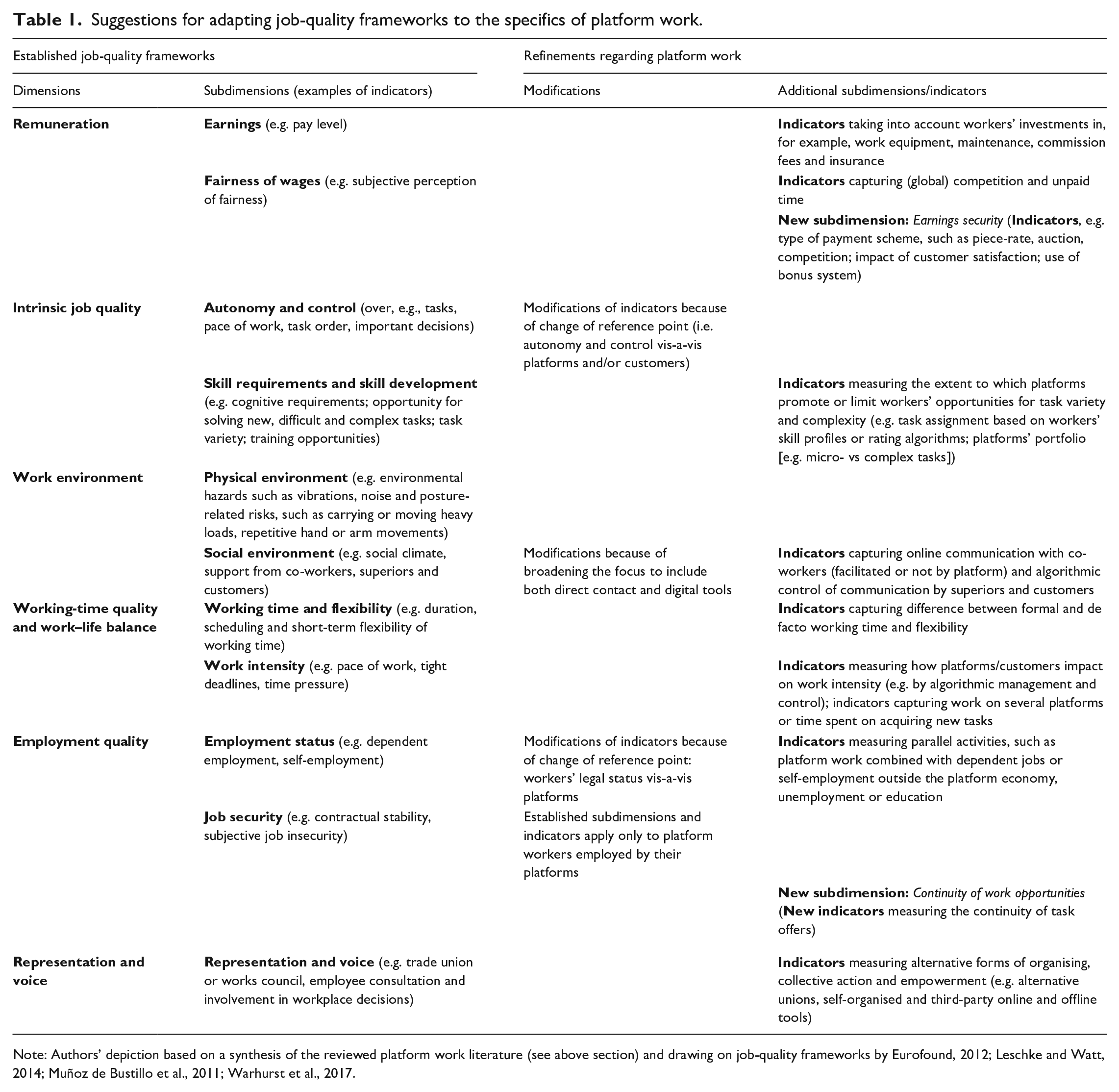
Note: Authors’ depiction based on a synthesis of the reviewed platform work literature (see above section) and drawing on job-quality frameworks by Eurofound, 2012; Leschke and Watt, 2014; Muñoz de Bustillo et al., 2011; Warhurst et al., 2017.
Remuneration, as one of the most basic dimensions of job quality, is commonly also in focus in studies on platform work. Established subdimensions such as earnings and fairness of wages are certainly applicable to platform work (Table 1). For assessing platform workers’ earnings, it is important to also take workers’ investment in things such as work equipment, maintenance, commission fees and insurance into account (e.g. Berg and Johnston, 2019; Gregory, 2021). Fairness of wages appears to be a particularly relevant aspect in the context of platform work. Depending on the specific research context, it might require new indicators capturing issues such as global competition in remote micro platform work, with workers in low-income countries underbidding competitors from high-income countries (e.g. Wood and Lehdonvirta, 2021), but also unpaid time resulting from searching for tasks on remote platforms (e.g. Berg, 2016) or from waiting for customers on local platforms (e.g. Berg and Johnston, 2019; Veen et al., 2020). One could also envisage a new subdimension capturing earnings security, which could take into account type of payment scheme (e.g. piece-rate, auction, competition), impact of customer satisfaction on payment (e.g. Bergvall-Kåreborn and Howcroft, 2014; De Stefano and Aloisi, 2018) and/or the use of bonus systems (ILO, 2021; Piasna et al., 2022).
Intrinsic job quality refers to the extent to which a job provides employees with the opportunity to use their competences in a self-determined way and to acquire new skills and qualifications. Its subdimension autonomy and control is a highly relevant and often-researched aspect also in the platform literature. What differs is the reference point against which autonomy needs to be assessed. In job-quality research, the issue is how much autonomy and discretion employees have vis-a-vis employers. Platform workers’ autonomy (e.g, over the time, place and pace of work) can be promoted or restrained by the organisational features and technologies of the platforms, including monitoring through algorithmic management or by customers’ requirements (e.g. Goods et al., 2019; Howcroft and Bergvall-Kåreborn, 2019; Veen et al., 2020; Wood et al., 2019). This necessitates modifications to the indicators to be used in studies on platform work.
The subdimension skill requirements and skill development strongly affects workers’ future labour market chances. The established indicators appear to be not entirely appropriate in the context of platform work. They are based on the assumption that skill requirements and opportunities for development are primarily set by the employer and the job. However, platform workers can influence the complexity, variety or cognitive demands of their work to some degree by picking specific platforms or tasks. Indicators tailored to platform work would need to focus on the way in which platforms promote or limit workers’ experience of task variety and complexity (e.g. Wood et al., 2019). Potential mechanisms include platforms’ task portfolios (e.g. micro- vs macrotasks) and the way they assign tasks to workers, whether according to skill profiles or past performance captured among others via rating systems based on customers’ satisfaction.
The dimension work environment traditionally captures physical environment (such as environmental hazards and posture-related risks) and social environment. Whereas the former subdimension can be applied relatively unchanged to certain kinds of platform work (see e.g. Gregory, 2021, for on-demand food couriers), addressing the latter requires an expansion of the focus from direct contacts with co-workers and superiors to digital tools. This implies the necessity to develop additional indicators that capture different means and forms of digital communication alongside physical social contacts, including online groups provided and controlled by platforms, as well as worker-organised online communities for mutual advice and motivation (Lehdonvirta, 2018; Panteli et al., 2020; Wood et al., 2018). Moreover, it seems essential that these indicators also acknowledge the role of performance monitoring and customer rating in the form of algorithmic management in shaping the relationship between platform workers, platforms and customers (see e.g. Heiland, 2022; Veen et al., 2020; Wood et al., 2018).
Further refinements are required with respect to working-time quality and work–life balance. A preference for working-time flexibility is an important motive for performing platform work (e.g. Goods et al., 2019). Unlike traditional employers, labour platforms do not necessarily impose working-time arrangements, not least because they often do not formally act as employers. However, even in the absence of formal requirements, there can be de facto constraints on when and how long to work (e.g. Berg and Johnston, 2019; Lehdonvirta, 2018; Wood et al., 2019). In the case of local platforms, working hours are largely determined by customers’ preferences. While flexibility tends to be higher for remote platform work, working time can still be affected by practical issues, including deadlines imposed by customers, the need to synchronise one’s schedule with that of customers and the necessity to work on several platforms in parallel to make ends meet. In job-quality research, working-time arrangements have been measured by indicators such as contractual and actual working hours. In platform work studies, it seems even more important to develop indicators that distinguish formal from de facto ‘working time and flexibility’. The established indicators capturing the subdimension work intensity would, by and large, be applicable to the context of platform work. They should, however, be supplemented by additional indicators that measure whether platforms and/or customers affect work intensity, such as through algorithmic management and control. Additional indicators could also capture parallel work on several platforms and (unpaid) time spent on acquiring new tasks, both issues that are likely to affect work intensity.
The dimension employment quality traditionally captures employment status (e.g. dependent vs self-employment) and job security (e.g. contractual stability). Employment status seems to be a particularly important issue for platform workers. The frequent status as independent contractor – which impacts several other job-quality dimensions – is disputed, as exemplified by legal cases and the focus of the proposed EU directive on working conditions in platform work. Given that platform work is often carried out as a side job in addition to employment outside the platform economy, modified indicators need to explicitly focus on platforms (instead of employers) as the reference point. Moreover, it would be important to explicitly capture parallel activities such as education or unemployment. While job security can be assessed by established indicators in the cases where platform workers are employed by their platforms, for the majority of workers it would seem more appropriate to assess the continuity of work opportunities as a new subdimension. This would require indicators that measure the continuity of task offers. On a given platform, this depends on how the platforms’ task allocation system interacts with worker behaviour. On many platforms, for example, the number and kind of tasks offered to workers is contingent on their past performance or customer ratings (e.g. Bergvall-Kåreborn and Howcroft, 2014; Wood et al., 2019). In this context, it is crucial to record whether workers are registered with one or several platforms, as this also affects their overall access to work opportunities.
The dimension representation and voice traditionally captures trade union or works council representation, employee consultation and involvement in workplace decisions. While traditional unions increasingly organise platform workers, as highlighted by recent examples of the negotiation of collective agreements for platform workers, platform work research also requires new indicators measuring alternative forms of organising and empowerment (e.g. Tassinari and Maccarrone 2020; Wood et al., 2018). Examples are alternative and grassroots unions in food delivery (Vandaele et al., 2019) and worker-run online fora that – beyond their social environment function of resource and information sharing – can also be used as a basis for collective action (Panteli et al., 2020; Tassinari and Maccarrone, 2020). Voice through empowerment also arises through third-party tools such as Turkopticon, which is used by MTurk workers to review customers along criteria such as pay, payment speed, fairness of evaluation and communication (Silberman and Irani, 2016).
A reflection on the plausibility of the proposed refined job-quality framework with reference to platform-based food delivery
An empirical application of a refined job-quality framework is beyond the scope of our study, which focuses on a conceptual proposal for the assessment of working conditions in platform work. As stated above, the exact implementation of dimensions and indicators depends on the specific research interest and the type of platform work under study. In the following, we use evidence from a research project to reflect on the plausibility of our conceptual considerations for future applications in this area. The data have been collected as part of a study scrutinising the EU Directive on Transparent and Predictable Working Conditions with reference to platform-based food delivery in Denmark, Germany, France, the Netherlands, Spain and Poland (Scheele et al., 2023). For exploring the applicability of our framework, an advantage of this study is that the data comprise both platforms that operate with independent contractors and platforms that employ their riders directly. While the study deals primarily with the job-quality dimensions remuneration, working-time quality, employment quality and representation and voice, some of the evidence also touches on autonomy and control and physical environment.
Overall, the data suggest that our refined job-quality framework with its proposed new subdimensions and additional indicators adequately captures the specific situation of riders in the European countries under study. To provide but two supporting examples here, the study points to a wide variety of payment systems used even within one specific platform type in a group of similar countries – with some payment systems compensating waiting times and others not – and thus confirms the necessity of the additional proposed subdimension under remuneration: earnings security. Similarly, the existence of various working-time arrangements, including regular and marginal part-time contracts, as well as no stipulated minimum or maximum hours where independent contractors or civil law contracts are used, makes it highly relevant to capture differences between formal and de facto working time as suggested in our framework under additional indicators for the dimension working-time quality.
However, as anticipated, the study also illustrates that further adaptations of our proposed framework are advisable for empirical analyses of specific types of platform work. Below we provide some examples to support this claim. In our refined job-quality framework we suggested that physical environment could be applied relatively unchanged. However, the data for this study highlight how some of the platforms provide monetary incentives for quick delivery (task-based pay and/or monetary bonuses as a function of speed of delivery), which can lead to risky behaviour and even traffic accidents. This would call for new specific items such as monetary incentives for risk taking to be included when measuring the physical risks people encounter in the workplace. On the representation and voice dimension the empirics show broad-based attempts of representation by both riders’ collectives and traditional unions independently of whether the riders are employees or independent contractors. In several countries there was also an inclusion of riders’ collectives into traditional union structures. Thus, in studies on food delivery platforms, indicators with a simultaneous focus on both traditional and alternative forms of organising and how they intersect would be pertinent.
In accordance with our review of the literature, the empirics on the food delivery sector confirm that algorithmic management also plays a fundamental role in autonomy and control, including through the use of bonus systems linked to speed and/or work performed during peak hours. While indicators capturing this particular aspect might not be applicable across all types of platform work and are hence not included in our refined framework, they are likely to play an important role in research on food delivery platform work. As regards the social environment dimension, the study by Scheele et al. (2023) again confirms the importance of algorithmic management and highlights that its implications go beyond controlling communication as indicated in our framework. For example, customer rating systems can also impact the social climate by triggering competition between co-workers. Similarly, job security can be directly affected by algorithmic management when rating systems impact access to future delivery tasks. While it is presumably also a relevant aspect in other types of platform work, the evidence on food delivery platforms highlights that, given the opaque nature of algorithms and the untransparent information, it could prove difficult to capture this aspect in a coherent and useful manner, particularly in quantitative studies.
Conclusion
In the sociological and industrial relations literature on platform work, working conditions are often assessed according to criteria similar to those applied to jobs outside the gig economy. However, research on platform work and the more general literature on job quality have rarely been related to each other explicitly. We contend that a stronger connection between these two areas of research would be beneficial for future research.
Against this background, our article has made a first attempt to render the established job-quality frameworks commonly used to assess working conditions in traditional jobs more sensitive to platform work. Such an approach provides important advantages but also faces a number of challenges, including the common classification of platform workers as independent contractors – with self-employment not usually in the focus of job-quality frameworks – as well as the necessity to account for the impact of algorithmic management. However, as our study emphasises, these challenges can be overcome.
While the main dimensions of job quality identified in existing frameworks also apply to platform work, it seems necessary to complement and replace some indicators in existing subdimensions and in other cases to add new subdimensions. Our suggestions for modification do not constitute a readymade analytical scheme. Rather, they are intended as an inspiration for future empirical applications, as the choice and design of specific indicators depend on several factors, including the type of platform work in focus and the specific research questions. Thus, the framework presented here is best understood as a moving target that will need to be continually refined based on findings from future case studies and surveys on the working conditions of platform workers.
Assessing the quality of working conditions according to an analytical framework carries a number of advantages. First, the existing case study findings on working conditions in platform work are abundant but – owing to the heterogeneity of forms and contexts of platform work – the evidence is also complex. In this regard, our framework might help contextualise and systematise case studies on single aspects of job quality while enabling easier identification of research gaps. Second, the framework could provide a starting point for hitherto sparse representative quantitative data collections on working conditions in platform work. Large-scale representative surveys can complement existing evidence on the major risks associated with platform work by identifying their relative importance in different contexts and thus promote the development of targeted policy measures. Third, analysing platform work through a job-quality lens may also allow researchers and policy makers to obtain a more structured view of commonalities and differences between platform work, on the one hand, and regular dependent employment as well as different types of non-standard work (e.g. freelancing and temporary agency employment), on the other. Finally, our framework could also inspire theory development on the interface of platform work and working conditions.
From a policy perspective, systematic, comprehensive and representative empirical evidence on working conditions in platform work is a fundamental requirement for improving job quality in the gig economy. Both binding and voluntary regulatory initiatives are currently high on the agenda, as evidenced by numerous local, national, supranational and global initiatives. For example, the Fairwork Foundation (Graham et al., 2020) evaluates and benchmarks individual labour platforms in selected countries worldwide against standards of decent working conditions (fair pay, conditions, contracts, management and representation) and works closely with various stakeholders to improve the working conditions on the ground. Moreover, at the EU level the European Parliament and the Council at the time of writing are negotiating a proposal for a directive on improving working conditions in platform work (European Commission, 2021). The proposal focuses on, among other issues, worker status misclassification, as well as fairness, transparency and accountability in algorithmic management. Ultimately, the aim of improving working conditions in platform work based on multidimensional job-quality indicators is very much in line with recent approaches to developing a comprehensive set of enforceable minimum standards for work and employment in general (Warhurst and Knox, 2022).
Footnotes
Declaration of conflicting interests
The authors declared no potential conflicts of interest with respect to the research, authorship, and/or publication of this article.
Funding
Janine Leschke received funding from EUSOCIALCIT – The Future of European Social Citizenship (870978).
