



Abstract
Using interview and survey data, in this article the authors compare discrepancies between emic (how union members classify their union participation) and etic (how researchers classify union participation) conceptualizations of union participation. Interview data were used to create activity-level profiles that link how study participants labelled their level of union participation to the union activities they participated in. Survey data were used to determine the relationship between type of participation (i.e. active, passive) and generational cohort to how members view their level of union participation. Qualitative and quantitative findings are compared and implications drawn concerning how researchers/practitioners should conceptualize the union participation construct offered.
Unions and union researchers have worked towards understanding and reversing the decades-long decline of union power, which has spread across market-driven neoliberal nations (Murray, 2017). While the debate continues over the merits of the differing strategies unions can use to rebuild and revitalize the labour movement, many agree that increased member participation is essential to the success of renewal initiatives (Gall and Fiorito, 2012a; Hickey et al., 2010). Union participation has been defined as ‘the behavioral involvement of members in the operation and activities of the union’ (Redman and Snape, 2004: 847). There is general agreement that union participation (also known as ‘activism’ or ‘union citizenship behaviour’) is inexorably linked to unions’ ability to survive, grow and affect change. There is, however, less agreement within the union literature on how this construct should be theorized and operationalized (Fiorito et al., 2015).
This lack of definitional clarity has resulted in inconsistencies in the reporting of union participation/union activism within the union literature (Fiorito et al., 2015). For example, Hart Research Associates (2003) report activism levels at upwards of 50%, while estimates provided by Nissen (1998) are much lower (i.e. about 2%) (Fiorito et al., 2015). These discrepancies stem from different understandings of the term ‘activism’ and show the need to reassess what we understand as active union participation. Also problematic is the fact that most studies of union participation take a quantitative, researcher-driven (etic) approach, which is pre-eminent in the construct’s development and interpretation. The relative lack of qualitative research in this area means that researchers and practitioners are less aware of how union members themselves intellectualize the idea of participation and how this translates into action (Fiorito et al., 2015). This article addresses this gap in our understanding by using emic research methodologies to better understand how union members themselves conceptualize union participation.
Our understanding of how best to measure and intellectualize union participation is further challenged by the likelihood that how one interprets ‘active’ participation may differ across generational cohorts. Findings from recent union renewal research, which show that pro-union attitudes (Hennebert et al., 2021), participation in union activities (Hennebert et al., 2021), work centrality (Lyons et al., 2015) and adherence to the so-called ‘Protestant work ethic’ (i.e. the view that it is a person’s duty to achieve success through hard work) (Lyons et al., 2015) are positively related to the age of the generation, provide support for the idea that union members’ participation and the way they process this participation cognitively could be related to their generational cohort.
To address these gaps in our understanding of the union participation construct, our research seeks answers to the following two questions: (1) to what extent is there a discrepancy between how union members and researchers understand and classify members’ level of union participation? (2) to what extent is this discrepancy affected by generational cohort? Our mixed-methods emic/etic study of the union participation construct builds on and extends Fiorito et al.’s (2015) quantitative exploration of this construct. We began our investigation by undertaking research that uses an emic approach, interviewing 100 members of a union based in the USA and asking them to tell us: (1) how they would classify their level of union participation, and (2) to then describe what union activities they typically participate in. We then did a second study, which used an etic approach and followed the methodology described by Fiorito et al. (2015). These two studies provided us with the emic and etic data needed to answer the research questions guiding this study and to better understand how union members intellectualize union participation and to what extent that perspective resembles or differs from researchers’ understanding of the construct.
The research studies presented in this article contribute to labour management theory and practice. By combining emic and etic perspectives and examining the possibility that generational cohort may impact union-related outcomes we provide researchers with insights into how best to conceptualize and assess union member participation. Our findings could also help unions to understand the way their members think about and picture their own participation, which could be useful in mobilization efforts.
Literature review
Our studies are grounded in the union participation and generational cohort literatures. We begin with an overview of the research in these two domains that helped inspire and frame our research. We begin with a discussion of the evolution of the conceptualization of union participation construct within the literature. This is followed by a summary of relevant concepts from the generational cohort literature.
The union participation construct
Union participation is a complex and dynamic concept with a variety of drivers and motivators, and a similarly large number of ways it can manifest itself. Researchers have taken a range of methodological approaches to quantify and measure union participation over time. Early studies of union participation typically assessed members’ activity using a unidimensional measure of the construct (McShane, 1986). This approach quantifies union participation with a general question and a single data point such as ‘how would you rate your level of union participation?’ More recently, researchers (see Fiorito et al., 2015; Redman and Snape, 2004) have, for theoretical and methodological reasons, employed more complex approaches to its conceptualization. Anderson (1979), for example, aggregated multiple items into a single score, while Fiorito et al. (2015) performed post-facto factor analyses to identify different dimensions. While there is no consensus on how this construct should be operationalized (Tripti and Ginni, 2015), the view that a more complex conceptualization of union participation based on the union member’s level of activity (i.e. ‘active’ versus ‘passive’ participation) is warranted is widely held (Sadler, 2012). Studies operationalizing the construct in this manner (e.g. Sadler, 2012) tend to include a list of items which are then factor analysed into different dimensions. ‘Active’ forms of participation are typically conceptualized as those requiring more effort and commitment from the union member (e.g. holding a position in the local office, pursuing grievances, serving on committees) than those activities typifying passive participation (e.g. reading the union newsletter, discussing union issues with colleagues) (Gall and Fiorito, 2012a).
The second study presented in this article replicates Fiorito et al.’s (2015) reassessment of the union participation construct. Fiorito et al. (2015) surveyed a sample of union members. Included in the survey were questions that allowed the researchers to quantify union participation and a question that asked union members to self-classify their level of activity using one of four labels: very active, active, somewhat active and not active at all. They then compared union members’ self-reported level of participation to their reported involvement in various union activities to test convergent validity. They found that participation in ‘active’ types of activities generally led to ‘very active’ self-classifications among the union members they surveyed. The outcomes associated with participation in ‘passive’ types of activities were, however, less uniform. Nevertheless, their results generally reflected congruence between the participants’ and the literature’s conceptualization of active and passive participation.
Fiorito et al.’s (2015) survey study provides support for the following ideas: (1) ‘union activism is not all of a piece . . . attending union meetings and reading union emails are a very different experience time-wise, skill-wise and stress wise than handling grievances, recruiting new members and bargaining a contract’ (p. 575); and (2) the determinants of participation likely vary depending on the form of participation being considered. Their findings also identified some degree of congruence between the researcher and union members’ conceptualization of activism. The authors concluded their paper by presenting areas that would benefit from future research. Of relevance to this current study is their recommendation that researchers seek to better understand what factors impact active union participation. We respond to this recommendation by exploring the impact of generational cohort (an indicator of social change) on union members’ perception of the union participation construct, a decision that is supported by research done by Bailey et al. (2010).
Generational differences, union renewal and union participation
A growing body of research has identified the importance to union renewal of engaging and activating the younger generations of workers (unionized or non-union alike), who to this point have been under-mobilized and underappreciated by the union movement (Aleks et al., 2021; Hennebert et al., 2021). Evidence shows that economic, political and social changes over time, in combination with factors internal to unions, have contributed to a reduction in union participation in subsequent generations of younger workers (Murray, 2017). These changes over time and the concomitant declines in union membership suggest that generational theory, which argues that (1) people born into the same historical, cultural and geographic context share and internalize formative experiences in a similar way, and (2) that shared experiences inform the way that people view and react to the world around them (Mannheim, 1952), might explain individual differences in how union members think about union participation.
In this article, we argue that, because each of the generational cohorts involved in the labour market when this study was done (Boomers, Gen X, Millennials) were exposed to quite different economic, political, social and labour environments, it is possible that their overarching understanding of and attitudes towards unions will vary by generational cohort membership. Support for this contention comes from a study of Scottish coal miners done by Phillips (2017), which demonstrated how the foundational experiences and circumstances of three groups of miners influenced the goals of three different generations of workers: (1) the ‘Village Pits’, who succeeded in nationalizing the previously privately owned industry; (2) the ‘New Mines’, who fought for and won a more democratic workplace in a time where miners felt they had no voice; and (3) the ‘Cosmopolitan Collieries’, who strove to maintain previous cohorts’ gains in the face of a wave of neoliberal reform.
The first cohort of concern to our study – the Baby Boomers (born 1946–1964) – are the oldest currently active cohort in North America. They entered the workforce at a time when the institutional environment was more hospitable to unions – by the late 1960s union density was still near its peak (about 30% compared to 13% today) (BLS, 2022) – while the number of strikes of over 1000 workers per year peaked in 1970 at just under 400 (BLS, 2022). While the union movement showed signs of hope through the early 1970s, with a new cohort of committed and active unionists from a variety of backgrounds pushing back in the workplace and on the picket and protest lines, there was also cause for pessimism (Cowie, 2010). External threats, such as a rightward political push from the likes of President Nixon and his compatriots, meant a growth in anti-union sentiment and policy, while social and political divides helped fracture the labour movement itself even further (Cowie, 2010). At the same time, the labour movement got in its own way as the old guard was unwilling to accept and embrace the new wave of militant unionists and refused to adequately broaden its scope beyond its traditional parameters (whether racial, industrial, or otherwise) (Cowie, 2010).
The 1980s saw continued erosion of environmental support for unions as the new decade brought with it the Reagan era’s anti-unionism (Cowie, 2010). The anti-union sentiment which would define the era in which Gen Xers (born 1965–1979) were socialized to unions was exemplified by the Republican president’s decision to fire 10,000 striking air traffic controllers. Key indicators provided evidence of a decline in union power and solidarity over this decade. Union density continued its decline from about 22% in 1980 to 17% in 1990 (BLS, 2022), and strikes over 1000 workers also plummeted from about 200 in 1980 to under 50 in 1990 (BLS, 2022), indicating a decline in solidarity and union power.
By the time Millennials (born 1980–2000) entered the workforce, the dotcom bubble had burst, overturning the economy. Contract and part-time work was on the rise and manufacturing work had been long outsourced, negatively impacting key union strongholds (Clawson and Clawson, 2007). Meanwhile, the Bush government’s administration of the National Labor Relations Board helped erode the union movement’s institutional environment as they placed management-friendly representatives in key positions throughout the organization (Freeman, 2007). Over this time, a wave of ‘right to work legislation’ swept the nation, taking varying levels of effect in 28 states (BLS, 2022).
By 2005, union density had fallen to about 12%, and there were fewer than 25 strikes of over 1000 workers (BLS, 2022). Not only were external social factors pushing younger members out of unions, research shows that unions themselves had not done enough to engage and inspire younger members to become more involved with their union. Research by Dufour-Poirer and Laroche (2015), for example, reported that younger members felt they had no voice and no connection to the inner social networks of union power structures. Relatedly, inadequate socialization (Hennebert et al., 2021) and communication (Rivers and Truitt, 2014) processes had seemingly failed to engage younger workers in the union movement.
The outcome of these trends and the need to refocus on engaging younger (particularly Millennial and now Gen Z) workers in future research pertaining to union renewal are supported by research reporting generational differences in union outcomes. These studies have found that younger workers are less interested in unions (Aleks et al., 2021), participate less actively in the union movement (Cates, 2014), and have less of a connection to the history and philosophy of the union movement (Smith and Duxbury, 2019) than was observed previously.
In this study, we focus our attention on the relationship between generational cohort and how union members conceptualize and classify their own level of union participation. Specifically, we argue that generational differences in attitudes and experiences with the union could potentially impact their understanding of what constitutes ‘active’ union participation. Research supporting this argument is provided below.
Research in the area provides support for the idea that perceptions of what constitutes ‘hard work’ (and by extrapolation, participation in various union activities) vary with generational cohort. For example, data show that work centrality (i.e. the importance an individual assigns to work) and belief in the ‘Protestant work ethic’ have declined in over time, such that Boomers report higher levels of work centrality and adherence to the Protestant work ethic than those who are members of Generation X, who in turn report higher levels of both these attitudes than Millennials (Lyons et al., 2015). Accordingly, we expect that the likelihood that a union member will perceive that a particular union activity typifies active (versus passive) union participation will be negatively associated with the age of the cohort: such members who are Boomers (high work centrality and belief in the value of hard work) will be more likely to rate their contribution to the union more conservatively than will members who are Millennials, who can be expected to feel that performance of the same activities typifies more active participation.
Changes in union experience and attitudes might also have a similar effect. Research shows that affective commitment to organizations can impact motivation and effort (Luchak and Gellatly, 2007). This implies that the generational cohorts who are more committed to the union (i.e. Boomers) (Cates, 2014) might not perceive their contribution as overly taxing due to their affective attachment to the union. Similarly, those who were part of the union in times where the union was more active (i.e. Boomers) might evaluate their participation levels using quite a different benchmark than younger members who became members of a union more recently. For example, when the Boomers entered the workforce a higher percentage of employees were members of/and active in the union movement than was the case for the Millennials who entered the workforce at a time where union participation was in decline. These different experiences with the union could lead members of these two generations to have different norms and expectations around union participation and to use quite different baselines for assessing activity levels.
Methodology
We employ a mixed-methods (interviews, surveys) approach in our study, which investigates the extent to which emic (member-driven) and etic (researcher-driven) understandings of union participation converge. In Study One (the emic perspective), we conducted interviews to gain informants’ first-hand accounts of the union activities they participate in and how they would assess their level of participation. In Study Two (the etic perspective), we used a questionnaire to collect information on the union activities our respondents participated in along with an established measure of union participation. Before describing each study in more detail, we will introduce the case organization we studied in our research.
Case study
The data featured in our analysis were gathered as part of a four-year research programme undertaken with a large (approximately 40,000 workers) male-dominated ‘blue-collar’ transport industry union (referred to as ‘CaseUnion’ in this article) that operates throughout the continental USA. Members of CaseUnion perform a variety of jobs ranging from welding to heavy machinery operation. Members are often away from home as their job requires they travel across the country to maintain the transportation infrastructure on which their industry relies. CaseUnion is a closed-shop union meaning that employees must become union members upon their hiring and cannot opt out of union membership.
Our research partnership with CaseUnion began in the fall of 2010, as the union sought to improve the engagement and participation of members. CaseUnion has had first-hand experience with the issues we are studying. In fact, the study was motivated by the fact that the average age of their membership was 54 years of age and a significant proportion of their active members (and many in leadership positions) were nearing retirement and there was no clear cohort of active union members to replace them.
We used an action research methodology (Young, 2005) in which researchers and practitioners work together to diagnose, analyse and overcome organizational issues in our work with CaseUnion. The action research approach is particularly useful in emic research, as it involves those who have closest experience with the problem under study (Young, 2005). Our research was supported by a multigenerational research advisory board (RAB) made up of national division executives, vice chairs, local leaders and rank-and-file members. The RAB provided practical, context-specific expertise that helped us to determine our focus, interpret our results, and shape the next steps of our research. The research team was unpaid, but CaseUnion covered research and travel costs. Our partnership ended in 2015 after two rounds of interviews and surveys that led to the implementation of several pilot programmes aimed at improving communication and relationship building between the union and its members. This article focuses on two studies we undertook with CaseUnion to help them better understand how their members conceptualize union participation.
Study One: Emic study of union participation construct
We began our research with a qualitative study designed to find out how union members perceive their own level of union participation from an emic perspective. We conducted semi-structured interviews with a sample of 100 union members from across CaseUnion’s membership, asking informants questions relating to union participation, feelings about unions and unionism, and their satisfaction and relationship with CaseUnion. This article focuses on only those interview questions that relate to union participation.
The sample was identified as follows. CaseUnion notified its members via a letter that they might be contacted by the research team and asked to participate in an interview. The letter also included information about the project’s goals, the interview process and the benefits of the study to the union. After sending out the letter the union provided the research team with a list of members’ names and contact information, stratified by generational cohort. We contacted a random sample of potential participants within each generational cohort and asked if they would be willing to participate in a short (approximately one hour) interview. We conducted interviews using Skype’s phone function, which allowed us to contact participants on their phone without associated long distance charges. We used SkypeRecorder software to record the interviews.
Our final sample consisted of n = 35 Boomers (operationalized as respondents who were born between 1946 and 1964), n = 35 Gen X (operationalized as respondents who were born between 1965 and 1979) and n = 30 Millennials (operationalized as respondents who were born between 1980 and 2000). Participants lived in 32 states and worked in 42. Just over half (58%) worked a ‘typical’ 40 hour/5-day work week. The rest either worked compressed weeks that consisted of four 10-hour workdays (22%) or had variable schedules (11%). Participants worked an average of 44.5 hours per week in the month prior to the interview. Almost all our participants were male.
We analysed the interview data to identify key themes in our participants’ responses typifying different understandings of participation. We coded responses using the initial/focused coding process described by Charmaz (2006). The goal of initial coding is to identify and name themes found within each piece of data. The focused coding process followed in this study consisted of two steps: (1) theoretical coding, where theory is used to investigate any relationships between categories of responses, and (2) axial coding, which involves the analysis of factors found within categories identified in initial coding. We organized and analysed our qualitative data using QSR NVivo-10 software. A detailed explanation of our coding process can be found in Appendix 1. The results from our analysis of the four interview questions relevant to our analysis are provided in the sections below. Consistent with the recommendations of Hannah and Lautsch (2011) we use autonomous counting (i.e. produce numbers), which allows us to develop a summary of the entire data set that can be used to discern patterns in the data.
How would you label your level of participation in the union?
We began by asking respondents: ‘Which of the following labels best describes your involvement in the union? (a) Active, (b) Moderate activity, (c) Limited activity, and (d) Inactive?’ As shown in Figure 1, approximately one in three respondents (n = 37) described themselves as ‘active’, while one in four felt that their level of participation was either limited (n = 26) or moderate (n = 24). About one in 10 participants (n = 13) labelled themselves as inactive.
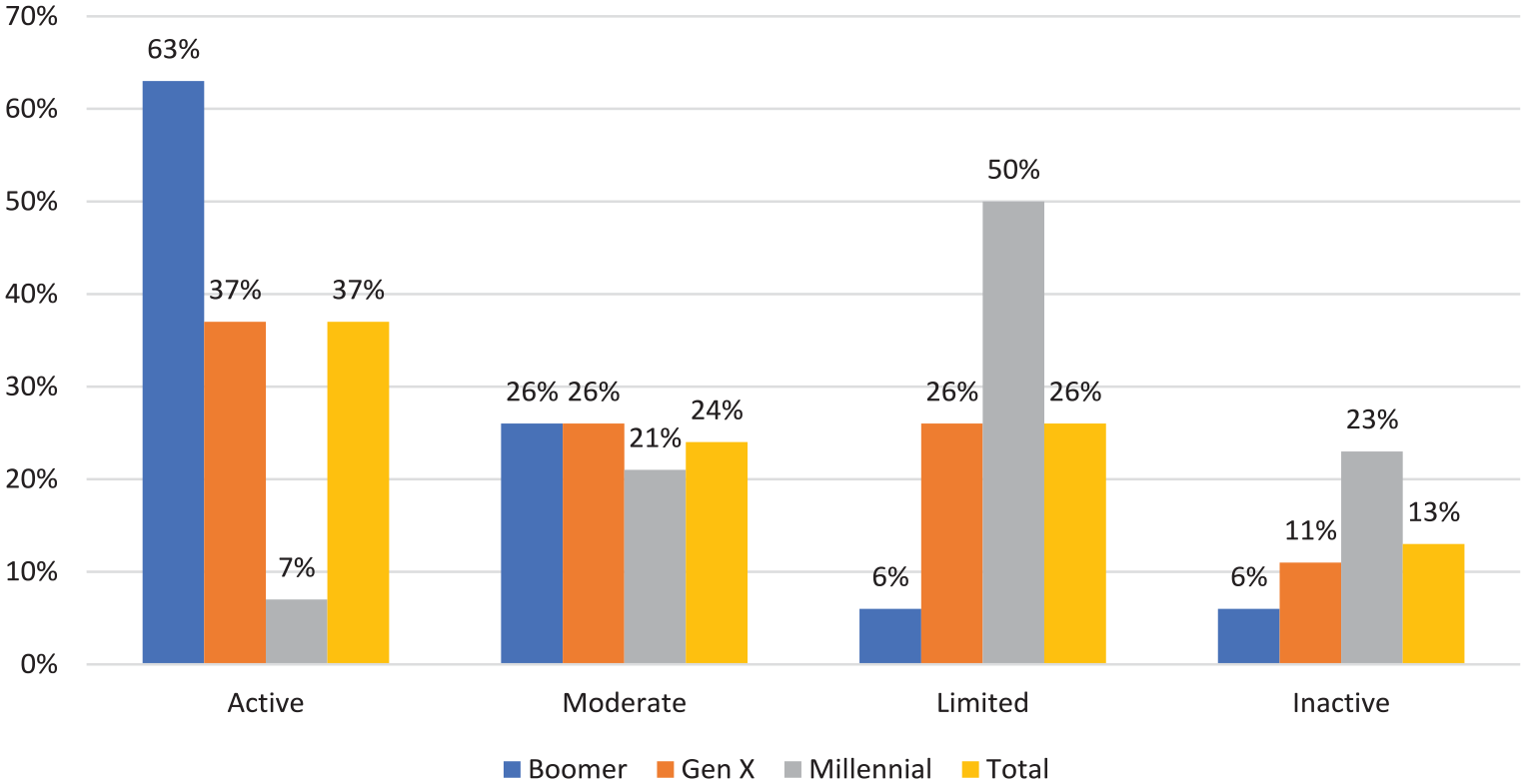
Activity level by generational cohort, interview data (N = 100).
The data in Figure 1 support a link between our informants’ self-classification of their union participation and generational cohort. Of note: (1) a greater proportion of Boomers (63%) than Gen Xers (37%) and Millennials (7%) used the ‘active’ label to describe their union participation; (2) a greater proportion of Millennials (50%) than Generation X (26%) and Boomers (6%) described their levels of union participation as limited; and (3) 7 of the Millennials (23% of the sample) stated that they were inactive in the union – more than double the number in either of the other two cohorts who described their participation this way.
What union activities do you typically participate in?
We then asked informants to describe the union activities that they typically engaged in over the past year. Initial coding resulted in the identification of 10 codes including a ‘no participation’ category. We used the active/passive conceptualization of union participation articulated by Gall and Fiorito (2012a, 2012b) to guide the theoretical coding process (as described in Appendix 1). The first focused theme includes descriptors of active participation, defined by Gall and Fiorito to include union activities that require a greater amount of commitment and effort on the member’s part. The second focused theme includes responses corresponding to passive participation, defined by Gall and Fiorito to include union activities that require less commitment and effort on the member’s part. Those who indicated that they did not participate in union activities and did not respond to this interview question are included in a third group. Table 1 features the results from this stage of our analysis along with sample quotes for each initial code.
Sample quotations: Types of active and passive participation.
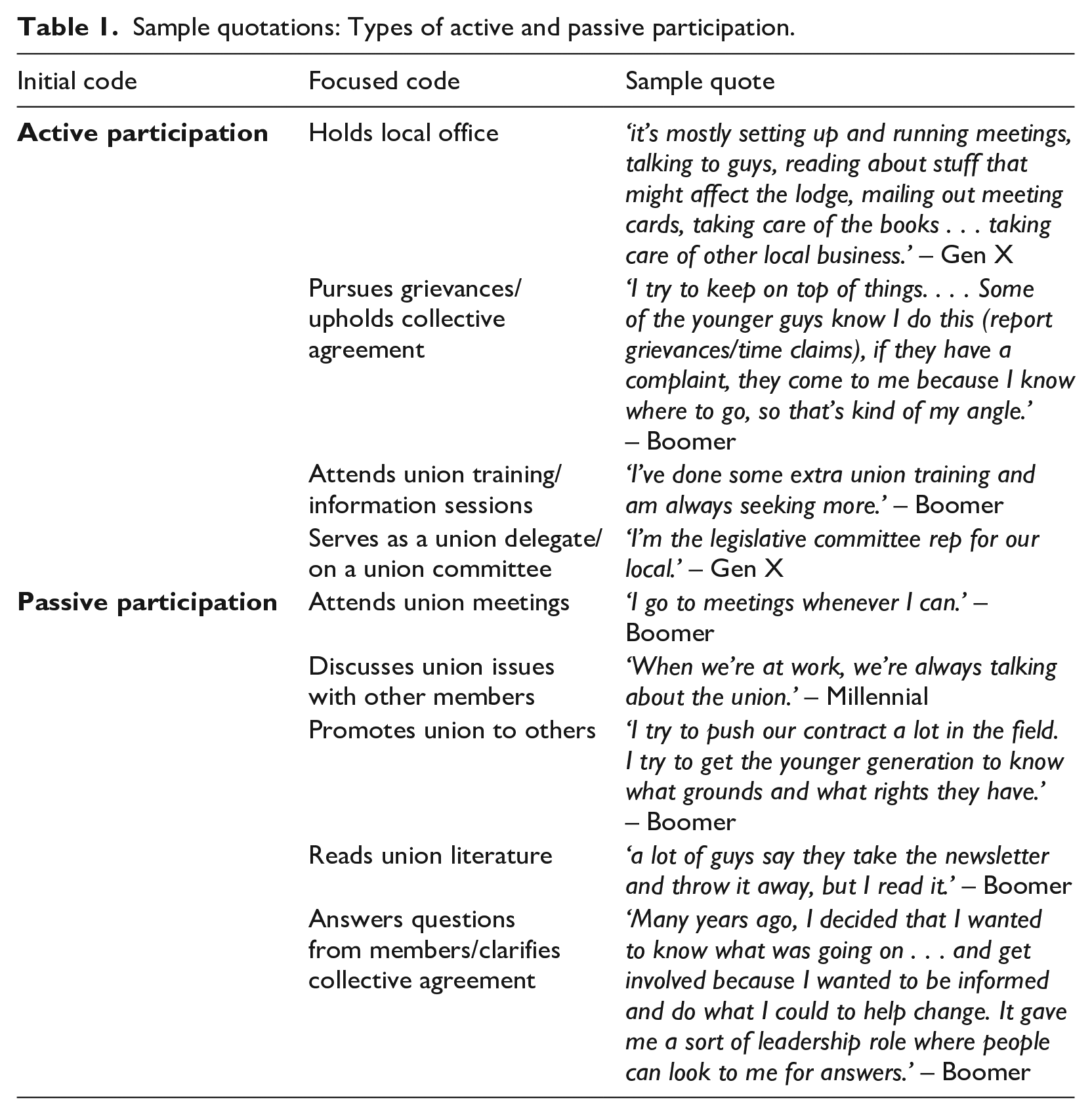
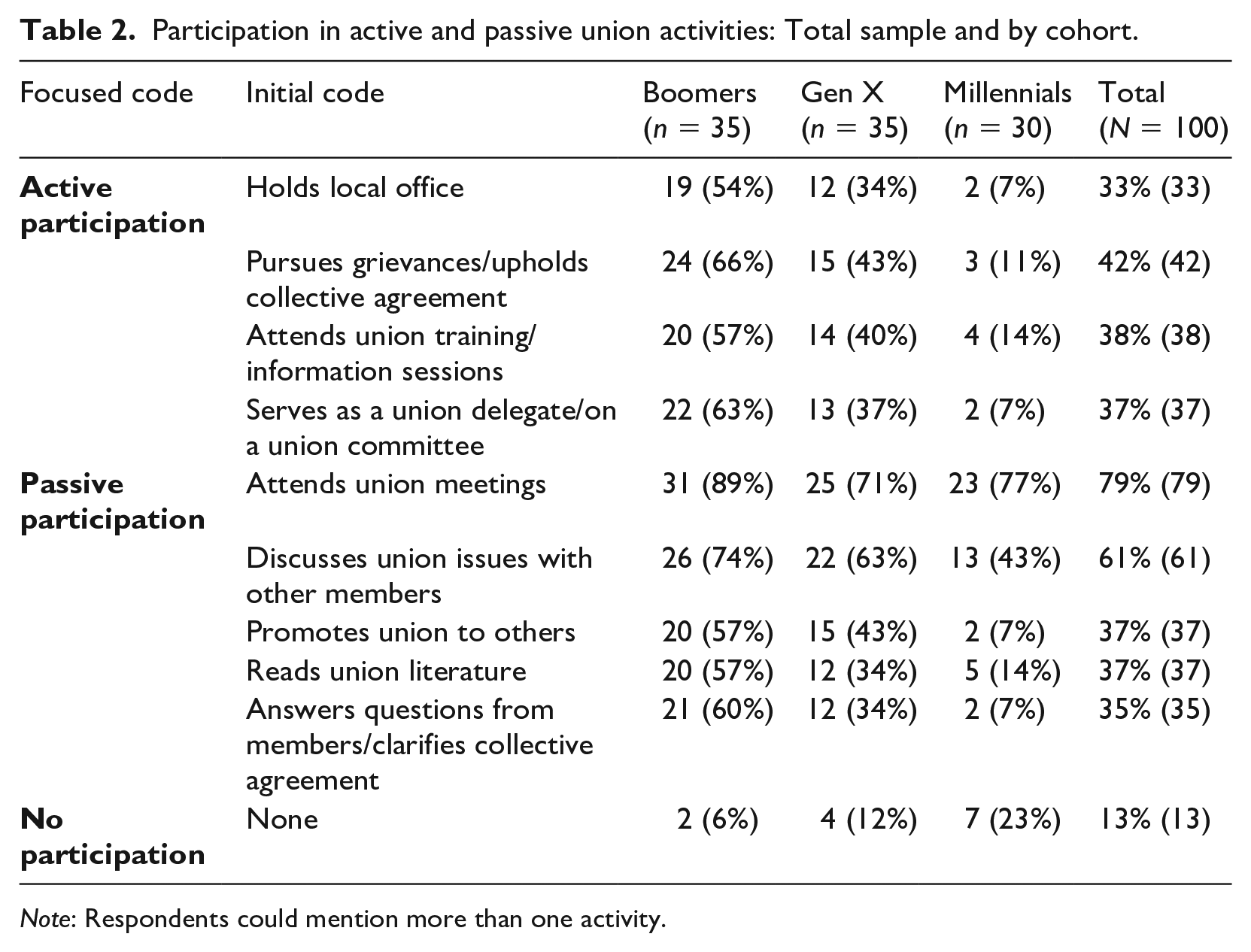
After creating the coding scheme, we did a validity check of our interpretation of the responses by sharing our findings with contacts at the union to see if we had identified the full range of union activities normally performed by CaseUnion members and if they agreed with our classification of these activities as active or passive. Our contacts from the RAB confirmed that, in their opinion, the list of activities we developed represented the full array of actions typically performed by their members and that our classification was consistent with their view of the amount of time and energy required by each of these types of activity. We then tallied the number of informants in the total sample and in each generational cohort mentioning each response. Table 2 features the results of this phase of our analysis.
Participation in active and passive union activities: Total sample and by cohort.
Note: Respondents could mention more than one activity.
Several observations can be made from these data. First, more informants described passive than active forms of participation. Second, the two most consistently mentioned forms of participation are passive – attending union meetings (79%) and discussing issues with other union members (61%). Third, the most commonly mentioned active form of participation (41%) involves activities relating to pursuing grievances and holding the company to the collective agreement. The rest of the activities identified in our analysis were cited by approximately one in three of the respondents.
The data in Table 2 also suggest a relationship between generational cohort and the types of union activities the informant identified. For example, the likelihood that an informant will mention any of the activities included within our active participation theme as well as four out of five of the activities included in the passive participation theme is negatively associated with the age of the cohort. In fact, the only union activity that was consistently mentioned by informants across the generational spectrum is union meetings (at least 70% of each generation). Finally, we note that informants in the Boomer cohort were the most likely and the Millennials the least likely to mention each of the activities describing union participation identified in this study.
Type of activity by participation level
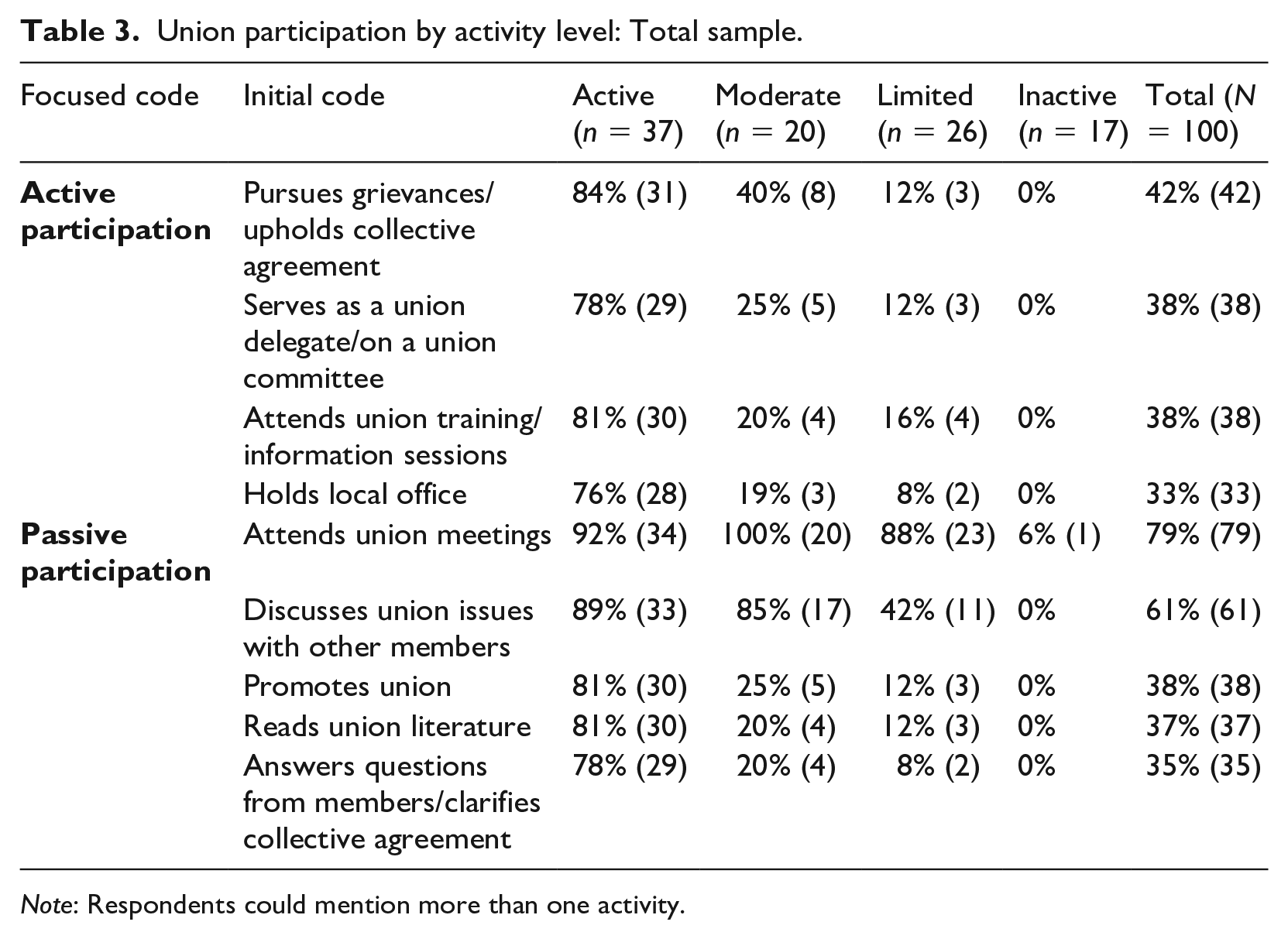
As a next step in our analysis we linked the informants’ self-assessments of their participation to the activities they stated that they engaged in. Results from this analysis are shown for the total sample in Table 3.
Union participation by activity level: Total sample.
Note: Respondents could mention more than one activity.
Several observations can be drawn from the data in Table 3. First, the data show a high degree of overlap between the active union participation construct as described in the literature and the activities informants who self-classified as active said they engaged in. When compared to the informants who self-classified their union participation as ‘limited’ or ‘moderate’ a higher number of the respondents who labelled themselves as actively participating in their union stated that they were an officer in their union, had engaged in activities associated with the collective agreement, had undertaken committee work and attended union training. Second, we note that informants who self-classified as active were, with two exceptions (attendance at meetings, discussion of union issues), more likely to mention participating in activities included within the passive participation theme than informants who self-classified their level of union participation as moderate and limited. Finally, it would appear from the data that one activity – discussing union issues with fellow members – seems to differentiate informants who feel that they are moderately active in the union from those who see their participation as limited.
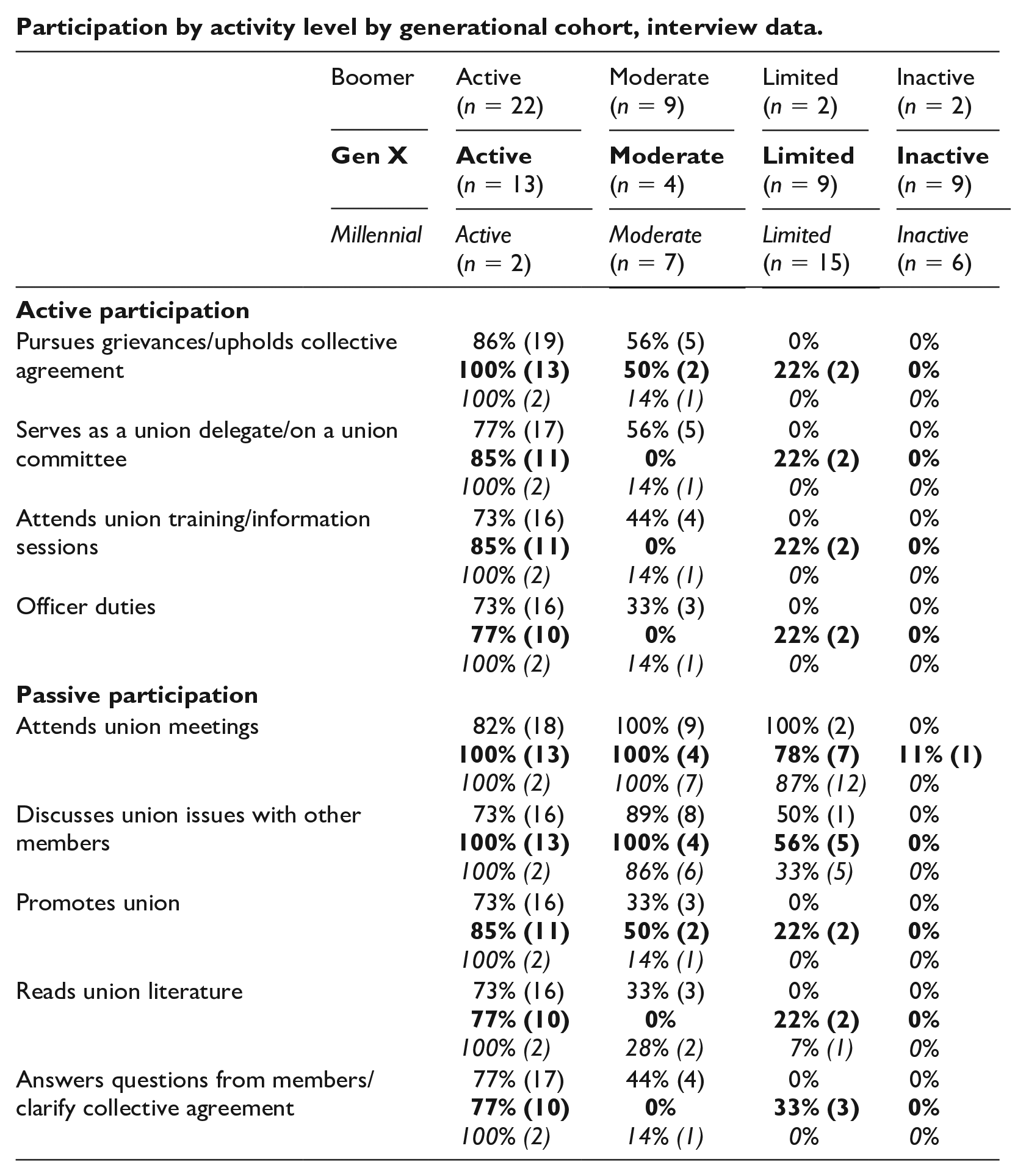
To explore the extent to which generational cohort influences the association union members make between the activities they engage in and how they self-classify their levels of union participation, we performed a cross-cohort analysis, the results of which can be found in Appendix 2. The following observations can be made by visually inspecting these data. First, there is a high degree of consensus within the sample on the sorts of activities that constitute active participation in the union. Virtually everyone we interviewed who served as a union officer, sat on a union committee, attended union training sessions and dealt with the collective agreement self-classified their level of participation using the descriptor ‘active’. Second, we note that Boomers were more likely than those in the Gen X and Millennial groups to classify their level of participation as moderate even though they engaged in activities that researchers (Fiorito et al., 2015) consider typical of active participation (i.e. serve as a union delegate, attend union training, take on officer duties). Boomers were also uniquely more likely to associate moderate levels of union participation with one of the activities classified in our analysis as representative of passive participation, e.g. answered questions from members about the collective agreement. Finally, we note that two of the Gen X informants classified their union participation as being limited even though they said that they engaged in several activities that researchers see as representing active and passive union participation. Our analysis of the emic data supports the following observation: there appears to be cohort-driven variation in the way that union members of different generations assess their own participation level, particularly around the conceptualization of moderate and limited levels of participation.
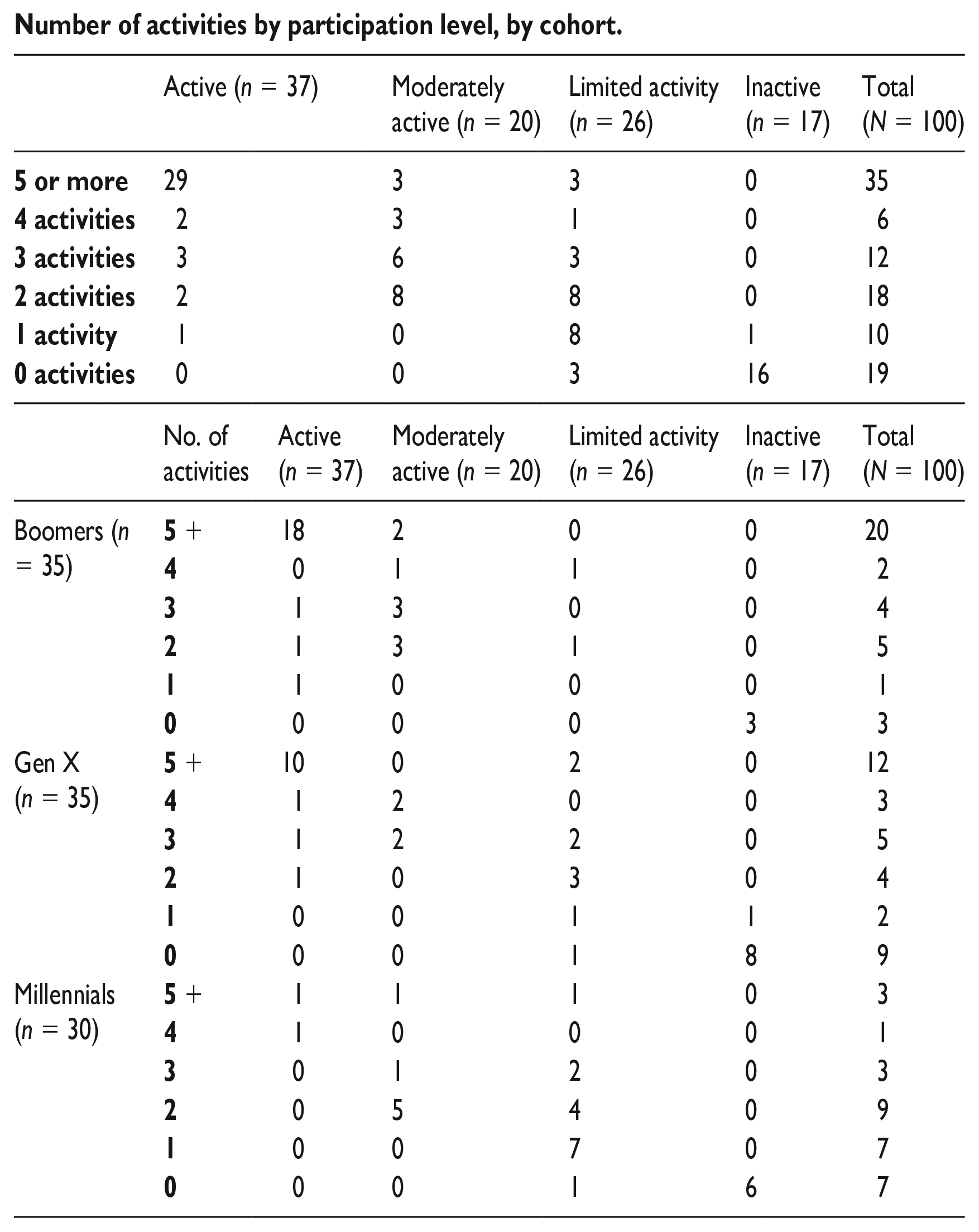
To explore the extent to which the number of activities members stated that they engaged in relates to how they self-assess their union participation we counted the number of discrete union activities each participant mentioned participating in during their interview. In Appendix 3 we show the number of activities engaged in by our informants classified by how they self-assessed their level of participation and by generational cohort. The following observations can be made by visually inspecting these data.
First the data imply that the more activities an individual participates in the greater the likelihood that they will self-classify their participation level at the active end of the continuum. Specifically, 80% of those who self-categorized as ‘Active’ mentioned performing five or more union activities; 70% of the informants in the ‘Moderate’ group described participating in two or three activities; 75% of those who described their participation in the union as ‘Limited’ identified participating in between 0 and 2 activities; and all but one of the 17 people who self-classified as ‘inactive’ stated that they did not engage in any union activities. These findings provide support for the idea that how a union member self-classifies their union participation has more to do with how many activities they engage in rather than simply the activities themselves. Second, the data also provide some support for the idea that how a member classifies their level of union participation is to some extent in the ‘eye of the beholder’. For example, 20% of those who self-classified their union participation as ‘Moderate’ engaged in five or more union activities while 25% of the informants who felt that their participation levels were ‘Limited’ indicated that they were involved in three to five activities. Finally, we note that the above observations are not associated with generational cohort.
Study Two: Quantitative analysis of survey data
Study Two was designed as a follow-up to our initial interview study. By building on Study One using a large sample and survey data, Study Two seeks answers to the following questions: (1) what is the relationship between how researchers operationalize union participation and how members self-classify their own union participation? and (2) how does generational cohort shape this relationship? The theoretical framework guiding Study Two is shown in Figure 2. Details on how this model was empirically tested are provided below.
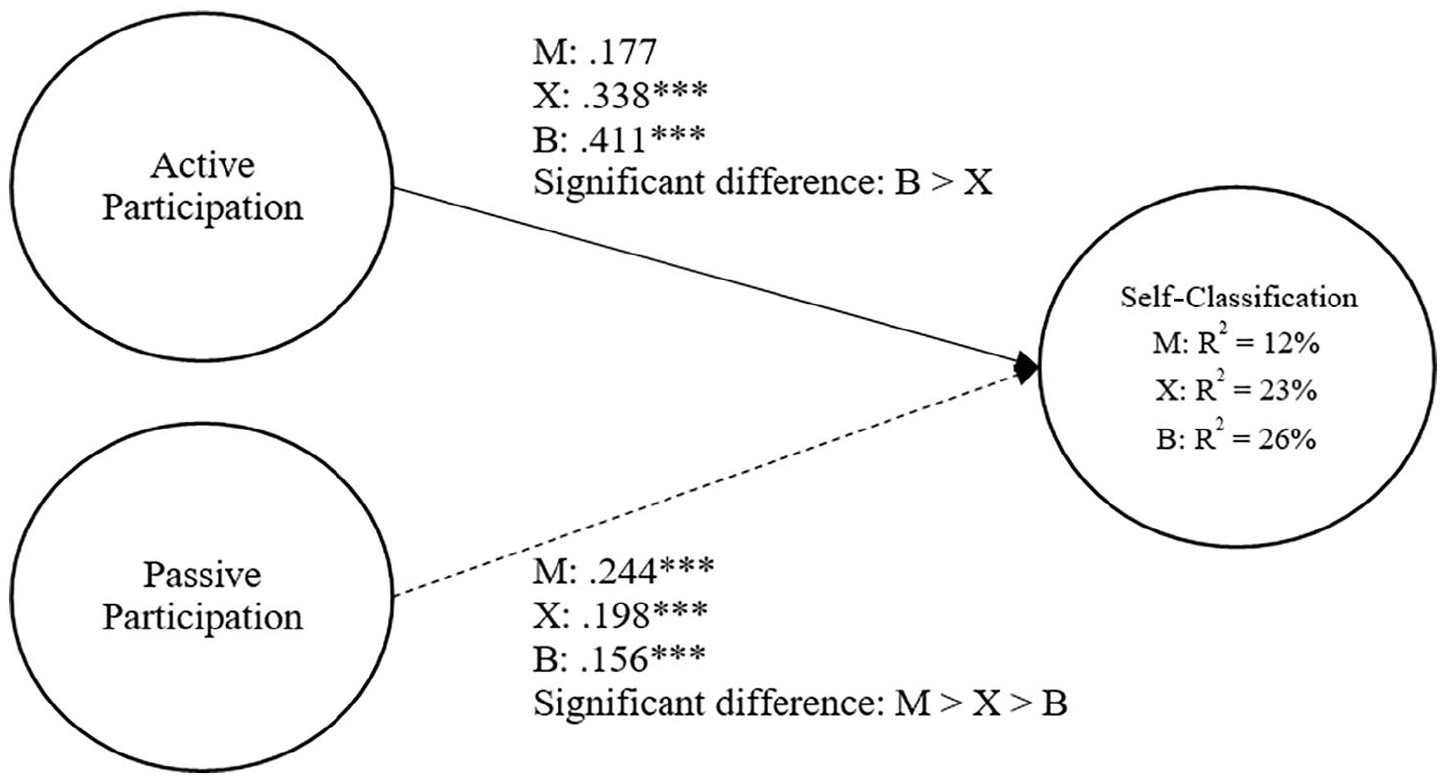
Structural model of self-classification of union participation.
Sample
We used a survey to collect the data analysed in Study Two. The survey was sent to all CaseUnion members, along with self-addressed and stamped envelopes to facilitate their return to the research team. National, regional and local leaders promoted the survey at union meetings and through informal interactions with members. Of the 40,000 surveys distributed, N = 4490 were returned to the research team, for a response rate of about 10%. A number of factors likely contributed to this response rate including the nature of the work performed by our participants (half the union’s membership works entirely out of state, while another fifth spends at least half of their work time away from their home state) and the fact that the union was lacking up to date contact information for approximately one in 10 of their members.
The demographics of this sample mirror that of the union. The sample consists of 99% men. Most respondents (61.6%) were Boomers (n = 2988). Just over one in four (26.9%) were in the Gen X cohort (n = 1209) and 6.5% were Millennials (n = 293). The age of the sample was similarly skewed as just over half (55.6%) of our respondents were 50 years of age or older, whereas only 6.5% were younger than 30. Tenure in the union has a bi-modal distribution with half (48.2%) of the sample reporting more than 25 years’ experience in the union and 30.1% reporting fewer than 10 years of experience in CaseUnion. Not surprisingly, 98% of the respondents in the Millennial sample have fewer than 10 years of experience with CaseUnion as compared to 61.9% of those in the Gen X cohort and 11% of those in the Boomer sample. Marital status varied with generational cohort (81% of those in the Boomer and Gen X cohorts were married as compared to 59% of the respondents in the Millennial sample) as did the percentage of the sample with children at home (48% of Millennials, 39% of Gen X and 28% of Boomers).
Measures
Self-classification
We used the methodology described in Fiorito et al. (2015) to quantify our dependent variable – how union members ‘self-classify’ their level of participation in the union. The survey question used to operationalize this construct asked respondents to choose from a list of the following four labels the one that best describes how they view their level of participation in the union: ‘I am a member of the union but
Active and passive participation
We quantified union participation using a two-factor active/passive union participation scale we developed and validated in an earlier study (Smith and Duxbury, 2019). The measure contains six items: (1) served on a committee, (2) attended a union-sponsored training session or educational seminar, (3) been involved in the settling of a grievance, (4) helped promote the union, (5) helped a new member learn about the union and (6) voted in union elections. A five-point Likert scale (Almost Always = 5; Sometimes = 3; Almost Never = 1) was used to collect responses. Items 1 to 3 measure active participation while items 4 to 6 quantify passive participation. Active and passive participation served as our independent variable.
Generational cohort
Generational cohort was operationalized in the same manner as was used in Study One.
Control variables
To minimize the likelihood that any generational-cohort differences in union participation observed in our analysis were due to the mathematical confounding of life cycle stage (i.e. ‘change in variable values which occurs among all cohorts independently of time period, as each cohort grows older’) (Bell and Jones, 2015), we controlled for marital status and parental status in our analysis. Marital status was quantified by asking individuals ‘What is your marital status?’ (1) single, (2) married or living with a significant other, (3) divorced and (4) widowed. We measured Childcare by asking members to indicate how many children they have. Similarly, to minimize the likelihood that generational differences in union participation are due to the mathematical confounding of work experience/time in the union (Fiorito et al., 2015; Fullagar et al., 2004), we controlled for two forms of tenure in our partial least squares (PLS) analysis: Years in union (measured by asking ‘How many years have you been a member of CaseUnion?’) and Years with current employer (operationalized by asking respondents ‘How long have you worked for your current employer?’) We did two checks on our data to ensure that multicollinearity between these final two controls was not an issue. We began by assessing the variance inflation factor (VIF) to ensure that the VIF was less than 5, as recommended by Hair et al. (2012). All VIFs were between 1 and 1.5. Second, we retested the model two additional times. In the first case we removed years in union and in the second case we removed years with current employer. Neither of the comparative models changed the significance of any pathway from what it was in our hypothesized model.
Data analysis
To study the relationship between how researchers operationalize union participation and how union members self-classify their participation, and the extent to which generational cohort influences this relationship, we used partial least squares structural equation modelling (SEM) software (SmartPLS 3.2.6) to test the model. We followed the procedure outlined by Hair et al. (2012) to conduct our analysis. While traditional SEM techniques (e.g. AMOS, LISREL) estimate model parameters and use indices to establish model fit, PLS ‘maximizes the explained variance of the endogenous latent variables by estimating partial model relationships in an iterative sequence of ordinary least squares (OLS) regressions’ (Hair et al., 2012: 415) and uses a coefficient of determination (R2) to represent the amount of explained variance of each endogenous latent variable. The complexity of the hypothesized model (i.e. three different samples, three factors) and the fact that PLS-SEM can almost unrestrictedly handle complex models (Hair et al., 2012) supports the use of PLS-SEM in this phase of the research.
Results
How do union members ‘self-classify’ their degree of participation in the union?
Responses to our question asking union members to self-classify their degree of participation in the union are shown in Table 4. Examination of these data indicates that the vast majority of our respondents (82.8%) self-classified themselves as being inactive in the union. Another one in 10 (10.2%) self-classified their participation as limited. Only 7% of respondents self-classified their participation as moderate (5.8%) or active (1.2%). The low number of informants who indicated that their participation in the union was ‘moderately active’ and/or ‘active’ required us to combine these two groups when further analysing our data.
Self-classification of union participation: Total sample and by generational cohort.
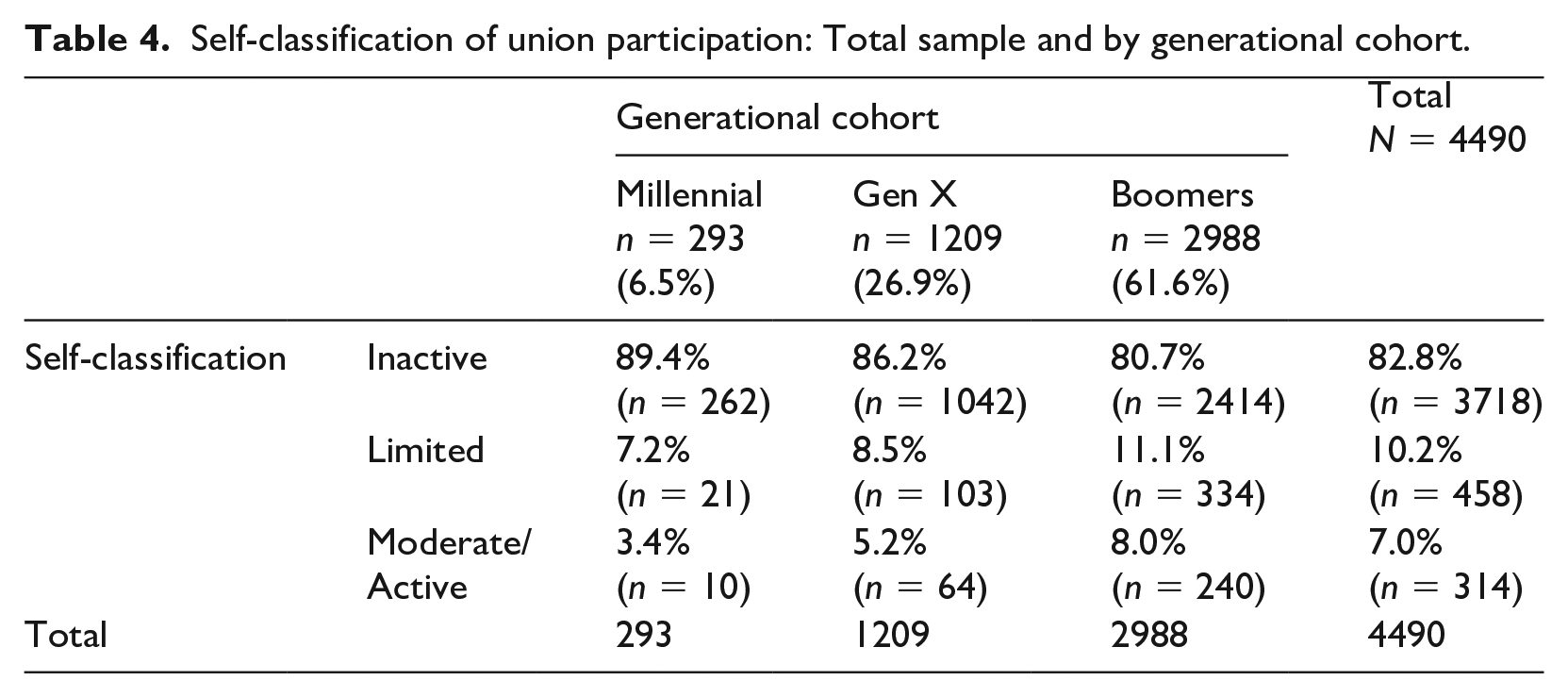
What is the relationship between generational cohort and union participation self-classification? To answer this question, we converted the ordinal self-classification variable into three dummy coded variables and using paired-sample t-tests with generation as the independent variable, and activity level as the dependent variable, we determined that, in comparison to Gen Xers, Boomers are less likely to self-classify their union participation as inactive (p < .001), and more likely to self-classify their union participation as limited (p < .05) and moderate/active (p < .01). Furthermore, in comparison to Gen Xers, Boomers are less likely to self-classify their union participation as inactive (p < .001), and more likely to self-classify their level of participation as moderate/active (p < .05).
Self-classification of union participation
We began this stage of our analysis by assessing the measurement model. This was done by examining factor loadings, Cronbach’s alpha, Fornell and Larcker’s measures of composite reliability, and average variance extracted (AVE) (Fornell and Larcker, 1981; Hair et al., 2012) for both active and passive participation measures for each cohort. Results from this analysis are shown in Table 5. Data for the Millennial cohort did not show support for the active participation construct, as the AVE was below .5 (i.e. .48), Cronbach’s alpha was below .7 (i.e. .61), and two of the three items loaded below .7 (i.e. ‘been involved in the settling of a grievance’ is .66, ‘served on a union committee’ is .66). As noted earlier, our analysis of the demographic data determined that those in the Millennial sample are younger, have fewer years’ tenure in the union, and are more likely to have children at home than are respondents in the other two cohorts. As such, we speculate our findings with respect to active participation reflect the fact that those in the Millennial cohort have either had fewer opportunities to engage in the activities typifying active participation and/or are less likely to be able to devote time to such activities at this stage of their life cycle.
Item loadings included in the measurement model.
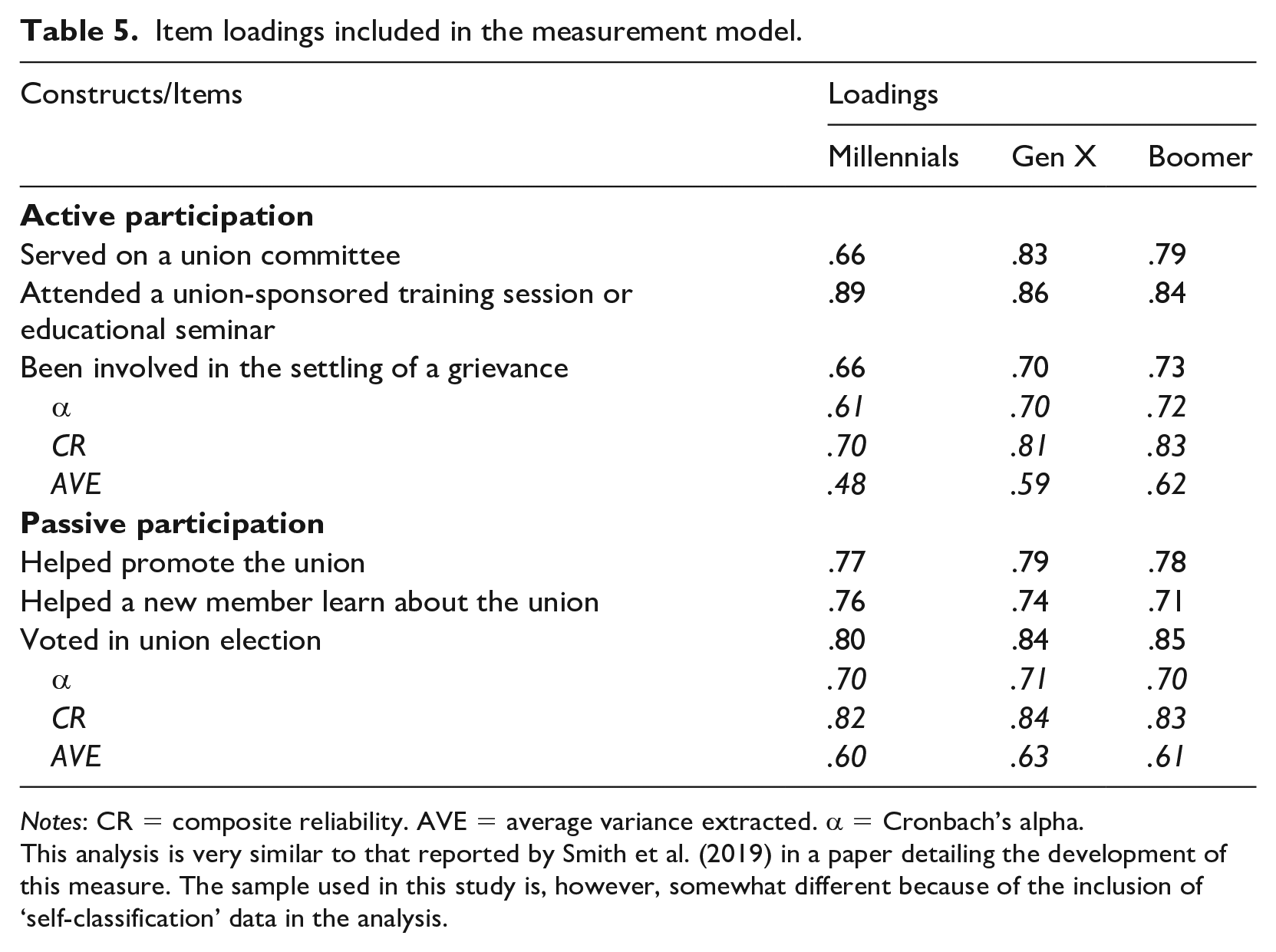
Notes: CR = composite reliability. AVE = average variance extracted. α = Cronbach’s alpha.
This analysis is very similar to that reported by Smith et al. (2019) in a paper detailing the development of this measure. The sample used in this study is, however, somewhat different because of the inclusion of ‘self-classification’ data in the analysis.
The remaining results were supportive of our measurement model: all scales achieved Cronbach’s above .7, Fornell and Larcker’s composite reliability above .81, and passed the test for convergent validity with values greater than .59. We elected to retain active participation in our measurement model, while acknowledging that the concept of active participation appears to have less relevance to younger union members.
Tables 6a and 6b show the means, standard deviations and correlations for study variables in our model for each of the three samples. There were two correlations above .5 (i.e. between active and passive participation for Boomer and Gen X samples). These highly correlated factors were not, however, a source of concern, as we did not theorize a relationship between them. The diagonal element of these correlation matrices is the square root of the AVE. The fact that for all constructs the square root of AVE is greater than the corresponding row and column correlations indicates adequate discriminant validity. Thus, the measurement model was accepted.
Means, standard deviations and correlations for Gen Y and Gen X samples.
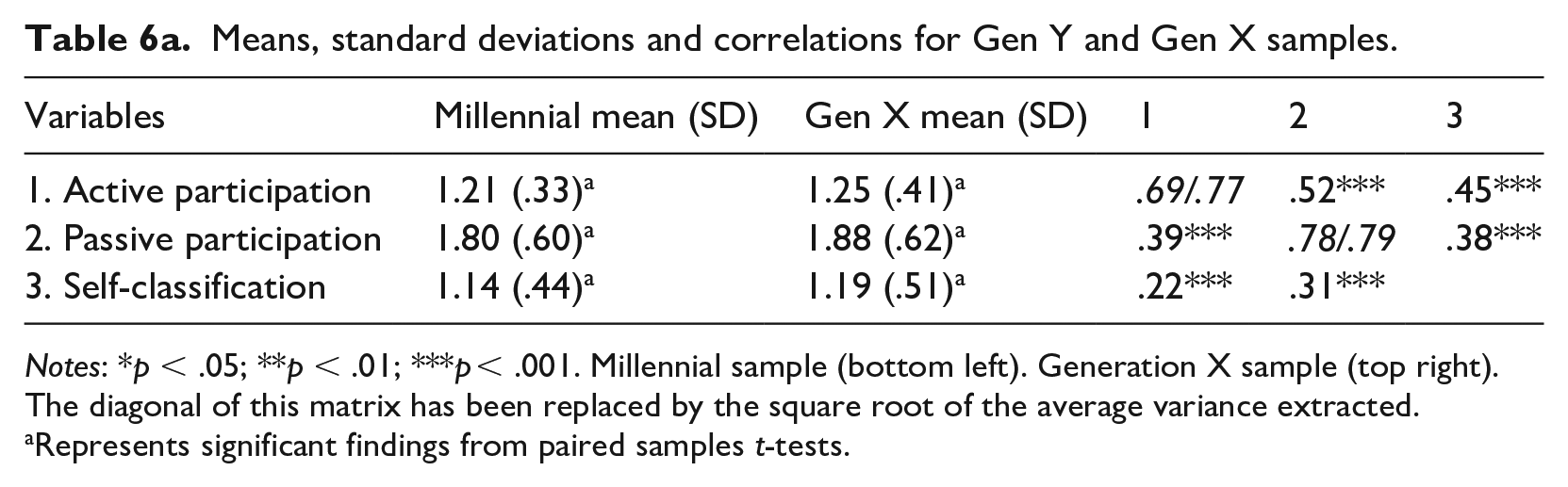
Notes: *p < .05; **p < .01; ***p < .001. Millennial sample (bottom left). Generation X sample (top right). The diagonal of this matrix has been replaced by the square root of the average variance extracted.
Represents significant findings from paired samples t-tests.
Means, standard deviations and correlations for Boomer sample.
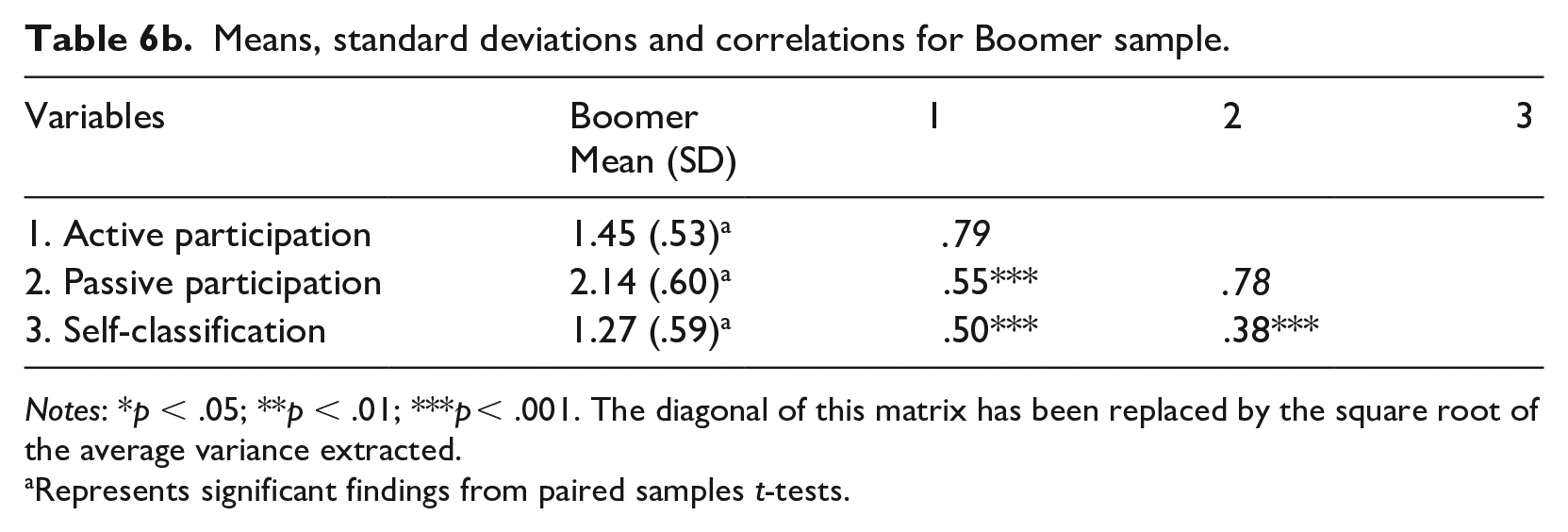
Notes: *p < .05; **p < .01; ***p < .001. The diagonal of this matrix has been replaced by the square root of the average variance extracted.
Represents significant findings from paired samples t-tests.
Paired samples t-tests were used to determine mean differences between respondents of the three cohorts. Respondents in the Boomer sample reported, on average, significantly higher levels of active participation, passive participation and self-classified union participation scores than respondents in the Millennial and Gen X samples.
Our research compares findings across three samples (i.e. generational cohorts). This required us to test for measurement invariance. We performed this analysis within PLS by testing the composite models to ensure that path differences are not the result of differences across measurement models (Henseler et al., 2016). We followed Henseler et al. (2016) to analyse the measurement invariance of the composite model (MICOM). A permutation algorithm included in SmartPLS was used to determine whether the same construct was being measured across all specified groups. The results of our MICOM analysis (available from the authors on request) revealed full measurement invariance and allowed us to proceed to our structural model using multi-group analysis (MGA).
Lastly, the structural model was assessed using SmartPLS’s MGA subroutine. The PLS-MGA is a non-parametric significance test for the difference of group-specific results that builds on PLS-SEM bootstrapping results (Henseler et al., 2009), and was used to test for significant differences in group-specific parameter estimates (e.g. path coefficients) in the three pre-determined samples. A result is considered significant at the 5% probability of error level (i.e. p < .05, p > .95).
Key findings from the testing of the structural model with the three different samples are provided in Figure 2. Several important observations can be made from the data shown in Figure 2. First, our analysis shows that a substantive portion of the variance in self-classification of union participation is accounted for by the union participation construct in our model (Millennial: R2 = 12%, Gen X: R2 = 23%, Boomer: R2 = 26%). Second, there is a significant positive relationship between active union participation and our respondents’ self-classification of their union participation for those in the Boomer (β = .411, p < .001) and Gen X (β = .338, p < .001) cohorts. No such relationship was observed for those in the Millennial sample; a finding we attribute to the fact that the sample size for the Millennial group is small and very few of the younger union members in our sample engage in activities included in the active union participation measure. Third, we see that the positive relationship between active union participation and self-classification of union participation as moderate/active was significantly stronger for those in the Boomer than Gen X cohorts (β = .076, p < .05). Fourth, there is a significant positive relationship between passive participation and our respondents’ self-classification of their union participation as passive for all respondents, regardless of their generational cohort (Boomer: β = .156, p < .001; Gen X: β = .198, p < .001; Millennial: β = .244, p < .001). That being said, we note that this relationship is significantly stronger for those in the Millennial group than for either Gen Xers (β = .063, p < .05) or Boomers (β = .102, p < .05), and significantly stronger for respondents in the Gen X cohort than Boomers (β = .57, p < .05). In other words, the younger the cohort, the stronger the positive path between passive union participation and self-classification as passive. Lastly, it should be noted that, of the four control variables included in the analysis, only one (years’ tenure in the union) acted as a significant control variable – and that was for one group only (Boomer: β = −.068; p < .05). For those in the Boomer sample, the more years’ tenure with the union the less likely the respondent was to self-classify themselves as active in the union.
Discussion
In this article, we present the key findings from a multi-method research study designed to provide a better understanding of how researchers’ ‘etic’ notion of active and passive union participation reflects and/or differs from union members’ ‘emic’ conceptualization of this construct. Figure 3 provides an overview of the key findings from our analysis. In the section below, the figure is used to guide our discussion and draw relevant conclusions with respect to our emic/etic comparison, our cross-cohort analyses, and other important findings that we uncovered in our research.
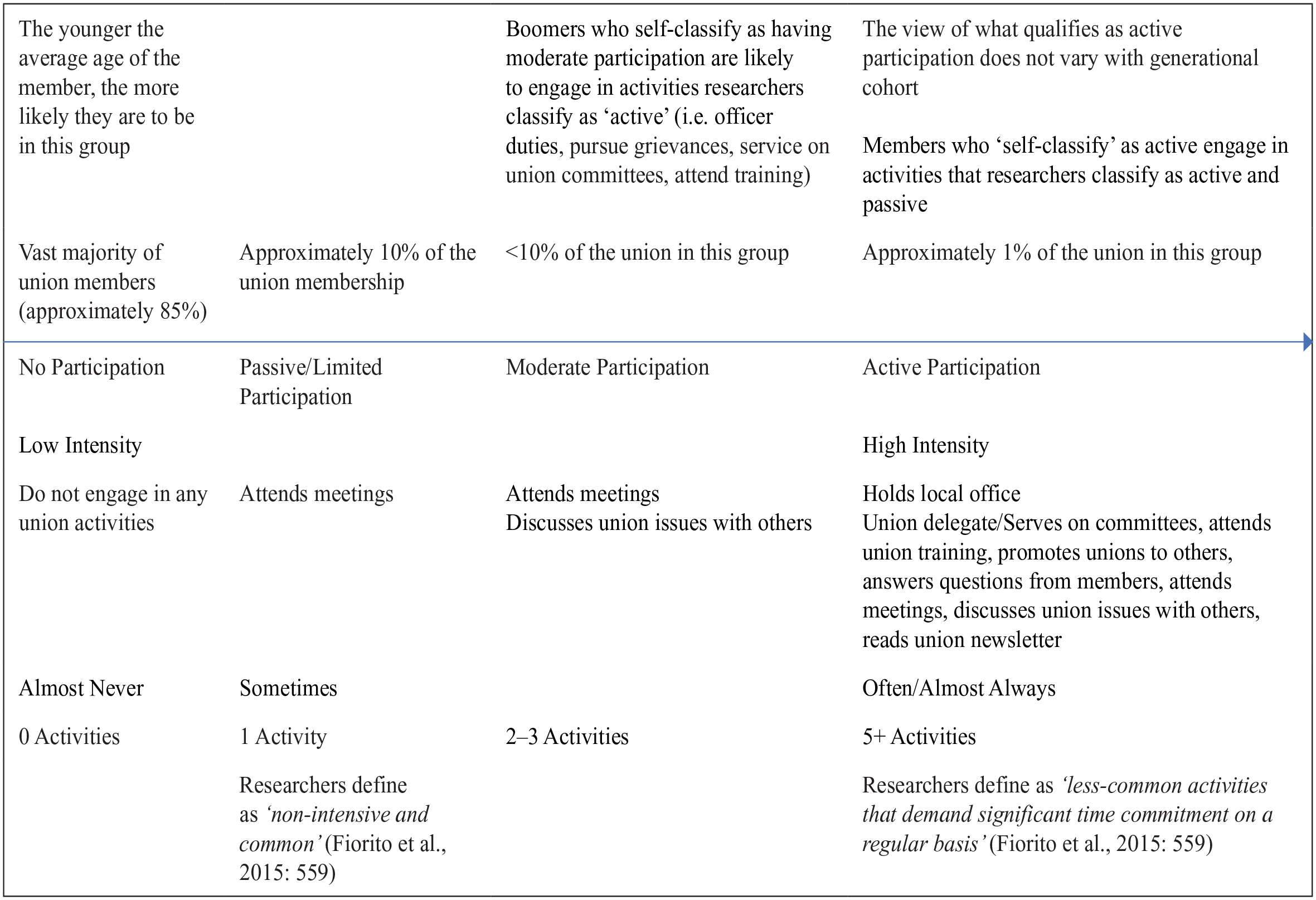
Summary of findings.
Emic versus etic views of participation
Our comparison of emic and etic conceptualizations of union participation aimed to expand upon the work of Fiorito et al. (2015), in which the authors strove to clarify the conceptualization and understanding of the union participation construct. Details on how emic views of participation converge or diverge from the etic interpretation are highlighted over the next several sections, organized by the activity level (Active, Limited/Passive, Moderate, Inactive). We then bring these findings together in a reflection about what our results could mean for future conceptualizations of the union participation construct.
Active participation in the union
Fiorito et al. (2015: 559) summarize the etic view of active forms of participation in the union as including ‘less-common activities that demand significant time commitment on a regular basis’. The findings from the emic phase of our research support the idea that many of the activities performed by ‘active’ participants are indeed less common and demanding. They also imply that members who see themselves as ‘active’ in the union tend to ‘do it all’. Not only do active members say that they engage in those duties that researchers consider to represent ‘active’ forms of participation (i.e. hold a local office, participate on union committees, fight to uphold the collective agreement), they also engage in activities that researchers would consider as indicative of ‘passive’ participation (e.g. attend union meetings, discuss union issues with others, read the union newsletter). While few in number (only 1% of those who answered our survey and 37% of those who were interviewed self-classified their participation as active), these are the members upon which unions rely most heavily and who play a vital role in the day-to-day operation of the union (Gall and Fiorito, 2012a). The fact that active union members uniquely indicated that they spent time promoting the union to others also highlights the critical role individuals in this group may play in union renewal where peer-to-peer socialization and social networks have been found to encourage buy-in to the union among new and/or inactive members (Bailey et al., 2010).
Passive/limited participation in the union
Fiorito et al. (2015: 559) summarize the etic view of passive union participation to include activities that are ‘non-intensive and common’ and require little obligation on the part of the member. While researchers include a number of different activities in their measures of passive union participation (e.g. vote in union elections, talk about the union to others), the union members we interviewed seem to be much more restrictive in terms of how they view passive participation. More specifically, the emic view of passive participation seems to equate to attending union meetings – no more, no less. Those whose participation consisted of more than meeting attendance typically classified themselves as either active or moderately active, suggesting perhaps our understanding of ‘passive’ forms of participation could use a reassessment. While the activities that are used to typify passive participation may be non-intensive, they are not, as illustrated by this study, common.
Moderate participation in the union
The emic phase of our research contributes to the union participation literature by suggesting that researchers focus their attention on those who are moderately active in the union. Members who self-classify themselves as exhibiting moderate union participation augment their attendance at union meetings by spending time each month discussing union issues with colleagues. This group seems to have received limited recognition within the union literature. This is unfortunate, as those with moderate levels of participation may be critical to the success of union-renewal initiatives, particularly if unions can identify strategies to encourage members of this group to move up to the next level of participation (i.e. active). While our data suggest that this group is small (3% of survey respondents, one in five interview informants), work by Dufour-Poirier and Laroche (2015) shows less active members would likely increase their participation if their union made more of an effort to reach out to them, listen to and incorporate their views, and make them feel like they are valued. Unions could, for example, use their interactions with those with moderate levels of union participation to make these members feel important, and to bring them into the union’s informal social network of active members. As Dufour-Poirier and Laroche (2015) demonstrated, failing to do so is likely to leave potentially active members (i.e. those with moderate participation in our case) feel left out and discouraged from participation. Similarly, a greater focus among researchers on the circumstances of union members with moderate levels of participation could help unions determine which factors may be discouraging or preventing them from becoming more active and take corrective action.
Inactive members of the union
Finally, we note most our survey respondents (85%) and one in 10 of those we interviewed indicated that they were not active in their union. This finding is consistent with the research literature that has highlighted union participation’s downward trend over time (Vachon et al., 2016), and provides impetus for unions to find ways to increase their members’ involvement as a means to achieving union renewal (Cates, 2014). These findings reiterate the importance of research that goes beyond just the exploration of active and passive participation to a focus on identifying those factors that have contributed to non-participation (e.g. a lack of interest in and/or an inability to participate in their union) as well as identifying how such obstacles can be overcome. This finding also suggests that the etic conceptualization and measurement of active/passive participation could be broadened and refined. We would, for example, suggest that measures of active/passive participation provide respondents with the option of indicating that they ‘never’ engage in a particular activity as opposed to ‘almost never’, as is sometimes the case.
Generational differences
This study contributes to the limited available recent research into the influence of generational cohort on outcomes related to union renewal (Cates, 2014; Dufour-Poirier and Laroche, 2015; Smith and Duxbury, 2019; Smith et al., 2019) by exploring the possibility that there are generational differences in the way in which members ‘self-classify’ their level of union participation. Analysis undertaken using the survey data determined that: (1) those in the Boomer cohort were significantly less likely and those in the Millennial and Gen X cohorts significantly more likely to place themselves in the ‘limited participation category’; (2) those in the Boomer cohort reported significantly higher active and passive union participation scores than their Millennial and Gen X counterparts. These findings are consistent with both the theory (Wray-Lake and Hart, 2012) and previous empirical work on generational differences in union participation (Cates, 2014; Smith and Duxbury, 2019; Smith et al., 2019) and provide further evidence supporting the need to re-engage younger workers in the union.
Findings from our emic study provide us with additional information on this important relationship. First, we note that, generally speaking, generational cohort had little impact on how members conceptualized the activities associated with active and passive participation. Second, we again note that those in the Boomer sample were significantly more likely to ‘self-classify’ themselves as an active participant in the union, while those in the Gen X and Millennial cohorts were more likely to categorize themselves in the limited or inactive participation categories. Third, we note that Boomers in our interview sample self-classified their level of participation at a lower level than the literature would given the activities that they said that they engaged in (see Appendix 1). More specifically, about one-quarter of Boomers rated their level of union participation as ‘moderate’ despite the fact that many also said that they participated in union activities that an etic approach would see as typifying active participation. Again, while it is impossible to know with certainty why these differences exist, we speculate that one potential reason why some Boomers ‘underestimate’ their level of participation could be attributed to the fact that they became union members at a time when unions were more powerful, had higher rates of participation, and better public support than they do currently (Smith et al., 2019). It is possible, therefore, that Boomers use a different metric (union participation in the 1970s and 1980s) during the ‘self-classification’ process than younger workers, who have a different set of formative union experiences. It is also possible that due to their greater level of experience within the union, Boomers are more likely to accurately assess their level of activity than are the less experienced cohorts. If this is indeed what is going on, this could also explain why many Boomers perceive that younger members do not contribute enough to the union movement. This interpretation of the data is consistent with Smith et al.’s (2019) study of cross-cohort perceptions of unions which found that some Boomers felt that Millennials were not active enough in their union and Dufour-Poirier and Laroche’s (2015) research which found that Millennials were discouraged from being active in their union because they felt as though they did not fit in. Again, these findings provide support for additional research in this area based on generational theory.
Methodological implications
Based on the above comparison of our ‘emic’ findings to the typical understanding of different levels of union participation found in the literature, several findings stand out when considering our conceptualization of the union participation construct. While our multi-method analysis does uncover some overlap between etic and emic understandings of active and passive forms of participation, the differences we found have inspired us to consider an updated conceptualization of the construct.
As pictured in Figure 3, we envision union participation as a continuum ranging from ‘Inactive’ at the low end, to ‘Active’ at the high end, with ‘Limited’ and ‘Moderate’ participation in between. An individual member’s placement along this continuum is decided by the extent of their participation in active and passive forms of union activities. Therefore, as members participate to a greater extent, whether in active duties such as serving on committees or in passive duties such as reading the union newsletter, their placement along the continuum would reflect this increase in activism, moving further towards the ‘active’ end, depending on how much and in which activities they participate. Similarly, a decrease in participation in either active or passive activities would move the member towards the ‘Inactive’ end of the continuum.
We argue that by viewing union participation through a continuum lens we can better account for the nuance identified in our emic data. For example, the continuum as envisioned here recognizes inactive and moderate members, expanding beyond an active/passive dichotomy. The continuum also recognizes the effort and commitment required of members performing a high level of passive activities, as theoretically these members could be considered ‘active’ with enough participation, even if when taken on their own, these duties may not be as onerous as active duties such as pursuing a grievance. Similarly, the continuum also takes into account the likelihood (based on our findings and those elsewhere) that members who participate in active forms of activities tend to participate in passive forms of activities as well.
Our interview data helped us identify another opportunity for future research to refine the measurement of union participation, as our conversations pointed to the need to assess the perceived/felt stress level or burden of each activity. As such, we suggest that future quantitative studies also collect data, perhaps through the use of an appropriately designed Likert scale, that allows them to quantify the amount of time or commitment required of the union member to participate in each of the activities included in the union participation scale. This would help to add depth to the analysis and provide more insight into the thought processes of union members as they conceptualize and act upon their understanding of union activism.
Another methodological issue that became apparent through the interview process related to the perception on the part of our respondents that their level of participation in the union was related to their awareness of opportunities to participate. Self-report measures of union participation do not capture this potentially important causal factor. Our data imply that researchers could improve their measurement of union participation by also asking union members if they are aware of/to what extent do they perceive that they have the opportunity to participate in each activity included in the measurement instrument. This would allow researchers to better disambiguate the ‘chicken or the egg’ problem of assessing union participation using actual participation history as suggested and employed in some places (i.e. Redman and Snape, 2004).
While our findings demonstrate the value of a mixed-methods approach, they also highlight the individual strengths and situational applicability of the emic and etic approaches, respectively. Specifically, emic perspectives rely on subjective meaning provided by knowledgeable informants, while etic perspectives rely on existing theories and concepts (Morris et al., 1999). Researchers performing exploratory studies looking to uncover new elements or categories of union participation would benefit from an emic perspective, whereas researchers looking to compare different forms of participation across samples, for example, would benefit from an etic perspective.
Morris et al. (1999) argue that mixed-methods researchers can benefit from the concept of refinement – the use of one set of findings (emic for example) to refine our understanding of others (etic, for example). By combining the findings of our emic and etic studies, we have refined our conception of the ‘union activism’ construct as featured in Figure 3, which can inform future research, while also demonstrating the value of a mixed-methods approach for the study of union participation and other behaviours. By first asking union members to describe their own participation and their participation level, then comparing these to researchers’ perspectives, we employ many of Greene et al.’s (1989) rationales for mixed-methods research. More specifically, we touch on ‘triangulation’, in which outcomes from one study are tested on a wider sample, and ‘complementarity’, in which etic studies are used to elaborate on themes identified from the emic perspective – approaches that are fit for research in new or changing contexts (Greene et al., 1989), as our interviews helped us refine our theory-based understanding of the active/passive dichotomy into that of a more nuanced conceptualization of participation as a continuum.
While on their own, both interviews (not always generalizable), and surveys (potentially lacking in context and depth of analysis) have their shortcomings, but employed together, they can add both depth and added generalizability to findings while providing both an insider’s and outsider’s perspective (Morris et al., 1999). This approach can be useful in future study of the dynamic union environment as interviews allow for rich first-hand accounts in which follow-up surveys can be grounded and allowing the further study of themes/relationships on a wider sample.
For example, mixed-methods studies into the potential impacts of the COVID-19 pandemic on union behaviours and attitudes could provide a depth of analysis (both exploratory and explanatory) that neither interviews nor surveys could provide on their own (Greene et al., 1989). The mixed-methods approach could also be used to study union-related behaviours such as voting intentions, as interviews could identify the main themes and motivators of certain voting intentions while surveys could test their impact on a wider scale. Similarly, individual participation behaviours could be explored such as the decision to pursue grievances, or attend meetings, among others. Additionally, the mixed-methods approach could be useful for further study of generational differences in union behaviours, another area where context and narrative combined with more generalizable empirical results can tell a more effective story about complex issues (Morris et al., 1999).
Implications for future research
Our data pointed to a largely under-studied group of union members – those who are moderately active in the union – they do more than simply attend meetings, but they are not typically as involved in more active forms of participation. Future research using interviews could provide more contextual information about how, if possible, unions could build on these members’ current level of participation and motivate them to be engaged at the ‘active’ level. Similarly, focus could be paid to potential barriers to increased activism.
One of the factors motivating our research is the apparent inconsistency in the measurement of union activism as demonstrated by vastly disparate levels of activism identified across a variety of studies (Fiorito et al., 2015). This level of inconsistency was further demonstrated within our own mixed-methods study as about 30% of interview respondents indicated they were ‘active’ members, while only about 1% of the survey sample reported being ‘active’ – a large disparity considering both samples were pulled from the same union. Future studies should continue the effort to better understand and resolve this issue.
Practical implications
Our research provides some practical lessons that unions could use moving forward, specifically regarding mentorship and outreach. While it goes against the union ethos to compartmentalize union members into specific groups rather than focusing on the collective, our research has identified some lines along which unions could potentially segment or target mentorship and mobilization efforts. Active members could be identified and used either formally or informally as role models for members with moderate and less/inactive participation. While many inactive or less active members may simply be disinterested, those in the moderate group in this study have shown some desire to participate. This suggests that the union could enhance participation by providing specific outreach to members in this group which could help identify any roadblocks to further activism, while also building the relationships that research has shown are important to developing activism among younger and less tenured members (Dufour-Poirier and Laroche, 2015). While there is overlap between activity level and cohort groups, the same approach could be taken with regard to leveraging the experience and enthusiasm of Boomer members to help pass the torch on down to Millennial and now Gen Z members who do not have the same relationship with the union/unions as do the more seasoned Boomers.
Further, a better understanding of how union members conceptualize participation and perceive their own level of participation can help unions in their attempts to increase member activism. If members and their union have differing understandings of what an ‘active’ member is and is expected to do, then there could be a disconnect when it comes to mobilization, where for example, members, feeling they are already ‘active’ might not increase their participation, potentially frustrating the union leadership who might perceive these members as less active. An understanding of these differences could help unions in their messaging regarding efforts to increase mobilization and activism.
Limitations
While our studies do present findings that are relevant for both academics and practitioners, they are not without limitations. One limitation is the cross-sectional nature of our research. Researchers have pointed out shortcomings with cross-sectional instruments for union (Parks et al., 1995) and generational cohort (Aleks et al., 2021) research. Future research could take a longitudinal or time-lag approach, studying how conceptualizations of levels of participation change (or remain constant) over time. Future research could also ask Boomers and Gen Xers if they feel their participation level in the union changed from when they were younger, if so, how and why?
Second, the study is limited by the fact that the relatively low number of survey respondents who self-classified themselves as active union members meant we were unable to use the same ‘self-classification’ measure in both the qualitative and quantitative studies. In fact, we suspect that the comparatively high proportion of ‘active’ participants (about 30%) who engaged in the interview process indicates a self-selection bias among more active members for the interview. These findings do, however, reinforce the need to do targeted research with extreme samples when exploring a phenomenon that may be rare in the environment (e.g. active union participation).
Thirdly, neither our qualitative nor quantitative studies consider the demand for or availability of opportunities to participate. Some researchers argue that measures of participation intention rather than actual participation could be more useful (Redman and Snape, 2004), due to a potential lack of opportunity to actually participate. Future research in this area could collect data on demand for/supply of participation opportunities in addition to historical participation data.
Lastly, while not a limitation per se, the proportion of ‘active’ participants was significantly higher in our interview sample than in our survey sample. This anomaly could be related to the difference in effort required between the two types of data collection – the interview is more time consuming and logistically complicated than is the survey, which could mean that those who are less committed to the union would self-select out of the interviews leaving the more committed and active members more likely to participate. In addition to the letters disseminated to all members, our interviews and surveys were also promoted by union reps at meetings, so it is possible that members who go to meetings (and are therefore at least somewhat active) were motivated to participate, or some snowball sampling occurred within the more active circles of the union, thus contributing to the skewed numbers.
Conclusions
Our study makes contributions to the union participation literature in several ways. First, we contribute to the literature conceptually by providing a visualization of union participation as an inactive to active continuum, accounting for ‘moderate’ levels of participation, which provides room for more nuanced understandings of participation found in our results and across the literature. Second, we contribute to the literature methodologically. While previous studies of this sort take a quantitative approach, our study supplements quantitative analysis with interview data that provides insights into the experiences of our participants and helps to explain some of the ‘why’ behind the quantitative results. Third, we contribute to the literature empirically by providing data that show potential generational differences in union-related outcomes, and find that, while each generational group conceptualizes participation similarly, there are important areas where they are more different than similar, and that younger generations are less likely to be active in their union. In addition to its academic contributions, our article could potentially help unions further the renewal process – through the segmentation of members to mobilize inactive segments of the union. Specifically, unions could look to leverage the efforts of their more active members (typically Boomers) to effectively integrate less active (typically Millennial) members into the collective.
Footnotes
Appendix 1: Qualitative coding
Appendix 2
Participation by activity level by generational cohort, interview data.
| Boomer | Active |
Moderate |
Limited |
Inactive |
|
|---|---|---|---|---|---|
|
|
|||||
| Millennial |
Active
|
Moderate
|
Limited
|
Inactive
|
|
|
|
|||||
| Pursues grievances/upholds collective agreement | 86% (19) 100% (2) |
56% (5) 14% (1) |
0% 0% |
0% 0% |
|
| Serves as a union delegate/on a union committee | 77% (17) 100% (2) |
56% (5) 14% (1) |
0% 0% |
0% 0% |
|
| Attends union training/information sessions | 73% (16) 100% (2) |
44% (4) 14% (1) |
0% 0% |
0% 0% |
|
| Officer duties | 73% (16) 100% (2) |
33% (3) 14% (1) |
0% 0% |
0% 0% |
|
|
|
|||||
| Attends union meetings | 82% (18) 100% (2) |
100% (9) 100% (7) |
100% (2) 87% (12) |
0% 0% |
|
| Discusses union issues with other members | 73% (16) 100% (2) |
89% (8) 86% (6) |
50% (1) 33% (5) |
0% 0% |
|
| Promotes union | 73% (16) 100% (2) |
33% (3) 14% (1) |
0% 0% |
0% 0% |
|
| Reads union literature | 73% (16) 100% (2) |
33% (3) 28% (2) |
0% 7% (1) |
0% 0% |
|
| Answers questions from members/clarify collective agreement | 77% (17) 100% (2) |
44% (4) 14% (1) |
0% 0% |
0% 0% |
|
Appendix 3
Number of activities by participation level, by cohort.
| Active (n = 37) | Moderately active (n = 20) | Limited activity (n = 26) | Inactive (n = 17) | Total (N = 100) | ||
|---|---|---|---|---|---|---|
|
|
29 | 3 | 3 | 0 | 35 | |
|
|
2 | 3 | 1 | 0 | 6 | |
|
|
3 | 6 | 3 | 0 | 12 | |
|
|
2 | 8 | 8 | 0 | 18 | |
|
|
1 | 0 | 8 | 1 | 10 | |
|
|
0 | 0 | 3 | 16 | 19 | |
| No. of activities | Active (n = 37) | Moderately active (n = 20) | Limited activity (n = 26) | Inactive (n = 17) | Total (N = 100) | |
| Boomers (n = 35) |
|
18 | 2 | 0 | 0 | 20 |
|
|
0 | 1 | 1 | 0 | 2 | |
|
|
1 | 3 | 0 | 0 | 4 | |
|
|
1 | 3 | 1 | 0 | 5 | |
|
|
1 | 0 | 0 | 0 | 1 | |
|
|
0 | 0 | 0 | 3 | 3 | |
| Gen X (n = 35) |
|
10 | 0 | 2 | 0 | 12 |
|
|
1 | 2 | 0 | 0 | 3 | |
|
|
1 | 2 | 2 | 0 | 5 | |
|
|
1 | 0 | 3 | 0 | 4 | |
|
|
0 | 0 | 1 | 1 | 2 | |
|
|
0 | 0 | 1 | 8 | 9 | |
| Millennials (n = 30) |
|
1 | 1 | 1 | 0 | 3 |
|
|
1 | 0 | 0 | 0 | 1 | |
|
|
0 | 1 | 2 | 0 | 3 | |
|
|
0 | 5 | 4 | 0 | 9 | |
|
|
0 | 0 | 7 | 0 | 7 | |
|
|
0 | 0 | 1 | 6 | 7 | |
Declaration of conflicting interests
The authors declared no potential conflicts of interest with respect to the research, authorship, and/or publication of this article.
Funding
The authors received no financial support for the research, authorship, and/or publication of this article.
