



Abstract
This article applies the concept of legitimacy to reinterpret collective bargaining as a war of words instead of an institutional arrangement of negotiations and power struggles between employers and trade unions. The case study investigates trade union discourse by collecting and analysing campaign materials about academic wages across British universities over 18 years. The results suggest trade unions tried to stigmatize British universities for not engaging in consultation and negotiation; acting with honesty and good faith; or being transparent and equitable. However, none of these management practices puts economic framing at the forefront, which is at odds with financialization and the essence of wages being about money and performance. This article concludes that embracing economics and reducing plurality within trade union discourse may help legitimize academic wages to match economic growth in the sector.
Introduction
Trade unions provide employees with collective representation and have historically played a critical role in collective bargaining and labour–management relations (Freeman and Medoff, 1984; Katz, 1993). While there are countless nuances amongst trade unions, they exist primarily to represent their members’ interests by increasing employee wages and protecting their job security (Oswald, 1985). Trade union success in achieving these goals conventionally depends on institutional arrangements and respective bargaining powers of employers and trade unions (Rubery, 1997). Traditionally, industrial relations scholarship focuses on statistically proving that proxies for trade union power – such as coverage, density and bargaining level – affect wage premiums (Barth et al., 2020; Fitzenberger et al., 2013; Hirsch, 2004; Hirsch and Schumacher, 2001).
While industrial relations scholars have extensively analysed how trade unions affect wages based on economic and socioeconomic assumptions, organization studies scholars have been relatively silent on this issue. However, the latter group could offer unique insight by drawing on theoretical frameworks based on discursive assumptions and conceptualizing labour–management relations as a war of words within an institutional context. Notably, neo-institutional theory investigates how organizational structures and processes acquire legitimacy even if they lack functional necessity and economic rationality (Suddaby, 2010). This article draws upon this theoretical framework to investigate what meanings trade unions create to stigmatize employers and legitimize wage increases.
The case study focuses on how trade unions discursively sought to increase academic wages in British universities and draws on over 18 years of published trade union campaign materials retrieved from an internet archive. The analysis suggests that trade unions stigmatized British universities for not engaging in consultation and negotiation; acting with honesty and good faith; or being transparent and equitable. For trade unions, these claims legitimize increases in academic wages, primarily in the spirit of morality and plurality. However, these could also be considered independent concerns as British universities can cooperate – like acting with honesty and good faith – without necessarily needing to increase academic wages. More notably, these concerns conflict with the current institutional environment – financialization and the essence of wages being about money and performance. While trade unions are building organic solidarity through alignment with broader societal questions (Grady and Simms, 2018), working with rather than transforming the institutional environment could prove more fruitful. For trade unions to legitimize increases in academic wages to match economic growth in the sector, this article suggests that economics should be at the core of their future campaigns.
Background
Neo-institutional theory
Despite increased criticism, neo-institutional theory continues to be the dominant conceptual framework within the field of organization studies (Alvesson and Spicer, 2018; Alvesson et al., 2019; Lawrence et al., 2010). The core assumption is that survival depends upon conforming to society’s norms, values, beliefs and definitions (DiMaggio and Powell, 1983). Following the discursive perspective, management practice is determined by what society or the institutional environment prescribes as legitimate. It upholds that cultural and normative institutions – widely shared, taken-for-granted meanings within society – are maintained by discourse (Phillips and Malhotra, 2008; Phillips et al., 2004). Discourse is also the mechanism through which meanings about legitimacy transform and agents can use communication – symbols and language – to change management practice (Cornelissen et al., 2015; Munir and Phillips, 2005; Suddaby and Greenwood, 2005).
In Suchman’s (1995) theoretical exploration of legitimacy, the pragmatic, cognitive and moral are distinguished as separate sources of meaning. Acknowledging this separation is a significant conceptual change. Firstly, it is no longer non-conformity to society’s cultural and normative institutions that matters but also the type of non-conformity. In particular, moral stigmatization poses a significant threat to organizational survival, arguably more problematic than cognitive or pragmatic legitimacy (Prasad et al., 2016). Moral stigma affects emotions and challenges people’s hearts, whereas cognitive and pragmatic stigma affects rationality and challenges their heads. Since legitimacy is a sense-making process, discourse based on emotions is conventionally more influential than rationality.
Secondly, this is a significant conceptual change as it is now possible for an organization to engage in legitimate management practices and stigmatized management practices. For example, the tobacco industry can be legitimate in its transactional relationships while being stigmatized since it manufactures a product that kills people (Palazzo and Richter, 2005). Organizations can compartmentalize, balance or even separate these different roles to fulfil multiple demands. However, creating one form of legitimacy may invalidate or be at the expense of another form of legitimacy (Pratt and Foreman, 2000). Essentially, evaluators create a single evaluation of legitimacy from multiple, conflicting, pluralistic semiotic features, which are not directly comparable (Kraatz and Block, 2008; Seo and Creed, 2002). Determining the legitimacy of management practices is not straightforward because society does not have just one stable discourse for organizations to follow (Jancsary et al., 2017; Meyer and Höllerer, 2016; Thornton et al., 2015).
Stigma and legitimacy
Given the fundamental importance, there is an implicit assumption that all organizations actively seek to maintain their legitimacy by avoiding engaging in management practices that society stigmatizes (Hudson, 2008; Sutton and Callahan, 1987). Consequently, much discussion has been about how organizations can strategically regain their legitimacy after a misdemeanour. For example, Hampel and Tracey (2017) have discussed the responses of shielding, straddling, co-opting and destigmatization. In contrast, Lamin and Zaheer (2012) have discussed denial, defiance, decoupling, accommodation and no comment or action. Organization studies scholars have throughly explored how organizations use strategies to regain their legitimacy. However, they have not investigated to the same extent how third parties – such as trade unions – stigmatize management practices.
The concept of controlling societal perceptions of legitimacy has various labels, including defining (Sutton and Callahan, 1987), symbolic management (Ashforth and Gibbs, 1990) and manipulation (Oliver, 1991). Broadly, this concept encompasses how actors construct verbal accounts or discourse to frame whether management practices are legitimate (Elsbach, 1994). These frames are ‘schemata of interpretation’, which create meaning for individuals (Snow and Benford, 1988), and the different sources organizations can draw upon are summarized in Table 1. While pragmatic, cognitive and moral legitimacy were previously listed (Suchman, 1995), these can be further broken down into seven significant motivations (Vaara and Monin, 2010; Vaara and Tienari, 2008; Vaara et al., 2006).
Current framing strategies.
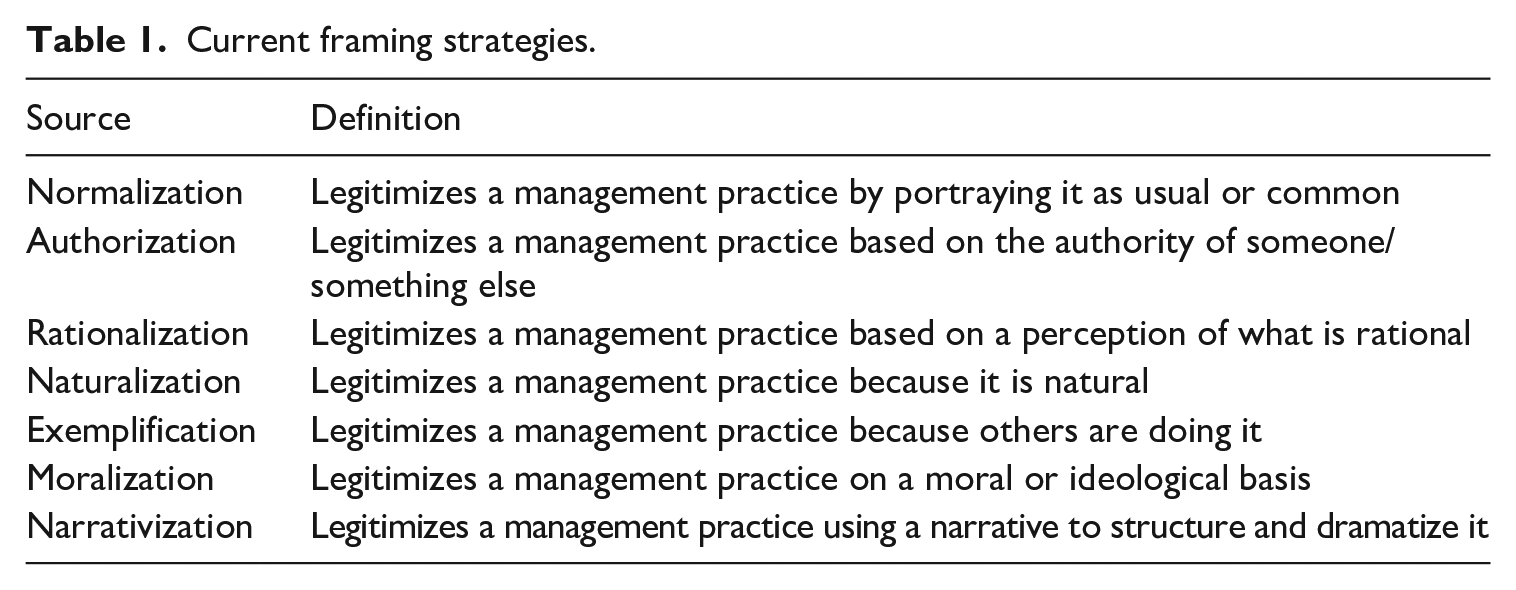
These framing strategies abstract the justification behind participating in management practices, but there is also ambiguity as framing a management practice in a particular way, such as immoral, does not automatically mean the institutional environment accepts the discourse as accurate. Moreover, while third parties can use the inverse of these generic framing strategies to stigmatize organizations, the underlying contextual circumstances still need to be considered to determine whether the discourse successfully threatens the organizations’ legitimacy. Thus, whether trade union discourse stigmatizes employers and forces them to maintain their legitimacy by increasing employee wages depends on what framing strategies trade unions use and the context of British higher education and wages. Essentially, the institutional environment plays a vital role in meaning-making and defining legitimacy.
Financialization of British higher education
At least in terms of purpose, the modern history of British higher education arguably began in 1997 with a governmental review examining the aims, shape, structure, size and funding of higher education (Department of Education and Science, 1997). The subsequent Dearing Report promoted two underpinning propositions (Dearing, 1998). First, teaching in higher education is a growing market opportunity for British universities, especially with increasing global student numbers. Second, increasing global competition makes higher standards necessary to attract these students and win in the marketplace. The consequence of not accepting these two propositions, the Dearing Report warns, would be over half of the British universities operating at a deficit by 1999/2000 (Department of Education and Science, 1997). Accordingly, this report marks the need for British universities to generate a surplus by commercializing higher education and the dominance of financialization within the sector.
The concept of financialization refers to the ‘increasing role of financial motives, financial markets, financial actors and financial institutions in the operation of the domestic and international economies’ (Epstein, 2005: 5). Notable trends reflecting financialization include rising vice-chancellor pay, increasing student fees, reducing government funding and aligning revenue flows with performance evaluation metrics such as the research excellence framework, national student survey and teaching excellence framework (Walker et al., 2019). A less discussed trend includes increasing reliance on public bonds and private placement markets (Bennett, 2019), or in other words, debt financing. Growing debt levels increasingly make the sector dependent on servicing interest payments by securing and maximizing their revenue streams to meet covenant agreements.
These trends reflecting financialization coincide with economic rationality winning the battle for theoretical supremacy across academia and broader society, with performance and efficiency being the dominant mantras (Ferraro et al., 2005; Lazear, 2000). Economics upholds the premise that markets and competition will reward organizations and individuals shown to be the best performers and who contribute the most (Lazear, 1995; Milgrom and Roberts, 1992). Consequently, universities and academics must transform themselves into market actors seeking to maximize capital values for survival (Rhodes, 2017). In other words, the income and performance of British universities depend on academics publishing in quality journals, winning research grants and receiving good student feedback (Jones et al., 2020).
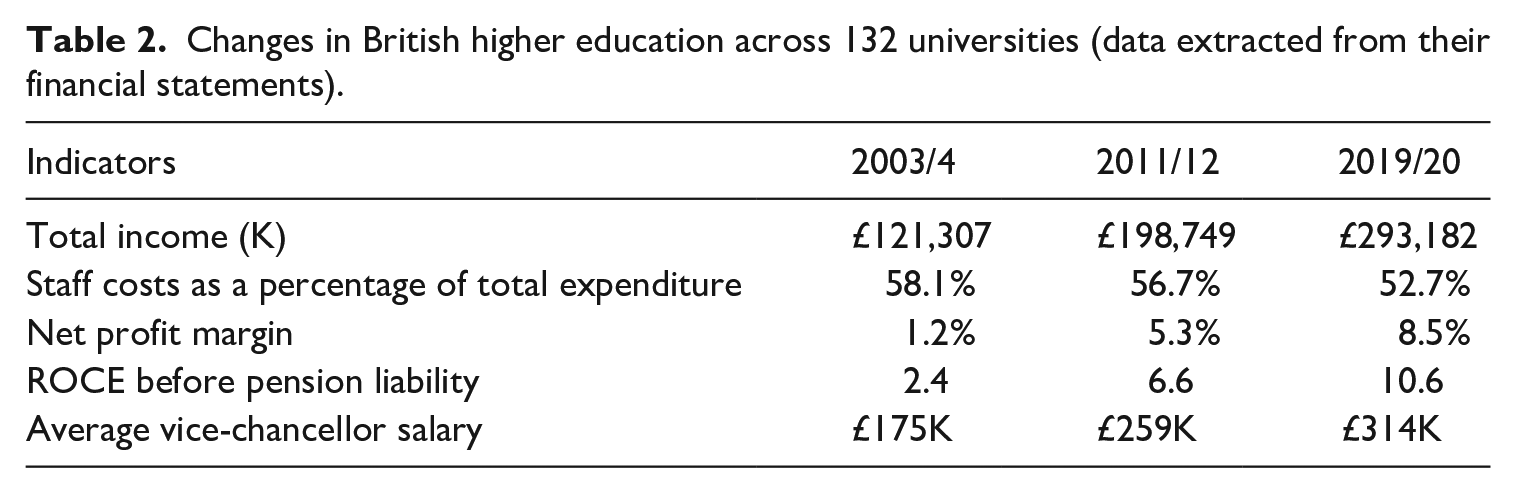
In the context of financialization (Table 2), there has been a 142% increase in income, a 608% increase in net profit margin and a 342% increase in return on capital employed (ROCE) before pension liability averaged across 132 British universities. In contrast, academics have only received a 40% increase in pay during the same period. The hypocrisy is that there has been a 79% increase in vice-chancellor pay during the same period. Making matters worse, staff costs relative to other expenditures have reduced by 9%, suggesting a potential increase in work intensification. These figures suggest that academics are not receiving an adequate proportion of the economic growth within the sector.
Changes in British higher education across 132 universities (data extracted from their financial statements).
However, it is not just academics in British universities receiving an inadequate proportion of the economic growth. This trend extends across society and internationally, as Piketty (2013) highlighted in his bestselling exploration of capital. His central thesis, r > g, states that the net return on capital (r) is increasing faster than the growth rate of output (g). Consequently, money accumulates faster from owning capital (profits, dividends, interest, rents and other income) than from working in employment, especially non-managerial employment. The process of financialization combined with economic structural changes explains the declining share of labour across OECD countries (Pariboni and Tridico, 2019). Organizations are increasing their profits and promoting capital interests at the expense of increasing wages (Palley, 2013). While shareholders do not own British universities, they are subject to the same mantras of improving performance and efficiency within this institutional environment. The pace of change because of financialization makes British higher education important for international debates in industrial relations.
Industrial relations within British higher education
The previously mentioned Dearing Report accepted that there had been a long-term comparative decline in academic wages, but resolving questions about pay was outside of its remit (Department of Education and Science, 1997), which led to a one-off review and the subsequent Bett Report (Bett, 1999). These reports encouraged negotiations between trade unions and the Universities and Colleges Employers Association (UCEA), which acted for British universities. In 2001, these bodies established the Joint Negotiating Committee for Higher Education Staff (JNCHES) under the express agreement of moving towards institutional-level bargaining over wages. Lengthy negotiations continued for a few years, but the Framework Agreement for the Modernization of Pay Structure was ultimately accepted (JNCHES, 2003). The main element concerning academic wages was a single 51-point pay spine with yearly renegotiations at future meetings. The pay spine covered academic and non-academic staff wages across British universities but not senior staff, such as professors and vice-chancellors, who were still subject to pay bargaining at the local level. Since 2003 academic wages have been the product of institutional bargaining structures instead of market forces.
In British higher education, discursive negotiations between trade unions and the UCEA determine academic wages unless both parties fail to reach a compromise. In the latter case, they undergo the dispute resolution process, which requires parties to meet more regularly and consider third-party assistance for mediation and conciliation. Finally, after dispute resolution procedures have been fully exhausted, British universities may impose a resolution while trade unions undertake industrial action (JNCHES, 2013). Typical industrial action within this sector may consist of marking and external examination boycotts, working to contract, overtime bans and strike action. However, it is also essential to recognize the various legal hurdles in organizing industrial action in Britain, especially after the Trade Union Act 2016 (Bogg, 2016). Furthermore, even when trade unions take industrial action, it has an insignificant financial impact on British universities because students continue to pay their fees independently of whether teaching happens. Therefore, conceptualizing these pay negotiations as a war of words appears appropriate given the above institutional arrangement.
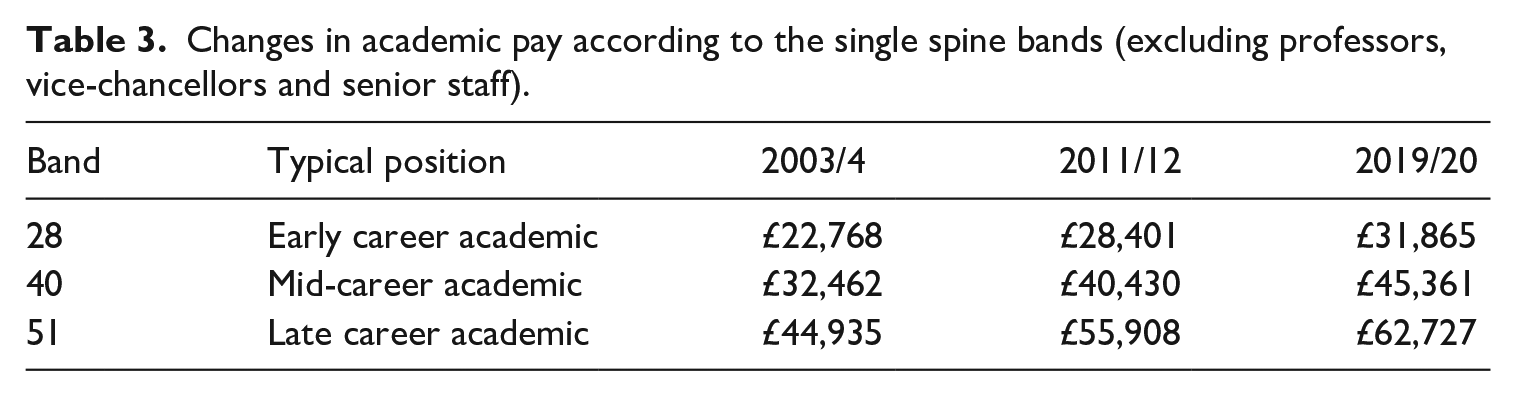
Nevertheless, the consequences for academics of this current institutional environment are somewhat problematic. On the one hand, universities are forcing academics into doing more work, whether teaching, research or administration, albeit with fewer resources and continually increasing performance expectations while implicitly normalizing more extreme working behaviours (McCann et al., 2020; Ogbonna and Harris, 2004). On the other hand, trade unions represent academics (both members and non-members) as part of the national bargaining structure. These negotiations (see Table 3) have resulted in an average percentage increase of less than 2%, and academics’ wages have not matched economic growth within the sector, despite national strike action in 2004, 2006, 2013, 2018, 2019, 2020, 2021 and 2022. With recent changes in trade union leadership in the University and College Union (UCU), there have been significant efforts to mobilize academics, students and the public while taking a less conciliatory approach to British universities. Notably, over 70,000 staff at 150 universities participated in the most extensive sector strike ever in 2022, and there are more frequent bouts of industrial action. However, the increasing level of industrial relation activity is not yet impacting wage negotiations as the yearly wage increase from 2019/20 to 2022/3 was, on average, 1.5%, which is partially attributable to the impact of COVID-19.
Changes in academic pay according to the single spine bands (excluding professors, vice-chancellors and senior staff).
Conventionally, industrial relations scholars would attribute the lack of wage growth to trade unions lacking the power to engage in industrial action and force British universities to pay academics higher wages. In contrast, organization studies scholars instead would examine how trade unions stigmatize British universities within the institutional environment. This article applies the latter approach because discursive bargaining is the main mechanism for deciding academic wages.
Methodology
Data collection
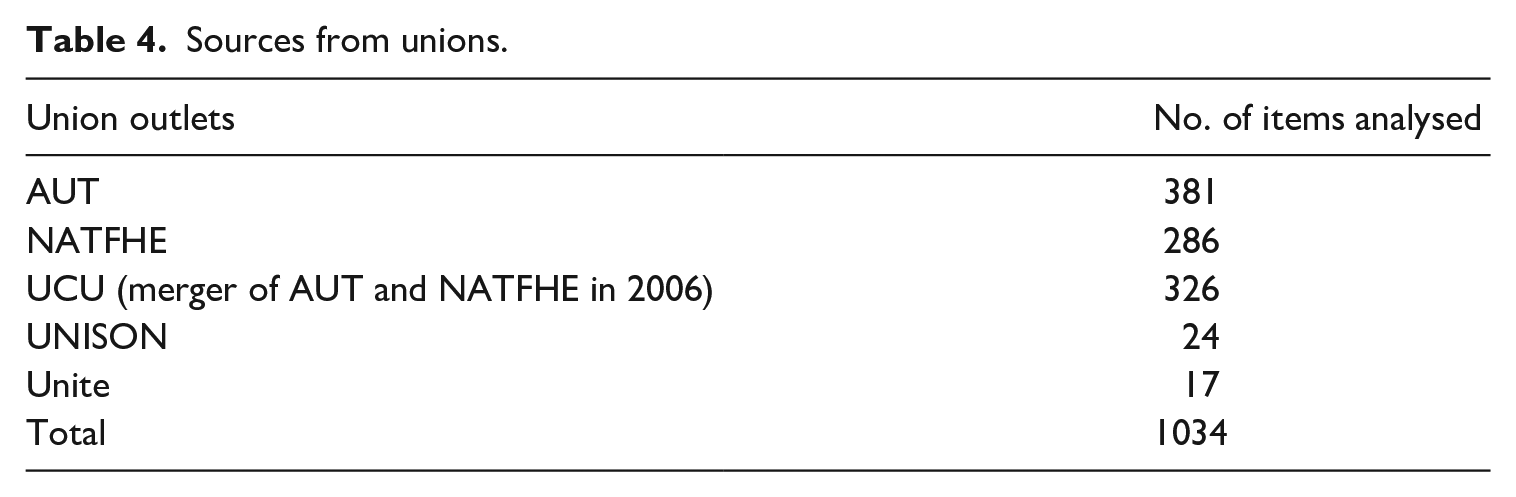
The article’s data collection draws on documents created by trade unions that campaign to increase academic wages in British universities. Items included were posters, campaign notices, news statements, responses to other actors, research reports, employee advice, meeting minutes and newsletters. All texts are still publicly available and found within various internet archives. It was, therefore, unnecessary to anonymize quotations, especially given that the trade unions are already known to those involved within the sector. All texts either directly or indirectly commented on academic wages in British universities, and they were published over 18 years by one of five different unions (see Table 4). For rigour, data gathering considered all relevant documents found from the Association of University Teachers (AUT), the National Association of Teachers in Further and Higher Education (NATFHE) and UCU, despite reaching the point of theoretical saturation much earlier in the coding process. Additionally, a random selection of documents from UNISON and Unite were collected and analysed afterwards, which confirmed the previously found discourses. These trade unions do not primarily represent academics but are part of the national bargaining structure.
Sources from unions.
Data analysis
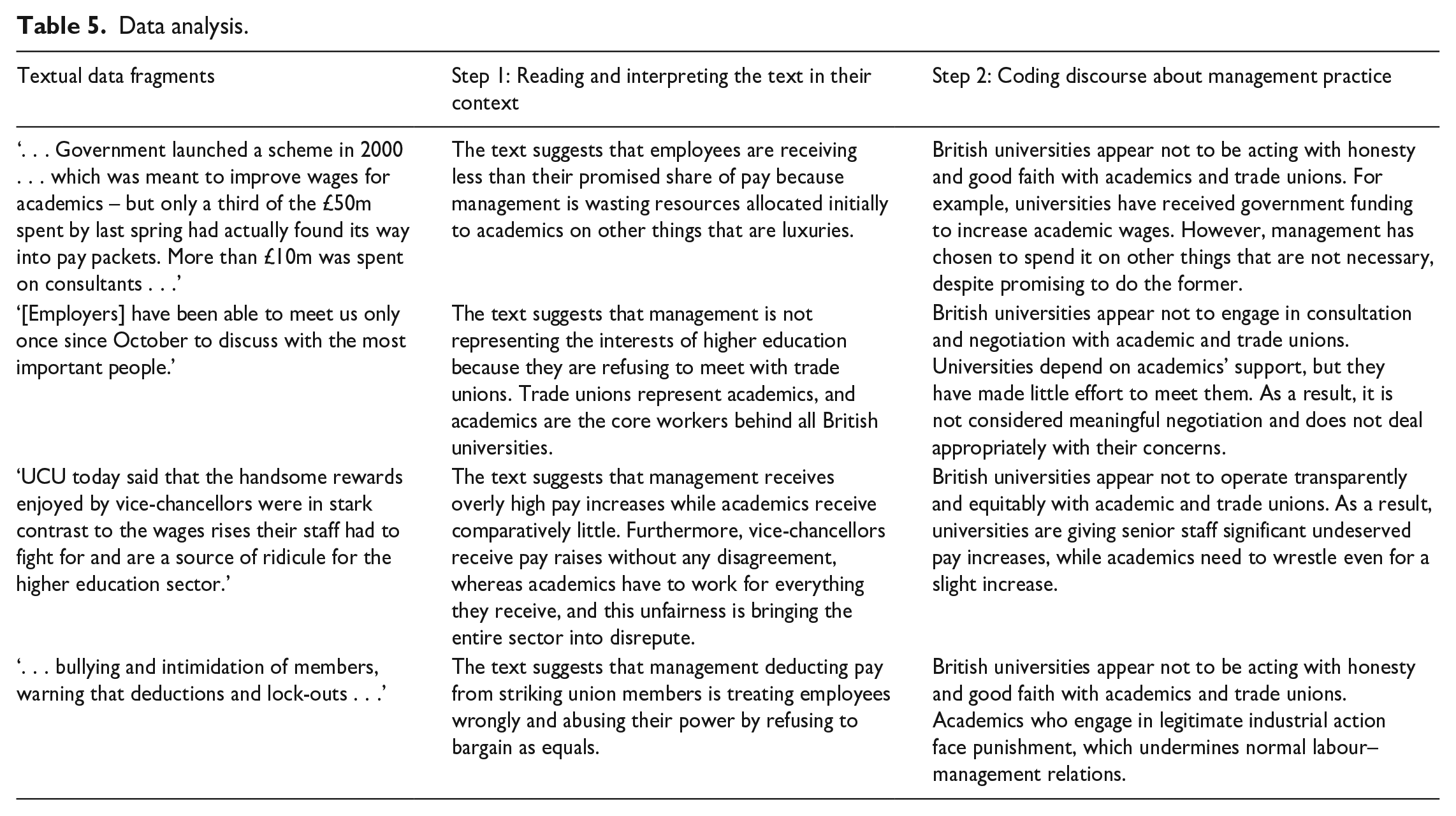
The article’s data analysis draws on ideas from grounded theory (Corbin and Strauss, 2014) and discourse analysis (Phillips and Hardy, 2002). First, the data were prepared by manually collecting textual data fragments about academic wages by reading and interpreting the text in their context. Second, data fragments were coded into discourses about management practice by describing their meanings using an iterative process to abstract the essence of each argument. The emphasis was on what causal relationships trade unions were making about academic wages and how it stigmatized British universities. Data fragments that made claims about academic wages but did not communicate why were discarded. Also, data fragments could receive multiple codes when they have multiple meanings. Table 5 illustrates the complete data analysis process.
Data analysis.
Three discourses
Consultation and negotiation
The discourse analysis suggests that trade unions stigmatized British universities during their campaigns for refusing to engage in consultation and negotiation. Trade unions implied that if British universities had engaged in normal labour–management relations, academic wages would be higher than the current level, and there would be no need for industrial action. Instead, British universities were undermining the spirit of institutional-level bargaining and ignoring meaningful discourse. Normalization was a primary source of legitimacy as debating, compromising and investing time and effort into reaching an agreement over academic wages appears commonsensical. However, British universities undertook no action and refused to engage with what academics and stakeholders considered valid concerns and usual processes.
UCU general secretary, Sally Hunt, said: ‘Despite our best efforts to resolve this dispute, we cannot negotiate with an empty chair. Our action will start today and will see thousands of UCU members at universities across the country stop going the extra mile.’
While trade unions depicted themselves as proactive and academics as altruistically working to support students at their own expense, British universities rejected participating in the mutually agreed collective bargaining processes. Exemplification was also a source of legitimacy for trade unions, and they detailed their various efforts to resolve disagreements over academic wages. Trade unions sought to find a solution by acting upon the dispute resolution process, but British universities were continually creating unnecessary problems through their lack of action: ‘The AUT would be happy to involve conciliation service ACAS in helping break the university’s imposed impasse,’ Ms Hunt said.
Trade unions also appeared confident about the morality of their claims and accepted independent scrutiny as a source of authorization. Moreover, they implied that the Advisory, Conciliation and Arbitration Service (ACAS) – a governmental institution set up to facilitate industrial relations – would agree with the concerns of academics and help them stigmatize British universities. However, British universities remained defiant and did not engage in meaningful consultation and negotiation, despite stakeholder criticism.
We must all hope that Tuesday brings an end to the dispute and the disruption to students’ work is stopped immediately. It is what the unions and the students want.
Trade unions did everything they could to discursively settle the disagreement with British universities and were even willing to accommodate to break the deadlock because of genuine concern about student welfare. Indeed, neither trade unions nor academics wanted to engage in industrial action. However, British universities forced trade unions to undertake industrial action repeatedly as there was no other way to resolve the dispute. British universities were in denial and contradicting the spirit of collective bargaining, despite previously agreeing to it.
Honesty and good faith
The discourse analysis also suggests that trade unions stigmatized British universities for refusing to act with honesty and good faith. The lack of trustworthiness of British universities made meaningful discourse difficult and undermined the integrity of collective bargaining. British universities would regularly mislead the public, participate in unnecessary fights against academics and use underhand tactics rather than offer a reasonable wage increase. Moralization was a primary source of stigma as British universities were not engaging in fair labour–management relations: They have refused to make us an offer, instead preferring to engage in a propaganda war of misinformation.
Trade unions rationalized that they were protecting higher education’s interests. At the same time, British universities focused on short-term cost savings and did not respect academics enough to pay them a fair wage. When academics engaged in industrial action because of no alternative, complaints about institutional bullying and poor management were relatively common. For example, as a punishment for engaging in strike action for a few hours, some British universities refused to give academics their wage for the day: Perversely, any universities that do dock a full day’s wages will ensure far greater disruption for their students, which suggests the approach has nothing to do with the welfare of staff or students and is based around penny pinching and bullying.
While British universities were not treating academics fairly, trade unions exemplified their action and were accommodating to British universities. Trade unions were proactively limiting academic wage increases to a level that would not jeopardize the sector’s competitiveness, which was a source of rational legitimacy. Whenever funding was scarce, trade unions were willing to accept a less-than-fair wage on the promise of future increases, to protect academic jobs and the education of students. However, later, British universities did not fulfil such promises: The union is angry that promises to ‘act on wages when we get extra funding’ from the employers have not been kept. When lobbying for top-up fees vice-chancellors promised the then higher education minister, Alan Johnson, that a substantial proportion of the new money would be spent on staff wages.
Instead, British universities manipulated the situation by using low academic wages as an excuse to levy more money from the government and students. When British universities received these monies, management refused to use them for this purpose: . . . Government launched a scheme in 2000 . . . which was meant to improve wages for academics – but only a third of the £50m spent by last spring had actually found its way into wages packets. More than £10m was spent on consultants . . .
Essentially, British universities were relying on the generosity of academics to work more than their wage merits, and trade unions naively believed that academics would receive a just pay increase when British universities received adequate funding. However, British universities instead spent the money on non-essential items, which exacerbated academic resentment and calls for industrial actions.
Transparent and equitable
Lastly, the discourse analysis suggests that trade unions stigmatized British universities for refusing to be transparent and equitable while dealing with trade unions and academics. Trade unions implied that British universities maintained their legitimacy only because they hid their unfair employment practices. However, higher education has significant problems with excessive senior pay, workload intensification, casualization and inequality. Trade unions regularly publicized these problems and linked increasing academic wages as one part of the solution, whereas British universities denied everything. Essentially, the lack of accountability allowed senior management to receive high salaries, despite poorly performing and mistreating academics.
If Sussex University were a primary school, our board of governors would be under investigation by OFSTED. The only area of growth they’ve overseen in the last five years is in the vice-chancellor’s salary.
Trade unions claimed the governance of British universities was inept and unable to deal with the selfishness and ignorance of senior management. The exemplification of hypocrisy was evident in how they treated academics, as claims about being overly frugal and subject to harsh bureaucratic surveillance were common. Indeed, academics were accountable, even when they were not at fault, whereas senior management concealed their mistakes. The worst consequence for senior management was resigning with a hefty payoff or receiving a promotion to another institution. The benefit for senior management, in contrast to academics, was that wages grew year after year without being subject to standard due diligence. Bureaucratic governance processes to ensure transparency, independent authorization and links to performance were missing and jeopardizing the integrity of British higher education: UCU general secretary, Sally Hunt, said: ‘The wages rises senior staff, in particular vice chancellors, have enjoyed in recent years have been a constant source of ridicule for higher education. There is no transparency or justification for the arbitrary, and usually enormous, rises they receive.
Trade unions also claimed that academics suffer from a deteriorating working environment, intensifying workloads and everyday use of casualization. Essentially, the increasing use of contemporary accountability and performance indicators – university league tables, workload planner systems, employee performance appraisals, research quality exercises, teaching quality exercises, journal rankings and bibliometrics – made academics’ working lives worse. British universities were continually pressuring academics into doing more work – whether teaching, research or administration – but with fewer resources, and there was a continual ratcheting of performance expectations. As a result, many academics suffered from emotional distress, burnout, poor work–life balance, loss of dignity and health problems. However, British universities appeared unwilling to give academics a wage rise for the increase in work and lack of job security, as illustrated below: The wages settlement in 2017/18 for the majority of HE staff was yet another below inflation uplift. This is against a backdrop of staff reporting ever increasing workloads, increasing casualization and working hours and increased work-related stress.
Finally, trade unions cited problems with gender, race, disability, age inequality and tackling homophobia and transphobia. While homophobia and transphobia were recent concerns, the other concerns spread across the 18 years. It is unfair that the pay gaps and promotion prospects of these categories of academics are inferior to others, and trade unions were advocating on their behalf to promote equality in British universities. While this issue was not explicitly about raising the wages of academics in the traditional collective bargaining sense, it focused on marginalized groups and was intertwined. Trade unions used this to illustrate how British universities take advantage of unfair employment relationships and stigmatize them for it.
Discussion
The preceding results are one-sided, and it is possible that trade unions and the three discourses above falsely represented British universities. Nevertheless, this article does not seek to provide a balanced account or uncover an objective reality. Instead, it investigates what meanings trade unions created to stigmatize employers and legitimize wage increases for academics. An organization studies based analysis shows that trade unions stigmatized British universities during their campaign by accusing them of not engaging in consultation and negotiation; acting with honesty and good faith; or being transparent and equitable.
As discussed in the background section, these discourses have not changed management practice sufficiently, and academic wages have not matched economic growth in the sector, despite the frequent use of industrial action. While critics could argue that academic wages would be lower without trade union involvement and sector-level bargaining, it is equally possible to speculate that academic wages would be higher if things were different. Critics may also argue that it is necessary to examine the discourses British universities produce and create a complete account before making any conclusions. However, trade unions have no control over the discourse that British universities create. How trade unions position themselves relative to the institutional environment determines the legitimacy of their discourse. The institutional environment provides the structure for interpretation (Phillips and Malhotra, 2008; Phillips et al., 2004), which British universities, trade unions and other stakeholders collectively reproduce.
While the three discourses present a convincing and sophisticated case for why academics should receive a wage increase, a critical analysis highlights a disconnection between trade union discourse and the institutional environment. Following financialization (Epstein, 2005) and economic hegemony (Ferraro et al., 2005; Lazear, 2000), the institutional environment of British higher education appears to prioritize money and performance over other concerns. However, the three discourses discussed in the previous section show that trade unions embraced pluralism and were driven primarily by moral framing. Indeed, the first discourse discussed beliefs about needing consultation and negotiation, which are the foundations behind a meaningful partnership, cooperative relations and industrial democracy (Saridakis et al., 2017). Essentially, collaboration based on mutual benefit is the modern agenda for industrial relations (Johnstone and Ackers, 2015). Without dialogue and debate, there cannot be any constructive collective bargaining or management–labour relations. Trade unions accused British universities of ignoring their moral duty and failing academics, students and higher education by refusing to engage with trade unions meaningfully. However, this discourse also lacks efficacy, as the need for consultation and negotiation over academic wages ignores the inherent conflict between trade unions and British universities. The latter seek to maximize their performativity by limiting labour costs. Consequently, financialization encourages distributing income away from wages to increase profits (Palley, 2013), which is both common and legitimate management practice within the current institutional environment.
The second and third discourses also argued that British universities ignored their moral duty. In support of the former, honesty and good faith are necessary to establish cohesive labour–management relations because a formal contract cannot cover every employment detail (Guest, 2016). Trust is necessary for cooperation, but the importance extends beyond business instrumentality (Radoilska, 2008). British universities acted immorally by lying to trade unions, which conflicts with broader society. Similarly, transparency and equity are components of procedural and distributive justice. While there is a rich philosophical underpinning (Cropanzano et al., 2007), the core claim was that British universities were not building fairness into their management practices and were treating their employees unjustly. Inequality of treatment between senior management and rank-and-file academics was a source of hypocrisy, and this discrimination also extended to protected characteristics. However, like in the first discourse, there is no recognition of economic framing, making it possible for British universities to engage in bargaining and cooperation; act with honesty and goodwill; and be transparent and equitable without needing to give academics a wage rise.
It is likely that trade unions strategically produced these discourses because pluralism enabled them to tap into multiple sources of legitimacy by interlinking academic wages with other management practices. Essentially, it allowed trade unions to craft multiple justifications for why increasing academic wages was legitimate and to appeal to different stakeholders with different perspectives (Lamin and Zaheer, 2012). Trade unions could simultaneously draw upon justifications like exemplification, normalization, moralization, rationalization, authorization and narrativization (Vaara and Monin, 2010; Vaara and Tienari, 2008; Vaara et al., 2006). Furthermore, these justifications fit with prioritizing moral legitimacy (Suchman, 1995), which the academic literature suggests is more influential than pragmatic and cognitive legitimacy (Prasad et al., 2016). However, this strategy was unsuccessful in the case of matching academic wages to economic growth in the sector. While trade unions might reflect academic concerns by relating this plethora of issues to academic wages, institutional environments already have plurality and uncertainty when defining legitimacy (Meyer and Höllerer, 2016; Seo and Creed, 2002). Promoting plurality is making the institutional environment more complex by mixing up the boundaries between management practices.
While trade unions are building organic solidarity through alignment with broader societal questions (Grady and Simms, 2018), the gap between discourse and the institutional environment may help explain why trade unions have not been able to match academic wages with economic growth. As discussed, the belief about how market competition rewards employees is a significant basis for legitimacy (Lazear, 1995; Milgrom and Roberts, 1992). Consequently, the rationale for a pay increase is that academics must collectively or individually contribute more to British universities to deserve more money. However, trade unions chose to conflate wages with other management practices based primarily on morality rather than economic rationality. Exactly why trade unions did not try to legitimize increases in academic wages during their campaign based on pragmatism is unknown.
However, the spirit of collective bargaining requires solidarity that pluralism and morality reinforce. Plurality helps build unity because while not every concern is essential to every academic, if trade unions represent enough variety of concerns, they can cover most academics. For example, campaigning against casualization might not be in the pragmatic interest of older established academics, but academics are united when combining the issue with protecting pension provisions. Pragmatic legitimacy is about trade unions representing and improving the self-interests of members, and representing multiple issues allows them to maximize their scope for support. Consequently, both young and old academics support trade union action. Secondly, trade unions move the focus from pragmatic legitimacy to moral legitimacy. Supporting these issues is not about whether it is in the individual’s interest but is about right and wrong. Morality provides a basis for solidarity even when advocating for proposals not in the individual’s self-interest. For example, campaigning for gender inequality might not be in the pragmatic interest of male academics, but everyone supports it because of concern about justice. Morality, unlike economics, marginalizes the role of competition between academics and standardizes academic pay scales across most British universities by linking them to time served rather than ability. The lack of competition promotes comradeship between academics while campaigning for mutual wage increases, but it also unifies British universities against academics. British universities compete amongst themselves over student fees, teaching metrics, research income and research rankings, but they do not compete over wages to attract academics that create these ends.
In the current industrial relations system, striking is the most potent action to win a wage increase and requires members to unilaterally sacrifice their income or self-interest for the greater good. However, unlike conventional organizations, this does not impact the profitability of British universities as students continue to pay their fees regardless. Instead, it makes the university richer because academics that do not strike may cover teaching for no extra pay or replace the lecture with a recording. In contrast, academics that do strike receive wage deductions. Although trade unions may be more successful in other important issues – like workload, anti-casualization and gender inequality – pay has been discursively conflated and marginalized as though self-interest and pragmatism are not legitimate reasons within themselves. Shifting industrial relationship scholarship and practice towards the less sophisticated belief that staff pay should match economic growth in the sector could be more fruitful in gaining legitimacy. Simply, academics are performing to a higher standard in quantity and quality of publications, research grants and teaching and therefore deserve more pay to reflect this.
Conclusions
Scholars within organization studies have proposed strategies to maintain and frame legitimacy (Vaara and Monin, 2010; Vaara and Tienari, 2008; Vaara et al., 2006), but rarely have they discussed how third parties such as trade unions create stigma. It emerged from the case study that trade unions stigmatized British universities for not engaging in consultation and negotiation; acting with honesty and good faith; or being transparent and equitable. These discourses used pluralism and morality to legitimize increasing academic wages. However, neo-institutional theory suggests that legitimacy requires discourse to reflect the institutional environment. Consequently, trade unions may succeed more by embracing financialization within British higher education. The current trade union strategy centres around building organic solidarity through alignment with broader societal questions (Grady and Simms, 2018) rather than meeting the pragmatic interest of individuals. Yet, trade unions are potentially missing the opportunity to leverage the competition between British universities over attracting the best academic staff by linking the 51-point pay spine to individual or performance and legitimizing a yearly wage rise to match economic growth in the sector.
Lastly, there are potential risks with embracing economics and accepting the institutional environment of financialization for trade unions. The first is that the balance could swing the other way entirely, with ethics becoming unimportant, which is not the intention of this article. Issues like workload, anti-casualization and inequality have value and require a separate campaign with a different rationale. The second is that trade unions could become a subject of financialization rather than the master. Accepting financialization may inadvertently legitimize hyper-competition, job intensification, privatization and managerial autocracy. These trends often make working life worse for academics, and caution is needed. The third is that trade unions may marginalize stakeholders who believe British higher education is altruistic and serves a higher purpose. Acknowledging money and performance within trade union discourse lowers academics to the same level as British universities, which may conflict with the identity of activists and the socially responsible image of trade unions. Finally, it may stop trade unions from campaigning to transform the institutional environment and opposing financialization, which, if successful, would likely improve the working life for academics.
Footnotes
Declaration of conflicting interests
The author declared no potential conflicts of interest with respect to the research, authorship, and/or publication of this article.
Funding
The author received no financial support for the research, authorship, and/or publication of this article.
