



Abstract
This article studies how organizational commitment is shaped by individual and macro-level factors. Drawing upon data from the 2015 International Social Survey Program (ISSP) and using multilevel modeling, the article shows that workers have less organizational commitment than employers. The article also presents evidence indicating that strong trade unions are positively correlated with organizational commitment. Finally, contrary to the hypothesis derived from previous studies, cross-level interactions suggest that in countries with strong corporatist industrial relations (IR) institutions, union members have lower levels of organizational commitment than non-union members. The article discusses how the findings contribute to the literature on class, neo-corporatism, and power resources. In addition, it reflects on how the findings contribute to the recent debate on the ‘neoliberal convergence’ of IR systems.
Introduction
The study of attitudes to work has occupied a central place in social sciences. IR scholars and sociologists have long analyzed how individual-level variables such as social class and membership in trade unions shape different (and sometimes opposing) attitudes towards work and employment relations (Hult, 2005; Ringqvist, 2021; Svallfors, 2006). Likewise, human resources scholars have long studied how sociodemographic factors and individual workplace experiences shape work outcomes such as job satisfaction, turnover intentions, and organizational commitment (i.e., the extent to which employees identify with the company’s goals and values) (Hult, 2005; Kelliher and Anderson, 2010; Kurtessis et al., 2017; Nazir et al., 2016).
Building upon the power resources approach and the literature on neo-corporatism (e.g., Kenworthy, 2003; Korpi, 1985; Schmitter, 1974), recent investigations have used multilevel modeling to analyze how institutional and political factors such as the existence of corporatist IR institutions and the relative strength of trade unions help explain cross-national differences in attitudes to work. This research has shown that when labor regulations are stricter or when union power is stronger, work is less intensive and job security is higher. In these cases, workers not only perceive higher levels of job autonomy and security, but they also tend to be more satisfied with their jobs (Adăscăliței et al., 2021; Edlund and Grönlund, 2010; Esser and Olsen, 2012; Hipp and Givan, 2015). In presenting these findings, this research has emphasized the need to use a multilevel approach to analyze how micro- and macro-level factors shape employment relations and the way employees perceive them. For instance, Hipp and Givan (2015) used multilevel modeling and found not only that the relationship between union membership and job satisfaction varies significantly across countries, but also that this relationship is contingent on countries’ IR systems. This finding led them to conclude that to understand how union membership influences work outcomes, we must consider the larger context in which unions operate (2015: 367–368).
Despite this, no investigation has used multilevel modeling to study how micro-level variables such as union membership and social class and contextual factors such as corporatism and trade union power help explain national variations in organizational commitment. In fact, although the relationship between class and employees’ commitment to the organization has been studied in a few countries (Hult, 2005; Svallfors, 2006), to date no study has analyzed how contextual factors influence organizational commitment, let alone how these contextual factors moderate the relationship between, say, class and employee commitment. The lack of systematic research is surprising, considering that analyzing organizational commitment is crucial for understanding employment relations, workplace behavior, and organizational outcomes such as job performance (Meyer and Allen, 1991; Mowday et al., 1979; Nazir et al., 2016).
In this article, I fill this gap in the literature by studying how organizational commitment is shaped by individual-level and macro-level variables. Drawing upon data from the 2015 International Social Survey Program (ISSP) survey, I fit multilevel models with random intercepts and random slopes to analyze, first, how class position and union membership status shape organizational commitment. Next, I study if corporatism and trade union power produce significant effects on employee commitment. Finally, I examine whether the effect of class position and union membership on organizational commitment differs across countries with varying levels of corporatism and trade union power. The results of these models support some of my hypotheses and contradict others. Consistent with my hypotheses, they show that workers are less committed to their organization than employers, and that union members are less committed than non-union members (although in this latter case, the effect of union membership is not significant when random slopes are included in the model). In line with my hypothesis, the results also suggest that trade union power is positively correlated with organizational commitment. Nevertheless, the results of cross-level interactions do not allow me to establish that corporatism and trade union power reduce the effect of class and union membership on organizational commitment. Moreover, the results contradict the hypotheses deduced from the literature on neo-corporatism and power resources, and suggest that in countries with higher levels of corporatism, union members are less (not more) committed to the organization than non-union members.
At the end of the article, I reflect on how these findings contribute to the literature on class, neo-corporatism, and power resources. In doing so, I discuss how the results of the cross-level interactions are more consistent with the research on class than with some of the hypotheses derived from the literature on neo-corporatism and power resources. Finally, I also discuss how my findings contribute to the recent debate on the ‘neoliberal convergence’ of IR systems (Baccaro and Howell, 2017; Streeck, 2009). I argue that, even if we recognize a move towards more ‘disorganized’ political economies, we should not assume that national differences in IR institutions and in the relative power of labor unions are irrelevant to analyzing the dynamics of cooperation or conflict that take place in the workplace.
Organizational commitment in empirical research
Organizational commitment is an attitude that refers to ‘a state in which an individual identifies with a particular organization and its goals and wishes to maintain membership in order to facilitate these goals’ (Mowday et al., 1979: 225). According to Meyer and Allen (1991: 73–74), organizational commitment involves not only a desire to maintain membership in the organization (‘affective commitment’), but also a need to remain in it that arises from recognition of costs associated with leaving (‘continuance commitment’) as well as an obligation to remain in the organization arising from the internalization of loyalty norms (‘normative commitment’).
Building upon this definition, empirical research has demonstrated that organizational commitment is shaped by several individual and work-related factors. Human resources scholars have shown that organizational commitment is affected by employees’ workplace experiences and perceptions of human resources management practices. These scholars have established that organizational commitment is higher when workers feel that they are recognized and respected by the organization (Kurtessis et al., 2017), when they are satisfied with the rewards offered by the organization (e.g., stable employment and job autonomy) (Bernhard-Oettel et al., 2011; Hult, 2005; Nazir et al., 2016), or when organizations establish work arrangements such as reduced working hours and compressed working time, which enable employees to balance work with other aspects of their life (Kelliher and Anderson, 2010). Conversely, organizational commitment is lower when employees feel that their job is unsecure or when they experience pay reductions (Bernhard-Oettel et al., 2011; Wang and Seifert, 2017).
According to several scholars, these results are consistent with social exchange theory. This theory views organizational commitment as the result of a process of interaction in which workers expect their employers to offer secure jobs and good human resource management practices in exchange for loyalty and commitment (see, e.g., Bernhard-Oettel et al., 2011; Kelliher and Anderson, 2010; Nazir et al., 2016).
Class, unions, and organizational commitment
Sociologists and IR scholars have long studied how class and membership in unions affect individual perceptions and attitudes. However, unlike the literature on human resources, class analysts have paid little attention to organizational commitment.
Scholars interested in class have shown that class position is a significant individual-level determinant of people’s attitudes towards work and workplace dynamics. For example, they have demonstrated that non-managerial workers perceive (and have) less job autonomy, job security, and control over their work schedule than high-level managers or the self-employed (Esser and Olsen, 2012; Gallie, 2003; Lyness et al., 2012). Similarly, the few studies on the relationship between class and organizational commitment have shown that, compared to employers or managers, non-managerial workers tend to be less committed to the organizations in which they work (Hult, 2005; Svallfors, 2006). Svallfors (2006: 44) analyzed the cases of Germany, Great Britain, Sweden, and the US, and found that the self-employed and the higher managerial classes had the highest levels of organizational commitment. He also found that the differences between classes decreased – but still remained significant – after controlling for individual work perceptions (e.g., perceptions regarding job rewards) (2006: 48–49).
Scholarly research has explained these subjective effects of social class by emphasizing different (but not mutually exclusive) mechanisms. Svallfors (2006) contends that classes differ in their attitudes to work because they have diverging ‘moral economies’, i.e., different normative dispositions towards distributive justice. Wright (1997), on the other hand, argues that workers are members of the exploited class, and therefore are more prone to hold ‘anti-capitalist’ interests than employers (the exploiting class) and the members of the ‘middle-class’ who are located in contradictory class locations (that is, positions where they simultaneously occupy the roles of exploiter and exploited).
Wright’s analysis departs from other approaches to class, such as that developed by Erikson and Goldthorpe (1992). Erikson and Goldthorpe contend that the transformation of property into corporate forms and the bureaucratization of large firms resulted in the formation of a new ‘service class’ made of higher-grade professionals, managers, and large proprietors. Based on this premise and on a conceptualization of employment relations rooted in the distinction between ‘service’ and ‘labor’ contracts, they proposed an influential Weberian-inspired class scheme that, unlike the Marxist scheme developed by Wright (1997), does not depend on the identification of a ‘capitalist’ (employer) class. Without neglecting the structural transformation of property noted by Erikson and Goldthorpe, Wright presents an alternative view. He argues that ownership of the means of production continues to be a central criterion to identify classes. Not only does it give rise to a basic class distinction between those who hire (and exploit) workers and those who sell their labor power (and are exploited), but in doing so it also shapes the basic contours of class conflict and, by extension, of individual attitudes to work.
Scholars have made similar arguments regarding the subjective effects of union membership. In their classical study of unions in the US, Freeman and Medoff (1984) showed that unions not only represent the collective voice of workers but also, in doing so, facilitate communication between workers and management and potentially help to ameliorate workplace conflict. However, Lewin (2005: 213) argues that unions are much more than a channel to communicate workers’ concerns to management: in representing the voice of their affiliates, unions also build collective power to ‘win more’ at the expense of their employers – e.g., to win more protective work rules or more money to settle grievances. According to Lewin and Boroff (1996), this explains why union members are more likely to file grievances and less likely to be loyal to their employers than their non-union counterparts.
Consistent with this idea, other investigations have shown that union members tend to be less satisfied with their jobs (or with some aspects of it) and be less committed to the organization’s goals and values than non-unionized workers (Green and Heywood, 2015; Hipp and Givan, 2015; Laroche, 2016; Lincoln and Boothe, 1993). Lincoln and Boothe (1993), for example, compared the effects of union presence in American and Japanese workplaces, and found that in the two countries organizational commitment was significantly lower in unionized workplaces. Although it is not clear to what extent unions cause these subjective outcomes, such a relationship has proven to be both strong and robust (see, e.g., Green and Heywood, 2015). Moreover, research studies have found that unions reinforce the political attitudes of workers and that union members are more willing to mobilize against employers than their non-unionized counterparts (Dixon et al., 2004; Kerrissey and Schofer, 2018; Wright, 1997).
Based on the evidence outlined above, the following hypotheses can be proposed:
H1a: People located in the working class (or in an adjacent class position) have lower levels of organizational commitment than individuals located in the managerial or self-employed classes (employers or petite bourgeoisie).
H1b: Union members are less committed to the organization in which they work than non-union members.
Corporatism, trade union power, and industrial relations
In recent years, research has begun to develop multilevel frameworks to analyze how political and institutional macro-level variables shape individual perceptions and attitudes towards class relations, and the workplace in particular. Within this literature, two key variables have been proposed: the existence of corporatist IR systems and the degree of trade union power (Edlund and Grönlund, 2010; Kerrissey and Schofer, 2018; Ringqvist, 2021).
These two variables have long been emphasized in the literature on neo-corporatism and power resources as they represent two central (and closely interrelated) features of IR systems and the welfare state (Jahn, 2016; Kenworthy, 2003; Schmitter, 1974). The literature on neo-corporatism uses the concept of ‘corporatism’ to refer to a form of interest representation established in Nordic and continental European countries after the Second World War and based on centralized IRs and state-sponsored pacts between powerful, hierarchically organized and highly institutionalized unions and employer associations. Democratic corporatist arrangements differ from ‘pluralist’ (liberal), decentralized systems of representation, predominant in Anglo-Saxon countries, where social actors are organized in multiple, competitive, and non-hierarchical associations (Kenworthy, 2003; Schmitter, 1974). Therefore, the existence of corporatist arrangements is closely associated with strong trade unions. Compared to class actors in pluralist systems, unions in corporatist systems are not only more powerful and all-encompassing, but also more actively involved in tripartite social dialogue and policymaking. Therefore, they have a more prominent political role as representatives of class interests (Kenworthy, 2003; Traxler et al., 2001).
These political and institutional divergences between corporatist and non-corporatist systems have important implications for employment relations. In corporatist countries, the existence of centralized bargaining and all-encompassing unions reduces the uncertainty during the bargaining process and facilitates the moderation of wage demands by raising union leaders’ awareness of the economic effects of wage increases – most notably, inflation and unemployment (Brandl and Traxler, 2010; Calmfors and Driffill, 1988). Corporatist institutions also favor the political inclusion of unions which in turn enables them to push for more protective labor legislation (Edlund and Lindh, 2015; Korpi, 1985). As a result, in corporatist IR systems workers have higher levels of job autonomy and security than in decentralized systems (Edlund and Grönlund, 2010; Esser and Olsen, 2012).
Over the last decade some scholars have contended that the institutional and political distinction between corporatist and non-corporatist IR systems has become blurred as a result of neoliberal globalization (Baccaro and Howell, 2017; Streeck, 2009). According to Baccaro and Howell (2017), starting in the 1980s neoliberal globalization increased the pressure on policymakers to deregulate national political economies and augmented employers’ power to demand the liberalization of IR. This resulted in the convergence of national political economies around a common trajectory of liberalization, which has involved the ‘disorganization’ of economies, the expansion of employers’ discretion in IR and labor markets, and the decline of union membership rates (see also Gumbrell-McCormick and Hyman, 2018).
Without denying these effects of neoliberalism, recent investigations have presented evidence suggesting that national variations in the degree of corporatism and trade union power continue to be crucial for explaining differences in class perceptions and attitudes to work. In countries where the welfare state is stronger the aggregate perceptions of ‘social conflict’ – i.e., perceived conflict between classes – are lower than in market-oriented economies (Edlund and Lindh, 2015). Likewise, in countries where unions are routinely involved in corporatist policy formulation, individuals are less likely to perceive conflict between workers and managers (Ringqvist, 2021).
To my knowledge, no study has used multilevel modeling to address the question of how corporatism or trade union power affect employees’ organizational commitment. However, the existing comparative research suggests that when unions are strong, workers not only have more chances to participate in decision-making on the job, but they are also more likely to have higher levels of job autonomy and security (Edlund and Grönlund, 2010; Esser and Olsen, 2012; Gallie, 2003). In line with this, Hipp and Givan (2015) demonstrate that in countries with high bargaining coverage, workers are more satisfied with the material aspects of their work, i.e., income, security, and advancement opportunities. Therefore, it can be posited that:
H2a: There is a positive relationship between corporatism and organizational commitment.
H2b: There is a positive relationship between trade union power and organizational commitment.
Building upon these findings, recent research studies have also analyzed whether the effect of individual-level variables is conditional on contextual political and institutional factors. Edlund and Lindh (2015) show, for instance, that in strong welfare states, class attitudes towards redistribution are more polarized than in countries where the welfare state is less developed. They explain this significant interaction effect by contending that welfare states politicize inequality and redistribution, thereby enhancing class differences in attitudes. This explanation resembles the argument developed decades ago by Wright (1997: 433–440) and Svallfors (2006: 74). Although not relying on multilevel modeling strategies, these two authors contend that in countries with more developed welfare states workers are more ‘class conscious’ because left parties and unions are more powerful.
Nevertheless, when it comes to attitudes to work, recent investigations suggest that the relationship between these micro- and macro-level variables may be the opposite. In their study of perceived job autonomy, Esser and Olsen (2012: 451) found a negative interaction effect between class position and trade union power. This means that although employees of lower socioeconomic position perceive less job autonomy, this negative effect is lower in countries with stronger labor movements. Regarding the interaction effects between macro-level variables and individual union membership, the evidence points to the same direction. In a recent study of perceptions of worker–management conflict, Ringqvist (2021: 141) found a negative (but insignificant) interaction effect between trade union power and union membership, which suggests that stronger union power may reduce the positive effect of union membership on people’s perceptions of labor conflict. Furthermore, Hipp and Givan (2015: 365) found that in countries with high bargaining coverage, union members are more satisfied with the material aspects of their jobs. Hipp and Givan explain this finding by arguing that bargaining coverage is associated with lower wage dispersion. In other words, they argue that union members’ job satisfaction ‘increases if the collective bargaining system contributes to a more equal wage distribution by ensuring wide coverage and centralizing the wage coordination process’ (2015: 367).
Based on this evidence, two hypotheses can be formulated:
H3: Where corporatism (H3a) or union power (H3b) is high, the negative effect of class location (e.g., of being a worker) on organizational commitment is smaller than where they are low. In other words, in countries with higher levels of corporatism/union power, workers are more committed to the organization than their counterparts from countries with low levels of corporatism/union power.
H4: Where corporatism (H4a) or union power (H4b) is high, the negative effect of union membership on organizational commitment is smaller than where they are low. In other words, in countries with higher levels of corporatism/union power, union members are more committed to the organization than their counterparts from countries with low levels of corporatism/union power.
Data and methods
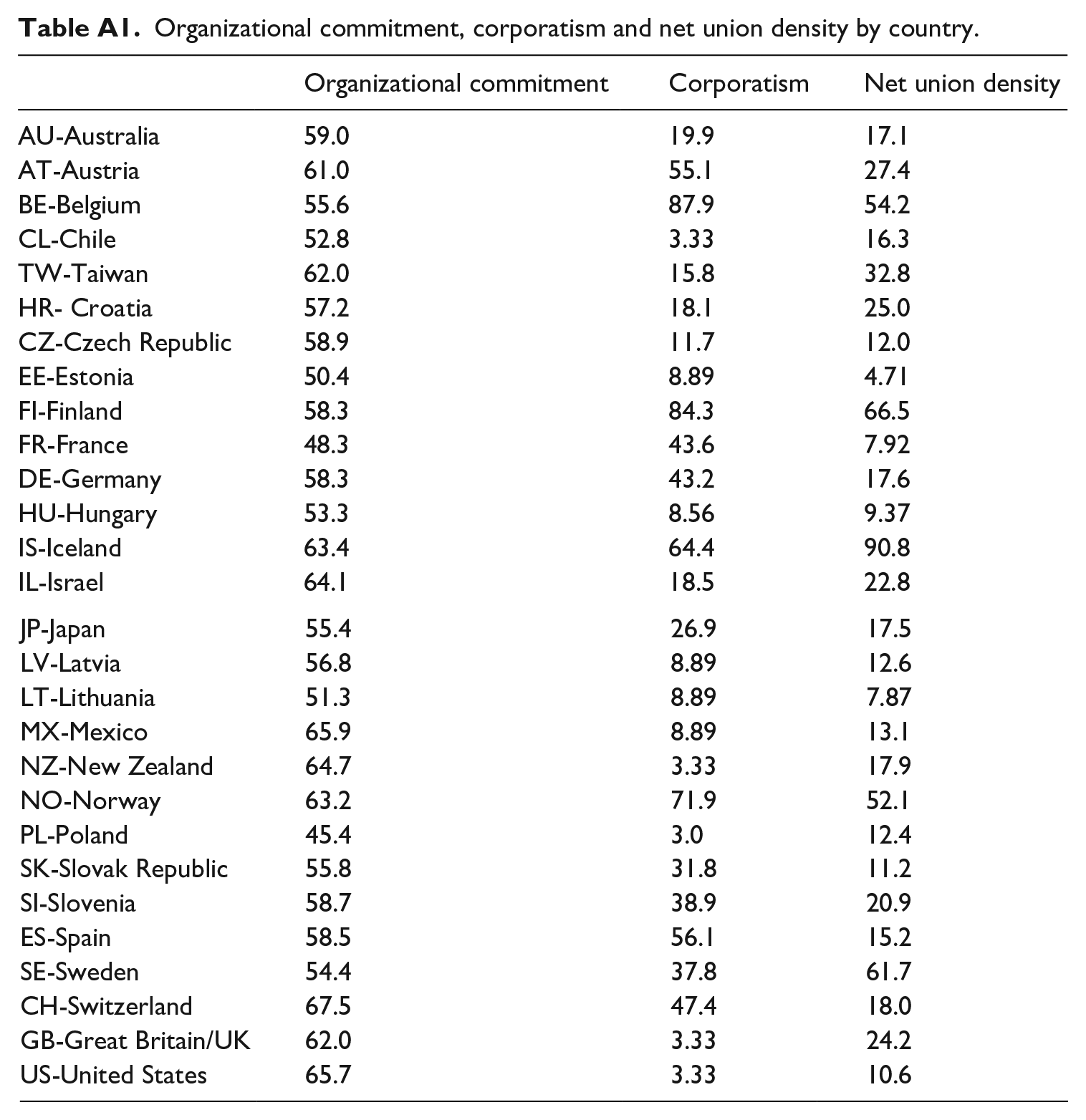
For this article, I analyzed data from the ISSP 2015, module ‘Work orientations’. This survey includes a set of questions that allowed me to operationalize the dependent variables (organizational commitment) and the individual-level independent variables (e.g., class location and union membership status). I restricted my analysis to 28 countries with data on the two contextual variables of interest (corporatism and trade union power). My sample of countries included liberal market (pluralist) economies (e.g., the UK and the US), continental European and Nordic countries that have or used to have strong corporatist IR institutions (e.g., Austria, Belgium, Germany, Finland, Iceland, Norway, and Sweden), as well as other continental or southern European nations (e.g., France and Spain). Unlike other similar studies, my sample also included emerging economies from Latin America (Chile, Mexico), Central or Eastern Europe (e.g., Croatia, Hungary, Poland), and Asia (Taiwan) (see Table A1, Appendix).
In total, after listwise deletion, my sample included 16,835 individuals nested in 28 countries. Although the number of level-2 units (countries) is not exceptionally large, it is large enough to produce reliable estimates from multilevel linear models, provided that the models include a small number of level-2 variables (Bryan and Jenkins, 2016).
Method: Multilevel analysis
The hypotheses that lead this study were tested using multilevel linear models (MLMs). MLMs are appropriate when we analyze datasets that include observations (individuals) nested in upper-level units (countries). In these cases, the standard linear regression model assumption of independence of observations, which states that the residuals for any two observations in the population are independent of one another, is not met. When this assumption is violated and the hierarchical structure of the data is ignored, the standard errors of the regression coefficients are underestimated, leading to an overestimation of the test statistic and to an increase in the probability of Type I error (Finch et al., 2019: 29). In theoretical terms, MLMs are also appropriate when we are interested in analyzing the relationship between a dependent variable and independent variables that measure attributes of both individuals (level-1 units) and countries (level-2 units) (Bryan and Jenkins, 2016).
To test the hypotheses of this study, I estimated several MLMs through a sequence of four steps (Aguinis et al., 2013). First, I fit a null model, which omits independent variables and only allows intercepts to vary across countries. This model enabled me to compute the intraclass correlation (ICC), which quantifies the proportion of the total variation in the level of organizational commitment explained by country differences. Then, I estimated random intercept models, which allowed the intercepts to vary across countries and included individual- and country-level independent variables. In the third step, I fit models with random slopes for the two main independent variables (social class and union membership). These models add a random component for the independent variables, and allowed me to assess whether the relationship between the dependent and the level-1 independent variables varies across countries. Finally, in the fourth step, I estimated models with cross-level interaction terms.
All the models were estimated using the lme4 package in R (Bates et al., 2015).
Dependent variable
The dependent variable was ‘organizational commitment’. Similar to previous studies (e.g., Bernhard-Oettel et al., 2011; Kehoe and Wright, 2013; Svallfors, 2006), this was measured through an additive scale constructed through the summation of the following Likert-type statements (the coding scheme of the variables was reversed so higher scores denote higher levels of organizational commitment):
I am willing to work harder than I have to in order to help the firm or organization I work for succeed (1 = Strongly disagree to 5 = Strongly agree)
I am proud to be working for my firm or organization (1 = Strongly disagree to 5 = Strongly agree)
I would turn down another job that offered quite a bit more pay in order to stay with this organization (1 = Strongly disagree to 5 = Strongly agree)
The variables were summed up to create an additive scale of organizational commitment. To facilitate interpretation the scale was transformed into a 0 to 100 score. Statistical analyses suggested that this scale is internally consistent and unidimensional, and that the three variables used to construct it are manifestations of the same latent construct (Cronbach’s alpha = 0.68; Factor Analysis [Principal Axis Method]: Eigenvalue = 1.39; Explained variance = 46%).
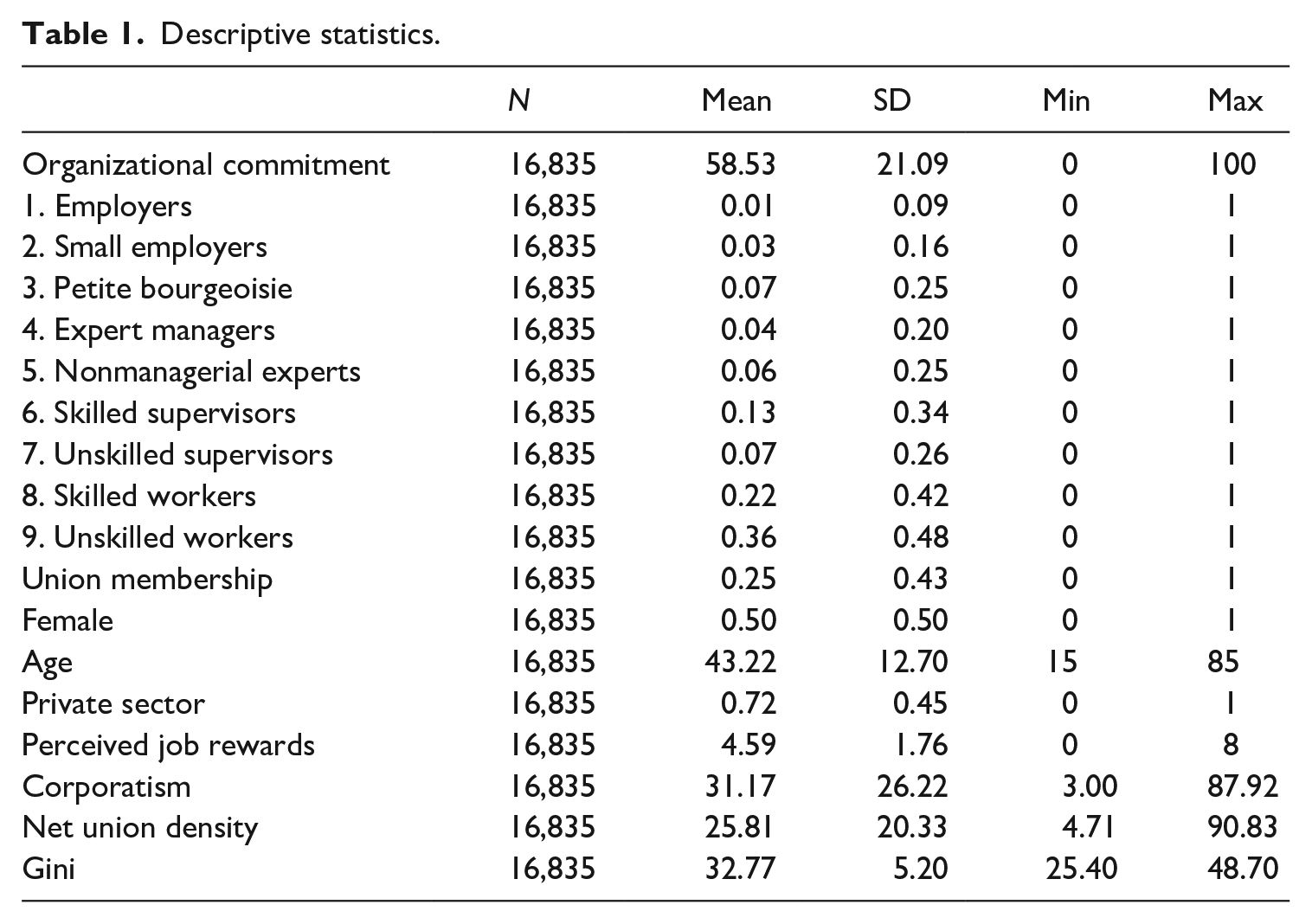
The descriptive statistics for this variable and the independent variables are shown in Table 1.
Descriptive statistics.
Individual-level independent variables and controls
Class location
This variable was measured using a modified version of Wright’s (1997) class schema. According to Wright, class locations refer to the social position occupied by individuals within relations of exploitation. To operationalize this idea, Wright distinguishes class positions on the basis of three criteria: (1) the private ownership of means of production; (2) the level of skills; and (3) the possession of ‘organizational assets’ (authority) within the production process.
Within the first criterion – ownership of means of production – I distinguished between: (1) Employers (owners of firms with 10 or more employees); (2) Small employers (with between 1 and 9 employees); and (3) Petite bourgeoisie (self-employed). Based on the second criterion (skill level) and third criterion (authority), I created six categories of salaried class position. In relation to skill levels, I distinguished wage earners according to their condition as experts, skilled laborers, or unskilled laborers. To do so, I used the ISCO-08 codes aggregated to two digits. Then, I corrected the ‘experts’ category for education levels so experts were those employed in occupations belonging to ISCO groups from 10 to 26 who had also completed some post-secondary education. The remaining occupational groups were classified as either skilled workers (groups 30 to 35, as well as groups 60, 61, and 72 in the ISCO-08 code) or unskilled workers (groups 40 to 54, groups 62, 63, 70, and 71, and groups 73 to 96). Finally, the ‘authority’ dimension allowed me to differentiate between managers/supervisors and wage earners without supervisory authority. Though my dataset does not offer distinctions between the three authority levels proposed by Wright (1997: 74–90), the survey data at least distinguish between those who worked in a supervisory capacity and those who did not. Taking all these criteria into account, the six categories created to differentiate salaried class locations were: (4) Expert managers, (5) Nonmanagerial experts, (6) Skilled supervisors, (7) Unskilled supervisors, (8) Skilled workers, and (9) Unskilled workers.
Taken together with the three business owner categories described above, my class schema contains nine class positions in total.
Unionization
Union membership was measured with a dummy variable (1 = union member; 0 = non-union member).
Controls
My analyses also included the following controls: age (in years), gender (0 = male; 1 = female), and sector of employment (0 = public; 1 = private). Following recent research that shows that organizational commitment is also affected by how employees perceive the rewards (e.g., job security and income) offered by the organization (Bernhard-Oettel et al., 2011; Kurtessis et al., 2017; Nazir et al., 2016), I included a variable to control for individual differences in perceived job rewards. This variable was measured through a 0 to 8 scale, and was constructed through the summation of two Likert-type statements which measured whether the respondents perceive that their work is secure and their income is high. 1
Country-level independent variables and controls
The first country-level variable is labor power. This variable was measured by means of the net union density rate, which is one of the most commonly used indicators of trade union strength (Traxler et al., 2001). The data were obtained from the OECD/AIAS ICTWSS database (Visser, 2019) and refer to 2015 or the closest year with available data.
The second contextual variable is corporatism. Building on prior work on corporatism (e.g., Jahn, 2016; Kenworthy, 2003), I constructed an Index of Corporatism that included six variables obtained from the OECD/AIAS ICTWSS database:
Coordination of wage settings (‘Coord’ in the ICTWSS database), which ranges from 1 = fragmented, uncoordinated wage bargaining, confined to individual firms or plants, to 5 = binding norms regarding maximum or minimum wage rates or increases resulting from either centralized bargaining or unilateral government imposition of wage schedule/freeze
Type of coordination of wage setting (‘Type’ in the database); range: 0 = no specific mechanism to 6 = government-imposed bargaining
The predominant level at which wage bargaining takes place in terms of coverage of employees (‘Level_I’); range: 1 = company level to 5 = central or cross-sectoral level
The level that determines the wage clauses in collective bargaining (‘Level_D’); range: 1 = enterprise level to 7 = cross-sectoral level with centrally determined norms of ceilings to be respected by all further agreements
The actual level of wage bargaining in multilevel systems, adjusted for factors such as the degree of control over additional bargaining at enterprise level, the existence of derogation clauses and favorability principle (‘Level_M’). This variable ranges from 1 = company level to 5 = central or cross-sectoral level.
Clauses for the extension of collective agreements to non-organized employers (‘Ext’); range: 0 = no legal provisions for mandatory extension to 3 = virtually automatic extension and more or less general extension.
These six variables were strongly correlated to one another – Pearson’s coefficients ranged between 0.51 and 0.92. I chose these variables for pragmatic and analytical reasons. Analytically, they capture central aspects of IR systems. In pragmatic terms, these variables were available for all countries in my sample, unlike other indicators of corporatism such as interest group participation in policymaking (see Kenworthy, 2003), which are available for only a small number of industrialized countries.
To assign equal weight to these variables, they all were transformed into a 0 to 5 scale. Then, they were summed up to create the Index of Corporatism. To facilitate interpretation, the index was transformed into a 0 to 100 scale (higher values = higher degree of corporatism).
Due to the limited number of level-2 units and the high correlation between net union density and corporatism (Pearson’s r = 0.67), the two contextual variables were analyzed in separate models. Following recent literature (Edlund and Lindh, 2015; Ringqvist, 2021), the models controlled for income inequality (Gini index). 2 To simplify comparison across models, the country-level variables were transformed into z-scores before being entered in the models.
Results
Tables 2 and 3 present the results of several MLMs predicting organizational commitment. In preliminary analyses, I estimated models that included random intercepts and slopes for the two key independent variables. These analyses suggested that the models with random slopes for class were too complex to be supported by the data (i.e., to estimate the random coefficients precisely). They also suggested that the random slopes did not improve the models’ fit. Compared to the random intercept models, these models had higher AIC and BIC values. Additionally, these analyses indicated that adding random slope terms for class did not change the sign and significance of the independent variables of interests. By contrast, other preliminary analyses showed that the models with a random slope for union membership fit the data better (i.e., had lower AIC and BIC values) than the random intercept models. Furthermore, chi-square tests of deviance were statistically significant (p-value < 0.001), which indicates that the models with random slopes perform significantly better than models without it. For this reason, in addition to presenting the MLMs with random intercepts, Tables 2 and 3 only report the models with random slopes for union membership (the models with random slopes for class are available by request).
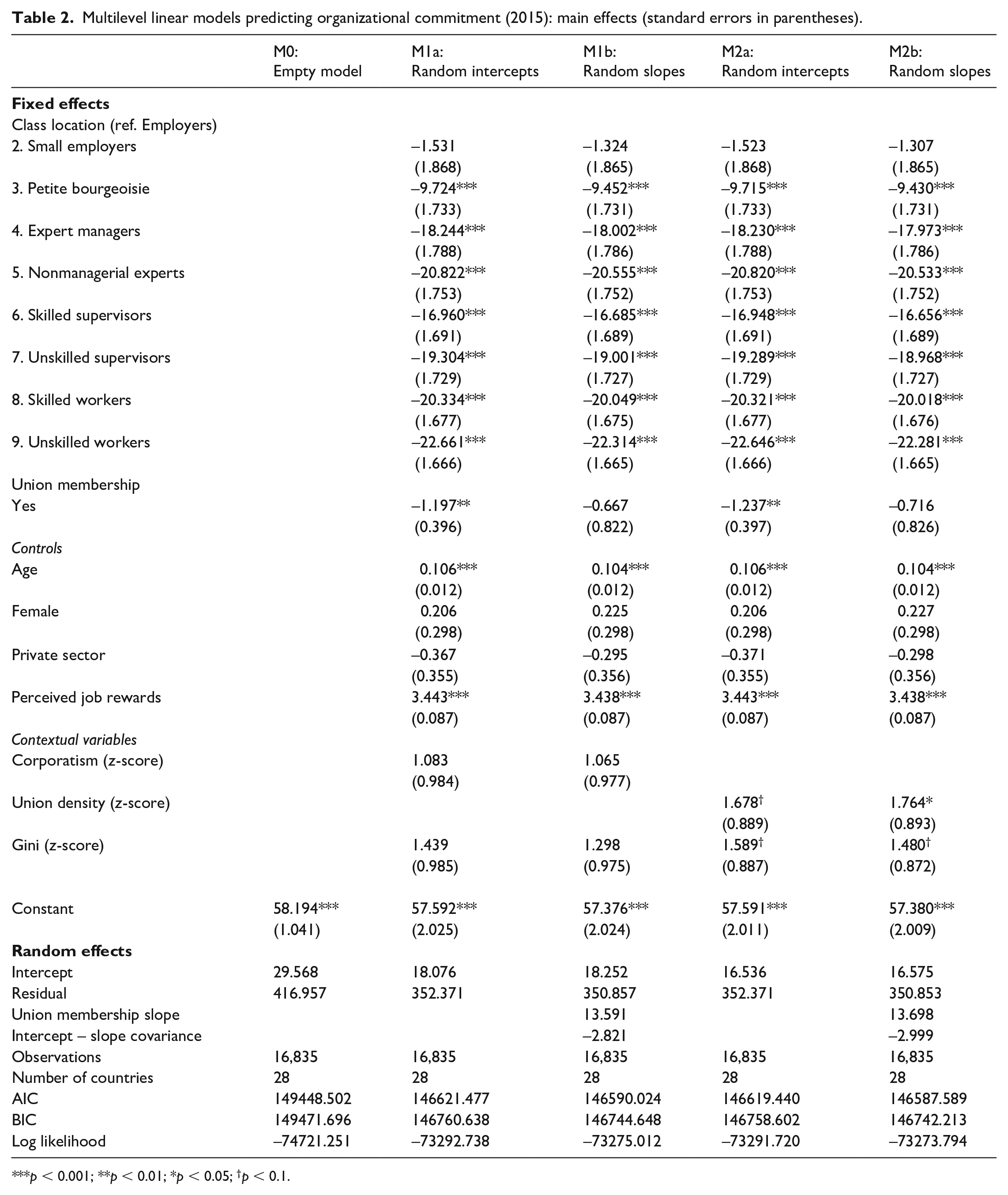
Multilevel linear models predicting organizational commitment (2015): main effects (standard errors in parentheses).
p < 0.001; **p < 0.01; *p < 0.05; †p < 0.1.
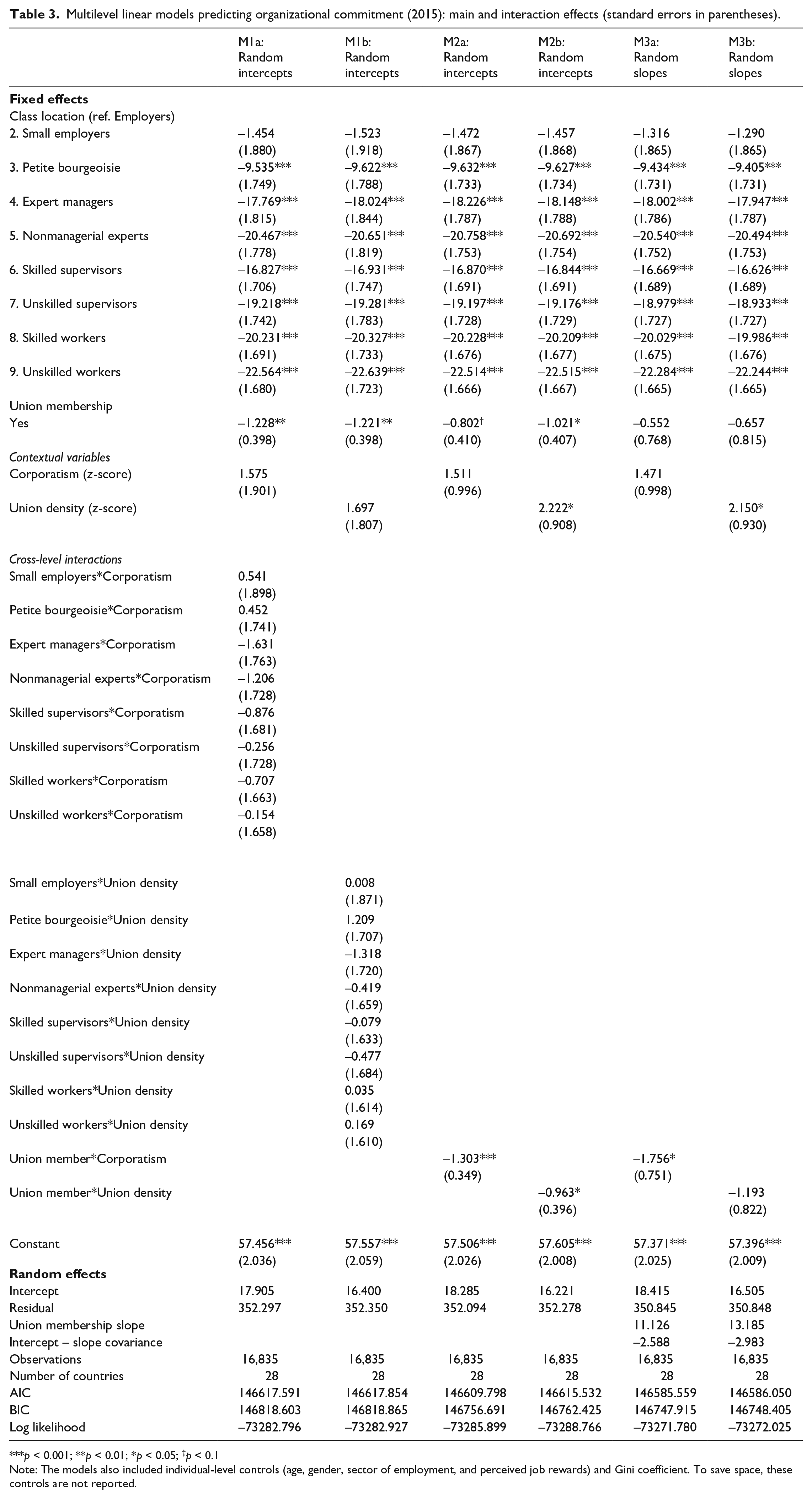
Multilevel linear models predicting organizational commitment (2015): main and interaction effects (standard errors in parentheses).
p < 0.001; **p < 0.01; *p < 0.05; †p < 0.1
Note: The models also included individual-level controls (age, gender, sector of employment, and perceived job rewards) and Gini coefficient. To save space, these controls are not reported.
Before fitting these models, I fit an empty model that indicated that 7% of the variance in the level of organizational commitment is explained by between-country differences (ICC = 0.066). This empty model is presented in Table 2.
Direct effect of micro-level and contextual variables
The coefficients presented in Table 2 show that class position is a significant determinant of organizational commitment. In all models, the effect of class location is statistically significant (p-value < 0.001): unskilled workers score around 22 points lower than employers on the 0–100 scale of organizational commitment. This supports H1a. In relation to union membership, the results are less clear. Although its effects are negative and statistically significant in the random intercept models (p-value < 0.01), they are no longer significant in the models that include random slopes. Therefore, H1b cannot be accepted.
As for the contextual variables, Table 2 shows that corporatism is positively correlated with organizational commitment, although its effect is not statistically significant. This implies that H2a cannot be accepted. By contrast, union power has a positive and statistically significant effect on organizational commitment. The coefficients from Model 2b indicate, for example, that an increase of one z-score unit in trade union density is associated with an increment of 1.76 points on the scale of organizational commitment (p-value < 0.05). This means that H2b should be accepted.
Cross-level interaction effects
To test whether the effect of class and union membership on organizational commitment differs across countries with varying levels of corporatism and trade union power, I fit several MLMs with cross-level interactions. The results of these models are reported in Table 3. As explained earlier, in preliminary analyses I estimated models that included random slopes for social class and union membership. In these analyses I found that the inclusion of random slopes for social class did not improve the models’ fit. In theoretical terms, this suggests that the relationship between class and organizational commitment does not vary across countries. In line with this finding, Table 3 shows that none of the interaction effects between class and corporatism (Model 1a) and between class and union power (Model 1b) is statistically significant. This means that we cannot draw strong conclusions about the hypothesized moderating effect of corporatism/trade union power on the relationship between class position and organizational commitment. Therefore, H3a and 3b cannot be accepted.
Lastly, consistent with the results of the models with random slopes for union membership discussed above, the results of Models 2a through 3b of Table 3 indicate the relation between union membership and organizational commitment varies across countries. Nevertheless, the direction of the coefficients was contrary to what was expected: in countries with higher levels of corporatism or union power, union members are less (not more) committed to the organization than non-union members. This is particularly clear for the interaction between union membership and corporatism, which is statistically significant even in the random slopes model (Model 3a, p-value < 0.05). Therefore, H4a and H4b should be rejected.
To illustrate the moderating effect of corporatism on the relationship between union membership and organizational commitment, I plotted the marginal effects (predicted values) for the cross-level interaction reported in Model 3a. The marginal effects were calculated using the ggeffects package in R (Lüdecke, 2021), and are presented in Figure 1. This figure shows the predicted values on the 0–100 scale of organizational commitment for non-union and union members, in countries with ‘high’ and ‘low’ levels of corporatism (‘high’ and ‘low’ levels are represented by a score of 2 standard deviations above/below the mean). Figure 1 shows that in countries with low levels of corporatism, union members are slightly more committed to the company than non-union members. In these countries, the average scores for non-union members and union members are, respectively, 74.7 and 77.6. By contrast, in countries with high levels of corporatism union members have lower levels of organizational commitment than non-union members. In corporatist countries, the average scores for union members are 76.5, while the scores for non-union members are 80.6. Although the differences are not exceptionally large, the interaction effects are statistically significant. Thus, the alternative hypothesis should be accepted despite the fact that the confidence intervals overlap (see Schenker and Gentleman, 2001).
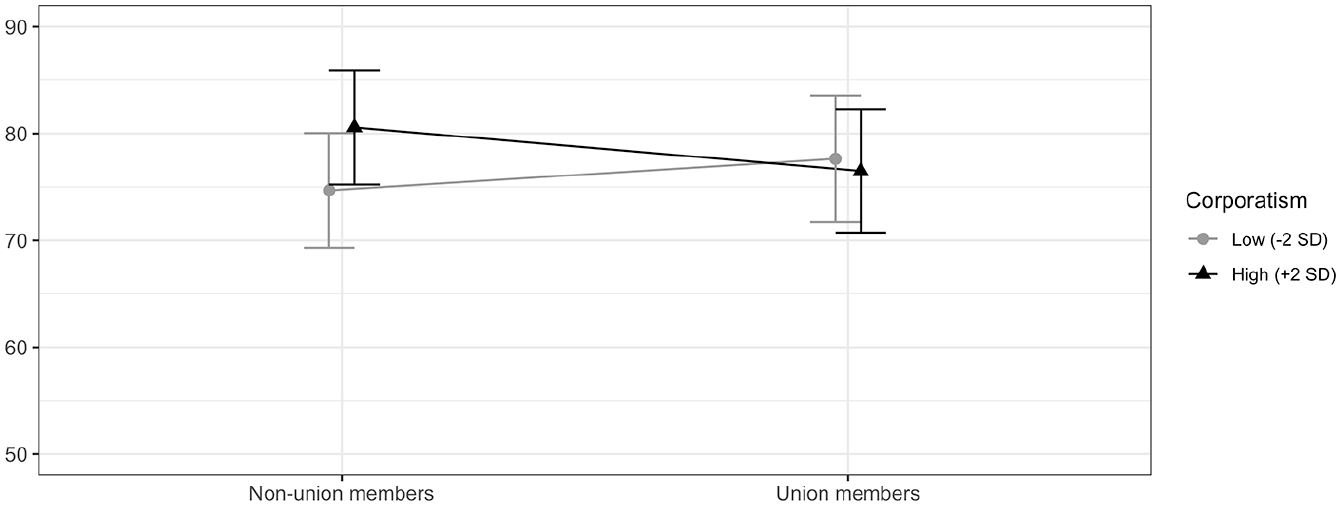
Marginal effects of the interaction between corporatism and union membership.
Discussion
The results of the MLMs are consistent with previous research that argues that social class is a significant determinant of people’s perceptions and attitudes (Edlund and Lindh, 2015; Svallfors, 2006; Wright, 1997). Wright (1997: 20) explains these effects of class position by noting how class defines people’s location in relations of exploitation and domination within production. This means that employers do not simply own the means of production and hire workers, but they also dominate them to extract and appropriate the fruits of their labor. According to Wright, this results in the formation of antagonistic interests between classes, which represents a crucial mechanism that links people’s objective class position with their subjective perceptions and attitudes. The results of the MLMs concur with Wright’s claim, as they demonstrate that the effect of class location on organizational commitment is large and significant, and in the direction hypothesized.
My findings also concur with Wright’s emphasis on the distinction between property owner and non-owner classes. The similarities in the level of organizational commitment of large and small employers indicates, in effect, that rather than the size of the firm owned, what really shapes how property owners perceive labor relations is the very fact of being an employer, i.e., the fact of owning a firm, hiring workers, and dominating them within production. Consistent with Wright’s (1997) class theory, my findings demonstrate that distinguishing between property owner and non-owner classes is key to understanding variations in workplace attitudes.
That said, the results of the MLMs also suggest the existence of important differences within the salaried classes. My results show that expert managers score higher on the scale of organizational commitment than non-managerial classes, which can reflect the importance of authority and domination in employment relations. While part of the salaried classes, managers ensure the transformation of labor power into ‘profitable work’ (Thompson and Smith, 2010) by exercising ‘delegated’ capitalist class powers (Wright, 1997: 20). Prior research argues that this reinforces pro-business interests among managers (Wright, 1997). My findings strengthen this argument by showing that expert managers are significantly more committed to the organization than non-managerial workers.
As for union membership, the results are less consistent with prior research. This research has shown that unions politicize workers, making them more aware of the conflicting interests between them and employers (Dixon et al., 2004; Kerrissey and Schofer, 2018; Ringqvist, 2021). In line with this argument, I showed that union members are, on average, less committed to the organization than non-union members. Nevertheless, the effect of union membership is no longer significant when random slopes are included in the model. In statistical terms, this occurs when the effect of a lower-level variable is not robust to the inclusion of random slopes that take into account cluster-driven heteroskedasticity and within-cluster correlation among the errors (Heisig and Schaeffer, 2019: 264). This means that the relationship between union membership and organizational commitment may be insignificant when the statistical models control for country effects. The implication is that the relationship between unionization and work attitudes such as organizational commitment may not be ‘universal’ but ‘country-specific (on this see also Donegani and McKay, 2012: 481; Hipp and Givan, 2015).
In relation to the contextual variables, the results of the MLMs suggested that at the macro-level trade union power is positively correlated with organizational commitment. This is consistent with the literature on corporatism and power resources, which argues that in corporatist countries labor relations are less conflictual (Brandl and Traxler, 2010; Korpi, 1985). Within this literature, research has shown that in countries with strong unions, job autonomy and control is higher (Edlund and Grönlund, 2010; Esser and Olsen, 2012). Building upon this evidence, my findings indicate that in institutional environments that reinforce unions’ power to protect workers’ autonomy and job control, the aggregate levels of employee commitment are higher (see also Kelliher and Anderson, 2010; Kröll and Nüesch, 2019). In doing so, my findings add nuance to the ‘convergence thesis’, which states that neoliberal globalization has essentially blurred the divide between national IR systems (Baccaro and Howell, 2017; Streeck, 2009). Without denying the effects of neoliberal policies emphasized in the convergence thesis (e.g., the decline in union membership), my evidence suggests that national differences in union strength continue to be crucial for explaining work outcomes such as organizational commitment.
That said, the cross-level interactions also add nuances to the neo-corporatist and power resource arguments. On the one hand, Table 3 suggested that neither corporatism nor trade union power moderate the effect of class on organizational commitment. On the other hand, Table 3 indicated that in countries with higher levels of corporatism (Models 2a and 3a) or union power (Model 2b), union members have lower levels of organizational commitment than non-union members. As stated above, this is particularly clear for the moderating effect of corporatism, as the cross-level interaction effects were significant in the random intercept and random slope models. This finding implies that the moderating effect of corporatism is contrary to what one might expect based on the results of some investigations described in the literature review section (e.g., Esser and Olsen, 2012; Ringqvist, 2021). Instead, this finding is more consistent with the argument developed decades ago by class analysts such as Wright (1997) and Svallfors (2006). Focusing on a small sample of advanced capitalist countries, these two authors found evidence that in countries with strong welfare states and corporatist IR systems (most notably, Sweden), class attitudes towards the workplace are more polarized than in market-oriented countries such as the US. According to Wright and Svallfors, this is explained by the fact that in Sweden unions are more powerful and therefore have more capacity to forge ‘class consciousness’ (Wright, 1997: 433–440) and promote ‘partisan attitudes’ among workers (Svallfors, 2006: 51). My evidence supports this explanation, although one important caveat must be mentioned: corporatism increases differences in attitudes to work only among unionized workers relative to their non-unionized counterparts, not among all workers relative to employers.
Conclusion
Organizational commitment is a central aspect of workplace relations. Despite its importance, few researchers have used multilevel modeling strategies to investigate how this work attitude is shaped by both individual-level factors such as social class and macro-level variables such as corporatism and trade union power, let alone to investigate how these contextual factors moderate the impact of individual-level attributes. In this article, I filled this gap in the literature by studying organizational commitment from a multilevel approach.
I presented evidence suggesting that class position is a significant determinant of organizational commitment and that the effect of class does not vary across countries. Additionally, I showed that there is a negative relationship between union membership and organizational commitment. However, my results indicated that this relationship is no longer significant when the models include random slopes. At the contextual level, I found that there is a positive relationship between trade union power and the aggregate levels of organizational commitment. Building upon recent studies, I argued that this relationship can be explained by the way in which strong unions produce work environments that protect employees’ autonomy and control, thereby increasing their commitment to the organization in which they work.
My findings have important implications for the recent debate on the ‘neoliberal convergence’. Even recognizing a move towards more ‘disorganized’ political economies in which unions have a weakened position vis-a-vis employers (Streeck, 2009), they imply that we should not conclude that the relative strength of trade unions is irrelevant to analyzing the dynamics of cooperation or conflict that take place in the workplace.
This argument was further reinforced by the significant cross-level interactions between trade union power and union membership, and especially between corporatism and union membership. The interaction effects suggested that corporatism moderates the relationship between union membership and organizational commitment. This implies, again, that neoliberalism has not totally erased the institutional and political distinctions used in the literature on neo-corporatism and power resources to identify different patterns of employment relations.
Nevertheless, my findings suggested that the moderating effect of corporatism was contrary to what was hypothesized: in corporatist countries, union members are less (not more) committed to the organizations in which they work than non-union members. Future studies based on longitudinal data are needed to clarify this issue. Using longitudinal data, these studies could elucidate why corporatist arrangements that were designed to reduce labor conflict may have ended up enhancing ‘partisan’ attitudes among union members. In doing so, further research could also clarify to what extent the function of corporatist political-institutional arrangements has changed in recent decades as a result of neoliberalism. Ideally, these studies should rely on larger country samples. In this article, I used a sample of only 28 countries. This may have affected not only the reliability of the estimated ‘country effects’, but also the accuracy of the estimates for the fixed effects and variance components. To address these issues, I followed Bryan and Jenkins’s (2016) recommendations and fit models with few contextual variables. However, working with a small sample of countries may still have affected the statistical power of some estimates, especially in the models with cross-level interactions between social class and the contextual variables. Future studies with larger country samples should resolve this limitation.
Finally, considering that class position has significant effects on employees’ commitment, future studies should also interrogate how social class helps explain other work outcomes. A recent article has emphasized the need to study the role played by social class in organizations (Kish-Gephart et al., 2022). Although in this article I offered some explanations for the relationship between class and organizational commitment, more research is needed to analyze whether these explanations apply to other aspects of employment relations.
Footnotes
Appendix
Organizational commitment, corporatism and net union density by country.
| Organizational commitment | Corporatism | Net union density | |
|---|---|---|---|
| AU-Australia | 59.0 | 19.9 | 17.1 |
| AT-Austria | 61.0 | 55.1 | 27.4 |
| BE-Belgium | 55.6 | 87.9 | 54.2 |
| CL-Chile | 52.8 | 3.33 | 16.3 |
| TW-Taiwan | 62.0 | 15.8 | 32.8 |
| HR- Croatia | 57.2 | 18.1 | 25.0 |
| CZ-Czech Republic | 58.9 | 11.7 | 12.0 |
| EE-Estonia | 50.4 | 8.89 | 4.71 |
| FI-Finland | 58.3 | 84.3 | 66.5 |
| FR-France | 48.3 | 43.6 | 7.92 |
| DE-Germany | 58.3 | 43.2 | 17.6 |
| HU-Hungary | 53.3 | 8.56 | 9.37 |
| IS-Iceland | 63.4 | 64.4 | 90.8 |
| IL-Israel | 64.1 | 18.5 | 22.8 |
| JP-Japan | 55.4 | 26.9 | 17.5 |
| LV-Latvia | 56.8 | 8.89 | 12.6 |
| LT-Lithuania | 51.3 | 8.89 | 7.87 |
| MX-Mexico | 65.9 | 8.89 | 13.1 |
| NZ-New Zealand | 64.7 | 3.33 | 17.9 |
| NO-Norway | 63.2 | 71.9 | 52.1 |
| PL-Poland | 45.4 | 3.0 | 12.4 |
| SK-Slovak Republic | 55.8 | 31.8 | 11.2 |
| SI-Slovenia | 58.7 | 38.9 | 20.9 |
| ES-Spain | 58.5 | 56.1 | 15.2 |
| SE-Sweden | 54.4 | 37.8 | 61.7 |
| CH-Switzerland | 67.5 | 47.4 | 18.0 |
| GB-Great Britain/UK | 62.0 | 3.33 | 24.2 |
| US-United States | 65.7 | 3.33 | 10.6 |
Acknowledgements
The author would like to thank the anonymous reviewers for their helpful and constructive comments. He would also like to thank Valentina Andrade for her assistance with the database and to the participants of the VIII COES International Conference (Santiago, Chile) where a preliminary version of this article was presented.
Declaration of conflicting interests
The author declared no potential conflicts of interest with respect to the research, authorship, and/or publication of this article.
Funding
The research project that gave rise to this article was funded by FONDECYT Project 11190229 (‘Institutional and political determinants of conflict between employers and workers: The cases of Argentina and Chile in comparative perspective’, PI: Pablo Pérez Ahumada) and by the Center for Social Conflict and Cohesion Studies (COES; ANID/ FONDAP/15130009).
Ethic statement
Not applicable.
