




Abstract
Power resources are embedded in societal ties. Using qualitative network analysis, our fieldwork in Quebec (Canada), based on 30 interviews and three focus groups, explored union-societal ties, their resource properties and the extent to which unions weave them into a network. We identified five different types of union-societal ties: instrumental, civil society organizations, identity-based, satellite and fishing line. These ties were mostly unwoven. Analysis of networking provides insights into how unions frame issues, identify grassroots leaders and leverage societal power resources in broad-based movements.
Introduction
Changes in the employment relationship have undermined the organizational and institutional power of trade unions in promoting labour justice (Heery, 2005; Piore and Safford, 2006; Rizzo and Atzeni, 2020). To regain their place as the champions of labour rights, unions are expanding their horizons beyond the workplace (Sullivan, 2010). One renewal strategy has been for unions to leverage societal power, residing in network relationships that they have with other social actors (Heery, 2018; Lehndorff et al., 2018; Schmalz and Dörre, 2018). Engaging with civil society, some use the organizing strategies of social movement unionism to find new social partners (Engeman, 2015; von Holdt, 2002).
Strategies to increase their power challenge unions to identify latent or hidden ‘basic power resources’, the ‘power to’, embedded in networks (Ford and Gillan, 2021; Korpi, 1985; Lévesque and Murray, 2010). This gives unions the capacity to unlock and deploy resources to gain ‘power over’ capital and state forces (Fairbrother, 2008). Investigations of ‘basic power resources’ embedded in union-societal networks can contribute to an understanding of strategies to regain a central role in promoting labour rights (Ellem et al., 2020; Schmalz and Dörre, 2018).
Network analysis is an underexplored tool in studying union-societal relations. This is surprising as power resides within networks (Dixon and Roscigno, 2003; Tilly and Tarrow, 2007). Such analyses should go beyond observing dyadic ad hoc alliances between a union and civil society organizations (CSOs) and their joint actions (Rhomberg and Simmons, 2005; Tattersall, 2005). Union societal-networks are characterized by diverse relationships with collective and individual societal actors, a variety of power resources embedded in those relationships and a variable degree to which resources can be mobilized through a union’s capacity to harness relationships into a powerful network (Holgate et al., 2018; Martinez Lucio and Perrett, 2009). In exploring the struggle for labour rights and justice beyond the workplace, network analysis can reveal foundational elements of a potentially powerful broad-based movement, how it develops and catalogue basic power resources that might be leveraged (Gall and Holgate, 2018; McAlevey, 2016).
In an explorative study, we examine union societal power by analysing resources embedded in union-society ties and how these are harnessed into a network (Diani and Mische, 2015). Our fieldwork did not target unions that already embrace social movement unionism nor those that had taken formal steps to do so. Further, we did not assess unions pursuing ‘power over’ strategies. Our research was designed to uncover potential union societal resources that could be organized and mobilized in the relations that many unions have with social actors. Union power resources reside in a specific institutional context (Ellem et al., 2020). The fieldwork was conducted in Quebec, Canada, a part of North America with high and stable union density (around 38% over the last two decades) and a vibrant civil society (Grenier and Jalette, 2016; Kennelly, 2014). This provided two advantages. First, in this dynamic society we examined social connections that were not driven by declines in membership (Lévesque et al., 2005). Second, while unions in the rest of Canada and many European countries influence the state indirectly through (dwindling) links with social democratic parties, Quebec unions embrace a non-partisan approach, lobbying governments directly (Denis and Denis, 1994; Savage, 2010). Quebec unions try to solve labour problems at the provincial level, with a minimal attention to the federal level and count on organized political actions extending beyond the workplace. In the interest of change aimed at labour rights and social justice, Quebec unions need to know the societal power resources that can be mobilized (Denis and Denis, 1994; Graefe, 2007). 1
Our findings accentuate the value of network analysis, enlarge the typology of union-societal ties by elaborating their properties, unveil specific power resources and outline developmental strategies for union involvement in broad-based movements. First, we position our analytical framework in the context of current debates about union power and union–society relations. We then present our methodology, data and results. In the discussion, we outline how our findings contribute to unions taking steps to create a powerful and mobilizable broad-based movement.
Power in a network of societal relations
‘Within a social relationship, power means any chance (no matter whereon this chance is based) to carry through one’s own (individual or collective) will (even against resistance)’ (translation of Weber, 1947: 152, in Wallimann et al., 1977). Lukes (1974, 2005) conceptualized power as operating along three complementary dimensions: decision-making; agenda setting; and manipulation of thoughts (Blomberg, 2020: ch. 6). As recognized by Lukes himself, decision-making is the ‘core’ dimension in any analysis of power (Morriss, 2006). Power is primarily conceived as the ability to effect outcomes, and secondarily as the ability to affect agendas or others’ thoughts. The third dimension becomes relevant when power struggles are not ‘visible’ but where the thoughts of the dominated party are nonetheless manipulated (Morriss, 2002). This is not the case where the cleavage is visible, as between employer and unions. Our approach follows these leads in exploring the decision-making power of unions in their relationships with civil society actors.
The decision-making power of unions increases the likelihood of labour carrying out its will over capital and state. Decision-making ‘power over’ state and capital is the tip of the iceberg (Korpi, 1985). By influencing decision-making, the ‘power to’ is the base of the iceberg of ‘power over’, encapsulating the potential ability and capacity of an actor that has not yet been fully realized (Lukes, 2005). For the most part, ‘power to’ is latent, a ‘hidden’ resource (Lévesque and Murray, 2010). Using the latter, actors leverage, combine and multiply resources to attain ‘power over’. Mobilization of resources could reverse the decline of unions and modify the parameters of the debate regarding the future of the labour movement (Ellem et al., 2020). Unions can exercise power only after becoming aware of the existence, characteristics and potential impact of available resources (Lévesque and Murray, 2010).
Unions must consider four potential sources of power: associational (labour movement vitality; Silver, 2003); structural (collective bargaining strength; Wright, 2000); institutional (influence in trade-offs; Schmalz and Weinmann, 2016); and societal (viable civil society cooperation; Lévesque and Murray, 2013). As access to the first three sources of power began to wane, some trade unions shifted focus from workplace to society to take advantage of societal power embedded in social relationships (Engeman, 2015; Turner et al., 2001). For typical North American ‘business’ unionism, this shift poses two challenges (Geary and Gamwell, 2019; Tapia, 2013). First, union actions would not be centred on top-down executive actions within traditional industrial relations institutional boundaries. Rather, the focus becomes participatory, bottom-up, broad-based societal (de Turberville, 2004; Hetland, 2015). Second, union goals move from narrow, members-only, workplace interests to labour rights and social justice for all citizens. For the unrepresented and disadvantaged, this offers hope for fairer treatment in employment and society, and raises the profile of unions as movement protagonists (Però, 2020; Yu, 2014).
Ad hoc shallow mobilizing of societal relationships is not powerful enough to achieve broad union goals (Holgate et al., 2018; McAlevey, 2016). Tangible changes in employment conditions for the many can only be fostered by a union’s capacity to deeply organize resources embedded in societal relationships, providing strong, enduring, bottom-up forces (Holgate et al., 2018; Però, 2020). Societal power emerges out of relations with and repeated interactions among unions and multiple networked individual and collective actors and from the flow of power resources among them (Tilly and Tarrow, 2007). To harness a powerful network, unions must identify power resources embedded at the intersection of a multitude of relationships with a plethora of societal organizations and unorganized individuals, and broker relationships among them (de Turberville, 2004; Sullivan, 2010; Tapia, 2013). Social actors of interest are civil society organizations (Croucher and Wood, 2017; Martinez Lucio and Perrett, 2009), community groups (Holgate et al., 2012), and many marginalized and unorganized people not previously involved with unions or other organizations (McAlevey, 2016).
Network analysis is ideal for the investigation of ‘hidden’ power resources embedded in societal relationships (Diani and Mische, 2015; Tarrow, 2005). Using it, social change can be linked to relationships among actors and to the flow of resources among them, rather than to the individual characteristics of independent actors. Unions are embedded in a series of societal relationships, each providing specific resources. The weaving of these ties can shape labour-capital dynamics and improve working and living conditions for a wide array of people (Lévesque and Murray, 2010). To understand the societal ‘power to’ of unions, we must first identify the properties of societal ties, and explore how they are developed (Diani and Mische, 2015).
The first step in applying network analysis to this dynamic is to adopt an egocentric perspective, examining ties from one node to others (Tindall, 2015): place unions at the centre of analytical attention, study ties between them and sets of different social organizations and individuals, observe their properties – specifically power resources. Consider the following examples. During adversarial bargaining, ties in ad hoc union coalitions are mainly instrumental, focused on short-term mobilization, with limited spill-over to solidarity (Heery, 1993; Reinecke and Donaghey, 2015). Union community organizing is based on the proximity of values and agendas among various nodes that pave the way to stronger bonds and a ‘contagious’ involvement of previously unorganized actors (van Dyke and McCammon, 2010). These types of ties are established between unions and social justice-oriented CSOs, leading to commitment to causes that goes beyond the restrictive interests for which unions ordinarily advocate (Heery et al., 2012). Similarly, ties might be based on group identification (gender, ethnicity, race, sexuality), conveying a more ‘universalistic’ meaning than those bound to a single organization (Piore and Safford, 2006; Yu, 2014). Attention might also be devoted to ties developed with individuals who do not have pre-existing interests in unions or social organizations; they constitute an integral part of societal power and represent potential for expansion, because such people are embedded in other networks and communities (McAlevey, 2016).
For establishing ties across which power resources flow, ‘bridge builders’ – individuals or organizations spanning structural holes – broker relationships between unconnected actors (Granovetter and Soong, 1983; Heery et al., 2012). This broadens the network and makes it robust by recognizing the value of working across different nodes, enhancing solidarity, endowing actors with additional resources (Tindall, 2015). Individuals who belong to multiple organizations have the potential to link already constituted networks of strongly tied individuals, generating a crucial multiplier effect for movement expansion and empowerment (Cockfield et al., 2009; Tattersall, 2005).
Beyond the properties of single bonds, the systemic perspective of network analysis reveals the extent to which multiple ties evolve into a dense network that supports resource flows. It is important to discern union capacity to broker and weave relationships across societal ties to create a dense network of resources obtained from its basic societal relations (Granovetter and Soong, 1983; Lévesque and Murray, 2010). This fosters a broad collective identity that goes beyond the confines of specific networked actors to become the structural foundation of a potentially impactful movement (Tindall, 2015).
Union capacity to organize societal power broadly as well as deeply rests on three pillars: (1) establish strong relationships; (2) identify power resources across the different social actors; and (3) ‘weave’ a network that can draw on those power resources. A bottom-up movement of engaged citizens can develop for whom feelings of solidarity transcend initially fragmented communities of struggles (Holgate, 2021; Però, 2020).
Research methods
Quantitative network approaches produce statistical data to trace formal mathematical properties. Qualitative network approaches delve deeply into the behaviours of actors and relationship characteristics (Edwards, 2010; Marin and Wellman, 2011). Given the exploratory goal of this research, we used the latter to: (a) identify specific resources embedded in different union-societal relationships and (b) analyse the existence of interactional processes – union ‘weaving’ – allowing for their flow across the network. From union-egocentric and systemic perspectives, we developed insights into a variety of network characteristics and power resources. We conducted semi-structured interviews, and, subsequently, confirmatory focus groups to consolidate emerging evidence and patterns (Onwuegbuzie and Leech, 2007).
The study of power resources embedded in relationships starts with the identification of a small set of nodes of interest (Marin and Wellman, 2011). We used a purposeful non-probability sample of union actors with societal ties to groups and individuals (Palinkas et al., 2015). The leadership of Quebec’s three largest union confederations (FTQ, CSN, CSQ) introduced us to eight union officers, at different organizational levels, who had union-societal ties. The confederations are independent, so our starting sample had a variety of different Quebec union-societal relationships. We ‘snowballed’ (Heckathorn, 2011) an additional 10 and, subsequently, 12 more union interviewees, for a total of 30 – a diverse set of respondents on several characteristics of interest and who were able to discuss different types of union-societal relationships with very little overlap (online supplementary Appendix 1).
A semi-structured interview schedule engaged interviewees from an egocentric network perspective regarding their unions’ societal relations. Four lines of inquiry were tackled: (1) relationships with organizations and individuals; (2) their evolution; (3) resources and limits embedded in them; and (4) from a systemic point of view, efforts to broker and harness relations to make a denser and more powerful network (i.e. the union as ‘weaver’). Interviews were conducted in 2015–2016, focusing on the post-2010 period. Twenty-seven interviews were conducted in French and three in English: 25 in person, five remotely. Interviews lasted between 37 minutes and 1 hour and 34 minutes. All were recorded and transcribed. Interviews with the third group of our sample gave some new examples, but no new relationship types emerged. Consequently, we considered the sample to be ‘saturated’.
Each of us independently assessed the content of every interview, clustered the relationship examples into different categories and identified their characteristics. Differences in categorization (very few) were discussed until consensus. Dimension reduction and iterative interpretation were essential to the development of our typology (online supplementary Appendix 2).
The second stage of the research was designed to: (a) collect new examples of union-societal ties; (b) validate the categorization and the properties of each type of tie; (c) gather non-union narratives of union-societal ties; and (d) better understand the degree of union network harnessing. This was accomplished via three focus groups (Barbour, 2007): one composed of three union executives (not interviewees from stage one) who had developed societal relationships; another consisted of four members of civil society organizations and/or militant individuals who developed relationships with unions; and the third was four academics who conduct research in Quebec on union renewal (online supplementary Appendix 3). Encounters lasted between 85 to 105 minutes. Each session was recorded and transcribed, and each researcher assessed them independently. Debates among us were used to validate and enrich the preliminary findings from this stage as well as from the interview stage.
Results
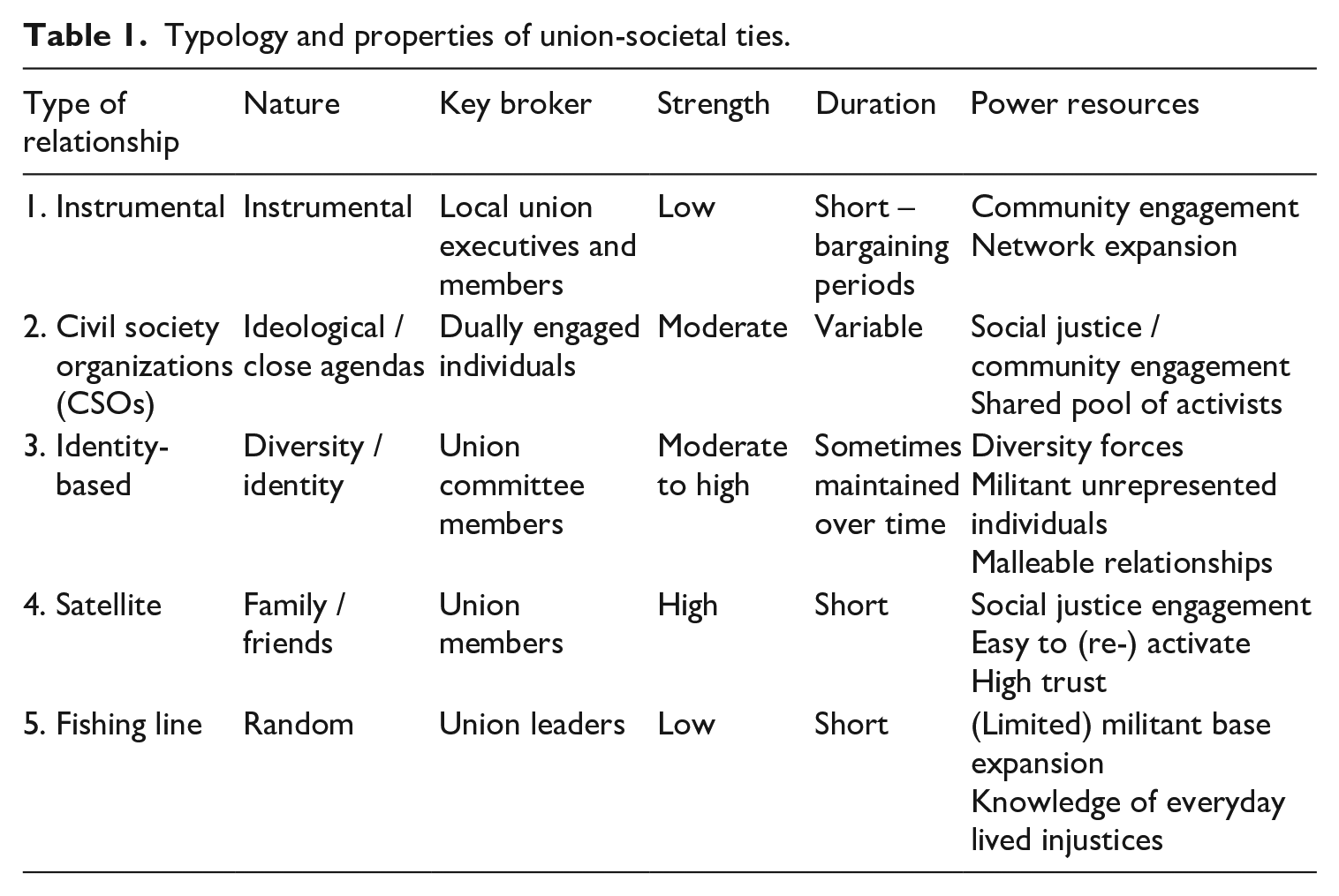
Interviews and focus groups revealed a variety of union-societal ties with groups and individuals. First, we present our typology, categorized in terms of specific characteristics, including distinctive power resources (Table 1). Then, we assess the extent to which Quebec unions deployed strategies to weave those ties into a network.
Typology and properties of union-societal ties.
Instrumental
Some ties linking unions to civil society are instrumental in nature. Such relationships are formed when unions engage in adversarial bargaining dynamics with employers; they leverage shallow pre-existing relationships via ad hoc actions. Interviewees indicated that when bargaining dynamics were threatening unfavourable outcomes, local unions attempted to build coalitions with groups and individuals likely to feel the impact of negative outcomes from negotiations. After consistently nurturing these ties during the bargaining period, unions attempted to leverage them, putting pressure on employers (14, 16). 2
Consider the alliance strategy devised by unionized elementary school special educators and support staff who felt their work was undervalued and their working conditions were threatened when management decided to reduce services to children. To protect their interests, and those of the students, union members asked the parents of the students with whom they had daily dealings to testify ‘how the work of a professional made a difference in their child’s educational progress’ and how important it was for their children to receive services from someone ‘with the [right] qualifications, who are part of a professional order so [. . .] the children [can] have the services that suit them best’ (21). The union activated ties with parents knowing that management was concerned with keeping parents satisfied.
Another example came from a trade union facing the threat of closures. The union linked to groups that had ‘an interest in defending their local store’, successfully ‘adapting’ the strategy to ‘each environment’ (4). When a store that sells local products in a highly touristic location was threatened with closure, the union contacted local suppliers to form an alliance to maintain employment in the region. They relied on the ‘touristic’ and ‘locally made’ aspects to show the community the importance of ‘promoting our local products’ (4). The union was able to leverage existing relationships to attract public attention to save the store.
Another example of community engagement came from a different retail union’s ability to identify and to activate salient individual relationships. During a lockout at a store in a remote village, unionized grocery clerks explained their grievances to customers who were won over when the locked-out clerks drove them to the nearest opened grocery store to buy food (1). The frustration of customers, many of whom would have been incapable of grocery shopping without help from union members, was used against the employer. Once the villagers understood the union’s situation and the impact that store closure would have on the local community, they became supportive, encouraging the members to ‘Keep it up, keep fighting, be strong!’ (1). Even with the population’s support, the store closed.
In the above cases, unions were reactive in eliciting the power of their ties; local union executives and members acted as relationship brokers, but activation was triggered as a response to tough adversarial bargaining conditions. Formal alliances ended when collective bargaining outcomes were announced (1, 4, 6, 14, 21). Important societal power resources were embedded in those ties. These relationships demonstrated how unions are engaged beyond the workplace in creating broad solidarity around social justice for disadvantaged people (students with special needs and individuals who did not have means to go grocery shopping) and the local community (store closure threats and maintaining regional employment). Non-union people – parents, local growers, tourists and villagers – were brought into the union’s social justice network.
Relationships with civil society organizations
Ties unite unions with CSOs when they share common social justice values and action agendas intersect (2, 3, 4, 7, 16, 20, 22, 23, 27, 28). Although union efforts to create and nurture relationships with CSOs exhibited differences, common characteristics also emerged. At the confederation and federation levels, unions establish relationships with CSOs that support labour-related social issues. 3 Cooperation with organizations that protect the rights of unemployed, precarious and immigrant workers or that fight for socio-political issues that ‘affect workers as citizens’ (2; 3, 7, 23, 28) was considered imperative by most interviewees. Some union leaders insisted that such relationships are entrenched in union culture, that is, a ‘tradition of lasting, broad engagement with other organizations of civil society’ (2; 3, 4, 22, 28).
In the immediate environment, local unions engage directly with the community by developing ties with likeminded CSOs. Interviews and focus groups revealed that such ties provide financial or in-kind support to less endowed CSOs (7, 9, 10, 13, 15, 20, 22, B4, B3). These relationships allowed unions to ‘join forces with civil society, [mobilize] as many people as possible, [so] we can win our battles’ (22; 5, 7, 15, 16, 17). These relationships seem to be built on tacit agreement for mutual benefit: unions support CSOs financially ‘as long as [the latter] are willing to maintain the same level of [militant] engagement’ (10; 20, A3). These ties were quiescent, activated by one partner or the other when specific financial support or mobilization efforts were required (2, 3, 23, B1). A prevalent sentiment was that ‘. . . [CSOs] were almost uneasy to create an alliance with us’ (4; 7, 16). CSOs appeared to fear power inequity with unions and perceived difficulties in being recognized as peers. Unions expressed feelings of being financially exploited by CSOs, while still allowing for a modest level of trust (8, 14, A3, B1). Nonetheless, in these relationships, power resources are shared.
First, relationships with CSOs provide unions the opportunity to reinforce engagement with society and demonstrate solidarity with social justice issues. We heard that ‘working side by side with the community [makes unions] look good [and] more open’ (20; 16, 27). Second, these ties create a pool of activists across unions and CSOs to promote social change (3, 13, 20, 30, B1). This allowed unions to increase societal impact when campaigns and rallies were undertaken, such as the ‘Fight against Austerity’ (2; 6, 7, 18, 20, 24, 25, 30, B1) or ‘Idle no More’ (3; 28, 30). 4 Third, local ties increase the community involvement of unions and nurture community solidarity. Finally, consistently nurtured ties result in strong and frequently activated bonds as the outcome of ‘double engagement’ – union executives who are members of CSOs, or CSO members who join the union; these individuals act as constant relationship activators.
Identity-based
Other ties that link unions to society are identity-based. Observable at the federation level, they are extensions of existing identity-based committees within the union. Unions form member committees based on age, gender, ethnicity and sexual orientation to create inclusive spaces and to ‘motivate members to get involved in the union organization’ (15; 2, 5, 14, 15, 16, 19, 30). These committees spark the interest of traditionally underrepresented groups and expanded union ties by triggering a series of existing bonds beyond the workplace: members of these committees are encouraged to ‘bring a person [with the same shared characteristics] who is interested or who is simply curious, but who is not part of the union’ to the committee meetings (3; 17).
Interviewees noted that such ties are activated at specific political conjunctures, like the Quebec debate on legalization to recognize same-sex marriages (12). This had a spill-over effect within union practices. One union executive denounced the fact that labour laws and collective agreements themselves often discriminate against homosexuals (i.e. parental leaves). To reverse this situation, he activated existing ties with LGBT associations and mobilized other LGBT individuals to protect their rights. ‘There was what was called the Civil Marriage Recognition Coalition which included LGBT community organizations and groups, such as the LGBT Homo-parental Coalition. Instead of just working with LGBT groups, I felt it was important for labour organizations that had similar demands to work with us’ (12).
Interviewees reported that some members considered the valorization of diversity as debasing the class-unity approach and that there was little institutional support for organizing identity-based ties (3, 8, 16, 17, 30). Preserving these relationships over time was described as a function of the stability of the internal committees and the role of bridge-building individuals. Relationship strength fluctuates and ties created for campaigns fade when specific issues get resolved. ‘Diversity’ clearly pushes unions beyond traditional workplace/class-identity. These relationships seem more informal and malleable than those with CSOs, facing fewer bureaucratic obstacles. LGBT, young and ethnic-based bonds tend to be characterized by strong and militant engagement. Key bridge-builder resources were union members who were connected to individuals and groups that shared a specific identity. Such union members become relationship brokers and contribute to abolishing, albeit slowly, barriers between unions and these corners of civil society. Ties built on this foundation have the advantage of providing direct access to previously constituted socially active, sturdy networks.
Satellite
In addition to organizations and groups, societal ties link union members in on-going relationships with family, friends and like-minded individuals. Descriptions were rich and are best imagined as network nodes revolving around each other like satellites caught in a gravitational field (14, 17, 18, 24). Satellites could be spouses, children, relatives and/or friends, tied strongly to members and linked easily to unions.
Satellite relations were activated primarily by local unions, involving individuals in rallies, public campaigns and events by encouraging members to ‘bring their children, their spouses, their aunt if they want to take part’ (7; 3, 14, 17, 18, 24, 26, A3). Several unions reported organizing activities in recreational or festive settings (17, 25, 27, 30, C1). Some unions organized summer camps for members’ families to discuss ‘unions and labour relations’, or barbecues in parks to inform about unionism and its influence on the community (26; 1, 14, 17, 28). The interpersonal nature of such activities ‘really had an impact on people who participated’ (26). These types of activities give unions the opportunity to address social issues with non-members and to promote the union’s values and social mission. These events helped shatter stereotypes about unions and represented ‘the best way to give a positive view of what unionism is’ (17; 7, 26), to ‘reach a different audience’ beyond the workplace (26) and ‘give information about [social] causes’ (7; 14, 17, 26), legitimizing unionism as a movement beyond the workplace. A high level of trust bonds union members to their entourage, so the latter are generally receptive to union social goals, and ‘it makes people want to participate next time’ (7; 17, 26). These ties are strong, embedded in trust and easily activated, providing significant power resources for unions.
Fishing line
Interviewees described union-societal ties that almost appeared to be ‘random’. Trade unions look for ways to connect with individuals and ‘hook’ them into their social justice sphere. One focus group participant thought this was analogous to fishing for new social supporters in the ocean (C3). The target here is the general public, not those already attached to the union in some way and the aim is to create ties with individuals who are not committed to a specific societal organization. Initially, they may not even be interested in unions. In contrast to other types of union-societal ties, fishing line relationships do not rely on extant ties or intermediaries. They are built directly and anew.
Unions may use a passive approach: by making activities public, engaging in limited advertising, hoping that individuals will attend (6, 7, 26, A1). This does require a lot of effort: ‘We have always opened our assemblies to everyone. They are not assemblies reserved for members, anyone can participate as an observer and even with a right to speak [. . .] [and] we invite people from civil society to present certain issues that affect them’ (26; 7, 15, A1).
Unions sometimes proactively approach individuals, soliciting participation in activities; for example, holding interactive kiosks in educational institutions (3, 10, 12, 13, 28). This was depicted as an excellent opportunity for unions, enabling them to reach students entering the labour market (26). Young people who have an early, positive primer to union social engagement bring these values to their work and social milieu. It is an opportunity for unions to increase engagement by showcasing their involvement in social justice issues. ‘[. . .] the purpose [is to] develop [. . .] links with civil society, educating people in schools, in CÉGEPs and universities, precisely holding kiosks, talking about unionism. [We] go to high schools to present the movement, from a more social point of view, 5 (28). It is a way to educate teenagers and young adults about unionism beyond the workplace, spreading a positive image of unions in society as ‘young people talk to their parents and people from the community’ (13).
An innovative public outreach activity by one union was to set up a canteen in a bus and drive it to public squares, festivals and rallies across Quebec to show support for social causes (7, 10). This mobile unit would show up at popular places to offer snacks and coffee and initiate conversations about unionism and social issues with passers-by. This networking effort had a noticeable impact as ‘people expect to see [the bus-canteen] when there is a mobilization’ (10).
Confederation, federation, and, on occasion, local executives ‘hit the streets’ to build ties outside of the usual constituency by approaching individuals with whom they do not usually interact (10, 17, 22, 28, C4). Interviewees mentioned the importance of taking time to initiate conversations with the public by ‘going door-to-door, . . . to shopping centres, . . . to conferences, . . . to local events to speak with people’ (30; 2, 6, 14, A1, A3).
Relationships with individuals caught on the fishing line were rarely maintained or re-activated over time (5, 11, 19, 20, 29). Nonetheless, such relationships allow unions to disseminate information about engagement beyond the workplace, potentially modifying biased or mistaken perceptions. They permit unions to engage with everyday people and be exposed to societal issues and lived injustices – powerful knowledge for unions in moving beyond a narrow workplace perspective.
Weaving relationships into a network
Ties linking unions to societal groups and individuals are numerous, diverse and creative. Union executives appreciate such efforts because they ‘demonstrate that the trade union movement can be useful beyond its own members, to bring it back to where it has been, and still is’, that is, part of civil society (A3). These ties are imbued with powerful resources that if activated allow unions to ‘share solutions of solidarity, exchange common resources [with society], recreate powerful relationships [based] on aspects that are work related and other aspects of everyday life’ and to ‘give meaning to several common issues’ as steps in organizing a broad-base movement (C4).
To create collaborations, combine resources and empower actors, societal ties must be ‘weaved’. Union leaders lamented the ‘lack [of] resources to do everything [they] would like to do [. . .] especially regarding social struggles’ (A3). Interviews and focus groups revealed that societal ties were not nurtured consistently and were rarely maintained over time. They decried the lack of long-term strategies for maintaining, activating and reactivating relationships with instrumental allies, CSOs, identity groups, satellite populations and the public (2, 7, 13, 27, A3, C1, C2). Efforts to build societal ties were mostly ad hoc, called upon only when needed for negotiation purposes or public demonstrations, and were perceived internally as ‘trivial’ in comparison to ‘real core union activities’ (A2).
Societal power relies on the fusion of different ties into a consolidated, supportive network, capable of being readily activated. Without harnessing and weaving, union networking efforts cannot realize their full power potential. Societal networking for Quebec unions appears almost exclusively extemporaneous, driven by reaction to circumstances, and not part of a comprehensive plan. Relationships with society are not strategically shared within unions, not coordinated across unions in the same federation and are not discussed among confederations (A3, B1, B3, C4). Within the same local union, members were unaware that executives were developing relationships with a certain CSO or that LGBT members were trying to leverage an identity-based network. Likewise, interested individuals caught by a federation’s ‘fishing line’ were not put in contact with identity-based committees. Confederations and federations do not dedicate resources to map networking efforts strategically, nor to trace resources embedded in relationships, nor to weave ties across union levels (7, A1, B1). Inherent network multiplier effects were largely underexploited by our sample of Quebec unions, representing a missed opportunity to create a broad-based movement.
Discussion
Power resources are key for strengthening labour in its relationships with capital and the state, and for improving outcomes. In a context of declining workplace and institutional influence, we analysed power resources embedded in union relationships with societal actors as a fundamental aspect of union decision-making power. While not the only strategy for empowering labour – and referring to just one of Lukes’ (1974) three dimensions of power – it is a promising one. The power to change does not reside in individual organizations per se but rather in their interconnectedness. Consequently, we adopted a network perspective to explore these issues in Quebec. We qualitatively studied the egocentric and systemic properties of different types of union-societal ties, providing insights on the nature of these relationships, the strategic role of bridge-builders and power resources embedded in them. Our evidence made clear both the potential and the limitations that unions have in leveraging societal power.
Our typology of relationships illustrates that union-societal ties are manifold. Quebec unions and organized groups are linked also through previously underexplored ties. ‘Satellite’ and ‘fishing line’ relationships need further exploration to understand ties between unions and unorganized individuals in the quest for societal power resources. While the nature of union-societal relationships can be instrumental, based on values or identity, we have shown that certain less explored aspects, such as ties grounded on friends and family or even random contacts, deserve additional consideration.
We identified bridge-builders who activate existing ties or, as in the case of fishing line relationships, build new relationships from scratch. Such individuals are pivotal in developing and consolidating a network that can support the flow of resources across nodes. Our empirical findings highlight different power resources embedded in each type of tie. Marshalling these forces drives unions into the broader societal realm, away from their North American standard business model. We described resources with the potential to re-empower unions: engagement with the issues of disadvantaged people and communities, expansion of an activist base, involvement of identity-based networked individuals, consolidation of satellites into the network and proximity to the social issues of everyday people. There are important variations in the strength of the societal relationships in which unions as organizations and their members as citizens engage, ranging from many occasional and guarded contacts to a few deep and steady collaborations. Clearly, only strong and steady ties can initiate and sustain powerful movements (Holgate et al., 2018; Rhomberg and Simmons, 2005).
Systemically, network ties between unions and other social actors tend to remain compartmentalized. We uncovered a marginal capacity for unions to create connections among the different actors with whom they have ties. A network constructed on such relationships is ‘unwoven’. Discontinuity in ties and fragmentation of the network are impediments to the ‘liquidity’ of power resources across relationships (Korpi, 1985). This decreases the ability to gain other resources and mobilize ‘power to’ into ‘power over’ capital and the state (Lévesque and Murray, 2010).
To achieve strong empowerment outcomes from involvement with societal actors, unions must identify power resources available in each tie, strengthen interactions among the partners and enhance the density of their social networks. Proactive harnessing of these ties would enhance union societal power and could become the cornerstone for broad-based movement actions in support of a social justice agenda to improve the everyday lives of oppressed people (Rizzo and Atzeni, 2020). These results are particularly relevant in Quebec, where unions lobby the government directly, rather than through political parties, to improve working conditions and advance societal justice.
At least for Quebec, union societal power has the potential to marshal resources but lacks a deep organizing strategy to mobilize relationships across the network to attain ‘power over’. Our data enrich the understanding of two mechanisms for overcoming such network fragmentation – framing the issues appropriately and identifying grassroots leadership, which together could contribute significantly to consolidation of a broad-based network.
The framing process constructs a narrative that challenges current beliefs, gives rise to political consciousness and unites social forces (Gahan and Pekarek, 2013; Melucci, 1980; Upchurch et al., 2012). For unions to count on their societal power this discursive process must bridge issues on which single ties are developed and handle power differentials to stimulate solidarity (Morgan and Pulignano, 2020). The knowledge of network properties as ‘envelopes of meaning’ (Passy, 2003: 41) that we have described represents a first step in ‘framing’ for a broad-based consolidated movement that might lead to impactful collective action (Yu, 2014).
Rather than relying on top-down union actions, deep organizing depends on the identification and empowerment of grassroots leaders to steer the network via bottom-up forces (Atzeni, 2010; Holgate et al., 2018). Egocentric qualitative network analysis facilitates the identification of union bridge-builders and their societal counterparts, engaged individuals who might emerge as grassroots leaders. Mapping the position of such individuals in the network through a systemic perspective and assessing stimuli for connecting them could enhance understanding of how powerful societal networks develop. Deeply rooted bottom-up forces could have enough ‘power over’ to rescript employment relations in favour of workers. Ultimately, deployment of these strategies rests on union willingness to conceive societal power resources as fundamental to improving their power to achieve long-established goals while simultaneously fighting for unrepresented, oppressed workers.
Conclusion
We identified ‘power to’ resources residing in specific union-societal ties. These emerged as unwoven, leading to ad hoc shallow mobilizing, unable to generate the bottom-up deep organizing needed to exercise ‘power over’ capital and state forces. Drawing on insights from network analysis, appropriate ‘framing’ and identification of ‘grassroots leadership’ enhance deep organizing for a broad-based social movement.
Our study contains inherent structural limits. Given its explorative design, we did not collect the detailed set of power resource properties of discovered ties. Snowball sampling might have missed types of union-societal relationships that representative sampling would capture. We were not able to map the networks from the words of interviewees. Future research can overcome these shortcomings by exploring union-societal ties with larger numbers of participants and representative samples of union executives to validate and extend our proposed typology and to better define the properties of union-societal ties and their power resources. Drawing on formal network analysis and data analytical tools, quantitative approaches could measure and plot the systemic network characteristics of union-societal relationships and compare them across unions and jurisdictions. This would be worth exploring in a context where unions have more organic links to political parties than in Quebec.
Finally, to the extent to which ‘virtue lies in the conflict’ (Della Porta, 2014), it would be valuable to observe the effect of ‘power over’ actions in creating new connections and harnessing unwoven ties across the broad and multiplex array of social actors with which unions are in contact. This could increase the ‘power to’. Similarly, the temporal consequences of non-activation of societal resources are worth considering. How the decision-making dimension of power that we analysed relates to agenda setting and the manipulation of thoughts remain questions for future research.
Supplemental Material
sj-pdf-1-wes-10.1177_09500170221092546 – Supplemental material for From Unwoven Societal Relationships to a Broad-Based Movement? Union Power in Societal Networks in Quebec (Canada)
Supplemental material, sj-pdf-1-wes-10.1177_09500170221092546 for From Unwoven Societal Relationships to a Broad-Based Movement? Union Power in Societal Networks in Quebec (Canada) by Lorenzo Frangi, Anthony C Masi and Bénédicte Poirier in Work, Employment and Society
Footnotes
Acknowledgements
We thank the editor and the three anonymous reviewers for their constructive comments. The first phase of this project was conducted with support from UQAM’s Service aux Collectivités (SAC).
Funding
While working on this article, Anthony C Masi benefited from a discretionary research fund from McGill University.

Supplemental material
Supplementary material is available online with this article.
Notes
References
Supplementary Material
Please find the following supplemental material available below.
For Open Access articles published under a Creative Commons License, all supplemental material carries the same license as the article it is associated with.
For non-Open Access articles published, all supplemental material carries a non-exclusive license, and permission requests for re-use of supplemental material or any part of supplemental material shall be sent directly to the copyright owner as specified in the copyright notice associated with the article.
