




Abstract
The German law on co-determination at the plant level (Betriebsverfassungsgesetz) stipulates that works councilors are neither to be financially rewarded nor penalized for their activities. However, lavish payments to works councilors in some large firms have generated a debate about the need to reform the law. This article offers an empirical basis for the discussion and provides representative evidence on wage payments to works councilors for the period 2001–2015. The authors find wage premia of 3–7% in OLS specifications, but observe no wage differentials in linear fixed-effects panel data specifications. Similar results are found for various subgroups of employees and when focusing on employees in particular types of firms. Hence, the results indicate that payments to works councilors are broadly in line with legal regulations.
Introduction
Motivation
The German industrial relations system rests on two main pillars: collective bargaining, mostly at the sectoral level, and co-determination within establishments (e.g. Jäger et al., 2022a). Currently, collective agreements cover more than 50% of private sector employees and works councils represent about 40% of eligible employees (Ellguth and Kohaut, 2021; Oberfichtner and Schnabel, 2019). The basic idea of co-determination is that many plant-level matters can be settled cooperatively between the employer and the works council, whereas distributional issues are negotiated outside the plant via collective bargaining. While both pillars have lost relevance in absolute terms, the importance of plant-level co-determination relative to collective bargaining has rather increased. This is because the fall in bargaining coverage and the rise in so-called opt-out clauses and other means of introducing flexibility into collective contracts (cf. Addison, 2016; Brändle, 2017) have made negotiations at the plant level and, hence, works councils more important. 1
Given the significance of co-determination at the plant level, works councils have been intensively studied (cf. Addison, 2009; Jäger et al., 2022b; Schnabel, 2020). The literature has largely viewed them as homogeneous entities and focused on the determinants of their existence and the economic consequences. Their members, i.e. works councilors, have attracted much less attention. This is surprising because the effects of works councils depend on the nature of the relationship between councils and management (see, for example, Addison et al., 2022; Arnold et al., 2018; Backes-Gellner et al., 2015; Dill and Jirjahn, 2017; Pfeifer, 2014) and, therefore, also on the willingness of works councilors to cooperate with the firm’s representatives.
One aspect which can strongly influence the attitudes and the behavior of works councilors is their remuneration. If becoming a works councilor results in a decline in income either in absolute terms or relative to a situation in which the individual had not taken up this position, councilors may oppose productivity-enhancing alterations of the production process. Such adverse reactions can result if councilors expect the firm not to share the resulting increase in profits with its employees. Therefore, wage reductions for works councilors may foster antagonistic behavior. Alternatively, pay cuts for work councilors can reduce their willingness to act as employee voice. Hence, a profit-enhancing restructuring of the production process can be implemented with less opposition by the employees’ representatives. If, in contrast, being a works councilor goes hand in hand with an improvement in pay, this may impair their voice credibility, such that employees are less willing to adhere to agreements fostering productivity with the firm. As in the case of an income decline, the opposite response of works councilors is also feasible. If they are paid better because of their councilorship, they may have incentives to support the management in its attempts to enhance productivity and profits, possibly to safeguard their own financial advantages. As a consequence, it is theoretically ambiguous whether firms have incentives to financially punish or reward works councilors (see Bourdieu et al. [2022] for the argument in the context of the French industrial relations setting).
Wage adjustments for works councilors, and the directions of such alterations, may, furthermore, depend on the nature of the production process, the industry to which the firm belongs and on whether works councilor activities are constrained or supported by collective bargaining agreements. Such features can have a bearing on the works councilors’ responses to wage alterations if they, for example, determine how strongly councilors can influence employee behavior. Additionally, wage changes may be shaped by the personal characteristics of works councilors, such as the longevity of their activities, because more experienced works councilors are likely to have better knowledge and wield greater bargaining power.
In addition to affecting the behavior of works councilors who have already been elected, financially rewarding or penalizing them can also influence who becomes this kind of employee representative. If works councilorship entails a reduction in current or future income, councilors may resign from office or not stand in elections in the first place. Such responses are more likely to occur for individuals who expect to obtain wage increases in their future careers: they would possibly forego becoming a councilor. This may be less likely to arise for individuals who have reached the peak of their career, implying that the extent of income increases foregone by becoming a works councilor is quite small. Similarly, individuals who are better protected against reprisals by management, such as trade union members, are less likely to be deterred. Alternatively, a better remuneration of works councilors can induce the more qualified workers to stand in council elections. Moreover, such financial advantages can provide incentives to act as works councilor for more than a single election period.
In summary, the pay of works councilors can affect their behavior and ultimately the economic consequences of co-determination at the plant level in a multitude of ways. Therefore, it is relevant to ascertain whether the wages of works councilors systematically differ from those of comparable employees who do not belong to the works council.
The possibility that firms influence the behavior of works councilors and their selection by adjusting wages had been anticipated by the legislator when setting up the law on works councils, the Works Constitution Act (WCA; Betriebsverfassungsgesetz). First, according to the law, obstructing council elections and favoring or putting elected councilors at a disadvantage are punishable acts. Second, the relevant part of the law has the explicit goal of preserving the independence of works councilors (Weber, 2022: 1329). In particular, it states that being a works councilor is a voluntary activity and that a councilor is compensated for a loss of income due to holding this office. This implies that works councilors cannot be paid for their activities as councilors. In particular, the law requires that they must be treated neither favorably nor disadvantageously because of their councilorship.
Against the background of this legal objective, instances of employer resistance to the establishment of a works council and obstructions of their work, on the one hand, and especially of excessive wage payments to councilors, on the other, have aroused substantial public and academic interest. Such excessive rewards have been documented for some long-term works councilors working at large firms. For example, the former chair of the works council of Volkswagen received an annual income of more than €500,000, of which a large share consisted of bonus payments (Tatje, 2019). He started his career as a qualified blue-collar worker. Hence, the remuneration is hard to reconcile with the requirement that works councilors must not be paid additionally for their activities. After terminating his councilorship, he became a board member responsible for personnel issues at Traton, a lorry-maker belonging to Volkswagen (The Economist, 2021). The disclosure of excessive remuneration of works councilors has renewed the debate among legal scholars about the suitability of the relevant law. In contrast, and as documented by trade unions, there are numerous examples of detrimental treatment. They have not triggered a comparable legal discussion. These (perceived) instances of pressurizing works councilors occasionally involve wage reductions (Mey, 2015). Moreover, there are also narratives of illegal attempts to dismiss councilors during their term in office or to reward them for stepping down (Behrens and Dribbusch, 2020).
Contribution
The reported instances of excessive payments to or wage cuts for works councilors are usually anecdotal. Accordingly, the discussion about the treatment of works councilors suffers from a substantial lack of representative information. Therefore, this article uses data from the German Socio-Economic Panel (SOEP) from 2001 to 2015 to systematically investigate wage payments to works councilors. We hypothesize that if the evidence on the payment of works councilors described above is not merely anecdotal, we will observe a works councilor wage differential, at least for a subset of councilors in Germany.
The results from pooled OLS specifications indicate that works councilors receive a wage premium relative to comparable employees who are not members of a works council. This is particularly true for blue-collar workers, employees in manufacturing, and long-term councilors. Moreover, we observe higher wages for blue-collar, female, and part-time works councilors than comparable colleagues prior and subsequent to their stint in office. However, we no longer detect positive wage differentials in two-way fixed-effects specifications.
Accordingly, we obtain no evidence of a comprehensive violation of the law. Therefore, the remuneration of works councilors does not impede the functioning of the WCA by biasing councilors in their dealings with management. Moreover, our results indicate that the calls for a reform of the WCA, as put forward by legal scholars (see, inter alia, Blattner, 2018; Byers, 2014; Rieble, 2008), lack an empirical basis.
The question of whether the remuneration of works councilors in Germany conforms to legal requirements has not been examined based on representative data, to the best of our knowledge. The only partial exception is the paper by Brébion (2022), who focuses on strategic discrimination by firms. To this end, Brébion (2022) considers estimating samples of the SOEP data, which exclude a substantial number of employees who could become works councilors and contain some who cannot be elected. 2 Brébion (2022) finds positive (negative) effects of council membership in manufacturing (some selected private services) on nominal wages in linear fixed-effects specifications, but not in pooled samples. We cannot replicate his industry-specific results using more appropriate estimating samples, which are in line with the WCA. Given the selective construction of the estimating samples, Brébion’s (2022) findings cannot directly contribute to the debate about a reform of the WCA.
The remainder of the article proceeds as follows: the next section describes the legal situation and the regulations concerning the remuneration of works councilors. In the third section, we delineate the empirical strategy, provide information on the data and describe our estimation samples. The fourth section presents the main results and investigates different types of heterogeneity. The fifth concludes the article.
Legal background
The Betriebsverfassungsgesetz (Works Constitution Act, WCA) contains regulations, for example, governing the founding of works councils, their rights and obligations, and the entitlements of its members. Employees can establish works councils in all private sector establishments which have at least five permanent employees who are entitled to vote in a works council election (§ 1 WCA). 3 While a works council can be set up at any time, regular elections take place between March and May every four years. However, employees in many firms do not request these elections. Therefore, in 2019 about 9% of all relevant plants had a works council. Since they are more prevalent in large establishments, the share of employees working in works council plants is about 40%. This share has declined by more than 10 percentage points in the last two decades (Ellguth and Kohaut, 2021).
Works councils are legally obliged to cooperate with management to the advantage of the workforce and the establishment (§ 2 WCA). They have information, consultation and co-determination rights, which become more extensive the larger the plant is. Furthermore, legal entitlements of works councils are more widespread with regard to personnel policy and social affairs, and less pronounced concerning financial and economic aspects. Co-determination rights in particular exist with respect to ‘social matters’ (§ 87 WCA).
All employees of at least 18 years of age, including apprentices, who do not have executive duties can become works councilors (§ 5, 7, 8 WCA). The employer has to provide council members with adequate resources and grant them sufficient time to perform their obligations. In line with this requirement, the stipulated number of works councilors increases with establishment size (§ 9 WCA). Moreover, a firm has to completely release councilors from their standard work obligations if the establishment passes a size threshold of 200 employees. The number of released councilors also increases with plant size (§ 38 WCA). The employer bears the costs of a works council, including the wages of its members.
With regard to pay, the WCA (§ 37(1)) states that ‘[t]he post of member of the works council is unpaid’, the so-called Ehrenamtsprinzip (principle of voluntary service). Most importantly, works councilors must not incur an income reduction because of their activity, the so-called Lohnausfallprinzip (the principle of no loss of wage income). In particular, § 37(4) WCA establishes a lower threshold: ‘During his or her term of office and for one year thereafter the remuneration of a member of the works council may not be fixed at a lower rate than the remuneration paid to employees in a comparable position who have followed the career that is usual in the establishment.’ 4 This comparison group comprises employees who had a similar job to the works councilor at the time of taking up the office and are also similar concerning personal characteristics, qualification and performance (Weber, 2022: 1378). If wages of comparable employees develop differently over time, the progress experienced by the majority of the comparison group members is decisive (Annuß, 2020; Blattner, 2018). These regulations imply that works councilors cannot be remunerated for qualifications they have acquired during their stint in office unless these qualifications would have also been obtained during the career they would have pursued if they had not become a works councilor. This constraint on the development of works councilor pay over time is heavily debated. Accordingly, various proposals have been made to mitigate this restriction on the compensation of works councilors. 5
The regulation in § 37 WCA gives substance to a more general passage entitled ‘Protective Provisions’ (§ 78 WCA): ‘Members of the works council . . . shall not be interfered with or obstructed in the discharge of their duties. They may not be prejudiced or favored by reason of their office; this principle also applies to their vocational development.’ Since this section does not explicitly refer to the comparison group of employees mentioned in § 37 WCA, the performance of councilors, which exceeds that of workers in a comparable position, can be rewarded appropriately (Annuß, 2020; Blattner, 2018). Lastly, members of a works council enjoy special protection against dismissal.
In addition to works councils in the private sector, there are so-called personnel or staff councils in the public sector in Germany. These are more widespread, as about 90% of all public sector employees are represented by such institutions (Oberfichtner and Schnabel, 2019). There are separate laws establishing the rights and obligations of personnel councils at the federal level and for the Bundesländer (federal states). While there may be some differences, for example, concerning the length of election periods or minimum size thresholds, the relevant laws mimic the WCA. Hence, in our subsequent empirical analysis, we focus on the private sector, where the WCA is applicable, and only briefly report on the wage effects of personnel council membership in the public sector.
Empirical strategy and data
Empirical strategy
We are interested in estimating wage differentials of works councilors in Germany against the background of the legal regulations in the WCA. Ideally, we would use matched employer–employee data with information on the individual works council membership status, the individual job biography, co-workers within the establishment, and further employer information. By comparing the wages of works councilors with the salaries of the control group of similar co-workers within the same firm, conditional on individual and firm-fixed effects, we would be able to assess in a clean way whether works councilors are paid according to the law. Unfortunately, to the best of our knowledge, such an ideal data set is not available for Germany.
However, we have access to individual data from a representative household panel in Germany with information on individual works council membership, the existence of a works council in the employee’s firm, and individual employment biographies, as well as limited information on the firm of the employees. Therefore, we use individual panel data from employees working in a firm with a works council.
Our empirical strategy is based on the following linear unobserved effects panel data model:

In equation (1), ln(
The main parameter of interest in equation (1),
We estimate equation (1) for various groups of works councilors and employees and for different types of firms to ascertain whether the wage effects of council membership vary, for example, according to gender, working time, occupation (blue- or white-collar), sector, firm size or bargaining coverage. Unfortunately, there is no firm identifier in our individual panel data which allows us to control for firm-specific fixed effects. However, in one robustness check, we tackle this issue and focus on employees who stay with their firm. In this case, individual and (individually-related) firm-specific fixed effects typically coincide in household panels.
We use pooled OLS and the standard within-estimator to estimate the parameters of interest and employ survey weights to account for survey design and panel attrition. While we can identify all three councilor-related parameters in pooled OLS specifications we focus on the variables
Because employees become members of a works council at different times, and the length of their stint in office varies, treatment effects may be heterogeneous. In this case, estimates of our TWFE specifications might be biased. To check the robustness of results, we also apply de Chaisemartin and D’Haultfoeuille’s (2020, 2022) difference-in-differences estimator.
Data
We base our empirical analysis on the German Socio-Economic Panel (SOEP), a nationally representative household panel data set that was started in 1984 (see Goebel et al., 2019). The SOEP provides information on individual works council membership for the survey years 2001, 2003, 2006, 2007, 2011, and 2015. A question on whether a works council is present at the respondent’s workplace was asked in the survey years 2001, 2006, 2011, and 2016.
Table 1 summarizes information on data availability, also indicating years of works council elections.
Information related to works councils provided in the SOEP.
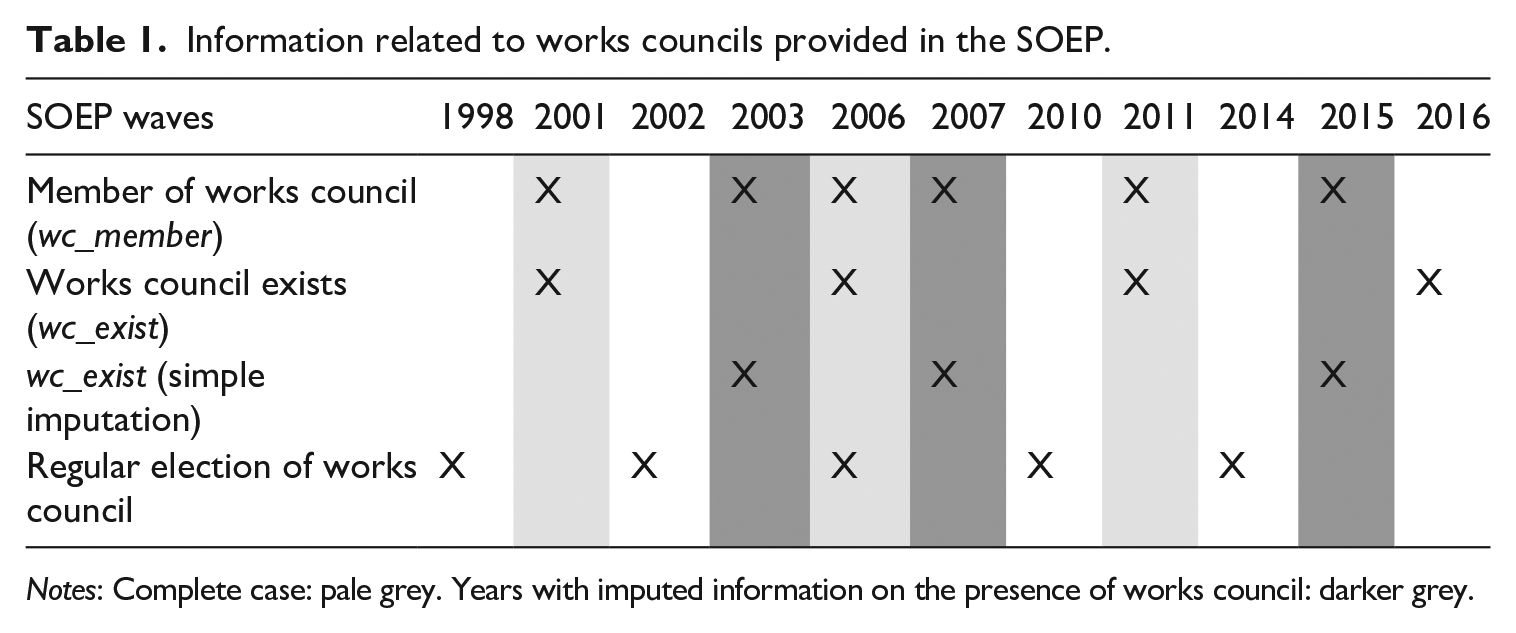
Notes: Complete case: pale grey. Years with imputed information on the presence of works council: darker grey.
Our first estimating sample is based on the years 2001, 2006, and 2011 for which the SOEP provides information both on the existence of a works council in the respondent’s firm and on individual council membership. To enhance the number of observations, in the second estimating sample, which is also an unbalanced panel data set, we additionally use information for the survey years 2003, 2007, and 2015. In these years, only information on works council membership is available. We impute missing information on the existence of a council. 8 The first estimating sample (complete case sample) consists of the survey years marked in pale grey in Table 1, whereas the second additionally includes the years marked in dark grey (comprehensive sample). 9
We focus on employees in private sector establishments in which a works council exists. Accordingly, we consider plants with at least five employees since the WCA only applies to such establishments. All respondents are required to have worked full-time, part-time or as an apprentice in at least one of the particular years. Furthermore, they are aged between 18 and 65. The WCA does not apply to so-called executive staff. Therefore, we use questions in the SOEP on the respondents’ occupational positions to exclude employees with extensive managerial duties from our estimating sample. 10 Finally, we omit observations with item non-response on relevant variables from the empirical analysis.
Given these restrictions, the first estimating sample based on the years 2001, 2006, and 2011 exploits information for 8780 observations from 6158 employees (complete case analysis, estimating sample 1). The more extensive sample adds information from the years 2003, 2007, and 2015 and consists of 15,839 observations from 8220 employees (comprehensive sample, estimating sample 2). Respondents with singletons are excluded in all TWFE specifications. We will use both estimating samples for our main regression exercises and the comprehensive estimating sample for the descriptive analysis and all robustness checks.
Results
In this section we, first, present descriptive evidence. Second, we display the main regression results. Third, we investigate different types of heterogeneity, focusing on differences among works councilors, on employee characteristics, and, finally, firm-related heterogeneities.
Descriptive evidence
In a first step, we compare our comprehensive estimating sample to the population of all employees who work in establishments in which a works council could exist but has not been established. We observe that employees working in firms with a works council are on average older, are more likely to have a university degree, stay longer with their employer, work part-time less often, and earn more than employees in non-works council establishments (see Table S1 in the Supplementary Material available online, based on the comprehensive estimating sample 2). 11
In our comprehensive sample (estimating sample 2), about 6.3% of employees are members of a works council. 12 Table 2 indicates that works councilors are on average 2.5 years older than their colleagues, have higher tenure, are more likely to have completed vocational training and to be a union member, but are less likely to have earned a university degree and to work part-time. 13 More importantly, a comparison of the means of the monthly real wages indicates a raw works council membership wage premium of 5.4%.
Descriptive statistics by works council membership.
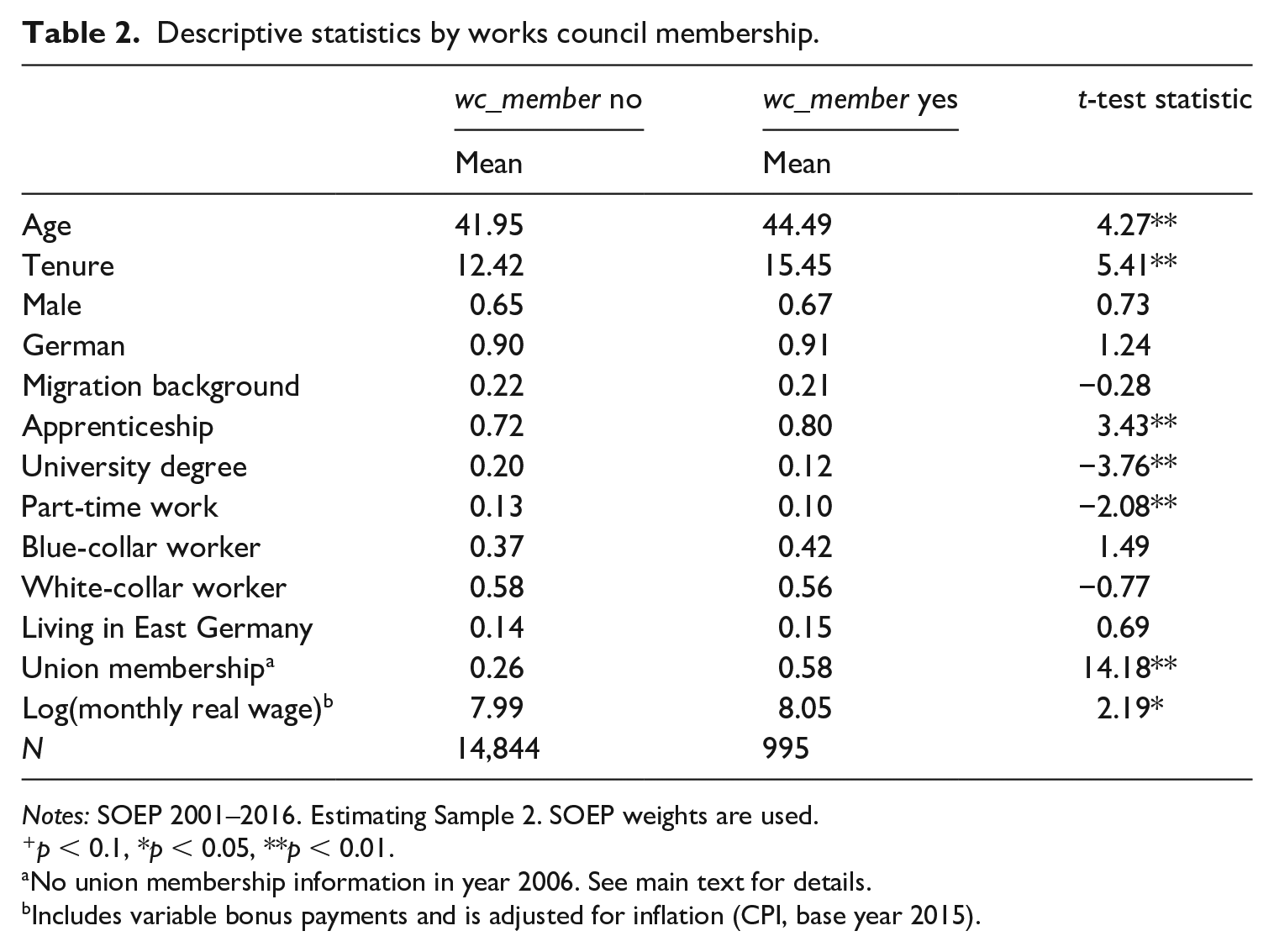
Notes: SOEP 2001–2016. Estimating Sample 2. SOEP weights are used.
p < 0.1, *p < 0.05, **p < 0.01.
No union membership information in year 2006. See main text for details.
Includes variable bonus payments and is adjusted for inflation (CPI, base year 2015).
Main findings
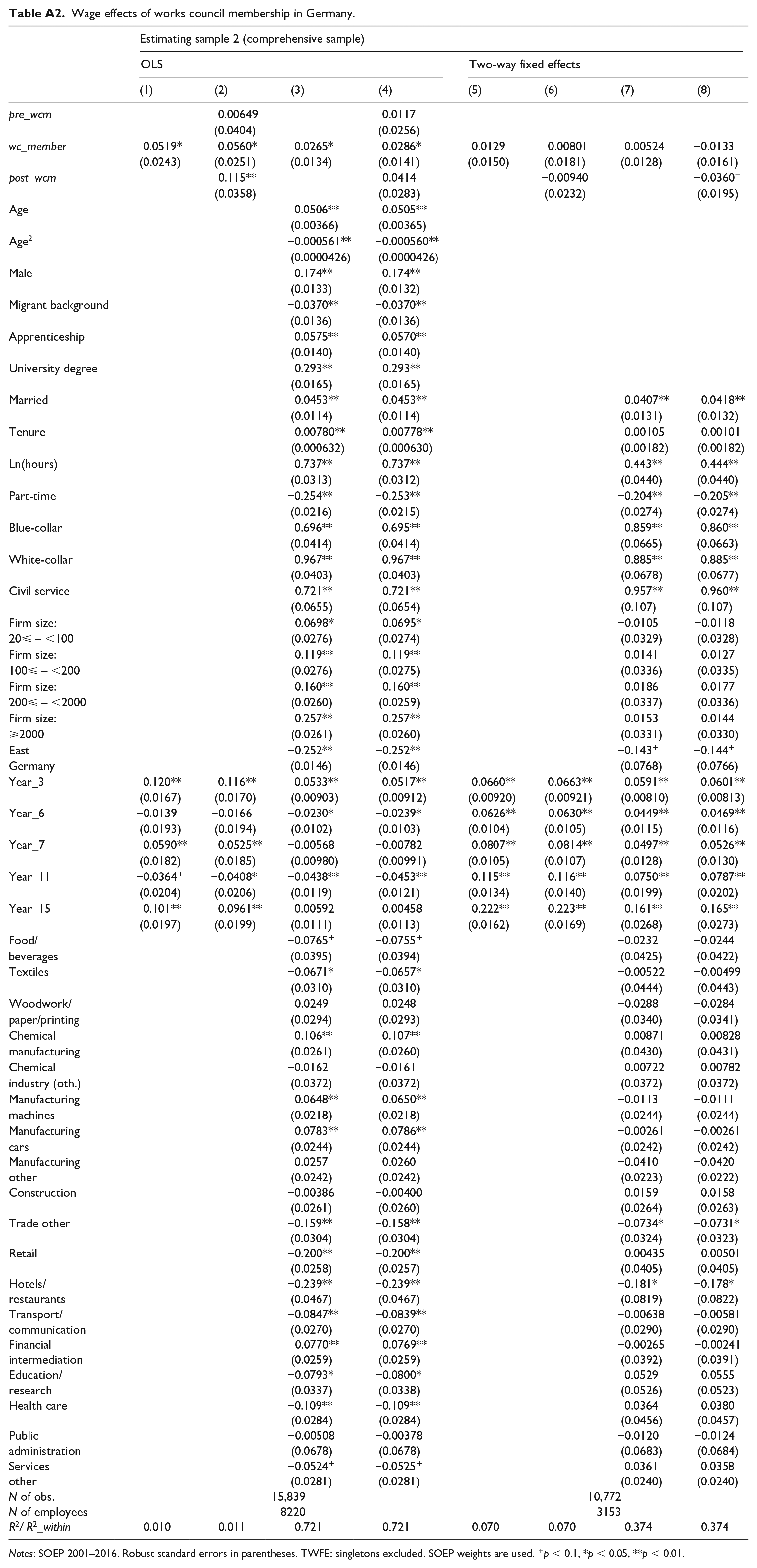
The upper part of Table 3 documents results from empirical specifications based on the estimating sample with complete cases only, while the lower part is based on the comprehensive estimating sample for the years 2001, 2003, 2006, 2007, 2011, and 2015. 14 The average raw works council membership wage premium amounts to 5–7% in the pooled OLS specifications with time dummies only (columns 1, 2). Allowing for dummies indicating the years before and after active works councilorship in these specifications reveals that former works councilors earn notably more in the years after their stint in office, i.e. we estimate a raw wage premium of 12–14%. 15
Wage effects of works council membership in Germany.
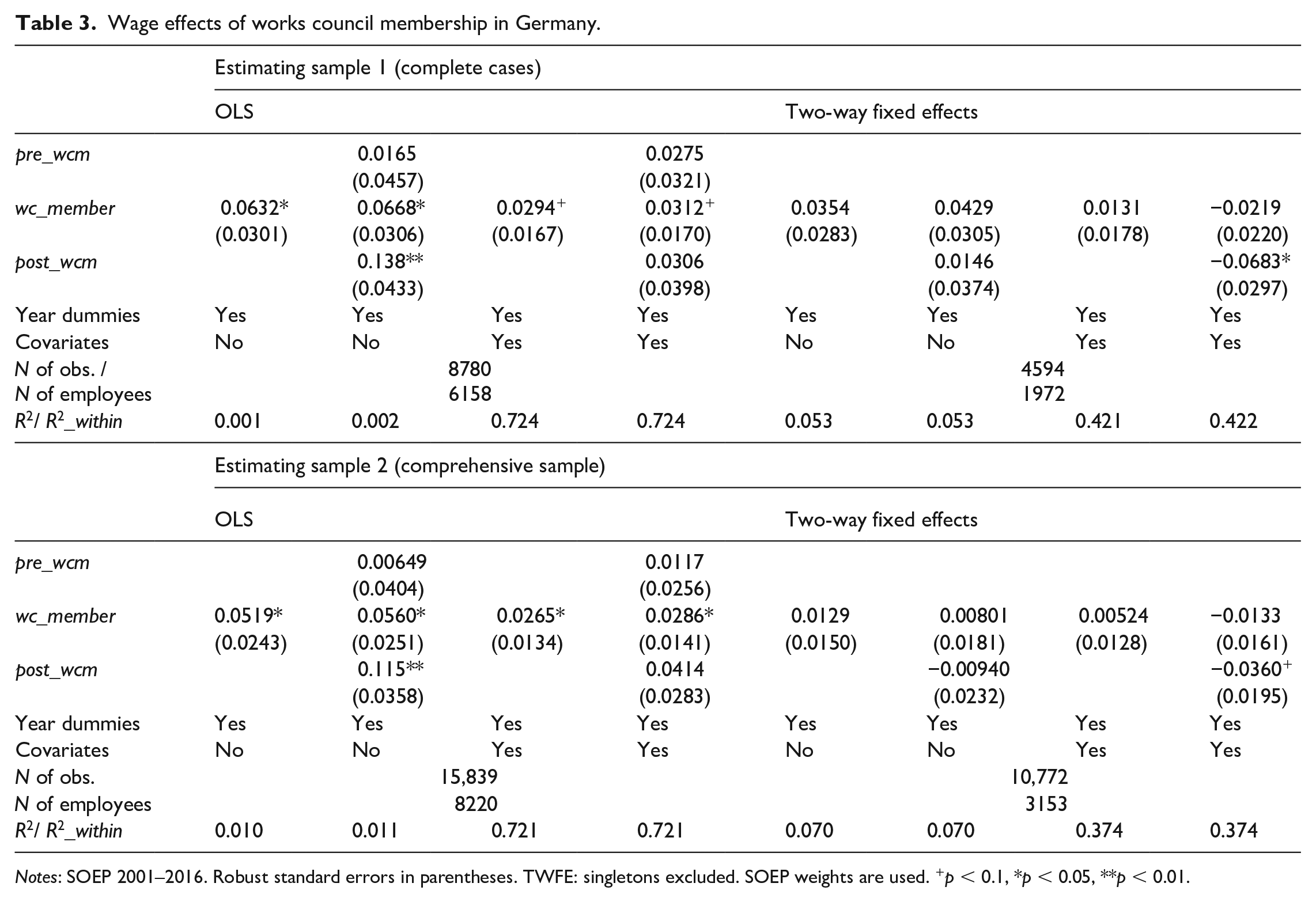
Notes: SOEP 2001–2016. Robust standard errors in parentheses. TWFE: singletons excluded. SOEP weights are used. +p < 0.1, *p < 0.05, **p < 0.01.
Including the full set of covariates, the pooled OLS wage premium of works council membership falls to about 3% and the estimated coefficients of the lag dummies are not significantly different from zero anymore. Focusing on the TWFE results, the estimated coefficients of council membership are not significantly different from zero in any of the specifications. Hence, we find no evidence of a works council membership wage differential during the time in office. Furthermore, our TWFE estimates do not point towards positive wage differentials after works councilors have left office, i.e. we find no evidence for delayed compensation. If anything, wage differentials shrink, relative to the time before taking office, since the coefficient of the post-office dummy is (weakly) significantly negative. However, this result is not robust across various specifications for subgroups (see below).
As mentioned above, TWFE estimates might be biased due to the presence of heterogeneous treatment effects over time (de Chaisemartin and D’Haultfoeuille, 2020, 2022). In our case, some of the wage effects averaged over in the TWFE specification above might exhibit negative weights, because employees become members of a works council at different times and the length of their stint in office varies. Although more than 85% of our observations stem from never-works-councilors, 16 which reduces the risk of negative weights (e.g. Borusyak et al., 2021), we check the robustness of results following the suggestions of de Chaisemartin and D’Haultfoeuille (2020, 2022). 17 First, we calculate the TWFE weights for the specification in column 7 of the lower part of Table 3. Only 15% of the weights are negative and the corresponding sum of the negative weights is −0.005. Second, we apply de Chaisemartin and D’Haultfoeuille’s difference-in-differences estimator. The estimated dynamic wage differentials of works council membership over time are in the range of [−0.027, 0.024]. All these estimated wage premia are not significantly different from zero. Therefore, there is no evidence that our main TWFE results are misleading.
The above analyses focus on the question whether works councilors are on average paid differently than comparable employees who do not belong to this institution. However, wage effects of council membership might exist beyond the mean. 18 One can, for example, imagine that a given absolute wage premium or penalty has stronger consequences on the behavior of works councilors who receive a low wage than on highly paid councilors. In this case, the incentives for firms to pay works councilors differently may vary along the real wage distribution.
To address this concern, we estimate unconditional quantile regressions based on both estimating samples. In particular, following Firpo et al. (2009), we employ RIF regression specifications without and with fixed effects to recover the effects of works council membership at different percentiles of the real wage distribution (see also Rios-Avila, 2020). 19 Tables 4a and 4b display the results. We do find significant wage premia at lower percentiles of the real wage distribution (10th and 25th percentile) and a significantly negative wage differential at the 90th percentile in pooled specifications without fixed effects. Moreover, pre- and post-office dummy coefficients are (weakly) significantly positive in the lower part of the real wage distribution and post-office dummy coefficients significantly negative at the 90th percentile. However, once we control for individual fixed effects, significant associations between the shares of works councilors and wages along the real wage distribution basically vanish. Looking at wage differentials after works councilors have left office, we do not find evidence for delayed compensation in the fixed-effects specifications. Rather, we obtain some indication of a shrinking works councilor wage differential relative to the time before taking office in the upper part of the real wage distribution.
Wage effects of works council membership in Germany – unconditional quantile regressions (complete cases, estimating sample 1).
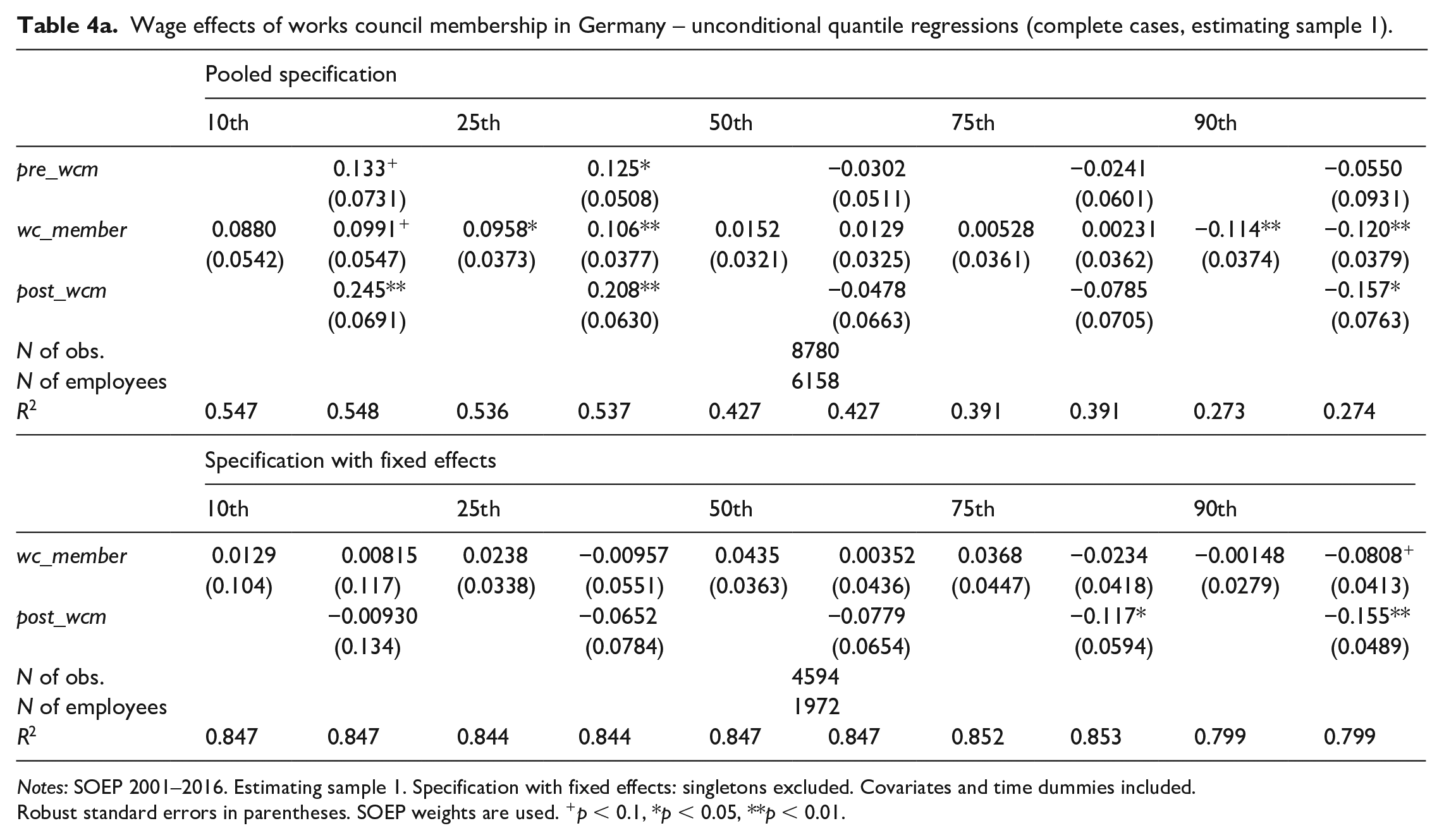
Notes: SOEP 2001–2016. Estimating sample 1. Specification with fixed effects: singletons excluded. Covariates and time dummies included.
Robust standard errors in parentheses. SOEP weights are used. +p < 0.1, *p < 0.05, **p < 0.01.
Wage effects of works council membership in Germany – unconditional quantile regressions (estimating sample 2).
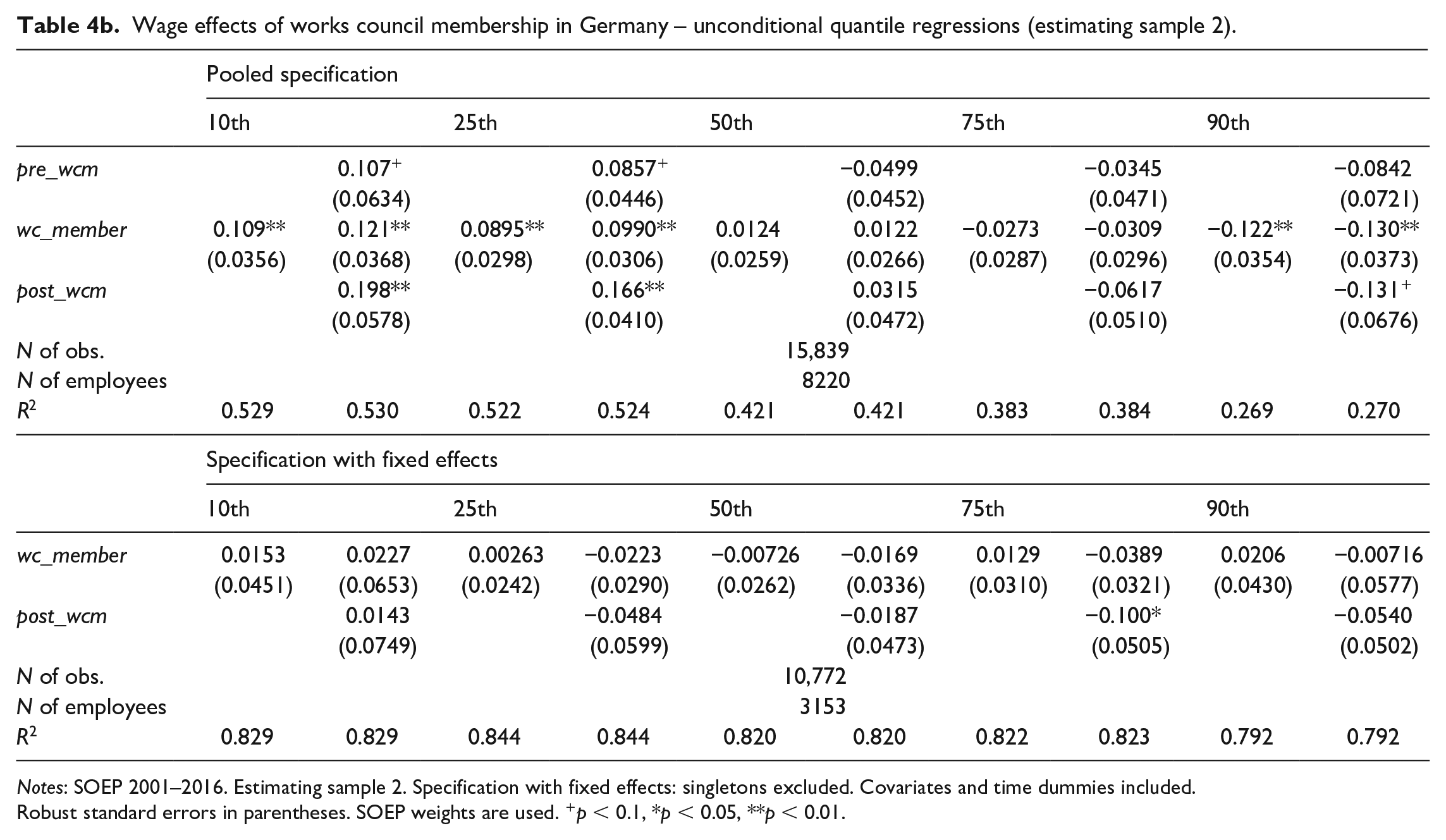
Notes: SOEP 2001–2016. Estimating sample 2. Specification with fixed effects: singletons excluded. Covariates and time dummies included.
Robust standard errors in parentheses. SOEP weights are used. +p < 0.1, *p < 0.05, **p < 0.01.
The differences between the results originating from pooled specifications and specifications with individual fixed effects suggest that members of a works council exhibit some time-invariant wage-affecting characteristics, which are not captured by the information available in the SOEP, but are discernible to the employer. 20 Taken at face value, our results might point towards a time-invariant positive selection into councilorship in the lower part of the real wage distribution and negative selection in the upper part. However, it is important to bear in mind that we cannot control for firm-fixed effects in our empirical work. Hence, firm-specific management strategies might drive our results. We provide further evidence on this issue in our subgroup analysis below, given the data restrictions.
All in all, the estimated wage differentials of works council membership provide no evidence of wage premia for works councilors and do not indicate that excessive payments are used by employers to influence the behavior of elected councilors. Rather, observed works council membership wage differentials vanish, once we control for individual observed and unobserved heterogeneity. Consequently, we do not find evidence that wage payments to works councilors in Germany violate the legal framework of the WCA.
Heterogeneity of works councilors
Our main results might mask heterogeneity with respect to individual characteristics of works councilors. A notable fraction of works councilors serve for more than one election period and a majority belong to a trade union. Therefore, in this section, and based on the comprehensive estimating sample, we examine whether there are wage differentials between works councilors and comparable employees, considering these dimensions.
Re-elected works councilors
About 21% of the works councilors in our estimating sample serve six or more years in office, i.e. are at least in their second term. 21 The longer an employee is a works councilor, the more knowledge about intra-plant processes the person obtains, and the greater the scope for wage adjustments becomes, which an observationally comparable employee does not experience. For this reason, wage effects may arise especially for long-term works councilors.
To check this conjecture, we add a dummy variable to our empirical specifications, which equals 1 if a works councilor is in office for at least six years. The results (Table S2a in the Supplementary Material available online) suggest that our main OLS estimates are partly driven by long-term works councilors. On average, they earn a membership wage premium of roughly 9% during their time in office, while the main effect of works councilorship is not significantly different from zero. Once we control for unobserved individual heterogeneity, the substantial wage premia for long-term works councilors observed in OLS specifications vanish. As a consequence, even for long-term works councilors, we observe no systematic violation of the principles laid down in the WCA.
As mentioned above, regulations in the WCA require that a plant must release members of the works council from standard work obligations if the establishment passes a size threshold of 200 employees. Since the hypothetical development of an employee’s career and remuneration is much more difficult to establish precisely for works councilors completely released from work than for those who continue working in their job, the scope for wage adjustments is much greater for the former group than the latter. Unfortunately, the SOEP provides no direct information on whether works councilors are partly or completely exempt from standard work duties. To tackle this problem, we use an open text question regarding the employee’s occupational activity. Searching for work council members’ answers like ‘released works councilor’ results in 33 such responses. Since 64% of them are re-elected works councilors, we perform horse race regressions where we include a dummy variable for ‘re-elected works councilors’ as well as one for ‘works councilor released from work’. The estimated coefficients for the dummy variable ‘works councilor released from work’ are not significantly different from zero, while those for the dummy ‘re-elected works councilors’ are basically identical with the ones discussed above (see Table S2b in the Supplementary Material available online). Hence, we obtain no evidence that being released from work as a councilor entails additional wage consequences.
Works councilors and union membership
In our comprehensive sample about 58% of all works councilors are trade union members (see Table 2). 22 Wages of councilors may vary with union status because trade unions can inform their members about legally adequate wage trajectories or enhance their bargaining power. To analyze this linkage, we exclude observations from 2006 from our estimating sample because information on union membership is not available in this year and consider subsamples of union and non-union members. We do not observe significant wage differentials in either of these two subsamples (see Table S3 in the Supplementary Material available online). Hence, union membership does not appear to mediate the wage effects of works councilorship.
Group-specific heterogeneity
We next examine whether the findings concerning wage differentials for works councilors vary according to selected employee characteristics. The underlying idea is that there may be wage differentials between works councilors and other, comparable employees for particular groups of staff. Therefore, we subsequently focus on more homogeneous groups of employees. This also enables us to more closely approximate some dimensions of the regulations of the WCA.
Our descriptive analysis, for example, indicates that part-time and female employees are slightly underrepresented in works councils. If this feature indicates that such works councilors have less influence on the workforce, management may be less inclined to treat them favorably concerning their remuneration. However, part-time and female employees tend to be paid less than comparable full-time or male employees in Germany. This may provide a greater incentive to use wage premia. Therefore, wage differentials between works councilors and comparable employees may vary with gender and working time. Moreover, the reasons for becoming a works councilor and, thus, potential pay adjustments, may also differ between blue- and white-collar workers. In line with this conjecture, the anecdotal evidence of hugely excessive works councilor remuneration often relates to former blue-collar workers. Finally, instead of including a tenure variable to condition on the employee’s time with the employer, we rely on a sample of firm stayers. By focusing on stayers only, we can, first, more closely approximate the legal constraint of the WCA, which links the remuneration of works councilors to the wages of comparable co-workers within the establishment. Second, since works councilors do not change employer during their time in office, concentrating on firm stayers results in a more homogeneous sample. Third, the time-invariant unobserved individual fixed effect
Below we outline the findings, focusing on the comprehensive sample, differentiated according to gender, working time, and occupation, as well as for firm stayers for specifications which include the full set of control variables.
Gender
For men, which constitute about two-thirds of our estimating samples, we detect no evidence of wage differentials for works councilors, neither during, nor before or after their stint in office. The picture for women is not conclusive. On the one hand, in the pooled OLS specifications we do not observe a wage differential for female works councilors during their time in office, though the estimated coefficients for their average wage before and after their stint in office are significantly positive. On the other hand, in one of the two TWFE specification, we find a weakly significant negative effect of works council membership (see Table S4 in the Supplementary Material available online). Because the TWFE estimate is only weakly significant, and the sample of female employees is relatively small, firm conclusions regarding gender differences require further research.
Working time
For part-time employees, the estimated coefficients for the time in office, and also the periods before and after, are all (weakly) significantly positive in the pooled OLS specifications (see Table S5 in the Supplementary Material available online). In TWFE specifications no evidence of higher wages for part-time councilors can be discerned. In our sample, part-time employees constitute a relatively small share, while slightly fewer than 85% of the observations stem from full-time employees. For these individuals, works councilorship is not associated with any wage gains or losses. In sum, we obtain no empirical support for the conjecture that the incentives to financially reward or penalize works councilors vary with working time.
Blue-collar vs. white-collar workers
Pooled OLS results suggest that the wage effects of works councilorship are a blue-collar phenomenon, since the coefficients indicating the years before, during or after the time in office are of similar size and significantly positive. However, these effects are no longer apparent, once we control for individual unobserved heterogeneity in TWFE specifications. For white-collar workers, there is no wage effect of works councilorship whatsoever (see Table S6 in the Supplementary Material available online).
Stayers
We identify stayers as employees who remain with their firm during all their years in our estimating sample. Restricting the sample in this way reduces the number of observations by about 37% in comparison to the comprehensive sample. For the stayer sample, we detect no significant wage differentials for works councilors before, during, or after their stint in office in pooled OLS specifications. More importantly, the results for the TWFE specifications indicate no wage council membership differential either (see Table S7 in the Supplementary Material available online). Therefore, when defining the comparison group of co-workers more narrowly to firm stayers we obtain no evidence for wage differentials between works councilors and other, comparable employees whatsoever.
Firm-related heterogeneities
The SOEP data contain limited information about the firm in which an individual is employed. While we control for firm and job characteristics, such as size and sector, in all our specifications, we cannot rule out that wage differentials for works councils will differ according to firm-related features. In order to tackle this issue and increase the extent of homogeneity of our estimating samples concerning firm-related features, we first distinguish between manufacturing and the private service sector. Works council coverage differs between them (Ellguth and Kohaut, 2021), such that also the management’s incentives to reward or penalize councilors may differ. Second, works councils are much more common in large firms than in small ones, and the number of released works councilors increases with firm size. Furthermore, wages in most large firms are determined by collective bargaining (Ellguth and Kohaut, 2021). The anecdotal evidence referred to in the introduction about excessive rewards for works councilors also often relates to individuals who are employed in large firms covered by collective bargaining agreements. Third, we have explicit information about collective bargaining coverage for the survey year 2015 and can investigate its role directly. In this subsection, we differentiate our results along these dimensions. The results are documented in Tables S8 to S10 in the Supplementary Material (available online) based on the comprehensive sample and for specifications which include the full set of control variables.
Manufacturing vs. private service sector
Works councilors in manufacturing experience wage premia of about 6% in pooled OLS specifications. However, in line with the main results, we do not observe these wage effects in the TWFE specifications and even a negative estimated coefficient for the post-office period. In the service sector, there are no wage differentials of works councilorships at all. 23
Firm-size
Works councilors in firms with fewer than 2000 employees obtain a wage premium of about 4% according to the pooled OLS specifications, while no such wage effect is discernible in firms with 2000 or more employees. Additionally, we do not find any significant wage effects of works councilorship in the TWFE specifications, irrespective of firm size.
From these findings, we conclude that the power of works councils, which is surely more extensive in larger firms, does not appear to affect whether councilors are financially rewarded or penalized. Moreover, the reports about excessive payments to works councilors of global companies do not seem to mirror a widespread phenomenon.
Collective bargaining coverage
Using the data for 2015 only, we do not find wage premia of works council memberships in the pooled sample to start with. This result holds in specifications based on subsamples of employees in establishments with or without collective bargaining coverage as well. Since most large firms are covered by collective bargaining agreements, these findings are consistent with our results for large firms.
Further robustness checks
While the robustness checks presented in the above subsections aimed at reducing the heterogeneity of either works councilors or the group of employees they are compared with, we take a somewhat broader perspective next and consider two further aspects which may impact the wage differential between works councilors and other employees. First, one could hypothesize that it is affected by the dependent variable, namely the wage measure. Second, while from a legal perspective, as given by the WCA, employees within the same establishment are the benchmark for the remuneration of works councilors, from a more economic vantage point, also employees who decided to work in an establishment that is subject to the WCA but without an established works council may be relevant.
Using a different wage measure
The dependent variable which we have used thus far is the real monthly gross wage, including variable bonus payments. Therefore, we can not only analyze changes in the standard remuneration, but also adjustments in variable payments, which employers may utilize selectively to reward or penalize works councilors. To check the robustness of our results, we rerun all main specifications with the plain real monthly gross wage as the dependent variable. Our results do not change (see Table S11 in the Supplementary Material available online). Moreover, focusing on variable pay only, we cannot observe any pay differentials between works councilors and comparable workers (see Table S12 in the Supplementary Material available online). Therefore, we observe no correlation between a works council membership and the salary structure.
Broader selection of estimating samples
Our results are based on estimating samples restricted to employees in establishments with a works council. However, one might argue that employees in all firms subject to the WCA irrespective of the existence of a works council in the particular firm are a reasonable alternative population at risk. This is the case due to the fact that all employees in firms subject to the WCA have a positive probability of being elected in a works council, once the process of establishing a works council has started. When we conduct regression exercises based on the extended estimating sample, we find very similar results to those documented in Table 3 (see Table S13 in the Supplementary Material available online). In addition, we observe a wage premium of employees in establishments with a works council of about 5–7% in the TWFE specifications. 24
Personnel councils in the public sector
Our analysis has, thus far, been restricted to private sector firms subject to the WCA. Personnel councils in the public sector are similar to works councils, and their legal regulations mimic the WCA. However, wage bargaining and promotion procedures are very different in the public sector. In addition, the scope for discretionary wage adjustments is much more limited than in the private sector. Hence, we expect no wage effects of personnel councilorship in the public sector.
To scrutinize this hypothesis, we use an estimating sample of public sector employees for the period 2001–2015. As expected, we cannot discern any wage effects of personnel council membership either in OLS or in TWFE specifications (see Table S14 in the Supplementary Material available online).
Summary and conclusions
Co-determination at the plant level is an integral part of the German system of industrial relations. In firms which have a works council, about 6% of all employees belong to it. The relevant law, the WCA, requires that works councilors are neither financially rewarded nor penalized for their activities. In the public debate, instances of large payments to prominent work councilors of global companies have attracted substantial attention. They have also sparked a debate about a reform of the WCA. This debate suffers from a lack of information because there is no systematic empirical analysis of works councilors’ wages.
In our empirical analysis, based on SOEP data, we find wage premia for works councilors of 3–7% in OLS specifications. They are more pronounced for part-time and blue-collar workers, long-term works councilors and workers in manufacturing. These wage effects of works councilorship vanish in linear fixed-effects specifications. Hence, our results indicate that payments to works councilors are broadly in line with legal regulations and, therefore, do not support the call for a reform of the WCA.
Taken together, our findings indicate that on average a works councilorship does not pay off in terms of wages. This might provide an explanation for why employees often refrain from initiating the election of a works council in their establishment: potential costs of conflicts with, as well as sanctions by the employer are not compensated for by expected returns for being a works councilor. Furthermore, the absence of wage premia for works councilors may be one of the reasons for the feature that a remarkable share of councilors do not complete their entire term in office (Behrens, 2021).
Considering strategies of employers on how to deal with shopfloor co-determination, our findings suggest that on average employers do not use (illegal) monetary compensation in order to enhance goodwill. In a recent survey on the economic effects of co-determination Jäger et al. (2022b) argue, that – even in the German case of shopfloor co-determination – existing laws do not significantly boost workers’ influence, because formal co-determination rights do not translate into substantial real authority. If their assessment is correct, managers of most German companies may simply expect no sufficient gain from paying works councilors for cooperative behavior. Furthermore, this perspective suggests that legal regulations of the pay of employee representatives are less important in industrial relations settings in which works councils or comparable institutions wield less power and have less impact on economic outcomes than is the case in Germany.
Supplemental Material
sj-docx-1-eid-10.1177_0143831X221139331 – Supplemental material for Wage determination in the shadow of the law: The case of works councilors in Germany
Supplemental material, sj-docx-1-eid-10.1177_0143831X221139331 for Wage determination in the shadow of the law: The case of works councilors in Germany by Laszlo Goerke and Markus Pannenberg in Economic and Industrial Democracy
Footnotes
Appendix: Full results for specifications reported in Table 3
Wage effects of works council membership in Germany.
| Estimating sample 2 (comprehensive sample) | ||||||||
|---|---|---|---|---|---|---|---|---|
| OLS | Two-way fixed effects | |||||||
| (1) | (2) | (3) | (4) | (5) | (6) | (7) | (8) | |
| pre_wcm | 0.00649 | 0.0117 | ||||||
| (0.0404) | (0.0256) | |||||||
| wc_member | 0.0519* | 0.0560* | 0.0265* | 0.0286* | 0.0129 | 0.00801 | 0.00524 | −0.0133 |
| (0.0243) | (0.0251) | (0.0134) | (0.0141) | (0.0150) | (0.0181) | (0.0128) | (0.0161) | |
| post_wcm | 0.115** | 0.0414 | −0.00940 | −0.0360 + | ||||
| (0.0358) | (0.0283) | (0.0232) | (0.0195) | |||||
| Age | 0.0506** | 0.0505** | ||||||
| (0.00366) | (0.00365) | |||||||
| Age2 | −0.000561** | −0.000560** | ||||||
| (0.0000426) | (0.0000426) | |||||||
| Male | 0.174** | 0.174** | ||||||
| (0.0133) | (0.0132) | |||||||
| Migrant background | −0.0370** | −0.0370** | ||||||
| (0.0136) | (0.0136) | |||||||
| Apprenticeship | 0.0575** | 0.0570** | ||||||
| (0.0140) | (0.0140) | |||||||
| University degree | 0.293** | 0.293** | ||||||
| (0.0165) | (0.0165) | |||||||
| Married | 0.0453** | 0.0453** | 0.0407** | 0.0418** | ||||
| (0.0114) | (0.0114) | (0.0131) | (0.0132) | |||||
| Tenure | 0.00780** | 0.00778** | 0.00105 | 0.00101 | ||||
| (0.000632) | (0.000630) | (0.00182) | (0.00182) | |||||
| Ln(hours) | 0.737** | 0.737** | 0.443** | 0.444** | ||||
| (0.0313) | (0.0312) | (0.0440) | (0.0440) | |||||
| Part-time | −0.254** | −0.253** | −0.204** | −0.205** | ||||
| (0.0216) | (0.0215) | (0.0274) | (0.0274) | |||||
| Blue-collar | 0.696** | 0.695** | 0.859** | 0.860** | ||||
| (0.0414) | (0.0414) | (0.0665) | (0.0663) | |||||
| White-collar | 0.967** | 0.967** | 0.885** | 0.885** | ||||
| (0.0403) | (0.0403) | (0.0678) | (0.0677) | |||||
| Civil service | 0.721** | 0.721** | 0.957** | 0.960** | ||||
| (0.0655) | (0.0654) | (0.107) | (0.107) | |||||
| Firm size: | 0.0698* | 0.0695* | −0.0105 | −0.0118 | ||||
| 20⩽ – <100 | (0.0276) | (0.0274) | (0.0329) | (0.0328) | ||||
| Firm size: | 0.119** | 0.119** | 0.0141 | 0.0127 | ||||
| 100⩽ – <200 | (0.0276) | (0.0275) | (0.0336) | (0.0335) | ||||
| Firm size: | 0.160** | 0.160** | 0.0186 | 0.0177 | ||||
| 200⩽ – <2000 | (0.0260) | (0.0259) | (0.0337) | (0.0336) | ||||
| Firm size: | 0.257** | 0.257** | 0.0153 | 0.0144 | ||||
| ⩾2000 | (0.0261) | (0.0260) | (0.0331) | (0.0330) | ||||
| East | −0.252** | −0.252** | −0.143 + | −0.144 + | ||||
| Germany | (0.0146) | (0.0146) | (0.0768) | (0.0766) | ||||
| Year_3 | 0.120** | 0.116** | 0.0533** | 0.0517** | 0.0660** | 0.0663** | 0.0591** | 0.0601** |
| (0.0167) | (0.0170) | (0.00903) | (0.00912) | (0.00920) | (0.00921) | (0.00810) | (0.00813) | |
| Year_6 | −0.0139 | −0.0166 | −0.0230* | −0.0239* | 0.0626** | 0.0630** | 0.0449** | 0.0469** |
| (0.0193) | (0.0194) | (0.0102) | (0.0103) | (0.0104) | (0.0105) | (0.0115) | (0.0116) | |
| Year_7 | 0.0590** | 0.0525** | −0.00568 | −0.00782 | 0.0807** | 0.0814** | 0.0497** | 0.0526** |
| (0.0182) | (0.0185) | (0.00980) | (0.00991) | (0.0105) | (0.0107) | (0.0128) | (0.0130) | |
| Year_11 | −0.0364 + | −0.0408* | −0.0438** | −0.0453** | 0.115** | 0.116** | 0.0750** | 0.0787** |
| (0.0204) | (0.0206) | (0.0119) | (0.0121) | (0.0134) | (0.0140) | (0.0199) | (0.0202) | |
| Year_15 | 0.101** | 0.0961** | 0.00592 | 0.00458 | 0.222** | 0.223** | 0.161** | 0.165** |
| (0.0197) | (0.0199) | (0.0111) | (0.0113) | (0.0162) | (0.0169) | (0.0268) | (0.0273) | |
| Food/ | −0.0765 + | −0.0755 + | −0.0232 | −0.0244 | ||||
| beverages | (0.0395) | (0.0394) | (0.0425) | (0.0422) | ||||
| Textiles | −0.0671* | −0.0657* | −0.00522 | −0.00499 | ||||
| (0.0310) | (0.0310) | (0.0444) | (0.0443) | |||||
| Woodwork/ | 0.0249 | 0.0248 | −0.0288 | −0.0284 | ||||
| paper/printing | (0.0294) | (0.0293) | (0.0340) | (0.0341) | ||||
| Chemical | 0.106** | 0.107** | 0.00871 | 0.00828 | ||||
| manufacturing | (0.0261) | (0.0260) | (0.0430) | (0.0431) | ||||
| Chemical | −0.0162 | −0.0161 | 0.00722 | 0.00782 | ||||
| industry (oth.) | (0.0372) | (0.0372) | (0.0372) | (0.0372) | ||||
| Manufacturing | 0.0648** | 0.0650** | −0.0113 | −0.0111 | ||||
| machines | (0.0218) | (0.0218) | (0.0244) | (0.0244) | ||||
| Manufacturing | 0.0783** | 0.0786** | −0.00261 | −0.00261 | ||||
| cars | (0.0244) | (0.0244) | (0.0242) | (0.0242) | ||||
| Manufacturing | 0.0257 | 0.0260 | −0.0410 + | −0.0420 + | ||||
| other | (0.0242) | (0.0242) | (0.0223) | (0.0222) | ||||
| Construction | −0.00386 | −0.00400 | 0.0159 | 0.0158 | ||||
| (0.0261) | (0.0260) | (0.0264) | (0.0263) | |||||
| Trade other | −0.159** | −0.158** | −0.0734* | −0.0731* | ||||
| (0.0304) | (0.0304) | (0.0324) | (0.0323) | |||||
| Retail | −0.200** | −0.200** | 0.00435 | 0.00501 | ||||
| (0.0258) | (0.0257) | (0.0405) | (0.0405) | |||||
| Hotels/ | −0.239** | −0.239** | −0.181* | −0.178* | ||||
| restaurants | (0.0467) | (0.0467) | (0.0819) | (0.0822) | ||||
| Transport/ | −0.0847** | −0.0839** | −0.00638 | −0.00581 | ||||
| communication | (0.0270) | (0.0270) | (0.0290) | (0.0290) | ||||
| Financial | 0.0770** | 0.0769** | −0.00265 | −0.00241 | ||||
| intermediation | (0.0259) | (0.0259) | (0.0392) | (0.0391) | ||||
| Education/ | −0.0793* | −0.0800* | 0.0529 | 0.0555 | ||||
| research | (0.0337) | (0.0338) | (0.0526) | (0.0523) | ||||
| Health care | −0.109** | −0.109** | 0.0364 | 0.0380 | ||||
| (0.0284) | (0.0284) | (0.0456) | (0.0457) | |||||
| Public | −0.00508 | −0.00378 | −0.0120 | −0.0124 | ||||
| administration | (0.0678) | (0.0678) | (0.0683) | (0.0684) | ||||
| Services | −0.0524 + | −0.0525 + | 0.0361 | 0.0358 | ||||
| other | (0.0281) | (0.0281) | (0.0240) | (0.0240) | ||||
| N of obs. | 15,839 | 10,772 | ||||||
| N of employees | 8220 | 3153 | ||||||
| R2/ R2_within | 0.010 | 0.011 | 0.721 | 0.721 | 0.070 | 0.070 | 0.374 | 0.374 |
Notes: SOEP 2001–2016. Robust standard errors in parentheses. TWFE: singletons excluded. SOEP weights are used. +p < 0.1, *p < 0.05, **p < 0.01.
Acknowledgements
We are grateful for very constructive advice by two anonymous referees, and for helpful comments by Martin Behrens, Jens Mohrenweiser, Steffen Müller, Christian Pfeifer, Claus Schnabel, Daniela Sonedda, colleagues in Trier, as well as participants of the 2020 TriECON (online) workshop on Co-determination at the IAAEU, a seminar at the FU Berlin, and the 2020 annual (online) congress of the Verein für Socialpolitik, and the 2022 COPE meeting in Herning. Furthermore, special thanks to Knut Wenzig for data support.
Declaration of conflicting interests
The authors declared no potential conflicts of interest with respect to the research, authorship, and/or publication of this article.
Funding
The authors received no financial support for the research, authorship, and/or publication of this article.

Supplemental material
Supplemental material for this article is available online.
Notes
Author biographies
References
Supplementary Material
Please find the following supplemental material available below.
For Open Access articles published under a Creative Commons License, all supplemental material carries the same license as the article it is associated with.
For non-Open Access articles published, all supplemental material carries a non-exclusive license, and permission requests for re-use of supplemental material or any part of supplemental material shall be sent directly to the copyright owner as specified in the copyright notice associated with the article.
