



Abstract
In the course of the so-called ‘digital transformation’, the digitalisation of manufacturing is on the agenda in many companies. Are works councils, as an important form of workplace representation of employees’ interests, prepared to bring employees’ interests into company digitalisation processes, and does this affect their own position of power? To answer these questions, four in-depth qualitative case studies of works councils from German industrial companies are conducted. The results show that works councils can rely on important resources in the bargaining of digitalisation processes. Through the combination of resource use with other factors, such as the perception of digitalisation and the (un)willingness of management to involve works councils, three different constellations can be identified under which dealing with digitalisation represents an opportunity or a threat for works councils.
Introduction
The so-called ‘digital transformation’ is on the agenda in many companies, and is therefore an important topic for industrial relations as well. Basically, digitalisation is a collective term which refers to a new quality of mechanisation and computerisation, which is expressed in a multitude of new digital technologies based on the internet as the central infrastructure (Kuhlmann and Rüb, 2020: 22). Characteristic is the increasing interconnectedness of people, machines and products, and examples of such technologies include wearables such as smart watches, the Internet of Things (IoT), algorithms and artificial intelligence (AI). Companies aim for the digitalisation of business processes and extensive business model changes (e.g. Gebauer et al., 2020), both of which lead to extensive change in the management of processes and people (e.g. Franken and Franken, 2018; Neuburger and Fiedler, 2020), in order to generate competitive advantages. All in all, the related changes at the company level can be far-reaching and are likely to affect workload, work content, working time regimes or places (e.g. remote work). Therefore, employee interests are at stake.
In industrial relations, attention has so far tended to focus on issues such as new forms of work like platform-based work (e.g. Swiatkowski, 2020) or the industry- or nationwide negotiating of these topics between employees and employers. Little is known about workplace representation and digitalisation, although there has been a general increase in interest in local, organisational constellations of industrial relations (e.g. Pulignano et al., 2016; Sako and Jackson, 2006). Moreover, the existing research on the impact of digitalisation on established workplace representation has produced contradictory results regarding the opportunities or threats for workplace co-determination itself (Haipeter, 2018, 2020; Niehaus and Katzan, 2020).
Especially against the background of established ‘dual systems’ of interest representation, as found, for example, in Germany (Behrens, 2009; Nienhüser, 2014), the question arises as to how works councils in their role as local interest representation at the company level represent employee interests in digitalisation processes, and what effect this has on their own position of power. Power plays an important role because, on the one hand, the positions of employers and employees are always contested and, on the other hand, I assume that how, why, to what extent and for what purpose digital technologies are implemented and used in organisations is strongly influenced by the organisational power constellation of the actors involved. Collective employee representation is one of these actors.
Therefore, I draw on a micropolitical approach to power (Crozier and Friedberg, 1980; Fligstein and McAdam, 2011, 2012) to answer the following questions: How is employee representation at the organisational level involved in the implementation processes of organisational digitalisation? How do its power position and power resources shape its involvement? And does interference in these processes represent an opportunity or a threat for the power position of employee representation itself?
The findings are based on four in-depth qualitative case studies of works councils from German industrial companies. In Germany, works councils are the central actor of collective employee representation at the organisational level within the German ‘dual system’ of industrial relations (e.g. Behrens, 2009), and have particularly strong co-determination rights (Nienhüser, 2014). As manufacturing is the traditional core area of works councils’ engagement, the presented cases all engage in the digitalisation of manufacturing.
The results build a bridge between the hitherto contradictory discussion regarding the question of whether digitalisation is an opportunity or a threat for workplace co-determination. Instead of a general assessment, I identify three constellations: digitalisation as an opportunity, as having a neutral effect, or as a danger for works councils’ power position. The constellations are based on specific combinations of the available resources and their use, the works councils’ perception of digitalisation, and the position of management.
In the remainder of the article, I discuss the state of knowledge on the role of co-determination in the digitalisation of manufacturing. Next, I introduce the theoretical framework to analyse power resources and power positions of works councils. After a short introduction to the method and cases investigated, I present my findings. The article closes with a discussion of the findings and concluding remarks.
Co-determination and the digitalisation of manufacturing
The connection between industrial relations and company-based, technology-related changes, such as in the course of increasing digitalisation, does not seem to play a recognisable role in international discourse. 1 In contrast, research on this topic is increasingly taking shape in the German-speaking scientific discourse, although there is some agreement on the fact that we still know and understand far too little about how an increasing digitalisation of work influences working relationships, and vice versa (Kirchner and Matiaske, 2019: 125). While newly emerging forms of work, such as platform-based ‘gig’ work and its regulation, receive considerable attention (e.g. Gandini, 2019; Heiland and Brinkmann, 2020; Swiatkowski, 2020), insights on how digitalisation processes affect labour–management relations in established manufacturing companies remain scarce. Before I present the state of this research, I will briefly discuss some of the peculiarities of the German system of industrial relations since this characterises both the following literature review and the empirical case studies.
The German system of industrial relations is characterised by a well-established division of labour between unions and works councils. While unions bargain collective agreements at the industrial level which comprise, e.g. the regulation of payments, working time, and qualification level assignments within the broader framework of the German law, works councils operate at the company- and plant level. Here, they make use of their rights and negotiate additional company agreements (Müller-Jentsch, 1997: 23). By international comparison, German works councils have quite extensive economic and social rights as well as co-determination rights in some areas. Still, one has to admit that ‘the more economic and strategic the decisions are, the weaker the works council’s rights of participation’ (Nienhüser, 2014: 252). 2 Regarding the exchange relation between unions and works councils, the latter may support the unions through the recruitment of new members. In exchange, the unions may support works councils through the negotiation of favourable collective agreements, training opportunities (e.g. concerning digitalisation) and company-specific consulting (Behrens, 2009).
Despite this well-established, and in many ways well-functioning, ‘dual system’ of industrial relations, Haipeter (2018, 2020) shows that it does not work well for the participation in (organisational) technological processes. On the one hand, unions such as the metalworkers’ union (IG Metall) recently started to engage in the promotion of technological change based on social partnership. On the other hand, apart from some exceptions, works councils cannot rely on practices of participation in technology configuration at the firm level (Haipeter, 2020), though they are mostly open to innovations (Kriegesmann and Kley, 2012). The reasons for this scarce involvement do not rely on new developments, but were already worked out during the late 1980s in relation to the introduction of new information and communication technologies (e.g. Ortmann et al., 1990: 570ff.; Windeler, 1989). The authors emphasise that works councils should involve themselves in the planning of new organisational technology as early as possible, as ‘the scope for decision-making in the course of the process is constantly diminishing’ (Windeler, 1989: 249, translated by the author) due to the decisions already made to restrict alternatives. To do so, they argue, works councils should inform themselves about the interests of the various employee groups with regard to the workplaces and processes concerned. This is a time and resource consuming issue which is complicated by the fact that the works council itself is not a space free of interests. Nevertheless, at the same time, this is an important way to avoid legitimacy problems which can arise, among other times, when only the interests of some of the workers are visibly represented.
Works councils often avoid engaging in technology implementation projects as they do not have the knowledge base to do so adequately. With regard to resource constraints, it is more promising for them to engage in well-known topics such as working time or workplace design, where success can be expected and demonstrated to the employees (who elect the works council). Windeler (1989) points to the integration of employees’ expertise or external experts as a solution to the problem of a technological knowledge deficit.
Therefore, there is some agreement in the literature that works councils were and are still not well prepared to engage in organisational digitalisation processes. To turn this into a positive finding, Haipeter (2018: 318) develops a vision of ‘Co-determination 4.0’ (‘Mitbestimmung 4.0’). This vision relies on two core elements. First, Haipeter highlights the participation of employees with the aim of increasing resources, competences and legitimation (as already discussed above). Secondly, he demands ‘a novel combination of new challenges for classical labour policy fields with innovation issues’ (2018: 318, translated by the author). Therefore, works councils are characterised by their orientation towards employee participation as well as by an orientation towards organisational innovations while remaining a strong representative of labour policy interests within the firm. He concludes that works councils will probably need to engage with digital (communication) technology to fulfil their own work as sketched out in the vision of ‘Co-determination 4.0’. In contrast, Niehaus and Katzan (2020) particularly emphasise the works council’s potential for refusing digitalisation processes. They particularly attribute this possibility to works councils when the company is doing well economically (2020: 50). In a way, both authors are paradigmatic for one discourse strand on digitalisation: Haipeter (2018, 2020) emphasises the opportunities while Niehaus and Katzan (2020) emphasise the risks. Kuhlmann and Rüb (2020) supplement this risk–opportunity axis with a competition–regulation axis in order to work out how works councils and management rely on existing discourses. They show that the competitive discourse currently dominates the regulatory discourse.
Consequently, the few recent studies undertaken on the role of works councils in digitalisation processes result in different assessments of the role works councils can and should play. In addition, older studies, such as that by Ortmann et al. (1990), suggest that the role works councils are actually able to play depends, among other aspects, on the power position and power resources they are able to rely on. Such a power perspective is not found in the current studies, although there is research on what influences the power position of unions (e.g. AK Strategic Unionism, 2013; Schmalz et al., 2018) or of works councils in general (e.g. Nienhüser, 2009; Skorupińska-Cieślak, 2019). However, both view power resources primarily from an industrial relations perspective. However, as I aim to understand what local enforcement potential works councils have and whether and under what conditions they can exploit it within the organisation, it is necessary to supplement this industrial relations perspective with an organisational power perspective. Therefore, I will introduce the organisational power perspective applied within this article.
Shaping the digitalisation of manufacturing: Power resources, power games and strategic action fields
Within trade union research, the power resources approach has emerged as a perspective which focuses on the power resources of trade unions. Drawing on the seminal work of Wright (2000) and Silver (2003), it distinguishes between structural, organisational, institutional and social power (AK Strategic Unionism, 2013; Schmalz et al., 2018). Its underlying assumption is that trade unions have the ability to act strategically and have a strategic choice. However, as this approach focuses on trade unions, the resources identified cannot be transferred one-to-one to works councils. Since works councils act primarily within the company and are integrated into the organisational structures of the company, an organisational approach to power resources is used supplementarily. I draw on Crozier and Friedberg’s (1980) ‘strategic analysis’ of organisations, a relational power perspective which is highly capable of explaining power constellations, power games and their results at the local (thus: organisational) level. For them, power is tied to relationships, and although power is unequally distributed, no actor is powerless, but has more or less deployable power resources.
Actors are trying to improve their own position of power by drawing on their sources of power. Crozier and Friedberg (1980: 39ff.) distinguish four sources of power resulting from:
the mastery of expertise and functional specialisation,
important interfaces between organisation and environment,
the control of information and communication channels, and
the existence of general organisational rules themselves.
Alongside these forms, structural power results from the simple fact that employees need to do their work to ensure the continued existence of the organisation, which highlights their potential to go on strike (their workplace bargaining power) or to change jobs (their marketplace bargaining power) (Schmalz et al., 2018: 116ff.). In addition, Ortmann et al. (1990) highlight that Crozier and Friedberg’s power resources lack a material dimension, which they supplement with material aspects of the environment (e.g. raw materials), material means of (re)production (e.g. technology) and produced goods.
Since actors in organisations always have a certain amount of leeway, they use this leeway to assert their own interests. This leeway is a zone of uncertainty around which power games unfold. Through power games, Crozier and Friedberg (1980) stress that it is the logic of a game which integrates the individual freedom of actors and the coercion exercised by organisations through the existence of rules, roles and so on. For even if actors pursue their own interests, they also have an interest in being able to continue playing (that is, pursuing their interests), and, consequently, in maintaining the existence of the organisation as a playing field. To achieve this, each actor must respond, at least to some extent, to the expectations of the other actors and must follow the rules of the game.
For my purpose, the ‘playing field’ in which resources are deployed is not to be equated with the organisation automatically. The concept of ‘strategic action fields’ (Fligstein and McAdam, 2011, 2012) is helpful here, as it defines a strategic action field (SAF) as . . . a meso-level social order where actors (who can be individual or collective) interact with knowledge of one another under a set of common understandings about the purposes of the field, the relationships in the field (including who has power and why), and the field’s rules. (2011: 3)
Fligstein and McAdam suggest that fields are nested like a Russian doll. In this sense, both the organisation as well as the organisational industrial relations are an SAF, and the introduction of new digital technologies is a possibly newly emerging SAF for works councils (Rego, 2020). Actors in the field(s) ‘tend to see the moves of others from their own perspective in the field’ (Fligstein and McAdam, 2011: 4), which draws attention to the position of an actor. In addition to this position, it is the resources which shape the possible strategies for action.
These theoretical assumptions have implications for my research question about how employee representation is involved in the implementation processes of digital technologies at the plant level. This depends on:
what power resources works councils can draw on, and
what position works councils occupy themselves, what position they attribute to management and what position management attributes to them.
A works council’s (power) position within a firm and the resources it may rely on define the chances of shaping uncertainty zones in their own interests and achieving desirable results for employee representation. The organisational actors of co-determination use opportunities in organisational events to improve or at least defend their position of power.
Recourse to SAFs is important for answering the question of whether this involvement represents an opportunity or a danger for works councils. I consider digitalisation processes as SAFs in which uncertainty zones exist and in which the interests of organisational industrial relations actors are negotiated. Power struggles unfold around the SAF, where power resources are used to assert the works councils’ interests. Due to the nested character of SAFs, I suppose that not only the new technology is negotiated within a field, but also the positions of the actors within the SAFs, i.e. the field of digitalisation processes, of organisational industrial relations and the organisation itself are (re)produced. In other words: it is never ‘only’ about the concrete object being negotiated, but always about the position of the actors in relation to each other and thus about questions of the distribution of power within the organisation as well.
Research design and methodology
Employing a qualitative empirical research design, I conducted four case studies (Yin, 2015) on works councils at different industrial companies where digitalisation processes in manufacturing are currently being carried out. In all cases, an advancing digitalisation of the site is present. The digitalisation processes range from the digitalisation of machinery, equipment and humans in production to the introduction of new IT systems and the (planned) construction of digital factory buildings in every respect. The four cases were selected as contrasting cases, initially on the basis of structural criteria such as the size of the works councils, and trade union membership, but also on criteria such as the strength of the works council at the site, and the quality of relationship with management. These criteria were selected due to the assumption that they might influence the amount of power resources and position. Table 1 provides some basic structural criteria of the works councils and respective sites.
Key data for the cases.
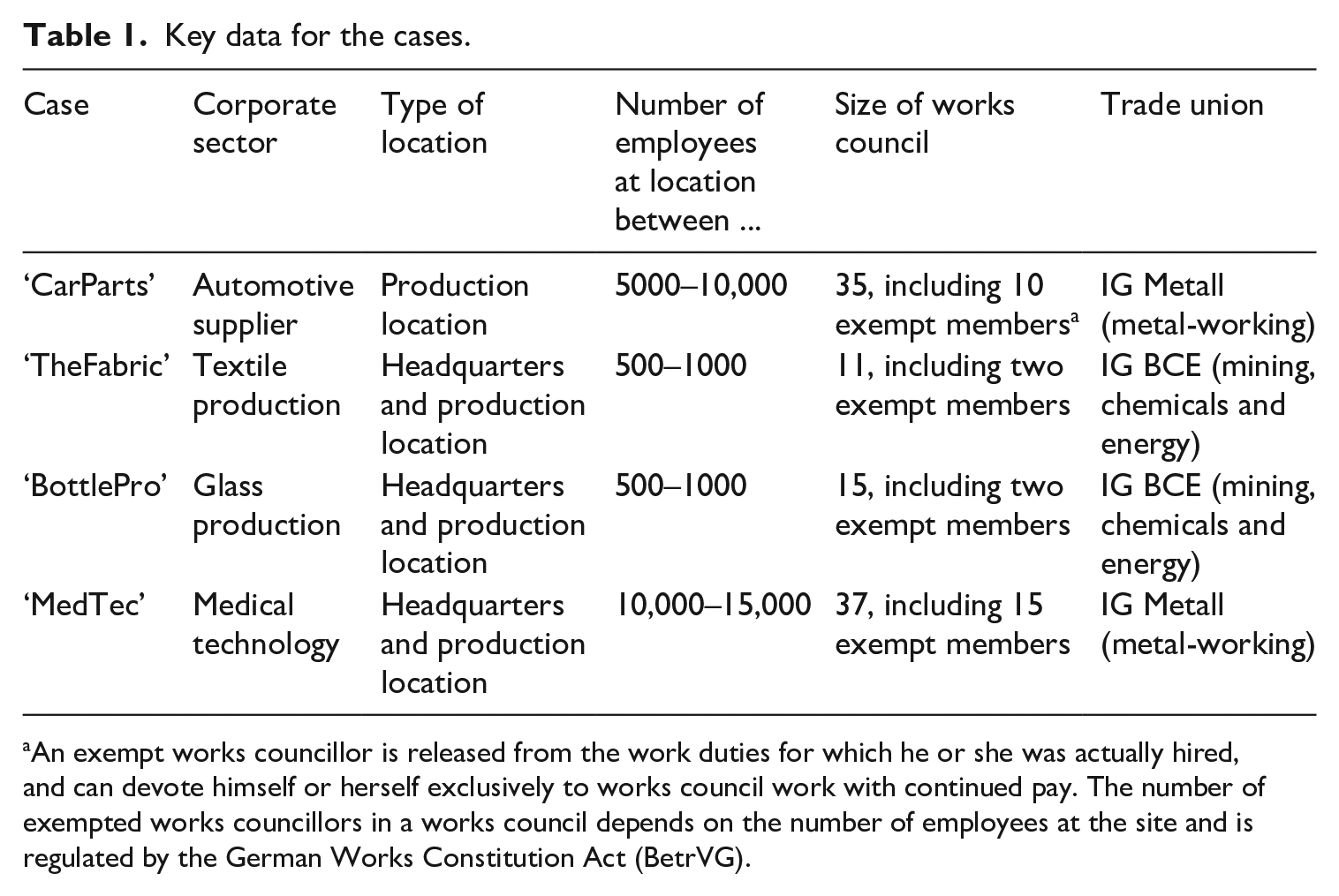
An exempt works councillor is released from the work duties for which he or she was actually hired, and can devote himself or herself exclusively to works council work with continued pay. The number of exempted works councillors in a works council depends on the number of employees at the site and is regulated by the German Works Constitution Act (BetrVG).
The empirical material consists of interview transcripts and documents. For the interviews, basically one exempt member (‘freigestellter Betriebsrat’) of the works council was interviewed repeatedly over a period of at least 12 months in 2019 and 2020, and at least one other member of the works council was interviewed for triangulation purposes:
‘CarParts’: my regular interview partner is responsible for a working group on Industry 4.0 in the works council. Throughout the first three interviews, another exempt member participated in the interviews. In addition, an interview with the head of the works council took place.
‘TheFabric’: this works council has two exempt members, who both participated in the regular interview series. In addition, an interview with the head of production (a non-works councillor) was conducted.
‘BottlePro’: this works council also has two exempt members, who both participated in the regular interviews, as well as another non-exempt member.
‘MedTec’: my regular interview partner is the responsible works councillor for the working group ‘Production 4.0’ in the works council. In addition, an interview with two exempt members from another IT-related working group took place.
In all four cases, the regularly interviewed work councillors are the ones responsible for topics of digitalisation in manufacturing. The interviews focused on digitalisation processes in manufacturing, how the works council deals with them, and the works council’s own understanding of digitalisation. The interview corpus comprises a total of 24 interviews with an average length of 85 minutes. I was also shown the respective production at all sites in order to better understand production-related digitalisation processes. In addition, 39 documents were collected, comprising documents provided by the works council or company, postscripts on the interviews, field notes on participating observation (e.g. a company-wide works meeting) and relevant newspaper reports.
The transcribed interviews and the documents are the basis for the coding of the data, which was supported by a qualitative data analysis software. Initially, the first interview for each case was open coded (Strauss and Corbin, 1990: 61ff.). In a next phase, I set the indicatively developed codes in relation to the categories resulting from the theoretical perspective addressed above. For example, several individual codes were related to the category ‘sources of power’, which is important from a theoretical perspective. I then examined to what extent these openly developed codes fit the sources of power listed in the previous section. An additional coding applied throughout the material subsequently ensured that no relevant segments in the initial data material were overlooked with regard to the categories derived from the literature, and all of the material was coded. Thus, I used a combination of inductive and deductive coding to take advantage of both coding methods.
The chosen sample implies that I identify the resources and the positioning of the works councils on the basis of their members’ own presentations. In some cases, I was able to supplement this with participatory observation, but the systematic inclusion of management representatives, for example, was not possible. Consequently, the position of the works councils in their perception is presented in the following.
Findings
The findings section is organised into two parts. First, the resources of works councils will be examined in a cross-case overview. Second, these will be linked to the power position and the results of power games in each case.
Power resources of works councils
In Crozier and Friedberg’s classification, the first power source concerns power rooted in the mastery of expertise and functional specialisation (1980: 40). Works councils have two sources of power which can be assigned here: the orientation towards classical co-determination issues and special organisational knowledge. Firstly, works councils are oriented towards classic topics of co-determination. These include co-determination as defined by labour law, for example, with regard to remuneration, occupational safety and health protection, training, etc. This is the area in which works councils are very well versed, often better than their ‘opposite party’. Works councils can sometimes point to problems which the management representatives might not have considered in the respective digitalisation process, or at least not at that stage. In this way, they contribute significant knowledge and prove to be an important variable, which means that they will continue to be involved in the future. Secondly, works councils may derive a great deal of power from the special knowledge they collect within the company as a distributed knowledge system (Tsoukas, 1996). In particular, the works councillors who have been freed from their duties fulfil their tasks for a long time, sometimes even for decades. In this way, they acquire an enormous amount of knowledge about all the important legal foundations of co-determination as well as about more far-reaching collective bargaining regulations and the even more specific works agreements and their concrete application and implementation. This includes important knowledge on a number of informal agreements on how things are handled on site. In addition, they are very familiar with the history and genesis of the company due to their long years of service with the company, and are in a position where they have access to a great deal of confidential information from various actors (employees, superiors, personnel management, management). This puts them in an advantageous position, and not only when they are confronted with management representatives who either change positions frequently or are new to the company’s industry: I also have a lot of private contacts in that company [main customer], and I repeatedly get to know things. Via [messenger service], ‘I just placed another huge order for [case company]’, and then they [the management] come and say, uh, we have to talk about additional shifts. [I say] ‘Yeah, right, [customer] needs a bunch of stuff, right.’ . . . That is immensely important. And just that the management knows that we know things and that we have networks, and that they simply don’t know some networks and don’t know how far they go. That is a super trump card. (TheFabric, works councillor, interview 7)
This source of power not only gives works councils an advantage in direct interaction with the less knowledgeable management representatives, but also makes them an important figure in the company in general, for example, when it comes to forging coalitions.
What might be expected to be the most prominent source of power for works councils is their relationship with the union, as one of the sources of power in relation to an important area of the environment (Crozier and Friedberg, 1980: 41). Indeed, the relationship to the union is a possibly important one for three reasons. First, trade unions have the opportunity to train their members in knowledge relevant to digitalisation projects. Second, trade unions offer network structures through which the works councils of different companies can exchange information and support each other. Third, trade unions offer the possibility of providing specific expert knowledge for works councils, for example, to help them examine a works agreement proposed by management. Furthermore, (local) politics can also be an important part of the environment and therefore a source of power for works councils. This relationship may form another source of power if the interests of a works council and politicians align. This is the situation at ‘CarParts’, for example, where the works council and local politicians have the same goal of maintaining as much employment as possible at the site. Such a relationship can bring into play new resources and trump cards which are controlled by the organisational environment, in this case politics.
With regard to the control of information and communication channels, networking within the site and the company plays an important role as a power source for works councils. First, works councils are informed in good time about forthcoming changes, such as planned digitalisation processes, by means of distinctive internal company networks. Second, in-house experts may help works councils with the technological or IT evaluation of upcoming digitalisation processes. And third, these networks can monitor the actual implementation of digitalisation processes at the shop floor level and alert the works council if necessary.
When it comes to power from the existence of general organisational rules themselves, in formal terms, it is primarily the legal regulations which give the works councils power. In addition to the relevant laws which define the co-determination rights of works councils in Germany, § 87 no. 1 (6) of the Works Constitution Act (BetrVG) has a particularly important potential here as it regulates the ‘co-determination right of the works council in the introduction and use of technical equipment designed to monitor the conduct and performance of employees’ (Kuhlmann et al., 2019: 6, translated by the author), which applies today to almost every kind of technical equipment. Interestingly, this legal basis is not emphasised separately in the cases examined here. This can be explained in part by the fact that the statutory regulation at ‘CarParts’ and ‘MedTec’ was transferred to a works agreement regulating the co-determined introduction of digital technologies, which goes beyond the provisions of the law. For ‘BottlePro’ and ‘TheFabric’, there is no specific works agreement, but rather a strong emphasis on the ‘trustful cooperation’ between management and the works council, 3 which leads to their involvement in these processes and makes reference to specific paragraphs only necessary in exceptional cases. Consequently, although the legal basis is overridden by organisational agreements and informal regulations, it remains highly relevant as a background foil to safeguard it.
When cleverly played out, the general co-determination rights resulting from legislation can also be important information channels for works councils. Here, for example, institutionalised access to the supervisory board plays a role, as does access to the general works council. At ‘CarParts’, the works council presents itself as being generally more informed about company-wide developments than the plant management because it receives this information early on in the supervisory board. Another example is the use by ‘CarParts’ of its right to have overtime approved to gather relevant information: Every [week] early is the so-called overtime discussion. This means that the head of department from each department comes and reports on the problems he has on site and the overtime he . . . wants. . . . And this is already partly disturbing the plant management. Because so much information is exchanged where they might not even notice. Because every department manager discusses his problems with everyone in passing. . . . And we [the works council] are always three at the table. (CarParts, works councillor, interview 5)
With regard to structural power, marketplace bargaining power is high in all four cases, as each firm is struggling for qualified employees and competes in this area with other local firms. For workplace bargaining power, trade unions again play an important role expressed in the degree of unionisation of a workforce. The higher the level of unionisation, the more likely it is that management will have to redress the fact that large sections of the workforce will support a potential strike if massive disagreements arise. Moreover, the degree of unionisation of the workforce also legitimises the works council’s right to mediate between staff and management and therefore increases its workplace bargaining power. While the degree of unionisation is highest at ‘CarParts’, it is at its lowest level at ‘MedTec’.
Material aspects of the production process do not play a role as resources of works councils, but seem to work by enabling or limiting the scope of digitalisation possible at the site.
Finally, a source of power which emerged empirically also plays a role: the change of the own work organisation in the works council. This takes the form of the establishment of special working or project groups which focus on topics such as digitalisation in manufacturing or the handling of a specific internal company project. Another form is the consistent digitisation of the works council’s own work processes. Adapting one’s own work organisation helps to keep up with the management in the sense of keeping up with the increasing pace of change in the plant, the company and its environment.
Table 2 links the resources discussed systematically with the four cases and shows the extent to which these resources are potentially available to the works councillors. The cases are presented in descending order from left to right according to their total amount of resources.
Empirical results: Power resources relied on across the four cases.
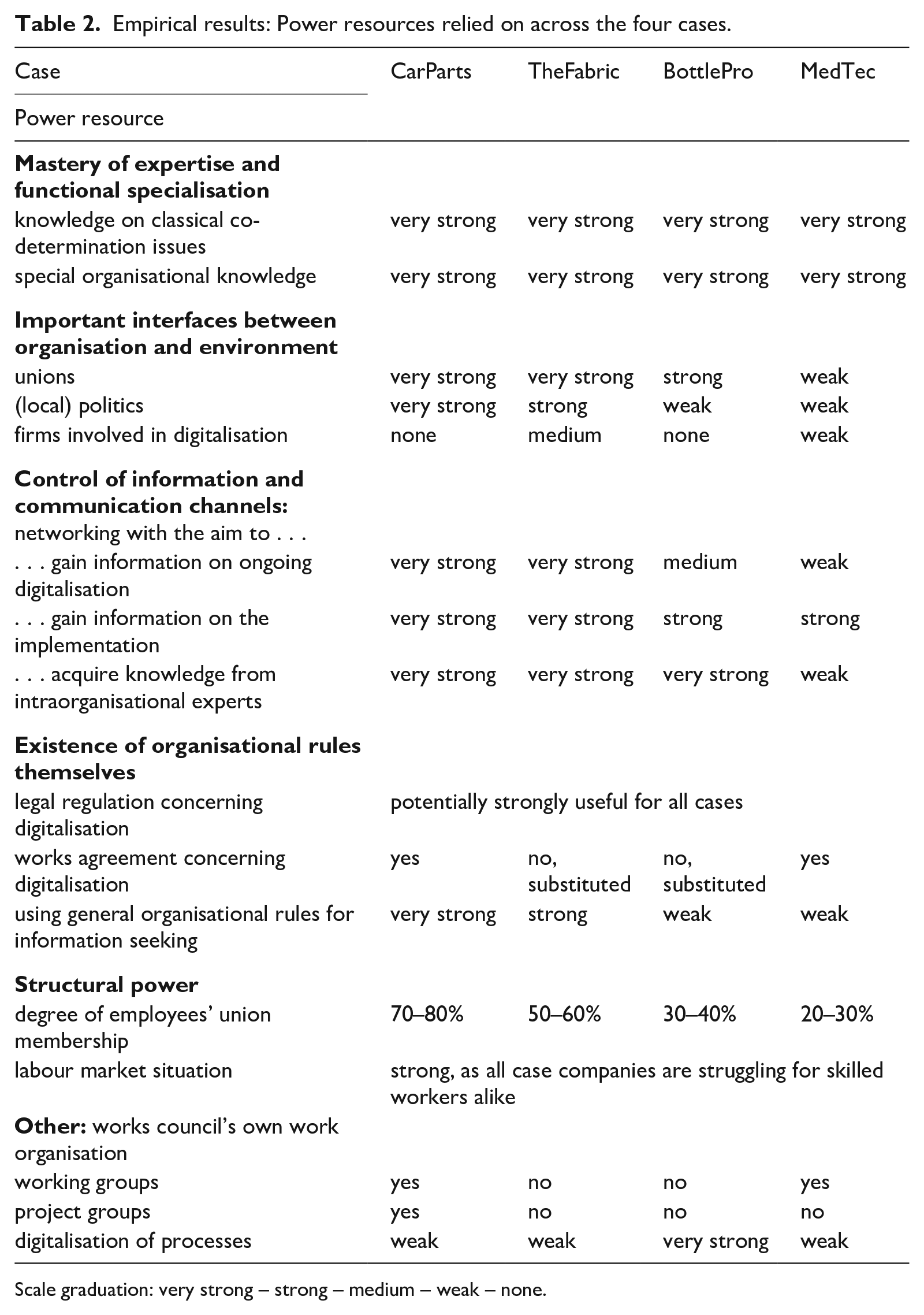
Scale graduation: very strong – strong – medium – weak – none.
This overview shows that all the works councils can fall back on sources of power in digitalisation processes. However, the central point is not that works councils have these resources, or to what extent, but whether they are willing and able to use certain resources to control relevant zones of uncertainty.
Power position and results of power games
The four cases studied differ firstly in their respective perception of digitalisation as a topic to be shaped, and secondly in terms of the willingness of management to involve the works council in shaping digitalisation. Both dimensions are visualised in Figure 1.
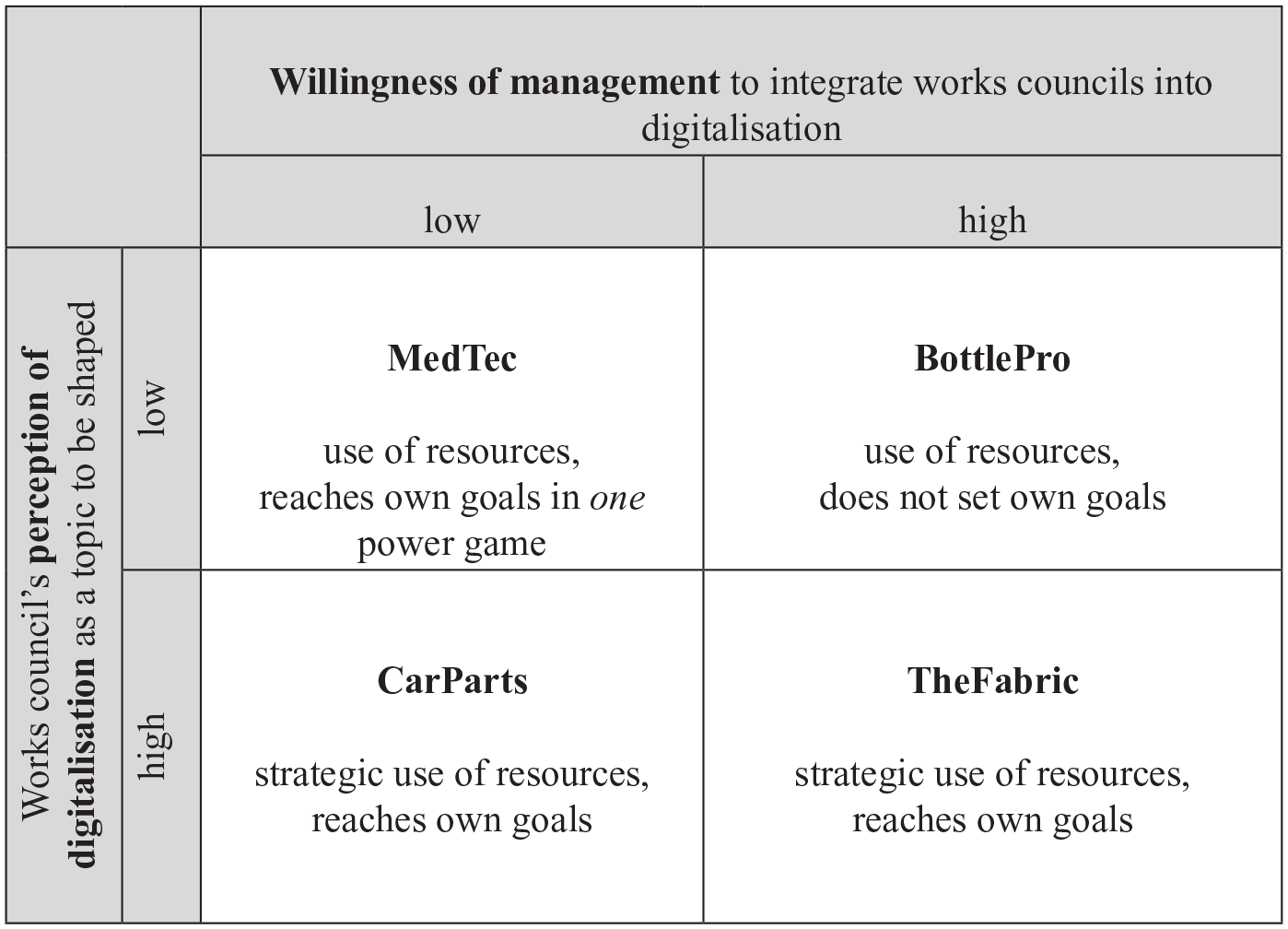
Position and achieved results.
The following case-specific results take these dimensions into account, link them to the available resources, and show the results achieved. They are arranged in descending order according to the strength of the works council’s position in the respective digitalisation process.
At
And there we, as the works council, are actually still one of the drivers in the plant (exhales) to bring the issue forward at all. As crazy as it sounds (laughs).
How come?
Yes, because we notice that if the plant doesn’t move in that direction, we won’t exist in 10 or 15 years. Because manufacturing plants that are not networked will not exist for long. (CarParts, works councillor, interview 1)
Indeed, ‘CarParts’ found itself in a difficult economic situation during the interview period. The general crisis in the automotive industry, developments in global trade policy and the generally high (labour) costs of a production site in Germany mean that the continued existence of the site is being questioned. According to the works council’s analysis, the greatest possible degree of digitalisation is central to maintaining a production site in Germany, especially against the background of high local labour costs. It is therefore important to the works council to actively promote its own issues: securing the plant and the local jobs (high perception of digitalisation as a topic to be shaped). In general, the strong position of the works council and the control of key resources are looked upon with disapproval by the management (local and central). But despite various skirmishes, which certainly emanate from both sides, the basic attitude of the works council is that of co-management: Because we always try to do everything together with the other side. . . . and [a person at a union meeting] said at the time: . . . ‘Listen [interviewee], that’s the way it’s going to be, you have to lead a co-management because otherwise you’ll run out of technology. You can’t take it all-, you can’t keep track of it. When it leaves your factory, leaves Germany, leaves the networks, the whole networked thing. You never have the overview.’ And at that time, it started with the computer and the whole subject. . . . and at some point I think like that during negotiations and yes, actually she was right. (CarParts, works councillor, interview 4)
It is noteworthy that the justification for co-management highlights technological developments. In the combination of this approach and repeated power games with local management, which shows a rather low willingness to integrate it into digitalisation processes, the works council is largely successful in achieving its objectives of securing the site and preserving jobs. Despite the difficult economic environmental conditions, the works council negotiated employment security for the workforce for several years, laid down in a new works agreement. All in all, the works council gets integrated into the power games around the negotiation of new technology, and is strengthening its position in the organisational industrial relations vis-a-vis management and the employees through the works agreement.
At And from that point of view, it is simply a project that is intended to move us forward. As I said, this traceability can help us. . . . Can increase our 1a yield. Can reduce our, our waste. And that is all, all, all cash money. And every cent which we collect elsewhere, the management does not have to come and say that they have to collect it from the employee. (TheFabric, works council chair, interview 2)
In addition, the digitalisation of product post-processing offers work relief for the employees since the control of the work processes through the IT system frees the employees from the psychological pressure associated with completing certain work steps too late and thus unintentionally worsening the product quality. Therefore, the works council uses its resources strategically to reach its goals, guarding the established benefits for employees and protecting their health, for example, by forging relevant coalitions. Thus, it is in close contact with the production manager of the respective area and with the management as well. It considers itself a recognised player within the company and emphasises that the advantages of its early involvement, for example, in order to allay concerns among employees and financial backers and to take into account important points in labour law from the outset of the process, are also evident. On the other hand, it is clear that it owes some of its resources to this recognised position. Access to information and communication channels, for example, in the form of data access for the works council or the opportunity to participate in regular management meetings could quickly be cut off without the goodwill of middle and senior managers: I can get at everything, because they let me. I could also be locked out of all these files. (TheFabric, works council chair, interview 1)
Consequently, the works council can play an active role here, but in contrast to ‘CarParts’, it is more dependent on a positive relationship with management. At the same time, however, it does not have to make heavy use of its sources of power due to the existing relationship. In conclusion, the works council is integrated into the improvement of production lines as an uncertainty zone, and keeps its position vis-a-vis management and employees.
The central digitalisation process at Of course, you are increasingly involved in the whole thing. . . . ERP system. Please take a look, go along. What are your wishes? What, what can you say, where are the concerns and so on. You will be brought in on this. (BottlePro, works council chair, interview 1)
The works council generally presents itself as having a recognised position in the company and in digitalisation processes. Its moderate sources of power result from their expertise and functional specialisation, involvement in communication and information channels and to some extent from their own work organisation (Table 2). Similar to ‘TheFabric’, the works council supports management in implementing digital technology to ensure the company’s continued existence. Another similarity is that many of the works council’s accessible resources depend on its recognised position with management and their goodwill. For example, there are only two works council members who wish to be freed from their regular work duties to work on the council, although the works council would be entitled to three. As a kind of compensation, the works council is given an assistant who at the same time retains important resources (knowledge of the way management ticks and willingness to digitise processes). However, ‘BottlePro’s’ works council differs significantly from those of ‘CarParts’ and ‘TheFabric’ in terms of the way the own position is used. The interviewed works councillors do not reveal any strategic goals of their own which they link to the digitalisation process. This may be due to the fact that the works council chair does not see digitalisation as a special challenge of a new nature for the company and/or the works council (low perception of digitalisation as a topic to shape), but rather as a long-term, continuous development: Digitalisation began much earlier. Now it is on everyone’s lips, but digitalisation has been going on for a long time. (BottlePro, works council chair, interview 1)
His role seems to lie more in a thematic division of responsibilities between him and the management, mediating between the requirements of the management and the concerns of the employees. Therefore, the works council is only slightly integrated into digitalisation processes, but seems to be able to keep its position vis-a-vis management and employees.
At We know that it’s going to be built, we know where it’s going to be, but how it’s all going to happen, in which direction, that they want to go digital, they haven’t told us that much. Because we have invited the planner, we wanted to meet him, we have invited him to the committee, but he always puts it off. (MedTec, works councillor, interview 2)
However, the responsible works councillor is not actively seeking involvement either (low perception of digitalisation as a topic to shape), as he admits in an interview eight months later: Uh, in these [digital factory] topics, [digital factory] team uh, we are actually, are asked very, very little. But I honestly have to say that I don’t care either. (MedTec, works councillor, interview 6)
On the contrary, the works council seems to display an almost defiant, passively reactive attitude: if the works council is not asked, after building it will insist that the points which are legally required have been forgotten and that they have to be repaired at great expense. He explains this procedure by means of another recently occurring example. Instead of engaging in the ‘digital factory project’, this works council uses its extensive knowledge of the provisions of the German Works Constitution Act to strictly monitor compliance with a company’s working hours regulation. However, this topic is chosen more from the perspective of compliance with the law than with the interests of the employees in mind. This means that the works council runs the risk of losing those parts of the workforce which want more working time and workplace flexibility. As a result, it could find itself in a situation where (parts of) the workforce sees their interests represented by the employer and not by the works council. This assessment is built on informal talks with employees during the walks through the production hall and beyond, e.g. as a greeting to the works council, a forklift driver shouts in passing: ‘The works council – always in the way!’ Concludingly, the works council is integrated into the regulation of working time as one topic related to an increasing digitalisation of production, but not timely into another important one: the building of a new, digital production hall. Though it is keeping its distanced position vis-a-vis management, empirical evidence points to the risk that the works council might lose legitimacy amongst employees.
Discussion
This article examines how far works councils are prepared to bring employees’ interests into digitalisation processes in manufacturing, and whether this affects their own power position.
In order to achieve this goal, the power resource approaches for trade unions (AK Strategic Unionism, 2013; Schmalz et al., 2018) and organisations (Crozier and Friedberg, 1980) first had to be tailored to workplace co-determination. I propose such a categorisation of power resources on the level of workplace co-determination. In Table 2, I concretise these resources with regard to the negotiation of digital technologies. The findings show that works councils are well prepared in terms of power resources. All can draw on sources of power, albeit to varying degrees. Networks continue to play an important role as sources of power (Kriegesmann and Kley, 2012; Ortmann et al., 1990; Windeler, 1989), also for shaping the digitalisation of manufacturing. In addition to the theoretically derived categories, the works council’s own work organisation emerged empirically as an additional source of power.
Therefore, the resources traditionally available to works councils are still valuable, although new zones of uncertainty are formed around digitalisation processes in organisations.
Second, the findings show that having resources alone is not enough. Though a higher amount of resources correlates with a stronger position of the works council at the site and in digitalisation processes, what is also needed is the perception that digitalisation is an issue which can be shaped and is worth shaping. If this perception is highly present, then one’s own strategic goals can be linked and pursued with digitalisation. This is the prerequisite for perceiving one’s own resources as such and using them accordingly in the battle for the uncertainty zone surrounding the digitalisation of manufacturing. At both ‘CarParts’ and ‘TheFabric’, there are central works councillors (the chair person) who identify digitalisation processes as an important topic, who can rely on strong strategic thinking skills and ensure that the available resources are used in a strategic way. Therefore, these works councils perceive digitalisation as an issue to be shaped in order to reach their own goals.
However, the position of the works council is not only determined by its perception of the topic of digitalisation, but also by the willingness of management to involve the works council. The comparison of ‘CarParts’ and ‘MedTec’, where management would prefer to reduce their role, shows the importance of a strong power position which is partly based on strong resources, but also on the competent use of resources. Comparing ‘CarParts’ with ‘BottlePro’ and ‘TheFabric’ suggests that fewer resources need to be deployed in a harmonious relationship than in a conflicting one. Furthermore, we see that those works councils that identify digitalisation as an important issue also actively seek their position (‘TheFabric’), or even fight for it (‘CarParts’) instead of having it assigned to them (‘MedTec’ and ‘BottlePro’). At ‘BottlePro’, the assignment of position is harmonious, but depends on the initiative of others rather than on the works council, while at ‘MedTec’, the works council largely accepts being excluded from important processes.
Consequently, it is not only the power resources that determine whether and how works councils get involved in shaping digitalisation at the plant level. Digitalisation must also be perceived as relevant for shaping, and management’s (non-)willingness to involve the works council influences the level of involvement as well (Figure 1). These factors can be aggregated to three different constellations to answer the question of whether digitalisation is more of an opportunity or a danger for works councils:
Very strong resources and high strategic awareness regarding own goals and digitalisation as an important issue enable and improve the works council’s position in all considered strategic action fields, even despite an opposing management. This is the case at ‘CarParts’, where digitalisation in production proves itself as an opportunity.
Strong to medium resources and willingness on the part of management to integrate the works council enable it to keep its position in all considered strategic action fields (‘TheFabric’), even despite a lack of own strategic awareness (‘BottlePro’). In these cases, the digitalisation of production effects is neutral.
Medium resources and low strategic awareness regarding own goals and digitalisation are an important issue which enables the works council’s distant position to be maintained vis-a-vis management, but potentially threatens acceptance by employees. This is the case at ‘MedTec’, where digitalisation in production might therefore result in a threat.
This shows that both the resources and the position of the works council determine whether being involved in the digitalisation of manufacturing turns into an opportunity or a threat for works councils. Thus, in contrast to the previous discussion, I show that digitalisation processes are not a threat per se (Niehaus and Katzan, 2020) or an opportunity (Haipeter, 2018, 2020) for the power position of works councils and their ability to represent employees’ interests. By identifying resources and positioning as factors that influence whether digitalisation becomes an opportunity or a threat, I build a bridge between these conflicting positions. In particular, the position that firms’ digitalisation is a general risk for works councils if they do not succeed in regulating these processes (e.g. Niehaus and Katzan, 2020) could have been the situation of ‘CarParts’ if they had not engaged themselves. However, digitalisation turned into an opportunity for ‘CarParts’ because they successfully regulated it. Incidentally, this by no means excludes the possibility of preserving one’s own rights and regulating potentially negative excesses around digitalisation. The opposing position which claims firms’ digitalisation comes with the danger of works councils losing influence if they do not adapt their co-determination style and therefore call for a new style of co-determination as an opportunity for the future of workplace representation (e.g. Haipeter, 2018) is supported by ‘MedTec’ due to its current positioning. In addition, I also show that in some cases dealing with digitalisation is neither an opportunity nor a threat, but neutral as, at least in the short term, it is foreseeable that it will not affect the (power) position of the works council.
Besides these two main contributions, two additional points require discussion. Firstly, it can be seen that the way in which digitalisation discourses identified by Kuhlmann and Rüb (2020) are referred to goes hand in hand with the positioning of the works council. ‘CarParts’, ‘BottlePro’ and ‘TheFabric’ relate almost positively to the opportunities offered by digitalisation and stress its importance for the competitive position of the company or site. In these cases, regulation is usually achieved through active and involving participation. Only at ‘MedTec’ are the risks associated with digitalisation, combined with the need for restricting regulation, brought to the fore. The resultant positioning is logically more of a defensive regulatory than a formative, actively involving one. Therefore, this study shows that the discourse references of works councils are related to the power position and strategic use of zones of uncertainty around digitalisation processes in manufacturing. This means that discourses are in the first place less of a resource for works councils (Schmalz et al., 2018), but shape the way digitalisation is perceived and, consequently, shape their involvement even though works councils undoubtedly tie in strategically with certain strands of discourse as well.
Secondly, already known time patterns of works council involvement are repeated: works councils usually become involved after the decision for a technology and/or a providing company has been made, which limits their scope of influence as the decision process is already much more closed at this point (Ortmann et al., 1990). This distinguishes the cases analysed here from company case studies in which the digitalisation processes’ object and technical digitalisation solution had to be negotiated first, or did not centre around a digital technology at all (e.g. Meyer, 2018).
Conclusion
This study was conducted against the background that ‘German works councils can hardly rely on ongoing co-determination practices in the introduction of new technologies. Empirical evidence in this issue is scarce’ (Haipeter, 2020: 246). Haipeter relates this to digital technologies and digitalisation processes, and this article aimed to investigate the role of works councils’ power position and resources within the digitalisation of manufacturing as an area in which works councils are traditionally strong.
It showed that works councils examine the digitalisation processes at their sites with regard to their effects on classic issues of co-determination, which are mostly related to the operational work organisation, and intervene if necessary. Particularly in those cases where the works council sets its own strategic goals, this creates not only a new SAF around the introduction of new digital technologies into production, but also uncertainty about the way the works council will act. Against the background of the consistently high relevance of the digitalisation processes, the scope of investment decisions made, etc., this creates an important zone of uncertainty. I found that whether works councils are able to (partly) control this zone of uncertainty depends not only on their power resources, but also on the position of the involved actors in terms of perception of digitalisation as a topic to be shaped, and the (non)willingness of management to integrate the works council.
However, the issues under which works councils address these zones of uncertainty and attempt to bring them under their control are, at least currently, still those of traditional co-determination, as are most of the resources used. This might become problematic in the future if, in the course of the increasing global technical interconnectedness of locations, customers, suppliers and products for local locations, important decisions are presumably made even more frequently outside the own location.
Concerning practical implications, this study strongly supports the recommendations provided by Windeler (1989) on how works councils can face up to the introduction of new technologies earlier. These include: systematically exploring and involving the interests of employees as far as possible, and including the expert knowledge of employees where their own (IT) expertise is lacking. In addition, my results show that with the involvement of employees, particularly through internal networks, the local interests remain in focus. In this way, thematic mistakes, which are more likely to harm than benefit the works council, can be avoided. Carefully constructed internal networks also provide the works council with all important information from both management and employees in a timely manner. Well-maintained external networks, such as those with other sites, trade unions and local politics, can provide access to important information. For trade unions, this implies that they should support network building, and initiate projects which enable works councils to work out their own position and resources in order to be able to position themselves strategically within the digitalisation process.
Finally, the proposed connections between resources, positioning at the site (with regard to the perception of digitalisation as an issue to shape and management’s willingness to integrate works councils) and the achieved results should be tested on a larger sample size. This would allow controlling for potentially influencing factors such as the size of the company or industry-specific labour relations. In addition, the generally comparatively strong rights of German works councils are brought to bear more strongly in this study because established works councils were examined. Therefore, the question of what the situation is like in companies where a works council is just being set up remains unanswered. The same applies to the situation in countries in which works councils generally have fewer rights – research is needed on how they are involved, what power position and resources they can draw on, and with what results.
Footnotes
Acknowledgements
Next to the two anonymous reviewers, I would like to thank Uli Meyer and Daniel Houben for the helpful discussions during our joint research project at JKU Linz. I would also like to thank the participants of the GIRA Conference 2020 in Heidelberg, Martin Friesl and his Brown Bag Lecture team at University of Bamberg, as well as my former colleagues at JKU Linz for their helpful feedback on earlier versions of this article.
Declaration of conflicting interests
The author declared no potential conflicts of interest with respect to the research, authorship, and/or publication of this article.
Funding
This work was supported by the Hans Böckler Foundation (grant number 2017-368-2).
Data availability
The interview material may be made available, subject to the consent of the interviewees. Since the company documents included cannot be anonymised, the author cannot make these data accessible. However, I would be happy to communicate with other researchers who are interested in conducting similar studies.
