




Abstract
Employees’ democratic right to participate is a core element of Nordic labour market models exercised both through representative and indirect participation as well as individual and direct participation. This article analyses representative participation and whether the form it takes matters: Is local trade union representatives’ assessment of influence at company level dependent on whether meetings with management are formal or informal? The question is important because institutional arrangements are on the decline in several European countries. Weaker trade unions and trade union representatives, due to falling unionisation rates, could affect strategic decisions by management when it comes to inviting trade union representatives into decision-making forums. Furthermore, individual-oriented management concepts may be strengthening this trend, in turn challenging the Nordic labour market models at company level. These issues are addressed through power resource perspectives by examining how such resources affect local trade union representatives’ capacity to influence decisions.
Introduction
Workers’ right to represent their own interests and to influence decisions made by the employer is seen as a core element of a democratic working life. While representative participation in which workers can have their interests represented by a larger collective (trade union) has traditionally been seen as the core of workers’ participation, participation can also be direct and individual. The form that participation takes in different countries and sectors varies, as the notion of participation is bundled into institutional features such as regulations.
In a European setting, the Norwegian case might be seen as a robust case when studying workers’ participation at company level. The model of employee involvement in Norway is a typical example of the Nordic single channel system, governed by co-determination legislation and collective agreements. The trade union density and collective bargaining coverage are fairly high in the country, at 50% and 70% respectively (Nergaard, 2020). In this study, we look into some of the most unionised companies in the private sector, those bound by collective agreements. This indicates that most workers will have a local trade union representative at their workplace, thus accommodating representative participation. Rights to have workers’ representatives elected by and among the workers are established both in collective agreements and in statutory regulations. Norwegian workers are relatively well represented at company level. Based on the Living Conditions Survey (Statistics Norway LKU-A, 2019), 62% of employees in private sector companies had trade union (TU) representatives present at their workplace (own calculations). However, these aggregated numbers mask sector differences. As seen in other European countries (Bechter et al., 2012), sector differences do exist, such as in the private services sector with less developed traditions in this area. This allow us to analyse sector differences within the robust case. By using survey data from trade union representatives in three private sector trade unions, we investigate if it matters whether representative participation takes place in formal or informal forums when it comes to perceived influence.
Participation and influence
Participation basically means that employers voluntarily or involuntarily hand over decision-making and management competence to the employees or their representatives (Busck et al., 2009: 33). When studying workers’ voice, different concepts are used, such as co-determination, cooperation, (employee) participation, empowerment and influence. In this study we primarily use the terms ‘participation’ and ‘influence’. We see participation as a prerequisite for influence, but to participate does not automatically lead to influence. Furthermore, influence is a slippery concept and is difficult to measure: how influence is perceived, is based on individual expectations. The quality of the influence will depend on whether the decision in question is on a matter of importance or not. As regards what kind of decisions TU representatives have influence on we make use of Knudsen (1995), who highlights a connection between the degree of influence and the nature of the decisions. He defines four type of management decisions, ordered in a hierarchy when it comes to importance for the employer as well as the employees. Welfare decisions are related to company-specific welfare arrangements (e.g. canteen, housing facilities) while operational decisions are to do with issues such as how work is to be carried out (e.g. definition and assigning of workers to do the job). Tactical decisions define means to realise the ambitions of the company, including work organisation, working hours and personnel management, while strategic decisions are overall decisions related to the company’s goals and structures (investments, mergers, takeovers, and partial or complete closures) (Knudsen, 1995: 11).
According to both statutory and collectively agreed regulations, local TU representatives have the right to be involved in all these four types of decisions. The influence is usually higher in welfare and operational decisions than in tactical and strategic decisions (see also Busck et al., 2009; Falkum et al., 2009). The type of decisions used in our analysis are tactical ones.
Different forms of participation
Participation can take several forms, it can be indirect or direct and it can be formal or informal. In the literature, indirect and direct participation have often been considered as two competing forms (Busck et al., 2009; Dachler and Wilpert, 1978; Haipeter, 2019; Trygstad, 2004). While direct and individual participation usually is seen as part of a management strategy and closely linked to efficiency and innovation, indirect and representative participation is important for reducing the asymmetric power relations between workers and management, and considered as a democratic right. A substantial literature engages with the question of whether different management styles embedded in concepts such as Total Quality Management, Lean and Human Resource Management fuel a development towards a more informal, individual and ad hoc type of participation that could challenge the Nordic variant of social partnership at enterprise level (e.g. Bradley et al., 2000; Bungum et al., 2015; Busck et al., 2010; Hvid and Falkum, 2019). However, this is not merely a question of form, but also of the rationale for employee participation. While international management models focus on effectiveness as an important rationale for employee participation, this can also be justified by considerations of fairness rooted in a rights-based perspective. In a Nordic context, empirical findings do however indicate that representative and individual participation actually support rather than compete with each other (Hagen and Trygstad, 2009). Research has nevertheless indicated that TU representatives struggle more when it comes to participation in foreign-owned companies (e.g. Falkum et al., 2013; Hagen, 2010; Trygstad, 2013). One important explanation is that foreign-owned companies bring with them other perspectives on both management and participation that makes it difficult to have influence over tactical and strategic decisions. In our study, we therefore use owner’s nationality as a variable in our analysis.
The form of representative participation might affect the quality of such participation. We investigate the importance of whether participation is formal or informal, by studying how this is related to the way local TU representatives value their own influence in discussions with management. The mixture of formal and informal participation is believed to be of importance not only for a democratic working life, but is usually considered to have a positive influence on the efficiency and productivity of undertakings (Bungum et al., 2015; Engelstad, 1999; Heiret, 2003; Nergaard, 2014). Based on a review of the literature on international comparisons and the historical development of participation, Haipeter (2019) concludes that participation is dependent on institutional foundations, which underpin formal structures rather than based on volatile management concepts (Haipeter, 2019: 162). Hernes (2006) emphasises how structure, routines and relations are important dimensions, in his operationalisation of the Norwegian labour market model at company level. These elements foster predictability, which is often seen as a key element of trust (Coleman, 1990; Gulbrandsen, 2001; Zucker, 1996). This explains why form is a central issue when discussing workers’ participation and influence and is one of the classic topics within working life research.
Various rationales for participation
The Norwegian labour market model is described as a multi-level system of industrial relations. It is distinguished by high rates of organisation among workers and employers, centralised and coordinated bargaining based on industry-level collective agreements, company-level negotiations and participation, low wage dispersion, and a culture of trust and cooperation among social partners (Andersen et al., 2014; Traxler et al., 2001).
The statutory regulations and collective agreements cover overlapping and different topics. While workers elect safety delegates and board representatives according to statutory law, collective agreements lay down a duty to elect local TU representatives to represent the employees in issues that are of importance to them. The form of this cooperation can vary. In some cases, it is highly formal with scheduled meeting points, in others, it is more informal, with issues being discussed as they occur, and some forms combine these two.
Various forms of participation and influence and their rationales were recurring topics in labour relations research in the 1970s, 1980s and 1990s. Part of the reason was the large and growing interest in democracy theories in the 1970s and 1980s (Axelsson and Bergman, 2016; Trygstad et al., 2019). Since the turn of the millennium, the number of research contributions has declined, although the topic cannot be said to have lost its relevance; quite the contrary (Pateman, 2012). The decline in unionisation rates seen in a number of European countries, including Norway, lends urgency to this topic. A weakening of the trade union movement as a consequence of the declining unionisation rates could have an effect on strategic management decisions to invite trade union representatives into important arenas for co-determination. In order to secure the right to representative participation, one could argue that the models must be designed in a way to be relevant not only to the employees, but also to the employers. Such relevance is inherent in the rationale for employee participation.
Because it’s fair
The rights-based perspective has its origin in the asymmetrical power relations between employers and employees. Collective employee interests are seen as a decisive buffer in the encounter with the enterprise’s unbalanced, insatiable and relentless demands on the employees (Lysgaard, 1961). Through representative participation, the employees can succeed in shifting the power balance in the organisation and thereby expand the area in which decisions are made on the basis of some form of democratic process (Nylehn, 1997; Rappaport, 1987). The trade union representatives’ opportunities to mobilise power resources, for example in the form of expertise and membership strength (energy), are crucial (Borum, 1995), since they enable representatives to exert influence over decisions that are of importance for union members (Korpi, 2006). Influence over tactical and strategic decisions is emphasised, and redressing the power balance is seen as a precondition for a democratic working life and society.
Because it’s effective
In the effectiveness perspective, less attention is paid to an asymmetric power relation and opposing interests. Here, it is assumed that employers and employees have shared interests. Participation is primarily regarded as a strategic management tool, which, when properly applied, will give rise to efficient and innovative enterprises (Busck et al., 2010; Trygstad et al., 2019). This school of thought is less concerned with collective issues, and focuses on participation by individuals or groups of employees. This will include informal participation in matters related to problem solving and work performance. The management and organisation are believed to benefit financially from providing an opportunity for workers and/or their representatives to participate, and participation in welfare and operational decisions are emphasised (Falkum et al., 2009; Finnestrand, 2015; Trygstad, 2004). The goal of this participation is to achieve specific and predictable targets and results (Dachler and Wilpert, 1978: 4; Lafferty, 1983: 32). This indicates firstly that the employer must regard representatives as competent and with an understanding of their role, and the cooperation as effective, and secondly that the involvement of the employees may change if the goals are changed (Dachler and Wilpert, 1978: 4; Lafferty, 1983: 32; Trygstad, 2004).
A Nordic mix?
The distinction made above is mainly of an analytical nature. In a Nordic context, these two different perspectives will tend to overlap, as employers and employees recognise both perspectives. Many employers acknowledge that there is indeed an asymmetrical power relation and thus regard participation as democratic and giving legitimacy to their decisions, as well as effective. In a survey among Norwegian employers in 2020, 87% of private sector employers said that the cooperation with local TU representatives was very or quite positive (Trygstad et al., 2021). According to Heiret (2012), the moral justification of the Nordic model of labour relations has been rather stable during the last 100 years. Although the moral justification, which he refers to as productivity and democracy, has been weighted differently during the period, it has not been in such a way that the balance between the two has changed substantially, or in such a way that productivity has displaced democracy (Mahoney and Thelen, 2010). Based on mainstream institutional theory, this is hardly surprising. Social institutions and social order are normally considered to be stable as a consequence of the paths chosen in the past (Pierson, 2004). However, as observed in previous studies conducted in the Norwegian labour market, an overall stability may mask significant variations and changes at industry and company level (Barth and Nergaard, 2015; Dølvik et al., 2018).
Topics of cooperation
The cooperation between management and local TU representatives should cover a wide range of topics, from strategic to welfare decisions (Knudsen, 1995: 11). Some of them could be subject to negotiation, for instance wage increases and working time schedules, while others are subject to consultation. The operation of the company (financial position, production, matters related to everyday production, etc.), potential reorganisation of operations (and reduction and expansions), mergers and so on are defined as consultation topics in the basic agreements between the confederations. These regulations are mainly the same for all industries. When we analyse tactical decision, we start out with studying wages and working conditions. Local wage increases, on top of the increases agreed at industry level, are negotiated every year, based on regulations in the collective agreements. While this is the main rule in most industries, in practice such negotiations are more common in manufacturing and construction than in the retail trade and hotels and restaurants, indicating stronger influence for local TU representatives in some industries than in others. Even though the term ‘negotiations’ is used, this process takes place under a non-strike clause and in the end the final offer of the employer stands (Trygstad et al., 2021). Regarding working time, a local level agreement is required in order to reach working time schemes that deviate from the main regulation in the collective agreement. As collective agreement regulations on working time are stricter in the manufacturing industry than in the retail trade (Stokke, 2004), this indicates that local TU representatives in manufacturing have stronger power resources in this field than their retail trade colleagues. Employer strategies are the second topic of our focus. This covers whether a company makes use of temporary (agency) workers, or if the company needs to lay off employees, either temporarily or permanently. The use of temporary (agency) workers has been high up on the political agenda, and regulations securing a consultation right for local TU representatives had been added both in collective agreements and in statutory law at the time of the survey, while consultation rights on layoffs have existed for decades.
How the cooperation should take place, and through what kind of cooperation committees or bodies in the enterprise, will depend on the size of the company. Statutory arrangements and committees laid down in the collective agreements have different thresholds that determine when they should be established. Regardless of this, management and TU representatives in all companies should meet on a regular basis and discuss matters relating to everyday operations: Unless otherwise agreed, discussions shall be held as early as possible and at least once a month, and otherwise whenever requested by shop stewards. (Basic Agreement, LO-NHO Section 9-3)
Similar regulations can also be found in other basic agreements in Norway. This indicates that in all companies covered by collective agreements, regardless of the number of employees, management is obliged to meet the TU representative on a regular basis. However, the instruments defined by the Basic Agreement need to be applied in order to be effective. Other studies point to some challenges in this respect.
Participation and representation gaps
Barth and Nergaard (2015) investigated the prevalence of bodies for co-determination in Norwegian private sector enterprises in the period 2003–2012, and found that the activity in formal bodies had declined.
In a previous study, Alsos and Trygstad (2019) identified a representation gap in the organised part of Norwegian working life. This indicates that the coverage of worker democracy is not meeting the expectation set by the legislator and social partners. Furthermore, a participation gap has been identified, meaning that requirements relating to form, i.e. how participation should take place, are not met for a surprisingly high share of TU representatives. 1 It was found that 29% did not participate in either formal or informal forums, while fewer than half participated both in formal and informal meetings, for example in accordance with what could be expected from the Nordic model of labour relations. The findings are summarised in Table 1.
Forms of participation and the share of TU representatives belonging to each category (N = 1612).
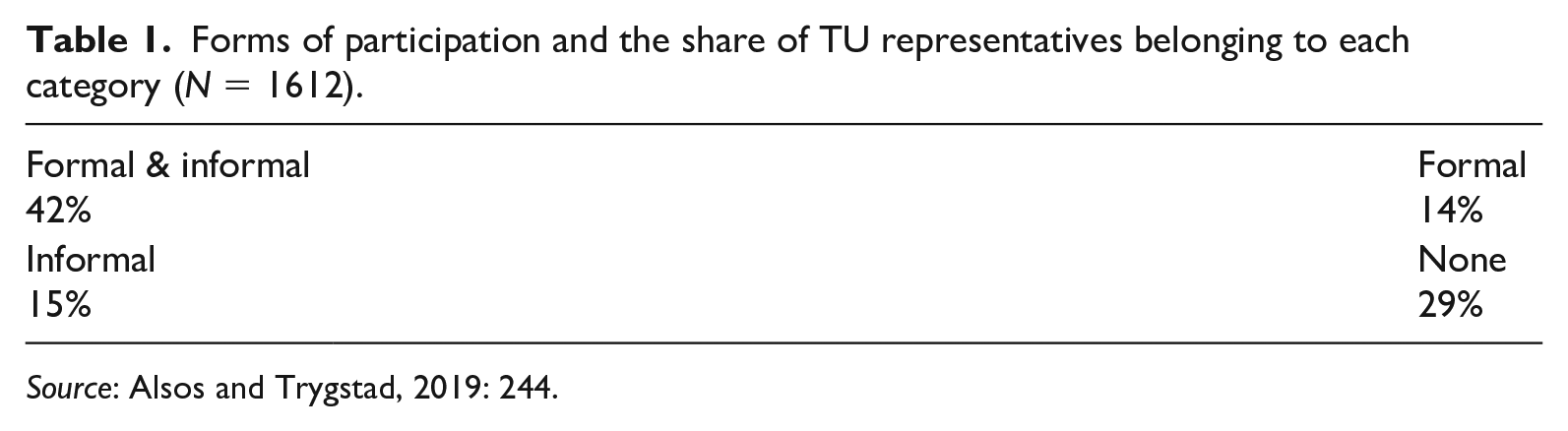
Source: Alsos and Trygstad, 2019: 244.
During the last 10–15 years, differences between industries and sectors have been attracting increasing attention in working life research (Bechter et al., 2012). Union density and bargaining coverage vary across sectors, indicating that the share of employees with access to collective representation at company level varies. However, even when looking at those covered by collective agreements, Alsos and Trygstad (2019) find differences between industries, as shown in Table 2. Both formal and informal participation were most widespread in manufacturing, while less common within the private services sector.
Forms of participation in different industries.
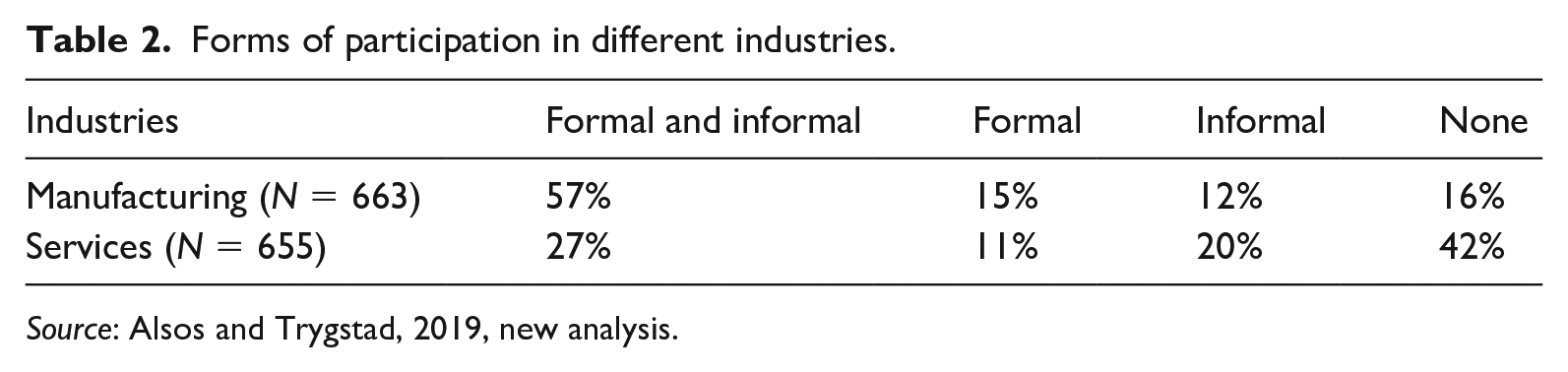
Source: Alsos and Trygstad, 2019, new analysis.
If forms of participation and influence are interrelated, this indicates that even employees in the private services sector in the unionised part of Norwegian working life, i.e. those covered by collective agreements, may have less influence in decisions made by management than employees in manufacturing. We investigate this question by using bivariate and multivariate analyses, and a possible explanation for why we assume to find sector differences is related to TU representatives’ different access to power resources.
The impact of power resources
Unions’ influence is often equated with their capacity to protect and improve the working conditions of their members and their possibilities to influence economic and social policies that benefit workers. This capacity is linked to power resources, or lack thereof (Levesque and Murray, 2010: 334). Levesque and Murray (2010) argue for the importance of focusing not only on the ‘power over’, as in actor A influencing actor B to do something that he or she might not otherwise do (Dahl, 1957), but also the ‘power to’ (Bachrach and Baratz, 1970; Lukes, 1974; Pfeffer, 1997). ‘Power to’ refers to the ability to set the agenda, or to ‘bring about significant effects’, either by ‘furthering their own interests and/or affecting the interests of others, whether positively or negatively’ (Levesque and Murray, 2010: 335). In our context, we relate ‘power to’ to the TU representatives’ capacity to exert significant influence on decisions related to wages and working time and employment strategies. Inspired by Borum (1995), we consider expertise and energy as important power resources, which can enable TU representatives to have ‘power to’. These two power resources are related to individual characteristics of the TU representatives as well as characteristics related to the companies where they perform their duties. Firstly, expertise includes control of and access to information, control and knowledge of models for processing information, and promotion of arguments in important arenas. If TU representatives are not involved in decision-making processes until the premises have been established, this will reduce their ability to exert influence. Moreover, if trade union representatives participate in bodies that make no decisions of importance for the enterprise or the members, this will erode their power resources. We ask if the TU representatives participate in formal or informal forums, a mix of the two forums or if they do not participate at all. In enterprises with international owners, important decisions may be made in forums that are beyond the scope of the Norwegian regulations on co-determination, and this will weaken the TU expertise. Seniority as a TU representative can also have an effect. Those who have served for many years will have more experience and thereby also more expertise than new recruits. A TU representative at a higher level will have more opportunity to exert influence than someone at a lower level, because he or she is likely to participate in forums that are closer to where the final decision will be made. Further, being part of a group of companies could also affect the expertise; however, in different ways. 2 TU representatives in subsidiary companies may have less expertise as decisions might be taken in the parent company and thereby out of reach of the representatives. On the other hand, the TU apparatus tends to be well established in groups of companies. This could provide the TU representatives in each workplace with closer ties to other representatives higher up the company hierarchy.
Our second power resource is energy that is channelled into a decision. In our context, the number of members that stand behind the TU representative will be essential, since it will determine how much weight his or her demands carry. A sole TU representative at a workplace may also feel more exposed than those in enterprises where the number of members creates a basis for electing multiple representatives. Collective agreement coverage is higher in manufacturing than in private service industries (Nergaard, 2020). We may therefore assume that TU representatives in the manufacturing industry will have better access to powerful alliances compared to others. These could be alliances with strong unions in other enterprises within the industry.
Even though each of these power resources may boost the TU representatives’ opportunities to influence a decision-making process, it is important to underscore that these different power bases are interrelated and self-reinforcing.
Methodology
This study is based on quantitative data collected through a randomised online survey of TU representatives at local level in the private sector. The survey was conducted in the autumn of 2014. It was answered by 41% of the TU representatives, which constitutes 1800 respondents. TU representatives should be elected in all companies bound by a collective agreement, thus companies not bound by a collective agreement are not included.
The TU representatives in our sample represent three trade unions, the United Federation of Trade Unions (Fellesforbundet), the Norwegian Union of Commerce and Office Employees (Handel og Kontor), and the Norwegian Food and Allied Workers Union (NNN), all of which are affiliated to the largest union confederation in Norway, the Norwegian Confederation of Trade Unions (Landsorganisasjonen i Norge, LO). The United Federation of Trade Unions (with 160,000 members) is the largest trade union in the private sector in Norway, and its members are mainly in the metal and shipbuilding industries, the graphical sector, car repair workshops, hotels and restaurants, the construction industry and the paper industry. 3 The Norwegian Union of Commerce and Office Employees (with 70,000 members) is the second largest union in the private sector and its members are in retail, services, administration, finance, marketing, banking, etc. NNN covers around 30,000 workers throughout Norway, from the food and drink processing industries, etc. Together, the three unions, representing approximately half of LO’s members in the private sector, both skilled and unskilled workers, are the bases for our survey.
Central questions in the survey were related to the existence of formal and informal cooperation between the TU representatives and management: Do the TU representatives meet the manager at his or her level to discuss matters concerning the company, the development of the company, productivity, profitability, recruitment, working environment and so on, in formal or informal forums? Furthermore, the TU representatives were asked whether management takes their input into consideration.
We are not able to control whether our sample is representative for TU representatives in the three unions. Based on the Living Conditions Survey (LCS) (Statistics Norway LKU-A, 2016), we can however compare our sample with the LCS sample of private sector TU representatives affiliated to LO (Table 3). Comparing company size, we find that the respondents in our sample are not substantially different from those in the LCS.
Study sample compared to the sample in the LCS of private sector TU representatives in LO.
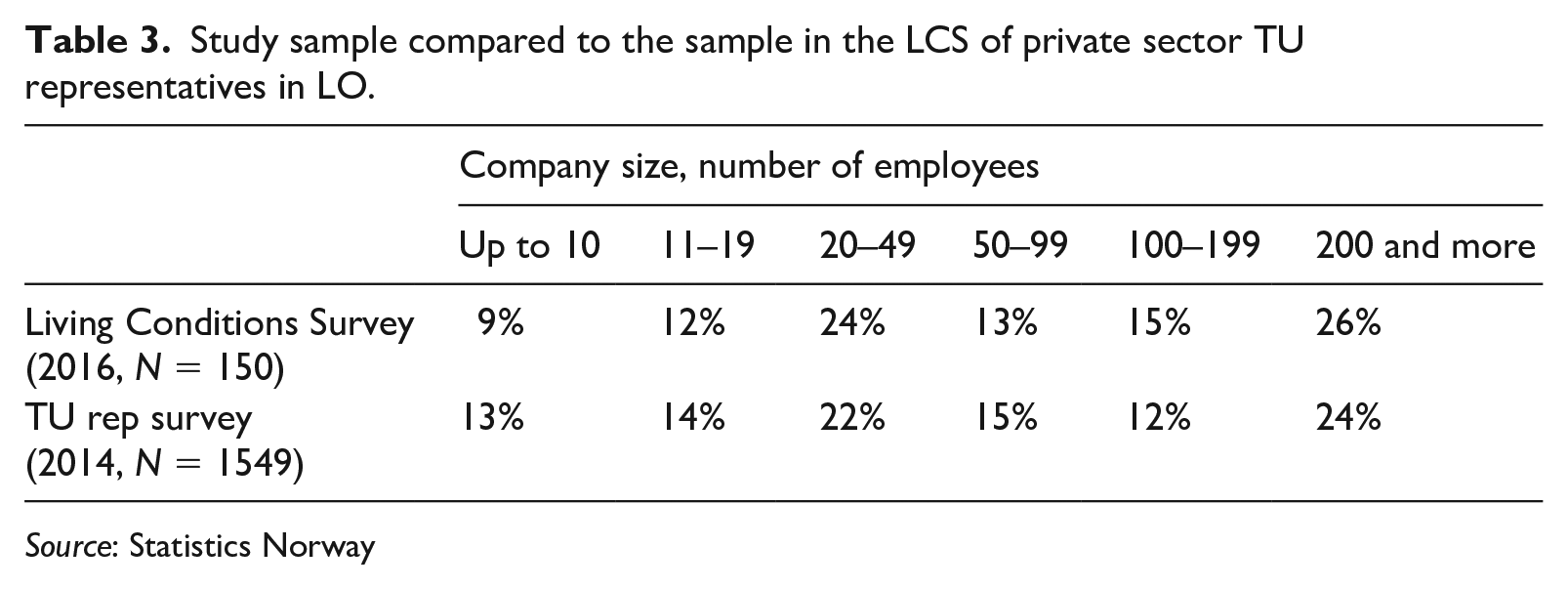
Source: Statistics Norway
In terms of the gender distribution, our sample has a larger share of women than the Living Conditions Survey. Among our TU representatives, 42% are women, compared to 29% in the Living Conditions Survey. One likely reason is that the members of the Norwegian Union of Commerce and Office Employees, one of the three unions in our study, are predominantly women. As regards age, 18% of the TU representatives in LO-affiliated unions in the LCS are 18 years old. In our study, the proportion is 17%.
Our sample has some possible biases. Firstly, our data give knowledge of the organised part of Norwegian working life, i.e. companies bound by collective agreements and with unionised employees. Secondly, we have used a randomised sample survey and measure self-reported participation and influence. This might lead to selection challenges. We may have a biased sample where the most interested TU representatives are overrepresented (Hellevik, 1991: 90). On the one hand, a selection of the most interested TU representatives may lead to a picture of participation and influence that is better than what it de facto is. On the other hand, interested TU representatives may also be more critical of their own influence. Both of these outcomes will probably affect our findings.
Measurements used in the analyses
We use three steps to analyse our main question: whether the form of participation makes any difference when it comes to influence. In step 1 we examine whether influence varies according to the form of participation by using bivariate analysis. In steps 2 and 3 we use multivariate analysis to study if the form makes any difference when we control for other variables, such as size. We use regression models to explain how a set of independent variables affect perceived influence on the topics (dependent variables). In other words, the main purpose is to test how different forms of participation affect perceived influence.
The measure of influence is constructed out of five variables. These five variables are organised into two indexes used in bivariate and multivariate analyses, where we also use eight independent variables.
Dependent variables
Influence can be measured in different ways. How actors evaluate their level of influence would depend on their expectation, and this will vary. In an attempt to raise the level of precision when creating the basis for two of the indexes, we use the following question: ‘To what extent do you perceive that the management takes into consideration input from employee representatives in matters pertaining to . . . ?’ This wording is used in the LO/NHO Basic Agreement (§ 9-6) where it says: ‘Before adopting any decision on matters that concern the employees’ jobs and working conditions, this shall be discussed with the shop stewards. In cases where the management of the enterprise finds that the shop stewards’ comments cannot be taken into consideration, the reasons for this must be given.’ This text is (or should be) familiar to local TU representatives and in our analyses we therefore use this as a measure of influence. The question is followed by five different topics, and the respondents can select one of six responses, where 1 = to a great extent, 2 = to a certain extent, 3 = neither or, 4 = to a fairly small extent, 5 = to a little extent, and 6 = don’t know. Those who selected ‘6’ were excluded from further analyses. 4 We have organised the questions into two indexes: employment strategies, and wages and working time. These are important topics of cooperation defined in collective agreements and statutory regulations. 5
‘Employment strategies’ consists of three variables: (1) layoffs, (2) temporary layoffs and (3) agency workers. Cronbach’s alpha for this index is .87.
‘Wages and working time’ consists of two variables: (1) wage bargaining and (2) working time. Cronbach’s alpha is .71.
In the construction of the indexes, we first added the values of the variables before we again divided these by the number of variables belonging to each index. 6
Independent variables
We test the relationship between various forms of participation, including the resources of the TU representatves (TU reps) and the form of participation, and TU reps’ perceived influence. We use an additive regression model where the independent variables partly are dichotomous variables/categorical variables (whether a person has a certain characteristic or not) and partly numerical variables. For some of the dichotomous variables, different forms of participation are based on a combination of several characteristics (indirectly allowing us to test for interaction effects).
Expertise
Participation: (1) formal and informal, (2) formal, (3) informal, (4) none
TU’s position: (1) shop floor, (2) leader of the TU at company level
Tenure as a TU rep: (1) 2 years or less, (2) 3–5 years, (3) 6–10 years, (4) 11–20 years, (5) 20 +
Owner’s nationality: (0) foreign, (1) Norewgian (NOR)
Part of a corporate group: (1) yes, (0) no
Energy
Members in the TU rep’s union: (1) up to 5, (2) 5–9, (3) 10–24, (4) 25–49, (5) 50–99, (6) 100 +
Number of employees: (1) up to 10, (2) 11–19, (3) 20–49, (4) 50–99, (5) 100–199, (6) 200 +
Industry: (1) manufacturing, (2) private sector (service)
We treat the independent variables ‘tenure as a TU rep’, ‘members in the TU rep’s union’ and ‘number of employees’ as numerical variables. The reason for this is that we expect a linear relationship between these variables and influence. However, our numerical variables are recoded into categories in order to avoid the effect of outliers/extreme values in a relatively small dataset. All other independent variables are coded as dummy variables. Participation, which has four values, is treated as four different variables: formal and informal (1), other types (0); formal (1), other types (0); informal (1), other types (0). We use no participation as the constant.
In addition, we use gender as a control variable, even though this is not a main question in our analyses. Most of our sectors are male or female dominated, and this allows us to control for potential systematic differences between how men and women assess their influence.
Findings
In the first step, we search for bivariate correlations between the two indexes and form of participation. Wages and working time and employment strategies are topics of major importance for the employees, and are defined as key areas of cooperation in legislation and the agreement framework. If TU representatives have influence, they can have the capacity to ensure that laws and regulations are complied with, and they can have a say in setting wages and working time and employment strategies.
Figure 1 shows that TU representatives who both participate in formal forums and have informal contact with the manager at their level consider themselves to have the best opportunities to influence decisions, while TU representatives who do not participate in such forums consider their opportunities to be the poorest. However, there are also significant differences between TU representatives who participate in formal forums compared to those who engage in informal forums. TU representatives who only have informal contact with the manager at their level consider their opportunities for influencing decisions related to both areas to be significantly poorer than those who participate only in formal information and discussion meetings with a manager at their level. The greatest difference in perceived influence is related to wages and working time, which is a key topic for the social partnership in many enterprises. One might argue that the difference between the two areas is surprisingly small, considering that wages and working time are core topics of co-determination. However, consultation rights related to layoffs are strongly institutionalised in Norwegian companies, and at the time of the survey, employment strategies like temporary agency work were high on the political agenda in trade unions, and co-determination rights concerning agency work had been added both in collective agreements and statutory law at the time of the survey. Furthermore, the analyses show that there are no significant differences between those who participate only in informal forums and those who do not participate at all. This indicates that informal engagement is a poorer form of participation than formal arrangements where this is the only channel available for influencing decisions in the two areas. The observation that non-participants also feel that they have some form of influence may be an effect of their contact with the management in an individual capacity.
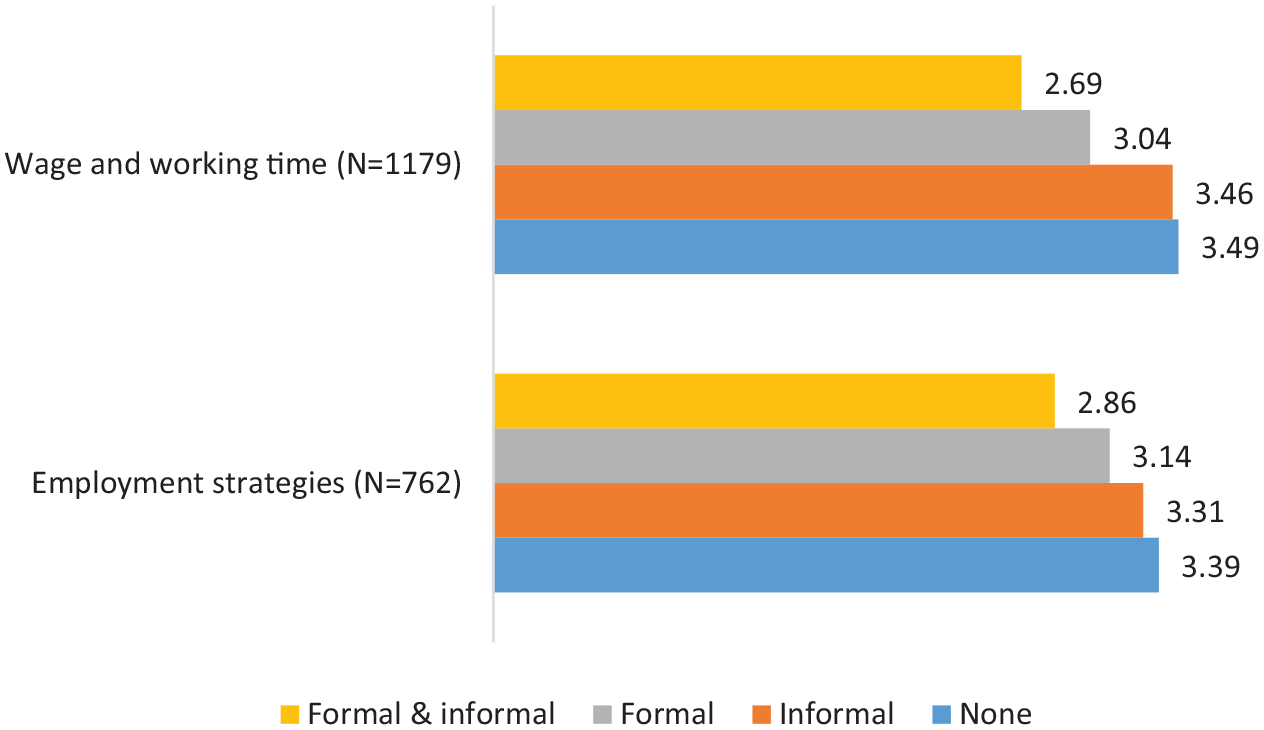
Step 1: Forms of participation affect influence. 1 = high, 5 = low. One-way ANOVA.
In our second step, we study if the form of participation still has an effect when controlling for other variables. In Table 4, we have included the form of participation: (1) formal and informal, (2) formal, (3) informal, (4) none, which we link to the power resource ‘expertise’, as well as other variables that also measure other aspects of this expertise, in addition to ‘energy’. The significant levels are based on robust standard errors. 7
Starting with expertise, those who participate formally and informally have an equally strong effect on our two indexes. Further, those who only participate formally consider their influence as higher on wages and working time, i.e. the core topics of co-determination, but not on employment strategies. Seniority as a TU representative has an effect on employment strategies: the longer a representative has been in office, the more influence they consider themselves to have. The position of the TU representative and ownership have no significant effect. Affiliation with a corporate group has an effect on employment strategies, but the opposite of the one we expected. TU representatives in corporate groups assess their influence as poorer than the others when it comes to employment strategies. This may indicate that in this context, affiliation with a corporate group tends to undermine the power resource expertise.
Looking at energy, the analyses show that the more members that stay behind the TU representative, the greater is the perceived influence over wages and working time. This indicates that TU representatives have the opportunity to bring more authority to their position if they are backed by many members. However, the number of members in a union has no significant impact on perceived influence over employment strategies. Furthermore, TU representatives in manufacturing enterprises assess their influence to be stronger than those in the services sector. As far as wages and working time are concerned, this is not surprising. Local wage bargaining to supplement the coordinated industry-level bargaining rounds is far more institutionalised in the manufacturing sector than in the services sector, where such bargaining is restricted to a few enterprises (Nergaard, 2020). Furthermore, TU representatives in the manufacturing sector can also rely on stricter regulations in the collective agreement than in the services sector (Stokke, 2004). This can be seen as an effect of low energy due to weaker institutions in the latter.
Our analyses also show that our control variable, gender, makes a difference. Female TU representatives consider their influence on wages and working time as lower compared to men. We lack good explanations for this, but it may be that women and men have different expectations, or that women are more critical of their own influence. However, it may also be that women and men as TU representatives are treated differently by the management.
The observation that TU representatives who have access to both formal and informal forums tend to assess their own influence as strongest is in line with the fundamental idea behind the co-determination scheme. If the parties only meet formally, it can be difficult to clear up minor disagreements and misunderstandings. Furthermore, informal contact and small talks are important to build trust between the parties. Lack of trust will make the cooperation more inflexible and makes it harder to compromise (Hernes, 2006).
The bivariate analysis in Figure 1 indicates that only formal participation is associated with stronger influence, compared to only informal. In step 3, we study these differences in more detail and ask if the differences between these forms of participation are still significant, when controlling for characteristics of the trade union and/or the companies. When the sample is split in this way, the number of respondents is considerably reduced, which gives the two models only limited explanatory power. We can nevertheless observe some interesting correlations. Again, the significant levels are based on robust standard errors. 8
As above, we start with expertise. As pointed to earlier and argued by Busck and colleagues, employers can voluntarily or involuntarily hand over decision-making and management competence to TU representatives (Busck et al., 2009: 33). Having formal participation only could indicate that the employer has done so involuntarily in order to comply with regulations. The analysis shows that it is only in connection to wages and working time that what form participation takes matters. Whether the participation is of a formal or informal nature makes a difference for influence on wages and working time, but not on employment strategies. One explanation could be that employment strategies are consultation rights that might be conducted at a more general level, and that TU representatives have less influence when it comes to tactical decisions on the scope of layoffs, or when to hire agency workers or not.
Ownership, on the other hand, has an effect on the topics, and TU representatives in Norwegian-owned enterprises regard their influence as higher than those with foreign owners. This indicates an interesting connection between the strength of the participatory structures, ownership and influence, where ownership is activated when the structure is weak. As in Table 4, Table 5 also indicates that TU representatives in groups of companies assess their ability to make a difference in decisions regarding employment strategies as lower, compared to others. One explanation could be that the overall employment strategies are fixed and difficult to change in subsidiaries. The decisions might have been taken by the parent company thus out of reach for the TU representatives in our survey. Groups of companies have however no significant impact on wages and working time. Here TU representatives participate in formal negotiations and can see the results more directly in each company.
Step 2: Four forms of participation. Linear regression of TU representatives’ influence on wages and working time and employment strategies.
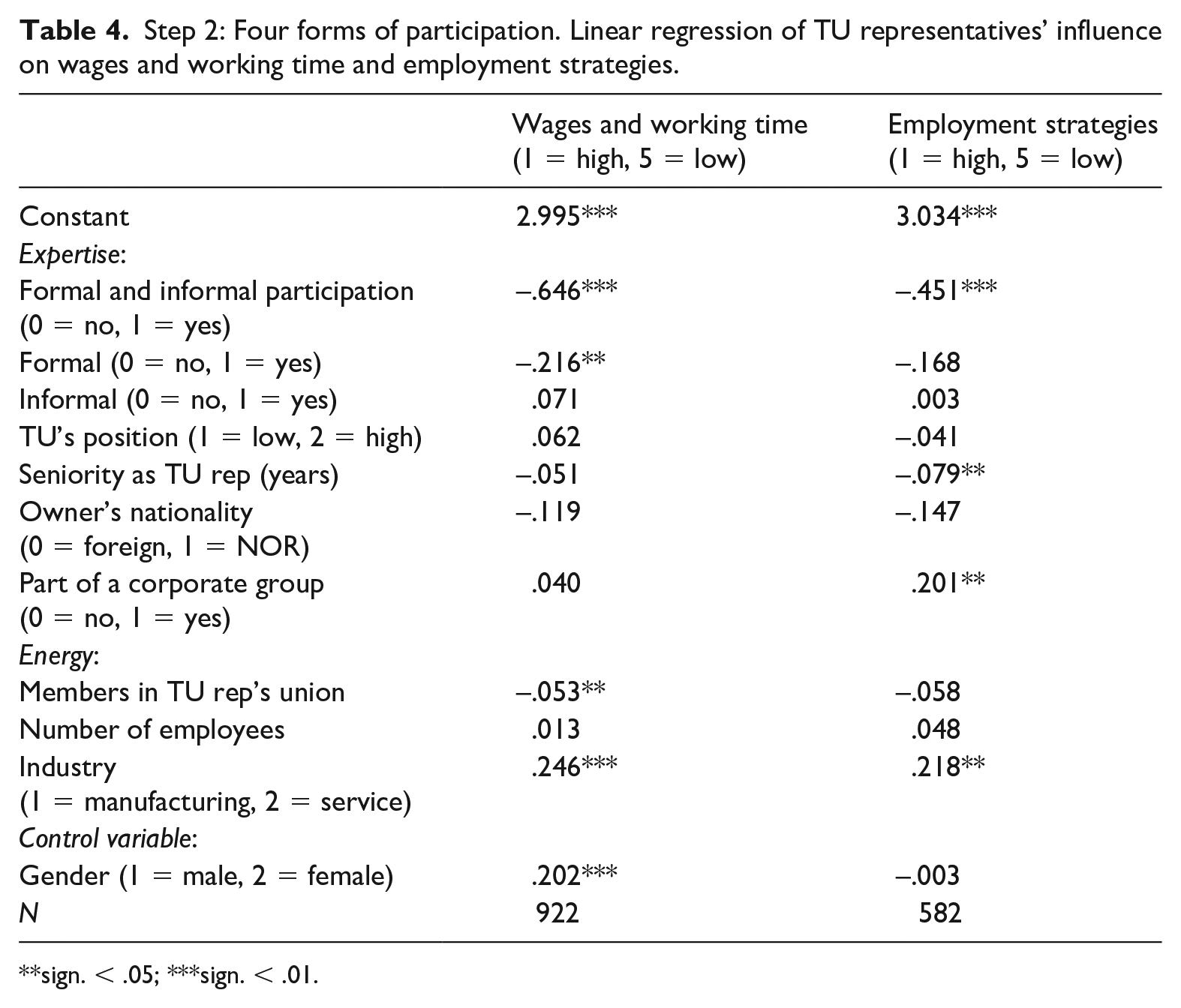
sign. < .05; ***sign. < .01.
Step 3: Two forms of participation. Linear regression of TU representatives’ influence on wages and working time and employment strategies.
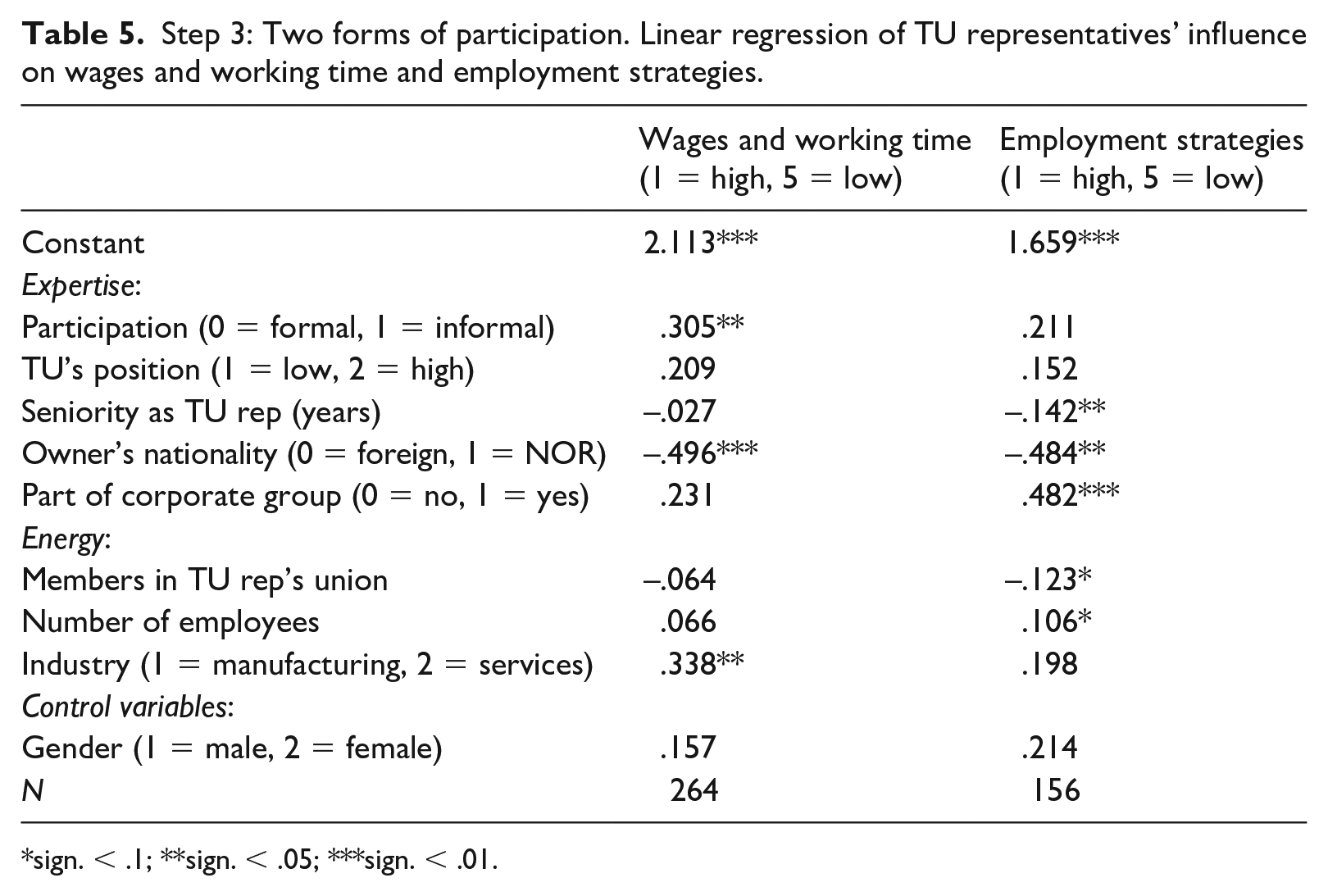
sign. < .1; **sign. < .05; ***sign. < .01.
Furthermore, seniority as a TU representative has an effect when it comes to influence over employment strategies, and this lends support to the theory of expertise as a power resource. Better knowledge of the rules of the game, as well as experience from similar processes related to layoffs and hiring may be one of the explanations.
The power resource ‘energy’ has little importance when looking at influence over wages and working time and employment strategies in a sample that only consists of TU representatives who participate either formally or informally. The membership strength behind the TU representative only has an effect in relation to employment strategies, and the strength of this effect is limited. We also see that TU representatives in manufacturing enterprises assess their own influence as stronger than those in the private services sector when it comes to wages and working time, but not for employment strategies. This higher score for wages and working time is not surprising, since this topic is more frequently discussed locally in the manufacturing sector than in private service enterprises.
Discussion
Compared to most other countries, the Norwegian case might be seen as a robust case when studying workers’ participation at company level. The Nordic trade union movement has emphasised the presence of formal arenas for participation, and the argument of fairness has been in a strong position. Formal forums have been regarded essential for the ability to shift power relations in the enterprise and enable TU representatives to act and exert influence over decisions of importance for their members. In the Norwegian tradition, informal participation has also been held up as important, and seen from an employer perspective this form for participation can be rather effective. In our study, this mix of formal and informal arrangements has frequently helped TU representatives gain access to knowledge and opportunities for influence. We assume that the mix is a result of these two perspectives overlapping in many companies. This mix can be described as the essence of the Nordic model at company level. Established frameworks help ensure routine and predictability, while the informal form helps to develop the social relationship between the parties. These factors that can be considered crucial for a relationship of trust (Coleman, 1990; Gulbrandsen, 2001; Hernes, 2006).
The general question in this article is whether the form of participation has an effect on the TU representatives’ perception of their own influence on two areas of great importance: (1) wages and working time, and (2) employment strategies. We have examined this question in three steps: starting from descriptive and bivariate analyses and continuing with multivariate analyses where we examined the effects of forms of participation operationalised in various ways, before attempting to identify whether there are any differences between participation in formal settings only versus informal settings only.
The opportunity to participate in formal forums in combination with informal contact and meetings with their immediate superior may give TU representatives access to information and knowledge that enables them to predict events and form arguments, and thereby present relevant ideas that could have an effect on management decisions. Through their argumentation, TU representatives can sway decisions that have a bearing on their members (Schröder, 2012). This testifies to the importance of the opportunity to obtain knowledge as well as the need for channels. Our analysis supports the assumption that the form of participation makes a difference.
In step 1 (see Figure 1) we found that TU representatives who participate in both formal forums and have informal contact with their manager consider themselves to have the best opportunities to influence decisions, especially when it comes to wages and working time, while TU representatives who do not participate in such forums consider their opportunities to be the poorest. We also identified significant differences between TU representatives who only participate in formal forums compared to those who engage in informal forums only. The analyses showed no significant differences between those who participate only in informal forums and those who do not participate at all. This indicates that participation in informal meetings alone has little effect on the TU representatives’ influence.
The impact of the participation channel on influence over wages and working time and employment strategies may however be weaker when controlling for variables representing essential power resources. Therefore, in steps 2 and 3 we included variables related to expertise and energy in the analysis. These analyses confirm that the form of participation is still important, thus give support to the Norwegian tradition for co-determination, which emphasises both forms.
The multivariate analysis in step 2 shows that factors other than the form of participation have an impact. Firstly, this applies to the membership strength behind each TU representative. An employer will be more likely to consider viewpoints from a local TU representative who is backed by a majority of the employees, compared to those who represent only a minority. However, this effect is only significant when it comes to the core elements of co-determination, wages and working conditions, and not on employment strategies. One explanation might be that this kind of tactical decision-making is given less attention among the members than wages and working time. If an employer is in doubt of whether the local TU’s stand is representative for the entire staff or only a minority, this may affect the priority given to them. The influence may thus be perceived as weaker. Employing a management style that gives little room for representative participation, the manager may also consider that ignoring the union’s viewpoints carries little risk, since this cooperation will be deemed as of less importance. This finding indicates that a decline in the unionisation rate, including the rate in enterprises bound by a collective agreement, may undermine the representative structures and could consequently push working life in a less democratic direction. This will have several consequences. We highlight two. Firstly, in the short run, to exclude TU representatives from decision-making processes may appear to be effective for management, because decisions can be made more quickly and smoothly. In the long run, however, the result may be that the management miss important information from TU representatives and members that could lead to poorer decisions. Secondly, if participation is regarded as part of a broader social phenomenon that is influenced by, and affects, society, its institutions and organisations and the individuals of society, a less democratic working life will also lead to a less democratic society (Dachler and Wilpert, 1978). However, the latter is beyond the reach of this article.
Seniority as a TU representative is likely to increase the power resource related to expertise. An experienced TU representative will tend to have built more trust in their relationship with the management, as well as more competence regarding rights and the expectations they can have for enterprise-level cooperation. The position of the local TU representative has however no significant impact, which is a bit surprising. We were expecting that a local TU representative at a higher level would have better access to forums of importance and therefore be in a better position to exert influence than someone at a lower level. We find no support for this in our analysis.
Last but not least, gender, which is our control variable, makes a difference. Female local TU representatives consider their influence on wages and working time as lower compared to men. We lack secure explanations for this, but it could be argued that men and women have different expectations with regard to their influence, and that women are more critical of their own achievements compared to men. Another explanation could be that the employer representative on average is more likely to be a man than a woman, to behave differently towards female and male TU representatives, and that they are more responsive to arguments put forward by male TU representatives.
In step 3 we investigate if there is a difference between those who only participate formally compared to those who only participate informally. Local TU representatives that participate both formally and informally are excluded from the analysis in this step, as are those who do not participate at all. Lack of informal contact might reduce the social interaction between the parties at local level, thus reducing the level of trust. Only informal participation, however, points in the direction of weak TU representatives who have less opportunity to enforce agreements as they are informal and of a non-binding character (Trygstad et al., 2019).
Starting with expertise, the analysis shows that formal participation is more important than informal, if a choice between these needs to be made. We find that the form makes a difference when it comes to influence over wages and working time. This indicates that it will be essential for the trade unions to ensure that formal forums are established. As regards employment strategies, the TU representatives in each of the groups assess their influence equally.
As in step 2, seniority as a TU representative still has an impact in step 3. An inexperienced TU representative assesses his or her influence on employment strategies as lower than a more experienced one. In our categorisation, ownership is linked to the power resource ‘expertise’, since enterprises with overseas owners may frequently make decisions abroad and thereby outside the scope of the collective agreement. In such cases, local TU representatives may not become involved in the decision-making process until it is too late to exert any actual influence. Our analysis confirms that ownership has an impact, and reduces the assessed influence both on wages and working time and on employment strategies. Ownership has however no impact when analysing the whole sample including all combinations of participation form in step 2. This indicates an interesting connection between the strength of the participatory structures, ownership and influence, where ownership seems to play a role when participation structures are weak.
Another explanation could be that international enterprises also bring with them international management concepts that differ to some extent from the Norwegian and Nordic tradition for co-determination. Some of these imported concepts that have left their mark on Norwegian and Nordic industrial relations in recent decades tend to emphasise ad hoc oriented and job-related forms of participation based on the rationale of efficiency. This has been greatly modified by the Norwegian tradition for both formal and informal, and individual as well as representative participation arising from democracy. Our findings can therefore indicate that in enterprises where the Norwegian tradition has a weaker position, such practices tend to be more frequently challenged. Being part of a corporate group has in step 3 a stronger impact on the TU representatives’ assessment of their influence on employment strategies than in step 2. The same explanation given for ownership may also serve here. To be part of a group of companies has stronger negative effect on TU reps’ influence when the participatory framework is weak. This may indicate that decisions are more likely to be taken in the parent company where the TU rep does not participate.
Looking at energy, it is just industry that has a clear impact on perceived influence on wages and working time. TU representatives in manufacturing regard their influence as higher than their colleagues in the private service sector. This confirms our assumption that through alliances to other enterprise unions, TU representatives in manufacturing increase their power towards the management, thus strengthen their position compared to for example, TU representatives in the retail sector. Numbers of employees or the members of the TU representatives’ union have only a minor effect.
Conclusion
Institutional arrangements are on the decline in several European countries. Weaker trade unions and trade union representatives, due to falling unionisation rates, could affect strategic decisions by management when it comes to inviting trade union representatives into decision-making forums. In this article we have shown that local trade union representatives’ assessment of influence at company level is dependent on whether meetings with management are formal or informal. This indicates that establishing formal forums at enterprise level is important in order to ensure a democratic and effective working life, which could be supported by both employers and employees. The level of influence could be decisive in order for the employees to find it worthwhile to be unionised. Furthermore, forums facilitating well-functioning co-determination processes might lead to more legitimate and efficient decision processes that could increase the employer’s support of representative participation and act against further decline of such processes. Contrarily, failing to establish formal participation in combination with the informal will put the Norwegian model of enterprise-level social partnership at risk of being undermined if the strength of employee participation is weakened, and participation takes more individual and informal ways.
Supplemental Material
sj-pdf-1-eid-10.1177_0143831X221076178 – Supplemental material for Do participation structures affect workers’ voice?
Supplemental material, sj-pdf-1-eid-10.1177_0143831X221076178 for Do participation structures affect workers’ voice? by Kristin Alsos and Sissel C Trygstad in Economic and Industrial Democracy
Footnotes
Acknowledgements
We want to thank Kristine Nergaard for contributing to the analyses.
Declaration of conflicting interests
The authors declared no potential conflicts of interest with respect to the research, authorship, and/or publication of this article.
Funding
The authors received no financial support for the research, authorship, and/or publication of this article.

Supplemental material
Supplemental material for this article is available online.
Notes
Author biographies
References
Supplementary Material
Please find the following supplemental material available below.
For Open Access articles published under a Creative Commons License, all supplemental material carries the same license as the article it is associated with.
For non-Open Access articles published, all supplemental material carries a non-exclusive license, and permission requests for re-use of supplemental material or any part of supplemental material shall be sent directly to the copyright owner as specified in the copyright notice associated with the article.
