



Abstract
Despite a generous system with high wage subsidies for the long-term unemployed and newly arrived immigrants, many Swedish employers do not make use of this opportunity. This study seeks to increase knowledge of why some employers use the opportunity and others do not. Both register and survey data and combined register and survey data are used. One finding is that employers lack information about the subsidy programmes, although employers that had previously employed subsidised workers were much more likely to employ them in the future. Thus, a key policy question is how to present these subsidies to employers to reduce this barrier. The study also found that some employers hired people from these groups from altruistic motives. However, some employers responded that they would not employ a person entitled to a subsidy, regardless of the content of the subsidy scheme.
Introduction
Improving the situation for the long-term unemployed (LTU) and newly arrived immigrants (NAI) is high on the policy agenda in many countries. 1 One component in labour market policy which has shown great success from the labour supply side is the use of a wage subsidy, either on its own or as part of other measures. 2 According to Hamermesh (1993) the aim of wage subsidies is to reduce the gap between wage costs and a potential employee’s expected inferior productivity, which determines his or her expected contribution to production value. The employer’s employment costs are not just about wage costs. A new employee must familiarise themselves with the workplace and the tasks in the new job. This is resource intensive and could also have an impact on the productivity of other employees.
Despite a sharp increase in the number of labour market programmes in Sweden that incorporate a generous wage subsidy, many employers do not avail of the opportunity to employ the unemployed entitled to such subsidies. According to data from Statistics Sweden, the proportion of employers who employed at least one person with a wage subsidy during the period studied, 2006–2013, varied between different parts of the country, between different years and between different industries, with an average of 8%. Thus, 92% of Swedish employers have not employed anyone with a wage subsidy, which formed the basis for the question of why more employers do not avail themselves of the opportunity for wage subsidies.
There is a large amount of literature on the labour supply side of wage subsidies, but there are only a few studies that look at the hiring of LTU from an employer perspective, and even fewer that look at the employment perspective for hiring LTU entitled to a wage subsidy. The limited empirical evidence that exists reports negative signals from the experience of labour market policies for the LTU (see e.g. Behrenz, 2001; Liechti et al., 2017). This study seeks to create a better understanding of the employer’s perspective on hiring subsidised workers.
The seminal definition of stigma – ‘an attribute that is deeply discrediting’ (Goffman, 1963) – could be present in some employers’ views of the long-term unemployed and newly arrived immigrants (see e.g. Neumark, 2013). One can argue that a plausible hypothesis is that for many employers, a worker that is entitled to a wage subsidy would signal that the worker is not attractive enough on the labour market to ensure his/her own employability, which implies a risk of stigmatising subsidy-eligible job seekers. 3 Theoretically, wage subsidies might, to some extent, be counterproductive as they might contribute to increasing the stigma attached to ‘less productive, less motivated workers’. Bonoli (2014) has shown that the negative signal of long-term unemployment is related to expectations of low motivation, low productivity and personal problems. As discussed in, for example, Oberholzer-Gee (2008) and Bonoli and Hinrichs (2012), refusal of employment by other employers may indicate a problem with the applicant such as low expected productivity, and not being called to an interview is the first step in this refusal. Oberholzer-Gee (2008), Ghayad (2014), Kroft et al. (2013) and Eriksson and Rooth (2014) all report a negative correlation between the duration of unemployment and the probability of being called for a job interview, which is the first step in getting a job. According to Eriksson and Rooth (2014), it seems that after eight or nine months of unemployment, the chance of receiving a response is substantially lower (i.e. 45–50%) than for a person who has been unemployed for only one month.
Newly arrived immigrants have problems establishing themselves in the labour market and are therefore one of the target groups for several different types of wage subsidies. Explanations why employers are hesitant to employ newly arrived immigrants with subsidies may be, as for the long-term unemployed, due to stigmatisation and negative signals. Difficulties for newly arrived immigrants can also be related to the lack of different types of country-specific human capital; however, it can also be a matter of ethnic discrimination. Strong human capital is the basis for success in the labour market. For example, formal education, vocational skills and language skills are important qualities that employers attach importance to in employment. Employers always face insecurity when hiring. Previous experience is a possible additional obstacle for foreign-born people because employers cannot assess the value of their experience. When employing foreign-born workers, additional uncertainty arises. The educational background is an important signal of future productivity and having foreign schooling makes it harder for an employer to assess. The biggest difference between the groups of foreign-born and people born in Sweden is the proportion with pre-secondary education as their highest educational level. According to Statistics Sweden, 20% of the foreign-born in 2018 had pre-secondary education as their highest educational level, while the corresponding level was only 9% among the domestic-born. There are studies that indicate an improved labour market integration with good knowledge of the Swedish language (see e.g. Delander et al., 2005; Rooth and Åslund, 2006). The latter find a 10% higher employment probability related to good language skills. A more recent study by Bussi and Pareliussen (2017) shows that if language skills and other background characteristics are controlled for, the differences between foreign and domestic-born in the employment rate disappear. For the newly arrived immigrants, ethnic discrimination may occur (see e.g. Carlsson, 2010; Carlsson and Rooth, 2007). With the help of field experiments, Carlsson and Rooth (2007), for example, observed that Swedish names had a 50% higher probability of being contacted compared to persons with names from the Middle East.
According to Welters and Muysken (2008), search behaviour among employers reveals that wage subsidies for LTU will have the greatest effect if they are targeted at employers who use non-extensive (the number of applicants will be small) or non-intensive search methods (the employment requirements are low). One aspect in the decision to hire LTU with a subsidy is how the unemployment duration is perceived and how this information is used in the employment decision. Hiring decisions are, of course, made based on limited information and unobserved factors, so one can expect that some employers make this decision based on very limited observable information such as education, previous work experience, experience from hiring persons with similar characteristics and/or unemployment history. According to Bonoli (2014), the four most important factors for increasing the likelihood of employing LTU are: (1) if the employer can observe him/her at work for a few months; (2) if he or she is recommended by a trustworthy person; (3) if he or she has good reasons why he or she has not previously found a job; and (4) whether the employer can receive a subsidy for a limited period of time.
To summarise: being LTU implies a lower likelihood of being called to a job interview. Not being called to job interviews can signal lower productivity and less chance of getting a job, which in turn results in long-term unemployment. Long-term unemployment signals low motivation, low productivity and so forth, making it even harder to find a job. The aim of the wage subsidy is to reduce the employer risk associated with hiring persons that are LTU and breaking this downward spiral of long-term unemployment. So, despite a generous wage subsidy scheme in Sweden: Why do employers not use this opportunity? The aim of this study is, in an explorative sense, to increase our knowledge about why employers are reluctant – or in favour – of hiring persons entitled to wage subsidies. 4 We also want to provide policy makers with new insights which can act as a base for developing the work with wage subsidies. Our contribution is strictly empirical and built on analysing register data, survey data and combined register and survey data. The first question we asked is: which employers hire persons entitled to a wage subsidy? To answer this question, register data on all employers in Sweden during the period 2008–2013 with at least one employee are used. The second question we asked is: What factors in the construction of the subsidy scheme are most important for employers? To answer this question, we used survey data sent to both employers who have hired subsidised workers and those who have not. The third question for this study is: What factors in the construction of the subsidy are important in a hypothetical employment situation? To answer the third question, we asked employers to respond to a hypothetical employment situation where a person entitled to a wage subsidy is ‘competing’ with a person who already has a job. In the survey, both employers with ongoing or previous experience of hiring persons entitled to a wage subsidy and those without such experience answered. Finally, we combined register and survey data and investigated the probability of hiring a person entitled to a subsidy controlling for responses to the hypothetical employment situation, employer and contextual factors.
The rest of the article is structured as follows. In the next section the empirical strategy and data are presented, followed by our results in the third section and the fourth section concludes the article.
Empirical strategy and data
Because the study consists of several questions, we make use of both primary and secondary data. As mentioned in the introduction, the aim of this study is to increase our knowledge about why some employers hire subsidised workers and others do not. 5 A first methodological challenge is to weigh external versus internal validity. By using register data, we can include every employer in Sweden, which gives high external validity. Register data only allow us to use what is recorded and identify correlations between observed employer, context characteristics and whether the employer has hired a person with a wage subsidy or not. However, this type of data cannot provide insight into the importance of different components within the wage subsidy construction. Therefore, survey data are also needed.
The institutional conditions for a wage subsidy vary between different types of wage subsidies and also between different types of current employment situations. The employer and the employee sign a fixed-term employment contract. The employee has the same rights as other employees and thus functions as an employment without support. Follow-up takes place during the employment period together with the employment service. An administrator from the employment service determines together with the employer what support is needed for the employment in question. The employer also receives information about what it means to hire with support and about the continued process. A complement to monetary support is guidance organised by the employment office. Guidance consists of introducing the new employee to the workplace and the tasks. Employment support can thus be paid with or without supervision support.
In Sweden all wage subsidies are for fixed-term contracts. The programme could replace 50% of the labour cost (including payroll taxes) for a maximum duration of 6 months or the total wage cost for a time equal to the duration of unemployment (i.e. at least 12 months).
Early in the design of this study, we concluded that employers that hire a person with a wage subsidy might not be average firms but are rather likely to be a select group in some sense. To increase the internal validity of our comparisons, we could not simply use those that did ‘not hire’ or a randomly selected group of employers from the group of non-hiring employers for comparisons. To reduce the effect of selection in our comparisons, we used a matching approach to select employers from the pool of non-hiring firms that in some respects were similar to those employers that have hired workers with wage subsidies. 6 From the total population of Swedish firms, we identified those employers that hired a person entitled to a wage subsidy in 2013 or 2014. We then matched these employers with employers that have not hired a person with a wage subsidy during the period 2000–2014. 7 Because the latest year for the regression models is 2013, we required that the employers should not have hired either before or directly after. The matching variables used were employers who were in the same county in 2013, were in the same industry (SNI level 2) and were, in terms of the number of employed, of the same size. To match on size, employers were divided into groups according to size: 1–5, 6–10, 11–20, 21–50, 51–100, 101–250, 251–500 and over 500 employees. After matching, 9826 employers were identified as either having employed a person with wage subsidy or were ‘twins’ with such an employer. In each group, 4913 employers received letters from Statistics Sweden (SCB) in which they were invited to respond to a web survey. 8 The response rate was 36% (i.e. 3566 employers answered the questionnaire) of which 2850 were employers that did not employ anyone with a wage subsidy (80%) and 716 employers that did (20%). After the responses were received, we combined the survey data with register data. The data were received from Statistics Sweden, which was also responsible for the primary data collection.
With regard to the empirical method, we present partial correlations in which we control for other factors entered in the model. The advantage of using regression methods rather than descriptive statistics is that we can isolate the relationship between the decision to hire a subsidised worker by keeping all other observed factors constant. For example, to investigate the importance of an operative leader being a woman, we would like to remove the impact of, for example, the fact that female leaders usually exist in industries other than those in which men are leaders. This means that the comparisons describe more purely the correlation between the investigated property and the probability that an employer will employ subsidised labour.
The model uses a binary dependent variable (employed with subsidy or not) and is estimated with OLS (i.e. a linear probability model). The interpretation of the coefficients should be done as marginal effects – that is, by how many percentage points a given characteristic influences the probability of hiring subsidised labour. A negative coefficient indicates that the characteristic will lower the probability of hiring a person with a subsidy and a positive coefficient indicates the opposite.
In the analysis and presentation, we have chosen to divide the variables into two categories: employer characteristics and context characteristics. Employer characteristics are factors that vary between employers, while context characteristics are factors that are constant for a group of employers within the context but vary between contexts. The context variables used in the analysis are county and industry fixed effects. We use these variables because we expect that there is a latent factor based on traditions and collective experience. In some counties, an employer will be less likely to hire subsidised labour due to historical factors, such as getting involved with the government. This is also expected to be the case for the industry variable – some industries are more likely to hire subsidised workers than others. The analysis has been carried out for all employers and a separate analysis has been done for private employers. The main reason for this division is that for the second group (for-profit employers) we include a financial performance indicator. This information is not available for non-profit employers. In this study, private companies are defined as firms that have reported any (positive, negative or zero) profit figures in their yearly reports.
Results
The results section is divided into four subsections. In the first, we report the results in which we estimate the probability of hiring a person entitled to a wage subsidy based on observable firm characteristics and register data. The novelty of this step is that we can include all firms, i.e. these results have a high external validity. In the second and third subsections, we take a deeper look at the content of the wage subsidy programme. More specifically, we report which subsidy factors were of most importance in the decision of whether or not to hire a person receiving a wage subsidy. The third subsection reports the results of asking an employer to choose whether or not to hire in a hypothetical employment situation. The question focused on whether there were factors in the construction of the subsidy that, if changed, would increase the probability that an employer would employ a worker with a subsidy. The employers responded to two scenarios, one in which the competition was between an LTU entitled to a wage subsidy and a person who had a job, and the second, in which a newly arrived immigrant entitled to a wage subsidy was competing with a person who already had a job. Finally, in the fourth subsection, we combine the register and survey data and analyse the probability of employment, where we control for both firm characteristics and the factors in the construction of the subsidy that were put forward as most important. Compared to the first step we have added information on the construction of the subsidy, but at the cost of reduced sample size.
Which employers use subsidised employees?
The data cover all employers in Sweden during the period 2008–2013 and employers that have hired at least one person with a subsidy were identified. The main point of the analysis was to present the characteristics that significantly affected the probability of an employer hiring a person entitled to a wage subsidy and thereby receiving this compensation. We were particularly interested in individual factors that affect the outcome in the decision to hire someone with a subsidy. However, based on the available data, it is not possible to say unequivocally that the relationship is one-way, so we have no opportunity to estimate any causal relations.
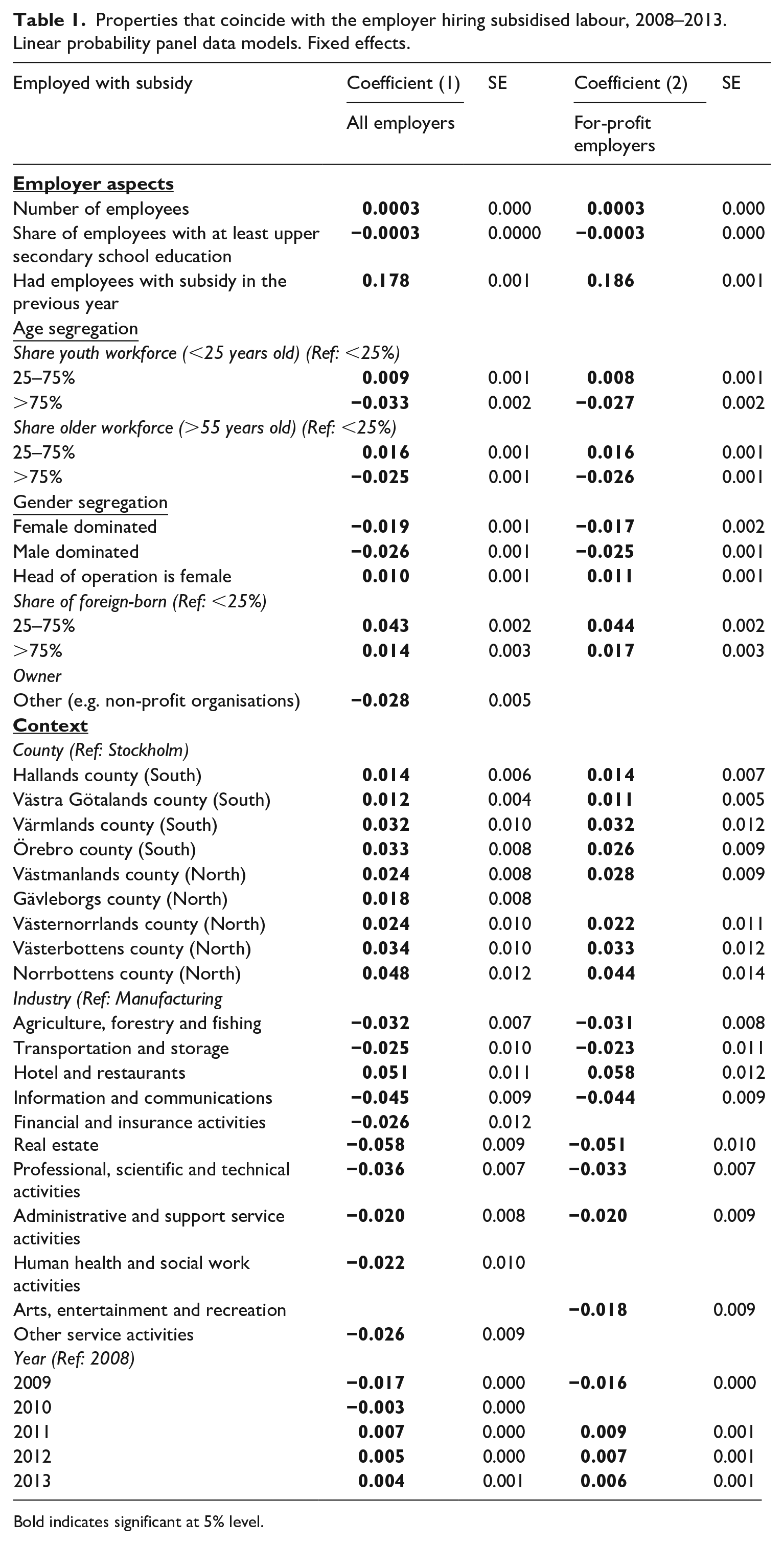
The results in Table 1 give an overview of employer characteristics that may influence the probability of hiring subsidised labour. We only report coefficients that are significant to at least the 5% level. Full results are presented in the Appendix. We report the results for two different populations. Column (1) shows the results for all employers. Column (2) also includes information about how successful the employer is in terms of operating earnings per employee. Only for-profit employers are included in that analysis, since this information is not available for public and non-profit employers. We use a linear probability model with fixed-effect panel data analysis. 9
Properties that coincide with the employer hiring subsidised labour, 2008–2013. Linear probability panel data models. Fixed effects.
Bold indicates significant at 5% level.
Employer characteristics
As shown in Table 1, the coefficient for employer size and firm size is positive – that is, the larger the size of the firm, the more likely it is that an employer will hire a person entitled to a wage subsidy. However, the magnitude of the coefficient is small, which indicates that size is less likely to be a determinant factor. The second employer factor measures the proportion of the workforce with at least secondary-level education. The relationship between this variable and the decision to employ a subsidised worker could arguably be both positive and negative. It is likely that workplaces with a high proportion of workers with at least upper secondary education will have better knowledge of wage subsidies and also that they may have more knowledge about issues that prevent the exclusion of certain parts of the labour force. On the other hand, it is also reasonable to assume that workplaces with a high proportion of people with at least an upper secondary education are found in industries and companies that require higher education, so the possibility of hiring a person with a wage subsidy may be lower. The estimated coefficient is negative, which means that the probability of hiring someone entitled to a subsidy is lower for employers who have a higher proportion of employees with at least upper secondary education. However, the marginal effect is small.
The results shown in Table 1 indicate that the experience of having employed subsidised labour in the past plays a major role; the probability of hiring a subsidised person in the current year is significantly higher if the employer has hired such an employee in the past. This is politically an interesting result, because it indicates that it is important to reduce the barriers to employers hiring the first person with a wage subsidy within the organisation.
Because the purpose of this study is to look from the employer perspective, we also control for heterogeneity in the workforce. We have operationalised this by including variables that indicate age segregation and gender segregation at different workplaces. Regarding age segregation, employers were divided into three groups depending on the age composition in the current organisation, and two variables were constructed: the proportion of young people under the age of 25 and the proportion of older workers (over 55 years). These two variables were then divided into three groups: <25%, 25–75% and over 75%. If an employer exceeds 75%, it is interpreted as that workers in this group dominate the workplace. The reference category for these two variables is that the respective group is underrepresented – that is, <25%. It appears that the probability of an employer hiring a subsidised person is lower if the workplace is age segregated. This applies to both younger and older workers. The fact that the middle group (25–75%) has a positive sign indicates that employers with a mix of younger and older employees are more likely to hire subsidised labour.
A similar division was made for gender segregation. We used two categories, defined as the workplace being male or female dominated. A gender-segregated workplace means that at least 75% of the employer’s workforce belongs to one gender. The results indicate that whether women or men dominate the workplaces, the probability of hiring someone with a wage subsidy is lower. Another gender dimension is whether the senior director of the current organisation is a man or woman, and it appears that this may in fact affect the likelihood of hiring staff with wage subsidies. If the operational leader is a woman, the chances are that the employer will hire a person with subsidies. It should be noted that in the regressions we control for industry, which is why the fact that women and men lead organisations in different industries does not affect the relationship between that and the likelihood of employing subsidised labour.
In the case of foreign backgrounds among employees, employers were divided into three groups: less than 25%, 25–75% and over 75%. The reason for including this variable is to control for the peer effect. This means, in the case of newly arrived immigrants, that employers with a larger proportion of foreign-born workers employ people with a foreign background to a larger extent, which is also the case for LTU. The results indicate that there is such a connection. If the employer either has an even distribution or is dominated by workers with a foreign background, then the likelihood that subsidised labour has been hired increases.
Depending on the fact that politicians want to meet goals of e.g. reduced long-term unemployment, it could be assumed that the public sector hires more people from vulnerable groups, for example those who are entitled to subsidised employment. However, our results indicate that this is not the case. Private businesses hire the most subsidised workers, and whether the employer is a public organisation has no significant effect on employing a person with a wage subsidy. On the other hand, the results show that the probability of employing a subsidised worker is lower if the employer belongs to the category of ‘other’, such as non-profit associations. The group ‘others’ are typically non-profit organisations that can be expected to have more motives to act solidaristically and provide opportunities for persons at risk. Having this in mind, we were somewhat surprised with the negative estimate.
Context variables
There appears to be regional variation, in that several coefficients are significantly different from zero and positive. The employers in the counties listed appear to be more willing to hire a subsidised worker, than employers located in Stockholm.
For the industry variables, the manufacturing industry is used as the reference. The negative coefficients should thus be interpreted as meaning that the probability of employing someone with a subsidy is lower than if the employer were in the manufacturing industry and applies to nine different industries. A positive coefficient, such as for hotels and restaurants, means that if the employer is present in this industry, the probability of employing a subsidised worker is higher than in manufacturing companies.
We have also included year fixed effects. These variables take into account that there has been an increased focus on subsidised employees, both in terms of the number of programmes and the number of new target groups. Compared to the reference year, 2008, the government’s focus on more opportunities for hiring subsidised workers is apparent, and the marginal effects of the later time fixed effects are positive and significant.
What are the important factors in the construction of the subsidy?
In this section, we report survey results regarding the main reason for hiring or not hiring a person receiving a wage subsidy. First, we present the results received from the employers that employed a wage-subsidised person, followed by the results received from employers that did not hire subsidised labour.
Employers that employed persons entitled to a wage subsidy
In the questions relating to hiring a person eligible for a subsidy, we asked the employer to scrutinise the main reason behind the latest hiring in which the employed person got a subsidy.
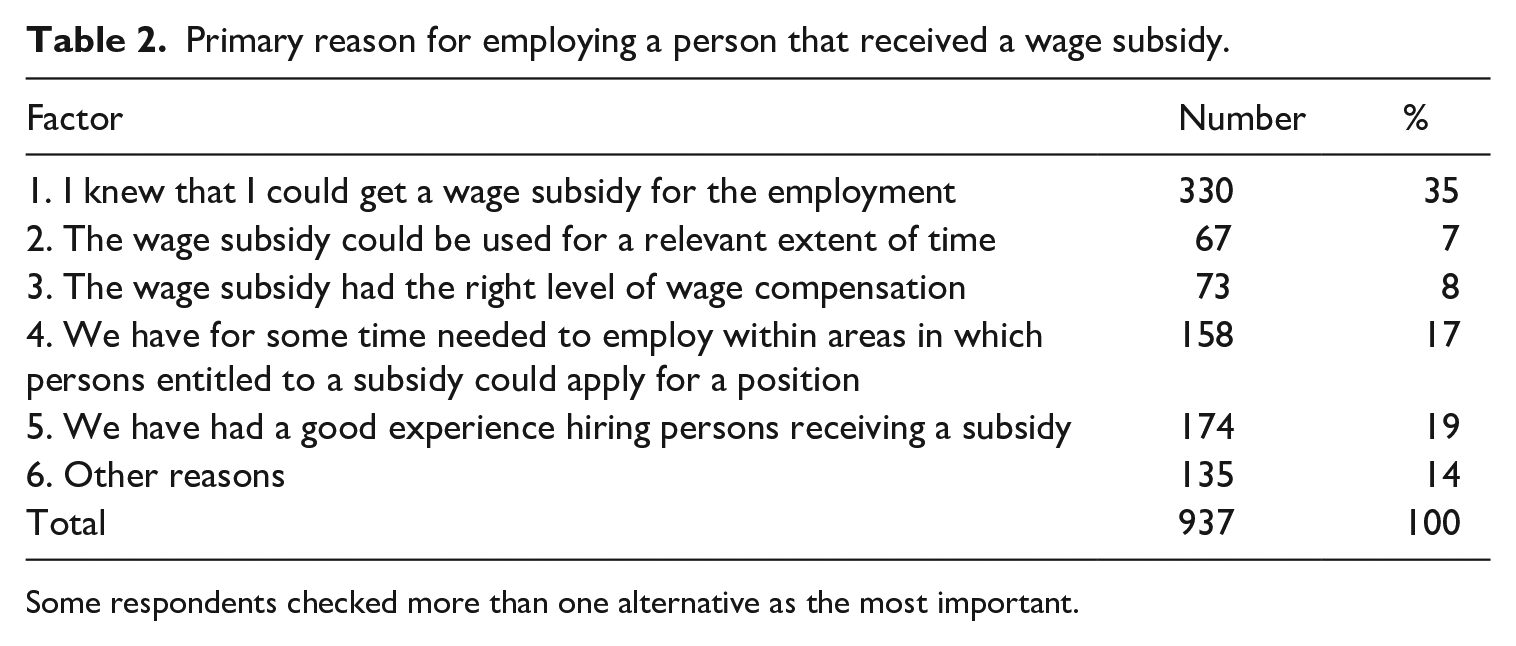
The results reported in Table 2 present the answers given as the main reason for employing the last person employed who received a wage subsidy that was not connected to a disability. The main reason is knowledge: 35% of employers mentioned that before hiring they knew that if they hired a certain person that the employment would come with a wage subsidy. What also stands out is prior experience of hiring persons entitled to a wage subsidy: 19% of employers mentioned this as the most important. ‘Other reasons’ accounted for 135 answers, and for respondents noting this alternative as the most important we included an open question where they could provide a reason. Several of the employers mentioned that the employment office had approached them, but there were also numerous respondents who stated that the main reason for employing a person entitled to a subsidy was ‘to help that person to re-enter the labour market’.
Primary reason for employing a person that received a wage subsidy.
Some respondents checked more than one alternative as the most important.
Employers who did not employ persons entitled to a wage subsidy
Table 3 presents the results of the survey for the group of employers who did not employ an LTU or newly arrived immigrant in the period 2000–2014.
Reasons why employers did not hire a person eligible for a wage subsidy.
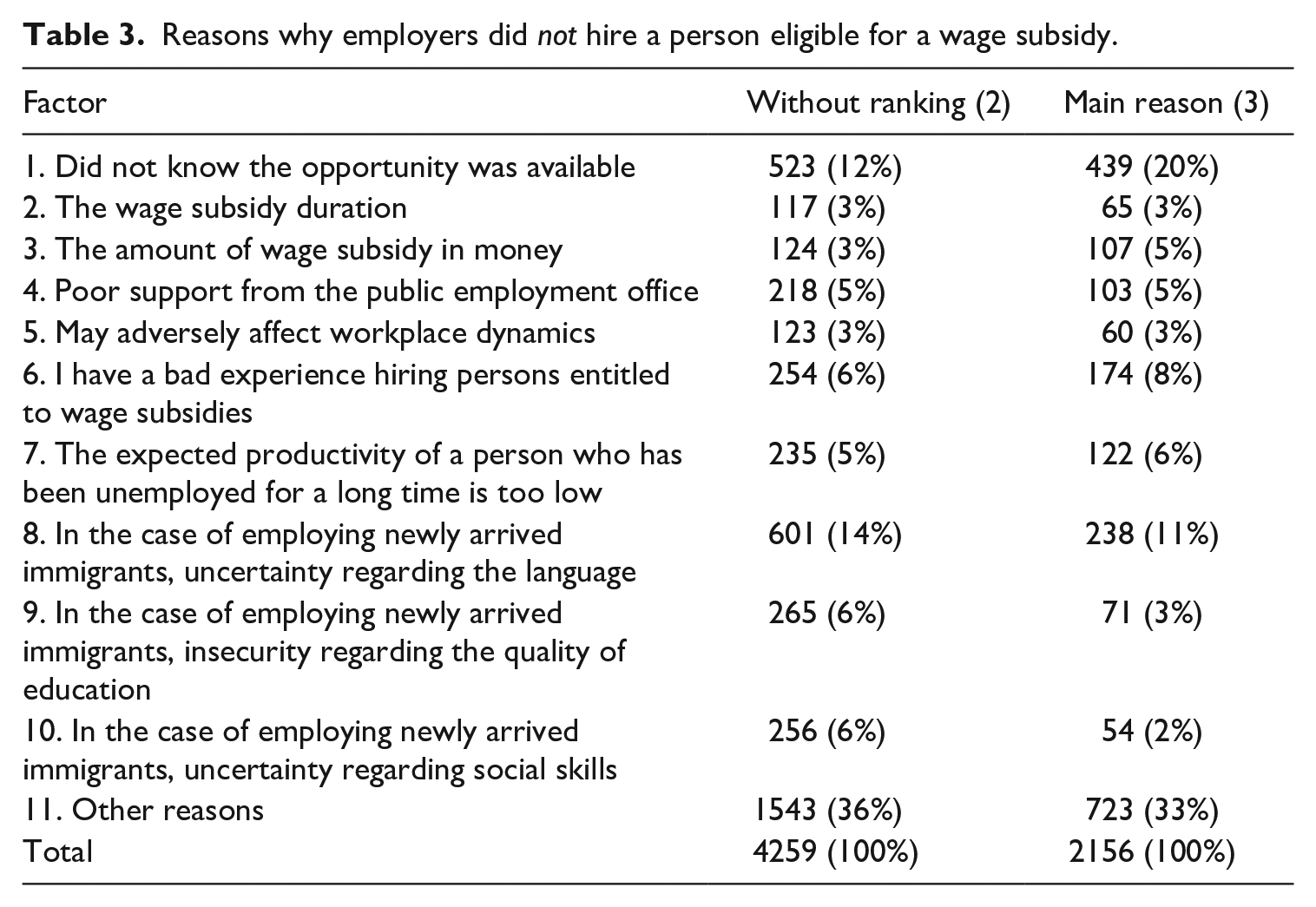
The respondents were asked to mark and rank the three most important reasons for not hiring an LTU/newly arrived immigrant entitled to a subsidy. In column 2, we report the results without ranking (i.e. if an employer marked 1, 2 or 3 on the item). In column 3 the response concerning the most important (marked 1) is reported. Note that for item 11, other reasons, the respondents had the opportunity to mention other aspects.
Table 3 reveals that a large number of employers were not aware that the possibility existed. About 20% of the employers who did not use this support indicated that the main reason was lack of knowledge. The more interesting answers to the question indicated employer responsibility and the requirement for highly skilled applicants, which these employers did not believe they could get by employing persons entitled to a wage subsidy. Regarding employer responsibility, a number of factors were given indicating that it takes ‘power, energy, and money’ for the employer to engage in hiring personnel in general. A large group expressed uncertainty regarding language for the appointment of newly arrived immigrants, while education quality and social competence were given as reasons not to hire to a significantly lower extent. Yet, the uncertainty of language, education quality and social competence together are mentioned in nearly a fifth of the answers as the main uncertainty. About one-third answered ‘other reasons’, and we have therefore analysed the open answers carefully. The answers that emerged were partly about the employer being a firm without any employees except the owner and also that there was no need to hire at the time of the survey.
What subsidy factors are important in an employment situation?
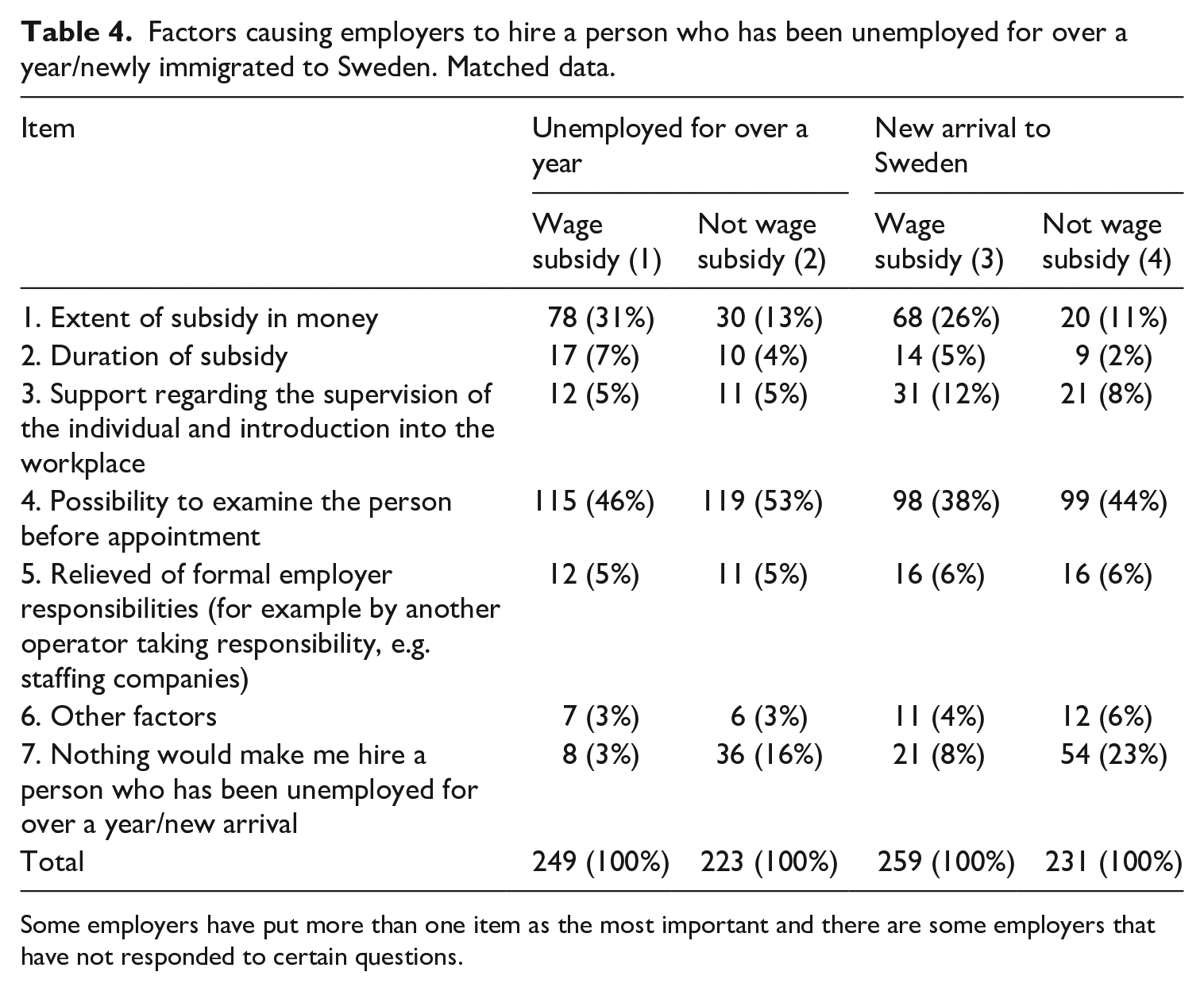
To further analyse what could induce employers to hire persons entitled to a wage subsidy, we set up a hypothetical employment situation in which the employer must choose between two individuals, one who has been unemployed for over a year or who is newly arrived in Sweden (for which the employer can get a wage subsidy), and a person who already has a job. The employer was provided information on the background characteristics relevant to the job, such as education and experience, but did not have all the information. The question was whether there are any conditions that would make employers hire the person entitled to a wage subsidy. In Table 4, we present the results from this hypothetical question from matched respondents. The motivation for this is to eliminate selection bias, at least to some extent. We gain in increased internal validity, but it also comes with a cost, which is reduced external validity. When filling in the web survey, the respondents were asked to state the three main reasons and rank them. In Table 4, we present the items that were considered the most important.
Factors causing employers to hire a person who has been unemployed for over a year/newly immigrated to Sweden. Matched data.
Some employers have put more than one item as the most important and there are some employers that have not responded to certain questions.
The first observation from Table 4 is that item 1, ‘extent of subsidy in money’, is more important for those who have hired subsidised labour. If the hypothetical situation concerned LTU, 31% marked this item as the most important, while only 13% of those that did not hire considered this item the most important. If the hypothetical situation related to newly arrived immigrants, the corresponding figures are smaller: 26% of those who hired ranked this item as the most important, while 11% of those that did not hire claimed that the amount of money was the most important factor. For item 2, the subsidy duration, few considered this the most important aspect, and the difference between those that did and did not hire subsidised labour is small. Item 3, supervision and introduction into the workplace, showed the same degree of importance, and the difference between groups is even smaller.
One of the main objectives with the wage subsidy is to share the risk regarding the uncertainty of worker productivity. There is the potential risk of a stigmatising effect of the wage subsidy. And there is likely a risk perceived by employers of hiring an LTU or a newly arrived immigrant. Employers would ideally like the subsidy system to give them a limited period in which to examine and evaluate the person onsite before offering employment. The answers to the hypothetical situation clearly show that the possibility of examining the potential employee before an appointment is the factor most frequently reported as the most important. That is, if the employer had the opportunity to examine an LTU or the newly arrived immigrant on the job before employment, the employer would be more willing to employ workers from these two groups. It is also worth noting that employers that have previously hired a person entitled to a subsidy consider this factor to be important to a lesser extent than employers that have not hired subsidised labour. 10
For the following two items, ‘Relieved of formal employer responsibilities’ and ‘other factors’, few respondents marked these items as of importance and the difference between the groups is almost non-existent.
The final item in the hypothetical situation gives the respondent the opportunity to state that persons from the two groups would be outcompeted by someone who has a job no matter what. A first observation is that there are employers hiring today that would never hire a subsidised person again and the share of respondents that claim this is higher when the hypothetical situation concerns newly arrived immigrants (8%) rather than an LTU (3%). A second observation is that for almost a quarter of respondents (23%) who have not hired a person receiving a wage subsidy, employing a newly arrived immigrant would not be an option. The corresponding figure for an LTU was 16%.
Subsidy content and employer characteristics
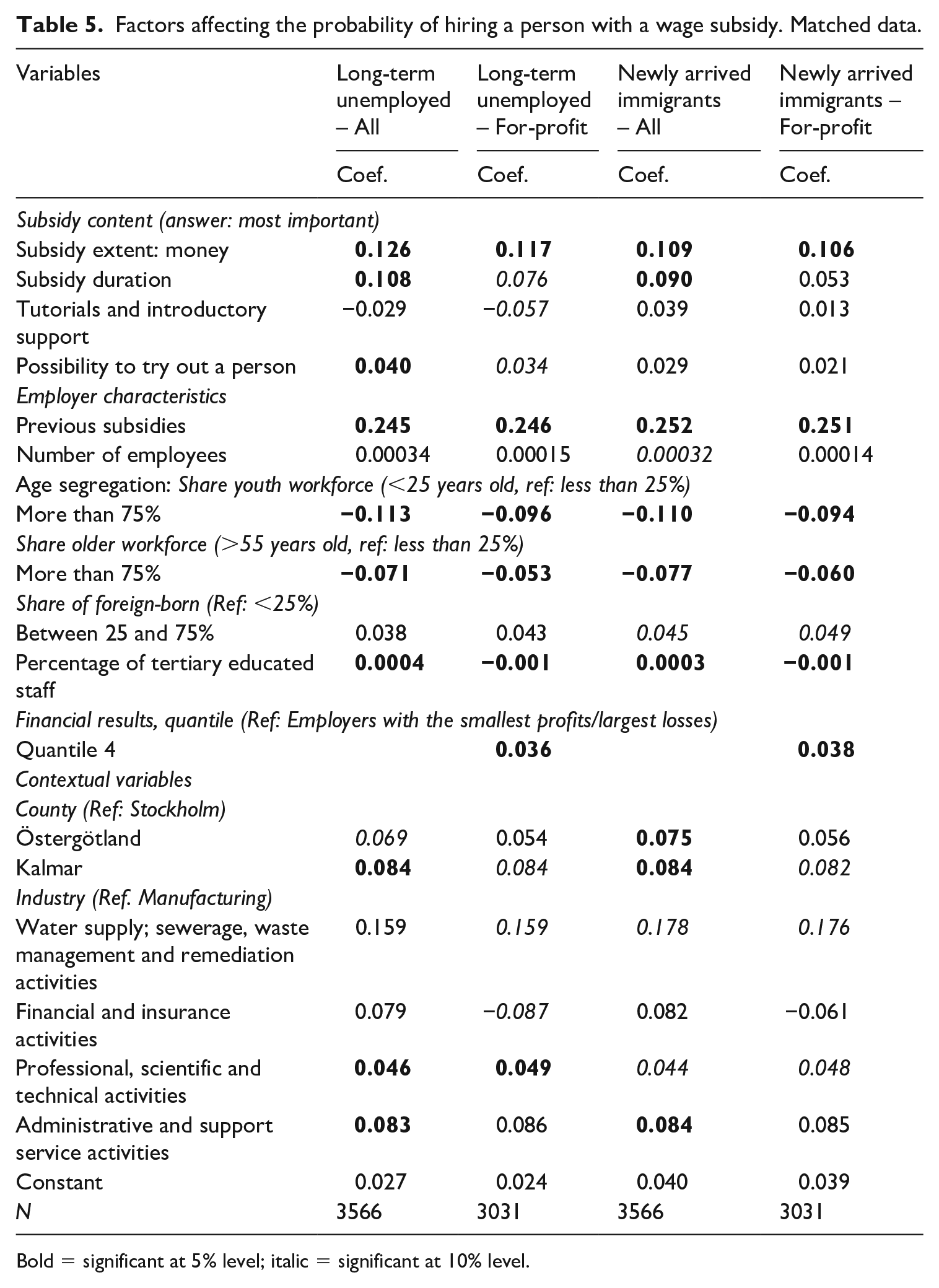
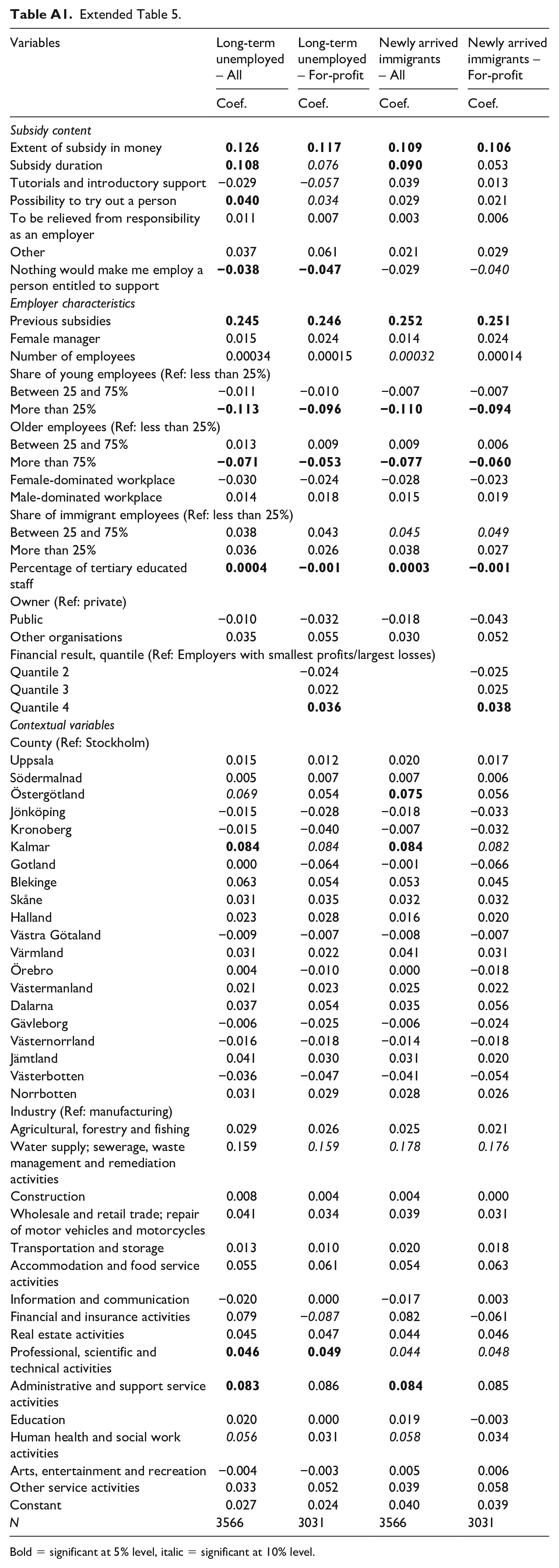
In a final analysis, we combined register data and the answers from the hypothetical employment situation used in the questionnaire. In the regressions, we have the response to the hypothetical situation, as well as employer characteristics and context variables. This means that in this analysis we can also control for attributes within the subsidy programme. Table 5 reports the results from the regression analysis in which hiring a person with a subsidy is the dependent variable. As for other analyses, only significant variables are reported, and descriptive statistics as well as full results are presented in the Appendix.
Factors affecting the probability of hiring a person with a wage subsidy. Matched data.
Bold = significant at 5% level; italic = significant at 10% level.
The first two columns in Table 5 (1) and (2) present the results regarding an LTU and columns (3) and (4) present the results for hiring newly arrived immigrants. We report regression results for both all employers and for-profit employers. The reason for dividing the sample is, as before, that we can also include a profit measure for for-profit employers that will give information about whether the employment decision is related to the financial situation.
Subsidy content
The first property analysed is whether the employer stated that the amount of money received was important in the decision to hire an LTU with a wage subsidy. As Table 5 shows, this characteristic is positive and significant regardless of the outcome and group studied. The positive coefficient indicates that the probability of an employer employing a person with a subsidy is higher for employers that state the extent of the subsidy is important. The results further show that if an employer stated that the subsidy duration is important in the hypothetical employment situation, this is associated with a higher probability that the employer would employ a subsidised worker, regardless of group. However, the duration is not significant at the 5% level if the analysed group consists of for-profit employers. Tutorials and introductory support have a negative sign, which means that if for-profit employers mentioned this factor as the most important, they are less likely to hire an LTU entitled to a wage subsidy. We get the opposite result for newly arrived immigrants, which indicates that importance of tutorials and introductory support leads to a negative probability to hire. If the employer answers that the possibility to try out a person is the most important factor for hiring subsidised workers, this results in a higher probability for employment of an LTU.
Employer characteristics
As shown in Table 5, the coefficient when an employer had previously used subsidies is positive (i.e. it is more likely that the employer will hire a person with a subsidy). It less likely that those workplaces with a high proportion of employees younger than 25 and older than 55 years hired an LTU or a newly arrived immigrant with a wage subsidy. A more even age structure raises the probability of hiring a person with a wage subsidy from among the LTU or newly arrived in Sweden. When the employer had good financial results and high profits, the probability that they would hire a person with a wage subsidy increased. In the analysis of industry significance, we have chosen to use the manufacturing industry as a reference. A positive coefficient, such as for technical activities and administrative services, means that if the employer is present in this industry, the probability is higher, compared to manufacturing, that the employer will employ a subsidised person. For financial and insurance activities in the private sector, there is negative sign significant at the 10% level, which implies a lower probability of hiring subsidised labour.
Contextual variables
There are only small regional differences. Only two counties (Kalmar and Östergötland) had coefficients with significant positive signs, which means that if the employees are located in these counties, the probability that the employer will hire a person with subsidies is higher than if the employer were located in Stockholm, regardless of other employer characteristics and industry. There is some heterogeneity with respect to industry. If the employer is in the sector ‘Professional, scientific and technical activities’ there is a higher probability of a subsidised worker being employed. The marginal effect is significant at the 5% level for long-term unemployed and significant at the 10% level for newly arrived immigrants. The sector ‘Administrative and support service activities’ has a positive and significant correlation with the probability of hiring a subsidised worker in the analyses covering all employers. However, the effect is not significant if the analysis is limited to for-profit employers.
Conclusions
Our study is purely empirical and descriptive, and the aim is to increase knowledge about the employer’s perspective on hiring a long-term unemployed person and/or newly arrived immigrant where both groups are entitled to wage subsidies. A second objective is to provide policy makers with new insights for policy construction.
In our first analysis, the variable that stands out is previous experience of employing a person entitled to a subsidy, which had a large impact on future decisions. This barrier, employing the first subsidised worker, could work as a catalyst for future employment, but the barrier has to be broken. Because we also learned that the amount of compensation is important, one potential way to break the barrier might be to differentiate the compensation scheme and put more effort into persuading employers that have not previously hired a person from the two groups.
As many as 20% of those who had not hired subsidised labour mentioned that the main reason was that they did not have any information. Lack of information about the possibility of hiring with a wage subsidy or a bad experience of hiring with wage subsidies and different types of uncertainty were the most important factors that employers named for not hiring subsidised workers. A first measure would be to increase the information about the possibilities and combine this with information about the experience of employers who have hired subsidised workers. In the study we have included variables that to some extent capture workplace homogeneity/heterogeneity. Our results indicate that workplaces that are heterogeneous regarding e.g. age and gender are more likely to employ persons entitled to a subsidy.
Employment with a wage subsidy in a temporary position means that, from day one, the employer assumes all employer responsibilities. The institutional framework for wage subsidies is of great importance for employers’ attitudes. The employer’s recruitment costs are not only about wage costs. A new employee must familiarise themselves with the workplace and the tasks in the new job. This is resource intensive and could also have an impact on the productivity of other employees. The extra uncertainty involved in employing a person with a long period of unemployment behind them requires that the employment subsidy is not only of a monetary nature but that it also includes other types of support from the employment service.
In the hypothetical employment situation, almost half mentioned that if it were possible to try out the person for a shorter time it would increase the likelihood of employing a person entitled to a wage subsidy. As previous research points out, the employer makes hiring decisions with limited information, and if a person is entitled to a wage subsidy it might signal expected lower productivity, but not the extent of this lower productivity. The subsidy should cover the reduced productivity, but there is no guarantee. This uncertainty is also connected with the negative signal of long-term unemployment, which is related to expectations of low motivation, low productivity and personal problems. The most important factor that could persuade employers to hire workers eligible for wage subsidies is the possibility of examining the person before a final appointment with wage subsidy is made. This argument is also one of the most important factors that would encourage employers to hire an unemployed worker with subsidies put forward in Bonoli (2014). One interpretation of the employer’s response is that they are not willing to take any risk from day one. A recommendation, based on this finding, would be to divide the time with the subsidy into two parts: one part where the public employment office has the responsibility for employment and a second part that gradually moves that responsibility over to the employer in question.
We find a stigmatising effect of the wage subsidy and there is a perceived risk for employers to hire a job seeker with a long unemployment record. A possible institutional change could be that the employer, for a limited time, has the possibility to examine and evaluate the person onsite before employment. The answers to the hypothetical situation clearly show that the possibility to examine the person in question before an appointment is the factor most frequently reported as the most important if employers are to become more positive about hiring with a wage subsidy. Furthermore, Eriksson and Rooth (2014) report results of a Swedish field experiment, which also indicates that stigmatisation occurs, but only when recruiting for jobs at a low or medium-qualified level and for applicants with an ongoing, continuous unemployment period of at least nine months.
The results also reveal a tendency towards discrimination. One of the alternatives in the statements about choosing to employ a person entitled to a subsidy was: I will under no circumstances hire a person entitled to a wage subsidy. The number of employers who checked this alternative was around 10 percentage points higher when the group was a newly arrived immigrant, compared to long-term unemployed. The employers mention more ‘risk factors’ associated with newly arrived immigrants such as language, social skills and awareness about social norms. Explanations why employers are hesitant to employ new arrivals with subsidies may be due to stigmatisation and negative signals, as for other long-term unemployed. Difficulties for newly arrived immigrants can be about a lack of country-specific human capital, but might also be a matter of ethnic discrimination. Based on this finding, we would like to stress that it is important for a potential employer to get information about these risk factors. Perhaps the employer needs to know that the person passed a language test or some other indicator. Our recommendation is to try to identify factors that employers consider to be risk factors and, if possible, to provide information about these to the potential employer.
Finally, in the answers to our open questions about hiring, two answers stand out. A not insignificant number of employers hired subsidised labour from altruistic motives; they see it as a chance to provide an opportunity to someone – it could be family, friends or the children of a friend. At the same time there are employers that would never hire a person entitled to a subsidy. It could, of course, be related to the negative signalling effect and the stigmatisation of job seekers eligible to a subsidy discussed in the introduction, but it could also be an attitude against being involved in any activities organised by the public sector and paid for by taxpayers’ money.
The aim of this study has been, in an explorative sense, to increase our knowledge about why employers are reluctant – or in favour – to hire persons entitled to wage subsidies. Even if our study has increased the knowledge in some areas, there are other areas where our results indicate a need for deeper investigation. One such question is whether the design of wage subsidies should be different for different types of employers: for example, regarding ownership and industry. A further area of research is to understand what lies behind the fact that some employers state that they would not under any circumstances consider hiring a person with a wage subsidy. Finally, our results indicate, to some extent, both industry and regional heterogeneity that could be topics for future research.
Footnotes
Appendix
Extended Table 5.
| Variables | Long-term unemployed – All | Long-term unemployed – For-profit | Newly arrived immigrants – All | Newly arrived immigrants – For-profit |
|---|---|---|---|---|
| Coef. | Coef. | Coef. | Coef. | |
| Subsidy content | ||||
| Extent of subsidy in money |
|
|
|
|
| Subsidy duration |
|
0.076 |
|
0.053 |
| Tutorials and introductory support | −0.029 | −0.057 | 0.039 | 0.013 |
| Possibility to try out a person |
|
0.034 | 0.029 | 0.021 |
| To be relieved from responsibility as an employer | 0.011 | 0.007 | 0.003 | 0.006 |
| Other | 0.037 | 0.061 | 0.021 | 0.029 |
| Nothing would make me employ a person entitled to support |
|
|
−0.029 | −0.040 |
| Employer characteristics | ||||
| Previous subsidies |
|
|
|
|
| Female manager | 0.015 | 0.024 | 0.014 | 0.024 |
| Number of employees | 0.00034 | 0.00015 | 0.00032 | 0.00014 |
| Share of young employees (Ref: less than 25%) | ||||
| Between 25 and 75% | −0.011 | −0.010 | −0.007 | −0.007 |
| More than 25% |
|
|
|
|
| Older employees (Ref: less than 25%) | ||||
| Between 25 and 75% | 0.013 | 0.009 | 0.009 | 0.006 |
| More than 75% |
|
|
|
|
| Female-dominated workplace | −0.030 | −0.024 | −0.028 | −0.023 |
| Male-dominated workplace | 0.014 | 0.018 | 0.015 | 0.019 |
| Share of immigrant employees (Ref: less than 25%) | ||||
| Between 25 and 75% | 0.038 | 0.043 | 0.045 | 0.049 |
| More than 25% | 0.036 | 0.026 | 0.038 | 0.027 |
| Percentage of tertiary educated staff |
|
|
|
|
| Owner (Ref: private) | ||||
| Public | −0.010 | −0.032 | −0.018 | −0.043 |
| Other organisations | 0.035 | 0.055 | 0.030 | 0.052 |
| Financial result, quantile (Ref: Employers with smallest profits/largest losses) | ||||
| Quantile 2 | −0.024 | −0.025 | ||
| Quantile 3 | 0.022 | 0.025 | ||
| Quantile 4 |
|
|
||
| Contextual variables | ||||
| County (Ref: Stockholm) | ||||
| Uppsala | 0.015 | 0.012 | 0.020 | 0.017 |
| Södermalnad | 0.005 | 0.007 | 0.007 | 0.006 |
| Östergötland | 0.069 | 0.054 |
|
0.056 |
| Jönköping | −0.015 | −0.028 | −0.018 | −0.033 |
| Kronoberg | −0.015 | −0.040 | −0.007 | −0.032 |
| Kalmar |
|
0.084 |
|
0.082 |
| Gotland | 0.000 | −0.064 | −0.001 | −0.066 |
| Blekinge | 0.063 | 0.054 | 0.053 | 0.045 |
| Skåne | 0.031 | 0.035 | 0.032 | 0.032 |
| Halland | 0.023 | 0.028 | 0.016 | 0.020 |
| Västra Götaland | −0.009 | −0.007 | −0.008 | −0.007 |
| Värmland | 0.031 | 0.022 | 0.041 | 0.031 |
| Örebro | 0.004 | −0.010 | 0.000 | −0.018 |
| Västermanland | 0.021 | 0.023 | 0.025 | 0.022 |
| Dalarna | 0.037 | 0.054 | 0.035 | 0.056 |
| Gävleborg | −0.006 | −0.025 | −0.006 | −0.024 |
| Västernorrland | −0.016 | −0.018 | −0.014 | −0.018 |
| Jämtland | 0.041 | 0.030 | 0.031 | 0.020 |
| Västerbotten | −0.036 | −0.047 | −0.041 | −0.054 |
| Norrbotten | 0.031 | 0.029 | 0.028 | 0.026 |
| Industry (Ref: manufacturing) | ||||
| Agricultural, forestry and fishing | 0.029 | 0.026 | 0.025 | 0.021 |
| Water supply; sewerage, waste management and remediation activities | 0.159 | 0.159 | 0.178 | 0.176 |
| Construction | 0.008 | 0.004 | 0.004 | 0.000 |
| Wholesale and retail trade; repair of motor vehicles and motorcycles | 0.041 | 0.034 | 0.039 | 0.031 |
| Transportation and storage | 0.013 | 0.010 | 0.020 | 0.018 |
| Accommodation and food service activities | 0.055 | 0.061 | 0.054 | 0.063 |
| Information and communication | −0.020 | 0.000 | −0.017 | 0.003 |
| Financial and insurance activities | 0.079 | −0.087 | 0.082 | −0.061 |
| Real estate activities | 0.045 | 0.047 | 0.044 | 0.046 |
| Professional, scientific and technical activities |
|
|
0.044 | 0.048 |
| Administrative and support service activities |
|
0.086 |
|
0.085 |
| Education | 0.020 | 0.000 | 0.019 | −0.003 |
| Human health and social work activities | 0.056 | 0.031 | 0.058 | 0.034 |
| Arts, entertainment and recreation | −0.004 | −0.003 | 0.005 | 0.006 |
| Other service activities | 0.033 | 0.052 | 0.039 | 0.058 |
| Constant | 0.027 | 0.024 | 0.040 | 0.039 |
| N | 3566 | 3031 | 3566 | 3031 |
Bold = significant at 5% level, italic = significant at 10% level.
Declaration of conflicting interests
The authors declared no potential conflicts of interest with respect to the research, authorship, and/or publication of this article.
Funding
The authors received no financial support for the research, authorship, and/or publication of this article.
