



Abstract
Employers are instrumental in the growth of non-standard employment, which exposes predominantly younger workers to higher levels of insecurity. Using an interdisciplinary theoretical lens, this article identifies which considerations, both positive and negative, underlie employers’ decision making with regard to the use of flexible contracts for younger workers and discusses how employers perceive future implications of an increasingly flexible labour market. Findings are based on interviews with 26 managers, HR professionals and directors working in different sectors of industry in the Netherlands: local government, education, health care, retail, corporate services and transport and logistics. While acknowledging benefits to the use of flexible contracts, interviewed employers also reported downsides to this practice. Using flexible contracts complicates retention of young talent, deters investment in training, negatively affects social morale on the work floor and puts pressure on younger workers. Interviewees did not deem employers primarily responsible for monitoring societal consequences of an increasingly flexible labour market and often did not see the bigger picture of how increased flexibility could have negative societal consequences. The findings suggest that corrective actions will not come from the side of employers.
Keywords
Introduction
Over the past decades, many European countries have witnessed a decline in ‘standard’ employment and a rapid rise in employment relationships that entail a lower degree of commitment from both employers and employees (OECD, 2019b; Spreitzer et al., 2017). Younger workers are overrepresented among those working in non-standard arrangements based on ‘flexible’ contracts (ILO, 2016) and as a consequence an increasingly large share of young adults in the labour market are exposed to higher individual risks of various types (Autor and Houseman, 2010; Giesecke, 2009; Mooi-Reci and Dekker, 2015; Yates and Clark, 2021). Previous research has shown that prolonged non-standard employment can lead to stagnated wage growth (Bentolila and Dolado, 1994), retarded career development (de Lange et al., 2014) and entrapment in a precarious financial situation (Mattijssen and Pavlopoulos, 2019). The OECD has warned that many workers in all forms of non-standard employment struggle to gain access to social protection, have few alternative employment options and low bargaining power (OECD, 2019b). Not only do these disadvantages at the start of working life decrease economic security (Kalleberg, 2018), they may also have long-lasting effects on workers’ long-term employability, their well-being and even on their ability to start a family (Laß, 2020; van Wijk et al., 2021) while increasing inequality over the life course (DiPrete and Eirich, 2006). European policy makers, concerned about the future economic position of the youngest and best ever educated generation of workers, have therefore urged employers to reflect upon their use of flexible contracts (European Parliament and Council, 2019). However, although employers’ decisions regarding contracts determine the level of exposure to insecurity among younger workers, not much is known about how employers experience using flexible employment contracts in practice. This study aims to fill this void by providing novel insights into how employers perceive the use of flexible contracts for younger workers within their organisations, as well as how employers assess the economic and social consequences of continued use of non-standard employment. We do so by drawing upon in-depth interviews with employers across different sectors.
Employers are generally thought to make use of flexible employment contracts to reduce labour costs. Employing workers on a short-term basis, for instance, allows organisations to quickly adapt to fluctuations in production and service requirements. Temporary labour agreements are also used to postpone definite hiring decisions and more extensively screen applicants for permanent positions (Houseman et al., 2003). In addition, flexible employment contracts are used to instantly acquire human capital that is particularly sought after (Atkinson, 1984). Until now, very few studies have looked at whether the anticipated employer benefits of using flexible employment contracts actually materialise in practice (Håkansson et al., 2020; Johnstone, 2019; Pulignano et al., 2020). So far employer research on non-standard employment is either of a macroeconomic nature (e.g. Bolhaar et al., 2018; Hevenstone, 2010) or has focused on micro-level stated preferences for the use of flexible working agreements, giving little evidence on day-to-day experiences (e.g. Hakim, 1990; Houseman, 2001; Kalleberg et al., 2003). However, economic research has shown that the relation between a higher share of flexible employees and anticipated benefits in terms of higher firm performance (Ji et al., 2014) and innovation (Kleinknecht et al., 2014) is not as straightforward as proponents of flexible contracts suggest. It also still remains unclear whether and to what degree employers perceive a downside to the increase in contract flexibility within their organisations. Increased flexibility in working agreements between employers and their youngest workers might complicate personnel management. The use of flexible contracts for younger workers could jeopardise retention of talent and adequate provision of training (Yates and Clark, 2021); it could also have a negative impact on social morale in the workplace and employee well-being (Davis-Blake et al., 2003).
It is important to identify which considerations, both positive and negative, underlie employers’ decisions with regard to the use of flexible contracts for younger workers and to explore how employers perceive future implications of an increasingly flexible labour market. From a theoretical point of view, in-depth insight into these employer rationales could help explain under which organisational conditions younger flexible workers are most at risk of experiencing disadvantageous outcomes. From a policy perspective it could inform human resource departments within organisations on the pitfalls of using flexible contracts, which might prove useful when designing guidelines for the use of these employment practices. In addition, insight into employers’ perceptions and possible future practices could inform national policies aimed at regulating the growth in non-standard employment. To increase economic security among younger workers, governments might introduce new regulation that reduces employers’ leeway to postpone offering standard employment.
To address these understudied aspects of the employer perspective on flexible employment this article examines the following research questions: (1) how do employers experience working with flexible employment contracts, especially for younger workers, in terms of benefits and downsides? and (2) how do employers perceive the future of flexible employment both within their organisations and for the labour market as a whole?
In this enquiry we use ‘flexible employment’ to refer to employment relations in which employees do not have a permanent, open-ended employment relationship with the organisation within which they perform their daily work. This includes direct hires on fixed-term contracts, employment intermediaries (‘temps’) and on-call workers, but excludes the self-employed (Cappelli and Keller, 2013). We take ‘younger workers’ to mean workers with most of their working life still ahead of them and therefore define them as workers below the age of 35. To gather diverse, individual accounts of work-related considerations and perceptions we chose a qualitative research design consisting of in-depth semi-structured interviews. Interviewees fulfilled different ‘employer’ roles: managing and evaluating the performance of (flexible) workers, monitoring processes and policy related to flexible employment contracts and making executive decisions regarding staffing. The total sample consisted of 26 managers, Human Resource (HR) professionals or directors working at 13 organisations in both the public and the private sector.
This article contributes to the literature on flexible employment and the academic debate on the drivers of labour market segmentation in three ways. First, employers’ views on possible downsides to the use of flexible employment contracts, both for their own organisation, as well as for the labour force and society in general, are topics that have so far received relatively little attention. Yet current underinvestment in human capital affects the quality of future labour supply and thus should be of interest to employers. By focusing on the perspective of employers and their experiences of working with flexible employment contracts for younger workers, we provide a managerial level point of view on flexible employment that has been qualified as relevant, but rare (Cappelli and Keller, 2013; Pulignano et al., 2020). Secondly, our qualitative approach allows us to interpret considerations about the benefits and downsides of flexible contracts within the social context of the workplace (similar to Acar, 2018). This article provides a multifaceted account of employers’ stance on the use of non-standard forms of employment. It shows how employers may display inconsistencies in thinking through the pros and cons of these types of employment. They also sometimes express dissatisfaction with the current practice of employing younger workers on a temporary basis. This employer-level variation may help in understanding the differential impact of flexible employment on the labour market position of younger workers. Previous survey research among employers has not provided in-depth insight into their decision making processes at this level of detail. Thirdly, the insights presented in this article are based on new data collected after the Great Recession (but before the onset of the COVID-19 pandemic) among employers operating in six different sectors of industry. The employer experiences discussed below cover a wider variety of types of work and types of younger workers, which allows for potential corroboration and extension of previously published findings. This is an advancement of the literature on flexible employment, which predominantly consists of studies carried out before the Great Recession (Hakim, 1990; Houseman, 2001; Kalleberg et al., 2003) or that focused only on the manufacturing industry (Håkansson et al., 2020; Johnstone, 2019; Pulignano et al., 2020). Flexible employment contracts are used at a substantially larger scale within European organisations since the Great Recession (OECD, 2019b). This study provides an up-to-date account of how flexible employment is being integrated within organisations and thus insight into how employers stimulate segmentation of the labour market into insiders (those with a secure position and prospect of opportunities) and outsiders (those whose current and future position are insecure).
Our empirical work was conducted in the Netherlands, a country characterised by a sharp increase in flexible employment over the past two decades. According to the OECD, the Netherlands had the fourth largest share of temporary employment in Europe in 2017, only to be surpassed by Spain, Poland and Portugal, three countries which are quite dissimilar in terms of GDP and economic structure (OECD, 2019a, 2019c). The growth in flexible employment in the Netherlands has both been rapid and recent. Whereas in 1993 the share of workers employed on a temporary contract was similar to the OECD average at just under 10%, by 2013 the share had more than doubled. In 2019, 22% of Dutch employees worked in flexible employment: either on a type of temporary contract, on-call contract or via a temp agency (Statistics Netherlands, 2019). The Netherlands can presently be characterised as having a two-tier labour market (Akgündüz and van Huizen, 2015). Compared to other European countries, employment protection for permanent workers in the Netherlands is high (OECD, 2020). Non-standard employment arrangements are subject to a considerably lower degree of national regulation and protection. National law binds employers to a maximum number of flexible contracts they can offer to the same employee within a limited spell of time. Once these limits have been reached, employers need to decide whether or not to offer the employee a permanent contract (Tweede Kamer der Staten-Generaal, 2018).
In the next part we present an interdisciplinary theoretical lens on employers’ behaviour with regard to the use of flexible employment contracts. The following section of the article details the research design and methodology. Our findings are presented under thematic headers in three subsequent sections and elaborated on in the discussion and conclusion.
The employer perspective on the use of flexible employment contracts
Employers operate both within the structure of their organisations, amid social relations with and commitments to their employees, and within their segment of the market with its own interrelated network of firms. Their behaviour can be understood as the outcome of a combination of highly contextualised independent decision making and patterned abidance to legal and social norms. This behavioural dynamic has been described as ‘agency within structure’ (Heugens and Lander, 2009). To interpret employers’ perspectives on working with flexible contracts for younger workers we combine insights from organisational science, psychology and sociology. As will be discussed below, considered short-term benefits of flexible contracts are predominantly economic in nature, whereas potential downsides pertain more to social interaction. The long-term consequences of increased use of flexible employment can pose risks for younger workers as well as employers.
One can expect employers to describe their experience of using flexible employment contracts based on a trade-off weighing the organisation’s short- and long-term needs and market opportunities. The use of flexible employment contracts has been said to benefit organisations by providing numerical flexibility: the ability to quickly increase or decrease their workforce in order to respond to market demands (Atkinson, 1984). Additionally, flexible contracts can be used as an extended probation period to screen newly hired employees (Houseman, 2001; Portugal and Varejão, 2009). The extent to which employers prefer to use flexible contracts also depends on the degree of specialisation required for a job (Remery et al., 2002). Flexible contracts are more attractive if specialised knowledge and skills are not required and training periods are short. In organisational discourse ‘maintaining flexibility’ has become a widely accepted answer to various issues related to responsiveness to market needs and managerial (financial) control (Hunter et al., 1993; Mackintosh, 2000). The employment model for a ‘flexible firm’ creates a distinction between jobs that are specific to the permanent activities of a particular organisation (core group) and those only involving activities that do not belong to the core tasks of the organisation (peripheral group). As markets grow, the periphery of the organisation can expand. As growth slows down these newly created jobs in the periphery disappear again. Consequently, workers in the core group enjoy a higher degree of job- and income security than those in the periphery.
Insight into the potential downsides for employers of using flexible contracts is provided by theoretical work on organisational behaviour. The ‘contract’ between employee and employer is not limited to the legal terms of the labour agreement; it is also a ‘psychological contract’ (Rousseau et al., 2018). This psychological contract entails social trust and reciprocal expectations that are based on previous work experiences and social custom within an organisation. The quality of the psychological contract between employee and employer has a strong influence on the social dynamic between both parties. When expectations are not met or actively disregarded, this implicit contract gets disrupted and the working relationship suffers. Flexible contracts provide little certainty regarding the status of the employment relationship in the future. This can create confusion about the expected investment of both the employee and the employer, resulting in a lower degree of trust between both parties. Because of this confusion there is also room for self-interested opportunistic behaviour (Cropanzano et al., 2017; Thibaut and Kelley, 1959).
Widespread use of flexible employment contracts has consequences for the future, both within organisations and for the labour market as a whole. From a sociological perspective employers’ experiences with using flexible contracts can be interpreted based on Granovetter’s (1985) embeddedness approach. As strategic labour market actors, employers’ behaviour is influenced by the existence of national regulation on flexible employment. Specific legislation is likely to be interpreted as the newly accepted norm (Barbieri, 2009; DiMaggio and Powell, 1983). At the market level, organisations with a high share of flexible employees do risk neglecting to invest in training and HR practices that secure (future) productivity (Black and Lynch, 1996; Rubery et al., 2016). Critical theorists have warned that the trend in flexible employment has tipped the balance of power between employees and employers in favour of the employer, allowing them to shift more of the risks that come with operating in an uncertain market towards the individual worker (Kalleberg, 2011). This labour market dynamic is said to lead to a growing share of highly vulnerable workers with a precarious societal position. Younger workers lack long-term working experience and tend to have less firm-specific expertise. This gives them a relatively weak position when negotiating terms of employment vis-a-vis potential employers and provides employers with the opportunity to offer employment with low job security (ILO, 2016). Because younger workers can be expected to be offered non-standard forms of employment more readily, they are especially exposed to the risk of experiencing disadvantageous consequences of flexible employment and opportunistic employer behaviour (Kalleberg, 2018).
Since employers’ decisions on the use of flexible employment contracts are usually trade-offs between perceived organisational benefits and downsides, individual considerations and organisational circumstances will also weigh into this judgement (Pulignano et al., 2020). Yet concrete examples of what is considered during this decision process are actually rather scarce. Moreover, specific national legislation on flexible employment and growing disparity of power between employers and employees make it likely that unfavourable outcomes for younger workers and (local) labour markets will persist (Yates and Clark, 2021). However, it remains somewhat unclear how employers envision their agency in this societal development. The present enquiry provides novel answers to these two underexplored lines of research.
Method and data
The aim of this study’s design was to gather employer experiences across different parts of the economy. We conducted in-depth, semi-structured interviews on the topic of ‘Flexible Contracts and Younger Workers’ with 26 purposively selected participants working at 13 medium-sized (100-250 employees) and large organisations (500 or more employees). In order to capture a variety of ‘employer’ responsibilities we interviewed managers, (executive) directors and HR professionals. We included participants from different age groups and a roughly equal number of men and women. We also paid attention to variation in the overall required skill-level of the workers within the organisations. To improve reliability we interviewed two people per organisation and recruited two organisations per sector (Morse et al., 2002). Fieldwork was conducted between January and June 2019 in the Netherlands.
To increase the likelihood of participation we chose a two-step recruitment strategy relying on the help of contact persons within organisations (Hennink et al., 2020), since we anticipated the degree of spontaneous participation among employers to be low (Baruch and Holtom, 2008). As a first step we used an existing network of contacts in the Netherlands to purposively select organisations based on two criteria: sector of industry (substantial contribution of [flexible] jobs to the Dutch labour market) and the number of staff (100 or more employees). We then personally approached potential contact persons at these selected organisations via email or social media (LinkedIn) and informed them on the aims of the research project by means of an information leaflet. This leaflet was neutrally worded to avoid self-selection bias. If interest was shown in contributing to our project, contact persons were then, as a second step, asked to recruit two voluntary interviewees using the leaflet and a set of in- and exclusion criteria (see Appendix). From the start of the recruitment process, all (potential) contact persons and interviewees were informed that participation in the research project was anonymous, meaning that the findings of the study could not be linked back to their individual identities or that of their organisations. In total we approached 28 potential contact persons of whom 13 were successful at recruiting two interviewees within their organisation.
We interviewed employers working in six different sectors: local government, tertiary education, health care (public); retail, corporate services and transport and logistics (private). Figure 1 provides an overview of the demographic characteristics of the interviewees, the number of years they had already worked for their organisation, their employer role and a description of the core activity of the organisations. The group of interviewees included 14 women and consisted of 12 people with managerial and 14 people with policy-oriented responsibilities (of both sexes). All but one of the interviewees obtained a degree in higher education. Eleven of the organisations were large in size (more than 500 employees), the consultancy firm and the shipping company were medium-sized (both between 100 and 250 employees). None of the interviewees expressed discomfort with their participation in the study or with the interviewer.
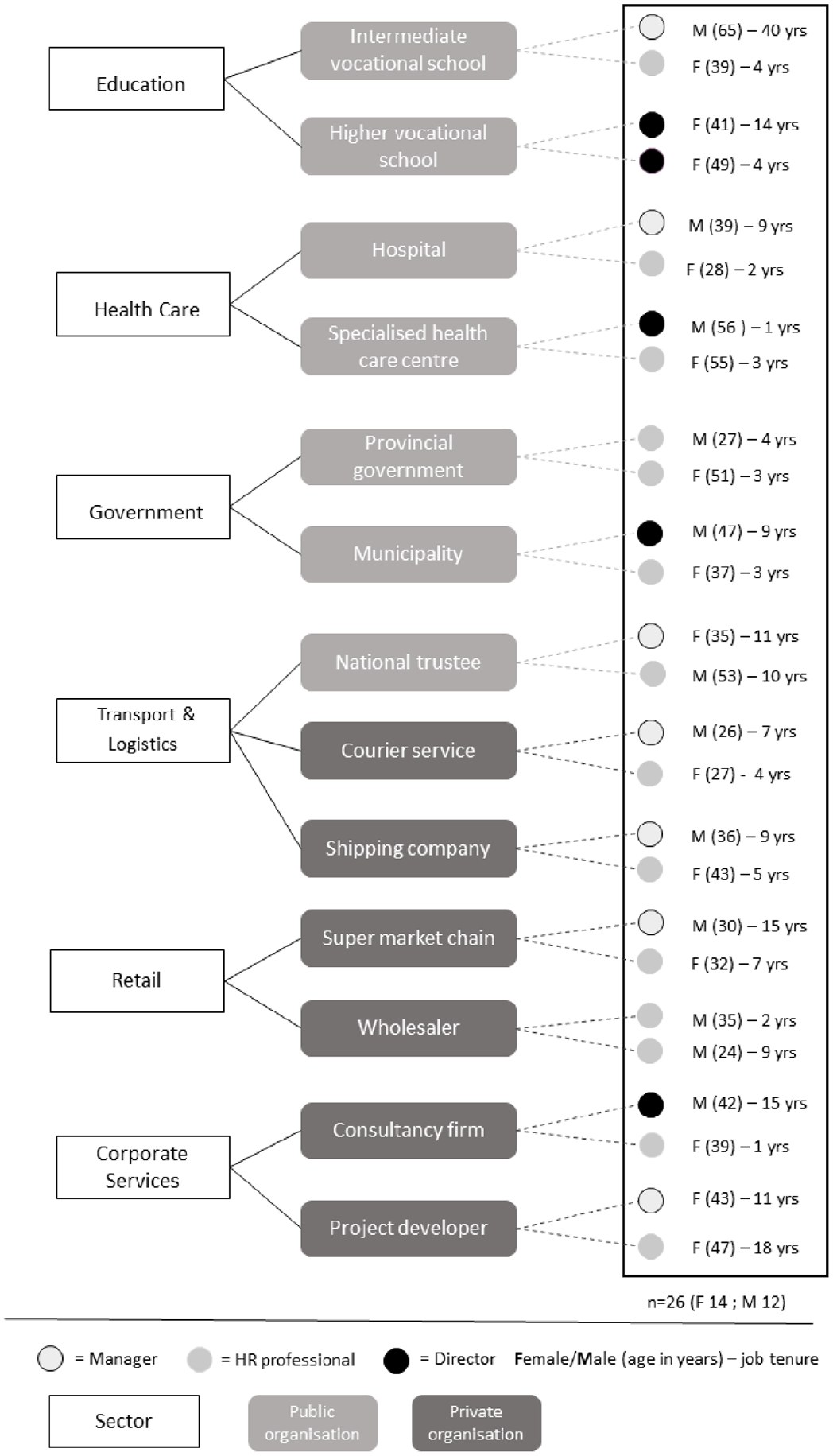
Overview of the study participants and their organisational context.
Interviews were conducted at the workplace to minimise the contextual difference between the interview setting and the rest of the interviewee’s working day. The first author conducted all interviews to maintain consistency across interviews. Interviews lasted between 1.5 and 2 hours, were audio-recorded and subsequently transcribed. To provide structure and focus to the conversations, the interviewer used question sets. Interviewees were asked about the ways in which their organisation utilises flexible employment contracts, their everyday experience in terms of the perceived advantages and disadvantages of having both permanent and, mostly younger, flexible staff members and to reflect upon potential future outcomes of a highly flexible labour market (see Appendix). Follow-up questions were formulated on the spot, in line with the general purpose of the interviews and depending on respondents’ reactions. Participants were informed about the aims of the study and the role of the interviewer within the overall project. Prior to the interview, all interviewees acknowledged awareness of their rights as participants in a scientific enquiry by providing informed signed consent.
We used speech-to-text transcription software to create verbatim overviews of what was said during each interview and conducted what is often called interpretative thematic analysis (Boeije, 2012). To start off, the first author listened to all of the audio material while taking note of recurrent or striking utterances. A combination of these observations and date-stamped field notes made during the data collection period resulted in a set of categories (codes) to organise the interviewees’ answers. As a second step, the accounts of the interviews were structured using this hierarchical set of codes. A software package for data storage and analysis (NVivo Pro) was used to facilitate this process. As a third interpretive step we compared and contrasted the categories of utterances across sectors and employer responsibilities (managerial vs policy-oriented) in order to gain a more generic understanding of employers’ perceptions.
Results
Benefits of flexible employment contracts at the workplace
Across all sectors interviewed employers showed a clear liking for working with flexible employment contracts. Three main reasons for this appreciation, mentioned in the academic literature (Houseman, 2001; Kalleberg, 2018; Kalleberg et al., 2003), came to the fore. Interviewees said they used flexible contracts to (1) cover financial risks, (2) make better hiring decisions and (3) facilitate control over workers’ performance.
While discussing the first perceived benefit – covering financial risks – interviewees from both the public and the private sector explained that within their organisation flexible employment contracts are used to postpone or avoid the expected long-term costs of employing someone permanently. This avoidance strategy is not without short-term consequences: various interviewees, most of them working in the public sector, complained that this strategic choice is sometimes rather costly. High fees for agency workers (‘temps’) were said to weigh considerably on present staffing budgets. Nevertheless, interviewed employers deemed flexible contracts a sensible protection mechanism against the risk of upcoming cuts in the organisation’s budget. As a female director working at a higher educational institution stated: As a school, we need room to breathe. Our student numbers are not stable, so we always need to wait and see how many will enrol . . . So that means I also need to be able to adjust the number of teachers. (Director, 41, female, Education)
Other interviewees spoke about potential risks in more general terms. A possible future change in the organisational structure was also seen as a reason to refrain from offering permanent contracts. As this male HR manager working at a national trustee phrased it: At times we probably think ‘well, this is a decent lawyer, but we might want to reorganise things in one or two years’ time. So yeah, he may be a nice guy, but at the moment I’d prefer to hire another temporary lawyer’. That definitely happens. (HR manager, 53, male, Transport & Logistics)
A sense of uncertainty appears to play a role in all of these considerations. The way in which employers explained what they meant by ‘covering risks’ can be understood as different operationalisations of a need for numerical flexibility (Atkinson, 1984).
The second perceived benefit of flexible, especially fixed-term contracts was that they offer employers additional time beyond the customary trial period to assess person-to-job fit before offering permanent employment. Interviewed employers would justify this use of flexible contracts by referring to ‘the new labour market reality’ in which the bar for obtaining permanent employment has simply become higher. Frequent reference was made to the common managerial fear of permanently employing a worker who turns out to burden the organisation because of sickness-related absence or inadequate performance. Most interviewees with management responsibilities said that they had become more critical with regard to overall employee performance as compared to five to ten years ago. A male director working at a consultancy firm stated: The norm is, the match should be 100 percent for both sides . . . I believe employability is more of an issue now as compared to 15 years ago. Back then you’d say ‘alright, this is your profile, this is what you are really good at, that will just lead to a nice career’. Now you see that it’s quite normal that people need to keep on developing themselves . . . so I do realise that for young people, that immediately raises the bar high. (Director, 42, male, Corporate Services)
When asked to explain their need for a longer assessment period in the case of younger workers, interviewees mentioned the high level of uncertainty concerning young people’s personal and professional development. Some interviewees said that many younger workers were like a ‘black box’ to them. Managers reported to be surprised, both positively and negatively, by the degree to which especially newly graduated workers could change during the first couple of years of working at their organisation. For a few interviewees their fear of making a bad hiring decision was in part based on previous negative experiences with newly hired younger workers. This male manager working for a courier service expressed his frustration as follows: When you start working with us, you will first learn how [the organisation] functions. We have people who already show misbehaviour at this point. Inhaling ‘laughing gas’, smoking weed, alcohol use etc. . . . If that is the way you wish to start off at a company, I can facilitate all I like, but things will never work out. The reason we don’t hand out permanent contracts is . . . because these people do not do what we agreed upon. (Manager, 26, male, Transport & Logistics)
Besides the predominant appreciation of flexible contracts as a suitable hiring tool, our analysis also showed voices of dissent on this point: a minority of HR professionals vehemently disapproved of this practice. They argued that it discourages managers to provide young workers with the necessary on-the-job training in order to be able to perform optimally. Instead young workers are often left to their own devices, resulting in poor service, disappointed managers and disgruntled co-workers. A female HR professional working at a specialised care facility said: That’s just really bad employer behaviour . . . throwing someone in at the deep end and then saying: ‘hmmm, you don’t quite meet our expectations’. (HR professional, 55, female, Health Care)
Reflecting on how managers in the organisation have become used to screening temporary staff, another female HR professional working at a courier service said: I do think flexible contracts are misused sometimes. There are managers who think ‘ah, it’s flexible, so we can easily get rid of someone again if we want to’. It frames their thinking in terms of ‘saying goodbye’ rather than ‘raising the performance’. They rather conclude ‘this person doesn’t fit the job’. Because that is easier. . . . some supervisors simply struggle more with coaching than others. (HR professional, 27, female, Transport & Logistics)
In a similar vein, a female HR professional at a consultancy firm drew this conclusion: Confronting someone… with that they aren’t performing well. Helping… to make them better. People find those things incredibly difficult . . . I believe conflict-avoidant tendencies are much more likely to be the underlying cause . . . of why flexible contracts are appreciated. (HR professional, 39, female, Corporate Services)
This contrasting point of view of employers, questioning whether the use of flexible contracts for younger workers actually leads to better selection for permanent positions has, to the best of our knowledge, not previously been reported in the literature on flexible employment.
During the discussions on perceived benefits of using flexible contracts some interviewees, predominantly in the public sector, said that flexible contracts allow them to bring in much needed up-to-date expertise in their ageing organisations. In these cases, attracting new young people was seen as an easy way to boost the image of the organisation to the outside world. More often, perceived ease was mentioned in relation to performance management: interviewees said that using flexible contracts enables management to more easily monitor and control workers’ performance (see also Pulignano et al., 2020). This third perceived benefit is indicative of the skewed balance of power between employers and flexible employees, in favour of the employer (Kalleberg, 2011). Some of the interviewed managers reported to leverage the pending hiring decision to increase the productivity of flexible workers. This statement was often combined with the conviction that, within the current legal framework, it is really difficult to fire an employee once they are employed on a permanent contract. Several managers alluded that the performance level of permanent employees is more difficult to manage. However, a few HR professionals actively debunked this perceived risk and categorised it as ‘old-school thinking’. They explained that a permanent employment relation can be ended both with and without judicial interference. Instigating this process would require managers to confront employees with their concerns about present and future performance. When asked about it, many line managers acknowledged that this can be a socially uncomfortable experience. Interpreted from a social exchange perspective, managers thus appear to appreciate the use of flexible contracts because these contracts allow them to let workers go without the direct social conflicts usually tied to an official dismissal of workers with permanent contracts (Cropanzano et al., 2017; Thibaut and Kelley, 1959).
Downsides of flexible employment contracts at the workplace
Aside from their enthusiasm about the perceived, mostly future-oriented benefits of flexible employment contracts, interviewees flagged several structural problems within their organisations which they associated with the increased use of flexible employment contracts, especially among younger workers. They reported problems regarding (1) retention, (2) continuity in available firm-specific human capital and (3) social morale on the work floor and employee well-being.
First and foremost, interviewees report that working with flexible contracts complicates the retention of high quality young employees. Across sectors line managers provided examples of losing high performing young employees after one or two years of flexible employment. Managers working in the private sector said that they feel forced to ‘fire’ well-performing flexible employees when these employees are legally entitled to a permanent employment contract simply because of pressure on the staffing budget within their organisation. This male HR professional working for a wholesale company reported: I have seen good people who had to leave because they could not get a permanent contract once their second or third temporary contracts had expired. Then they could often come back after 3 months. That [legally specified waiting period] is 6 months now. (HR professional, 24, male, Retail)
A similar dynamic appears to occur in the public sector where talented young workers are often initially employed on a fixed-term contract backed by short-term funding. Interviewees explained that rigidity in the organisational structure of many public institutions makes it difficult to retain these young workers when the end of the legally allowed period of flexible employment is reached. A male director working at a large municipality shared: Then you promptly realise after two years, ‘eh, we are now obliged to take this Mr. or Mrs. on permanently’. But at that point in time we often don’t have a position with long-term funding available in our organisation. That’s when the process gets stuck. (HR Director, 47, male, Government)
In line with previous research (e.g. Davis-Blake et al., 2003) many interviewees perceived commitment among employees with a flexible contract to be lower than that of permanent employees. They reported this as another disadvantage of working with such contracts and formulated the expectation that young flexible workers are more likely to switch employers once an opportunity arises. This manager working in the public sector shared the following anecdote: What’s important to me as a manager is hiring employees who I can retain . . . some time ago, when we were going through a period of budget cuts, I had to hire young employees on one-year contracts. I could see what that does to young employees . . . At some point they were spending more time and energy applying for other jobs than doing their current one. (Manager, 35, female, Transport & Logistics)
Another manager, working for a supermarket chain, shared concerns regarding the loss of firm-specific knowledge: What is troublesome, [young] people change jobs more quickly, which leaves us with a smaller group of employees with a couple years of working experience at [name organisation] and who we can promote from working on the shop-floor to a supervisory role. That ‘fish pond’ is shrinking. (Manager, 30, male, Retail)
We observed that managers’ intentions to use fixed-term contracts to improve their permanent hiring decisions can clash with organisational policy that identifies these contracts as a way to protect financial flexibility, limiting the number of permanent hires. This finding illustrates that within organisations there can exist inconsistency between micro-level behaviour and meso-level strategies regarding flexible employment.
The second problem within their organisation that interviewees mentioned were concerns about investment in (firm-specific) training for flexible employees. A few interviewees with management responsibilities said they actively promoted training opportunities among their flexible staff members. Most others, like this manager working in a hospital, expressed that they prefer to ‘postpone’ these types of investments until they know that an employee will be taken on permanently: If you offer someone a temporary contract and you can’t yet offer them an extension, then you often hold back on training them in the full range of tasks . . . full employability is sort of postponed. (Manager, 39, male, Health Care)
A similar point was made, somewhat apologetically, by a senior manager working at a vocational school: Of course we are a little more careful with investing heavily in those employees on a flexible contract . . . this could well provide a false sense of security, but that sentiment does play a role. (Manager, 65, male, Education)
In practice, managerial decisions about if, when and how flexible workers are allowed to spend time on additional schooling often have to be made on an ad hoc basis, because most company policies tend to be oriented towards employees in permanent employment. It is a stance that one can expect to be at work as economic theory predicts firms generally will not invest in training for employees who are likely to leave the firm soon (Brunello et al., 2007).
The third downside of the increased use of flexible employment contracts can be summarised as its negative impact on the social working climate and employees’ well-being. Interviewed employers shared stories showing that in practice the strategic use of flexible employment contracts is easily interpreted as unfair, exploitative employer behaviour. A female director working at an educational institution shared the following memory: There have been times characterised by emotional outbursts, with people saying: ‘Why can this person stay, while that person has to leave?’ . . . ‘Doesn’t he do a good job?!’ . . . in principle everyone is told what the status of their contract is when they start working here. So ‘your current role offers some perspective on obtaining a permanent position’ or ‘you are part of the flexible periphery’ . . . The uncertainty that some people still experience does burden the organisation. And myself too. Because I do go to bed at night knowing there are people who hate me . . . that’s obviously not why I do this job. (Director, 41, female, Education)
Misunderstanding about the terms of the psychological contract between flexible employees and employers can leave both parties disillusioned about reciprocal expectations and the level of mutual trust, even when legal contracts are crystal clear (Rousseau et al., 2018). Within an organisation, a socially shared perception of ‘opportunism’ on the part of the employer can lower morale, productivity and a general sense of belonging, not just of flexible workers who are told they will have to leave the organisation, but also of their co-workers in permanent employment (see Acar, 2018; Johnstone, 2019).
Across sectors the perception of opportunistic employer behaviour seems to be strengthened by organisational policies (see Håkansson et al., 2020). These policies, for instance, require temporary workers (‘temps’) to wear different work uniforms, as is the case in the courier service in our study, or exempt non-standard workers from attending parties organised by the firm. This male HR professional working at a wholesaler addressed the social tension these situations can evoke: When handing out company Christmas gifts we usually prefer to be generous [towards flexible employees]. Even though officially this is not allowed, because they are not [permanently] employed. (HR professional, 35, male, Retail)
The majority of the interviewees also reported seeing especially their young flexible employees struggle with perceived pressure to perform in their current position. Some interviewees, like this female manager, pointed out that it makes young workers feel uncomfortable when they are made overly aware of the temporary dimension of the relationship with their employer, because it highlights the uncertainty regarding their future within the organisation: As long as that uncertainty is present about whether they will actually be employed, people will always feel uncomfortable. They feel much more insecure and start to work even harder. Those things are strongly related. (Manager, 35, female, Transport & Logistics)
Since interviewees clearly perceive negative side effects to the use of flexible employment contracts among younger workers, it raises the question how these experiences inform their view on future developments related to flexible employment, both within their organisation and on the labour market as a whole.
Societal implications of flexible employment
Somewhat unexpectedly, the interviewed employers rarely shared reflections on how the strategic use of flexible employment contracts within their organisation might evolve in the future. Moreover, throughout the course of the interviews, hardly any of the interviewees spontaneously brought up or discussed what they perceived as the long-run consequences of their organisation’s current approach to flexible employment. We also specifically asked for their expectations regarding future developments in the share of flexible employment in their sector or at the national level. Here, interviewees tended to answer this question by extrapolating what was common practice within their own organisation or by simply affirming their awareness of the trend of increasing flexible employment, without reflecting upon it. In addition, many interviewees expressed that they found such grander questions quite difficult to answer. Towards the end of the interview participants were explicitly prompted to reflect upon two long-term societal risks of an increasingly flexible labour market. The discussed risks were (1) increasing economic insecurity borne by (young) workers and (2) the risk of underinvestment in human capital both within organisations and in the labour market as a whole. The interviewed employers were also posed the question who ought to bear responsibility for managing these risks.
While reflecting upon the long-run consequences of flexible employment in terms of job, income and work insecurity for younger workers, interviewees put forward two types of answers. Some interviewees actively questioned whether young workers today are actually in a more precarious labour market position than 30 years ago and if so, whether this should be considered a problem. This HR professional, working at a wholesaler, stated: Yes indeed, I do believe there are risks. But I don’t think they are applicable to young people, because deep down they don’t really want a permanent contract. They aren’t that attached to having one employer, they want to continue to develop . . . So they aren’t really searching for stability and therefore don’t experience a lot of stress. (HR professional, 35, male, Retail)
Like the HR professional working in the public sector quoted below, these interviewees argued that young workers themselves appear not to mind or sometimes actively seek a flexible contract: I don’t know how young people themselves experience this at the moment, but based on my experience I see them as highly flexible and willing to adjust. So sometimes I wonder if it actually matters to them that they just work on temporary contracts. (HR professional, 39, female, Education)
Nevertheless, whenever interviewees were asked to take the employee perspective and identify the comparative advantage of having a flexible contract over a permanent one, virtually all of them stated that they could not think of any.
Another group of interviewees, however, clearly expressed they understood that younger workers today experience a larger degree of economic insecurity, which complicates planning for the future. Difficulty with buying a first home or providing for a family were often mentioned examples. Four interviewees actively qualified this situation as unfair, especially in comparison with permanently employed prime age/older workers. Interestingly, three of them were older than 50 and used their own circumstances as a point of comparison. This male HR professional working in government reported: We do have internal discussions. That you have a younger generation that has to make do with very few securities. And an older generation that has faced more favourable economic conditions. (HR professional, 27, male, Government)
However, interviewees explained that there was not much they could do about this situation or that a tight labour market will eventually solve this issue. Furthermore, regarding cases in which their organisation decided to let go of younger flexible workers, most of the interviewees expressed that they did not see a role for themselves in assisting these workers in finding new employment.
Overall interviewees did not immediately recognise the potential link between flexible employment, insufficient investments in human capital and lower quality of future labour supply on the labour market as a whole. They either rejected the idea because they believed that their organisation actively aims to invest in the training of flexible workers. Or they had not considered that their organisation’s use of flexible contracts could affect future human capital, as illustrated by this quote from the HR director at a municipality: The idea that . . . as flexibility grows, you’d be less inclined to invest [in training]. So that actually, also as a society on the whole, you are not investing in young people. That’s something I have never thought about before. (HR director, 47, male, Government)
Some interviewees in more senior management positions acknowledged that the ambition to adequately train flexible workers had not yet been translated into organisational policy. A male chief executive director of a specialised health care facility phrased this as follows: We need to work on our flex-policy [regarding training] the upcoming year and make this explicit, because currently, to put it bluntly, anyone authorised to use their signature is just making it up as they go along . . . we really need to make that more clear . . . Strategically that would be a very wise thing to do, because we are not training people for today, but for tomorrow and the day after that. (Director, 56, male, Health Care)
Although theoretical knowledge on the related risks of lower investment in human capital has been circulating in the academic literature for several decades (e.g. Black and Lynch, 1996; Rubery et al., 2016), these findings indicate that such concerns have either not yet reached organisations, or management has not been charged with implementing change in the way decisions on training for flexible workers are made.
The question of who bears responsibility for keeping an eye on the long-term effects of a highly flexible labour market tended to trigger interviewees to adopt a slightly more defensive stance, except from those working for a municipality and a provincial government. A female HR director working at an educational institution commented: These types of issues and problems are too complex to say that they are the sole responsibility of the government. (HR director, 49, female, Education)
Yet, few of the other interviewees subscribed to the idea that employers collectively should play a key part in monitoring the societal risks of flexible employment. When asked the same question this female HR professional at a project developer answered: Oh dear . . . the employer? I can’t imagine that we as an employer are very much involved in thinking about this issues in terms of . . . ‘yes, we ought to take responsibility here’. That’s not my experience. (HR advisor, 47, female, Corporate Services)
Despite recurring criticism throughout the interviews on the ‘effectiveness’ of the current national legislation on flexible employment, many interviewees declared it was primarily the government’s responsibility to monitor the dynamics on the labour market. This finding aligns with the idea that employers strategically maximise on opportunities within existing legal frameworks (Granovetter, 1985). Trade unions and ‘employees themselves’ were mentioned as other relevant parties. Interviewees working in the private sector explained that they feel their organisation needs to fend for itself and protect its current workers by remaining competitive. Interviewed employers from both the private as well as the public sector spoke about how the organisational consequences of the Great Recession left ‘battle scars’. It had made them more mindful of potential short-term changes and cautious about offering permanent contracts, even to younger workers
Discussion and conclusion
Based on the qualitative enquiry presented in this article we find that employers highly value the use of flexible contracts and easily produce a favourable economic argument focusing on the opportunity to cover financial risks, make better hiring decisions and more easily monitor and control workers’ performance. Besides this, our analysis also showed voices of dissent. Employers noted that the use of flexible contracts causes structural problems. Within their organisation, it complicates retention, continuity in available firm-specific human capital and social morale on the work floor and employee well-being. Nevertheless, the interviewed employers predominantly perceived the increased use of flexible contracts as a new reality and provided few reflections on the question of how to reduce its downsides for their organisation or for society as a whole. In the extant literature, these employer views on possible downsides to the use of flexible employment contracts have not yet been reported. When asked about their role and responsibility in the upward trend in flexible employment, employers did acknowledge the burden that having a flexible contract puts on younger workers with regard to establishing financial stability and planning for the future. However, they pointed to other actors or institutions, such as the government, as primarily responsible for determining the limits of flexible employment and monitoring these risks.
Economic theory states that investment in human capital serves employers’ long-term interest, whereas foregoing the costs of investments in training for flexible workers today could result in lower productivity and staffing problems in the future (Black and Lynch, 1996; Kleinknecht et al., 2014). However, the employers in our study reported few concerns about limited access to development opportunities for their young flexible workers. Managers expressed a focus on covering short-term risks. The ‘gap’ between flexible and permanent employment in terms of employment protection regulation seems to inform this ‘short-termism’. Within the modern-day context of a rapidly changing work environment, managers perceive making a permanent hire as a risky decision. The fact that interviewees’ considerations underlying the use of flexible employment were primarily about following internal rules and facilitating processes within an organisation testifies to an inwardly focused employer view. The role of risk aversion among managers in determining flexible workers’ chances of staying employed with an organisation has so far received little attention in the literature on flexible employment. Employers also appear to have internalised national legislation on flexible employment as rules on when and how to use flexible contracts, which indicates the important role of coercive processes in their behaviour (DiMaggio and Powell, 1983). However, as our findings show, there remains a considerable degree of heterogeneity among strategic actors within organisations. This could be a crucial driver of inequality because managerial decisions determine if and how younger workers are exposed to the negative long-lasting consequences of flexible employment.
The reported downsides to the use of flexible contracts raise the question whether having a growing share of employees work on flexible contracts is always an efficient HR strategy (Rubery et al., 2016). Based on our findings it seems that within organisations, different anticipated employer benefits can be at odds with each other. When flexible contracts are used to protect financial flexibility, this precludes offering a permanent contract to every (younger) worker that has performed well during their screening period. The motive of covering financial risks can thus clash with employers’ ambition to make better hiring decisions. As a result the HR processes of hiring, retaining and training younger workers to become dependable employees are compromised. Moreover, it has been repeatedly shown that flexible employees, also the young, prefer to have a permanent employment contract (e.g. Hooftman et al., 2019). By postponing a permanent commitment employers allow for a degree of unpredictability in the working dynamic between employee and employer which may disrupt the psychological contract (Rousseau et al., 2018). As the interviewees in this study report, this can result in younger employees either looking for opportunities elsewhere or becoming overworked. Overall, this dynamic appears to make working relations between employers and their youngest workers quite fickle. Our findings suggest that HR professionals, compared to managers, are more aware of the potential pitfalls to the use of flexible employment contracts. HR professionals within organisations may be advised to take the initiative and explore how this knowledge can be transferred to management. In addition, line mangers could (be asked to) schedule regular talks with their (younger) flexible workers to express mutual expectations regarding the continuity of the employment relation, discuss opportunities for participation in training and, when necessary, how to find employment opportunities elsewhere.
For young workers, entry into today’s labour market can be a challenging experience. Employers demand rapid or instant performance while offering little guidance or stability. This is illustrated by the finding that some managers leverage their pending hiring decision to increase the productivity of flexible workers. Our portrayal, covering a diversity of economic sectors, resonates with theoretical work that critically reflects on the societal consequences of the growth in non-standard employment (e.g. Kalleberg, 2011, 2018; Yates and Clark, 2021). The finding that most interviewed employers say they have become more cautious in their employment decisions after the Great Recession indicates the influence of macro-conditions on their labour market behaviour (Granovetter, 1985). On the other hand, the finding that interviewed employers differ in their personal views, e.g. on the level of vulnerability of younger workers in the current labour market, illustrates the importance of acknowledging the existence of micro-level variation in the perceptions of employers and the social structures they uphold (Cappelli and Keller, 2013; Pulignano et al., 2020).
When interpreting the findings, some limitations of our study should be kept in mind. Firstly, we conducted our study in the Netherlands, a country with stringent employment protection for permanent employees creating a rather sharp contrast between ‘insiders’ and ‘outsiders’ to the labour market. Whether the experiences we report are similar among employers operating in more liberalised labour markets remains an open question that could be addressed in future research. Secondly, our qualitative approach did not allow us to isolate the role of required skill-level for a job in employers’ motivation whether or not to use flexible contracts. This question can best be addressed using quantitative methods. Moreover our study design provides limited information on organisation-level differences, case-study research is better suited for this empirical aim. Thirdly, the timing of our enquiry bears relevance. It was conducted during a period of prosperous economic conditions and low unemployment resulting in a tight labour market. Our current findings could be an understatement of employers’ perceptions during a period of economic downturn when budget cuts and downsizing may be more common.
In light of the rapid rise in non-standard, flexible employment relations across European countries, EU policy makers have urged employers to reflect upon the implications of this development in terms of the working conditions for employees and their own role in shaping them. Employers are expected to promote the transition to ‘more secure forms of employment’ and ‘to offer full-time or open-ended employment contracts to workers in non-standard forms of employment’ (European Parliament and Council, 2019: 110). As it stands, our study provides little evidence that suggests employers are actively engaging with this policy directive. Although our findings should be interpreted with care, they may gently remind practitioners that negative spillover effects to short- and long-term productivity of workers are apparently not incorporated in day-to-day employer decisions about the use of flexible contracts. National policy makers may therefore want to regularly assess the present and expected skill level of the labour force, so potential lags can be detected and addressed early. Since employers do not see themselves as primarily responsible for managing the societal consequences of increased flexible employment, they hardly reflect upon how their use of flexible contracts influences the level of economic uncertainty experienced by flexible workers. Our findings thus indicate that policy makers should not expect a priori that employers will perform the role of custodians of the youngest generation of workers entering an increasingly flexible labour market.
Footnotes
Appendix
Acknowledgements
The authors would like to express gratitude to all the individuals who volunteered to be part of this research. Wieteke Conen and Petra de Jong are thanked for valuable advice on the design of the study as well as colleagues participating in the NIDI feedback forum for constructive comments on earlier versions of this article.
Declaration of conflicting interests
The authors declared no potential conflicts of interest with respect to the research, authorship, and/or publication of this article.
Funding
The author disclosed receipt of the following financial support for the research, authorship, and/or publication of this article: This research was conducted as part of the National Science Agenda (NWA) project ‘The life course of the young in the 21st century: risks for increasing inequality’ and supported by the Royal Netherlands Academy of Arts and Sciences (KNAW).
