



Abstract
Workplace relations can be defined as cooperative when actors are satisfied that both their work organization and material concerns are met. However, cooperation is difficult to achieve and especially to maintain over time. A useful point of reference is the work of Bélanger and Edwards, who argue that technology, product markets and institutional regulations are necessary preconditions. Their model is derived mainly from studies of large, publicly-listed enterprises based in particular institutional (Anglo-American) contexts. In the present article the authors examine the case of family-owned, medium-sized manufacturing enterprises in Northeast Italy. Bélanger and Edwards’ model provides some but limited theoretical purchase in explaining the high level of ongoing cooperation witnessed in the case firms. In addition, the firms’ concentrated, financially patient capital and family-ownership together with their local embeddedness increase their commitment to their community and facilitate collaboration and investments in it. The authors term these features firms’ socio-economic embeddedness.
Keywords
Introduction
Employment relations can be defined as cooperative when actors are satisfied that both their work organization and material concerns are met (Edwards et al., 2006). However, the development of cooperative employment relations (ERs) is a persistent challenge even under favourable market and technological conditions, and with the sustained commitment of management and employees. They are considerably more difficult to maintain over the long term (Casey and Delaney, 2019). While there has been a great deal of research on the conditions promoting cooperative ERs in recent years, we still know little about the factors underpinning long-term workplace cooperation. A useful point of reference is the work of Bélanger and Edwards (2007), who argue that particular configurations of elements, including technology, product markets and institutional regulations, are necessary preconditions. However, their findings are mainly drawn from studies conducted in the UK and the US, as acknowledged by the authors themselves; namely, countries where companies are: often large, are listed on stock markets, are exposed to short-term shareholder pressures, and operate within institutionally permissive labour market regimes.
In this article, we enrich the existing literature by applying Bélanger and Edwards’ conceptual framework to medium-sized, family-owned enterprises in Northeastern Italy. We anticipated, a priori, that we would need to modify, or at least add to, their framework in order to properly and fully capture the context of our case firms and the form of employment relations we witnessed therein. Prior studies have shown that family-owned enterprises in countries like Italy are likely to be deeply embedded, socially and economically, in their local communities. This leads to cooperative interactions among actors based on local norms of reciprocity derived from strong community relations (Trigilia and Burroni, 2009). This specific literature focuses on local community relations that are usually neglected or little developed within industrial relations studies.
Our results show that the conditions for establishing cooperative ERs identified by Bélanger and Edwards are present. However, we find the firms’ socio-economic embeddedness, which was not foreseen in the model, to be particularly important. The companies’ owners’ identification and commitment to their local place and community were deeply rooted (Trigilia and Burroni, 2009). This translated into continuous investments in employee skills and development, and plant technologies inside workplaces. This managerial paternalism, however, was supplemented or underpinned both by a ‘negotiated paternalism’ (the phrase is Edwards and Ram’s [2010]) by which management negotiated with workers, and by constructive collective bargaining negotiations with unions. In reply, workers and their representatives responded by committing to the strategic aims of the enterprise. In reformulating Bélanger and Edwards’ model, we make an important contribution to the theoretical literature in understanding the internal and external conditions promoting workplace cooperation across different types of firms operating in different regulatory and social contexts. The article also provides an important empirical contribution by illustrating how firms, shielded from the pressures of external shareholders, are able to retain their earnings internally for the mutual benefit of their owners, staff and local communities as well as providing the basis for securing the future growth of the organization. As such, management’s objectives were framed around their attempts to accommodate and balance a variety of interests reflecting their broader vision of the social as well as economic purpose of the organization (Kristensen and Morgan, 2018). Employers’ regard for such ‘social’ purpose did not impede them competitively; on the contrary, they were commercially successful and were very competitive in global markets.
Understanding cooperative employment relations and underlying conditions
Employment relations can be defined as cooperative when actors’ (workers, unions and employers) control and developmental concerns are met (Edwards et al., 2006). Control concerns refer to the regulation of forces of production and particularly to day-to-day operations including workloads, work pace, health and safety conditions, job autonomy, and the managerial right to hire and fire. Developmental concerns are related to the development of production forces. They relate to efficiency and material benefits that, in the case of workers, are mainly represented by higher skills and wages (Guest and Peccei, 2001), and by employment security (Liu et al., 2009). An effective social compromise is achieved when the results are positive on both control and developmental concerns for workers and for managers (Edwards et al., 2006). Scholarly interest in cooperative ERs is motivated by an understanding of its antecedents and whether it yields mutually beneficial outcomes for employers and employees (Bray et al., 2021; Della Torre et al., 2021; Geary, 2008; Glover et al., 2014; Kim et al., 2010).
We know that cooperative ERs are difficult to generate even under favourable market and technological conditions (Butler et al., 2011; Casey and Delaney, 2019). Some scholars believe such outcomes are always hedged by a structured antagonism at the base of the employment relationship (Bélanger and Edwards, 2007). Others question whether it is universally true that the ER is inherently exploitative (from managers to the managed) and that it is more fitting to see the ER as based on a (variable) set of common and competing/conflicting interests which the parties negotiate over and whose outcomes may vary for each of them over time (Ackers, 2019). Thus, cooperation inherently requires negotiation and compromise, but again this is not easily achieved or maintained. Firms with established cooperative ERs systems have been found to falter and crumble in the face of market downturns and profit pressures (Adler, 2012; Kochan, 2016).
The main issue is that we still know little about the characteristics and factors underlying long-term cooperative ERs. Bélanger and Edwards (2007) argue that the conditions of technology, product market and institutional regulation represent ‘a set of structural conditions which in combination create more or less favourable conditions for certain workplace outcomes’ (p. 720). They emphasize that such factors allow one to take account of firms’ context since workplaces operate under regulatory institutions whose influence interacts with plant-level technological and product market conditions.
Technology is broadly defined to include all the machinery, equipment and software used within design and production activities of the enterprise. It relates to both control and developmental concerns. As regards control concerns, the starting assumption is that technology is not neutral and can entail different levels of employee autonomy, discretion and skills. On the one hand, Taylorized machines fragment working operations into narrow, simple and predetermined tasks that do not favour workers’ autonomy and skill development (Blauner, 1964). On the other hand, continuous process technology, as often adopted in the steel and chemical sectors, or numerical control machines, require higher competences and workers’ direct and autonomous control over their functioning (Boxall and Winterton, 2018; Sorge and Streeck, 1988). This particularly occurs when this technology is confronted with conditions of production uncertainty requiring prompt employee discretionary actions to address unanticipated issues (Cordery et al., 2010). In developmental concern terms, effort-saving technological changes create the possibility for managers to provide work for employees that requires reduced effort and allows for higher wages while still increasing firms’ productivity (Lazonick, 1990).
Product market considerations consist of the requirement for employers to disavow competitive postures that rely on labour cost-based strategies and instead to commit to compete through high wages, the production of high-value, high-quality goods/services and continuous improvement and innovation (Geary and Trif, 2011). Such an undertaking affords employee representatives the security to cooperate with management in identifying ways of driving down unit costs without fear of job losses, or of potential damage to employees’ terms of employment (Cutcher-Gershenfeld et al., 2015; Liu et al., 2009). Product market strategies affect the organization of production but such strategies especially influence the stability of employment. Employers positioning in stable and predictable market niches can ensure strong job security by protecting workers from short-term competitive pressures and market breakdowns.
Institutional regulation refers to laws and collective bargaining rights and systems that circumscribe managerial agency, which, in turn, may delimit cost-based business strategies and create the space for cooperation to flourish (Streeck, 2004). Several scholars highlight how employers in liberal market economies often fail to pursue high-road collaborative strategies because plant-based arrangements for realizing cooperative ERs lack wider institutional support mechanisms (Dobbins, 2010; Johnstone and Wilkinson, 2017; Roche and Geary, 2006; Vincent et al., 2020). Thompson (2003) has referred to this form of capitalism as ‘disconnected capitalism’. Thus even in cases where employers earnestly sought to cooperate with labour by cultivating employee involvement through job security and skills development, their efforts were undermined by the primacy accorded to shareholder value in a globalized, financialized economy (Thompson, 2003). Recent research has confirmed that in many Western Europe countries, there are more significant legal supports for employee representative participation in management decision-making compared with Anglo-American environments notwithstanding the challenges many of them now encounter (Behrens and Helfen, 2016; Brookes et al., 2019; Doellgast and Benassi, 2014; Signoretti, 2019). Although Bélanger and Edwards also draw on research from countries such as Germany, Sweden and Austria, the elaboration of the conditions for cooperation remains mainly based on studies in the UK and the US. Typically, Anglo-American firms share a number of contextual attributes: many are large organizations, are usually listed on stock markets, and operate within institutionally permissive labour market regimes that privilege short-term shareholder value (Thompson, 2003; Wood and Allen, 2020).
However, we also need to understand why, within a given institutional framework, some workplaces fail to develop workplace cooperation and consensus, while others succeed in doing so (Hauptmeier, 2012; Johnstone and Wilkinson, 2016). In the Italian context, for example, ERs are characterized by some remarkable differences across companies and regions. Industrial relations are often tense and adversarial in car manufacturing (Bubbico, 2020; Signoretti, 2019) while cooperation prevails in other manufacturing sectors, particularly in the case of smaller companies in Central and Northern Italy (Albertini and Leoni, 2009; Signoretti, 2016). Hence, as Bélanger and Edwards argue, we also must take account of the way in which the use of labour power is regulated at the point of production; that is, the requirement to look into the ‘black box of production’. But we wonder whether it might also be necessary to examine the nexus of interaction between processes at the point of production and the firms’ locational context and embeddedness in the locality. Therefore, we query if the conditions identified by Bélanger and Edwards are sufficient to explain cooperative outcomes in organizations that differ in both their institutional and social context. In the conduct of the current study, we accept Bélanger and Edwards’ invitation to apply their model to different contextual settings so that comparative questions might be posed, and broader lessons learnt.
Research strategy and firms’ socio-economic embeddedness
Our intention is to develop the literature by understanding the extent to which the conditions identified in Bélanger and Edwards’ model explain workplace cooperation in medium-sized, family-owned enterprises operating in the specific institutional and social environment of Northeastern Italy. Companies in this region are often characterized by the collaboration between employers, union and workers (Carrieri et al., 2015; Regini, 1995). Despite the general prosperity of this part of Italy, it has faced significant challenges since the 2008 economic crisis (Pulignano et al., 2018). As such, the cases and the region represent a critical setting for examining how long-term cooperation might survive during periods of significant market turbulence. From an empirical viewpoint, we contribute to the debate concerning the location of commercial activities and particularly the competitiveness of corporate governance systems forms that differ from the dominant Anglo-American paradigm of stock-listed companies often characterized by short-term financial interests.
The Italian ER context is characterized by distinct institutional and social characteristics. Unions enjoy strong recognition rights at workplace level. Representative bodies, referred to as Rappresentanze Sindacali Unitarie (RSUs), are unified (union) committees where the members are elected by the entire workforce. Union density remains relatively high across Italy at almost 37% (Meardi, 2018). Collective bargaining continues to be relatively well-rooted and stable in Italian workplaces, particularly in the northern part of the country (Pedersini, 2019). The system is based on a dual structure with the Contratto Collettivo Nazionale di Lavoro (CCNL) regulating sector-wide employment conditions integrated with company-level collective bargaining.
There are particular elements of the legal code and the collective bargaining system that sustain union voice at plant-level for the realization of cooperative ERs. First, the CCNL of the metal sector (where our case-study firms operate) ensures union information and consultation rights regarding a company’s economic situation, its production programmes, current and future employment levels, and relevant technological and work organization changes. As regards working time, the CCNL assigns the RSUs power of joint examination (e.g. working time changes) and collective bargaining (e.g. overtime and banking of hours). Negotiations on overtime and banking of hours have had some diffusion in unionized workplaces across the country although being still minor (Adapt, 2016). In the area of workers’ health and safety, workers’ representatives, RLS, (Rappresentante per i lavoratori sulla Sicurezza), which are part of the RSUs, enjoy information and consultation rights, and have the right to advance proposals to improve companies’ health and safety policies. Moreover, by law (l. 388/2000) and as reiterated by the CCNL, training programmes can be financed by employer funding only where such activities are agreed to by the RSUs. Law and the CCNL also stipulate that profit- and/or productivity-related payments permit a system of reduced taxation equal to 10% where any such payment system is agreed with the RSUs. Since 2016, fiscal relief is provided in respect of welfare payments (health care, payment of school or childcare fees, etc.). To receive these payments, workers (and companies themselves) do not have to pay any tax. Hence, there is an incentive for employers to introduce these benefits.
The three main unions in the metal sector – Federazione Impiegati Operai Metallurgici (CGIL-FIOM, henceforth FIOM), Federazione Italiana Metalmeccanici (CISL-FIM) and Unione Italiana Lavoratori Metalmeccanici (UIL-UILM, henceforth UILM) – have been characterized by conflicting relations over the last 30 years dividing the more radical CGIL-FIOM from the more moderate CISL-FIM and UIL-UILM (Paolucci and Galetto, 2020). These different orientations are evident mainly in the national arena or in relation to nation-level issues. However, we cannot exclude the possibility that different unions may adopt varying postures in regard to their relations with management.
As regards the social context, family-owned, small- and medium-sized enterprises in countries such as Italy are embedded in specific locally based social networks (Dekker and Hasso, 2016). A firm’s socio-economic embeddedness is identified when entrepreneurs have close relations within local communities (Le Breton-Miller et al., 2011). The literature on employers’ socio-economic embeddedness is particularly rich in respect of Central and Northeastern Italy, which is widely known as Third Italy (Piore and Sabel, 1984; Sacchetti and Sugden, 2003; Trigilia and Burroni, 2009). In these geographic areas, small- and medium-sized enterprises (SMEs) are family-owned and develop collaborative relations with various relevant local actors and institutions, such as educational institutes (particularly local technical schools), other firms, suppliers, unions and welfare associations to contribute to the socio-economic development of communities (Del Baldo, 2010; Trigilia and Burroni, 2009). Their cooperative behaviours are voluntary and mostly informal. They are based on shared local values and norms of reciprocity embedded in community relations (Crouch et al., 2004; Pichierri, 2002). In such a way, firms interact with other actors ensuring the harmonization of local interests (Sacchetti and Sugden, 2003) and pursue high-tech, high-road competitive strategies (Piore and Sabel, 1984). Family-owned SMEs often constitute patient capital (Sirmon and Hitt, 2003) where employers’ competitive strategies (Signoretti, 2020) and internal social relations mediate external influences (Ram et al., 2020). Reciprocal collaboration among local actors is favoured by the location of owners in the same geographic area allowing the development of trust and close social ties (Trigilia and Burroni, 2009).
Two elements are predominant for this cooperation to develop and for the firms to remain competitive in international markets. First, as mentioned, collaborative approaches derive from informal social ties involving entrepreneurs and workers (Piore and Sabel, 1984). Second, more formal collaborations exist with local institutions such as town councils and schools which generate local collective goods (e.g. technology transfer) (Pichierri, 2002). Since the 1990s, however, these local productive systems have encountered significant challenges arising from increased international competition and new constraints such as those arising from the monetary policies decided at the European level. These changes have paved the way for the growth of specialized and innovative medium-sized firms that have often replaced previous networks of small firms (Bagnasco et al., 2020). These enterprises are still family-owned, maintain links with local firms, and are socially embedded in local communities relying on non-market coordination mechanisms (Crouch et al., 2004; Trigilia and Burroni, 2009). At the same time, such firms have developed international supply chains and face stiff international competition (Ramazzotti, 2009).
From our reading of this literature, we argue that the concept of a firm’s socio-economic embeddedness can be usefully examined to account for long-established forms of cooperative ERs. We suggest that local norms of reciprocity, loyalty and cooperation are recreated inside workplaces favouring the development of long-term cooperative relations between management, workers and their representatives. Combined with firms’ investments in advanced technologies and employees’ skills, and their positioning in high-value market segments, management are inclined to listen to workers and seek their cooperation, paving the way for the realization of a ‘negotiated paternalism’, albeit under the shadow of institutionally sustained collective bargaining. In turn, unions and workers can be expected to reciprocate this employers’ cooperative approach by acting responsibly to contribute to the socio-economic prosperity of their firms and, by extension, their local communities.
Research design
Case site selection and features
Our four case-study firms are located in the Trentino-Alto Adige region in Northeastern Italy. This is a distinct region within Italy, culturally and economically. In Trentino, the dominant spoken language is Italian, while in Alto Adige the mother-tongue for up to half of the population is German. The region is among the wealthiest (as measured by GDP per capita) and most economically developed in both Italy and in the EU. We focus on the Trentino-Alto Adige region because the local context is characterized by the diffusion of small- and medium-sized companies and by a tradition of close collaboration among local actors (Ianeselli and Mattei, 2015).
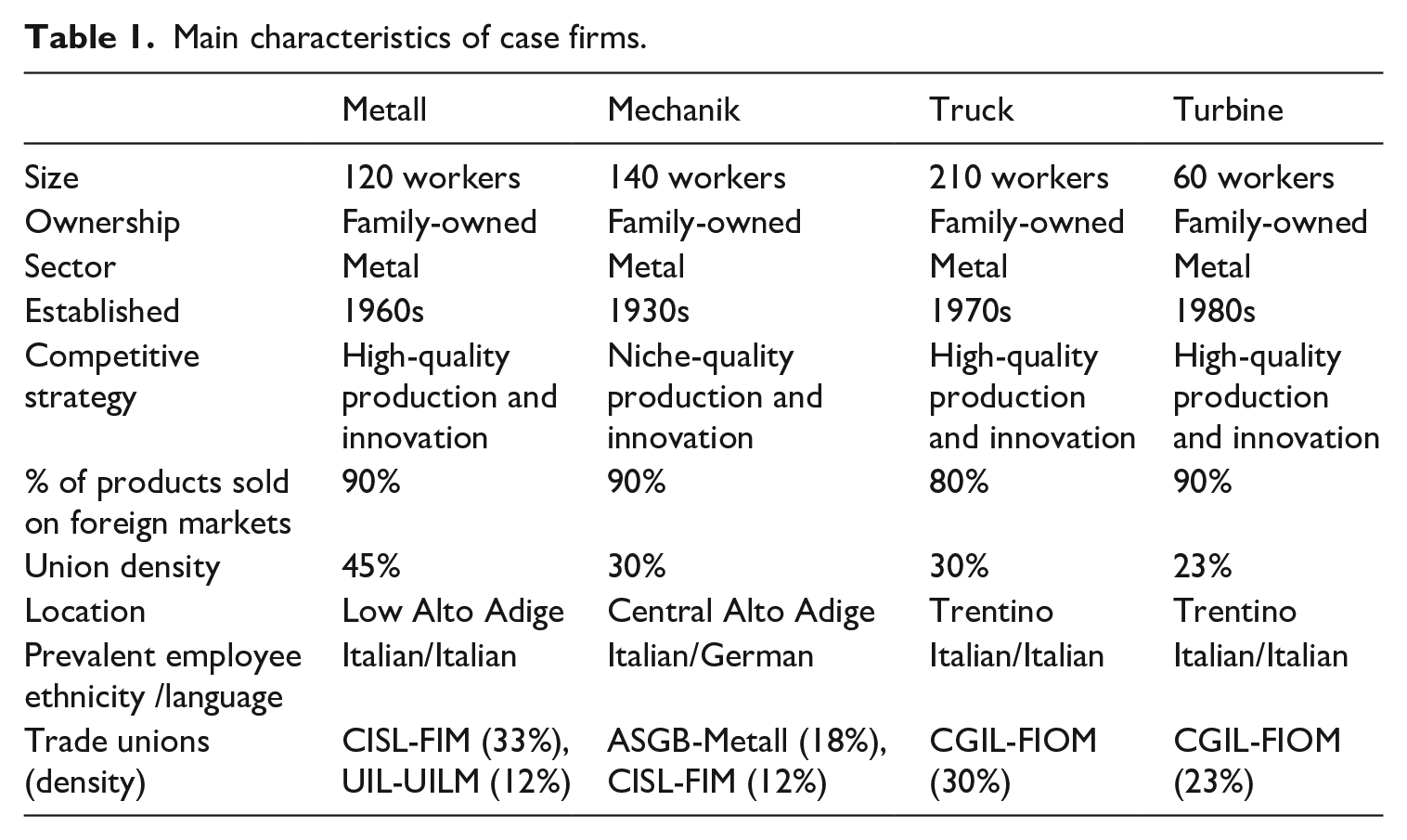
We followed a replication logic whereby we selected as many similar case firms as possible to verify if similar outcomes were evident (Yin, 2014). Four was considered an appropriate number. Table 1 synthesizes the main characteristics of our case-study enterprises whose names are anonymized as Metall, Mechanik, Truck and Turbine. All are family-owned, medium-sized (although with some difference), they operate within the same region (Trentino-Alto Adige) and institutional context (Italy), and are active in the metal sector. Some companies have other plants beyond the one considered, but in each instance the case site was their principal site. They are all well-established (since the 1930s in one case), and their businesses are export-led with more than 80% of their total turnover being accounted for by foreign sales. They also have union representation, although the level of representation and the union representing workers vary (see Table 1). In our research, we focus on manual workers where the level of union density is higher than that reported for the total workforce. We selected firms that have long-lasting cooperative ERs. We determined this by consulting with the officials of local trade unions and employers’ associations, and by enquiring in our preliminary interviews with the case gatekeepers as to the shape and tenor of ERs in their enterprises. In the last 20 years there has been no strike action in any of the firms (save one episode in Truck to re-establish the union’s role on collaborative decisions concerning employee dismissals); labour turnover is minimal with very few people leaving firms over the years, and the vast bulk of employees have been in the companies’ employment for most of their working lives.
Main characteristics of case firms.
Research methods
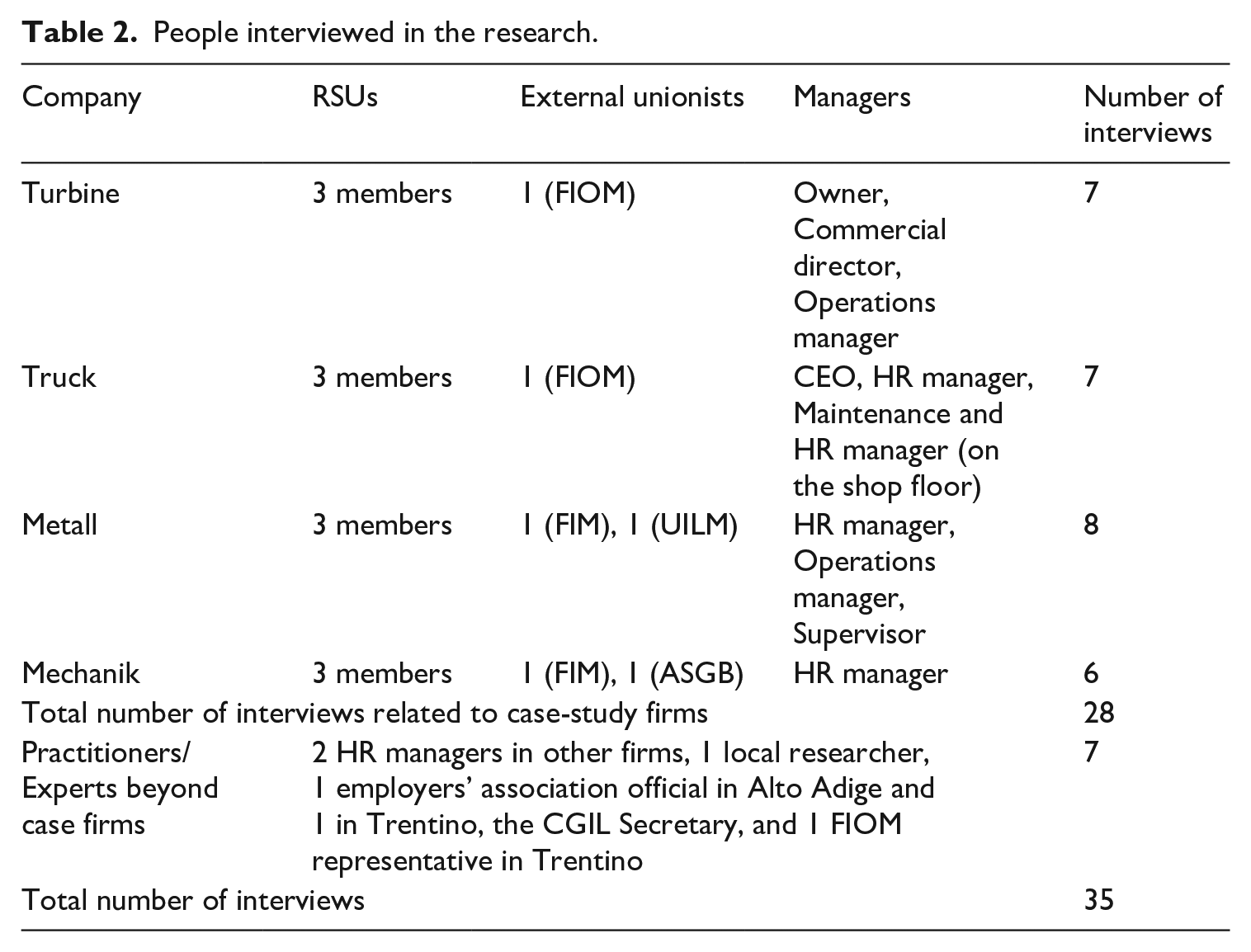
The research project began in 2015 and was completed in 2020. Mechanik and Metall were first studied while Turbine and Truck were analysed afterwards. During this period, we returned to all our case-study firms to collect additional data, mainly to examine whether there had been any changes in the pattern of ERs over the five-year time period, as well as to review our first findings with our interviewees. Our research involved the analysis of different data sources. First, semi-structured interviews were conducted with all lay employee representatives (three in each firm and who were members of the RSUs), external union officials who assisted and supported the RSUs, and various managers who had responsibility or oversight of the firms’ employment relations. Our interview questions focused on matters relating to the technical and social organization of work (production flow characteristics, teamwork, job rotation, job autonomy and health and safety/work pace conditions); product market (employers’ investments and strategic decisions, and consideration of job security); institutions (working time, pay settlement arrangements, redundancy processes and dismissals, and employee training; namely those subjects where the union’s role at the plant-level is sustained by law and by the CCNL). We also asked questions about the social and economic embeddedness of the owners in the area specifically in regard to their relationship with town councils, schools, local firms, suppliers, welfare associations and local communities, together with questions on the unions’ roles and behaviours. In all, 28 people were interviewed within our case-study firms. In two firms, Truck and Turbine, one RSU member occupied the role of preposto (person in charge of employee safety) and supervisor. All our respondents had worked in the firms for at least 15 years and some had worked there for more than two decades. Further details are provided in Table 2.
People interviewed in the research.
The interviews were recorded and transcribed. In Mechanik, interviews with the RSUs’ members and the ASGB union official were conducted in German by a native speaker and researcher. All the remaining interviews were conducted in Italian. Some interviewees were further contacted to ask for clarifications and/or additional information. We carried out visits inside workplaces, and we examined the companies’ collective agreements over a period of some 25 years to identify any particular changes in their ERs. They were analysed together with the CCNL for the metal sector. This dual analysis of historical records and interview materials helped identify the steps, changes and processes the firms took in implementing cooperative ERs.
Although we considered four case sites to represent an appropriate number in respect of our attempts to pursue a replication logic, we also interviewed 7 people outside our case firms with specific sectoral and/or regional expertise. We did this to place our firms and the data we derived from our interviews in a wider sectoral and regional context to see whether our findings in respect of our case firms were broadly in line or not with their perceptions of outcomes in these and other firms in the region and sector. In total, 35 people, whose roles are detailed in Table 2, were involved in this research. The data collected through the analysis, semi-structured interviews, other local interviews and collective agreements were triangulated in order to strengthen the validity of the study’s findings. We distinguish between ‘power quotes’ and ‘proof quotes’ (Pratt, 2008). The former are the more compelling (they more effectively illustrate the point being made) and are included in the body of the article. The latter (referred with the acronym PQ in the article) are placed in an Appendix (available online) and are provided in support. When reporting interview passages we indicate people’s role within the company and/or the union.
Empirical findings
We turn now to examine the influence of the various elements that we identified above in our literature review as supporting long-lasting cooperative ERs: first, technology, product, market and institutional conditions; and second, socio-economic embeddedness. While these are reviewed as discrete conditions, we appreciate they are interlinked and in the discussion we return to make and illustrate this point.
The influence of the technical and social organization of work
In all companies, there were no Taylorized machines fragmenting and narrowing the scope of working activities, or assembly lines dictating the pace of production. Manufacturing activities entailed the deployment of advanced machines (see also proof quotes, i.e. PQ1 in the Appendix). In some firms (Mechanik and Truck), machines resembled continuous process technology since each of them manufactures a specific product on its own. In the other two (Metall and Turbine), teams working in sequence shaped production flows. However, inter-team workflow relationships were based on quality requirements (although a certain lead time had to be met), and there were no sequences through conveyor belts. Each team was not pressured by other teams’ production levels. Thus, work organization was based on team-working, and job rotation was also applied if jobs were not particularly complex (see PQ2). Employees were assigned to teams on the grounds of their skills and moved to other teams if performance was not good. In most instances, these work arrangements and changes thereto were handled by management through informal dialogue and tacit bargaining with workers without any RSU involvement. While the union does not possess formal rights in this area, the RSU could – if it was of a mind to – hinder and obstruct the implementation of managerial decisions. Still, the RSUs recognized that management routinely took account of employees’ aspirations (e.g. willingness to perform specific tasks), skills and interpersonal relations. Training was regular and on-the-job training activities were especially important.
In all enterprises, workers enjoyed considerable levels of job autonomy, albeit within broad parameters defined by management. The deployment of advanced machines favoured work autonomy. For management’s part, this structure of work met both their control and developmental concerns. It rendered the production process more predictable since unanticipated issues in terms of product characteristics and/or machine functioning requiring workers’ decentralized control and problem-solving activities could be promptly addressed. Workers’ autonomy also reduced labour costs, such that supervisors were not preoccupied with surveying the production process and could be engaged in other tasks, while workers could use their skills productively. However, job autonomy was considerable for simpler jobs in Metall and Truck, too (see PQ3). In most cases, employees were said by management and RSU members to enjoy the autonomy permitted them and this was also seen to be central in retaining them (see PQ3). In fact, employee turnover was virtually negligible.
In none of the firms did any of the interviewees report that the structure of work was associated with high levels of stress or intense working levels. On the occasion when employees experienced any stress or excessive effort levels there was no perceived necessity for the unions to intervene since managers acted promptly by interacting informally with employees to address the issues. Neither were there any particular concerns expressed with respect to employee health and safety. In all companies, a specific system of employee participation to identify and address near-accidents was adopted. Further, work routines and health and safety issues were the subject of continuous informal employee conversations and informal agreement with RSUs and the RLSs also by introducing different working time arrangements and effort-saving technology (see also PQ4).
There is great collaboration between us on safety issues. This company invests a lot of money in safety. It is one of the best ones in Alto Adige. (Metall RSU UILM member) If there is something about which managers do not exactly know what collective agreements, laws, and so on prescribe, then we have a meeting. This mostly regards issues concerning employees’ safety. Management meets the RSUs first. (Mechanik FIM union official)
The influence of product markets
Our case companies’ competitive strategies were designed to sustain their positions in stable and remunerative markets. The technical and social organization of work described above was central to the firms pursuing such high-road strategies (see PQ5). These high-road and internationally oriented strategies favoured employers’ willingness to ensure strong job security. Companies encountered occasional economic crises and when they occurred were faced by additional investments in workers, products and machines to re-establish the viability of high-value competitive strategies. Unions appreciated this long-term employers’ commitment towards innovation and product quality. The character of information and consultation activities clearly illustrated the trust between the actors. Management met union representatives periodically, roughly three to four times per year, to inform them, in general terms, about the company’s market situation, budget balance, and the purchase of new machines. Decisions in respect of the companies’ competitive strategy were taken solely by management, but were never challenged by employee representatives, notwithstanding their rights to be precisely informed and consulted about such decisions under the provisions of the CCNL. There was general union acknowledgement that management was well-intentioned and competent in their attempts to design competitive strategies that relied on high product quality (see also PQ5): These companies talk with the RSUs but then they decide and do things for workers autonomously, and they do things effectively. (Metall UILM union official) I agree with having good relationship with unions but the employers must be free to decide the company’s strategy. (Mechanik HR manager) The employer claims that it makes great investments. Then we trust what they say. [. . .] In the last years the company has invested, they have renewed machines. Although the firm is medium-sized the approach is employer-centred. He decides all. [. . .] We are informed generally speaking. (Truck RSU member) About investments, they inform us but they do not ask our opinion. [. . .] This is a company that earns and re-invests. Look, in the last five years the company has changed ten machines on the shop floor. And each machine costs 500,000 euros. (Turbine RSU member)
Atypical contracts were used very rarely because of the complexity of the firms’ production processes. Permanent workers developed strong firm-specific skills that cost the firms a great deal thereby rendering it crucial for employers to retain staff until retirement age (see PQ6).
Competitiveness on quality and innovation was also based on employee involvement and suggestions. Direct participative systems for identifying production improvements were implemented, although they were generally informal in Truck according to the RSUs. Indeed, the size of the four firms was conducive to the use of frequent informal dialogue. And while these operated without direct RSU involvement, RSU representatives contended that the schemes’ provisions effectively allowed workers to express their ideas and to introduce changes in work practices. Managers, too, shared this positive opinion (see PQ7). Given the relevance of firm-specific skills, companies’ high-road strategies, job security and their prosperous financial situations, direct participation activities that resulted in enhanced efficiencies never gave rise to job losses.
The influence of institutions
Product market strategies and technological investments favoured a high-quality, high-involvement and safe working environment but institutional factors and particularly collective bargaining activities were also central, particularly in respect of the resolution of disagreements and potential conflicts. Constraining institutions stopped managers’ attempts to proceed with unilateral decisions or without considering employees’ concerns.
Production required high levels of working time flexibility. There were two elements. First, working time arrangements were jointly examined by managers and unions and enshrined within collective agreements. There were some inter-firm differences though. In Mechanik, the role of managers was particularly predominant and RSUs bargained changes within decisions already made by the management. In the other firms, working time arrangements were instead discussed more with unions. Second, unions often agreed to alterations in the patterns of working time to meet unexpected shifts in market demand, while obtaining additional compensatory payments. In Metall and Truck, a system for ‘banking’ excess working hours was also agreed whereby staff who worked more than the standard working week could have the excess hours transformed into holidays or extra pay (up to a 25% premium higher than the 15% established during working days by the CCNL). It also provided for security of earnings, whereby if there was less product demand, workers could take time off, but their income was safeguarded. In sum, the management and employee representatives in all firms spoke positively of the working time provisions whereby the management saw them as meeting market demands while for workers they meant to be compensated with extra payment for their additional flexibility and commitment, and to favour the satisfaction of family/personal commitments (developmental concerns) (see PQ8).
With respect to pay levels, employees were generally happy with the levels negotiated in all companies, particularly when compared to those negotiated in the sectoral agreement (see also PQ9).
If we compare the national contract of the metal sector with the wages earned by workers in the firm, they are paid much more. . . it keeps workers’ commitment high. (Metall UILM union official) This is a good company. . . in terms of wages. (Turbine FIOM union official)
Several different elements shaped workers’ wages. First, in all firms, contingent bonuses were introduced through collective bargaining over a number of years and were seen to be good. In most cases, payments bargained by unions ranged from €1000 to €1900 gross. In Mechanik, the scheme replaced an earlier scheme that was based on individual bonus payments that had provoked strong discontent among unions and workers. This change guaranteed the persistence of cooperation. In all cases, too, the bonus payments were agreed to be paid even if productivity/profitability goals were not met either because of falling market demand or rising raw material prices. Payments were linked to levels of individual absenteeism (albeit after excusing two absences); the greater the latter, the smaller the payment made (see PQ10).
A difference emerged between FIOM and the other unions in relation to additional payments and benefits provided to the workforce beyond collective contingent bonuses. FIOM’s preference was to obtain permanent and collectively bargained extra payments such as a 14th month salary and the so-called superminimi, for all workers, with the latter being equal to €200 gross in Truck and to €120 gross in Turbine. At the same time, FIOM opposed welfare company provisions (e.g. reimbursement for medical expenses, schools, etc.) following union national guidelines since only some workers would benefit from them. In the other firms, these company welfare measures were introduced under management initiative and accepted by the other unions present.
Finally, yearly individual bonus payments were decided unilaterally by management based on line managers’ recommendations. While the unions did not support these individual reward schemes, they accepted them since they were additional to the collectively bargained contingent payments.
As highlighted, firms’ market and financial situations were very positive. However, in Metall there were two minor company restructurings and job losses in 2003 and in 2008. The unions were involved as they were legally entitled to be, but their role in decisions went beyond institutional information and consultation rights provisions. Job losses were all voluntary and significant redundancy payments were made (see PQ11). There was only one exception to this collaborative management–union approach in the case of making job losses. This occurred in Truck, when the management dismissed two workers for disciplinary reasons without advising and discussing the matter with the union. In response, the union used its institutional rights to call a strike that was supported by the great majority of the workforce. Eventually, the company agreed the payment of €60,000 to each employee.
As regards training, all companies accessed funds from Fondimpresa to help fund staff training. The training programmes were designed by management and agreed and signed off by the RSUs. In principle, the RSUs can veto any such employer initiative where there is disagreement. Such disagreement was rare however and only arose with FIOM’s RSUs (based on union national guidelines) where they saw Fondimpresa funds being used to support mandatory safety training where they should have solely been used to develop workers’ skills. However, satisfying compromises were achieved in these situations, too. In Truck, the RSUs were more active than those in the other companies in advancing their own ideas for employee training. In the other cases the management took the lead with unions trusting their decisions (see PQ12).
As a result, the climate of employment relations was broadly similar among our case-study companies and it was good. There had never been an industrial dispute or strike, apart from one recent case in Truck. Employee participation in national strikes was also said to be negligible (lower than 5%) in Mechanik and Metall, very low in Turbine (around 15%), although more significant in Truck (between 30 and 40%). Apart from Truck, the companies’ workforce demonstrated little interest or regard for the wider politics of union mobilization in Italy. This lack of interest reinforced local close bonds between firms, RSUs and employees (see PQ13).
The influence of socio-economic embeddedness
The trustful, cooperative relations between management, employee representatives and employees were encased within a fabric of relationships that were deeply embedded in an identification with the community beyond the workplace. The firms were long-established and were founded by families resident in the locality. The companies’ owners’ identification and commitment to their local place and community were deeply rooted. First, we address the employers’ local attachment as shown by their engagement with schools, local firms, suppliers and by their provision of financial support to local associations. Our case firms did not have close or structured relations with town councils. However, Metall, Mechanik and Turbine benefited from financial assistance (available to all companies presenting innovative projects) from the Provinces of Bolzano and Trento to undertake technological innovations. All our case-study firms had close bonds with vocational and technical schools and mainly hired staff from them. Mechanik and Metall organized open days with students of the scuole medie (aged 11–14) to encourage them to consider pursuing technical qualifications in the local vocational and technical schools. Significantly, these initiatives were arranged in collaboration with other local manufacturing companies. Moreover, Mechanik worked with other local manufacturing companies to convince local politicians to open a technical school in their specific area. Truck, too, was a financing partner of a local technical school (see PQ14).
The embeddedness of our case firms was also demonstrated by their relationship with local suppliers. Mechanik was engaged with another firm in joint research and development activities to produce software, in product innovation and in financing start-up firms. Turbine offered training activities to their suppliers’ workers. It also worked with another small firm for more than 20 years which manufactured some of Turbine’s products when Turbine did not have the production capacity in its own firm to meet market demand for its products. This long-term collaboration has been maintained despite the higher costs of this local supplier because of the mutual trust existing between them and Turbine and their reliability in supplying product on time. Metall and Truck established other forms of local relationships. Metall regularly received a local award from the Province of Bolzano to certify it as a good employer in terms of work–life balance. This serves the purpose of rendering visible the firm’s support for local families. All the companies contributed to local associations, too (see PQ14). Truck finances various associations, charities and community initiatives (e.g. sporting associations for disabled people, non-profit organizations helping autistic children and women or couples with children in difficulty). Very recently, the company’s foundation donated €1 million to the local hospital, together with a significant financial contribution to maintain a failing social cooperative that managed a restaurant by employing disabled people.
Having highlighted this, our main point is to emphasize how these close and supportive relationships in the local area were reproduced within firms which further helped to engender long-term cooperative ERs. Employers’ investments in their firms and workers remained their primary contribution to local communities’ development and prosperity. At the same time, the companies’ owners not only had a good relationship with their employees and their RSUs, but they were also interested in continually developing these relations as a desirable social good. Interviews with employee representatives often pointed to employers’ willingness to address individual employees’ concerns and life difficulties. Requests for work-time flexibility, such as to accommodate the care of sick relatives or children, and for financial help, were often sensitively handled and responded to by management. RSU members only played a role when employees themselves were reticent in making their request directly. Generally, management was accommodating, and unions and staff greatly appreciated the companies’ sensitivity and care (see also PQ15).
This employer care and attention for their employees was linked by interviewees, particularly employee representatives, to the companies’ owners’ close elective affinity with and sense of responsibility to the locality in which their operations were based. The employers themselves were very proud of their contribution to the socio-economic development and prosperity of the local community (see also PQ16).
Metall has certainly invested a lot and it is a good company. It is part of those firms, which are fortunately numerous in our area, that are tied to the region and export-oriented. (Metall UILM union official) They have many policies to balance work and life to help families. You see that the owner comes from the territory. If you had managers from other areas, they would not care about that. [. . .] Each single worker is considered. I could not imagine the territory without this company. (Mechanik FIM union official) We have a relation with the union because of the law and because we are all from Trentino. We are all getting older together. I was in a company full of young people and now we are all in our fifties. I have backache and they have it, too. (Truck CEO) These are entrepreneurs who are certainly very tied to the territory, to the local community, and they have been able to make people understand that. . . how can I say it? That if you help each other and you make concessions reciprocally things can work out. (Trentino Employers’ Association)
The firms’ socio-economic embeddedness was linked to their product market strategies. Employers made significant investments in research activities and technology and were generally willing to reduce financial gains for themselves. During the recent Covid-19 pandemic, for example, all the companies were willing to realize lower profits in order to maintain employment levels. In Truck, the owner temporarily reduced the price of the firm’s goods to a point where it made no profits in order to maintain employees’ security of employment.
Unions and workers supported the employers’ locally embedded strategies demonstrating their loyalty and reciprocity to employers. In situations where management felt compelled to dismiss poor performing employees, they normally worked to find an agreed solution with the worker in question with the help of the union (see PQ17). Overtime working was another significant example. While employees were generally willing to work overtime when requested, they were free to decide for themselves whether they did so or not. For unions, this informality gave workers individual autonomy to partly determine their own monthly pay. This was particularly evident in Truck where the gates to the factory were open on Saturdays and workers could go to work if they wanted to. For management, there was no perceived reason to formalize overtime working given the flexibility and cooperation of the RSUs and staff (see also PQ17).
Overtime is on a voluntary basis. You just need to say no. The same occurs for overtime on Saturday. Look, for Saturdays people ask: may I come to work on Saturday? [. . .] Here people work on Saturday. The company has never obliged us to work on Saturday and to work overtime because they find people that do that. (Truck RSU member)
One manager working in Turbine highlighted the willingness of workers to work overtime, explaining how such overtime working could reach up two hours per day in periods of sustained market demand.
As such, the RSUs provided management with a cohesive and cooperative bargaining partner, and management recognized and acknowledged their productivist posture and collaboration (see also PQ18).
We sometimes signal to the RSU poor performing workers: ‘Try to talk to him you, too. His co-worker is complaining’. I know that the RSU sometimes went to these people saying: ‘Look, try to do your duty’. We always talk and they [the RSU] sometimes give us a helping hand as much as they can. (Truck Maintenance and HR shop floor manager)
However, we urge caution in the interpretation of our findings as to the extent to which the socio-economic context of the case firms might be viewed as one that was hermetically sealed from other more distant outside influences. This was perhaps most evident in the internal union challenges to managerial policies, albeit the extent and reach of such challenges varied across the four companies. The main difference was that between FIOM and the other unions. Unlike the other unions, FIOM workplace representatives shared and stridently followed guidelines that had been elaborated at a national level, and which resulted in a more forceful and collective-based approach to collective bargaining at a local level. This particularly occurred in relation to training and extra employee payments meeting workers’ collective development concerns. In Truck, for example, where FIOM enjoys a significant presence, the RSUs were more assertive in their calls for particular forms of employee training. By such means, the union retained the capacity to challenge managerial decisions from time to time. In contrast, the other unions were less evidently confrontational, but it would be wrong to claim that they were incorporated within management. They remained an independent voice which management had to consider and reckon with. They were, moreover, important influences in the realization of the mutual benefits that were derived from lasting cooperative ERs. According to the Bélanger and Edwards model, these minor variations within the same model are entirely possible.
Discussion and conclusions
Our study applies the theoretical framework elaborated by Bélanger and Edwards (2007) concerning lasting cooperative ERs to the specific organizational, social and institutional context represented by family-owned, medium-sized manufacturing enterprises operating in Northeastern Italy. The choice is motivated by the fact that Bélanger and Edwards’ model of cooperative ERs is mostly based on research concerning firms characterized by specific features, usually large private sector, publicly listed companies based in particular institutional (Anglo-American) contexts. Our first research question is theoretical and consists of enquiring whether the antecedents identified by Bélanger and Edwards (2007) were sufficient to explain how cooperative workplace relations were maintained over a long period of time including periods of market turbulence.
We find that all the conditions for establishing cooperative ERs identified by Bélanger and Edwards, namely product market, technology and institutions, are present in our case firms. Their presence also meets actors’ control and developmental concerns. Technological complexity, the production of small batches of goods and the complex character of the production process entailing the possible emergence of unpredictable issues led managers to design work around teams and permit workers considerable autonomy in the conduct of their work with little managerial oversight. Workers reciprocated the good and trustful relations with high engagement levels as demonstrated by their levels of voluntary overtime, quality performance and productivity, and by their participation in improving the companies’ operations. Critically, we observe links among these conditions; they did not operate in isolation from one another. Advanced machines and technologies support and are linked with the manufacture of high-quality and innovative goods. Product market strategies are based on employers’ commitment to compete through the production of high-quality goods, continuous improvement and innovation. Firms’ continuous investments and innovation helped firms to survive through periods of economic turmoil and crisis.
We also observe the important role played by institutional regulations. The Italian regulatory context was used by union representatives to sustain bargaining relations and to restrain employers while promoting workplace cooperation (Carrieri et al., 2015). This is not to deny the divergence of viewpoints and the existence of conflict; both were present. This confirms the explanatory role performed by institutions in favouring enduring employment relations (Johnstone and Wilkinson, 2017; Vincent et al., 2020). In particular, collective bargaining was reserved for resolving potentially contentious quantitative and distributive issues (e.g. pay). Joint informal consultations were engaged in separately to address qualitative concerns in the main, for instance, health and safety requirements. Overall, the institutional structure of industrial relations – labour law, centralized sectoral agreements and the presence of formalized representative structures (RSUs and RLSs) – acted to safeguard employees’ working conditions (control concerns) and rewards (developmental concerns).
However, we find the firms’ socio-economic embeddedness to be an additionally important factor in sustaining cooperative workplace relations, which is not foreseen in Bélanger and Edwards’ model. The model is not precise enough in its specification of context. Although it professes to take account of context and a consideration of the interface between the macro- (institutions) and micro-levels (technology and product market) of employment relations, it is blind to the manner in which such processes interact with the socio-economic embeddedness of firms. Particularly, we highlight how companies’ collaborative relations with schools, local firms, suppliers and welfare associations, highlighted by the literature on local development (also) in Northeastern Italy (Crouch et al., 2004; Trigilia and Burroni, 2009), can be transposed to ‘within factory gates’ to explain long-term cooperative ERs. The latter influence has rarely been identified in the industrial relations literature. Consolidating the possibility of cooperation, even in the most conducive of contexts, requires effort by the parties involved, but we argue that the incentive to expend such effort goes beyond the processes involved at the point of production and is paralleled by employers’ efforts to establish and maintain good community relations.
The creation of reinforcing conditions within and beyond the firm are required to sustain the high level of ongoing cooperation witnessed in our case-study firms in Northeastern Italy. The concentrated, financially ‘patient’ capital and family-ownership of firms together with their local embeddedness increase their commitment to their community and facilitate collaboration and investments in it. For instance, cooperation with local businesses encourages all parties to engage in continued long-term reciprocal relations. Analogously, when management highlight job opportunities in their firms to school students, they are not only motivating the pupils to seek jobs in their enterprises, but they are also signalling to the schools the types of skills they require.
The socio-economic embeddedness of family-owned firms also entailed a style of management that was paternalistic. The structures of employee participation did not extend to influence management’s strategic decisions in respect of the future direction of the business and qualitative organizational practices. But here the RSUs bestowed their tacit support for management by not questioning their bona fides or by drawing on rights provided them by the provisions of the CCNLs that might otherwise have provided them with some influence. The structure of work was shaped by managers listening to employees’ needs and by consulting, in many instances informally, with workplace representatives particularly with respect to health and safety issues. In effect, this amounted to a ‘negotiated paternalism’. Overall, then, cooperative ERs were the result of a combination of paternalism, negotiated paternalism and constraining industrial relations institutions while being underpinned by a deep-seated trust between the parties that was rooted in their community-based relationships. In this respect, the form of cooperative relations witnessed in our firms bears a close resemblance to that of ‘collaborative pluralism’ identified by Bray et al. (2021) with elements of ‘consultative unitarism’ in respect of work organization issues, which was accepted by unions.
While it was useful in our analysis of the findings above to identify and keep analytically separate the two sets of conditions underpinning long-lasting cooperative ERs (on the one hand, technology, product market and institutional conditions and on the other hand, firms’ socio-economic embeddedness), there are significant links between the two that mutually support one another. For instance, by going into schools to highlight job opportunities, firms help themselves to recruit appropriate employees. But they do so in a context where they can be relatively secure in the knowledge that their long-term approach to recruitment is supported by their technological capacities and product market conditions that are unlikely to change in a manner that would undermine their business model. Furthermore, the ownership structure of firms enables their management to make social commitments to other actors. In other words, because the firms are family-owned, they enjoy the luxury of being able to have a longer-term perspective that facilitates not only long-lasting cooperative ERs, but also mutually supportive links to other organizations. The owners of our firms are also concentrated and, unlike shareholders in many firms, are not dispersed geographically. These analytical links are important to specify as they help to set out the institutional conditions that structure firms’ abilities to become and stay socially and economically embedded.
These theoretical reflections also allow us to provide an important empirical contribution to the debate concerning the location of commercial activities and particularly the competitiveness of corporate forms that differ from the dominant Anglo-American paradigm of stock-listed companies with dispersed shareholdings (Wood and Allen, 2020). Our results confirm that other forms of corporate governance can be highly innovative and competitive (Witt and Jackson, 2016). There are close parallels with our findings and those of studies conducted on cooperatives and industrial foundations in Denmark. Together they show how such diverse forms of organizational ownership structure can be commercially successful in highly competitive global markets while also serving specific social objectives. The Danish firms, too, were found to be deeply socially embedded in their local communities. Just as with our firms in Northeastern Italy they also, in the absence of short-term shareholder pressure, were able to invest in staff training and in the local community. This created a co-dependence between economic and social development that was underpinned by employer, union and local political commitment to education and training as routes to competitiveness and shared gains (Kristensen and Morgan, 2018).
Supplemental Material
sj-docx-1-eid-10.1177_0143831X211039012 – Supplemental material for The role of socio-economic embeddedness in promoting cooperation in the workplace: Evidence from family-owned Italian firms
Supplemental material, sj-docx-1-eid-10.1177_0143831X211039012 for The role of socio-economic embeddedness in promoting cooperation in the workplace: Evidence from family-owned Italian firms by John Geary and Andrea Signoretti in Economic and Industrial Democracy
Footnotes
Acknowledgements
We thank Christopher Mathieu, Chiara Benassi, Markus Helfen, Laura William and particularly Guglielmo Meardi for their comments on a previous version of the article. We thank the journal’s two referees whose observations and suggestions helped us greatly in refining and tightening our argument.
Authors’ note
The article’s design and conduct of the research were undertaken when Andrea Signoretti was a Visiting Scholar in University College Dublin’s Business School, and when John Geary was Visiting Professor at the Department of Sociology and Social Research, University of Trento.
Declaration of conflicting interests
The authors declared no potential conflicts of interest with respect to the research, authorship, and/or publication of this article.
Funding
The authors received no financial support for the research, authorship, and/or publication of this article.

Supplemental material
Supplemental material for this article is available online.
Author biographies
References
Supplementary Material
Please find the following supplemental material available below.
For Open Access articles published under a Creative Commons License, all supplemental material carries the same license as the article it is associated with.
For non-Open Access articles published, all supplemental material carries a non-exclusive license, and permission requests for re-use of supplemental material or any part of supplemental material shall be sent directly to the copyright owner as specified in the copyright notice associated with the article.
