



Abstract
This article questions the perception of non-union workers as rather rigid and out-of-reach non-unionists by using research conducted in New Zealand. It explores whether, under new institutional architecture, non-unionists would continue to exhibit the same preferences and exercise the same choices as before. This was done by testing their responses to a union default scenario. The significance of this study concerns how this particular group of workers, contra non-union workers in non-union workplaces, would react to a union default where a union is already available to them. By contrast, non-union workers in non-union workplaces not only at present have effectively no choice for gaining union representation but are also bereft of any experience of it in their workplace. The results suggest 44% of these employees would join as a result of a union default with union density consequently rising in New Zealand from 17–18% to 26–27%.
Introduction
Though unions in most developed economies have experienced substantial membership declines over the last 40 years, none has been so precipitous as in New Zealand (Charlwood and Haynes, 2008; Jaumotte and Buitron, 2015). Here, by enacting voluntary unionism and decentralised bargaining, the Employment Contracts Act 1991 produced a decline from almost 50% density to less than 20%, a trend arrested but not reversed by the Employment Relations Act 2000 (Charlwood and Haynes, 2008). In this context, Harbridge and Wilkinson (2001: 60) estimated free-riding rose from 16% to 27% over the subsequent decade. 1
Perhaps, the most cost-effective way to increase union membership is by recruiting non-union workers in workplaces with existing members and recognition (see Kelly and Heery, 1989). This approach is often called ‘in-fill’ or ‘brownfield’ recruitment (as opposed to ‘distant expansion’ and ‘greenfield’ recruitment). Recruitment costs (financial and non-financial) are deemed to be lower because employers have legitimised the union by granting recognition for representation and bargaining, and the union has not only already undertaken organising activity but has representative machinery in place. However, it is also well known that non-union workers have a strong disincentive to join, since, as ‘free-riders’, they can gain much of the protection and representation a union provides its membership without bearing the cost (primarily financial) of joining, because employers ‘pass on’ union-bargained improvements to non-union co-workers. For this reason, recruitment of non-union workers in unionised workplaces is less attractive than it might initially seem.
To more deeply understand their free-riding, this article questions the perception of such non-union workers in unionised workplaces as rather rigid and out-of-reach non-unionists, using research conducted in New Zealand. Specifically, it explores whether, under the institutional architecture of a union default, non-unionists would continue to exhibit the same preferences and exercise the same choices as before. In other words, we examine the malleability of their preferences and choices by testing their responses to a union default scenario. Under a default, employees would automatically be enrolled into union membership wherever and whenever the coverage clause in a union’s collective agreement included their jobs and roles. 2 Following enrolment, employees would then be free to withdraw from membership after a prescribed short period. 3
A union default is significant in two respects. First, and most obviously, it could greatly facilitate recruitment of new, and additional, members, potentially enabling unions to organise workers who already want union membership in non-union workplaces through economies of size and scale. Second, and perhaps much less obviously, a default also has the potential to sway the preferences and choices of many who currently say they do not want union representation. The literature reviewed below shows defaults of any kind are not neutral in their impacts upon choice. Likewise, our survey data indicate that 44% of non-union respondents (from unionised workplaces), when presented with a default scenario, indicated they would not exercise the right to opt out, namely, return to non-unionism. We draw two implications from this. The first is that studies of non-union workers’ preference for membership (e.g. Freeman et al., 2007) are likely to have significantly under-estimated potential support for unions under different conditions. In New Zealand, our findings indicate a default would increase membership by almost 50% in already unionised workplaces. The second is that facilitating the experience of membership, and then subsequently allowing opt out, indicates workers’ preferences regarding unions are not likely to be strongly fixed. The significance of this non-rigidity is to be found in the ending of compulsory unionism (pre- or post-entry closed shops) in countries like Britain and New Zealand, for a ‘free-rider’ problem was (re-)created. For instance, one New Zealand study found that 45% of workers in already unionised workplaces stayed non-union even though they had an opportunity to join (Bryson, 2008: 13). Free-riding is now widely seen as intractable, so long as voluntary unionism is maintained and compulsory unionism rejected. However, the union default is an innovative ‘third way’ because it simultaneously guarantees the right to associate and not to associate. Both implications suggest a default, when enacted by the state, could have a major effect on the balance of power and, thus, the relationship between capital and labour.
The aforementioned second implication is, we believe, theoretically more profound because testing whether previously non-union workers would return to non-unionism by exercising the opt out allows a more penetrating and expansive examination of employee choice. First, it signals the configuration of extant relationships between worker agency and the capital-dominated environment of law and social norms could be substantially changed, whereby a substantial proportion of workers are likely to express modified (positive) views and preferences after having experienced unionisation. Second, it suggests a key part of the potential process of change amongst individual workers is the endogenous shaping of their preferences, resulting from a collective experience which influences their self-identity (see Rogers, 2012). Third, though the union default does not address Olson’s (1965) collective action problem directly by explicitly preventing free-riding, it does do so indirectly by lowering potential costs of continued membership (amortised over more members) and enhancing benefits (via increased bargaining leverage). For these reasons, we can interpret Rogers’ (2012: 361) conclusion on employee autonomous choice to a fuller extent than he might have anticipated when arguing: ‘Ultimately, employees will be free to choose unionization only if unionization is a realistic option, and only if they perceive it as a realistic option. . . . In other words, creating the preconditions for autonomous employee choice requires space both for reasoned deliberation and for the building of countervailing workers’ power.’ Thus, the case of providing non-unionised workers in a unionised workplace with the experience of unionisation represents a concrete way to realise this contention and speaks to Sunstein’s (1991: 11) argument concerning the requirement for ‘a full and vivid awareness of available opportunities . . . and without illegitimate or excessive constraints on the process of preference formation’.
We believe the significance of our study concerns how this particular group of workers, contra non-union workers in non-union workplaces, would react to a union default, where a union is already available to them. By contrast, non-union workers in non-union workplaces not only at present have effectively no choice for gaining union representation, but are also bereft of any experience of it in their workplace. Thus, our study is not a generic study of the reasons for non-unionism (for example, anti-social ideologies and instrumental material benefits) or why non-union workers do not unionise (for example, costs and barriers).
Previous studies have examined the factors that explain non-unionism in unionised workplaces (see, for example, Bryson, 2008; Chaison and Dhavale, 1992; Haynes and Boxall, 2004; Haynes et al., 2008). However, they have not, even counter-factually, considered under what circumstances non-unionists might become unionists, for they concentrate upon investigating why they are, and why they remain, non-union. Even in studies which do examine the reasons for membership and non-membership alike (see, for example, Jansen and Lehr, 2019; Kirmanoğlu and Başlevent, 2012), there is no consideration of the dynamic interchange between membership and non-membership, since the two categories are implicitly treated as static and separated into silos.
Moreover, but only by implication, these studies suggest the sources of any potential change in perception of – and preferences about – membership are exogenous (such as changes in political climate, institutional architecture and legal reform). By contrast, we argue the decision not to join a union, and associated preferences, have a hitherto largely unrecognised malleability, and so preferences can be swayed in a pro-union direction. And, following from this, we argue that the source of significant changes in perception of, and preferences about, membership are largely endogenous. Thus, we explore these phenomena by examining the impact of a proposed union default upon non-union workers’ attitudes and preferences in already unionised workplaces in New Zealand.
We begin by reviewing the salient literature, examining reasons for non-membership and free-riding in order to establish the relevant lines of investigation for our survey of non-union members in unionised workplaces with regard to a default. We then explain the specific means by which a default could raise membership. Following this, we detail the fieldwork and results. From here, we discuss the implications in terms of employee autonomy and choice architecture.
Reasons for non-membership
Logically, there are two fundamental reasons why workers do not to join a union when they work in a unionised workplace. The first, termed ‘inaction’, is that they have not yet exercised a decision to join, because they have either not taken the initiative to do so themselves or have not been asked to join by a union organiser, recruiter or member. This is surprisingly common. In studying Britain, Bryson (2008: 15) reported 55% of eligible non-members had not been asked to join, even though 36% of these individuals indicated they were ‘very likely’ or ‘quite likely’ to join if asked. Likewise, in their Australian study, Haynes et al. (2008: 16–17) stated that 50% of eligible non-members had not been asked to join, although 26% of the same group had said they were ‘very likely’ or ‘fairly likely’ to do so if requested. The second reason, termed ‘preference’, is because they desire to remain non-union as a matter of choice, reflecting one or more of a range of motives from concerns about the economic utility of unions to personal enmity towards the union’s staff. Each motive is discussed in more detail below.
Economic utility
Orthodox economic theory posits that workers make rational decisions to join or not join unions based upon the costs and benefits of membership. Workers might decide to remain non-union in unionised workplaces to avoid having to pay the union’s fees (dues). These fees might be perceived as simply too expensive to afford from a limited budget. Likewise, the union might also be seen as offering too little of value, in terms of improved collectively bargained terms and conditions, to warrant joining. A weak, ineffectual union may be unable to deliver ‘good’ outcomes for workers. Alternatively, the long-term benefits of union membership may be less obvious to and, therefore, less valued by, workers focused more on the short-term (Harcourt et al., 2019a). For instance, unions play an advocacy role in defending and protecting workers when problems arise, as with sexual harassment or dismissal, but few workers require such services at any given time. Moreover, given their cognitive biases for excessive optimism and poor probability estimation, workers might erroneously conclude they will never need such services (Harcourt et al., 2019a). In fact, Bryson (2008: 11) found that workers, in both Britain and New Zealand, were less likely to join a union when they were currently experiencing relatively few problems at work.
Non-union workers can genuinely but wrongly believe that the costs of membership exceed the benefits, 4 and still effectively free-ride on the bargaining and grievance-handling successes of the union in their workplace. In the literature, these individuals are referred to as ‘passive’ free-riders (Haynes and Boxall, 2004). By contrast, ‘calculative’ free-riders correctly recognise that the benefits of having union representation exceed the costs but choose to stay non-union anyway (Haynes and Boxall, 2004). Along the same lines, Olson (1965) famously argued that joining a union was an irrational act, because unions produced ‘public goods’ that had to be automatically shared with members and non-members alike or could be easily ‘passed on’ by management to non-union staff. As an example of the former, any collectively bargained improvement in health and safety cannot be easily restricted to union members alone, especially when union and non-union staff work in close proximity. As an example of the latter, any collectively bargained wage increase can be ‘passed on’ to a non-union worker. Given the accessibility of these so-called ‘public goods’, workers have an incentive to free-ride on the union by not joining. If all workers followed their self-interest and chose to free-ride, unions would not survive and members and non-members would be rendered poorer as a result.
Economic motivations for not joining the union have been evident in studies of British (n = 663) and New Zealand 5 (n = 451) (Bryson, 2008: 15), as well as for Australian free-riding (n = 1000) (Haynes et al., 2008: 17). Forty percent of British, 44% of New Zealand and 49% of Australian respondents said they had decided not to join because the union ‘does not achieve anything I value’ – e.g. the union was ineffective or misdirected in its activities. 6 Likewise, 30% of Britons, 37% of New Zealanders and 56% of Australians had decided to stay out of the union because the fees were ‘too high’. Finally, 33% of British, 52% of Australian and 64% of New Zealand respondents indicated that they had not joined because they ‘get all the benefits anyway’ – e.g. via ‘pass on’ by management.
Value incompatibility
Workers’ decisions to join or not join a union may be based on value incompatibility between the worker and the union. 7 Values, in this context, refer to what each party regards as important or worthwhile, with specific reference to means and ends. Thus, value compatibility is about whether the individual worker and union have similar/dissimilar goals and ways of obtaining these. Value incompatibility can manifest at the workplace in how the worker and union interact with management and what they pursue in the process of such interactions. For instance, some individual workers might prefer a more conciliatory and accommodating mode of management engagement, as against a more assertive and demanding one employed by the union. Individual workers might also personally prioritise pay increases and promotions associated with higher performance, even as the union is attempting to abolish all forms of paid performance recognition. Value incompatibility can also be an issue outside the workplace, that is, in the political sphere. As an example, the individual worker might be socially conservative, oppose gender equality and gay marriage, and vote for a right-wing political party, whereas the union might support a more progressive agenda based on human rights and formally align to a left-wing political party.
Research examining value incompatibility as a motivation for free-riding by non-union workers in unionised workplaces showed that 28% of New Zealand (Bryson, 2008) and 19% of Australian respondents (Haynes et al., 2008) had not joined the union because they ‘don’t believe in unions’, while 48% of Australian and 37% of New Zealand respondents had not joined because ‘unions do not cooperate enough for the good of the workplace’. The first item, though perhaps unclear, arguably assesses whether the respondent disagrees with the goals of unions. The second item focuses more specifically on the means unions employ to achieve such goals.
Anticipated management reaction
Personal convictions concerning unions are not the only factors that drive worker decisions to join or not join a union that has already established a presence in the workplace. Pragmatic assessments of how management would react to joining are also likely to be important, having financial and non-financial cost implications. Negative managerial responses cover a range from verbal disapproval and mild social ostracism to outright retaliation through, for example, denial of promotions and pay increases or, even worse, dismissal. Bryson (2008) acknowledged management opposition to union membership as a determinant of non-union free-riding in unionised workplaces, but did not examine this factor in his own empirical analyses of the phenomenon in Britain and New Zealand.
Personal enmity and preference for another union
The decision to stay non-union in a unionised workplace could also be personal in nature. Arguably, a worker may not disapprove of the incumbent union per se, including its methods and goals, but dislike the union’s staff, in particular the local union delegate (shop steward), and so rejects membership to avoid unwelcome interactions with this person. Previous research has not, thus far, studied personal enmity as a motivation for remaining non-union. In addition, workers’ rejection of the workplace union available to them could also reflect a preference for membership of a different union (rather than a rejection of unionism per se). The worker could perceive, especially from prior workplace experience, that another union is superior in various ways. For example, it might be seen as more successful at securing pay increases or resolving personal grievances. In New Zealand’s non-exclusive union representation system, where 30% of collective agreements have overlapping coverage (bargaining units), a worker could reasonably conclude that another and better union might eventually attain recognition in their workplace (Harcourt and Lam, 2011: 129). This sort of choice deferral, where individuals persevere with the status quo (e.g. non-union) until their most preferred alternative is available (another union), has been observed in a number of contexts (Anderson, 2003). Prior studies have not examined whether preference for another union, namely, one not currently at their workplace, explains why some workers remain non-union.
Default influence
We now turn to examining why we believe a union default would likely increase membership via four related mechanisms (see Harcourt et al., 2019b). First, it would reduce the costs of joining, sometimes referred to as ‘switching costs’, even in an already unionised workplace. Second, status quo inertia generated by procrastination and other forms of choice deferral would favour continued membership rather than becoming non-union. Third, a default would make membership the new reference point for assessing ‘gains’ and ‘losses’, where losses are typically weighted twice as heavily in the human mind as equivalent gains. Thus, the ‘losses’ associated with opting out of membership would count much more heavily than the ‘gains’ of maintaining membership. Fourth, a default would help to make membership a new social norm, sanctioned by the state. The first two mechanisms affect choices even as preferences remain unchanged. The second two change preferences and, thence, what individuals choose. Switching costs are the traditional, rational explanation for default effects on decisions. In contrast, inertia, social norms and loss aversion explanations draw heavily from insights from behavioural economics about how individuals think.
Switching costs
Defaults influence choices when ‘the costs of switching from the default . . . outweigh any increase in benefits associated with an alternative’ (Harcourt et al., 2019b: 76). Where there are substantial switching costs, decision-makers may rationally conclude they would be better off remaining with the default option, even when it is not their preferred choice (Wilson et al., 2013). There are two types of switching costs: direct and indirect (Harcourt et al., 2019b). Direct switching costs are those associated with making the switch from one option to another. If a union is already onsite, these costs are low and limited to the labour time required to seek out the union and complete its joining process. Much the same is involved if a union is conducting an organising campaign at the workplace. If there is no union onsite, these expenses can be large ‘because a group of workers must typically band together to found and operate their own workplace union and recruit members’, involving ‘a major time commitment as well as money for administrative, legal and other costs’ (Harcourt et al., 2019b: 80). Indirect costs are those that relate to second-order consequences that arise from a switch, particularly management retribution for having joined the union. Discriminatory treatment, harassment, and even dismissal of union members can generate indirect costs that dwarf any benefits of membership (Gall, 2021; Godard, 2003), spurring workers to stay with the non-union default.
Inertia
Defaults affect choices through the forces of inertia. Making decisions can be tedious, difficult and time-consuming, particularly in complex situations (Sunstein, 2015). Major effort can be required to understand the nature of the problem or opportunity at hand and the various solutions available. Costs and benefits need to be estimated and compared across options. Contingency factors likely to affect the probability and magnitude of outcomes need to be considered. If two or more unions have representation rights, comparisons must also be made across unions and not solely with the non-union option. It can be mentally taxing and potentially overwhelming, especially if the decision-maker is tired and/or has a hectic schedule (Sunstein, 2015). In such cases, an individual may choose not to choose, at least deferring any decision, and conserving mental resources for other, more pressing and possibly easier decisions (Anderson, 2003). Decision avoidance means staying with the default, the option that applies when no choice is made.
Making the choice to join, or not join, a union can be complex and, therefore, cognitively demanding (Harcourt et al., 2019b). There are many ‘purchase’ dimensions, because a union typically offers a large number and wide variety of services to members. Some membership benefits are intangible and, thus, hard to assess, as with union emotional support during a dismissal. Other benefits may be easier to quantify, but difficult to predict whether, how much and how often they would be needed, as, for example, with a union ensuring there is stress-related leave. Given these uncertainties, it can make sense to at least delay, and possibly permanently refrain from, making a decision, in which case the worker would remain unionised or non-union depending on the default (see Harcourt et al., 2019b).
Loss aversion
Defaults influence preferences by establishing a reference point in people’s minds, equivalent to a status quo position (Samuelson and Zeckhauser, 1988). Potential moves to other options from the status quo default are perceived as generating both ‘losses’ (from relinquishing the status quo) and ‘gains’ (from acquiring the new option) (Kahneman et al., 1991). In this mental comparison, monetary ‘losses’ are typically weighted twice as heavily in the human mind as equivalent monetary ‘gains’ (Tuncel and Hammitt, 2014). So, ‘[s]ince losses have a magnified significance . . . relative to gains, any alternative to a default must generally be perceived as much more attractive . . . to prompt switching’ (Harcourt et al., 2019b: 79). As such, individuals have an in-built bias, created by loss aversion in relation to a reference point, to preferring the default. With non-unionism as the default, workers’ minds are likely to focus more on the ‘loss’ in wages or salary associated with union fees than any ‘gains’ from union membership associated, for example, with increased bargaining power. With unionism as the default, workers’ minds are likely to focus more on the ‘loss’ of union protection and other services than any ‘gains’ in wages or salary associated with not paying union fees.
Social norms
Social norms influence people’s preferences, because they indicate what behaviour is likely to be seen as effective in a given situation and what is likely to win the support of others (Deutsch and Gerard, 1955). There are two basic sorts of social norm: descriptive and injunctive (Everett et al., 2015). Descriptive norms emerge when behaviours are widely adopted and often repeated. Their prevalence and durability suggest that behaving in accordance with the norm produces more positive outcomes than other courses of action. Workers are influenced by such norms in choosing to become union members. If their co-workers and family members are union members, they are more likely to see joining a union as normal, appropriate, and functional to their interests (Visser, 2002). Injunctive norms are more imperative in nature, defining what is acceptable and informing individuals what they ought to do in a given situation. These norms can arise from the actions and decisions of legitimate individuals and organisations in authority positions, including the employer and the state.
Defaults affect preferences, and thereby choices, because they are often construed as social norms (Everett et al., 2015). The common presumption is that the default reflects what a majority of individuals opt to do in the circumstances, as with a descriptive norm. Alternatively, the presumption is that decision-makers with the authority to set the default have deliberately aligned the default with what individuals should do in the circumstances, as with an injunctive norm (Halpern et al., 2007). Thus, a non-union default potentially negatively shapes worker preferences for union membership as both a descriptive and injunctive norm (Harcourt et al., 2019b). First, it suggests that most workers have opted to remain non-union from a realisation that the costs of membership exceed the benefits. Second, it suggests that those in authority, the employer and the state, endorse non-membership as more legitimate. A union default would have the opposite effects.
Fieldwork and methods
This section details the sample, employment context, data collection and method of analysis of the fieldwork carried out. We used the international research firm Qualtrics to gather data via an online survey of a simple random sample of New Zealand adults regarding their views of a union default. Qualtrics maintains traditional, actively managed, double-opt-in market research panels through a network of panel routers or aggregators. Prospective respondents were randomly invited to participate via electronic means (e.g. via email, SMS notification, in-app notification, by signing in to the response portal) which included the expected length of time required to complete the questionnaire and its title. Invitations remained active until 1600 completed responses were collected. Those who accepted the invitation to participate were directed to a Participant Information Sheet followed by an Informed Consent section. The former required acknowledgement of reading the document and the latter required acceptance before beginning the actual questionnaire.
Respondents’ surveys were excluded if they were incomplete or improperly filled out. Additional exclusions occurred if respondents were younger than 18, visitors to New Zealand, or visa holders. Of the remaining 1471 respondents, 170 indicated they were non-union employees working in a unionised workplace, where co-workers performing the same or similar work were union members and covered by a collective agreement. These 170 respondents comprise the sample used in our analysis.
Under the New Zealand Employment Relations Act 2000, union membership is voluntary. If a union attains recognition with the employer, the employee may either join the union and secure its collective agreement or remain non-union with an individual agreement. Such workers then have a choice about whether to join a union or not. How they would react to a union default is, therefore, very relevant to its likely impact. In contrast, employees who work for non-union firms have effectively no choice, because there is no onsite union they can join. 8
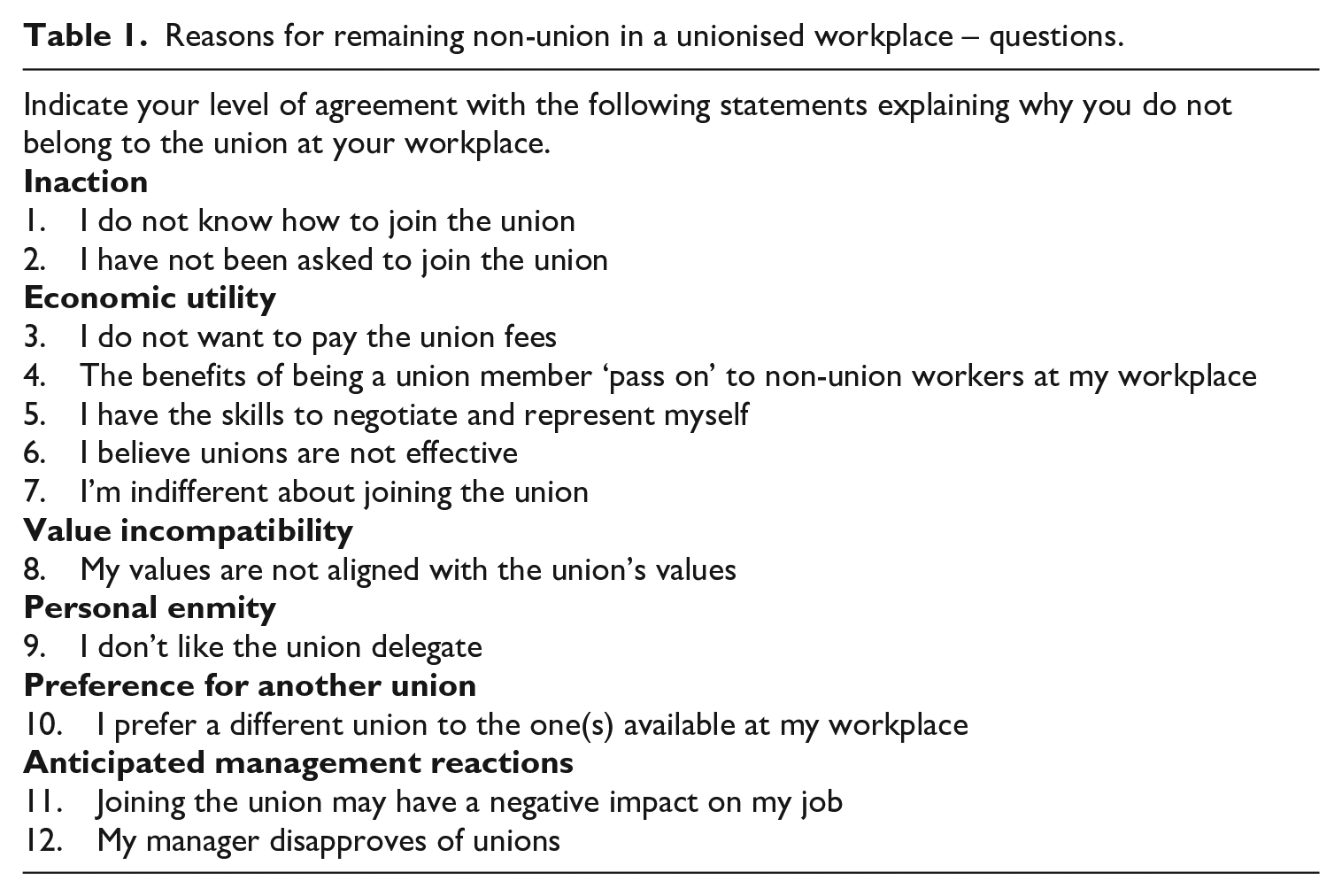
All 1600 respondents in the original survey were asked whether they supported or opposed a union default, and whether they would stay in the union or opt out under a union default scenario. Furthermore, the 170 respondents in the non-union sub-sample were asked to indicate whether they agreed or disagreed with a series of statements concerning their reasons for remaining non-union. Table 1 lists these statements, grouped in accordance with the broad themes identified in the literature review. All of these statements concern why respondents have chosen not to join the union. Two statements relate to inertia: the respondent has not joined because he/she has not known how to join or not been asked to join. Five statements relate to economic utility: the respondent has remained non-union because he/she does not want to pay union fees, has the skills to single-handedly negotiate an agreement (without union help), believes unions are ineffective, is indifferent to unions, or because improved terms and conditions are ‘passed on’ to non-union staff anyway. Another statement says that the respondent has remained non-union because of incompatibility between the respondent’s values and those of the union. Yet another one states that personal enmity, in particular for the union delegate, motivated the decision to stay non-union. An additional statement suggests that preference for a different union motivated the decision to not join the current union. Two statements address the reactions of management as motivations to stay non-union, in particular management disapproval of unions or a fear that joining might negatively affect the respondent’s job situation.
Reasons for remaining non-union in a unionised workplace – questions.
The data were obtained via one method, a survey, and so there is a risk of common method bias. To check for such bias, we ran a Harman single factor test, using exploratory factor analysis with a maximum likelihood extraction method. This shows that a single factor explains only 20.87% of the variance in the independent variables. A figure lower than 50% indicates that there is no obvious common method bias in the data. In other words, the values of these variables are not biased in one direction or another in a consistent pattern solely because a single survey was used to collect all of the data.
Our study uses binomial regression to estimate two multivariate, maximum likelihood models. In the first model, the various reasons for remaining non-union are used to predict the odds of whether the respondent stays in or opts out of the union in a union default scenario. In the second, the same independent variables are used to predict the odds of whether the respondent would support rather than not support the union default as a policy. The independent variables are coded ‘1’ when a respondent ‘agrees’ that a particular reason helps explain why he or she has remained non-union and ‘0’ otherwise. The binomial logistic regression model has the following form:

In the first model, ‘event’ refers to ‘staying in’ the union, and ‘no event’ refers to ‘opting out’ of the union. In the second model, ‘event’ means ‘supports the union default’ and ‘no event’ means ‘does not support the union default’. For each dependent variable, ‘event’ and ‘no event’ are respectively coded ‘1’ and ‘0’ for the purposes of statistical analysis. The probability of the ‘event’ divided by the probability of ‘no event’ represents an odds ratio, the odds of ‘staying in’ versus ‘opting out’ or the odds of ‘supports the default’ versus ‘does not support the default’. The log of each odds ratio is predicted by the independent variables, the various reasons for remaining non-union. The coefficient estimates, or βs, in each model show the expected change in the log odds associated with each reason for remaining non-union.
Control variables were also added for ‘Age’ (number of years old), New Zealand European ethnicity and ‘Female’ gender.
Results
Turning to the analysis of the results of the data generated by our survey, Table 2 outlines the various reasons for not joining the union, and the corresponding percentage (and frequency) of the 170 respondents who indicated each reason was relevant to their own situation. Statistics for the control variables indicate that 56% of the sample were female, 62% had a New Zealand European ethnicity, and the mean age was 38 years. The most common reasons for not joining the union relate to pragmatic concerns about membership costs and benefits. Specifically, 77% of survey respondents had not joined to avoid paying union fees, while 58% had not done so because union-negotiated contract improvements were ‘passed on’ to non-union staff. Similarly, 42% had not joined because they believed the union to be ineffective, whereas 58% had eschewed union representation on the basis they already had the skills to negotiate for themselves and so did not need union representation. Fifty-five percent of the respondents said they were indifferent to unions, possibly because they thought unions had little to offer them or possibly because they were unaware of what unions do and can achieve for workers (see Gomez and Gunderson, 2004). In particular, less experienced, younger workers may have little appreciation of what unions do, though this is less likely relevant for the respondents in this study, all of whom are employees from unionised workplaces. Some respondents were more principled in their opposition to membership, with 32% indicating their values were not aligned with those of the union.
Reasons for remaining non-union in a unionised workplace – percentage (frequency) of non-union employees.
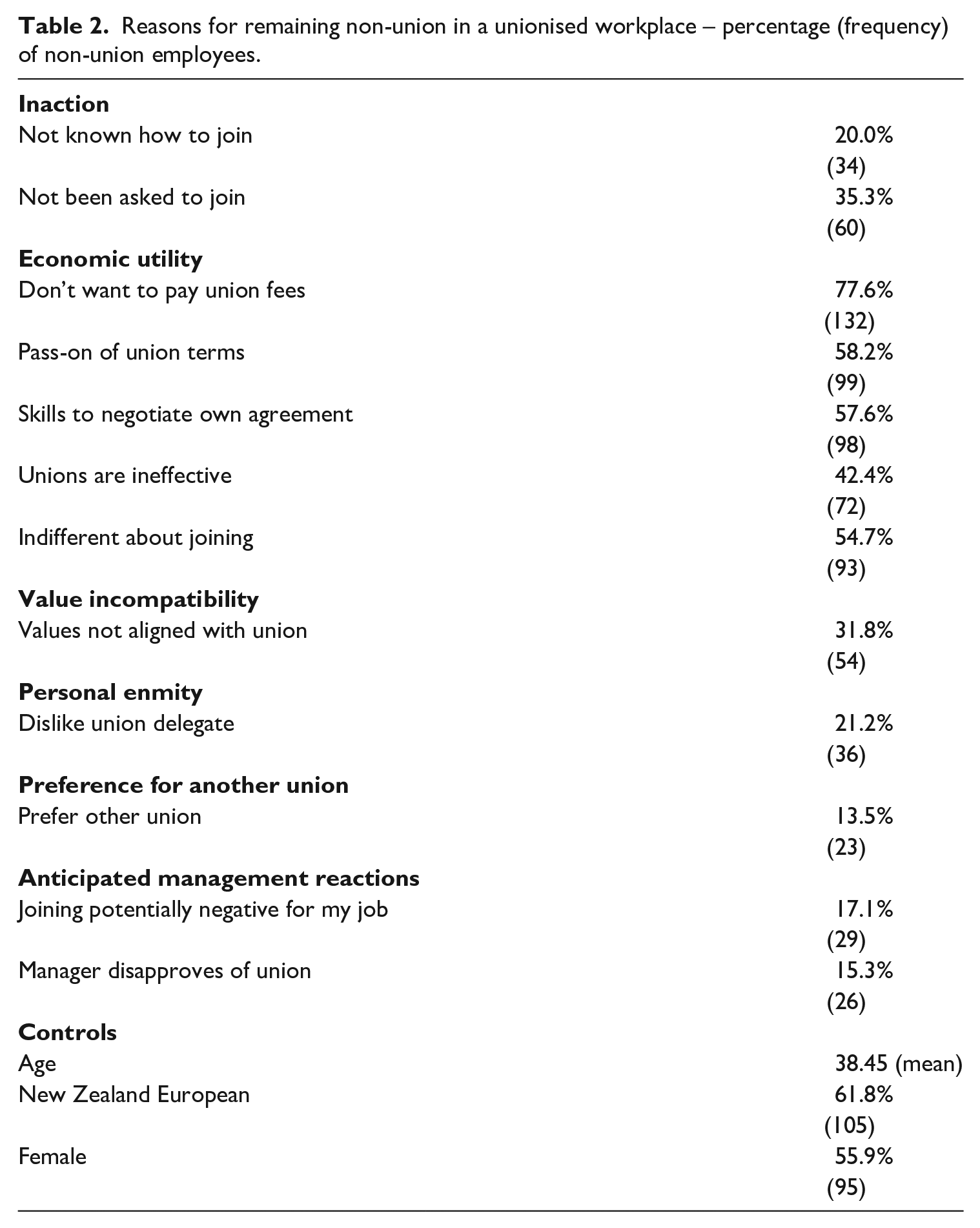
Some of the respondents attributed their failure to join the union to inaction, whether their own and/or the union’s. In particular, 35% said they had not joined because they had not been asked (and, presumably, had not taken the initiative to do so). Twenty percent also indicated they did not know how to join. On occasion, the motivation for staying non-union was particular to the situation, with 21% saying they disliked the workplace union representative and 13% saying they preferred an alternative union to the one available in their workplace. There were also respondents who had concerns about adverse management reactions to membership, with 15% indicating their manager disapproved of unions and 17% fearing that union membership could negatively affect their job situation (e.g. dismissal, promotion).
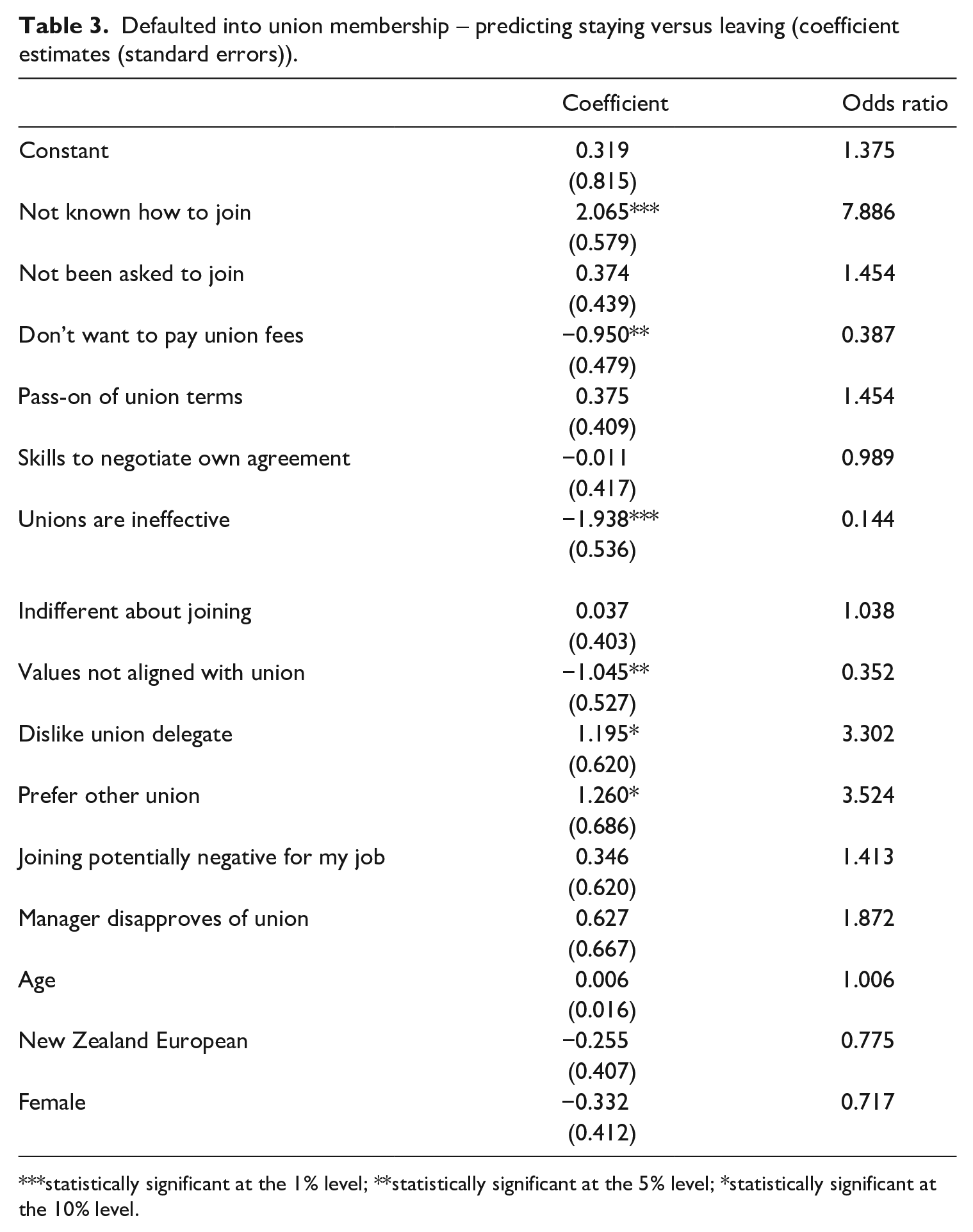
Table 3 outlines the logistic regression results, with various reasons for remaining non-union used to predict whether the respondent would stay in the union or leave in a hypothetical union default situation. The Nagelkerke R-square (0.407) and Cox and Snell R-square (0.304) indicate that at least some of the variance in the choice to stay or leave in the scenario is explained by the model. The classification table shows that the model accurately predicts 72% of the respondents’ choices, 78% for those preferring to opt out and 65% for those preferring to stay in the union.
Defaulted into union membership – predicting staying versus leaving (coefficient estimates (standard errors)).
statistically significant at the 1% level; **statistically significant at the 5% level; *statistically significant at the 10% level.
The coefficient estimate for each dichotomous independent variable is listed in the first column of Table 3, with the standard error below in parentheses. The estimate for the constant term is not statistically significant, and so is assumed to have a zero value. A constant with a zero value indicates that there are even odds (1:1) of staying versus leaving, a 50% chance of each choice, in the scenario. A positive, statistically significant coefficient estimate suggests an increase in these odds for a given reason. A negative, statistically significant coefficient estimate suggests a decrease in these odds. Statistically insignificant coefficient estimates indicate no change in the 1:1 odds ratio for a particular reason. The same applies in Table 4, where the dependent variable predicted is whether the respondents support a union default policy.
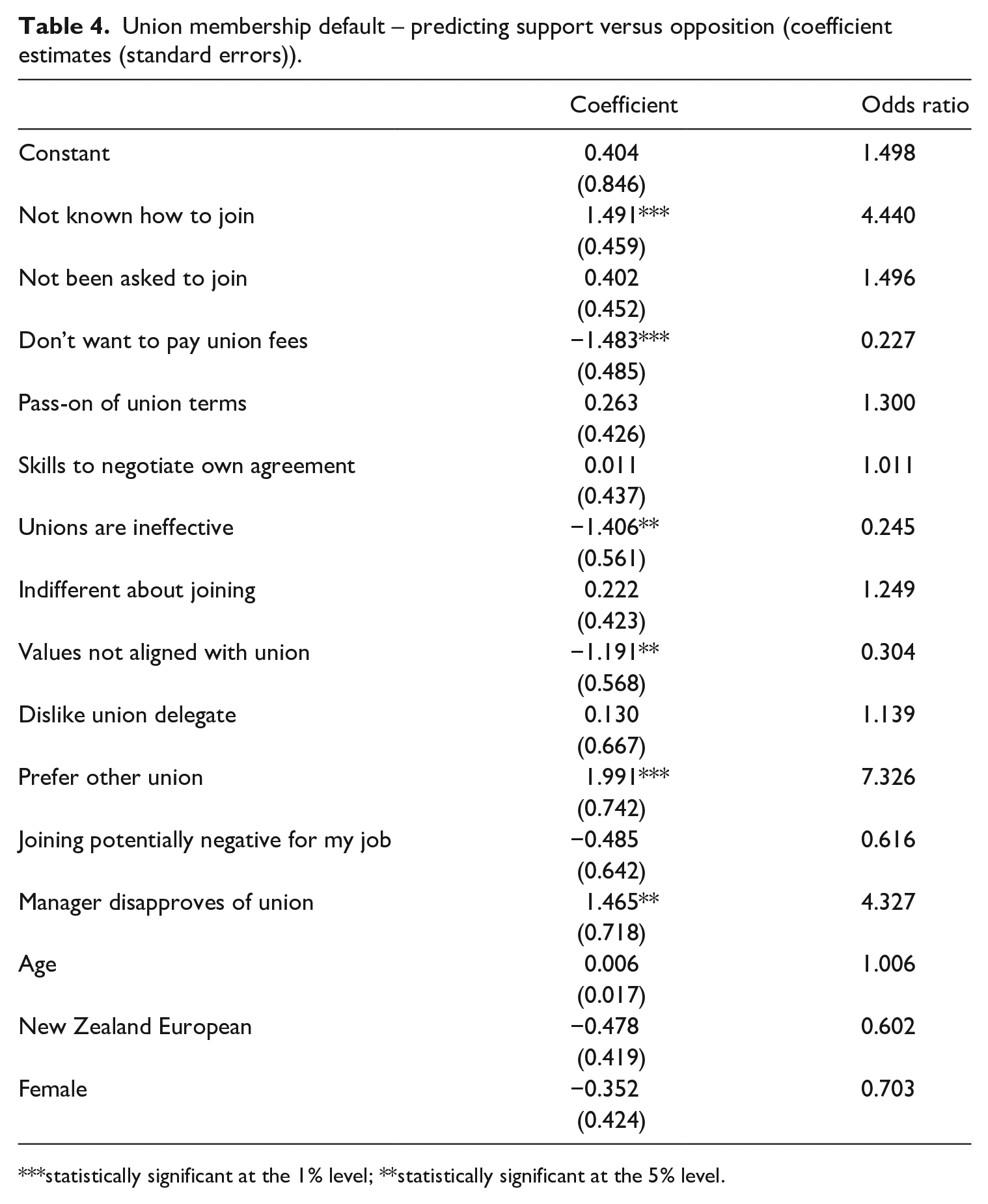
Union membership default – predicting support versus opposition (coefficient estimates (standard errors)).
statistically significant at the 1% level; **statistically significant at the 5% level.
The coefficients are statistically significant and negative for ‘Don’t want to pay union fees’, ‘Values not aligned with union’ and ‘Unions are ineffective’. Thus, anyone who indicated any of these as a reason for being non-union would be much less likely to want to stay in the union, if automatically enrolled. For the first reason (not wanting to pay fees), the odds of opting to stay rather than leave decline from 1:1 (50% chance of either option) to 2:5, equivalent to a 28% chance of staying (0.387/1.387). Similarly, with the second reason (values not aligned), the odds fall from 1:1 to approximately 2:5, equivalent to a 26% chance of staying (0.352/1.352). For the third reason (unions ineffective), the odds of staying rather than leaving fall more steeply from 1:1 to approximately 1:7, equivalent to a 13% chance of staying (0.144/1.144). The combination of any of these three reasons reduces the odds of staying rather than leaving even further. For instance, the odds of staying rather than leaving are only 1:20 (0.352 × 0.144 = 0.050), equivalent to a 5% chance, if the respondent had remained non-union due to value misalignment and not wanting to pay fees.
The coefficients are statistically significant and positive for ‘Not known how to join’, ‘Dislike union delegate’ and ‘Prefer other union’. A respondent who selected one of these reasons for remaining non-union would be much more likely to want to stay in the union, if automatically enrolled. For the first reason (not known how to join), the odds of staying rather than leaving increase from 1:1 to nearly 8:1, increasing the probability of staying from 50% to 89% (7.886/8.886). For the second reason (dislike the delegate), the odds of staying versus leaving increase from 1:1 to more than 3:1, increasing the probability of staying from 50% to 77% (3.302/4.302). With the third reason (prefer other union), the odds also rise from 1:1 to more than 3:1, raising the probability of staying from 50% to 78% (3.524/4.524).
Table 4 outlines the logistic regression results, with the reasons for remaining non-union predicting whether the respondent supports the union default. The model fit statistics (Cox and Snell R-square = 0.298; Nagelkerke R-square = 0.408) indicate that the model explains some of the variance in the choice to support or oppose the union default. The classification table reveals that the model correctly predicts 78% of the respondents’ choices, 88% for opposition to the default and 61% for support for it.
The estimated constant is not statistically different from a value of zero, implying a 1:1 odds ratio and a 50% chance of the union default proposal securing the respondents’ support. Coefficient estimates for ‘Pass-on of union terms’, ‘Skills to negotiate own agreement’, ‘Indifferent about joining’, ‘Not been asked to join’, ‘Dislike union delegate’ and ‘Joining potentially negative for my job’ are also statistically insignificant. Thus, these reasons have no predicted impact on the odds of support versus opposition to the proposed union default, which stays unchanged at 1:1.
Estimated coefficients are negative and statistically significant for ‘Don’t want to pay union fees’, ‘Unions are ineffective’ and ‘Values not aligned with union’. It follows that support for the union default is much less likely whenever the respondents offer one or more of these reasons for remaining non-union. Estimated coefficients are positive and statistically significant for ‘Not known how to join’, ‘Manager disapproves of union’ and ‘Prefer other union’. As a result, if one or more of these reasons is advanced, support for the union default is much more likely. For example, the odds of supporting the union default rise from 1:1 to more than 4:1, an increase in probability of support from 50% to 81% (4.327/5.327), if the manager disapproves of unions.
The coefficients for the control variables, 9 ‘Age’, ‘New Zealand European’ and ‘Female’, are statistically insignificant in both models.
Discussion
We now turn to discuss the analysis of our results in relation to the earlier review of the salient literature. Our results for the reasons for why non-union workers stay non-union in unionised workplace are similar to those of previous studies in Australia (Haynes et al., 2008: 17–18) and New Zealand (Bryson, 2008: 15–16). Economic utility considerations are dominant in these three studies. A higher proportion of our respondents remained non-union to avoid paying union fees – e.g. 77% versus 56% in the earlier Australian study and 37% in the earlier New Zealand study. A comparable proportion also indicated they had not signed up because they received the same benefits via ‘pass-on’ – e.g. 58% versus 52% in the Australian study and 64% in the other New Zealand study. A slightly lower proportion had not joined believing unions to be ineffective – e.g. 42% versus 49% in the Australian study and 44% in the other New Zealand study.
In the automatic enrolment scenario and subsequent opt out, 44.7% of our respondents reported they would retain membership. The logistic regression findings suggest three distinct reactions to the union default, depending on the initial reason(s) for remaining non-union. First, workers who dislike union fees, believe unions are ineffective and/or whose values are not aligned with those of the union are very likely to indicate they would leave the union. The same workers are also very likely to oppose a union default, no doubt as incompatible with their preferences. Such workers have strong, negative views of unions, reflected in their opt-out intentions, and so would not be easily swayed by any reversal of the default. Second, at the other extreme, workers who did not know how to join, dislike the union delegate and/or prefer a different union are very likely to indicate they would stay in the union. With this group, the default setting heavily influences their choices. The same workers, apart from those who dislike the union delegate, are also highly likely to favour a union default. Third, workers who had stayed non-union because of ‘pass-on’, a lack of an invitation to join, indifference to unions, management disapproval of unions, concerns about a negative impact on their job, or confidence in their own negotiation skills, indicate they are just as likely to stay as leave in a union default scenario. This group is still influenced by the default setting, though less so, since half the group would be prepared to change their decision to not join. Most are also just as likely to support as oppose the union default. However, the exception are workers whose manager disapproves of unions. These workers are highly likely to support a union default, perhaps because they see it as more compatible with making a genuinely free choice, with less potential for interference from management.
How did the union default scenario prompt 44% of 170 non-union respondents in our sample to say they would maintain union membership? Switching costs, inertia and social norms will have all played some role, depending on the initial reason or reasons for being non-union. The union default eliminates the switching costs of shifting to union membership. Moreover, any inertia associated with decision avoidance or deferral favours remaining in the union. Such issues are particularly relevant to workers, waiting for an invitation to join or not knowing how to join, who have not yet exercised a choice perceived as too laborious. Likewise, some workers with weak or poorly developed preferences regarding a particular union, as with those who dislike the union delegate or prefer another union, have little motivation to make a deliberate, active choice to move away from a union or non-union default.
Furthermore, a union default would establish union membership as a new, injunctive social norm, because it is endorsed and protected by the state as the preferred option in employment. Thus, workers would feel safer and more secure in exercising a preference to stay a union member. By enrolling all workers under collective agreement coverage (the bargaining unit), the union default would also help to establish union membership as a descriptive social norm. Research (e.g. Visser, 2002) has already shown that, when workers expect their co-workers to be union members, they are more likely to be persuaded to become union members as well. More generally, a union default would legitimise unions and union membership and de-legitimise anti-union management behaviour and policies. Automatic enrolment also absolves individual workers of any personal responsibility for having deliberately and obviously chosen union membership against management’s wishes. With a union default, workers would, therefore, have less reason to fear management’s wrath. 10
The union default appears to have little or no impact via loss aversion on worker choices. Workers concerned about the financial costs and benefits of unions generally indicate they would still opt out. A union default situation would prompt workers to see the improved terms and conditions negotiated by the union as ‘losses’ associated with opting out rather than ‘gains’ associated with opting in. It would also prompt them to view union fees as a ‘gain’ of opting out rather than a ‘loss’ associated with opting in. It is likely that this change of perspective, in a ‘real-life’ situation, 11 would induce many more to stay in rather than opt out, given that losses are weighted more heavily than gains by the human mind. However, an imaginary shift to a union default, as described in this study, might not have the same effect. Experience of an actual union default would be required to test the true impact of loss aversion in relation to this new reference point.
Age had no impact on intention to opt out of the union. Nor did it affect support for a union default. Yet, a common view in the media is that younger workers have less preference for union membership and so would be more likely to opt out of, and oppose, union membership. This is frequently attributed to supposedly rising individualism in younger generations. However, some research suggests that younger and older workers have similar preferences for union representation (Haynes et al., 2005). Their lower incidence of union membership reflects their growing non-standard employment in the non-union, small business service sector, where they have few, if any, opportunities to join a union (Haynes et al., 2005). Moreover, without the chance to learn about unions in such work contexts, younger workers can develop indifference towards unions, borne out of general ignorance about what they do rather than any anti-collectivist values (Hodder and Kretsos, 2015). It follows that, when younger and older workers both work for unionised employers and so have the same opportunities to join, as with our study, we would expect few, if any, age-related differences in expressed intentions to stay/leave or support/oppose.
Conclusion
Our research has six primary public policy and theoretical implications for the relationship between employee autonomy and union membership (and, in turn, for the balance of power between capital and labour in the workplace). We do not believe there is sufficient peculiarity to New Zealand – as a liberal market economy – to limit their relevance elsewhere.
First, and most obviously, a union default could significantly increase union membership in unionised workplaces. An earlier study suggested 45% of New Zealand workers in unionised workplaces remain non-union despite the opportunity to join (Bryson, 2008: 13). Thus, the number of members and non-members at a typical unionised workplace is likely to be similar. Union members comprise just under 20% of all New Zealand employees (Ryall and Blumenfeld, 2018), and so non-union employees at unionised workplaces are likely to comprise a similar percentage. If, as our results suggest, 44% of these employees would join as a result of a union default, membership numbers would increase by almost 200,000, representing 8–9% of the employed workforce. Union density would rise from 17–18% to 26–27% and, perhaps, more through other processes (see below). In other countries, similar proportions of non-union workers in unionised workplaces have expressed a preference for union membership. For example, in one British study, over one third of workers in existing unionised workplaces said they would join if asked (Bryson, 2003).
Second, even with a default, some workers would still opt out and free-ride. Our results suggest these workers comprise approximately half the non-union staff at unionised workplaces, equating to a further 8–9% of the employed workforce. Eighty-five percent of these workers said they had not joined a union because they are averse to paying union fees. It follows that, if they did not have to pay fees, many would be more easily encouraged to join/stay in. This might be achieved by specifying a default clause in collective agreements, requiring employers to pay all (or a specific amount) of each member’s fee. The alternative would be either voluntary or statutory ‘fair share’ agreements, whereby non-union workers are compelled to pay around 70% or 80% of dues to the union or a nominated charity.
Third, the extra resources the union default would raise via higher membership could dramatically shift the balance of power in favour of unions. Recruitment of additional members at brownfield sites would generate new resources for organising greenfield, non-union sites. Increased resources and members would also strengthen bargaining power at brownfield sites, thereby, improving terms and conditions for workers, and enhancing the desirability of membership. Higher membership density could increase feelings of community and solidarity, and help dissuade individuals from opting out, in a virtuous, upwardly reinforcing spiral. For instance, in their Danish study, Toubøl and Strøby Jensen (2014: 150) noted: ‘the most important factor motivating non-union members to join a union is whether their colleagues at the workplace are members of a . . . union. Where workplace union density is high, it is highly likely that a non-union member will decide to join the union.’ This was reinforced by another study of the Danish situation by Ibsen et al. (2017).
Fourth, the above implications relate to a more profound one concerning the autonomy of individual employee choice or, more obviously, the abject lack of it in many present-day circumstances. Essentially, workers’ panorama of preferences with regard to unions is highly affected and, thus, restricted by dominant social norms (Visser, 2002), which are themselves often reified into laws (Rogers, 2010, 2012). As such, a default is more than simply a protective device for immutable and permanent choices regarding the freedom to associate or not associate. Indeed, it has the potential to fairly and legitimately influence those preferences and choices in the first place by providing new experiential goods (in terms of information, knowledge, evaluation and understanding). This can generate, as Rogers (2012: 361) and Sunstein (1991: 11) suggested, a situation where a union default could provide individual workers with a stronger sense of autonomy and a firmer platform for choosing to exercise their freedom of association.
Fifth, it is worth reiterating that, although respondents were surveyed on their intentions in a scenario approximating an experiment rather than a ‘real-life’ situation, they made deliberate and conscious choices (albeit under certain conditions) so that the foundation of the study is valid and robust. The use of such scenario testing is an established, credible and legitimate form of social science research. Indeed, it has been widely used to examine how individuals respond to hypothetical defaults, including, for example, ‘green’ versus ‘grey’ electricity choices (Harcourt et al., 2019b). 12 Moreover, in actuality, a default might amplify some processes and their outcomes, as, for instance, loss aversion becomes manifest. 13 We believe these would strengthen pro-union preferences. Accordingly, we can now more deeply understand the heavily contingent nature of the epistemological approach that leads to a conclusion that ‘lack of perceived benefits explains much of . . . free-riding behaviour’ (Haynes et al., 2008: 23).
Penultimately, examining the responses of non-union workers in unionised workplaces in New Zealand is most apposite for two reasons. For one, New Zealand’s Labour Party, governing in coalition from 2017 to 2020, has expressed interest in examining the merits of a union default proposal. For another, a default system could be easily incorporated into New Zealand’s existing employment relations system (Harcourt et al., 2020a). Specifically, the ‘all-comers’ approach (see Albertyn, 1989: 988) embedded in New Zealand’s Employment Relations Act 2000 is potentially highly compatible with a union default. Under this legislation, the right to bargain collectively can be acquired in any given workplace by recruiting as few as two union members, the minimum number required to establish a collective agreement. Once a collective agreement is established, all employees embraced by the mandatory coverage clause, specifying the jobs or occupations in the bargaining unit, are then provided the option to join the union and have its collective agreement as their contract. Legislatively, it would not be a major step to have all such workers defaulted to union membership at first instance, as new employees, with a subsequent right to opt out.
Prospects for a union default in New Zealand have also been strengthened by the re-election of a Labour government in late 2020, this time with an outright majority of seats (64/120), and buttressed by an increase in representation of the Green Party (from eight to 10 seats). The new government fully intends to use its majority to re-collectivise employment relations. It has already announced plans to introduce a system of industry-based collective bargaining based on what it calls ‘Fair Pay Agreements’ (FPAs), which were the focus of a working group that released a report during the previous term of parliament. Each FPA will establish minimum terms and conditions across all employers and employees within a particular industry or occupation, and these must, at a minimum, include pay, hours of work and overtime. There must also be discussions concerning health and safety and leave entitlements, but terms regarding these issues need not be included in an agreement. A union will have the right to initiate bargaining for an FPA if it can satisfy either a representation or public interest test. The public interest test will encompass a number of criteria, including the prevalence of low-waged workers within the particular industry or occupation. The representation test will require the union to recruit at least 1000 or 10% of the employees, whichever is the lesser, within the given industry or occupation. Once agreement is reached, an FPA will be ratified by votes of all affected employees and employers, with employer votes weighted by the number of staff under coverage. If there is failure to reach agreement, the Employment Relations Authority will set the terms and conditions of the FPA; striking over an FPA will not be permitted. Draft legislation to create this employment relations system will be introduced before the end of 2021, with enactment expected in 2022. The first FPAs are anticipated in sectors such as private security, restaurants and cafes, supermarkets and retail (Bomball, 2021).
With its FPAs, Labour has demonstrated a renewed interest in unions and a more centralised system of employment relations not seen since the 1980s. The time is right for proposing and considering major reforms. Several Labour Members of Parliament (MPs) have expressed enthusiasm for a union default, especially those who are part of the union caucus. At the same time, the New Zealand Council of Trade Unions (NZCTU) is quietly lobbying for the adoption of the policy. There is support from a key stakeholder group, employment lawyers. Proponents are very much aware that the union default could be incorporated into FPAs as a standard, mandatory term, much like those currently required in the Employment Relations Act 2000. Interest in the findings of ongoing research into the effectiveness and popularity of a union default is also strong.
In Britain, the high tide of popular and parliamentary political support for such potential (legislative) reform passed with the decline of Corbynism within the Labour Party in late 2019. However, we have described how the existing institutional architecture could be relatively easily reformed (Harcourt et al., 2020a: 26–28) to introduce a union default. This would not require any kind of ‘delete all and amend all’ motion. Meantime, bodies like the Institute of Employment Rights continue their work in opening up spaces in political and policy circles to debate, discuss and take forward such proposals. At present, it is unclear whether the ‘Clean slate for worker power’ project (Block and Sachs, 2018), emanating from Harvard University, and with which a default is compatible and under consideration, will have purchase with the Biden Democratic (2021–) administration. The Democrats have signalled a willingness to reform the existing card check process under the National Labor Relations Act 1935. To this extent, the Protecting the Right to Organize Act – actually a Bill – was laid before the House of Representatives in early 2021 and passed its first hurdles there. It is unclear whether this success will be replicated in the Senate so that the Bill becomes an Act. However, should the Bill become an Act, it only would be the first of many necessary, but by itself insufficient, steps on the road to more far-reaching legislative reform (such as a union default) because the Protecting the Right to Organize Act seeks to amend the revisions made to the National Labor Relations Act 1935 rather than overturn it. Essentially, and in regard to union membership, it seeks to reprise the promise of the National Labor Relations Act 1935 in its original and unaltered form. 14
Finally, we recognise that there are some specific aspects of our proposal that require further detailed examination. One of the most pressing concerns young workers in the sample. Lower rates of unionisation among young workers provides a potentially firm foundation of ‘never’ membership and the so-called ‘demographic timebomb’ of extant union members dying out. In this instance, these further salient lines of investigation within our data would concern why the responses for the 18–24 and 25–35 age groups did not diverge from those of older age groups when the impacts of generational social effects and norms (e.g. less experience of work, most existing members being older) might have been expected to have had made their presence felt and do so in significant ways. Another one concerns unions as organisations. Although our questionnaire did recognise that unions are not homogeneous in either identity and image (such as general, craft/professional) or in goals and modus operandi (such as militant and moderate), the issue of preference for another union also merits further investigation for the matter is more complex and nuanced than these illustrative but simple binaries (see, for example, Fairbrother, 2015; Hodder and Edwards, 2015; Hyman, 2001).
Footnotes
Declaration of conflicting interests
The authors declared no potential conflicts of interest with respect to the research, authorship, and/or publication of this article.
Funding
We are grateful to the New Zealand Law Foundation for providing the funding to undertake the data collection.
