




Abstract
Focusing on 13 OECD countries over 25 years, we examine the factors that explain why a sizable fraction of wage-earners exhibit an inconsistency between their union membership status and their confidence in unions by being either confident non-members or non-confident members. While structural factors associated with joining constraints generate inconsistency in specific labour market categories, wage-earners who have extreme ideological orientations and are highly interested in politics are much less likely to exhibit inconsistency across time and countries. For individuals who have intermediate ideological orientations and are not very interested in politics, differences in terms of non-member and member inconsistency between countries are explainable through contextual variables such as economic conditions, the level of employment protection, and historical legacies. Implications for union membership research and union strategies are discussed.
Diverging membership and confidence trends: Introduction
The secular fall in union density and the resulting decrease in bargaining power experienced by unions is one of the most important developments in the labour market of the last decades. Despite declining union membership, several authors have highlighted that, at the national level, confidence in unions remained stable or even increased (Bryson and Gomez, 2005; Givan and Hipp, 2012). More recently, the same contradictory empirical pattern has been shown to hold even at the individual level (Frangi et al., 2017). The goal of this paper is to build on this recent research by zooming in on a particularly relevant segment of wage-earners, that is, those that exhibit an inconsistency between their union membership status and their confidence in unions by being either non-members who trust unions or members who are distrustful of unions. What are the main reasons that explain why a wage-earner shows inconsistency between confidence in unions (or lack thereof) and membership status? We answer this question for 13 OECD countries between 1995 and 2019 by taking into account the explicative power of individual and contextual factors. We argue that examining the reasons behind non-member and member inconsistency is the key element to understand why union membership and union confidence follow increasingly diverging trends. Focusing on these individuals is not only useful to shed light on an empirical puzzle but also has important implications for union renewal strategies.
The remainder of the paper is structured as follows. We first review the most relevant elements of the existing literature and then present our empirical approach and results. After discussing them, we illustrate the implications of our results for union strategies and highlight the main limitations of our findings.
At the sources of inconsistency: Theoretical background
Structural fences versus attitudinal backing
Since the decline in union density reduced the legitimacy and actual power of unions as bargaining partners, unions tried to counteract this trend by becoming increasingly active in the public sphere through explicit political communication (Baccaro et al., 2003; Streeck and Hassel, 2003). While these efforts were not successful in redressing membership numbers, they had a positive influence on workers’ attitudes about unions. Indeed, because of the increasing difficulties in joining unions, union density can no longer be considered the only measure of union support among wage-earners (Sullivan, 2010). Studying attitudes toward unions has also become relevant since they allow an understanding of individual behavioural dispositions beyond contextual constraints (Olson and Kendrick, 2011). Different attitudes toward unions have been studied in various countries, mainly based on public opinion surveys. They all highlight the presence of diverging trends between the stable or even increasing proportion of wage-earners expressing positive attitudes toward unions and the downward evolution of union membership (Givan and Hipp, 2012). This gap is defined as “frustrated demand” for unions (Bryson and Gomez, 2005).
In this paper, we operationalize the personal assessment of unions through an individual’s confidence in them. An individual who has confidence in unions must characterize her relationship with unions as one that is embedded in trust. 1 Trust in an institution—such as unions—is granted by an individual only if the institution proves that the interests it defends are those of the individual rather than opportunistic ones (Hardin, 1999). Individuals express confidence if they perceive good enough “reasons constituting evidence of trustworthiness” (Lewis and Weigert, 1985: 970) that unions have positive effects in their life and when union arguments are in line with their values. In other words, confidence in unions is an attitudinal disposition that is suitable to complement union membership as an indicator of the actual support for unions among wage-earners (non-members and members).
Our goal is to explain why positive/negative attitudinal predispositions toward unions may lead certain categories of individuals not to join or to join despite having attitudes toward unions that are inconsistent with their membership status. We hence aim to study the relationship between attitudes and behaviours (Ajzen, 1989) by understanding why an inconsistency between attitudes (confidence/absence of confidence in unions) and behaviours (not being a member/being a member) shows up for certain individuals (Rabinovich et al., 2010).
As a general expectation, following Ajzen (1989), we assume that consistency between confidence in unions and union membership is the rule unless there are some constraints beyond the voluntary will to join or not to join. In the next two subsections we review the main structural factors that can generate inconsistency and the main individual predispositions that can allow individuals to counter such pressures.
A dual labour market with structurally induced inconsistencies
As a consequence of the widespread decline in union density, explaining the reasons behind the individual decision to belong to a union and the variation in union density across countries have become two of the most examined research objects in the debate about unions (Bryson et al., 2011; Ebbinghaus et al., 2011). The decline in union density can be traced back to three interrelated macro-trends (Baccaro and Howell, 2017; Storm, 2017). First, a structural change in the labour market composition led to the shrinkage of highly unionized jobs in the manufacturing and public sectors. Second, the neoliberal turn provoked a liberalization of employment relations, which meant a generalized decrease in collective bargaining coverage and employment protection. Third, the secular stagnation recently affecting capitalist countries involves decreasing GDP growth and higher unemployment rates, which additionally limit opportunities to become a union member (Checchi and Nunziata, 2011; Frangi et al., 2017).
These structural changes can trigger both non-member and member inconsistency through different mechanisms. Focusing on non-member inconsistency, these contextual trends have increased the objective obstacles many wage-earners face to joining unions. While some decades ago the possibility to join a union was taken for granted for most workers, the development of a dual labour market led to the creation of a divide between insiders that have the opportunity to join unions, on the one hand, and outsiders at the margin of the labour market who are mostly de facto deprived of the opportunity to become unionized, on the other (Kalleberg, 2009; Lindbeck and Snower, 1989). We suppose that the objective obstacles to joining faced by outsiders are the driving force generating the first type of inconsistency we examine, that is, the scenario in which certain wage-earners have confidence in unions but cannot join because of structural obstacles linked to their job situation. Based on empirical findings in existing research describing them as the categories primarily affected by flexible labour market arrangements (Frangi et al., 2017; Gumbrell-McCormick, 2011), we expect young, female, and nonregular employees to be the core pool of inconsistent non-members. While the issues they have in joining are obvious, these same constraints make them the individuals who most need the intervention of unions. This may lead to a paradoxical “I wish I could, but I can’t” situation that may generate in them a “hope” that unions will be able to act on their behalf to redress their precarious working conditions, becoming the basis of their confidence in unions. While both union leaders and members ideally support the need to improve the wellbeing of all workers, insiders or outsiders, unionized or not, pragmatic constraints related to the shrinkage of financial resources have forced leaders to promote policies that prioritize the interests of members and insiders, rather than focusing on strategies to also organize outsiders and non-members (Frangi et al., 2021). The question is whether the intentions of unions to also help outsiders, as highlighted by the image unions try to give of themselves in the public sphere, are enough for outsiders to have confidence in them although potentially aware that unions may no longer be strong enough to actually intervene in their favour in most situations (Palier and Thelen, 2010).
Focusing on insiders, who mostly do not experience union membership constraints as outsiders do, we expect consistency to be the prevalent pattern. If an insider does not join a union, this suggests that she either does not share unions’ political goals or does not believe in their effectiveness in providing instrumental professional benefits. These consistent non-members may join unions only in exceptional circumstances, for example, after experiencing an important decrease in job satisfaction and turning to unions only as a last resort (Hadziabdic, 2020). More relevant for our purposes are insiders who are members. If their membership is the result of a voluntary choice, such as is prevalent in the European context (Hadziabdic and Baccaro, 2020), these are consistent members, since a positive attitude toward unions must be a necessary condition for them to decide to join. However, there is also a scenario in which an insider may be deprived of the freedom not to join. In North America and Australia, union membership is often determined by majoritarian rules in the workplace, pushing de facto all wage-earners to become unionized if the majority of them decide to do so. The question is to what extent these insiders who are constrained to join are likely to develop a positive opinion about unions after joining. Since these individuals do not a priori share union goals and are constrained to join, unexpected experiences or benefits provided by union membership are the main channel that may improve their opinion of unions. The key union experience usually invoked as provoking such change is the rise of class consciousness (Hyman, 1978). While there is classical literature arguing that class consciousness is mainly relevant in Europe (e.g. Sombart, 1976 [1906]), we also argue that today’s union members, much more heterogeneous than the blue-collar workers that once represented a monolithic group of union members, are less likely to develop solidarity based on structural professional commonalities. Nevertheless, direct contact with union leaders and other members may still be an effective way to develop pro-union attitudes (Gall and Fiorito, 2012; Givan and Hipp, 2012). In terms of benefits, the structural changes described above make us suppose that the ability of unions to provide instrumental professional benefits to their members is nowadays limited. Indeed, the decreasing union density and union power implied by the structural changes described above also negatively affect the ability of unions to provide substantial economic advantages, not only to excluded outsiders but also to their members (Kirmanoğlu and Başlevent, 2012). We hence expect to observe an increasingly important number of inconsistent members in countries characterized by industrial relations systems that entail the presence of quasi-compulsory union membership arrangements over which a worker has little or no influence.
Besides these labour market structural changes, other related macro-trends affect the way unions are perceived in society. In particular, favourable economic conditions may have a general positive impact on the perception of institutional actors, such as unions, that are seen as having an influence on such trends (Greenfield, 2009). Among contextual conditions, those specifically related to the labour market, such as the level of employment protection, are even more likely to influence trust in unions (Frangi et al., 2017). We expect these positive macro-level conditions to increase the proportion of non-members who have confidence in unions and decrease that of members who do not see unions as an effective labour market actor.
(Socially backed) ideational resilience?
While structural factors increase the likelihood of observing non-member and member inconsistency, we ask ourselves to what extent individuals may be able to resist them and find ways to exhibit union membership status that is in tune with their attitudes toward unions. Indeed, individual preferences also play a key role in an individual’s relationship with unions. Even though rational and value-driven motivations are both relevant determinants of an individual’s opinion of unions and propensity to join (Eaton et al., 2014), the level of political involvement, self-transcending values, and leaning toward a left-wing political ideology have recently become much more prominent factors (Fiorito et al., 2010; Riley, 1997; Turner and D’Art, 2012). As we described above, since unions have increased their visibility in the public sphere and are no longer able to provide substantive benefits to their members, it is not surprising that many individuals self-select themselves into unions because of an affinity between their political views and those defended by unions (Hadziabdic and Baccaro, 2020). Furthermore, paradoxically, the presence of stronger barriers to joining unions increases the chances that these political selection mechanisms become even more salient. If joining a union implies higher costs and less instrumental returns than before, the individuals most likely to become members nonetheless are those who particularly value union policies and ideals by being highly politically involved and highly left-wing oriented. Indeed, socio-psychological literature highlights that individuals who feel highly involved in the attitudinal object endorse attitudes with stronger conviction (Bassili, 2008). Therefore, attitudes become much more salient and resilient to contextual influences for the enactment of a behaviour (Glasman and Albarracín, 2006). In other words, we expect individuals who are highly involved in politics and with polarized ideological views to be more likely to exhibit a consistent link between their attitudes toward unions and union membership. Since union membership is a salient attitudinal object for them, they are likely to join unions when they have a positive opinion of them, despite the presence of objective constraints on doing so.
The motivation to overcome objective barriers to joining unions can also be generated at the meso-level in the social networks an individual is embedded in. Research in social psychology suggests that subjective norms, that is, the perceived social pressure to perform (or not) a behaviour (Ajzen, 1989), moderate the attitude-behaviour relationship. The reference group the wage-earner belongs to and identifies with may be highly influential for the union membership choice (Checchi and Corneo, 2000). The reference group can be related to the workplace and/or external to it. In the former case, although the rise of a class consciousness is a mechanism that can no longer be invoked in the workplace (Hyman, 1978), direct contact with union leaders and other members may still lead to the development of positive attitudes about unions (Gall and Fiorito, 2012; Givan and Hipp, 2012). In the latter case, that is, external to the workplace, we have mixed expectations regarding the impact of the social class an individual belongs to. On the one hand, higher social classes experience fewer obstacles to joining. Therefore, if they do not join a union, it most probably implies that they consistently do not have confidence in unions. On the other, individuals from lower social strata may be those with the highest likelihood of developing the hope in unions we described above for vulnerable groups. However, if their low social status is related not only to objective working conditions but also to a feeling of class consciousness that does not leave much room for hope, the confidence in unions may be negatively affected.
Micro-, meso-, and macro-level drivers of inconsistency: Hypotheses
Based on the previous elements, we formulate a set of hypotheses regarding the micro-, meso-, and macro-factors influencing the likelihood of an individual being an inconsistent non-member or member.
Among micro-level factors, we consider three individual-level indicators that epitomize workers’ submission to recent labour market trends generating objective obstacles to joining a union: a precarious worker profile (working part-time, being a woman, young) makes non-member inconsistency more likely since it involves more objective obstacles to joining unions (hypothesis 1).
Specific individual preferences can counteract the impact of objective union membership constraints, whether these concern obstacles limiting the freedom to join or coercive measures to join: since these are positively correlated with the likelihood of being exposed to unions’ political messages in the public sphere and of having political views in line with those promoted by union leaders, interest in politics and a left-wing political orientation increase/decrease the likelihood of non-member/member inconsistency (hypothesis 2a). For individuals who are highly interested in politics and at the extreme of the ideological spectrum (either on the left or on the right), due to the saliency of the attitudinal object, both types of inconsistency are much lower than for other wage-earners (hypothesis 2b).
At the meso-level, we consider variables shared by individuals in the same (objective or subjective) social stratum that can generate social pressure affecting the likelihood of a wage-earner being able to resist structural pressures that may lead to inconsistency: experiencing an objective and subjective advantage (having a higher socio-economic status and identifying with a higher class) reduces the likelihood of both types of inconsistency (hypothesis 3a), while the impact of a double disadvantage (having a lower socio-economic status and identifying with a lower class) is not a priori clear (hypothesis 3b).
At the macro-level, we take into account variables that are measured at the country level, operationalizing structural and labour market-related changes. Although these trends are visible in all industrialized countries, we suppose that the relevance and timing of each has not been the same across countries. Indeed, besides being interested in the impact of each of these variables on inconsistency, we use these factors to explain the heterogeneity in terms of the level of (non-member and member) inconsistency between countries. Since both the recruitment capacity and societal image of unions are positively affected by a positive economic context and by the level of employment protection, we expect that wage-earners in countries with better economic conditions are more/less likely to exhibit non-member/member inconsistency (hypothesis 4). wage-earners in countries with higher employment protection are more/less likely to exhibit non-member/member inconsistency (hypothesis 5). because of the increasing structural obstacles in joining unions, non-member inconsistency becomes more likely over time than member inconsistency (hypothesis 6).
Empirical strategy: Data and methodology
The world values survey and contextual factors: Data
In order to test our hypotheses, we rely on the World Values Survey (WVS). The WVS is the only existing survey providing individual information about confidence in unions and union membership over several decades and across several countries, together with a rich set of other individual attitudes and values. Due to longitudinal compatibility constraints across waves and contextual-level data availability, our analyses are restricted to the last five waves of the survey (1995–2019) and on 13 OECD countries: Australia, Canada, Finland, Germany, Italy, Japan, Netherlands, Norway, South Korea, Spain, Sweden, Switzerland, and the United States. We include in our analyses only wage-earners, working part- or full-time. The data are unbalanced across countries and waves (cf. Supplementary Table A1, Supplementary Appendix A).
In order to create our dependent variable, we cross the information about confidence in unions and the membership status of each wage-earner and obtain a dichotomous variable representing the consistency or inconsistency between confidence and membership. Wage-earners who are “Non-member” and show “None at all” or “Not very much” confidence in unions or who are “Member” and show “A great deal” or “Quite a lot” of confidence in unions are coded as 0 (consistent). Wage-earners who are “Non-member” and show “A great deal” or “Quite a lot” of confidence in unions or who are “Member” and show “None at all” or “Not very much” confidence in unions are coded as 1 (inconsistent).
In order to test our hypotheses, in a first set of models we explore the effect of a group of independent variables available in the WVS: gender, age class, working status, level of education, self-declared social class, level of interest in politics, political orientation (measured on a 1–10 left-to-right scale). In a second set of models, we employ a series of country-level covariates. The first two variables, GDP per capita at current USD and proportion of unemployed workers in the labour force, come from the database of the World Bank. A second group of variables operationalize the level of employment protection legislation for regular and temporary contracts using the OECD/IDB Employment Protection Database. Descriptive statistics on dependent and independent variables are available in Supplementary Table A2, Supplementary Appendix A.
Robustness and linearity: Model specification
All models have the following functional form

Since we have a binary dependent variable, OLS implies the use of a linear probability model (LPM) approach. The coefficients we obtain for each independent variable are to be interpreted as additive probability effects of observing the category coded as 1 in the dependent variable, that is, being an inconsistent non-member or member. Since we have an important number of observations and use robust standard errors, we can rely on the asymptotic behaviour of OLS and obtain consistent estimates for every type of distribution of the error term even though the underlying functional form is not linear (Angrist and Pischke, 2009: 94–107; Wooldridge, 2010: 562–565). This has the advantage of not having to check the plausibility of the distributional assumptions of nonlinear models and of obtaining estimates that are not dependent on the amount of unobserved heterogeneity, such as happens for logit or probit models, and that can be directly interpreted as average marginal effects (Mood, 2010; Wooldridge, 2010: 55–52 and Chapter 15). Nevertheless, in Supplementary Tables A5–12, Supplementary Appendix A, we also estimate models equivalent to those we comment on below by using the probit and logit estimators. Reassuringly, the average treatment effects and significance levels of these nonlinear alternatives are almost equivalent to those we comment on below.
Since we consider both individual-level and country-level covariates, a multilevel modelling approach may seem appropriate in order to consider potential heterogeneous effects between countries and to make sure that standard errors are not underestimated by taking into account intraclass correlation. In Supplementary Appendix B, we explain why both theoretically and empirically the added value of a multilevel approach would be limited with the research question we examine and data we employ. We also argue that our already rather conservative strategy in estimating standard errors appears to be enough to protect us against the serious risk of type-1 errors.
Descriptive and explanatory angles: Results
We first give a descriptive account of the differences existing between countries in terms of the proportion of wage-earners presenting an inconsistent confidence-membership status. We then explain the between-country heterogeneity using two sets of models: a first set relies on micro- and meso-level variables, while in the second we focus on macro-level explanatory variables.
Norwegian and Australian extremes: Descriptive analysis by country
Figure 1 provides two bar plots representing the proportion of inconsistent non-members and members for the 13 countries under examination. We consider all years of data available for each country and use the cross-sectional weights provided in the WVS. The exact percentages the plots refer to are given in Supplementary Appendix A, Supplementary Tables A3 and A4. Proportion of inconsistent non-members and members by country. Source: World Values Survey.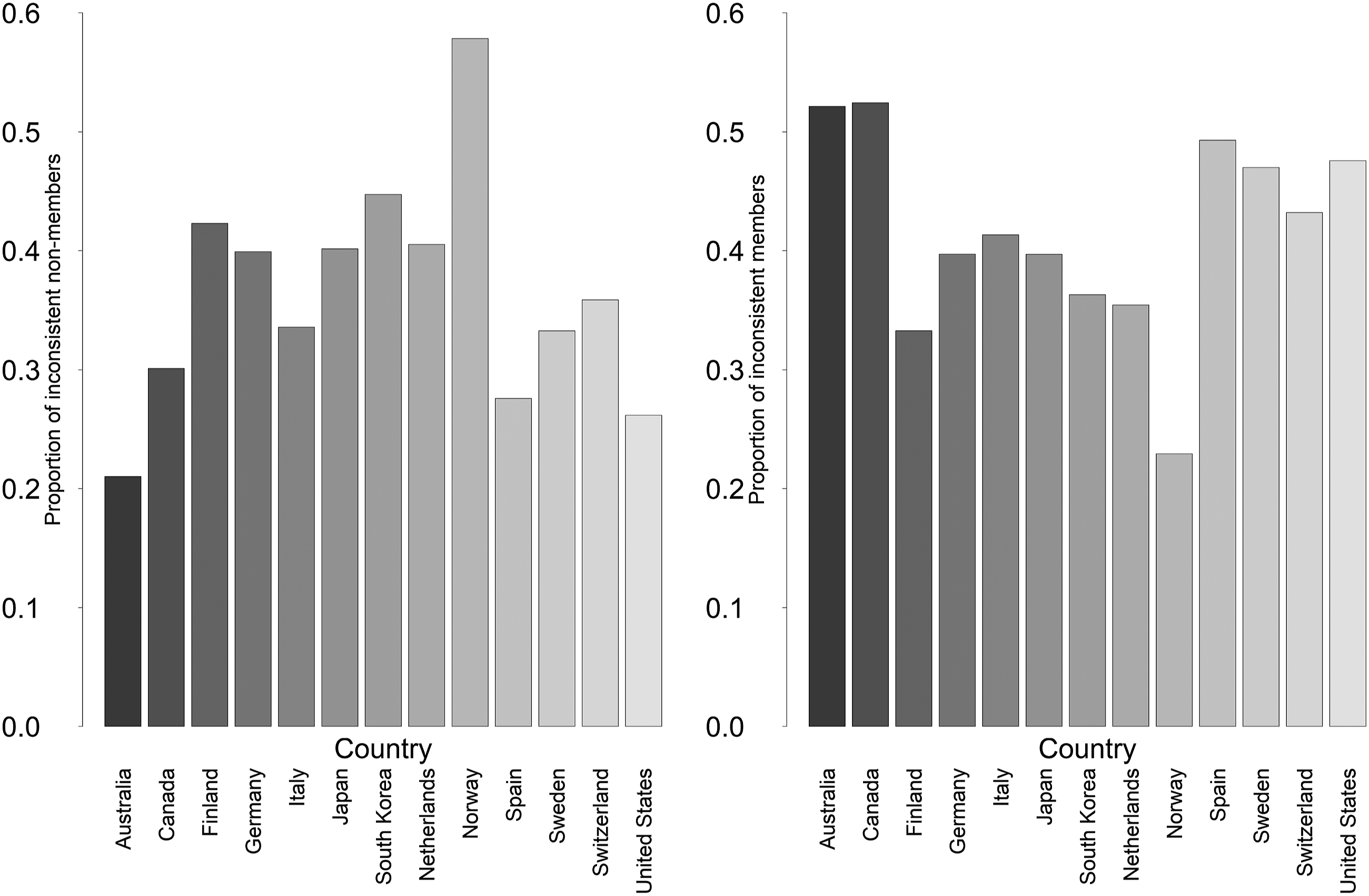
Without commenting on every percentage, the left-hand graph in Figure 1 shows that there is heterogeneity between countries in the proportion of inconsistent non-members and that two of them occupy extreme opposites: Norway exhibits the highest percentage of inconsistent non-members (58%), while Australia shows the lowest percentage (21%). Focusing on inconsistent members in the right-hand graph, Canada (52%) and Australia (52%) are associated with the highest proportion of union members not confident in unions, while Norway (23%) is the country affected the least by this type of inconsistency. In the models presented below, we explore the reasons behind the heterogeneity in terms of inconsistency existing between countries.
Explaining between-individual variation: Micro- and meso-level regression analyses
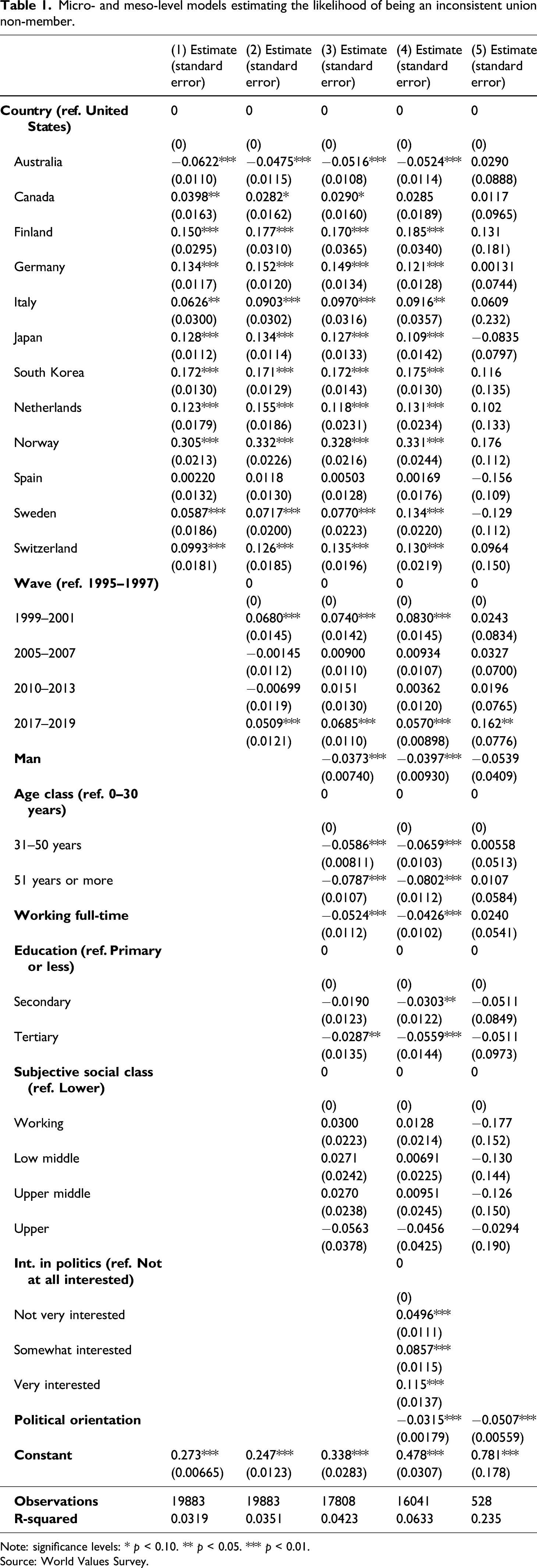
Micro- and meso-level models estimating the likelihood of being an inconsistent union non-member.
Note: significance levels: * p < 0.10. ** p < 0.05. *** p < 0.01.
Source: World Values Survey.
In the second model, a dummy variable for each wave is included to control for period effects. The second wave (1999–2001) shows the significantly highest peak (7% more than in 1995–1997) of non-member inconsistency. The estimates then become closer to 0 for the third and fourth wave before significantly increasing again in the last (2017–2019, 5% more than in 1995–1997). Hypothesis 6 is hence only partly confirmed since we do not observe a linear increase during more recent waves. The differences between countries change only slightly and, with the exception of Spain, remain significant. The absence of important variations in country estimates applies to all the models except the last one.
In the third model, we add five socio-demographic variables. Being a man (−4%), older (−8% for the oldest age class in comparison to the youngest), and working full-time (−5%) decrease the risk of being an inconsistent non-member, confirming hypothesis 1. The likelihood of showing inconsistent behaviour decreases with the level of education, becoming significantly lower for individuals with tertiary level (−3%) compared to those with primary level or less. Looking at the impact of subjective social class affiliation, those identifying with the lowest social stratum have the lowest likelihood of being inconsistent members (around 3% less than the working, low middle, and upper middle classes). The only social class showing an even lower likelihood of inconsistency (−6%) are upper class wage-earners, although the significance of the effect is slightly above the 10% threshold (p = 0.136). Therefore, in line with hypothesis 3a, a privileged objective or subjective social class situation decreases the likelihood of being an inconsistent non-member because these individuals are unlikely to experience strong membership barriers and are non-members by choice. At the other extreme, qualifying hypothesis 3b, those who subjectively belong to the bottom of the social hierarchy are also less likely to exhibit inconsistency, in this case because of objective barriers to joining coupled with a lower-than-average confidence in unions. This is probably the consequence of their self-awareness of being at the bottom of the social hierarchy and without the hope to climb higher, with or without union intervention.
The fourth model also includes the two political micro-level variables of our analyses. In line with hypothesis 2a, a right-wing political orientation (a 1-point shift to the right leads to a decrease of 3%) decreases the risk of inconsistency. A strong interest in politics (12% difference between the two extreme categories) increases the likelihood of inconsistency.
Finally, in the fifth model, we re-estimate the fourth model on individuals very interested in politics and having an extreme political orientation (either left-wing: score 1 or 2; or right-wing: score 9 or 10). All micro-level determinants except political orientation become insignificant. The same is true for the country dummies, with the estimates all becoming insignificant and closer to 0 or having an insignificant change of the sign of the estimate. Globally, these results confirm hypothesis 2b. Looking at wave dummies, we remark that, in comparison to the 1995–1997 period, the last wave signals an unexpected important increase in inconsistency (16%), leading to a partial confirmation of hypothesis 6.
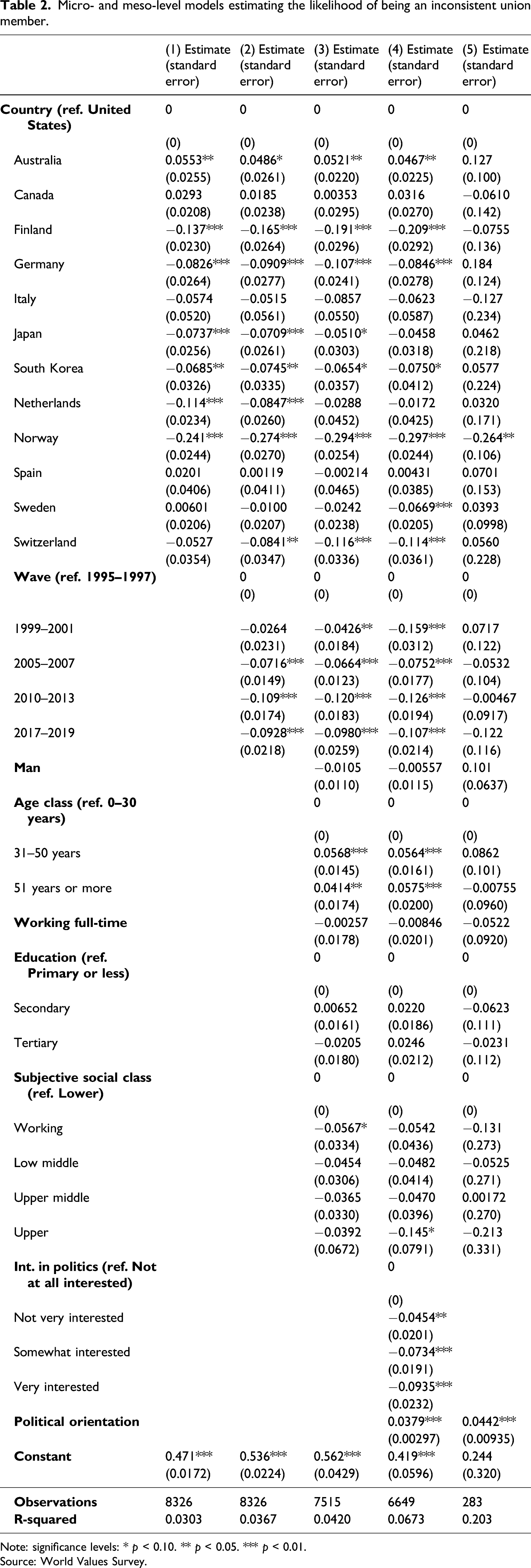
Micro- and meso-level models estimating the likelihood of being an inconsistent union member.
Note: significance levels: * p < 0.10. ** p < 0.05. *** p < 0.01.
Source: World Values Survey.
Including a set of wave dummies in the second model shows a clear and significant decrease in this type of inconsistency through time, with it reaching a bottom in 2010–2013 (11% lower than in 1995–1997) and showing a small increase of around 2% in 2017–2019. In line with hypothesis 6, since the obstacles against union membership have increased, the individuals that join unions tend to do so because they actually have a positive opinion of unions. Country differences remain stable both in terms of size and significance of the estimates, a pattern that we find in all models except the last.
In the third model, while gender and working status do not have a significant impact, it is during the middle of life (6% more in comparison to young individuals) that the likelihood of showing inconsistent membership status reaches its peak. Since we did not have any expectations regarding the impact of these variables on member inconsistency, the absence of strong empirical patterns does not come as a surprise. Contrary to hypotheses 3a and 3b, neither the level of education nor subjective social class affiliation shows consistent significant effects.
Adding the two political variables in the fourth model confirms hypothesis 2a: being interested in politics (9% difference between the two extreme categories) and having a left-wing political orientation (a 1-point shift to the left leads to a decrease of 4%) decrease the likelihood of inconsistency.
In the last model, we re-estimate the same effects for individuals being very interested in politics and having an extreme (left- or right-wing) political orientation. As for the other type of inconsistency, with the exception of political orientation, all micro-level determinants become insignificant. Most country estimates become closer to 0 and clearly insignificant. The only exception is Norway, still showing a strongly negative and significant difference with respect to the United States (−26%). Globally, these results confirm again hypothesis 2b. The outlying Norwegian case is examined in greater detail in the discussion section.
Explaining cross-country variation: Macro-level regression analyses
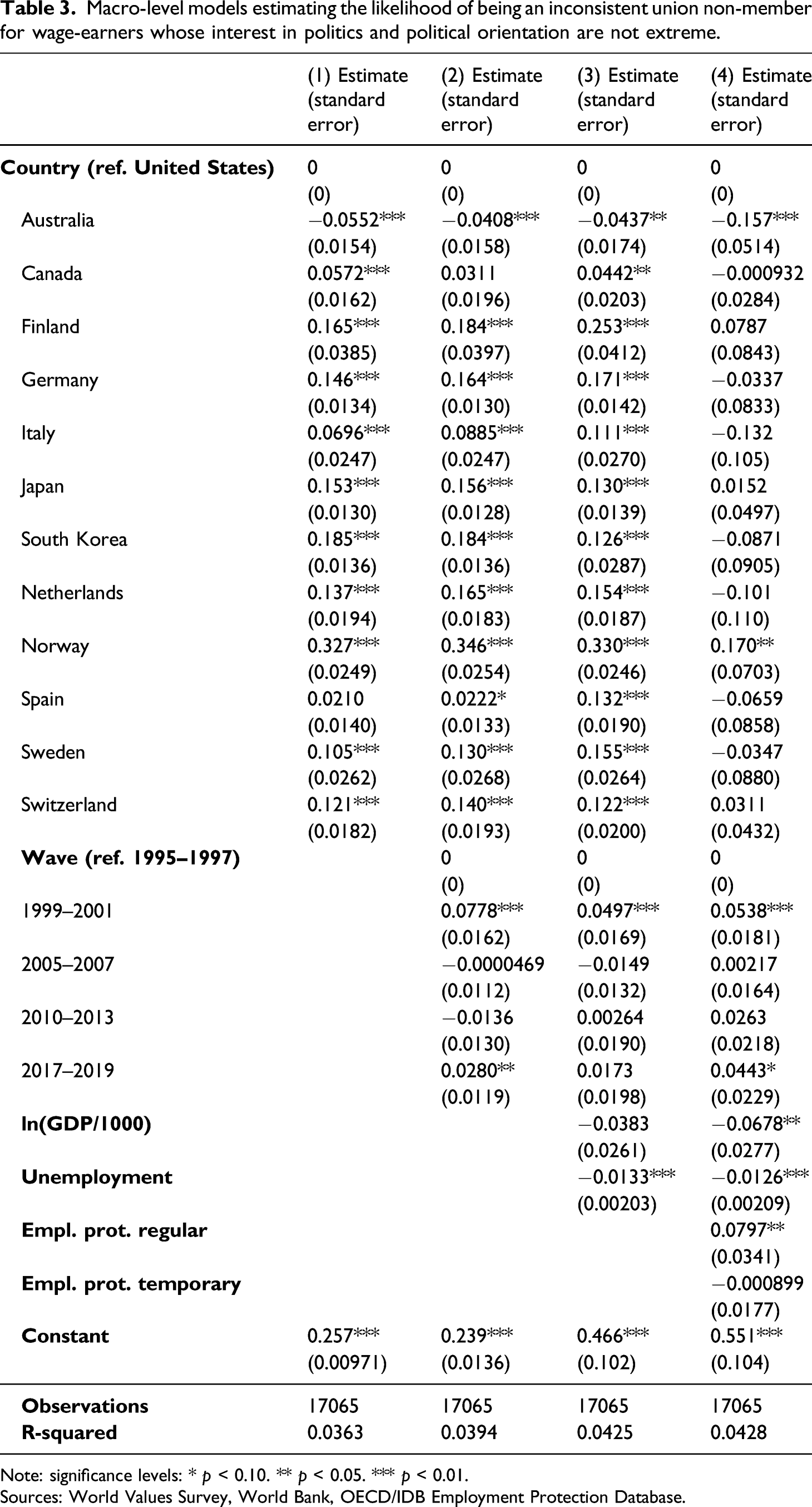
Macro-level models estimating the likelihood of being an inconsistent union non-member for wage-earners whose interest in politics and political orientation are not extreme.
Note: significance levels: * p < 0.10. ** p < 0.05. *** p < 0.01.
Sources: World Values Survey, World Bank, OECD/IDB Employment Protection Database.
Macro-level models estimating the likelihood of being an inconsistent union member for wage-earners whose interest in politics and political orientation are not extreme.
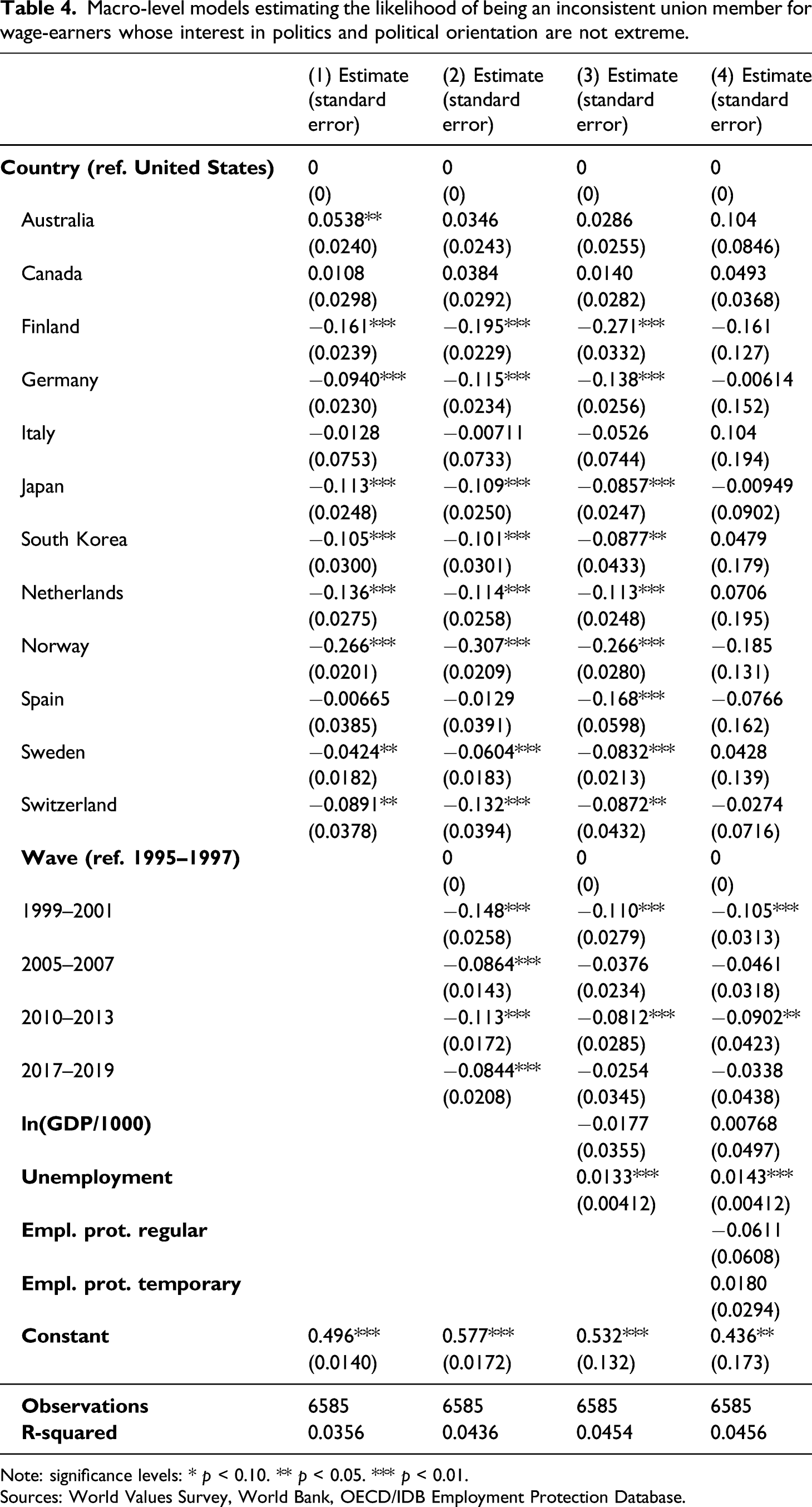
Note: significance levels: * p < 0.10. ** p < 0.05. *** p < 0.01.
Sources: World Values Survey, World Bank, OECD/IDB Employment Protection Database.
In the third model, we add two variables measuring macro-economic performance (the natural logarithm of GDP per capita and the unemployment level as a percentage of the total labour force). The two economic variables both have negative estimates, but only that related to unemployment is significant (−1.3%). Since we consider only working wage-earners, this means that a certain number of non-members attribute at least part of the unemployment they observe in the country to unions. This confirms hypothesis 4 and shows that unemployment matters more than GDP. Looking at country estimates, the one for Spain becomes clearly positive and significant, implying that this change in the estimate is related to the higher level of unemployment in Spain compared to other countries. For the remaining countries, we observe small increases and decreases in the estimates, which nevertheless still remain significant. Also, part of the positive effects in 1999–2001 and in 2017–2019 is explained by unemployment since the magnitude of both estimates decreases, with the second also becoming insignificant.
Finally, in the fourth model, we include the two employment protection indexes (one for regular and one for temporary workers) we described above. Only employment protection for regular workers has a significant and positive effect (8%), which is line with hypothesis 5. If we look at country estimates, almost all become insignificant. In other words, the differences between countries in terms of non-member inconsistency are to a large extent related to differentials in terms of employment protection for regular workers, which can be attributed to the effectiveness of the actions of unions and explain why non-members have confidence in unions or not. The only two exceptions (discussed in the next section) are Australia with a significantly negative estimate (−16%) and Norway with a significantly positive estimate (17%).
Table 4 provides models equivalent to those in Table 3 with member inconsistency as the dependent variable. The country differences visible in the first model are very similar to those described in Table 2. Including time dummies in the second model shows inconsistency reaching a bottom in 1999–2001 (−15% in comparison to 1995–1997), slightly increasing between 2005 and 2007 (−9%), and then fluctuating around similar levels in 2010–2013 (−11%) and 2017–2019 (−8%).
In the third model, both economic variables have a positive estimate, but only that associated with the level of unemployment is significant. It shows that a 1-point increase in the proportion of unemployed workers increases by 1.3% the likelihood of becoming an inconsistent union member. This is what we expect according to hypothesis 4.
The fourth and last model shows that the two indexes of employment protection for regular and temporary workers do not have a significant effect even though the one for regular workers has a negative estimate and the one for temporary workers a positive estimate. Hypothesis 5 is in this case not confirmed. However, the inclusion of these two indexes makes all country dummies become insignificant, implying that the differential in terms of employment protection between countries explains the variation in terms of member inconsistency.
Consistently inconsistent empirical patterns: Discussion
Despite the increasing importance of structural obstacles limiting the opportunities for wage-earners to become unionized, our results reveal that consistency and inconsistency between confidence in unions and union membership are first and foremost a matter of individual ideological inclination and interest in politics. For the small portion of wage-earners who have extreme or close-to-extreme ideological values (either toward the right or the left) and are highly interested in politics, unions are a very salient attitudinal object. Union saliency is so powerful for this group of wage-earners that no other individual characteristic moderates the attitude-behaviour relationship. They are a strongly consistent group of wage-earners for which individual evaluative dispositions toward unions are consistently transformed into an action, that is, belonging (or not) to unions, independently of the employment relations, labour market, and economic conditions they are exposed to. The only exception to this pattern is the strong increase in non-member inconsistency we observe between 2017 and 2019 especially among these individuals. While we expected a general increase in non-member inconsistency through time, we did not expect this period effect to be clearly more pronounced among individuals with extreme ideological stances and political interest. Since it is not clear why union membership constraints should be stronger specifically for these individuals, we suppose that the presence of strong constraints may itself generate extreme political attitudes. After their experience of actual constraints in joining a union, we can imagine that individuals with intermediate political attitudes may be led to embrace a more extreme ideological stance. This is more likely to happen in a context in which, as we argued, unions are increasingly active in the political sphere with explicit pro-labour claims. Nevertheless, this interpretation remains to some extent speculative and we leave it to future research to examine it empirically in more detail.
The group of wage-earners who have intermediate ideological values and who are not highly interested in politics exhibit a quite different pattern of results. These are wage-earners for whom unions are less salient and inconsistency between confidence toward unions and their membership status is therefore more likely to appear. Their attitude-behaviour consistency is shown to be malleable to individual and to contextual factors. Individual factors are relevant to explain the variation between individuals we observe in the dependent variable, while the differences between countries are mainly explained by contextual factors. Equivalently, this means that individual factors have similar effects across countries, while the baseline pool of inconsistent non-members and members in each country is essentially linked to country-level characteristics.
In this malleable group, most results are in line with our expectations. First, individuals with a vulnerable profile (women, young, working part-time) are the non-members most likely to trust unions and wish they could be members. Since their non-membership is mainly determined by obstacles that go beyond their will, the confidence they have in unions is consistent with the idea that it represents a “hope” that unions will act on their behalf by improving their working conditions. They represent an unmet demand for membership (Gomez et al., 2002). While gender and working status do not have any relevant effects on member inconsistency, middle-aged members have the highest risk of being inconsistent members. The unfulfilled eagerness of younger non-members to join unions thus contrasts with the disenchanted belonging of middle-aged and, to a lesser extent, older members.
Looking at the pattern by objective and subjective social class indicators for non-member inconsistency, interestingly, we observe that inconsistency becomes less likely at both extremes of the social ladder, but for different reasons. Since they are not exposed to major obstacles in joining unions, when highly educated individuals and/or individuals subjectively identifying with the upper class are not members, this happens because they are actually distrustful of unions. By contrast, individuals who feel that they belong to the lowest social stratum are likely to experience strong objective constraints in joining unions. Rather than hope in a future positive impact of unions, their subjective feeling of being a disadvantaged group is probably so engrained in them that the “hope” we described for vulnerable groups does not materialize, resulting in a lower-than-average confidence in unions that is probably in line with a generalized distrust toward institutions. In terms of member inconsistency, unexpectedly, individual and group socio-economic deprivation do not have a relevant impact on member consistency. The classical argument invoking the rise of class consciousness among disadvantaged workers after they have become unionized appears to be less relevant for lower social strata that nowadays are no longer linked together by homogeneous blue-collar interests.
As expected, a high level of interest in politics and a left-wing political orientation increase the likelihood of non-member inconsistency, while they have the opposite influence on member inconsistency. These effects can be linked to the stronger presence of unions in the political sphere. Left-wing non-members and members who are already well disposed toward union rhetoric become even more receptive to it if they are themselves involved in the public sphere.
Since these individual-level variables account mainly for the heterogeneity between individuals, the differences between countries can only be explained away through contextual variables. Malleable non-members become less confident in unions when they are fearful of the possible consequences of negative economic contextual conditions, hence becoming less likely to be inconsistent. The “hope” dimension we highlighted for vulnerable groups does not appear when economic hardship concerns the whole society, unions are not seen as being able to react to negative economic conditions or, especially when it comes to unemployment, are seen as being to some extent responsible for it. Negative economic circumstances also make members less confident and hence more likely to be inconsistent. By contrast, a high level of employment protection, especially for regular workers, increases confidence in unions and therefore inconsistency among non-members. Non-members reward with confidence unions that are active in advancing the protection of a large share of employees through political lobbying. This widespread perception of unions as effective actors in providing employment protection may also have the perverse effect of leading certain individuals to enjoy the achievements of unions as free-riders, having confidence in unions but not becoming members because they are aware that they can enjoy most advantages of union membership without joining. Members, on the other hand, become more consistent or mainly indifferent to unions’ efforts to protect a large array of employees. Members’ opinions are possibly more influenced by firm-specific actions affecting them more directly.
Needless to say, each country has a set of specific elements that contribute to explaining the level of (in)consistency we find. While explaining each country’s idiosyncrasies goes beyond the goal of this paper, the two extreme cases we identified, namely Norway and Australia, deserve more attention. Norway has the highest percentage of consistent members and inconsistent non-members. It is characterized by certain peculiarities within the Scandinavian cluster that explain the inconsistency we found. The Norwegian labour movement has a strong left-wing orientation, strong class consciousness, and has never faced strong opposition from employers, even in comparison to other Scandinavian countries (Sass, 2014). Moreover, where unions are organized also at the firm level, employees can nowadays benefit from wage gains even 50% higher than colleagues in firms where unions are not present or less organized (Nergaard and Stokke, 2007). In addition, the inconsistency of non-members can be also traced back to the structural changes in the Norwegian labour market together with the absence of union administration of unemployment insurance funds, a peculiarity of the Ghent system (Nergaard and Stokke, 2007). Indeed, non-members are especially present among the growing number of small firms and new workplaces where unions do not have a well-established shop floor representation. Moreover, union recruiting is made difficult by the growing number of precarious workers who do not go to union offices to access unemployment insurance funds. Hence, a strong socially recognized and institutionalized role of unions clashes with increasing difficulties for some wage-earners who wish to join but cannot due to structural barriers.
Australia, meanwhile, shows the highest proportion of non-confident members and the lowest percentage of confident non-members. Some employment relations legacies and recent changes help to explain the Australian peculiarity. Australian employment relations have been characterized for many years by a central role of the state through a compulsory conciliation and arbitration system (Cooper and Ellem, 2011). Moreover, closed-shop clauses, in many cases enforced by the arbitration system, overinflated union density (Cooper and Ellem, 2011). More recently, trade unions experienced a strong decrease in their power. Fiercer employer opposition, bargaining defeats in key sectors such as mining, and dramatic changes to the legal structure of Australian employment relations in 1996 and 2005 substantially limited union organizing and bargaining power, making union collective agreements one of many possible “workplace agreements”, including individual agreements (Stewart et al., 2014). The historical legacy of unions as being imposed and distant institutions, together with their recent clear limits in advancing employment conditions, may explain much of non-members’ and members’ distrust.
Moody members versus hopeful outsiders? Conclusions
Our findings confirm that unions’ institutional relevance cannot be evaluated through union density alone (Sullivan, 2010). Attitudes toward unions can act as a complement to union membership. However, it is only by focusing on the relationship between membership status and attitudes toward unions that we can unveil how the interplay between structural and individual forces produces inconsistency among non-members and members. Our results have implications for union strategies, especially those targeted toward internal (among members) organizing and external (among non-members) recruiting.
Union organizational power depends heavily on internal members’ active support and participation. Our results highlight that unions can still count on a small group of strongly consistent members. The larger group of malleable members easily lose confidence in unions during midlife and when facing negative economic conditions. It seems that they take some rights for granted and no longer see unions’ contribution but are ready to point the finger at unions in a moment of lower national economic performance. They represent a set of members that demand from union executives a large investment of resources to counterweight their internal disengagement and criticism.
Union power can be also increased through external strategies directed at recruiting and organizing non-members. Unions’ efforts in enlarging their membership could find more fertile ground among malleable non-members when contextual economic conditions are positive, and especially when institutional labour protection is higher. However, reaching confident non-members, especially those working under precarious employment conditions, requires significant resources and has non-guaranteed outcomes since the recent transformations in the labour market (decrease in manufacturing and public sector jobs and increased international competition) may substantially reduce the return on union efforts in terms of new member recruitment.
Unions have historically gained political leverage through direct or indirect lobbying in the political arena, especially on governments, to improve labour rights through legislative measures. Unions pushed for the introduction of measures to de-commodify labour and to protect it from possible economic shocks for a large number of employees (members and non-members alike). However, the focus on workplace organization and involvement in the political sphere are two strategies that may be at odds with each other because the shrinking resources available force union leaders to make choices in the variety and number of initiatives they can take, but also because the reactions of non-members and members are neither homogeneous nor easy to predict. Unions may reach out to unrepresented confident outsiders using the resources given by paying members only when the paying members consent or when union leaders persuade them to do so. Likewise, political efforts may produce positive results especially when unions can make sure that members understand the goals of such efforts and thus prevent unforeseen backfire effects from members on confident non-members.
Future research can provide more fine-grained insights that overcome some of the data-related limitations of our paper. First, the individual variables we employed do not provide consistent measures of individual job-related characteristics (e.g. sector, task, firm size, and type of contract). Second, the role of group-level variables could be assessed more extensively. On the one hand, additional variables could be considered. For example, information on the attitudes toward unions in the respondent’s kinship and workplace network could provide important insights to test the impact of subjective and group norms. On the other hand, future waves of the WVS should make it possible to repeat our analyses on a larger set of countries. An expanded pool of country cases would be more likely to meet the minimal theoretical and empirical requirements of a multilevel framework. Multilevel modelling would make it possible to explicitly take into account the heterogeneous effects of contextual variables within single countries and to link them to different characteristics of industrial relations systems. Third, individual-level longitudinal surveys can better assess the dynamic relationship between attitudes toward unions and union membership, giving higher leverage to tease out causality and to explore how effects vary dynamically. Such data are, to our knowledge, not yet available.
On a more substantive level, it would be interesting to explore other types of inconsistencies between the confidence of non-members in unions and more demanding types of union support, such as the participation in union labour justice campaigns and rallies. This might reveal that unions have a mobilization potential that goes well beyond their members. Studying the factors that underpin this potential would allow unions to effectively deploy societal mobilization strategies that can circumvent several institutional constraints on membership.
Supplemental Material
sj-pdf-1-ejd-10.1177_09596801211056836 – Supplemental Material for Rationalizing the irrational: Making sense of (in)consistency among union members and non-members
Supplemental Material, sj-pdf-1-ejd-10.1177_09596801211056836 for Rationalizing the irrational: Making sense of (in)consistency among union members and non-members by Sinisa Hadziabdic and Lorenzo Frangi in European Journal of Industrial Relations
Footnotes
Acknowledgements
Both authors contributed equally to the paper. We thank the editor Prof. Guglielmo Meardi and two anonymous reviewers for their helpful comments and suggestions.
Declaration of conflicting interests
The author(s) declared no potential conflicts of interest with respect to the research, authorship, and/or publication of this article.
Funding
The author(s) received no financial support for the research, authorship, and/or publication of this article.

Supplementary material
Supplementary Material for this article is available online.
Notes
Author biographies
References
Supplementary Material
Please find the following supplemental material available below.
For Open Access articles published under a Creative Commons License, all supplemental material carries the same license as the article it is associated with.
For non-Open Access articles published, all supplemental material carries a non-exclusive license, and permission requests for re-use of supplemental material or any part of supplemental material shall be sent directly to the copyright owner as specified in the copyright notice associated with the article.
